







Abstract
“Forensic Architecture” describes both the research agency, founded in 2011, as well as its investigative method and aesthetic practice. As an emerging discipline, forensic architecture exploits the relation between space, material, and memory. My aim in this article is to consider how the agency’s “memory objects”—aestheticized virtual renderings of their investigations—operate as testimonial objects, evidentiary archives, and simulated sites of conscience. I attend to one “memory object” in particular, a film titled “Drone Strike Investigation Case no. 2: Mir Ali, North Waziristan, 4 October 2010; The Architecture of Memory,” an investigation which the U.N. Special Rapporteur on Counter Terrorism and Human Rights commissioned Forensic Architecture to undertake. This article suggests that this virtual “memory object” troubles the status of both the human witness and the physical landscape to which it refers.
In 2010, a woman was eating dinner with her 2-year-old son in Mir Ali, a village in North Waziristan, Pakistan, when she heard a loud explosion close by. Her home shook; sand poured down from the ceiling; all she could see was smoke. Only later would she learn that several missiles had hit her property, that the five men who had been eating in the courtyard had been killed, that two of them had been identified as suspected terrorists by anonymous authorities. Before the strike, her son’s toys had been scattered about the open air space—bright, rainbow-colored Legos and a toddler’s walking chair. The toys, she says, should have alerted the drone operator to the fact that a small child lived in the compound.
The woman recalls these details years later, staring at a computer screen in Düsseldorf. She is seated between a lawyer from the European Center for Constitutional and Human Rights (ECCHR) and a “Model Maker” from Forensic Architecture, a London research agency. Their encounter is filmed from behind; only the back of the woman’s head, covered in a black headscarf, is visible. For the purposes of the investigation, she has chosen to remain anonymous. In the resulting film, she is labeled “Witness” (Figure 1).
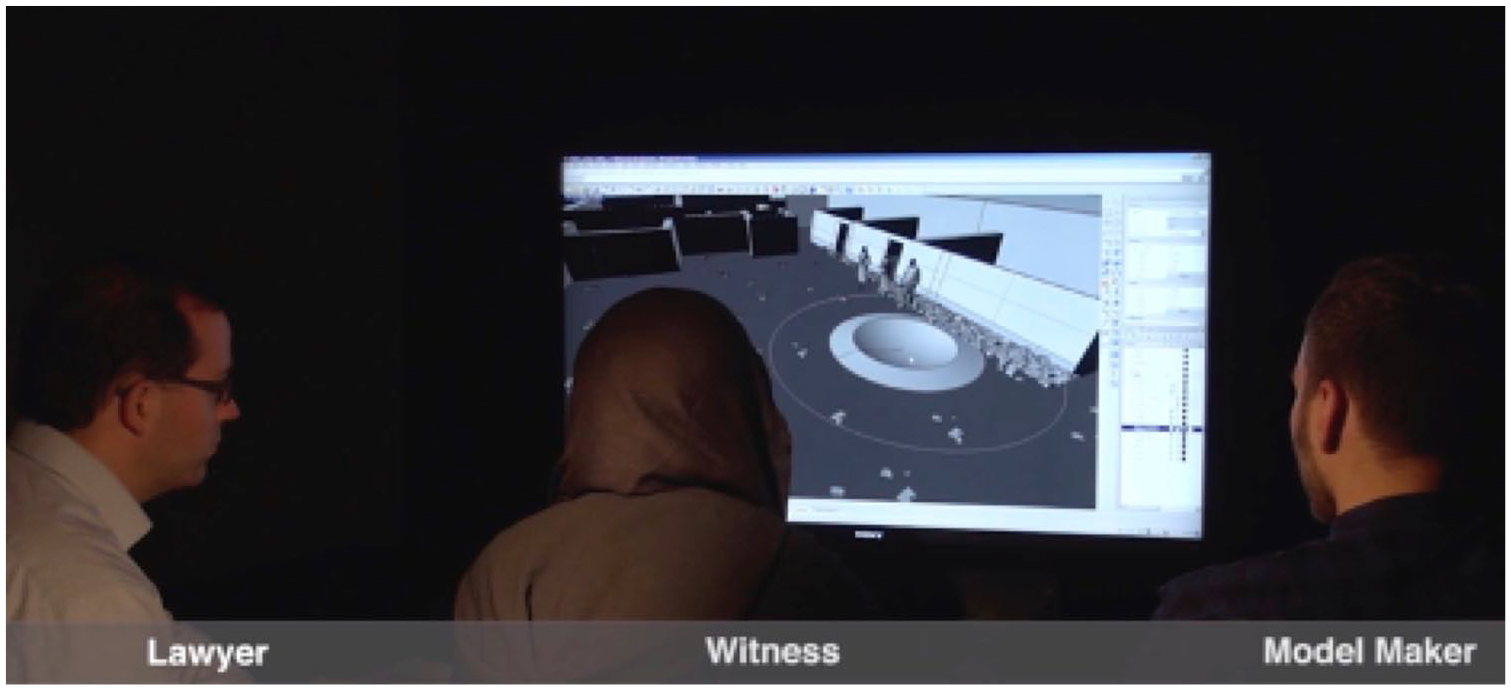
Still From “Drone Strike Investigation Case No. 2”.
The film depicts the following scene: The Witness walks the Lawyer and the Model Maker through her home’s virtual halls, telling them where its doors, windows, and walls were located. As she speaks, she recalls the locations of her belongings, and the investigators add new details to their computer model—a ceiling fan, a mattress, a rug. The Model Maker periodically shifts their collective position within the virtual environment to jog the Witness’s memory.
“Can I see it from above?” she asks.
The Model Maker uses his mouse to tilt the perspective so the Witness may see a bird’s-eye view of his rendering of her former home. Then, the Lawyer asks her a question: “Does this visualization help to remember what happened two and [a] half years ago?”
“It helps me a lot,” the witness responds. “Without the plan I could not have remembered it like that.” (Forensic Architecture, 2014)
The Lawyer, the Witness, and the Model Maker are involved in a project of cocreation, a collective memory practice. The virtual model of the North Waziristan house is both “a product of memory” and its stimulant (Weizman, 2017, p. 86). As they collaborate upon the detailed reconstruction of the Witness’s home, they engage in and produce a discourse on memory. They are consumed by their shared project of reconstructing a site of conscience, a site laden with con-scienta, “knowing-with,” as Lisa Guenther puts it (Guenther, 2020). The Witness possesses the shared knowledge of the strike, of the world it obliterated and the landscape it destroyed. The Lawyer and Model Maker must “know-with” the Witness to translate her memories onto the screen. As Eyal Weizman, founder of the Forensic Architecture agency, writes in his description of the curious encounter that results, “here, architecture and memory got entangled in a way that cannot be easily divided into subject and object, testimony and evidence, matter and memory”(Weizman, 2017, p. 47). The Witness is also entangled: Once she has provided her testimony, her physical presence is no longer required for its circulation, but her words and image are subsumed, transformed, and produced. The film, not the virtual model, is the final product: It will travel under the title, “Drone Strike Investigation Case no. 2: Mir Ali, North Waziristan, 4 October 2010; The Architecture of Memory.” Commissioned by the U.N. Special Rapporteur on Counter Terrorism and Human Rights, the investigation will eventually be presented to the U.N. General Assembly. It is published online in April 2014, posted to the website of Forensic Architecture and to an external site, wherethedronesstrike.com. Later, it will appear in art exhibitions and media articles about Forensic Architecture’s work.
“Forensic Architecture” describes both the research agency, founded in 2011, as well as its investigative method and aesthetic practice. As an emerging discipline, forensic architecture exploits the relation between space, material, and memory. For Weizman, its methodology emulates the ancient Roman practice of prosopopoeia, “the attribution of a voice to inanimate things,” first presented by Quintilian in his Institutio Oratoria around 95 c.e (Weizman, 2017, p. 65, See also Benne, 2016). “Despite its origins in the imperial context of Rome, we found in forensic a productive category that helped us define our practice as a mode of public address and a means of articulating political claims using evidence grounded in the built world—which is most of the world, by now,” Weizman (2017, p. 65) writes. Accordingly, the models that his research agency produces claim to give voice to inanimate objects—forests, craters, and fields—“by converting them into data or images and placing them within a narrative,” turning them into objects and actors that can speak in the forum, and which can be “referred to as if they were human subjects”(Weizman, 2017, p. 67). The agency’s investigations are usually either self-initiated or commissioned by a law office, nongovernmental organization (NGO), journalistic outlet, or international body. The resulting models have been submitted as part of ongoing legal procedures, artistic exhibitions, and citizens’ tribunals. As of this writing, the agency has published 69 investigations and 69 accompanying aesthetic objects, each of which makes a specific claim upon the publics to whom it is addressed.
I first encountered “Drone Strike Investigation Case no. 2” in 2016, while studying with Weizman and his colleagues at the Center for Research Architecture at Goldsmiths, University of London. The film was played for the current affiliates of the center—students, researchers, and faculty—as part of an introduction to its work. Weizman claims that the film’s “entanglement” of matter and memory, its ability to capture the witness in the act of recollection, led to “the genesis of a new element of FA’s practice, a new mode of witness interviewing, that we call ‘situated testimony’” (Forensic Architecture, 2014). The technique would go on to inform many of the agency’s future investigations.
“Situated testimony” is a term borrowed from documentary filmmaking. It describes the process whereby filmmakers return their subjects to the scene of a trauma or crime and film them as they respond to questions and explore the ruined space. The idea is that situated testimony—by producing a physical record of testimony in the form of a film reel or data file—can “realize its materiality,” as the filmmaker Janet Walker puts it. Situated testimony, she suggests, is a form of testimony with its own geography, “a distinctive testimonial paradigm,” “a kind of post-traumatic reassertion of physical belonging and right of return” (Walker, 2010, p. 86). As a documentary practice, it requires corporeality—a physical return, an embodied materiality.
There could be no return for the witness in “Drone Strike Investigation no. 2.” Satellite imagery of her former home—now indelibly marked as a gravesite—suggests that it has fallen into disrepair since the drone strike. Instead of testifying in situ, at the site of memory itself, the Witness’s testimony is subsumed into a media artifact that Weizman (2017, p. 92) calls a “memory object,” a virtual artifact that, according to one description of Forensic Architecture’s models, is “not quite evidence, nor simply testimony, rather they bring together these distinct functions” (Institute of Contemporary Arts, 2018). The political theorist Michal Givoni might, somewhat more accurately, call the film a “posthuman assemblag[e] of witnessing,” a kind of testimony that is neither human nor machinic, but a combination of the two. The witness’s words are generated, conveyed, and preserved via computer script. Givoni argues that these assemblages “erode” the status of human witnesses by diminishing the capacity of their words to make claims of their own, separate from the screen (Givoni, 2016, p. 213). The “memory object” preserves spatial knowledge, yet does so at the cost of embodied, affective, testimonial knowledge.
It is difficult to watch “Drone Strike Investigation Case no. 2” and not worry that the erosion Givoni identifies is already well underway. The film is at once a site of conscience, a site of knowing-with, and an evidentiary archive, an artifact of a ruined past. It is difficult to say what, if anything, came of its presentation to the U.N. General Assembly, if the representatives with their gavels understood what they were seeing. Since its publication, the film has continued to circulate online and in person—the film has been shown in eight artistic exhibitions to date. Every time it is viewed, the witness’s voice plays, but it is the film itself—the assemblage of human and machine—that speaks. An artifact that was meant to preserve the status of the human witness, to rescue shreds of evidence from the cloud of memory, thus accelerates the silencing of the witness and the diminishment of the site of which she speaks.
Six years after publication, the film has far outlived its legal usefulness, its probative value. When this occurs, when evidence expends its usefulness as proof, as Katherine Biber writes, it becomes something else, an “excess that survives” (Biber, 2019, p. 167). “Used” evidence can be put on display in a museum, stored away in an archive, or photographed and destroyed. “This is the stuff that floats in law’s wake, that may be picked up and salvaged, or left to oblivion,” Biber explains (Biber, 2019, p. 195). The Waziristan model, then, is a kind of legal flotsam, a virtual site of conscience that aimed to honor, imitate, and preserve its physical referent. The film’s protagonists form a curious assemblage: Lawyer-Witness-Model-Maker-Camera-Screen. They will continue circulating in this amalgamated form as long as the film’s virtual infrastructure is maintained, as long as the links remain unbroken. Already, it seems unclear how long this will be: The investigation home page invites visitors to “visit external site,” a page where the project once lived. To click on this link is to receive an error message: “502 Bad Gateway.” Wherethedronesstrike.com no longer exists.
Footnotes
Declaration of Conflicting Interests
The author(s) declared no potential conflicts of interest with respect to the research, authorship, and/or publication of this article.
Funding
The author(s) received no financial support for the research, authorship, and/or publication of this article.
