







Abstract
This essay examines the relationship between the processes of urban change and the politically and commercially constructed nature of Buddhism since 1978 in Shanghai. After examining data from 120 temples together with ethnographic research in two downtown temples, the author finds two key changes in urban Buddhism: First, political constructions cause an increasing divide between the city center and suburban areas in the religious spaces of Buddhism. The mainstreaming of Buddhism in the downtown areas has emerged with the new trend of economic and cultural gentrification that has generated different physical and social neighborhoods. Second, not confined to being iconized as tourist sites, Buddhist temples led by powerful abbots are engaged in “niche-switching” between attracting commuters and visitors and attending to temple-based devotees. With new spatial strategies, such as the development of cultural philanthropy and interprovincial pilgrimages, temple-based clergy have to negotiate their social positions in the commercial zones. The results indicate how the neighborhood has become less important once temples extend their members’ nongeographic ties.
Drawing on research data from government resettlement statistics, long-term observation, and surveys, this essay seeks to illustrate the process of revival in the Mahayana Buddhist communities in a post-Mao era under the state-planned acceleration of urban gentrification in contemporary Shanghai. I will use both Jing’an Temple and Jade Buddha Chan Temple as examples how niche theory and “niche-switching” help us understand the impact of gentrification on Buddhist temples. The study is based on an analysis of the complex and rapid changes in urban space in the last few decades.
Shanghai Buddhism has played a leading role in Chinese Buddhism since the beginning of modern China. With the accumulation of economic capital and the formation of an international port in Shanghai, many scholars documented critical developments in Buddhism since the 19th Century in the city. The critical reforms led by Taixue and the establishment of urban lay Buddhist groups set the unique foundation for the development of Han Buddhism in China in the 20th Century. The post-Mao governments have permitted freedom of religious belief and practice, which is subject to legal and regulatory restrictions. In 1982, religious toleration was formally restored. 1 In this political opportunity of religious revival, the historic religious sites, with significant forms of cultural capital, formed the center of this rehabilitation of Buddhism from the beginning. I have called this phenomenon the mainstreaming of Buddhism in the downtown areas and the separation of Buddhism from popular religions in the overall urban area (Huang, 2019a).
Since the revival after the Culture Revolution, the most pressing issues in the last 40 years center around the rehabilitation of the Buddhist tradition. Many major efforts have focused on restarting material construction, such as temple building, the training of clergies, and the establishment of a Buddhist academy. Ji’s study has pointed out a pattern of establishing a Buddhist temple economy, as seen in selling temple entry tickets, since the 1980s (Ji, 2014). As for the urban temples under accelerated gentrification, the new economics of the monasteries and the issues of monastic leadership on the organizational, district, and city levels have assumed vital importance.
Similar but different from the Daoist temples in the city, the “temple-centric” revival of Buddhism has served as a key element in Buddhist expansion in urban Shanghai. Daoist temples have not found the niches to stake their claim in downtown areas, except the Temple of City God. In Goossaert and Fang’s study of Daoist temples in Beijing, they find two factors tending to favor the activity of temples in large contemporary cities. The first is the expansion of the cities, whose suburbs continually absorb villages along with their temples. And, second, they discovered that there is a political shift, which tends to favor “Chinese” religions (Buddhism and Daoism) as opposed to the various forms of Christianity in the framework of the integration of a religious component into Chinese nationalism. In this development, the separation between city and country is one of the most significant results of Chinese modernity (Goossaert & Fang, 2009).
This article will be organized in the following order. A literature review on gentrification and niche theories will be followed by an examination of the relationship between the state-sponsored religious revival and the spatial changes of gentrification, especially by the massive out-migration of residents due to the conversion of residential homes into commercial spaces. I will then look at the differentiation of temple services as they are extended beyond members’ geographic ties. Finally, I will examine the changing relationship between religious practice and urban space. I argue that temple-based clergy develops new spatial strategies while devotees engage in various forms of religious commuting due to the changing forms of loyalty.
Gentrification and the Cultural Landscape
Shanghai’s district regenerations have distinct elements. First, by the end of the 1970s, nearly all land was owned by collectives or by the state. Private property rights nearly disappeared and land transactions were banned. 2 The state controls and fuels the process of district regeneration directly. Second, there is very little voice or social movement for antigentrification efforts within the urban political sphere. The individual or isolated antigentrification voices will quickly be overrun or repressed. Such resistance is difficult to form and maintain due to strong state control. Third, in recent urban planning for area regeneration, governors have recognized the recreational or diverse lifestyle attractions of cultural religious sites.
Both Ren and He’s works clearly point out the role of the local state in the process of gentrification in the framework of political-economic factors. In Ren’s research, demolishing older neighborhoods has become a major strategy used by city governments in China to stimulate the urban economy in the market reform era (1978 to the present day), especially since 1990, and Shanghai has been the leading example for the rest of the country in promoting urban growth through redevelopment (Ren, 2014). In He’s (2007) study of state-led gentrification in China, she observed the waves of gentrification in the urban areas, which correspond to the changing politico-economic rules and shifting financing strategies of urban redevelopment. With strong state interventions, demolishing older neighborhoods to lease the lands had become a critical source of revenue for the urban local state (He, 2007; Ren, 2014).
My account of the transformation of Jing’an District shows that residential areas are not the only ones to be redeveloped, as commercial areas are also included. Jing’an District was once considered as a commercially developed area in Shanghai; however, the push of economic redevelopment has driven further change in such districts. Both case studies of Jing’an District and Putuo District demonstrate that commercial initiatives are single-handedly driven by the district governments. In the last two decades, there has been an increased blending of commercial and residential spaces in both districts.
Most studies on gentrification focus on the economic impacts of this process; however, the turn to explore the role of culture in the production of cities became visible in the 1990s. As Mitchell (1993) wrote, “Treating culture as an explanatory variable in the production of landscapes can sometimes downplay the ways in which culture is deliberately produced by economic interests to increase the circulation of capital.” Recognition of the importance of the cultural factor appears in the work by Lees (1994), Mitchell (1999), and Hackworth and Rekers (2005). An earlier study I participated in also sought to fill this gap and recognize how culture is a meaningful and powerful—rather than a structurally residual—factor in the production of urban spaces (Cimino et al., 2013).
Typically, gentrification is understood as the process of new, higher class residents replacing deprived ones. A different type of gentrification is based on political leaders, urban planners, and developers regenerating a neighborhood for the purpose of increasing economic activity. In Hackworth and Rekers’ (2005) study in Toronto neighborhoods, they argued that the identity of an ethnic enclave had served a new function as a marketable branding mechanism producing nearby residential gentrification. Their work demonstrated the influence of ethnic packaging in the process of neighborhood gentrification.
Tokke’s (2013) study shows how “Tourist gentrification and redevelopment” in New York’s Time Square replaced neighborhood residents with visitors staying in hotels, eating in its restaurants, and shopping. Similarly, as I have observed in my study, 70% of Jing’an District’s land was rezoned for commercial use and many of the residents were relocated out of the city center. The real estate values have increased, with Jing’an District having a 5-star international luxury hotel already in 1988. After the turn of the century, the Jing’an District continues to have the most expensive real estate and shopping malls in the downtown area. High-end consumption in Jing’an District is comprised of shopping and entertaining in clustered luxury malls.
Based on the local government’s planning, the Jing’an District can be defined as a case study of effective neighborhood renewal, and this is due to more than its consumer activity and increase in real estate values. Its exclusive history and cultural heritage are the central factors in rebuilding this neighborhood. The unique heritage of material culture includes architectures, religious landmarks, and theaters. Social capital or neighborliness, influenced by living religions, are not included in the measurements of such success—until a neighborhood disaster strikes. In a previous study, I showed how Jing’an Temple ministered to more than 200 family members of fire victims, who were invited to participate in a public ceremony to mark the event. The first-ever public commemorative rituals after a neighborhood tragedy not only provided religious service for the victims’ families but also a social space where city residents could mourn collectively (Huang, 2019b).
Jade Buddha Chan Temple, unlike Jing’an Temple, is also a historic site appealing to out-of-town visitors, and has transitioned into one of the most popular sites for international tourists in the city. Between 2016 and 2018, when I visited the Jade Buddha Temple in Putuo District, its immediate neighborhood was in the process of relocation. The northern and eastern areas of the neighborhood were already gentrified, having turned into a dense residential community and commercial area.
Cimino (2012) points out how the process of neighborhood population change “can activate communities of faith even as their neighborhood functions are drastically changed.” He identified three different types of congregations: lifestyle enclaves, neighborhood social-center congregations, and ethnic and religious enclaves in his study of the changing Williamsburg-Greenpoint, Brooklyn sections of New York City. To engage with young newcomers, known as the “hipster” population, for example, the congregations in the area creatively adapted their ministries through the efforts of pastors, denominations, and religious entrepreneurs, resulting in multiple new niches. Cimino’s study introduced the new concept of “niche-switching.” In a study of over 30 congregations, Cimino found that different niches can exist within a single neighborhood and that the same environment can encourage “niche-switching” by congregations on a fairly regular basis. One example of this was how a pastor pointed out how older members of his congregation were connected to a “spirituality of place,” whereas newcomers were more into a “spirituality of practice,” not so much connected to historic buildings. Congregations were encouraged to alter their teachings to cater to different lifestyles and sites of worship were relocated (in some cases meeting in bars) to attract neighborhood newcomers. Rather than the neighborhood serving as a religious marketplace, in Cimino’s study, “gentrification and the network ties its new residents carry tend to fragment and even override neighborhood relations” (Cimino, 2012, p. 77). Congregations then fill niches and adapt to their environment to meet the needs of these different groups.
In the following section, I will use both Jing’an Temple and Jade Buddha Chan Temple as examples of how the niche theory and “niche-switching” help us understand the impact of gentrification on Buddhist temples. Furthermore, I will account for how the Buddhist temples gradually play the role of key actors in the process of state-driven neighborhood renewal.
A “Temple-Centric” Revival and the Reconfiguration of Spiritual Space
Because of the political opportunities of location-specific revival, we can clearly identify a phenomenon of “temple-centric” revival in Buddhism. Another consequence of these policies relating to categories of religion is that they affect the separation of Buddhism from popular religions in the urban area. The revival is, first, based on the policy of the legitimacy of five state-approved categories of religion at original sites rather than the realistic viewpoints of the religious practitioners themselves. Second, with this political opportunity, earlier Buddhist leaders, such as Yuanyin, Zhenchan, Mingyang, and lay leaders, had taken this initiative to recover and secure the sites for Buddhist development.
In my research, I found two significant trends in the downtown temples. First, there was the mainstreaming of Buddhism in the city center in the revitalized religious and educational spaces in Buddhist temples that came with new political opportunities. Second, there was an increase of the temples’ agency in fashioning a new relationship between religious clergy and lay practitioners, which was created and shaped by economic opportunities as a bottom-up method of generating Buddhist growth (Huang, 2019a).
The Mainstreaming of Buddhism in the City Center
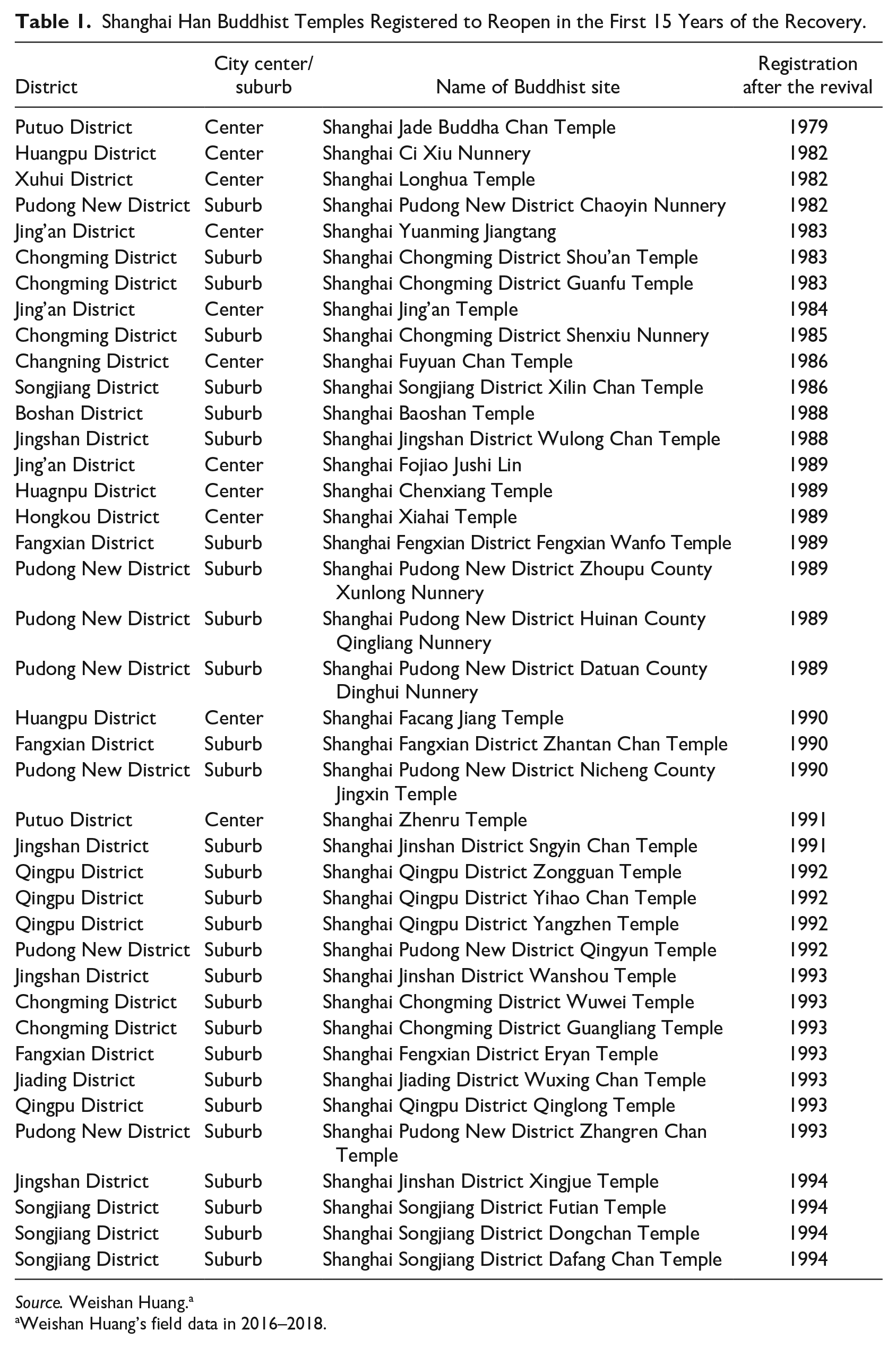
Since the beginning of the revival, institutionalized Han Buddhism, together with Daoism (Goossaert & Fang, 2009), was given relatively privileged roles in preserving and transmitting “Chinese culture” to the current generation by the Chinese government. Based on the data I collected up to 2018, there are 122 Han Buddhist temples in Shanghai but only 31 Daoist temples. My study showed that the leadership within institutionalized Han Buddhism has yielded more significant results in terms of temple claiming and renovation. However, location in downtown areas is also an initial factor in the development of the temple economy. Before 2000, as the following table shows, there were 49 sites that had been recovered (Table 1). Among them, 13 were in the city center (downtown). Below are the temples registered to reopen before the turn of the century.
Shanghai Han Buddhist Temples Registered to Reopen in the First 15 Years of the Recovery.
Source. Weishan Huang.a
Weishan Huang’s field data in 2016–2018.
In the first 15 years of the Buddhist revival, the existing 13 downtown temples were reopened. Twelve of them reopened within the first 10 years. Most initiatives were government-led, as five temples were recognized as National Key Han Buddhist Temples. The only exception was Taiping Baoen Temple, which reopened in 2008 and was a subdivision of Jing’an Temple. The temples located in the city center and downtown areas were registered with temple names. The rest of the Buddhist sites, in the suburbs, were officially registered with district names, which shows the influence of district governments and local Buddhist associations. Another spatial indication is the greater divide between the city center and suburban areas from the perspective of the political-economic administration.
The Jade Buddha Chan Temple was the first temple reopened in Shanghai after the return of its leader Zhenchan. In 1981, the Jade Buddha Chan Temple was not only recovered as a worship site, but also as the educational site known as the Shanghai Buddhist Academy (SBA). The first generation of Shanghai Buddhist Academy graduates has occupied leading positions in over 74 temples in Shanghai since the early 2000s. The leadership of those temples is now set for the next 20 years or longer. The appointed first-generation abbots and abbesses in downtown Shanghai once studied at the modern Buddhist Academy within a traditional master-disciple relationship under such leaders as Yuanyin, Mingyan, and Zhenchan. Some disciples were trained at another important school, Lingyan Mountain Buddhist Academy, while most of the Shanghai Buddhist leaders were trained at SBA. Once these elite SBA graduates were appointed as abbots or abbesses, they were given secure sites and definite territories for the development of Buddhist institutes. In the beginning of the temple recovery process, each leader was given a certain amount of seed money to maintain or refurbish the sites. After 40 years, it is evident that downtown temples are more resourceful, in terms of temple economy and manpower. The current and previous appointed Presidents of SBA are abbots from the downtown temples.
Through two case studies, this article seeks to expand our knowledge about urban Buddhism in a period of accelerated urban re-structuring. In my research on Jing’an Temple and Jade Buddha Chan Temple, the results indicate how the neighborhood has become less important after both temples extended their membership’s nongeographic ties. However, the locations of these two temples provide both challenges and opportunities during neighborhood regeneration.
The Neighborhood Changes in Jing’an and Putuo Districts
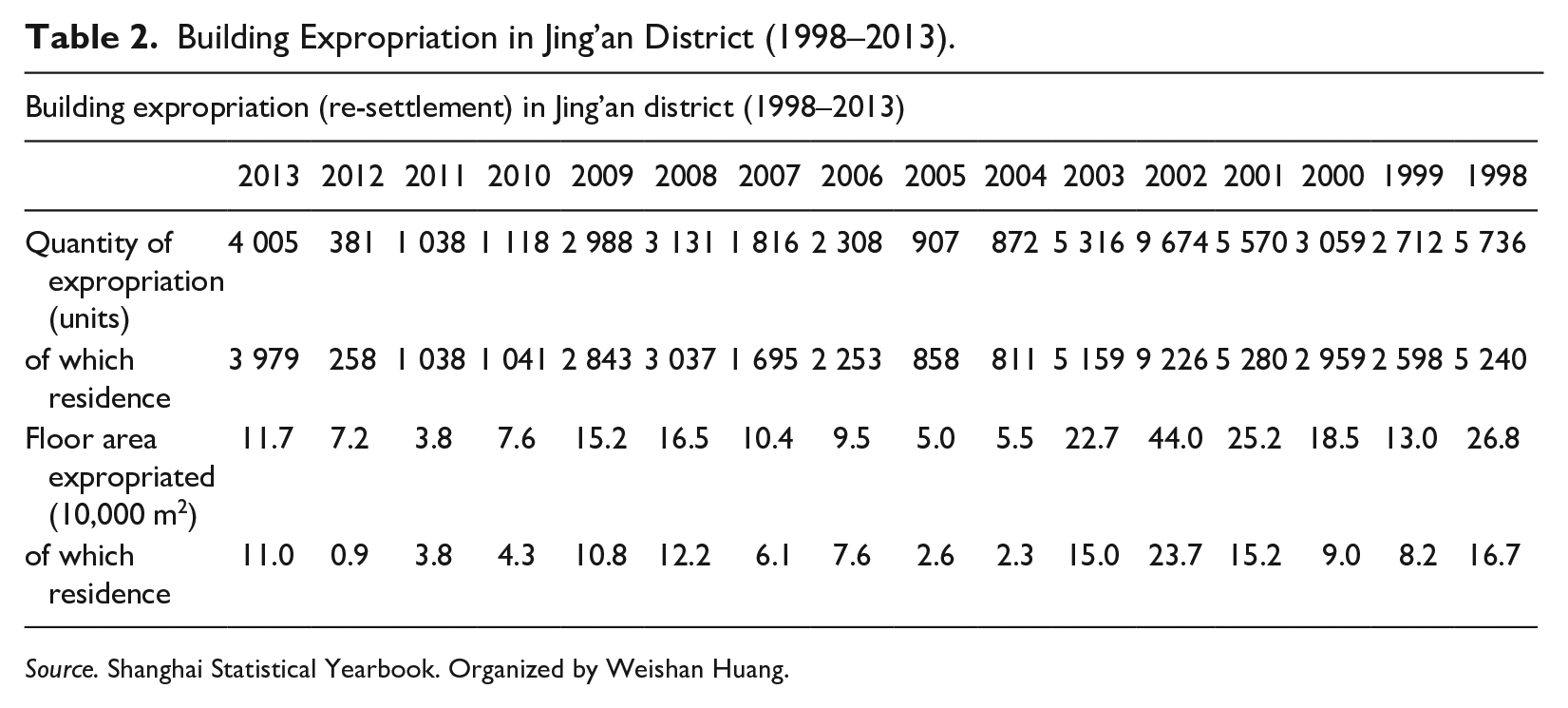
During the process of neighborhood regeneration, urban religious sites have faced a new test: the transformation of the traditional population. In the 1950s and earlier, Jing’an Temple performed important religious, social, and economic functions within the local community. These ties were initially severed when the temple was closed during the Cultural Revolution. When the Jing’an Temple reopened in the post-Mao period, the residents could not resume these earlier ties because the district government was playing an increasingly important role in changing Shanghai’s urban landscape due to rapid urbanization and economic growth. Based on my research (Table 2), 70% of its land was rezoned for commercial use and many of the residents were relocated out of the city center. Between 1998 and 2013 alone, 50,631 units in Jing’an District were expropriated, of which 48,275 were residential units. Seventy percent of what was once a mostly residential area has now been reallocated for commercial use. 3
Building Expropriation in Jing’an District (1998–2013).
Source. Shanghai Statistical Yearbook. Organized by Weishan Huang.
Drawing data from the Shanghai Statistical Yearbook, building expropriation data were analyzed, starting from 1998. The resettlement rate peaked between 1998 and 2003, in term of units, populations, and spaces. Before Jing’an District merged with Zhaobei District, it was a small area with a history of commercial development dating back to the first half of the 20th Century. Jing’an District, located in downtown Shanghai, is as small as 7.62 km2, but it has been at the heart of some of Shanghai’s most significant developments in the post-Mao period. The scale of neighborhood change is enormous based on the rate of expropriation. For example, 9,674 household units had been expropriated in just 2002. 4 Ninety-five percent of expropriation units were residential spaces.
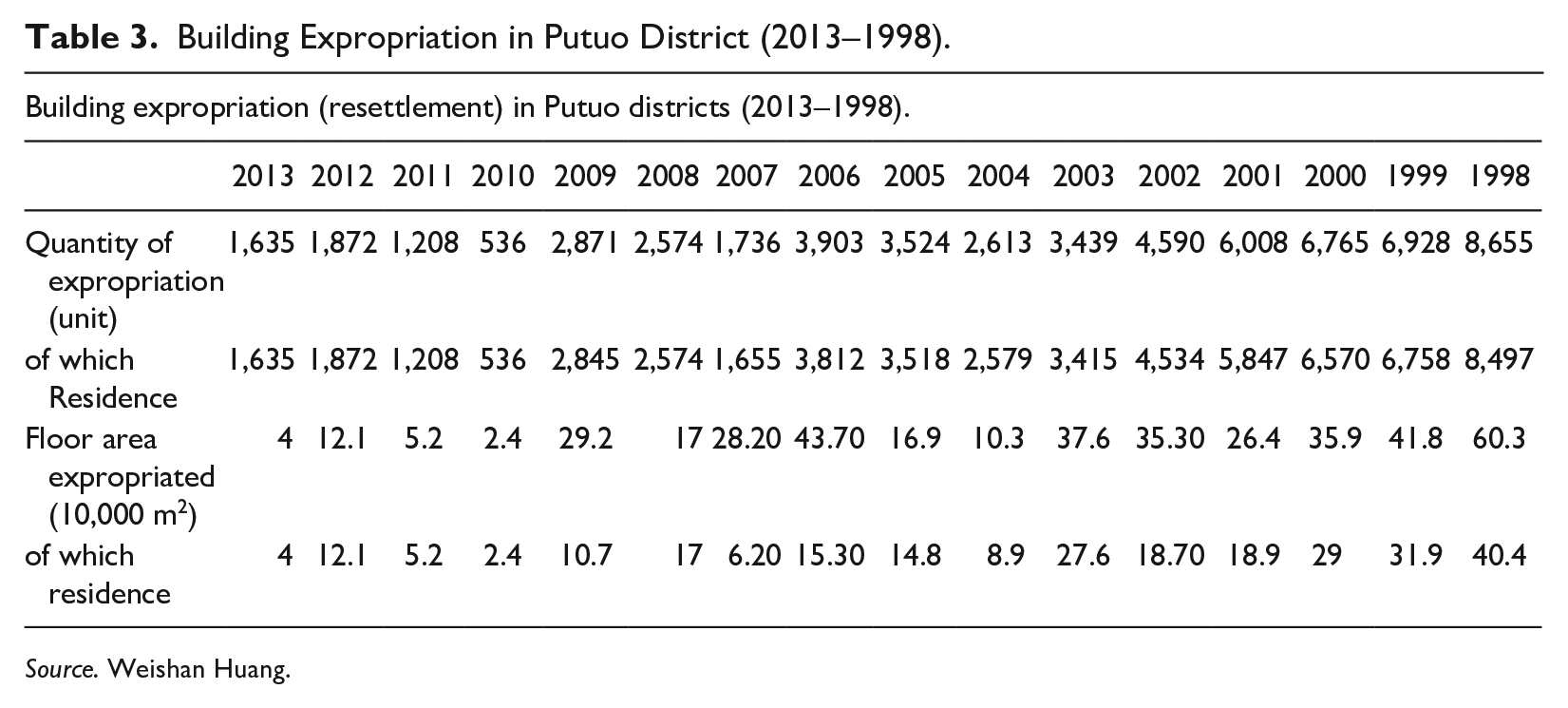
Putuo District is located in the west of Shanghai. In 1945, it was first incorporated into Shanghai as the 13th district and it was, at that time, only a corner on the south bank of the Wusong River, covering an area of 2.65 km2. After 1945, the district had expanded by merging the land with neighboring districts. By the end of 1990, the territory area was 29.88 km2, accounting for 4% of the total urban area. Still, the Putuo District was four time larger than Jing’an district (until 2016). 5 Between 1998 and 2013 alone, more than 58,857 units in Putuo District were expropriated (Table 3). Among them, 57,855 were residential units. I found that the expropriation rate was high between 1998 to 2006, in terms of units, populations, and spaces; 64% of expropriation areas belonged to residential spaces.
Building Expropriation in Putuo District (2013–1998).
Source. Weishan Huang.
Based on data from 1998 to 2013, there were massive resettlements taking place in both the Jing’an and Putuo areas, representing city-wide changes, or what I call, “the disappearing neighborhoods” of Shanghai. The measure of expropriations in both Jing’an and Putuo Districts has shown us the large-scale nature of changing neighborhoods and changing relationship between temples and their immediate neighborhoods. During the process of temple revival, both Jing’an Temple and Jade Buddha Temple have, though not by choice, fewer ties with their neighborhoods.
Niche or Monopolistic Spiritual Services?
As mentioned earlier, religious toleration was formally reinstated in China even though the increasing mainstreaming of Buddhism in the city center took place. As the “temple-centric” revival of Buddhism was the only type of state-approved revival, it can be asked whether the Buddhist temples in the city center provide niche or monopolistic spiritual services. The Buddhist temples benefit from the present monopolistic arrangement since each temple is given a certain defined territory. Although small temples have little or no say in what kind of initial territory they get, there is no competition with other niche temples in the same neighborhood. As faith communities all face competition from secular sources in the recreative and commercial business districts, Buddhist temples will need to deliver niche services for maintaining both long-time participation and luring new visitors.
We learned from Richard Madsen’s (2007) work in Taiwan that middle-class urban Buddhists have left the temples and found a new spirituality in reformed Buddhist groups, such as the Tzu Chi Foundation, Foguangshan, and Fagushan. As I witnessed in Shanghai, during the revival of “temple-centric” Buddhism, most of the Buddhist communities also actively promote their religious aims with innovative methods within the framework of state policies. As both Healy and Cimino’s research on member demographics and urban religion in gentrified areas suggests, in both suburbs and downtown, faith communities must organize themselves nongeographically and along the lines of social networks to survive (Cimino, 2012; Healy, 2005). Buddhist temples in Shanghai also fashion a new relationship with young and middle-aged lay practitioners, who belong to the main populations residing or visiting recreative and commercial business districts.
“Niche-Switching” of Service and Changing Spatial Strategies
Considering the complicated and changing nature of temple goers or “memberships” in Buddhist temples, I divide these Buddhists into two groups: commuting visitors and temple-centric devotees. Commuting visitors are travelers both within Shanghai, and outside of, Shanghai. They could be practitioners visiting temples during significant Buddhist holidays, or travelers from outside of Shanghai, including but not limited to pilgrims and tourists. In a small survey my assistant and I conducted, out of 49 temple visitors in the city center, approximately half were born in Shanghai. The survey was conducted during the summer of 2015, covering the (8) city-center temples during opening hours, both morning and afternoon on weekdays and weekends. The respondents from Shanghai accounted for half of the total number of people, but the respondents currently living in Shanghai accounted for 92% of the total number of people. I found that 41% of the respondents are new immigrants and work and reside in Shanghai. The survey found that 8% of the respondents are short-term tourists. In sum, most of the temple visitors are commuting visitors who reside in Shanghai and travel to temples in different districts.
Temple-centric devotees are laypeople who have stronger ties with current abbots and temple history; therefore, they have stronger loyalty than commuting visitors to the temple. Devotees can be differentiated based on their relationship with the temple leadership. They may not form horizontal solidarity nor know each other, which is similar to the findings of Ashiwa and Wank’s (2005) study of early 20th Century Buddhism. Each abbot has a group of lay elites who support his positions and frequent temple events. Some of them are the abbots’ disciples. They continue bringing new family members or their business friends into this religious circle. Others are economic elites who have formed friendships with abbots and clergy and visit temples for Buddhist rituals as donors for special events. Some of them are local Shanghainese who have a connection with temples through previous generations since the 1950s or 1960s. In 2016, for example, I met four elderly practitioners with their families from Hong Kong who reported that they had returned to the temple for the annual ceremony of Dharma rituals since 1997. They said they felt loyalty to this particular temple because that was where they worshipped with their grandmothers before they fled to Hong Kong and later to the United States. Memory and sentiment are the main reasons for forming an attachment to the place of faith for these participants, even as other former residents in the immediate neighborhood said it was difficult for them to return regularly once they had been displaced. However, the temple has readjusted to the restructuring of its neighborhood in various ways. With the right locations in the downtown area, temple abbots can change their ties with society from geographical to social ones. Old members tend to attach themselves to temples because of geographical reasons; they are loyal to the place of faith. The newer and young members, in my interviews, are temple-centric volunteers and their loyalty is directed to the abbots.
Differentiation of Service
Both Jing’an Temple and Jade Buddha Temple have established volunteer troops with more than 1000 members. Previous research has shown that the emergence of urban voluntarism among Buddhist communities in China requires a social space beyond the temple walls and trained leaders beyond religious qualifications (Laliberté, 2015; Palmer, 2019). The concept of benevolent Buddhist practices in China or Shanghai is not new, having been part of the Buddhist tradition. But these new organizational forms and the voluntarism of lay practitioners are different from the laymen that emerged in the 1920s. In Welch’s (1968) book, The Buddhist Revival in China, we learn that laymen in the early republic era were not affiliated with monasteries and focused on merit earnings, which were not like monks who were defending the establishment of monasteries. According to Welch (1968), Shanghai laypeople in the 1920s were bourgeoisie, literati, or businessmen, who did not affiliate with temples or governmental officials.
What was new after the turn of the Millennium was the emergence of a new type of lay involvement led by monastics who are exclusively identified with temples, their histories or whose loyalties rest on abbots or abbesses. With a monopoly of defined territory in recreative and commercial business districts, temple economies for both Jing’an Temple and Jade Buddha Chan Temple have been guaranteeing economic gains by selling entry tickets. Not limited by the local government, by establishing the volunteer troops, the abbots from both temples demonstrate the will to bring in newcomers from different age, education, and class groups into the temples. Using the idea of “niche-switching,” could be a useful framework for observing this tendency in other Chinese cities as well.
In my field observations, most of the revived temples have been encouraged by the state to emphasize Sinicization, or a return to “traditional” Chinese practices, which may resonate with elderly believers. However, there are increasing numbers of white-collar young Buddhists desiring modern spiritual teachings and dharma events, due to an interest in certain charismatic monks. The increasing number of laymen affiliated with monastics or temples is the population I conceptualize as temple-centric lay practitioners who are also mobilized by new urban volunteerism. We can further differentiate temple-centered devotees into subgroups of donors (hufa) and volunteers (zhigong/or yigong), who are distinct along class lines.
After 40 years of religious revival, many urban Buddhist temples have built a similar model of philanthropic involvement and have taken up limited charitable works, such as caring for the elderly or scholarships for poverty alleviation in their immediate residential communities. Such projects also reflect their relationship with neighboring party leaders. The group of white-collar workers or middle-class volunteers in the monastery may be the most vital force set up by temple leaders. These new actors are laymen and are often directly referred to as volunteers (zhigong/yigong) to distinguish them from donors (hufa). These temple-based volunteers are the grassroots actors promoting the development of urban Buddhism in contemporary society, especially with the application of new social media, and expanding the influence of Buddhism to nonbelievers on wider geographical and social scales.
Based on the interviews and survey data in the Jade Buddha Chan Temple, 1,600 volunteers 6 are registered with names and identification numbers in the Juequn Cultural and Education Foundation, which is a temple-affiliated charitable foundation of Jade Buddha Chan Temple. The majority of them are local residents, mostly born in Shanghai, and the ratio of women to men is 4:1. Volunteers aged over 70 account for approximately 10% of all volunteers, those aged 60 to 70 account for 20%, those aged 40 to 50 represent a majority (40% to 50%), with those under 40-year-olds accounting for 20% to 30%.
In my investigation, 7 laypeople and volunteers are based on class division. Their basic ideas of earning merit and learning Buddhism are the same. Both are loyal to their temples—only attending other temples for joint events. Volunteers, however, mainly established their relationship with a monastery as a created religious community through donations of time and labor. They willingly take up small tasks, such as leading cleaning efforts in Buddha halls or serving as security guards at large dharma events. Many of them are first attracted by dharma events and then drawn into volunteerism. The concept of earning merit, based on my interviews, is still the main reason for volunteering time and labor.
To strengthen the solidarity among the group, the clergies who lead the volunteers often plan a systematic and exclusive course for volunteers. The leadership, training, and scheduling of volunteer organizations are, most of the time, solely under the responsibility of leading clergy. The Juequn Culture and Education Foundation created opportunities for volunteers to involve themselves with different cultural and educational merits, such as the basic editing of Buddhist scriptures. These forms of direct participation in the daily work of the temple, and bonding with the clergy or professional staff, in addition to the accumulation of merit earning, have created a sense of honor and solidarity for the volunteers.
New Spatial Strategy
What we have witnessed is that Buddhist clergy develop a new spatial strategy by not only changing temple service but also repackaging the Buddhist temples into a program of exploring a living heritage with active philanthropic, educational, and spiritual dimensions. The increasing numbers of volunteers and patrons from outside of the neighborhood, or even outside of the city, are attracted to diverse religious services and rituals. The concentration of religious power was also swiftly accumulated by the powerful abbots. For example, the abbot of Jing’an Temple has accomplished finishing his renowned four interprovincial pilgrimages in 2017. The most recent pilgrimage was 2,500 km2 in distance from Shanghai. The news was distributed by WeChat and fascinated many patrons and followers outside of Shanghai. It has become a religious Olympic event for laypeople, not only attracting online followers but also participation in the pilgrimage.
The interprovincial pilgrimages are a spatial expression of venerating the sacred Buddhist sites and routes. The four long pilgrims included journeys to Buddhist sacred sites, Mount Jiuhua, Mount Putuo, Mount Wutai, and Mount Emei, and could be seen as an expression of traditional religious austerity and piety. It is also a declaration to redeem the abbots’ vow when abbot Huiming took on four long pilgrimages, by foot, to Buddhist heritage sites in redeeming for the successful restoration of Jing’an Temple between the late 1990s and 2010s. This last Emeishan pilgrimage was a pilgrimage traveling by foot, lasting for 97 days. The diaries of the latest pilgrim were delivered by WeChat, a phone App, for the whole 3-month period. WeChat followers were following the event online with the imagery of spatial travel between towns, cities, and provinces. Since then, there are not only citywide volunteers communicating to Jing’an Temple, but also region-wide patrons traveling to Shanghai to Jing’an Temple.
Conclusion
I hypothesize that the key reasons behind the appearance of temple niche-switching during neighborhood regeneration are primarily environmental and organizational. The environmental factors include policy and neighborhood changes. Those environmental factors force the religious institution to adjust to what is going on around it, both economically and politically (Ammerman, 1997; Cimino et al., 2013). The organizational factors mainly refer to temple leadership. As the Buddhist groups have gained new economic influence over the last two decades, I found that they have also become vital agents in shaping their urban belief system.
After establishing political and religious legitimacy, the temples continue to use their locations in the business districts to rebuild or expand. In urban areas, not all Buddhist temples have been recognized as revenue-generating entities for local governments. This is not to claim that these two temples’ images of middle-class Buddhism in Shanghai are completely managed and reproduced by local governments or capitalist institutions, I only argue that they are the ones where a local tourist bureau has been involved to serve in this capacity. The function of revenue-generation is considered as a public good for district development. However, Buddhist communities have their own agency within this framework, as some try to advance their missions by incorporating themselves into a state-planned tourism business district or a recreational business district. Some groups will find ways to negotiate with the roles planned for them by the state. Under conditions of neighborhood gentrification, temple leaders filled new niches, developing a new spatial strategy to integrate traditional ritual services, new teachings, and new forms of worship by which they not only relate to their old population but also reach out to nongeographically related newcomers.
Footnotes
Declaration of Conflicting Interests
The author(s) declared no potential conflicts of interest with respect to the research, authorship, and/or publication of this article.
Funding
The author(s) disclosed receipt of the following financial support for the research, authorship, and/or publication of this article: This research is funded by Hong Kong RGC General Research Fund, project no. 14609315.
