







Abstract
This poem emerges from fieldwork in Northern Ireland and rambles in the north woods of my home state. A dreamlike transcultural diffusion of embodied symbolism has the persona inhabiting home and field at once. In this instance, nature’s affordances and the martial atmosphere of Michigan hunting season evoke murals, bonfires and the marching season in Belfast. The opportunity for casual violence resonates across settings, and the possibility of the participant observer becoming collateral damage is a real one. The poem ends in a matter-of-fact manner, dramatizing both the mundane nature of risk and the fluidity of our experience of spatiotemporal translation.
i swagger in the frosty autumn haze, blaze orange anorak unzipped and swinging blackthorn stick, border collie paddling a wet atv track, bracken brushing fur with heavy dew, man and dog inhaling woodsmoke and cold fog, trying to dodge broadheads of sound shooters, and the buckshot of rookies zeroing scopes: marching season in the north woods, tree bark rubbed with antler velvet, canopy aflame with spiking color, Michigan graffiti and bone fire
Commentary
Rather than imposing an interpretation that forecloses the reader’s joy of heavy lifting or dampens the pleasure of co-creation, I highlight instead the spreading activation that gave rise to the poem, and the narrative transportation I hope to evoke in the reader. I include a few photographs to illustrate the kinds of images conjured in my reliving.
Walking in the north woods can be an opportunity for mindful contemplation of the more-than-human world. My favorite trail is narrow and canopied, winding past lakes through plentifully varied wildlife habitats that are alive with birdsong. A hike quiets the mental chatter of everyday life and directs close attention to natural ecosystems. Walked enough times, a trail can be glided as the forest delivers a sensory inundation experience spiritually unmatched in urban life.
Unless you’re in the company of dogs (see Figure 1), who love to stalk and burrow, startle and chase. Their fascination with the woods can become your own, interrupting your immersion but amusing you nonetheless. When large surface roots are masked by a carpet of colorful autumn leaves, a high-stepping gait reminiscent of marching is sometimes required to prevent a painful face plant on the forest floor. The risk is heightened by an exuberant dog on a leash, eager to flush fleet deer or foraging squirrels. Or unwary of the depth of a flooded All-Terrain Vehicle rut.
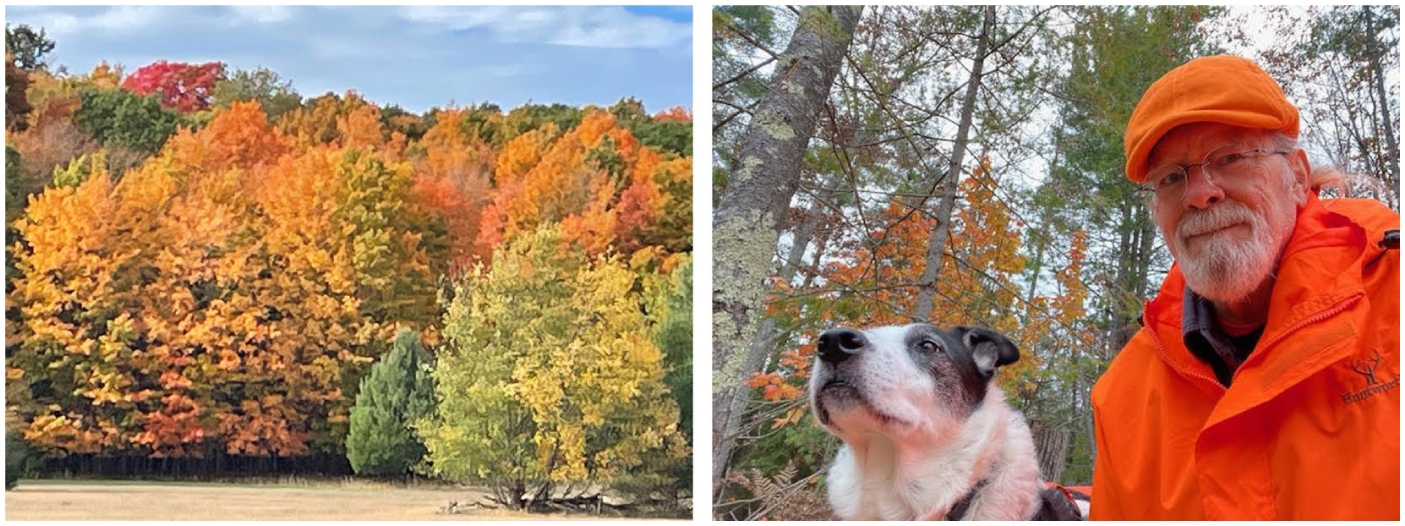
More-than-human vibrance, 2025.
Distraction and danger can be elevated around hunting seasons, when the hills are alive with the sound of gunfire. Walkers don bright orange clothing that rivals fall’s chromatic splendor, praying to be sighted by hunters in mossy oak camo before triggers are pulled or bowstrings loosed. Dogs wear similar bright vests and harnesses to mark noncombatant status. Sometimes, though, a poorly-trained or over-eager hunter will fire at mere sound or motion, imperiling all life down range. This may be a partial function of the decline of hunting culture in Michigan, of vital traditions not being passed down.
One fall ramble triggered a concatenation of images of ethno-national conflict in Northern Ireland, site of my most recent ethnographic field research (see Figure 2). On that colorful autumn morning in Michigan, the deep resonance of orange symbolism (from leaves and garments to the banners and sashes of the Ulster Orangemen) of marching (from energetic hiking with a shillelagh to assist my balance to the July 12th Unionist parades), of the loud rumble of gunshots (evoking the deafening percussion of massive Lambeg drums beaten so vigorously that drummers hands may bleed) and of vibrant murals and towering bonfires (the Ulster accent caressing my midwestern ears as “bone fahrs”) celebrating Protestant culture (cued by the striking arboreal palette, the bark-stripped evidence of seasonal antler growth and the savor of campfire), as well as my own baseline cultural Catholicism, conspired to transport me momentarily back to the Shankill Road and other environs in West Belfast. Deep in an otherwise languid woods, I felt the urban intensity of a culture that believes itself to be under siege. The pang of unraveling traditions being desperately and often problematically reinforced. Persistent echoes of ethnocide (the “Kill All Taigs” acronym an especially graphic reminder) commanding the cultural erasure of Republicans. The prospect of resurgent ethnogenesis born of perpetual Loyalist perseverance.
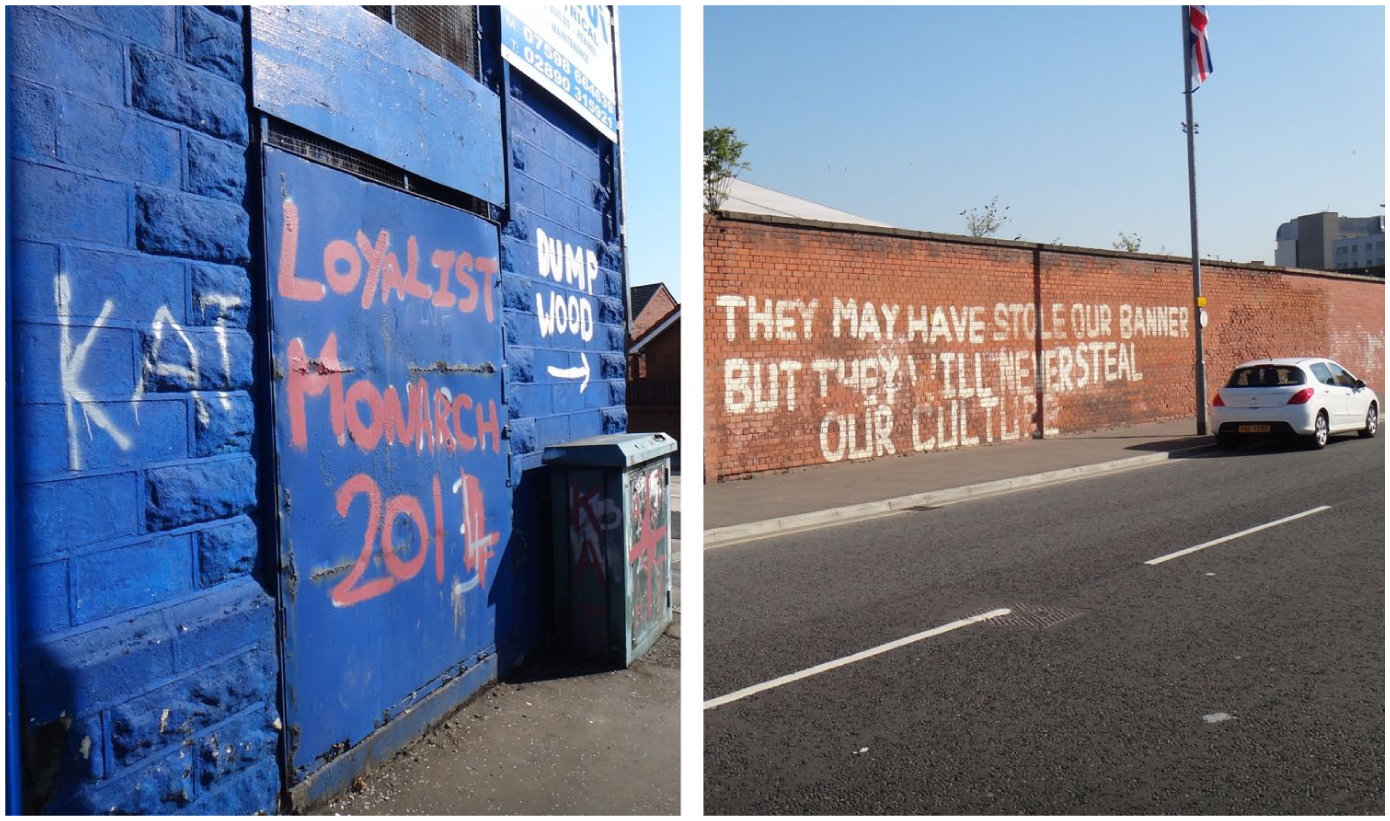
Ethnocide and ethnogenesis, 2014.
The daydream hinges on the experience of precarity, whether of spatial negotiation or ethno-cultural persistence. The mundane acceptance of risk, the resignation to threat of collateral damage and the prospect of unforeseen triggering occasions that uncertainty induces all lie at the heart of the poem. The persona’s sensitivity to symbolism invites engagement in a dialectic of dislocation and relocation, a disorienting feeling of being home-and-away. The ethnographer’s exposure to cultural contestation provokes engagement with personal and structural violence in both historical and contemporary perspective (see Figure 3), an enhanced situational awareness that feels like a constant looking over one’s shoulder. The dread and exhilaration of risk and threat inhere in each context. The inescapable need to compare experiences across home and host cultures will be familiar to many ethnographers.
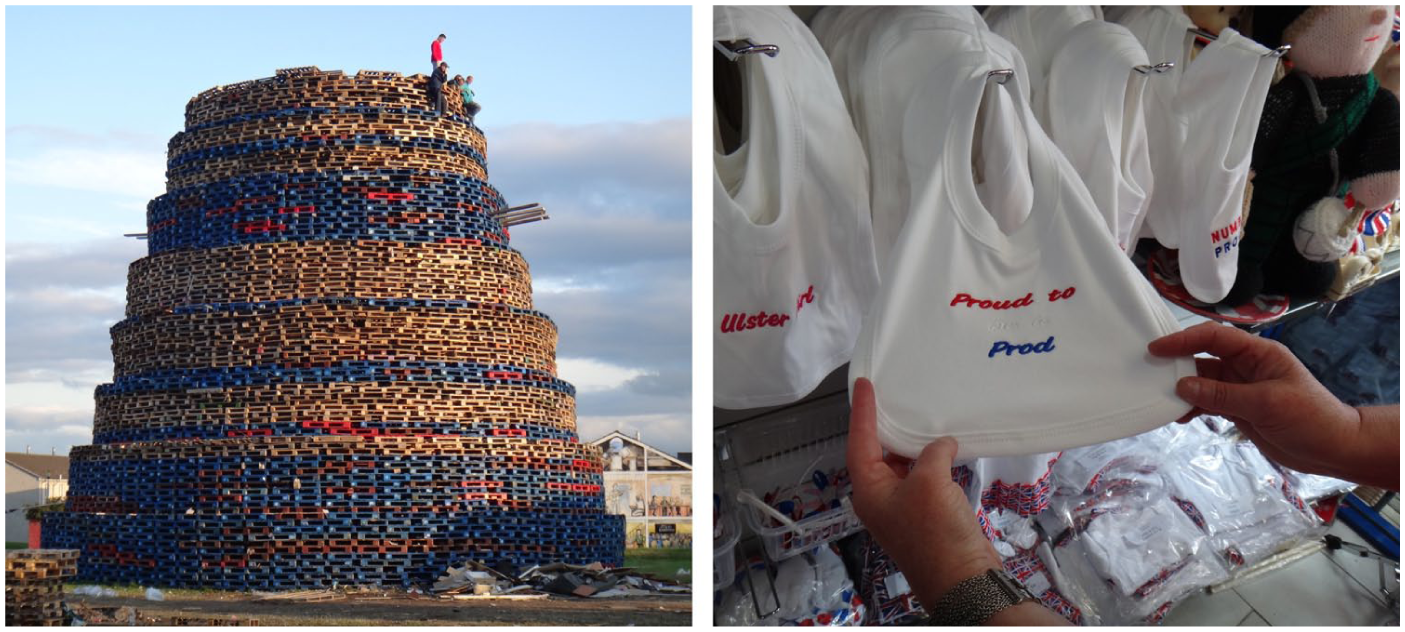
Maintaining tradition, 2014.
Encounters with negligent hunters and Loyalist zealots provided an image bank kinetic enough to spark imagination and produce a playful yet uneasy sense of bilocation. The poem is a projective vessel recounting this coincidence.
Key Online Resources
Placeness, Place, Placelessness
Michigan Department of Natural Resources
Department of Natural Resources
Conflict and Politics in Northern Ireland
CAIN: Northern Ireland Conflict, Politics, and Society. Information on “the troubles.”
Poetry and Anthropology
Anthropology and Humanism—Wiley Online Library
Art, Earth, Spirit, Society
Footnotes

Ethical Considerations and Informed Consent
Exempt, as no human subjects were involved.
Funding
The author received no financial support for the research, authorship, and/or publication of this article.
Declaration of Conflicting Interests
The author declared no potential conflicts of interest with respect to the research, authorship, and/or publication of this article.
Data Availability Statement
No data were reported in this paper.