






Abstract
Through a comparative reading of selected visual and performance works, ranging from Edvard Munch’s Silent Scream and Kazimir Malevich’s Suprematism to Samuel Beckett’s dramaturgy and Marina Abramović’s performances, the study demonstrates how silence becomes a minimalist device and a philosophical stance as well as a social stance. These examples highlight its role in reshaping artistic language, audience reception, and the ontology of art itself. Silence is thus approached as a horizon of potentiality where concealment and revelation intersect, enabling forms of communication that exceed the limits of speech. In this sense, silence functions as an aesthetic and existential presence that turns the absence of expression into a revolutionary protest across different artistic forms. Methodologically, the research combines analysis, deduction, and comparative critique, situating silence within contemporary debates on aesthetics and semiotics, while also addressing its social and revolutionary dimensions. The findings suggest that silence, in its multiple manifestations, emerges as a powerful tool of artistic expression, often more eloquent than words.
Introduction
Silence has emerged as a central theme in artistic and philosophical inquiry, no longer perceived solely as emptiness or lack, but as a space of potential where presence and absence intersect. Far from being a passive void, silence opens new modes of perception and reflection, creating conditions for expression that exceed the limits of verbal communication. In this sense, silence functions as both an aesthetic and existential category, capable of articulating what remains unsaid while inviting deeper engagement with the essence of being.
Equally important is the spatial dimension of silence. Silence is never detached from space; rather, it materializes within visual and performative environments. The empty canvas, the monochrome surface, the silent stage, or the gallery void all transform silence into a palpable presence that organizes perception. By suspending sound, speech, or movement, silence reconfigures space as a field of contemplation, heightening the audience’s awareness of absence, stillness, and potential action. Space thus becomes an active medium where silence resonates, shaping the conditions of both creation and reception.
In the visual and performing arts alike, silence has been mobilized as a strategy of removal, reduction, and distillation. It provides a framework for expanding expressive boundaries by privileging absence, void, and minimalism as aesthetic resources. Such practices underscore that silence does not negate meaning but rather transforms it into a mode of presence, where emptiness itself becomes communicative.
The present study, therefore, aims to examine how silence operates simultaneously as a minimalist artistic mechanism, an existential stance, and a spatial practice. Through a comparative analysis of selected visual and performance practices—from Edvard Munch’s Silent Scream and Kazimir Malevich’s Suprematism to the theatrical explorations of Samuel Beckett, Peter Brook, and Marina Abramović—the article highlights how silence reshapes artistic language, challenges representational norms, and redefines the ontology of artistic expression. Methodologically, the research combines analysis, deduction, and comparative critique, situating silence within broader aesthetic and semiotic debates.
Materials and Methods
This research adopts a qualitative and interpretive methodology aimed at examining silence as both an aesthetic strategy and a cultural practice across diverse artistic domains. The approach emphasizes how revolutionary presence is generated within the cultural sphere through artistic and social practices.
The research corpus was constructed through purposive sampling of exemplary cases drawn from modern and contemporary art practices that articulate silence within distinct artistic traditions and spatial arrangements. In the visual and fine arts, analysis focused on the existential anxiety embodied in Edvard Munch’s Silent Scream and the radical minimalism of Kazimir Malevich’s White on White, where visual silence extends to the point of erasure, manifesting as a silent horizon and the void of abstraction. Experimental audio-visual and performative practices were also included, notably Yves Klein’s Le Vide (1958), Symphonie Monoton-Silence (1960), and John Cage’s 4'33", where silence emerges through void, monochromy, and spatial stillness, set against the backdrop of social noise and industrial modernity.
In the theatrical domain, Samuel Beckett’s Waiting for Godot and Peter Brook’s theoretical reflections on the “empty space” highlight silence as temporal suspension, scenographic reduction, and a moment of existential contemplation on stage. Contemporary performance art has further extended this trajectory: Marina Abramović redefined silence as a gendered, political, and social stance in works such as Rhythm 0 (1974) and The Artist is Present (2010), where silence is co-produced through audience participation and institutional mediation.
These cases were selected to provide both historical depth and contemporary resonance, bridging visual modernism, avant-garde theater, and performance art, to demonstrate how silence circulates as part of social expression that art transforms into modes of communication exceeding verbal silence and opening multiple aesthetic manifestations.
Three interrelated strategies were employed in the analysis. The first is close reading and visual/performative analysis, treating each artwork or performance as a cultural text. For paintings, attention was given to composition, spatial framing, and visual silence; for theater and performance, stage directions, scenography, and documentation (photographs, videos, critical reviews, and archival notes) were examined. Second, comparative semiotics was applied, approaching silence as a signifying practice, comparing its function across media—as void, as temporal suspension, as embodied vulnerability—while tracing intersections between visual, acoustic, and performative registers. Third, contextual interpretation situated each case within its philosophical, aesthetic, and socio-cultural framework, ensuring interpretive depth: existentialist thought (Beckett, Sartre), phenomenology of the void, theories of sound and acoustic ecology (Klein, Cage), feminist critique and ethics of spectatorship (Abramović).
Conceptual and Artistic Framework
This study adopts a qualitative and interpretive methodology that combines philosophical inquiry, artistic analysis, social impact, and audience-centered observation. Central to this approach is a careful distinction between key conceptual registers that inform the analysis of silence in contemporary art and performance: silence as acoustic absence, silence as a spatial and architectural condition, and emptiness as a relational field generating this metaphorical silence. Clarifying these distinctions prevents conceptual conflation and ensures that the study engages rigorously with theoretical, artistic, and interpretive dimensions alike.
The concept of emptiness is treated not as mere absence, but as a dynamic, productive condition that structures perception, imagination, and interaction. Philosophically, emptiness provides a reflective temporal horizon, a medium in which thought, creativity, and perceptual engagement unfold without the constraints of semantic or temporal closure (Marleau-Ponty, 1973). Artistically, emptiness functions as a spatial and symbolic register: it organizes the stage, gallery, or performative environment, shapes the relationships among bodies, objects, and spectators, and generates aesthetic and ethical significance. Socially, silence becomes a medium for collective engagement, involving the audience in awareness of its implications for self and other, enabling shared contemplation and endowing the artwork with a political or protest dimension that reflects societal tensions and values (Pacheco, 2025). Here, the emptiness of space converges with the silence of sound to produce a dense relational field in which the audience is implicated in both observation and co-creative participation. In this way, silence and emptiness operate as living tools for reproducing aesthetic experience, deepening philosophical reflection, and fostering social participation in artistic performance.
Methodologically, the study employs close readings of modern and contemporary visual and performative works, including visual analysis, scenographic examination, and interpretive assessment of audience engagement. The primary case studies include seminal works in visual art, installation, theater, and performance art, with attention to how silence and emptiness are enacted, perceived, and ethically situated. The research also relies on reflexive observation, drawing on archival sources and documented performances to illuminate the intersections of aesthetic, ethical, and social dimensions of silence.
Results
Existential Anxiety and Social Alienation: Silence in Munch’s The Scream
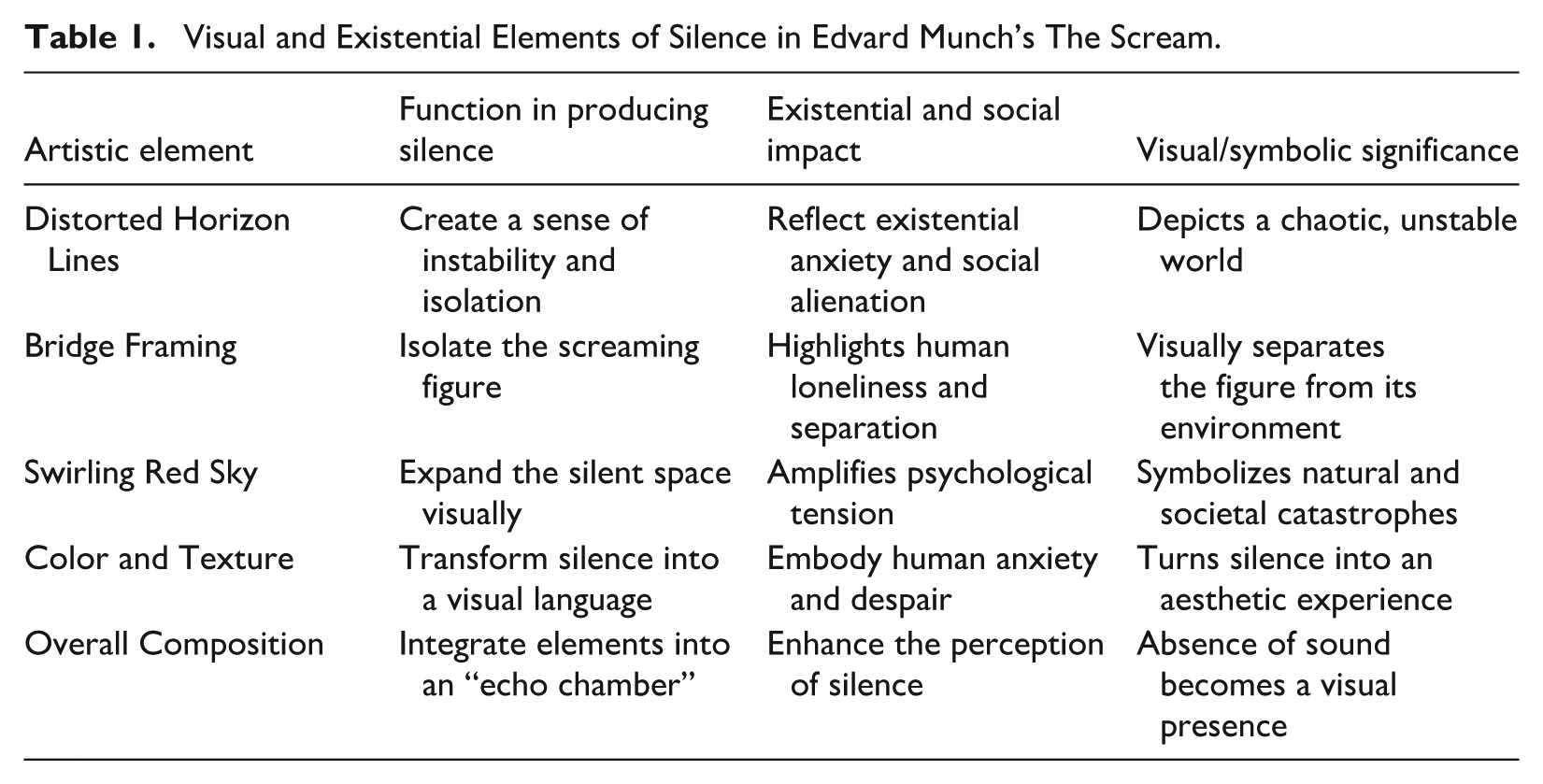
The expressions of silence in the visual arts are mediated through spatial and compositional devices. In Edvard Munch’s The Scream (1893), silence is staged through the distorted horizon lines, the framing of the bridge, and the apocalyptic sky. These elements construct a spatial environment where sound appears visually announced yet perpetually withheld. The viewer perceives the intensity of a scream, but the canvas itself absorbs it, producing what may be called a visual dampening of sound.
Munch employs horizon lines and framing as visual mechanisms that both contain and mute expression (Özdemir et al., 2025). The constricted bridge isolates the screaming figure, while the swirling, blood-red sky expands outward like waves of suppressed resonance. The entire composition turns into an echo chamber where silence reigns. As Pettersen (2022) observes, “The sky is blood-red, a strong feeling of anxiety ensues, and an endless scream penetrates nature” (p. 1407). Yet, paradoxically, no sound emerges—silence is constructed through spatial distortion. This paradox resonates with Mallarmé’s poetic and philosophical vision, where silent spaces are not mere voids but authentic and expressive presences. They embody a metaphysics of absence, articulating meaning through what is unsaid, while acquiring an aesthetic force that transforms negativity into truth and eloquence. “Mallarmé brought his readers to an increased awareness of their essential rôle in poetry as limits, where nothing can lie beyond them. In consequence, the silent spaces become genuine and just, testifying to their negative force” (Bindeman, 2017, p. 12). This has led modern art to reflect in many of its paintings the existential anxiety, incapacity, and psychological fragility of man.
The silent scream thus becomes more than an aesthetic device; it is an existential inquiry (Daly, 2025). The tension between the figure’s soundless cry and the engulfing environment reflects what Meskini describes as “the echo of the quietude surrounding the body’s turbulent past intertwined with various types of violence” (Meskini, 2023, p. 149). Silence here is a metaphor for modern man’s fragility, despair, and confrontation with being. Munch’s own illness and personal anguish permeate the work, turning the painting into a dialogue between individual suffering and universal anxiety.
Beyond its existential weight, The Scream resonates with cultural crises across time. The distorted horizon lines, evoking an unstable world, mirror contemporary fears about ecological disaster and psychological fragility. Pettersen (2022) notes how the apocalyptic aura of the painting now resonates with our “littered planet and accelerating climatic changes” (p. 1417). Silence in this spatialized form becomes critique: a refusal of normalcy and a warning about impending catastrophe.
Artistic discourse, even in its silence, indicts a troubling reality, sometimes transcending the nature of philosophical discourse. The silence that envelops the painting takes on a contemplative, mediatory aspect for interpreting and understanding the artwork, since what one contemplates in art is ultimately their humanity confronted with existence. In this way, silence can sometimes say more than words. Language is not merely verbal expression but a manifestation of existence; thought does not simply express man but allows existence to occur as a linguistic event, seeking to understand being. This requires a genuine openness to the self and to thought. Consequently, visual art contributes to translating human existence—its ideas, feelings, and way of life—while plunging the viewer into endless sophistries of nihilism and silent meaninglessness, making the artwork a refuge for both escape and self-discovery.
From a semiotic perspective, the silence of Munch’s painting arises from its compositional choices. M. Müller (2015) reminds us that “a work of art can be understood as a system of signs” (p. 79), and here the absence of audible sound is itself a signifier. The distorted horizon, violent colors, and enclosed framing transform silence into a visual lexicon. Thus, the scream becomes a silent call to being, bypassing verbal language and confronting us with existence in its rawest form (Daly, 2025).
Such allegorical activity concerning the artwork constitutes a mode of reading in which cognitive and analytical methods converge—across artistic, philosophical, cultural, social, and ideological perspectives—seeking to uncover different levels of understanding. This calls upon the principle of finitude in apprehending both the reality of the artwork and the mechanisms of its interpretation. Language, in this sense, can only indicate and suggest, offering a provisional conception that, even as it multiplies, strives to preserve coherence and harmony within its own semantic field. Within this horizon, the idea of ‘giving up on words’ initially portrays silence as mere absence; yet, ethnographic descriptions suggest otherwise: silence emerges as a potent mode of communication and sociality, and it is precisely in the absence of silence that breaches of norms occur (Dragojlovic & Samuels, 2023, p. 3). Hence, the limitations of language in artistic interpretation resonate with the anthropological insight that silence itself becomes a signifying practice—at once restrictive and generative—structuring meaning beyond verbal expression. This argument is further deepened by Shohet (2021), particularly through his examination of the complex relationship between silence and sacrifice.
What mediates between auditory silence and visual noise is the painting’s intrinsic capacity for modulation, transformation, disruption, and empathy. It is through this dynamic interplay that art reveals existence as situated beyond the immediacy of sound, scream, and noise—within a space where being is articulated through rather silence than clamor. Marie Thompson speaks about the “critique of silence as a potentially suppressive agent of control, risks missing the point that listening lies at the heart of the acoustic ecology mandate. That is, connecting with the world through listening is necessarily accompanied by silence” (Lacey & Thompson, 2017, p. 64).
In the end, The Scream embodies what Meskini calls “residing in the labyrinths of silence as a language that cannot be translated into spoken language” (Meskini, 2023, p. 93). The painting resists domestication by words; its silence exposes the fragility of human identity, reminding us that existence is dynamic, shifting with historical and cultural change. By turning a scream into silence through spatial framing, Munch redefined the possibilities of visual art, showing that absence can speak louder than presence, and silence louder than words.
As shown in Table 1, Edvard Munch’s Silent Scream has had a profound and lasting impact on popular culture. Its unique ability to capture a universal sense of anxiety, combined with its striking visual composition, has established it as a globally recognized existential reference. The work has been interpreted as a silent expression of humanity’s fears regarding social alienation and the psychological pressures of modernity, a voiceless scream that embodies society’s sense of estrangement and anxiety in the face of economic changes, urban transformations, and social disparities.
Visual and Existential Elements of Silence in Edvard Munch’s The Scream.
Suprematism and the Silent Revolution of Form
Color-space in visual art is a field of sensory and semantic contemplation, where silence can be staged through the absence of form and the flatness of material. Kazimir Malevich sought to embody silence through emptiness, through the deliberate negation of representation, and through what he called Suprematism—a radical abstraction that dismantled the ties of painting to objecthood and redirected it toward pure being. “Malevich spent nearly fifteen years of his career espousing the aesthetic and moral superiority of a system of abstract art he termed Suprematism” (Drutt, 2003, p. 17). Like Blanchot’s writings on the abstraction of language, Malevich’s Suprematism strives for a condition where thought can encounter nothingness, where absence itself becomes the ground of expression.
Malevich embraced silence as a form of destruction: the will to negate all representational structures and to return to a zero point—le zéro de la forme (Ravel, 2000, p. 75). In this “fatal point” of vision, form disappears and perception falters. Yet from this void, a language emerges: a dialectic of presence and absence where silence is no longer emptiness but a mode of articulation. As Blanchot (1982) observes, “the power decisively to be still, so that in this silence what speaks without beginning or end might take on form, coherence, and sense” (p. 26). Malevich’s ambition, then, was to make nothingness visible, to demonstrate the vanishing of things in perception, where seeing is bound as much to absence as to appearance.
By pushing abstraction to its extreme, Malevich declared the end of objective representation and elevated color and form to absolute values. Suprematism was thus an ethical and spiritual endeavor: a pursuit of pure form, pure color, and pure silence. It embodies “a posture of silence, responsive to the silence of the painting itself, in which the theologian opens to self-reflexive questions concerning the operations of their own imagination, creativity, imagery, and silence.” (Eikelboom & DeSpain, 2024, p. 3). In this sense, for Malevich, painting transcends the function of verbal expression; it no longer exists simply to convey meaning, but to reveal that there is something beyond vision, a presence that cannot be seen yet is intuited through the meditative engagement with form and silence (Ravel, 2000, p. 74). Silence here becomes the very possibility of transcendence: the refusal of bourgeois aesthetics, of ideological co-optation, of art as commodity.
The Black Square and the White on White are the most striking articulations of this philosophy. In the Black Square, the saturation of darkness is stripped of all symbolic connotations of evil or negation; it becomes instead the silence of absolute form, an emblem of painting’s refusal to represent. The White on White pushes further: a nearly invisible square dissolving into its white ground, flattening surface and depth alike. Malevich here attempts what he called the “death of painting”—a silencing of color, form, and representation, in favor of pure spatial infinity. “The only good canvas in the entire Unovis exhibition is an absolutely pure, white canvas with a very good prime coating” (Drutt, 2003, p. 18). Flatness itself becomes silence, a material dampening where absence overwhelms presence.
This voluntary silence was a political and ethical stance. In a time of ideological totalitarianism, Malevich’s emptiness embodied resistance: the right to withdraw, to preserve individuality against collectivist domination. His art aspires to what Gagnon (1999) calls “hope for a great liberation of the human spirit” (p. 68). Silence, then, is not nihilism but a liberation—an affirmation of freedom through negation.
As shown in Table 2, Suprematism articulates silence through a triadic structure combining visual/aesthetic, philosophical, and socio-political dimensions. The black and white of Malevich’s works symbolize this ambiguous dialectic. Black silences madness, even as it evokes it. White dissolves meaning into infinity, erasing the world of appearances to reveal a metaphysical void. As Foucault suggested, this is an “archaeology of silence”, a silence that connects language, madness, and absence (Lancaster, 2025). For Malevich, painting embodies precisely this: a silence that communicates through the resistance of form, through the flatness of color, and through the very notion of zero form. He conceptualizes that [V]isual silence as the absence of an element whose presence is expected. Expanding this understanding beyond artistic paintings, this can also apply to, for instance, objects and behaviours in everyday situations in which there is a marked absence that is visually identifiable (S. Muller, 2022, p. 3647)
Suprematism: Visual and Conceptual Dimensions of Silence.
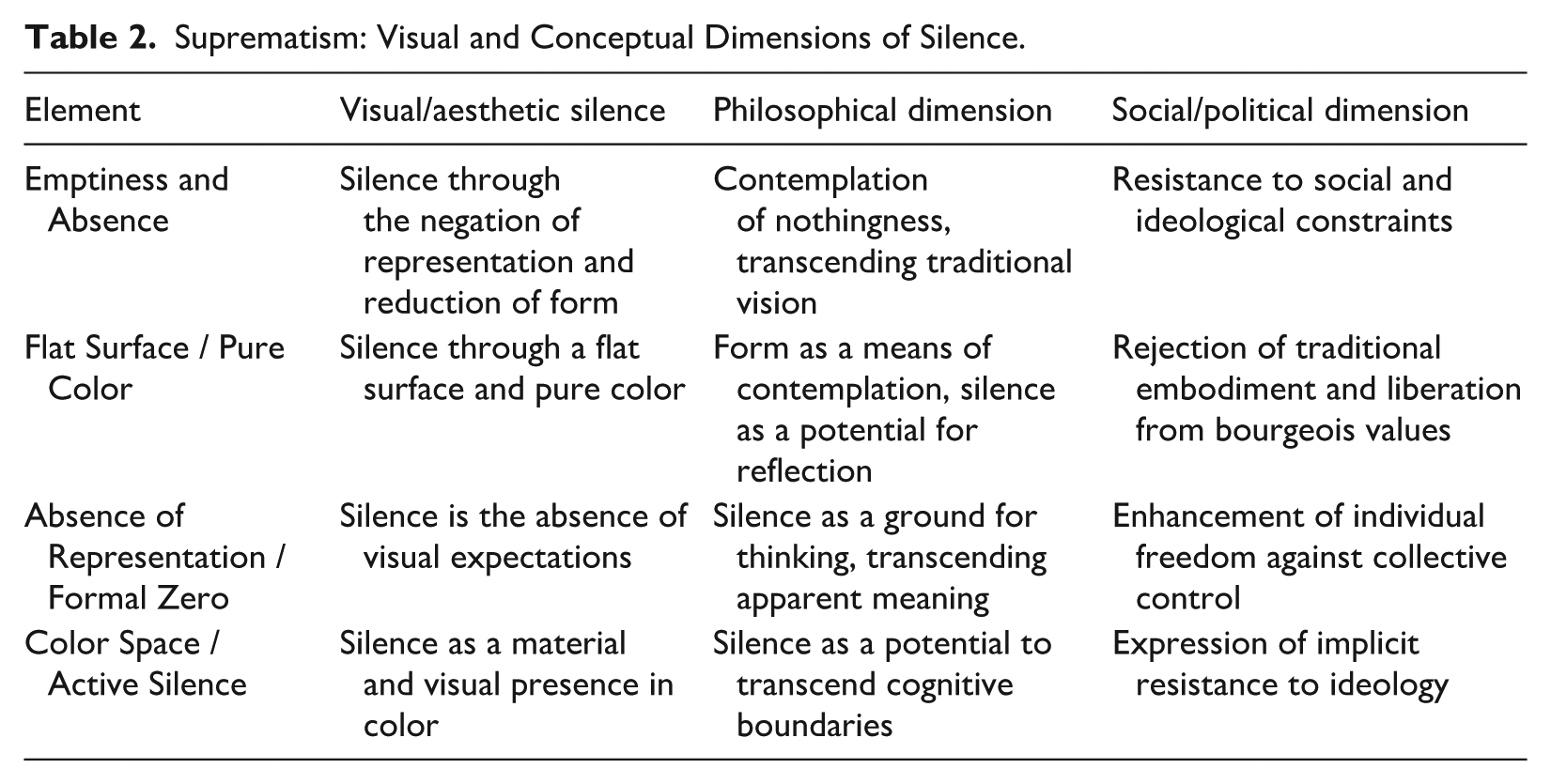
where the discernible absence of an expected element articulates meaning beyond the immediately visible, revealing a structural and ontological dimension of silence.
Silence in Malevich’s Suprematism is active, resistant, and generative. It is the silence of the void, the silence of pure surfaces, the silence that abolishes representation to allow thought to open toward infinity. This approach constituted a rejection of traditional visual conventions: Malevich’s Suprematist works carried implicit social messages about liberating thought and art from conventional visual and societal constraints. They were also part of a broader movement in pre-Revolutionary Russia, in which artists sought to transform the way people perceived the world and art, encouraging a rethinking of the role of art and society. Through Suprematism, we encounter an invitation to contemplate being at its threshold, where silence becomes the language of form reduced to its zero degree (Pihlaja, 2023).
Silence as Institutional Architecture in the Face of Chaos: Yves Klein
The artistic practice of Yves Klein is marked by a mystical and contemplative nature that transforms void and silence into existential categories. His engagement with the void was not the pursuit of nothingness for its own sake, but rather an attempt to create what he called a “sensitive pictorial state”—a state in which absence itself becomes an artistic event. This is most famously realized in The Void (1958), where Klein presented an empty gallery space, inviting audiences to experience silence as a material presence. The white walls, emptied of objects, resonated as an architecture of silence akin to what Brian O’Doherty later theorized as the white cube: a space that strips away noise and context, producing both contemplative transcendence and institutional exclusion. He engages with the void as “an opportunity to share in the experience of the here and now, as the manifestations of a young artist’s vision on a life liberated from the strictures of time and space” (Weitermeier, 2001, p. 31).
Klein’s fascination with the immaterial reached its most radical form in his invention of International Klein Blue (IKB), a color that he described as a space one could not see but could immerse oneself in. He deemed this blue to be “the colored space you cannot see, but you can immerse yourself in” (Girard, 2010, p. 31). For Klein, this deep blue embodied silence and infinity, allowing the viewer to dissolve into the void. His artistic void was thus a fertile ground for experience, a suspension of worldly structures that brought the audience into contact with a boundless present. Some visitors to The Void remained speechless for hours, while others trembled or cried, testifying to the performative force of silence as both presence and absence (Laudrin, 2025).
This engagement with silence extended beyond painting and exhibition into the domain of music. Klein composed La Symphonie Monoton-Silence (1960), in which an orchestra sustained a single note for 20 min, followed by 20 min of complete silence. This composition anticipated and paralleled John Cage’s 4'33", “the manifesto presentation of his definition of silence as the presence of ambient and unintentional noise rather than the complete absence of sound” (Branden, 1997, p. 85). In this composition, silence framed the ambient sounds of the environment as music.
“For Cage, any silence in Miesian architecture would not negate the environment but would open the building up to an interpenetration with its surroundings along the lines of Cage’s own definition of silence” (Branden, 1997, p. 89). In both cases, silence is revealed not as emptiness but as a temporal architecture: a framework that heightens perception, transforming the unnoticed into the audible. These works thus signify a marked departure from the conventional, intentional purposes of traditional classical music (Bindeman, 2017, p. 13). As Daniel Moquay of the Yves Klein Archive observed, the silence of Klein’s symphony became a collective, almost mystical experience: “After ten minutes, you could hear your saliva in your throat, and you find yourself contemplating with hundreds of people” (Thackara, 2017).
In Klein’s performances, silence and void were mediated by the body itself. His Anthropometries replaced the brush with women’s bodies coated in IKB, pressing their forms onto white canvases while the symphony unfolded. The 20 min of silence that followed resonated around these imprints—headless, voiceless, and emptied of individuality—as if to embody the very state of disappearance Klein sought. In this way, silence became both institutional architecture (the gallery), temporal composition (the symphony), and embodied inscription (the imprinted body).
Klein extended this logic in his Zones of Immaterial Pictorial Sensitivity, where he sold empty spaces as symbolic transactions of immateriality. Here, silence and void were commodified yet also liberated, opening the boundaries between art and life. His final gesture, immortalized in the staged photograph Leap into the Void (1960), condensed this trajectory into a single image: the artist hurling himself into emptiness, surrendering to silence as the ultimate form of freedom.
The Void offered a space in which there existed a complete dissolution of boundaries – not only of lines, form and horizons, but also of the boundary between the observer and the object of observation, between the art ‘space’, the audience and indeed the artist himself. (Brady, 2018, p. 6)
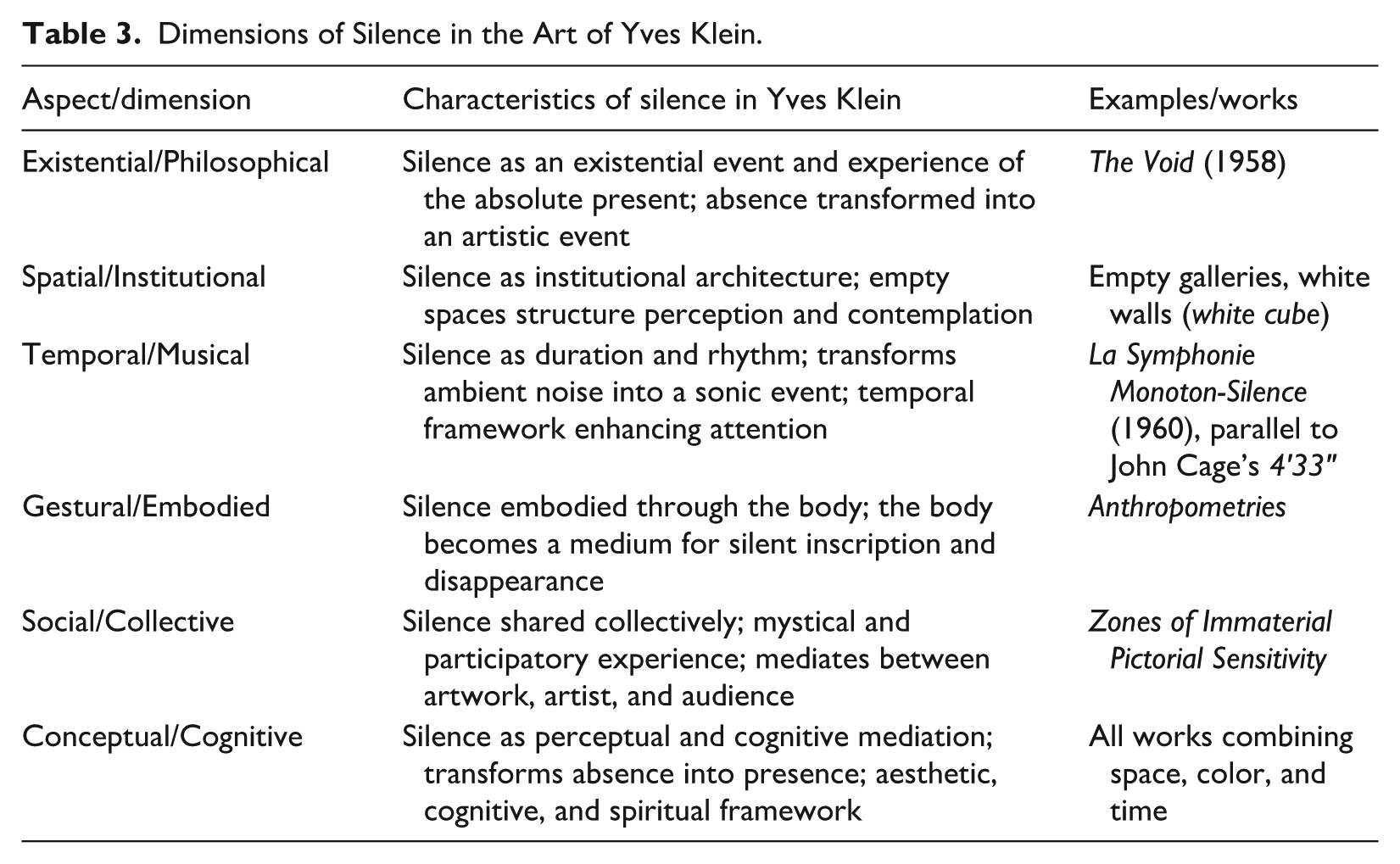
As shown in Table 3, silence in the art of Yves Klein unfolds across multiple dimensions (existential, spatial, temporal, gestural, social, and conceptual), each contributing to its transformation into an aesthetic and perceptual event. Philosophically, silence can be understood as a structuring presence that organizes experience. In architecture, silence manifests as spatial intervals and voids that shape perception, guiding attention and fostering contemplation; the empty hall or the carefully proportioned void becomes a temporal and cognitive framework within which presence is felt more intensely. Similarly, in music, silence functions as a temporal architecture that heightens auditory perception, transforming what is ordinarily unnoticed into a profound sonic event. This conceptual parallel is exemplified in the works of Yves Klein and John Cage, where the absence of intentional sound foregrounds ambient noise, inviting listeners into a reflective, participatory encounter with sound. In both architectural and musical contexts, silence frames experience, giving form and meaning to what surrounds it. Thus, architectural silence and musical silence converge: both operate as mediums through which absence becomes presence, structuring aesthetic, cognitive, and even spiritual engagement. (Laudrin, 2025)
Dimensions of Silence in the Art of Yves Klein.
By situating Klein’s practice alongside Cage’s redefinition of musical silence and O’Doherty’s theorization of the white cube, we can understand his work as a radical experiment in the institutional and perceptual architectures of silence. Whether in the gallery, the concert hall, or the void of color, silence emerges as an active medium of attention, a symphony without sound that reshapes both art and perception.
Performing the Void in Theater: Silence as a Reflective and Existential Practice
Silence has long occupied a paradoxical place in the theatrical tradition. Far from being an absence or a void, it often functions as a powerful presence on stage, shaping rhythm, atmosphere, and meaning. Silence interrupts dialogue to open spaces of reflection, amplifies tension, and draws attention to the unsaid as much as to the spoken word. In many cases, it allows audiences to engage with the performance on a deeper sensory and emotional level, as silence communicates what language cannot articulate. Thus, within the dramaturgical economy of theater, silence becomes an active force that reframes speech, gesture, and perception.
In Beckett’s dramaturgy, silence functions simultaneously as a negation of language and as an existential affirmation of being. Whereas silence in the visual arts often assumes metaphorical or symbolic forms, in Beckett’s theater it is embodied through gestures, bodily postures, pauses, and fragmented dialogue. Silence becomes a gestural language, producing meaning through absence. Techniques such as mime and pantomime, which Beckett admired in silent cinema and clown traditions, underscore the idea that silence constitutes a semiotic system in which emptiness conveys more than speech (Solé, 2025).
Beckett’s plays reflect the devastation and existential anxiety of the post–World War II period. His use of silence is not ornamental but essential: it exposes the limits of language and dramatizes the collapse of communication. As González observes, playwrights of the Absurd rejected traditional language because of its inadequacy in conveying individual experience; silence thus emerged as the most meaningful communicative element. In Beckett’s theater, silence appears as pauses, mutterings, or sudden eruptions of sound that fracture dialogue and reflect the disorientation of human life. (González, 1993, p. 205)
In Waiting for Godot (1947), silence structures the dramatic rhythm of the play. The endless waiting for the absent figure of Godot is punctuated by pauses and empty intervals, highlighting the futility of speech and the absurdity of waiting. These silences embody the void at the heart of existence: not emptiness but a fullness of meaning, what Beckett sought as utter silence in which no word is spoken. As Simpson (2022) notes, Beckett orchestrates verbal fragments—often improvised and unintelligible—that are immediately succeeded by contemplative silences, turning the gap itself into a site of meaning (p. 112). Such silences are not interruptions but spaces of resonance, enabling reflection and existential awareness.
Beckett’s late works show a gradual reduction of language. His play Breath (1969)—half a page long, with no characters or dialogue—epitomizes his fascination with emptiness. The entire piece consists of a cry and the sound of breathing, foregrounding silence as both the subject and structure of performance. This radical reduction reflects his rebellion against the chaos of modernity, in which speech had become mere “chatter,” severed from truth. As Roche (2009) argues, Beckett’s poetics of silence disrupts Aristotelian causality, situating the audience in a space where meaning arises from gaps, repetitions, and pauses. Silence thus becomes Beckett’s existential language: a way of confronting nothingness, exposing the triviality of life, and revealing that “there is meaningless speech and meaningful silence” (Ephratt, 2008, p. 1918).
The movement discourse represents one of the most prominent elements of the Theater of the Absurd, as Beckett focused on distorting verbal expression and obscuring it. Loevlie (2003) states “Silence, precisely because it is not a defnable, graspable thing, is subject to numerous different understandings and can be used [. . .] to make it serve many purposes” (p. 9).
Movement became a fundamental means of expressing what concerns humanity, transforming movement discourse into a way to articulate the hidden forces residing deep within the human self. Consequently, movement takes on a crucial role in expressing human emotions more authentically. Thus, the actor abandons the realistic aspect of performance and presents the audience with lost characters who are often silent, and when they do speak, they utter repetitive and disorganized discourses, considering that human existence persists even in silence. “Language can only deal meaningfully with a special, restricted segment of reality. The rest, and presumably it is the much larger part, is silence” (Steiner, 2010, p. 30).
While Beckett’s silence operates in temporal and linguistic registers, Peter Brook radicalizes this principle by extending it into spatial and phenomenological dimensions. Beckett situates meaning in the pauses and gaps of language, staging an existential dialogue with nothingness. Brook, in contrast, transforms silence into a tangible force: the “empty space” as both container and generator of theatrical presence. Thus, the temporal poetics of Beckett’s silence finds its spatial counterpart in Brook’s architecture of emptiness, linking linguistic absence with the experiential dimensions of stage space (Profit, 2025).
Peter Brook radicalizes this theatrical silence by extending it into spatial and phenomenological dimensions. His concept of the “empty space” foregrounds silence not merely as absence of sound but as a generative condition for theatrical creation. “I can take any empty space and call it a bare stage” (Brook, 1996, p. 7). For him, silence creates space, and space generates silence: the two are inseparable in performance.
Brook distinguishes between “dead silence”—the inert quiet of dust, stone, or the graveyard—and “living silence”—the resonant stillness of a cathedral (Guillon, 2019, p. 6). Theatrical silence, for Brook, must be a “living silence”: a presence that enables imagination and communion between actors and spectators. Silence here becomes institutional architecture: the white cube of theater, the stage emptied of distractions, where silence frames action and makes visible the invisible.
In The Empty Space (1968), Brook insists that theater begins with silence: one person crosses a stage while another watches in silence. This minimal situation constitutes the very essence of theater. Silence thus reorganizes the relationship between stage and audience, actor and spectator. It creates a void that must be filled with imagination, rendering performance a co-produced event where silence itself becomes the medium of communication.
Brook’s phenomenology of silence resonates with his insistence on purification: stripping theater of decorative conventions to reach the emotion itself. Silence here functions as both support and departure point, enabling the emergence of thought and the birth of an idea. In this way, silence is not negation but potentiality—an open field for creativity. Brook’s Between Two Silences (2006) encapsulates this philosophy: theater is born between the silence of the performer and the silence of the spectator (Daly, 2024).
Brook’s conception of silence resonates with anthropological observations of ritual and social practice, wherein the absence of sound is not emptiness but a productive force that generates social and cultural meaning. In this way, the theatrical space becomes an extension of the communal, transforming silence into a medium through which presence, interaction, and shared understanding are articulated. “Recently, anthropologists have taken the analysis of silence in yet other directions. They have done so, for example, by demonstrating how silence can be a form of care or respect” (Dragojlovic & Samuels, 2023, p. 3).
For Brook, silence is inseparable from space. The void is a contemplative arena. “It’s like silence. We cannot describe it. But when all the noise has been removed, silence appears by itself” (Guillon, 2019, p. 4). His empty space thus becomes an existential architecture, shaping the actor’s body, the rhythm of the play, and the reception of the audience.
As shown in Table 4, modern theater reconfigures silence as both a temporal-linguistic and spatial-phenomenological structure, revealing its existential and cultural dimensions. When Beckett’s rhetoric of silence meets Brook’s empty space, we recognize silence as a theatrical technique that reorganizes the very conditions of performance. Beckett deconstructs language, using silence as a poetic rebellion against the inadequacy of words and the absurdity of life. Brook extends this rebellion spatially, treating silence as the architecture of theater itself. So, “Directors have employed silence, not giving direction, to empower actors’ artistic freedom or to build suspense and uncertainty, not only among actors/characters but also between the audience and the stage, as well as between characters and the aesthetic staging” (Werner & Benyamine, 2025, p. 109).
Comparative Dimensions of Silence in Modern Theater: Beckett and Brook.
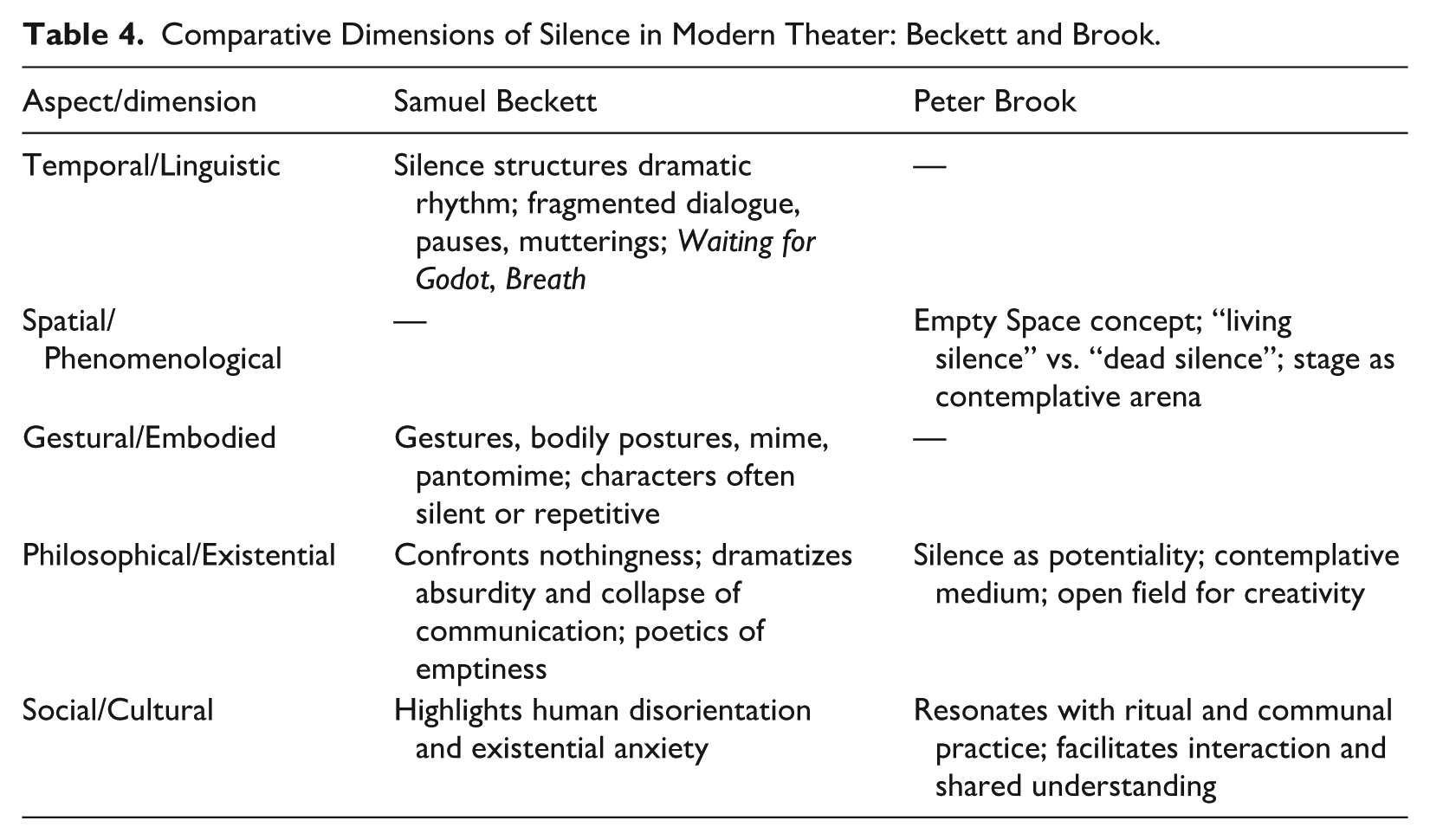
Together, Beckett and Brook illustrate how silence functions as existential language in theater. Beckett’s silences dramatize the collapse of communication, while Brook’s generate a contemplative void that invites co-creation. Both demonstrate that silence is never a passive absence: it is an active presence, a performative gesture that creates meaning, redistributes attention, and opens theater to philosophical inquiry. In this way, silence transcends theatrical technique to become a cultural and existential force—criticizing language and society in Beckett, while structuring the stage as an architecture of potentiality in Brook. Silence speaks, emptiness resonates, and theater mirrors the human condition.
Audience Co-Production in Abramović: Silence as Gendered, Social, and Political Practice
Silence in performance art emerges as a dense field of relations where presence, attention, and vulnerability converge. It is never a neutral backdrop; rather, it is a medium through which time thickens, bodies resonate, and the invisible bonds between artist and spectator acquire form. Within this horizon, silence becomes both an aesthetic condition and an ethical demand, calling the audience to inhabit the work as co-creators of its unfolding. To remain in silence, to share its weight and duration, is already to participate in the event and to accept its transformative potential.
Marina Abramović, a seminal figure in contemporary performance art, has systematically explored silence as an expressive, participatory language, transforming it into a site of ethical, psychological, and existential inquiry. Her approach extends the concept of the silent body beyond a mere aesthetic or meditative gesture; silence becomes a medium through which she interrogates human nature, social structures, and the relational space between artist and audience. Abramović’s performances are characterized by the radical exposure of her body, extreme temporal endurance, and the transformation of her presence into a silent communicative vector that invites audience co-creation of meaning.
In Rhythm 0 (Naples, 1974), Abramović enacted one of the most provocative demonstrations of silent embodiment. Positioned motionless for 6 hr, she relinquished all control to the audience, providing 72 objects ranging from benign items such as flowers, a feather, and a rose, to potentially lethal implements, including scissors, a loaded gun, and whips. A sign declared, “I am an object. Do with me what you will; I take full responsibility” (Brouquet, 2009, p. 200). Here, silence operates as a structured openness, a communicative void in which human projections, anxieties, and latent aggression manifest through direct physical interaction. The audience is compelled to negotiate the boundaries of action, consent, and ethical responsibility in real time. Some participants enacted care, others inflicted harm, creating an unstable, morally charged environment (Gitau, 2025).
Abramović noted that the most striking dimension of the performance resides in the diverse projections it evokes upon women. From this vantage, “the feminist praxis casts a particular light on the question of silence and on its boundaries. Moreover, it invites us to reflect on how we perceive silence, how we define it, and—most importantly—how we experience it” (Edwige, 2024, p. 31), as a relational medium through which the internalized silence of women may be confronted, negotiated, and ultimately transcended. “In feminist activism, the idea of a need to ‘break the silence’ has recurred throughout the twentieth century. From the suffragette movement’s work to achieve the vote, being able to speak about and influence politics” (Werner & Benyamine, 2025, p. 110).
The silent body in Rhythm 0 functions as a vessel for both vulnerability and revelation. The immobility and absence of verbal communication amplify the symbolic density of the work: each gesture, each choice by the participants, becomes a unit of meaning. Silence, therefore, is not passive; it is dynamic, productive, and provocative. Through the audience’s interventions, the artwork extends into the social and ethical consciousness of the participants, rendering each act a reflection on human agency, complicity, and the potential for both cruelty and empathy.
This approach was also advanced by Ana Dragojlovic within an anthropological framework aimed at unsettling intergenerational silence by activating both personal and collective histories of violence and loss. In this context, the practice of tracing silence in this context manifests as an act of haunted speakability, which Dragojlovic suggests has been shaped by intergenerational aspirations to visibilize personal and collective injuries. (Dragojlovic & Samuels, 2023, p. 4)
In The Artist is Present (MoMA, 2010), Abramović extended this exploration into relational and temporal dimensions. She invited participants to sit silently across from her in a stark, empty space, sustaining a prolonged gaze without verbal exchange. Across 736 hr and 30 min, she maintained unwavering attention to each participant, creating a shared silent presence that functioned as a nonverbal communicative medium. Some participants lingered for minutes, others for hours, engaging in an embodied, contemplative dialogue mediated entirely through presence and attention. Silence here is no longer a passive condition; it becomes co-constructed, relational, and temporally expansive, allowing participants to experience the weight, duration, and ethical resonance of shared stillness (Day, 2024).
Abramović’s work highlights the active role of institutional governance in structuring silence as a participatory experience. The museum or performance space is not merely a backdrop; it is a co-producer of meaning. In Rhythm 0, the spatial arrangement of objects, the temporal limits, and the clear instructions to the audience function as governance mechanisms, framing the ethical and phenomenological parameters within which silence unfolds. In The Artist is Present, the institutional control of space, duration, and audience circulation is even more pronounced: the empty chairs, the strict conditions for engagement, and the curated absence of distractions create a context where silence can fully emerge as a shared, relational phenomenon, inviting reflection on its emergent and contingent qualities. In this light, silence can indeed be understood, as observed, as “a dynamic, emergent, and contingent resource deployed strategically in communicative events” (S. Muller, 2022, p. 3646).
In both cases, silence is embedded within the operational logic of the space: it is through the controlled environment, audience interaction, and adherence to performative protocols that silence acquires its experiential and aesthetic potency. Participants are not passive spectators; they become co-authors of the silent narrative, shaping the temporal, ethical, and emotional dimensions of the artwork through their presence, attention, and choices.
Central to Abramović’s use of silence is the ethical interrogation of agency. In Rhythm 0, she surrenders all bodily autonomy, creating a situation in which participants confront the ethical consequences of their actions or inactions. The audience becomes acutely aware of the moral weight of each choice, the potential for harm, and the responsibility inherent in engagement. Silence amplifies this ethical dimension: the absence of verbal mediation forces participants to navigate the tension between curiosity, empathy, and aggression without the comfort of narrative or explanation.
In The Artist is Present, ethical agency is subtler yet equally profound. The silent encounter demands attentiveness, presence, and mutual respect, placing participants in a reflective posture that foregrounds the relational ethics of co-presence. Silence becomes a space in which the ethical stakes of attention, recognition, and emotional vulnerability are enacted, without the mediation of language. Abramović’s performances reveal that silence is not neutral; it is a site where moral, psychological, and social imperatives intersect, exposing both the latent capacities for care and the dangers of neglect or disengagement.
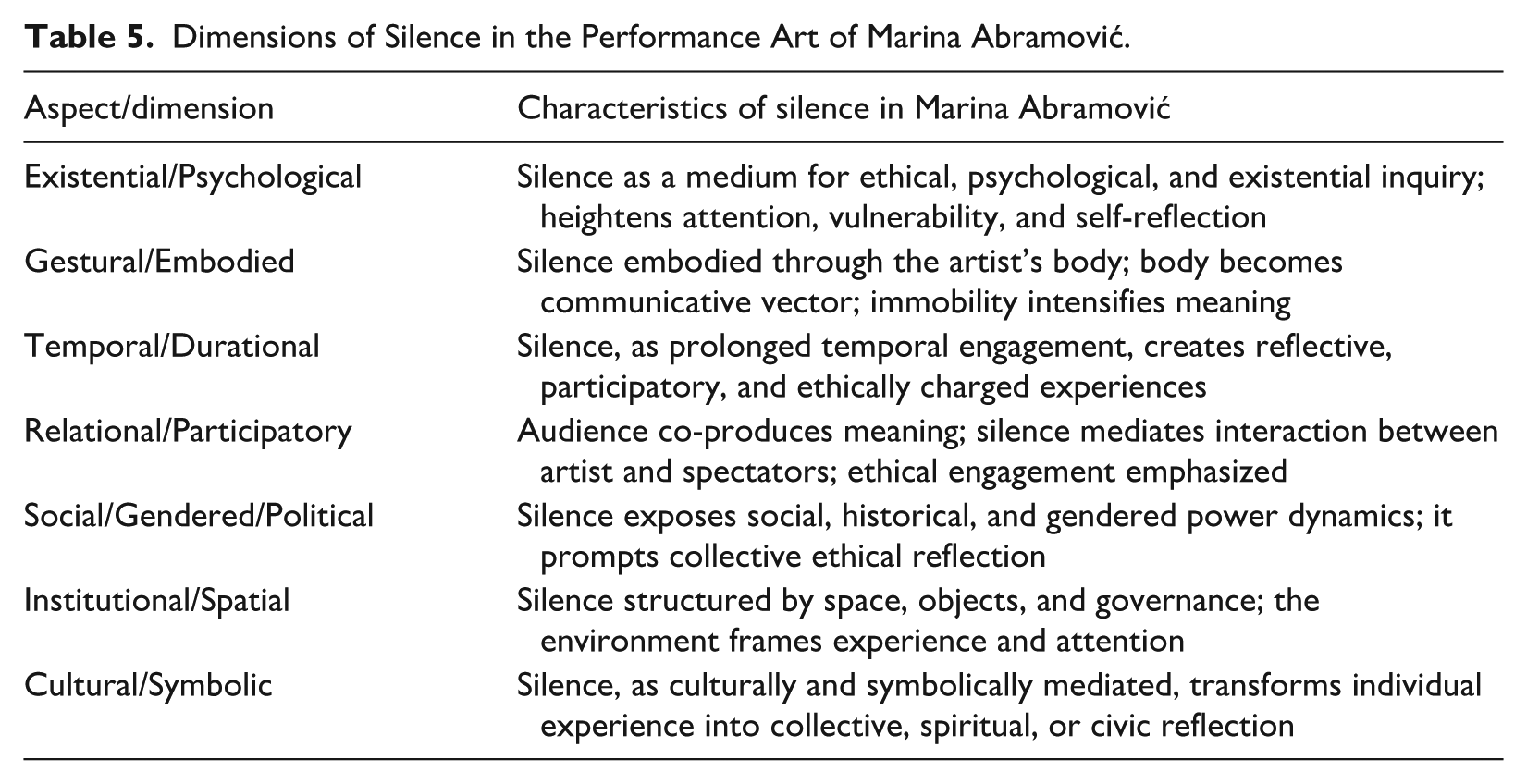
Abramović’s exploration of silence also operates at a cultural and symbolic level. In Rhythm 0, silence becomes a mirror for the social, historical, and gendered dimensions of power, aggression, and empathy. By subjecting her body to audience action, she exposes the vulnerabilities historically imposed on women, while simultaneously generating a collective ethical reflection on human behavior. In The Artist is Present, the silent gaze functions as a mechanism for shared contemplation, empathy, and spiritual presence, creating a form of collective participation that transcends individual experience. This encounter can be interpreted as a therapeutic and spiritual engagement, where the audience becomes attuned to a subtle relational rhythm, sensing comfort and connectedness through the very act of shared silence. Table 5 synthesizes these dimensions of silence in Abramović’s work, emphasizing its articulation across embodied, relational, temporal, and cultural registers. As articulated, “silence is most productive when used after the formation of a strong therapeutic alliance; the use of silence is most effective when clients feel comfortable, safe, and trusting” (Montgomery et al., 2023, p. 283), highlighting how silence, when relationally situated, unfolds as a dynamic and transformative resource.
Dimensions of Silence in the Performance Art of Marina Abramović.
In 2024, during the Glastonbury Festival of Contemporary Performing Arts, Abramović orchestrated 7 min of silence for over 250,000 participants, inviting them to reflect on global environmental and humanitarian crises. Here, silence achieves civic, symbolic, and participatory dimensions: it is collectively embodied, ethically resonant, and culturally mediated. Silence, in Abramović’s practice, emerges as a performative and participatory medium through which ethical reflection, social critique, and existential awareness converge (Day, 2024).
By transforming silence into a shared, ethically charged, and culturally significant experience, Abramović establishes the silent body as both a medium and a site of co-production, inviting audiences to engage with themselves, their choices, and the broader social and existential conditions they inhabit. In this way, silence is elevated from absence to an active, participatory, and ethically potent element of contemporary performance art.
Discussion
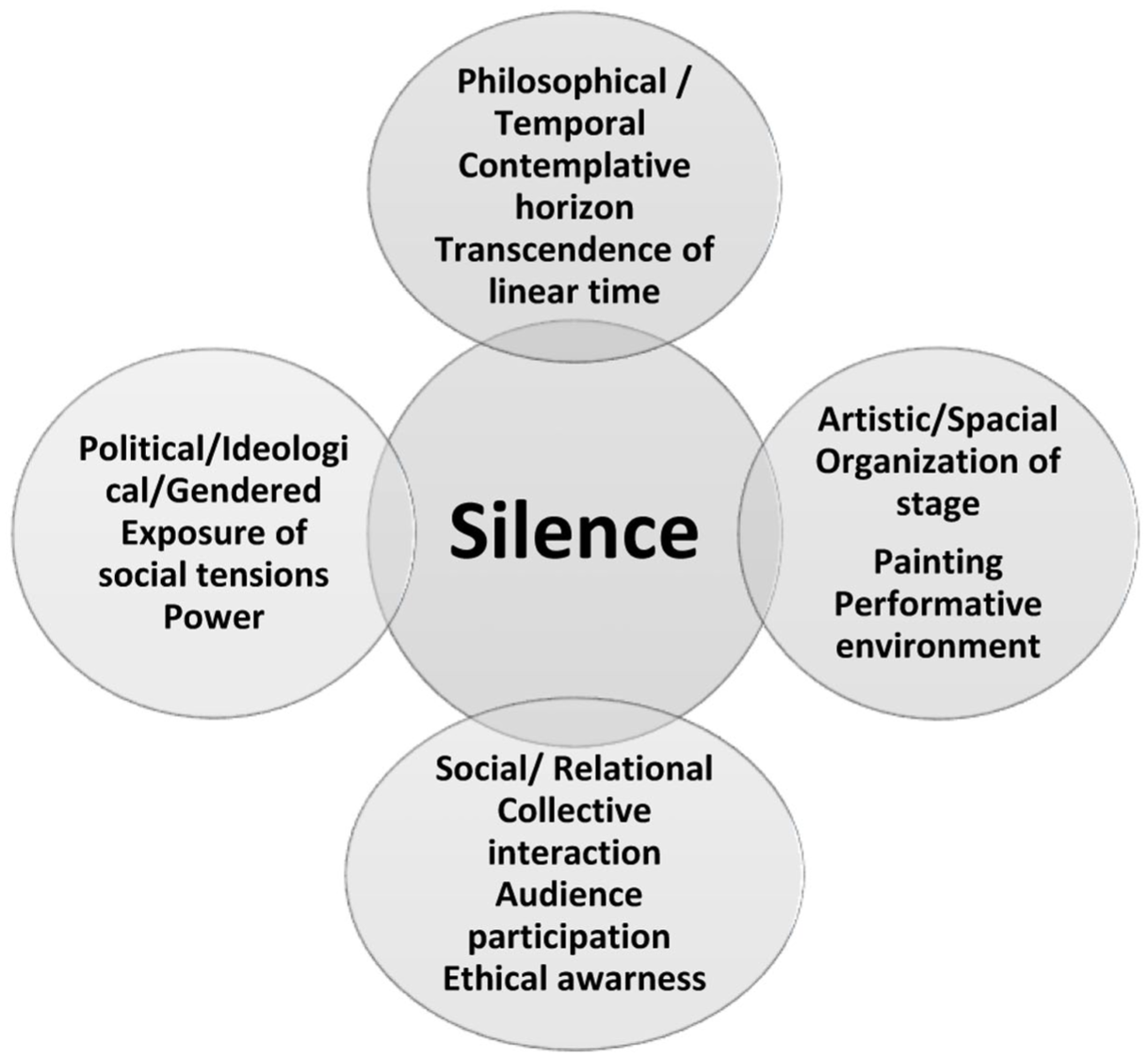
This study integrates philosophical inquiry, artistic analysis, and audience-centered observation to demonstrate that silence is not merely the absence of sound but a spatial and architectural condition in which relational interactions between bodies, objects, and spectators emerge. When silence transforms into a spatial void, it imposes a distinct rhythm that compels participants to recalibrate their perception of the surrounding world, rendering silence a dense presence that fills the space with vision and contemplation. This interactivity is not confined to the individual level; it extends to the social and intellectual structures of the artwork. Silence can simultaneously assume ideological, gendered, and political dimensions, revealing hidden tensions and power dynamics within society while providing a space for collective critical reflection.
Philosophically, silence constitutes a temporal horizon that transcends ordinary linear time. Between the moments of sonic absence and spatial void, a space opens for thought, creativity, and cognitive engagement, where the conscious presence of participants or spectators becomes an integral part of constructive reflective action. In this sense, artistic silence—whether in a painting, the organization of performance space, or the arrangement of performative elements—can weave new relations between bodies, objects, and place, transforming the sensory experience into one that is simultaneously aesthetic and ethical.
On the social level, silence becomes a medium for collective interaction, whereby the audience actively participates in the production and interpretation of the work, becoming aware of the implications of another’s silence on themselves and their environment. When spectators experience silence in the presence of the artist’s body, as in the cases examined in this study, a network of ethical and social reflections emerges. Silence demonstrates its capacity to activate awareness of individual and collective responsibility, turning participation in performance into a potentially political or protestive experience that mirrors societal values and tensions.
In this context, silence transforms from a symbol of submission or social oppression into an act of protest and a moment of shared awareness that reconstructs the relationship between the individual and the collective. In this sense, silence becomes a civic and participatory condition that enables the restoration of collective sensibility and the recovery of human values in a world saturated with verbal and symbolic noise.
When artists choose silence in performance or visual composition, they redistribute the balance of power between presence and absence, between sound and void, revealing the structures of authority that govern social and political expression. Artists have employed silence as a subtle language of resistance that exposes the mechanisms of dominant discourse without engaging in its direct confrontation. This is particularly evident in feminist practices that turn the silent body into a space for questioning patriarchal authority, or in performative works where silence becomes a form of symbolic disobedience against the clamor of political and media rhetoric.
These artistic transformations have reverberated within the social consciousness, giving rise to new cultural phenomena that rebel against passive silence and reinterpret it as both an existential and protest value. Today, we witness collective moments of silence in civic and political spaces as acts of symbolic solidarity, the return of conscious withdrawal as a stance against the acceleration of digital time, and an increasing reliance on bodies and gestures as expressive alternatives to direct discourse.
Reconfiguration of aesthetic, intellectual, and social experience of silence.
Thus, art has contributed to the re-creation of silence as a dynamic social phenomenon capable of exposing the latent tensions within collective discourse and generating new forms of expression and awareness. In this way, silence extends from the artistic domain into the social sphere, becoming a philosophical, political, and aesthetic language that redefines the very meanings of speech, listening, and human participation in an increasingly noisy and fragmented world.
Conclusion
This study has sought to interrogate silence as a void and as a generative condition that traverses artistic, aesthetic, and cultural domains. By disentangling silence from its frequent conflation with emptiness or muteness, the analysis has emphasized its multiple registers—acoustic, spatial, performative, and ethical. What emerges is that silence functions less as a negation of expression than as a medium that intensifies presence, reconfigures perception, and invites forms of participation that are at once embodied and interpretive.
Through the comparative movement between visual and performative arts, the research has demonstrated how silence acquires meaning in diverse modalities: in Munch’s Silent Scream, in Malevich’s white abstraction, in Klein’s void, in Cage’s music, in Beckett’s dramaturgy of pauses, in Brook’s empty space, and in Abramović’s radical performances. Each case illustrates how silence is situated, shaped by specific artistic strategies, cultural contexts, and audience interactions.
The central finding is that silence operates as a co-constructed field where artist, work, and spectator converge. Whether through the contemplative stillness of painting or the participatory endurance of performance, silence becomes a practice of relation, an ethical demand that destabilizes habitual modes of seeing, hearing, and feeling. In this sense, silence is both method and message: a rhetorical and semiotic force that resists closure.
At the same time, the analysis reveals the importance of spatial silence; the architectural and environmental conditions that frame how silence is perceived and enacted. From the blank walls of the white cube to the ritualized emptiness of theatrical space, silence inhabits material structures that shape its resonance. In this way, silence is never disembodied; it is grounded in place, in atmospheres, and in the social geographies of spectatorship.
By reframing silence as a dynamic, spatially grounded, and participatory experience, this research defends the initial problematique: silence is not ancillary to artistic discourse but constitutive of it. It is precisely through silence—whether acoustic, spatial, or performative—that art reveals its power to unsettle, to connect, and to reimagine the conditions of human presence in a world marked by noise, fragmentation, and overcommunication.
Footnotes

Funding
The author received no financial support for the research, authorship, and/or publication of this article.
Declaration of Conflicting Interests
The author declared no potential conflicts of interest with respect to the research, authorship, and/or publication of this article.