







Abstract
In recent years researchers have contributed a great deal to our shared understanding of the complexities of studio practices, which are widely regarded as a centre-point of higher education music. This article investigates an aspect of studio learning that does not lend itself easily to scrutiny, by drawing common issues from the cases of two students who, exceptionally, reported dissatisfaction with the approaches taken by their current teachers. These issues, loosely grouped under the metaphor of dissonance, are explored through interview and observation evidence, in terms of the balance of activity within lessons, turn taking, and encouragement. The study gives rise to questions that might be applied, arguably, in any studio setting.
Keywords
Introduction
In research focused on higher education music, there are regular references to the importance and efficacy of studio-based learning, and the associated one-to-one teacher–student relationship (for example., Burwell & Shipton, 2011; Carey, Bridgstock, Taylor, McWilliam, & Grant, 2013; Gaunt, 2008, 2010; Presland, 2005). Increasingly over the last generation, researchers have turned their attention to studio practices, with a tendency to produce what Jørgensen (2009) has described as “micro-studies” investigating individual approaches in a variety of settings (p. 190). The variety is so wide that it is difficult to make generalisations, although occasional references are made to a tradition of somewhat limited approaches to teaching, based on technique, demonstration and modelling. Previously we have referred to the studio setting as being something of a “secret garden” (Young, Burwell, & Pickup, 2003, p. 144), but as we learn more, “it is becoming clear that the teaching–learning transaction is more complex than its critics might have imagined” (Polifonia Working Group, 2010, p. 37). In “the largest European project studying issues related to higher music education to date” (p. 5) the “Polifonia” Working Group for Instrumental and Vocal Music Teacher Training has emphasised a varied and quickly evolving state of affairs:
Research has addressed both musical and pedagogical dimensions and has highlighted the individualised and contextualised nature of the process. In recent years, in many countries, the focus of the pedagogical discourse has shifted from the teacher to the student, from the musical product to musical processes and from teaching to learning. … There is a greater emphasis on more creative approaches, on developing student autonomy, on teaching students how to learn. Learning is seen in terms of developing ways of musical thinking rather than merely the acquisition of specific skills. (Polifonia Working Group, 2010, p. 37)
Often in this shift of discourse, practitioners have opened the doors of their studios, admitting and sometimes working with researchers to develop a better, shared understanding of studio practices (Hultberg, 2005; James, Wise, & Rink, 2010; Johansson, 2013; S. G. Nielsen, 2010). Even so, the studio setting itself is not conducive to the sharing of ideas, among participants or between participants and researchers, and there is much to be learned still about the complexity of studio practices. Thus Jørgensen (2009) calls for a good deal of further description, discussion and reflection (pp. 111–112).
The current paper draws on a close description of two related case studies, in an effort to problematise aspects of studio learning that do not lend themselves easily to scrutiny. In particular, it pursues the nested case studies of undergraduate students who, exceptionally, reported that their current teachers’ approaches were not appropriate for them, at their current stages of development. The aim of this article is to contribute a little further to an understanding of what might be at issue in such cases. What might be learned from a comparison of two “dissonant” case studies, and how might that contribute to our understanding of the complex and varying dynamics of studio practices?
Dissonance in the studio
The case studies identified for comparison were nested in a broader project exploring studio practices in a university music department, through questionnaire, interview and video data collected from nine studio teachers with three students each. When the students were asked to characterise their current teachers, and to comment on the appropriateness of their approaches, only two of the 27 replied in directly negative terms. These were Sandra, a singer, and Gavin, a guitarist. An attempt to identify what might be at issue in the studio practices experienced by each was made through the “rich transcription” of the cases, cross-referencing interview data with an analysis of the verbal, nonverbal and performance behaviour in their filmed lessons; the varying possible issues were loosely grouped under the metaphor of dissonance (Burwell, 2016a, 2016b).
There were limits in the application of this or any metaphor, in the sense that metaphors are literally false, “or true only ‘in passing’” (Scruton, 1997, p. 91). The use of a metaphor enabled reference to details as yet unspecified, their causes and scope unknown, though their presence might be glimpsed in reports of student dissatisfaction. “Dissonance” was transferred from the context of music because it implied a want of resolution without suggesting single causes, instead evoking a confluence of forces and the tensions among them. One of the limitations of the metaphor lay in the non-longitudinal nature of the study, which was based on single observations and interviews: these would not offer the opportunity to gauge the effects of the dissonance in either the long or short term, although they did allow an exploration of the moment, seeking and describing behaviours that might be associated with it.
In that “moment”, Sandra and Gavin stood out among the student participants, for reporting dissatisfaction with their current teachers’ approaches. Of course, reports cannot be corresponded simply to instances of dissonance in the studio; it remains an open question among discourse theorists how far interview respondents can be regarded as having stable psychosocial characteristics that might explain their own behaviour, and as being reliable sources of information about their social world (e.g., Hammersley, 2003; Potter, 2003). The interview evidence must be interpreted with care, and—regardless of the degree of care—the interpretation cannot be sufficient to support simple generalisations about the nature or frequency of dissonance in the studio. However, a further study comparing the interviews of Sandra and Gavin, with each other and with those of the other student participants, supported the impression that reporting concerns about the approach taken by a studio teacher can be a delicate and difficult proceeding (Burwell, 2017). This was evident in the fabric as much as the content of the student interviews, in which critical comments about the teachers’ approaches were rare, and—when they did occur—were typically introduced and modified by verbal markers such as “I think” or “I feel”. Such an undertaking could appear to be quite effortful, as for example when one student offered a tentative reservation, saying “I think it is maybe, sometimes, with some people it seems it might be better for younger children”—instead of “It would be better for younger children” (Burwell 2017, p. 196).
Evidently, criticism of the approach taken by one’s teacher is felt to be out of order, and while this might be specific to the interview context, as a “distinct interactional form” that shares some of the characteristics of “institutional” discourse (Madill, 2011), it seems to be felt in other settings as well. Hanken (2011), investigating teacher and student attitudes to formal student evaluations, described expectations of appropriate behaviour that are “culturally embedded in the institution”, and added that even if individual participants interpret those expectations differently, their behaviour allows for the possibility that others might be “carriers” of them (p. 253). Students may feel, or think that others feel, that criticism of their teachers’ approaches is inappropriate, and this can constrain their behaviour not only in interviews and evaluations, but in lesson interactions. Thus Gaunt (2010), in an interview study with 20 conservatoire students, described one who wanted “a different emphasis in the type of feedback being offered” by her teacher, and who felt able to articulate that in an interview but not in a lesson (p. 193). A similar attitude was demonstrated by a colleague of Sandra and Gavin, who complained to the interviewer about the timing of her most recent lesson, but admitted that she had not raised the issue with her teacher: “You can’t just come out with it” (Burwell, 2017, p. 197).
Gaunt (2010) reported a student perception that teachers’ approaches were not to be negotiated, with nothing to be done about difficulties except in “extreme circumstances” (p. 193). In the research literature, the outcomes of dissonance in extremis tend to be reported indirectly, or anecdotally, with Hays, Minchiello, and Wright (2000) referring to “negative mentorship” and relationship “failures” (p. 8), and others referring to students changing teacher (Gaunt, 2010; Purser, 2005). The current study is not focused on such extreme cases; however, as I have argued elsewhere (Burwell, 2016b), short of reaching such an impasse in the studio setting, presumably lesser difficulties or “dissonance” are more common; and if these difficulties are not raised or articulated in the normal order of things, then it is assumed that they are resolved or borne in silence (Burwell, 2016a). “Dissonance” may never lead to a student changing teacher, but if changes of teacher are the only concrete indication of dissonance that we normally have, then it may be more common than we imagine. It must be important to investigate any evidence of dissonance in the studio, not only to pre-empt potentially destructive impulses in the relationship between teacher and student, but to better understand any undercurrents that may be undermining the success of their work together.
Procedure
Participants were involved on the basis of informed consent, and were assured of anonymity in reporting; consistent with the ethics protocols of the host university, the topics under study were not regarded as particularly sensitive, nor the participants particularly vulnerable. The data collection included the use of a questionnaire, asking for biographical details of participants, and their views of the areas of study and teaching strategies involved in their studio lessons; nine teachers were filmed, each giving single lessons to three different students, and shortly afterward the participants were interviewed individually about the lessons that had just taken place, and about their studio practices in general. All participants were invited to comment on whether the research camera had affected the conduct of their lessons.
The analysis of observation data involved both qualitative and quantitative strategies, which Yin (1998) asserts is characteristic of “the most desirable case studies” (p. 245), and particularly likely to occur in what he calls “embedded” cases which, although qualitative in design, may include quantitative data and analysis at the subunit level (p. 238). Maxwell (2010, p. 478) refers to numerical description as a complement rather than a substitute for qualitative information, with “simple counts” supporting terms such as “some, usually, or most” (p. 476; original emphasis). Such tools have been used in various ways, in exploring studio lesson behaviour: for example, Lindström, Juslin, Breslin, and Williamon (2003) asked conservatory students to estimate the percentage of their lesson time that was devoted to expressivity, while Young et al. (2003) counted the wordage devoted to the discussion of technique, within recorded lesson dialogue. Word-counts have been used also to clarify the proportions of dialogue contributed by teachers and students (Burwell, 2006, 2012; Karlsson & Juslin, 2008; Young et al., 2003), while incidents of performance activity have been timed and their frequency counted (Benson & Fung, 2005; Burwell, 2012).
In addition to giving more precise meaning to amounts and frequency, numerical description has helped to identify patterns of behaviour (Yin, 2013). One pattern sought, having been carried over from classroom research, is the incidence of “approvals” and “disapprovals” from the teacher (Colprit, 2000; Henninger, Flowers, & Councill, 2006; Yarbrough & Price, 1989; Zhukov, 2008), though Duke and Henninger (2002) have questioned the categorisation of correction as negative feedback, along with the assumption that our expectations of teacher behaviour should be the same in the studio and the classroom. Behavioural patterns have also been timed, with Benson and Fung (2005), for example, calculating the proportions of video observations characterised by teacher verbalisation, teacher modelling, and student behaviour, along with a range of subunits including positive and negative feedback. In each of these studies, numerical description complements qualitative information, and although this does not imply that the descriptions were complete—since description is inevitably selective, and no case study can account for everything (Yin, 1998, p. 235)—it draws attention to features of behaviour that are relevant to the research questions posed. In the current study, the use of numerical description also helps to facilitate the comparison of behaviours between two studio lessons.
The current study is nested in a broader research project, investigating studio lesson interactions. Within this project, four lessons were treated as nested case studies (Burwell, 2012, 2016a, 2016b), with lesson observations analysed through a range of qualitative and quantitative tools that were developed inductively. Non-verbal behaviour was described in terms of, for example, posture, mutual positioning, and gesture; performance behaviour was measured in seconds, and divided among categories that ranged from the exercise of the instruments through to simulated performance; and verbal behaviour was quantified in terms of wordage, and categorised according to its function. Lesson behaviour was considered in the light of questionnaire and interview evidence, as a way of enriching the account of lesson observations. This, according to Maxwell (2013), is the meaning of “thick description” as the term was originally coined by Ryle and Geertz: “description that incorporates the intentions of the actors and the codes of signification that give their actions meaning for them” (p. 138). The combination of multiple tools for observation analysis and participants’ views was described as “rich transcription” (Burwell, 2010, 2012).
The current study returns to data previously collected and analysed, and interrogates that data again, with the particular purpose of comparing the two nested, “dissonant” cases. These were identified as being particularly interesting, as previously mentioned, because when Sandra and Gavin were asked in the interviews whether their teachers’ approaches were appropriate for them at their current stages of development, they were the only students who gave directly negative responses. Their reported attitudes were very different. Even in their responses to the question about their teachers’ approaches, Sandra tended to emphasise the affective aspects of her learning, explaining how she felt about her lessons before moving on to the reasons for this: “I just don’t feel comfortable sometimes with it. I feel a bit let down” (Burwell, 2016a, p. 469). Gavin tended to emphasise the professional aspects of his lessons, from the perspective of a student musician who was already teaching, himself: “I want more self-discovery, exploring different ways of doing things” (Burwell, 2016b, p. 502). The exploration of what might be at issue in each of their lessons, again led to contrasting findings. The study of Sandra’s case tended to highlight issues concerning authority, trust and communication, while in the case of Gavin, the development of the student’s own critical thinking seemed to sit uncomfortably with the teacher’s friendly but perhaps inflexible signature style.
The purpose of the current paper is to seek and explore common issues in the analyses of the two dissonant cases. The findings are divided among three lines of enquiry that emerged through the inductive analysis of the individual case studies: contributions to lesson activity, overlapping behaviours, and feedback (Burwell, 2016a, 2016b).
Findings
In reporting the findings, participants are given pseudonyms: Sandra the singer is working with her teacher Theresa, and Gavin the guitarist is working with his teacher Tom. Where relevant, some sense of context is created through reference to other lessons given by Theresa and Tom, within the broader study. Remarks that are quoted from the lesson transcripts are labelled with the time of their occurrence, in minutes and seconds, thus m:s.
Contributions to lesson activity
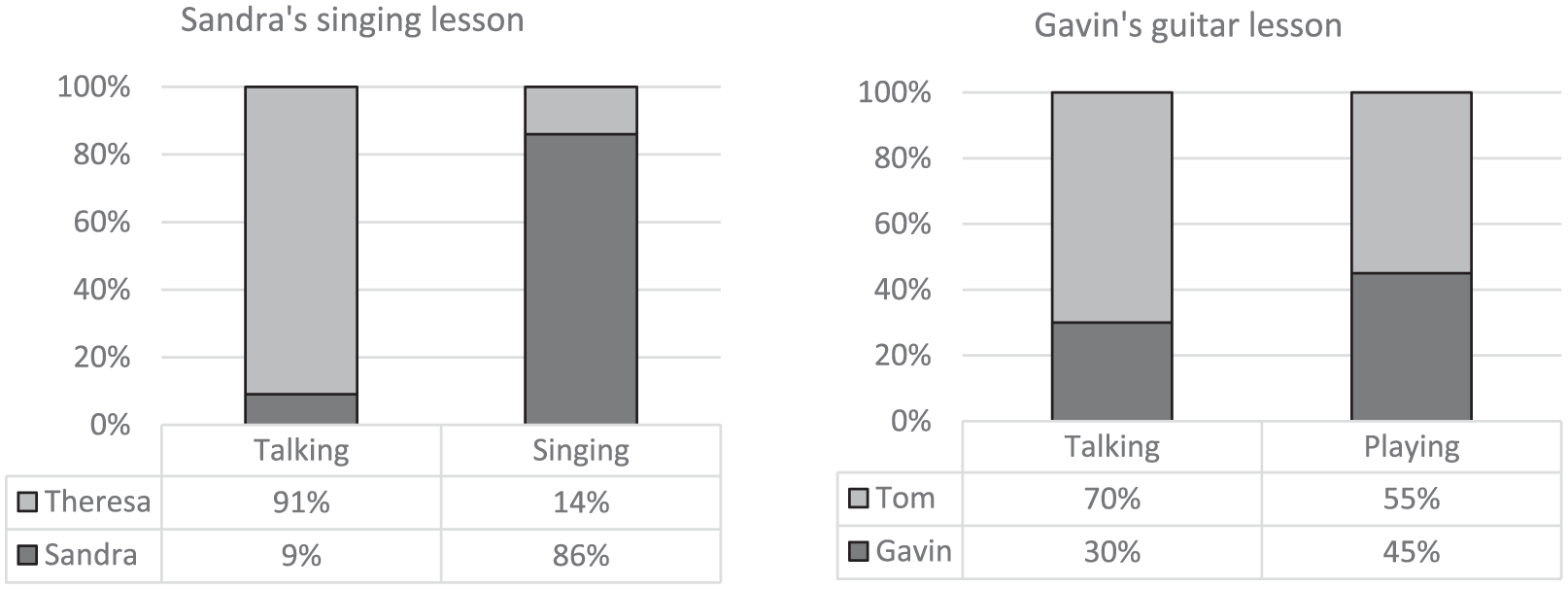
In each lesson, and for each participant, the verbal behaviour was quantified in terms of wordage, and performance behaviour was quantified in terms of seconds. The proportions are shown in Figure 1.
Balance of verbal and performance activity.
At a glance, the balance of activity between teacher and student might appear to be more striking in Sandra’s singing lesson. The proportions are almost symmetrical, with Sandra and Theresa contributing 9:91 1 of the wordage, and 86:14 of the timed singing, respectively. It is difficult to know whether this is a consistent feature of Theresa’s studio practices; the broader study includes two other lessons given by Theresa but they overlap substantially so that the students can work on a duet together, and this would undermine the validity of a comparison. The balance of activity in Gavin’s guitar lesson is quite different, with the contributions of teacher and student much closer to each other. It does seem striking however that here the teacher dominates both verbal and performance activity, contributing 70% and 55% respectively. These figures are reasonably consistent with the balance of activity in two further lessons given by Tom, whose average contribution across the three lessons on film amounts to 79% of the verbal and 55% of the performance behaviour.
Some of the participants’ attitudes to the balance of activity can be gleaned from the interview data. Sandra’s teacher Theresa worries in her interview that she has been too commanding with her student, as she explains in the extract below. The interviewer’s speech is shown in italics.
What sort of teaching approaches did you adopt in the lessons, and how did they differ, if they differed, for each student?
Well I know what—I’m pretty sure I know what I wrote on that [questionnaire] form a little while ago, you know, being a teacher that encourages my students to have their own opinions and all that sort of stuff.
Yeah
And I realised, as I was working through this afternoon, that gosh, I wasn’t doing that at all. Sorry, to go back to one of your [previous] questions, I think that’s one of the things that might be different from a normal lesson, this term. This term I’m more interested in getting them to performing stage than I am in encouraging their own—
Right. So that affected your strategies in the lessons?
Yes. Albeit completely subconsciously; I wouldn’t say that I thought “Oh yes, I need to—”
Yeah
[but] I told them what they were doing wrong, and gave them ideas on how to correct it. Until we’d got it corrected. (Extract from the interview with the teacher, Theresa)
This is not only because performance examinations are approaching: Theresa says that “Basically, [Sandra]’s got some good talent, but it feels to me that she doesn’t come very well prepared”, and in response to such an attitude, “I go into teacher mode”. For Sandra, however, the balance of lesson activity is not itself a subject of complaint. Indeed, in her interview she indicates a preference for allowing her teacher to lead, reporting that Theresa “really pushes” her regarding the connection between vocal registers, and that “I want her to really push me” to develop better performing skills.
Gavin’s teacher Tom explains in his interview that he has been much influenced by his own teacher, whose attitude was “not too academic”; he likes to take an open-ended approach, often asking questions, “because if you just tell them something it becomes ‘Tom’s law’”. Perhaps complementing that, Gavin remarks that Tom has a “very laid-back approach”; another of Tom’s students, involved in the broader study, describes him as “relaxed”, and a third explains that Tom is like a friend, “very easy-going, easy to talk to, which makes it easy to play, too”. However, while Gavin does not find Tom dominating verbally—“He didn’t actually say ‘do it faster there’, or ‘don’t do that’, or ‘do this’”—he asserts that he can be dominating in other ways—“So [today] his guitar was speaking to me and commanding me”. Gavin admits with a laugh that he has not discussed this with his teacher: “I just take what comes”.
Overlapping behaviours
In Sandra’s lesson, singing from either teacher or student occupies 43% of the total lesson time, while in Gavin’s guitar lesson, performance occupies 60%. Both of these figures include overlapping behaviours of various kinds.
In Sandra’s singing lesson the amount of singing is exceeded by the amount of piano playing, which is heard for a total of 45% of the lesson time. Sandra objects to this in her interview, “Because sometimes I find that [Theresa] is concentrating more on the playing”. She also raises the objection during her lesson, with the assertion “It’s a shame we didn’t have an accompanist here this morning” (28:49). 2 Perhaps more interestingly, although Sandra occasionally talks at the same time as her teacher, with an overlap of 48 words during the lesson, she never speaks while Theresa is singing, and rarely while the piano is sounding (five words). Theresa often leaves the piano pedal ringing while she talks (239 words); and it is tempting to associate this with Sandra’s relatively slight contribution to the lesson dialogue (Burwell, 2016a, p. 477). Theresa’s relatively slight contribution to performance behaviour includes some full-voiced demonstration, used most during the early, technical phase of the lesson and only sparingly thereafter, and many short half-voiced cues to Sandra while repertoire is being addressed.
The greater amount of performing time in Gavin’s lesson seems to be associated with a good deal more overlapping behaviour. Gavin and Tom rarely overlap each other when they are talking (20 words) but teacher and student are equally likely to talk over other behaviours, with the overlap representing 38% of the wordage of each. Each talks while the other is playing; they talk over their own playing; and sometimes they carry on talking while both of them are playing simultaneously. Once again this behaviour is reasonably consistent with the other two filmed lessons given by Tom, though in those lessons Tom proved more likely than his students to talk over other behaviours.
The willingness of the guitarists to talk over playing, or to play during talk, also seems associated with the quality of performance behaviours. Consistent perhaps with his “laid-back” approach, Tom rarely engages in formal demonstration, instead tending to try things out, generally in a leisurely way, and often “thinking aloud”, apparently to demonstrate his thought processes; there is also a good deal of what has been described as idling, with tuning, strumming and improvisation often merging more or less gradually into recognisable repertoire (Burwell, 2016b, p. 7). Gavin’s playing typically involves a good deal of stopping and starting, which might be linked perhaps to Tom’s dominance of performance activity: when there is an opportunity for him to play, Gavin seems to rush in before he is ready, in spite of exhortations from Tom to “pull it back” (34:21, 35:00, 35:19), and this often results in false starts and stumbling. The overlapping of talk and play might be linked, too, to a remark in Gavin’s interview, that he would like more “performance-oriented teaching”; he expresses some envy of friends who have told him that they “wouldn’t have felt nearly as good performing, or comfortable about their performance, if it hadn’t been for [their own tutor]”.
While there is little in Gavin’s lesson that could be described as simulated performance, from either teacher or student, each of the two songs addressed in Sandra’s lesson is introduced by running straight through from the beginning. The success of the simulation is limited in the eyes of the participants themselves, as both of them remark during the lesson and during their interviews. As previously noted, Sandra complains about the lack of an accompanist; Theresa, in her interview, agrees: “Because even if I was a pianist, which—you’ll see—I’m patently not, I would still not be able to concentrate and watch completely”. If Theresa’s participation is constrained by her role at the piano, Sandra’s participation is constrained by her dependence on the score: in their lesson, Theresa is unable to persuade Sandra to persist in an attempt to sing from memory, though with a performance examination approaching, she tells the interviewer, “as far as I’m concerned it’s crucial”. In spite of Sandra’s remark, noted earlier, that she wants her teacher to “push” her performing skills, Theresa is unsuccessful in persuading Sandra to perform from the nook of the piano, rather than standing beside the piano stool to read the score over her teacher’s shoulder. Theresa is also unsuccessful in persuading Sandra to accept what seems to be intended as a compliment: when she suggests, albeit somewhat abruptly, that Sandra might take an audition, Sandra appears to imagine that she might be joking, saying, “Right, so that you can laugh?” (35:13); and although Theresa protests, she quickly abandons the subject, returning to the more detailed business of the lesson.
Feedback
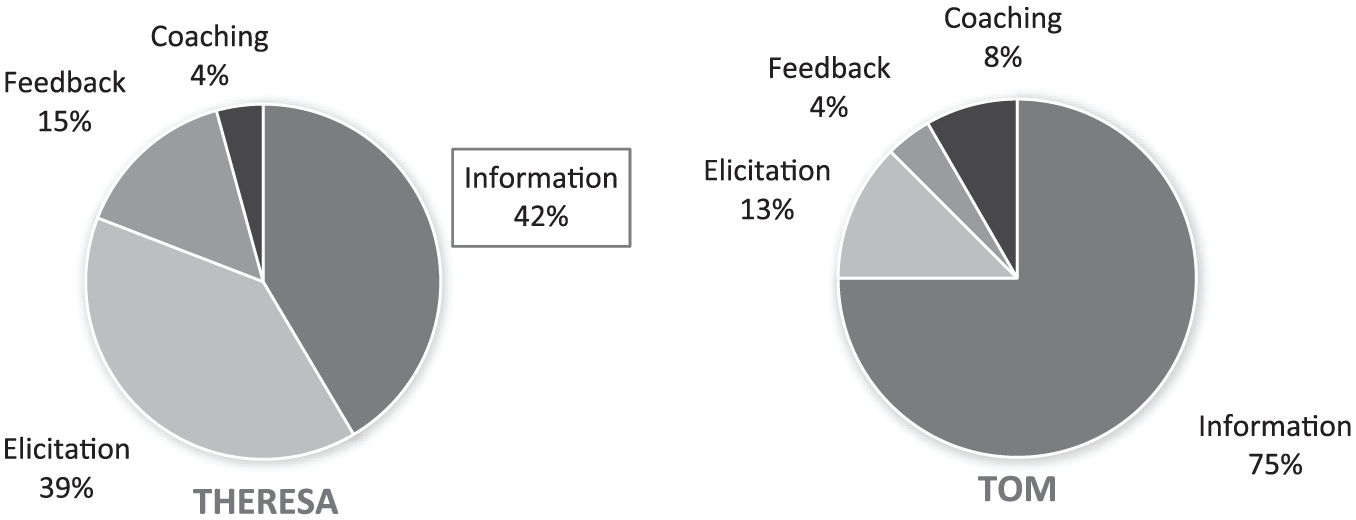
The teacher’s verbal behaviour in each lesson was categorised according to its function. The categories were Information, referring for example to the nature of the instrument, or of performance, to the repertoire at hand, or to musical principles; Elicitation, through which the teacher elicited a response from the student, whether through instructions or questions; Coaching, consisting of guidance, encouragement or advice during a student performance; and Feedback, given after a student performance. These accounted for 94% of Theresa’s lesson talk, and 96% of Tom’s lesson talk. The proportions of wordage devoted to each category are shown in Figure 2.
Functions of teacher talk.
The larger proportion of Elicitation from Theresa may be linked to the balance of verbal and performance behaviour within the singing lesson, with the first dominated by the teacher and the second by the student: Sandra responds to much of Theresa’s elicitation by performing. The smaller proportion of Elicitation from Tom might be linked to the balance of performance activity within the guitar lesson, in which the teacher takes a greater part: Gavin, as already noted, describes Tom’s playing as being commanding, as if elicitation were effected through performance. Coaching in both lessons occupies only a small proportion of teacher talk, and perhaps it is to be expected that comments directed at a performing student are necessarily brief and to the point. The main contrast between the Figure 2 charts is encapsulated perhaps in the larger proportion of Information in Tom’s talk, at the expense of Elicitation and Feedback.
Once again these patterns have some resonance with the interview data. As previously noted, Theresa suspects that she might be too dominating with Sandra; she prefers to help students develop their independence by asking for their opinions about interpretation—“I know that that is an element in my teaching”—but with performance examinations impending, she feels that there is no time now, for such discussion: “At this stage, they should’ve already done that, and if they haven’t, then basically I feel that I’ve got to say, ‘Okay, this is my interpretation of it, this is how you’re going to practise it’”. Sandra’s attitude suggests that she accepts this approach somewhat passively, in that she says that she wants her teacher to “push” her, at least in some ways; but Gavin takes a different view of his lessons, telling the interviewer that “I want to do more of the work”:
A student needs to experience doing certain things IN FRONT of the tutor to get their feedback on that, [rather than a situation where the tutor] picks up the guitar and plays all these weird and wonderful things, but doesn’t really explain why. (Interview with Gavin)
One attitude that Sandra and Gavin seem to share concerns a perceived want of encouragement from their teachers. Sandra explains her own perception: “I am not so sure if we understand each other. [Theresa] compliments me sometimes and it is nice because it encourages me. I am the sort of person that, if I am doing something right, I would like to be told”. However, she adds a moment later, “I asked her last week ‘How am I doing in comparison to everyone else?’ because I just feel that I am not as good as what she is used to. She doesn’t encourage me as much as I want her to”. Gavin perhaps goes further in perceiving a lack of encouragement as a long-term problem. Tom, he tells the interviewer, tends to focus on his mistakes: “You imagine it—you get three years of that and all you can remember your tutor saying to you is where it went wrong”.
Sandra’s somewhat ambivalent account of her teacher’s encouragement may be cross-referenced to the video evidence of their lesson together. In all, there are 84 incidents of what might be described as approval, from Theresa; however, these tend to be brief, with almost half (40) consisting of single words, and only three incidents in which Theresa is explicit about what she is praising: “That wonderful sound you had on the hum” (05:24), “That was a much better ring on the sound” (20:55), and “ You’re not taking a breath there, which is good” (25:11). The longest mark of approval consists of 13 words: “Good, that was not bad at all; and the um—that was lovely” (28:54). According to Sandra, there were more compliments today than usual, because of the presence of the video camera: “She kept on saying ‘that’s good’ and ‘that’s nice’. I was thinking, ‘Good. Thank you’”.
In contrast to Theresa’s frequent but brief affirmations, there are only 14 incidents of approval from Tom in Gavin’s guitar lesson, though none of them are as brief as one word. The discrete incidents are quoted in full, below. Square brackets indicate remarks that overlap performance behaviour, and the timing of each incident is noted.
00:18 Good man. That’s a lot for you.
00:26 Good man.
09:05 [You got it that time.]
10:36 [Yeah that’s it.]
12:26 [Good, yeah.]
13:45 [That’s good]
14:11 [(unclear). It’s not bad actually.]
17:13 [All right, that’s fine]
19:47 [That’s the way.]
24:10 Got it.
25:35 This bit was actually okay!
25:37 No I don’t think it was particularly noticeable there, it came out—
26:50 Some of it’s got some good bits in it.
31:01 And—it’s only little things, Gavin, you’re very, you know it—
The first two remarks—“Good man”—are responses to Gavin saying, on arrival, that he has done two hours’ practice this morning; the rest refer to Gavin’s performances, with coaching as he plays, and feedback afterward. The longest mark of approval (at 25:37) and the compliment immediately preceding (25:35) are responses to a student initiative, in which Gavin asks for help with a problem passage that he has noticed in his practice; in keeping with Gavin’s description of Tom as being “laid back”, these responses seem to offer only mild reassurance, and the problem—if it is a problem—is waved aside rather than diagnosed. With examinations approaching, Tom may be trying to downplay such concerns: in his interview he explains that Gavin “can be affected by nerves”, and that he often advises him to restrain his tempos, “for musical reasons AND for reasons of maintaining the calm”.
Discussion
That there is much to be learned about the complexity of studio practices is reflected in the differences between the two “dissonant” cases compared in this study: while the lines of inquiry explore issues arising in both cases, it seems that those issues are played out in different ways. The balance of performance and verbal activity within lessons is an obvious example, with Sandra and Theresa each dominating one in their singing lesson, while Gavin and Tom share both more evenly in their guitar lesson. Some sense of context for these balances may be found in research undertaken in the same university (Burwell, 2006), in which students with “traditional conservatoire” instruments (n = 32) contributed an average of 10.7% to lesson dialogue, while those with “non-traditional conservatoire” instruments (n = 23), including guitar, contributed 26.3%, and singers (n = 12) contributed 15.8% (p. 338). In the light of these figures, Gavin’s relatively robust contribution of 30% might reflect the culture associated with his instrument, but Sandra’s contribution of 9% is low for a singer, and even for a classical instrumentalist. Verbal and performance behaviours from teacher and student are strongly differentiated in the singing lesson, perhaps suggesting a relatively hierarchical discourse, while the more even distribution in the guitar lesson suggests more of a collaborative approach between colleagues. Either could be associated with aspects of conservatoire culture (Nerland, 2007). The hierarchical balance in the singing lesson recalls descriptions of students in higher education music who seek and support their teachers’ authority (Nielsen, 1999, p. 124), and while Theresa makes some self-reflective remarks about her verbal dominance, that is not a subject of complaint for Sandra; indeed, Nerland and Hanken (2002) describe the teacher’s authority as “a crucial and productive resource in the teacher–student interaction” (p. 168). It may seem ironic that it is Gavin who objects to his teacher’s dominance of lesson activity—or at least, reports his own desire “to do more of the work”; but although the proportions contributed by teacher and student are more even, Gavin’s teacher dominates both verbal and performance behaviour. The teacher’s dominance of performance activity seems to be the anomaly here, and therefore might be more keenly felt by a student wanting to do more; and a broad impression of teacher dominance might be emphasised by the pervasiveness of performance behaviour, which occupies 60% of the lesson time.
The term “performance” is used here to signify playing or singing, rather than referring more specifically to a simulation of concert behaviour. That simulated performance or rehearsal might be a significant element of an advanced studio lesson is demonstrated in a case study, again from the same music department (Burwell, 2012). In this study, a clarinet student was described prefacing his lesson performances with moments of preparation which involved not only taking an initial breath, but standing “still and poised, collecting himself and establishing a sense of performance before actually making a sound” (p. 132); these moments typically lasted only one or two seconds, but amounted to 73 seconds over the course of the whole lesson. The student was evidently confident that these moments would be respected by his teacher (p. 139), and the practice seemed to imply respect for the act of performance, from both teacher and student. Once again this might have particular cultural implications: Nerland (2007) in a study of cultural practices within the music academy, describes studio lessons that are “organised around performance”, starting with the student’s “initial concert-like performance” (p. 404); the teacher asserts that even practice sessions should be organised “as realistic performance situations” (p. 407).
The position of simulated performance in the lesson may tell us something about how the participants understand the relationship between their studio practices and the profession, and perhaps the students are demonstrating their perception of that relationship when Sandra says she likes her teacher to “push” the development of her performance skills and Gavin says he wants more “performance-oriented teaching”. In the immediate setting, the absence of “concert-like” performance may be associated with a lack of preparation, on Sandra’s part, and a lack of composure, from Gavin; it may also be associated with the problem of piano accompaniment in the singing lesson, which exercises both teacher and student; and with the lack of differentiation among behaviours in the guitar lesson, with talk often overlapping the playing, and playing freely divided among tuning, improvisation, “idling” and try-outs of repertoire. It seems that while the nature of the individual studio settings must have multiple sources, neither setting puts the student in a good position to achieve the kind of serious, focused concentration needed to create a sense of performance.
Might this be associated with what Sandra and Gavin both perceive to be a want of encouragement from their tutors? Duke and Henninger (1998), who have done much to reveal the complexity of evaluating teacher feedback in the distinct interactional form of studio lessons, argue that “feedback emanates not [only] from the teacher directly, but from students’ perceptions of their own accomplishment of proximal performance goals” (p. 484), although this presumably depends on the provision of “multiple opportunities to ‘do it again’” (Duke & Henninger, 2002, p. 84). Gavin’s often rushed and stumbling efforts would not appear to give him the kind of felt success that Duke and Henninger describe, and this might help to explain why he perceives a want of encouragement in his lessons, though the relatively slight quantity and the mildness of Tom’s approvals are also implicated in his attitude. In contrast, Sandra has many opportunities for performance trials, and these are often supported by affirmations from her teacher, but the evidence suggests that she does not perceive either the trials or the affirmation as constituting encouragement. Sandra seems to distrust compliments from her teacher—it will be recalled that she regarded the suggestion of an audition as a joke—and this might be related to the minimal and generic nature of Theresa’s approvals, particularly if—as Sandra asserts—the presence of the research camera has engendered more compliments than usual, today.
Affective aspects of learning are implicated here. Sandra frames her account of her teacher’s approach in terms of her own comfort, worrying that she might not be as “good” as what Theresa is used to, thus touching on emotional investment and personal anxiety; Gavin frames his own account, more often, in terms of the professional aspects of teaching, but it seems clear that he too is emotionally involved in his work, describing the want of encouragement in stronger terms and asking the interviewer to “imagine it”—three years of feeling ill-supported in this sense. Affect is not the exclusive province of the student, of course, and it should be remarked that both teachers show that they are involved in this way: Sandra’s distrust of Theresa’s compliments might be balanced against Theresa’s distrust that Sandra prepares adequately for her lessons, while Tom’s “laid-back” attitude in lessons might be associated with his efforts, as he explained to the interviewer, to put a nervous student at ease with his own playing. The problem with that might be that what students perceive as a friendly, relaxed, laid-back attitude that makes performance “easy”, could also make performance seem casual; and insofar as the student identifies with his own performance project, this might be an unintended source of frustration.
For their part, both teachers seem to be aware of the power relations that, according to Lave and Wenger (1991), must be inherent in any concrete case of apprenticeship. Thus, Theresa regrets that her preferred open-ended approach has been overtaken by a more commanding “teacher mode”, partly in response to the impending performance examinations but also in light of the disappointing level of preparation, from Sandra. In contrast, Tom seems to deliberately downplay his position of authority, preferring to ask questions rather than giving verbal instruction, and apparently trying to allay Gavin’s anxieties about his performance through mild reassurance rather than targeted diagnosis. All of the participants—teachers and students—seem to assume that the management of lesson activity is the teacher’s responsibility. Thus, although Sandra and Gavin are dissatisfied with their teachers’ approaches to their studio lessons, they evidently assume that those approaches remain the teachers’ prerogatives—in the terms used by Gaunt (2010), not to be negotiated—with Gavin explicitly stating that “I just take what comes”. In the interview setting, Gavin’s expressed desire to do more of the work, and Sandra’s expressed desire for more encouragement, might equally be seen as a call for more teacher attention to their personal performance projects; evidently, however, these are not desires that they feel able to discuss with their teachers.
Implications
Given the variety and complexity of advanced studio practices, the pursuit of such “microstudies” as these might seem to lead merely to further confirmation that advanced studio practices are varied and complex. To an extent, qualitative researchers try to give convincing accounts of “social practices that are possible” (Peräkylä, 1997, p. 215), typically having identified critical issues in advance, and providing “sufficient descriptive narrative so that readers can experience these happenings vicariously and draw their own conclusions” (Stake, 2005, p. 450). While the specifics of the case studies compared in this paper cannot be generalised to studio learning in higher education music, issues and questions arising from the comparison might be theoretically generalisable, potentially informing research and even practice in other cases of “dissonance” and perhaps in studio practices more generally.
From the varying and complex practices involved in the singing lesson conducted by Sandra and Theresa, and in the guitar lesson conducted by Gavin and Tom, several potentially significant questions arise, and arguably might be applied in any studio setting. What opportunities do students have to contribute to lesson activity—verbal, or performance—and how are they regulated? What are the sources of encouragement for students, and do students perceive them as being encouraging? How do teachers demonstrate their attentiveness to the students’ performance projects, and what engenders mutual trust in the roles played by each? What avenues are open, within the unique interactional setting of the studio, for students and indeed teachers to voice their concerns about the conduct and aims of studio practices? While much of this might seem to be related to the management of student expectations, or to shifting their perceptions of dissonance in the studio, it must be related also to the ability and willingness of participants to identify with and invest in the students’ learning trajectories, and therefore to the success of their collaborative work in the studio.
Footnotes
Funding
This research received no specific grant from any funding agency in the public, commercial, or not-for-profit sectors.