







Abstract
Although creativity in music is a topic widely considered and studied among global music educators, it has received limited attention in China while quite a number of Chinese pianists have been recognized on the international stage. How do Chinese pianists and professors perceive creativity in piano performance? How would they nurture creativity in the performances of their own and/or their students? Employing the Grounded Theory approach, this study investigated the perceptions of creativity in piano performance of 13 eminent pianists and professors from Beijing, Shanghai and Guangzhou through a series of semi-structured interviews. The interviewees identified several factors related to the development of musical creativity in piano performance, including pianists’ relevant knowledge, their musical and life experiences, imagination and association, reflection and musical judgment, performing environments, and the Chinese cultural elements of holism and dynamism. Implications for teaching include the encouragement of a balance between Western and Chinese epistemologies in both analytical and abstract thinking. In nurturing students’ creativity in piano performances, students should live in culture-related contexts, and understand the world in a holistic epistemology with an abstract imagination. This study has further provided a more holistic understanding of how to nurture musical creativity with an alternative perspective.
Background
As an important element of the West’s interest in creativity that started in the mid-20th century (Runco, 2004), research within the realm of music—particularly in terms of creative thinking in music (Hickey & Webster, 2001; Webster, 2016) and assessment (Byrne et al., 2003)—has established itself as a primary concern. Musical creativity can be reflected through composition (Barrett, 2006; Duarte & Constantinidi, 2020; Priest, 2006), improvisation (Arkin et al., 2019; Daikoku, 2018), listening (Peterson, 2006), and performance (Graham, 1998). However, creativity in musical performance has attracted somewhat less attention from researchers, especially in the East. In the context of modern globalization, this issue becomes complex when both Western and Eastern cultures meet.
Historically, Chinese people demonstrate a high degree of creativity when it comes to producing tangible products to solve practical problems. Indeed, China has a long history of inventiveness, both non-musical (such as in the development of the compass, gunpowder, paper, and printing (Deng, 2011)) and musical (such as with regard to equal temperament (Chou, 2008)). Exactly how contemporary Chinese musicians perceive musical creativity within the realm of performance, however, has not been widely studied. The aim of this study, therefore, is to investigate this issue by interviewing a representative sample of professional Chinese pianists and piano professors. In so doing, the following research questions were identified as a means of guiding the study:
How do Chinese pianists and professors perceive creativity in piano performance?
How might Chinese pianists and professors nurture creativity in their own performances and/or those of their students?
Creativity in music performance
Creativity is closely connected with contemporary socio-cultural contexts. For instance, Burnard (2012, 2014) proposed the concept of multiple musical creativities, whereby genres, traditions, and practices across a variety of cultures, and collaborations with a variety of stakeholders, may differ depending on the context concerned. Such contexts include the virtual contexts of the Internet and the business sector of music entrepreneurs. Composition, improvisation, listening, and performance are all related to creativity, but have their own modes and approaches.
Proposing a working definition for the term “performance creativity” establishes clear boundaries for the study. The authors adopt the definition proposed by Gonzalez-Moreno (2014): “the multiple possibilities in which creativity manifests (as a process) and develops in a musical performance (as an original product) that takes places in a particular socio-cultural context” (p. 87).
Concepts of creativity in China
With reference to Confucianism, Taoism (or Daoism), and Zen of Mahayana Buddhism, Z. Liu (2001) has proposed a theory of creativity from the Chinese perspective. Arguing that creativity is situated within modern Chinese philosophical contexts, three tiers—from the lowest to the highest—exist as follows: (1) creative skills, (2) creative thinking, and (3) creative persons. Creative skills involve imagination, associations, new combinations, and the pursuit of aesthetics. Creative thinking in China is based on the semiotics from Zhouyi 周易 (Book of Changes; see Gu, 2005), which employs imagery to represent nature and the inter-relationships among the different elements. When considering creativity, Chinese people traditionally tend to employ intuition, inspiration, and metaphors from nature to generate new ideas. For example, the philosophy of Wuxing 五行 (literally, the five elements of metal, wood, water, fire, and earth; see Wang, 2016) can also serve to represent different aspects of our shared humanity. Metal, for instance, may imply perseverance, while water may symbolize flexibility.
The highest state of creativity is concerned with human development (Z. Liu, 2001). According to Tao Te Ching 道德經, one of the classic texts of Taoism (see Chang, 2014), not only are verbal descriptions and explanations of ideas too imprecise, but the highest philosophical state can neither be named nor elucidated. Creativity is obtained by apperception through constant participation; it exists naturally within human beings. According to the Analects, it is only through learning various disciplines that individuals can develop their morality as a means of incarnating the tao 道. Observation of, and inspiration from, nature, as well as the discovery of personal intuition, are also beneficial in terms of encouraging creativity. In short, creativity from the Chinese perspective is not limited simply to creating unique and useful things, as with the Western tradition (Runco & Jaeger, 2012), but extends to the development of a holistic understanding of life itself.
Influenced by traditional culture, “Chinese ideals of creativity are rooted in respect for the past and the search for harmony with the forces of nature” (Leong, 2011, p. 58), while the Western view places greater emphasis on outcomes such as unique products and solutions in appropriate contexts (Lubart, 1994, 1999). For instance, Tardif and Sternberg (1988) relate diverse creative products to solutions to problems, responses on creativity tests, explanations for phenomena, technological inventions, artifacts, novel ideas and new designs, fine arts and scientific problem solving, while the eminent Torrance Tests of Creative Thinking focus on evaluating creative products (Torrance, 1974). In contrast, “re-creation,” a process whereby personal uniqueness is infused within traditional practice, has a long history in the East; instrumental performers in ancient China were adept, as a result of diligent practice, at “re-creating” existing musical pieces based on the flexible treatment of notes, rhythm, articulation, tempo, and expression (Yu, 2005). “The Chinese notion of creativity in many ways equals perfection and excellence, resulting in the kind of achievement with a significant contribution to the field they have chosen to pursue” (Niu & Kaufman, 2013, p. 79).
In recent years, Chinese piano teachers and researchers have come to realize the significance of creative thinking in both performance and pedagogy. For instance, Y. Liu (2012) has argued for recognition and respect for students’ learning autonomy, while H. Liu (2011) has suggested exciting students’ affective experiences through proactive participation. Their writing focuses on the significance of creative thinking and presents a summary of the importance of its cultivation, although in both cases, detailed strategies are noticeably absent.
Contending that “music” is the way that a pianist communicates sound (as opposed to the information relayed through the composer’s score), Zhao (1999) applied Chinese Taoism to his creative piano performance philosophy. According to Zhao, the pianist—while complying with the composer’s basic intentions—should also “re-form” or “re-create” the original style and meaning according to their personal characteristics, tastes, hobbies, and interests, thereby distinguishing themselves from other pianists. Performances that either deviate excessively from the composer’s intentions, or alternatively, lack any personality will eventually be ignored.
In summary, the concept of creativity found in China is clearly distinct from that found in the West. Chinese philosophy tends to regard creativity as a lifelong pursuance for the “tao,” or the way of life. Creativity is broadly defined and inclusive enough to include all tangible and intangible creation. As the concept is abstract, metaphors are often used as illustrations, while imagination is necessary for understanding and implementation. In music performance, imagination and thinking outside musical boundaries is considered necessary.
To determine whether such concepts of creativity are accepted by both pianists and piano teachers, further empirical studies are required. This study thus aims to investigate the perception of senior piano teachers and experienced pianists on how to perform creatively and nurture students to perform creatively. Findings of the study will enhance the understanding of a perspective on music creativity from the East, which may provide an alternative viewpoint in facilitating creative music performances.
Methodology
This article reports part of a doctoral study, which was successfully completed and examined in 2017. The first author received ethical approval from the Human Research Ethics Committee of The Education University of Hong Kong, which was a pre-requisite of endorsement of the proposal. All the participants signed a consent form permitting the inclusion, collection, and use of their anonymized data, and the publication of this article. The study itself employed semi-structured interviews (Kvale & Brinkman, 2009) as the method of data collection. The following three major questions (supported by 13 second-level questions) were asked:
To what extent are you aware of creativity in general and in music specifically?
What are the nature and characteristics of creativity in piano performance and pedagogy?
What pedagogical and practising strategies have you employed in nurturing your students’ creativity in piano performance?
Recruitment of interviewees
With the aim of recruiting a representative sample of interviewees, invitation letters were sent to a selection of individuals from eminent music conservatories and universities in Beijing, Shanghai and Guangzhou, China. To avoid bias, invitations were not sent to those people with whom the authors had a personal relationship. Fulfillment of two or more of the following criteria was necessary for all participants:
Possessing professorship/associate professorship; and/or
Whose students had won significant prizes; and/or
Active on the international and national stage with released personal albums; and/or
Had won significant prizes or awards; and/or
Possessing relevant adjudicating experience; and/or
Had published extensively in piano pedagogy and/or performance.
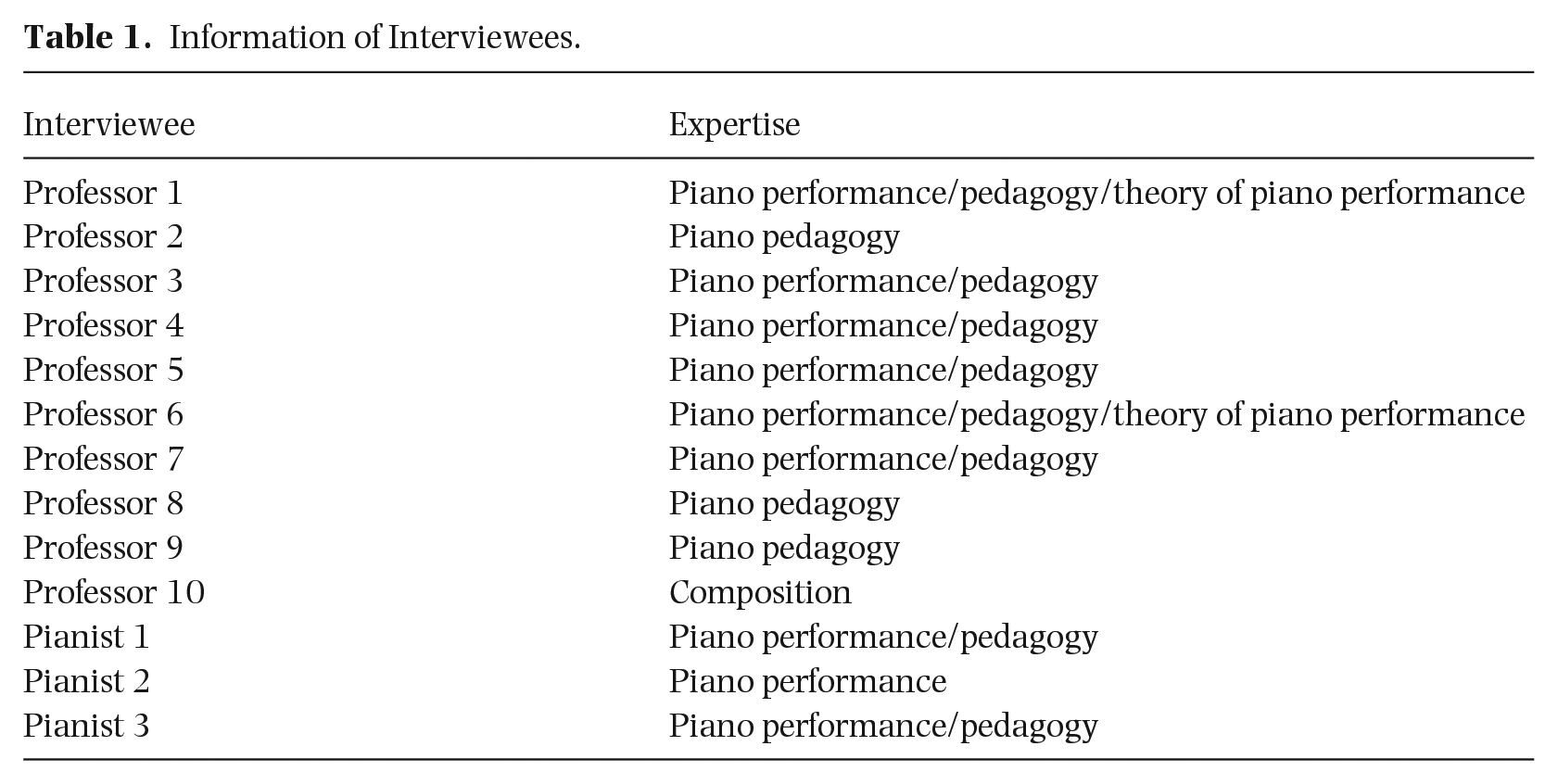
Based on these requirements, a total of 13 participants (10 professors and three pianists) accepted voluntarily to participate in the study (see Table 1). According to their contributions, performing and teaching experiences, they were largely representative of pianists and professors of piano in China. To maintain their anonymity, any identifying details that might allow them to be recognized by a colleague or friend have been removed or fictionalized.
Information of Interviewees.
Administration of the interviews
The 13 semi-structured interviews were undertaken in December 2013 in Beijing, Shanghai, and Guangzhou. The target interviewees were initially contacted through emails or phone calls, at which point, they were informed about the content and significance of the study, as well as the kind of information that was being sought from them. A series of open-ended questions, along with the three research questions, were sent ahead of time to assist them with their preparation.
All the interviews were held in relatively private and quiet spaces, including the interviewees’ piano studios, homes, or hotel rooms. Before the interviews began, the participants were asked for their permission to audio-record the proceedings for the purposes of transcription and data analysis. During the interviews themselves, the first author acted as the interviewer. The interviewees were asked to elaborate on each of their responses to derive more detail (Kvale & Brinkman, 2009).
Once the interviews had been transcribed, the transcripts were sent to the interviewees for their verification and revision as necessary. The first author informed the interviewees that they could choose to revise the wording in the transcriptions to ensure that the text fully expressed their intentions and ideas.
We analyzed the qualitative data using a Grounded Theory approach (Glaser & Strauss, 1967), applying an induction method from the collected data to formulate a theory through open coding (exploring the data and identifying units of analysis), axial coding (drawing linkages between codes), and selective coding (identifying the core and other codes, and comparing them with existing theories; Bernard & Ryan, 2010; Cohen et al., 2011). The first author read the transcriptions carefully to identify the codes related to the research questions with support from individual quotations, while the second author verified and revised the selection based on investigator triangulation (Cohen et al., 2011). Once all the themes had been validated, the first author compiled all the themes and formulated a proposed model based on an interpretation of the inter-relationship among the different themes.
Results
The study investigated interviewees’ perceptions regarding the application of creativity in piano performance and pedagogy. In general, most of the participants agreed that creativity was vital for piano performance, with different pre-requisites contributing both holistically and abstractly to the process. The following themes emerged from the participants as findings of the interviews.
Knowledge as creativity
As reported by some interviewees, a pianist’s creativity does not emerge out of nowhere; it is related to his or her knowledge: Pianists shouldn’t only focus on “performance.” Other than performance knowledge, pianists should roam widely based on relevant scientific and cultural knowledge. This is not only limited to the performance field but extends to emotional and perceptual knowledge. (Professor 3)
Additional knowledge may include that for contextual understanding, skill enhancement, and musical expression.
Knowledge for contextual understanding
Understanding and mastering contextual knowledge is a major premise of piano performance and a pianist’s creativity, as the latter is rooted in reflections gained from a piano work’s cultural, national, and artistic background: . . . to understand the piano work’s connotations when pianists prepare to perform . . . there is certain information that needs to be studied . . . such as piano works’ social context, historical situation, geography, climate and environment . . . Actually, pianists . . . need to comprehend the related cultural and artistic knowledge of the same era of specific piano works. (Pianist 1)
Knowledge for enhancement of musical expression
When it comes to creativity, pianists may acquire the required knowledge for the enhancement of musical expression from other disciplines. Some of the interviewees believed that dance and singing could inspire pianists to be creative: Once Shanghai Conservatory invited one German Baroque dance expert to teach us dance . . . Learning how to dance in the Baroque palace is important for us to know the style, rhythm and tempo . . . With these understandings, pianists’ performances wouldn’t be out of line, and the tempo and rhythm will be in the appropriate range. The creativity should be based on the appropriate style, tempo and rhythm. (Professor 9)
Experience as creativity
Appropriately drawing on personal life experiences in their performance allows pianists to demonstrate their personal styles and enhances the quality of original works. According to one interviewee, “creativity in piano performance is a kind of coincidence under pianists’ life-long performance and life experience accumulation” (Professor 5).
Life experiences related to creativity, according to another interviewee, can be classified into the following two categories: emotional experiences and social experiences. Pianists preserve various emotions from real life and express them through actual performance: Piano performance is an art that needs to be accumulated over a long period—not only practice and thought accumulation, but also accumulation of emotion and self-control . . . Emotion control is a cruel experience for artists; sometimes we need to control and utilise our emotions . . . Especially when I am in a depressed emotional period, I am sensitive and tender, and maybe I want to cry and feel sad, but I realise these kinds of emotions can be utilised for specific piano works. Then I extend this kind of feeling deliberately to remember the emotion. (Professor 5)
Pianists’ social experiences may affect their world outlook and personal philosophy. Information drawn from natural scenes, local culture and people are often the source of these social experiences: [The] Chinese have a proverb: travelling ten thousand miles beats reading ten thousand books. That means collecting data from reading, movies, or travel . . . to see a lot of scenes, visit museums and listen to the story of local people in China or abroad . . . These experiences will reflect in pianists’ performances. Abundant social experiences and knowledge enable pianists to be creative in performances. (Pianist 1)
Chinese culture advocates a free and smooth spirit of artistic conception. Likewise, the Chinese temperament contributes to the unique thinking style of its pianists. Finding a balance between the Chinese cultural perspective and the appreciation of Western musical styles is significant for creativity: Chinese pianists’ performance is affected by the Chinese temperament . . . piano master Fou Ts’ong is the best representative Chinese pianist. Chopin, Debussy and Schubert’s piano works are interpreted totally differently in Fu Cong’s performance; all of these performances contain Chinese culture and temperament . . . In Chinese emotional logic, feelings cannot give full expression through words. Chinese aesthetics advocate the feeling of intangibility and boundlessness, from the Chinese perspective that Western culture can be utilised in the enhancement of Chinese pianists’ creativity . . . In Fu Cong’s master class, students and I were all inspired that Chinese culture cultivation and temperament can be blended into Western culture. The creativity in Fu Cong is rooted in the cultural integration between China and the West. (Professor 6)
On stage, many factors affect a pianist’s performance. Although difficult to accomplish, many aspire to achieve a “flow state”: The highest status for creativity is “flow” . . . forgetting everything, and digging into the music . . . I have a friend majoring in vocal performance . . . she sang an emotional song in the recording studio, and she wept during the recording procedure because she immersed totally into her singing . . . This experience made me realise that the best stage state is “flow” . . . I once had this state, I just played and enjoyed the music itself. I believe the stage state is a significant part of creativity in piano performance. (Professor 4)
Judgment as creativity
Some participants suggested that the pianist’s ability to “see” the multi-dimensional musical expressions in piano works, and to estimate their actual music effect, constitutes judgment as creativity. Creativity within this context exists in the accuracy and uniqueness of the individual piece being presented, specifically through the elements of musical expression, skills, and aesthetics.
Musical expression
When pianists read the notation before an actual performance, they should judge possible music effects, atmosphere, color, and tension. Based on their initial judgment, pianists can apply their creativity to develop the various dimensional viewpoints, spiritual power, and vitality to enhance the originality of the performance, gradually developing a personal style: The beauty of music is not always the same . . . the appropriate music expression for piano works needs pianists’ judgment. The beauty of music will burst out through pianists’ right judgment . . . musical emotion is complex . . . For example, one musical phrase sounds pitiful, but it contains vivifying life power, and reflects the vitality from another viewpoint. This is a kind of complex ideology . . . So a wise and creative pianist will find out the emotion behind the notes and phrases . . . a performer without creativity may only see the notes. (Professor 4)
As suggested by one interviewee, composers may follow their personal imagination and narrative customs as a means of providing musical creativity. Like oral narration, the same musical phrase may be open to various interpretations. Although fully respecting a composer’s initial intentions, a pianist’s judgment may refine and improve the quality of the original work: Composers’ creations are not always perfect. As pianists, we have lots of things we need to do. For example, Beethoven wrote a forte on the score . . . we need to judge and understand the music language behind this forte rather than just play with great strength . . . We need to judge the strength level, tone and the timbre of this forte, we should know what this forte means in the whole phrase . . . Maybe a pianist’s interpretation for this forte is better than the composer’s original intention. Composers create this forte, but may not imagine that pianists can interpret far beyond his expectation . . . This kind of creativity is like a tree; it will grow. Every unique idea developed by pianists and accepted by the public, will be learned by other pianists . . . and other pianists may have new ideas. (Pianist 2)
Aesthetics
A pianist’s aesthetic perspective is a vital ingredient when it comes to performance. Although Chinese pianists closely follow Western performance practices, their competence is demonstrated through their ability to utilize creativity and Chinese cultural characteristics as a means of developing unique possibilities: When I play, I try to demonstrate various aspects of specific works with creativity. But the core idea is to be consistent . . . we need not play exactly like Western pianists, because they have Western characteristics in their blood that we don’t have . . . Chinese and Western people possess different performing characteristics, so we need to find out the similarities and common points. (Professor 5)
In the preparation stage or actual performance, understanding the audience’s aesthetic expectations is of vital importance: Performances need to meet the audience’s aesthetic expectations, which were formed by their aesthetic experiences . . . Thus, pianists should accord with the audience’s aesthetical expectations, and creativities cannot go beyond their expectations . . . From the perspective of receptive aesthetics, a musical work is not completed until it is heard by an audience and resonates with the audience. (Professor 1)
Environment as creativity
The following two inter-related environmental factors suggested by some participants may affect a pianist’s performance: concert hall acoustics and audience responses. Concert hall acoustics heighten the sensation of hearing and facilitate communication with the audience: “A good concert hall will make pianists attach importance to their performance . . . you can feel the music you play is interacting with the audience’s listening status . . . ” (Professor 5). Such acceptance by an audience may stimulate a pianist’s motivation to be creative during live performance: The feeling on stage is totally different . . . audiences are all quiet and enjoying your music . . . I have the motivation to tell my audience how beautiful the music I played is . . . That feeling makes me revel in my performance. Lots of inspirational ideas appear and I forget the restrictions of the piano works . . . It is the emotion, feeling and interaction between me and audiences during performances but not practices. (Professor 2)
Imagination and association as creativity
Pianists bring diverse imaginative and associative influences to bear on specific pieces. These differences shape pianists’ particular musical styles while enriching their artistic vision of the original work: Pianists’ performances can’t be duplicated . . . actually, imagination is a creation of the brain . . . every individual’s imagination is distinct . . . imagination is creativity, significant for musicians to make their music vivid . . . every pianist has a distinct imagination for specific music . . . actually, the imagination for specific musical works is the pursuit of excellence. (Professor 8)
Imagining the actual sounds, together with their acoustic effects, is critical for performance creativity. Before a performance, pianists generate imaginary acoustics in their mind; by comparing these with the reality generated by the concert space, pianists can develop greater control over the holistic effectiveness of their performances: Composers have preliminary acoustic estimation in their mind when composing. The estimative acoustic is not always a completed musical effect; it may be musical motives, and fragments of music thoughts, harmonic progressions or just a rhythmic pattern . . . this acoustic estimation can be regarded as a musical logic, which relates to harmonic, structural, contrapuntal, melodic, dynamic and tempo logic . . . the essence of piano performance is through pianists’ playing and imagination to express the music effects. (Professor 7)
Although pianists hear the sounds they are playing, they do not necessarily listen to the actual musical effects being produced. This may lead to an appreciation gap between the performer and the audience: I always remind my students to notice the inner listening imagination; it is not the sound we hear objectively. We have two ways of music listening: one is the sounds heard directly by our ears. The other is inner hearing; the imagined sounds in the mind . . . The inner hearing imagination replenishes the shortage of ears hearing, but it is subjective . . . There is a gap between performer and audience . . . the sounds performers hear on stage are different from what the audience hears . . . (Professor 6)
Within the context of piano performance, “association” is the ability to connect with artistic materials and musical imagination that enhance the quality of playing: “Association is the significant precondition of artistic performance creativity” (Professor 6). Appropriate association enables the pianist to demonstrate their understanding of a composer’s original work and ultimately deliver a performance full of imagination and creativity: Creativity is association and imagination from the perspective of piano performance . . . All of us have unique experiences, and we understand the music history from books and obtain inspiration from score sheets. Nevertheless, this is insufficient; pianists should have the ability to associate all the elements related to musical works with individual experience and make the music a personalised label. (Pianist 1)
Reflection as creativity
In daily practice and actual performance, pianists bring their understanding and reflections to bear on composers’ works. The ultimate performance is the marriage of a composer’s original ideas and the re-creative abilities of the pianist: “Reflection for creativity is to see whether the practice, ideas and strategies are worthy . . . rigid practice without self-reflection is a waste of time which can’t lead performers to a higher perspective” (Professor 6).
Cultural reflection
According to the interviewees, Chinese pianists tend to perceive performance from a Chinese cultural viewpoint. The creativity that is related to cultural reflection is embodied in seeking common ground while simultaneously observing differences based on pianists’ different backgrounds and various personality characteristics: My father was accomplished in Chinese folk music research, and deeply influenced by Western music . . . He was also a theorist, thinking a lot about music aesthetics . . . Influenced by him, I realised that I cannot learn Western music in a Western way . . . To discover the Chinese characteristics in our nature . . . and find out the contradictions and the shared characters between Chinese and Western culture . . . People’s creativity is like a sphere . . . different performances demonstrate the various aspects of the specific musical work, but the central music ideas are the same. (Professor 5)
Reflective practice
As practice occupies most of a pianist’s daily musical life, a lot of time and energy is spent on problem solving. The process of finding suitable solutions to problems is essential in self-observation and self-reflection process: Piano performance is the art of sounds. Pianists’ ideas need to be expressed by sounds through the piano . . . Thus in practice and performance we have lots of possibilities in practical application . . . actually, the essence of musical structure arrangement is pianists’ understanding of music phrasing . . . Pianists have their reflections on the basis of in-depth understanding of composers’ first creations. (Professor 6)
The technique of piano performance not only refers to physical dexterity, but also relates to all means of music creation. Practice is a process of self-reflection whereby pianists display their wisdom and creativity by successfully connecting techniques, methods, and strategies so that the perfect musical balance is achieved: Creativity is the self-reflection for your own performance. If you find some ideas which you never notice before but have effects on your performance, that is your creativity . . . Your creativity is not only produced in the practice room; you need to observe, summarise and think, then reflect through comprehensive understanding which is combined with your ideas which are absorbed from various sources; there is no creativity without foundation. (Pianist 2)
Live performance reflection
A pianist’s unique style, timbre, control, and phrasing all contribute to their success. However, reflection based on daily practice alone is insufficient. The ability to sense the mood of an audience, and make the necessary adjustments according to the instant demands in live performance provides another opportunity for pianists’ self-reflection: In live performances, pianists will sense the communication with the audience . . . This feeling and context will inspire pianists to be creative . . . you have practiced a musical phrase a thousand times but still cannot find a unique idea. But during live performances, you will suddenly have the motivation and passion to tell the audience the beauty of the music and your unique ideas . . . A successful performance stimulates their inspiration. (Professor 6)
Re-creation reflection
A musical performance is the re-creation of a composer’s original intentions. Pianists demonstrate their creativity by focusing on the appropriateness, uniqueness, and acceptance of the re-creation. This kind of “reflection on re-creation” is a significant aspect of a pianist’s artistic vision: “Instead of humanistic and theoretical thinking, Chinese pianists always play with inner creative instinct” (Professor 1).
Chinese culture and creativity
Some interviewees believed Chinese people nowadays lack creativity: “It is generally supposed that Chinese people are not creative” (Pianist 3). The reason for this phenomenon may relate to the Chinese mode of thinking about aesthetic concepts: “Chinese aesthetics tend to view an issue in a more abstract way, not as figuratively as in the West. It is more inclined to an unreachable and memorable mindset” (Professor 6). In addition, Chinese people neglect, to a certain extent, the study of the creative process and the cultivation of creative competence. This approach to creativity may be partly related to Chinese historical and cultural traditions: There are quite a few Chinese people who possess high creative ability. When it comes to the general and widespread creativity in the public, Chinese have less creativity than Western people. Chinese educational ideas may focus too much on studying hard . . . there is limited time, freedom and imaginative space for Chinese to be creative. (Professor 2)
Political motivations appear to lie behind the existing problems; specifically, the idea that “creativity” may not be regarded as people’s freewill or as a useful product under particular circumstances: People from the West may be more creative than Chinese. The biggest problem of China is lack of personal creativity. Compared to Westerners, Eastern people are more sensitive and have strong personalities. But Chinese creativity is mostly generated by the government appeal. “Creativity” under government slogans, is always based on unrealistic fantasy and caters for political needs. This kind of “creativity” may lead to the result of “in order to be creative, chase creativity.” (Pianist 2)
Some interviewees considered the relative disadvantages and advantages of the Chinese way of thinking and its impact on creativity. One interviewee perceived Chinese modes of thinking as an advantage that could be capitalized upon: Most Chinese people have linear thinking and are sensitive to lyric target and surface of objects. Chinese also have strengths, such as sensitive and delicate personalities. If Chinese take full advantage of what they have, and combine it with personal cultivation and Chinese culture, these merits will become unique characteristics which are different from Eastern creativity. (Professor 9)
A balance between Chinese and Western perspectives was considered by some to be vital for creativity: There are lots of advisable ways of creative thinking in Chinese heritage. But compared to Western ways, Chinese ways are relatively imprecise and less specific. Most of them cannot be expressed in words but meanings. Chinese place more focus on achieving mastery through a comprehensive study of specific subjects. Western ways are the opposite; they have great precision . . . But sometimes they are too specific to have comprehensive views . . . For creativity, I think both modes of thinking are necessary and significant. (Professor 5)
Discussion
A proposed model of creativity in piano performance within Chinese culture
Several concepts related to creativity in piano performance by Chinese pianists emerged from the findings. Creativity from the Chinese perspective can be separated into “practice” and “live performance”; there is a circular inter-relationship between both categories as they pertain to knowledge, imagination, association, and judgment. “Knowledge” refers to acquired information for the purposes of understanding, skill enhancement, and musical expression; “imagination” and “association” relate to acoustics, the sense of space, musical scenes, and inner hearing, while “judgment” correlates with the decision-making process concerning musical expression, skills, and aesthetics. When experience from practice, including emotional and social experiences, is integrated into a live performance, performers apply their knowledge, imagination, association, and judgment to create a unique aesthetic bond with their audience. After each performance, performers self-reflect within the context of their cultural identity. Figure 1 shows a model of this creative process in piano performance.
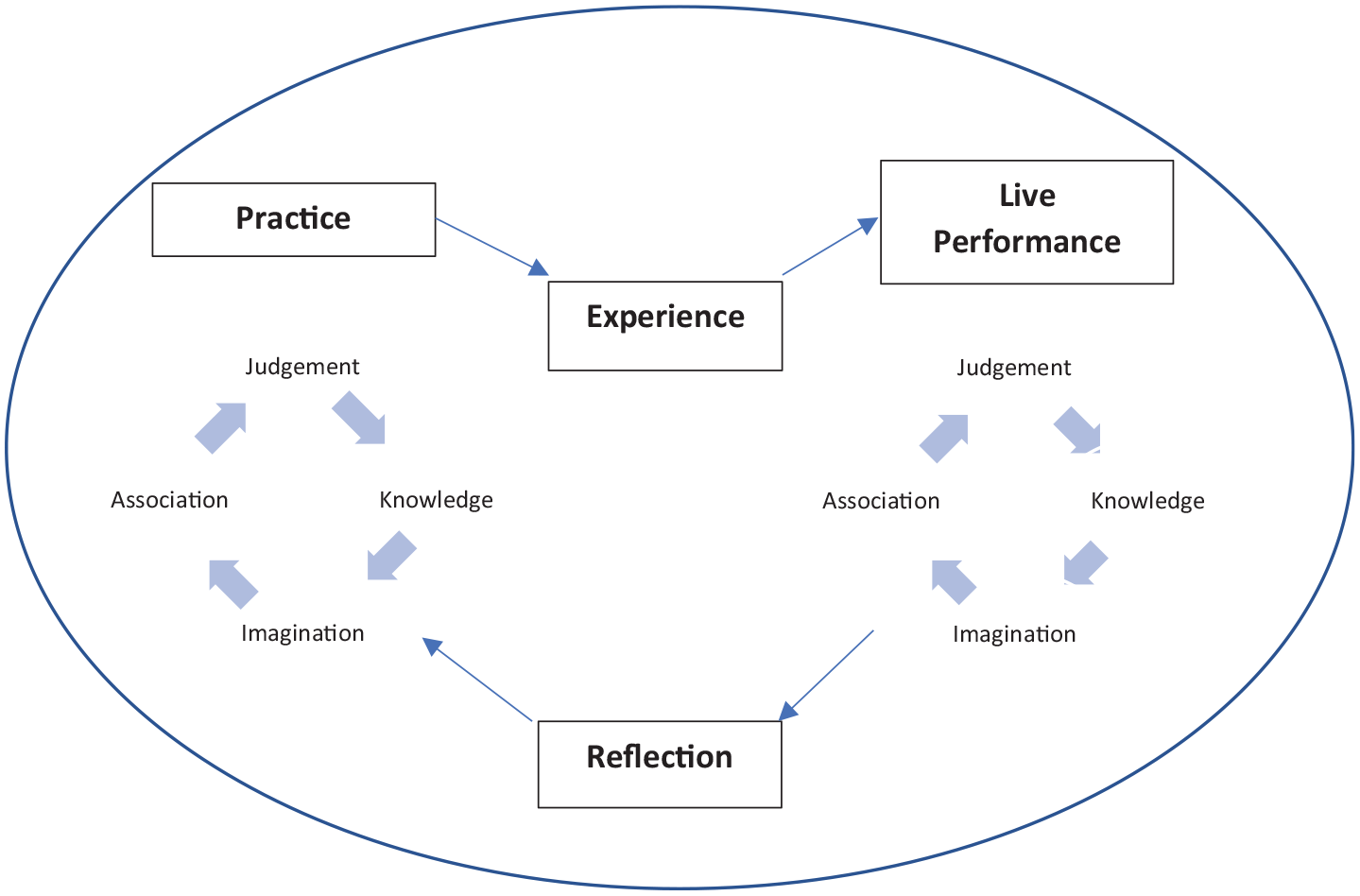
Proposed Model of Creativity in Piano Performance.
Chinese perceptions of creativity in music
In creativity, Chinese traditions focus on lifelong self-attainment with personal continuous effort rather than merely making new inventions to contribute to the society (Z. Liu, 2001). In other words, creativity is more “personal” rather than “social.” In Chinese common wisdom, an individual does not need to be “a genius or possess special abilities to be creative” (Niu & Kaufman, 2013, p. 78). Chinese epistemologies tend to understand the world in a holistic and dynamic way, with a high degree of both complexity and abstraction (Dai, 2015). According to Dai (2015), “Taoists were convinced that if there is anything constant in the universe, that is change, and that the human cognitive apparatus (e.g., language and thinking), however sophisticated, cannot capture all the nuances of the pervasive and ubiquitous changes” (p. 38). How to perform a piece of music both dynamically and holistically within the framework of abstract imagination is the key to Chinese creativity in the context of piano performance. Chinese pianists tend to regard creative performance as a kind of spiritual product, employing an intuitive thinking mode (Fu & Luo, 2000). This intuitive sense, which is vital in terms of allowing performers to explore various creative possibilities, is combined with the processes of integration (which enables performers to derive inspiration from other disciplines) and abstraction (as a means of giving the creative imagination free rein).
There might be significant differences between playing in the concert hall and the practice room. Due to the nature of the profession, pianists need to be able to perform in various environments with diverse acoustics and atmospheres, on pianos of different qualities, and to audiences with dissimilar cultural backgrounds (Schenker, 2000). Their performances may be affected by unexpected environments. Therefore, to play in the optimal state requires pianists to use their creativity to adapt to their environment rapidly or cultivate unique, creative performance ideas. According to the practical needs of a specific music piece, some environmental factors can be utilized to improve pianists’ performance creativity. In certain environments, various factors build a unique atmosphere; pianists can utilize the appropriate environmental factors which suit the music expression to increase the intensity of emotional expression. Advantageous factors which are applied to stimulate inspiration for creativity in piano performance may ultimately improve the performance quality, and, therefore, uniqueness can be regarded as pianists’ performance creativity in stage performance.
The emotional intensity required in musical performance is not a normal emotional state in daily life. Chinese musicians tend to derive inspiration from nature for expressing various emotions, moods, and experiences in music performance (Xiu, 2004). In piano performance, many pieces depict natural scenery and composers’ resultant moods. Similarly, pianists are likely to enrich their personal sense of beauty and experience through the observation of nature, to acquire inspiration for specific musical expression. Nature provides countless materials that can be taken as performance references, and while the starting point for students’ inspiration may be an external locus within nature, this, in turn, can generate their internal locus and individual emotion (Zorzal, 2020).
Implications for nurturing creativity in piano performance
Teachers’ stimulation and cultivation of piano students’ imaginations are a vital element in their experience of musical images, emotions, and association. One strategy is to utilize students’ moods and intuitive feelings toward the acoustics of a particular environment as a means of exploring different possibilities. Teachers may also make use of natural scenes or sounds to stimulate students’ imagination and expression in connection with a piece (Zorzal, 2020); students’ creativity can also be stimulated by playing games like “Communicate with Yourself,” the teacher adopting suitable narrative styles to help students immerse themselves in their own inner selves. During this process, teachers may enquire into students’ inner thoughts while simultaneously judging whether such ideas are suitable for an actual piano performance.
Environmental factors may directly or indirectly affect performers’ moods, motivations, understanding, preferences, and imagination in their performances. In daily practice, the acoustics of the practice environment are not comparable to the actual performance environment. Pianists may therefore choose to construct an inner environment by recalling knowledge and utilizing experience with imagination. This “inner environment” refers to piano performers’ inner feelings stimulated by specific musical works, which relate to their moods, knowledge, experiences, and imagination, and which could help them to imagine the actual acoustics and situation on stage.
Multicultural experiences may enhance both creative performance and creativity-supporting cognitive processes. This is because (1) students learn new and different ideas during multicultural experiences; (2) students recognize the behavioral implications of different cultures; (3) students are better prepared for different, innovative ideas; and (4) unusual practices from different cultures may generate innovative ideas as a way of solving practical problems (Leung et al., 2008). In these kinds of cultural scenarios, Chinese piano students may apply their abstract and holistic intuition to Western knowledge and logical analysis. Teachers looking to develop multiple musical creativities should therefore aim to broaden their students’ knowledge in both Chinese and Western socio-cultural perspectives.
In conclusion, this study has revealed the perceptions of a representative sample of Chinese pianists and piano professors in nurturing creativity in their own and their students’ performances. The Chinese concept of creativity tends to be inclusive, focusing not only on creative thinking and skills, but also upon holistic human development with both tangible and intangible outputs. When it is employed in music performance, pianists may expand their musical thinking beyond concrete and specific ideas, using their imagination and association with existing knowledge and experiences in music to generate personal style. Ultimately, performance creativity, influenced by pianists’ personal lives, is regarded as an advancement of spiritual pursuance.
Footnotes
Funding
The author(s) received no financial support for the research, authorship, and/or publication of this article.
