






Abstract
Culturally responsive pedagogy in music education is becoming increasingly crucial for all students, in all types of music programs, and at all levels of education as demographic shifts occur in schools. In music ensembles, the selection of repertoire is a critical component of culturally responsive pedagogy. The purpose of this study was to investigate student perceptions of repertoire in college music ensembles. This study was guided by the following research questions: (a) Do students perceive current ensemble repertoire as representative and supportive of their self-identities? (b) What are these perceptions according to students’ race or ethnicity, gender, and ensemble type? (c) What factors do students consider important in directors’ selection of repertoire? (d) How are directors’ current repertoire selection practices, as experienced by the respondents, informed by or responsive to gender and racial diversity in the ensembles? Respondents (N = 278) were graduate and undergraduate college students enrolled in band, choir, or orchestra. Data were collected through an online questionnaire. Overall, respondents felt that current repertoire practices were representative and supportive, although male respondents rated composer gender as lower in importance in repertoire selection than both females and those not identifying as male or female. White students indicated that they felt repertoire selection was more representative of their gender than Black, Indigenous, and other students of color. Respondents also indicated a desire for more underrepresented composers in ensemble repertoire. Numerous implications are provided, including the need for an increased focus on culturally responsive repertoire selection processes in teacher preparation programs.
A fundamental premise of education is that students are unique in the ways that they learn (Lind & McKoy, 2016). Numerous educational researchers have acknowledged that in an increasingly pluralistic and interconnected world, educators must be sensitive to and knowledgeable about the impact of cultural diversity on student learning (see, for example, Gay, 2010; Ladson-Billings, 1995; Nieto, 2008). Apple (1986) defined culture as a complex social process that constitutes a way of life as well as the things people produce, transmit, and consume. According to researchers, cultural diversity includes, but is not limited to, race, ethnicity, age, geography, economic class, religion, and native language (Apple, 1986; Mixon, 2009). In many schools, according to Liu (2020), this wide array of demographic characteristics leads to a heavily diverse student population. Garrett (2012) indicated that a growing awareness of students’ self-identity in regard to gender and sexual orientation has further affected how educators view such diverse student populations. In an urban collective case study, Shaw (2015) found that in the face of rapid demographic change, response to cultural diversity was a central concern for choral music educators. The ubiquitous nature of cultural diversity in schools can be properly addressed, according to researchers, through culturally responsive teaching (Abril, 2006, 2009, 2013; McKoy et al., 2017; Mixon, 2009; Thibeault, 2013).
Culturally responsive teaching
The philosophical principles of culturally responsive teaching have been addressed in education literature for more than 30 years. The terminology currently associated with culturally relevant pedagogy (Ladson-Billings, 1995) or culturally responsive teaching (Gay, 2010) was originally expressed through many labels, including culturally appropriate (Au & Jordan, 1981), mitigating cultural discontinuity (Macias, 1987), and culturally compatible (Jordan, 1985). Prior to the 1980s, deficit approaches to teaching and learning, where the languages, literacies, and cultures of many students were viewed as deficiencies to be overcome, were firmly in place in many general educational circles. By the 1990s, resource pedagogies were built by scholars who sought to resist deficit thinking and connect students’ heritages and communities to classroom teaching. Resource pedagogies repositioned the cultural heritages of students as resources to honor and explore in classrooms (Paris, 2012). As evidenced by Moll and Gonzalez’s (1994) theoretical framework funds of knowledge, teachers could successfully use students’ historically accumulated and culturally developed knowledge, acquired in their homes and communities, in formal classroom learning. Eventually, the term culturally relevant pedagogy emerged in general educational dialogue, most notably articulated by Ladson-Billings (1995) who is credited with coining the term. Later, Paris (2012) published a landmark article using the term culturally sustaining pedagogy, defined as linguistic, literate, and cultural pluralism that is sustained and embraced in education. Today, it appears that the terms culturally responsive teaching and culturally relevant pedagogy (CRP) have maintained their headline positions in published discussions of culture and education (Lind & McKoy, 2016).
Regardless of the phrase used, educators’ sustained effort to teach students from a variety of cultures and communities is significant and meaningful. According to Gay (2010), CRP can serve as a bridge of relevance between home and school experiences. To characterize CRP, Gay (2010) outlined several strategies designed to make curricular materials representative of and engaging to the learners, including using the cultural knowledge, prior experiences, frames of reference, and performance styles of ethnically diverse students. Furthermore, researchers have defined CRP as instruction that is responsive to how knowledge bases from different cultures affect student learning (Lind & McKoy, 2016).
Teachers’ knowledge of their students’ individual backgrounds is the core of CRP (Bond, 2017). According to Abril (2013), music teachers who seek to know more about their students, and to be more culturally responsive, can initiate conversations with their students, acknowledging and validating them as individuals and as members of extended and intersecting cultural circles. Rather than making assumptions based on physical attributes or stereotypes, culturally responsive teachers solicit their students’ self-proclaimed culture of identity to create a nuanced understanding of students’ lives (Abril, 2013), and act upon this understanding when making curricular decisions (Abril, 2009).
Disconnects in culturally responsive pedagogy
Implementing effective CRP can be challenging, as culture in culturally responsive practices is often more complex than can be reduced to a single descriptor. Researchers have frequently investigated music teachers’ preparedness and capability to respond to students’ cultural diversity when selecting repertoire (Doyle, 2013; Jensen, 2014). While music is clearly part of culture (Lind & McKoy, 2016), and engaging culture is a key aspect of culturally responsive teaching (Bond, 2017), culturally responsive repertoire selection processes are less commonly addressed in music teacher education programs than other core components of CRP (Bond & Russell, 2019).
In addition, an underlying issue in CRP is the current lack of diversity in the teacher workforce (Matthews & Koner, 2017). In the United States, teachers are overwhelmingly White, whereas the student population is increasingly diverse (Abril, 2009). Data have shown that in 2018, an estimated 80% of teachers were White; in contrast, an estimated 50% of students were classified as being from racial or ethnic minorities (Snyder et al., 2019). Further data reported by the U.S. Department of Education (2015) revealed that the average U.S. public school teacher is White and female, whereas U.S. public school student populations reflected a wide variety of cultures and identities. This cultural gulf in U.S. public schools has become axiomatic in education (Elpus, 2015; McKoy et al., 2017).
The teacher or student disparity is further evident through the results of numerous research studies centered on student perceptions of CRP and the connective void that exists between students’ home and school music environments (Carlow, 2004; Kelly-McHale, 2011; Tuncer, 2008). In a survey of diverse middle- and high-school choral students who participated in choirs directed by culturally responsive teachers, Shaw (2015) found that students possessed extremely complex cultural identities. Although students appreciated opportunities to perform repertoire representative of their own cultural backgrounds, they felt challenged when asked to identify repertoire or musical experiences that aligned with their multifaceted self-identity and recognized the challenge this would present to teachers. According to Erickson (2005), these complex interactions make it difficult for teachers to identify learning experiences that their students find culturally relevant. Indeed, CRP necessitates an in-depth knowledge and understanding of students’ cultures, which can lead the way to making informed decisions that positively affect student learning (Ladson-Billings, 1995).
Culturally responsive repertoire
Abril (2006) suggested that music educators respond to cultural diversity through curricular decisions, particularly in the selection of repertoire. Researchers have found that ensemble directors use multiple criteria in the repertoire selection process, including the quality of repertoire (Backes, 2010; Chen, 2018; Cooper, 2001; Wiggins, 2013; Young, 1998), performance context (Apfelstadt, 2000), general variety (Apfelstadt, 2000; Backes, 2010; Jones, 2005), amount of rehearsal time (Carney, 2005), consideration of musicians’ ability levels (Cooper, 2001; Reynolds, 2000), audience appeal (Dordzro, 2020), and student appeal (Dordzro, 2020). In a survey of Missouri high school band directors, Grant (1993) found that music quality, teaching goals, conductor appeal, contest or concert suitability, student appeal, and student recommendations were criteria used to select repertoire. Forbes (2001) conducted a survey of choral directors and found that directors considered a number of factors in selecting repertoire, including repertoire style, teaching experience, program size, and student socioeconomic status.
While some published authors have hinted at CRP in discussions about repertoire selection, CRP has not been explicitly mentioned in those discussions. In a commentary about the importance of selecting high-quality repertoire that is appropriate for musical ensembles, Persellin (2000) stated that quality musical repertoire allows the teacher to make connections outside of the classroom during the process of enhancing musical skills. Participants in Chen’s (2018) study considered student interest and engagement when making repertoire decisions, but not in the context of CRP, where repertoire is purposely chosen to represent and specifically connect with students’ backgrounds.
Purposeful intent is needed for teachers to fully realize the principles of culturally responsive repertoire. Many researchers have indicated that selecting repertoire written by underrepresented composers—such as females or racial minorities—based solely on the gender or race of the composer, does not represent purposeful intent or a full understanding of culturally responsive repertoire selection (Baker & Biggers, 2018; Goetze, 2000; Hinely, 1984). In other words, representation does not constitute culturally responsive practice. Instead, as suggested by Legg (2010), repertoire should be programmed based on its ability to authentically connect with students’ diversity and self-identities, where the gender or race of the composer may not matter. Genuine musical diversity is needed to serve as touch points for all students. As Abril (2013) stated, “culturally responsive teaching requires an intense connection with and understanding of students so that teachers can act in ways that further their learning and deepen their understanding of music and the world around them” (p. 10). Otherwise, as indicated by Baker and Biggers (2018), the absence of diverse repertoire on a program sends a strong, silent message to students who share those same diverse characteristics.
Need for research
Researchers indicate that culturally responsive pedagogy in music education is becoming increasingly crucial for all students, in all types of music programs, and at all levels of education as demographic shifts occur in schools (Abril, 2009; Lind & McKoy, 2016; Thibeault, 2013). The repertoire performed in school ensembles takes on special pedagogical significance because repertoire is the curriculum (Denis, 2019; Reynolds, 2000). While Erickson (2005) found that some students have difficulty forming self-identities, Shaw (2015) reported that other students appreciate opportunities to perform repertoire representative of their cultural background. As suggested by Bond (2017), integrating repertoire that relates with students’ cultural diversity may lead to greater student learning. But to what extent does ensemble repertoire matter to students in those ensembles? While many researchers have investigated repertoire from the director perspective (Carney, 2005; Forbes, 2001; Grant, 1993; Wiggins, 2013; Young, 1998), a few investigations have been centered on ensemble repertoire from the student perspective, particularly as it relates to CRP. Therefore, the purpose of this study was to investigate college students perceptions of repertoire in college music ensembles. It was guided by the following research questions:
Research Question 1. Do students perceive current ensemble repertoire as representative and supportive of their self-identities?
Research Question 2. What are these perceptions according to students’ race/ethnicity, gender, and ensemble type?
Research Question 3. What factors do students consider important in directors’ selection of repertoire?
Research Question 4. How are directors’ current repertoire selection practices, as experienced by the respondents, informed by or responsive to gender and racial diversity in the ensembles?
Method
Respondents
Respondents (N = 278) in this study were undergraduate (n = 256) and graduate (n = 22) students enrolled in band, choir, and orchestral ensembles at two large public universities in the southwestern and central United States. The universities and respondents were selected for inclusion through convenience sampling. Participant responses were anonymous; names and other identifying data were not collected. The Institutional Review Boards (IRBs) at the institutions of the study granted ethical approval for the research to take place. All respondents provided written informed consent prior to enrollment in the study. When categorizing race/ethnicity, respondents who indicated more than one race/ethnicity were identified by a multiracial category in an attempt to acknowledge their unique life experiences and perspectives as opposed to those from a single racial/ethnic background. We acknowledge that this is a monolithic approach to a nuanced issue, but felt that other approaches, such as counting those selecting multiple races or ethnicities as members of each of the selected groups, either diluted their possibly unique perspective or made statistical comparison unwieldy due to small group sizes and large number of comparisons. We used the term “race/ethnicity” throughout the survey to reflect the inclusion of the “Hispanic, Latino, or Spanish” option, which is an ethnic group, among the remaining options, which are racial groups (American Psychological Association, 2020). Furthermore, we recognize that the terms “race” and “ethnicity” are terms with different meanings. As defined by Bryce (2020), race is often perceived as something that’s biologically inherent to each person, and therefore inherited across generations. Ethnicity, however, is typically understood as something that is acquired, or self-ascribed, based on factors such as geography and shared cultures.
Resulting breakdowns were as follows: Asian (n = 12); Black or African American (n = 6); Hispanic, Latino, or Spanish (n = 8); Native American (n = 2); White (n = 223); Other (n = 3); and Multiracial (n = 24). The divisions of respondents by gender identity were female (n = 147), male (n = 124), non-binary (n = 3), genderfluid (n = 1), gender non-conforming (n = 1), and genderqueer (n = 1). One participant provided an inappropriate response.
Respondents included 18 pursuing a double major; these entries were counted among each of their respective majors. The divisions by academic major were music education (n = 73), music performance (n = 86), other music degrees (n = 86), and other non-music degrees (n = 51). Average age of respondents was 20.4 years (SD = 2.5 years) and ranged from 18 to 35 years. Respondents indicated their primary performing ensemble of band (n = 125), orchestra (n = 47), or choir (n = 106).
Dependent measure
The dependent measure was a researcher-designed online questionnaire divided into two sections (see Appendix 1). We used a cross sectional survey method in this study. Part 1 contained questions that were primarily designed to collect self-reported demographic data. While we acknowledge that culture is often more complex than can be reduced to a single descriptor, for the purpose of our data analysis, we identified race and gender as the leading demographic variables to help define this extremely nuanced topic. Part 2 contained questions that were designed to collect data on respondents’ perceptions and opinions about repertoire selection practices in their primary performing ensemble. The first open-ended response question in Part 2 elicited respondents’ opinions regarding the criteria that should be important to directors when selecting repertoire. The second question asked the degree to which respondents felt repertoire selection practices were representative of their own self-identity. The third question contained a series of six statements constructed to determine further opinions about repertoire, including statements centered on race/ethnicity and gender. Respondents were asked to use a Likert-type scale anchored by strongly disagree (1) and strongly agree (5). The final open-ended question asked respondents what changes they would like to see implemented in their teacher’s repertoire selection practices for their ensemble. The questionnaire title and instructions did not alert respondents to the culturally responsive nature of the investigation.
The questionnaire was piloted using undergraduate music majors (N = 5) who were not included later in the full administration of the questionnaire. Results of the pilot test indicated that the questionnaire could be completed in less than 10 min. Following the pilot test, questionnaire instructions were adjusted for clarification.
Procedure
The researchers held brief in-person informational sessions during regular scheduled choir, band, and orchestra rehearsals. During the sessions, prospective respondents were told the purpose of the study was to investigate their perceptions of their primary ensemble’s repertoire. There was no pressure or expectation, direct or implied, to participate. Following the sessions, the full questionnaire was administered online through an email link from the ensemble director. Prospective respondents were emailed a participation reminder approximately 2 weeks after each informational session.
Content validity
As White, cisgendered researchers, the authors of this study hold a variety of teaching experiences in a variety of settings, which fueled personal interest in culturally responsive repertoire. We acknowledged the potential for personal bias to influence interpretations. To mitigate that possibility, and in an effort to establish content validity, the methodology and questionnaire were sent for review to a colleague who was an expert in research design who could provide feedback from a different demographic perspective than that of the researchers. As a result of the feedback from this expert, minor adjustments were made in the wording of the questionnaire. The most notable change that occurred as a result of the content validity feedback was the rewording of two open-ended response questions in Part 2 of the questionnaire. The expert had no reservation regarding the validity of this study.
Data analysis
Overall internal consistency was calculated for the questionnaire’s opinion statements. Internal consistency was assessed using Cronbach’s alpha, resulting in a score of .76, which was deemed an acceptable level of reliability (George & Mallery, 2003). A content analysis was completed for the open-response question regarding repertoire considerations. Each open-ended response was assigned a singular, descriptive, in vivo code for the purpose of summarizing the primary topic (Saldaña, 2016). The codes were then grouped into emergent patterns to identify themes. We mutually agreed on 10 codes and the number of codes within each participant’s response. Then, we independently coded each response, with an inter-rater reliability of .93, after which we discussed and came to agreement on the remaining codes. A doctoral student in music education unfamiliar with the study served as an additional reliability check and independently coded 30 randomly chosen participant responses, approximately 10% of total responses, resulting in an inter-rater reliability of .90, indicating sufficient reliability. Preliminary analyses of the Likert-type scale responses indicated violations of normality, so we used non-parametric statistics for all comparisons.
Results
The first research question concerned whether students perceived current repertoire selection practices as representative and supportive of their self-identities. Using a 5-point Likert-type scale, respondents rated their agreement to statements regarding whether repertoire selection practices were representative of their self-identities (M = 3.46, SD = 1.08), whether they enjoyed the repertoire that was programmed (M = 3.81, SD = .95), and whether the repertoire made them feel welcomed in rehearsals (M = 3.91, SD = .88).
The second research question sought to determine if there were differences in these perceptions according to the respondents’ race/ethnicity, gender, or ensemble type. Because of the number of categories of races or ethnicities represented in the sample (n = 7), Bonferroni corrections to post hoc comparisons of omnibus tests, such as Kruskal–Wallis, would require a substantial reduction in the critical value. In addition, White respondents constituted a large majority of our sample. As a result, we completed two sets of comparisons. The first comparison indicated no significant difference in perceptions between White and BIPOC (Black, Indigenous, and People of Color) respondents, consisting of those indicating Asian, Black, Hispanic, Native American, Other, and Multiracial races/ethnicities, using a Mann–Whitney test. However, due to the extreme imbalance in the sample favoring White respondents, we also ran additional comparisons excluding White respondents with a Kruskal–Wallis test using the Bonferroni adjustment for multiple comparisons. Again, no differences were found in perceptions based on race or ethnicity.
For the purposes of comparisons based on gender, all respondents not identifying exclusively as male or female were grouped into a third category, with similar intent as the creation of the Multiracial category. Comparisons based on gender revealed differences in the perception of relevance, H(2) = 7.60, p = .022. Subsequent Mann–Whitney U comparisons revealed that those not identifying as explicitly male or female felt the repertoire was less representative than females (U = 156.00; N1 = 132; N2 = 6; p = .009, r = .22).
We also completed comparisons looking at differences based on ensemble type. Results of a Kruskal–Wallis test based on student’s major ensemble type of band, choir, or orchestra indicated no significant differences between groups.
The third research question investigated the factors that students considered important in their directors’ repertoire selections. We identified 11 codes to reflect the variety of responses provided by students. Respondents supplied comments through open-response, resulting in a total of 864 codes. The most frequently mentioned criteria related to Variety (n = 174 or 20.1%). Comments assigned this code dealt with variety in any aspect, including time period, style, and composer. Criteria referencing Difficulty were nearly equal in number (n = 173 or 20.0%). This was followed by comments referencing Student Appeal (n = 85 or 9.8%). There were 78 comments (9.0%) referencing Core repertoire and/or balancing Contemporary repertoire, 68 comments (7.9%) referencing the selection of repertoire for the Technical or Musical Growth of students, and 64 comments fitting into an Other category (7.4%). While this does seem like a substantial number to be coded as Other, the variety of topics included things such as ensemble community, length of concert, the conductor’s strengths, and timing during the semester to consider student stress. There were 62 comments (7.2%) referencing Diversity. Given the focus on cultural responsiveness in this study, we felt it important to differentiate comments specifically mentioning aspects of composer diversity (such as gender, race, national origin) versus a blanket statement of including a variety of composers. This was followed by comments regarding Practical features of performance including instrumentation and compositional features such as range and equipment accessible by the performing ensemble (n = 61 or 7.1%). The final three codes related to Audience Appeal (n = 46 or 5.3%), Quality of the repertoire (n = 31 or 3.6%), and Thematic Considerations, such as holiday concerts, a unifying concert theme, or other unifying elements (n = 22 or 2.5%).
A second open-response question offered respondents the opportunity to comment on what they would change about the repertoire selection practices for their primary ensemble if given the opportunity. A total of 170 comments were suggested from respondents and were coded using the same set of codes as the previous open-response question. The largest number of comments related to composer diversity, particularly a desire to see more women and BIPOC composers represented (n = 74 or 43.5%). This was followed by comments related to Difficulty (n = 22 or 12.9%), with most reflecting that students wanted to perform more difficult repertoire, although a few remarked the opposite. Comments related to Variety and expressing a desire to perform more Core repertoire and/or balancing more Contemporary repertoire each received 17 comments (or 10% each). Several students expressed a desire for more student input or more enjoyable repertoire (n = 14 or 8.2%), while Other comments, such as a desire for school-wide collaborations, more explanation from conductors about reasons for selecting particular repertoire, and comments regarding rehearsal strategies received 13 comments (7.6%). Requests from students for more consideration given to Technical aspects, mostly orchestration, received six comments (3.5%), and five comments centered around students’ preferences that repertoire selection should be focused primarily on the Quality of the repertoire (2.9%). Finally, one comment each described participant’s desire for more thematic concerts (0.5%) and greater consideration to increasing audience appeal, particularly among students (0.5%).
The final research question was designed to investigate how ensemble directors’ current repertoire selection practices, as experienced by students, were informed by or responsive to students’ gender and racial diversity. To address this question, respondents rated their agreement with statements regarding the importance of gender and racial diversity in repertoire and whether they felt the repertoire programmed in their ensembles was representative of their gender and race/ethnicity. Comparisons based on academic major and student type yielded no differences in responses to these questions. A Kruskal–Wallis test based on ensemble type indicated significant differences in responses to whether race/ethnicity was important, H(2) = 8.19, p = .02, and whether the programmed repertoire was representative of their race/ethnicity, H(2) = 8.98, p = .01. Post hoc Mann–Whitney tests, incorporating the Bonferroni correction for multiple comparisons, indicated that choir students agreed more than band students to both the importance of race/ethnicity, U = 4,034.00; N1 = 117; N2 = 90; p = .004, r = .20, and the representativeness or relevance of programmed repertoire to their race/ethnicity, U = 4,267.00; N1 = 117; N2 = 90; p = .014, r = .17. Choir students agreed more than orchestra students only that the programmed repertoire was representative of their race/ethnicity, U = 1,429.00; N1 = 90; N2 = 43; p = .011, r = .22, indicating equal agreement on the importance of race/ethnicity in repertoire selection.
A Kruskal–Wallis test based on gender indicated significant differences in ratings on the importance of both race, H(2) = 14.58, p = .001, and gender, H(2) = 15.75, p < .001. Post hoc Mann–Whitney tests indicated that females rated both race, U = 5,369.50; N1 = 131; N2 = 111; p < .001, r = .23, and gender, U = 5,572.50; N1 = 132; N2 = 111; p = .001, r = .21, as more important than males did. In addition, those not identifying as either male or female rated gender as more important than males did, U = 138.00; N1 = 111; N2 = 6; p = .013, r = .23. There were no differences in the perceptions of race or gender repertoire representation based on participant gender (see Table 1).
Demographic Comparisons of Importance and Representation in Repertoire Programming: Mean Scores.
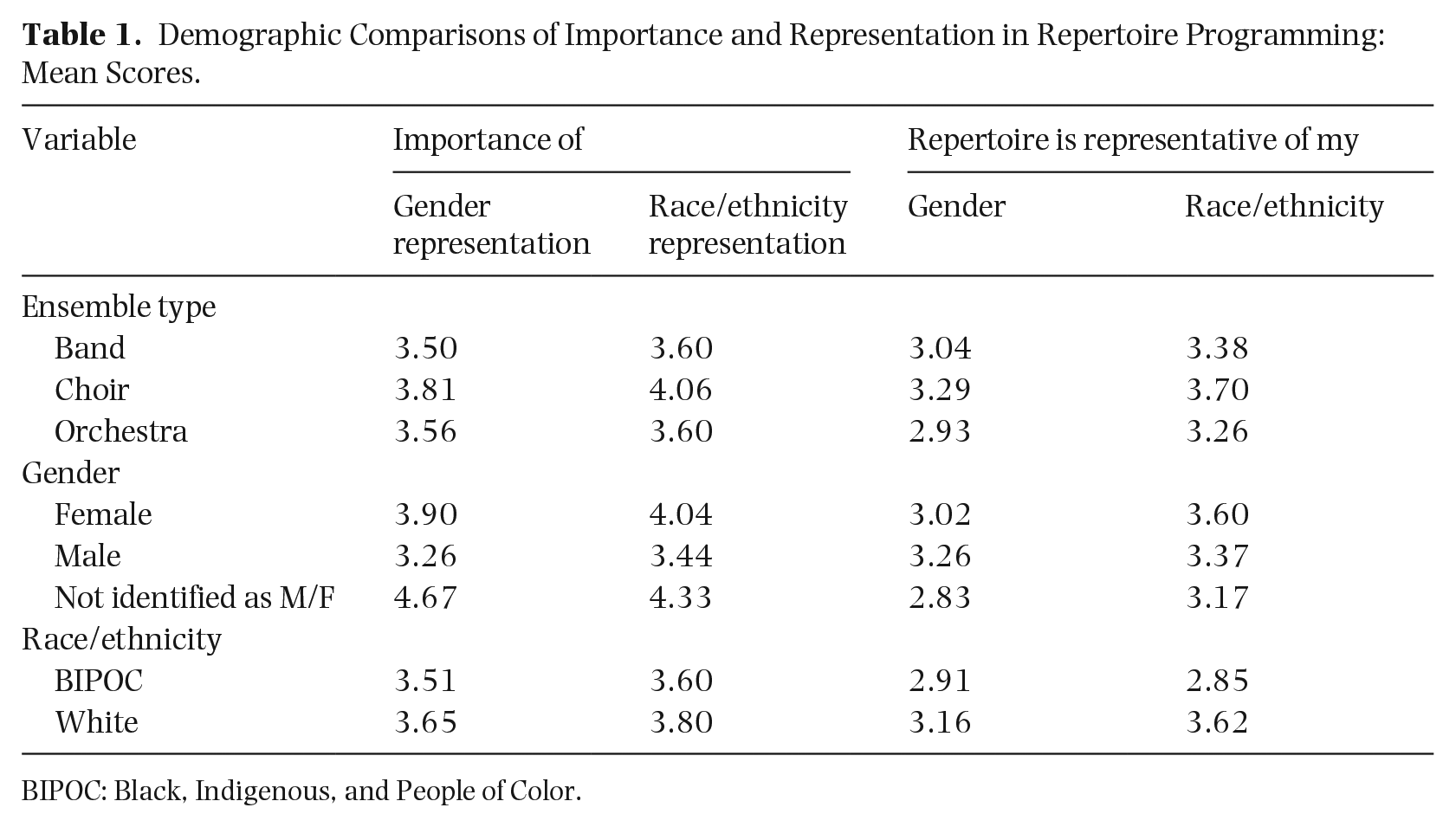
BIPOC: Black, Indigenous, and People of Color.
Comparisons for the final research question based on race/ethnicity followed the same procedure as the second research question. Comparisons of White and BIPOC respondents indicated that White respondents felt that their race/ethnicity was more represented in the repertoire, U = 3,009.00; N1 = 47; N2 = 203; p < .001, r = .26. Comparisons between non-White respondents yielded no significant differences.
Discussion
In an effort to explore student perspectives on self-representation in repertoire, we investigated university ensemble members’ (N = 278) opinions on repertoire selection practices. It is important to keep in mind that repertoire is just one aspect of culturally responsive pedagogy and that focus on a composer’s race/ethnicity or gender does not singularly constitute culturally responsive pedagogy. Indeed, representation, as it relates to CRP, is a critical component of repertoire selection. However, we felt that student voices on these topics would provide meaningful insight and provide an important incremental step in this area of research.
1. Do students perceive current ensemble repertoire as representative and supportive of their self-identities?
Overall, respondents appeared to feel that the repertoire was enjoyable and representative of their self-identities. The response to relevance received the lowest rating (M = 3.46) and had the largest standard deviation (SD = 1.08) of all three general responses. Indeed, these overall trends mask important differences that surfaced during analyses related to other research questions, as can be seen by the relatively large standard deviations, given the use of a 5-point scale. It is also notable when observing overall responses that our participant sample was heavily biased toward White respondents, reflective of trends in music participation, particularly at the university level (Elpus, 2015).
2. What are these perceptions according to students’ race/ethnicity, gender, and ensemble type?
Overall, very few differences emerged between demographic groups in perceptions of overall relevance and feelings of enjoyment and being welcomed. There were no differences based on race/ethnicity. This seems to be somewhat refuted by findings related to the fourth research question, but the current findings are characterized by references to their individual self-identities, not situated within questions specifically related to race/ethnicity. Indeed, the only differences found in regard to this research question were related to gender identity, and the reasons are not immediately apparent. It may be that students not identifying as male or female may view this as a more salient feature of their identity and thus are more inclined to view the repertoire as irrelevant (Garrett, 2012).
We acknowledge the unequal group sizes within the variables of race and gender; however, this demographic disparity is representative of the American music student population in traditional music ensembles. Elpus and Abril (2011) report that non-White students are significantly underrepresented in music programs across the United States. Furthermore, many studies investigating gender within music ensembles define the variable as binary male or female, which limits the data that can be reported from non-binary identifying students. A salient point of this study is for ensemble directors to make concert repertoire culturally relevant to all musicians. Perhaps if music was accessible to all, a wider demographic range of students might choose to participate in traditional band, choir, and orchestra.
3. What factors do students consider important in directors’ selection of repertoire?
Open-ended responses provided a substantial view into students’ opinions about repertoire selection criteria. The two most-mentioned criteria related to Variety and Difficulty, mirroring common advice given to directors by leaders in the profession, such as Reynolds (2000). To provide a well-rounded music education, ensemble members should perform a variety of repertoire, considering compositional styles, time periods, composers, and more, while also taking into consideration the technical and musical capabilities of the players. While there are certainly other important considerations, such a statement seems to encapsulate the view of many current conductors. Only 7% of comments referenced the importance of considering issues related to composer Diversity, such as gender, race, nationality, or language (for choral works). This number may be artificially low, as students may have intended comments related to a variety of composers to be inclusive of diversity, but we opted to separate these concepts into two distinct codes to identify how many respondents felt the criteria important enough to explicitly mention.
It is also noteworthy that just under half of comments (43.5%) asking about what they would change about current repertoire referenced composer diversity. However, perhaps primed by the preceding questions, several respondents protested against the idea of including composers for the sake of diversity, with comments such as, I think that both the preservation of fantastic works throughout history and the premiering of great new composers should be the top priority. I feel like, however, that the programming of new composers at [institution] is done specifically because a person is diverse, rather than the fact that their compositions are good.
If directors look to increase composer diversity on concert programs, such responses indicate that directors may need to inform the ensemble about their reasons for selecting particular pieces to avoid such (mis)perceptions. Similar sentiments also surfaced during the second open-response question when respondents were asked about what repertoire selection practices they would change. These findings align with other researchers that have indicated students appreciated performing repertoire of the highest quality (Baker & Biggers, 2018).
Related to the idea of being culturally responsive is the importance of student input and appeal (Abril, 2013; Bond, 2017). Roughly 10% of comments referenced a desire to consider student Appeal, with one participant stating, Skill level should be considered, as well as student feedback on pieces or genres that THEY would like to experience. I don’t think I’ve ever been asked [sic] that what interests me within the ensemble ever in my time here.
While directors may take students’ musical lives and backgrounds outside of school into consideration without students knowing, the sentiment does express a degree of helplessness for students who are passive recipients in the repertoire selection process. Perhaps directors can address such feelings by making selection criteria more explicit and talking students through the decision-making process, which ideally includes some component of student interest or appeal.
4. How are directors’ current repertoire selection practices, as experienced by the respondents, informed by or responsive to gender and racial diversity in the ensembles?
Analyses based on the final research question yielded several differences between comparison groups. Overall, students enrolled in choirs felt that repertoire programmed for their ensembles was more representative of their race/ethnicity than students in both band and orchestra. Given previous findings of researchers looking at composer representation in traditional performance ensembles (Girtmon, 2004; North et al., 2003), it is unsurprising that students in two of the three major performing ensembles felt similarly unrepresented in regard to gender and race/ethnicity. Perhaps instrumental conductors might look to their choral colleagues for inspiration and approaches in repertoire selection, as the current results seem to suggest that students do, in fact, notice these differences. Interestingly, there were no differences between ensemble types based on participant gender. This may suggest that favorable improvements have been made in increasing the repertoire selection of non-male composers, although longitudinal studies would be necessary to verify such changes in selection processes.
Comparisons based on gender and race/ethnicity yielded several important findings. Males rated composer gender as lower in importance in repertoire selection processes than both females and those not identifying as male or female. In addition, males rated composer race/ethnicity as less important than females. White students, while not differing in their rating of importance of race/ethnicity, did indicate that they felt the repertoire was more representative of their race/ethnicity than BIPOC students. Given the underrepresentation of both women and BIPOC in positions as ensemble conductors (Sheldon & Hartley, 2012; VanWeelden, 2003), these findings highlight the systemic nature of the issue. Although it appears that there are opportunities for some students to recognize the value of representation, others may inadvertently continue to contribute to a lack of diversity in music ensemble enrollment.
The complex interactions within students’ multifaceted self-identity can make it difficult for directors to identify repertoire that students find culturally relevant. Directors can reconcile these challenges by establishing and maintaining personal connections with students, a worthwhile endeavor that takes time. Such connections can be established through intentional moments of dialogue (i.e., directors standing at the door when students enter rehearsal rooms) or unplanned interactions, such as casual conversations after rehearsal. Again, in CRP, purposeful intent is needed for directors to connect student backgrounds to ensemble repertoire.
Limitations
There are several limitations to this study and suggestions for future research. Primarily, this study is only one small part of a much larger CRP contextualization. As our literature review states, culture is complex. To clearly define the variables of race/ethnicity, gender, and ensemble, there is much more nuance within CRP in real-world interactions between music directors, students, and repertoire. There are many aspects of culture beyond gender and race/ethnicity that would be germane to investigations into CRP that we did not include, such as sexuality, socioeconomic status, and nationality (Alcoff & Mendieta, 2003). To obtain a more complete understanding of whether a student feels included and represented, it may be helpful to expand the demographics under consideration. It would also be helpful to have deeper understandings of students’ experiences in these ensembles as related to a CRP, possibly through the use of ethnographic or other qualitative investigations. While non-parametric analysis is robust and versatile (Sawilowsky, 1990), the use of such statistics does not permit suitable investigation of any possible interactions, such as between race and ensemble type (Siegel & Castellan, 1988). Given some of the findings, it is likely that interaction effects may exist.
We chose to study college students’ perceptions of their directors’ current repertoire practices in their primary ensembles. Students were asked broadly about repertoire selection practices without regard to specific semesters of study or performances. Future researchers may wish to investigate students’ perceptions and compare with actual repertory performed in ensembles. We decided to investigate traditional ensembles because of their prominence in postsecondary institutions, but clearly they do not constitute the entirety of music education offerings. It is possible that investigations into other ensembles, such as mariachi, modern bands, or steel pans, might yield very different results from a CRP lens, and may offer opportunities for improvement in other, more traditional settings. It may be beneficial to explore whether the use of a CRP in a traditional ensemble leads to more diverse enrollment or student satisfaction.
Finally, the enrollment of the ensembles in this study contained a large majority of White students, aligning with the findings of previous researchers (Elpus & Abril, 2011). This may be indicative of the overarching need to increase diversity in traditional music ensembles. The convenience sampling method employed in this study was chosen to meet certain practical criteria, including accessibility, availability, and willingness to participate. One disadvantage to such sampling is that it is likely to be biased (Etikan et al., 2016). This study was completed in the southwestern and central United States. Perhaps our results would differ through the use of a random sampling process from larger geographic regions. Future research may help provide a concrete path toward diversifying and increasing student enrollment in these ensembles.
Implications for music education
The perspectives of students in this study illuminated the possibilities of representation in ensemble repertoire. As reported by Bond and Russell (2019), culturally responsive repertoire selection is less commonly addressed in music teacher education programs than other core components of culturally responsive teaching. It appears that teacher preparation programs are a natural starting point for the development of culturally responsive pedagogy in music ensembles. Although the leaders of teacher preparation programs are cognizant of credit hour constraints and undue course loads for students, such training can occur in existing music education courses. For future music directors, CRP presents great potential for flexibility, agility, and openness to new ideas.
Openness and flexibility to CRP considerations, however, will not change repertoire selection practices alone. As Marcho (2020) suggests, barriers including demanding schedules and programming habit strength often obligate directors to maintain the status quo, leaving little time to explore new and progressive repertoire selection practices. Strong habits may be difficult to change, inhibiting the ability to be open to new CRP ideas. More resources may be needed, especially for novice music directors, to enable discovery and acquisition of ability-level appropriate repertoire that aligns with the objectives of CRP.
When directors select repertoire that is representative of musician demographics, musicians will be encouraged to participate in music. Students in this study indicated that, overall, they felt welcomed and enjoyed their time in the ensemble, although some desired more input in repertoire selection. However, as this study sought to determine the views of students as they relate to ensemble repertoire, we should note the function of conductors as teachers. In some cases, students may prefer limited genres or undervalue other musical cultures. Ultimately, repertoire should be determined by the conductor or teacher with consideration of the many purposes of music education, including the transmission of values and development of identity across all musical cultures.
We intended this study to provide insight into the missing student perspective on the discussion of culturally responsive repertoire in college ensemble settings. Several comparisons revealed significant differences based on demographic factors, which speak into the principles and guiding rationale of culturally responsive pedagogy: getting to know one’s students (Gay, 2010; Ladson-Billings, 1995; Lind & McKoy, 2016). By spending time and effort building relationships with students, directors can successfully choose repertoire that is meaningful and representative of every student in their music ensemble.
Footnotes
Appendix 1
Declaration of conflicting interests
The author(s) declared no potential conflicts of interest with respect to the research, authorship, and/or publication of this article.
Funding
The author(s) received no financial support for the research, authorship, and/or publication of this article.
