







Abstract
This study aims to investigate leadership in orchestra conducting and interrogate educational principles to improve conducting pedagogy. Effective leadership implies a set of interpersonal, communicational, and emotional skills combined with a high level of expertise, which may enable the leader to not only achieve excellent outcomes but also create a positive and collaborative working climate and vision for the performance. This work demonstrates that there are strong implications between effective leadership and orchestra conducting. We examine how orchestra conductors are perceived to be effective leaders and deduce from general leadership theories the following five parameters: charisma, stage presence, nonverbal communication, relationships with musicians, and leadership style. Interviews with orchestra conductors and performers support these five parameters for effective orchestra conducting. We perform a detailed analysis of the profiles of two renowned orchestra leaders— namely, Herbert von Karajan and Gustavo Dudamel— to test the five parameters and distill educational implications for both scholars and practitioners. The results are presented and discussed, along with implications for the education of orchestra conductors.
Keywords
Introduction
Research in orchestra conducting has attracted the attention of scholars in different fields, who often treat music conducting as an arena that can offer valuable insights into topics such as education, leadership, group coordination, and teamwork (Bennis, 1989; Bonshor, 2017; de Reizábal & Gómez, 2019; Drucker, 1988; Hackman, 2002; Hunt et al., 2004; Jansson & Balsnes, 2021; Jansson, Elstad & Døving, 2021; Mintzberg, 1998; Pollack, 1991). A plethora of theoretical and applied interdisciplinary perspectives have been offered regarding how an orchestra conductor could be viewed as a leadership model for chief executive officers (CEOs) and managers (Annushkina et al., 2015; Atik, 1994; Bennis & Nanus, 1985; Drucker, 1988; Nica, 2013; Pasher et al., 2020; Traub, 1996). Orchestra conductors lead professionals in a specific working environment that has several implicit and explicit rules. This requires assigning the proper indications for achieving the best outcome and providing an excellent performance for the audience (Annushkina et al., 2015; Atik, 1994).
Modern orchestra conducting involves new aspects of leadership: “while the classic impression of a maestro is one of fiery brilliance, eccentric artistry, and tyrannical personality, the successful modern professional conductor must master a complex set of leadership behaviours and skills” (Hunt et al., 2004, p. 146). Today’s orchestra conductors must provide a convincing vision for their interpretations of musical scores—a vision that must be shared by the members of the orchestra (Durrant, 2018). Furthermore, the conductor must provide constant feedback to the performers while creating and maintaining a collaborative working climate (Biasutti, 2012 ). It is important to take these leadership aspects into account when educating and teaching young orchestra conductors because they could emerge as brilliant musicians but less effective as charismatic leaders. Nowadays, young students are technically prepared but often have not developed (or have not been taught) the fundamental communication and relational skills to manage the unique teamwork involved with an orchestra. The profile of a conductor requires a leadership attitude and high levels of interpersonal skills and emotional intelligence, combined with musical skills and knowledge (Biasutti, 2012). An effective conductor could be seen as a relationship-oriented leader who combines different roles: mentor, innovator, facilitator, educator, director, and coordinator (Hunt et al., 2004; Schmidt et al., 2021).
Regarding the relationship between “music performance” and “performance” as studied by organizational disciplines, several studies in the past few decades have revealed possible leadership models in which CEOs and orchestra conductors overlap (e.g., Annushkina et al., 2015; Gilling, 2014; Mintzberg, 1998): transactional leadership, path–goal theory, participative leadership, leader–member exchange theory, and charismatic leadership. Orchestra conducting is considered an instructive model for managerial work (Mintzberg, 1998), and Annushkina et al. (2015) analyzed the similarities and differences between orchestral and organizational contexts, emphasizing that orchestra conductors develop a unique leadership perspective.
The present study is a non-deterministic, novel exploration to identify key parameters for analyzing orchestra conducting leadership and to “rehearse” them using the contrasting profiles of two eminent conductors. We decided to explore effective leadership in orchestra conducting more deeply due to the lack of an appropriate evidence-based foundation focusing on the psychological elements in group leading for future orchestra conductors in conservatories. Our aim was to identify behaviors and attitudes that could be helpful in achieving excellent musical performances. We were interested in furthering our understanding about a conductor’s psychological characteristics that are key in effective leadership, both in orchestral and in organizational contexts. We suggest that studying and seeking to operationalize leadership styles in orchestra conducting can make a valuable contribution to music, particularly with regard to working efficiently in a group, obtaining increasingly better performances and outcomes, and transferring skills learnt through musical experience to everyday life.
Method
A methodological approach consisting of one phase articulated in three steps was adopted. Step A consisted of an analysis of the material in the general leadership literature, and Step B involved analyzing data from semi-structured interviews with both orchestra conductors and professional musicians, with the intent of corroborating and refining the results in Step A. At the end of Step B, five parameters emerged as the key determinants of leadership in orchestra conducting: charisma, stage presence, nonverbal communication, relationships with musicians, and task-oriented versus relationship-oriented leadership styles. Step C involved analyses of the leadership skills and styles of two leading conductors, Herbert von Karajan (1908–1989) and Gustavo Dudamel (b. 1981), using recorded footage of rehearsals and performances (a similar approach was used by Tsay, 2014) and written and recorded interviews. We used our five parameters and compared Karajan’s and Dudamel’s perceived charisma, stage presence, nonverbal communication, relationships with musicians, and leadership styles.
The study was carried out in accordance with the recommendations of the Ethical Committee for Psychological Research at Università degli studi di Padova, with oral informed consent obtained from all participants. To reveal the heuristics for future research and applications, the five parameters were used to contrast the conducting styles of Karajan and Dudamel. These two renowned orchestra leaders were selected because they are often viewed as representing opposite poles of a classical (and somehow idealistic) leadership continuum, from “being competent” (or somewhat of a technocrat) on one side to “being relationship-oriented” on the other (Yukl, 2013). In addition, although certainly not something from which one could generalize, Karajan and Dudamel notably belong to two different historical periods and sociopolitical contexts. The analysis provided several suggestions that we believe could help expand our understanding and future discourse about the complex nature of leadership in orchestra conducting.
Step A: Literature review and selection of suitable leadership styles
This phase consisted of a critical background analysis of previous leadership models and research with the aim of selecting leadership theories and styles most suitable for orchestra conducting. This extensive review of the literature revealed that the following approaches were relevant, as they involved fundamental aspects of orchestra conductor leadership and were used for empirical research in this field: traits theories (Mann, 1959; Northouse, 2004; Yukl, 2013), behavioral theories (Stodgill, 1974; Tosi & Pilati, 2012; Yukl, 2013), contingency theories (Tosi & Pilati, 2012), path–goal theory (Evans, 1974; House, 1971), process theory (Capozza et al., 2017; Tosi & Pilati, 2012), result-based theory (Tosi & Pilati, 2012; Ulrich et al., 1999), and followership (Hollander, 1964; Northouse, 2004; Weber, 1947). Consequently, we analyzed the related leadership styles: transformational leadership (Bass, 1999; Yukl, 2013), transactional leadership (Haslam et al., 2011; Kuhnert, 1993), path–goal theory, participative leadership (Huang et al., 2010; Scully et al., 1995), leader–member exchange theory (Basu & Green, 2006; Dansereau et al., 1975; Haslam et al., 2011), and charismatic leadership (Bass & Avolio, 1990; Haslam et al., 2011).
After selecting the leadership theories appropriate for orchestra conductors, it was necessary to examine how they could be considered relevant in this context, which required postulating some criteria that we called “parameters.” This process was aided by interviewing a small sample of orchestra conductors and musicians. The analysis of both leadership theories and interview data revealed five core parameters of conductor leadership: charisma, stage presence, nonverbal communication, relationship aspects, and adopted leadership style. Three other complex dimensions emerged from the interviews: vision, interpersonal skills and mastery, or managing relationships. These last three were not kept as parameters, because they were regarded as already nested within the five parameters.
Leadership studies offer several theoretical approaches, such as traits theories, behavioral theories, contingency theories, path–goal theory, process theory, result-based theory, and followership, which have developed over a century of research and practice (Yukl, 2013).
Traits theories, and the great man theory in particular, are based on identifying “the innate qualities and characteristics possessed by great social, political and military leaders” like Napoleon, Abraham Lincoln, and Gandhi (Northouse, 2004, p. 15). The Big Five personality traits model has also been considered in regard to leadership; it is associated with high levels of extraversion, agreeableness, conscientiousness, emotional adjustment, and openness to experience (Judge & Bono, 2000).
Behavioral theories focus on functional and managerial behavior and the coping skills that leaders use (Yukl, 2013). Researchers from Ohio State University contributed to this approach by creating the Leader Behavior Description Questionnaire (Stogdill et al., 1962). Two categories of leadership emerged: consideration and initiating structure. The former refers to leaders who are considerate, support teamwork, and allow followers to take part in decision-making processes, whereas the latter stands for task-oriented leaders who structure tasks and schedules and are more concerned with objectives, planning, and delegation (Tosi & Pilati, 2012). Kahn and Kats (1953) and Likert (1961) identified two leadership styles: production-oriented (or job-oriented) and employed-oriented (Tosi & Pilati, 2012). The first focuses on reaching a high level of production and how this enhances levels of pressure and distress, while the second reflects a cooperative climate in which leaders believe in mutual trust and want their followers to feel accepted and at ease (Tosi & Pilati, 2012).
Contingency theories, also called situational approaches, analyze how situational factors determine the relationships between leader behavior and effectiveness. The variables investigated are the characteristics of followers, the nature of the work performed, the type of organization, and the nature of the organizational environment (Yukl, 2013). According to this approach, two subcategories influence leadership. The first reflects the similarities and differences in leadership processes based on the structure of the organization, the level of management, and the organizational culture. The second subcategory considers the moderating variables between the leader’s traits, skills, behaviors, and leadership effectiveness (Yukl, 2013).
Path–goal theory affirms that “the leader’s behaviour is acceptable and satisfying to subordinates to the extent that they see it as either an immediate source of satisfaction or as instrumental to future satisfaction” (House & Dessler, 1974, p. 254). The leader must encourage and support employees to be more effective, building stronger relationships with them to accomplish tasks in the proper way. House (1971) described this situation as follows: The motivational function of the leader consists of increasing personal payoffs to subordinates for work-goal attainment and making the path to these payoffs easier to travel by clarifying it, reducing road-blocks and pitfalls and increasing the opportunities for personal satisfaction en route. (p. 324)
Process theory is also known as reciprocal theory and underlines the reciprocal relationships between leaders and followers (Tosi & Pilati, 2012). Human behavior is influenced by objectives and how individuals behave rationally to achieve them; beneficial behaviors are nurtured, whereas nonbeneficial behaviors are dismissed. The norms of reciprocity rule the exchange in relationships. Leaders must define leader–follower relationships in teamwork because the company’s success depends on the followers’ performance (Tosi & Pilati, 2012).
Results-based theory underlines that outcomes are the most important gauge of the effectiveness of leadership (Tosi & Pilati, 2012). The focus shifts from leadership inputs to leadership outputs, and a leader must be able to connect leadership attributes to the company’s outcomes. Four essential criteria are presented: equilibrium, strategic aspects, duration and selflessness.
Finally, followership deals with the “process whereby people are influenced by leaders in such a way that they contribute to the realization of group goals” (Northouse, 2004, p. 3). Followers feel free to speak and are committed to their work. The more a leader encourages followers and fosters relationships with them, the more followers will do to meet organizational goals.
Selection of leadership styles
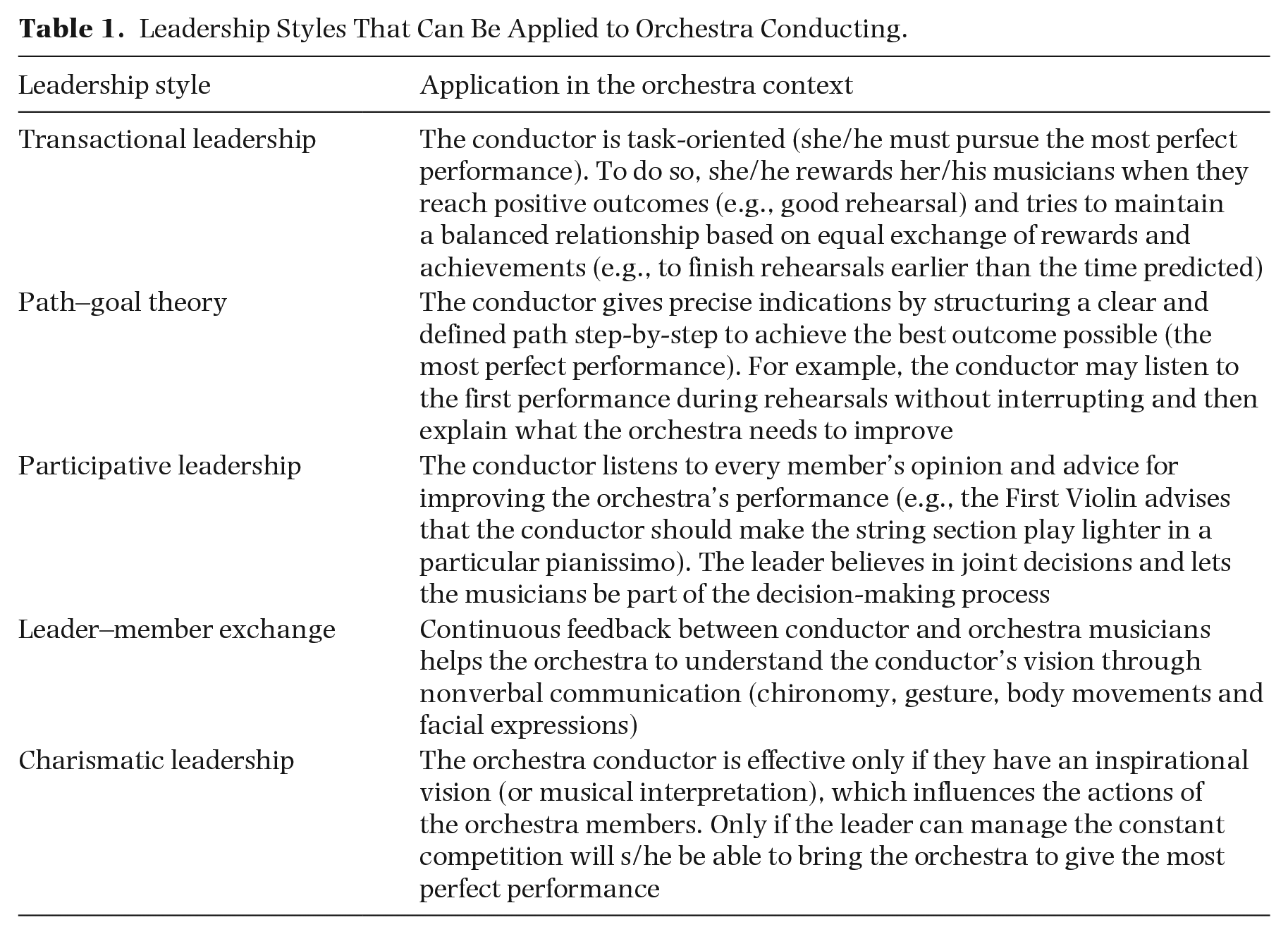
These theories offer a wide variety of approaches, but it is most important to select styles that encourage effective leadership in orchestra conducting. Of all the approaches noted above, the following five styles fit best with the leadership demands placed on conductors (Annushkina et al., 2015; Atik, 1994; Hunt et al., 2004): transactional leadership, path–goal theory, participative leadership, leader–member exchange theory, and charismatic leadership. They were selected after reading orchestra conductors’ biographies and studying renowned orchestra conductors’ interviews and rehearsal footage, including those for Simon Rattle (b. 1955), Leonard Bernstein (1918–1990), Claudio Abbado (1933–2014), and Riccardo Muti (b. 1941). Possible matches between the behaviors of these conductors and key aspects of the five leadership styles were identified. In the organizational context, the transformational leadership style focuses on encouraging independent thinking among followers to help them achieve self-actualization and contribute to the company’s well-being (Bass, 1999; Hansbrough, 2012). One of the main goals of the transformational leader is to fulfill followers’ potential and encourage them to improve their performance levels. Followers are motivated not only to accomplish their tasks but also to find new strategies and tactics to do so (Yukl, 2013). Several similarities with conductors’ leadership styles can be found on a theoretical level. Orchestra conductors have to fulfill musicians’ potential and encourage them to attain self-actualization by aiming for, and ideally achieving, a perfect performance. In this process, the conductor helps musicians to strategically overcome distress and difficulties. In the present study, transformational leadership was not included because charismatic leadership (which can be viewed as a particular type of transformational leadership) was judged to be more suitable to the specific demands on orchestra conductors. Charismatic leadership has already appeared as a fundamental leadership style in conducting (Annushkina et al., 2015; Atik, 1994), but, as summarized in Table 1, orchestra conductors can apply other leadership styles.
Leadership Styles That Can Be Applied to Orchestra Conducting.
Step B: Interviews with orchestra conductors and musicians
In the interviews, participants were asked to express their personal views about the characteristics of an orchestra conductor. A semi-structured interview paradigm was established and adopted both for orchestra conductors and for musicians (see Appendices 1 and 2). The interviews helped reveal musicians’ beliefs about leadership in conducting, with a focus on how leadership is implemented in daily working routines. The purpose of this step was to confirm the model selection in Step A. The first six interviews lasted approximately 30 min each and were conducted in 2017. All interviews were recorded digitally (as pcm wave audio [.wav] files) using a personal computer running the Microsoft Windows operating system. The digital recordings were then transcribed verbatim, with the transcripts sent by email to participants asking them to review, amend, and approve the content to avoid any misunderstandings. The remaining interviews were conducted in 2021; the general outline and questions for the semi-structured interviews were sent to the musicians who agreed to participate in advance.
Participants
Participants consisted of 16 musicians and conductors who provided explicit verbal consent to be interviewed. Half (eight) were male orchestra conductors (coded C1, C2, etc. below), seven from Italy and one from Germany, and all working internationally, while the other eight, five men and three women, were orchestra musicians (coded M1, M2, etc. below). The musicians comprised two cellists, a bassoonist, two violinists, a trumpet player, a horn player, and a flutist. Most participants were aged above 40 years, with only one in her early 20s. They all had at least 3 years of professional orchestra practice, and all worked as professional musicians at prestigious opera and concert houses, such as Arena di Verona and La Scala di Milano. After interviewing the participants, we focused on identifying common aspects of their remarks.
Interview results and further findings: Three new dimensions
The transcripts of the interviews were analyzed using an inductive method developed using grounded theory as a framework. It has been successfully employed in previous qualitative research (e.g., Biasutti et al., 2019; Schiavio et al., 2020) and is based on content analysis in which codes and categories are developed from the data. The analysis of the qualitative data obtained from the interviews highlighted the following three themes in leading an orchestra: inspirational vision, interpersonal skills, and a balance between technical mastery and the ability to manage relationships with musicians. These dimensions are in line with previous research on choral conducting (Durrant, 2018; Jansson, 2018). All participants mentioned these aspects in one way or another, as the excerpts below further unpack.
Inspirational vision
According to the participants, creating a common and inspirational vision is the main goal of the orchestra conductor, who must be able to “combine all the individualities to create a uniform and coherent sound, which derives from his or her unique vision” (C3). For M6, “an orchestra is a group of people who work together for a common purpose, and the orchestra conductor is responsible for making it happen during the concert performance.” M8 wanted to express the orchestra conductor’s vision, which is shared with and inspires the musicians. The conductor must be an inspirational, tolerant, and convincing leader with persuasive skills who gives the right indications to achieve common goals. According to M2, “Karajan was the number one conductor because he made something unrepeatable and inimitable, and he was the first to have that vision.”
For C2, “the orchestra conductor must be an excellent psychologist and a competent musician and has to be polite and agreeable to be perceived in a positive way.” Musicians will feel more involved and inspired by a leader who respects them and awakens their intrinsic motivation (M8). C1 stated that a conductor should be able to create harmony when there is conflict and have good problem-solving skills, while C6 underlined that an orchestra conductor must be convincing and believable, which is only possible if he or she is prepared and can communicate in a positive and productive way.
Interpersonal skills
A leader must be constantly present and show care for followers and how the working process is going (M8, C4). It is important to be honest when dealing with human beings, as this is the best way to be effective. Every member of the orchestra has their own personality and experience, so it is crucial to adapt and be flexible to build meaningful relationships with followers (M8, C4). According to C2, if orchestra conductors are effective and working with a “good orchestra, they would hardly have to solve conflicts. The more convincing the conductor is, the more the orchestra understands their interpretation of the piece, and the results are outstanding if their approach is very humble.” The conductor must demonstrate prosocial working behavior and trust in their followers, as has been noted above and in other research (e.g., Dobson & Gaunt, 2015). The conductor must value and fulfill the potential of other—extremely talented—musicians (C2). A conductor can manage everything easily by developing monitoring skills and a high level of internal locus of control (C2): “The sense of affiliation, mutual respect, and the emotional aspects of music and the orchestra context are as important as musical competence” (C7).
Technical mastery and managing relationships
The balance between technical mastery and managing relationships is crucial for creating an excellent performance (C1). According to C5, “Balancing these two aspects is what facilitates a successful career.” This kind of interaction is defined by two elements: the musical superiority of the orchestra conductor, which allows them to lead all the other musicians and understand their intentions and behaviors, and the empathy among section musicians, whose professionalism enables them to adapt their sound to create one balanced harmony. “The constant exchange of ideas is positive for the elaboration of interpretation. I think that the orchestra conductor needs to discuss with the orchestra members to develop his or her own interpretation of the piece” (C8).
C2 talked about “absolute musicianship,” which refers to musical superiority; the orchestra conductor must be self-confident and demonstrate mastery of the craft. The relationship between mastery and empathy is based on taking pride and pleasure in being part of that particular orchestra (C1). This happens when, according to C4, the conductor “shows knowledge of the pieces and has metabolised every detail. The conductor’s gestures are clear and coherent, and he or she always involves everyone in the musical process.”
The five parameters
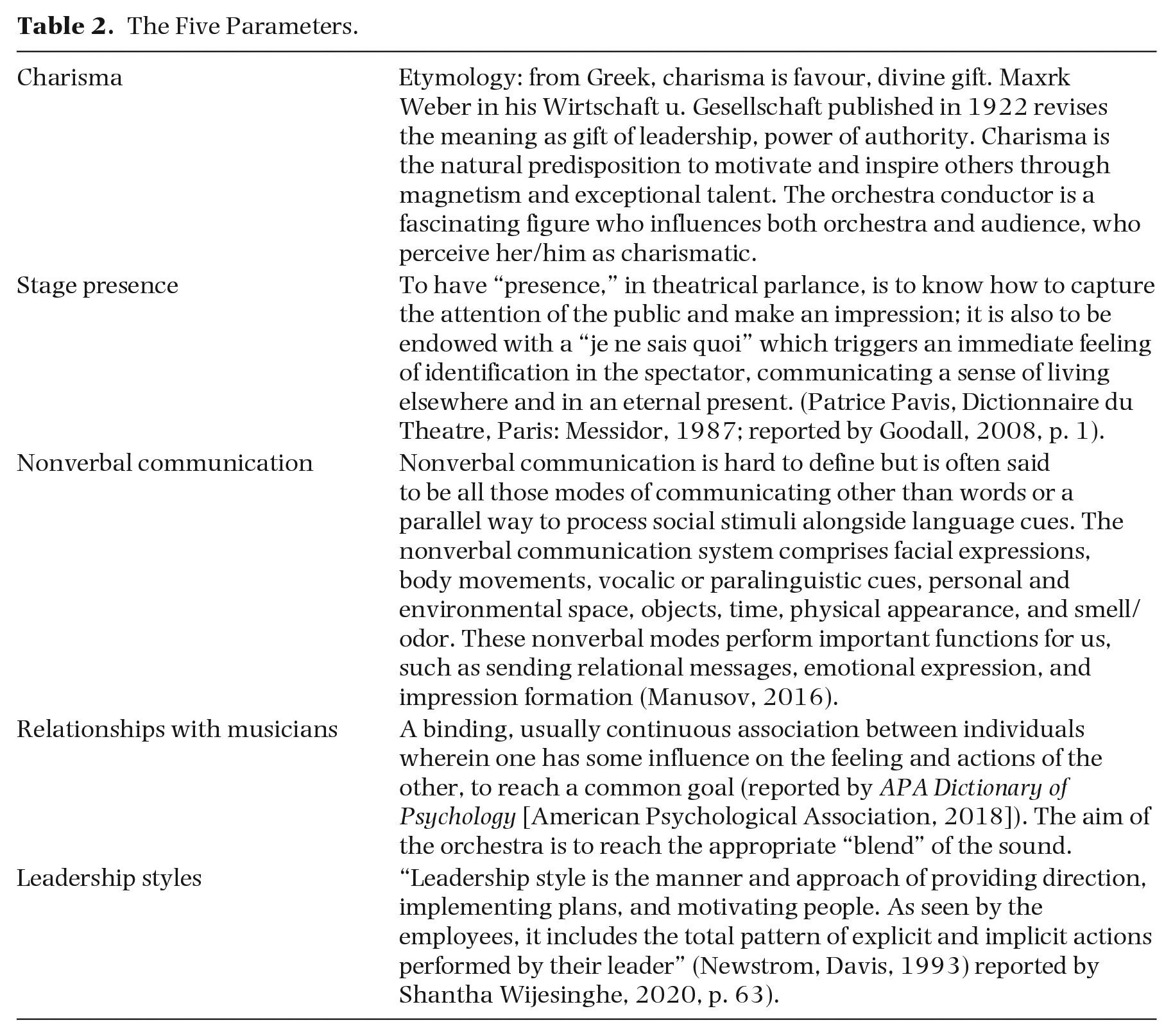
The following five parameters were identified after merging and synthesizing the outcomes of Steps A and B (see Table 2): charisma, stage presence, nonverbal communication, relationship with musicians, and leadership styles. We argue that these parameters are transferrable and could be used to study organizational leadership in several contexts. They could be considered a theoretical contribution and as normative competences and mastery elements. The following five parameters were identified from the distillation of findings from Step A, further interrogated and tested in Step B.
The Five Parameters.
Charisma is the ability to be inspirational and motivational through symbols, such as analogies and metaphors. Although charisma is one of the truly troublesome concepts in leadership theory because of the ontological ambiguity of its precise role (which is sometimes even considered to be negative: cf. Ladkin, 2006), it is generally presented as a powerful leadership tool for conducting. It helps in explaining a shared vision of a musical interpretation and in organizational management for providing feedback to and motivating subordinates (Haslam et al., 2011). A charismatic leader influences the tasks to be pursued, increases the motivation of followers, maximizes the level of coordination, and indicates how to distribute resources and plan working procedures (Yukl, 2013).
Charisma is positively related to stage presence (the second parameter), which implies magnetism and the ability to attract and hold the attention of others (Goodall, 2008). Like charisma, stage presence relies on the complex facets of an individual’s self-esteem (e.g., Bobbio, 2009), but has to be viewed as a distinct element within a broader range of existential factors. The following statement distinguishes between charisma and stage presence: Charisma needs to be understood in a longitudinal sense, as a heightened life force that animates a whole career and fuels the trajectory of a sustained mission in the world. Presence is an expression of life force in the moment, so that the moment itself is transformed in a way that has an impact on all who witness it. . . Yet the charismatic leader and the actor with presence have in common a capacity to communicate with a peculiar intimacy to the individuals massed as their audience. (Goodall, 2008, p. 46)
Charisma and stage presence enable the leader to be attractive, to be listened to and to be inspirational. Employees identify themselves with this kind of leader as they do with an actor on stage. However, it is important to clarify that charisma is not unequivocally a positive feature and may even be outright destructive (Vergauwe et al., 2018). Charisma has been found to be effective only when it is not too little or too much.
Nonverbal communication refers to aspects of communication—gestures, facial expressions, posture, body movements and so on—that do not employ words. It is positively related to orchestra conducting on stage during concerts as the conductor usually does not speak to give direction but relies instead on nonverbal communication, especially when performing in front of an audience (Biasutti, 2012). In addition, nonverbal communication has an important impact on organizational leadership: Leaders who are more nonverbally skilled are more interpersonally effective than leaders who only communicate efficiently with words (Riggio & Reichard, 2008).
Regarding the relational aspects of leadership, such as empowering and trusting in employees (Bobbio et al., 2007; Huang et al., 2010), we hold that leaders have to be relationship-oriented, even if they have demonstrated task-oriented attitudes (Tosi & Pilati, 2012). Interpersonal abilities involve communication skills and have a powerful influence on leadership (Durrant, 2018; Tosi & Pilati, 2012).
Finally, leadership style can be regarded as a way of offering direction, realizing plans and motivating people. It includes explicit and implicit actions performed by the leader (Clark, 2016). A review of the overarching literature suggests that no study to date has offered a broad, critical assessment of this multifaceted context to offer a model of effective leadership in orchestra conducting.
Step C: Analyzing two orchestra conducting leadership styles—Karajan versus Dudamel
This step consisted of analyzing the conducting style of two eminent conductors: Herbert von Karajan and Gustavo Dudamel. Karajan and Dudamel belong to different historical periods and cultural backgrounds and employ different methods and approaches to guiding an orchestra, but both are acclaimed as effective leaders (Persivale, 2012). Karajan and Dudamel provide good examples of leadership to extrapolate indicators for effective leadership in orchestral and organizational contexts. The aim is to examine their differences to refine our understanding of leadership styles, because there are different ways to be an effective leader.
Karajan and Dudamel predominantly differ in the following specific aspect: a relationship-oriented versus a task-oriented approach to leadership. We analyzed the biographies of both Karajan (Lang & Lang, 1993; Osborne, 1989; Vaughan, 1986; Zignani, 2008) and Dudamel (Hernandez-Estrada, 2012; Tunstall, 2012) using the five parameters to evaluate their similarities and differences. It was determined that the most effective way to assess these parameters in orchestra conducting would be to directly observe video footage showing Karajan and Dudamel rehearsing or performing with an orchestra. We selected a total of 30 min of video clips from the archives of both the Berliner Philharmoniker and the Los Angeles Philharmonic and analyzed them using a checklist based on the five parameters. In addition, longer articles in the popular press (e.g., The New York Times, Repubblica, Corriere della Sera) about Karajan and Dudamel were considered.
Karajan versus Dudamel analyzed through the five parameters
Charisma
Karajan was seen as a “heroic leader” (Koivunen, 2003) or a “strong” or “ideal” leader. According to Koivunen (2003), “a strong leader is a person who has a clear vision about the future and an equally clear plan of how to get there. Strong leaders can convince others to follow them with pleasure” (p. 123). They can show and transmit confidence to followers and are models on which to rely and imitate. Moreover, sex appeal is a crucial factor for a strong leader (Koivunen, 2003). Regarding CEOs, being attractive is important, and personal charm and appeal are usually related to charisma and leadership skills.
Dudamel has a charisma that is a mixture of enthusiasm and creativity, with a conducting style that is fresh and full of energy and charm (Tunstall, 2012). His excitement makes him radiant; Tunstall (2012) describes it as “electrical.” Orchestra members report that Dudamel is so magnetic that he “reawakens the feeling of pure delight that originally drew them to dedicate their lives to music-making, [. . .] with a fresh sense of discovery and even adventure” (p. 9). Dudamel is an inspirational and innovative leader who can drive intrinsic motivation to very high levels and always has the attention of the entire orchestra.
Stage presence
Karajan was considered a “glamorous” music star (Osborne, 1989) who was concerned about his physical appearance—his clothes, his hair, his stage presence. Regarding this final aspect, Karajan had a unique and unforgettable stage presence; his composure and elegance of both attire and gesture were admired by every orchestra member. He considered fashion key to his success with the audience. Through the care he took with his clothes and hair, he became a myth, a great man who achieved the maximum level of fame within the profession.
During rehearsals, Dudamel wears casual outfits, unlike the unfailingly stylish Karajan (Tunstall, 2012). Dudamel’s very curly hair is a tool he uses to enhance both his personal appeal and his conducting; it helps him give more emphasis during crucial moments: “He mimes mystery, amusement, foreboding; he sneaks up on the players and surprises them; he seems to be asking them to dance. And the orchestra seems to comply” (Tunstall, 2012, pp. 8–9). Dudamel also has an unconventional and extravagant way of relating to the audience and the orchestra. He enchants people through brightly colored clothes, through posters and commercials, through his curly hair, and through his smiling face.
Nonverbal communication
Karajan would keep his eyes closed during concerts; he did not want to intimidate the musicians through his gaze (Osborne, 1989). Karajan believed that this was the best approach to letting the orchestra members listen to one another and improve their sound. Nevertheless, Karajan expressed his authority. He had a precise vision of the performance before conducting, and no one could change anything without a very good reason. While never blatant, his gestures called for composure and attention as he started to move his head in the precise rhythm he demanded of his musicians. He reproduced what he wanted with his hands and voice.
Dudamel smiles and laughs a lot; he also makes the orchestra laugh. He turns his head to meet every musician’s gaze and make them more involved in the music-making process (Tunstall, 2012). Dudamel uses his eyes and hands to create an example of what he is demanding. When he is referring to the pace of a piece, Dudamel uses his fingers to reflect the rhythm and fraseggio of the musical phrases. Dudamel’s body language is amplified and exaggerated so as to be seen by all the musicians in the orchestra; when he is conducting, it is as if he is dancing.
Relationships with musicians
Karajan was famed for being demanding, but he rewarded the efforts of his followers (Osborne, 1989). Although he was scrupulous, he preferred to finish rehearsals well in advance and made them less stressful than other conductors because he believed in the need to release tension. Karajan was admired—even loved—by his musicians because he did not reproach them; rather, he made everyone work harder because he expected perfection, and they were aware that his trust should not be betrayed. He focused on fulfilling his followers’ potential and cared deeply about young pupils and music students, allowing them to attend his rehearsals.
Dudamel thinks better results can be achieved if the conductor is emotionally closer to the orchestra members (Tunstall, 2012). Karajan cared about his followers, but Dudamel is more demonstrative in his involvement. He possesses not only musical intelligence but also emotional intelligence, which enables him to not only be appreciated as a competent musician but also be loved as a human being. Dudamel acknowledges that he can have a great influence on the orchestra only if its members are open to his interpretations, especially if they are fully united as a team.
Leadership styles
Karajan is the most famous model of charismatic leadership in the history of orchestra conducting. Karajan adopted elements of the path–goal theory by defining and structuring a clear route to achieving the perfect performance. He planned rehearsals step by step to improve the most difficult parts of pieces and reinforce the confidence of his musicians. Berliner Philharmoniker musicians considered Karajan “the real leader” because he made them autonomous and self-confident enough to enrich their performance mastery and become one of the most prestigious orchestras in the world.
Dudamel is a good example of the “shared leadership” style that is suited to a musical and organizational environment, as it is the basis for teamwork and is focused on collaboration and creative thinking (Koivunen, 2003). Dudamel has adopted elements of the charismatic leadership style, the participative approach, and the path–goal theory (Koivunen, 2003). His leadership style focuses on developing an emotional and interpersonal connection with his followers to create a cooperative working environment. Dudamel believes in joint activity and negotiation, which “becomes a process in which a manager and others may come to know each other’s perspectives and construct shared understandings about their relations” (Koivunen, 2003, p. 145).
The results of this analysis are summarized in Table 3.
Contrasting von Karajan Versus Dudamel on the Five Parameters.
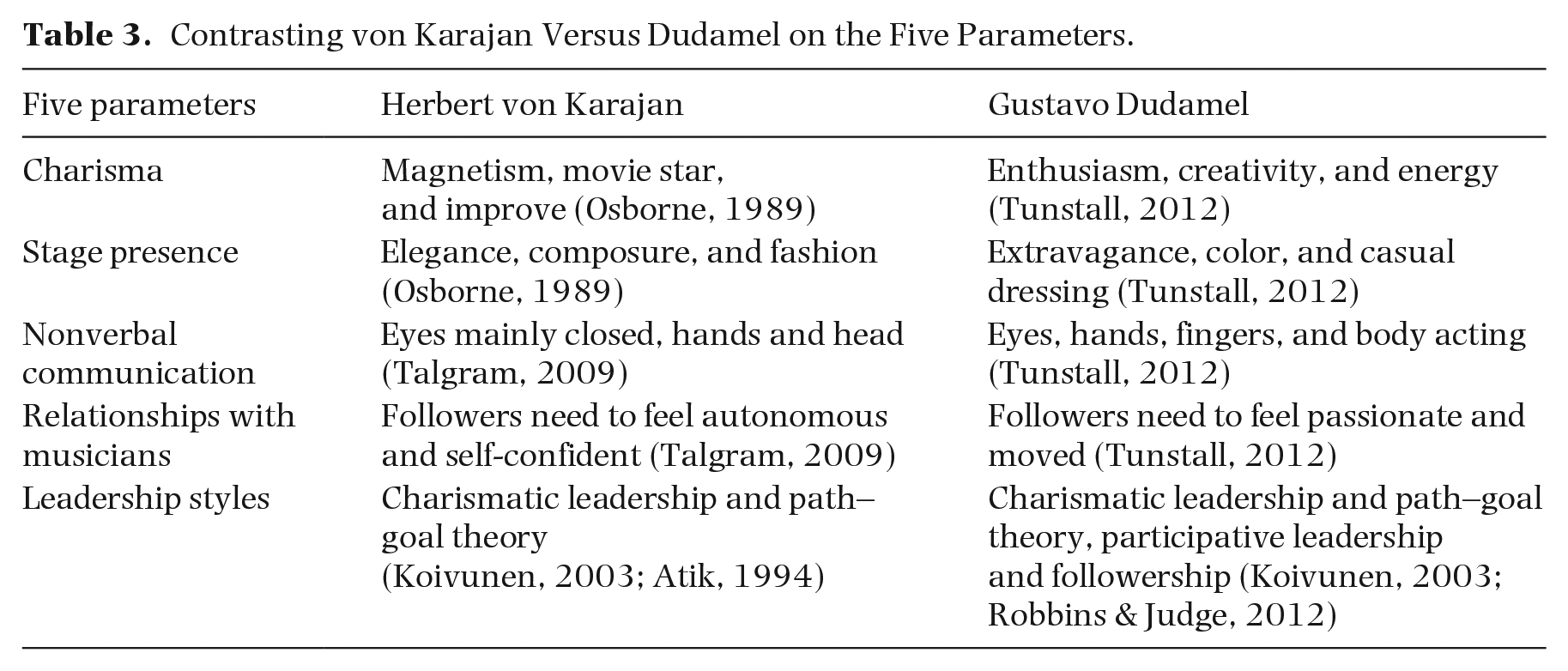
This section looked at perceived key characteristics of the two conductors. This was performed without undertaking detailed one-to-one comparisons of individual elements, but rather more holistically—to identify them, discuss their usefulness, their limitations, and gauge their potential role in theory building. However, this comparison highlighted how different the two conductors were believed to be, while still both being prominent, effective, and admired. We can argue that there are many ways conductors may be effective, and (yet again), normative models are difficult to verify scientifically. One reason might be that there are too many ways a leader can configure a range of competence elements to be effective (Jansson, Elstad & Døving, 2021).
Conclusions: Considerations, limitations, and further studies
Our review of the evidence base, augmented by the findings of our small-scale empirical study, suggests that effective leadership education could affect the way orchestra conducting is taught. Although non-deterministic or prescriptive, our findings suggest that the development of effective leadership skills could impact the promotion of a more positive working environment, by improving nonverbal and verbal communication and preventing setbacks.
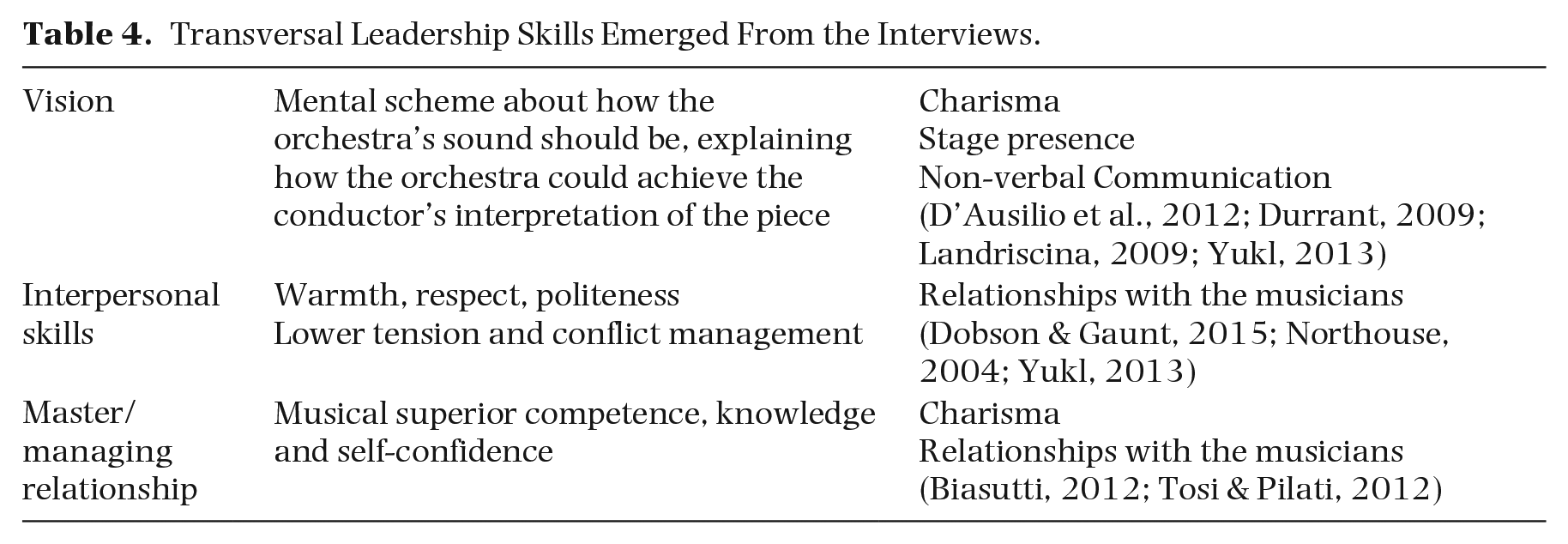
Table 4 summarizes the three key aspects of effective leadership in orchestra conducting according to the interview participants, along with the corresponding parameters, which, if practiced, can help to improve the specific skill. Vision, interpersonal skills and master/managing relationship were three further dimensions which emerged as predominant and universal according to orchestra conductors and musicians who were interviewed. These results can easily be compared and transferred to the organizational context and could be important teaching topics for educational achievement in the careers of young orchestral conducting students.
Transversal Leadership Skills Emerged From the Interviews.
The exemplary orchestra conductors we analyzed and the qualitative data we collected from the interviews underline that there are skills—such as emotional, communicational, managerial, and interpersonal skills—which can be learnt, improved and mastered. There are also psychological dispositions which can make an effective orchestra conductor great and successful. Therefore, a synthesis of expertise, competences, social skills and psychological traits should be nurtured during the education of a young orchestra conductor.
This research also has some limitations. First, the review of the leadership literature was restricted, to some extent, to more established and traditional theories. Future studies should explore more recent approaches to leadership, such as servant leadership (e.g., Van Dierendonck et al., 2017), or perhaps theories that deal more directly and fully with the “dark side” of leadership (Yukl, 2013). Second, the sample of orchestra conductors and musicians interviewed was quite small. However, all participants were internationally recognized experts and leaders and expressed clear support for the proposed five-parameter model. Third, the decision to choose Karajan and Dudamel as conductor exemplars was based on the perceived diversity of their personal and professional characteristics: They belong to different historical periods and sociocultural backgrounds, and could even be seen as opposites. We did not imply determinism from this choice, and offered these two examples as diverse vignettes of internationally established excellence to test the heuristic validity of our five-parameter model. Fourth, all participants in our empirical research were Italian. We are not in a position to assess whether the Italian context is different and whether one should expect to witness substantial differences in conductor training and education across different Western countries. It is possible that participants’ perceptions of “temperament” and conductor “characteristics” are tinted by their own personal but also socially located identities; this would be a very welcome comparative future study. Fifth, little is known about the actual behaviors of leaders who are perceived to be successful (Behrendt et al., 2016). It is therefore important to acknowledge the lack of specificity and determinism within the supra-set of evidence in leadership when conducting research within the sub-set of leadership in conducting. It is also relevant to note that although the development of subject matter expertise is a clear focus within the conservatoire, very little is known about the contribution of expertise in our general perception of “charisma.” Finally, this study is limited by its narrow focus on permanent orchestra conductors. It would be interesting to see whether guest conductors are perceived and evaluated differently.
Further studies could verify whether a reverse focus and critical assessment of leadership could potentially inform orchestral conducting practice. It would be interesting to contrast orchestra musicians’ points of view with those of business leaders to perform an in-depth comparison of leadership styles. Future research could also look at other orchestra conductors’ leadership styles, such as Antonio Pappano (b. 1959), Riccardo Chailly (b. 1953), Simon Rattle (b. 1955), Arturo Toscanini (1867–1957), Pierre Boulez (1925–2016), and Leonard Bernstein (1918–1990). Several additional questions could be considered for framing further research, such as: Is there a difference between conductors of professional and amateur instrumentalists? Is there a need for adaptation of leadership styles? How would expert conductors such as Karajan fare in front of an amateur orchestra? Is the role of the conductor different in front of a less professional orchestra—perhaps more similar to that of a teacher? What are the differences between orchestra and choral conducting and why? These questions demonstrate that there is much room for further discussion and that future research on this topic would be beneficial.
Footnotes
Appendix 1
Appendix 2
Declaration of conflicting interests
The author(s) declared no potential conflicts of interest with respect to the research, authorship, and/or publication of this article.
Funding
The author(s) received no financial support for the research, authorship, and/or publication of this article.
Ethical approval
All procedures performed in studies involving human participants were in accordance with the ethical standards of the institutional and/or national research committee, as well as with the 1964 Helsinki Declaration and its later amendments or comparable ethical standards.
