







Abstract
One-to-one studio music lessons provide the potential to develop strong teacher–student rapport. However, these relationships can also inhibit progress if students are more motivated to seek their teacher’s approval than pursuing musical goals. The purpose of this survey study was to explore relationships between music students’ motivations to pursue degrees in music, perceived rapport with their studio teachers, and praise-seeking and rejection-avoidance beliefs. Participants (N = 151) were music majors at a large school of music in the United States with highly competitive entrance requirements across all degree programs. Participants completed a demographic questionnaire, the 12-item Revised Achievement Goal Questionnaire, the Praise-Seeking and Rejection-Avoidance Scale, the Student–Instructor Rapport Scale, and open-response items. Results indicated that there was a weak positive correlation between perceived rapport with studio teachers and mastery-approach achievement orientation, that praise-seeking was weakly correlated with the performance-approach orientation, and that rejection-avoidance was moderately correlated with the performance-avoid motivational orientation. The open-response items revealed profiles of both positive and maladaptive statements about motivation and student–teacher relationships. These results suggest that the relational component of studio teaching requires teachers to carefully consider how their words and actions affect students, as student motivational tendencies can be influenced either positively or negatively by teachers.
Applied studio music instructors exert substantial influence on their students’ musical career trajectories and are seen as role models by students in conservatory-style institutions (Austin et al., 2012). Because applied lessons comprise a large component of music degrees regardless of their focus (e.g., music performance or music education), studio music instructors are important figures in the lives of university music students, and therefore their praise or criticism can have a considerable impact on their students’ learning. Indeed, Nerland and Hanken (2002) emphasized the closeness of this relationship as characteristic of this environment; this potential for closeness means students put a great deal of stock into the comments provided by their teachers and may seek praise for their efforts.
Rapport
Because studio lesson environments provide opportunities for close working relationships, rapport may develop between a teacher and student. Rapport has been defined as an overall feeling between two people encompassing a mutual, trusting, and prosocial bond (Faranda & Clarke, 2004; Frisby & Martin, 2010; Gremler & Gwinner, 2000). Student-reported rapport has been associated with ratings of course instructors (Demir et al., 2019; Rowan & Grootenboer, 2017) as well as with student motivation, positive perceptions of learning, and self-reported grades (Wilson et al., 2010). Although the majority of research on rapport in educational contexts has been conducted in classroom environments, the need for close working relationships to achieve musical goals in the applied studio has been noted by some authors (e.g., Blackwell, 2022; Blackwell & López Íñiguez, 2024; Burwell, 2016, 2019, 2020; Clemmons, 2009; Creech, 2012; Kurkul, 2007; Zhukov, 2008); indeed, the one-to-one nature of instruction intensifies the need for understanding the importance of rapport in this setting.
Tickle-Degnen and Rosenthal (1990) proposed a conceptual model of rapport based on three interrelated components: mutual attentiveness, positivity, and coordination. Mutual attentiveness refers to the expression of attention to and involvement with one another; participants’ focus is directed toward the other person, and they experience mutual interest during the interaction. Positivity is characterized by feelings of mutual friendliness and caring. Coordination is conceptualized as being “in sync,” such that actions between individuals have a sense of regularity and predictability that results in smooth interactions. Taken together, these three components provide a multidimensional characterization of rapport that could be useful in understanding its expression in music teaching and learning.
Praise
Kanouse and colleagues (1981) define praise as “positive evaluations made by a person of another’s products, performances, or attributes, where the evaluator presumes the validity of the standards on which the evaluation is based” (p. 98). Although this definition provides a useful starting point, Henderlong and Lepper (2002) have identified necessary nuances that this definition does not include. First, “positive evaluations” do not necessarily serve a strict reinforcing function but can enhance or undermine motivation depending on context (e.g., praise for completing easy tasks can be demotivating). Second, praise is a complex social phenomenon; the characteristics and interpretations of the recipient are particularly salient for understanding the outcomes of praise. Finally, they distinguish praise from two related phenomena: “simple acknowledgment and feedback” and encouragement (e.g., “You can do it!”), which they say “is more future-focused than praise and often is used in response to negative performance outcomes” (p. 775).
In addition, it is important to note that feedback and praise are not synonymous. Although feedback provides information to a student that assists in achieving educational goals, and praise can be a component of feedback, praise alone does not communicate information about further learning unless it is specifically directed toward the achievement of those goals (Hattie & Timperley, 2007). Furthermore, praise directed at a person or their accomplishments is more likely to be remembered than educational feedback (Hattie & Clarke, 2018), often making said praise ineffective for learning (Lipnevich & Smith, 2008). The effects of praise vary depending not only on the content of the praise but also on the context in which it is delivered, the potential meanings it may convey, and the way in which it is understood by the recipient (Henderlong & Lepper, 2002). However, praise and “positive feedback” are often convoluted in the extant research literature, and thus, we use the term “positive feedback” in quotation marks when the authors use this term but its application suggests that they are discussing praise.
Praise can have positive outcomes; for example, in studying young musicians, Droe (2012) found that music students who received praise for effort more often selected learning-oriented goals and reported a higher attitude toward task persistence. Soenens and Vansteenkiste (2021) suggested that when individuals understand praise primarily in terms of its informational value, their need for competence is supported, and praise is likely to contribute to high-quality motivation. Conversely, praise for intelligence or talent has been shown to undermine both motivation and performance in educational contexts (Dweck, 2007; Zentall & Morris, 2010) and has been associated with higher extrinsic motivation (Bear et al., 2017). Previous literature has been mixed on the impact of socialized gender norms on the reception of praise. For example, Henderlong and Lepper (2002) noted that students’ self-perceptions of competence and intrinsic motivation were supported by praise of ability for boys and praise of effort for girls. However, Lessard and colleagues (2015) found no differences by gender for university students responding to person or process praise. In addition, it has been noted that studies that have not used gender as a variable of interest in university student populations have been based on samples that are heavily skewed female (e.g., Skipper & Douglas, 2012), which may not be representative of male students (Reavis et al., 2018). Moreover, a limited number of studies have been conducted with university students that consider the potential impact of gender on perceptions of praise, thus requiring additional data before substantive claims can be made in this population (Reavis et al., 2018).
Although praise can have a positive impact on student motivation to learn, some students engage in praise-seeking behaviors, which have been attributed to anxiety, egosystem motivation (i.e., preoccupied with one’s worth and value, both from one’s own perspective and the perspectives of others), and other maladaptive outcomes, as noted in the general education literature (Crocker, 2021). Although existing research literature has not clearly defined praise-seeking, we propose praise-seeking behavior as actively pursuing positive information about oneself from others. In contrast, we propose that rejection-avoidance can be defined as actively avoiding negative information about oneself from others. When students move from simply receiving and enjoying praise to actively seeking it from those around them, or avoiding information that may damage their ego, this motivational shift could lead to a number of changes in behavior that do not support learning.
Motivation in lessons
The seeking of praise or avoidance of rejection may be associated with other learning patterns in relation to motivation and achievement goals. Achievement goals can be categorized by two dimensions of competence—mastery and performance—and are valenced by how the learner aims either to create a positive outcome (approach valence) or to avoid a negative outcome (avoid valence) (Elliot & Murayama, 2008). Thus, four orientations are possible in how one sets a goal, and any goal may contain aspects of each dimension of competence and valence. As Miksza (2009b) notes, performance-approach motivation is characterized by a desire to demonstrate “normative competence” in comparison to others, whereas performance-avoid motivation describes a drive to avoid “normative incompetence” (i.e., not wanting to play worse than peers) (p. 11). Conversely, mastery-approach is characterized by the motivation to develop abilities or make improvements, whereas mastery-avoid reflects a desire to avoid demonstrating “self-referential incompetence,” such as losing skill with age or lacking skill maintenance (p. 11). The maladaptive nature of performance-approach and performance-avoidance motivation is well-documented in the music literature, including associations with lower student achievement, performance anxiety, and quitting music (e.g., Lacaille et al., 2007; Miksza, 2009a, 2011; Smith, 2005). Conversely, mastery goals, and in particular mastery-approach motivations, are associated with flow, grit, commitment, intrinsic motivation, continued participation, deliberate practice, and performance achievement (e.g., Miksza, 2009b; Miksza et al., 2016; Tan & Miksza, 2019; Tan & Sin, 2020). In addition, Matthews and Kitsantas (2007) found that high school instrumental ensemble students tended to endorse the motivational beliefs they perceived their instructors to hold.
Praise has the potential to be a problematic extrinsic motivator for students (Bear et al., 2017); for example, seeking praise from a music teacher for their talent may lead students to performance goal orientations as they seek this external validation (Droe, 2012). VandeWalle (2003) found that individual differences such as a learning goal orientation or a growth mind-set may lead people to seek negative feedback instead of “positive feedback,” because negative feedback is more useful for learning. As VandeWalle (2003) notes, “when attempting to seek positive feedback, if performance-goal-oriented individuals are surprised with negative feedback, the impact on self-efficacy should be especially devastating . . .” (p. 598). If students are particularly devastated by criticism or particularly motivated by praise, they may seek musical tasks that they perceive will result in praise, rather than tasks that could result in critical appraisals, even if those tasks are not as conducive to their musical growth.
The complex relationships between motivation, praise or “positive feedback,” and interpersonal relationships have been well-established in other fields (e.g., Henderlong & Lepper, 2002). However, relationships between motivations to pursue degrees in music, student–teacher relationships, and praise-seeking have not been explored in collegiate music studio contexts. Music-specific research on how praise might facilitate or hinder musical development is necessary to establish best practices for studio teachers and to advance our understanding of students’ experiences in lessons. Such research may have important implications for music studio pedagogy, as understanding students’ motivations to engage in performance and how they seek praise from their teachers can help to develop interventions to prevent maladaptive motivational patterns and to positively affect student well-being.
Purpose
The purpose of this survey study was to explore relationships between music students’ motivations to pursue degrees in music, perceived rapport with their studio teachers, and praise-seeking and rejection-avoidance beliefs. We sought to answer the following questions:
What relationships exist between praise-seeking and rejection-avoidance beliefs, achievement goal orientations, and perceived rapport in studio lessons?
What differences are there in praise-seeking and rejection-avoidance beliefs and achievement orientations according to gender and degree standing?
How do participants describe their motivation to complete their degree, and how do such descriptions relate to their praise-seeking and rejection-avoidance beliefs, achievement orientation, and rapport with their teacher?
Method
Participants
Participants (N = 151) were all enrolled at a large, preeminent, conservatory-style school of music in the United States with highly competitive entrance requirements across all degree programs. We received completed responses from approximately 10% of eligible students enrolled in applied lessons during the recruitment period who had also completed at least one prior semester of applied lessons. Although we did ask participants if they were studying with a faculty member (n = 117) or graduate student (n = 34), there were no notable differences in their responses, and thus, they were treated as one sample. We additionally conducted an independent t-test to identify if there were any significant differences in responses between students studying performance, music education, or other programs, but as there were no significant differences, we treated the entire participant pool as one sample. The mean age of participants was 21.4 years (SD = 3.64), 83.4% were completing undergraduate degrees (n = 126), and 16.6% were completing graduate degrees (n = 25). Of the participants, 55 students (36.4%) were pursuing a bachelor of music education degree, 46 students (30.5%) were pursuing a bachelor of music degree, 15 students (9.9%) were pursuing a master of music degree, 14 students (9.3%) were pursuing a bachelor of arts degree, 11 students (7.3%) were pursuing both a bachelor of music degree and a bachelor of music education degree, nine students (6.0%) were pursuing a doctor of musical arts degree, and one student (0.7%) was pursuing a performance certificate. The majority of the sample was White (n = 108; 71.5%), with smaller percentages of Hispanic (n = 18; 11.9%), more than one race (n = 11; 7.3%), Asian (n = 9; 6.0%), Black (n = 4; 2.6%), or Middle Eastern (n = 1; 0.7%) participants. Seventy-three participants (48.3%) identified as female, 67 (44.4%) as male, four (2.6%) identified as nonbinary, and seven (4.6%) preferred not to answer. Although we did not specifically ask for the genre of focus in lessons, four participants (2.6%) specifically noted jazz as their specialization. Distribution of instruments and voice parts was broadly similar to the population of the entire institution. Participants’ major instruments were brass (n = 45; 29.8%), woodwind (n = 37; 24.5%), strings (n = 21; 13.9%), voice (n = 19; 12.6%), percussion (n = 13; 8.6%), piano (n = 8; 5.3%), harp (n = 4; 2.6%), guitar (n = 2; 1.3%), or other instruments (n = 2; 1.3%).
Recruitment and survey instruments
Recruitment procedures were approved by our respective Institutional Review Boards (IRBs). We recruited participants via an emailed announcement to all music majors at the institution, and we reminded students about the opportunity to participate via in-person announcements in classes and ensemble rehearsals and via messages posted in the course Learning Management Systems. Several studio teachers also forwarded our follow-up emails to their students.
Data for this study were collected via Qualtrics (see Supplemental Figure 1). Upon clicking the link provided to them, prospective participants first read an IRB-approved consent form. Then, upon providing consent and completing screening questions to ensure they were enrolled in applied lessons, participants completed a demographic questionnaire, the 12-item Revised Achievement Goal Questionnaire (Elliot & Murayama, 2008), an English translation of the Praise-Seeking and Rejection-Avoidance Scale (Kojima et al., 2003), the Student–Instructor Rapport Scale 9 (Lammers & Gillaspy, 2013), an open-response item about their relationship with their instructor (“How would you describe your relationship with your applied studio teacher?”), and an open item about their motivation to pursue their degree (“What is your motivation for completing your current degree?”). Ninety percent of participants completed the survey in 18 min or less (M = 7:45).
Pilot
An initial pilot of the survey instrument (N = 38) was conducted at a large, pre-eminent, school of music in Australia. The original survey contained a demographic questionnaire, the Revised Achievement Goal Questionnaire, the Praise-Seeking and Rejection-Avoidance Scale, and the open-response items previously described. Small changes to wording and correction of typos were completed following the pilot. In addition, we noted that students who described their relationships with their instructors positively in the open-response items were more likely to report praise-seeking tendencies and more likely to report performance-approach and performance-avoid goal orientations, which led us to wonder whether their positive relationships with their teachers may have had an impact on student motivation. Thus, we became curious about whether we would be able to identify any relationships between rapport and motivation using a quantitative measure. To more directly address student–teacher relationships, we added the Student–Instructor Rapport Scale 9 (Lammers & Gillaspy, 2013) to the final survey to provide a quantitative measure of student perceptions of their relationship with their teachers, alongside their written descriptions.
Revised Achievement Goal Questionnaire
The Revised Achievement Goal Questionnaire scale is a 12-item scale that evaluates each achievement orientation from the 2 × 2 motivational framework, which we modified slightly to reflect a studio lesson environment. The scale is comprised of three questions for each of the mastery-approach (e.g., “My aim is to completely master the material presented in my lessons”), mastery-avoid (“My goal is to avoid learning less than it is possible to learn in my lessons”), performance-approach (“My aim is to perform well relative to other students”), and performance-avoid (“My goal is to avoid performing poorly compared to others”) goal orientations. In previous research, this scale showed strong content and predictive validity, and the subscales demonstrated high levels of internal consistency: for mastery-approach goals, mastery-avoid goals, performance-approach goals, and performance-avoid goals, Cronbach’s alpha values were .84, .88, .92, and .94, respectively (Elliot & Murayama, 2008). In the present study, all Cronbach’s alpha values were acceptable (mastery-approach, α = .60; mastery-avoid, α = .76; performance-approach, α = .81; performance-avoid, α = .89), with .60 as the lowest acceptable value (Hajjar, 2018).
Praise-Seeking and Rejection-Avoidance Scale
The Praise-Seeking and Rejection-Avoidance Scale includes a total of 18 items, created to measure two directions of approval motivation based on reputational concern. Nine of the items are directed at praise-seeking (e.g., “I am the type that tries to stand out in a large crowd”) and nine are focused on rejection-avoidance (e.g., “When I share my opinion, I worry that everyone will disagree with me”). Because no English language version of this scale was available, we contacted the original authors to request permission to translate the scale; we then hired a translator to provide a direct translation of the scale and slightly modified this translation to more accurately reflect common phrasing and syntax in English. For example, “I quickly assess the other’s mood when I receive an unpleasant facial expression,” became, “When I notice an unpleasant facial expression, I quickly assess the other person’s mood.” During the development of this instrument, Kojima and colleagues (2003) found strong test–retest reliability (for praise-seeking, r = .735 between first and second administrations, r = .760 between the second and third administrations, and r = .723 between the first and third administrations; for rejection-avoidance, r = .758 between first and second administrations, r = .751 between the second and third administrations, and r = .763 between the first and third administrations), internal consistency (praise-seeking, α = .83; rejection-avoidance, α = .82), and concurrent validity with other praise (r = .710, p < .01) and rejection (r = .658, p < .01) scales used in previous research. In the present study, the English translation of the Praise Seeking and Rejection Avoidance scale also demonstrated acceptable internal consistency (praise-seeking, α = .748; rejection-avoidance, α = .803).
Student–Instructor Rapport Scale 9
The Student–Instructor Rapport Scale 9 is a nine-item, self-report measure of perceived rapport as reported by students (e.g., “Your instructor has earned your respect”), with items related to perceived understanding, encouragement, caring, respect, and approachability of the instructor. Previous research supports the internal consistency (α = .95) and concurrent validity (with the SIRS connectedness scale, r = .77, p < .01) of the Student–Instructor Rapport Scale 9 scale (Lammers & Gillaspy, 2013). In the present study, the Student–Instructor Rapport Scale 9 demonstrated excellent internal consistency (α = .91).
Open-response items
To enrich the insights provided by the quantitative data, we also reviewed all the responses for the open items regarding (a) students’ motivation to complete their degree and (b) their description of their relationship with their studio teachers. The first author analyzed the data using descriptive coding (Miles et al., 2014), which was then checked by the second author for inconsistencies (Mays & Pope, 1995). A total of 132 participants (87.4%) responded to both open-response items, which ranged from a single sentence to a paragraph of six sentences in length. We used these codes to inform the motivational profiles described below.
Results
Research Question 1
A Spearman’s rho correlation was used to determine if there were relationships between the Praise-Seeking and Rejection-Avoidance Scale and Revised Achievement Goal Questionnaire subscales. It is important to note that the correlations found between performance-approach and performance-avoid (rs = .706) as well as mastery-approach and mastery-avoid (rs = .382) are consistent with the theoretical underpinning of the theory and consistent with reporting in the initial validation of the Revised Achievement Goal Questionnaire (Elliot & Murayama, 2008). Regarding the measures of interest in this study (Table 1), weak positive correlations were found between the praise-seeking and performance-approach subscales (rs = .217, p = .007) and the Student–Instructor Rapport Scale 9 composite score and the Revised Achievement Goal Questionnaire mastery-approach subscale (rs = .260, p = .003). A moderate positive correlation was found between the rejection-avoidance and performance-avoid subscales (rs = .328, p < .001).
Intercorrelations Between Variables.
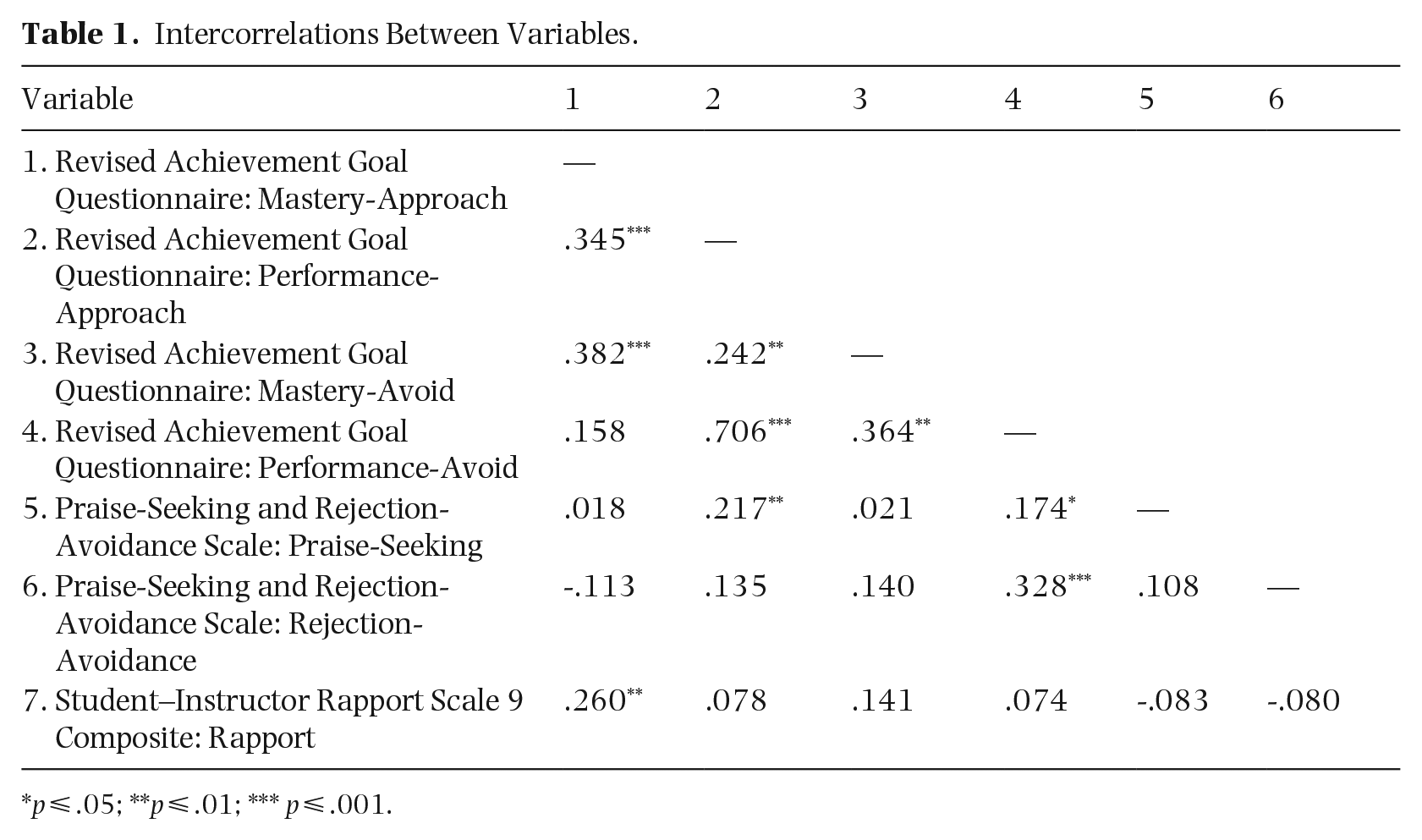
p ⩽ .05; **p ⩽ .01; *** p ⩽ .001.
Research Question 2
To determine if there were any significant differences on the Praise-Seeking and Rejection-Avoidance Scale and Revised Achievement Goal Questionnaire subscales by gender, an independent samples t-test was performed. Due to small numbers, participants who did not identify as male or female (n = 11) could not be included in the statistical analysis, resulting in 140 participants for this portion of our examination (male identifying, n = 67; female identifying, n = 73). A significant difference was found on the praise-seeking subscale, with male-identifying participants reporting higher scores (M = 29.04, SD = 6.35) than female-identifying participants (M = 27.08, SD = 5.22), t(138) = 2.01, p = .023, d = .34. A significant difference was also found on the rejection-avoidance subscale, with female-identifying participants reporting higher scores (M = 32.95, SD = 7.14) than male-identifying participants (M = 30.39, SD = 6.20), t(138) =−2.25, p = .013, d = .38. Although a statistical test could not be performed for nonbinary identifying participants (n = 4), mean scores for praise-seeking (M = 28.5, SD = 2.66) were lower than for male-identifying participants, whereas mean scores for rejection-avoidance (M = 35.8, SD = 5.50) were higher than for both male- and female-identifying participants. For participants who chose not to share their gender identity (n = 7), praise-seeking (M = 27, SD = 4.93) and rejection-avoidance (M = 28.29, SD = 8.42) scores were lower than for both male- and female-identifying participants. No significant differences were found between undergraduate and graduate participants on any subscale.
Research Question 3
We reviewed the responses for the items regarding (a) students’ motivation to complete their degree and (b) their description of their relationship with their teachers. These questions served to enrich the quantitative results and provide a more in-depth understanding of the participants. We identified three motivational profiles, split into high- and low-score groups, that correspond with the three significant correlations (Praise-Seeking and Rejection-Avoidance Scale praise-seeking and Revised Achievement Goal Questionnaire performance-approach subscales; the Student–Instructor Rapport Scale 9 composite score and the Revised Achievement Goal Questionnaire mastery-approach subscale; the Praise-Seeking and Rejection-Avoidance Scale rejection-avoidance and Revised Achievement Goal Questionnaire performance-avoid subscales) identified in the first research question, examining the relationships between subscores on the three scales. To identify representative comments from student groups with the highest and lowest scores, we examined participants whose reported scores were 1 SD above or below the mean on the two correlated measures (approximately the top 16% and bottom 16%, resulting in 24 participants in each profile), to identify any commonalities among responses; we have also included the participants’ scores on the relevant measures alongside their quotes. The quotations that follow are representative responses (per our consensus between first and second authors) that highlight typical responses for participants within each section of the profile, sharing sentiments expressed by most or all of the participants with similar scores.
Avoid profile
Participants in the avoid profile reported scores 1 SD above or below the mean on both the rejection-avoidance (M = 31.67, SD = 6.88) and performance-avoid (M = 3.88, SD = 1.03) subscales. Interestingly, when participants in this profile described their relationships with their teachers, they did so in generally very positive terms; descriptions of friendly, positive, professional, helpful, and supportive relationships were prevalent for both high and low groups. However, the difference between the high- and low-score groups was readily apparent when they discussed their motivations for completing their current degrees.
High Avoid Profile. For participants in the high end of the avoid profile, their motivations were heavily focused on the opinions of others and their desire not to be disappointing. For example, two representative participants said the following:
• Do not disappoint my parents and proving to myself that I can get a degree. (rejection-avoidance = 41; performance-avoid = 5.0; BME degree) • I try my best to do well and avoid disappointing them, but I have the overwhelming feeling that I constantly disappoint them that they have given up on me. (rejection-avoidance = 41; performance-avoid = 5.0; Performance certificate)
The participants in the high end of this profile were consistently preoccupied with avoiding disappointing others, representing an external focus of attention and motivation.
Low Avoid Profile. Conversely, students in this profile who reported low scores on the rejection-avoidance and performance-avoid subscales described their motivations in terms of their personal goals and satisfaction. Two representative participants said the following:
• My passion for teaching and music being fulfilled and instilled into others. (rejection-avoidance = 19; performance-avoid = 2.0; BME degree) • I very much enjoy playing my instrument, and find satisfaction in all aspects of my improvement, including practice. I am not scared of my lessons because my professor and I have developed a healthy “mentorship” relationship. My improvements in playing have led to multiple outside opportunities, which gives me more drive. (rejection-avoidance = 23; performance-avoid = 1.67; BM and BME dual degree)
For these participants, their focus was much more on what they wanted to accomplish and their own personal satisfaction, improvement, and goals, rather than on the opinions of others.
Approach profile
Participants in the approach profile reported scores 1 SD above or below the mean on both the performance-approach (M = 3.90, SD = .94) and praise-seeking (M = 27.99, SD = 5.73) subscales. Although there were no distinct patterns in their answers about their motivations to complete their degrees, there were clear contrasts in the ways in which participants described their relationships with their teachers.
High Approach Profile. Participants in the high end of this profile described distant, overly formal, unhelpful, or controlling student–teacher relationships. For example, two representative participants said the following:
• My professor is not close with me. The occasional “hi” in the hallway or comments when I play in departmental. . . (performance-approach = 5.00; praise-seeking = 35; BM and BME dual degree) • Our relationship doesn’t extend beyond our lesson time. We don’t really have a relationship as friends. (performance-approach = 5.00; praise-seeking = 34; BME degree)
Participant responses in this profile suggested a lack of rapport, including some level of dissatisfaction with the relationship dynamic with their applied teacher.
Low Approach Profile. In contrast, participants on the low end of the approach profile described respectful, productive, collaborative relationships with their studio teachers. For example, two representative participants said the following:
• We’ve gotten to develop a great mutual understanding and respect for each other. She has helped me along my path in ways that I couldn’t have even imagined prior to studying with her, and I am a much better person and musician for having been her student. (performance-approach = 1.00; praise-seeking = 20; MM performance) • Collaborative and understanding; as I have shifted my goals from a performance career to a music therapy career, she has allowed me the flexibility to shift our lesson content to reflect those goals. (performance-approach = 2.67; praise-seeking = 20; BM degree)
These participant responses indicated more rapport-centered, meaningful student–teacher relationships. Although such results cannot be interpreted as causal, the differences between the high and low praise-seeking scores in this profile may in part be explained by more meaningful relationships with their teachers; when students feel more supported and collaborative in their lessons, it is possible that they feel less compelled to actively seek praise from their teachers.
Rapport profile
Participants in the rapport profile reported scores 1 SD above or below the mean on the Student–Instructor Rapport Scale 9 rapport scale (M = 4.40, SD = .65). However, because the mastery-approach subscale (M = 4.68, SD = .44) was both negatively skewed (sk = −2.38) and highly leptokurtic (kur = 8.30), there was not sufficient variation in the responses to include responses that were plus or minus 1 SD from the mean. Instead, we have included representative quotes from participants with the lowest and highest rapport scores and report the mastery-approach score alongside the rapport (Student–Instructor Rapport Scale 9) score to provide additional context.
Low Rapport Profile. Participants on the low end of the rapport profile described awkward, uncomfortable, or actively unpleasant relationships with their teachers. For example, one participant wrote:
• I believe my relationship is very awkward. I do not feel seen or understood or that my teacher knows me. My teacher is not as encouraging as I need them to be, and I often find myself anxious before lessons and discouraged after them. (Student–Instructor Rapport Scale 9 = 2.89; mastery-approach = 4.00; BM degree)
High Rapport Profile. Conversely, students on the high end of this profile described more supportive, caring relationships:
• My relationship with my studio teacher is great! I can tell that she cares about my wellbeing in addition to my ability to play well. I leave most of my lessons feeling empowered to learn. (Student–Instructor Rapport Scale 9 = 5.00; mastery-approach = 5.00; BM degree)
One participant gave a particularly insightful account of how rapport in their lessons fostered open, honest communication. When describing their lessons, they characterized them as: • Comfortable and casual. I have a lot of respect for them because they can demonstrate what they teach: I have complete confidence that they have full content knowledge. They are not timid in addressing my weaknesses, and their own, and this transparency helps me feel comfortable with identifying and addressing my weaknesses. They make a clear plan for what steps I need to take to address my weakness. They do not lie and tell me something is good when it is not, but give ample praise when it is successful, and [. . .] point out other aspects of my playing that are great. (Student–Instructor Rapport Scale 9 = 5.00; mastery-approach = 4.68; BM and BME dual degree)
This student highlighted how strong rapport with their teacher allowed for an open, honest learning relationship in which they were comfortable developing skills and actively working on their weaknesses in a supportive environment.
Discussion
The purpose of this study was to explore relationships between music students’ motivations to pursue degrees in music, perceived rapport with their studio teachers, and praise-seeking and rejection-avoidance beliefs. Results indicated that perceived rapport with studio teachers was positively, albeit weakly, correlated with a mastery-approach achievement orientation, praise-seeking was weakly correlated with the performance-approach orientation, and rejection-avoidance was moderately correlated with the performance-avoid motivational orientation. Moreover, the open-response items revealed profiles that highlighted both positive and maladaptive statements about student motivation and student–teacher relationships.
Praise-seeking behaviors, which have been attributed to anxiety, egosystem motivation, and other maladaptive outcomes in previous research (Crocker, 2021), may also affect a student’s motivation to pursue musical growth. The results of this study suggest that when a student seeks praise or avoids rejection, their motivation to pursue a degree in music may shift from an internal to an external focus, resulting in preoccupation with the thoughts of others rather than improvement. This is consistent with egosystem motivation, which involves preoccupation with worth and value, both from one’s own perspective and the perspectives of others (Crocker, 2021). Conversely, the relationship between higher Student–Instructor Rapport Scale 9 composite scores and the Revised Achievement Goal Questionnaire mastery-approach subscale suggests that when students have higher perceived rapport with their teachers, they may be more likely to pursue musical improvement for its own sake, without a focus on the views of or comparisons to others. The contrast between the high- and low-scoring participants in this profile highlights how relational considerations might affect student outcomes (Blackwell & López Íñiguez, 2024; Burwell, 2016, 2019, 2021). When students feel supported in their learning, they can grow without fear of personal judgment; when they feel less supported, anxiety and a lack of motivation to improve may ensue. Importantly, this suggests that positive rapport with teachers may provide a sort of insulation against outward focus and extrinsic motivation; when students perceive that their teacher is trying to support their growth, they may be able to see their mistakes as information used for improvement, rather than personal failures or evidence of a lack of skill (Blackwell, 2022). Although such results cannot be interpreted as causal, the differences between the high and low praise-seeking scores in the profiles described above may, in part, be explained by more meaningful, collaborative relationships with their teachers, in which students may feel less compelled to actively seek praise from their teachers. Given these findings, studio teachers might consider prioritizing the establishment and maintenance of strong rapport with each of their students—not merely as a social nicety, but as a means of facilitating students’ musical growth (i.e., Blackwell & López Íñiguez, 2024; Clemmons, 2009).
The gendered difference in praise-seeking (higher among male-identifying students) and rejection-avoidance (higher among female-identifying students) found in this study is consistent with previous literature, highlighting how socialized gender norms affect the reception of praise (e.g., Henderlong & Lepper, 2002; Kelly, 2002). Notably, although previous research has typically highlighted these differences in children, research on tertiary populations has typically not reported an effect of praise by gender (e.g., Lessard et al., 2015; Zhukov, 2012). These mixed results suggest that future research might be conducted to further clarify how considerations of socialized gender affect the motivational drive toward praise or away from rejection. Again, although our results must be regarded as preliminary, and individual differences must always be respected, studio instructors might be wise in recognizing the potential for gender-based speech and behavioral patterns that reflect their students’ underlying motivation. Importantly, rejection-avoidance might be of notable concern among nonbinary students.
Although the results of this study suggest that students’ beliefs about praise-seeking and rejection-avoidance in their lessons may be connected to motivation for individuals who are particularly inclined toward praise or avoidant of rejection, previous literature suggests that praise given within the context of a supportive student–teacher relationship may be received differently. Previous research suggests that when students understand praise primarily in terms of its informational value, their need for competence is supported, and thus, it is more likely to contribute to high-quality motivation (Soenens & Vansteenkiste, 2021). This suggests that although praise-seeking is a maladaptive motivational profile, simply withholding praise is likely not a productive teaching strategy for studio teachers, as highlighting what a student does well as well as what they need to improve provides important feedback information for continued growth.
Indeed, the relationship found in this study between rapport and mastery-approach motivation suggests that strong rapport between instructors and students helps students to pursue their goals for their own sake, further suggesting that rapport is a meaningful motivational consideration, and thus, its development warrants future study. Importantly, rapport is richer and more nuanced than mere positive comments. For example, previous research has suggested that if students feel their teachers are providing false or inflated praise, they do not believe in their abilities (e.g., Graham & Chen, 2021) and are less likely to experience the perception of rapport. Also known as prosocial lies, false praise is antithetical to learning; as Levine and Lupoli (2022) note, “lying to spare a target from emotional harm, even when the truth has instrumental value, is paternalistic because it reflects an assumption that avoiding harm is more important to the target than learning or improving” (p. 338). Rather, rapport is better characterized by what it allows in teaching–learning relationships: honest evaluations of performance from teachers and the ability to receive this information as a genuine attempt to reach musical goals for students. In the current study, participants in the high rapport profile highlighted the mutual attentiveness, positivity, and coordination that Tickle-Degnen and Rosenthal (1990) proposed in their model of rapport, suggesting that these components allow students to feel supported to learn. Instructors would do well to recognize that strong rapport allows students to actively engage in their lessons as partners in learning. This may take the form of students asking questions during lessons, teachers soliciting feedback from their students regarding how well they are understanding lesson content, and working together toward mutual goals.
Previous literature has suggested that praise can help to foster rapport (e.g., Crocker, 2021), but we posit that if students misdirect their learning efforts toward seeking praise from their teachers, rapport cannot truly develop. In addition, we propose that “positive feedback” and praise are not the same thing: feedback must be information aimed at improving learning (Hattie & Timperley, 2007), whereas praise does not have to be focused on improving learning and can have other goals (such as mitigating negative emotions or boosting self-esteem). Because praise is a complex social phenomenon, teachers cannot fully control how their comments will be received. Indeed, positive feedback may be perceived by the student as praise depending on their motivation or what response they desired before the performance of the task. Thus, teachers might focus their efforts toward providing honest evaluations of student performance—which include both strengths to be further developed and weaknesses to be remedied—in an attempt to direct students toward understanding the instructional value of comments, regardless of whether those comments are feedback, praise, acknowledgment, or encouragement. Indeed, Henderlong and Lepper (2002) state that “provided that praise is perceived as sincere, it is particularly beneficial to motivation when it encourages performance attributions to controllable causes, promotes autonomy, enhances competence without an overreliance on social comparisons, and conveys attainable standards and expectations” (p. 774). In contrast to egosystem motivation, Crocker (2021) discusses ecosystem motivation, which is characterized by people who are “understanding, caring, and validating,” and that such actions encourage responsiveness in others. According to Crocker (2021), this suggests that “when praise is given with the intention to be supportive and constructive, rather than with the intention to manipulate or control another’s behavior or emotions, praise may activate ecosystem motivation” (p. xxi), highlighting how both the intentions and reception of praise comments shape their motivational outcomes. Such insights comport with our findings: if students can see their teacher’s comments as a sincere effort to help them improve, they may be able to develop more meaningful rapport and focus their efforts on musical improvement.
Limitations, future research, and conclusions
The results of this study should be considered in light of its limitations. Participants were drawn from one large school of music, with a response rate of approximately 10%, which cannot be regarded as representative of the entire United States. This response rate may be due to the length of the task, as 48 eligible participants consented to participate but did not complete the survey. It is possible that the students who responded to the survey may have been specifically interested in the topic. Future research might seek a national sample and higher response rate to be more representative of all students pursuing music degrees. Questionnaire responses might also have been subject to social desirability bias in that participants offer answers they feel are “best” and thus may not be entirely reflective of their beliefs or actions. As some differences were seen in praise-seeking scores by gender, it would be interesting to consider gender pairings in student–teacher relationships in future studies. The correlational evidence found in this study was weak to moderate, and the effect sizes on the t-tests were small; thus, cautious interpretation of these results is warranted. There is also a notable lack of literature available in English specifically addressing praise-seeking and rejection-avoidance, and thus, additional study is needed to explore these constructs in English-speaking contexts. The present study only considers rapport as self-reported by students, without considering the teacher’s perspective, and future research might look more holistically at relational aspects of studio teaching by including both student and teacher perspectives on rapport. Data collected from direct observation of instructional patterns in lessons that reflect elements of rapport could also be insightful (cf. Duke & Simmons, 2006).
Given the long and intensive process needed to become a high-level musician, healthy motivation is one of the most important considerations in helping students to reach their full potential. The results of this study suggest that student perceptions of their relationships with their studio teachers have an important impact on student motivation, and thus, teachers should carefully consider how they interact with their students as they attempt to develop positive working relationships and encourage musical growth. When students have positive, productive, and meaningful professional relationships with their studio teachers that appropriately consider how that relationship might affect their motivation, they are better positioned to thrive as musicians.
Supplemental Material
sj-docx-1-rsm-10.1177_1321103X251356621 – Supplemental material for Motivation, student–teacher rapport, and praise-seeking and rejection-avoidance beliefs of university-level music students
Supplemental material, sj-docx-1-rsm-10.1177_1321103X251356621 for Motivation, student–teacher rapport, and praise-seeking and rejection-avoidance beliefs of university-level music students by Jennifer Blackwell, Nicholas Matherne and Mark Montemayor in Research Studies in Music Education
Footnotes
Author Contribution(s)
Declaration of conflicting interests
The author(s) declared no potential conflicts of interest with respect to the research, authorship, and/or publication of this article.
Funding
The author(s) received no financial support for the research, authorship, and/or publication of this article.

Supplemental material
Supplemental material for this article is available online.
Author biographies
References
Supplementary Material
Please find the following supplemental material available below.
For Open Access articles published under a Creative Commons License, all supplemental material carries the same license as the article it is associated with.
For non-Open Access articles published, all supplemental material carries a non-exclusive license, and permission requests for re-use of supplemental material or any part of supplemental material shall be sent directly to the copyright owner as specified in the copyright notice associated with the article.
