







Abstract
The sense of belonging at school is a critical factor in adolescent health, academic achievement, and socioemotional well-being. Prior research in music education indicates that, among other benefits, music classrooms may provide an environment where students feel they belong. Using student surveys of school membership (n = 190), student reflective writings (n = 190), teacher interviews (n = 5), and classroom observations (n = 10), this study examined the relationship between seventh- and eighth-grade student-reported levels of connectedness within their school-based music ensemble and teacher instructional practice. Findings were derived from descriptive and inferential statistical analyses of the survey responses and inductive and comparative analyses of qualitative data regarding how teachers utilize instructional practices to build an inclusive music learning environment. Students reported high levels of positive school membership within their music classes, which aligned with teacher instruction practices. The findings offer important implications for future music teacher instruction to create environments of inclusion and promote strategies that enhance student connection to schooling.
Keywords
A sense of belonging is a critical component of schooling, as it not only influences students’ emotional well-being but also plays a pivotal role in their long-term academic success (Arslan, 2018; Davis et al., 2019). When students feel a sense of belonging within their school community, they are more likely to engage actively in their learning, succeed academically, have higher attendance, and complete their schooling (Allen & Bowles, 2012; Ma, 2003; Neel & Fuligni, 2013; Osterman, 2000). However, a gap exists between the extensive research on the importance of belonging and day-to-day instruction at school (Allen & Bowles, 2012; Riley, 2022). According to data from the Organisation for Economic Co-operation and Development (OECD), the sense of belonging in school settings has declined worldwide over the past decade, with one in three students reporting that they feel they do not belong at school (OECD, 2017, 2019). This research–practice gap may be due to a lack of research on how belonging is fostered during instruction.
Previous research indicates that music classrooms may provide an environment where students feel they belong (Adderley et al., 2003; Campbell et al., 2007; Schultz, 2018). For example, Siegal (2023) found that high-school music band students experienced greater levels of belonging in their band than in the school environment outside these ensembles. But, in contrast, Rawlings and Stoddard (2017) reported no statistical difference in peer connectedness, a fundamental aspect of belonging, between middle-school band students and their peers in the wider school context. As much of the existing research primarily centers on band settings, Siegal (2023) recommends that future studies include other types of music ensembles. In the present study, I therefore focus on the orchestra setting to contribute to a more comprehensive understanding of belonging across school music ensembles.
Within such settings, investigating teachers’ roles in cultivating environments of belonging is critical for gaining deeper insight into the instructional practices that support or hinder students’ sense of connection to and inclusion within their schooling experience. Research consistently reports that teachers have the strongest and most direct effect on students’ psychological experience in the classroom and influence students’ sense of belonging through interpersonal interaction, autonomy support, and methods of instruction that support positive peer relationships (Osterman, 2023). However, there is limited research in the field of music education that specifically examines how teachers cultivate environments of belonging, highlighting a need for further investigation into this essential aspect of teaching practice. In the present study, I investigate how students experience a sense of belonging in their ensemble and examine how teachers’ instructional practices help to cultivate environments that support belonging.
Belonging at school
Maslow’s (1943) hierarchy of needs used an ecology framework to underscore the importance of belongingness, proposing that meeting fundamental needs is pivotal for advancing to higher levels of psychological development and self-actualization. Baumeister and Leary’s (1995) theory of belongingness further suggests that a deficiency in belongingness could result in adverse psychological effects, including feelings of loneliness, depression, and diminished self-esteem.
The construct of the psychological sense of belonging at school is often referred to as school engagement, school bonding, or school connectedness. Goodenow (1993) first defined school connectedness as “the extent to which students feel personally accepted, respected, included, and supported by others in the school environment” (p. 80). Students who experience school connectedness feel like they belong in the school environment, believe their teachers care about them and their learning, and think that education matters.
This sense of connectedness is especially important for adolescents during a school day. Students spend a significant amount of time with their teachers and peers in school, and the quality of their relationships is a critical influence on their social, emotional, and academic development (Demanet & Van Houtte, 2012; Wentzel, 2003). Adolescents who feel they receive emotional support and are positively connected to their school experience are more likely to be motivated to learn (Cornelius-White, 2007; Delgado et al., 2016), have increased attendance (Wang & Holcombe, 2010), perform better in tests (Bryk & Schneider, 2002), and have fewer internalized problems such as depression (Reddy et al., 2003). Students who have strong connections to school are less likely to develop substance abuse, engage in early sexual activity, and engage in weapon-use violence (Catalano et al., 2004).
Despite the documented benefits of teacher and peer relationship-building during the school day, middle and high schools in the United States are often structured in ways that make this difficult (Jackson, 2000). Most secondary schools have routines and structures, such as switching teachers and peer groups every hour, along with large class sizes that translate to diminished opportunities for sustained personal contact between teachers and peers (Hill & Chao, 2009; Way et al., 2007).
A sense of belonging in school music ensembles
Historically, performing ensembles such as band, orchestra, and choir have played a central role in American school music programs (Abril, 2013). These ensembles often exist alongside other curricular offerings such as guitar, keyboard, and music technology courses, reflecting a diverse but unevenly distributed music education landscape. According to Elpus and Abril (2019), 24% of high-school students in the graduating class of 2013 participated in at least 1 year of band, choir, or orchestra. Similarly, Elpus (2022) found that 34% of eighth-grade students were enrolled in an ensemble music class in 2016. Elpus and Abril (2019) reported that only 2% of American high-school students were enrolled in orchestra, compared to 11% in band and 13% in choir. This discrepancy highlights the marginal positioning of orchestras within the larger ensemble ecosystem. Moreover, Elpus and Abril (2019) identified socioeconomic status as a critical factor in ensemble participation, as students from lower-income backgrounds were considerably less likely to have access to or enroll in music courses, particularly those requiring private instruction or instrument ownership. These structural inequities raise important questions about who has access to ensemble learning and how participation may be shaped by broader systems of privilege and exclusion (Abril & Bannerman, 2015).
Despite these barriers, ensemble participation has been shown to foster a sense of belonging among students. Research suggests that music ensembles serve as important social environments where students can experience connections with peers and a shared commitment to a common goal. Adderley et al. (2003) described school ensembles as a “home away from home” (p. 204), with students citing feelings of emotional safety and acceptance. Similarly, Campbell et al. (2007) found that students often characterized their ensemble experiences as familial, where a sense of camaraderie and shared identity was cultivated through the routines of rehearsal and performance. This sense of belonging may not be incidental, as it is tied to the collective experience of making music and the intensive time students spend together during and outside of school hours.
Less is known about how music educators intentionally foster this sense of belonging through their instructional choices. While belonging is often attributed to the social dynamics of ensemble participation, the teacher’s role in cultivating inclusive practices, facilitating peer connections, and shaping classroom culture remains underexamined. This study builds on previous work by exploring the specific strategies teachers employ to create welcoming, equitable ensemble environments. By focusing on instructional practice, this research contributes to a deeper understanding of how belonging is constructed, and potentially disrupted, within school orchestra ensembles.
Research design
Research questions
The following research questions were addressed in this study:
RQ1. To what extent, if at all, do middle-school orchestra students report a sense of school belonging in their school-based performing ensemble?
RQ2. In what ways do music teachers use instruction to foster a sense of belonging?
Theoretical framework
This inquiry into instructional practice and school belonging in middle-school orchestra classrooms was grounded by the integrative framework of belonging. Introduced by Allen et al. (2021), this framework captures the intricacies that may affect a student’s sense of connection to a learning environment. It posits belonging as a dynamic feeling and experience that emerges from four interrelated components: competencies for belonging, opportunities to belong, motivations to belong, and perceptions of belonging.
Competencies for belonging are the skills that enable individuals to relate to others, identify with their cultural background, develop a sense of identity, and connect to a place. Such skills include being aware of oneself and others, emotional and behavioral regulation, verbal and nonverbal communication, acknowledgment and alignment with social norms, and active listening. Opportunities to belong emerge from the availability of groups, people, and spaces that enable belonging to occur. The need for opportunities to belong has become increasingly significant during the COVID-19 pandemic, as communities were required to social distance and schooling worldwide was either halted or transferred to virtual platforms. Motivations to belong are the needs or desires to connect with others. While Maslow’s (1943) hierarchy of needs first identified the fundamental need for people to be accepted and seek social interaction with others, further studies have followed, outlining how individual differences and context play a crucial role in understanding belonging motivation (Leary & Kelly, 2009). Finally, perceptions of belonging are a person’s subjective feelings and cognitions of their experiences. Subjective experiences and perceptions of experiences act as feedback mechanisms that increase or decrease the desire to connect with others.
In what follows, I detail the complexities of how music educators nurture a sense of belonging while also outlining instructional challenges that may hinder students from fully embracing the advantages of belonging within music ensembles.
Method
This study employed a multiphase mixed-method design, beginning with a convergent phase (Phase I) in which quantitative and qualitative data were collected simultaneously but analyzed separately to compare and integrate findings. This was followed by a sequential phase (Phase II), where insights from the initial analysis informed the next stage of data collection and interpretation, allowing for a more comprehensive understanding of the research topic (Creswell & Plano Clark, 2011). While quantitative methods typically follow a positivist framework, which seeks to measure objective, observable phenomena, qualitative methods align with interpretivist and constructionist frameworks, focusing on understanding subjective experiences and the meanings individuals attach to their reality. These differing paradigms can work congruently when qualitative data are used to provide depth and context for the trends identified through quantitative analysis, allowing for a greater understanding of the research problem. By integrating both approaches, this study aimed to capitalize on the strengths of both frameworks—generalizability and context—to offer a fuller, more nuanced perspective on the research question.
Ethical approval
This study was approved by the Institutional Review Board of the University of California, Los Angeles (IRB#19-000083). All participants (and, where appropriate, their guardians) provided their written informed consent for inclusion before voluntarily participating in the study.
Site and participants
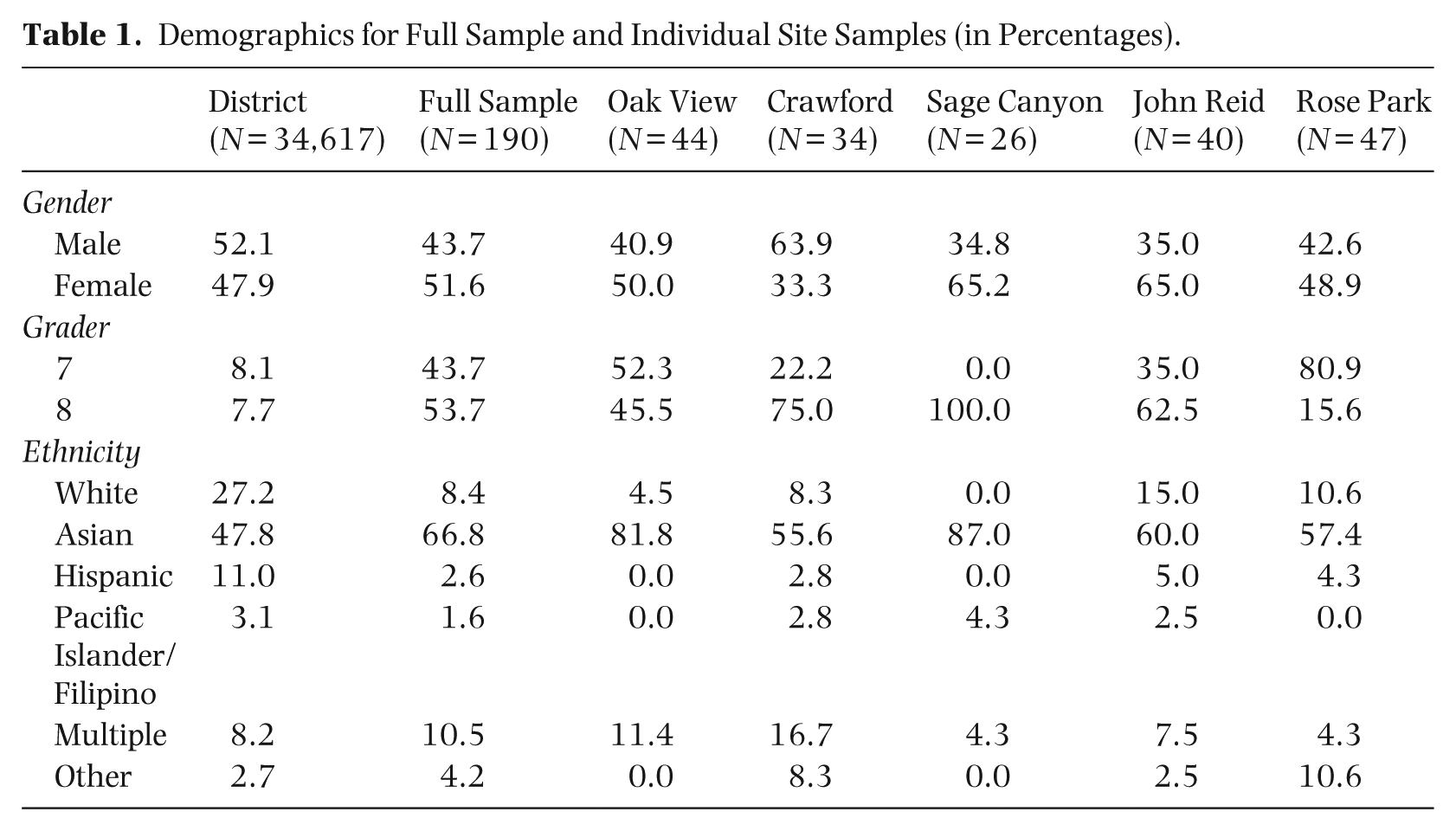
The research was conducted at five middle schools in Southern California. The target school district had a population of 33,400 students, of whom 14% were low-income, and 19% were English Language Learners. Participants were 190 seventh- and eighth-grade student musicians currently enrolled in their school orchestra, along with five music teachers. The majority of the participants identified as female (52%) and had played their instrument for 4 years (41%). A total of 66% of students were of Asian descent, representing a higher percentage than the district’s reported 47.8% of students of Asian descent. The orchestra classes that participated in the study had a noticeable absence of representation from other students of color, including those of Hispanic and Black descent. Table 1 shows the demographics of student participants.
Demographics for Full Sample and Individual Site Samples (in Percentages).
Each middle school offered two to three bands, two orchestras, and one to two choirs. Orchestra classes were selected to participate in the study due to the availability of scheduling. Furthermore, the participating orchestra classes comprised students who possessed at least 1 year of experience on their instruments, as opposed to those in beginning-level ensembles.
As in many American schools, the orchestra classes in this study convened as a large ensemble 5 days a week, each class session lasting 50 min within the academic day. Students received academic and effort grades each trimester and participated in several concerts during the year. Student enrollment in the five school music programs, including band, orchestra, and choir, was elective and ranged from 25% to 38% of the school population, reflecting the aforementioned music class enrollment data reported in American secondary schools (Elpus & Abril, 2019; Elpus, 2022). However, orchestra enrollment in this study ranged from 10% to 12% of the school populations, compared to the approximately 2% reported by Elpus and Abril (2019).
The five music teachers at the participating school sites were interviewed. One of the teachers identified as female, the other four teachers identified as male, and all teachers racially identified as “white.” All five teachers received their undergraduate degrees in music, ranging from a Bachelor of Arts in composition to a Bachelor of Music in music education to three graduate degrees in conducting or composition. All teachers were credentialed in the state of California and full-time employees of the school district. Their teaching experience ranged from 10 to 30 years, and all five teachers had taught their entire careers in the target school district. As a local colleague in the field of music education, I had existing professional connections with the five teacher participants; however, I had no prior experience observing their classrooms.
Quantitative method and results
Method
Students from the five participating middle schools completed a survey measuring their sense of belonging as members of their middle-school orchestra. Belonging was measured using Goodenow’s Psychological Sense of School Membership (PSSM) Scale, adapted to align with the context of this study. The 18-item PSSM uses a 5-point Likert-type format, with response options ranging from 1 (not at all true) to 5 (completely true), with three serving as a neutral midpoint. Reverse scoring was necessary on items 3, 6, 9, 12, and 16. The individual item scores were summed into a total score. The PSSM included questions involving personal acceptance, inclusion, respect, and encouragement for participation. Examples of the questions include: I feel like a real part of (name of school), people here notice when I’m good at something, I am included in lots of activities at (name of school), and I can really be myself at this school.
The survey showed a Cronbach’s alpha internal consistency coefficient of .894, indicating that the scores had acceptable reliability. Survey responses were analyzed using descriptive statistics, including means, standard deviations, and frequency distributions. The overall response rate from all participating sites was 86%. In all, 190 students participated in the survey and reflective writing.
Results
Data from the survey analysis were consistent with the previous literature suggesting that students feel a positive sense of belonging in their music learning environments (Adderley et al., 2003; Campbell et al., 2007; Schultz, 2018; Siegal, 2023). Overall, 92.0% of students surveyed felt like a “real part” of their orchestra, and 86.9% of students “felt included” in the activities of their class; 90.0% of students reported they felt their music teacher respected them, and 88.0% of students felt they were treated with as much respect as their peers.
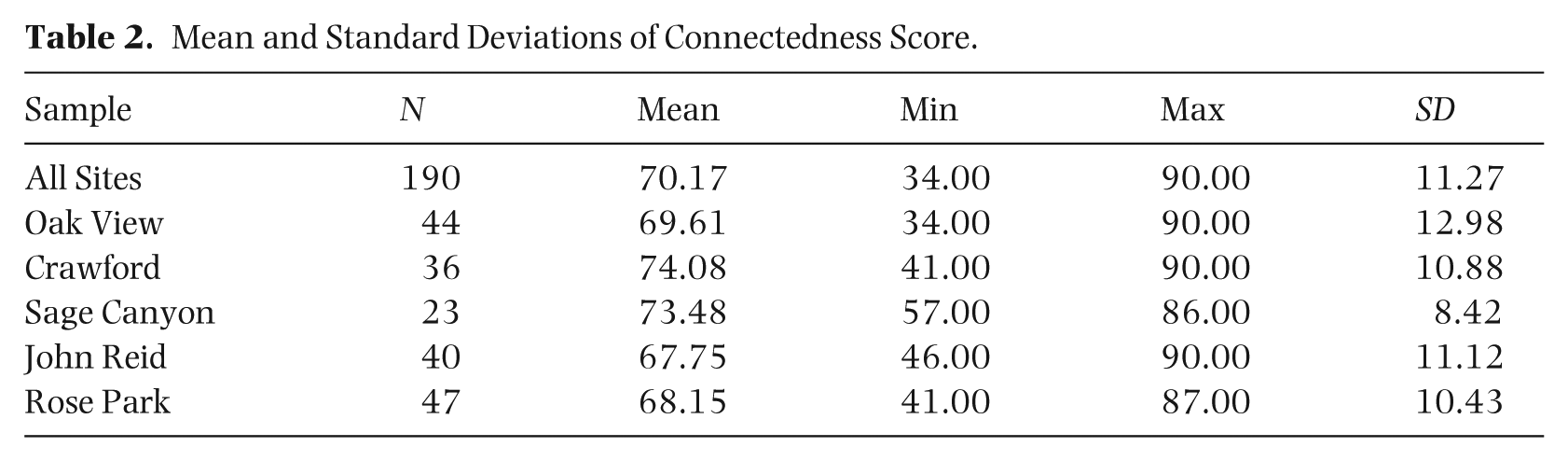
The average score of connectedness was high across all sites. Students with a summed score above 45 could be considered to have generally positive experiences, while those with a summed score below 45 experienced generally more negative than positive. However, certain sites not only reported higher overall scores but also a smaller spread of participant answers. John Reid Middle School (pseudonym) showed the lowest belonging score of the sample sites and the second-highest standard deviation. Table 2 shows the mean score and standard deviations for the full sample and individual site samples.
Mean and Standard Deviations of Connectedness Score.
While students generally reported a sense of belonging in their ensembles, several nuances in the data warranted further examination. Although “don’t know” was coded as a neutral response, its frequency in certain items suggested uncertainty among students, particularly regarding peer relationships. Table 3 presents the survey items most relevant to social and instructional dimensions of belonging, illustrating areas of both strong agreement and significant uncertainty. For instance, 37.4% of students selected “don’t know” in response to the statement, “Other students in this orchestra take my opinions seriously.” Similarly, 33.2% selected “don’t know” when asked if, “People in this orchestra know I do good work.” These findings suggest that although students felt respected by teachers and included in class activities, a portion remained unsure about how their peers perceived their strengths and contributions, indicating potential gaps in social belonging within the ensemble context (see Table 3).
Selected Belonging Survey Items.
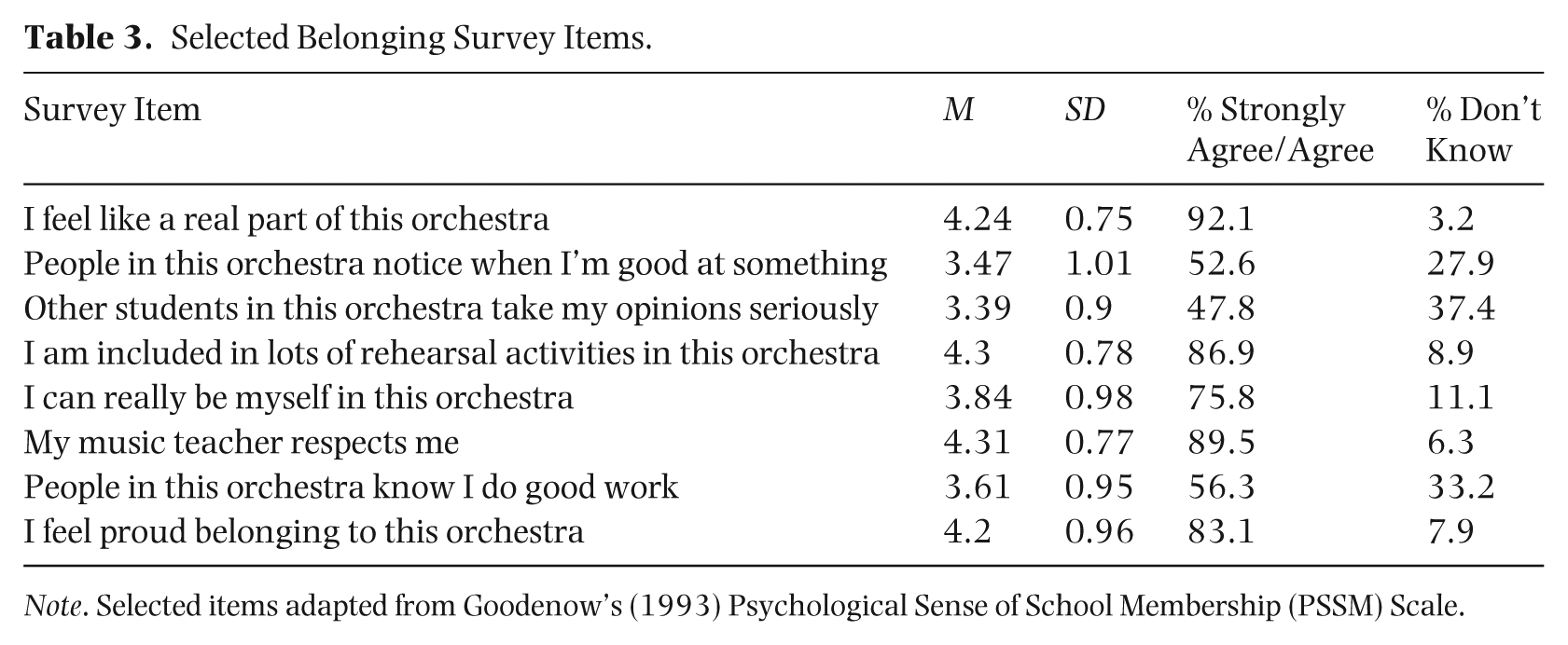
Note. Selected items adapted from Goodenow’s (1993) Psychological Sense of School Membership (PSSM) Scale.
Qualitative method and discussion
Method
Gathering student voices was important in this study. As the district did not approve the request to interview students—a noted limitation—a reflective writing prompt accompanied the survey. The reflective writing prompt featured two “sentence frames” to help direct writing focus and a “free-write” prompt. Sentence frames are a method of scaffolding that is particularly helpful for students who struggle with writing and for English Language Learners (Carrier & Tatum, 2006). The sentence frames were, “When I play my instrument with other students, I feel . . .” And, “I choose to participate in a music class because . . . .” However, while sentence frames may assist writing, they may be too restrictive and not allow creativity. Acknowledging this, the reflective writing prompt also included the following open-ended question: “Does being a member of your school orchestra make your experience in middle school better, worse, or has no impact? Why do you think that is?”
After collecting the survey data and reflective writings from the five school sites, I initially employed an inductive analytical approach to identify emerging themes from the students’ reflections. Then, I applied a deductive (a priori) approach by aligning these themes with the existing research on belonging. Building on these analyses, a sequential approach where three of the participating schools were identified for further study. The selected sites included the orchestra classes that scored the highest belonging scores, the lowest belonging scores, and the class with the lowest standard deviation. At each of the three sites, teachers and students were observed three times. Throughout the three observations, I spent approximately 140 to 160 min in each classroom.
Semi-structured interviews with all five music teachers provided valuable insight into the instructional strategies reflected in the classroom observations. Participating teachers were asked how they structured rehearsals, provided feedback for individual student and ensemble improvement, implemented seating practices in the sections of the orchestra, and motivated student achievement. Data from music teacher interviews were compared with student responses from the adapted belonging survey and reflective writing prompt.
To ensure the trustworthiness of the findings, I employed multiple strategies aligned with qualitative research standards. Triangulation was used across three data sources: student reflective writing, teacher interviews, and classroom observations. Comparing insights across these sources allowed for a more holistic understanding of the learning environment and helped validate emerging themes. Member checking, recognized as a valuable qualitative tool (McKim, 2023), was conducted with the teacher participants to confirm the accuracy of the interpreted data and provide opportunities for clarification or elaboration; this process not only supported credibility but also yielded deeper insights and contributed to a more refined and substantiated discussion of the instructional practices and classroom dynamics under study. In addition, I kept analytic memos throughout the coding process to document decision-making and reflectivity, particularly regarding my own positionality as a music educator. This reflexive journaling supported confirmability and helped reduce potential research bias in the interpretation of data.
Findings
The second objective of this study was to examine how music teachers used instruction to foster a sense of belonging. Three themes emerged from the student reflective writings, teacher interviews, and class observations. First, a sense of belonging was fostered when teachers de-emphasized competition. Second, specific rehearsal techniques contributed to students’ sense of belonging. Third, teachers could adversely affect students’ sense of belonging through negative testing procedures, perceived favoritism, and a lack of peer feedback opportunities during instruction. In addition, students developed competencies for belonging through their shared orchestral skills and social interactions, which in turn deepened their motivation to belong.
De-emphasizing competition
Historically, American school music ensembles have a tradition of ranking their student musicians and placing them in seating arrangements that represent skill levels (Hamann & Gillespie, 2009). This physical reminder of who is deemed a better musician can result in intragroup competition among student musicians. In this study, however, participants reported a shift in precedent. In 190 student reflective writings, students mentioned “being part of a team” or “part of a group with a common goal.” At sites with the highest connectedness scores, no students mentioned their “chair placement” in the orchestra as a factor for membership in the ensemble. These students failed to mention the role of competition in their orchestra experience.
After interviews and observations, it became clear that while the five participating teachers undertook some performance assessment at the beginning of the year, typical “orchestra seating” traditions had evolved in their instructional practice. Rotational seating was favored by the teachers at Sage Canyon and Crawford Middle School, giving all students the experience of being “unranked” and emphasizing the importance of every person in the orchestra. Upon observation, the teachers at these two schools addressed the orchestra as a whole and did not direct questions at the “first chairs.” Eye contact, asking questions, and receiving student input demonstrated a fair and balanced teaching practice. At Crawford, the students performed with musical energy while playing, and it appeared that almost all students demonstrated focused engagement in the performance. The teacher at Crawford remarked that the “no last chairs” philosophy increased the level of engagement of all students during instruction and fostered more developed musicianship individually and as an ensemble. These findings reflect similar research by Yi (2023), who found that alternative seating practices fostered students’ collaboration and increased their motivation and engagement.
At John Reid Middle School, the students were sat traditionally in chair placements according to the teacher’s assessment of their playing ability. When asked about seating practices, the teacher at John Reid shared that he no longer held “chair challenges” in his orchestra and reported that he perceived this change from an “old tradition” as a positive for the overall ensemble experience. Interestingly, this was the ensemble where a student reported the teacher having “favorites” in the orchestra. As the site with the lowest connectedness score, this finding suggests that it may not be enough only to discourage direct competition within the ensemble; instructional practices such as chair rotation may be necessary.
Rehearsal techniques
At Sage Canyon, the teacher commented, “I think inclusivity is . . . well, I think it’s just organic. With music, we’ve got a place for everybody; everybody has value.” Supporting this statement, the survey found that 87% of student participants across the five sites responded that they were “included in lots of rehearsal activities in this orchestra.” In addition, when asked if they were treated with as much respect as other students, 88% of students agreed.
During observation of the school sites with the highest scores of belonging, rehearsal practices supported the “valuing” of all students. During a rehearsal at Sage Canyon Middle School, the teacher instructed the orchestra to play a two-measure cadence at the end of a musical phrase and added a fermata on the resolving chord. The teacher then asked certain sections of the orchestra to “drop out” of the chord and listen to how the harmonic structure and “feeling of the music” changed without their parts. A discussion between the teacher and volunteer students resulted in the conclusion that all parts, although different in harmonic function, were of great importance.
Likewise, during an observation at Crawford Middle School, the teacher rehearsed several measures of ensemble literature, asking the second violin section not to play, and guided the entire orchestra to listen to how the music sounded “without them.” After the orchestra played the target measures, the teacher led a short discussion with volunteer students in which several students remarked how the music felt “empty” without the second violins. Other instructional strategies that contributed to building students’ perceived value in the ensemble included instructing a section to play a mistake on purpose to see how the other parts were impacted, recognizing the improvement of certain groups of the orchestra for all to applaud, and directly emphasizing the idea of teamwork within the ensemble. The idea of teamwork was corroborated in the student’s reflective writings. Students from Crawford Middle School wrote, “I feel like part of a team trying to reach a goal,” and, “When I play with my orchestra, I feel like I’m a part of something important.” However, it should be noted that during such rehearsal strategies, students engaged in discussion only with their teacher and not directly with their peers, suggesting that peer-oriented learning was an underutilized instructional strategy that could have been of added value in rehearsal routines.
Rehearsal techniques that incorporated dialogue between students and the teacher played a significant role in observed school sites with the highest scores of belonging. Students were invited to share their ideas, reflections, and musical interpretations, highlighting the value of student voices and meaningful individual contributions to the ensemble. These interactive approaches positioned students as active participants rather than passive recipients, reinforcing students’ sense of agency and inclusion. Dialogue-based rehearsals that emphasized student values align with research indicating that environments characterized by respect, responsiveness, and shared decision-making contribute positively to students’ psychological sense of belonging (Osterman, 2023). While Osterman’s (2023) work in the broader field of education identifies cooperative learning and dialogue as key to promoting belonging, applying these findings specifically to music education—and ensemble rehearsals in particular—represents a new area of inquiry for the field.
Barriers to belonging
In the 190 student reflective writings, 114 students mentioned “happiness,” “enjoyment,” “relaxation,” or “feeling good” as part of their orchestra experience in middle school. However, not all students responded positively and some made negative comments concerning testing and favoritism. Two students at John Reid, the middle school with the lowest connectedness score, wrote that the teacher did not always give equal attention to all students. One student wrote, “There are good sides to the orchestra and bad (the teacher has favorites, and only the first violins are acknowledged).” Another student at Rose Park wrote, “Being part of the orchestra means that I can play my violin, but I feel uncomfortable always taking the blame for my stand partner’s mistakes because my stand partner is the music teacher’s favorite.”
Rose Park Middle School implemented testing procedures where individual students played assessment material in front of the entire class. Students reported that this left them feeling “stressed” or “embarrassed during test time.”
“Sometimes I feel like no one notices me except when I make mistakes on test days. It is also very stressful when I take tests because people stare, make faces at the mistakes I make or talk about how bad I was behind my back,” wrote a student from Rose Park.
The data collected indicate that such “public testing” assessment techniques could present barriers to belonging.
When observing the middle school orchestras with the highest and lowest belonging scores, students were never asked to give feedback to their peers. This may have demonstrated why approximately one-third of students reported “don’t know” when asked in the PSSM how other students perceived them in their orchestra. Research indicates that peer support and feedback, in addition to teacher support and feedback, could have positive implications for belonging in middle school (Kiefer et al., 2015). The findings of this study highlight the potential for teachers to further strengthen a student’s sense of belonging by providing opportunities for peer feedback as part of music instruction.
Shared competencies and motivations for belonging
In their reflective writings, students reported feeling united by the shared skill of musicianship. As a student from Sage Canyon wrote, “I feel like an elite member of school because our orchestra is so good.” Allen et al. (2021) suggest that belonging emerges from having a set of skills and abilities needed to connect and experience belonging. The present study found that students strengthened their sense of belonging through the shared skills of orchestral playing. A student from Crawford wrote, “When I meet someone else who plays viola, I feel an immediate connection.”
Participation in a school orchestra may also contribute to developing social competencies, a critical component in the integrative framework of belonging. While the participating teachers mentioned that students elected to take a music performing ensemble in middle school because of friendships, the student data collected indicated a much more in-depth view of motivations to connect with others. Students reported maintaining friendships in the orchestra and forming new ones, often with peers with whom they did not expect to find a connection. A student from Sage Canyon wrote, “I like playing music in a group. It’s fun and such a great experience to be in class with people who have the same interests.” People who feel socially connected—who are motivated to belong—will actively seek similarities and things in common with others (Allen et al., 2021). Music teachers can enrich students’ experiences by fostering peer-to-peer feedback, mentorship, and discussion groups, nurturing shared competencies, and deepening students’ motivation to belong.
Implications and limitations
While the findings of this study align with prior research suggesting that school-based music ensembles can serve as environments that support positive school belonging, this study advances the conversation by identifying how specific instructional strategies used by music teachers can either promote or inhibit students’ sense of belonging. In particular, seating practices such as chair placement and seating auditions emerged as areas where instructional choices may unintentionally contribute to exclusion, anxiety, or unhealthy comparison among peers, thereby undermining a sense of belonging. Although these practices are often intended to motivate students and uphold musical standards, they can create rigid structures that diminish students’ sense of inclusion and community within the ensemble. By highlighting how such practices can operate within middle-school orchestra settings, this study underscores the importance of critically reflecting on the unintended social consequences of traditional instructional norms in music education.
These findings highlight the critical role of the music teacher, not only in musical development but also in shaping the social and emotional climate of an ensemble. As Osterman (2023) states, teachers do not bear sole responsibility for the emotional well-being of children; but, as we have seen so clearly both in the words of students and in empirical data, the quality of care that students receive in the classroom has an important influence on their learning and behavior. (p. 991)
School-based music ensembles have the potential to serve as spaces for connection and belonging; however, this potential can only be realized when teachers intentionally cultivate inclusive and affirming classroom environments.
Further research is needed to deepen our understanding of how competitive instructional practices affect different student populations, particularly in relation to cultural identity, prior musical experience, and levels of confidence. Expanding this line of inquiry across varied ensemble types, school contexts, and age groups will help inform more inclusive, flexible, and culturally responsive approaches to music education. In addition, future research into belonging would benefit from using student interviews to provide rich, in-depth insight into students’ experiences, perspectives, and feelings. Personal narratives have the potential to uncover nuanced factors, explore shifting experiences, and deepen understandings of how students experience inclusion, connection, and support in their educational environments.
As previously noted, the higher rate of orchestra enrollment in the schools included in the present study, ranging from 10% to 12%, is notably above the national average of approximately 2% reported by Elpus and Abril (2019). This elevated participation may reflect localized factors such as strong community support for music education, robust feeder programs, or school and district policies that prioritize arts offerings. Such a context may amplify students’ opportunities to experience belonging that may not be prevalent in schools with lower enrollment or fewer resources. While the instructional strategies identified in this study may offer valuable insights, they may not fully translate to less resourced or less supported settings.
Limitations of this study included a lack of diversity in student and teacher participants, which may reduce the generalizability of the findings. Notably, although a majority of the student participants were of Asian descent, the study did not explicitly explore how their cultural identities may have shaped their experiences of belonging and was therefore unable to examine the nuanced ways in which cultural background intersects with instructional practices and perceptions of inclusion. There was, however, minimal evidence of teachers incorporating students’ cultural identities into classroom instruction, particularly through repertoire selection and musical materials—an area that holds significant potential for fostering a deeper sense of connection and belonging in school music ensembles.
A growing body of research has examined how culture influences how people learn and the need for music education to be increasingly culturally responsive (Carroll, 2020; Butler et al., 2007). Culturally responsive pedagogy is closely intertwined with efforts to enhance school belonging, as it honors the lived experiences of students, ensuring that their experiences are validated by their teachers, their peers, and their school curricula (Lind & McKoy, 2022). Music education would therefore benefit from further research on the intersections of school belonging and cultural responsivity to help music educators create environments where all students feel valued, respected, and empowered.
Footnotes
Author Contribution
Declaration of conflicting interests
The author declared no potential conflicts of interest with respect to the research, authorship, and/or publication of this article.
Funding
The author received no financial support for the research, authorship, and/or publication of this article.
