







Abstract
This article proposes the Sustainable Musical Lifecourse framework as a theoretical orientation for addressing the challenges that lifelong music education faces in rapidly aging societies. Situated within the broader interconnections of lifelong learning and music education, the article builds on policy reflections from two distinct national contexts: Finland and China. By reframing the concept of later-life and examining current music learning opportunities for older adults, the study reveals that existing policy structures are often shaped by economic demands and the discourse of successful aging. These structures overlook the deeper pedagogical and existential possibilities of later-life music education. To address these limitations, the Sustainable Musical Lifecourse framework integrates four interrelated conceptual dimensions – lifecourse theory, transformative learning, sustainable aging, and gerotranscendence – to expand and envision personal transformation and social sustainability through music education in later life. This article contributes to developing practical approaches to lifelong music education by advancing a forward-looking perspective for envisioning alternative futures and more sustainable ways of living and learning through music in later life.
Keywords
Lifelong (Music) Learning in an Aging World
Population aging due to rapidly rising life expectancy is an irreversible global trend currently faced by all societies, including in both developed and developing countries (Robine, 2021). Lifelong learning is a policy frequently adopted by governments to tackle the social challenges presented by aging populations (United Nations, 2019), by “creating learning opportunities for all ages, in all life-wide contexts, and through a variety of modalities” (UNESCO Institute for Lifelong Learning, 2022c, p. 19). Lifelong learning is also included in UNESCO’s Sustainable Development Goals (SDGs), particularly through the fourth goal, which aims to ensure inclusive and equitable quality education and promote lifelong learning opportunities for all (United Nations, 2015). However, older adults face significant barriers and deep inequalities in accessing lifelong learning opportunities (UNESCO Institute for Lifelong Learning, 2022a, 2022c). Policies concerning lifelong learning predominantly aim to meet economic demands, including supporting the reskilling and upskilling of adults of working age (UNESCO Institute for Lifelong Learning, n.d.). Hence, their primary motivation for engaging older adults in lifelong learning is framed through employability, as enabling “older people to stay in the workforce and participate meaningfully in society” (UNESCO Institute for Lifelong Learning, 2022b, p. 16). Furthermore, such policies emphasize that older adults need to stay physically and mentally active to avoid being a strain on society, maintaining a discourse on aging as a problem that needs to be solved (Gilleard & Higgs, 2014). Consequently, lifelong learning is expected to generate visible action and results around active aging, especially for older adults outside the workforce. The notion of precarity makes visible how the demand of aging actively is deeply embedded in neoliberal discourses that shift responsibility from institutions to older adults and their families. Precarity is not a later-life anomaly, but the cumulative effect of earlier disadvantages carried forward across the lifecourse, often widening inequalities in later life (Grenier et al., 2020). To advance and expand lifelong learning opportunities, particularly for those in socially and economically marginalized positions, there is now a call for the integration of policies across all levels of education, from basic to higher education institutions, and an extension into a wide range of public service spheres beyond formal schooling and workforce applications (UNESCO Institute for Lifelong Learning, 2022c; UNESCO World Conference on Culture and Arts Education, 2024).
In line with past discourse on the “problem” of aging, research and practice on musical learning and participation for older adults has long focused on “solutions” such as therapeutic interventions (e.g., Elliott & Gardner, 2018; Viola et al., 2023) and the physical and psychological benefits of music (e.g., Galinha et al., 2022; Maury & Rickard, 2022). Framing music learning primarily through therapeutic or health-related outcomes reduces music education to an instrumental tool, implicitly perpetuating a narrow orientation of successful aging marked by utilitarian goals and individualistic assumptions rather than pedagogical and educational aims (Laes, 2023; Laes & Creech, 2023). This perspective overlooks broader dimensions of music education, such as the potential to support life narrative reconstruction and existential meaning-making. However, more recent community-based trends within music education for older adults (Mantie et al., 2021; Myers et al., 2013) represent more meaning-oriented and holistic lifelong engagement approaches that aim to ensure equitable opportunities to participate and develop in music-making (McPherson & Welch, 2018; Veblen & Olsson, 2002). However, the connections between community music and music education have remained vague (Veblen & Olsson, 2002). As suggested by scholars, professional music education should focus more on music as a lifelong source supporting meaningful lifecourses (Laes & Creech, 2023; Mantie et al., 2021), while community music should consider the pedagogical ethos of music-making within different age groups (Kertz-Welzel, 2016). This need for integration highlights the gaps in music education that require attention (Mantie & Tucker, 2008), particularly considering older adults and the justifications for their music education.
We argue in this article that the purpose of lifelong learning in music education should be reoriented from serving instrumental values dominated by the economic-driven, individualistic “success” discourse to embracing intrinsic and meaning-oriented values of music learning and participation within a broader, multidimensional approach (Findsen & Formosa, 2011). In our exploration of a new theoretical understanding of lifelong music education, we propose the Sustainable Musical Lifecourse framework, which integrates four key perspectives: gerotranscendence, sociological lifecourse theory, transformative learning, and sustainable aging. This framework challenges dominant views on aging that are particularly influential in Western societies (e.g., Katz & Calasanti, 2015) and increasingly visible in other contexts (e.g., Liang & Luo, 2012). Rather than seeing lifelong education merely as a means of boosting individual competence and meeting socio-economic demands, we propose a shift toward understanding lifelong education as a path to ecological, social, and cultural sustainability. To unfold our perspective, we begin by exploring the concept of later life as a generative way to conceptualize older adults in music education contexts. Then, we examine current opportunities for later-life music education within two fast-aging societies, Finland and China, where there is a critical need to rethink the structural and policy foundations of lifelong music education. Building on these case examples, we propose the construction of a Sustainable Musical Lifecourse framework to provide a broader theoretical understanding that can enable not only Finland and China but also other aging societies to reimagine and reorganize later-life and lifelong music education practices. More than a practical approach for structuring policy and pedagogy, the Sustainable Musical Lifecourse framework serves as a forward-looking perspective: a means of envisioning more sustainable futures and ways of living and learning throughout the lifecourse (Westerblad, 2022).
The Concept of Later-Life
There is ongoing debate over how to define older adults – whether based on biological age, psychological functioning, or social roles. Policies in high- and middle-income countries often designate the age of 65 as the threshold for older adult status (Skiadas & Skiadas, 2018). Rather than relying on chronological age as a defining criterion, however, this study follows the critical gerontological perspective that considers “older adults as people, whatever their chronological age, who are post-work and post-family, in the sense that they are less or no longer involved in an occupational career or with the major responsibilities for raising a family” (Findsen & Formosa, 2011, p. 11).
In educational contexts, the term older adult has been prevalent in educational gerontology since the 1970s, merging adult education and social gerontology for the purpose of lifelong learning initiatives designed as preventive and anticipatory measures for all ages (Peterson, 1976). In parallel, traditional terminology has remained prevalent in music education, including music education for older adults (e.g., Davidson, 1980) and music education for older people (e.g., Hays, 2006; Southcott, 2009) used to refer to older individuals participating in music programs across various contexts. In contrast, later adulthood music education draws a conceptual parallel to early childhood music education and positions later-life music education as a structured developmental stage rather than a residual category of oldness (Laes, 2015). This is consistent with Young’s (2021) perspective of “always maturing never arriving” – which critiques linear, dualistic pathways toward the complete adult musician – positioning early childhood and later adulthood as parallel sites of ongoing musical becoming.
At the same time, concepts such as third and fourth age have begun to emerge in recent decades (e.g., Joseph & Southcott, 2015). These concepts have been critiqued as products of consumer-driven societies, which differentiate between the third-age opportunities for actively pursuing personal goals outside paid work, and the passive fourth-age life stage of “old-old” (Gilleard & Higgs, 2002, 2014). These conceptual debates reflect the growing interdisciplinary nature of aging-related terminology and conceptions, extending beyond biological aging and gerontological classifications to encompass broader educational and social dimensions. While it signals an increasing recognition of older adults within the framework of lifelong learning, scholarly attention to this area remains limited (Findsen & Formosa, 2011, p. 56).
In this article, we adopt the concept of later life to move away from chronological age definitions and provide a deeper, more comprehensive perspective. When discussing older adults, the focus turns toward the externally defined qualities of an individual: “who is considered an older adult?”, whereas later life shifts the focus to the temporality and intersectionality of lived experience. Unlike older adults, which directly refers to a population group, later life is often conceptualized as a distinct phase within the human life cycle – a significant life stage marking transitions in roles and life experience (Findsen & Formosa, 2011). Rather than defining a specific age cohort, later life conceptualizes a dynamic and unfolding process shaped by early life experiences and evolving societal contexts (Jarvis, 2013; Laes, 2023). Moreover, the term later life broadens sociological understandings of aging by reflecting a shift from institutionalized statutes toward a more reflexive, layered and fluid lifecourse view. From this pluralistic perspective, later life is not simply a biological process or categorical status but a social space in which the diverse lives, lifestyles, and possibilities of older adults are increasingly realized (Higgs & Gilleard, 2025).
Contextualizing the Challenges of Aging Societies
To examine how opportunities for later-life music education are currently framed and delivered, we provide contextual examples of the policy structures of lifelong education in two fast-aging societies, Finland and China. These countries were selected not only because the first author is from China and the second author from Finland, and because the countries serve as the contexts of an ongoing research project, but also because they offer varying examples of how lifelong music education is organized in fast-aging societies. Despite substantial differences in geography, demographics, political systems, and cultural values, both countries are encountering similar structural challenges associated with rapidly increasing population aging, such as the persistence of ageism and its broader implications for social development (Phillipson, 2013) and the need to realign their educational policies to meet the demands of aging societies (United Nations, 2019).
China and Finland are both grappling with the complex consequences of fast-aging societies (United Nations, 2019). Finland has already entered the super-aged stage, with 23.4% of its population aged 65 and above (Official Statistics of Finland, 2025), ranking among the top three countries globally by aging population percentage. Finnish researchers emphasize the urgent need for policymakers and practitioners to respond swiftly to the social changes triggered by rapid population aging following the baby boom period (Komp-Leukkunen, 2021), including creating an environment in which older individuals are better supported in navigating later life through a balance between personal agency, social interaction, institutional support, and cultural values (Haarni et al., 2014). In comparison, China has the world’s largest aging population, recently reaching 216.76 million – 15.4% of its total population (United Nations Population Division, 2024). China faces unique challenges due to the unprecedented speed of its population shift, which has prompted the development of structured government-led policies promoting the overall welfare of older adults (Zhang, 2023). A distinctive feature of Chinese aging policy is in the historical and philosophical traditions that underpin it, specifically the values of moral duty and filial piety. These traditions emphasize community-based support and intergenerational solidarity, positioning aging not merely as an individual concern but as a collective societal responsibility (Chen, 2016).
These notions reveal fundamentally different orientations toward the population aging dilemma. Examining how these opportunities are framed in the later-life music education context helps uncover not only national variations but also shared limitations that may constrain the sustainable development of lifelong music education.
Current Policies for Later-Life Music Education in Finland
In Finland, the contemporary public debate on aging as a socio-economic concern has been accompanied by a counter-discourse positioning older adults as active, autonomous contributors to society (Ministry of Social Affairs and Health, 2023). These narratives also emerge in lifelong learning discourses. While lifelong learning is generally seen as promising possibilities for learning from early childhood to old age, in practice it is often equated with formal and non-formal learning in educational institutions to assist labor market adaptability and competence, leaving individuals’ diverse learning aspirations and the maintenance of supportive social well-being structures insufficiently addressed.
The Constitution of Finland establishes the right to education and culture, including the equal opportunity to receive education before, during, and after compulsory schooling. Finland’s recent policy vision defines lifelong learning as a complex system requiring new thinking and reforms to legislation, financing, and cooperation (Sitra, 2021). Liberal adult education institutions in Finland offer education and continuous learning to all citizens nationwide without qualification or occupation-specific aims (Finnish National Agency for Education, n.d.). By emphasizing institutional values, educational aims, and special tasks, liberal adult education promotes social cohesion, equality, and active citizenship. While liberal adult education mainly offers tuition for basic skills such as literacy, digital skills, language tuition, and working life skills, the share of adults with immigrant backgrounds – especially women – taking part has grown in recent years (Finnish National Agency for Education, n.d.; Saloheimo, 2016). Over 1 million individuals take part in liberal adult education annually, while Finland’s whole population is 5.5 million (Eurydice, 2022; OPH, n.d.). Although older adults represent a growing segment of learners, their specific needs are not systematically prioritized.
Arts education in liberal education institutions aims to provide the knowledge required for artistic perception, as well as to inspire and enable learners’ artistic self-expression (Rikandi, 2010). Music courses such as choirs and group instrument lessons are particularly popular among older adults. Still, their offerings vary regionally and depend on available resources (Laes & Rautiainen, 2018). This means that music education offerings within liberal adult education institutions tend to be unevenly distributed across regions, as they are heavily dependent on local resources and staff availability, resulting in inconsistent accessibility. In addition to liberal adult education institutions, the government-subsidized Basic Education in the Arts system maintains a vast national network of over 400 music schools (Finnish National Agency for Education, 2019). However, opportunities for adults to access music schools are scarce, as the system is legally mandated to prioritize children and youth. Some music schools have even set upper age limits for applicants, and only a few schools provide special programs for adults. Opportunities for musical participation are also offered in informal contexts such as church choirs and private studios, but no systematic data or information is available on these activities. Overall, despite the positive discourse around lifelong learning and the constitutional right to education, opportunities for later-life music education remain unevenly distributed. The ability of older adults to engage musically is not merely a matter of personal choice or motivation, but is shaped by institutional structures, access to resources, and sociocultural norms regarding age and music learning.
Although the music learning needs of older adults are less recognized in institutional education, there is some research in Finland on self-directed music learning in informal contexts. For example, middle-aged and older adults’ rock bands are a relatively popular leisure activity in Finland, and exemplify actor-based and transient communities that make manifest individual learning interests and social connectedness. In Rinne’s (2021) study of over 70 self-directed leisure rock bands, the experiential nature of older amateur musicians emerges as momentary voluntary activities and new initiations that break through the flow of everyday life. Similarly, in Laes and Kiuru’s (2023) study, older adult rock band activities provided participant benefits such as new skills, social recognition, and increased self-efficacy. However, achieving these benefits required a struggle of learning that arose from setting pedagogical goals under professional guidance. Band activities were, therefore, not just a pastime or recreational activity but a space for personal and collective meaning-making and empowerment that extended beyond learning and health benefits. It is possible that the current generation of retirees will increasingly be drawn to the contexts of rock and popular music, where self-directed learning and forms of social musicking will emerge as key sources of meaning-making and social purpose. The key challenge for Finnish institutional music education is to recognize this need and allocate professional resources as part of the systemic renewal of lifelong learning policy in Finland.
Current Policies for Later-Life Music Education in China
Unlike Finland’s decentralized and municipally driven model of liberal adult education, China’s approach to later-life education is centrally structured and embedded within a broader strategy of national modernization and social governance. In response to the challenges posed by population aging, the Chinese government took early steps by establishing the National Committee on Aging Issues in 1982, renamed the National Committee on Aging in 1995 in a symbolic shift in framing aging as a manageable social reality rather than a looming crisis. Since then, China’s centralized governance has enabled the establishment of a wide-reaching policy infrastructure, bringing together over 30 governmental and civil organizations under the coordination of the State Council to formulate and implement aging-related initiatives (Central Committee of the Communist Party of China & State Council of the PRC [CCP & State Council], 2023).
In line with global policy trends, Chinese aging strategies emphasize the role of older adults as social participants and promote education as a key tool for active aging. Legislative frameworks such as the Law of the People’s Republic of China on Protection of the Rights and Interests of the Elderly explicitly affirm the educational rights of older adults. However, older adult education remains structurally separated from other educational tiers, positioned as a parallel system rather than an integrated component of lifelong learning. Recent policy initiatives, such as the Key Tasks for Building a Learning-Oriented Society, seek to build a comprehensive education system that connects family, school, and social education. While this initiative aims to integrate formal and non-formal education, advance educational modernization, foster active aging, and build a learning-oriented society (e.g., General Office of the State Council of PRC [GOSC], 2016), the predominant vision remains top-down, driven by bureaucratic rationality and functionalist aims.
At the institutional level, the older adult education system is coordinated by the Ministry of Education and administered through national and local governments networks, primarily through the Open Universities (OU) and University for Aged (U3A) who are targeted to cover every county, city, and district by 2025 (State Council of PRC, 2021). This effort emphasizes infrastructure and scale over pedagogical depth and educator agency: access is increasingly widespread, but curriculum content largely prioritizes traditional and utilitarian domains, including moral and ethical values, leisure activities, health education, artistic appreciation, digital skills, legal rights, intergenerational communication, and dignity in later life (National Health Commission & National Working Commission on Aging [NHC & NWCA], 2020).
Musical engagement and education for older adults are often viewed as components of eldercare services and classified more broadly as cultural, arts, or recreational activities designed to enrich the spiritual and cultural lives of older individuals and their communities. Currently, music education for older adults is primarily facilitated through U3As, as well as street and community education centers, cultural activity centers (community-based recreation venues), and arts and cultural centers (institutions for arts participation and education). Policies related to cultural and artistic activities emphasize the balanced development of both online and offline platforms to enhance social participation. Therefore, music education is not a marginal aspect of aging policies. Instead, it can be seen to play a vital role in enriching the cultural and social lives of older adults. However, music engagement remains mostly framed as recreational enrichment rather than as a site for later-life music education. As such, opportunities for meaningful, sustained, and self-directed musical learning remain unstructured. Policy support for music industries and performance troupes (GOSC, 2024; Ministry of Civil Affairs of PRC, 2024) is largely representational – positioning older adults as consumers or symbolic bearers – rather than pedagogical, engaging them as reflexive, creative agents. Chinese aging policies focusing on education and cultural arts activities therefore remain largely community-based, aiming to enhance intergenerational interaction, cultural integration across age groups, and neighborly support, thereby strengthening social cohesion (e.g., NHC & NWCA, 2020). Government encouragement for the aging workforce to engage in public service and volunteering (GOSC, 2016, 2024) aligns with growth-oriented, productivity-focused agendas, yet it risks obscuring core questions: for whom later-life music education is designed, who authors its futures, and who benefits.
Conceptual Dimensions of the Sustainable Musical Lifecourse
Insights from the contrasting cultural contexts of Finland and China form a basis for conceptual discussion on how to respond to structural gaps in lifelong music learning in later life. These examples show how different educational philosophical ideals and societal discourses on aging influence the structures and organization of educational opportunities. Drawing from the varying policy, educational, and philosophical aspects of each context, we have formulated the Sustainable Musical Lifecourse framework, which integrates multiple theoretical concepts to guide a more forward-looking perspective on later-life music education globally.
We propose four conceptual dimensions for a sustainable approach to musical lifecourses in and through later-life music education (see Figure 1). First, lifecourse theory offers a temporal and relational lens for understanding how individual biographies evolve through intersectionality and significant life events rather than prescribed linearity, helping to break away from unhelpful aging discourses (Hunt, 2016). Second, transformative learning (Mezirow, 1991) supports the value of personal meaning-making and reflection at the core of musical engagement and education, shifting the focus from externally defined goals (such as the cognitive benefits of music) to situated, relational achievement (e.g., ecological agency). Third, gerotranscendence provides a critical ontological reframing of aging by illuminating its unique existential significance (Tornstam, 2005). It draws upon the Chinese philosophy of transcendence as a dialectical and relational process beginning with individual self-cultivation and unfolding through situated interactions with family, community, nature, and society (Feng, 2017; Lai, 2017). Fourth, sustainable aging reframed through ecological agency contributes to a policy-oriented dimension that emphasizes intergenerational solidarity and social responsibility (Laes, 2023; Laes & Schmidt, 2021). Sustainable aging has been proposed as a framework for considering how music education can offer new ways to produce social networks and create meaningful experiences in later life while changing attitudes toward the social status of aging individuals (Laes, 2023). Here we expand on the idea by considering ecological agency as situated and relational, where aging is seen as a temporally and spatially mobile part of the lifecourse and the related communal relationships between humans and other natural objects.
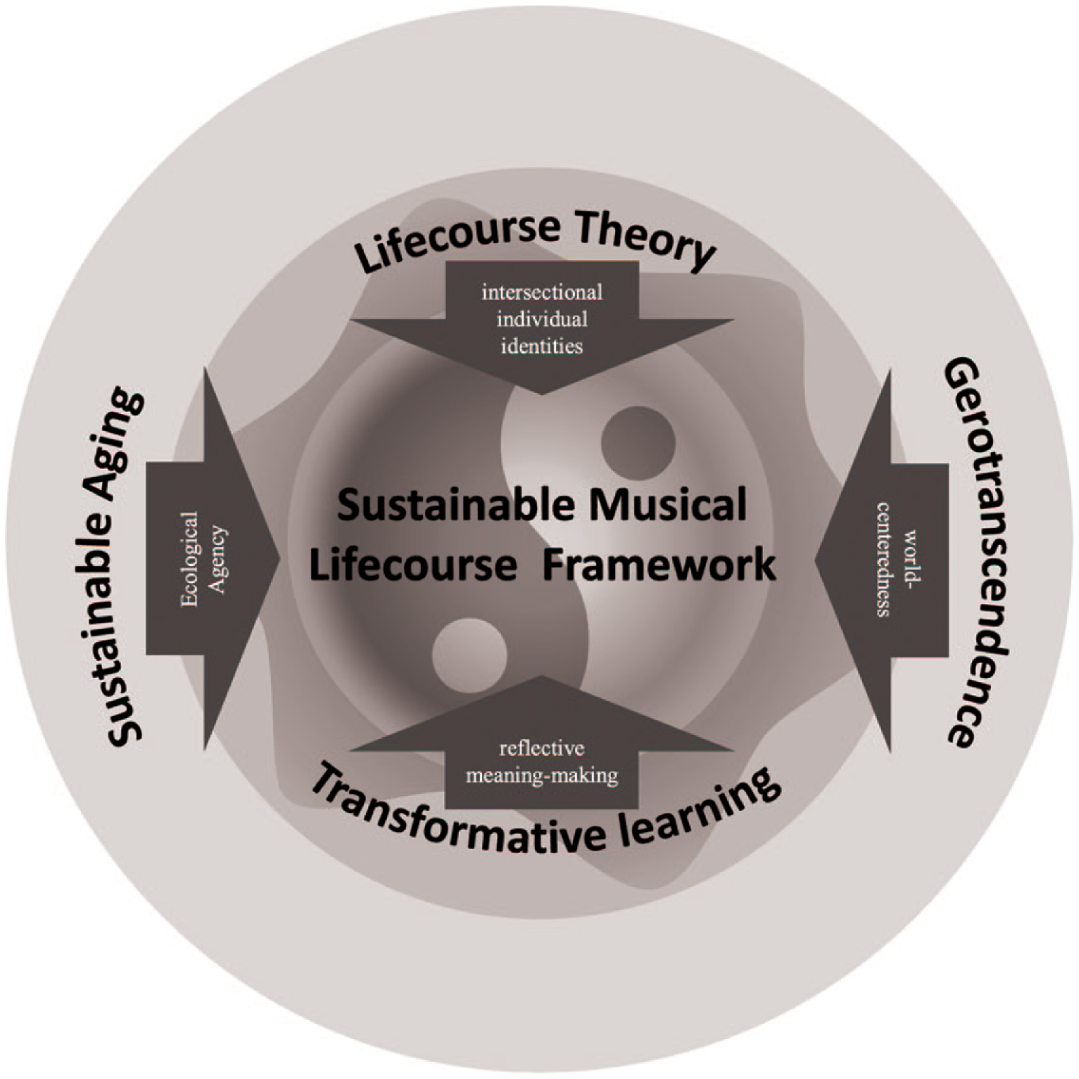
A theoretically reoriented Sustainable Musical Lifecourse framework.
Re-Narrating Individual Lifecourses Through Transformative Learning
Sociological lifecourse theory provides a temporal and relational perspective, emphasizing aging as a continuous, dynamic biographical process unfolding across all life stages, shaped by personal experiences and evolving social contexts (Hunt, 2016; Komp-Leukkunen, 2021). This perspective situates the heterogeneity of aging within its socially constructed nature, focusing on the influence of early life circumstances and structural conditions in simultaneously shaping trajectories and cumulative experiences of inequality throughout an individual’s lifespan (Komp-Leukkunen & Formosa, 2024). These structural conditions refer to broader societal arrangements and institutional factors, such as access to education, labor market participation, health care, and retirement systems, which intersect with individual dynamics including gender, race, ethnicity, and socio-economic status (Holman & Walker, 2021).
As an extension of this perspective, transformative learning theory enriches the lens of later-life music education by highlighting that learning is not merely the acquisition of knowledge and skills but also involves the reconstruction of meaning and the critical transformation of emotions, social interactions, and identities (Illeris, 2014; Mezirow, 1991). From this perspective, later-life music education can provide an opportunity for older adults to further construct and (re-)narrate their biographies through lived, transformative musical experiences (Laes, 2023). Musical engagement and co-creation can serve as a means for individuals to revisit and reconfigure their life stories, adapt to dynamic interconnections with their environment, achieve equilibrium, and form new relationships with themselves, others, and the surrounding world (Jarvis, 2013).
This theoretical integration broadens the possibilities for later-life music education, moving beyond a narrow focus on musical engagement as merely “a tool” for active aging or a remedy for age-related decline (e.g., Creech et al., 2014). As Laes and Creech (2023) emphasize, later-life music education should further address the intersectional identities of older adults and the diverse needs that emerge from their individual heterogeneity, rather than relying solely on strictly age-categorized pedagogical models. Instead, it should explore how music education can contribute to “filling life with meaningful experiences and creating a sense of purpose” (p. 13). In parallel with research with younger generations, transformative music engagement empowers learners to take active roles in their learning through expanded opportunities for creative and participatory experiences (e.g., O’Neill, 2012, 2014, 2015). This transformative pedagogical perspective, which is less frequently incorporated into music education for older participants, encourages learners to use “imagination, exploration, and critical reflection to construct and reconstruct musical knowledge” (Varvarigou & Creech, 2021, pp. 174–175).
In this way, within the Sustainable Musical Lifecourse framework, lifecourse theory provides the narrative structure, while transformative learning serves as the experiential process through which older adults can re-author their identities rather than reiterating the narrow societal roles available for older adults. This theoretical intersection highlights how aging is both a temporal identity process and a transformative learning opportunity. It calls for pedagogical models that move beyond static, age-based categorizations and instead supports intersectional, evolving identities across the lifecourse, from children to youth and middle-aged adults who are future older adults (Laes, 2023; Komp-Leukkunen, 2021). Later-life music education, in this view, is not only about inclusion, but also about recognizing and facilitating identity reconstruction as a lifelong, life-wide process.
Reframing Sustainable Aging Through Ecological Agency
Building on this perspective, the sustainable aging policy framework (Laes, 2023; Laes & Schmidt, 2021) has been proposed as a policy congruence approach that responds to the need to reorient the focus of later-life music education. The concept of sustainable aging highlights the interdependencies between age groups and the necessity of constructing a broad, inclusive model of social well-being. This perspective repositions music education beyond age-segregated models and toward fostering intergenerational interconnections and contributing to the broader development of societal systems through the integration of social and cultural sustainability (Laes, 2023). In other words, later-life music education should not be considered merely an isolated field focusing on older adults, but rather an inclusive educational model that integrates all generations, emphasizing social cohesion and holistic well-being.
This approach aligns specifically with the fourth of UNESCO’s SDGs (United Nations, 2015), which aims to ensure inclusive and equitable quality education and promote lifelong learning opportunities for all, recognizing older adults as critical agents in achieving transformative, inclusive, and sustainable societies (United Nations, 2017). Within the framework of sustainable aging, later-life music education can therefore be understood as a public educational right, underlining the importance of promoting well-being across all dimensions of social life, including culture and education (Laes, 2023; Laes & Schmidt, 2021).
To further unpack how sustainable aging can be supported in practice, we draw from the concept of ecological agency (Biesta & Tedder, 2007; Priestley et al., 2015), which emphasizes that agency is not a fixed individual capacity, but a situated, relational achievement. From this view, the ability of older adults to learn and engage through music education is shaped by the dynamic interplay across the lifecourse of cultural backgrounds, institutional structures, and political systems. Agency emerges not in isolation, but within the ecologies of people, practices, and places, constructing fertile ground for sustainable later-life music education.
Our vision of sustainable aging, grounded in ecological agency, is inherently intergenerational, participatory, and future-oriented. It expands the understanding of later-life music education from merely providing access to cultural engagement toward enabling individuals to claim the right to achieve agency and transcendence within socio-ecological environments. Building on Laes and Schmidt (2021), the Sustainable Musical Lifecourse framework further expands on this perspective by aligning with the complex, intersecting mechanisms of individuals, education, and society. It addresses the future need to rethink professional lifelong music education by recognizing both the situated nature of agency and the structural conditions necessary for sustained musical participation in later life.
The Existential Horizon of Aging: Gerotranscendence Reimagined
Gerotranscendence theory, developed within critical gerontology, offers a complementary lens by framing later life as a stage of profound personal and social transformation, emphasizing existential growth beyond traditional notions of aging. Gerotranscendence theory critiques traditional perspectives on aging that focus solely on successful aging and the view of older adults as mere social resources or burden. Instead, it highlights the intrinsic meaning and character of later life, emphasizing the unique existential significance that older adults develop (Tornstam, 2005).
Tornstam’s (2005) theory introduces the idea of the process of living rather than aging, proposing that transcendence in old age unfolds through three dimensions: cosmic transcendence, self-transcendence, and social and personal relations. In other words, gerotranscendence can be understood as a form of wisdom gained through lived experiences – a new understanding of fundamental existential questions. This shift moves away from the self-centeredness of earlier life stages toward an increased sense of life satisfaction, achieved by reconstructing one’s identity and lifecourse. In this light, achieving gerotranscendence through later-life music education can be seen as an existential orientation grounded in world-centered education, which foregrounds the question of human existence in and with the world (Biesta, 2021) as opposed to curriculum- or student-centered education. Music experiences can serve as a bridge to transcend barriers (Tornstam, 2005), offering a way to relate to the world beyond the individual – to nature, others, and future generations. Previous research has considered how musical encounters facilitated by music professionals, particularly in therapeutic and eldercare contexts, can help both elderly patients and their caretakers gain deeper agency and a more thorough understanding of transformative change as part of aging (Koivisto & Laes, 2022). In this way, the creation of pedagogical spaces where existential questions are encouraged aligns with this orientation, helping to address the often unasked question: later-life and lifelong music education for what? The answer lies in acknowledging music’s potential to support an awareness of one’s relational existence within a broader, shared understanding of life not as a simple linear process but as a complex, transcendental experience.
Discussion
In this article, we have envisioned the Sustainable Musical Lifecourse framework as a potential reorientation of lifelong music education through conceptual dimensions identified in the structural and educational grounds of later-life music education in Finland and China, revealing both shared patterns and context-specific trajectories. In both societies, aging is increasingly framed through active and successful aging, which emphasizes sustaining health, independence, and productivity. This discourse shapes expectations around what later-life music education should entail, and often influences the design and implementation of educational opportunities for older adults. While both countries demonstrate a commitment to lifelong learning as a response to demographic aging, the integration of arts and music education into these systems remains superficial and fragmented.
Despite their different policy architectures, both systems tend to reinforce narrow visions of aging that prioritize functional engagement and instrumental outcomes. This aligns with Higgs and Gilleard’s (2025) critique of how dominant policies continue to conceptualize aging through the lens of persistent social inequality, particularly by emphasizing economic demands and individual success (Laes, 2023; Laes & Creech, 2023). In doing so, they risk neglecting deeper educational possibilities for older adults, namely, the potential for existential reflection, identity transformation, and social co-construction. A critical interrogation of these structures and perspectives reveals that, while access and participation are often emphasized, the underlying aims of later-life music education remain underdeveloped. The Sustainable Musical Lifecourse framework that we propose offers an alternative perspective that integrates four interrelated theoretical perspectives to explain how personal transformation and broader social sustainability can be achieved through later-life music education. These four domains are not separate processes but are dynamically interconnected across individual, social, and relational levels.
At the individual level, rather than treating older adults as passive recipients of care or sociocultural bearers for younger generations, the Sustainable Musical Lifecourse perspective foregrounds the capacity of individuals to actively (re)author their lifecourses through meaningful, sustained, and reflective learning in and through music. Gerotranscendence and sustainable aging expand the framework beyond the individual, emphasizing the need to understand aging as a socially embedded and relational process. Gerotranscendence theory relates to Eastern philosophy, emphasizing ethical balance and interconnection within complex social realities, challenging instrumental rationalism through a vision of relational wholeness (Zhang, 2023). From this standpoint, music education is not merely an activity, but a way of life – enabling expressive freedom and existential exploration through embodied, everyday practice (Fung, 2018). By re-centering music education within a world-centered perspective (Biesta, 2021), later-life music-making is positioned as a public, relational practice through which older adults encounter others, places, and times and respond to worldly concerns. To bridge the long-standing gap between community music and music education (Veblen & Olsson, 2002), later-life music education should bring together the epistemic rigor of professional pedagogy and the democratic potential of music as social practice, linking institutional scaffolding with participatory, community-embedded musicking (Philpott, 2025).
Finally, our extension to sustainable aging introduces the notion of ecological agency (Biesta & Tedder, 2007; Priestley et al., 2015) as a way to situate aging individuals within broader environmental, intergenerational, and societal systems. Ecological agency not only concerns older adults as the “receivers” of education but also educators themselves through the communities they serve. Indeed, reflecting on later-life music education thus requires us to move beyond policy discourse toward policy as practice, “by music educators, for music educators, and their communities of care” (Schmidt, 2023, p. 581). Here, we call for considering the Sustainable Musical Lifecourse framework not merely as a model for the structures of later-life music education, but as an invitation for critical reflection on the subjectivities embedded within these frameworks.
Implementation and Concluding Thoughts
The Sustainable Musical Lifecourse framework in this study does not aim for immediate structural change in Finland or China, but to offer an alternative lens through which to reimagine the purpose, scope, and societal value of later-life music education in aging societies. From a practical standpoint, implementing the Sustainable Musical Lifecourse framework requires reimagining the role of music educators and older adults as co-constructors of a sustainable later life, rather than as deliverers and receivers of predefined music education content. Future research must attend more closely to the lived experiences of both learners and music educators, as well as cross-sector collaborators such as professionals in community music and elderly care. Further reflection is also required on how professional music education can more effectively broaden its perspective to consider individuals of all ages within the premise of lifelong music learning. Also, bridging the long-standing gap between music education and community music remains a key implementation pathway for later-life music education, requiring collaboration across institutional, community, and care-sector ecologies. Policy development should not only focus on access strategies to music education but also rethink content, pedagogy, and the purpose of later-life music education – moving beyond the notion of music as leisure or therapy, toward its potential as a transformative educational process across the lifecourse by calling for a shift from standardized, top-down delivery models to participatory ones that embrace the heterogeneity of aging (living) experiences.
Our suggestions for a global implementation of the Sustainable Musical Lifecourse framework include the following:
Offering older adults new perspectives and the courage to re-author their lifecourses through music as a way of life.
Developing deeper pedagogical and philosophical understandings that support both individual and collective agency and participation, prioritizing lifecourse meaning-making, identity (re)authorizing, and existential reflection over utilitarian rationales.
Challenging dominant active and successful aging discourses that constrain pedagogy and practice in later-life music education.
Contributing to wider conversations on ecological, social, and cultural sustainability in education.
As we have addressed in this article, current dominant approaches in later-life music education policy and practice have remained largely managerial in nature, often overlooking the evolving needs of aging populations and the need for professional development. However, transformative change will not happen only by addressing practical approaches to structuring policy and pedagogy.
Therefore, the Sustainable Musical Lifecourse framework offers a broader theoretical lens and a forward-looking perspective for envisioning alternative futures and more sustainable ways of living and learning in later life (Westerblad, 2022). Ultimately, this discussion invites a reconsideration of the intersections of aging and music education by embracing more holistic, participatory, and lifecourse-aligned strategies that recognize music engagement not merely as a tool for coping with aging, but as a catalyst for agency, expression, and sustainable transformation across generations.
Footnotes
Acknowledgements
The authors thank Prof. Heidi Westerlund and the participants of the music education seminar group for their insightful comments on the earlier draft of this article. The authors are also grateful to Dr. Christopher TenWolde for his thoughtful and meticulous proofreading. Special thanks to Arash Sammander for his support with the figure design.

Author Contributions
Funding
The authors disclosed receipt of the following financial support for the research, authorship, and/or publication of this article: This research was funded by the Finland Fellows Scholarship (Talent Boost Programme) from the Finnish Ministry of Education and Culture (2022-2025).
Declaration of Conflicting Interests
The authors declared no potential conflicts of interest with respect to the research, authorship, and/or publication of this article.