






Abstract
With reference to Herman and Chomsky’s propaganda model, this article analyzes the Indian elite English-language dailies’ strong criticism of the Gujarat government for failing to protect Muslim victims of the riots that engulfed the state in 2002. The propaganda model claims that media in capitalist societies consistently serve the interests of corporations and state powers, while its liberal–pluralist critics argue that the model does not do justice to media’s complex functioning. In exploring if the model can be applied to free market capitalist economies in developing countries, such as in India, this article analyzes the English-language national dailies’ critical stance as opposed to the vernacular-language newspapers’ supportive posture. This article argues that the different positioning of the dailies reflects the dissent among ruling elites, which Rajagopal (2001) refers to as a ‘split public’. Nevertheless, the model remains relevant because a contiguous and homologous space between media institutions and dominant powers is still discernible as different factions align with different media outlets. The Gujarati-language dailies reflected the views of local/regional businesses and power centres, while the English-language dailies with a national circulation were concerned with larger agenda of protecting India’s reputation as a favourable business destination that was being damaged by the breakdown in law and order.
In the wake of relentless neoliberal globalization, democratic public spheres across the world are becoming a construct of profit-driven commercial media enterprises. This is as true in developed capitalist societies such as the United States (US) as in developing countries like India aspiring towards this status. One of the primary enabling conditions for neoliberal globalization has been the dismantling of non-profit state broadcasters and the establishing of commercial media operations (Chakravartty & Schiller, 2010). According to Thussu (2002, 2007a, 2007b), India’s media evolution since liberalization in 1991 epitomizes this trend, 1 where a dominant state broadcaster, Doordarshan, competes with an expansive commercial media industry growing at a rate higher than the national economic growth. 2
Herman and Chomsky (2002) argue that commercial media’s aggressive expansion, even if it entails a freedom from stifling control of government ministries and departments, 3 does not necessarily lead to greater diversity or more independent views and opinions in the public sphere. Instead, the profit-maximization motives driving media operations, and hence their dependency on advertising, makes media more amenable to hegemonic interests rather than being committed to plurality, diversity or free and fair flow of information. They contend that although media’s subservience to structures of power may not be self-evident in free market economies, the media do provide an influen-tial channel for ‘government and dominant private interests to get their message across to the public’ (Herman & Chomsky, 2002, p. 2). Herman and Chomsky theorize that the media ownership structure, funding sources, journalists’ deference to authoritative sources, the ‘flak’ journalists receive for deviating from the status quo and the dominant ideology frame the type of news contents we get from the media.
Evidence for the Propaganda Model: A Review of Literature
The radical Marxist critiques of society (see Gurevitch et al., 1982) were first to point out that the media serve the interests of dominant classes and that media autonomy is but an illusion. Likewise, the Frankfurt School’s critique of the media as ‘the cultural industry’ also proposes that the media induce passivity among audiences by perpetuating the status quo (see Adorno & Horkheimer, 2005). The propaganda model reflects these criticisms through a content analysis of the US elite media coverage of world events that have direct bearing on the US foreign policy. Their findings show that only news that align with American foreign policy are published with greater frequency and given more airtime, and do not explicitly challenge the dominant powers. For example, Klaehn’s (2002) analysis of Canadian newspaper’s—The Globe and Mail—coverage of the ethno-religious conflict in East Timor shows that it did not question the Canadian government’s political interests. Rather, ‘the interrelations’ of state, corporate capitalism and corporate media ‘effectively circumvented fundamental democratic process’ (Klaehn, 2002, p. 315). Robertson’s (2004) study of press reportage of the Iraq war in Scotland’s broadsheet newspapers, The Herald and The Scotsman, makes similar observations that while undue coverage was given to Western governments and military viewpoints, the concerns of Iraqi civilians suffering from high-ordinance bombing were almost elided.
Oliver Boyd-Barrett (2004), in his study of The New York Times’ reportage of the US invasion of Iraq in 2003, while finding evidence of the filters alluded to in the propaganda model, proposes another filter to highlight the intentional co-options of journalists and news creators—as was the case with embedded journalists like Judith Miller who dominated the coverage of the Iraqi war in the US media (p. 435). The manner in which media’s linkages with dominant institutional sectors and classes by the way of overlapping of ownership, management and even common social circles can create forms of censorship without overt coercion has also been indicated by studies such as Babe (2005), Beder (2006), Knightley (2003) and Miller (2004). However, Bagdikian’s (2004) mapping of the US media industry draws attention to how the media’s complicity with hegemonic powers can further facilitate legislative environment favourable to media industry’s profit maximization, as in the spate of mergers, which have been enabled by the lifting of restrictions on media cross-ownership by the Telecommunications Acts of 1996 in the US. This has created a cartel-like situation with just five major corporations controlling almost all media outlets across Europe and North America.
Criticisms of the Propaganda Model
The major concern of most of these studies has been with how corpora-tions and governments can influence media content and editorials through legislative and economic measures to the detriment of press freedom and democracy. One of the main criticisms against the propaganda model has been that though it may throw light on the mutually supportive relationship between dominant powers and media institutions, it is unable to offer incontrovertible proof. This is because, as Curran et al. (1982) point out, even if the influence of the political economy of the media on its contents may be self-evident, the impact of the filters is not easy to examine empirically. The model has therefore been dismissed as a blunt instrument of assessment, working with the most basic of statistical tools such as frequency of stories published (see Corner, 2003; Lang & Lang, 2004a, 2004b; Sparks, 2007). However, even as the model is denounced for its inability to offer conclusive evidence substantiating its claims, it is also criticized for being overly deterministic. For example, John Corner (2003, p. 369) not only rejects the model for not being as efficacious as European media enquiry in the ‘assessment of state and market dynamics...their scale, operations and consequences...within institutions and processes of mediation’, but he also censures it for offering ‘a totalizing and finalizing view’, wherein the filters are ‘assumed to function without much, if any, need for further specification or qualification’. But Klaehn (2003a) argues that this does not diminish the model’s relevance because its aim is to conceptualize relationship between dominant powers and major institutional sites, and to enumerate the role of structural factors, rather than to test the ‘micro-processes’ of media functioning.
The other criticism against the propaganda model is it assumes that both journalists and audiences are lacking in agency or discerning powers, wherein the former are seen to be ‘comfortably if numbly functioning’ within the media system and the latter are largely perceived as ‘brainwashed’, while both are considered incapable of countering the constraints imposed by the working of the filters (Corner, 2003, p. 369). But according to Sparks (2007), neither media nor audiences function as imagined in ‘the propaganda system of a totalitarian state’; and dissent within democratic societies is real, while the propaganda model’s view of debate in democratic society is that it is encouraged only insofar as it ‘remains faithfully with the system of presuppositions and principles that constitute an elite consensus’ (Herman & Chomsky as quoted in Sparks, 2007, p. 72). And according to Sparks, this is because the model is drawn on a flawed assumption regarding the existence of a homogenous and undivided ruling class. Critics also tend to dismiss Herman and Chomsky’s arguments for not offering a theory of media–political relations or saying anything different from previous Marxist social theories (Corner, 2003, p. 369). However, Klaehn (2003b, p. 378) strongly refutes this and argues that the propaganda model indeed ‘predict[s] a correlation between patterns of media behavior and broader institutional and market imperatives even if it is not given to theorizing either audience effects or questions of agency or subjectivity in the micro-processes of news construction’.
But the other question raised by the critics, which is relevant to this study is: can a theoretical precept developed to explain American media reportage of international political events provide an insight into media’s relations with dominant powers in other countries with very different political conditions and media systems, while also focusing on domestic politics instead of foreign affairs (see Corner, 2003; Sparks, 2007). It is in light of this query that this article examines the Indian English-language national dailies’ coverage of the Gujarat riots of 2002 and seeks to understand if their highly critical stance towards the Gujarat government, notwithstanding strident opposition from right-wing forces both at the state and federal level, exemplifies the liberal–pluralist faith in media’s vigilant functions? And, does this contradict the propaganda model’s key argument that media in free market economies function in the interest of dominant powers? As India’s media functioning in a globalized and liberalized economy becomes deeply commercialized, it provides new grounds to examine the propaganda model’s arguments in other non-US contexts.
Indian Media Businesses in Liberalized Indian Economy
The media’s exponential growth in India is directly related to an expanding globalizing economy (see Jeffrey, 2000, 2005; Ninan, 2007), especially as the opening up of the closed socialist state-controlled economy to global financial flows was accompanied by an open skies policy. Indian visual spheres transformed overnight and Indian audiences, who had access to only a single state-controlled broadcaster, were being wooed by every major global media company competing for a share in the highly profitable Indian market (Ninan, 2007). It is only the print media which did not open up to foreign competition because Indian politicians, bureaucrats and other elites consider it to be extremely important to the creation and maintenance of Indian democratic public sphere. But this does not mean that the Indian print media has not aggressively commercialized.
In fact, the Indian print media, both in the English and vernacular languages, have devised innovative schemes to augment their revenue streams—inadvertently deepening their links with business and political interests. According to critics, the unbridled desire for profits has even given respectability to journalism regurgitating press handouts and publicity material from corporate and political power centres (Ram, 2005). The Times of India has a documented policy for offering news coverage at a price, and its initiatives for streamlining the process of selling news space has been emulated by both English-language and vernacular newspapers in total violation of ethical, fair and objective journalism (Ninan, 2007). In fact, the relationship between media and commercial interests in vernacular and Indian-language newspapers is so intimate that local advertisers and distributors in small towns and villages are known to double up as journalists, plugging in stories from their communities and neighbourhoods, while also furthering their business interests (Jeffrey, 2000; Ninan, 2007).
The fallout of excessive commercialization has been that space for serious journalism and deliberation on urgent concerns of a developing country, which is home to more poor people than all of Africa, has greatly been constricted. Instead, tabloid journalism and celebrity reportage have exponentially expanded (see Bhaskar, 2005; Ninan, 2007; D. Sharma, 2005; K. Sharma, 2005; Thussu, 2007a). Thussu (2007b) refers to the current phase of Indian journalism, wherein values of accuracy, credibility and responsibility to society have been made secondary to ratings and profit, as the ‘Murdochization of news’; while Bek (2004), noting similar trends in Turkish commercial media, calls it ‘the tabloidization of news’, wherein politics is trivialized, political information is reduced to personal stories about politicians and investigative reporting is undermined by lack of investment in training of journalists.
In fact, Indian media’s functioning often exemplifies the excesses of both commercialization and media’s complacent relationship with dominant commercial and political power. In the light of these facts, media’s highly critical stance towards the Gujarat government in coverage of riots creates an anomalous situation and provides an instance to examine the propaganda model’s key arguments and assumptions in non-Western free market economies.
Media Coverage of Gujarat Riots
The Gujarat riots of 2002 have the distinction of not only being one of the worst incidences of communal violence in India but also one that was most televised. India’s expanding 24-hour news channels, both in English and Hindi language, relentlessly exposed the mayhem as nearly 3,000 Muslims lost their lives, while the state government failed to intervene on their behalf or protect them (see Mehta, 2006; National Human Rights Commission, 2002; Ohm, 2010; Rajagopal, 2006). The riots are also noteworthy for being covered under new conventions of immediacy and live coverage promoted by 24-hour news channels, which offer very limited time for editorial decisions as compared to the print medium (Mehta, 2006). Moreover, even as some news channels took a conscious, moral and ethical decision of reporting the events to bring to the world’s attention what has been described as ‘attempted genocide’ by the United Nations (UN), the others had to perforce follow suit, because not reporting on the critical event would hurt their ratings and their credibility. Hence, irrespective of their political allegiance (whether right wing, left wing or centre), satellite news channels in India made Gujarat one of the most televised cases of communal violence.
The riots are also noteworthy because the media coverage of the riots itself became a topic of debate and a critical issue for the ruling factions. Media’s inexorable scrutiny of the events and its criticism of the Bharatiya Janata Party (BJP) government in Gujarat persisted, despite the right-wing Hindu nationalist party’s vicious grip on state institutions and agencies as it was the ruling party at both federal and state levels. The BJP’s key spokespersons vehemently condemned the media, especially the English-language media and news channels like NDTV, for tarnishing the party’s reputation. It even went so far as to claim that it was media’s coverage of the events in Gujarat, and not the state government’s inactions or misdemeanours, which were responsible for igniting and perpetuating the violence (The Indian Express, 2002). The relationship between Gujarat’s Chief Minister, Narendra Modi, and the English-language press became particularly fraught. He accused the English-language media of being deliberately vituperative and biased in its coverage and ‘characterized the reportage which continued to expose his government’s complicity as a “hate campaign” against fifty million Gujraratis’ (Desai, 2004, p. 229). Not surprisingly, Gujarat became a hellhole not only for the Muslims but also for the journalists and camera crews reporting on the ground. They were not only refused police protection but also came under attack from the same mobs which were targeting the Muslim population (Desai, 2004; Ohm, 2010; Rajagopal, 2006; Sengupta, 2007; (The Times of India, 2002).
The question is why and how could commercial media, which is highly dependent on advertising and susceptible to ‘flak’ or disciplinary action from political and commercial factions, so unrelentingly challenge the very powers that sustain it? How could BJP, which was in a position to exercise enormous control, be subject to such unfavourable reportage? To answer this question, this article focuses on the coverage of the Gujarat riots in two popular English-language national dailies, The Times of India and The Indian Express, from among the media mix. This is because even if the riots were extensively exposed by the visual medium of satellite news channels, it was through the lens of the English-language media that the strident opposition to the ruling government was clearly perceived and labelled as a case of media bias (see Rajagopal, 2006, p. 223). Hence, these dailies are important sites to investigate the commercial media’s relationship with hegemonic powers because, while The Times of India, a pro-establishment paper, has been a trendsetter in both developing fresh revenue streams and ‘bringing about new pragmatism in news business’, The Indian Express, despite its staunchly anti-establishment editorial policy, has not been left behind in the race to reap greater profits (Ninan, 2007, pp. 197–199). But notwithstanding their editorial differences, both dailies were vehemently critical of the Gujarat government for failing to uphold law and order. The confrontational stand taken by the media against the powerful forces confounds Herman and Chomsky’s assertions about media’s complicity with dominant powers and raises the question of whether media can function as impartial vigilantes in democratic societies despite their commercial agenda.
Research Problem and Assumptions
This article examines Indian English print media’s censuring of Gujarat government and its agencies, notwithstanding its extensive commercial agenda, to understand whether media’s relationships with hegemonic powers is more problematic than as demarcated by the propaganda model. It investigates the model’s claims regarding the constraints imposed by the working of the four filters—media ownership, source of funding, dominant news sources and flak—to understand how their capacity to limit dissent was applicable to Indian media coverage of the Gujarat riots. The assumption is that the parameters of the first two major filters, regarding the cost of setting up and servicing a media business and media’s advertising-supported business model, are unlikely to be affected over the short duration of the riots. But, in trying to understand media’s strong oppositional stand to dominant powers, it examines if the other two filters, which are more concerned with the day-to-day media functioning—including media predilection to favour government and business establishments for news sources and the power of entrenched interest to punish recalcitrant media operations—could have been affected or changed.
And although analysis of the constraints imposed by production techniques, institutional setting and other dynamics of the ‘agencies of political, judicial and economic power’ on media content (Richardson, 2008, p. 152) is best conducted in real-time environment (as in Ursula Rao’s ethnographic study in 2010 of the journalistic practices in Indian regional news organizations), this study is conducted retrospectively. It draws on Martin’s (2008) long-term study of newspaper coverage of labour unions and strikes to understand how such structural constraints can be discerned through an analysis of the news texts itself. Martin’s analysis of newspaper coverage exposes how business imperatives of catering to changing audience demographics, from working class to niche and upper class, influenced editorial framing of labour unrest stories—altering their presentation from being an example of working class’s heroic struggle in the 1950s and 1960s to being a matter of public inconvenience in the post-1970s era. This article analyzes coverage of Gujarat riots in the profit-driven, advertiser-supported English-language dailies, The Times of India and The Indian Express, to understand if the practices, routines of media, which favour the viewpoint of the rich as outlined by the propaganda model, were effectively altered during this period. The assumption is that if the structural and monetary constraints identified by the filters are in place, especially media’s dependence on official news sources and other exigencies of news routines to keep cost of operations in control, then in the media reports:
The news sources will predominantly be government, police and members of the ruling political parties. Reports and editorials will not be critical of the establishment. They will be neutral or non-committal in delineating the situation on the ground.
But if media sources do not overwhelming refer to the dominant power structures and take a strongly critical stand while presenting the voices of the victims, then the filters proposed by the propaganda model are culturally inadequate in explaining the complex processes and relationship between the media, the state and the power elites in developing countries affected by continual ethno-religious and caste conflicts, such as in India.
Methodology
Following Herman and Chomsky’s methodological precedence, this study also uses content analysis to study the coverage of the Gujarat riots in two English-language national dailies—The Times of India and The Indian Express. The frequency of occurrence is used to ascertain the presence of different sources in the print media stories and to mark how many stories are supportive, critical or neutral towards the establishment and government. The timeframe of the study is from 1 March to 1 June 2002, when the riots were raging in Gujarat. The sample was selected through Lexis-Nexis using search terms—‘Gujarat and riot or violence’—which threw up nearly a thousand documents, out of which 202 randomly selected stories or about 20 per cent of the total reportage was coded and analyzed.
The distinct editorial standpoints of the two dailies were also taken into account—while The Times of India does not have an overtly critical agenda, The Indian Express, by its own admission, is a newspaper with a mission to unearth the truth, and is known for its critical and investigative reporting.
Results
Table 1 shows the frequency of occurrence of different sources. The different sources were collapsed according to their affiliations into five different broad categories. The category ‘Government and law and order-enforcing agents’ refers to the dominant bureaucratic and institutional agencies, including the police, government and the Central Bureau of Investigation. The second category collapses political interests affiliated with the ruling BJP party. The first two categories would constitute the dominant voices and most favoured sources of information according to the propaganda model. The third category of ‘Opposition parties’ comprises political forces in opposition to the government and they are aligned with the fourth category of ‘Other opposition’, comprising civil society bodies such as National Commission for Human Rights, the Confederation of Indian Industries and other trade organizations, major non-governmental organizations (NGOs) and civil activists, social commentators and other prominent personalities. The last category refers to the victims, the Muslim population, who have been targeted by factions with close associations to the entrenched power structures as represented by the first and second category of sources.
A total of 102 stories from The Times of India and 100 stories from The Indian Express were analyzed. The sources quoted in each story were noted. Each source mentioned in one story was included as a single entry per story.
The Most Dominant Voices: Frequency of Mention of Different Sources
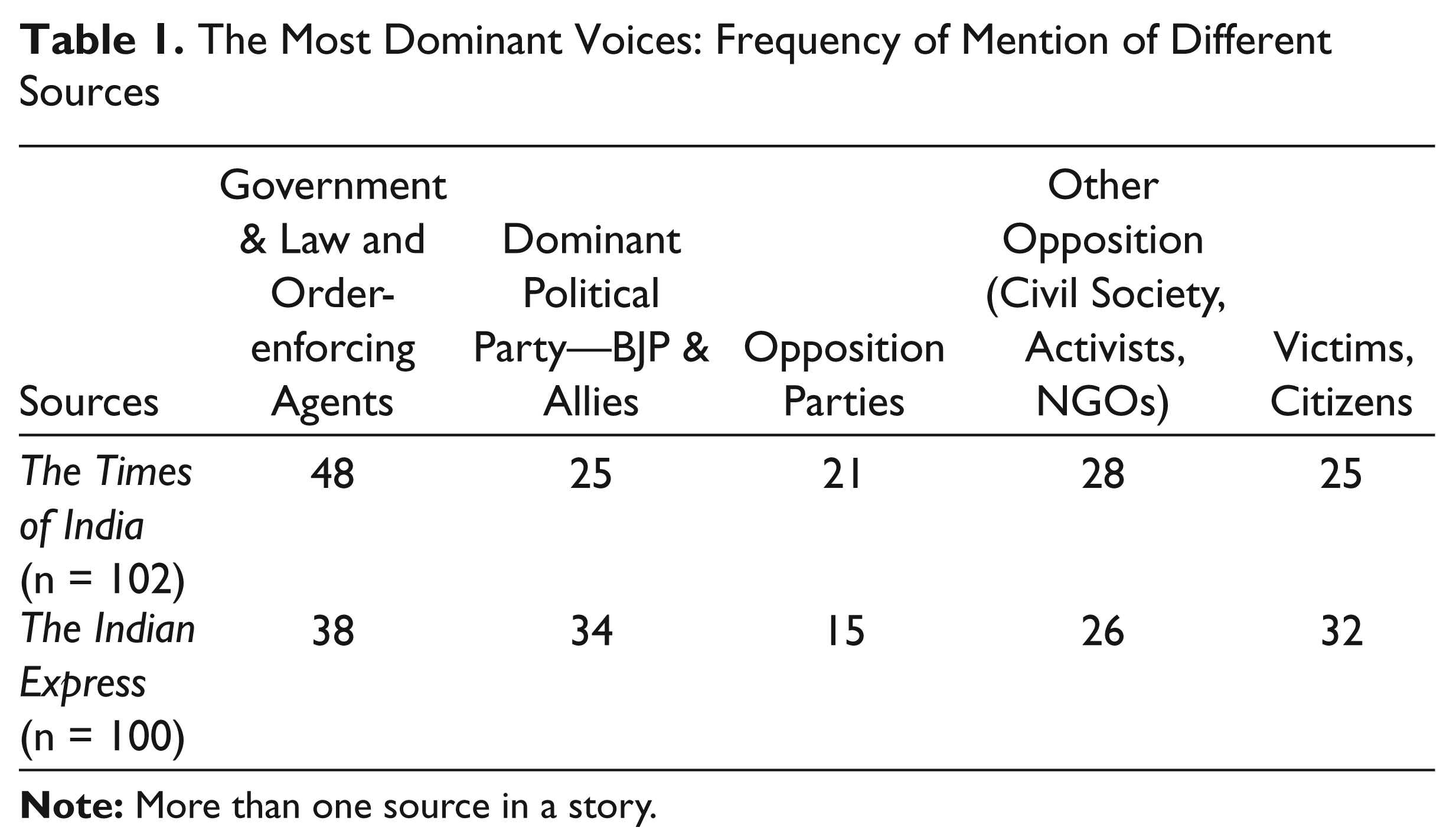
Table 2 computes the percentage of stories that are supportive, neutral or critical towards the government, the bureaucracy and the established power structure. The tone of the story was ascertained from explicit observations and comments in each story.
Media’s View of the Establishment
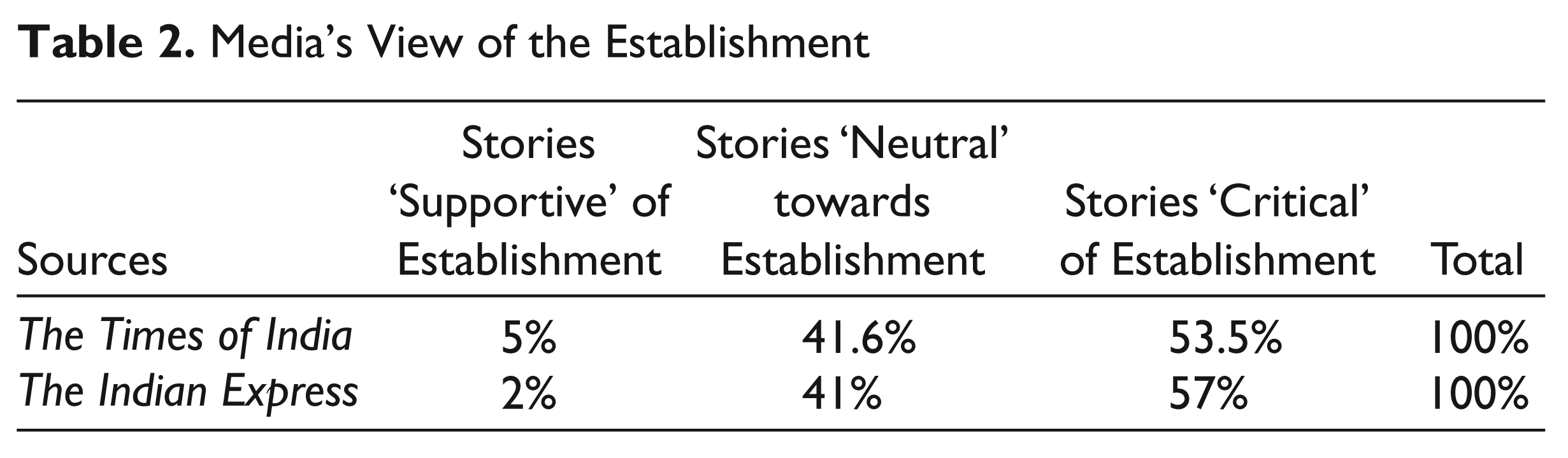
The results show that no one source has an overwhelming presence. Both newspapers have sourced their information from the establishment, that is, the government, its law enforcement agencies and the dominant political parties as well as from the critics of the establishment, including the victims, civil society organizations and the political parties in oppo-sition. Despite the avowed differences in the editorial stand of The Times of India and The Indian Express, there is only a minor difference in the relative importance given to dominant institutional sources comprising the government and law enforcement agencies as opposed to the victims. The Times of India gives greater leverage to dominant institutional sources as compared to the victims, whereas The Indian Express is more balanced in its coverage, giving almost equal weight to the voices from the institutions as well as the victims. Moreover, in both newspapers, the majority of the stories are critical of the establishment, rather than supportive or neutral, though The Indian Express, in keeping with its professed editorial posturing, is more strident in its reporting and has more number of stories censuring the government and the dominant political party.
The results are inconclusive because though the working of media filters is indicated by the dominant faction’s overwhelming presence as news sources, media’s standpoint is starkly critical. We have an anomalous situation wherein we are neither able to dismiss Herman and Chomsky’s assertions nor establish them uncritically as, despite indications of existence of media filters, the media fail to follow their established logic.
Discussion
The analysis of Gujarat riots’ news coverage in national dailies reveals that even if voices from the ruling political party, government bureaucracy and law and order agencies dominated the news stories, the media were still highly critical of these very agencies. Media’s opposition to the government’s position persisted in the face of the administrative agencies’ unprecedented power to administer ‘flak’. But the English-language press and the satellite news channels were not deterred and continued to cover the unfolding tragedy in Gujarat even if it meant endangering the lives of their journalists. They also clearly pointed to the culpability of Gujarat administration, especially of its Chief Minister, Narendra Modi. This reflects a lack of correspondence between media routines and media’s editorial posturing, belying the consistency in the relationship between commercial media and hegemonic powers as explained in the propaganda model, and it calls for a re-examination of the model and its underlying assumptions.
Lang and Lang (2004b) argue that the way media functions is much too complex to be contained within paradigms of a model, and drawing conclusions on the basis of the number of times a topic is mentioned or omitted is an inadequate explanation of the media’s complex relationship with dominant powers. Data gathered in this study illustrate this fallacy as predominance of voices belonging to dominant factions in the news stories did not positively influence the editorial stance. Lang and Lang (2004b) also argue that the propaganda model works on the assumption that the material already exists out there as news and that the gatekeepers only allow a focus on some events while ignoring others. But news is not ‘the surviving residue from an input of filtered information’, rather the creation and selection of news is an active process involving interactions and negotiations between diverse social forces (Lang & Lang, 2004b, p. 109). According to Lang and Lang (2004a, p. 96), ‘news is…produced whenever reporters approach their sources for information that the latter may want disseminated, disseminated in a certain way, or not dissemi-nated at all’ and that the ‘providers and conveyors do indeed cooperate but only to the extent that they need one another’. In the media coverage of the Gujarat riots, cooperation between government bureaucracy and English-language dailies can be ascertained from media agencies’ dependence on institutional bodies as primary news sources. But this dependence cannot be ascribed only to predetermined media routines structured to maximize profits. Rather, in the highly unsafe and volatile conditions prevailing in Gujarat, sourcing of news at organized press conferences or from the offices of government officials was infinitely more feasible than approaching the beleaguered parties, especially as the Gujarat government offered no protection to journalists from the violent mobs. Hence, in spite of media’s dependence on the government, its bureaucracy and agencies for news, the media continued to rebuke them, and the powerful factions’ inability to control the news process totally was exposed.
Lang and Lang (2004a) argue that this anomalous situation, wherein the presence of filters elaborated by the propaganda model is not denied but media do not follow the filters’ established logic, is replicated daily in the routine relationships between media and the public relations activities of corporations and governments. The state and business enterprises do attempt to present their perspective by providing news via press releases and press conferences to be conveyed by the media; and the powerful and the wealthy constituencies do have the potential to craft news stories and influence media outlets, indicating the lack of a level playing field; but the fact that dominant factions are unable to be completely in command is reflected in the political conservatives’ voci-ferous critique of the so-called ‘liberal media’ (Lang & Lang, 2004a, p. 96). Moreover, they also argue that there is uncertainty surrounding the possible impact of the news product itself and this further contributes to the indeterminacy in the relationship between media and entrenched powers. For example, even if the riots in Gujarat were to be covered by a media house with clearly defined sympathies with the government and the dominant political party, the BJP, could the inflammable nature of the news be overlooked? There is no direct relationship between the express intentions underlining news construction and the possible outcomes of its circulation in the public sphere as the journalists from Aaj Tak, a 24-hour satellite news channel in the Hindi language with close ideological affiliation with the BJP, were to discover. A broadcast journalist from Aaj Tak shared with Britta Ohm (2010) that, at first, they were welcomed as insiders by the mobs attacking the Muslim populations because they thought that the electronic media, and especially one sharing similar ideological inclinations, would document their defence of the Hindu pride and legitimize the violence against the minority Muslim population. But it was not long before the very same mobs realized that the documentation of the images of blood and gore could as well be proof of their crimes, and they withdrew their cooperation, leaving the journalists from Aaj Tak to fear the mob’s tyranny along with the Muslims.
But most importantly, this analysis of media’s coverage of the Gujarat riots has drawn attention to the propaganda model’s key assumption that there exists a homogenous and undifferentiated dominant class with similar interests and priorities. The model argues that commercial media and dominant interests have a mutually beneficial relationship, but critics argue that it overlooks the conflicts ‘within the elite, among powerful interests, between any of these and the public in general’ (Lang & Lang, 2004a, p. 97). The other criticism is that Herman and Chomsky have substantiated their argument by drawing on examples of external conflict and foreign policy concerns—instances when media are most likely to align themselves with the government’s propaganda machinery (see Boyd-Barrett, 2004; Klaehn, 2002, 2003; Robertson, 2004). This is because, according to Lang and Lang (2004a, p. 97), when a country goes to war and ‘people rally to the flag’, there is a muting of debate, critics are silenced ‘by charging them with a lack of patriotism’ and peace is maintained between rivals. However, in the instance of an internal conflict within national boundaries, it may be difficult to establish that a seamless and contiguous space extends between media outlets and entrenched power because media are also ‘designated battleground on which the political parties and various interests compete over whose version of reality is to prevail’ (Lang & Lang, 2004a, p. 97). And, media coverage of Gujarat riots clearly reflects the case of dissenting elites.
This is because while the voices of the English-language press and of news channels like NDTV rose up in defence of the victims and severely castigated the Gujarat government for failing to prevent most horrendous instances of violence, wherein even Muslim women and children were not spared from a gruesome death, the Gujarati vernacular-language papers, aligned with state-level politics and to BJP’s long-term political and electoral strategy, vehemently defended the Gujarat government. They even rationalized the violence as just anger of the Hindus, framing the victims as perpetrators and also blaming the English-language dailies for what they saw was their anti-Hindu and anti-national politics (Desai, 2004; Ohm, 2010; Rajagopal, 2006). This conflicting position problematizes Herman and Chomsky’s assertions about media’s equation with dominant powers, especially as both the vernacular press and the English-language dailies are equally driven by commercial and profit-making agenda. However, this difference in the position of the English and the vernacular-language press indicates the existence of what Rajagopal (2001) refers to as the ‘split public’ in the Indian public sphere. In his analysis of the Ram Janmabhoomi movement in the early 1990s, Rajagopal notes the role of deep-rooted rift between urban, cosmopolitan, outward-looking, English-speaking elites and regional, semi-rural, vernacular power centres in the construction of an event, which like the Gujarat riots tested India’s secular credentials. This entrenched split and differences between urban and rural India, between national and state-level politics, which arise in vastly different interests, politics and alignments, were not only articulated in the print media but, according to Rajagopal, the print media coverage was also instrumental in shaping the underlying power struggle between different factions. The internal contestations between differently aligned members of the dominant classes are also instrumental in shaping polar oppositional position taken by English-language press versus the Gujarati-language dailies in their coverage of Gujarat riots. The media reportage on Gujarat riots parallels the coverage of the Ram Janmabhoomi movement in Hindi and English-language newspapers in 1992 and is a replay of the same power struggle between urban elites and emerging regional power centres. Hence, while not denying the sincerity of journalists and activists who put their life on line to expose and contain the pogrom unleashed by right-wing Hindu fundamentalists, the power struggles amidst the vastly diverse and deeply divided Indian publics along the lines of caste, religion, region, language, class and education also had a role to play in creating a line of defence for the riot victims in Gujarat.
The English-language dailies and satellite channels like NDTV, which vociferously condemned the violence in Gujarat and strongly censured the state’s government for its inaction and complicity, have as their audience, the outward-looking, English-speaking, upper middle-class elite and urban populations, commanding the heights of the national economy. According to Rajagopal (2001, p. 159), this well-networked coherent group sees itself as the bearer of ‘the agenda of modernization’. The same group is equally invested in the idea of India as an emerging global power and economy, taking particular pride in India’s status as the world’s largest democracy (see Das, 2001; Kristof, 2011; Nilekarni, 2009). Their passions for being seen as global citizens are not necessarily shared by those commanding regional powers centres such as in the state of Gujarat, wherein the more inward-looking political and economic elites were bent on showcasing the ideology of Hindutva, which marks India as exclusive territory for Hindus, denying India’s plurality and diversity for short-term electoral gains. The flexing of ideological and administrative muscle to validate the right-wing agenda had particular valence for the newly elected Chief Minister, Modi, as it enhanced his position as a rising star in the BJP’s pantheon (Ohm, 2010; Rajagopal, 2006). However, the divisive politics and its ensuing atrocities were a cause of great embarrassment to the national elites because they symbolized the breakdown of law and order at a point of time when the drumbeats for India as the functioning democracy, offsetting China’s authoritarianism, helped position India as America’s strategic partner (see Carter, 2006). They were particularly embarrassed as the world press minced no words in conveying its shock and displeasure at the hollowness of India’s claims to plurality, diversity and responsible governance (see Ankara, 2002; Dugger, 2002; (The New York Times, 2002). The editorial in The New York Times (2002, p. A. 30) admonished the BJP leadership for failed governance, stating that ‘the pledges by Mr Vajpayee and Mr Advani have been welcome, but they and their government must do more to curb the fanaticism of groups that support their government’.
The outward-looking elites could not ignore the world’s displeasure or the downgrading of India’s position as a reliable ally because, in the neoliberal globalizing economy, the very large cosmopolitan middle class is invested, through prospects of global employment opportunities, education and travel, in the image of India in global spheres. While images of India paralleling some primordial hell and evoking volatility of nations like Afghanistan circulated in major newspapers like (The New York Times 2002; Dugger, 2002, July 27), the reiteration of essential continuance and stability of Indian democracy was of essential importance to the national elites, as evinced in a letter to the editor of The New York Times, which reads that though no one can ‘defend the alleged inaction of the government...it is a testimony to the strength of the secular nature of Indian democracy that the riots did not spread to the rest of the country’ (Aggarwal 2 August 2002, p. A. 20). The cauterizing critiques of the Gujarat government from the English-language press in India reflect anxiety and desire to return to normalcy before more damage is done to India’s reputation as a result of these events.
Moreover, the English-language dailies’ strident criticism of the dominant powers in Gujarat and their markedly different position from the vernacular press, also reflects an attempt by the national elites to exert their control over the form and expression of national politics and to counter the rising challenge from the regional players. According to Jeffrey (2000, p. 1), the revolutionary expansion of the vernacular-language dailies in the 1990s in rural and small-town India, endorsed by both regional businesses and political interests, have given the rural populations new ways ‘to think about themselves and to participate in politics that would have been unthinkable a generation before’. Indeed, the rise of a new class of political players in Indian heartland is intimately linked to the increasing influence of vernacular-language newspapers, challenging the dominance of older elites and of the Congress Party on national politics (Jeffrey, 2005; Ninan, 2007). The English-language press was, in some ways, contesting the pulls from regional power centres, confirming Lang and Lang’s (2004a) argument that though media may be biased towards dominant power, they, nonetheless, are also a space for contestation where different factions compete for increasing influence.
To conclude, I argue that the multipronged power struggles between a ‘split public’ that played out in the media coverage of Gujarat riots are not unique to Indian society, but are a facet of all societies. And while there is no denying that media function in tandem with dominant poli-tical and economic powers, this relationship is not certain, but has a shifting and fluid quality dictated by historical contingencies and power alignments within particular contexts that are difficult to account for within the parameters of a model as proposed by Herman and Chomsky. It is due to the divides within the dominant class, despite the entrenched elite factions’ infinitely better position to influence commercial media, that the space for dissenting opinions is created, stalling total domination of democratic public spheres by select sections of society.