







Abstract
This article draws upon the Pacific Media Assistance Scheme (PACMAS) State of Media and Communication Report to examine the implications of a changing media landscape for journalism practice in the Pacific region. The report contributes to an understanding of the diverse media and communications environments in the Pacific Islands (PI) region and captures aspects of the variations both in media, and in context, across and within the 14 Pacific Islands countries. This article highlights the need for synergies in the Pacific Islands to strengthen legislation, capacity-building initiatives and content production in a fast-changing digital environment.
Keywords
Introduction
The Pacific Islands region is characterized by highly diverse geographic, cultural and communication ecologies (Papoutsaki & Sundar Harris, 2008; Papoutsaki, McManus & Matbob, 2011). With population ranging from over 7 million in Papua New Guinea to just 1,538 in Niue and geographies stretching from Kiribati’s 33 low-lying coral atoll islands across 3.5 million sq. km of ocean to Nauru’s just one island of 21 sq. km, each country has its own unique challenges and opportunities related to communication flows, media systems and journalism practices (Robie, 2013; Prasad & Singh 2008).
Communication networks and flows are complex, based on decisions and choices on how to use various media platforms, availability and access. Recent research indicates that a wide range of forms and modes of communication play a role in development and social change in the Pacific—including community radio, information and communication technology (ICT) initiatives (Harris, 2013; 2007; Horst, 2013; Watson, 2011) and processes such as community dialogue (Thomas, 2011; Thomas, Eggins & Papoutsaki, 2013) along with traditional mass media. A comparative analysis allows us to better understand the role of media and communication and how journalists can be supported not only within their countries but also across the PI countries.
This baseline study builds on the findings in the PACMAS State of Media and Communication Report (Tacchi, Horst, Papoutsaki, Thomas & Eggins, 2013) to explore the diverse and dynamic media and communications environments in which journalists in the PI region operate and seek to capture aspects of the wide variations both in media, and in context, across and within the 14 countries. 1 We examine the ways in which the media environment is changing for journalists with particular focus on transformations in the media industry, media production and media use. This article captures the situations at a specific point in time while contributing to an understanding of the changing dynamics of media and communication landscapes across the PI countries.
Media and Communication in the Pacific
One of the most comprehensive studies of the media and communications environments in the Pacific is The Informing Citizens (SANA) report, which provides a situation analysis and needs assessment of the capacity of the media, government and civil society ‘to produce information on good governance’ (Pacific Media and Communications Facility [PMCF], 2005, p. ix). The SANA report includes the same 14 Pacific Islands Forum countries focused in this baseline study. It details each country’s legal and regulatory frameworks, cultural contexts and training institutions and infrastructure for media and communications.
The Pacific region has always been recognized for its rich and complex media and communications environments (Papoutsaki & Harris, 2008). Some of the largest media industries are present in Fiji, Papua New Guinea (PNG), Samoa and Tonga with many media industries being privatized over the last decade. Radio remains an important platform for communication across vast distances and diverse audiences, with most radio consumption occurring while riding public transport and in other communal spaces. Although television retains its importance (especially in urban areas), the practice and infrastructure of television continues to change. For example, there is a growing trend towards watching television via satellite and cable, a shift that often provides less access to local content. Finally, newspapers and newsletters have taken on a new life as they are uploaded and shared online to be read by the Pacific diasporas (Tacchi et al., 2013).
Alongside the traditional broadcast media, new ICTs have entered the media and communications landscape. Studies of media in the Pacific from as little as 5 years ago considered access to new digital infrastructure less relevant than access to traditional media, especially radio, considering issues such as power, unsuitable climate and lack of maintenance and repair capacity in the region (Duffield, Watson & Hayes, 2008). While radio remains important, recent studies find ICTs are becoming more relevant and are indeed underutilized for development communication despite presenting significant potential (Cave, 2012; Watson, 2012). In places such as PNG, where radio is a dominant platform, more households now have access to mobiles than to radio (Cave, 2012; Intermedia Europe, 2012).
According to a recent report by the GSMA (Groupe Speciale Mobile), mobile phone penetration increased in the PI region from 2.1 million in 2009 to 4.1 million at the end of 2014, although unique subscriber rates remain relatively low at 37 per cent (GSMA, 2015). In a number of Pacific countries (e.g., Fiji, PNG, Samoa and Tonga), mobiles are being used for banking, payments and transnational remittances (Horst, 2013). Mobiles are now the most common way to access the Internet, with Facebook being the dominant social network in PNG, Fiji and Samoa (Foster & Horst, n.d.; GSMA, 2015; Intermedia Europe, 2012).
Yet, as the media and communication environment becomes seemingly more accessible to people, questions remain about the reliance on ICTs for specific purposes given the diverse infrastructures in the PI region. This includes the use of ICTs during emergencies and disasters, the ability of broadcasters and technicians to keep up to date with the latest equipment and software, and the consequences of integrating ICTs like mobile phones into media and communication plans for ‘tried and tested’ technologies such as broadcast radio (Noske-Turner, Tacchi, Horst & Papoutsaki, 2014). While ICTs offer new opportunities, digital literacy training is becoming increasingly important to keep pace with the changing environment.
The Research Approach
The conceptual and methodological framework that guided our baseline research was Lennie and Tacchi’s (2013) framework for evaluation specifically developed for communication for development, which is based on systems and complexity thinking and maintains a focus on power, gender and other differences. This approach to social change recognizes that changes in technology and media may have complex, diverse and often contradictory effects on different communities such as women, young people and people with disabilities.
This research included stakeholders’ interviews and a verification survey with media and communication experts (a ‘panel of expertise’). Each questionnaire content, customized for each area of expertise, was administered to 212 research participants. The recruitment process for participants drew on various networks in the Pacific region. In consultation with researchers, 28 key people from mainstream media and C4D fields were identified for a ‘Panel of Expertise.’ The verification process focused on legislation and the media and communications environments in each country. This provided a mechanism for checking whether data sourced was up to date and accurate. The study involved the Pacific Islanders as researchers, 2 research participants and experts to ensure that the findings would be relevant and beneficial to the Pacific media as experienced by the Pacific Islanders.
Media and Legislation: A Regional Comparison
Policy and legislation conditions vary considerably across the Pacific region. Measures of freedom and communication rights for citizens and media outlets are covered in the PACMAS State of the Media and Communication baseline study (Tacchi et al., 2013), informed by previous comparative studies, especially by Perrottet and Robie (2011). Table 1 sets out some freedom measures across the 14 countries, drawing on both existing measures and responses from the Panel of Experts (PoE) and relevant comments by other research participants.
Freedom Measures across Countries
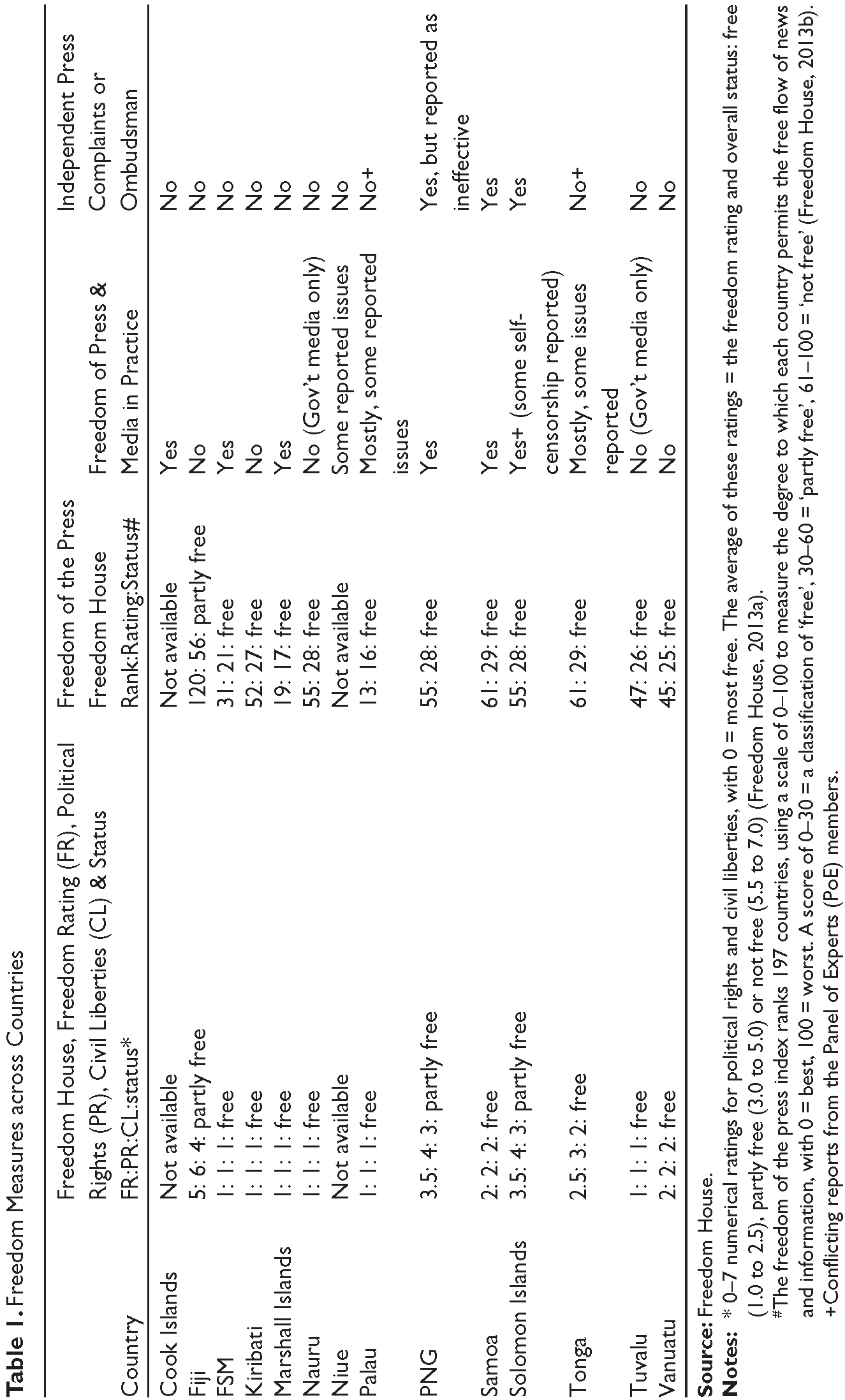
#The freedom of the press index ranks 197 countries, using a scale of 0–100 to measure the degree to which each country permits the free flow of news and information, with 0 = best, 100 = worst. A score of 0–30 = a classification of ‘free’, 30–60 = ‘partly free’, 61–100 = ‘not free’ (Freedom House, 2013b). +Conflicting reports from the Panel of Experts (PoE) members.
The Pacific Freedom Forum (PFF), in partnership with the Media Association of the Solomon Islands (MASI), convened a meeting in May 2013 to explore the need for and creation of a Pacific media ombudsman. Also notable is that Tonga moved from ‘partly free’ to ‘free’ in the freedom rating during 2012 due to an improved civil liberties rating.
In the area of freedom of information, Cook Islands was at the time of this research the only country in the region to have passed legislation of this kind, although progress towards specific FOI legislation is being made in Papua New Guinea, Solomon Islands, Vanuatu, Tonga and Palau. Respondents from several Pacific countries report that in practice their governments are generally open to sharing information. For example, in Marshall Islands the Panel of Experts member indicated that
‘The difficulty, for the most part, is that few government offices have policies or systems for releasing information, so obtaining information is an ad hoc situation. I have found most government offices to be willing to share information when asked, but many do not offer it because there is no system in place’.
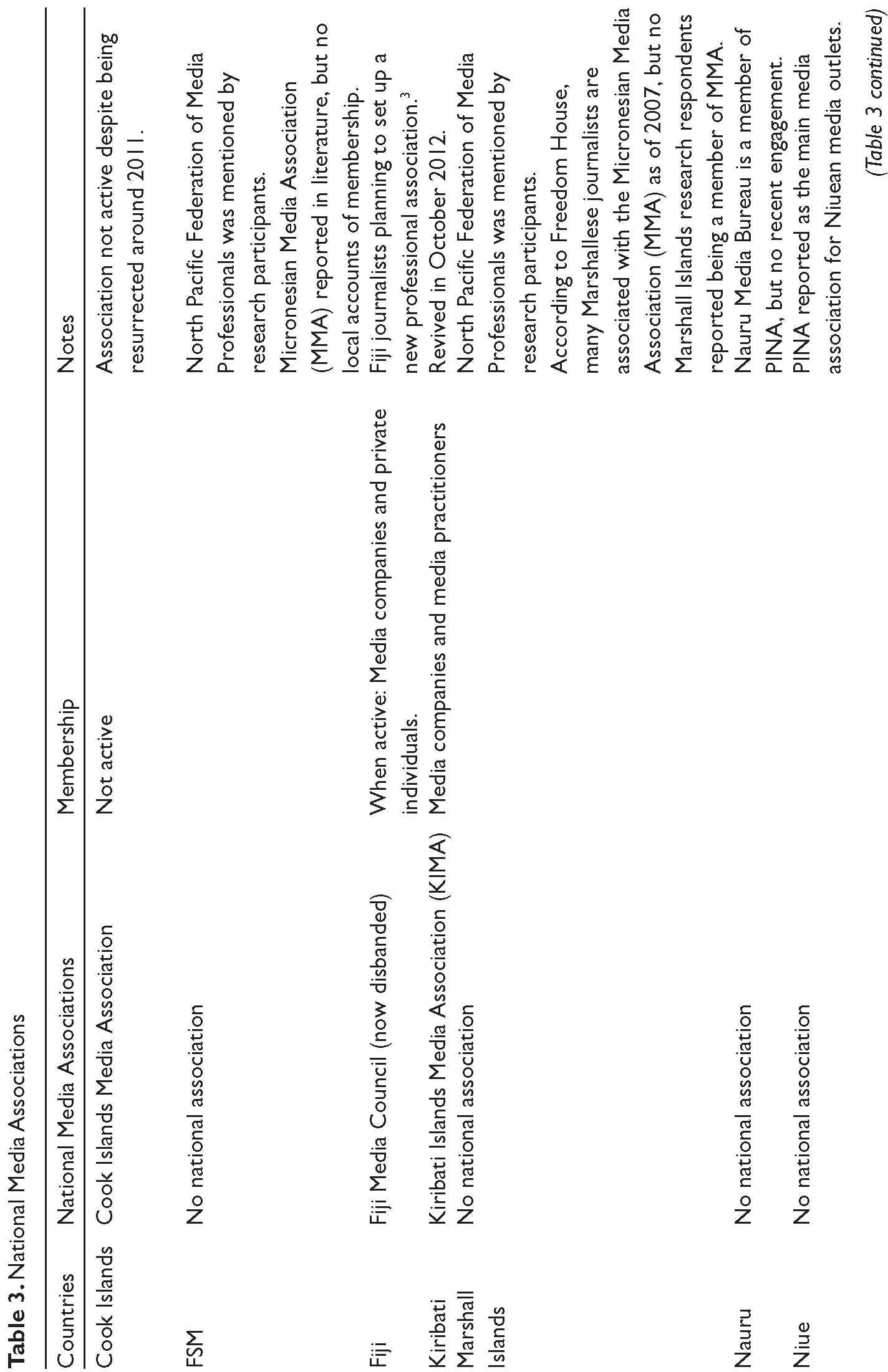
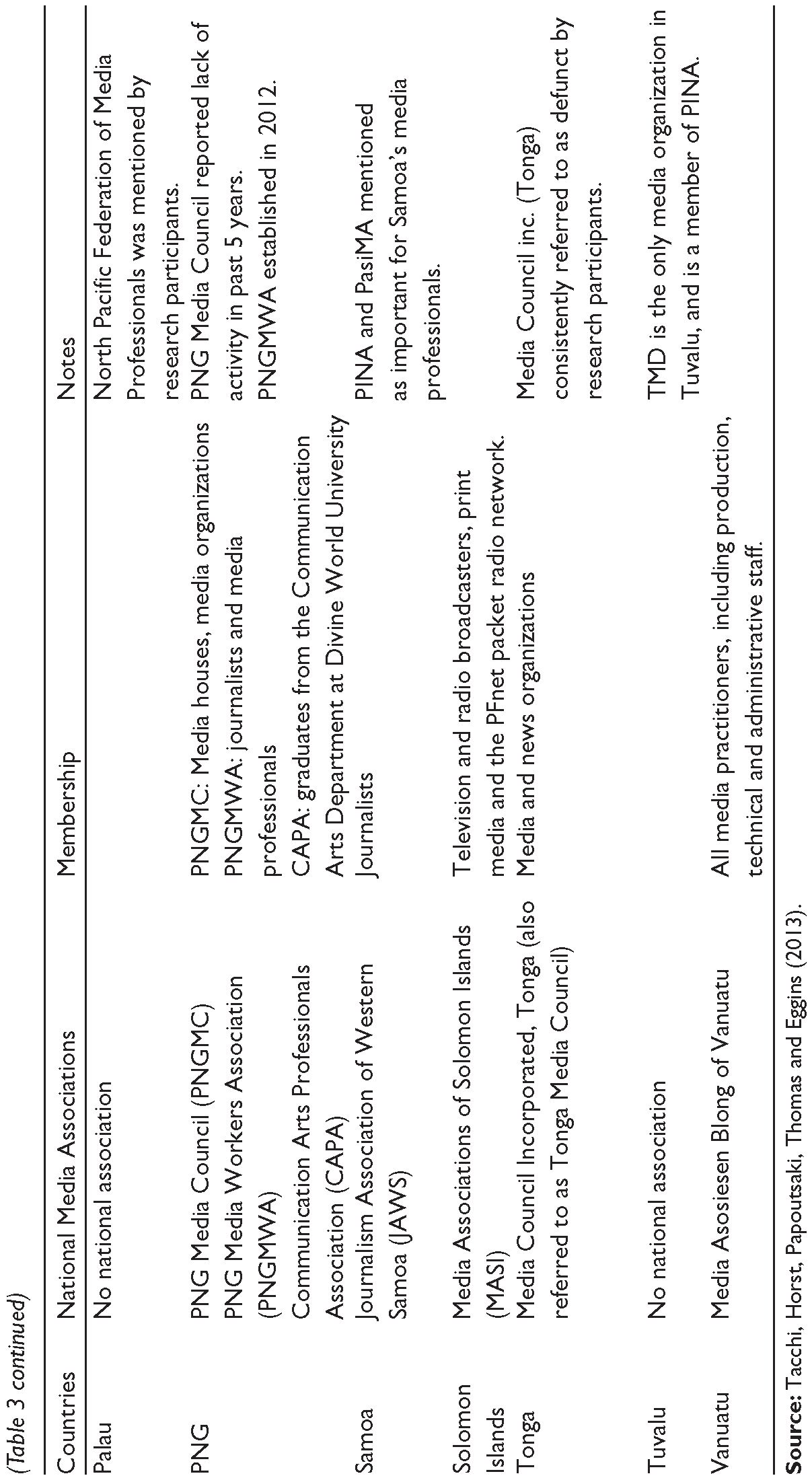
This baseline study also considered issues of media and communications plurality and diversity. While some media environments are growing and diversifying, especially with increased access to ICTs, others are shrinking due to commercial imperatives and the challenges of distances and scale or, in some cases, due to inaccessibility of licences. Likewise, there is a significant diversity in the perceptions of the frequency and inclusivity of discussions on media policy and legislation. National media associations were rarely seen by interviewees as playing an active role in policy advocacy, despite this often being included in their mandate, with the exception of two organizations in PNG (Table 3).
Much progress has been made in the area of legislation, owing in large part to the regional Digital Strategies programme initiated through the Pacific Islands Forum Secretariat. However, some countries have yet to pass draft legislation in this area, while others have passed legislation with little effect. Digicel has entered the market in six countries in the Pacific (Fiji, PNG, Vanuatu, Tonga, Samoa and Nauru) (Digicel Asia Pacific, n.d.) and expanded its services in some countries to television via a digital set top box, which poses further challenges with regards to foreign ownership and content.
As new technologies emerge, policies must be developed and adjusted to the changing opportunities and circumstances. Overall freedom of the press is provided but better regulations of the market could encourage further growth in the sector. Opportunities are there to utilize technology to bridge some of the challenges and policies must ensure appropriate use and integration.
Strengthening Capacity: Media Associations and Journalism Training
Mixed responses about media associations were noted in each country and across the region. In countries with existing and functioning associations, general concerns are over organizational structure and management, governance, representation, conflicts of interest, collaboration, funding and resourcing, development of code of ethics and membership composition. In countries without exiting media associations, respondents expressed a need for associations to be formed:
‘We want to set up our small islands media … organisation so that we can look into our own needs and challenges […] we don’t have much voice […] because we have a lot of our own problems that might not be regarded as problems in other countries of the Pacific’. (TUVALU 07)
Media associations in small island countries are often dormant to non-existent: for Marshall Islands, Nauru, Niue, Tuvalu and Palau, media associations do not exist; the Cook Islands association was non-functioning at the time of this research, while in Fiji the media association ceased.
‘I understand that there is a media association for the north Pacific but … I was never invited [and] if I was invited, I couldn’t afford to go. I can’t even get to the other islands’. (FSM01)
Media association affiliation to government has caused media personnel to lose faith in associations as in the case of Micronesia. PNG presents a different experience with three associations—the Media Council of Papua New Guinea (MCPNG) (non-functioning), the PNG Energy Workers Association and the Communication Arts Professional Association (CAPA). However, issues around accountability remain.
‘There is [a code of ethics] but nobody follows it. The challenge that we see in the industry today is … employment conditions and salary is so poor that many journalists are exposed to… bribes. … What we saw in the lead up to the last election was quite worrying, sums of money being given to journalists for showing up to certain press conferences and doing stories on certain politicians…’ (PNG11)
Many of the 14 PI countries do not have an existing Media Code of Ethics except for Palau, Niue, Fiji and PNG. Regional media associations have recently changed in membership due to specific country issues. For example, the Pasifika Media Association (PasiMA) has a more Polynesian-focused membership, while the Pacific Islands News Association (PINA) is increasingly seen as Melanesian-focused.
‘We really need a media council, not only in terms with dealing with people with grievances but actually developing the skills and knowledge that working journalists should be having and assist media program with TVETs’. (TONGA14)
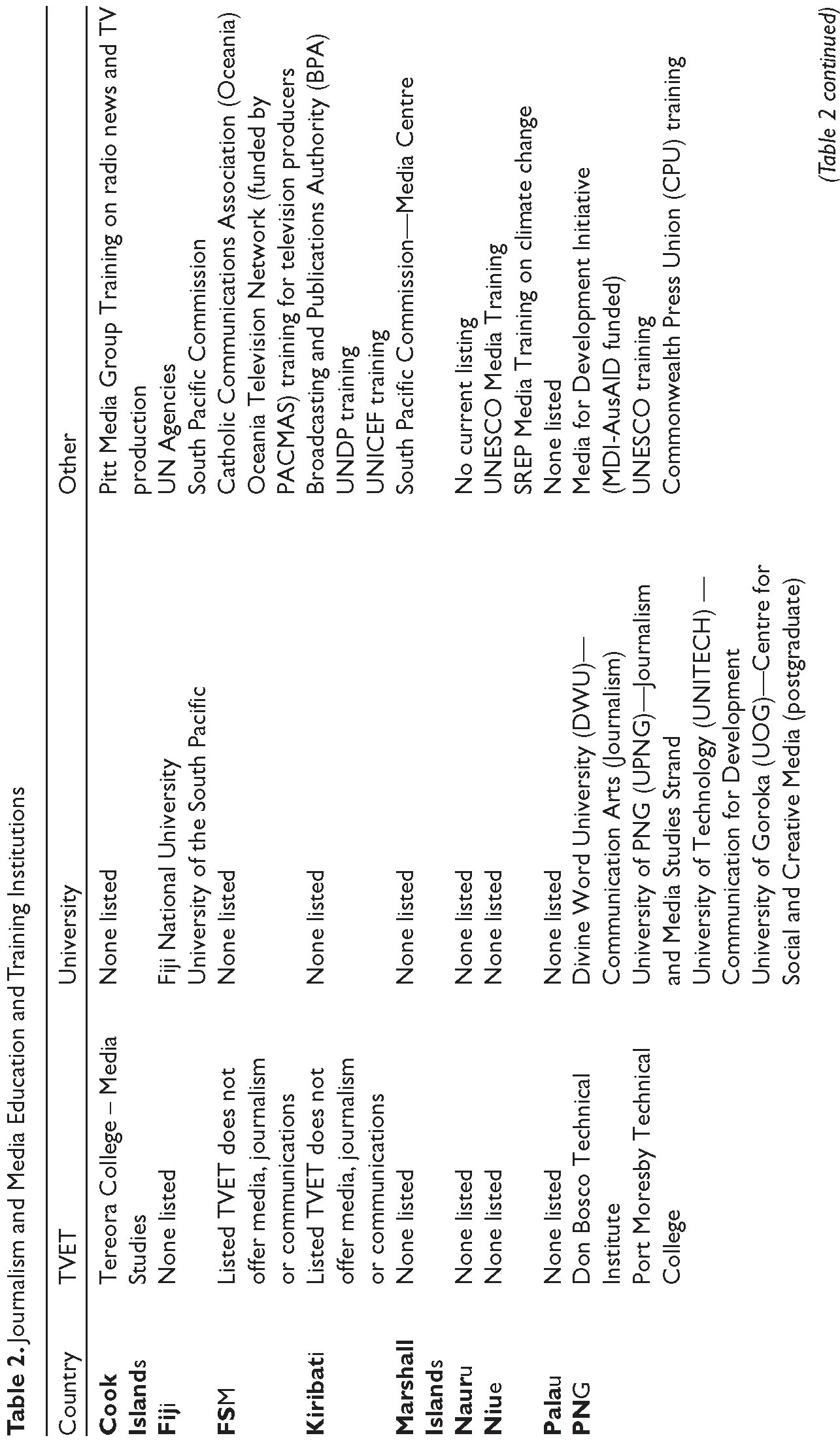
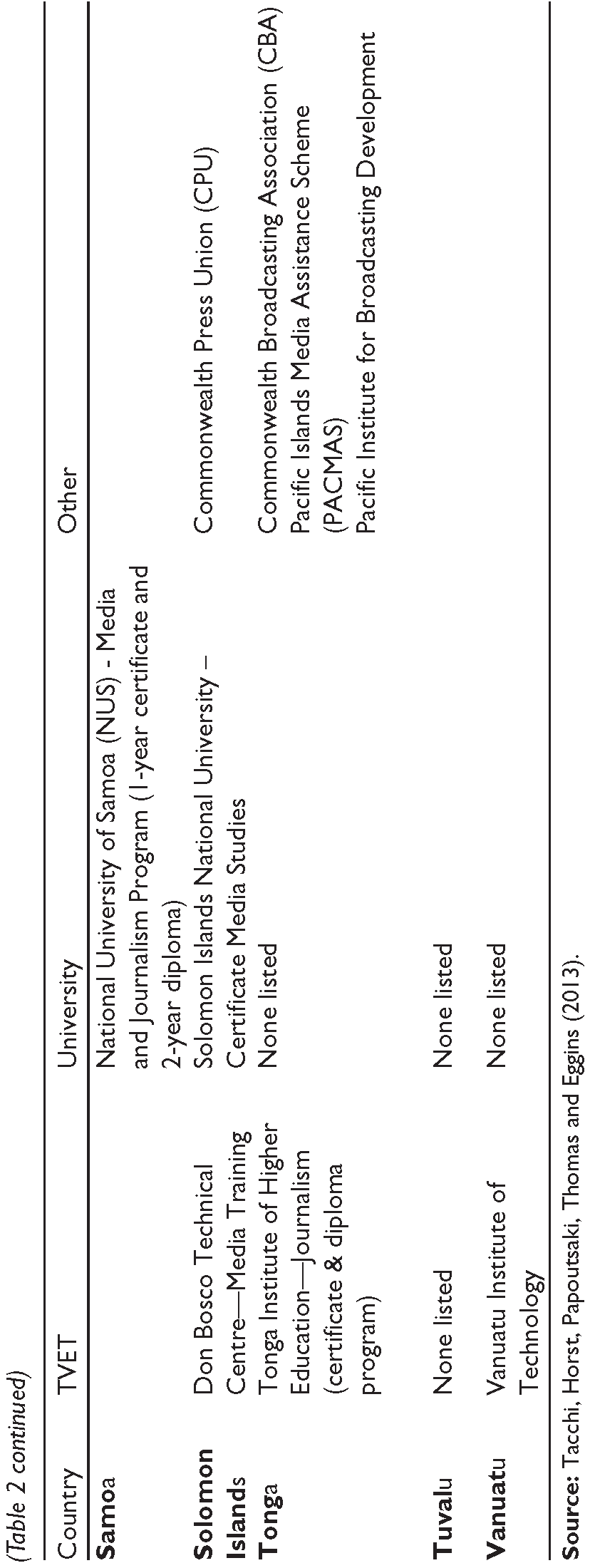
Media associations for many of the 14 PI countries have been key providers of training for professionals. Collaboration on capacity building does take place between the PI countries and others such as Radio New Zealand and Auckland University of Technology’s Pacific Media Centre. Church-based organizations also participate in capacity building including the Catholic Communication (SIGNIS) and the World Association for Christian Communication (WACC). External support networks include the Australian Department of Foreign Affairs and Trade (DFAT) through the Media for Development Initiative (MDI) in PNG, Solomon Islands Media Assistance Scheme (SOLMAS) in the Solomon Islands and PACMAS in 14 PI countries (Table 2).
Journalism and Media Education and Training Institutions
National Media Associations
PNG, Fiji, Solomon Islands, Samoa, Vanuatu, Cook Islands and Tonga have in-country institutions offering diploma to degree and postgraduate degree in media. Kiribati, Marshall Islands, Nauru, Tuvalu, FMS, Palau and Niue do not have entry-level training, but travel out for this.
‘The main problem that I see it is that they’re using people in the industry to teach who aren’t proper teachers and not used to teaching, so it’s a fairly big learning curve for them and you need a lot of time to set up classes’. (VANUATU02)
Most of the institutions follow a standard format for certificate (1 year), diploma (2 years) and bachelors (4 years) programme structure. Institutions in Tonga and Vanuatu have one and two year courses. Work experience or industrial training is factored into the curriculum. For Samoa, a response to the industry’s call for quality graduates has resulted in the addition of another year to diploma level to adequately prepare students for an entry-level journalism.
Course accreditation for some countries is clearly in place. The Australian Technical College (ACT) accredits the Vanuatu Institute of Technology media programme. The National University of Samoa has an Industry Advisory Panel (IAP) that participates in curriculum development and it collaborates with the Government of Samoa to endorse any changes to the course.
The Solomon Islands National University curriculum, as well as National University of Samoa (NUS), is based on the Pacific Media Communication Facilities (PMCF) course design developed by PINA. Industry professionals also provide input into the curriculum design. The delivery of their Technical Vocational Education and Training (TVET) programmes is done in close consultation with the National Apprentice Board, where participants have to sit for a particular test. Their course advisory committees comprised of media professionals. For universities in PNG, quality assurance through academic audit is mandatory (government directives). The National Department of Education of PNG also has a TVET office that solicits education specialists to train technical college staff on curriculum development, management and leadership.
In terms of institutional capacity, the opportunities and challenges vary both regionally and within countries. There is Fiji National University (FNU), which has received a lot of international support through DFAT to equip its training facilities. But, in Kiribati, Nauru and Niue, there is no local access to (or an entry point for) journalism or media training.
‘[t]he training of staff is quite important to us to develop further because there is no such training available on the island yet.[…] we just learn from our colleagues who have been in the field for longer than others’. (NAURU01)
A major challenge for all the countries, especially the smaller ones, is funding for training. Reliance on external aid-related funding, often through regional media associations, can result in training that not only is costly but also not locally relevant.
Response from the industry on the quality of graduates from media training courses varies but tends to indicate that improvements can be made, especially in regards to language skills. In Samoa, Tonga and Solomon Islands, there is disillusionment with the level of graduates coming into the industry. Consistent reference is made to a lack of basic journalism skills such as grammar, spelling and literacy, attributed to the curriculum offered at the journalism training schools. The media associations can play a stronger role in providing training opportunities in a more systematic manner and with stronger regional ties.
Media Content: Access, Production and Distribution
The media’s role in strengthening governance and democracy in the PI region and its ability to contribute to development outcomes require both public access to media and increased access to media production in order for citizens to tell their stories or voice their concerns. While all countries produce content across various platforms including print, radio, TV and mobile and online media, the capacity to produce media content is linked to the size of its media industry.
Foreign content is widely available either through Pay-TV or pirated DVDs. Due to increased access to technology, remote communities actively seek out media, through the mobile phones (still relatively costly in most parts of the Pacific) or by communal watching of films, such as in PNG, which has a high number of village cinemas. The challenge for media producers lies in understanding the formal and informal distribution systems in order to provide content to communities relevant to them.
Considering the technological developments in the PI and their impact on content production and reception, sharing across countries and platforms is on the rise, particularly where content relates to shared issues and a broader Pacific or regional identity. While media content producers say they regularly assess their immediate audiences, there have only been a small number of extensive studies undertaken on the audience access to the media by public broadcasters in the Pacific, including in PNG (Intermedia Europe, 2012) and Vanuatu (Intermedia Europe, 2013).
Reporting on issues of increasing concern also comes with new challenges. For example, interviewees commented on the difficulties in reporting climate change issues due to translation of technical terms.
‘[o]ne of the biggest problems is actually transferring all those policies and all those legislations … into language that people would not only understand but actually be motivated to do something about…because there is a mountain of legislation’. (SAMOA02)
Apart from government departments, NGOs and churches often produce content. In countries like Samoa and Tuvalu, a few churches are taking a leading role in informing people on issues of local importance, including climate change. In PNG, church organizations continue to lead by introducing technological infrastructures such as radio transmitters. Provisioning high frequency (HF) radios in small and isolated communities in PNG has been a core focus of the NGO Christian Radio Missionary Fellowship (CRMF). Whether governments, churches, NGOs or commercial companies undertake production, a common concern is the high costs associated with broadcasting educational and development content. Not-for-profit organizations and companies are often required to pay for airtime.
‘[w]e have quite a lot of thinking of getting these things out in a sort of education form to the public. But we are having a problem with… the budget. […] the airtime for our radio programs are quite expensive here—very, very expensive’. (VANUATU09)
Apart from structural factors around media content production in the Pacific, there has been discussion around how content is being produced to suit the Pacific audiences. In regards to journalism, Robie (2008) has discussed the idea of development journalism in the Pacific. Although development journalism is part of the debate around content production in the Pacific, the realities of the Pacific media present challenges in its practical application. More in-depth research and reporting of stories can at times be challenging to journalists in the Pacific as resources are often limited.
‘I think it’s [media coverage around Non-Communicable Diseases] still superficial. […] we’ve had three trainings, had the media people invited… to let them know all about NCDs and they can be able to be a partner. And they do. But, only on a news basis … if there’s an important thing coming up, … they grab it fast and put it out on the media, everybody sees it at that time and then, that’s it’. (VANUATU09)
The language of media content also represents a constraint, one that usually affects those living outside urban areas. Fiji enjoys a rich multilingual content scene with broadcasting in Fijian, Hindi and English for large audience groups. In Vanuatu broadcast is mainly in English, Bislama or French. Despite its many indigenous languages, content production in local PNG dialects is rare and broadcasting is mainly in English, Tok Pisin and Motu. The Cook Islands has four spoken languages but mass media is in either English or Rarotongan. English is being increasingly used in Palau and most media in Micronesia is in English. There is also a trend to use English in programming, which will enable content producers to distribute their product regionally.
Active involvement in media production by Pacific Islanders is important for enabling people to have a voice on local issues, ensuring appropriate representation and the plurality of media. The most common form of participation is talkback radio, widely used by government and commercial radio stations. It allows people from outer regions to express their opinions and participate in radio discussions. In Tonga for example, members of the Women and Children Crises Centre and organizations such as Tonga Health Promotion Foundation have regular programmes on radio and TV with a discussion and interview format including health workers and doctors.
With regards to participatory and local content production, FemLINK Pacific, an NGO based in Fiji, focuses upon training women to use mobile suitcase transmitters that transmit up to 100 watts over a 10 km radius to produce and transmit content relevant to women and communities. Participatory production was also commented on in the Solomon Islands:
‘We have trained unskilled, uneducated people how to do digital editing and then they have produced their own radio programs according to the themes that have been identified. So it’s possible for you to build those capacities if they have those radio stations there and they got the ownership. So it is truly empowerment radio then’. (SOLOMON02)
The University of Goroka, through the Centre for Social and Creative Media, has investigated community-responsive ways of filmmaking in Melanesia and collaborative media production. The process of filmmaking as a space for exploring community relations and practices and challenging stereotypical media representation of PNG communities has been an important dimension of this activity (Thomas, 2011; Thomas, Eggins & Papoutsaki, 2013).
Social media and other grassroots communication and participation have been assisted by the availability of technologies and the Pacific is experiencing an increase in ideas being voiced via online forums, changing the way Pacific Islanders participate in public debates. Social media, especially Facebook, has generated political and social debates such as PNG-based Sharp Talk, and Vanuatu’s Yumi Toktok Stret. While political blogging, like in the case of post-coup Fiji provides an alternative source of information to mainstream media, Walsh (2010) argues that the anonymous publishing often allows rumours to circulate, making it difficult to establish the reliability of information. Cave (2012), however, argues that although some Fiji-focused blogs have lacked editorial discipline, overall in the Pacific, ‘[t]he blogosphere has been a key sphere for exposing corruption and unlike traditional media, most of these online media provide forums to discuss and debate these reports’ (p. 12).
Increasingly, traditional broadcast media picks up on information provided via citizen journalism, like PNG’s EMTV Online news service Mi Ripot (
Conclusions
As the evidence presented in this baseline study suggest, access to media in the PI region is diversifying and widening, particularly in Melanesia where community members and community media are training to use radio, Internet and mobile. Whilst substantial progress has been made in terms of legislation, other persisting issues like skills in reporting and capacity building continue to impact on the media and journalism practices in the region. There are promising forms of engagement with citizen journalism through the blogosphere and the reach of news to spread through online formats, social media and participatory video. Pacific diasporic populations cannot be left out of these developments as evidence shows an increasing online media engagement. The communication and media landscape of the Pacific must be understood in context and although some generalizations can be made across the region, the 14 countries included in this baseline study require individual attention before an accurate comparison can be made. Understanding media and communications environments also requires consideration of broader political, economic, geographic, demographic and cultural dimensions as well as patterns of migration and diaspora.