







Abstract
This article examines the implications of adopting a discovery learning education model for distance education students in a first-year undergraduate journalism subject. It reviews subject enhancement strategies against learning theory and analyzes the ways students are engaged with subject content and assessment. Results of subject redesign included increased student satisfaction, greater retention and higher grades despite the increase in overall assessment requirements. It demonstrates that discovery learning based on group work and social engagement can be adopted in a distance education environment with positive outcomes. This article maps how a subject designed initially to align with a cognitivist/behaviourist model progressed to adopting a social constructivist approach. It concludes with a discussion of the issues associated with that transition.
Introduction
Traditional delivery of distance education is often based on a cognitivist/ behaviourist model (materials are developed and content is delivered). Distance education is often the ‘addendum’ to on-campus delivery. Group learning by distance (if it is present) often defaults to posts on discussion forums (Anderson & Dron, 2012). While inquiry-based models based on social constructivism, which emphasize on student learning rather than content delivery are not new, implementing such a model for first-year journalism students who study by distance education poses a significant pedagogical challenge. There is also limited empirical research and specific case analysis study to draw on when revising course design. This article addresses this gap by documenting how a subject—Introduction to Journalism—designed initially along cognitivist/behaviourist model, delivered by distance education, progressed to adopting a social constructivist approach to enhance the learning experience and improve the knowledge and skills of students.
Welcome to Journalism
Introduction to Journalism is offered in the first term of the first year of professional communication and arts programmes at a regional university in Australia. As a core subject in the journalism specialization/major, it introduces concepts and foundation knowledge of journalism upon which advanced subjects will build. The course is offered by distance education and on campus across multiple sites. A central subject website is available to all students through the Moodle learning management system. A coordinator manages the subject and teaching staff and is responsible for engaging with all distance education students. Tutors conduct tutorials for on-campus students. Tutorial outlines are provided for use by the subject coordinator to ensure the consistency of delivery. This subject was the focus of a review conducted over three years and changes implemented incrementally over three consecutive terms (Term 2 in 2013, Term 1 in 2014 & Term 1 in 2015) as per Table 1.
Changes to Assessment in Introduction to Journalism
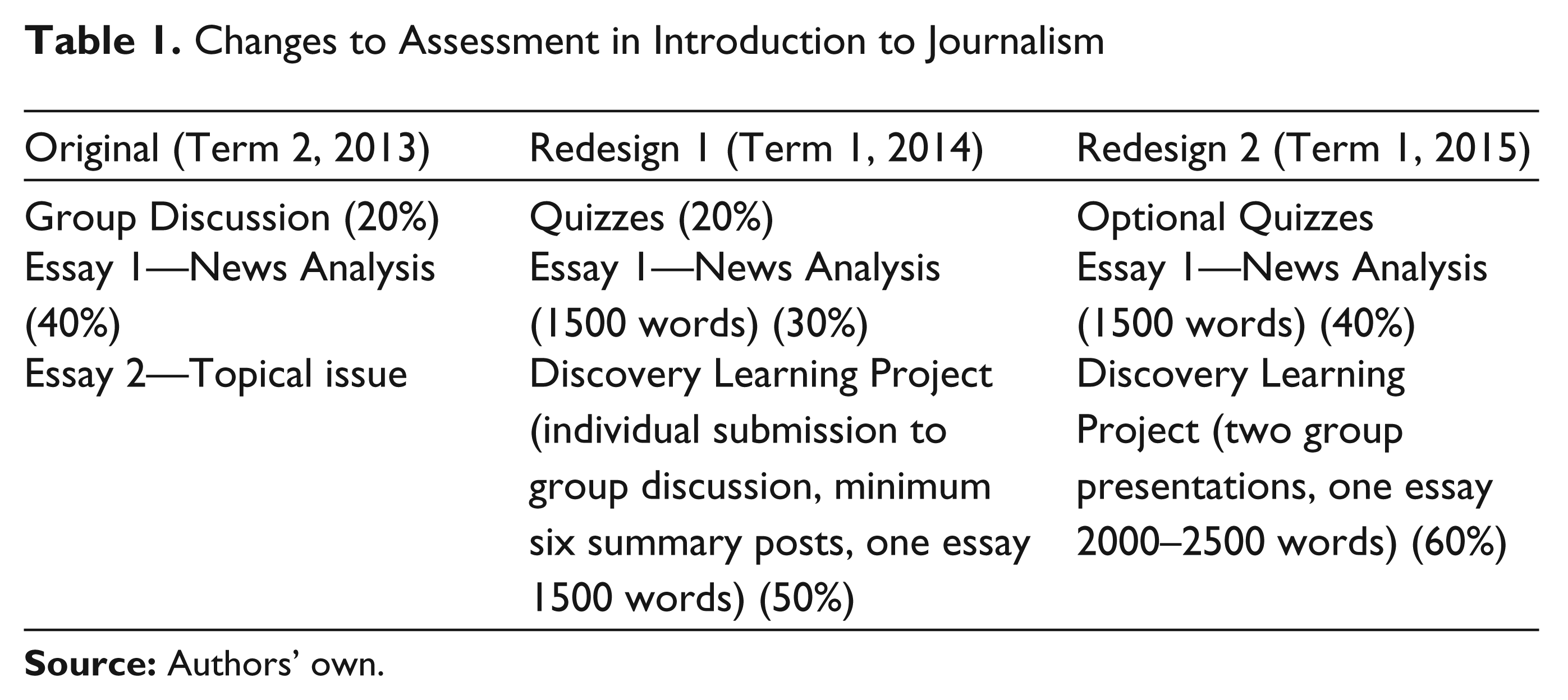
In 2013, the subject was designed based on a cognitivist/behaviourist pedagogical model. Content was developed and delivered in weekly modules over a 12-week period via Moodle. Students were required to complete three assessment tasks: group discussion via the subject discussion forum on Moodle (30 per cent); and two essays (one 40 per cent and one 30 per cent). Group discussion was a response to a question posed in the subject’s weekly study guide. Students were not required to interact or engage with one another, except to contribute to the broader ‘discussion’.
The first essay required students to review three published articles and discuss the genre structure. The second essay was to research a topical issue in journalism as a profession, for example, ‘What fundamental ethical breaches and issues were raised during the “News of the World” revelations, its subsequent closure and the Leveson Inquiry in the United Kingdom during 2011–2012? Were these solely the work of individual journalists or part of a wider culture?’
The learning outcomes were on successful completion of this subject, students would be able to: (1) discuss the social and historical development of journalism from a range of cultural perspectives; (2) explain the differences between journalism genres and how genre influences journalistic practice; and (3) critique the issues relevant to journalistic practice in current media environment.
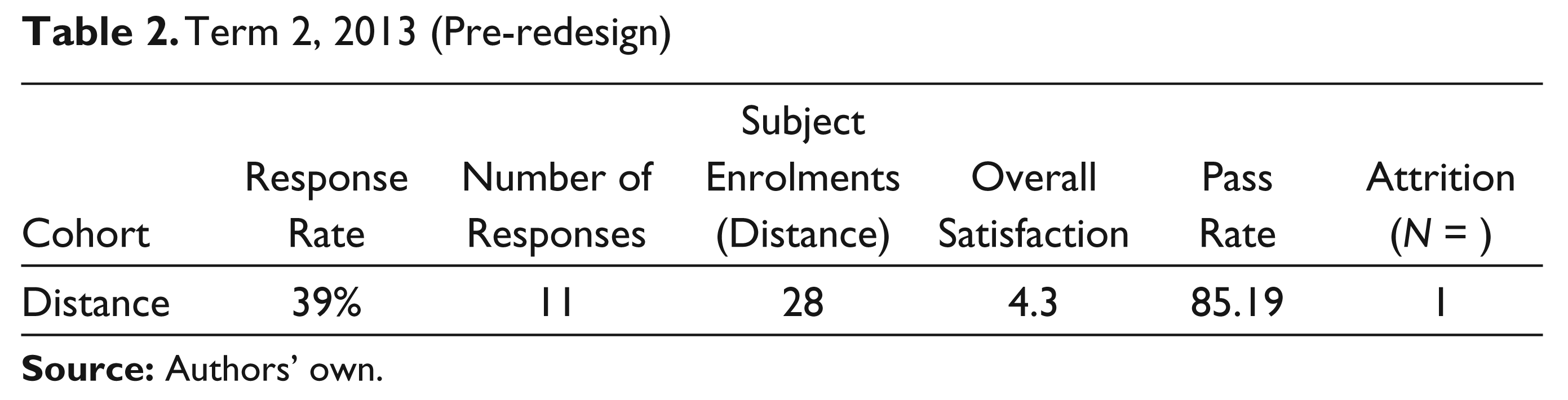
Term enrolments for this offering totaled 52 students with 28 studying by distance education. Subject results and pass rates for distance education students were satisfactory, as per Table 2.
Students were enthusiastic about the subject and keen to learn as reflected in the introductory comments posted on Moodle. However, despite the general satisfaction and pass rate, the staff teaching the subject noted that the assessment was individually focused, based on reflective essays, and generally did not reflect the dynamic and social nature of the journalism profession. Students needed to be introduced to some ontologies associated with journalism—for instance, that artefacts are created for public consumption; that journalism is a social rather than individual pursuit; and that connection and research are fundamental to discipline practice. Hence, a discovery learning model based on a constructivist model was considered the best approach.
Discovery learning is an associated inquiry-based instructional method based on the premise that through the process of finding out for themselves, students engage in deep learning and remember the facts and issues more readily than if they were given the facts directly, or ‘instructed’ (Mayer, 2004). It is a method commonly employed for on-campus students, particularly in inquiry-based classroom settings where students are able to actively contribute to their learning outcomes. Applying this model to distance education is problematic because students learn at different times and rates and more effort is required to clarify issues and support students. Distance students are resistant to being assessed in group work, but at the same time appreciate social contact. They need the ability to work independently but also have some flexibility within the learning framework and need to have clear orientation and explanation provided (Butcher & Rose-Adams, 2015; Huang, 2002; Roblyer & Wiencke, 2003). However, guided discovery has been found by some to be more effective than pure discovery (Alfieri, Brooks & Aldrich, 2011; Clark & Hannafin, 2011; Mayer, 2004 ). The benefit of guided discovery learning is students’ attention is focused (Mayer, 2004). This was the approach adopted for Redesign 1.
2, 2013 (Pre-redesign)
Redesign 1 (2014): Discovery Learning as Individuals
Redesign 1 was implemented in Term 1, 2014. Content remained the same with very minor revisions, but changes were made to the assessment as per Table 1. The key change was that a guided discovery learning project replaced the topical essay. This project was based on the premise that students, through detailed examination of a journalist, would address important questions about the professional context of that journalist’s life. Students were required to individually research journalists and contribute to one another’s learning by posting facts about the journalists to the discussion forum by the due dates throughout the term. Using the collective knowledge built by the group, students then had to summarize the journalists’ careers and, as a conclusive exercise, submit a 1,500 to 2,000 summary-based ‘Journalist of the Century’ essay ranking the journalists against a set of criteria.
As a guided discovery approach, students had to consider each journalist against a specific set of questions that addressed issues in contemporary journalism such as: ‘Describe the relationship between the journalist and the concept of “the Fourth Estate”’, ‘What genre of journalism was/is the journalist most renowned for in their work?’, ‘What was the journalist’s most significant contribution to public knowledge or interest?’ and ‘Did this journalist practice ethically and lawfully? If not, why not? If so, what is the evidence for this and were there any consequences?’
Each journalist was one whose life was difficult or whose work had led to personal consequences (they were jailed, sacked, demoted or killed in action). Each journalist’s profile raised important questions about the professional context of that journalist’s life, which led to the moment that became problematic. Students were required to select journalists from different countries/cultures and aligned with subject content for the week—for example, Indian journalist Barkha Dutt was a journalist aligned with a topic covering journalism in non-Western countries.
The new assessment within the discovery project did not go smoothly for distance education students mainly for practical reasons. While on-campus students completed the weekly discussion in class, the distance education students worked at their own pace. Hence, group discussions and shared learning on the forum were very disjointed. Distance students worked in ‘blocks’ and there were regular periods throughout the term where they were clearly rushing to catch up. The subject coordinator was repeatedly asked to open up forums or for extensions related to weekly contribution. Students also complained that they wanted more room to reflect on the final ranking of journalist essay and that 2,000 words was not enough. Overall engagement within the course, however, increased. The model was theoretically sound and worked well for on-campus students.
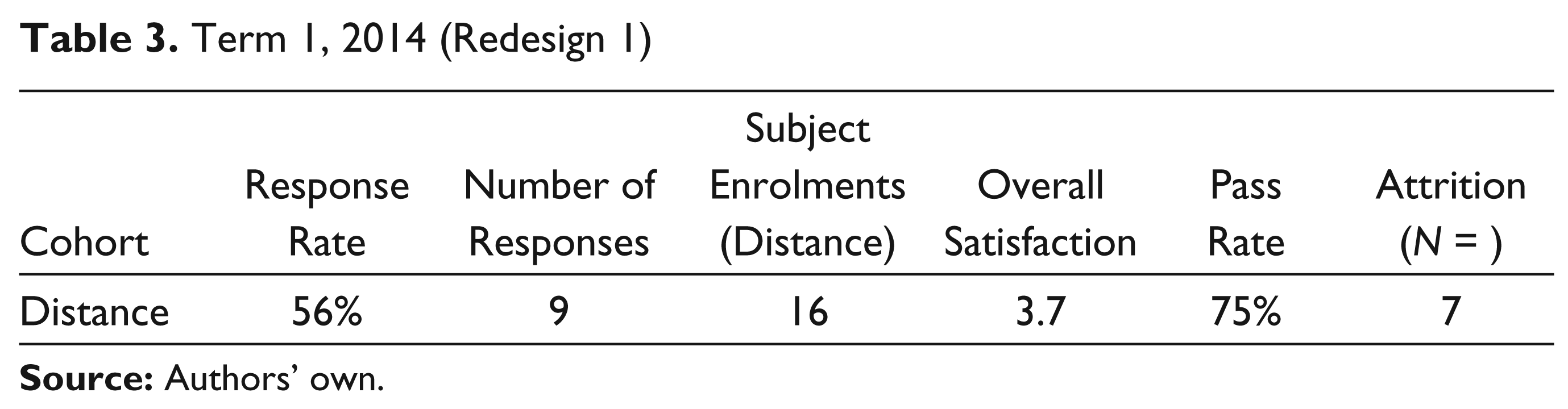
Distance students, however, were impacted negatively. Innovation that aimed to engage them had failed. Of 33 students enrolled in total, 16 were distance students. The satisfaction rate and pass rates in this distance cohort were significantly less and the attrition jumped from one in 2013 to seven in this offering. The subject coordinator responsible for distance students was the same as in the original offering and the course content was essentially the same. Table 3 demonstrates the summary of satisfaction, pass and attrition.
The focus of subject adjustment was, therefore, on further revising the assessment to address issues as identified in the normal course review process.
Redesign 2: Making It Social…Group-based Discovery Learning
Redesign 2 (Term 1, 2015) added ‘social’ to a constructivist approach. This aimed to move beyond a simple use of discussion forums for distance students, previously acknowledged as the ‘staple means of learning in constructivist distance learning models’ (Anderson & Dron, 2012, n.p.). Discussion and articulation with others assist with learning (Anderson & Dron, 2012; Laurillard, 2012; Paulsson, 2008). Therefore, where distance students had been required to make individual contributions to forums as the central tenet of engagement, distance students were required to work in groups (comprising three to four students) to develop two research-based presentations on journalists. These groups worked collaboratively to research a journalist and develop a presentation that summarized the journalist based on a list of prescribed questions. These presentations were designed to teach other students about that journalist. Distance education students self-selected their groups by nominating a journalist of interest.
Term 1, 2014 (Redesign 1)
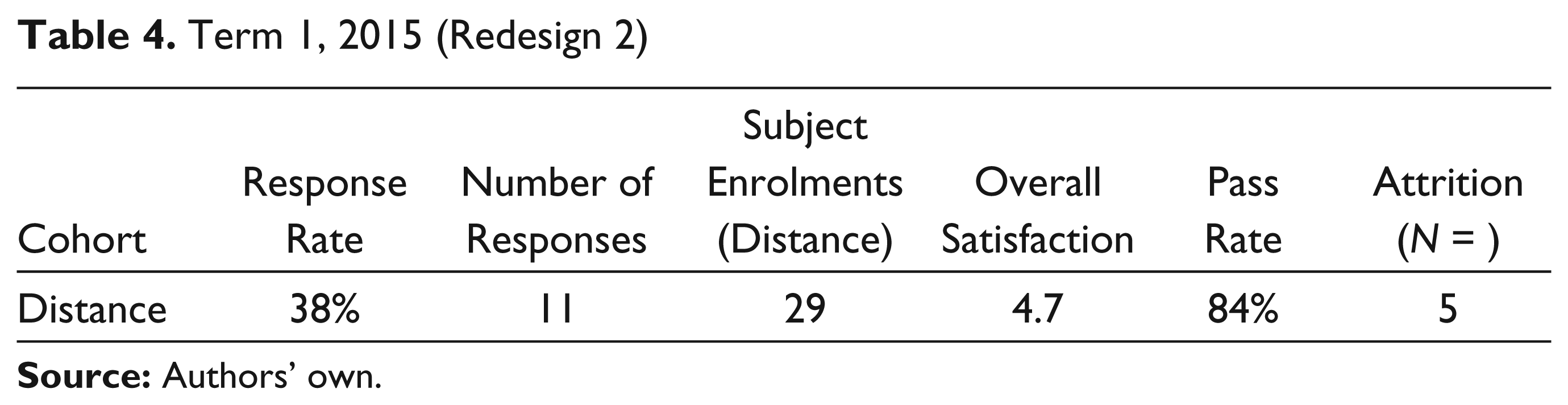
Term 1, 2015 (Redesign 2)
Technology adopted for the course was simple. Presentations were in PowerPoint. Distance students ‘presented’ their work by recording narratives and posting these to the discussion forum. Fellow students were required to contribute virtually to the forum discussion. This discussion was more focused—for example, the subject coordinator would ask a question related to that week’s journalist such as: ‘Review the presentation/s on Benjamin Franklin and respond to the question: What do you think (from what you know) he has in common with modern journalists, if anything?’ While interaction—group-to-group and between staff and students—in the course was still oriented to the discussion forum, it was up to the students within groups to communicate in any way with one another outside the formal learning environment. Students were encouraged to make use of a university-based social networking site.
Setting the group-based assessment for a first-year first-term distance cohort was high risk. These students required significant orientation and guidance generally. The coordinator was aware that the subject would be difficult to manage requiring active engagement via weekly posts based on presentations to keep the students on track.
The discovery project in Redesign 2 was more substantial than Redesign 1 and represented an increase in the amount of work for students generally. Students were to work in groups to present two ten-minute presentations, contribute to group discussion and summarize arguments by writing 2,000–2,500 words in the final essay. Despite this increase in workload, the delivery model allowed the students greater flexibility. Students could select journalists who interested them. Students were not locked into weekly deadlines. They were not compelled to work in groups, although most opted to. Overall, the redesign of the discovery project appeared to work much more effectively in engaging students and the quality of work produced by students was high. As per Table 4, the overall satisfaction rate increased markedly. The total number of students in this offering was 42 with 29 studying by distance.
Discussion
Key indicators when reviewing a course’s quality are student satisfaction, grades and pass rates, and attrition. Redesign 1 (2014), which did not involve the ‘social’, but was based on a constructivist student-centred inquiry-based model, saw an almost 40 per cent attrition rate within the distance student cohort (much higher than the ‘normal’ 25 per cent for first-year subjects at this institution). Students noted their frustration about weekly deadlines and those who could not keep up simply dropped off reinforcing the need to ensure flexibility, which should be central to the course design for distance learners (Butcher & Rose-Adams, 2015). The final iteration of the subject (Redesign 2, 2015) incorporated the ‘social’ into the constructivist model and took into consideration that flexibility needed by distance students.
Student Satisfaction
Student satisfaction at the institution is measured centrally based on an online survey that is based on 10 Likert scale questions where students respond on a range from ‘strongly agree’ to ‘strongly disagree’. These questions were: (1) campus (the institution has multiple campuses); (2) overall, I was satisfied with the quality of this subject; (3) the Moodle site for this subject was easy to navigate; (4) the resources provided in this subject supported my learning; (5) the assessment tasks in this subject helped me to learn; (6) the requirements for each assessment task were clearly explained; (7) my assessment work was returned in a timeframe that supported my learning; (8) the feedback given on my assessment work helped me to learn; (9) what are the best aspects of your subject?; and (10) what aspects of your subject are most in need of improvement?
Distance student satisfaction increased markedly across the three offerings, from 3.7 in 2013 to 4.7 in 2014.
Student Grades (Performance)
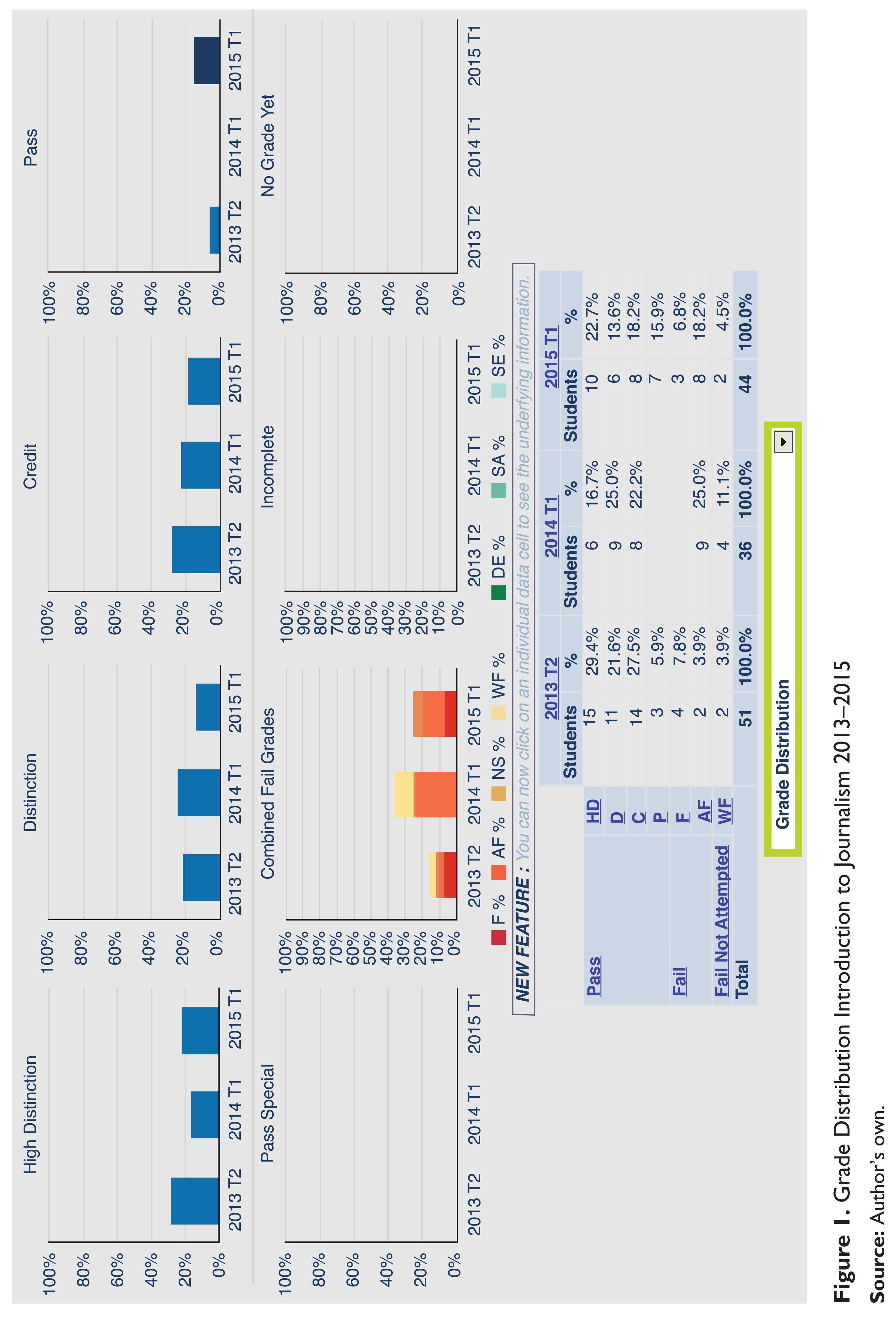
Grading is criterion based. As per Figure 1, essay-based assessment on which the 2013 offering was based resulted in higher overall grades and a lower absent fail rate (whereby students do not complete the requirements of assessment). This could be related to a number of factors. Learning in this design model was passive—students had access to support for essay writing in their first year; similar topics had been set for another subject in the programme and the essays were simply too easy. The failure rate in Redesign 1 (2014) increased significantly, but there were no genuine Fails—that is, all students who received a fail grade for that subject failed because they did not complete the requirements of the assessment (noted as absent fails). Distance students traditionally drop out rather than submit substandard work, so absent fail grades reflect disengagement with the course. Redesign 2 (2015) returned to a more normal statistical line for our student cohort.
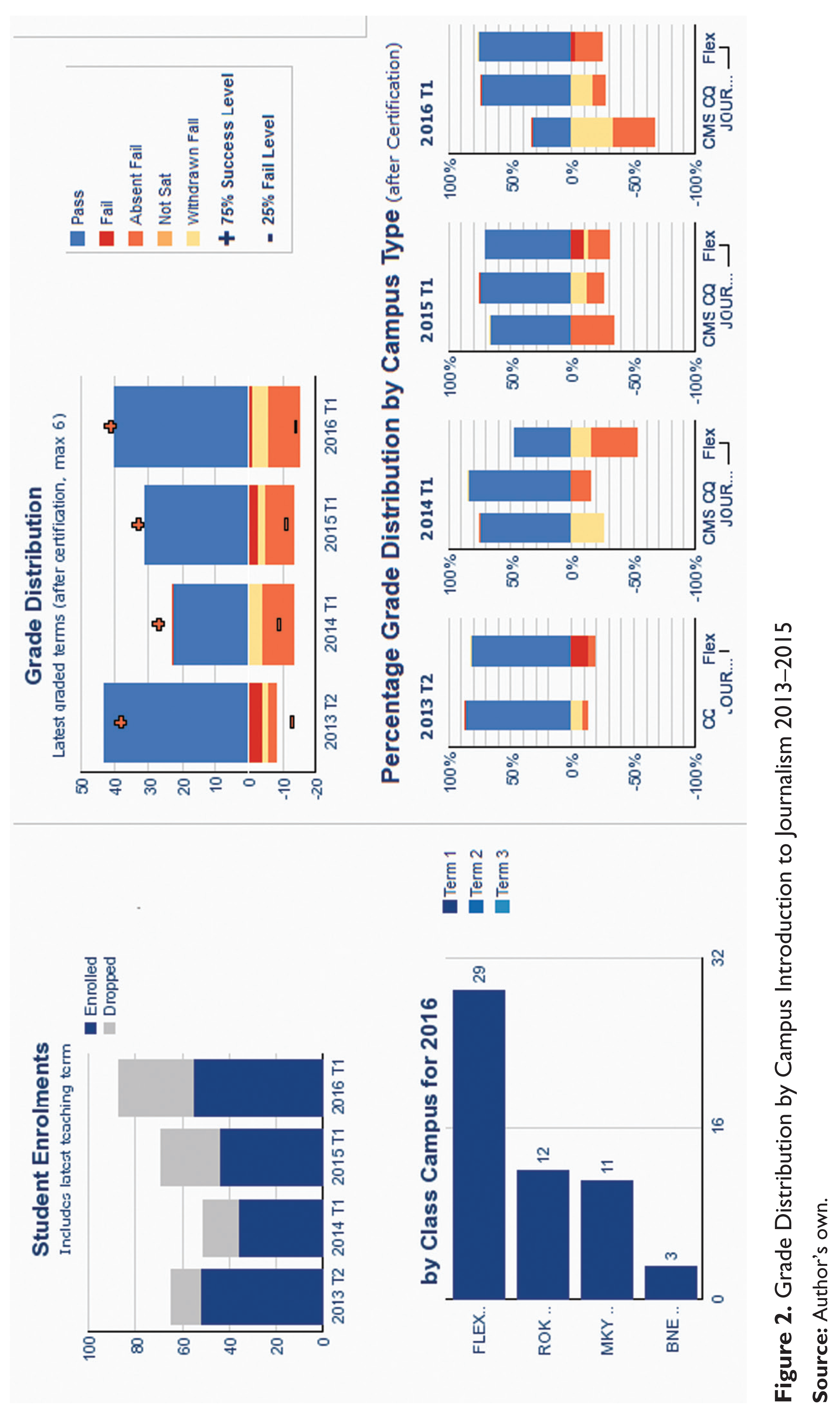
Grades for distance education students improved in Redesign 2 (2015). The overall pass rate excluding absent fail grades also improved in Redesign 2 (see Figure 2).
The ability of students to plagiarize in Redesign 2 (2015) was reduced to almost nil as a result of assessment strategies. These included: (a) the list of journalists on which students were working was a different list to that used in 2014; (b) students were required to present their work to their peers in the form of a recording by PowerPoint or in class with their group; and (c) Turnitin as a plagiarism detection platform was used to check final submissions. There were no incidences of plagiarism in 2014 or 2015.
Student Engagement and Support
In Redesign 2 (2015) group work was not compulsory and student social engagement was supported by a university-supported social media network. The ease of this for students is supported only anecdotally at this stage but as an example, a student who initially requested to work individually changed her mind after she found her peers on this network and began working with them. A self and peer assessment tool was also used and the extremely high level of ratings most students gave one another indicated they enjoyed the group experience and had found it easy to connect with one another.
Attrition
Attempting innovation had a cost in terms of attrition. In the 2013 offering, designed around a fairly passive instructor-led model, which is common in distance settings, the pass and satisfaction rates were high and the attrition rate was low for distance students. In 2014 (Redesign 1) the subject was theoretically sound, but did not adapt the delivery model to consider how distance students like to learn. This impacted on satisfaction, attrition and pass rates. In 2015 (Redesign 2), the model was socially-oriented, student-centred and flexible. It was not as ‘easy’ to pass and demanded greater engagement by students, which was a high-risk strategy. Student attrition remained high, but satisfaction was also very high and the pass rate improved. Students in Redesign 2 were not only able to write an essay; they had demonstrated that they could research and collaborate with peers in a virtual environment to a professional standard in some cases.
Satisfaction rates are regularly cited in good teaching practice, but in this case attrition was a clear issue. This raised the question: Is learning design effective if students are leaving because of perceptions that it is too difficult or too complex for them to complete? Upon further investigation, students who left this subject without completing the assessment were overwhelmingly those who had poor student records with repeat fails. Out of the 19 absent fail grades over three years, only 3 students failed in this subject. All other students failed in all other subjects at the same time as failing in Introduction to Journalism. This indicates that for most students, non-completion is due to factors unrelated to the subject and is consistent with research on attrition (Beer & Lawson, 2016).
There are a number of factors that can influence the results. The same coordinator was responsible for distance education students across three terms. Course content (study guide material) was consistent across the three terms. The only changes made were to the assessment. It is important to note that the first offering of this subject was in Term 2 2013 whereby it could be expected that students were more familiar with the university and, therefore, less likely to fail generally (Li, Marsh, Rienties & Whitelock, 2016). Redesigns 1 and 2 were offered in Term 1 of each consecutive year and many students were new to the university.
Curriculum redesign from a theoretical perspective, as this study shows, addresses a known gap in instructional design research, whereby design for interaction and collaboration are based on heuristics and lack grounding in learning theory (Woo & Reeves, 2007, p. 16; Yun Jeong & Hannafin, 2015). Exploring the effects of curriculum redesign within a distance education context also adds to the knowledge about collaborative learning in online environments, which is lacking in academic research (Yun Jeong & Hannafin, 2015). Yun Jeong and Hannafin specifically noted the reliance on discussion post interaction as ‘collaboration’ or group work: ‘Higher education subjects, including distance education ones, are often limited to discussion activities in which students respond to questions posted by instructors’ peers and reply to detailed responses’ (2015, p. 78).
They argued: ‘Distance education, particularly online post-secondary, may easily devolve into platforms for the final submission of group work, in contrast to a space that promotes the sharing of ideas, iterative and research-informed knowledge building, and co-constructive, dynamic knowledge events’ (Yun Jeong & Hannafin, 2015, p. 79). Much of the research or commentary on distance learning is technology-focused. In this case, learning is facilitated via a learning management system, but technology requirements were very simple based on easily available software (PowerPoint). Our final design incorporated discussion forum interaction, but promoted this as a space for student-centred interaction. The integration of independent virtual group engagement to enhance learning aligned with the ideal described here by Yun Jeong and Hannafin (2015).
Conclusion
This article has reviewed the implementation of discovery learning within a tertiary-level teaching environment in a first-year journalism subject over a period of three years. It demonstrates that innovation in learning design comes with an institutional cost (student attrition), but student satisfaction and engagement is greatly improved. At a programme level, making the subject more difficult and complex but at the same time embedding attributes required from a professional discipline perspective have overall been a positive strategy. Significant lessons are that distance students enjoy and are able to be social if the assessment is inquiry-based. The assessment design needs to cater for flexibility and be outcome-focused. And, the distance education students need to be appropriately oriented to remote learning and their learning needs supported by the university. The challenge now is to consider ways to reduce the attrition while at the same time embed discipline-based attributes within the assessment framework.