







Abstract
This article attempts to look at how two international newspapers, Wall Street Journal (WSJ) and The Telegraph (TT), have reported on Islam and Muslims in Malaysia and Indonesia from 2012 to 2014. The study explores the demography of the news articles, including the article frequency, number of paragraphs, news focus and lastly the news sources. A total of 420 news paragraphs from a collection of 20 news articles from WSJ and 10 articles from TT were analyzed. The researchers used the SPSS program to analyze the demography of the news and the news sources used. In assessing the extent of news bias, the researchers used a qualitative content analysis tool (QSR NVivo 11). The findings revealed that a majority of the news articles studied had reported negatively on Islam and Muslim issues in Malaysia and Indonesia. Based on this fact, it can be seen that Islam in Southeast Asian countries is still receiving negative reporting from the Western media.
Introduction
Islam and Muslims have been associated with stereotypes, provoking fear among Westerners, causing the polarization of societies and marginalizing Muslims. Much of the literature also state that Muslims are portrayed in the media as potential terrorists (Carler & Ahlin, 2011). Poole and Richardson (2006) have argued that Muslims around the world have been labelled as underdeveloped, illiterate, homeless and orchestrators of failed states. Their study found that the media had mostly reported on Islam and Muslims through three frames: religion, culture and political structure (Poole & Richardson, 2006). According to Kabir (2006), Muslims in Australia believe that negative media portray of Islam has impacted on them economically and socially. The growing negative public perceptions of Islam and Muslims are reflected in public opinion polls, academic studies and institutional projects about Islam and Muslims in the United States (Alibeli & Yaghi, 2012). Recent terror attacks in Paris and Brussels have reinforced the negative image where the suspects in both attacks were reported to be linked to Islamic State.
In the context of this study, the term ‘media’ refers to the international newspapers such as Wall Street Journal (WSJ) and The Telegraph (TT). The focus of this study will be the newspapers’ representation of Islam and Muslims in Malaysia and Indonesia between 2012 and 2014. Malaysia and Indonesia have been selected because to date there has been little research on Islam and Muslims in Muslim-majority countries compared to similar research on Islam and Muslims in the West and the Middle East (Perreault, 2014). Furthermore, Malaysia and Indonesia have the largest Muslim population in Southeast Asia (Husin, 2008). This article aims to show the different levels of bias in the news coverage by WSJ and TT.
Definition of Terms
News bias is categorized into four areas:
Representation of Islam and Muslims in Malaysia and Indonesia
Malaysia, Indonesia, Brunei, the Philippines and Thailand are located in Southeast Asia with a growing Muslim population. According to the Asia Muslim Population website, in 2014, the population of Indonesia alone is 88 per cent Muslims. It is followed by Brunei, consisting of 67 per cent Muslims, in Malaysia 60.4 per cent and in Thailand and the Philippines 10 per cent of the population are Muslims. Indonesia has the world’s largest Muslim population, which is attributed to the multitude of ethnic groups, socio-economic classes, political and doctrinal orientations and cultural dispositions (Fealy, Hooker & White, 2006).
Malaysia and Indonesia have long felt the impact of religious violence. In Indonesia, the main radical movement was Darul Islam, followed by Jemaah Islamiyah (JI) in 1993, led, respectively, by Abdullah Sungkar and Abu Bakar Ba’asyir. These radical movements targeted Westerners by launching two massive bomb attacks on different Bali nightclubs in 2002 and 2005, respectively. JI is labelled as an extremist group by both the media and academe (Fealy et al., 2006).
In Malaysia, the Al-Ma’unah was one of the groups in the Kumpulan Militan Malaysia (Malaysian Militant Group). Ahmad (2007) added that both Al-Ma’unah and the rebels at the Memali conflict were identified among 12 militant groups in Malaysia, which had attempted to take over the country’s administration since 1967. 1 Darul Arqam is another militant group banned by the Malaysian government and all the leaders detained under the Internal Security Act. This was because the head of Al-Arqam at that time, Ashaari Muhammad, had proclaimed the lies and heresy of Al-Arqam and called upon all the followers to repent and return to the right path (see Ismail, 2010).
Overall, cases such as Kumpulan Militan/Mujahidin Malaysia or JI remain controversial. Nonetheless, JI in Malaysia has focused on terrorist attack plans mainly in Singapore, Indonesia and the Philippines rather than in Malaysia. Besides, the number of Malaysians who became a part of this leading Indonesian terrorist group was small (Farish, 2002; Funston, 2006). Recent reports showed that Malaysian police arrested nine suspected members of the Islamic State of Iraq and the Levant (ISIL also known as ISIS), which included two local suspects and three foreigners. Police also seized a grenade that was intended for a planned attack. Police records show that since 2013, more than 200 Malaysians have been arrested for being ISIL suspects (Al Jazeera, 2016, 13 August).
Currently, studies on Islam and Muslims in Southeast Asia, especially in Malaysia and Indonesia, have become a major focus since the emergence of ISIS in 2014 (Fealy & Hooker, 2006). This, and the willingness of the jihadist community in Indonesia and Malaysia to fight in Syria and Iraq, has perpetuated the negative portrayal of Islam and Muslims even in Muslim-majority countries by the media.
Western Media Coverage of Islam and Muslims
Akbarzadeh and Smith (2005) revealed that the newspaper coverage on Indonesia between 2001 and 2004 in two Australian newspapers (The Age and Herald Sun) had mostly focused on terrorism, the main ones being the Bali bombings and JI. They reported that Australians and Westerners in Indonesia had been the target of Islamic extremists. Alghamdi (2015) observed that any terrorist attacks in the West must be connected with Muslims. This is especially so in the US where Muslims, Islam and terrorism are reportedly linked in media coverage. He also noted that Muslims were labelled as individuals with a propensity to commit violent crime and terrorist attacks. That was reflected in the confirmative language in the news reports.
The involvement of Malaysians and Indonesians in ISIS is not new given the online propaganda by ISIS to attract jihadist sympathizers to their cause. On 21 September 2014, ISIS urged its supporters around the world to kill Westerners, especially the people of France and the US. ISIS identified several methods of attack, including, but not limited to, bombs, guns and motor vehicles. Malaysian newspaper Sinar Harian (2016, March 5) reported that 47 Malaysians, including 30 men, 9 women and 8 children, were detained in Syria and Iraq due to their involvement with militant group Daesh.
Fatima and Azizah (2016) conducted a content analysis of the coverage of ISIS by Al Jazeera and CNN. They identified the frequency of the coverage and explored the frame of the ISIL coverage based on three generic frames from Semetko and Valkenburg (2000). The results revealed that CNN produced 49 news articles on ISIS compared to just 10 in Al Jazeera over the two months’ studied (June–July 2014). One of the frames used by CNN is ‘ISIS is serious national security threat to US and Europe’. Another frame by CNN is the conflict frame in which CNN framed the ISIS issues as ‘brutality’, ‘true evil’, ‘monstrous’, ‘barbarians’, ‘savage’, ‘disgusting’ and ‘despicable’. These frames all relate to the beheadings by ISIS members.
However, Al Jazeera framed the conflict by focusing more on the issues of ‘revenge’ or ‘contribution’ by ISIS to fight US interventions and to attack the fighters. Pew Research Center (2013) also notes in a study that Muslims in the Southeast Asia and Middle East were involved with Islamic extremism issues. This article aims to show the extent that the Islam and Muslims in Muslim-majority countries like Malaysia and Indonesia are also portrayed in the WSJ and TT coverage as entrenched in extremism.
Methodology
Neuman (2006) noted that content analysis is suitable for systematically gathering and analyzing newspaper reports—either as text, photographs, words, symbols or ideas. This includes counting the number of events pertaining to Islam and Muslims in the newspapers. The qualitative content analysis was also employed specifically to examine any evidence of bias in the news reporting of these topics. According to Patton (2002), careful examination of the research and the constant comparison of all articles analyzed can help identify bias in the news to be either positive to Islam/Muslim, negative to Islam/Muslim, neutral or balanced.
The scope of this study is limited to only online news articles. The researchers have eliminated all features, photos, editorial columns and opinions even though they are related to the topic being studied. This approach is due to the researchers’ desire to focus the study to ‘as it happened’ reports and the frames adopted by news reporters.
All the news articles in this preliminary study were selected through a search for the following keywords and phrases: ‘Muslim majority country’, ‘Islam in Malaysia’, ‘Muslim in Malaysia’, ‘Islam in Indonesia’, ‘Muslim in Indonesia’, ‘Terrorism in Malaysia’, ‘Terrorism in Indonesia’, ‘Muslim issues in Malaysia’ and ‘Muslim issues in Indonesia’. There was a difference in the number of news articles on this topic published by both newspapers. Thus, the researchers selected the news based on one issue per month. For example, the researchers chose one issue in January 2012 and it continued with one issue in February 2012 and so on. The reason for this approach was to avoid bias in sample selection. This is similar to the constructive week sampling technique. The origin of the news was considered by the researchers sufficient to achieve a balance in the selection of the news coverage across the two countries—Malaysia and Indonesia. As a result, this preliminary study yielded a total of 420 news paragraphs, comprising 20 news articles from WSJ and 10 news articles from TT.
The researchers then coded all the news in three sections on a coding sheet. Section A provides the information on the news articles such as the coder and date of the news. Section B codes the title of the news, number of the paragraphs and also the news focus (Malaysia or Indonesia). Section C coded the bias of the news in columns of either positive to Islam/Muslims, negative to Islam/Muslims, neutral or balanced.
Before conducting the actual analysis, the coders were given a sample of the stories, a coding book and training on how to code the news. An inter-coder reliability test was conducted for validity and reliability. The reliability index for quantitative analysis is R = 0.80, while Cohen’s k reliability index for qualitative content analysis is K = 0.71. According to the formula, a result of 0.71 is at the level of substantial agreement. Thus, in this pre-test, the reliability index for news bias is high.
Background Information about WSJ and TT
The WSJ and TT were chosen because of their prominence, extensive readership and also their ties with different news conglomerates. The WSJ is ranked as the number one daily newspaper in the US with a circulation of more than 2 million. It was the highest circulated newspaper in 2012 and 2013. Its circulation had dipped to 2.276 million, compared to USA Today with 4.139 million (Audited Media, 2014). The unique selling points of this newspaper are its coverage of global business news, in-depth news stories and features. Furthermore, the web version of WSJ has more than 1 million subscribers (D&Hoovers, n.d.).
TT is the UK’s number one quality newspaper and is well known for its news brand, news coverage, sport and finance. It also has more readers compared to other daily broadsheet newspapers in the UK and almost all their readers (87 per cent) are adults. In 2013, it won the National Newspaper of the Year Award and received positive comments from the judges who said: ‘The Telegraph has become a by-word for quality in the newspaper world’ (The Telegraph, n.d.). The Audit Bureau of Circulation (UK) listed TT as having the highest circulation among broadsheet newspapers in three consecutive years.
News Coverage on Islam and Muslims in WSJ and TT
This section explains the frequency of the news, the number of paragraphs used and the news focus in the sample of news stories.
Table 1 shows that from 2012 to 2014 there were 30 news articles, of which 22 (73 per cent) news articles were published in WSJ and 8 (27 per cent) in TT; 2014 had the highest number of articles, whereas only 8 articles appeared in 2012. The imbalance of coverage by WSJ and TT shows a drawback in the gathering of archived news articles. Neuman (2006) stated that choosing online newspaper articles as a study sample is susceptible to several problems such as missing the publication (that is lost, not in the subscription list), the news cannot be accessed anymore (expired, technical errors), volatility of the total number of news stories and also the overload of related news, among other issues.
The Frequency of News Articles According to Newspaper
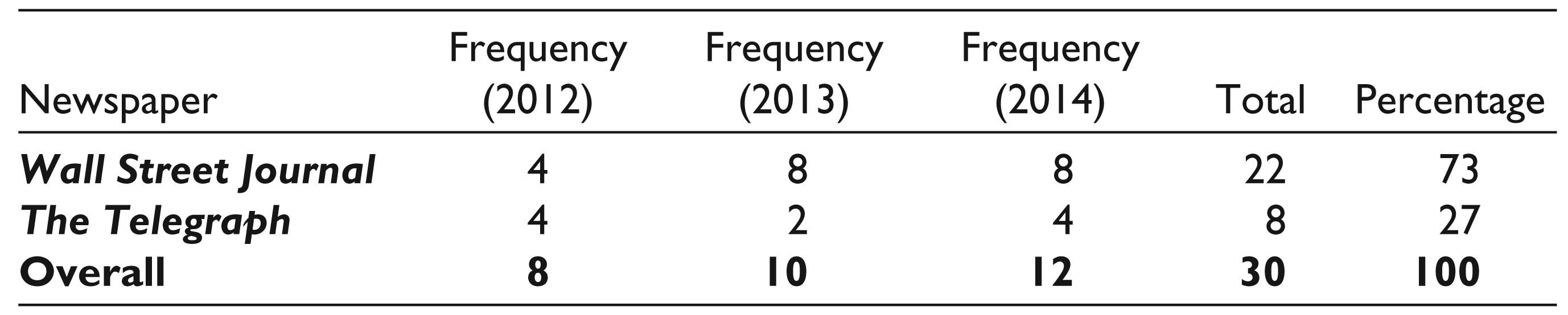
The researchers found that most news articles relating to this particular topic were found in WSJ because the incident of 11 September 2001 in the US underscored Islam and Muslims as the key news topics, which likewise stirred worldwide media focus on these topics. Byng (2014) also observed that Islam and Muslims were closely linked to terrorism activities in the United States after the 9/11 terrorist attacks in New York. This helps explain why more news stories were published in the WSJ compared to the TT.
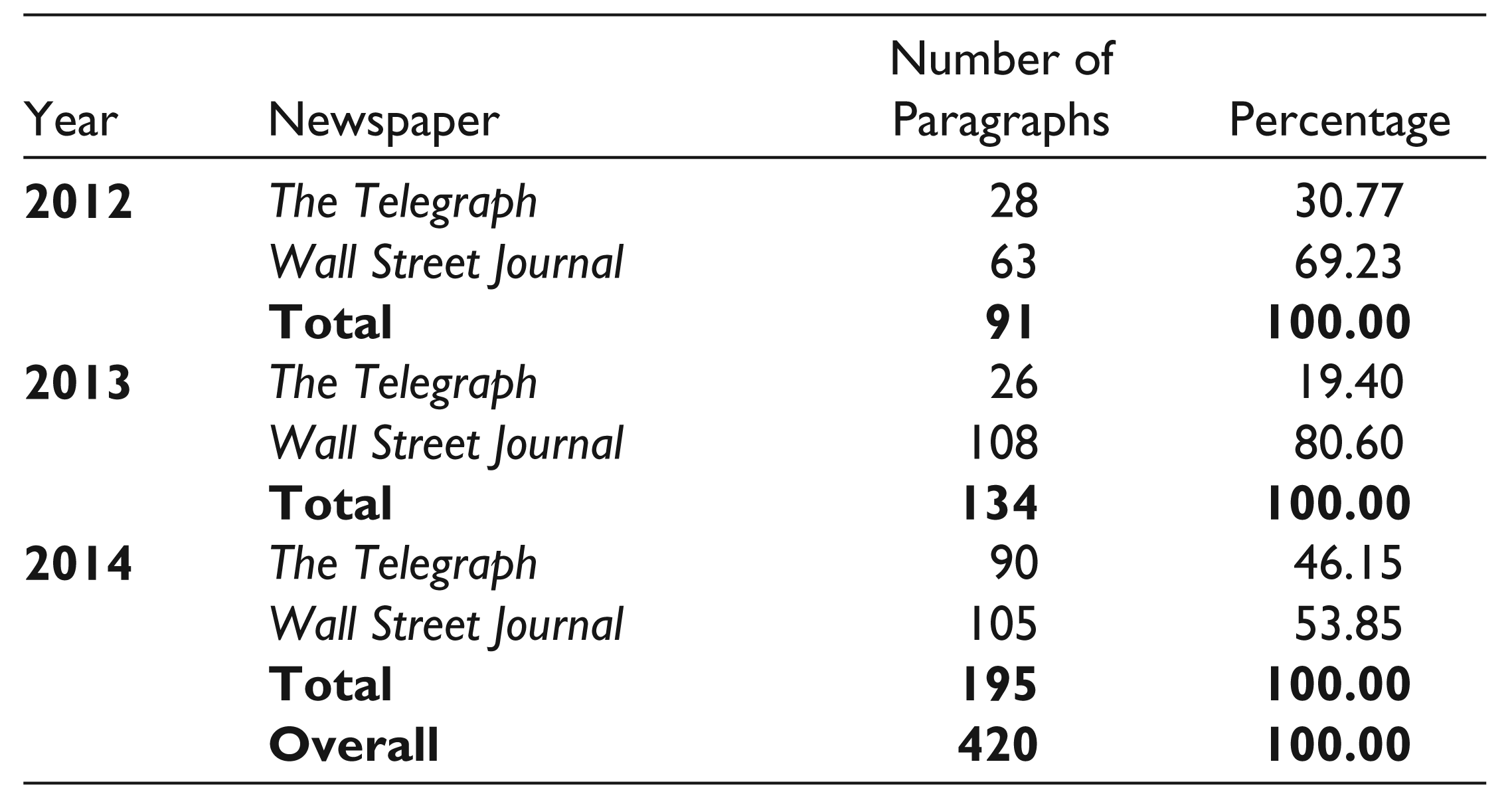
Table 2 shows the number of paragraphs devoted to this issue. There were 420 news paragraphs used in total. Based on the table, there was an increasing number of news paragraphs year by year. In 2012, the number of paragraphs was 91, followed by 134 in 2013. In 2014, the number steadily increased to 195.
The researchers categorized the news focus into three sections: Malaysia, Indonesia and combined. There were 14 news articles specifically on issues related to Islam and Muslims in Malaysia; and 14 news articles on Islam and Muslims in Indonesia. However, there were two news samples from TT, which mentioned both countries in one article in their reporting (Table 3).
The Frequency of News According to Number of Paragraphs
The Frequency of News According to News Focus
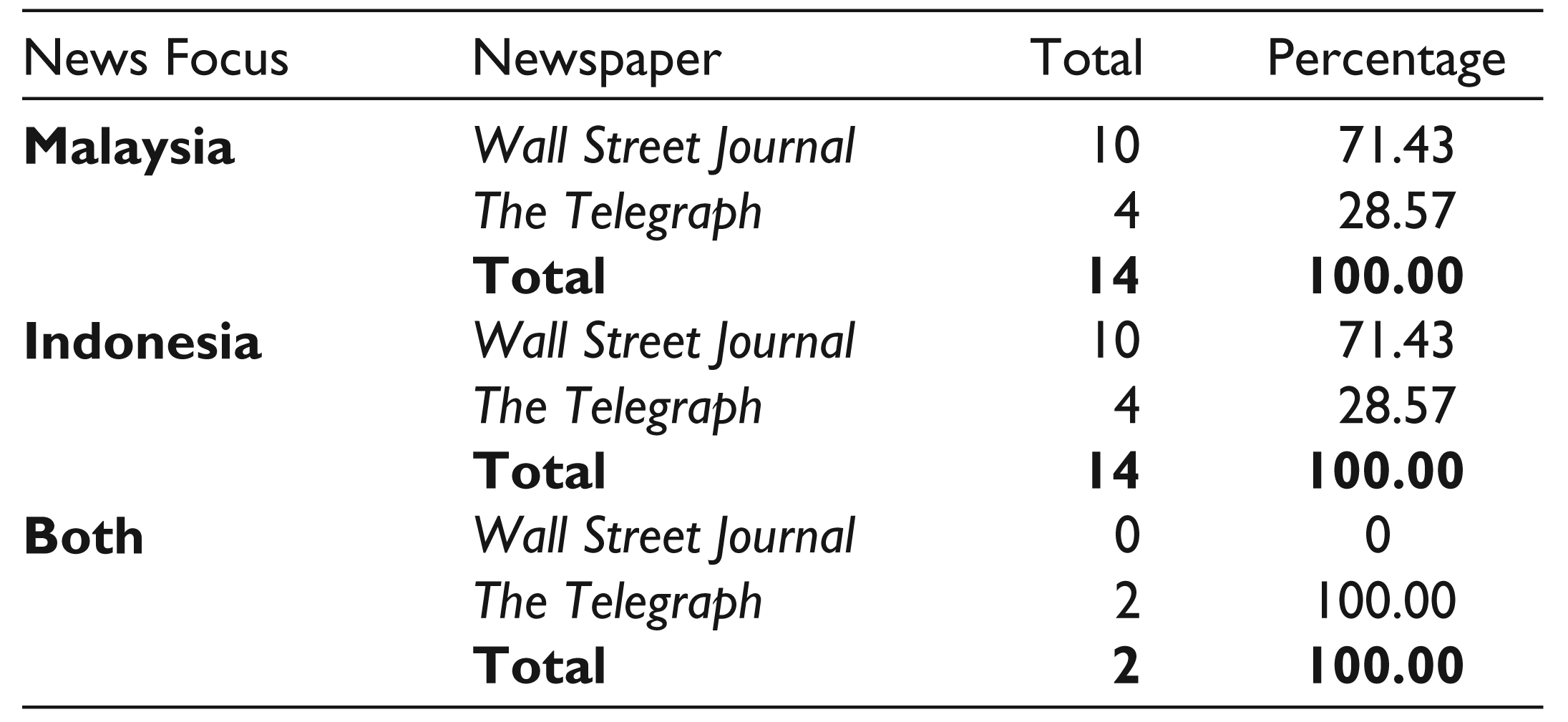
WSJ published 10 news items on Islam and Muslims in Malaysia and 10 news items on Islam and Muslims in Indonesia. Most of the news coverage in Malaysia was focused on protest issues, political scenarios, religious disputes (the Allah word issue), inter-religious dialogues and others. Meanwhile, in Indonesia, WSJ focused on issues such as terrorism, Islamic morality such as the question of beauty contests, Muslim organizations, Islamic politics and others.
Conversely, from the outset, this study revealed that TT did not have much coverage on Islam and Muslims in Malaysia and Indonesia. There were only four news stories on Islam and Muslim issues in Malaysia and also just four news stories on Islam and Muslims in Indonesia. Some of the news articles focused on the Bali bombings, illegal Muslim activities (such as gambling), Miss World issues and the Indonesian Election. Meanwhile in Malaysia, TT focused on terrorism activities in Malaysia such as a hijacked plane and Malaysian militants.
Distinct Usage of News Sources
The issue of news sources in reporting news related to Islam and Muslims have been discussed earlier by Fauziah et al. (2016). They noted the need to enhance media credibility by quoting credible news sources such as ministers, police officers, politicians, media organization and government officers. Kabir and Bourke (2012) revealed that most newspapers in New Zealand quoted sources from overseas news agencies when it reported on issues relating to Islam and Muslims. Table 4 shows multiple news sources used by WSJ and TT in covering this issue.
In WSJ, there were 124 news paragraphs that identified sources. Almost 46 per cent of WSJ sources could be identified as ‘government’. This included police officers, religious officers and spokesmen, both from Malaysia and Indonesia. Conversely, unofficial sources were mentioned just 12 times. These unofficial sources comprised statements from activists, civilians and others such as the local event organizer, security and a protester (in WSJ ), and a global study, supergrasses and the investigators (in TT ).
Distinct Sources Used in WSJ and TT
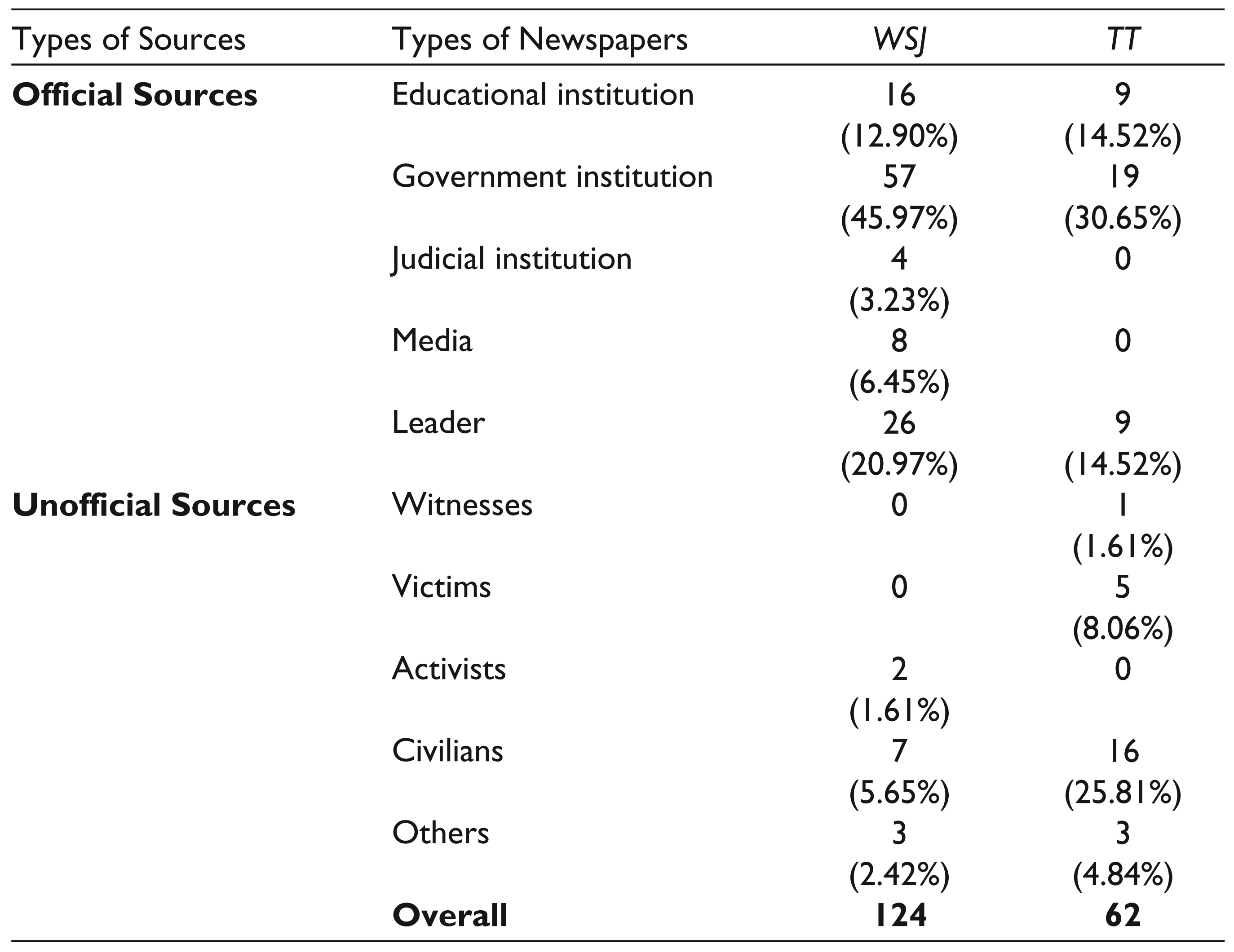
TT articles mentioned official sources 37 times (59.68 per cent) in 144 news paragraphs. Similarly, TT also showed the highest use of government sources with 19 mentions (30.65 per cent). However, there were no sources quoted from financial institutions, the judiciary or media. In contrast, TT cited unofficial sources 25 times (40.32 per cent). The most mentioned unofficial source was civilians at 16 times (25.81 per cent).
The Illustration of News Bias in News Reporting
This study investigated four angles of news bias: positive to Islam/Muslim, negative to Islam/Muslim, balanced and neutral.
Table 5 shows that the coverage in WSJ was predominantly negative (85 per cent with an inter-coder reliability of 91.1 per cent). Western media reporting on Islam and Muslims became more negative after 9/11 (Freeman, 2010; Schwartz, 2010). However, the researchers found that even before the 9/11 attacks, Islam and Muslims had long been depicted unfavourably in the Western media. As Allen (2007) noted, the phenomenon of ‘Islamophobia’ had tarnished the image of Islam and Muslims in 1997. According to Allen, the term ‘Islamophobia’ was used to describe the dread and hatred of Islam and consequently to exacerbate fear and dislike towards Muslim communities.
News Bias in WSJ
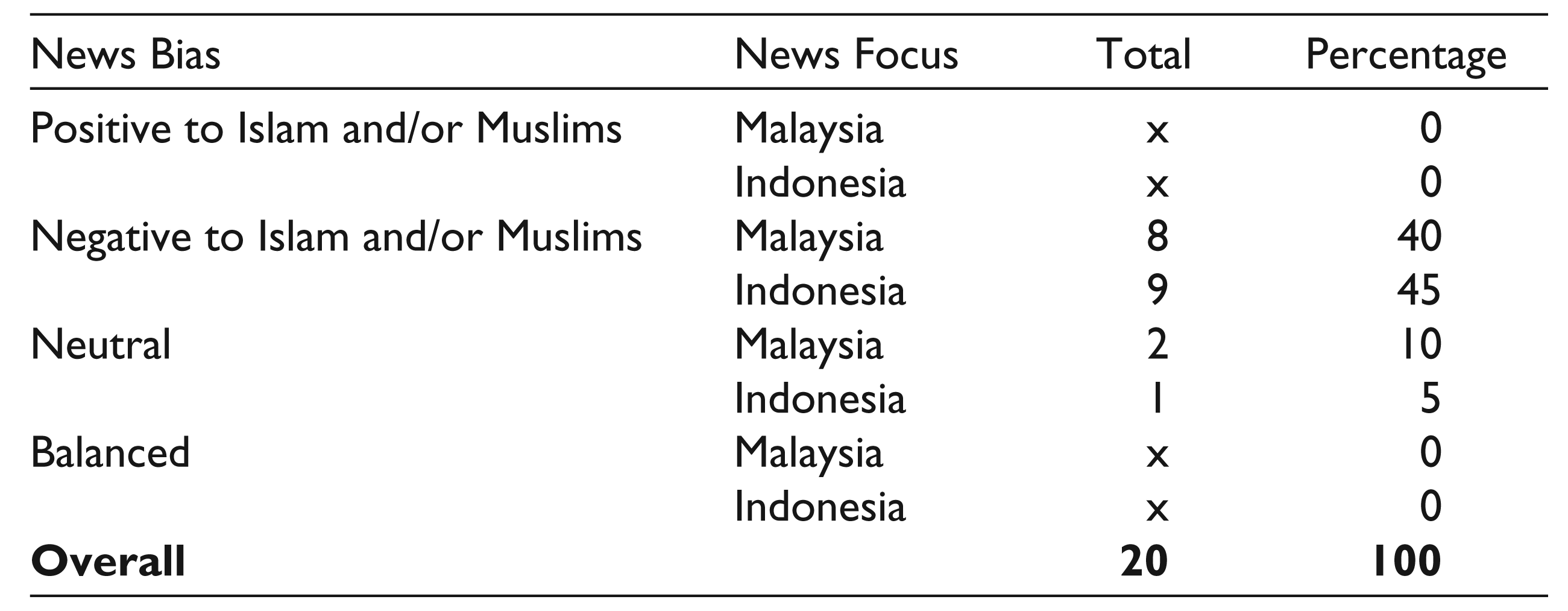
That the Indonesian coverage leaned towards a negative bias comes as no surprise as the country has been associated with terrorism since the Bali bombings. In 2012, reports described how Indonesians had protested against an anti-Islam video, which mocked the Prophet Muhammad:
Today’s demonstration was anarchy, resulting in 11 policemen who needed to be hospitalized,’ Maj. Gen. Rajab said. ‘Demonstrations are allowed, but as long as they’re not anarchic’. (Eric & Ben, 2012, p. 79)
The paragraph clearly stated that Indonesia also allowed the protest but it must be conducted in a good manner. This implied that the acts of burning tires, throwing rocks and Molotov cocktails were considered inappropriate.
Malaysia was also included in negative coverage by WSJ. Most of the issues that were highlighted unfavourably by WSJ related to politics, religious disputes, inter-religious dialogue and the administrative system:
Malaysian opposition leader, Anwar Ibrahim, said on Monday ahead of his verdict in his ongoing sodomy trial that the country risks losing its standing as a model for democracy in the Muslim world if he is convicted. Speaking to The Wall Street Journal as he walked in to hear the verdict at Kuala Lumpur’s high court, Mr. Anwar said, ‘We are no longer a democracy. There is blatant abuse and endemic corruption. We’re not an example for others.’ (Hookway & Fernandez, 2012, p. 12)
The above excerpt is an example of negative reporting of the political conflict that occurred in Malaysia. It involved the former Deputy Prime Minister, Anwar Ibrahim, who was facing a trial for sodomy, an act forbidden in Islam and deemed unacceptable in a country where the majority of the population are Muslims. This WSJ story quoted Anwar Ibrahim as stating Malaysia was not a Muslim country because he had been victimized.
The findings also indicated that two news items relating to Malaysia were neutral in tone. For example, stories covering the printing of bank notes for Eid and the grief surrounding the loss of the plane MH 370 were neutral.
Malaysia’s Central Bank plans to draw on existing supplies of one- and five-ringgit bank notes ahead of the Muslim festival of Eid al-Fitr, when demand for these denominations spikes for gifts. (Gangopadhyay, 2013, p. 7)
For the families of the Muslim passengers and crew on board Flight 370, assuming that their relatives have died is a decision with irreversible consequences. Islamic laws require a specific set of prayers to be said for the dead. They happen only once. Malaysia’s National Fatwa Council, which provides guidance on matters pertaining to Islam in Muslim-majority Malaysia, decided Tuesday evening that it would wait for the ongoing search and rescue to conclude before it determines when prayers can be held. Islamic law requires a body to be present before prayers can be recited. (Maxwell & Fernandez, 2014, p. 38)
Both news excerpts show how the WSJ can report neutrally on issues relating to Islam and Muslims in Malaysia. As stated in the description of the neutral angle earlier, there were no positive comments or criticisms towards this issue and they were reported without using inflammatory or provocative words. Therefore, this particular news can be categorized as neutral.
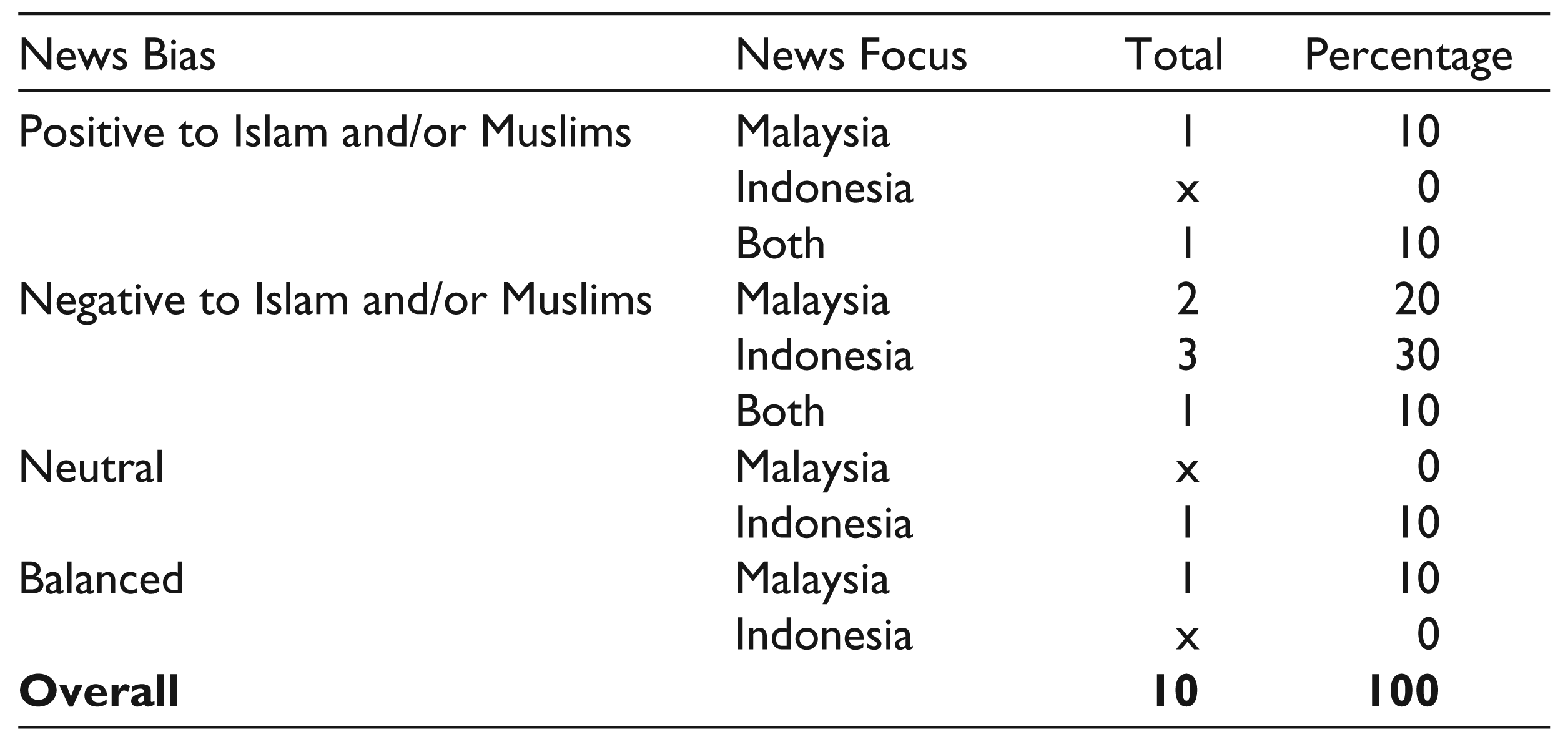
Table 6 shows the bias in TT’s coverage of issues related to Islam and Muslims. The table shows six news stories were negative towards Islam and Muslims. Two of the negative reports related to the issue of Islam and Muslims in Malaysia, three related to Islam and Muslims in Indonesia and one article with a negative portrayal in which the news focus was mixed.
The issue in Indonesia of the Bali bombings received negative reporting from TT. Excerpts from this article stated that: ‘Patek, who faces the death penalty if convicted, is accused of mixing the explosives, filling up filing cabinets with the black powder, and loading them into a car’ (MacKinnon, 2012, p. 22). This excerpt shows that the Indonesian man named Umar Patek intended to bomb nightclubs in Bali. In the news, it was reported that Patek played a small role in the Bali bombings in 2002 as a bomb plotter.
Malaysia also received a negative report from TT with regard to terrorism, including the plane hijacking and the involvement of Malaysian Muslims with militants. An example of a negative excerpt is below:
The 19 suspected militants, arrested from April to June, were formulating plans to bomb pubs, discos, and a Malaysian brewery of Danish beer producer Carlsberg, said Ayob Khan Mydin, deputy chief of the Malaysian police counter-terrorism division. Ayob Khan told AFP the group, all Malaysians, had visions of establishing a hardline Southeast Asian Islamic caliphate spanning Malaysia, Indonesia, Thailand, the Philippines, and Singapore, and planned to travel to Syria to learn from Islamic State, formerly known as ISIS or Islamic State and the Levant (ISIL). (AFP, 2014, p. 13)
The excerpt says clearly that Malaysians were involved in planning terrorism attacks and were linked to ISIS/ISIL. This was an example of a negative story. Surprisingly, TT had two news stories that portrayed positive bias towards the issue of Islam and Muslims. One of them was a story focusing on Malaysia entitled ‘Thailand signs breakthrough deal with Muslim rebels’ on 28 February 2013.
News Bias in TT
Malaysia’s government has repeatedly said it wants to see a peaceful resolution to its neighbours’ conflicts and has denied funding, arming or providing any other support to militants. (Reuters, 2013, p. 61)
The excerpt reported that Malaysia had an initiative to find a peaceful resolution and showed that it was not linked to any terrorism as it claimed that the government is not involved in any activities relating to terrorism, such as funding, providing equipment or any other support to militants.
Discussion of the Findings
Both newspapers used in this study presented mainly negative coverage of Islam and Muslims in Malaysia and Indonesia. The effects of media priming and framing are evident in the findings. According to Entman (2010) framing might lead to news bias and this study shows that the negative slant in the majority of news related to Islam and Muslims in WSJ and TT. The researchers believe that the main explanation for bias links to the media’s capacity to determine which frames are dominant and which are not. This is in line with Habel (2012) who states that previous studies on news effects have declared that media is actually capable of influencing audiences through framing, priming and slanting the news. The selective choice of loaded words, language and phrases used in WSJ and TT is manifested in the biased coverage.
Therefore, newspapers such as WSJ and TT should introduce appropriate policies and strategies in reporting the issues related to Islam and Muslims. This could include identifying and utilizing reporters who have profound knowledge about particular issues related to Islam, the inclusion of information from multiple sources and usage of less provocative words in the reporting. This would help to achieve more ‘balanced’ and ‘fairer’ coverage of issues relating to Western newspaper coverage of Islam and Muslims.
Conclusion
This content analysis of the frequency of the news reporting on Islam and Muslim issues over three years reflects previous studies which stated that despite the increasing coverage of Islam and Muslims by the international media, news framing still shows a negative bias. This includes news articles about adherents of the faith in Muslim-majority countries. It is clear that the WSJ still portrays Islam and Muslims in Malaysia and Indonesia in a negative light. However, positive coverage of Malaysia is limited to news relating to education and the economy (Ali, 2007).
In a nutshell, the stigma of the negative news bias towards Islam and Muslims is still in the status quo even if the issues prevailed in Muslim-majority countries such as Malaysia and Indonesia. This shows that the Western media do not only label Islam and Muslims in the Middle East as negative, but apply the same negative frames to Islam and Muslims in Southeast Asia countries such as Malaysia and Indonesia. This leads to the question: ‘Is the negative reporting of Muslims and Islam in these two newspapers indicative of a broader problem?’ While this question can be addressed by expanding the study to include other newspapers, it only partly addresses the concerns identified in this study. Media coverage of Islam and Muslims should be construed as part of a much broader study that includes coverage of all religions in Malaysia and Indonesia.
Indeed, such a study would potentially reveal any bias either in favour of, or against any religion. For example, a study by Mahony in 2010 identified differences in media reporting on religion by local media, compared with ‘other’ media. Mahony argued that the way Australian media constructed Islam issues in Indonesia could not be compared with how Indonesian media constructed Islam issues in their own culture. It becomes a question of context (Loo & Mustafa, 2010).