







Abstract
This article examines fiction as a major sector of trade-book publishing in exploring the place of Australian publishing within a globalised industry and marketplace. It traces the function of ‘literary fiction’ as industry category and locus of symbolic value and national cultural capital, mapping its structures and dynamics in Australia, including the impact of digital technologies. In policy terms, literature and publishing remain significant sites of national and state government investment. Following Bourdieu’s model of the field of cultural production, the literary/publishing field is presented as exemplary rather than as a high-cultural exception in the cultural economy. Taking Thompson’s use of field theory to examine US and UK trade publishing into account, it analyses the industry structures governing literary and genre fiction in Australia, demonstrating the field’s logic as determined by the unequal distribution of large, medium-sized and small publishers. This analysis reveals distinctive features of the Australian situation within a transnational context.
Introduction
‘It is a matter of some puzzlement that the one sector of the creative industries about which we know very little is the sector that has been with us for the longest time – the book publishing industry’ (Thompson, 2012: xiii). So begins the first sociological study of Anglophone trade-book publishing, John B. Thompson’s Merchants of Culture: The Publishing Business in the Twentieth-First Century. Publishing in general has been neglected in accounts of the creative industries, with the partial exception of work on magazines (Bonner, 2014) and popular fiction (Gelder, 2004). Mainstream book publishing has attracted little interest from cultural studies.
There are several reasons for this neglect. Publishing studies is a floating discipline, attached uncertainly to communications, literary studies, book history, writing and business studies. Books have also been cast as ‘old media’, despite their having rapidly become part of the new media landscape with the dramatic rise in digital reading devices, online bookselling and ebook production since 2009 (Coronel, 2014: 4). Elsewhere, the blurring of ‘books’ with ‘literature’ has meant that the field is identified with a consecrated aesthetic realm, while their status as ‘everyday culture’ is ignored. The claims made by conservative and radical commentators alike for literature’s special status as a marker of national, civic or human values only reinforce this narrow view. Finally, as ‘literature’, books have suffered from cultural studies’ sometimes antagonistic relationship with ‘English’ as it sought its own institutional spaces. The antagonism has largely disappeared, but disciplinary divisions remain. Where they have dissolved fruitfully is in work on cultural institutions and value, frequently taking its bearings from Pierre Bourdieu’s model of the literary field (Bourdieu, 1993; Driscoll, 2014; English, 2005; Gelder, 2004), while recent studies of literary marketing (Collins, 2010; Squires, 2007), reading cultures (Fuller and Rehberg Sedo, 2013), digital publishing (Striphas, 2009) and the adaptation industry (Murray, 2012) have brought books and literature into the purview of cultural/media studies. This essay takes the literary field as exemplary rather than ‘ex-centric’ as a field of cultural production insofar as it is still defined fundamentally by the relation between economic and symbolic rewards, but also, in contemporary terms, by its hybrid local, national and transnational structures; its uncertain status as an object of policy and state investment; and its uneven transitions between old and new media.
Trade and fiction publishing: industry and field
In this article, I use fiction publishing, a major sector within the broader domain of trade-book publishing, in order to explore how the Australian publishing industry exists within a globalised industry (publishing was arguably the first globalised media industry), to trace the function of ‘literary fiction’ as an industry category as well as a locus of symbolic value and national cultural capital, and to map the structures and dynamics of the field of fiction publishing in Australia, including the impact of digital technologies. Trade publishing, in contrast to the educational, academic or professional sectors, refers to the very diverse sphere of fiction and non-fiction books ‘intended for general readers and sold primarily through bookstores and other retail outlets’ (Thompson, 2012: 12). Trade or consumer books are the publishing industry’s ‘most visible products’ (Lee et al., 2009: 9), and fiction is the single largest category in terms of production and sales. In Australia, fiction titles comprise more than a third of new titles (excluding educational) published annually and around a quarter of total sales value (Carter, 2007: 232–236).
From an industry perspective, literary fiction sits within the broader field of fiction publishing, which in turn sits largely within the general field of trade publishing; ‘largely’, because literary publishing is also concentrated on the margins of, or in opposition to, trade publishing and its commercial imperatives, in areas of production which are typically small-scale and fully invested in the prestige of literature as art or other forms of symbolic value. This positioning is clearest for poetry, which exists essentially within a separate publishing economy (Lea, 2007) where the limits of commercial success become the virtues of commitment to artistic autonomy.
From the perspective of field theory, however, trade-book publishing and the fiction industry exist within the ‘literary field’ (Bourdieu, 1993: 38–51). Bourdieu’s analysis of the avant-garde opposed to bourgeois taste and institutions (and to the mass or popular) has limited explanatory power for the contemporary Australian literary field. Indeed, it is remarkable how little the field’s dynamics have had this logic since the 1970s; fractions are now more likely to emerge among genre fiction producers or digital activists staking new claims to symbolic value against consecrated forms of literary taste. Nonetheless, the struggle between ‘autonomous’ and ‘heteronomous’ principles of legitimacy (Bourdieu, 1993: 38–41), or, in simpler terms, the opposition between commercial and cultural imperatives, continues to structure the key institutions of the literary field in fundamental ways, despite the greater blurring of high and popular categories that critics – and publishers – have noted. The literary field behaves at one end like the art field, as if it were an economy of scarcity where only a small number of rare objects count; at the other, it operates as an economy of abundance, like popular music, with a surfeit of goods in both mass and niche markets. While literary works can circulate in hundreds of thousands and the methods of their production (if not their production values) are the same as for any other kind of book, the economy of prestige is still narrowly distributed and organised hierarchically through the institutions of reviewing, scholarship, prizes and, not least, the internal organisation of publishing houses into different imprints, the publishing process determined for each individual book and in the position of each agent within that process.
The point for the present is that trade publishing participates in both economies, both principles of legitimacy – a small specialised literary publisher like Giramondo no less than the big players. The opposition between ‘the field of restricted production’ and ‘the field of large-scale production’ (Bourdieu, 1993: 39) operates internally within the larger houses, especially in relation to fiction, which extends voluminously all the way up and down the scale of value. In Bourdieu’s terms, ‘the novel … is the most dispersed genre in terms of its forms of consecration’ (p. 51). Fiction is where the balance or stand-off between economic and symbolic capitals is most intense, but also most banal. Within the industry, notions of literary fiction function in two distinct ways, in the more traditional sense signalling cultural value, but also, increasingly, as a quasi-generic term, literary fiction as ‘a kind of category fiction’ in its own right (Collins, 2010: 225). For a publisher or bookseller to assign a novel to a literary or general fiction list rather than a crime, romance or fantasy imprint is to make a judgement about kind in the first instance rather than quality.
In this light, the interest of Thompson’s Merchants of Culture does not lie simply in the detailed information that it provides about the industry, but rather its explicit use of Bourdieu’s field theory to model its subject: trade publishing as a relatively autonomous field ‘in which agents and organizations are linked together in relations of cooperation, competition and interdependency’ (Thompson, 2012: 4). The field-like attributes of the industry are evident in the ordinary competitive/cooperative relations that exist among publishers and agents and between agents and publishers. Thompson distinguishes five separate but interlocking forms of capital that represent the key resources for publishing firms: economic, human, social, intellectual and symbolic (pp. 4–9). As Bourdieusian theory would suggest, most significant is the ‘differential distribution of economic and symbolic capital’ (p. 9). Here, we begin to see the ‘logic of the field’. The rules of the game are quite distinct, and while the field is ‘intensely competitive [and] characterized by a high degree of inter-organisational rivalry’ (p. 10) – publishers, like recording companies, compete for content as well as customers (p. 11) – there is also a high degree of consensus as to the rewards in play. Or rather, the forms of consensus and competition are articulated around two different ways of understanding these rewards: the ‘value’ of a particular book or book project is understood in one of two ways: its sales or sales potential, that is, its capacity to generate economic capital; and its quality, which can be understood in various ways but includes its potential for winning various forms of recognition such as prizes and glowing reviews, or in other words, its capacity to generate symbolic capital. These are the only two criteria – there simply are no other. (p. 10, italics added)
Sometimes the two criteria will work together, often they will conflict; but both will be important for all publishers. To make a good book a bestseller, for example, has symbolic and not merely economic value in the field.
This same ‘logic’ produces the ambivalent place of literature in national cultural policy. Literature was the first target of such policy with the founding of the Commonwealth Literary Fund in 1908; it was one of the named Boards of the Australia Council until its recent restructure. State and federal governments invest significantly in literary festivals and prizes (about AUD$1.5 million on the latter). And in September 2015, the federal government announced the terms of reference of its proposed Book Council of Australia (BCA), to be funded controversially by an AUD$2 million cut to the Australia Council. These terms of reference restated in the strongest terms the cultural significance of ‘Australian literature and literary non-fiction’: Australian literature is vital to our cultural and intellectual life. Australian writers are ambassadors for our stories and experiences, reflecting the diverse and exceptional creativity of the nation. The Book Council of Australia will … focus on promoting Australian writing nationally and internationally, developing and extending audience engagement with Australian literature, and nurturing a vibrant reading and writing culture. (Attorney-General for Australia, 2015)
In early December, however, plans for the BCA were shelved. Although criticised for representing an ‘old model of publishing’ at the expense of newer forms based on ‘smaller and more mobile forms of literary production and consumption’ (Glover, 2015a), the BCA’s brief promised to reverse ‘the long drift of cultural policy arguments towards cultural industry arguments’ (Glover, 2015b: 14) by addressing ‘the accessibility of books and writing for all Australians; the breadth and diversity of Australian writing; support for and promotion of high quality Australian literature; [and] the Australian publishing industry’s capacity to meet new technologies and competitive challenges’. There was no extended consideration of literature or publishing in Creative Nation or Creative Australia, and while important industry reports were commissioned (Book Industry Collaborative Council, 2013; PriceWaterhouseCoopers, 2011), ‘Australian literature’ as an object of cultural policy appeared to be fading. A new model defined by the contiguous but non-identical claims of Australian literature, literary quality, ‘books and writing’, ‘reading culture’ and industry capacity – that is, by mixed national, social-reformist, aesthetic and commercial imperatives – would not necessarily be a policy failure.
Australia in the global publishing industry
Bourdieu’s two-dimensional model – with its horizontal relational structure of positions within a field and its vertical scale of symbolic value – brings the institutional and industrial aspects of literary production into relation with the aesthetic. This model made one kind of sense in a literary field (as in France) where publishing was largely a matter of independent houses that behaved like self-governing individuals, more or less consciously taking a position within a self-contained field, and where homologies existed across authors, editors, publishers, booksellers and critics (Bourdieu’s term ‘production’ refers primarily to writers). If this arrangement was also the case in the United States and United Kingdom until the 1960s through the familiar names – Random House, Simon & Schuster, Scribner, Viking, Knopf, Macmillan, Longman, Heinemann, Jonathan Cape, Penguin and so on – the fit is much less obvious in the contemporary Anglophone book trade given its dramatic restructuring since the 1980s by the emergence of multinational publishing conglomerates and global booksellers. The symbolic logic of the literary field in the present needs to be mapped across a fundamental structural feature of the industry: its dramatic polarisation between a very small number of very large multinational corporations and a very large number of small (local) publishers, with relatively few medium-sized firms in between. The dynamics of production and bookselling produced by this polarisation significantly determines the logic of the field. Size and scale will determine which strategies and business models are available, the kinds of access to economic or symbolic capital and possible relations to local or national cultures. But questions of scale will not be identical in every market.
Thompson’s focus is on the US and UK industries, and his arguments need careful drawing down into the Australian situation. In what ways is the Australian trade and market on the receiving end of developments originating elsewhere, and how far does the Australian context exert its own pressures back onto these larger forces? It is useful to recall Tom O’Regan’s (1996) description of Australia as a ‘middle-sized English-language’ culture. If the effects of the English-language dimension are clear, ‘middle-sized’ is no less significant: Australia is big enough for major producers to want a ‘slice of the action’, to impact on but not satisfy the local market and to be an exporter. Book exports grew 39% from AUD$162 million in 2001 to AUD$225 million in 2010 (PriceWaterhouseCoopers, 2011: 54). At home, 48% of revenue for publishers is derived from Australian books (PriceWaterhouseCoopers, 2011: 54). Titles published in Australia represented 47 of the top 100 sellers among adult fiction across the 12 years to August 2014, although this number included seven works by American Jodi Picoult (in Australian editions) and multiple titles by a small group of authors: Bryce Courtenay, Tim Winton, Matthew Reilly and Di Morrissey (Nielsen BookScan, 2014). Still, these figures suggest a mature industry, however uneven the distribution of its resources and rewards. Australia is no longer a dominion or client state within a closed literary and publishing system, but a medium-sized player, both importer and exporter, within a globalised industry and a transnational market, especially for fiction: ‘Australian book publishers are … enmeshed with global markets, both as buyers and sellers, to a far greater extent that their counterparts in the USA’ (Lee et al., 2009: 25).
The polarisation of the field among English-language publishers can readily be demonstrated. In US trade publishing in 2007–2008, Random House and Penguin occupied the top two positions, sharing 24% of total sales (Thompson, 2012: 117). The remaining big players were HarperCollins at 9.5% and Simon & Schuster at 7.5%, followed by the Hachette and Holtzbrinck groups. The top 4 publishers accounted for more than 40% of total US trade sales, the top 6 almost 50% and the top 12 almost two-thirds. The picture from the United Kingdom is very similar. Hachette, Random House, Penguin, HarperCollins and Pan Macmillan dominate, with the top 4 commanding almost 50% of trade sales and the top 10 over 60% (Thompson, 2012: 124).
This top-end domination was spectacularly reinforced in July 2013 with the merger of Penguin and Random House, ‘the two largest consumer book publishers in the world’, two ‘trophy brands’ according to new chief executive officer (CEO), Markus Dohle (Publishers Weekly, 2013), coming together to form the first truly global publishing company with operations in the US, Canada, UK, India, South Africa, Australia, New Zealand, Spain, Mexico, Argentina, Uruguay, Colombia and Chile. [It] employs more than 10,000 people and publishes more than 15,000 new titles every year across 250 imprints. (Pearson, 2013)
The scale is extraordinary. But Dohle could also advocate the virtues of smallness: Penguin and Random House before the merger were actually two communities of small and medium size publishing houses, creatively and entrepreneurially independent. The task is to bring these two communities of small and medium size publishing houses together into one and still preserve that small company feel on the creative, author- and agent-facing part of the business … The core of the book business will always be local. (Publishers Weekly, 2013)
This is not just management-speak. It is a powerful truth about publishing and of defining significance for Australia.
There are obvious advantages in being large in terms of economies of scale, capital resources (the ability to offer larger advances and absorb larger losses), negotiating power and access to markets. But, there are also less obvious advantages in being small – a shared ethos among independent publishers, booksellers and authors; close knowledge of local markets and writing scenes; avoiding some of the pressures on the big firms (such as agents expecting high advances); and for some, a high level of symbolic capital through personal editorial attention or an overt commitment to cultural values. Being medium-sized, by contrast, makes it difficult to benefit from either scale (Thompson, 2012: 148–176).
The concentration among majors is reinforced when we map in the corporations that own these publishers and the imprints that they control (see Thompson, 2012: 410–414). All are now active in Australia. Their presence looks like a classic instance of cultural/economic imperialism thwarting or threatening the local industry and, hence, the local (national or regional) culture. The diagnosis has often been made (Bode, 2014: 79–81), and certainly there have been casualties, but the picture is more complex because the point of mergers and acquisitions is not just global growth but also to gain a foothold in local markets. The multinationals now operate as major ‘Australian’ publishers – indeed, as the major publishers of Australian books produced for the local market. What we see is rather a classic instance of the capacity of the larger firms to work small as well as large. Their success depends upon not only capital or size but also their capacity to build symbolic and social capital locally ‘on the creative, author and agent facing part of the business’ (Publishers Weekly, 2013).
Australian fiction publishing, 2000–2013
In Australia between 2000 and 2013 (Figure 1), the top six publishers of Australian fiction were Harlequin, HarperCollins, Penguin, Allen & Unwin (an independent Australian firm since a management buy-out, from HarperCollins UK, in 1990), Pan Macmillan and Random House, followed at some distance by Hachette, University of Queensland Press (UQP), Text and Fremantle Press in the top 10. The top 3 were responsible for more than a quarter (26.4%) of all new fiction titles, the top 6 just over 45% (down from 50% in 2007 to 38% in 2013).
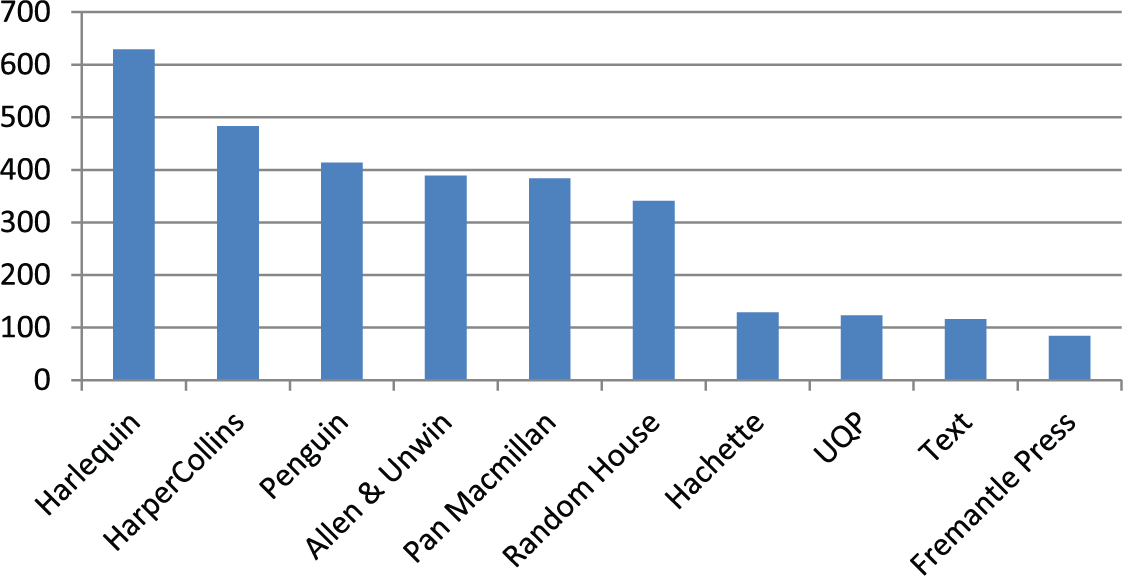
Top 10 fiction publishers 2000–2013 (New Titles). Excludes ‘vanity’ publishers Zeus and Sid Harta and digital publisher CreateSpace.
If we remove Young Adult fiction, the ordering changes slightly, but the top 6, responsible for 46% of the total, remain the same. Whichever way the numbers are assembled, the pattern recurs: a small cluster of large publishers at the top responsible for a high proportion of the titles released, followed by a long tail of independent firms comprising both dedicated literary houses, such as Giramondo, with a high investment in cultural value, and occasional publishers with little investment at all in the prestige stakes.
Although this pattern reproduces the US and UK situation, it also indicates local differences. What is noteworthy is less that the multinationals dominate but that there is one Australian independent in the top 4, and four altogether in the top 10. Furthermore, it appears that being medium-sized is more sustainable in Australia than in the larger overseas markets (but also that what counts as medium-sized in Australia is comparatively small). Allen & Unwin publishes around 250 titles annually, and it is telling that a medium-sized university press, UQP, with around 60 titles annually, ranks in the top 6. The book trade itself sees an ‘expanding middle-ground, where [for all categories] 101 publishers produced between 20 and 99 titles each and another 96 published between 11 and 20 titles’ (Coronel, 2014). At the other end of the scale, almost 90% produced one to five titles only. In terms of literary fiction publishing, between 2000 and 2013, only 20 publishers averaged more than one title annually, and only four (Penguin, Random House, Pan Macmillan, and Allen & Unwin) averaged 10 or more. Fifteen averaged between five and one, and all except Hachette and Simon & Schuster were independents. Most could be defined as medium-sized (e.g. UQP, Text, Fremantle Press and Wakefield).
The majors are dominant in both literary and genre fiction, but unevenly depending on sector. Isolating literary fiction between 2000 and 2013, Penguin, Random House, Pan Macmillan, Allen & Unwin, and HarperCollins dominate, followed by the local independents UQP, Text, Ginninderra, Fremantle and Australian Scholarly Publishing. While 6 of the top 10 firms were local independents, there is a significant gap between fifth-placed HarperCollins’ 131 titles and sixth-placed UQP at 61. For genre fiction, romance unsurprisingly is dominated by Harlequin (now owned by HarperCollins), responsible on its own for 64% of romance titles. By contrast, a much larger number of independents figure in crime publishing, testifying to its higher standing among genre forms and investment in local settings; even so, the big firms still produce more than a third of crime titles.
In summary, local independents are more visible in literary and crime fiction publishing, less so in romance, thriller/adventure and fantasy. Medium-sized firms are substantially represented, but the multinationals dominate in both literary and genre fiction and in both the more profitable and the more prestigious forms of publishing. As is shown by examples such as Christos Tsiolkas’ The Slap (Allen & Unwin) or Winton’s novels (Penguin), the larger publishers are also better placed to benefit in both respects at once. The medium-sized publishers are much less engaged with genre fiction, in part because of the typical pattern of larger print-runs and relatively rapid production of successive titles rather than the title-by-title strategies common elsewhere. Again, the advantages of size are evident: you can act ‘small’ where it matters (e.g. in cultivating a literary list) and ‘big’ where that matters (say, in sustaining a romance list). A small publisher, by contrast, has little option but to specialise or invest in literary prestige.
The dynamics of Australia’s medium-sized industry have produced a distinctive modus operandi for those large enough to deploy the different strategies: To cater for a modest but affluent market in which imported books and locally originated titles are sold side by side, successful Australian trade publishers have developed a distinctive business model in which revenue is derived from multiple sources: importation, the publication of Australian-originated titles and of local editions of overseas-originated titles, overseas rights sales, exports and, in the case of several of the larger firms, revenue from distributing third parties. (Lee et al., 2009: 29)
Indeed, despite the accelerated pace of multinational consolidation, we cannot assume that the local industry has been suddenly or radically transformed by globalisation. First, multinational publishers began to play a significant role in Australian publishing from the 1980s, and their role as publishers of Australian novels increased steadily through the 1990s (Bode, 2014: 74–76). Second, this growth has not been sustained; there has been a slight but steady decline in the proportion of Australian novels produced by multinational firms, from 52% in the 1990s to 48% in the 2000s. Over the same period, the field of Australian novel publishing has become less concentrated: the top five publishers contributed 42% of all titles in the 1980s and 30% in the 2000s (Bode, 2014: 84). My own figures concur: among the top 35 publishers of literary fiction, the proportion contributed by the top 5 declined from 67% to 57% between 2000 and 2013, while the contribution of local independents rose from 40% to 66%. Bode also confirms my analysis of an expanding middle: ‘the considerable expansion in this middle band [of publishers] suggests a diverse local industry with a substantial and growing commitment to Australian literature’ (p. 91).
Bode’s study was completed before the recent growth in ebook production and sales reflected in the overall number of fiction titles. In Australia, there was an eightfold increase between 2009 and 2013 in the number of books published in digital formats: 29% of all titles published in 2013 (Coronel, 2014: 4). With many books released in print and digital formats, the precise contribution of ebooks is not clear nor are reliable sales data kept, but the rise in ebook production for fiction would almost certainly be above 29% (Bookseller & Publisher, 2012: 10). Figures indicate a rapid expansion: from 306 new adult fiction titles in 2010 to 723 in 2013, and an even greater increase in genre fiction, from 160 to 434 (Figure 2). Otherwise, the ratio of literary to genre fiction has remained fairly constant.
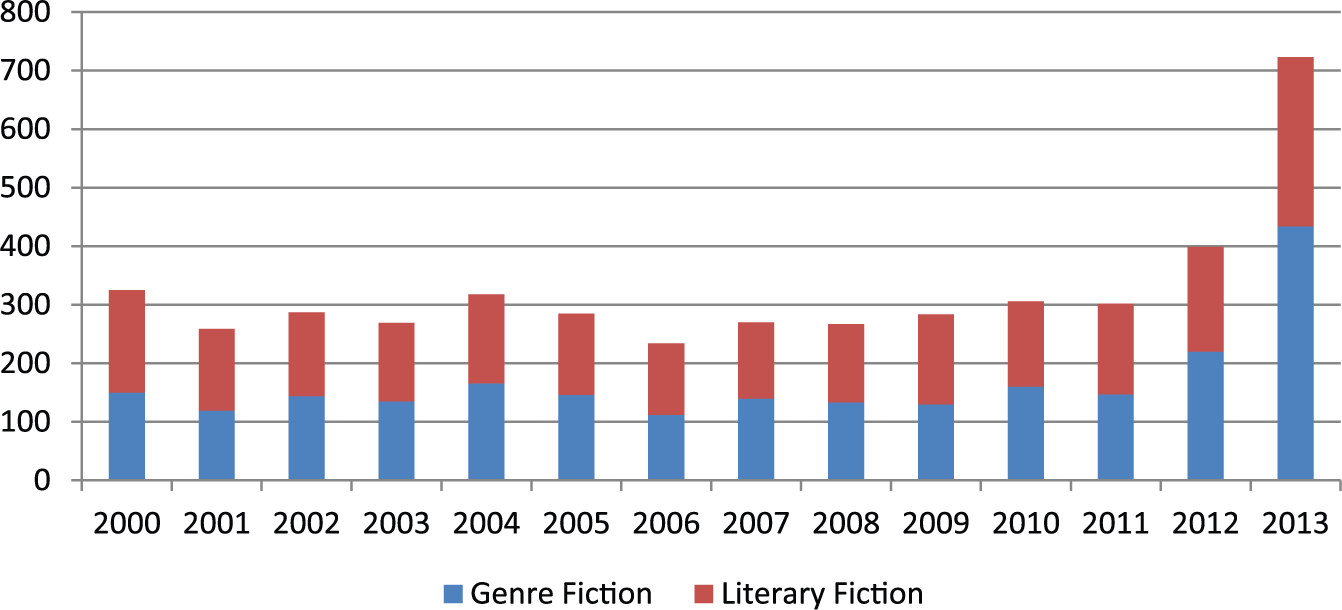
New adult fiction titles 2000–2013 (first published in Australia).
Ebooks represent 25%–30% of sales in the United States and United Kingdom, again with higher levels, near 40%, for fiction (Wischenbart, 2014: 23–26). However, the rapid growth in sales has slowed – in the United States, sales fell 8% in the first quarter of 2015 (Milliot, 2015) – and many predict that they will stabilise at around a quarter or a third (Wischenbart, 2014). Ebooks are now ‘in the later stages of the innovation curve and have settled into reasonably predictable consumption patterns’ (Milliot, 2013). For the Australian case, it is too early to say whether the recent growth in fiction publishing is sustainable, or even whether print or digital formats are the key to its sustainability. The longer term impact of the ‘digital revolution’ might well be from bookselling. For publishers, ebooks mean ‘more units but less [sic] revenue’ (Donoughue, 2013: 17), and the ‘overwhelming majority of the industry’s profits still derive from print’ (Stinson, 2013: ix). The majors are best-placed to reap the benefits of investing in multiple digital titles in the hope that one or two might take off, in which case they would probably be released in print. All now have digital-first imprints privileging popular fiction – Pan Macmillan’s Momentum imprint for sci-fi, fantasy, romance and thrillers; HarperCollins’ Impulse within its speculative fiction Voyager imprint; or Penguin’s Destiny and Harlequin’s Escape, both digital-first romance lists. For smaller publishers, digital production is likely to have a different rationale, less a question of expansion than reducing costs.
Conclusion
The spread of publishers in Australia points to a mature industry and a relatively stable (rather than crisis-ridden) book culture, despite the vulnerabilities inherent in the system for the small and medium-sized players. Conceptions of local or national production and markets remain significant. How conceptions of the national literature will be sustained or transformed is much less clear. Genre fiction is expanding at a faster rate than literary fiction. But, the latter is also growing, alongside mid-range titles in areas such as ‘commercial women’s fiction’ that are neither genre fiction nor literary in a restricted sense. They may make little claim on the national culture, but, in the Book Council’s terms, might well contribute to a ‘vibrant reading and writing culture’. Literature is a dispersed, disaggregated field, mobilised in diverse ways in diverse institutions – as commodity, industry, professional or aesthetic practice, ethical or pedagogical technology, leisure, entertainment, policy object and national space – a diversity better captured in a more flexible notion of ‘Australian writing’ than restricted notions of Australian literature, not least for bridging the gap between industry and policy. Perhaps surprisingly, the proposed Book Council’s brief went some way towards articulating this understanding.
Footnotes
Funding
The author(s) disclosed receipt of the following financial support for the research, authorship, and/or publication of this article: The research for this article was supported by funds from the Australian Research Council for the Discovery Project ‘Australian Cultural Fields: National and Transnational Dynamics’ (DP140101970).