







Abstract
The social media phenomenon of the amyotrophic lateral sclerosis (ALS) Ice-Bucket Challenge attracted more than 3 million donors to upload 1.2 million Facebook videos and give more than US$115 million. In fundraising terms, it was a social media anomaly. This article applies Kent and Taylor’s dialogic theoretical component of propinquity (immediacy of presence, temporal flow and engagement) to explore how the ALS Ice-Bucket Challenge leveraged a propinquital loop (and subsequent chain), to enable participants to move between social media and offline spaces, while creating relational elasticity between participant and cause. Propinquity and its function within a social media context is an area of research that has not yet been greatly considered in the literature, yet may have the potential of informing public relations professionals from the non-profit sector and more widely about social media practice.
Introduction
Social media has become a common consideration for the public relations profession and an ever-growing area of research, yet speculation abounds as to what constitutes social media best practice. While a relatively new communication channel compared with more traditional methods, public relations professionals and scholars continue to learn through experience as to social media’s potential and impact, both positive and negative. This article uses an explanatory and flexible case study approach to explore the phenomenon known as the amyotrophic lateral sclerosis (ALS) Ice-Bucket challenge to gain a greater insight into the mechanics of the campaign (Robson, 2011; Weerakkody, 2015). This study also aims to contribute an alternative approach to the discussion of social media practice through the analysis of a specific case that could be deemed by the non-profit sector (and the broader public relations profession) as a social media fundraising success (more than US$115 million raised): the ALS Ice-Bucket Challenge (ALS Association, 2015). Its analysis applies propinquity, a component of Kent and Taylor’s (2002) dialogic theory, to explore how the ALS Ice-Bucket Challenge leveraged a propinquital loop (and chain), to enable participants to move between social media and offline spaces, while creating relational elasticity between participant and cause.
This theoretical approach to social media practice has wider implications for the public relations profession in terms of stakeholder engagement and relationship management. It suggests that incorporating offline environments into social media practice (and vice versa) creates a bridge for stakeholders to move their relationship seamlessly between the two spaces, creating one overall brand experience and increasing the potential (and opportunities) to strengthen organisational relationships.
This study acknowledges that the ALS Ice-Bucket Challenge was an unconventional public relations campaign, its activity spontaneously instigated by social media users instead of an organisation. Confirmation that such activity can occur for the benefit of an organisation without its official involvement indicates the complex environment that social media presents public relations practitioners. This article proposes that organisations can benefit by initiating propinquital loops and chains or by helping to facilitate them if instigated by social media users.
Background
The ALS Ice-Bucket Challenge
ALS is an incurable, progressive neurodegenerative disease that affects nerve cells in the brain and the spinal cord resulting in the loss of control of muscle movement (ALS Association, 2016). The ALS Association is the only non-profit organisation in the United States devoted to ALS (also known as Lou Gehrig’s disease), and like many organisations in the non-profit sector, fundraising has been both a priority and a challenge. To date, the ALS Ice-Bucket Challenge has been the most effective fundraising activity for the ALS Association. However, the uniqueness of the campaign lies in the fact that it was not conceived by or initiated by the ALS Association. Originally, the challenge was not tied to any particular non-profit organisation or cause (Sifferlin, 2014). Instead participants nominated the charity of their choice to donate funds. The challenge involved a participant nominating someone in their network on social media to take part. If the challenge was accepted, the nominee was videoed tipping a bucket of ice over their head and challenging someone else to participate. The video was uploaded to social media where the participant tagged their nominee(s) and concluded the challenge by donating funds to their chosen charity. The ALS Ice-Bucket Challenge as it became known began on 16 July 2014. Chris Kennedy from Florida, USA, was the first to support ALS by participating in the challenge, and it soon spread to Pelham, New York, where it gained in popularity and continued to be connected with ALS (Sifferlin, 2014). Next, the challenge reached ALS sufferer, Pat Quinn from Yonkers, New York, and connected with fellow ALS sufferer, Pete Frates (a social media influencer and ALS activist) (Sifferlin, 2014). Frates solidified the association between the Ice-Bucket Challenge and ALS by continuing the momentum of the challenge within his own vast network of over 40,000 Facebook followers and sharing a video providing an insight on living with ALS. Since the challenge was first linked with ALS, it has raised in excess of US$115 million from the 3 million people who participated, with more than 1.2 million videos uploaded to Facebook. The challenge also received strong support by high-profile people such as Oprah, Mark Zuckerberg and Bill Gates (Romano, 2014). Overall, the challenge could be considered a social media success for ALS in terms of the awareness and funds it raised for the cause – a phenomenon that other non-profit organisations would benefit from replicating. While replication may be challenging, this article aims to deconstruct the social media process involved in the ALS Ice-Bucket Challenge using the dialogic component of propinquity to suggest an alternative approach to public relations social media practice.
Propinquity in a social media environment
Traditionally, propinquity has been defined as the state of being in close proximity to someone or something (Oxford Dictionary, 2015). In a public relations context, the concept of propinquity has been applied to an organisation’s extension of dialogue to issues that affect its stakeholders and vice versa (Kent and Taylor, 2002). This dialogic component is believed to include three main characteristics: ‘immediacy of presence, temporal flow and engagement’ (Kent and Taylor, 2002: 26). The propinquital feature of ‘immediacy of presence’ refers to dialogue on issues taking place in the present, rather than after decisions have been made that affect both parties (Kent and Taylor, 2002: 26). Social media can facilitate such discussions and interactions between an organisation and its stakeholders and can also be used by stakeholders to visibly respond to organisational decisions once they have been made. In this article, ‘immediacy of presence’ signifies the rapid or immediate facilitation of stakeholders’ interactions with the ALS cause between social media and offline spaces.
The ‘temporal flow’ of propinquital dialogue requires both parties to have an understanding of the history of the relationship and its present condition while simultaneously considering its future well-being (Auger, 2010: 5; Kent and Taylor, 2002: 26). This requires both parties to enter into dialogue not as a singular encounter but as an ongoing process of relationship building. This aspect of propinquity is highly relevant when using social media because charities practising temporal flow will use the technology to strengthen relationships that have been cultivated in other environments, such as offline through volunteering or fundraising activities. Such organisations will utilise social media as a method of acknowledging and maintaining relationships until they can be strengthened further through an offline activity.
Kent and Taylor (1998) reminded public relations practitioners of the suitability of using the World Wide Web for temporal flow with the following statement, applicable to social media: ‘The trick is to realize the technology, at hand and forthcoming, must be used to keep in touch and not distance ourselves – from clients, peers and the media’ (p. 323). This notion was raised by Isaacs (1999), who warned that while advances in digital technology have provided increased opportunities for connection, they have not yet achieved true ‘contact’ (p. 388). Although occurring in the brief time period of a campaign life cycle, the temporal flow of the ALS Ice-Bucket Challenge refers to the way social media facilitated, enhanced and supported relational elasticity between stakeholders and the cause to function positively in both social media and offline environments.
The final component of propinquity, ‘engagement’, describes the necessity for participants to be ‘willing to give their whole selves to encounters’ (Kent and Taylor, 2002: 26) for true dialogue to ensue. This willingness extends to participants being accessible and motivated to listen and actively contribute to the dialogic process in a transparent way and requires participating parties to be both ready and sincere in their exchanges. As Taylor and Kent (2014) write, ‘engagement assumes accessibility, presentness and a willingness to interact’ (p. 387). Engagement is a concept of great importance within public relations as it frames, and can describe, the varying levels of interaction that stakeholders have with charitable organisations via social media and vice versa. While problematic to accurately define, in a social media context, engagement is often quantified by ‘likes’, ‘shares’, ‘retweets’, the rate at which followers participate by leaving comments on an organisation’s social media profile or mentioning an organisation or brand within their own networks. Alternatively, engagement on behalf of an organisation using social media may refer to the number of platforms on which the organisation maintains a presence, how often it attempts to generate interactions with stakeholders, how timely it is in responding to stakeholder posts and the approach or voice chosen to represent the organisation during those exchanges. Engagement in the context of this discussion refers to the willingness and frequency of participation by those accepting the Ice-Bucket Challenge.
Social media and public relations practice
Social media and public relations practice has been a burgeoning area of research for the past decade (Duhé, 2012; Kent, 2013; Valentini, 2015). While social media has been lauded as a communication channel and relationship management tool, allowing practitioners to bypass news media to directly connect and engage in symmetrical two-way communication with publics and stakeholders, it has been criticised as not yet delivering the dialogic outcomes necessary to support ongoing organisational-stakeholder relationships (Valentini, 2015). This criticism stems largely from the suggestion that for dialogue to occur, presence must exist within the interactions and exchange of information of social media users, yet research has indicated that public relations practitioners are still using social media as a broadcast channel instead of using the technology for communication exchanges with publics and stakeholders (Kent and Taylor, 2002; Valentini, 2015; Wright and Hinson, 2014). Valentini (2015) highlights a scarcity of evidence promoting the positive results of social media use by public relations practitioners, suggesting that research to date has predominantly reported perceptions of organisational social media performance instead of real results (Wright and Hinson, 2014).
The current literature suggests a similar situation in relation to social media by public relations practitioners in the non-profit sector. Non-profit organisations are not yet using social media to its full capacity, particularly in terms of leveraging its dialogic capabilities (Cho et al., 2014).
Taking the current issues relating to social media and public relations practice into account, this case study aims to explain the movement between social media and offline spaces using the dialogic component of propinquity (Kent and Taylor, 2002; Taylor and Kent, 2014).
Propinquity and social media research
To date, a scarcity of research exists that specifically applies the dialogic component of propinquity to the movement of relationships between social media and offline spaces. Instead, studies have focused on the influence of social media activity on stakeholder offline behaviour, exploring concepts such as engagement and proximity in a political context.
The concept of blending social media and offline environments is present in the literature, but differs in that it has not been explored in the same framework as this study. In a study of young people and social media use, Waite (2011) suggests that social media is an extension of a young person’s offline life. An additional study of the connective action of young people in terms of social media and political participation found that Facebook was fundamental in the organisation of offline political events, again suggesting a blend of environments (Vromen et al., 2015). A Paek et al. (2013) study explored the relationship between social media use and offline stakeholder engagement in a non-profit context. Paek et al. (2013) found that during a campaign period, stakeholders who interacted with a non-profit organisation online using Facebook, Twitter and/or blogs were more likely to carry out desired behaviours such as communicating about the campaign offline and volunteering. A finding highlighted in the literature that is important to this study is the strong influence of personal networks in motivating participation in social media and offline environments (Bakardjieva, 2012). The ALS Ice-Bucket Challenge relied on the relationships of people who were connected by social networking sites, and therefore must be acknowledged as a fundamental part of this research.
Similarities to pyramid selling
On the surface, the success of the ALS Ice-Bucket Challenge shared some characteristics with pyramid selling, which depend on a process of continual recruitment by customers who are also salespeople in order to be successful (Vander Nat and Keep, 2002). However, it also differs largely because those participating in a pyramid selling scheme do so to generate personal income from their recruits, whereas the participants in the ALS Ice-Bucket Challenge generated funds for an altruistic cause. Furthermore, the mechanics of pyramid selling may explain recruitment of participants like a ‘chain’, yet it does not address the movement of activity between social media and offline spaces like that which occurred in the ALS Ice-Bucket Challenge.
This study views this movement between social media and offline spaces through a propinquital lens to suggest to public relations professionals how relationships can move fluidly between environments while keeping stakeholders in close proximity to the organisation or cause.
The propinquital loop
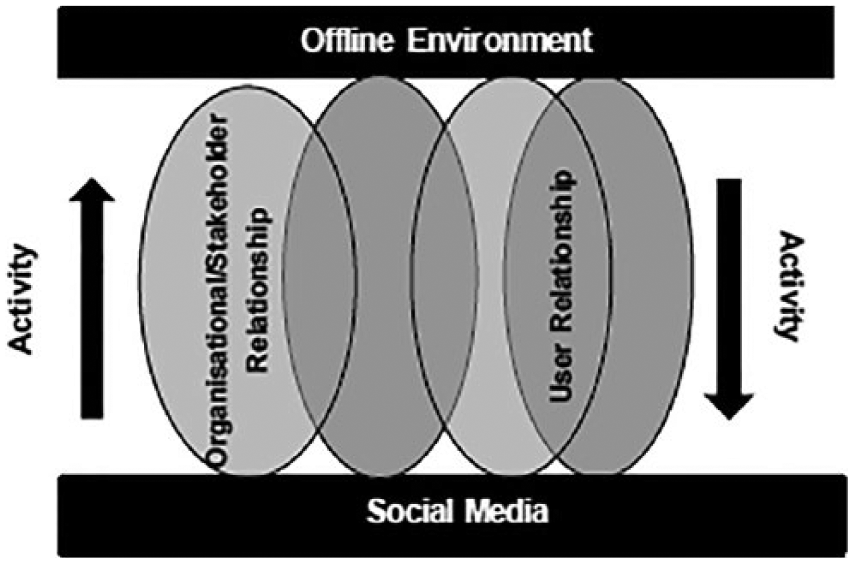
While social media researchers have viewed the online and offline activities of users as interconnected, public relations research has yet to sufficiently focus on how relationships are formed using those connections. A propinquital approach to social media activity in a public relations context does not view social media and offline spaces as separate entities. Instead, these spaces are blended, and the amalgamation of environments is facilitated through a propinquital loop (see Figure 1). It is suggested that a propinquital loop occurs when social media interactions between organisations (or causes) and stakeholders are encouraged (and supported) in moving back and forth between social media and offline spaces on a regular basis. Thus, this movement creates a loop of activity which keeps the stakeholder in close proximity to the organisation. The brief time frame of the ALS Ice-Bucket Challenge is not adequate to demonstrate the longitudinal functionality and impact of a propinquital loop. However, it can provide some insight into its components on a smaller scale as the first step in exploring this alternative approach to social media activity. While the relationships between ALS Ice-Bucket Challenge participants were a key component underpinning the activity between social media and offline environments, supporting the ALS and the ALS Association provided motivating factors for this movement; a relationship between the participant and cause (or organisation) was established (or further developed) as a result. It is suggested that organisations can leverage the proposed benefits of a propinquital loop by instigating this activity or supporting it if it occurs spontaneously, as in the case of the ALS Ice-Bucket Challenge. The following analysis aims to demonstrate the three stage process of a propinquital loop through the deconstruction of activity involved with the ALS Ice-Bucket challenge.

Propinquital loop.
Stage 1 – social media environment
The first propinquital stage of the loop occurring in the ALS Ice-Bucket Challenge existed online within a social media environment, most commonly via Facebook, when a social media user became aware that they had been nominated to participate in the challenge. The person posting the nomination was generally someone within the same network of the nominee, suggesting the presence of ‘temporal flow’, leveraging a past relationship in the present to encourage a future event. The nomination was delivered through a post using a range of techniques, including tagging the person (linking their name to their personal profile within the post to generate notification), verbally nominating the person in the uploaded video or writing the person’s name in the post, but not directly linking to their personal profile.
The content of the actual nomination consisted of an invitation to a specific social media user (or group) to accept the challenge and, in doing so, undertake it in the same manner as the person making the nomination (dumping a bucket of ice water over their head(s) offline and in front of a video camera or other video recording device such as a smartphone). A 24-hour deadline was commonly imposed for the nominee to complete the challenge which could also be identified as requiring ‘immediacy of presence’. The existence of the nomination suggested the presence of ‘engagement’ as the past participant in the challenge needed to display accessibility, presentness and a willingness to interact by encouraging involvement from someone else. The significance was that the first stage of the propinquital loop in this case occurred on social media with strong encouragement and call-to-action to undertake an offline activity in the name of a specific cause. If the challenge was accepted, the nomination provided both the impetus and the motivation for a social media user (or group of users) to move their relationship to the cause (in this case ALS) and the person nominating them, from a social media environment to an offline context to undertake the activity.
Stage 2 – offline environment
Moving into an offline environment constituted the second stage of the propinquital loop in the ALS Ice-Bucket Challenge. Nominees, upon accepting the challenge, were videoed speaking to camera citing the name of the cause (ALS), mentioning the name of their nominee and nominating others to complete the challenge before being videoed having a bucket of ice water dumped over their head. This activity was supposed to be followed by a donation to the ALS Association.
This stage of the propinquital loop was important as it contained two significant characteristics. The first involved the participants addressing the call-to-action personally posed to them and undertaking the desired behaviour required to be involved in the collective activity of the challenge. This action displayed all three propinquital components. Participating in the challenge demonstrated ‘engagement’ on the behalf of the participant. ‘Immediacy of presence’ could be identified if the nominee responded to the invitation within the 24-hour deadline. Next, undertaking the challenge posed by someone with which the nominee had an existing relationship acknowledged the history and the presentness of the relationship and suggested that it would continue in the future, demonstrating ‘temporal flow’. By mentioning the charity and dumping the ice water while being videoed, participants provided tangible evidence of the elasticity of their relationship and their association to the cause and their nominee although this gesture was brief in its duration. Further to fulfilling the desired behaviours of mentioning the charity, undertaking the prime activities of the challenge (ice water drenching and donation), the second stage of the propinquital loop required participants to carry out other requirements to ensure that the loop between social media and offline environments could not only be created, but could facilitate momentum.
To create the propinquital loop, and its momentum, participants were required to nominate someone else on camera and share the video of them undertaking the challenge in an offline environment, back in a social media environment. Nominating another person within their network increased the likelihood that the challenge would continue by leveraging the existing relationship to compel a new nominee to undertake the same desired behaviours from social media to offline. Using video to capture this offline activity also assisted in creating the propinquital loop by enabling an offline event (instigated in a social media environment) to be viewed back in the same social media environment where it originated. Therefore, the second stage of the propinquital loop associated with this case required specific elements (a new nomination and video sharing) to move the activity from offline back on social media for the loop to be created.
Stage 3 – return to social media environment
The final stage of the propinquital loop associated with the ALS Ice-Bucket Challenge occurred when the nominee posted their video on social media and nominated another user to participate, again demonstrating all three propinquital components. However, the loop would only be created if the new person being nominated accepted the challenge, videoed the event and shared it on social media while remembering to mention ALS.
The propinquital chain
It is suggested that a chain of propinquital loops facilitated the viral spread of the ALS Ice-Bucket Challenge (see Figure 2). Once the formation of a loop was completed by the nominee (uploading the video of their offline interaction and mentioning ALS), the momentum to create a new loop was propelled through leveraging an existing relationship to nominate a new person (in the video and tagging them on social media). The propinquital chain was formed through the ensuing acceptance and implementation of that nomination. Thus, the nomination of new people and their participation in the challenge, including the necessary components (video, ALS mention and new person nomination), supported multiple propinquital loops linked together to form a chain that was viral in result.
Propinquital chain.
Omitting any of these components would result in a fundamental part of the propinquital loop (and subsequent chain) being lost. Neglecting to mention the charity meant that the relationship to the organisation or cause would be broken. Neglecting to include the nomination of another person, or not videoing the event (or sharing it), would result in the loops and chain not being created and the challenge remaining purely in a social media environment.
Critical components facilitating the ALS Ice-Bucket Challenge
Analysing the activity involved with the ALS Ice-Bucket Challenge through a propinquital lens suggests several factors that facilitated its success. First, it confirmed that social media activity can influence offline behaviour and vice versa, confirming the findings of Paek et al. (2013). However, a motivating factor must exist to drive this activity between social media and offline environments. In the case of the Ice-Bucket Challenge, accepting the social media nomination from a personal connection drove activity offline in the first instance, and the motivation to nominate someone else in the participant’s network influenced the movement of activity back to social media. The power of personal relationships in influencing both social media and offline behaviour demonstrated in the ALS Ice-Bucket Challenge confirms the work of Bakardjieva (2012). The propinquital loop or chain could not be formed without the encouragement or influence of personal connections.
The requirement to prove the offline activity in the Challenge via video drove it back to a social media environment. Additionally, the propinquital loop was formed by embedding a driver (the nomination) into the video evidence of the offline activity and in its accompanying post to encourage movement offline again. This highlights the importance of a strong call-to-action when attempting to generate activity from one environment to another.
A further critical characteristic of the ALS Ice-Bucket Challenge was that it relied on user-generated content. The Challenge would have failed if generating such content prevented participation. Internet access, a social media profile and a video camera were the only requirements to fulfil the challenge, which for the majority meant using a smartphone. With the number of smartphone users worldwide projected to surpass 2 billion by 2016 (eMarketer.com, 2014), the ALS Ice-Bucket Challenge leveraged this technology and the vast network of social media users to facilitate optimal participation rates. Additionally, Facebook was the social media platform most commonly used throughout the Challenge, also confirming the work of Vromen et al. (2015) relating to the usefulness of Facebook to encourage offline interaction.
Participants had the ability to respond to a nomination in the palm of their hands. The challenge also involved a simple activity using everyday household items (bucket and ice), resulting in its requirements being highly accessible for those wishing to participate. The ALS Ice-Bucket Challenge may not have been as successful if an activity of greater complexity was required. The use of smartphone technology and household items reduced the likelihood that people would not participate because the challenge was too problematic to undertake.
It was this simplicity and accessibility that enabled people from all walks of life to participate. It resulted in high-profile people and members of the general public all undertaking the same activity. It also provided people with an insight into relationships between celebrities by being able to witness who celebrities nominated and who accepted a challenge. The celebrity aspect of the ALS Ice-Bucket Challenge also allowed fans of celebrities to view them in a vulnerable and humiliating light, drenched by a bucket of ice water, a scene removed from the usually polished images presented to the public. Celebrity endorsement of the challenge through its participation may have added to its success with people hoping to emulate celebrities by taking part, possibly creating a feeling of empathy.
Another reason for the success of the ALS Ice-Bucket Challenge could be attributed to the way that it prompted participation by leveraging participants’ need to belong. A nomination provided an invitation to join a worldwide movement and to become part of a greater whole. Furthermore, a fear of disapproval from others by not accepting a nomination may have also been a motivating factor underlying participatory activity in the challenge. Driving stakeholder activity between social media and offline spaces while addressing a need to belong may provide a framework for organisations when shaping social media approaches in the cultivation and management of relationships with stakeholders. While there has been a strong emphasis on harnessing the dialogic nature of social media, specifically in generating two-way symmetrical communication, analysis of the key characteristics of the ALS Ice-Bucket Challenge suggests that it may be more advantageous (at least in the short term) for public relations professionals to widen their scope. Rather than focusing on two-way communication, engineering stakeholder experiences that influence actions between social media and offline spaces on behalf of their organisations may be of greater benefit. Grunig (2009) stated that public relations practitioners were not taking advantage of social media’s functionality for two-way communication. Seven years have passed since this claim, and as social media technology has evolved, it may also be time for a more integrated and sophisticated approach if using social media as tools for engagement and relationship management. Social media has become a pervasive part of life for millions, and instead of perceiving social media use as purely an online activity that ends when stakeholders put down their smartphones or step away from the computer, public relations practitioners could improve engagement and relationships by approaching social media use and offline activities as one extended experience and seamless opportunity to build and maintain relationships – an approach reinforced by the work of Waite (2011).
In the case of the ALS Ice-Bucket Challenge, participants were inspired and motivated to fulfil specific actions in both social media and offline environments to achieve a common goal and cause. The strength of this trajectory is a powerful reminder of what can be achieved through social media, but what can also be attained when social media activities extend into offline environments and back again. If stakeholders can be inspired to convert their association with an organisation or cause from a social media relationship (possibly demonstrated through ‘likes’, comments or shares) into a physical offline action, it may be suggested that the original relationship has been strengthened as a result of it traversing from one environment to another. Alternatively, the movement from one environment to the other may purely demonstrate that the existing relationship (although primarily subsisting on social media) is strong enough for the organisation or cause to influence an offline action. Both cases could provide insight into the strength of existing relationships with stakeholders. Furthermore, strategically leveraging a propinquital loop (or chain) to regularly move stakeholder relationships between social media and offline interactions with the organisation or cause (or activities to support it) may strengthen their overall association with the organisation or cause by creating an active history and sense of belonging to a community through that activity.
Key implications for public relations social media practice
The importance of taking a propinquital approach to social media has three main implications. Initially, it proposes that public relations practitioners need to focus on the overall stakeholder experience, both on social media and offline, as a holistic entity rather than two isolated interactions. This specific case study suggests that focus should be placed on optimising both social media and offline experiences for stakeholders, and emphasis must also be directed to how social media interactions can be converted into offline experiences and vice versa. Encouraging stakeholders and providing accessible conditions for them to move their interactions between the differing environments increase the likelihood that relationships may be strengthened to encourage ongoing support: a key motivation for social media use by non-profits.
To achieve propinquity, it is important to be strategic when developing social media content to consider how each post can be crafted so that it encourages offline interaction. Effort should be placed on bringing social media offline and vice versa to reinforce stakeholder relationships through informing and encouraging an ongoing feeling of belonging to a wider community connected with the organisation. In both instances, public relations practitioners need to focus on maintaining the momentum of interactions. An event could be advertised using social media; photos could be taken at the event, which could then be shared on social media with attendees tagged (with their permission) and encouraged to comment about it. This would create a propinquital loop, whereby stakeholders may feel a greater connection to the organisation by interacting with social media and offline. The activity may also support appreciation and endorsement from the organisation by including stakeholders in their highlights from the event. While this is definitely an area for further research, this article suggests that paying greater attention to propinquity may aid non-profit organisations (and others) in strengthening their relationships with stakeholders.
Limitations and further research
The application of propinquity as a suggested framework within which the movement of stakeholders between social media and offline environments can be analysed and articulated is an approach that requires greater exploration. This article applied the approach to a singular explanatory case study to contribute an alternative perspective to the discussion of social media practice. Further research to understand the way relationships and content move in both directions between social media and offline environments, or how the environments blend, and the impact of this would provide a valuable contribution to public relations social media research. Such research might attempt to describe the phenomenon and aim to develop a way to provide evidence of and measure its influence, such as through the innovation of a propinquital quotient or some other relevant measurement tool. This would involve further analyses of case studies and proactively testing the approach through action research in collaboration with representatives in the public relations profession.
Conclusion
This article aimed to provide public relations practitioners and scholars with an alternative approach to the use of social media as a tool for relationship management. It suggested that taking a propinquital approach to social media practice may result in stakeholders extending their attachment to an organisation through encouraged activities that move between social media and offline spaces. While this case study, the ALS Ice-Bucket Challenge, occurred within a brief time period, this case demonstrated the movement between environments (a chain of propinquital loops) and suggests that a propinquital approach to social media may provide a productive basis for further analysis and discussion in the future.
Footnotes
Acknowledgements
Thank you to Dr Elizabeth Gray from Massey University for the valuable feedback on the presentation of this research at the Australian and New Zealand Communication Association 2015 Conference.
Declaration of Conflicting Interests
The author(s) declared no potential conflicts of interest with respect to the research, authorship and/or publication of this article.
Funding
The author(s) received no financial support for the research, authorship and/or publication of this article.