







Abstract
Technologies of memory and affect are all around us. In this introduction to a special issue of Media International Australia on the theme of technologies of memory and affect, we report on the activities of year-long collaborative and interdisciplinary research programme funded by the Flinders Institute for Research in the Humanities. We offer insights into the research program, its structure and methodologies, from which some of these articles emerged, including brief description of collaborative processes and creative outputs. We include field note excerpts and selected images from the visual arts exhibition, part of the Adelaide Fringe Festival, in an effort to share the energies and embodied dynamics of the event. We summarise the six articles that form the collection and reflect upon their relationship to one another and our theme.
This Special Issue of Media International Australia on the theme of ‘Technologies of Memory and Affect’ is the culmination of two years of work by our team, and we want to acknowledge that much of the labour – its collaborative processes, presentation, and textual and visual outcomes – occurred on the traditional lands of the Kaurna people of the Adelaide plains. Australia’s Indigenous people are the original users and researchers of affective technologies. The intersection of journeying and storytelling as knowledge exchange is the foundation of Indigenous approaches to life, culture, research and community. We recognise that we are all always co-created with technologies that enable our cultural expressions, regardless of whether these ‘tools’ are ancient and analogue or recent and digital.
Each year, Flinders University’s Flinders Institute for Research in the Humanities (FIRtH) calls for proposals for a unifying theme to coalesce divergent research interests into productive research capacity. Ideally, the theme draws in collaborators from across the range of disciplines in the School of Humanities and Creative Arts at Flinders University and creates opportunities for researchers from all backgrounds to participate in a lively research culture with significant outcomes. Our project sought to create research opportunities by finding the overlap of interests in the work of staff, early career researchers and postgraduate students within our own School and disciplines. Our successful 2016 bid for a research focus on ‘Technologies of Memory and Affect’ unfolded against the background of a university-wide restructure, in which the survival of the Institute was uncertain. Perhaps this inspired a certain boldness and willingness to push against the edges of the identities imposed on us by broader academic structures. These explorations are evident in the six papers curated here in this Theme Issue section and were evident at many other stages of our programme. The programme included a series of informal PechaKucha (a style of short punchy presentation where 20 slides are shown, each for 20 seconds, which means that each presenter speaks for 6 minutes 40 seconds), a mid-year symposium and writing workshop, and an end-of-year conference and art exhibition which was part of the 2017 Adelaide Fringe Festival. In the following, we outline some methodological practicalities before tracing the journey from method to research outcome. Finally, we reflect on some of the affective resonances that came about as a result of the year-long programme of activities and, in particular, from the Exhibition opening and performance by the Unbound Collective during Adelaide’s 2017 Fringe Festival.
The traditional output for Humanities scholarship is the printed monograph. In recent years, this fact has been under assault from three directions: the rise of the digital as the space where scholarship is communicated and disseminated; the open access debate, crucial to the foundations of public scholarship for public benefit; and the growing presence of creative arts disciplines within Humanities departments, which has required a reappraisal of non-traditional research outcomes (NiTRO) and demanded acceptance of alternative ways of communicating research. After all, our primarily textual research methodologies frequently have visual outputs that complement and complicate the production and dissemination of new knowledge. As part of our work on the theme of ‘Technologies of Memory and Affect’, we were keen to push ourselves and our collaborators to scholarly exploration in new modes, creating space for uncertainty in multiple forms – words, images, fibres, cables, performance – in the knowledge that creative research can be both rigorous and generative, collaborative and high quality, innovative and expressive. As humanities scholars, we felt we could create space through our theme to embrace the visual elements of our research, incorporate visual methodologies and share our research in ways that make use of those visual elements. We describe these efforts below briefly, before turning to the articles that comprise this Theme Issue.
Here, we must include a note on language, voice and visual representation in this collection. We have, at all points of intense and sometimes hurried collaboration, attempted to take pause and honour the voice of the speaker, regardless of tone or linguistic difference. Thus, what follows is a certain range of scholarly ‘textures’ in the articles included. While our initial hope was to include a larger range of visual representations to accompany our words, the parameters of academic publishing remain somewhat constricting. In this instance, we are limited to inclusion of a finite number of black and white images in which the approval of anyone who is identifiable has been confirmed. In the case of the public art installation, contain yourself, grey scale renders vibrant colour out of context, and people appear only at a distance. In the case of ‘The Marching Dunstans’, the symbolic hot pink shorts become grey and some middle-distance faces of participants have been blurred. While they were photographed at a public march that celebrated visibility and pride, our deadlines precluded locating and clearing all individual permissions. In Deb Verhoeven and Stuart Palmer’s work on ‘Gender Offenders’ – the visualisation of data about gender and success in the film industry and grants administered by the Australian Research Council (Verhoeven and Palmer, 2016) – the highly significant nodes of blue and red are rendered almost indistinguishable. We include reference to these compromises to highlight certain systemic ironies and to illuminate our critical stance at all points of the research, writing, visualising and distributing research. Nevertheless, we know even if we cannot wholly show that our themes of memory, affect and technology were unpacked, scrutinised and reassembled in these alternate forms, to see what bubbled forth through the cracks, fissures and seams when we set about trying to do things differently.
While there is no space in this introduction for detailed description/recapture of each paper or artwork, or the process undertaken by each artist-scholar, we include here evocative excerpts from field notes undertaken by each of us throughout the yearlong FIRtH theme. As an experiment in slippery tonal representations, and memory, we include the asterisk symbol (*) in lieu of name and institutional affiliation. We initially used this asterisk as a means of de-identifying our work for peer review; however, we noted how this ‘censorship’ process also re-shaped our relationship to the work being described, as both authors and readers. In the field note excerpts that follow, we experiment further by degendering language, using the non-binary and sometimes plural ‘they’. In an attempt to decolonise language (Smith, 2013), we illuminate the assumptions that frame our meaning-making. For example, when we describe the work of a renowned scholar, naming them evokes a certain deference. Removing their name shifts focus to the work itself and its capacity to spark new thoughts or feelings. The implications of gendered pronouns, as well as names that are imbued with class and race, have also received recent analysis in experiments that test assumptions in blind recruitment trials. In removing gendered pronouns and replacing names with asterisk, we are reflexively reminded that we ‘like’ (and indeed celebrate) these games with text, tone, representations and resonances, even as they began as scrutiny of naming, measurement and blind review. While our experiments are not wholly successful here, in part because we feel a (conflicting) duty to celebrate authorship and creative practice by acknowledging providence of articles and artwork, within these italicised notes, we invite the reader to let go of playing ‘guess who?’ and instead imagine a time and space where gender and authority are less significant. We blow these bubbles in the air, mixing metaphors and offering traces of our memories via scraps of paper, public records, images and photos of artworks.
A confession: until recently I swapped out ‘affect’ with ‘emotion’ in my head. Upon reflection, this is evident in my inclusion of a Gene Wilder meme in our initial theme launch: Willy Wonka (of the Chocolate Factory) with half-focused gaze and laconic smile. The text reads, ‘You know the difference between affect and effect? Yes, I’d love to hear about how annoyed you get when people use them incorrectly’. I thought of it as an arch reference to academic verbosity and jargon. In curating this collection, I’ve learned about affect as the complex networked relationships between people and places, traces of memories and ideas of belonging. It is a framework that I can conceptualise much more clearly now than when we first proposed ‘Technologies of Memory and Affect’.
We pitched an all-embracing structure that could accommodate the diverse research interests of our colleagues in the Humanities and Creative Arts at Flinders. ‘Technologies of memory’ applies to anyone/everyone in complex and interesting ways – from the space archaeologist who theorises the debris of humanity on the moon, and traces of everyday life on earth, to the Fitbit as diary (framed within life-writing). Traces of everyday life include the Google Books project – that aims to digitise every book on earth.
In between pages of the canon, we see bank-card receipts of book purchase (with still-searchable home addresses) and ghostly traces of routinely non-White hands meeting quota. When * describes the physical feeling in the pit of their stomach when they first encountered the dismembered spines of books piled up in the rubbish bins, affect came into being for me.
As theme curators, we strove to adopt feminist, ‘un-scholarship’ principles of collaboration throughout ‘Technologies of Memory and Affect’. We started with low-stakes PechaKucha presentations that allowed for playful exploration of new ideas. Mid-year, we facilitated a symposium where Larissa Hjorth led us in workshop collaborations around common strands (or hashtags) shared by our work. This was followed by a more intensive paper slam the following day. Later in the year, Yungorrendi scholars (at the Office of Indigenous Strategy and Engagement at Flinders University) and University, members of the Unbound Collective, shared their creative development processes through writing retreats and strategic efforts to capture unexpected and uncontrollable affect. One of them spoke of discovering the words of their grandmothers, rendered in black and white, authored by White men and imprisoned between the pages of dusty books in the archives. The shiver her words generated stayed with us until opening night, weeks later, where their affective resonance transforms into tears.
In the spirit of our theme, culminating activities were a true feast for the senses that both provoked and inspired. On 17 February 2016, we descended upon Flinders University Victoria Square campus, navigating through Fringe preparations in the Square. Coffee’d up, our day began with a keynote from notorious academic stirrer, Deb Verhoeven. The conference presentations that followed unearthed unexpected intersections, emerging principally between new materialism, feminism, queer theory, Indigenous storytelling and creative research praxis (Figure 1). We take this as evidence that creating ‘unbounded’ space can afford generative ‘serendipity’ (Verhoeven, 2016) and collaboration that, in turn, produces trust and compassion – as well as high-quality research outcomes. Our day of scholarship wrapped up with a public lecture by the acclaimed poet, filmmaker and academic, Romaine Moreton. After Moreton’s presentation, we gathered in the exhibition space in the foyer downstairs to launch the visual art exhibition. We were privileged to witness a performance from the Unbound Collective – Ali Gumillya Baker, Simone Ulalka Tur, Faye Rosas Blanch and Natalie Harkin – as they performed a small part from their work, Bound and Unbound: Sovereign Acts (see also Baker et al., 2015).
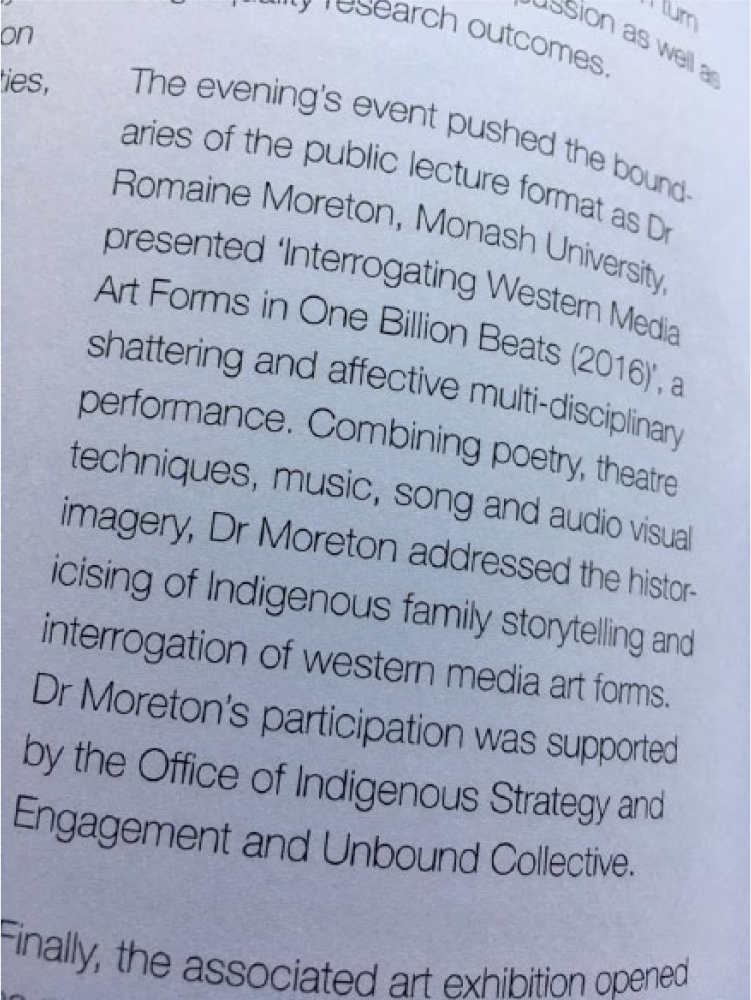
NiTRO output 1: public record of performance/exhibition and conference in excerpt from ‘Viewpoints’ (Weeks et al., 2017).
The members of * have been everywhere at once, sewing/repairing, lecturing, negotiating care of young and old, and picking up emails, phone calls and woven baskets. They are resurrecting hand-sculpted skirts of paper bark, a textured and material presence in the room and so on. The * offers a basket of epiphanies and small pieces of paper with stirring statements. They are the words of their mothers. There is not a dry eye in the house. This has to be the epitome of the multilayered interweavings of technologies of memory and affect (Figure 2).
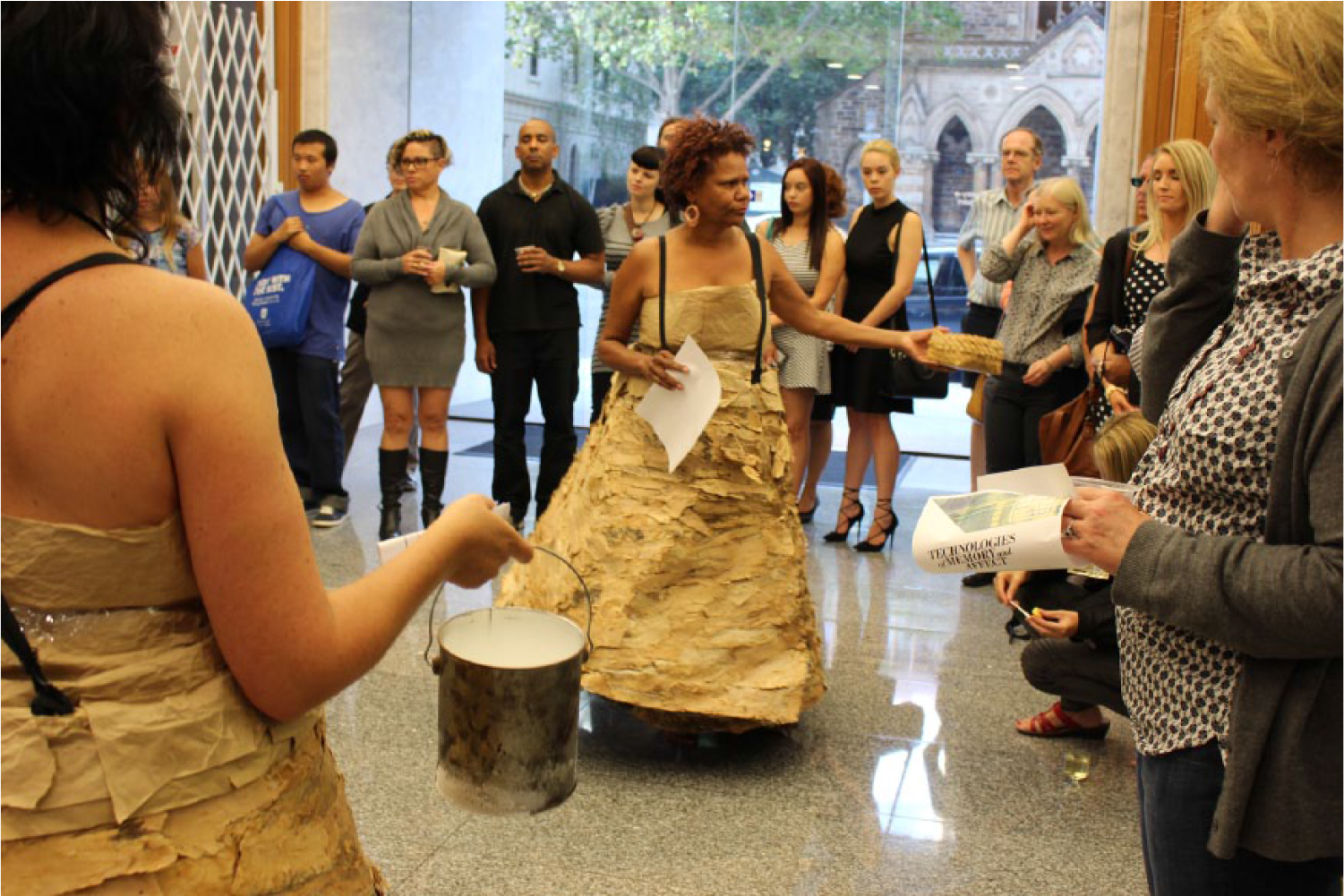
The Unbound Collective performance at the Technologies of Memory and Affect conference, February 2017.
* work is a set of swirling webs of intersecting lines and dots of red-pink and blue (Figures 3 and 4). We’ve seen network representations before, but these looked beautiful, almost bioorganic and I imagined them rendered in watercolours on expensive cartridge and tasteful framing. But, I’ve heard *’s lecture about what they represent. Their ‘natural order’ beauty is the antithesis of their referents – each dot equates with male and female leaders in the respective fields of Film Production and Academia. They are a set of data visualisations that literally represents patriarchy. We know that it feels this way, but here the technology proves it. And, the irony is that this research, rendered in text and tables, is a quantifiable output in Excellence in Research for Australia (ERA) terms. Now we can claim the data visualisation as a NTRO (non-traditional research output), too. Amplifying bang for our buck.
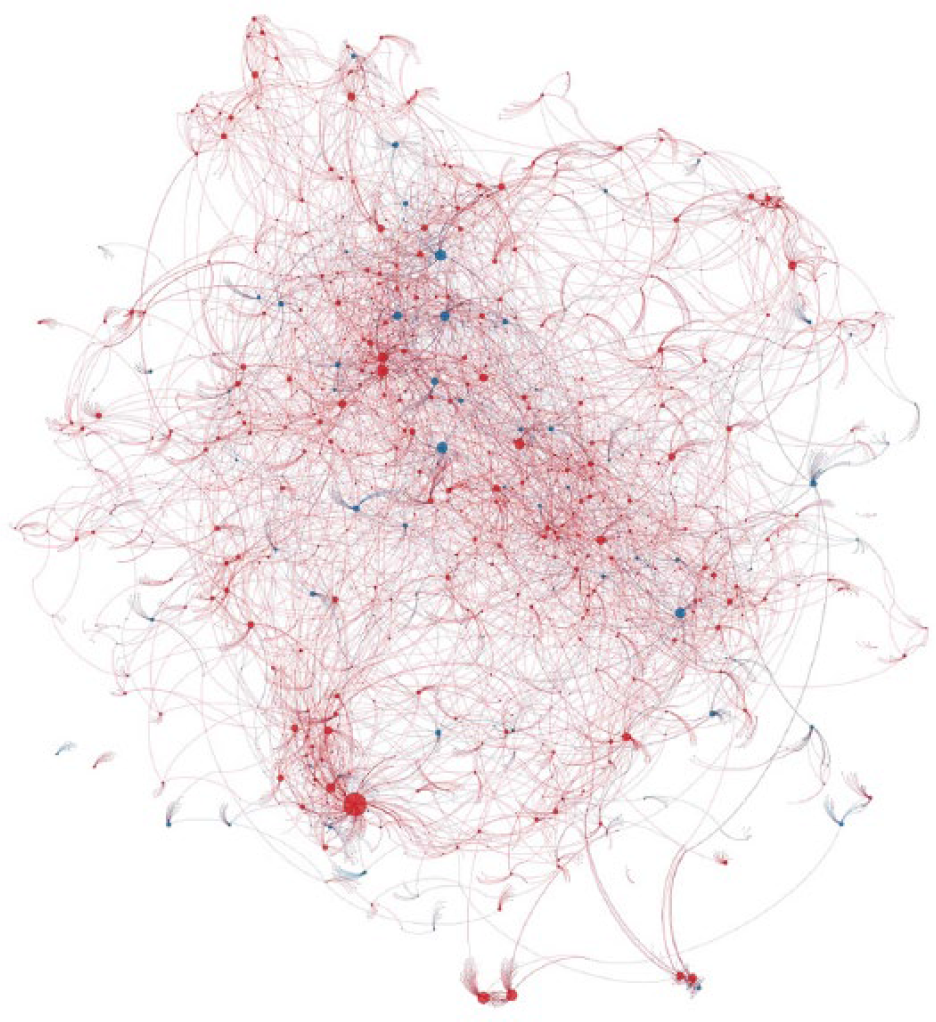
Perspectives in Patriarchy by Deb Verhoeven and Stuart Palmer.
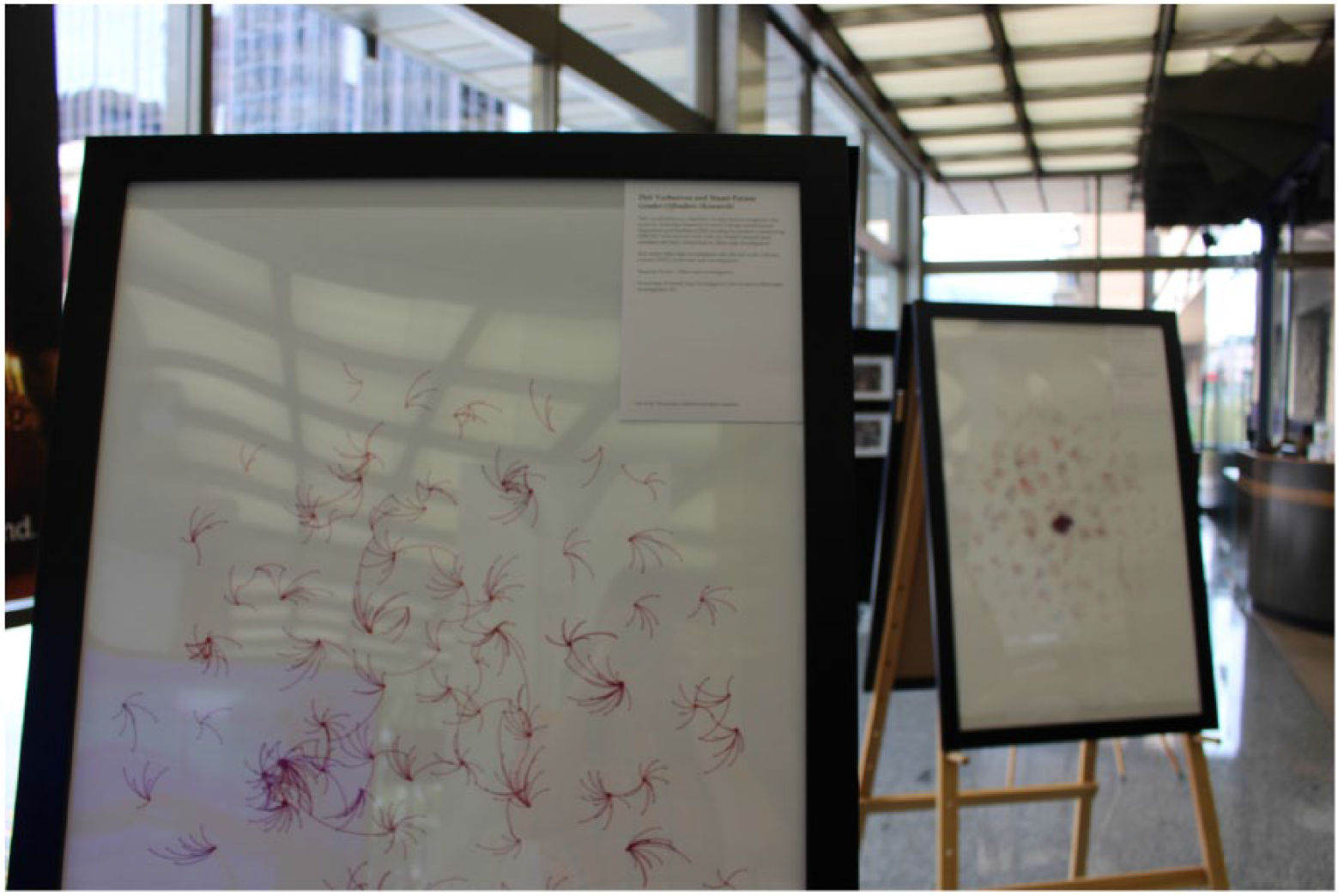
Gender-Offenders data visualisations in situ (see also Verhoeven and Palmer, 2016).
Uneasy Arms (Figure 5) highlights the interaction of the digitiser and the reader in the production of archives of the book in mass-digitisation projects. The ghostly spectre of the scanner crowds the text. Inside mass digitisation archives, such as the Google Books project, the Internet Archive and the Hathi Trust, traces of previous readers and workers crowd the work and consequently the exchange between text and reader. Digitisation makes us rethink what the book is. Human computer entanglements are evident in the way we encounter and interact with layered technologies inside of our reading experiences. All writing is technologised. Parchment, the pen, the scroll, the printing press, the computer are all technologies of inscription from different orders and eras. In Uneasy Arms, * wanted to show the usually invisible human labour involved in digitisation of texts and how the combining of the material and the digital creates a disjuncture or hybridity. Readers are present in the text and leave traces we only sometimes glimpse.
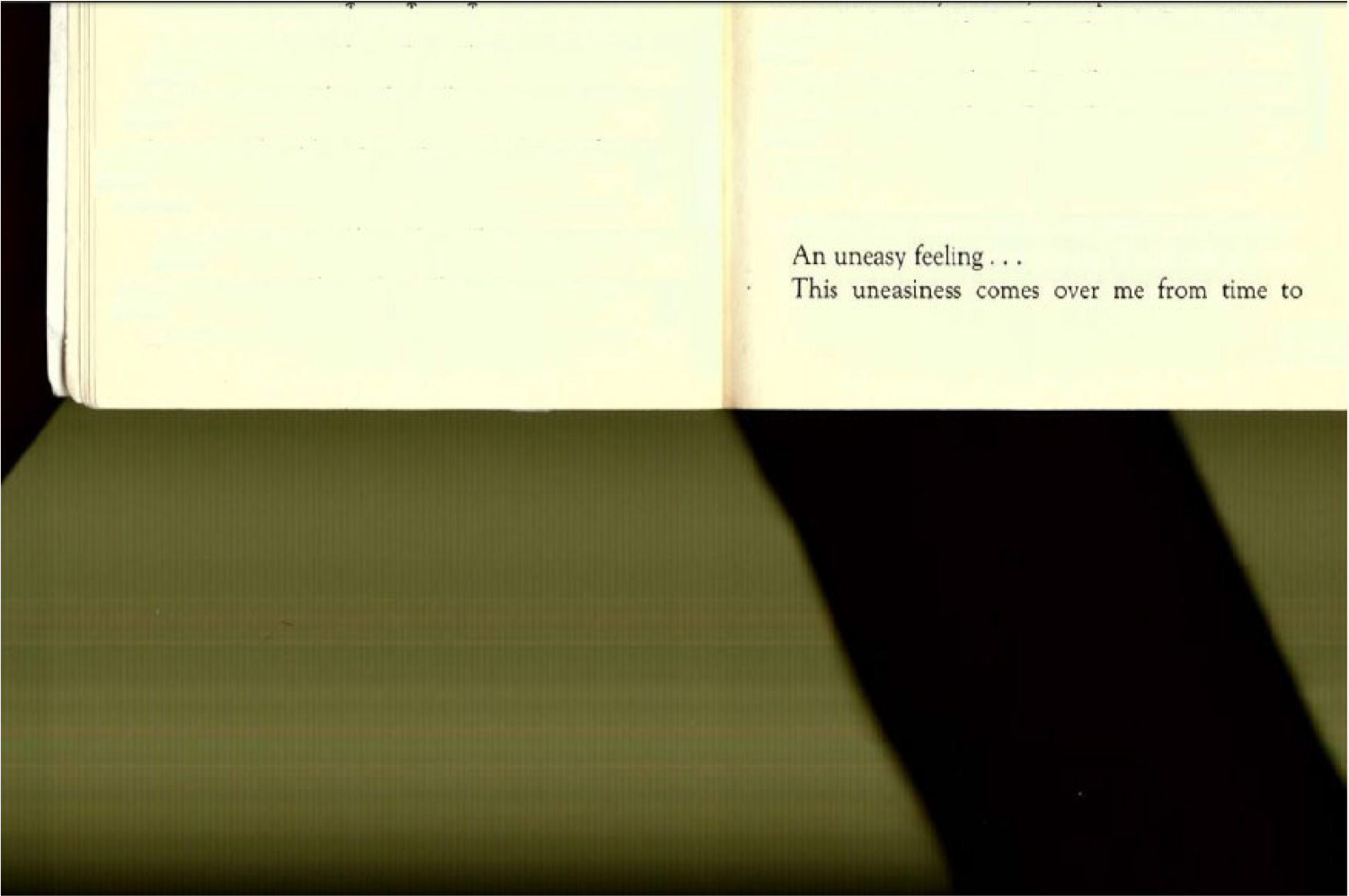
Uneasy Arms, by Tully Barnett (see also Barnett, 2015).
When * presents this work, audiences are always dumbstruck at the fact that the addresses of purchasers, imprinted in mistakenly scanned credit card duplicates 30 years ago, can be viewed right now on Google Maps. The visual is an important tool for the communication of research results and the inherent affect located in them (Figures 6 and 7).
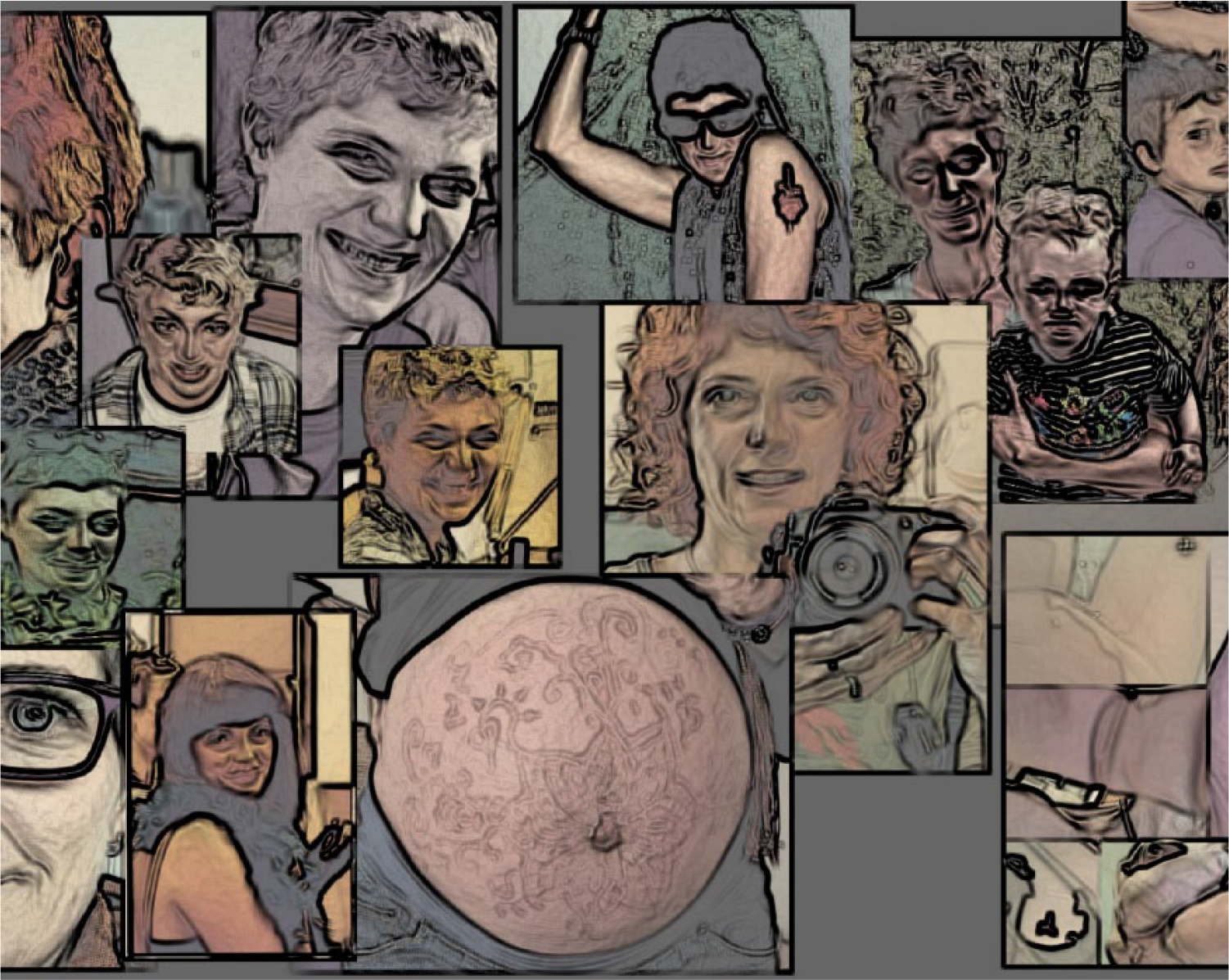
Fluid Selves, by Son Vivienne (see also Vivienne, 2017).
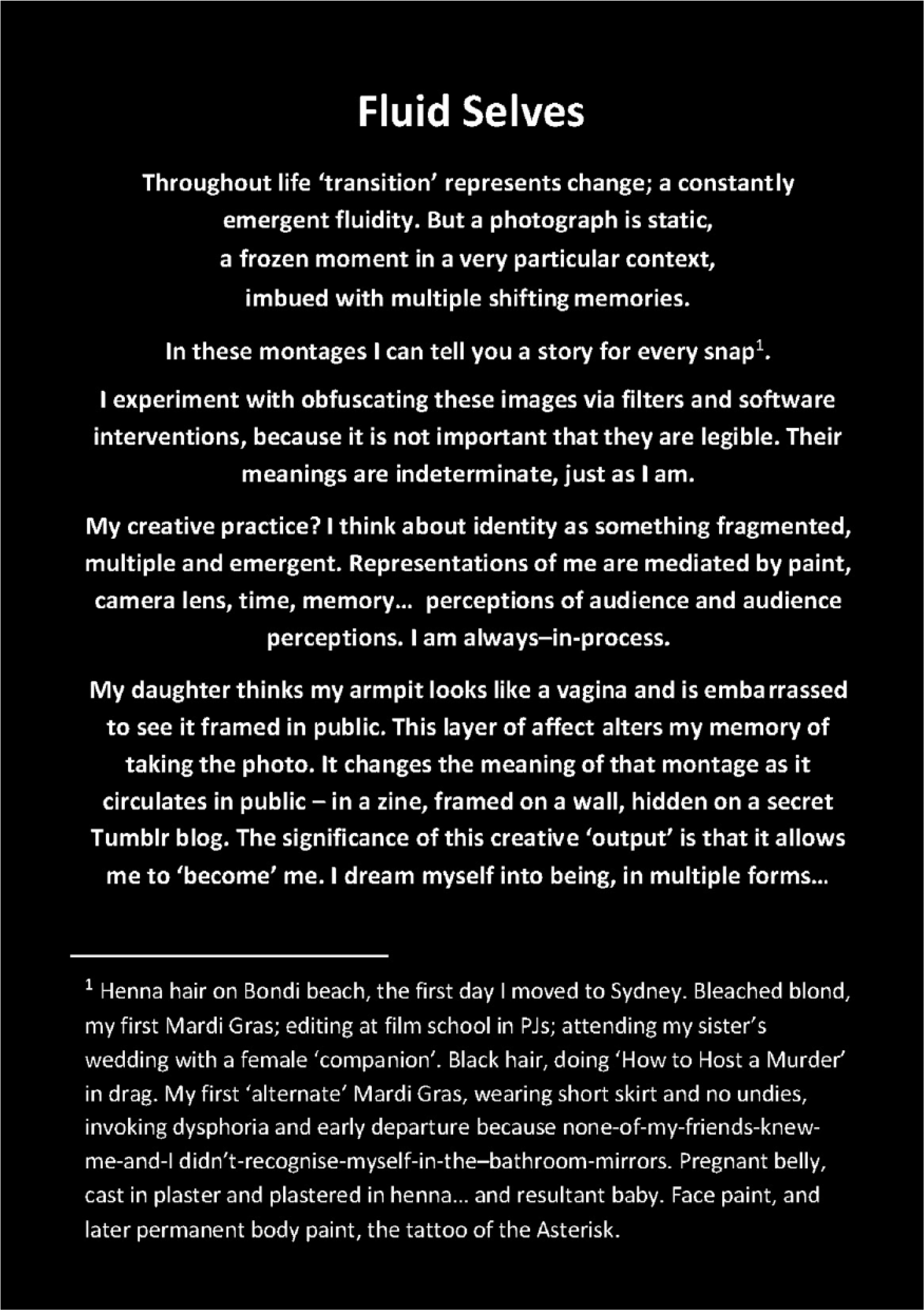
Artist’s statement, by Son Vivienne.
In the following, we offer a more conventional account of a richly textured range of articles that are themselves digitised traces of their authors’ engagement with memory and affect. These articles coalesced around conference and exhibition themes that were then framed in a wider call for papers. Unexpectedly, this revealed national intersections among scholars who are entangled in praxis and theorising of the ephemeral and imprecise parameters of memory and affect, mediated by technology. In this regard, the name of the call and its parameters are less significant than the space we held open for exploration to take shape and new ideas to emerge. We must note here that, in part due to an unusually short turn-around time between catalysing conference (February 2017) and publication outcome (November 2017), some fascinating but not quite ‘ready’ articles have fallen by the wayside. We acknowledge the work undertaken by these authors and look forward to seeing revised iterations of their articles in print in the near future. Following much debate on the subject of ‘flow’ or thematic development between one article and the next, we acknowledge that these papers could be re-ordered in many other equally sensible arrangements.
Barbara Baird and Ros Prosser’s article, ‘The Marching Dunstans: performing memory, queering memory’, reports on a scholar-led community project to commemorate the valuable input of the former South Australian Premier, Don Dunstan, in an act of commemoration that also queers the archive. In Adelaide, they report, Dunstan is memorialised in material and embodied form by people marching in safari suits or pink shorts to commemorate 40 years since the decriminalisation of homosexuality at the annual Adelaide Pride Parade. This embodied performance of archive breathes new life in the memories of Dunstan’s contributions to queer culture.
Jane Mummery and Debbie Rodan, in their article ‘Mediation for affect: coming to care about factory farmed animals’, detail the calls for affective connection between animal and human, a trope used by animal activists in campaigns such as those by Animals Australia. The affordances of online tools that make social media so personal help pitch, circulate and make sticky the messages that are most able to create change in mindsets about cruelty to non-humans. Comments and interactions from intimate online publics trace changes in public sentiment.
Pamela Graham’s article, ‘Crowdsourcing obituaries in the digital age: ABC Open’s In Memory Of’, considers the way that the Australian Broadcasting Corporation’s ABC Open platform mediates a new form of obituary writing: intimate, interactive and articulated by ‘ordinary people’ who sometimes address their lost loved one directly. Graham looks at this case study in light of the growing scholarship on death narratives in online spaces (how we deal with the Facebook profiles of our friends, family and colleagues who have since died), but also the long history of life writing and biography studies. This disciplinary frame provides insight into the new question, ‘When we leave so much of our lives on line, how will our deaths manifest digitally?’
Grant Bollmer’s ‘Empathy machines’ dissects the claims that VR (Virtual Reality) can explicitly and implicitly evoke feelings of empathy. Bollmer argues instead for the notion of ‘radical compassion’ as a concept to help us think through the layers at work between digital representations and feeling. This article makes a significant contribution to new scholarship on the notions of affect, emotion and sentiment as they pertain to the work we do in the digital sphere.
In the next article, intergenerational collaborations in digital storytelling make visible sentimental stories of heroism, thereby constituting and broadening an intimate public. Kelly McWilliam and Sharon Bickle’s article, ‘Digital storytelling and the “problem” of sentimentality’, tackles Stories of Service, a site that performs emotion in ways that are constitutive of sentimentality, a concept they substantially reclaim.
In the article ‘contain yourself’, Shanti Sumartojo, Jordan Lacey and Fiona Hillary walk us through the visceral and audible pleasures of a public art installation on the Docklands in Melbourne, and we feel the thrill of the warm summer night, recalling our own experiences of traffic rumble and bird song in urban environments. By emphasising the affective components of the assemblage of humans and the infrastructures around them, the artwork creates an intimacy among disparate publics.
The articles in this Theme Issue engage with the topic of technologies of memory and affect in complex and unstable ways: memory (archives, obituaries, queer history), affect (sentimentality, grief, attunement and radical compassion) and technology (ABC Open, VR, Stories of Service, banners and postcards and safari suits). These contributions reveal new dimensions to the ways that memory and affect are mediated through digital entanglements.
Following the conference and exhibition, there were many conversations in hallways. Some were whispered, all conveyed collusion, in a mysterious way, as if we were fearful of being monitored by our bosses. Was it because we had been temporarily absorbed in a space of our own making – what Berlant (1997) calls an ‘affective public’ – affirming our place as ‘others’ in the corridors: women, Indigenous people, people of non-normative genders and sexualities in the corridors of White neoliberal academia? The (unpublished) headlines read something like this:
Beyond ‘hearts on sleeves’ [I felt like] hearts [were] dumped on table for audience dissection (tweet) There was an unexpected thread through it all – feminist – Indigenous – queer – media – arts – methods – spaces … were these things we should have explicitly articulated in our theme? All the papers referenced ‘personal’ intimate or affective engagement with the objects or actors of their study … Could this be loosely interpreted as #intersectionalstandpointtheory?
These mutterings in the hallways, 140-character quips on twitter, and tiny pieces of paper bearing words whispered by ancestors in the archives are arguably fleeting. Perhaps they are not conclusive, not ‘definite’. They are not a scientifically proven, robustly reviewed, scholarly output, yet they are underpinned by collaboration, trust, vulnerability and compassion. We claim them here in order to mark their value, beyond measurable ERA units of ‘impact’ and ‘new knowledge’. We acknowledge their value in working cautiously around and across boundaries, in processes that our inspirational mentors and teachers in Flinders University’s Office for Indigenous Strategy and Engagement might call ‘bound/unbound’.
We conclude that what matters is holding a space – empty, waiting to be filled – until something appears at the edges, in this case affect mediated by technology and sometimes memory. Despite our good intentions, however, we acknowledge the pressures that are routinely placed upon collaboration. In this written trace of our endeavours, deadlines and multiple commitments of many collaborators hampered our desire to include multiple perspectives. This is but a slice. We hope you enjoy the slices to follow.
Footnotes
Acknowledgements
This Special Issue came together with the support of the Flinders Institute for Research in the Humanities (FIRtH), its director, Associate Professor Craig Taylor and its Research Officers, Joy Tennant and Elizabeth Weeks. Our fellow 2016–2017 FIRtH theme leaders were Alice Gorman, Julia Erhart and Julian Meyrick. Thanks to our advisory board: Patrick Allington, Ali Baker, Kylie Cardell, Kate Douglas, Lina Eriksson, Pamela Graham, Emma Maguire, Christèle Maizonniaux, Eric Parisot, Helen Stuckey and Melanie Swalwell. Thanks to our keynote speakers: Larissa Hjorth, Romaine Moreton and Deb Verhoeven.
Declaration of Conflicting Interests
The author(s) declared no potential conflicts of interest with respect to the research, authorship, and/or publication of this article.
Funding
The author(s) received no financial support for the research, authorship, and/or publication of this article.