







Abstract
The media plays a large role in facilitating negative racial and gender ideologies about Indigenous women. In Canada, as we struggle with the national crisis of missing and murdered Indigenous women (MMIW), researchers have collected data from social media (SM) and identified that subversive texts about Indigenous women perpetuate a racialized violent discourse. Given that many Indigenous peoples, including Indigenous youth, have smart phones and/or other ways to access SM they too are exposed to the discourse that subjugates, vilifies and dehumanizes Indigenous women, many of whom are family or community members. Our research investigates the messages shared on #MMIW and identifies a reframing by hashtag users. The results assist in understanding how SM plays a role in perpetuating stereotypes about Indigenous peoples but also how SM can be used to mitigate those messages.
Keywords
Introduction
Hashtags such as #timesup and #metoo illustrate the growing international concerns about the sexual violation of women. Women of all dispositions, races, and economic and social standings are standing up and voicing their opposition to abuse towards women. In Canada, Indigenous organizations have long been raising concerns about the levels of racialized and gendered violence directed towards Indigenous women and girls (Ontario Native Women’s Association (ONWA), 1989). More recently, the amplification of voices speaking up about racialized and gendered violence (Razack, 2000; Smith, 2005) and the increasing numbers of missing and murdered Indigenous women (MMIW; Native Women’s Association of Canada (NWAC), 2005, 2009) have included the use of social media (SM), in particular Twitter. Of note is Sheila North Wilson, the former Grand Chief of Manitoba Keewatinowi Okimakanak Inc., who coined the hashtag #MMIW while working for the Assembly of Manitoba Chiefs in 2012: … the social-media hashtag #MMIW – for missing and murdered indigenous women. The choice of “I” was deliberate, she said. Her people are indigenous to Canada; she does not connect with the term “aboriginal.” She went with “W” for women, but looking back, she wonders if it should have been an “F” for females, given how many girls have been victimized, or even a “P” for peoples … (Blaze Bam, 2016)
SM is a tool of mass production that provides disparate individuals and groups who have access with an ability to present their voices and coordinate efforts in order to press for change. For example, the hashtag #NoDAPL, created by a young Indigenous girl named Tokata Iron Eyes and her teenage friends, is a grassroots campaign against the Dakota access pipeline in the northern United States. SM can also be a positive source used to create a sense of mobilization and collective conscientization among users.
Underscored by an Indigenous research methodology, this research used quantitative big data analysis and reports on research that investigated Twitter messages shared on #MMIW during the time period 1 September 2016–29 July 2017. This period aligns with the announcement of the National Inquiry into MMIW on 1 September 2016 through to the start of first public hearings that occurred on 29 May 2017. The results assist in understanding how SM can increase attention paid to Indigenous issues. In the climate of SM and iPads/iPhones, Indigenous peoples are better able to represent their lived realities to broader society. It is here that SM can also be used to mitigate negative racialized representations and reframe a more truthful story by and for Indigenous peoples.
Situating ourselves
In keeping with Indigenous culture, it is important that we situate ourselves. We do this in our own voice in the paragraphs that follow.
Kia Ora, my name is Dr. Taima Moeke-Pickering. I am Maori of the Ngati Pukeko and Tuhoe tribes from Aotearoa. I am an Associate Professor in the School of Indigenous Relations at Laurentian University where I teach courses on Indigenous research methodologies, International Indigenous issues and Indigenous social work. I have lived in Canada for 13 years and have developed extensive experience working with Indigenous communities, evaluative research, big data analysis and photovoice methodologies. I have also authored numerous articles on decolonization strategies, social change and Indigenous well-being.
Kwe kwe, I am Dr. Sheila Cote-Meek from the Teme-Auguama Anishinaabe. I have 28 years of experience working in the field of Indigenous education where my passion is to assist with building institutions that are more responsive and respectful for Indigenous peoples. I have worked on numerous research projects that aim to highlight Indigenous women’s roles and responsibilities in the community. I entered this project to raise awareness about the impact of ongoing colonial violence.
Hello, my name is Ann, and I identify as an ally with an interest in ensuring research links to community needs. I am committed to following the 94 calls to action in the Truth and Reconciliation Commission (TRC). I am an Associate Professor at Laurentian University and have been researching SM for the past 10 years. My research encompasses big data analysis across SM platforms with a growing emphasis on the analysis of how social issues unfold in this milieu.
As a team, we have been working on big data analysis specific to #MMIW for 4 years. Importantly, as academics and social justice researchers we stand in solidarity with the voices of women and families that pressured the Canadian Government to pick up the Truth and Reconciliation (Truth and Reconciliation Commission (TRC), 2015b) 94 Calls to Action and to endorse an MMIW inquiry. We contribute to this movement by highlighting how big data SM Twitter analytics demonstrate the force of SM voices. SM voices using the hashtags #mmiw and #inquiry are the new media journalists who are able to name, empower and articulate powerful messages often coming from the heart to honour MMIW in Canada. We are hoping that this work will reach the educational networks that we belong to and extend the borders to those who might not otherwise be exposed to Indigenous issues as well as to provoke awareness via students, professors and allies to generate knowledge mobilization in relevant areas.
Background and context
Debwewin (Truth)
There is no doubt that Indigenous peoples in Canada continue to face oppression and racism, often on a daily basis (Cote-Meek, 2014). In Canada, Indigenous women are overrepresented as victims of sexual and physical violence and homicide and are five times more likely to experience a violent death than non-Indigenous Canadian women (Boyce, 2016; Brennan, 2011; Eberts, 2014; Gilchrist, 2010; Pearce, 2013). In 2015, the Native Women’s Association (NWAC) reported that they had gathered information on 582 cases about MMIW in Canada since the 1980s. The NWAC’s numbers are conservative compared to what was revealed in Tasker’s (2016) CBC news article (February 16), who reported that the Royal Canadian Mounted Police (RCMP) had found 1200 MMIW in their files and the Minister for the Status of Women, Patti Hajdu stated that the number is likely much higher with estimates as high as 4000. According to NWAC, while there might be some disagreement about the exact numbers of MMIW, there is a growing need for an independent database that would serve as a tool for local advocacy and violence prevention. Sadly, half of these murder cases remain unsolved (Gilchrist, 2010).
Inquiry into MMIW
The TRC arose as a ‘result of protracted litigation by survivors of the IRS system against the government and churches that ran the schools’ (Stanton, 2011: 1). The TRC Report B ‘Survivors Speak’ (2015c) document contains submissions from over 6750 people, most of whom survived the traumatic experience of living in the Indian Residential schools. Children were abused, physically and sexually, and many died at the Schools. In the TRC (2015a) Report Honouring the Truth, Reconciling for the Future (p. 3), researchers found that there was a deliberate policy by the Indian Residential School system to ‘eliminate Aboriginal peoples as distinct peoples and to assimilate them into the Canadian mainstream against their will’. The same report puts forth that reconciliation is a Canadian issue – one that ‘requires a new vision based on commitment to mutual respect’ (TRC, 2015a: vi). In Prime Minister Justin Trudeau’s speech to the Assembly of First Nations (AFN) 36th Annual General Assembly on 7 December 2015, he remarked how his government would renew its relationship with Aboriginal peoples. Specifically, he announced his commitment to enacting the recommendations of the TRC by launching an inquiry into the systemic problem of MMIW. The inquiry was officially launched on 1 September 2016 and the first public hearings started in Whitehorse, Yukon on 29 May 2017.
It is also important to highlight that the Calls to Action articulated in the TRC (2015b) specifically identified the media as an area that could promote reconciliation: Media and Reconciliation 84. We call upon the federal government to restore and increase funding to the CBC/Radio-Canada, to enable Canada’s national public broadcaster to support reconciliation, and be properly reflective of the diverse cultures, languages, and perspectives of Aboriginal peoples, including, but not limited to: (iii) Continuing to provide dedicated news coverage and online public information resources on issues of concern to Aboriginal peoples and all Canadians, including the history and legacy of residential schools and the reconciliation process.
Racialized media stereotypes
Traditional mainstream media (in particular, newspapers) have often been a powerful force for perpetuating biases and stereotypes about Indigenous peoples. Many researchers note that typically, traditional mainstream media has framed Indigenous issues in a subjugated and paternalistic manner that operates to reinforce negative stereotypes of Indigenous peoples in Canada (Bailey and Shayan, 2016; Harding, 2005; Strega et al., 2014). This hegemonic negative framing of Indigenous issues enables cyclical misconceptions to be sustained. Robert Harding (2005) notes there has been an emergence of new stereotypes, one of which he says puts ‘doubt [into] the ability of Aboriginal people to successfully manage their own affairs’ (p. 312). Given the time frame of Harding’s research, it is understandable that the emerging stereotypes during 2002 would relate directly to issues of governance since the Treaty negotiations and land rights were the predominant discourse operating at the time (Harding, 2005). Harding (2006) also contrasted news text from the mid-19th and late-20th centuries and, sadly, found that the discourse about Indigenous peoples remained ‘much as they were in colonial times, in ways that protect dominant interests and signify aboriginal peoples as a threat’ (p. 205).
Media reports of the TRC and MMIW (both in traditional and SM) often obscure the seriousness of crimes against Indigenous peoples and further mitigate the seriousness of their victimization; this signals to the public that crimes against Indigenous people do not matter (Gilchrist, 2010: 376). One only has to pick up a newspaper or tune into a Twitter feed to see how Indigenous peoples are frequently negatively depicted in the various forms of media. Martin-Hill (2003) reported that Indigenous women are stigmatized; they are viewed as prostitutes, street people and addicts, regardless of the veracity of these attributions. Jiwani and Young (2006) claim that racialized stereotypes inform societal constructions; further, they state that stereotypical attributes ‘feed into and reproduce common-sense notions of itinerant and irresponsible behavior’ (p. 902), rendering Aboriginal women as prostitutes that belong ‘in the lower echelon of the moral order (p. 903).
Cote-Meek (2014) and Razack (2016) contend that sexualized violence against Indigenous women is both gendered and racialized with its origins in ongoing colonialism. Colonialism can be understood as having four essential dimensions ‘it concerns the land, it requires a specific structure of ideology to proceed, it is violent, and it is ongoing’ (Cote-Meek, 2014: 18). Razack (2000) suggests that a deeper entrenchment of colonial patriarchy exists as to why the law routinely minimizes the violence against Indigenous women. For example, Razack (2000), in an article on the brutual murder of Pamela George, provides an excellent case of the gendered, racialized and settler colonial violence that Indigenous women are subjected to. She argues that while it is patriarchy that produces the context where gendered violence is normalized, one cannot overlook that the dehumanization of Indigenous women is both gendered and racialized when two White settler men can brutally kill an Indigenous woman without much recourse. With regard to MMIW, Kuokkanen (2008) identifies a similar connection in which ‘colonial relationships are gendered and sexualized and sexual violence functions as a tool of racism and colonialism’ (p. 220).
(Strega et al., 2014) collected data from Canadian media print materials on violence against women across the period 2006–2009 and identified two dominating discourses about MMIW; one being that the blame is placed on the victims and second that the fault lies with those who live a risky lifestyle. In this example, the media played a role in perpetuating a racialized and gendered bias with readers against MMIW. Similarly, studies by Bailey and Shayan (2016) and Felt (2016) drew their data from SM users (anti-women websites/Twitter), which identified that subversive texts about Indigenous women perpetuate a racialized violent discourse. Sadly, given that many Indigenous peoples, including many youth, have cellphones and/or other technological devices (tablets/computers), they too are exposed to material that subjugate, vilify and dehumanize Indigenous women, some of who are their family and/or community members. Victim blaming is a serious discourse that needs to be mitigated. While society can be distracted by such negative discourses, the grief and loss of a loved one, and the unsolved murders and the seeking of justice tend to be delayed or hidden. Drawing on Felt’s (2016) research, the media (traditional and social) can be a positive source used to create a sense of mobilization and collective conscientization among similar followers.
SM
Those who use SM play a vital role in bringing awareness to Indigenous issues, framed from an Indigenous worldview. In our view, they are change makers and educators as their tweets, by sheer volume, are changing the discourse about Indigenous issues. The #mmiw and #inquiry tweets have served as a rallying space for activism against the violence of women and girls even reaching international audiences. Whereas traditional media control what information is shared to the public, SM and tweets have no borders, no boundaries or constraints. This power to change the political landscape of the media has been used as an opportunity by Indigenous peoples and is fast becoming the norm for portraying Indigenous perspectives and issues quickly. For example, what happens in an Internet minute? In a velocity of 1 minute, a volume of 347,000 tweets can be conveyed via text, images or video (Lewis and Callahan, 2017). SM becomes a communication platform for connectivity and provides short bursts of texts about repositories of life or key political issues.
Indigenous SM has emerged as the new social movement platform and is very quickly becoming one of the norms for asserting Indigenous self-determination. For example, this can be demonstrated from the development of hashtags such as #idlenomore #sistersinspirit and #nodapl, each of which were created by Indigenous peoples to assert agency and their own views. The #nodapl data from August 2016 to 18 June 2017 had a reach of 13.3 billion and 23.5 billion impressions by 4.5 million users. Protest hashtags provide swiftness in receiving and disseminating information, building and strengthening ties among activities, increasing interactions with the world (Eltantaway and Wiest, 2011). In the #MMIW movement, Twitter serves as one part of the communications repertoire of Indigenous groups and is primarily used to keep the traditional media’s focus on the inquiry and the stories of the Indigenous women.
Methodology
An Indigenous research methodology was used to guide this work. Attention to detail around preserving Indigenous culture, building resistance to dominant discourse, strengthening aspects of self-determination, and ensuring meaningful and respectful relationships were critical aspects of how the project was carried out.
Drawing on the work by Linda Tuhiwai Smith (1999), we purposefully situated this work in the larger decolonizing Indigenous peoples’ movement that Smith identifies as self-determination. Smith (1999) notes, ‘Self-determination in a research agenda becomes something more than a political goal. It becomes a goal of social justice.’.. (p. 116). We draw on three specific Indigenous community projects that Smith (1999: 153–154) describes: reframing, restoring and returning.
Reframing is described as ‘about taking much greater control over the ways in which indigenous issues and social problems are discussed and handled’ (Smith, 1999: 153). In this particular project, we utilized this concept to situate the issue of MMIW in the larger context of ongoing colonization, as well as to assist with analysing the ways in which SM frames and handles Indigenous narratives under the hashtag MMIW. This is noted in the detailed ‘Background and context’ section as well as in the ‘Analysis and discussion’ sections of this article.
Restoring is about how Indigenous people work to recover their spiritual, emotional, physical and material well-being (Smith, 1999): ‘Restorative programs are based on a model of healing rather than of punishing’ (p. 155).
Returning ‘involves the returning of the lands, rivers and mountains to their Indigenous owners’ (Smith, 1999: 155). In this research we discuss the repatriation of MMIW stories. We want to ensure that the data and analysis we produce connect back to the MMIW their families and friends to let them know that we are doing our part to pressure the government and police to resolve what happened to their loved ones and to also make sure that it does not happen again.
Method
Sysomos MAP was used to gather information from all public accounts whose posts contained #MMIW, #MMIWG and #inquiry between 1 September 2016 and 29 July, 2017. Sysomos MAP is an analytic software that has the capability to identify the volume of conversation, including identifying influential participants and map demographics on SM networks (Dennis et al., 2015).
Analysis and discussion
In an 11-month period, September 2016–July 2017, Sysomos identified 107,400 tweets that included #MMIW and #MMIWG. These tweets, produced by 55,400 unique users, provided 156.1 million impressions (Figure 1).
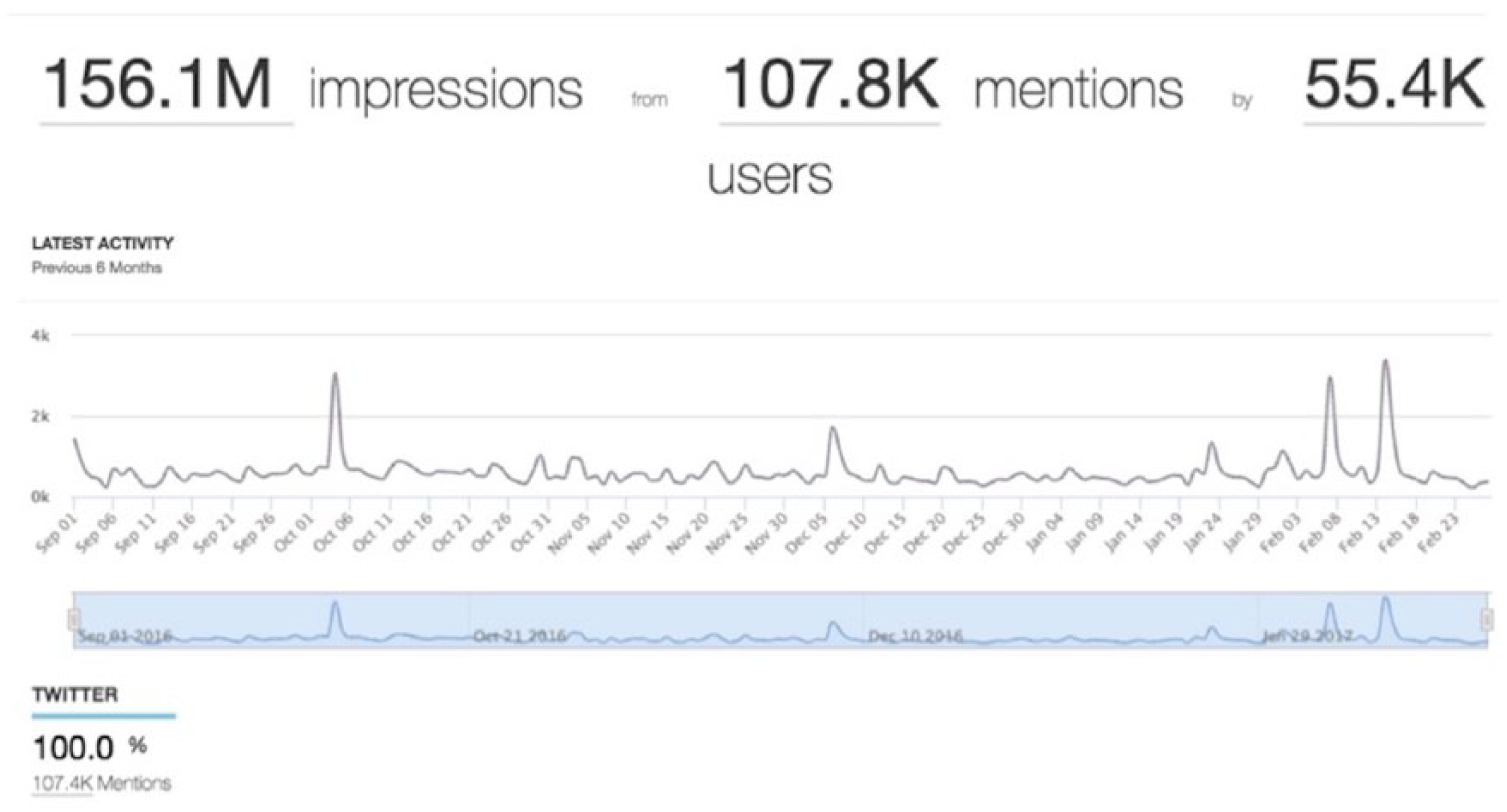
Tweets produced by users, Sept 2016 – July 2017.
The peaks match key timelines aligned with the inquiry. For example, the small peak that can be seen at the beginning of the timeline of 1 September 2016 is associated with the announcement by the Government about the inquiry. During the 1–6 October 2016 period, there is a larger peak which coincides with the Sisters in Spirit vigil held on Parliament Hill in Ottawa, Ontario, expressing their disappointment and concerns over the delays in starting the National Inquiry into MMIW since its official announcement in 2015.
By December 2016, there was momentum by Twitter users highlighting that the inquiry was too clinical and legal in its approach to the presentation of stories by families and friends. Twitter users acted by tweeting that the inquiry was not conducive to the spiritual and cultural ways that families wanted to present the stories about their loved ones who were either missing or not found. Laying tobacco, bringing in elders and cultural items, and talking about the life stories of their loved ones were important to them. The inquiry, at that time, was perceived to be presenting itself as a courtroom. Twitter users began educating the public. In doing so, they were recommending changes to the approach of the National Inquiry. It became clear at this point that there was an obvious mismatch between the inquiry commissioners and what Indigenous peoples expected the inquiry format to be.
The next major peaks are in February 2017. This time users took to Twitter raising awareness about the need for the inquiry to address the spectrum of violence including investigating police procedures. There were also tweets announcing the first public hearing in Whitehorse, which was scheduled for 29 May 2017. Many tweets were preparing families and communities for the hearing as well as calling into question the inquiry process and approach. The last peak was in July 2017, which correlated with the first commissioner resigning. Twitter users began to call for a reset and restructure of the inquiry. Nevertheless, the inquiry continued. The inquiry did take into consideration cultural input in the approach as well as decide to include stories about the police procedures. To some extent, we believe that Twitter users played a large role in bringing awareness, if not some change, to the approach.
Data provide undisputed facts that people are interested, they care, they engage with information from tweets and they form or reform opinions. Replies and comments, retweets or likes confirm this. For the September 2016–July 2017 period, the top nine tweets during this period garnered a large number of retweets between them with the highest retweet count being 863 (Figure 2). Tweet content focused on seeking support and boosting the MMIW story. Because each of the users whose tweets were retweeted have large numbers of followers their messages get distributed to a wider audience very quickly (see examples below). Thus, the velocity and impact of a single tweet can be significant.
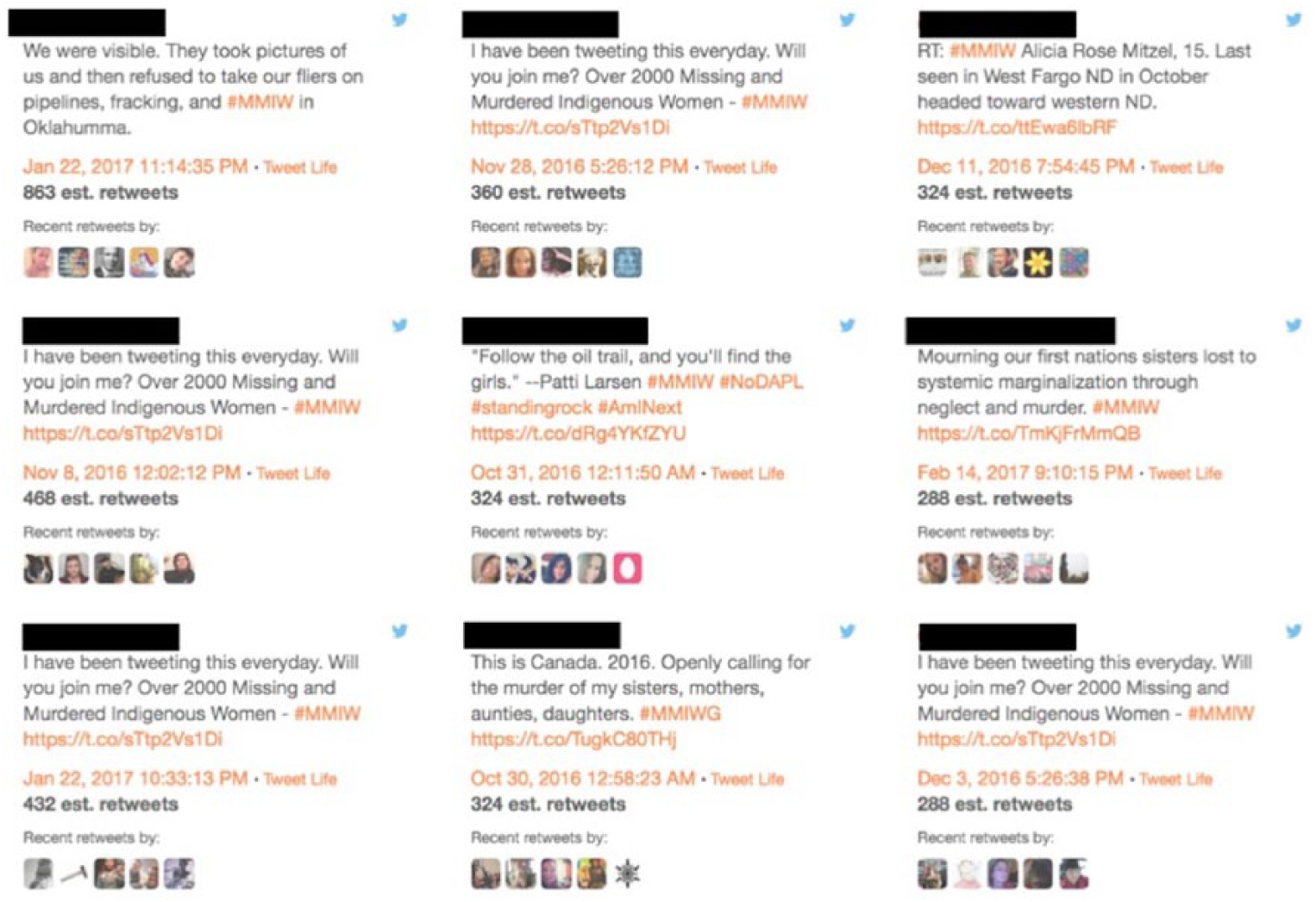
Tweets using the #MMIWG during the September 2016 – July 2017 period.
The data collected demonstrate how big data analysis can provide insight into SM activism with regard to #MMIW and the related inquiry. The next section provides a synthesis of the literature reviewed and the data with a framework of reframing, restoring and returning.
Reframing: taking control
This article highlights that Indigenous peoples themselves are taking control of how their lived realities and their political agendas are depicted on Twitter. They are using SM platforms to tell the Twitter world what is important and meaningful with regard to their communities and families. In this case, they are honouring MMIW by continuing to pressure the government about the national inquiry as well as outing the political, sexist and racial contexts in which Indigenous peoples are constrained by. It is clear from many of the tweets that they are using this forum to mobilize and conscientize the public. We believe SM activism is the new format for Indigenous self-determination strategies to influence broader societies views of Indigenous peoples.
In a fairly short order, SM platforms, in this instance Twitter, have become repositories of social life in all its aspects, from intimate pictures of families and important events in one’s life to participation in social movements.
Restoring our well-being
The tweets and retweets from our research demonstrate the heartfelt stories shared across Twitter. They include stories from family members, friends and concerned citizens from all over the world. There were messages of prayer and anger. So, when we present this research to the public, our first slide is always a tribute to the MMIW themselves acknowledging that they are a mother, sister, friend, auntie, cousin, community member and have a spirit. We are mindful of the tremendous responsibility we have as educators to ensure that we put the heart back into our research.
Smith (1999) discusses restoring as being about using holistic approaches to problem-solving. In this research, we have simultaneously reached out to the local Indigenous community working in the area of mitigating violence perpetrated on Indigenous women. This outreach has resulted in a collaborative approach to raising awareness about the use of social and in particular Twitter as a means to raise awareness locally. For example, we engaged the local Indigenous community in a workshop that specifically focused on how to use SM in Indigenous activism. This consisted of a half-day interactive workshop whereby we provided a presentation that was followed by hands-on practice of setting up and working with a Twitter account. In addition, there was a fulsome discussion on the use of SM to raise the profile of social issues. Further to this, we also agreed to participate and share our findings at a local Indigenous workshop on MMIW. In this way, we are mindful of working from a holistic approach of engaging with individuals and community members versus taking a traditional academic approach, which is to solely work with the data and report on it in academic spaces.
Returning: repatriation of MMIW stories
In this research, we discuss returning as being about the repatriation of MMIW stories. There is not much sense, in our view, of doing research for research sake. Rather, because we consider ourselves social justice researchers we endeavour to ensure our work connects back to the Indigenous community and especially Indigenous women. We have also assisted with amplifying the need for an inquiry and have assisted with getting information out about events that support MMIW through our own personal SM accounts. We have also spent time among ourselves as well as with Indigenous community members discussing critical questions of how we influence the broader society and conversations around MMIW so that people understand that the issues are very real. In our workshops, we ask critical reflection questions for audiences to consider such as: What can you do to assist with shifting perceptions/stereotypes of Indigenous women using SM?
Concluding remarks
SM cannot provide a complete understanding of a social event. However, it does provide a comprehensive look into how certain individuals frame events. Big data analytics can provide data evidence of SM movements, which can compel audiences to rethink previously held constructions about certain issues. This is important because media stories can last a few days until the next sensational story emerges. By sharing information via workshops, conferences, tweeting or via articles, we keep the MMIW stories alive and up-to-date. This is important because for the longest time narratives around MMIW were obscured from broader society. It also assists with maintaining political pressure to ensure change happens. For Indigenous families and friends, this provides some assurance that people continue to care about them and that there are others who are dedicated to finding solutions. For educators and researchers, we believe we must be part of contributing to making a better society for everyone. It is not only our duty but it is our moral obligation.
Footnotes
Declaration of conflicting interests
The author(s) declared no potential conflicts of interest with respect to the research, authorship, and/or publication of this article.
Funding
The author(s) received no financial support for the research, authorship and/or publication of this article.