







Abstract
The new environment for Filipino journalists is a difficult terrain to navigate: Professionals struggle to establish themselves as a source of information in the time of technological disruptions, digital populism, tighter market competition, labour precarities and the political pressures of an increasingly authoritarian regime. This provided the context for the subsequent discussion on journalistic competence: What competencies are most important for Filipino journalists given this status quo? More importantly, how should the concept of journalistic competence be viewed, conceptualised or interrogated given the current conditions that affect or threaten journalistic practice? The discussion on competencies was anchored on extant research, a survey with Filipino journalists and data from in-depth interviews with selected experts worldwide. The prominent elements of journalistic competence in the Philippines were identified and discussed vis-à-vis factors and conditions that influence journalism competence such as journalistic roles, media systems, popular attitudes towards news and educational infrastructure.
Keywords
The Internet pervades life in the Philippines in a rapid pace, as evidenced by the surge in Internet and mobile penetration rate and in the volume of transactions done online (see Internet World Stats, 2020; We Are Social and Hootsuite, 2020). In fact, Filipinos spend more time on Internet and social media than most populations across the globe (We Are Social and Hootsuite, 2020), including those in many developed countries, making the Philippines the ‘social media capital of the world’ (Mateo, 2018). Although it can be argued that the time spent on the Internet could be attributed to poor speeds, the idea has yet to be validated by empirical studies; moreover, the level by which Filipinos use the Internet, particularly mobile Internet, could also be seen in the increasing adoption of digital finance (Massally et al., 2019) and the birth of the online public sphere. This is an irony if one considers the mediocre Internet infrastructure and urban–rural divide (Estella and Löffelholz, 2019). In other words, the Philippine case is that of a developing country lacking the competitive science and technology infrastructure, or at least the infrastructure comparable with the so-called Global North nations, but with a robust Internet and mobile market (The Nerve, 2019). What adds another layer for analysis is the country’s ‘authoritarian turn and democratic decline’, to borrow Power’s (2018: 307) words, spelling dire implications for its long tradition of watchdog-adversarial journalism (Balod and Hameleers, 2019). All of these conditions characterise the current environment in which Filipino journalists operate.
Given all these, it becomes important to ask the following: What do journalists need to have to navigate an environment changed by digital and economic disruptions and governed by an administration that seems intolerant of critical reportage? What defines – or should define – ‘journalistic competence’ in a country such as the Philippines, a developing country with ‘severe income inequalities’ (IBON Media & Communications, 2018), remarkably high Internet penetration, and high levels of educational deprivation (BusinessMirror, 2018)? How can the notion of journalistic competence or journalistic competencies be conceptualised or interrogated? This article attempts to address these questions.
The article has four parts. The first and second lay down the context for the discussion on journalistic competence. The first builds on a survey with Filipino journalists and tackles the character of digital newswork as well as role perceptions especially under the Duterte regime. The topic of competence cannot be divorced from an account of the political and media system, as well as an account of prevalent journalistic roles. The second covers the state of research on digital newswork and journalistic competence in the Philippines, while the third describes the main research design and method given the research deficit. The last part delves into concepts integral to understanding journalistic competence, as well as perspectives relevant to ‘Global South’ settings, particularly the Philippines. In this part, I will describe journalistic competence in the Philippine setting, based on literature and on the insights of experts in the country and other experts across the globe.
Digital populism in the Philippines: disinformation campaigns and delegitimisation of professional journalism
Populism as a concept has been defined and studied in many ways, so much so that the ‘definition is not always clear’ (Noury and Roland, 2020: 423) or the definition is often disputed. In some works, populism is a political strategy, in others a political communication style, an ideology, or a ‘project of political renewal’ (Brubaker, 2017; Kriesi, 2018 cited by Noury and Roland, 2020: 423). Perhaps, the most inclusive is the oft-cited definition of Mudde (2007): Populism is a thin-centered ideology that considers society to be ultimately separated into two homogeneous and antagonistic groups, ‘the pure people’ versus the ‘corrupt elite’, and which argues that politics should be an expression of the volonté générale (general will) of the people. (p. 23)
Being ‘thin-centered’ means that populism can ‘ally with all sorts of ideologies’ (Noury and Roland, 2020: 424), which would explain the presence of radical left and radical right populisms in different countries. Populists believe or project an image that ‘they are the only true and virtuous people whose views are underrepresented in politics and in the media’ (Schroeder, 2019). Populist leaders bank on messages that appeal to broad masses or are made to appear that such messages represent the will or the interest of the people.
In their review of literature on populism, Noury and Roland (2020) arrived at cultural and economic factors that could explain populism, apart from the role of disinformation in social media. They explained that populist parties, especially the right-wing, ‘exploited the economic trauma and anxiety’ of the population to push forth their political agenda (Noury and Roland, 2020: 435). This could explain the rise of populism following an economic crisis, as in the case of radical right populism in some European countries during and after the Great Recession in 2008 (Pappas and Kriesi, 2015). Cultural factors, meanwhile, are a matter of identity and values, as seen in the rise of populist parties espousing the traditional or conservative values believed to be under threat by those of ‘othered’ groups (Noury and Roland, 2020: 433), or of parties marketing an image that appeal to their supporters’ sense of identity (i.e. the supporters of populist leaders see their ideals embodied in the declarations and political agenda of the latter).
Which brings us to the case of the Philippines under President Rodrigo Duterte. The conditions prior to the 2016 elections allowed to Duterte to take the populist mantle, with a promise of change from the previous administration that his supporters often describe as tone-deaf and out-of-touch with the reality of the majority. Although the populist ‘political style’ is not new in the country, Duterte’s is a ‘departure’ (Curato, 2016a: 145): His brand of populism banks on an image of authenticity, which supposedly excuses his cursing and ‘bad manners’, as opposed to the supposed ‘hypocrisy’ of his detractors and predecessor. He also banks on a strongman image (Curato, 2016a: 149); a leader with the political will to get things done and who will not hesitate to use brute force supposedly for the greater good of society. The ‘populist publics’ that supported Duterte in the 2016 elections ‘cut across classes, generations, gender, and geography’, as the messages of his campaign resonated with the everyday Filipino (Curato, 2016b: 95–97). These messages articulated what Cabañes (2020) described as ‘aspirations that ordinary Filipinos had about discipline brought about by their fears about the country’s rampant disorder and criminality’ – messages that appeal to the desperation for change of a nation marked with steep inequalities, corruption and rural–urban divide (Estella and Löffelholz, 2019).
In the years following Duterte’s rise to power, the country has seen an increased ‘weaponization of the internet’ (Ressa, 2016). As Ong and Cabañes (2018: 1) observed, ‘trolls’ and the ‘fanatic followers’ of Duterte have ‘debased political discourse’ in social media through ‘vociferous sharing of fake news and amplification of hate speech’. Political players across the spectrum clearly took advantage of Filipinos’ social media ‘addiction’: click farms, troll armies and fake news were systematically deployed to sow disinformation and shift public opinion (Estella and Löffelholz, 2019). Duterte himself admitted that people were paid about US$200,000 to ‘defend him on social media’ during the 2016 campaign period (Ranada, 2017).
Schroeder (2017), in comparing four right-wing populist movements in the United States, Sweden, India and China, found that digital media was a ‘precondition for success, but in quite different ways, depending on the media system’. The use of paid disinformation campaigns appear to be in the playbook of an increasing number of right-wing regimes worldwide, making digital populism a ‘dangerous threat’ to democracy and human rights in a different way than traditional right or even left-wing populism does (Zabala, 2020). Schroeder (2019) noted that in digital populist campaigns, the ‘issue of media manipulation’ is a dominant theme, leading to a ‘more fluid and antagonistic’ relationship between media and the government. In the Philippines, these disinformation campaigns also attempt to delegitimise non-state or alternative sources of information, especially those with a reputation for publishing content critical of government policies or statements. Filipino journalists perceive ‘online harassment’ as one of the ‘key safety threats’ in today’s practice, based on a 2018 survey conducted by the International Federation of Journalists (IFJ) and South East Asian Journalist Unions (2019: 40).
Apart from dealing with systematic disinformation campaigns, journalists also have to struggle with low levels of audience trust, ‘offline’ harassment and attacks, low-paying or unstable jobs, and other forms of employment precarities (see also Tandoc, 2017). According to the 2020 Digital News Report survey (Newman et al., 2020), audience trust towards news in the Philippines is one of the lowest among 40 countries in the sample, which might be linked with Duterte’s consistently high-approval ratings since he assumed office in 2016 (Mendoza and Canare, 2020), although this has yet to be proven through empirical approaches. Philippines also continues to be in the bottom third of the World Press Freedom Index (Reporters Without Borders, 2020), as the ‘culture of impunity’ that makes journalists targets for harassment and assassination continues to exist (Bacalso, 2020). Furthermore, what was described as Duterte’s ‘political vendetta’ against news organisations sends a ‘chilling effect’, especially after the forced closure of ABS-CBN, the country’s leading media network, in 2020. Duterte said that he himself will block the renewal of its franchise because the network allegedly did not air his campaign advertisements in 2016 (Corrales, 2017).
To cope with this kind of hostile environment, journalists had to employ methods to distinguish themselves and their brands from the other sources of online information. In an initial survey with Filipino journalists conducted online in May to July 2018 (N = 84), 1 majority reported that they had to double down on fact-checking as a counter-disinformation strategy (some of the responses include ‘enhanced validation of data/info’, and ‘present all proof and information possible to strengthen the story’). One shared that there is ‘an added pressure not to be wrong’. Majority reported that
The number of hostile or troll comments (e.g. comments ‘maligning the integrity of the news firm’ or ‘maligning your integrity as a reporter’) increased since 2016 (82.1% of the sample);
Times of ‘emotional stress’ from reading adverse or offensive comments on their stories (57.1%);
Their newsrooms institutionalised new methods to establish online integrity, such as investing in fake news seminars (57.1%);
They changed their individual work habits or methods in response to a perceived change in audience preferences and feedback online (63.1%);
They ‘strongly’ believe that Duterte’s pronouncements about the Philippine media influence audience perception (54.8%).
Apart from more rigorous fact-checking and establishing an image of integrity, self-censorship appears to be an alarming way to cope. For instance, one of the respondents said that ‘there’s a marching order from our top bosses to “avoid confronting and agitating” Duterte . . . We are also encouraged to write more positive stories’. Indeed, as Balod and Hameleers (2019) wrote, Filipino journalists at this time ‘revert to the primary roles of journalism such as the basic dissemination of factual, accurate, and balanced information and checks and balances of the institutions in power’. Although journalists believe that watchdog and interpretative roles are important, political and commercial pressures lead to reluctance in publishing critical reports – a form of self-censorship that could have sprung not only from the perceived audience sensitivity to negative news frames, but also from the audacious exercise of political power against news media.
In addition, state functionaries peddle their own narratives on journalistic competence, which served as their pretext for attempting to regulate the media. For instance, since 2013, government officials have been proposing a ‘Magna Carta’ for journalists, which, if implemented, will require journalists to pass licensure examinations every 6 months. The declared rationale is to ‘professionalise’ the journalism industry, but for Teodoro (2018), this is only a veiled attempt to ‘silence critical journalists’ because these examinations may force journalists to pander to the motives or ideology of whoever is in power. Furthermore, by deriding journalists for being ‘biased’, unethical or as hindrances to governance and progress (see, for example, Chua, 2020), Duterte and his supporters appear to have capitalised on supposed media lapses or ‘incompetence’ to justify political manoeuvres inimical to media freedom.
In the time of these narratives and counter-narratives defining journalistic competence, scholarly inquiry is therefore essential, and this begins with revisiting what has been written on the topic. The state of research, however, suffers from a deficit, which will be discussed in the next section.
Digital newswork and journalistic competence: the research deficit
The volume of research on online or digital newswork (i.e. production studies) pales in comparison with that on digital news content and audience perception in the Philippines (however, even the research on the latter is far from robust). In terms of themes, the research is highly fragmented, something that could easily happen if the research is also painfully scant. There are works that dealt with how news workers and their organisations modified their routines, logics and decision-making according to online or social media trends (David et al., 2019; Zafra, 2018) and how journalists perceive their roles ‘in response to mis- and disinformation’ (Balod and Hameleers, 2019). An earlier work examined role perceptions as well, and also included the demographic profile and perceived challenges arising from the emergence of new technologies (Tandoc, 2017). Other works focused on the language and content themes of online news, including multimodal news. One article covered how the news media was burdened with the political pressure that came with the Philippine cybercrime law, which includes a provision on online libel (Robie and Abcede, 2015). Interestingly, outside the database searches, there are unpublished works that deal with online journalistic production, but none were peer-reviewed (e.g. Baldemor, 2011; Quinto and Viray, 2014).
Even the broader field of journalism studies appears to be new to empirical approaches to journalistic roles, practices and cultures. It was only recently that journalistic roles (see, for example, Tandoc, 2016) and role perceptions (see, for instance, Balod and Hameleers, 2019) were investigated through established empirical methods, particularly large-sample studies. Surveys profiling journalists and determining the state of media freedom were published fairly recently (see International Federation of Journalists and South East Asian Journalist Unions, 2019; Tandoc, 2017), although the country has long been included in the World Press Freedom Index, which evaluates the ‘degree of media freedom’ in 180 countries through surveys with experts (Reporters Without Borders, 2020). The case of digital news consumption behaviour is more or less the same story; it was only in the latter part of the last decade (2016–2020) that the Filipino audiences’ attitudes towards news and their gateways to news – including digital news – have been profiled (e.g. Chua, 2020; Newman et al., 2020). Consumer preferences (which brands and types of media are trusted to what extent) in general were mostly studied by market research firms that also provide ratings data to media conglomerates in the Philippines.
The state of research on digital newswork is in fact still better than the state of research on journalistic competence or competencies in the Philippines. The same goes for journalism education or journalist training in the country, even though journalism training projects and conferences are common, offered by local and international institutions. The research deficit on journalistic competence could probably be explained by the fact that ‘journalistic competence’ or ‘journalism competencies’ have yet to be conceptualised or theorised especially in the Philippine setting. The same can be said for many settings across the globe, particularly in the Global South. In fact, the state of research on journalistic competence is hardly global and is Western-centric, as suggested by the fact that most studies, particularly the large-sample surveys (e.g. Drok, 2013, 2019; Finberg and Klinger, 2014; Opgenhaffen et al., 2013) and content analyses of job postings (e.g. Marta-Lazo et al., 2018; Wenger et al., 2018), are situated in the Global North, especially Europe and the United States.
A qualitative approach to journalistic competence: the research design
A qualitative research design is a sound choice given the research deficit on journalistic competence not just in the Philippines but across many developing and even developed countries. There are no large-sample studies on journalistic competencies in the Philippines and there are hardly any academic works on the topic.
Moreover, most of the empirical research sought to identify the elements of journalistic competence through responses of practitioners, thus missing the introspection that can be offered by the academe – the ‘corrective to the industry’ (Josephi, 2009: 52) – and other actors outside the industry. Given the gaps and disbalance in perspectives in scholarship, a qualitative research design would allow scholars to ‘go deeper into issues of interest and explore nuances related to the problem at hand’ (Alchemer, 2010).
In this study, the prominent elements of journalistic competence in the Philippines were identified through in-depth semi-structured interviews with experts speaking particularly about the Philippine context as well as experts from 32 other countries and the three accrediting bodies covering Europe (European Journalism Training Association), the United States (Accrediting Council on Education in Journalism and Mass Communications) and many developing regions (United Nations Educational, Scientific and Cultural Organization). These 47 experts also include those who can represent key empirical research projects on journalistic competence and journalistic roles. I cross-checked and annotated data from the interviews with literature, and vice versa, allowing me to identify prominent elements of journalistic competence in different settings across the globe. However, in this article, I will focus only on those that apply on the Philippine condition (which will be discussed further in the next section), according to the insights of experts from the Philippines and environments that share some circumstances with the country.
The experts and the countries were chosen based on several considerations. The countries were selected according to the character of media system, as seen in literature and its rank in the 2018 World Press Freedom Index (Reporters Without Borders, 2018), and other political and socio-economic parameters, taken from the Global Competitiveness Index 2018 published by the World Economic Forum (Schwab, 2018). The experts chosen have both professional and academic experience, a rich portfolio of research on journalistic roles, journalism education or media studies, or were suggested by peers as an authority on the subject. Apart from ensuring that different environments are represented in the sample, I also included scholars who have done landmark research on the field of journalistic competencies and related fields. Much of these were conducted in the United States, Europe and the Nordics, so I had to balance this with perspectives from the areas with poor research infrastructure or poor appreciation for journalism studies research.
Two interview questions that are especially important to this study are the following:
What do you think are the most important competencies that journalists need to have given all the technological and economic disruptions – and other upheavals – in the field?
What competencies do you think are important for journalists given the unique or non-unique circumstances in your country or region?
The data from the interviews were coded through MAXQDA 2020 software. The qualitative coding process was circular: I first generated codes based on literature, then I applied the codes on the data and revised the codes as needed, then I re-coded the data. Emerging codes that are not among the theory-driven codes were included and used when the data were revisited.
Conceptualising journalistic competence: focusing on the Philippine context
In an earlier work, I discussed how competencies as a concept is broader and more inclusive than the other commonly used terms such as ‘ability’ and ‘skill’ (Estella, 2020a; see also Himma-Kadakas, 2018; Sturgess, 2012). It includes skills, knowledge and attitudes, and personality traits – mostly ‘context-specific dispositions for achievement that can be acquired through learning’ (Klieme et al., 2008: 8). Journalistic ‘competence’, meanwhile, is ‘a domain of competencies’ (Estella, 2021).
Following Hanitzsch and Vos’ (2017) typology of role concepts, a typology of competencies can be formed based on literature (Estella, 2021):
Normative competencies – Competencies deemed essential for journalism as a profession, practice or institution to perform its designated or imagined role in society and to contribute to societal development.
Institutionalised competencies – On the individual level, these are competencies that the journalist believes are necessary ‘based on socialization with his or her discursive community’, while on the organisational level, these refer to competencies deemed necessary based on how the organisation negotiated or interpreted normative competencies.
Performative or practised competencies – Competencies that are used in actual practice and are usually studied through methods like ethnography and participant observation.
Perceived performative competencies – Competencies that practitioners believe they possess or use in the newsroom, as well as competencies deemed valuable by journalists in their newsroom operations.
However, a disclaimer has to be made: These categories are not mutually exclusive. For example, some performative competencies are also normative and/or institutionalised competencies translated into practice, ‘a product of negotiation and internalization of norms’ (Estella, 2021). The prominent elements of journalistic competence that will be discussed in the succeeding paragraphs are a combination of these four categories, based on experts’ insights and empirical research.
The Table 1 shows the prominent elements of journalistic competence in environments similar to the Philippines in terms of political system and national income, state-media dynamics, prominent journalistic roles and other factors that influence journalistic competence.
Prominent elements of journalistic competence in the Philippines and environments that share some similar conditions.
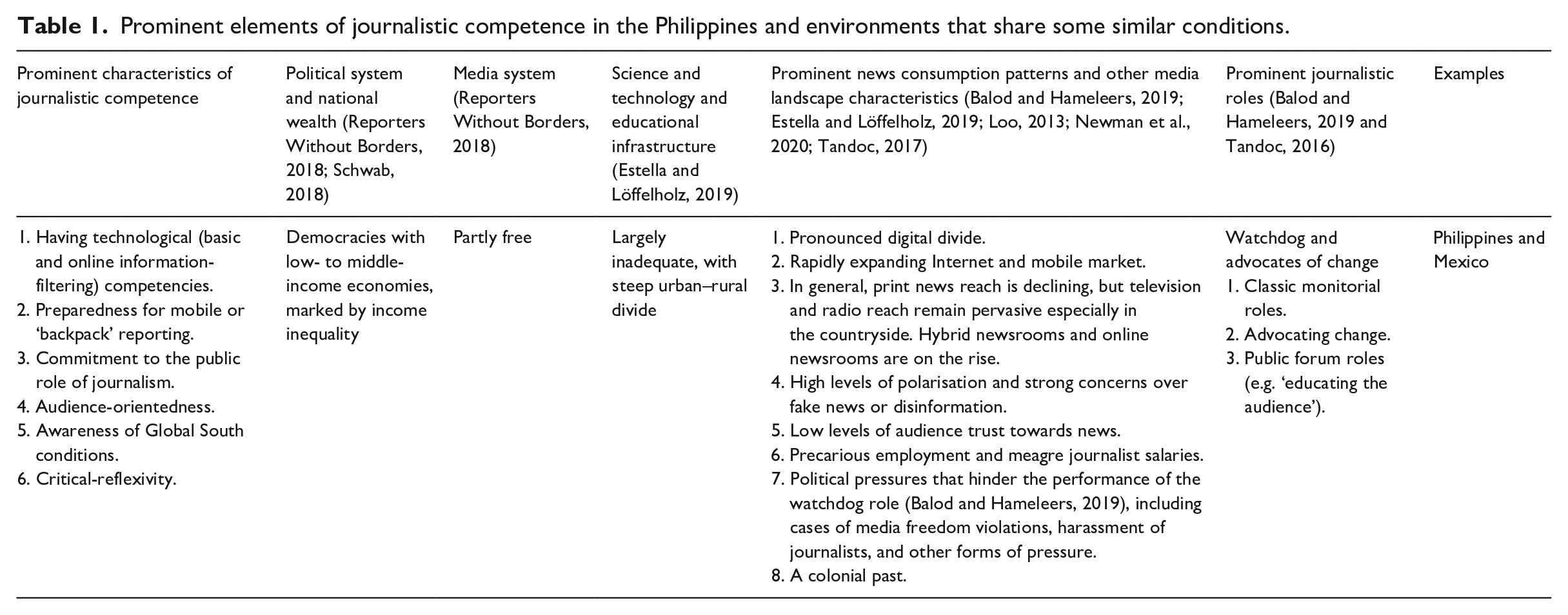
In the next paragraphs, I will discuss each of the six characteristics as enumerated in the first column of the Table 1.
Fact-checking
Almost all of the experts (including those from the Philippines) mentioned ‘fact-checking’ as a core competency or underscored the importance of selecting and evaluating online information. The latter is also related to the ability to assess the impact of content and to identify ‘newsworthy’ (in journalist parlance) information. As discussed in the first section, the digital landscape in the Philippines, marked by systematic disinformation, high levels of social media use and high levels of polarisation, gave rise to journalistic practices that emphasise rigorous fact-checking towards establishing an image of online integrity. The supremacy of this competency as seen in the interviews is congruent with the findings of Balod and Hameleers (2019). They wrote that fact-checking, accountability and self-monitoring, which journalists see as an extension of their watchdog role, became ‘more pronounced’ in the time of ‘post-factual relativism’, out of the pressure to avoid being tagged as fake news outlets.
The emphasis on fact-checking is also congruent with the findings of international and comparative studies. Across many countries, there seems to be a ‘shift’ in journalists’ self-perceived role ‘from speedy news hunter to beacon of reliability’ (Drok, 2013: 156; see also Opgenhaffen et al., 2013). In other words, ‘breaking the news’ is no longer the sole domain of the journalist due to the emergence of alternative sources, but journalists aim to produce verified, coherent and more reliable information from content posted or published in social media and elsewhere (see also Coddington, 2018; Dimitrov, 2014).
In a more recent work, Drok (2019: 12) sees this as an outcome of the shift from the ‘mass model’ of journalism in the 20th century to the ‘network model’ of the 21st century, characterised by an ‘interactive’ journalism infrastructure enabled by the Internet and ‘context-oriented’, ‘accountable’ and ‘transparent’ journalists, as opposed to ‘scoop-oriented’ and ‘neutral’. Drok (2019: 8–10) further explained that this shift came with the financial and functional crises of journalism, largely brought about by the erosion of its monopoly of news. True enough, the media market is shrinking in many parts of the world, as newsrooms are pressured develop and diversify new revenue sources (International Center for Journalists (ICFJ), 2019).
Commitment to the public role
Journalistic competence in environments like the Philippines also involves a commitment to the public role of journalism (journalism as a form of public service and as a facilitator of dialogue). The commitment to the public role of journalism is related to the fact that roles enabling public forum are popular among such countries (see ‘Prominent journalistic roles’ column) . In low- to middle-income democracies like the Philippines, the commitment to the public role can be seen in this prevalence of the watchdog and agents of change roles. Meanwhile, in the tightly controlled developing countries such as Vietnam, this commitment often manifests in the form of informing and mobilising the population according to state agenda.
Basic technological competence
In the Philippines (and in other developing countries that share some similar aspects), journalistic competence requires basic technological competencies (see first item in the first column of the Table 1), particularly taking and editing audio–visual content, online data-gathering, information-filtering and working in social media (especially Facebook). It should be noted that technological competence in an environment like the Philippines is not similar to the basic technological competence required as a minimum in advanced economies, where the research and technology infrastructure enables more sophisticated use of technologies for journalism that in turn require more sophisticated competencies, such as processing and visualising big data and working with artificial intelligence (AI)-assisted editorial systems. This can probably be explained by the fact that while Internet penetration rate is rapidly increasing, the digital divide and the urban–rural divide remain steep, the research and development infrastructure is largely inadequate, and educational deprivation levels are high (Estella and Löffelholz, 2019).
The ability to gather information primarily through mobile phones (mobile or ‘backpack’ reporting) is becoming more common to keep pace with hyperaccelerated content distribution. Interestingly, this competency was deemed very important by many journalists in the less-developed regions (International Center for Journalists (ICFJ), 2017). Several interviewees from developing regions said that gathering information and producing the news text through mobile phones has become a ‘customary practice’, especially for journalists who have to work outside cities or in areas of deprivation. One interviewee explained that journalists now need to use ‘faster tools to keep up with the pace of news through, for instance, practicing mobile journalism where we no longer have to move physically from the field to the newsroom’.
Audience-orientedness
Like in many other countries, Filipino journalists are expected to be more ‘audience-oriented’, which means that they should have the competencies for knowing and building an audience base, something that is less important for journalists prior to the Internet coming of age. However, based on the interviews with experts speaking for the Philippine context, there is less focus on mastering computational or scientific approaches to knowing the audience (e.g. using software in audience data analytics), unlike the audience-orientedness as defined by interviewees speaking for high-income economies. Knowing the audience through such methods is often outsourced to information technology personnel. One of the interviewees underscored the need to balance this audience-orientedness with the perceived societal mission of journalism. She said that especially in countries like the Philippines, there is a danger in interpreting newsworthiness according to what could be ‘viral’, and while that could be ‘considered news because it has public interest . . . journalism is still part of trying to educate people on what is important’. Moreover, around the world, the presentation or form of news has become more audience-oriented: multimodal (e.g. text is supplemented by graphics or videos), hypertextual and more contextualised (readers can access relevant or tangential information through links), more navigable (such as better sign-posting in lengthy articles), and interactive (more feedback options for the audience; see, for example, Lister et al., 2009; Pavlik, 2001: 3–27).
In the Philippines, the greater weight of audience engagement or ‘community management’ could be explained by the fact that Filipinos consume news mostly through social media, especially Facebook and YouTube (Chua, 2020; Newman et al., 2020). Professional news media had to work within the logics of social media in order to boost website traffic or expand the reach of content, the currency in today’s digital journalism. As early as 2009, big news organisations have been employing ‘social media managers’ and online ‘community managers’ to boost readership and carve a niche (Newman, 2009). The same applies to the Philippine context: mainstream news brands have social media officers or teams that are well-versed in search engine optimisation and social media algorithms. Social media roles have become embedded in newsroom practices and ‘increasingly influence news agenda’, as David et al. (2019: 341) found in their study on top four online newsrooms in the country. This has led to organisational arrangements such as ‘inclusion of social media editors in story conferences’ and ‘collaboration between reporters and social media teams’ (David et al., 2019: 329).
Critical-reflexivity and awareness of Global South conditions
The interviewees also emphasised the awareness of Global South conditions (poverty, colonial past, corruption, among others) as a competency that allows journalists to make sound editorial judgements and form a code of ethics grounded on an understanding of such conditions. This also means looking at Indigenous perspectives and being reflexive about ingrained bias in favour of Western perspectives and methods, such as what Nerone (2012; see also Hanitzsch and Vos, 2016) called as the ‘liberal hegemonic view’ in journalism – a body of beliefs and norms imported by the West to other settings and which privileges values of democracy as a prerequisite for effective journalism, even though democracy is practised only in minority of the world’s nations (see also Zelizer, 2012), thus generating an ‘undemocratic form of journalism scholarship’ (p. 465) that is Western-centric (Estella, 2020b: 19).
Finally, given the present circumstances of journalism practice in the Philippines, there is a stronger need to be ‘critical-reflexive’. In the Philippine context, ‘critical thinking’ has long been regarded as a core competency even before the convergence of media technologies. However, critical-reflexivity goes beyond critical thinking as a basic cognitive ability for problem solving or as the ability to assess individual work. It also refers to the capacity to critique role perceptions, norms and routines – in other words, ‘journalism cultures’ (Hanitzsch and Vos, 2017). ‘Critical reflection as an academic effort’, as one of the interviewees said, entails competencies in using academic research tools or methods and familiarity with theory. The seemingly elusive nexus between academic theory and journalistic practice is not really elusive, but only appears to be so because of what Harcup (2011) called as ‘anti-intellectualism’ (p. 172) celebrated by some industry actors, who according to him emphasised practical skills as the end-all-be-all of journalistic competence (see also Hanna, 2005), contributing to the inertia of professional journalism culture at the time of upheavals. As Rodny-Gumede (2018) wrote, journalism education or journalist training in the Global South should be ‘research-based’, reflexive and ‘comparative’.
According to some of the interviewees, critical reflection on technological advancements also allows the journalist to be more open to change because the learning does not end on technical know-how, but extends to looking at technology as a ‘social product’ that has implications on the socio-political, cultural, economic and professional spheres. In other words, the journalist should also be able to analyse technological advancements in terms of ‘how people interact with media’, how these shape their behaviour, and how these impact the media economy and professional norms. Viewing technological advancements through a more critical lens (or through the tools offered by critical theories of sociology, as explained by one of the interviewees) is part of critical-reflexivity.
The insights of the interviewees reiterate what Cabañes (2020) wrote on digital disinformation: professionals have to understand how inequalities, culture, and social dynamics enabled the rise of fake news and political trolling. The ‘moral panics’ over disinformation take a ‘strong information-orientation to understanding digital disinformation’, focusing on the information dissemination process and neglecting the ‘cultural, emotional, and narratival roots’ of digital disinformation (Cabañes, 2020: 436). Journalists need to think beyond fact-checking as a tool against disinformation; they also need to understand and relate to what Hochschild (2016, cited by Cabañes, 2020) called as people’s ‘deep stories’, which refer to stories that people tell themselves about their identity, ideals and place in the world (Cabañes, 2020: 437). According to Kreiss et al. (2017: 470), deep stories reflect the socio-cultural dynamics, ‘economic anxiety’ and media system in a society. The journalist needs to understand that disinformation becomes viral because they connect to or articulate the deep stories of the everyday Filipino, the legitimate online users who then propagate the concerted messages of the paid trolls (Cabañes and Cornelio, 2017: 235). Indeed, in this time of post-factual relativism, ‘identity concerns’ take precedence over fact-checking (Noury and Roland, 2020: 434). Therefore, supporters of populist parties or leaders should not be hastily labelled as ‘trolls’ not worth engaging, even if they help propagate the messages of paid trolls. Professional news media has to be reflexive in dealing with online audiences, bearing in mind the line between paid trolls, whose purpose is simply to deceive and sabotage online conversations, and the legitimate online users who found their voice in them.
For Cabañes and Cornelio (2017), the media industry needs to be more inclusive – the point is to have ‘legitimate news media platforms, rather than trolls, articulate these different positions’ (p. 245). Furthermore, journalists need to be more ‘reflexive in their biases’ (p. 244) and be more transparent in how they arrived at the truth, which meant allowing audiences to see or even participate in the process of gathering information and forming a stand on issues. Understanding deep stories is important especially because the future may require a hybrid of social media manager and journalist (in small newsrooms, the journalists already function as social media managers).
Critical-reflexivity also refers to negotiating market logic with the normative perceptions of what journalism should be (although one of the interviewees is ‘skeptical’ over the possibility of balancing market orientation and societal mission of journalism at all times). Performing the right competencies to sustain this balancing act is an advantage for journalists who work in areas where they can be instrumentalised by political or commercial pressures. Critical-reflexivity then is a prerequisite of flexibility in an environments marked by employment precarities or political disruptions.
One interesting thing to note is that interviewees from the Philippines and other low- to middle-income economies put greater emphasis on (1) the capacity to evaluate political contexts and structures and (2) the capacity to ‘take a step back’ and evaluate individual and organisational work and decisions, compared to the capacity to reflect on journalistic norms, roles and cultures. In other words, for these interviewees, critical reflection is defined more as the ability to evaluate environments and individual work than the ability to interrogate occupational ideology and professionalisation. This could be related to the fact that scholarly inquiry into journalism cultures is not yet a well-developed field of study in the Philippines (the same applies to much of the Global South), as discussed in the section on the state of research. Nevertheless, the importance of critical reflection on contexts cannot be stressed enough. In authoritarian or semi-authoritarian systems (or in countries like the Philippines that are in the middle of a democratic decline), it is necessary to be ‘socialised into the political system’, as one of the interviewees described it, and to be knowledgeable and flexible enough to work with state controls. They should be familiar with the delicate position of media in the society and dynamics of the state and the media. One interviewee cited examples for what he called ‘lateral thinking’, or the ability to approach sensitive or taboo topics ‘sideways’ or through ‘indirect’ ways. Another interviewee described this as the ability ‘to bring out the important content with caution’ that ‘depends on bravery and creativeness’.
Conclusion and recommendations
Digital populism in the Philippines has burdened the news media with the need to distinguish itself from the plethora of online sources and defend itself from the delegitimisation attempts of politically motivated actors, all while trying to survive in a market competition made more difficult by networked technologies and in a hostile relationship with a state that is becoming more and more authoritarian. Given the circumstances of the Philippines, journalistic competence can be defined by some prominent characteristics: having technological (basic and online information-filtering) competencies, preparedness for mobile or ‘backpack’ reporting, commitment to the public role of journalism, audience-orientedness, awareness of Global South conditions and critical-reflexivity. These characteristics can help practitioners across different types of news media (mainstream, alternative, regional, etc.) to better adapt to an ever-changing environment, particularly an environment with increasing Internet use but with high levels of educational deprivation and long-standing inequalities. Current trends suggest that Internet penetration rates and social media use in the country will further increase in the future, which might mean that audience-orientedness will continue to define journalistic competence. The technological competency matrix might also expand as more Filipinos conduct more lifestyle transactions through the Internet, which means that journalists in the future might be expected to have more sophisticated technological skills, especially audience data analytics. This might also mean that as alternative online sources continue to challenge the gate-keeping function of journalism, news outlets will continue to struggle amid pressures of the media economy and might require more qualifications from journalists in the future, but not necessarily providing higher pay (i.e. a ‘jack of all trades’ that can also perform tasks previously delegated to other departments, such as the IT department). The findings and what these suggest in terms of future trends can be used as guide for journalism educators, administrators and policy-makers in reflecting on and making necessary adjustments in journalism curricula.
Newswork has indeed changed to adapt to this new terrain, but there is still little scholarly interest in digital newswork or online news production. It would be best to conduct large-sample surveys or content analyses on journalistic competence in the Philippines, and the ideas discussed here can be tested or used as guide. Researchers should also look into the notions of competence and role perceptions of journalists in regions outside the capital, who may have realities and perceived norms or duties different from those working in the mainstream media.
Finally, in a period marked by technological-economic disruptions, it becomes imperative to re-think or even subvert definitions of journalistic competence as well as the other norms and practices well-entrenched in the industry. More important, it should be clear that while journalists can have all the important competences (normative or performative), the definition of journalistic competence can still be redefined by populists that peddle their own standards and narratives of journalistic excellence.
