






Abstract
The paper presents a methodology to understand WeChat Official Accounts (WOAs) from their backend to their frontend, and from tracing the platform's history to its present. Our ‘Backend-in method’ proposes to study platform governance in the meso – between macro political economic concerns and the micro (and usually mobile) user-interface mediation. It shows how including backend platform media practices deepen ethnographic understandings of platform use. The ‘Traceback method’ uses researcher-informant collaboration to document and reflect on the shifts of platform affordances that have reconfigured media practices, organisational structures, and economic incentives over time. We show how these methods proved useful in mapping Chinese-Australian media organisations’ deployment of WOAs for news production. Together these methods contribute ways to understand previously hidden aspects of media practice and platform governance in a novel methodological design, which may have wider application for future research.
Introduction
Platforms mediate power and history. This study introduces and reflects on a novel methodological approach to understand the history and power of platforms through studying WeChat Official Accounts (WOAs). Our novel methodology contributes to explaining how platform governance in the middle ground – between macro political concerns and micro user interface affordances – comes about. The approach is built upon the scholarship of studying platforms through the ‘walkthrough method’ (Light et al. 2018; Dieter et al. 2019), ‘media go-along method’ (Jørgensen 2016), and ‘scrollback method’ (Robards and Lincoln 2017), as well as theoretical perspectives that situate a ‘media archaeology’ (Apperley and Parikka 2018) and ‘platform historiography’ (Helmond and van der Vlist 2019) as useful ways to learn about the representation, politics, and governance of platforms (Gillespie 2010). Our contribution is to develop additional methods to highlight a platform's mediation of power and history if platforms are themselves a middle ground to distribute power and mediate the past of a platform to its present.
As such, we illustrate our methodological experiences of ‘tracing back’ media practices in line with a platform's evolution and opening discussion from the ‘backend-in’ to locate a new meso space for analysis and insight. Tracing back considers the chronological development of a platform that has continually configured the socio-technical activity taking place on a platform and extended to its ecology in the physical world. Backend-in shifts focus away from frontend user interfaces to ask how the backend experiences of platform management sit between micro and macro concerns of platform governance.
These two methods allow researchers to engage with participants to co-construct knowledge of a platform's history and to reflect on how content creators who are exposed to more sophisticated platform interfaces than individual users come to understand, manage, and negotiate platform affordances (i.e. features and layouts, algorithms, and policy updates) on a daily basis. We hope that our methodological exploration will strengthen inquiries into the mediation between human, platform governance infrastructures, frontend interfaces, backend interfaces, and their combined evolution that reconfigures social activity.
The need to experiment with these methodological innovations came from the extended study of Chinese-Australian migrant media entrepreneurs. Their deployment of the ‘WeChat Official Account’ functions as a ‘platform’ for news production for Australian-Chinese has offered a unique set of media practices. We suggest that the practice of ‘news-focused WeChat Official Accounts’ (Yang 2021a) offers a different site and category of media practice than users who connect to WeChat's interface either on their mobile phones or through their desktop logins. We note WeChat Official Accounts (hereafter WOAs) sit between the frontend user interface common to consumers of this media platform and political and economic concerns of WeChat's policy infrastructures, the latter of which might be better served by using macro-level governance and infrastructural frameworks (Li 2016). Yet, WOAs require an additional set of research practices than those usually found at the ‘frontend’ of social media content creation and use and the macro levels of internet/platform governance.
WOA functions as a type of ‘media platform’ residing within WeChat. WOA operators are able to transgress into the WOA system and shift the programming of WeChat through a backend interface of the domain. WeChat describes these capacities as ‘APIs’ and understands WOAs, including Official Accounts, Service Accounts, and Mini-programs, as their own platforms: ‘The Weixin Official Accounts Platform is used to develop services for Weixin Official Accounts’ (Weixin Docs n.d.). This middle platform produces media practices via unique socio-technical constraints offered to the selected users of WOA. The point of WOA's middle ground is made visible in the hierarchical relationship displayed in the URL http://mp.weixin.qq.com. WeChat projects its WOAs as ‘media platforms’ (.mp) under WeChat's (Weixin) infrastructural governance which is legally executed by its parent company Tencent and its registered webportal QQ.com.
In summary, macro questions of political economy and micro questions starting from the lowest common user interface denominator are useful but not adequate to deeply understand WOA media practices. This article provides an account of methodological experimentations in backing into this novel space to gain and expand ways of knowing how platforms come to function, affect, and connect their users in three sections.
The first section contextualises how we think about WeChat, platforms, and governance. We do not demarcate platforms in the West and China as technologies in China have been developed under the postcolonial influence of the West (Lindtner 2020); emphasising the difference of Chinese technologies would suggest techno-orientalism (Yang 2020). With the recognition of national specificity on WeChat, we highlight the intersection between WeChat (or broadly Chinese digital media) and theoretical perspectives on platform governance that have been largely established by studying Anglo platforms. We understand platforms as socio-technical assemblages and complex institutions (Gillespie 2010, 2018), that are implemented through computational programming, policies, protocols, interface design, algorithms, and censorship and content moderation (Gorwa 2019). Therefore, it is critical to understand how platforms serve and are served by end-users, developers, businesses, investors, state actors, across a governance architecture, ecosystem, and interface (Helmond and van der Vlist 2019). While we frame our concerns from platform governance, existing methodologies of platform-focused research inspired our research design.
The second part situates our methodological design within a critical understanding of the internet and what its ‘situated knowledges’ (Haraway 1988) bring to community mediation. Here we specify how platform ‘walkthrough method’ (Light et al. 2018; Dieter et al. 2019), ‘media go-along method’ (Jørgensen 2016), ‘scrollback method’ (Robards and Lincoln 2017), are collectively drawn upon in the development of platform backend-in method and traceback method. We also show how the traceback method works in concert with media archaeology (Apperley and Parikka 2018), and platform historiographies (Helmond and van der Vlist 2019).
The third part of the paper describes how the two methods were initially implemented in the context of a project examining the internal operations of news-focused WOAs in Australia. Here we reflect on the researcher's own experience observing the WOA community in these ways and the utility of the approach. This section shows how our novel methodology contributes to explaining how governance in the middle ground – between the macro political concerns and micro user interface affordances – comes about. The paper concludes by considering the limitations of the research and its applicability to future work outside of the WOA ecosystem.
WeChat Official Accounts in Australia
Here we describe WeChat and how it works from interface to governance, including the meso-level platform practices observed around WOAs in Australia. With 1.24 billion monthly active users recorded in the first quarter of 2021, WeChat is arguably the primary social platform for Mandarin speakers globally (Iqbal 2021). In August 2012, the text-oriented information-broadcasting sub-platform WOA was launched on WeChat which at the time started transforming itself from an instant messaging app to a platform infrastructure (Plantin and de Seta 2019). Since then, the sub-platform has been employed by individual and organisational users to produce and circulate information among groups of subscribers and WeChat users. Different from individual WeChat users, WOA accounts have access to a level of managed generativity (see Zittrain 2008) in the platform. It allows these accounts to work with and within the platform in ways common users cannot, presenting itself as a middle ground between web 2.0 interfaces common to the West and open media-platform construction, but with Chinese political considerations overriding. In one sense, WOAs function as ‘platforms’ embedded within WeChat, an infrastructure of platformisation. The function offers a diverse range of features to its users including publication, messaging, user forums, polls, advertising, payment, and user profile analysis, which are described as the ‘APIs’ by WeChat. The use of the term ‘APIs’ suggests each WOA's technical capacity of repurposing its frontend interface without being able to programme new interfaces within WeChat. The relation between WeChat and the WOA is characterised by WOAs performing as a middle space for managed generativity in the string of protocol to interactive content relations within
WeChat's sizable popularity compels many migrant business entities to include information production on WeChat as part of their daily media practice to establish transnational brand awareness among users despite and because of borders and migration patterns. This paper's focus on methodological innovation was spurred from the research practice in a long-term, ongoing project examining the internal operation of news-focused WOAs in Australia. In Australia, Chinese migrant media entrepreneurs have been employing the WOA function as a channel to produce and circulate news stories among the Chinese diaspora (Yu and Sun 2021; Yang 2022). ‘News-focused WOAs’ is the particular genre that this paper and the longitudinal project address.
The news-focused WOAs in the project are based in Australia, however, their businesses are registered in both China and Australia to access the maximum number of functions and markets on WeChat (Yang 2021b; Yang and Heemsbergen 2022). Chinese business licence legitimises a company's presence on WeChat as a ‘Chinese’ organisational account. For example, the group of news-focused WOAs managed by Today Media Group – Sydney Today, Melbourne Today, and Queensland Today – are registered under a technology company based in the city of Nanchang, where their Chinese office is located. This information is demonstrated in the account profile on WeChat. For some news-focused WOAs operated by individuals or small teams, they are bound to certified companies allocated by Tencent in order to access the full APIs offered by the WOA system. Without retaining ownership, those accounts are positioned more precariously, with the possibility of unanticipatedly having their accounts revoked by WeChat. The incentives to do so, however, draw producers of content into the
WeChat's pursuit of strategic convenience and economic efficiency incorporates large numbers of WOAs that are based overseas into the platform and China's internet governance directed by the CCP (Li 2016). With more APIs open, organisational WOAs function like ‘media platforms’, as WeChat projects. Aligning with how WeChat perceives its WOAs to be, many news-focused WOAs in Australia expand their service from news publication towards multiple functions – gaming, payment, user forum, and embedded links into their accounts’ frontend interfaces. In the public discourse, this allows WOAs to frame themselves as ‘platforms’ to dodge the responsibilities that usually apply to media outlets (Li et al. 2018). Whereas ‘media accounts’ must obey truthful coverage of social issues, ‘platforms’ are exempt from this and legitimise the commercial-driven production and distribution of misinformation. A similar discourse has also been deployed by Facebook (now Meta) and Google (Madrigal 2019).
WeChat has restructured the landscape of Chinese ethnic media. Located at the historical continuity of Chinese ethnic media, news-focused WOAs engage in the production of ethno-specific content in Australia, transport the content to China, and propagate the Chinese diasporic portrayal of Australia. Nevertheless, the content production and news representation are under the structuration of WeChat, a platform developed in and governed by the Chinese state, despite those media entities being operated in Australia. The transnational intersectoral complications and the language barriers prevent these Australia-based news-focused WOAs from being overseen by the Australian Communications and Media Authority. Different kinds of questions, assumptions, or misconceptions of news-focused WOAs regarding cross-jurisdictional tensions and expectations (Feng 2019) and the cross-border effects on political activities and identities have been provoked (Yu and Sun 2021). These sorts of debates tend to exclude and otherise this ethnic mediasphere from Australian society (Yang and Jiang 2022). The unique form of news-focused WOAs as ethno-transnational media, governed by platform infrastructures tied to CCP directives, thus poses interesting methodological questions as well as structural ones.
Platforms, governance, and methodology
With the increasingly comprehensive functions integrated into the WOA, operators regard the WOA as a platform in the sense that they are able to design purpose, connections, by adding or removing functions on the frontend user interface layout via the operation of the backend interface. Thus, we understand news-focused WOAs through the lens of platform governance. Platforms mediate power and history. They are anything but neutral or equal (Gillespie 2010) transmission media for the propagation of digital communication. Initial libertarian viewpoints of platforms as open, neutral spaces (see Rheingold 1993) have failed to capture the commercially incentivised technological companies that programme order and our capacities to interact within it. However, this is not to uphold ‘corporational determinism’ by describing digital media corporations as the main or the only agency informing socio-technical change (Natale et al. 2019). We aim to counteract the narratives of technological determinism and corporational determinism through our methodological outlook to underline the complex technological, social, and cultural nature of platforms.
The juxtaposition of the two streams of platform studies underlines the generalisability that platforms in the West and China are entangled with political-economic interests; these entangled interests are rendered in the form of platform governance implemented through computational programming, policy, protocol, interface design, automated curation of news feed, content moderation, and censorship (Gorwa 2019). Existing scholarship from Anglo perspectives has inquired into the hidden power relations within platforms. This includes how the social structure is contextualised by platform capitalism (Srnicek 2017), surveillance capitalism and the state intervention (Zuboff 2019), and programmed social inequality within the platform (Noble 2018). The myriad of power mechanisms is manifested on and veiled behind the platform interface within the institution (Arun 2021). Studies on the Chinese internet specifically identify the embodiment of power into the platform infrastructure (see Liang et al. 2018; Plantin and de Seta 2019; Zhang 2021). In this way, platforms regardless of their national specificities present themselves as a form of middle-ground organisational power mediating between powerful institutions that insert power dynamics within platforms and social activities occurring on platforms (Beverungen et al. 2019); users, on the other end, demonstrate capacity to translate the use of technologies (Latour 1994).
We extend Latour's technical mediation by drawing upon ‘media archaeology’ (Parikka 2011; Apperley and Parikka 2018) and ‘platform historiography’ (Helmond and van der Vlist 2019) to indicate the history within and of platforms. We understand the 'history’ from the two aspects. First, platforms present historical continuity by programming old social structures into technologies through individual programmers and corporate culture (Noble and Roberts 2019). Media archaeology is interested in the historical construction of the present – ‘what has remained from the past in the present like archaeological layers, operatively embedded in technologies’ (Ernst 2011: 241). Platforms emerge out of the sediment of existing social structures. In this way, media archaeology provides a useful technique to trace the emergence and development of platforms and to comprehend how the old media form is built into the platform structurally, politically, culturally, and economically.
In light of the platform's historical continuity, Apperley and Parikka (2015) have bridged platform studies and media archaeology. They propose to understand a platform as an archive that stores and folds the ‘old’ form of media in its evolution. This ‘history’ is highly related to platform's mediation of power while eliminating the more celebratory novelty discourse of platforms. Another aspect of history that we are interested in is the materiality of platforms that presents themselves as underutilised archived web sources, which is described as ‘platform historiography’ (Helmond and van der Vlist 2019). Platform historiography establishes the methodological considerations and reflections associated with the use of multiple sources to interpret a platform's pasts in order to inform the understanding of a platform's present. This methodological outlook does not particularly concern the embodiment of the old power structure into the platform architecture; however, it emphasises the material traces of platforms.
In our methodological development, media archaeology and platform historiography complement one another to necessitate the examination of the platform evolution, the removed, re-emerged, or modified functions or policies, or even inactive or ‘zombie’ platforms that are no longer subject to popular uptake. Despite the invisibility of the removed, refined, or modified features or policies on platforms, they are important subjects to study as they have shaped and redirected user activities. We draw upon the three strands of literature – platform governance and technical mediation, media archaeology, and platform historiography to establish our understanding of WOAs – the mediation of power and history.
From ethnographies online to platform-based methods
The need to gather data in and on platforms has spurred many innovative methodologies extended from ethnography. Platforms, online communities, and their extended activities taking place offline are the fieldsite. This section charts some of these methods to explain how they influenced our own experience in practicing research with WOA professionals. In short, our methods were grown from the literature that guided us and the constraints and opportunities presented in our WeChat-based research site. This organic process of research, including our methodological reflections of the practice, is what provides scope for the article overall.
Well-cited modes of inquiry consider ‘online ethnography’ (Markham 2017), ‘digital ethnography’ (Pink et al. 2016), ‘platform ethnography’ (Bonini and Gandini 2020), ‘social media ethnography’ (Postill and Pink 2012), ‘netnography’ (Kozinets 2015), with grounding from earlier computer-mediated communication potentials from ‘virtual ethnography’ (Hine 2000) through defining virtual communities (Rheingold 1993) and imposing critical multidisciplinary considerations on how these communities mediate themselves (Gurak 1997). The list is not meant to be comprehensive as distinct disciplinary training and distinct mediations of power and history through platforms create ever novel needs and opportunities for research. For an in-depth comparison of some of these listed research methods see Abidin and de Seta (2020). Here we consider how some stand-out methods might apply to WOAs, and what they teach us about how WOAs unique middle-platform position may encourage novel methods itself.
Our understanding of platforms from above aligns us closely to ‘online ethnography’ as advanced by Markham (2017). ‘Online ethnography’ reflects Markham's training in European science and technologies faculties and interpretative ethnography (Markham 2017). What we see as notable in Markham's online ethnography is the emphasis on building a holistic viewpoint of the internet technology without demarcating the online and the offline, and a ‘situated knowledge’ of its participants from a feminist perspective versus the objective construction of knowledges from the view of the researcher (Haraway 1988). In this way, the deployment of online ethnography as the methodological base is to immerse the researcher within the ‘socio-technical’ context where social activities are mediated. From this perspective, numerous methods have hoped to find new ways to gather reflexive data.
The holistic view of platforms is updated into the ‘app’ age through Light, Burgess, and Duguay's (2018) ‘walkthrough method’. This work melds the vernacular walkthroughs of cultural texts with Human-Computer Interaction (HCI) user walkthroughs. It produces a critical analysis from the researcher on platform logics – the history and power at play – via guided tours of interface entry, use, and disuse. We note that these complicated forces are manifested in the form of the platform interface design and governance framework. The method is operationalised to focus on the semiotic and discursive framing of the platform where target user groups are established, the governance model over the user base is characterised by the regulatory framework, and the platform promoting or limiting particular engagements beyond the subject application itself (i.e. with other affiliated third parties). WOAs benefit from such walkthroughs in order to help understand how WOAs frame their users and their community, consider the operating model and its political effect, as well as manage those who use the app (Light et al. 2018). And different types of users might use the app for different purposes.
The study of WOAs allows the researcher's interpretation of the app based on various users’ phenomenological engagements with the technology. It can be useful for a researcher's own persona to structure the enactment of the walkthrough activity where exploration can be associated with the interest of the research and the researcher's narrative of expected use or interest in deviations from it. The heterogeneous human-computer interfaces in a multi-layered platform (like WeChat where WOAs craft content differently from other user types), an extended set of personas and situations are useful to set up. Considering users’ occupational types for WOAs opens questions around how users envision themselves and their interaction with platforms, and to what extent autonomy exists within the confines of the mediated histories and power that spur content creation.
Engagement with subjects in their media go-along method and scroll-back method underscores the user-centric perspective and focus on users’ heterogeneous interactions with the platform. These two methods are usually correlated with interviews with research participants and thus require the collaboration between researcher(s) and participant(s). In particular, media go-along method explores users’ streams of experience and their practices in relation to the platform materiality (Jørgensen 2016: 39–40). Practically, in the course of interviews, researcher collaborates with the participant to look at, navigate, and talk about the informant's digital traces on their personal media account. Scroll-back method (Robards and Lincoln 2017) is designed to study how social media disclosure practices change over time by working with participants to reflect on the longitudinal nature of digital traces on social media. The collaboration with research participants generates participants’ phenomenological understandings of the platform use; however, both the methods would involve strong privacy-related concerns identified by Møller and Robards (2019). Researcher might view or even collect the data that users involuntarily show or contribute under the pressure of co-presenting with the researcher.
Shared amongst all these methods is the foregrounding of the frontend interface as a window into explaining how platform logics can be observed. Specifically, research outcomes of the walkthrough, media go-along, and scrollback suggest aims of how the platform navigates for end-users and how these navigations might be reflexively understood by the user. This is not to mention their relationships to more traditional geopolitical governance concerns or diasporic media.
Considering the above, there are additional opportunities to refine the scope of the walkthrough to be of interest to the study of the WOA ecosystems. We look to capture the middle ground between how ‘end-users’ might walk through the interface and the structures of WeChat itself. That is to say, the creation of WOA layer provides another organising focus of labour, politics, governance, and market concerns that differs from both an end-user persona for the app, and its central structural-platform constraints as measured from the head offices of Tencent. WOAs produce a tangential set of concerns that stem from the intermediate set of practices that themselves navigate between user preferences and WeChat platform governance. In other words, WOA content creators’ media practices dip into both frontend and backend system affordances as well as socio-cultural norms and knowledge of legal regimes at both ends to structure, fill, and share their content. Each ‘end’ of these media practices has a role in creating regimes of communicative practices within WOAs in WeChat and Tencent's larger interests.
Here we see a need to consider not only how frontend interfaces contribute to platform governance, but the backend interfaces that create WOAs as media. As mentioned above, there are unique affordances for WOA accounts situated on WeChat's infrastructure. Methods to develop data around these potentials, their relations to users and those that govern the platform, and structural forces that shape interaction are required. The goal here is to explore how backend interfaces might themselves shape the frontend experience that ‘walkthrough’, ‘media go-along’, and ‘scrollback’ methods attend to. Further, there's room to consider how changes to user-perceivable platform affordances reconfigure user activity. There is a complex and interdependent set of relations between those crafting WOA content, the platform's ability to shift how they do so, and the end-users’ perceptions and engagement with the platform. To further consider these questions, a set of methodological practices was conceptualised and tested in the WOA ecosystem, with a specific focus on the Australia-based WOAs of the platform. The applicability of the methods can be extended to studying other WeChat's public-facing functions (WeChat Service Accounts, WeChat Livestreaming Accounts, and WeChat Miniprograms) as both the frontend and backend interfaces of WeChat are standardised globally. We would also like to encourage researchers to experiment on the new research methods on other digitally dependent entities whose daily operation is contingent on platform technologies. The next section details these considerations, their operationalisation, and the reflection of their implementation.
Implementation and reflection
The design and implementation of platform backend-in and traceback methods are deeply influenced by the ‘walkthrough method’, ‘media go-along’ method, and ‘scrollback’ method, discussed above. Platform backend-in analysis and traceback method can be separately implemented in studying platforms and social phenomena occurring on platforms. Both of the methods are interested in addressing the questions: Who control(s) the platform and how? In the context of this project, the two methods were collectively implemented by one of the authors Fan Yang in collaboration with research participants – Chinese-Australian media professionals from August 2019 to February 2020. With the media business established and being shaped by WOAs, participants observed, documented, and experimented platform affordances on a daily basis. Their insights can be critical for us to understand how WeChat governs.
Traceback method explores how a platform's past shapes the present and views a platform not just in terms of its technical manifestation but also as an economic-socio-cultural-political complex. This method directs both the researcher and participants to recall the previous features (now abandoned or inactive) that nurture the current ones and the transformation in the organisational structure, such as the ownership, external investors, and internal committee board, that individually or collectively shape the way that a platform is represented to the public. To trace back, participants were invited to scroll back to their previous publications and tap each feature within the WOA function in order to recall how the change of platform algorithms, policies, and features has continually reconfigured their media practices. When participants offered a departure point on the transformation of the WOA system on the frontend user interface, the researcher followed the methodological outlook of platform historiography and delved into a further exploration after the fieldwork to confirm and specify the change.
In the post-interview, archival resources that document WeChat's modification were drawn upon. These materials were collected from the official sites of Weixin iOS version (https://weixin.qq.com/cgi-bin/readtemplate?t=weixin_faq_list), WeChat Public Platforms (https://mp.weixin.qq.com/), Weixinpai, and Newrank. Weixinpai and Newrank are two influential WOAs where news and analysis on WOAs are released. These sites were suggested by participants as they also frequently referred to the statistics published by the two WOAs to evaluate their market positionality. To trace back the change taken place within the WOA system, the researcher also included the grey literature, for example, interviews with WeChat developers, developers’ blogs, product documentation, app updates, and academic research to comprehend the change. In the process of tracing back, the researcher recognised that grey literature can come with credibility issues as archives from websites, platforms, and apps can remain incomplete or inconsistent, and old records can be moved, overwritten or deleted. For example, the WOA's incorporation of algorithms in curating the news feed is not documented on the official website (weixin.qq.com). However, the change was brought up by participants and the information was further justified by the researcher reading developer blogs and relevant materials. There is a possibility that researchers who access WeChat through Android, iOS, or Symbian (now discontinued) systems may come up with different versions of understanding of the platform's evolution. There was also a circumstance when Allen (Xiaolong) Zhao, one of the founders of WeChat, announced in March 2019 that WeChat was inspired by Kik, a messaging app in Canada released in October 2010. However, WeChat was widely perceived as a resemblance to WhatsApp for its capacity of platformising existing social networks and the interface design (Horwitz 2014). Disparity like this should receive critical justification for credibility from both the researcher and participants. Based on the web archives and research participants’ recollection of WeChat's evolution, Figure 1 demonstrates a timeline of WeChat's development (iOS system) as part of the research output.
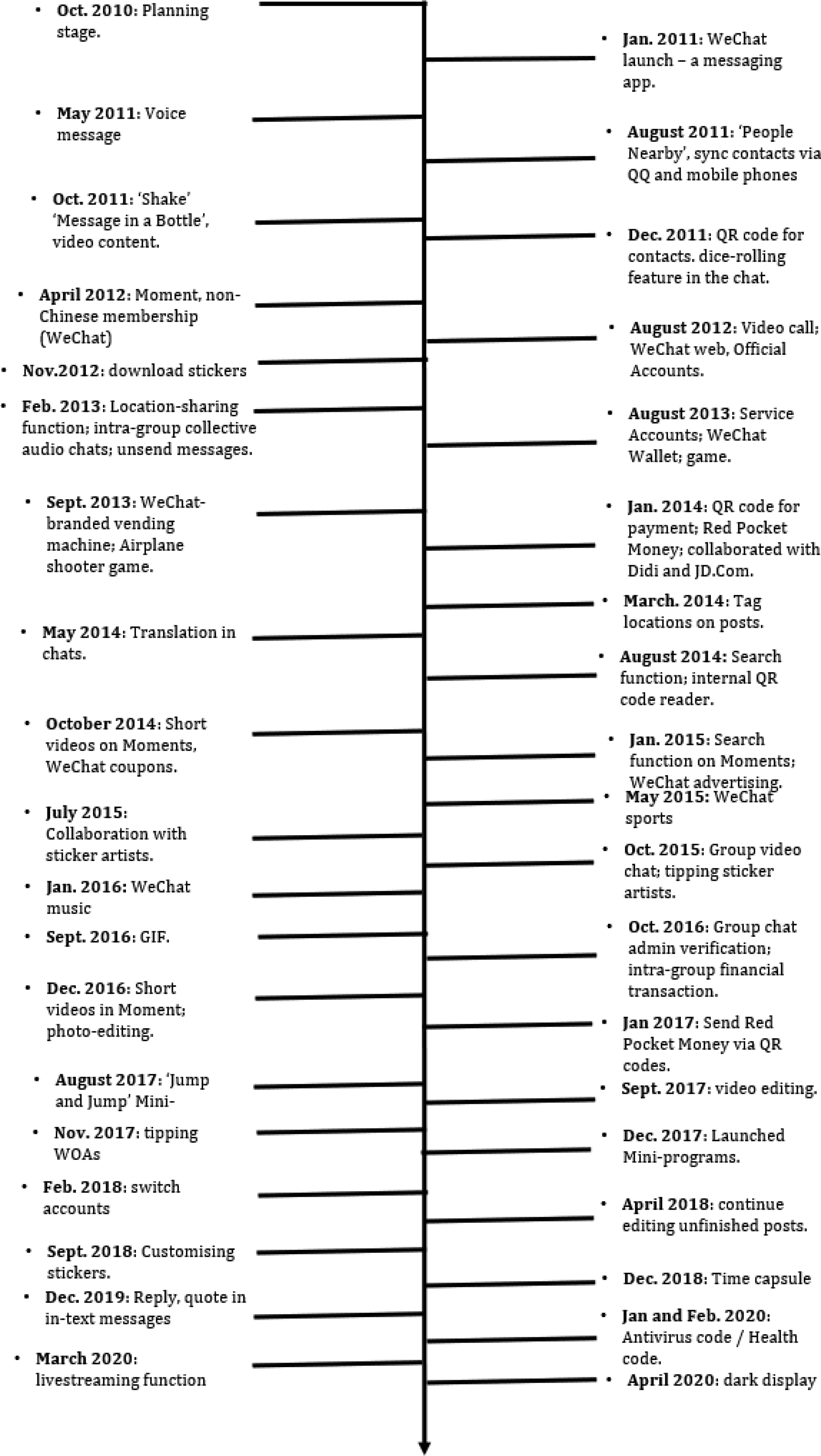
Wechat’s evolution.
Backend-in analysis concerns how the social structure is built into the backend interface through coding and programming, and how the institutional power can be related to the platform design. This method solicits the contention that platforms are vectors reinforcing the existing social structure theoretically and methodologically. In this way, it can be helpful in inspecting how the economic-political-socio-cultural nexus is programmed into the backend interface of a platform. Backend-in analysis enables us to assess conflicts of interests among different bureaucratic departments within a platform entity and among external stakeholders, inspect the negotiation of those competing interests which are ultimately manifested through programming and platform features, and understand the dominant power channelled through the backend to the user frontend interface.
The backend interface of the WOA system is exclusively accessible to the media professionals at the managerial level. For the informants with access to the backend interface, the researcher politely requested if they would be willing to walk through the backend interface of the WOA system with the researcher and assured them that no disclosure would be made on their account identities, confidential statistics or user profiles. The request to access the backend interface was normally proposed in the middle of the interview when the trust between the researcher and the participant had been established. In this project, 3 media professionals agreed to take the researcher through the backend interface of the WOA system on their own laptop (Figure 2). During the process, the researcher observed the publication procedure, took photos of the backend system of their accounts, took screenshots of the policy updates, and wrote down notes on the key interface features to enable future analysis. These actions took place under the permission of each participant. This process was also accompanied by participants’ detailed explanations. Platform backend-in analysis and traceback method were conducted jointly in this project. The researcher also invited the three participants to recall if there was any change that reconfigured their media practices from the backend.

The series of photos and screenshots serve to contextualise the implementation of the backend-in analysis and the backend interface of the WOA system. Key identifiers are covered to protect the privacy of participants.
The two proposed research methods add additional dimensions to the common currency of the user frontend interface on the mobile phone found in online ethnographic study of platforms. Respectively, backend-in analysis contributes to exploring the backend interface of the system which is normally inaccessible to users while playing a significant role in shaping the frontend; traceback method investigates the past of the platform that constructs the present. The two methods are situated in the perspective that platforms mediate power and history as they explore the mediation between the platform and the user, the powerful and the powerless, and the history and the present.
In terms of the ethical concern, platform backend-in analysis and traceback method mitigate the displacement of user's platform experience by the researcher's viewpoint that walkthrough method may introduce; they also eliminate the potential revelation of participants’ privacy when a participant is going along with their daily use of the platform or scrolling back at their previous posts (Møller and Robards 2019). Despite the close researcher-participant collaboration, platform backend-in analysis and traceback method in this project explored the published articles through news-focused WOAs without involving participants’ private messages on WeChat or their personal WeChat posts. Traceback method also invited participants to recall the certain change which had happened within the platform and how the modification reshaped news publication. The request did not involve any revelation of participants’ personal information; instead, participants had the agency to decide how the change could be recalled.
There is, however, a new ethical concern generated particularly through the exercise of backend-in analysis. This includes details of subscriber information to WOAs being visible to the researcher without consent of these individuals. To protect the privacy of participants and readers whose activity could be captured in the backend-in, account statistics represented in the form of photographs or screenshots are covered. With the confidential information involved, being able to access the backend interface of a platform should not be considered as easy or taken for granted. In this project, the researcher Yang's shared demographic feature with participants, as first-generation Chinese migrants, and the pre-established conversation gained informants’ trust and thus the access to the backend interface of the WOA. Online ethnographers should be particularly sensitive and sensible about the future implementation of platform backend-in method so that the imbalanced researcher-informant power dynamics would not lead to coercive actions where participants unwillingly reveal the backend interface or confidential information.
Conclusion
This paper has outlined a trajectory of methods that conceptualise Computer-Mediated Communication through users’ experience with frontend interfaces, and showed how novel research methods can be conducted through considering backend interactions between media practitioners and how platforms govern. We have understood platforms as forms of the mediation of power and history. Platforms are imbued with power dynamics in their platform design, ecosystem, and governance infrastructure through which power is channelled to the public. The organisational power of platforms is contextualised by the existing social structuration. In this way, platforms can be situated in historical continuity without being completely novel. Old forms of media are folded within platform technologies. In this way, platforms present themselves as to-be-utilised archival resources. The understanding of platforms’ mediating power and history has established our methodological consideration to address platforms’ past to inform its present, and to examine its backend system to understand how it shapes user activities through the frontend interface.
Platform backend-in analysis and traceback method were extended from the ‘walkthrough’, ‘media go-along’ and ‘scrollback’ methods. Backend-in analysis invited the media workers to walk through the backend interface of the WOA system with the researcher. This helped the researcher analyse how the media practice on the backend interface configured the frontend user interface on the mobile phone that further shaped user experience. Traceback method examined the change of platform affordance that continually reconfigured the media practice and the ethnic media industry, the implementation of which was hinged on informants’ memory and archival materials of the platform. The past and the backend enabled new insights into the current, more visible media practices of WOAs, which we hope will spur new forms of scholarship that recognise the contextual complexities of digital media practices and platform governance.
Our experiments with backend-in and tracing back show the utility of novel directions and reflections concerning complex media practices that are situated within and permeate outside of platform governance. Future research may consider how these experiments might be incorporated, as well as their limits to creating new knowledge in the mediation of histories and power via platform interface. The future applicability of these two research methods can be extended to investigate how platforms beyond WeChat have transformed and reorganised traditional and emergent industries. This both includes scope – opening up enquiries on how industrialising personas (Marshall 2021) in emerging platforms like TikTok evolve content creation (Abidin 2021), and backend infrastructures as creators acquire new formats and affordances (Heemsbergen et al. 2021; Vicari and Kirby 2022) as well as depth. Our elucidation of the two novel methods serves as a departure point to encourage further methodological development that enables sociological understanding of actions coordinated by platform logics through computational programmes, the testimony of algorithmic changes (usually unannounced), and the identification and prediction of uninformed censorship.
Footnotes
Acknowledgements
We would like to thank Stefanie Duguay, Brady Robards, and Robbie Fordyce for the feedback on the initial conference presentation based on the method proposal. We also thank the reviewers for the constructive feedback.
Declaration of Conflicting Interests
The author(s) declared no potential conflicts of interest with respect to the research, authorship, and/or publication of this article.
Funding
The author(s) received no financial support for the research, authorship, and/or publication of this article.
