







Abstract
In 2016, following the ‘Moomba riots’ in Melbourne, the powerful and damaging narrative of ‘African gangs’ reemerged in Australian media and political discourse. The hyper-criminalisation and problematisation of Black African young people as violent and engaging in gang activity, created moral panics that exacerbated already existing anti-Black African sentiment in Australia. This racist ‘majoritarian narrative’ of Black Africans resulted in far-reaching consequences for the African community in Australia, particularly for African young people. Significantly, it has been noted that in the face of these overwhelmingly negative portrayals, African young people felt invisible, disempowered and psychologically defeated by the media. This paper employs the use of the critical race methodology ‘counternarratives’ to explore the use of social media by African young people in Australia to challenge the ‘majoritarian narrative’ of African gangs. Drawing on six months of social media ethnography and multiple participant interviews with African youth participants (n = 15), this paper argues that social media is a significant site where African young people (re)claim their narratives as African kids who ‘can’.
Introduction
The ‘African gangs’ narrative has problematised and criminalised African migrants in Australia for over a decade (Farquharson and Nolan, 2018). In 2016, following Melbourne's annual Moomba Festival, the African gangs narrative once again re-emerged in dominant media and political discourse. During this time, mainstream Australian media reported that the ‘Apex Gang’ – a group of ‘youths of African appearance’ had ‘terrorised’ and ‘run riot’ through the city (Travers, 2016). Melbourne was portayed as a ‘city under siege’ and ‘overrun by African gangs’ (McNeill et al., 2018). According to Peter Dutton, the Home Affairs Minister at that time, Melbournians were ‘scared to go out to restaurants… because they’re followed home by these gangs’ (Karp, 2018). Despite the inaccuracy of these claims, they incited a racialised ‘moral panic’ (Cohen, 1972/2011) exacerbating already existing anti-Black African sentiment in Australia (Benier et al., 2018; Han and Budarick, 2018).
African gangs discourse has largely been centralised and controlled by white mainstream media corporations and liberal politicians. Victoria's Murdoch-owned tabloid the Herald Sun was identified as a key contributor to reactivating the African gangs story in the aftermath of the Moomba riots (Koumouris and Blaustein, 2021). A time-series analysis (Weber et al., 2021) found that a significant number of African gangs media articles occurred in the period prior to the 2018 Victorian election. The authors argue that the steep decline of media reporting on African gangs following the 2018 election served as evidence that the African gangs narrative was not tied to an ongoing problem with Sudanese and South Sudanese communities, but rather that, following the Liberal Party's election loss, the story of the ‘law and order crisis’ of African gangs in Victoria was no longer a beneficial narrative.
As a response to the increasing dominance of African gangs discourse during 2018, the African Australian community took to Twitter, co-opting the hashtag #AfricanGangs to share counternarratives. Spearheaded by two members of the South Sudanese community in Melbourne – Natalina Andrew and Maker Mayek – these counternarratives visibilised the everyday contributions of African migrants in Australia, challenging the racist portrayal of Africans by dominant Australian media. These counternarratives were a way in which African Australians could ‘fight back’ against the unfair labelling, reclaiming the story by using the hashtag to share their everyday lived experiences as African people in Melbourne. Maker Mayek, one of the movements founders, wrote on Twitter ‘Dear Africans, they gave it to us, so let's wear it with a badge of honour. For the next 24h my profile name will be ‘The African Gang’ (Wahlquist, 2018). Posts by African Australians (Figures 1 and 2 which are examples of #AfricanGangs twitter posts as captured by Wahlquist, 2018) satirically critiqued the racist media reporting, sharing their stories, often alongside photos, to highlight the many achievements and contributions that Africans are making to Australian society. The hashtag was supported widely, with non-African users retweeting the posts to show their support. Despite the popularity of these counternarratives on Twitter, the hyper-criminalisation and hyper-problematisation of Africans in Australia remained consistent in dominant Australian media coverage and still prevails in contemporary discourse. However, these Twitter posts do point to a specific moment in time in which social media was used by African Australians to collectively visibilise counternarratives that exposed and challenged racist media and political discourse.
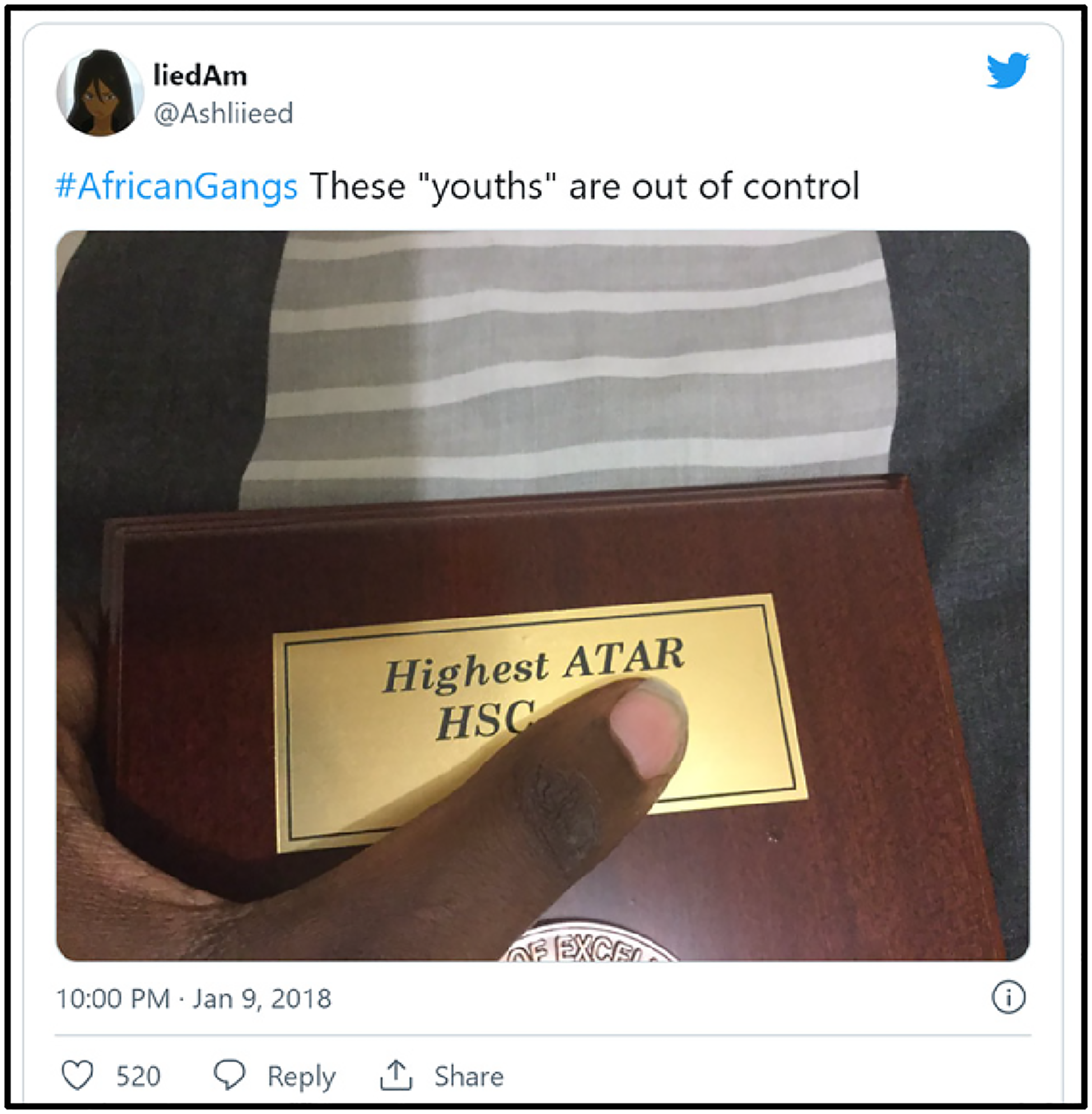
A twitter post with the hastag #AfricanGangs. The post features a photo of an award that says ‘Highest ATAR HSC’ alongside a caption that reads ‘#AfricanGangs These “youths” are out of control’ (Twitter post captured by Wahlquist, 2018).
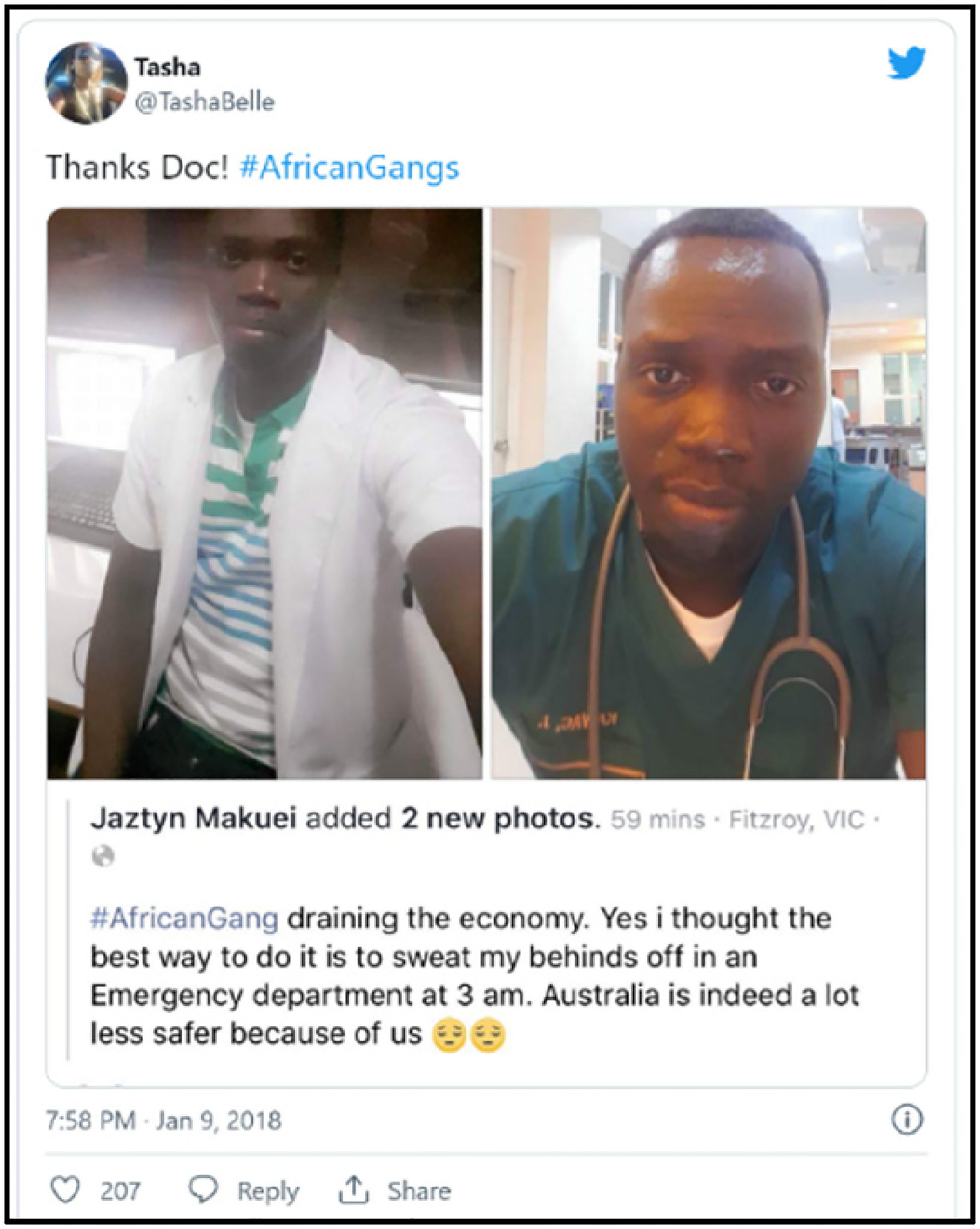
A twitter post with the hashtag #AfricanGangs. The caption reads ‘#AfricanGang draining the economy. Yes I thought the best way to do it is to sweat my behinds off in an Emergency department at 3am. Australia is indeed a lot less safer because of us’ (Twitter post captured by Wahlquist, 2018).
This is where the findings of the forthcoming paper are situated. In this paper, I explore how Black 1 African young people in Australia drew on the affordances of social media platforms to visibilise Afrocentric youth digital counternarratives that, grounded in their lived experiences, perspectives and voices, directly challenged the majoritarian narrative of African gangs that racialised them through problem-centred discourses. These counternarratives are located within participants efforts to shift racial discourse, to dignify blackness and Black stories and ultimately, to (re)claim the narrative of African kids who ‘can’ in Australia. The findings from this study indicate that two common themes emerged within the Afrocentric youth digital counternarrative: Black contributions and collaborations, and Black excellence.
To position the findings of this study, this paper begins by weaving together different bodies of literature – African Australian diasporic research; youth studies and digital media research – to situate the digital practises of African young people within the settler-colonial, multicultural Australian context. Providing this context is essential for grounding the digital practises of the Black African participants in this study as deeply embedded within their racialisation, criminalisation and problematisation in Australia. Following this, I then outline the critical race methodology of ‘counternarratives’ as a response to ‘majoritarian narratives’ (Solórzano and Yosso, 2002), which form the basis of the analysis for this paper.
Background
Anti-Black Australia
The African gangs racist trope of conflating blackness with criminality is a long-standing one, with global and local literature exploring how Black and Brown men are disproportionally grouped under the ‘gang’ and ‘thug’ label (Majavu, 2020; Smiley and Fakunle, 2016). In Australia, these labels are underpinned by enduring anti-Black sentiment that has been a core part of Australian ideologies since the establishment of Australia as an ‘isolated outpost of white supremacy’ by white colonisers in the 1770s (Foley, 2011: 609). Anti-Black/Blak 2 racism in Australia is documented within Australia's racist and violent colonial history, as well as the ongoing colonial project, of white possession and domination and the violent treatment of Australia's First Nations peoples. Anti-Black racism is also evident in Australia's early immigration legislation such as the Immigration Restriction Act 1901 (which came to be known as the White Australia Policy) which restricted, alongside other racial and ethnic groups, Black African immigration to Australia between 1901 and 1973.
Following the abolishment of the ‘White Australia Policy’ different waves of African immigration have seen Black Africans arrive in Australia under the skilled, family or humanitarian visa schemes. From the late 1990s to 2007 there were significant numbers of South Sudanese refugees settling in Victoria. Described as one of Australia's fastest growing communities, this group is mostly young and male (ABS, 2016; Jakubowicz, 2010). Recent census data suggests that approximately 1.7% of the Australian population are African born (ABS, 2016). Half of this number are thought to be white3, middle-class South African migrants (see for example, Majavu, 2017). Additionally there are growing numbers of first-generation Australian-born children of African parentage (ABS, 2016). These diverse migration pathways over the past 60 years, has resulted in what Mapedzahama and Kwansah-Aidoo (2018) term the ‘new Black African Diaspora’ (Mapedzahama and Kwansah-Aidoo, 2018), a heterogeneous group of people, with a multitude of socio-cultural and political backgrounds.
Despite the heterogeneity of the ‘new Black African diaspora’, the African identity is homogenised by the ‘majoritarian story’ of Black Africans in Australia. Their distinctive phenotypic features identify them as ‘too tall, too dark, too culturally diverse’ (Ndhlovu, 2013: 15), making them easily identifiable as ‘foreigners’ (Hatoss, 2012) and ‘perpetual outsiders’ (Mapedzahama and Kwansah-Aidoo, 2010) under the Australian ‘white gaze’ (Yancy, 2008; Fanon, 2008). Throughout this paper I use the term ‘Black’ to collectively group these experiences despite the very diverse sociocultural and political backgrounds of the new Black African diaspora in Australia. Here, I do not advocate for an uncomplicated notion of blackness, but rather argue alongside a number of other scholars (see e.g. Gatwiri and Anderson, 2021; Mapedzahama and Kwansah-Aidoo, 2017) that because of their shared racialisation as Black Africans in settler-colonial Australia there are a number of similarities in their experiences.
I use blackness acknowledging that it is not solely about one's phenotypic characteristics. It is also about how blackness has been social constructed in white majority Western societies, like Australia. Becoming Black is a process of entering the social white imaginary where a Black person must not only be Black, but Black in relation to the white construct (Yancy, 2008). Blackness is often created and discursively circulated within spaces that are ‘imagined and constructed as white, though claimed as multicultural’ (Mapedzahama and Kwansah-Aidoo, 2014: 169). In these white spaces, whiteness ‘orientates bodies in specific directions, affecting how they “take up” space’ (Ahmed, 2007: 150). As such, Black Africans in Australia become Black in relation to specific social, cultural, and political contexts. This means that there is no ‘authentic’ or ‘universal’ Black experience but that ‘shades’ of blackness fluctuate based on locally specific racial politics, histories of white supremacy and interethnic relations among Black people (Asante et al., 2016: 369).
In Australia, ‘living Black’ involves constantly having to navigate ‘normative’ white spaces in which problem-focused stereotypes are imposed upon Black bodies by a non-Black majority. These stereotypes often involve ‘deficit’ or ‘deviant’ discourses, which have been popularised and sensationalised by mainstream ‘majoritarian narratives’ of African migrants (Mapedzahama and Kwansah-Aidoo, 2017). Deficit discourses synonymise all Black African migrants not only as refugees, but as a specific ‘type’ of refugee who ‘needs help’ and is ‘lacking in something’ – this is often implied through a focus on a lack of education, professional expertise and/or English proficiency (Udah and Singh, 2018). Alongside deficit discourses are deviant discourses which construct the ‘gang violence’ of African young people as ‘ethnically-inherent’ and ‘tribal’ (Windle, 2008).
These discourses – created and controlled by the white majority – work together to dehumanise, marginalise and exclude Black Africans who are forced to the bottom of the racial hierarchy in Australia. This is the ‘burden of blackness’ (Mapedzahama and Kwansah-Aidoo, 2017) in which Black Africans are subjected to preconceived, socially constructed, problem-focused stereotypes of blackness which can be likened to being ‘cursed’ or ‘burdened’ (Mapedzahama and Kwansah-Aidoo, 2017: 4). This often unspoken and invisible burden forces Black African bodies to engage in racial ‘work’ (Ngo, 2015) where they undertake ‘bodily adjustments’ to navigate racism (even its anticipation), for example: calling out racism, defending oneself and others from it, taking care of oneself and having to prove oneself. A growing body of scholarship has examined the emotional, psychological and physical toll that this racial work takes on racialised people and communities (see e.g. Gatwiri, 2019; Smith, 2014; Smith et al., 2006; Gatwiri and Moran, 2022).
The ‘African gangs’ narrative
The African gangs narrative has antagonised and stigmatised the Black African community in Australia for more than a decade (Budarick, 2018). In particular, Sudanese, and South-Sudanese youth have been subjected to hyper-criminalisation and hyper-problematisation (Kwansah-Aidoo and Mapedzahama, 2018a, 2018b) often characterised as ‘violent’, ‘out of control’, 'belonging to ‘gangs’ and a ‘threat to social cohesion’ by Australian media outlets and political figures (Majavu, 2020; Windle, 2008).
A significant amount of African Australian diasporic research has focused its attention on examining the journalistic practises (Koumouris and Blaustein, 2021) and media tactics that were employed to construct the African gangs narrative (Budarick, 2018; Farquharson and Nolan, 2018; Hanson-Easey, 2018; Majavu, 2020; Nolan et al., 2011; Windle, 2008). These studies have exposed the specific language that is used to racialise and criminalise Black young people as ‘crimmigants’ (Franko, 2019). For example, perpetrators of African gang violence are often described as being of ‘African appearance’ (Budarick, 2018), ‘barbaric and uncivilised’ (Davis, 2021), ‘skinny’, ‘tall’, ‘defiant and swaggering’ (Windle, 2008). Their violent behaviour is often referred to as ‘un-Australian’ and not part of the ‘Australian way of life’ (Windle, 2008). Instead, it is presented as being ‘ethnic-related’ and ‘race-based’ (Windle, 2008). This is often in direct contrast to the white victims of crime who are referred to as ‘locals’ or ‘residents’ (Windle, 2008). References are made to perpetrators as being ‘imported’ into ‘our’ country and are condemned for bringing with them a ‘plague’, that is a ‘threat’ to the ‘host society’ (Davis, 2021: 121–122). These racialised discourses work to support Australia's ‘white multiculturalism’ (Hage, 1998) whereby the public imaginary of who is Australian and who belongs in Australia typically refers to those with white or white passing skin.
These hyper-criminalised and hyper-problematised narratives are further exacerbated by the media's celebration of the antithesis – the ‘good African refugee’ (Benier et al., 2018; Davis, 2021; Macaulay and Deppeler, 2020). The ‘unusual success’ (Davis, 2021) of African migrants – such as Aliir Aliir – on the Australian sporting field – is positioned in counter to the ‘bad African refugee’, as he is celebrated for his ‘resilience’ and for behaving like ‘one of us’ (Davis, 2021: 122). Davis argues that the ‘good African’ representation helps to stabilise the ‘bad African’ narrative, as media reporting on the success of ‘good Africans’ is presented as the exception to the rule.
Research has documented the devastating and far-reaching consequences that the African gangs narrative has had on the Black African community in Australia. For example: increased experiences of racism and discrimination (Benier et al., 2018; Budarick, 2018; Majavu, 2020); increased police surveillance and racial profiling (Majavu, 2020; Weber, 2020); decreased and/or negative employment opportunities (Han and Budarick 2018; Kalemba, 2021); the depletion of educational, social and economic opportunities (Benier et al., 2018; Macaulay and Deppeler, 2020); and withdrawal and exclusion from Australian society (Gatwiri and Anderson, 2021; Udah, 2018). The findings from these studies demonstrate that the ‘fall-out’ of this dominant discourse has resulted in wide-ranging social, cultural and economic impacts on the African community.
Despite African young people being at the centre of the African gangs media narrative, their voices and perspectives were rarely featured in the coverage, rendering their perspectives and experiences completely invisible (Budarick, 2018; Nunn, 2010). This was particularly evident for young Black African men, who despite being identified as the primary perpetrators of gang violence, rarely featured within the debate. Research has described how African young people have had intense feelings of powerlessness (Macaulay and Deppeler, 2020: 9) and have described themselves as feeling ‘exhausted’ (Benier et al., 2018) by the pressure of having to continually justify and explain themselves in relation to their hyper-criminalisation and problematisation. Despite there being a determination to ‘fight back’ (Benier et al., 2018), African youth explained how they ‘don’t have help’ (Macaulay and Deppeler, 2020: 10) or the ‘resources’ to really ‘make a difference’ (10). These feelings of disempowerment have been emotionally taxing on African young people who have described themselves as being ‘emotionally damaged and psychologically defeated by the media’ (Macaulay and Deppeler, 2020: 9). This sentiment has been captured across the Afrodiasporic scholarship in Australia which has highlighted how the overwhelmingly negative portrayals of African young people have been detrimental to their pursuit of education and employment opportunities and has also had negative impacts on their health and wellbeing (Benier et al., 2018: Young, 2020).
Counternarratives
Narratives are powerful tools for shifting racial discourse (Solórzano and Yosso, 2002). First introduced in 2002 as a critical race methodology in education research, Solórzano and Yosso (2002) define counternarratives as the telling of stories that are ‘grounded in the experiences and knowledge of people of colour’ (23). The counternarrative challenges the ‘majoritarian narrative’ or ‘master narrative’ which is the ‘description of events as told by members of the dominant group, accompanied by the values and beliefs that justify the actions taken by dominants to ensure their dominant position’ (Love, 2004: 229–230). Majoritarian stories are generated from a legacy of racial privilege and are told from the perspective of whiteness (Solórzano and Yosso, 2002). These narratives purport to be neutral and objective and yet implicitly carry ‘layers of assumptions that persons in positions of racialised privilege bring with them’ (28). The ’majoritarian narrative’ is the legacy of colonialism – since Africa was first ‘discovered’ by white colonists there has been a tradition of telling African stories in the West which portray Africa as ‘a place of negatives, of difference, of darkness, of people, who are half devil, half child’ (Ngozi Adichie, 2009). In response to these dominant Eurocentric ‘truths’ about Africa and its people, Afrocentricity has emerged as a paradigm and ‘orientation toward data’ that seeks to reclaim the stories of Africa and people of African descent through their perspectives (Asante, 2020).
As a critical race methodology, counternarratives are key for tackling racism because they centre the expertise and lived experiences of racialised people thus exposing and challenging racist discourses and injustices that constrain and limit subjectivities. Kwansah-Aidoo and Mapedzahama (2018a, 2018b) argue that Afrocentric perspectives are critically needed to challenge the harmful majoritarian narratives of African people in Australia. Afrocentric perspectives will bring a ‘unique person-of-colour voice’ to race talk in Australia which has largely been invisible in mainstream media and political discourse. These counternarratives have the potential to visibilise the unequal social relations and systemic racism that are at the centre of the majoritarian narrative. As such, African youth, who have felt invisible, disempowered and defeated by the overwhelming negativity in the media, are critically needed to challenge, decentre and destabilise the problem-centred anti-Black African discourses that run rampant in settler-colonial Australia.
Positionality
In a paper that centres the experiences of Black African young people, it is necessary to critically reflect on my positionality as a white Anglo-Saxon Australian woman. As a racial outsider to the African community, I am neither Black, African nor migrant and thus this paper is positioned from the perspective of a white ‘ally in training’.
Unlike the participants in this study, I have no lived experience of blackness nor of racial discrimination or exclusion. As such, the findings of the larger research project – of which this paper is a small part – have been led by my partnerships and collaborations with the Black African community to ensure that the findings and analysis of this research are guided by the ’voice of colour thesis’ (Mapedzahama and Kwansah-Aidoo, 2014) that is, people with lived experiences of racialisation inform and guide the analysis and discussion of the findings from this research (see for example: Moran and Gatwiri, 2022; Moran and Mapedzahama, 2022). As such, this research has been shaped by my relationships with the research participants, the mentorship I continue to receive from my relationships with Black African colleagues and co-authors and through an extensive engagement with Afrodiasporic Australian literature (Gatwiri and Anderson, 2021; Kwansah-Aidoo and Mapedzahama, 2015, 2018a, 2018b; Majavu, 2017, 2020; Mapedzahama and Kwansah-Aidoo, 2017).
As a white ‘ally in training’ I endeavour to use my racial power and privileges to centre and elevate the voices and experiences of culturally and racially marginalised groups, like the participants in this study. As such, I have included, where possible, participants’ self-representations throughout this paper, using participants’ real social media content (de-identified), participant-chosen pseudonyms, participant-created bitmojis 4 and participant-chosen ethnic-identity markers. As a white ‘ally in training’ I remain committed to listening, learning and engaging in collaborative work with Black African migrants, so that my work is done with Black Africans, not for them in ways that silence and take up spaces that they should occupy.
Methods
Fifteen young people (16–25), self-identifying as African, and living in Australia were recruited to participate in this study. Participants in this study self-identified as: South Sudanese (n = 5), Kenyan-Sudanese (n = 1), Rwandan/Rwandese (n = 2), Rwandese-Congolese (n = 1), Ethiopian-Australian (n = 1), Somalian (n = 1), Zimbabwean (n = 2) and Zimbabwean-Australian (n = 2).
Participant numbers for this study were purposefully kept low as there was a focus on collecting ‘small data with thick descriptions’ (Latzko-Toth et al., 2017). The goal was not to provide representative data but instead to produce deep insights into the everyday experiences of a small group. Small data offer richness through a process of ‘thickening’ which captures the ‘sticky stuff’ – emotions, stories, lived experiences. As such, the study utilised multiple methods concurrently: social media ethnography, in which participants consented to my following and/or friending them on social media platforms that they nominated and observing their behaviour for a six-month period; and in addition, multiple interviews – comprising an individual ‘social media scroll back interview’ (Robards and Lincoln, 2017), ongoing discussions via social media direct messaging and individual exit interviews.
The scroll back interviews were conducted at the beginning of the six-month ethnographic period and were an important starting point to building rapport with participants as well as understanding how they used social media in their everyday lives – thus capturing the ‘sticky stuff’. In ‘scrolling’ through participants social media spaces with them, the researcher and participant together become ‘co-analysts’, as I was able to ask questions that elicited participants reflections and narratives of their digital content. This ‘shapes the matter that comes to matter’ (Robards and Lincoln, 2017: 716) and produced in-depth insights into the digital practises of participants that have been essential in the analysis of their social media data presented in this paper. Scroll back interviews were conducted in English, were digitally recorded and transcribed verbatim, with each recording ranging from 60 to 90 minutes.
The six-month observation period of participant's social media practises commenced and concluded at different stages between June 2019 and June 2020 as recruitment was staggered during this time. The majority of participants were observed across three social media platforms – Facebook, Instagram, and Snapchat. Due to the nature of the social media ethnography, I engaged in an ‘on-going dialogue’ with participants, where I would occasionally probe for further details around participants social media posts through direct messages, which produced further insights into their social media practises. These on-going dialogues resulted in sustained, behind-the-scenes perspectives into the context of participants’ digital practises, allowing for the ethnographic digital data to be ‘thickened’. At the conclusion of the study, 1650 screen captures of participant social media data had been collected.
All interview and social media data were systematically coded in NVivo using an open coding scheme (Corbin and Strauss, 1990) which allowed for the prioritisation of participants experiences by focusing on patterns that existed in the data rather than assigned a priori. These codes were then thematically analysed (Braun and Clarke, 2006) to establish themes and subthemes and find connections between the transcript data and the social media data. I’ve discussed the benefits and limitations of these methods in more detail elsewhere (see: Moran and Robards, 2020).
Ethical considerations
Written consent was obtained prior to the commencement of the scroll back interviews and social media ethnography. Ethical approval for this study was granted by Monash University (Project ID: 18128).
Findings
Afrocentric youth digital counternarratives: ownership, agency and the African youth collective
The findings of this study overwhelmingly suggest that social media is a significant space in which Black African young people living in Australia can agentially self-represent their stories and experiences. Throughout the scroll back interviews participants expressed their frustrations with the negative portrayal of African youth by the mainstream Australian media and perceived social media to be a place where they could show ‘the good side’. For example, Lance (aged 25, self-identifies as Zimbabwean) explained during his interview that: Africa is always portrayed in a negative way. This leads people to think that Africa is a really poor place, and everyone is starving there. When you turn on the news, pretty much all you see is just that there's been an incident that involved an African. You never see any of the good that they do… so we can use social media to show that good side
A shared sentiment among the participants in this study was that – unlike ‘physical’ or ‘offline’ spaces in Australia where they were subjected to racism and discrimination that they described as unavoidable – in digital settings, they felt in control, using the affordances of social media platforms to create racially safe and friendly spaces. Participants described social media as a space where they had the ‘creative freedom’ (Amy, aged 19, self-identifies as Zimbabwean Australian) to express themselves. They felt ‘in control of how people see you’ (Trey, aged 20, self-identifies as Zimbabwean Australian), using their platforms to show people ‘who I really am’ (Rosalina, aged 18, self-identifies as South-Sudanese). This ownership of their stories, and the ‘control’ they had over creating and sharing them on social media was fundamental to the emergence of their digital counternarratives that form the basis of the forthcoming section.
Like Lance, participant Eddie (aged 23, self-identifies as Ethiopian Australian) was similarly frustrated with the portrayal of African young people by the mainstream Australian media, explaining: We’re not that bullsh*t that you see in the media. Social media helps us to show that African kids can
Significant within Eddie's statement is his use of the word ‘us’ to which he is collectively referring to Black African youth in Australia. Eddie saw social media as essential in connecting and uniting African young people so that they could ‘take back the narrative of African kids in Australia’. This African youth collectivism was a fundamental part of the counternarrative, as participants explained how they used social media to connect with other African youth, and through their cultivation of digitally mediated Afrocentric youth communities, they formed a collective resistance to ‘change the narrative’ (Figure 3). Eddie was particularly active in using social media to call out the mainstream Australian media for portraying a ‘false narrative’ about the African community in Australia, while also encouraging African young people to ‘get involved’ in opportunities to challenge it (Figure 3).
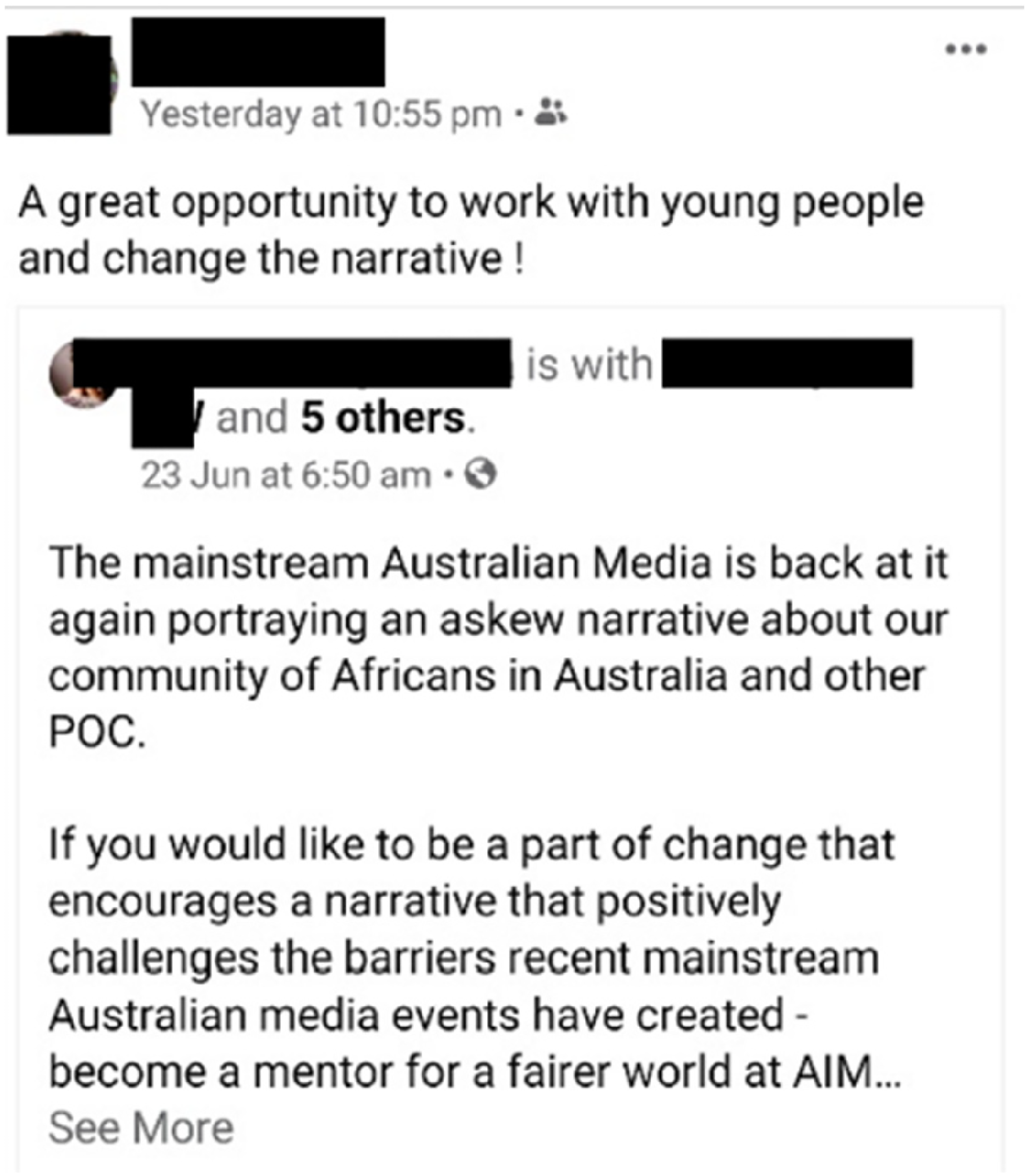
A Facebook post by Eddie.
Participant Mark (aged 24, self-identifies as Rwandan) similarly explained how African youth used social media to collectively shape and enact change stating, ‘social media is a place where we (African youth) can make a difference together’. Mark perceived social media as a tool that could be used to unite all African young people where, collectively, they could show the beauty of your culture and what you are on track to achieve… there's the idea that your collectivism shines through your behaviour
Marks reflection emphasises how Black African young people – who have been collectively grouped and penalised by the African gangs narrative – could use social media as a space to mount a collective resistance, using counternarratives to show the ‘beauty’ of their culture.
As such, a fundamental aspect of sharing Afrocentric digital counternarratives was the unification and collective resistance of African young people on social media. During the scroll back interviews participants described the various Black Afrocentric social media communities they engaged in, where they met other African young people and collectively would visibilise, celebrate and advocate for all the ‘good stuff’. For example, pages such as the Facebook groupthe African Australian Community and the Instagram page African Australians. Instagram pages like African Australians (established in 2008) describe their digital communities as ‘For Us, By Us … Inspire. Educate. Empower. ... Together we achieve more’ (African Australians, 2022). These pages played an essential role in building the African youth collective in Australia, with participants like Prince (aged 18, self-identifies as Rwandese-Congolese) emphasising that ‘I wouldn’t know as many people as I know now in my community without social media’. It was through these digital Afrocentric youth communities where – among a supportive network of similarly racialised, criminalised and problematised youth – the collective message of ‘African kids can’ emerged as a counternarrative.
These collective spaces fostered solidarity and a sense of belonging for participants, as they engaged in media representations that celebrated, rather than problematised them. The collectivism of these spaces, in which Black African youth locally and globally could join in solidarity with others and together, engage in positive expressions of blackness were seen by particicants as valuable to theirpositive sense of self. This was particularly evident amongst the female participants in this study who extensively engaged in digital content that celebrated the beauty and strength of blackness (Moran and Mapedzahama, 2022).
The findings of this study indicate that social media is a space where African youth can feel empowered through a sense of collective action and a visibilisation of counternarratives. These findings are significant given that much of the previous research on African young people – Sudanese youth in particular – has found that African youth feel powerless and like they ‘don’t have the resources’ to challenge harmful media narratives (see e.g. Benier et al., 2018; Macaulay and Deppeler, 2020: 10).
At the same time, participants were also aware that digital platforms could also be spaces that censored or ignored Black voices – particularly if they were calling out anti-Black racism (see for example, a Facebook post reshared by participant Rosalina – Figure 4). And these fears are justifiable with emerging research finding that Black users – amongst other culturally and racially marginalised groups – disproportionately experience greater rates of content removal or censorship on social media, particularly when they post content that is related to racial justice or racism (Haimson et al., 2021). So, while participants were optimistic about the power of social media to tell their stories, they were also aware that there were potential consequences – such as censorship, moderation or exclusion – for being too critical of anti-Black racism in Australia (I’ve written more about this in Moran and Gatwiri, 2022). However, ultimately, participants were unwilling to remain passive ‘victims’ (Eddie) of the media's racist reporting, and therefore, used their social media platforms to ‘take back the narrative of African young people’ in Australia (Eddie).
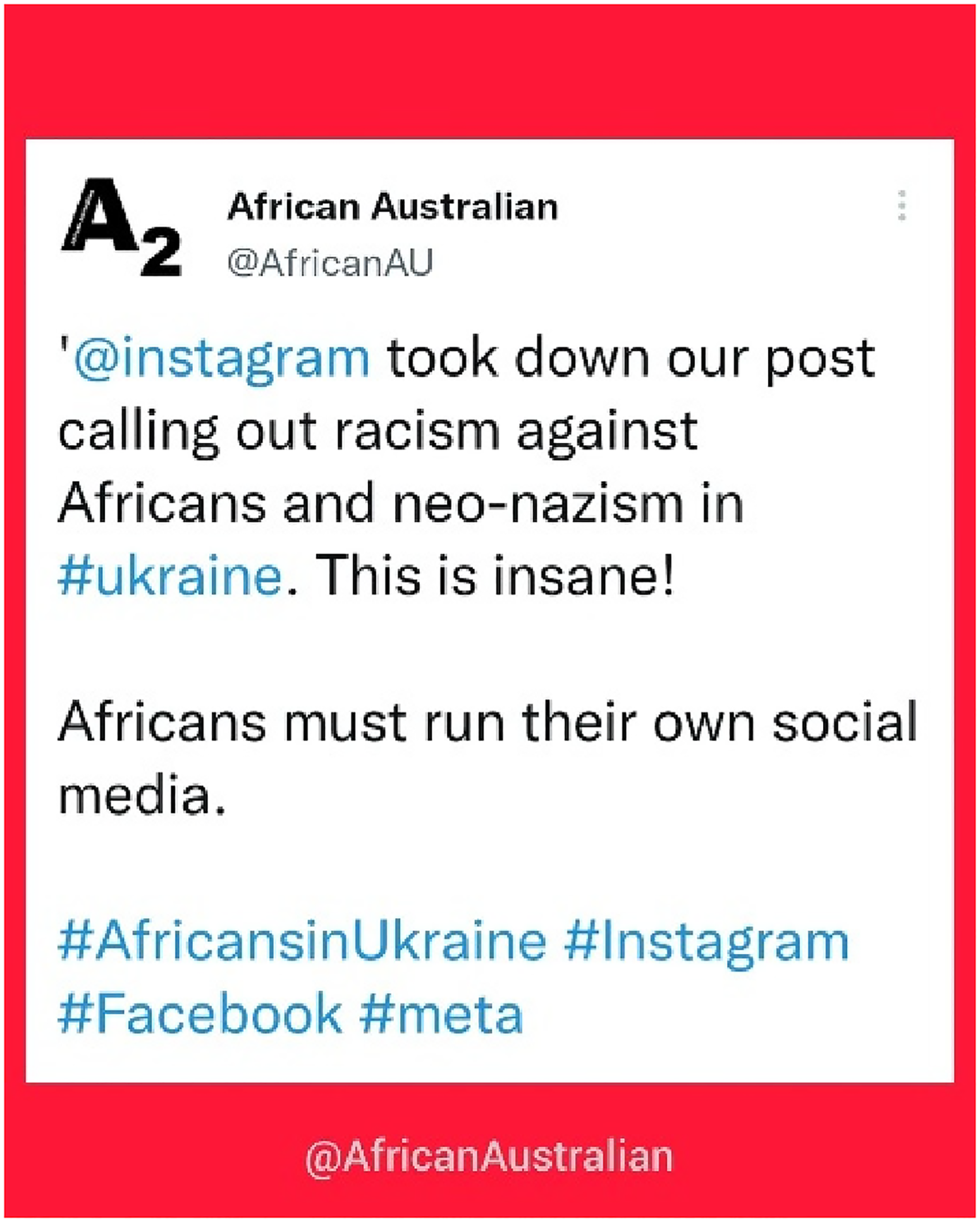
A Facebook post from the African Australian Facebook group, shared by participant Rosalina.
In the forthcoming section, I detail the Afrocentric digital counternarratives visibilised by the African youth in this study using two prominent themes: Black contributions and collaborations, and Black excellence. Following this, I critique participants’ Afrocentric youth digital counternarratives by critically considering them as a digital ‘burden of blackness’ (Mapedzahama and Kwansah-Aidoo, 2017).
Black contributions and collaborations
The majoritarian narrative of African youth in Australia has labelled African youth as ‘violent’, ‘out of control’, belonging to ‘gangs’ and a ‘threat to social cohesion’ (Majavu, 2020; Windle, 2008). Significant within the findings of this study were Afrocentric digital counternarratives that directly challenged this discourse by visibilising the contributions and collaborations of Black African people (see e.g. participants’ social media posts in Figures 5 to 7). During his scroll back interview, participant Eddie explained how ‘social media is a powerful tool to share our experiences, form groups and mobilise social change’. He detailed his experience of using social media to organise a Melbourne-based protest against the 2019 Khartoum massacre in Sudan, explaining: I was like 'yo, people are posting about this shit (the massacre in Sudan) but no one is doing anything, you know'. So later that night I was like ‘I'm going to make a protest’. So I messaged a mate and then through social media I had 3 other African people reach out to me and in a space of 48-72 hours we had formed the committee and formed the action plan. Literally within 2 hours we had 2000 people click attending the protest. It was just 4 African kids, who put this event together… we had about 800 people attend… We had speakers from different African countries talk about the conflict and how we can all fight together for human rights’
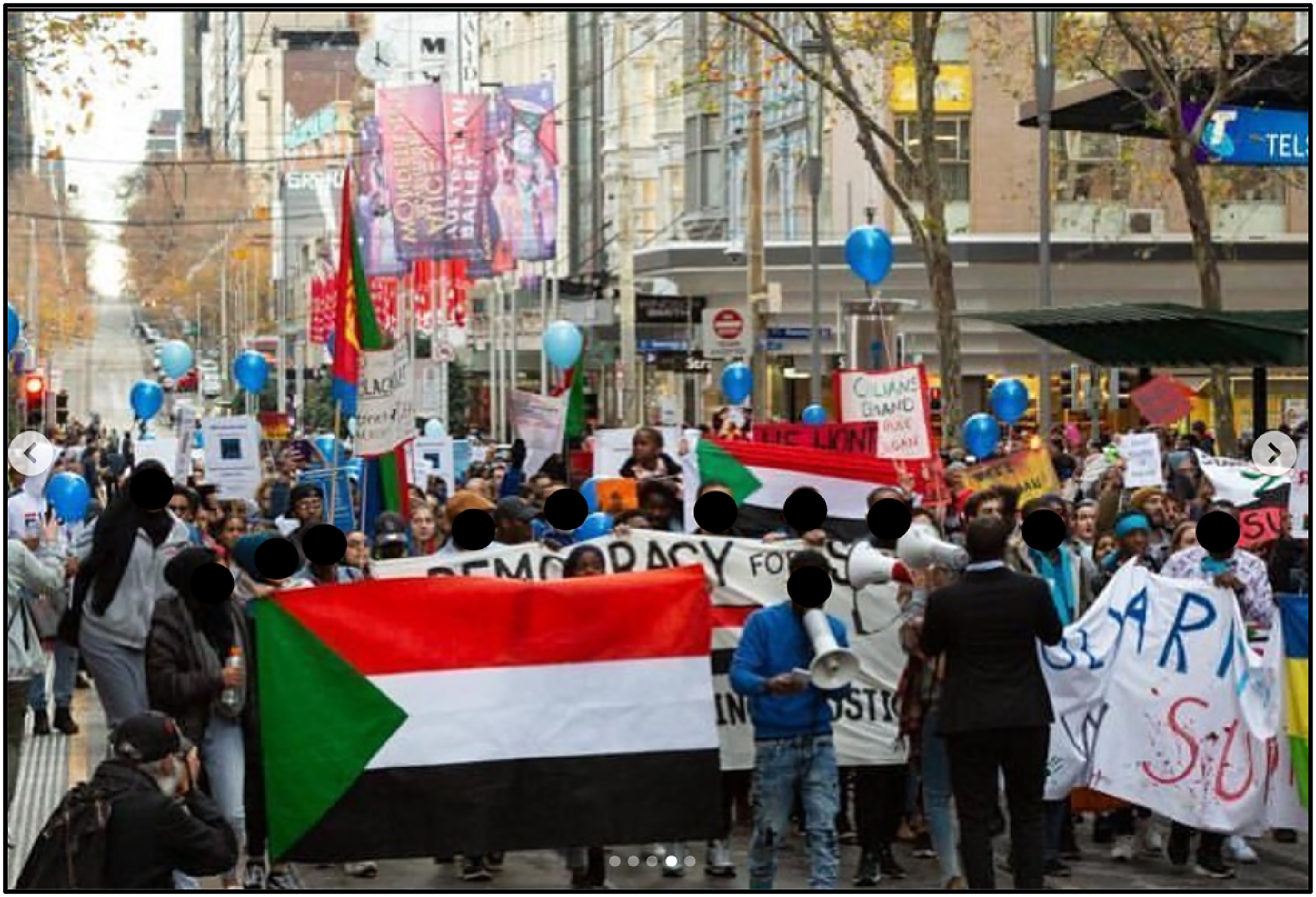
An Instagram post by participant Eddie (image de-identified).
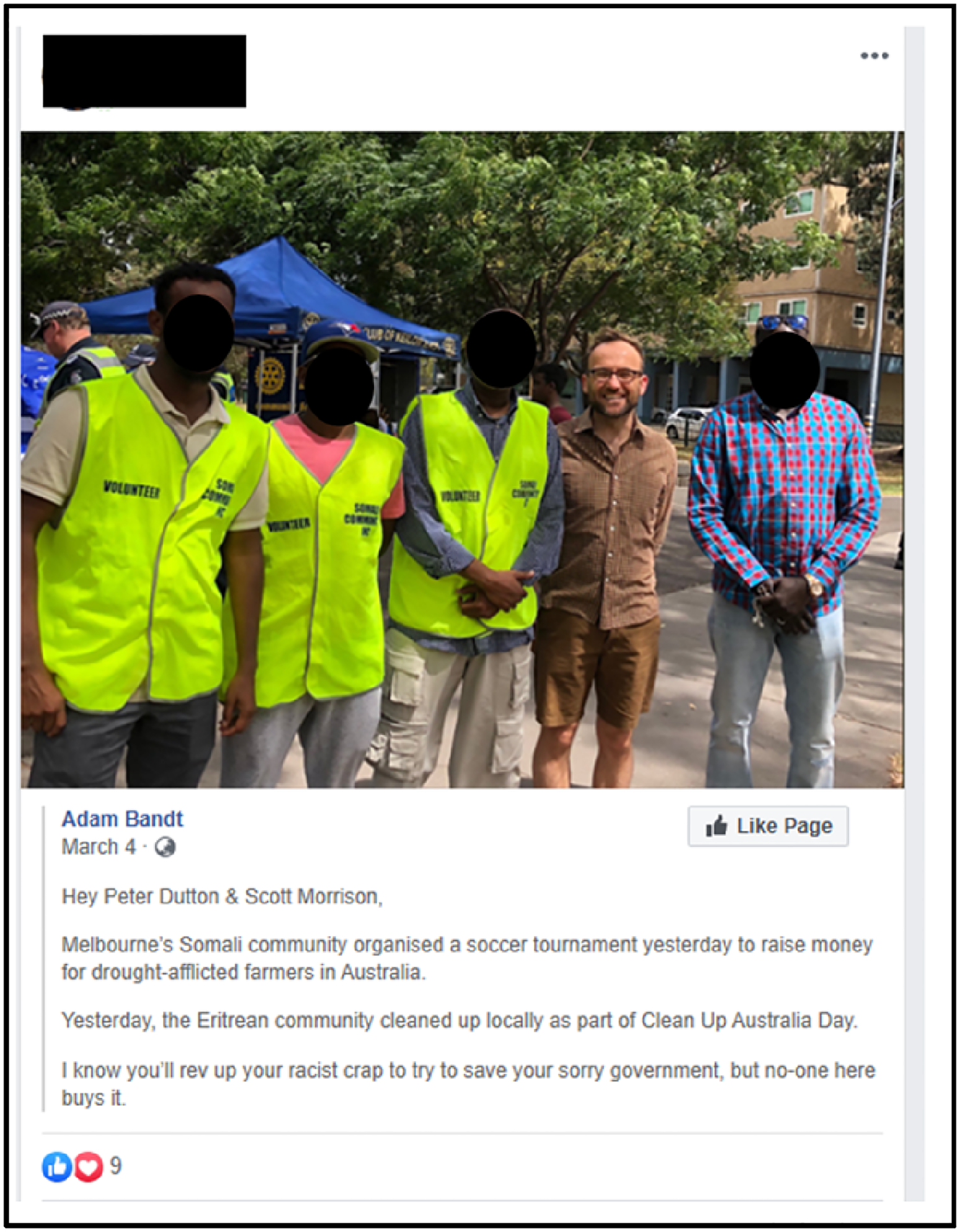
A Facebook post (image de-identified) by Adam Bandt (Federal member for the Australian Greens Party) shared by participant Rosalina. The post reads ‘Melbourne's Somali community organised a soccer tournament yesterday to raise money for drought-afflicted farmers in Australia. Yesterday the Eritrean community cleaned up locally as part of Clean Up Australia day’.
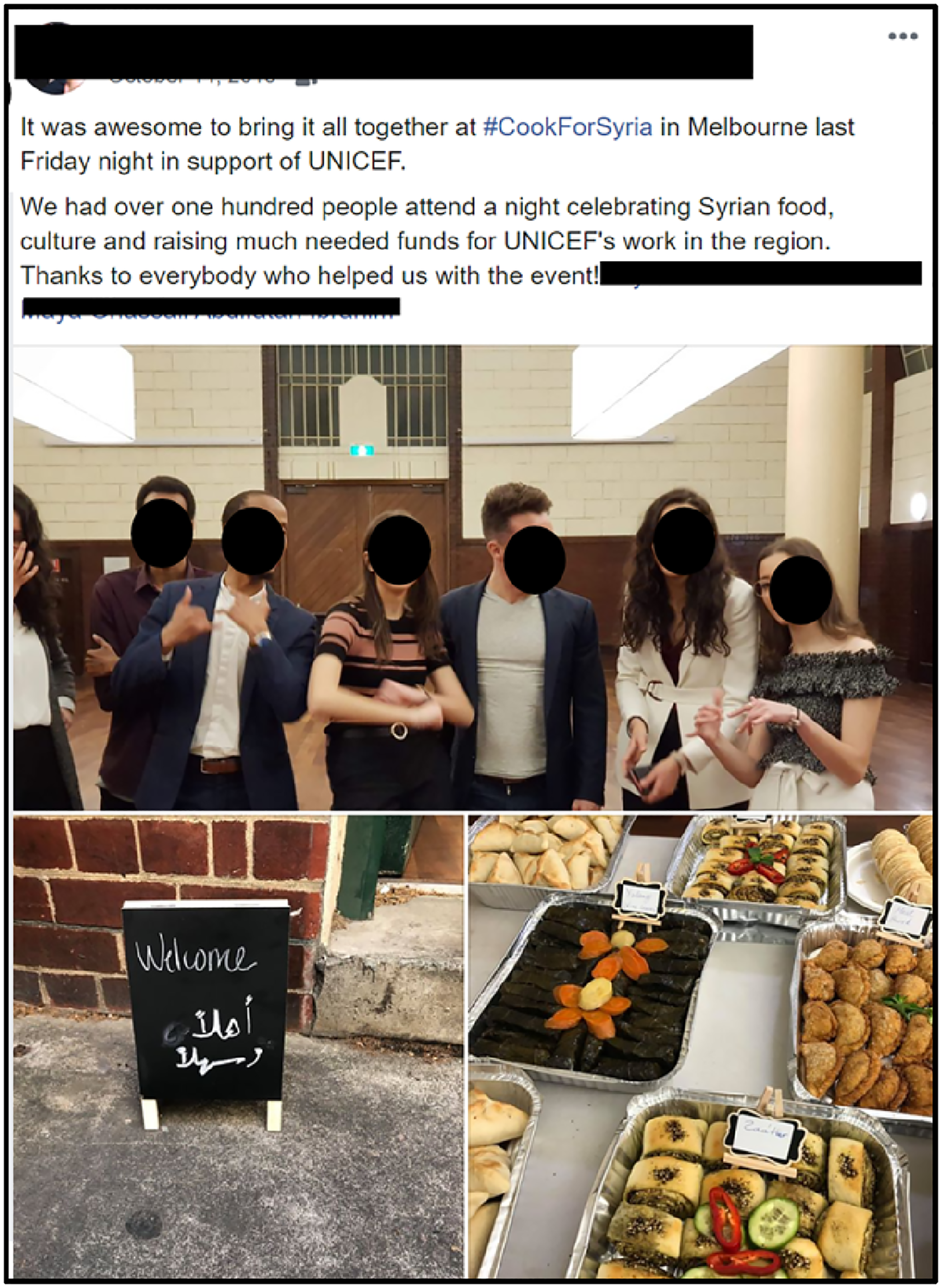
A Facebook post by participant Zuberi (image de-identified). It reads ‘It was awesome to bring it all together at #CookforSyria in Melbourne last Friday night in support of UNICEF. We had over one hundred people attend a night celebrating Syrian food, culture and raising much needed funds for UNICEF's work in the region’.
Following the successful protest, Eddie posted on Instagram (Figure 5), with photos from the protest alongside a caption that read: ‘WE DID IT! We put together an event that didn’t just bring Sudan together, but the Australian community. A group of African youths with the power of the people put together an event to stand for democracy, human rights and justice. @7NewsMelbourne this is a story to talk about’
Significant within Eddie's story is his emphasis on how the protest brought together not just other African young people, but the wider Australian (non-African) community. Eddie had experienced a rise in anti-Black sentiment following the ‘African gangs’ moral panics in 2016 and therefore, he saw social media as playing an important role in making the (non-African) Australian community aware of the ‘true’ African youth story. He perceived social media as essential to counter the violent stereotypes that had been built around African young people so that ‘trust’ could be repaired between the Australian community and the Black African youth community. In Eddie's post he emphasises the ‘power’ of African young people to ‘stand for democracy, human rights and justice’, capturing African youth as they peacefully walk Melbourne's city streets – streets that had once been at the epicentre of the violent ‘African gangs’ rampage. To Eddie, this post captured African young people in their element – on the front lines of protesting against human rights abuses and advocating for change. Blackness – when told from Afrocentric youth perspectives – is not violent, nor to be feared. Rather, as Eddie's post demonstrates, Black African young people are socially and politically engaged, utilising white Australian spaces – and their digital platforms – to fight for human rights.
Significant within Eddie's post is that he ‘tags’ 5 the Instagram account for Channel 7 News alongside the text ‘this is a story to talk about’. For Eddie, the power of social media lay in the ‘everyday users’ ability to share their experiences, and accordingly, he used his social media platforms to draw attention to ‘African stories that deserve recognition’. For Eddie, tagging Channel 7 in his post was an empowering moment as it was a direct and explicit challenge to Channel 7 (who had previously been at the forefront of the racist African gangs narrative, see for example, e.g. Henriques-Gomes, 2018) to report a story that captured the ‘true’ contributions of African people in Australia. For Eddie, this was an opportunity for Channel 7 to fairly represent the Black African community in Australia and to work towards making amends for the damage that they had done to the African community in the wake of the 2016 Moomba riots. Unfortunately, although ‘not surprisingly’, according to Eddie, Channel 7 – as well as other mainstream news channels – did not report on the protest despite the significant numbers that attended and the visibility of the protest on social media. This didn’t appear to upset Eddie as he showed me during his scroll back interview the significant digital engagement on his social media posts. ‘Awesome job guys! Bringing about actual change!’ one user writes on his Instagram post ‘Proud of you’ another writes. Eddie reflected that these comments, as well as the likes and shares of his posts, was immensely satisfying and ‘validating’. For Eddie this was evidence that the event had been meaningful to many people, and further, that his voice – and the wider Black African youth community in Australia – had been heard. Several participants in the study mentioned the importance of their stories being ‘heard’ by an audience on social media, suggesting that beyond the use of social media as a space to simply share their counternarratives, participants also valued the communities who listened to and validated their stories. This compliments several studies that have examined the importance of ethnic and alternative community media as spaces where diverse voices are heard (Bailey et al., 2014; Dreher, 2010).
Black excellence
The majoritarian narrative of Black Africans in Australia has constructed Black Africans as ‘lacking’ (skills, education, English language proficiency), ‘trauma infested’, morally suspect and easily falling foul of the law (Mapedzahama and Kwansah-Aidoo, 2017). The data from this study indicates that a prominent digital counternarrative among African youth was one that visibilised the achievements of Black Africans, both in Australia and abroad. Many of the participants explained that these posts were meant to be ‘thought-provoking’ (Eleanor, aged 17, self-identifies as South-Sudanese) and were aimed at ‘raising awareness’ (Prince, aged 18, self-identifies as Rwandese-Congolese). Eleanor explained that it was particularly important for her to share content that highlighted Black excellence for her ‘local, Aussie followers’ as it allowed them to gain different perspectives about Africans that are rarely seen in the mainstream Australian media. Eleanor had spoken in her interview about being one of the only ‘Black people at school’ and had subsequently faced a lot of preconceived (and racist) assumptions about her intellectual abilities saying, ‘people often think of me as less’.
The counternarratives of Black excellence would often focus on academic or career achievements. Like many of the #AfricanGangs counternarratives that emerged on Twitter in 2018, these posts deliberately contradicted deficit and deviant discourses by exposing all of the ways that Black Africans are excelling. For example, the Congolese Scientist who developed the cure for Ebola (Figure 8), a South African Doctor curing deafness (Figure 9), and ‘Nyadol Nyuon – From refugee camp to Collins St Law firm’ (Figure 10). Blackness – when visibilised by African young people on social media – becomes a marker of success and hard work, despite the systemic barriers that Africans must overcome. These posts were often accompanied with Black-centric hashtags such as #BlackExcellence and #BlackisBeautiful to position blackness as intelligent, strong and successful – all the things that Black Africans are not portrayed as in normative white Australian spaces.
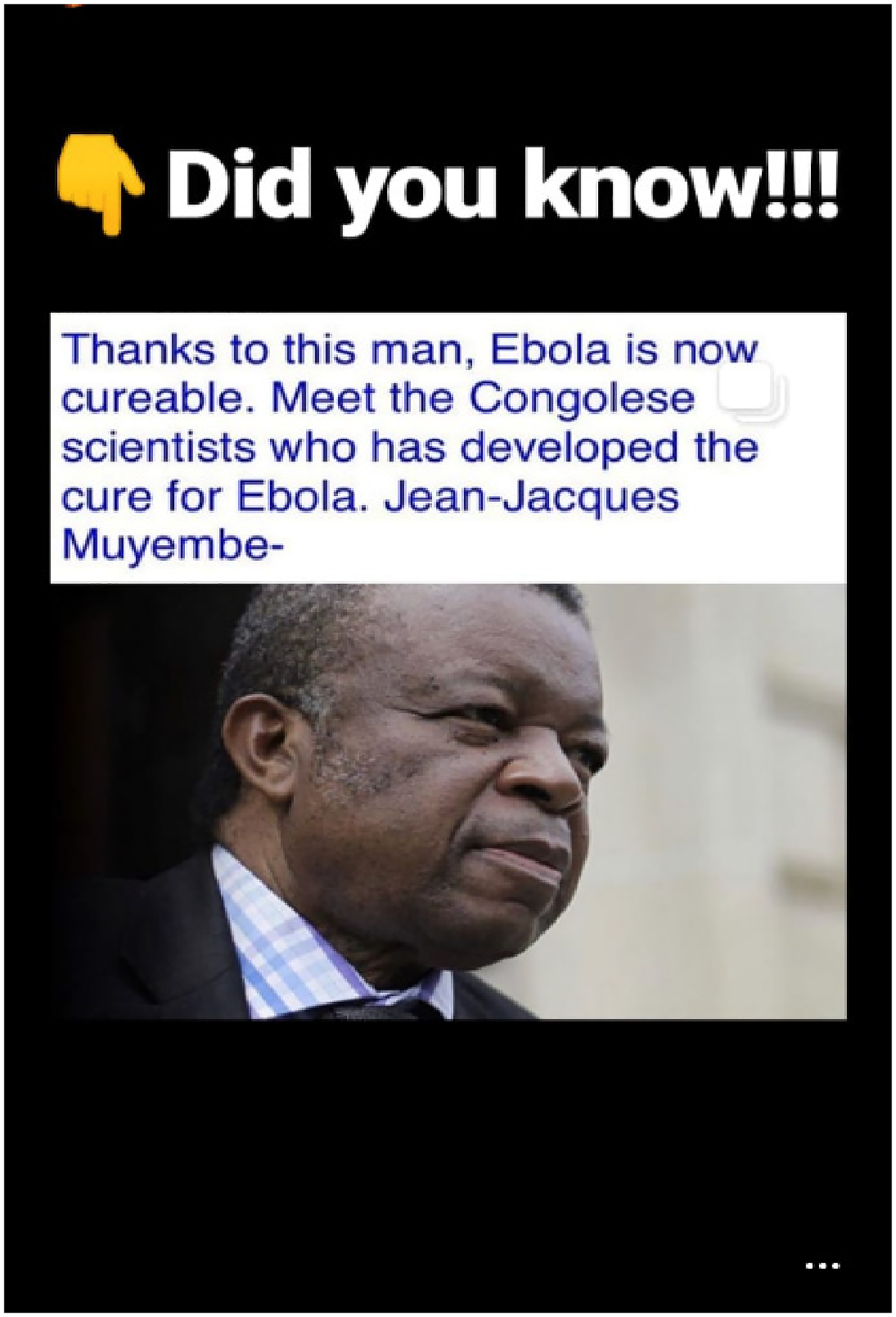
Instagram story post by participant Prince.
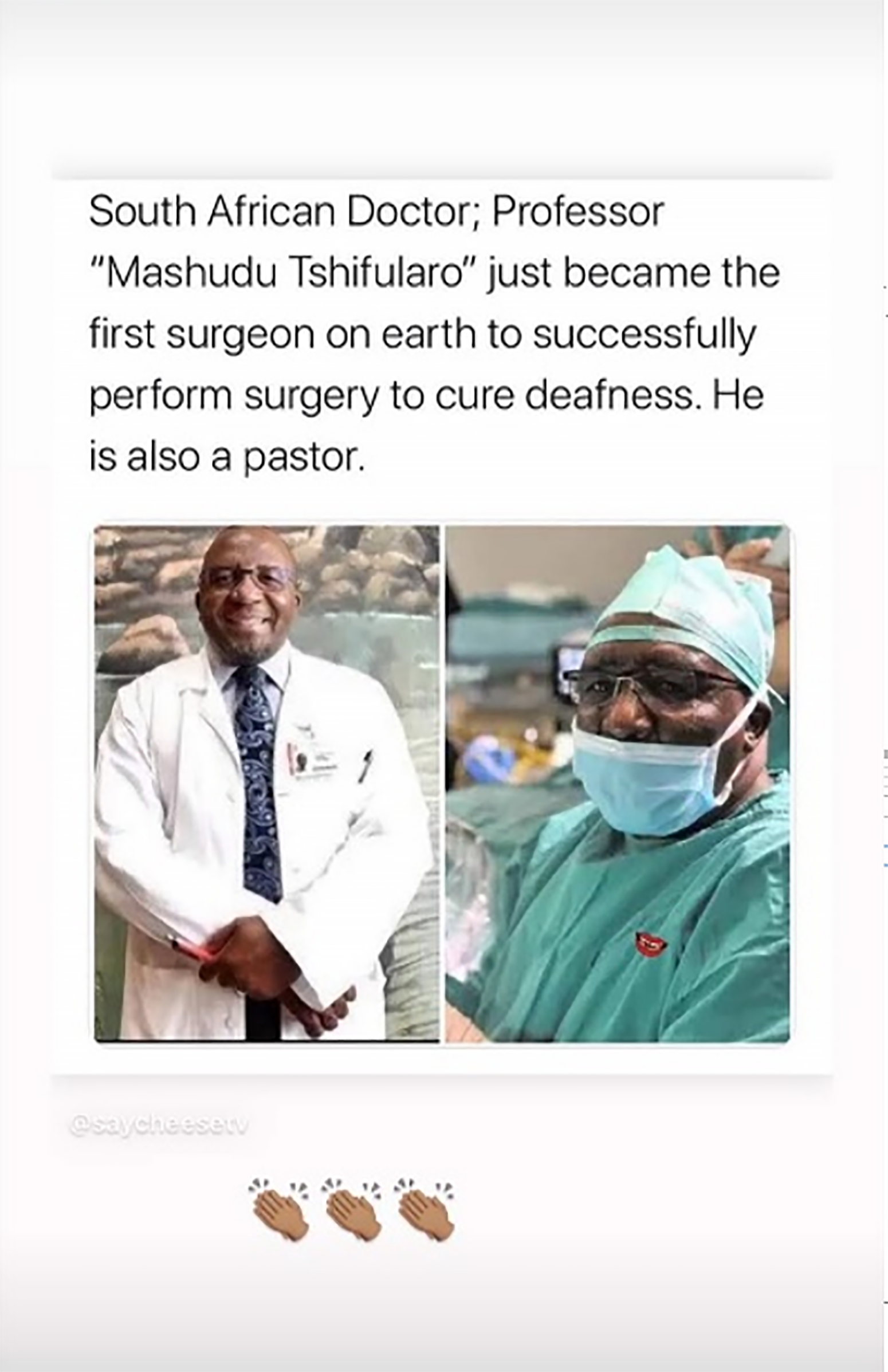
Instagram story post by participant Trey.
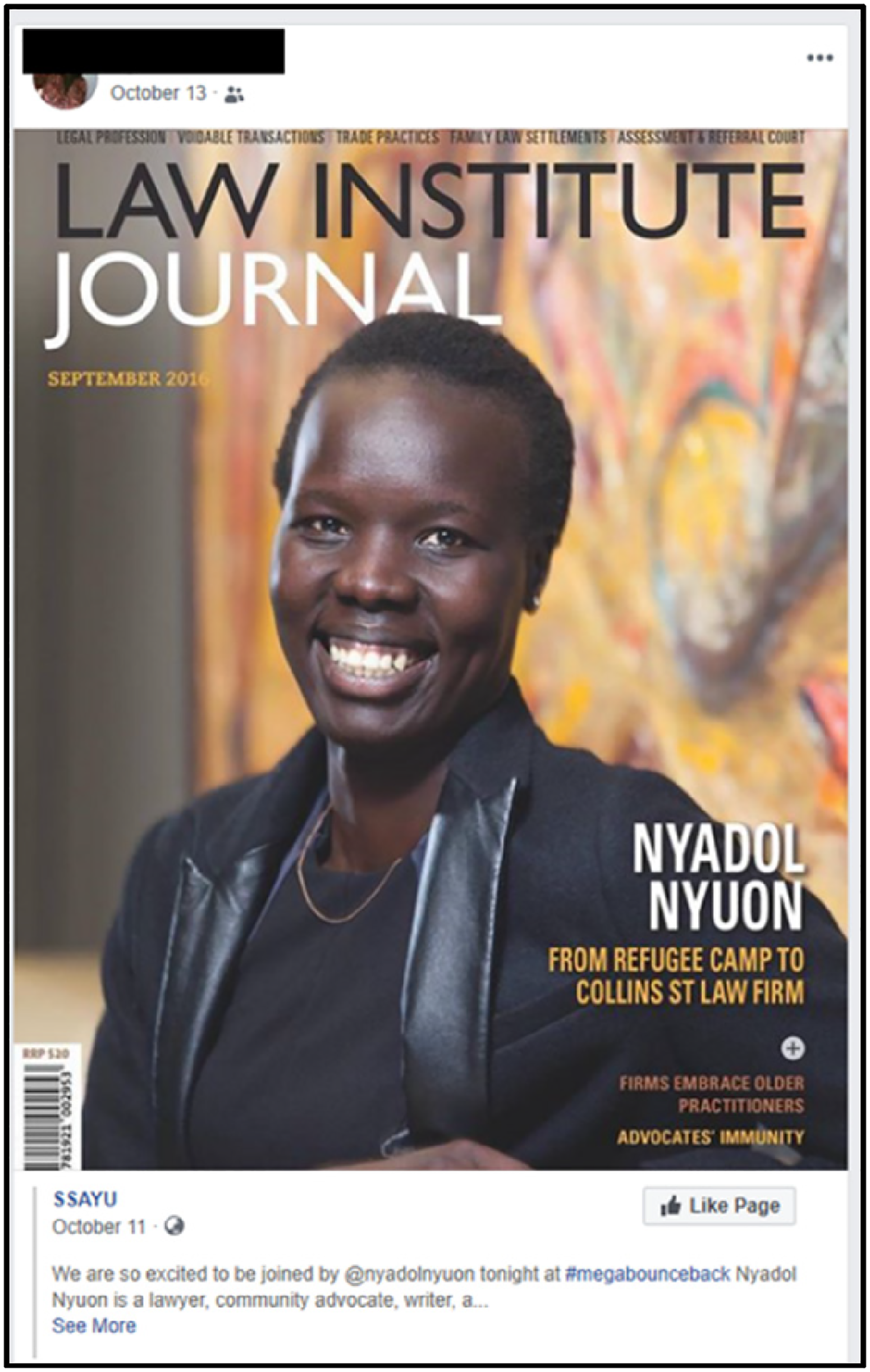
Facebook post by participant Eleanor.
During his interview participant Zuberi (aged 25, self-identifies as Somalian) spoke about the importance of seeing blackness presented as successful. He reflected on the lack of representation of successful professional Black people by the mainstream Australian media, saying ‘In Australia, Black people aren’t really presented as driven or successful’. (except in the case of sporting success)He described this as having an impact on Somali young people in Australia who he described as ‘struggling to find a job after graduating’ and in ‘need of a mental shift’. Zuberi detailed how his perception of Black excellence and success changed drastically when he travelled to the United States for a university exchange program several years prior. He explained how he saw for the first time a number of Black people in high-ranking positions at his university. He explained how this made him become ‘more conscious of my career and how I should be working harder to achieve success’. Upon returning to Australia, Zuberi began following professional networks on social media such as African Professionals of Australia and the SomaliPN – Australia (Somali Professional Network). These social media pages inspired Zuberi as he was able to access and engage in content that visibilised Black African excellence as the norm. The counternarratives of Black African success that Zuberi was able to see within these social media communities convinced him that Black African success was achievable in Australia, and was within his grasp ‘if he worked hard enough’ (Zuberi). These findings are significant given that previous research has found that the consequences of the African gangs media narrative have been detrimental to African young people's pursuit of education and employment (Benier et al., 2018; Macaulay and Deppeler, 2020; Young, 2020).
Like Zuberi, other participants in this study perceived the visibilisation of Black excellence on social media as empowering, and yet some scholars have been critical about the rise of the Black excellence counternarrative within popular discourse. For example, the theorisation of racial battle fatigue, that is – the emotional toll and stress associated with prolonged exposure to racism (Gatwiri and Anderson, 2021; Smith et al., 2007) – can result in a loss of self-confidence, low self-worth and social withdrawal but also result in hypervigilance where individuals feel compelled to overwork or overachieve to combat negative racial perceptions. This constitutes a greater burden to Black African people in Australia who have to work twice as hard to prove themselves as capable (Gatwiri, 2021; Mapedzahama et al., 2012). Similarly, Gassam Asare (2021) argues that visibilising Black excellence may in fact harm Black people more because it sets the expectation that all Black people must be excellent to be seen as deserving. Black people are subsequently judged by higher standards despite there being significant systemic barriers to this greatness. Subsequently, Black people who do not exhibit these positive traits are seen as not deserving. As such, despite the African young people in this study perceiving these counternarratives as empowering, as Gassam Asare (2021) argues, they may in fact set the standard for Black Africans in Australia at such an exceptional level that those who fall short may be seen as lacking, not deserving and therefore, justifiably excluded.
Counternarratives: a digital burden of proof
The data from this study overwhelmingly indicates that Afrocentric youth digital counternarratives were empowering to participants who perceived their counternarratives as agentic, creative and free. Social media are spaces where African youth feel in control, validated, inspired, and for the most part, racially safe (for more on how participants cultivated their racial safety on social media, see: Moran and Gatwiri, 2022; Gatwiri and Moran, 2022). And yet, despite the agentic, empowering perspectives that participants presented, the quantity of data collected in this study reveals that the Afrocentric youth digital counternarrative requires Black African young people to engage in extensive and ongoing racial ‘work’ (Ngo, 2015). This work was imposed on participants who were ‘burdened with’ (Mapedzahama and Kwansah-Aidoo, 2017) visibilising these counternarratives in their efforts to shift the racist stereotypes of Black African youth so that they can create meaningful futures for themselves in settler-colonial Australia.
In their theorisation of the ‘burden of blackness’, Mapedzahama and Kwansah-Aidoo (2017) describe Black embodiment as a symbolic and material burden, where problematic stereotypes constructed by the ‘white gaze’ are imposed on all Black Africans who must navigate the discomfort, challenges and limitations of Black embodiment in white majority spaces. Blackness imposes a task upon those who bear the colour ‘that weighs them down in ways that they otherwise would not experience’ (Mapedzahama and Kwansah-Aidoo, 2017: 5). In essence, ‘they are made responsible for things that they have no control over’ (8). This burden is evident within the majoritarian narrative that followed the 2016 Moomba riots where the ‘blame’ of African youth gang violence was firmly placed on the African community in Australia, forcing African community elders – and African Australians more broadly – to ‘take responsibility’ for the behaviour of African youth gang crime. African community leaders and organisations were publicly called upon by right-wing media and political figures to explain the behaviour of African youth and what steps they were taking to address it (ABC News, 2018). This was further evidenced in the establishment of an African-Australian community taskforce by the Victorian police, with the aim to ‘tackle’ African youth crime (Florance, 2018).
The ‘burden’ of having to contend with these hyper-criminalised and problematised stereotypes of African youth – as told from the majoritarian narrative – was significant in this study, as several participants disclosed that they were motivated to share their counternarratives on social media because they were fearful that if they didn’t tell the ‘truth’ about African youth in Australia, then they would continue to be subjected to anti-Black racism from both the media and broader (non-Black African) Australian community. The racism experienced by participants was extensive and deeply embedded in the white Australian spaces they frequented – school, public transport, work (see Moran and Gatwiri, 2022 for further discussion on this). The Afrocentric youth digital counternarrative therefore was perceived as a type of ‘proof’ that had to be provided as ‘evidence’ of all the ‘good’ things they were doing in Australia (their contributions, collaborations and excellence). This proof was seen to be essential in building a meaningful future in Australia, as participants wanted to be respected and valued by the broader Australian community.
As such, the Afrocentric youth digital counternarratives presented throughout this paper speak back to – and are framed by – Australia's ‘white multiculturalism’ (Hage, 1998), a system of white domination where the acceptance of non-white bodies remains contingent upon the status quo of the white majority in Australia (Gatwiri and Anderson, 2022). This is a system in which the dominant group – white Australians – hold power over who they ‘grant’ belonging to, that is, who is seen as deserving of belonging. These ‘hierarchies of belonging’ (Back et al., 2012) maintain white supremacy as Black African bodies who are at the bottom of the hierarchy (Gatwiri and Anderson, 2022) are forced to contend with the rules and expectations that are placed upon them through this racial system.
Multiculturalist ideologies in Australia frame belonging through capitalist neoliberal discourses and policies where migrant belonging – often referred to in relation to ‘integration’ or ‘social cohesion’ – emphasises the ‘significant economic contributions’ (Culos et al., 2020: 13) that migrants make when they are successfully ‘settled’ in Australia. Migrant ‘belonging’ can be leveraged for the whole Australian community as the non-migrant population benefits from the ‘value’ that migrants add to Australian society. Thus – in this context – the African migrant becomes a labourer for the capitalist project where their contributions – often measured through workforce and education participation and English language proficiency metrics – becomes a marker of their belonging or non-belonging in Australia. This capitalist neoliberal framing can be weaponised against those who are seen as not belonging or ‘not integrating’ as was evident in the case of the ‘African gangs’ majoritarian narrative, where the violent behaviour of a small group of individuals was used as grounds to justify the deportation of African youth who break the law (Majavu, 2020) and a reduction to the number of humanitarian visas allocated to African countries (Topsfield, 2007).
As a response, the Afrocentric youth digital counternarrative becomes a ‘burden of proof’ that is required of Black African young people in Australia, who utilise their social media platforms to emphasise the ‘good’ they do and the ‘value’ that they bring to Australia through using this capitalist neoliberal framing of migrant belonging to claim their right to belong in Australia. Belonging, for the majority of participants in this study, was also described in this way, where participants perceived themselves as deserving of belonging in Australia because of their significant contributions and ‘good behaviour’. For example, participant King (aged 18, self-identifies as South-Sudanese) reflected during his interview ‘I belong here because I don’t do anything bad, and I don’t cause anyone to feel bad in anyway or intimidated’. Like King, the participants in this study shared counternarratives that demonstrated they were ‘doing the right thing’, visibilising themselves as agentic, capable and socially engaged in the social, cultural, economic and political domains of Australian life. Their counternarratives demonstrate the many ways that they belong in Australia beyond the ‘African enclaves’ or African subcultures, as there was an explicit attempt to visibilise their ‘integration’ into mainstream (white) Australian culture (as evidenced in Eddie and Mark's reflections). These counternarratives demonstrate that they are not people who are a ‘problem’, nor do they need to be ‘saved’. Rather, these counternarratives offer highly visible ‘proof’ that Black African young people are not only surviving in a society that seeks to exclude and marginalise them but that they are thriving as active contributors and collaborators who are achieving excellence in Australia, despite the systemic disadvantages and racial violence they have to overcome to do so. These counternarratives are a direct effort to (re)frame and (re)claim the Black African story in Australia through discourses that celebrate, value and respect African migrants and see the strengths and capabilities that they bring to Australia.
For Black African young people who have been ‘othered’ and oppressed through Australia's hierarchies of white multiculturalism, these counternarratives constitute a significant ‘burden of proof’ that African young people are taking on in digital spaces. Thus, despite the importance of these counternarratives as giving African young people in Australia the space to challenge and contest the majoritarian narrative, they do constitute a significant racial burden as the bodily ‘work’ (Ngo, 2015) is put on Black bodies to expose the majoritarian narrative as false, and furthermore to demonstrate the many ways in which they are contributing to, and are therefore deserving of belonging, in settler-colonial Australia.
In the same way that Mapedzahama and Kwansah-Aidoo (2017) argue that blackness is experienced as a ‘burden’ in white dominated physical spaces, I have argued here that these counternarratives demonstrate how increasingly, the burden of blackness is also embedded within digital spaces. The examples provided throughout this paper demonstrate the racial ‘work’ that Black African young people are doing within their digital spaces to challenge racist majoritarian narratives and to (re)claim their stories using their lived experiences as ‘proof’ to show that, in Australia, ‘African kids can’.
Conclusion
Social media, from Afrocentric youth perspectives is a place of agentic storytelling that is empowering and fulfilling. It is a space where Black African young people, who are at the bottom of Australia's white multicultural hierarchy, can command an audience, centre their lived experiences and feel validated and heard. This is particularly significant for African young people in Australia who have had their voices and perspectives invisibilised by the dominant majoritarian narrative that has problematised and criminalised them. As such, social media becomes a site of collective resistance where Black African young people can band together to produce counternarratives that expose the majoritarian narrative as false and racist. Through their social media platforms Black African young people position themselves as active agents of their narratives in Australia, inspired to create, share and visibilise Black contributions and collaborations and Black excellence. And yet, despite the many positive experiences Black African youth perceive their counternarratives to have, here I have theorised them as constituting an ongoing, digital ‘burden of proof’ that they have been forced to contend with, given the capitalist neoliberal ideologies of white multiculturalism in settler-colonial Australia. As argued by Mapedzahama (2022) and Gatwiri and Anderson (2022), it is only through counternarratives – where the expertise and lived experiences of racialised people are centred – that we can embed anti-racism rather than non-racism into the structures of Australian society, to enact positive change that celebrates and welcomes a multiplicity of ways of being Australian. These counternarratives are evidence of the important ‘racial work’ that Black African young people are doing in digital spaces to (re)claim their stories as African kids who ‘can’.
Footnotes
Declaration of conflicting interests
The author declared no potential conflicts of interest with respect to the research, authorship, and/or publication of this article.
Funding
The author disclosed receipt of the following financial support for the research, authorship and/or publication of this article: This research was supported by a Monash University Faculty of Arts Postgraduate Scholarship and a Monash University Postgraduate Publications Award.
