







Abstract
Participatory environmental communication (PEC) offers a way of engaging in communication by inviting the participation of communities and their ways of knowing. As a process-oriented approach, PEC enables communities to use local knowledge and design solutions, by employing their unique perspectives and intimate experiences of the places in which they live. This case study is an effort to record and interpret a historically important moment in the author's own community, using the PEC lens, to discuss the lived experiences of a rural community and the actions they are taking to mitigate future impacts from natural disasters. It includes the author's personal experience of a natural disaster in the small rural town of Wingham in MidCoast of New South Wales, Australia. It reflects on how a community in crisis relies on networks of cooperation for disaster response and recovery.
Keywords
Introduction
Ordinary people's capacity to tell stories and share knowledge provides a society with the means to remember the past, understand the present and plan for the future. The narrative form connects people in a meaningful way to the places we live and the challenges that communities experience in the face of mounting disasters, both natural and man-made. How can communities tell stories that validate their lived experience? It is only by using their voice that people can give an account of their experience because ‘voice is the currency of environmental struggle’ (Peeples and Depoe, 2014: 2). Communities in the periphery create alternative dialogic spaces for self-expression. Local knowledge systems (Orthia, 2020; Stewart, 2019) are gaining greater acceptance alongside conventional knowledge systems and communication practices. Community-based adaptation has become an important aspect of adaptation strategies in the Pacific islands, as it draws on local knowledge and involves vulnerable communities in the design and implementation of solutions appropriate to their needs (Inamara and Thomas, 2017; McNamara and Limalevu, 2015). Diverse forms of knowledge – inclusive of scientific, experiential and traditional – are essential in order to understand vulnerabilities and to increase the resilience of local communities in the face of enormous environmental changes. Participatory environmental communication (PEC) offers a way of engaging in communication by inviting the participation of communities and their ways of knowing (Harris, 2018). It acknowledges that communication is not one-way, but a dynamic and interactive process that involves listening, sharing information and decision-making.
The question posed in this special edition is, how can environmental communication be inclusive of the lived experiences and knowledge traditions informing the research and pedagogies of those living and working at the peripheries of scholarship? In answering this question, this article uses voice and storytelling to share a community's lived experience of two natural disasters, the fires in 2019/2020 and floods in 2021, in the small rural town of Wingham in MidCoast of New South Wales (NSW), Australia. The case study uses a framework that advances PEC to discuss how a community in crisis relies on communication and networks of cooperation for disaster response and recovery and for community resilience.
Theoretical background
Participatory environmental communication
At its core, PEC is a method that enables communities to design solutions using their unique perspectives, knowledge systems and intimate experiences of the places in which they live. In the process of finding solutions to local issues, people become empowered and engaged as environmental citizens. Communication in this regards must be transformative. It must move beyond the top-down transmission model and invite people to actively participate in communication processes. Participatory environmental communication has lacked a cohesive model that enables a holistic and networked communication which can be employed in different contexts. The Diversity, Network and Agency (DNA) is one such model, developed by the author, to advance dialogue and collaboration by assisting affected communities to use their networks, voice their concerns and find place-based solutions (see Harris, 2018).
To formulate DNA framework for PEC, I have drawn on epistemic knowledge and practice-based insights from two areas – participatory communication and environmental communication. The interdisciplinary nature of the field demands that scholars bring in perspectives from multiple knowledge domains. With its roots in critical theory, participatory communication empowers people on the margins, gives voice to marginalised narratives, uses horizontal communication, fosters dialogue and engages in an action–reflection–action cycle (Tufte and Mefalopulos, 2009). Participatory communication research embeds local and indigenous knowledge because it is place-based and involves local communities in all phases of planning, research, project implementation and evaluation (Servaes, Jacobson and White, 1996). The idea of the learner as a co-creator of knowledge is based on Brazilian educator Freire's (1970) foundational principles of emancipatory pedagogy that values action and reflection (praxis) over passive learning. In finding their voice, people gain control of their own storytelling and by implication their own lives and thereby gain power. Dialogue is an important aspect of learning. Participants must be proactive for genuine learning and empowerment to take place. These encounters are the essential first steps in engaging people in communication about their own circumstances.
Meanwhile, environmental communication scholars seek to explain how communication shapes human–nature relations, influenced by various social, cultural, economic and political contexts in which these occur (Pezzullo and Cox, 2017). According to Milstein (2009: 345), ‘The ways we communicate powerfully affect our perceptions of the living world; in turn, these perceptions help shape how we define our relations with and within nature and how we act toward nature’. The role of communication, either as mediated message or direct experience, is studied at the intersections of other key environmental issues such as climate change, environmental damage and disaster, biodiversity, sustainable development and representations of nature in popular culture (Takahashi et al., 2021).
Flor (2004: 4) calls for environmental communication programs to contain a cultural dimension because the ‘information, knowledge, and even wisdom’ is founded in traditional cultures which are passed down over generations. Dialogue, rather than transmission of information, is what brings nuance and depth to our understanding of how context shapes our relationship with the environment. ‘Communication elicits relational possibilities, ferments cross-fertilisation of ideas and enables problem solving by creating spaces for dialogue in society’ (Harris, 2021: 101). Through dialogue and discussion people identify the links between environmental changes caused by global warming and the ways these impact on their livelihoods, access to energy, food and water security that can lead to border disputes and wars. As such, an important aspect of environmental communication is the interconnection of the local and the global. Developing a holistic framework that recognises the interconnectedness of nature, culture and communication thus becomes urgent in our efforts to study and practise environmental communication. One such framework is discussed below.
The DNA framework
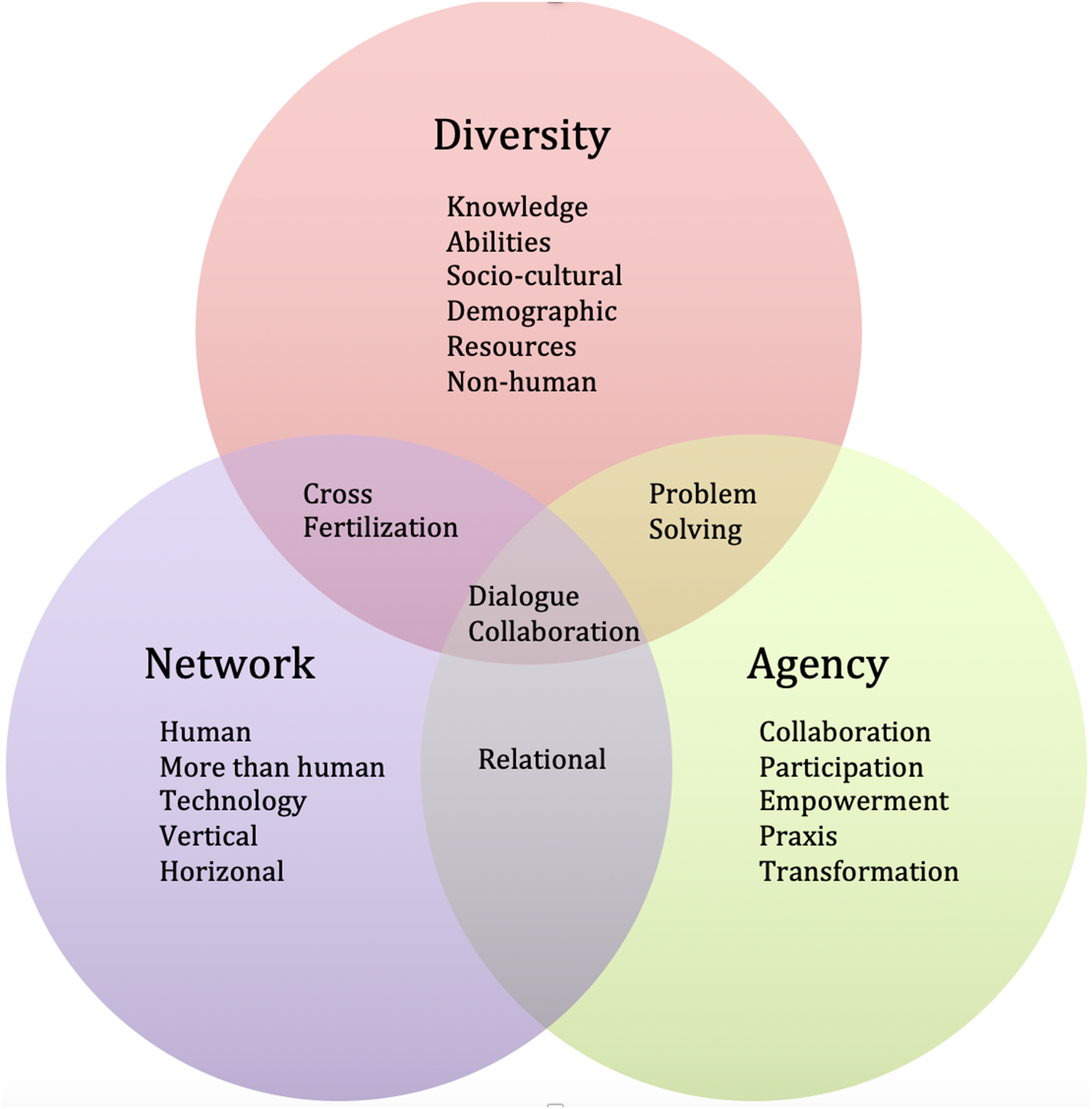
The Diversity Network Agency is a conceptual framework that fosters collaboration and dialogue in society about environmental matters through diverse ways of knowing and being, employing networks to catalyse the agency of ordinary people towards collective action (see Harris, 2018). Diversity, Network and Agency (see Figure 1) are three interconnected elements. Diversity is the inclusion of entities and knowledge systems (human and more-than-human) to enable innovative and transformative thinking; Network is the interconnectedness of all things vital for information exchange and survival of the ecosystem; Agency is the capacity of all beings to act upon their environment in order to bring about change. Each thread of the DNA is not separate but is intertwined in a holistic relationship, influencing and shaping the other in a communicative process that engenders cross-fertilisation, problem-solving and relational links at the intersections (Harris, 2018).
The DNA framework.
The intersection of diversity and network stimulates cross-fertilisation and cross-pollination of ideas by proactively linking disparate networks or nodes which previously may not have interacted or had weak links. These manifest as communication between interconnected entities, both vertical and horizontal, such as intergenerational, intercultural, interdisciplinary, interfaith and interagency dialogue, leading to innovation and collaboration previously untapped. These entities can be individuals, organizations, ideas or even objects, and the connections between them can be physical, social or informational. By studying diverse networks, we gain insights into how information flows, how relationships are formed and the impact of social networks on individual and group behaviour. Social capital is an important attribute of social network. Bourdieu (2011) states that social capital is the product of social obligations through membership in a group which provides each of its members with the backing of the collectively owned capital. Putnam's (2000) work on social capital posits that features of social organization, such as networks, norms and trust, can facilitate action and cooperation for mutual benefit. Networks are the connections between individuals and groups within a community. Norms are shared expectations, beliefs and values that guide behaviour. Trust refers to one's willingness to rely on others, even in the absence of formal guarantees.
In the context of the DNA framework, social capital is used to explain the form and content of various relational links between actors (see Harris, 2018 for in-depth discussion). At the community level, shared norms and social networks empower individuals to collaborate effectively (Woolcock and Narayan, 2000). A growing body of research examines the role of social capital in disaster responses and resilience (Aldrich, 2012; Meyer, 2018), including its importance in facilitating community recovery, withstanding disasters (Hawkins and Maurer, 2010) and rebuilding infrastructure and social bonds (Faas and Jones, 2016). Some scholars advocate for a critical perspective on social capital (Bourdieu, 2011; Pelling and High, 2005), recognizing the potential drawbacks such as ‘tribalism, nepotism, and marginalization’ (Valance and Rudkevitch, 2021: online). Any relationship involves inherent conflicts and power dynamics that should be thoroughly explored in discussions with diverse stakeholders.
When network and agency intersect new relational links are formed. As actors in networks participate in reciprocal acts, they begin to understand the relational possibilities in expanding networks. The relational links are the various manifestations of communication identified under Network and Agency. For example, stronger trust between networks would engender greater collaboration, resulting in opportunities for knowledge sharing and transformative thinking. The relational aspects bring to light both positive and negative interactions. The process of communication brings new insights into old problems. Indigenous scholars such as Pacific scholar, Upolu Lumā Vaai, have emphasised the importance of relationality in their worldview: ‘Relationality sees the world as an eco-relational multidimensional whole that sustains itself only through a healthy flow of connections and deep relationships’ (2019:3). By emphasising the interconnectedness of all beings, relationality involves reciprocity where individuals and communities recognise their obligations to each other and responsibility for the well-being of the planet.
The agency and diversity nexus facilitate problem-solving. Agency is an action or a doing of human and more-than-human entities. Agency in the natural world contributes to the efficient working of an ecosystem. Human agency refers to an individual's capacity to act independently and make choices that influence their own lives and the world around them. Sen (2013) places human agency at the forefront of the freedom and capabilities approach on transitioning to sustainability. For him, agency of individuals is vital in leading a sustainable life. Individuals with agency are seen as capable of making their own decisions and shaping their own destinies. It results from a realisation of our own power and potential through dialogic encounters that act as the catalyst for change. However, scholars contend that social structures, power relations and contextual factors can enhance or constrain an individual's capacity to act (see Bourdieu, 2011: Foucault, 2000).
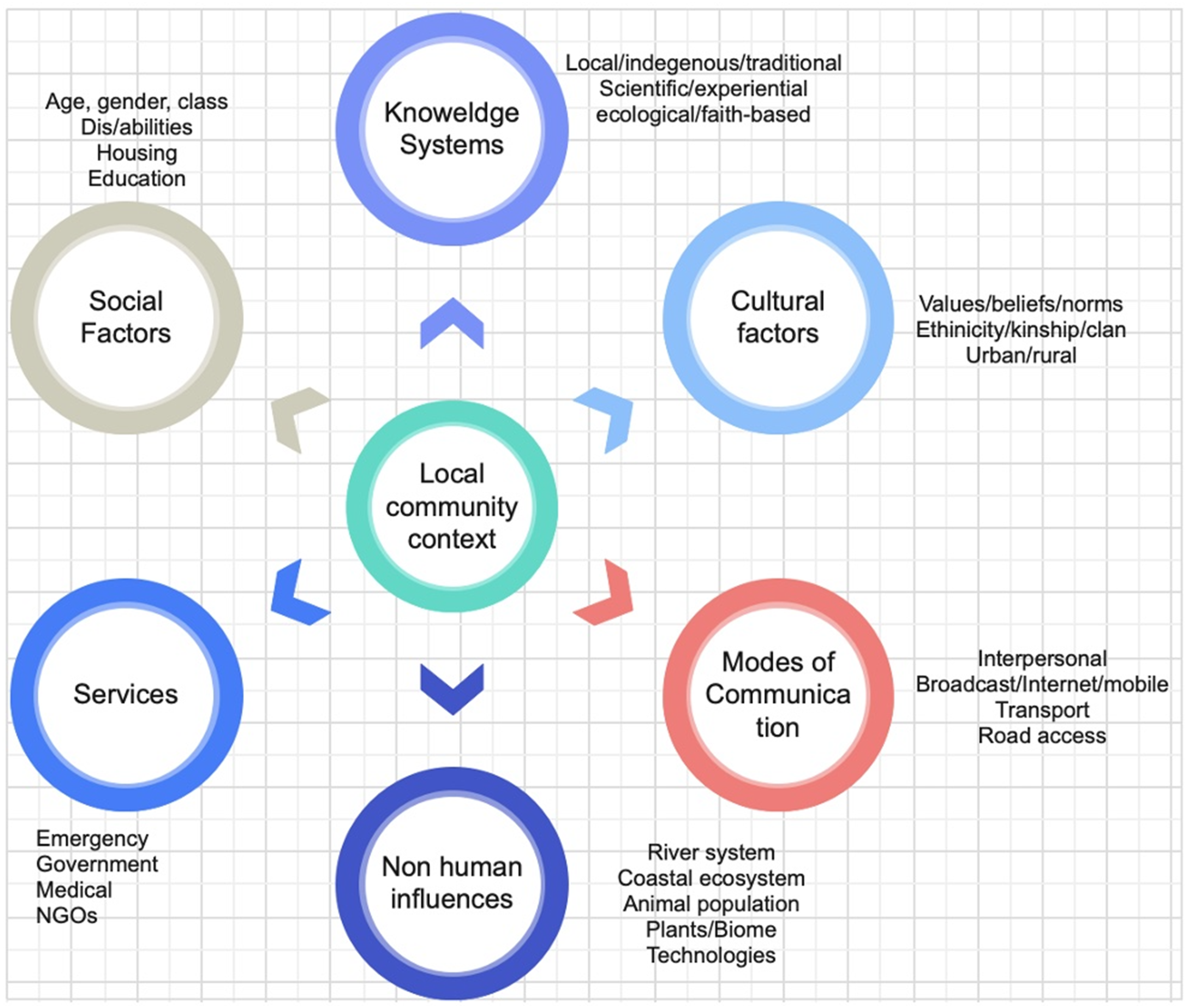
Diversity + network + agency create a dynamic space for dialogue and collaboration. This is based on the belief that the cornerstone of human progress is collective enterprise instead of conflict and competition. The DNA framework also places special emphasis on non-human networks, including communication technology and local ecosystems (inclusive of animals, plants, river systems etc.) which have an impact on community resilience (Harris, 2018). Diversity, Network and Agency mapping exercise at an early stage will ensure that a cross-section of the community is included (see Figure 2). The identification of these actors and entities is the first step towards designing sustainable projects. Interaction and exchange are essential functions of a resilient ecosystem in which information from each component is fed back to maintain the system's stability. While recognising that power and inequality exist in society, DNA proactively seeks a collaborative approach to solving environmental problems. It can be used both as an analytical framework and as a resilience-building tool to map information flows and identify access to resources and skills in multiple contexts (see Harris, 2018). As such, it is contextual and adaptable for a variety of uses by individuals, groups, organisations and communities. The DNA model can be used in the areas of environmental management and planning, education, awareness raising and disaster risk management to improve community resilience.
DNA mapping.
Resilience requires reducing risks, adapting to the risk, bouncing back and thriving. The United Nations Office for Disaster Risk Reduction (DRR) defines resilience as ‘the ability of a system, community or society exposed to hazards to resist, absorb, accommodate, adapt to, transform and recover from the effects of a hazard in a timely and efficient manner, including through the preservation and restoration of its essential basic structures and functions through risk management’ (UNDRR, 2024). It is a collective process of strengthening a society's ability to manage and overcome stresses. Critics point out that the concept of resilience has migrated from natural and physical sciences into the social sciences without due attention to the social relation and structures which are responsible for the disruptions (MacKinnon and Derickson, 2012). While top-down strategies place the burden of resilience and adaptation on communities in the face of mounting threats, capitalist social relations remain intact. Mackinnon and Derickson (2012: 255) suggest the use of ‘resourcefulness as an alternative concept to animate politics and activism that seek to transform social relations in more progressive, anti-capitalist and socially just ways’.
Method
This case study draws lessons from two major natural disasters from my own lived experience and those in my network. A case study is a qualitative method used to study a particular situation in-depth ‘by means of a story and critical analysis of the situation’ (Hatcher et al., 2018: 276). This case study is based on personal experiences and observations supported by interviews and online document searches. Four interviews were conducted with people who had been personally affected by recent natural disasters in Wingham, of which two interviews were chosen for this study. It also includes the author's own lived experience and observations during the flood that occurred in 2021. Information on disaster recovery was gathered from Midcoast Council documents available online, media reports and an interview with the council community recovery officer. Oral consent was sought prior to conducting the interviews, and subjects were informed about how the author intended to use the data. Open-ended questions were put to participants whose responses were in the form of personal narratives or stories of what and how they experienced the disaster and its aftermath, and their emotional responses at the time. A case study based on lived experiences is context specific. It captures the flow of thoughts and meaning people bring to their immediate situations in narrative form (Clandinin and Connelly, 1994). Narratives offer a more effective way to communicate science to non-experts compared to traditional scientific methods. They are easier to understand, capture attention better and align with how people naturally consume information (Dahlstrom, 2014). Thaker (2021: 202) contends that it is important to ‘build the capacity of scholars to be able to humbly participate in and understand the lived experiences through which environmental issues are negotiated’. This gives voice to people's own experiences of a disaster situated in their socio-cultural and geographic setting and their emotional capacity to cope in that moment. As such, the author does not presume that the method used in this study can be repeated exactly nor claim that the findings can be interpreted universally. Both micro-level and macro-level studies are needed to provide insights into disaster response and recovery. The limitation of the research is the small sample of participants chosen from within the author's own network who happen to be mainly women. The study is unfunded, making it unfeasible to engage in large-scale research with area residents.
Case study – recovery and resilience in the Manning Valley
This case study is an effort to record and interpret a historically important moment in my own community through the lived experiences of a rural community and the actions they took to overcome the challenges during and after a disaster. It reflects upon the importance of community networks and cross-sectoral collaboration for building resilience within affected communities.
I live in the small rural town of Wingham about 4 hours north of Sydney with a population of just over 5000. It is settled on the Manning River and supports farming families but is increasingly seeing an inflow of lifestyle changers such as ourselves. The Manning Valley spans coastal towns to mountains with pristine beaches, rivers, lagoons, lakes and rainforests in between. Wingham Brush Nature Reserve, a small footprint of the few remaining sub-tropical flood plain rainforests, is habitat for the vulnerable grey-headed flying fox. The Manning River is the only double delta river in the southern hemisphere with two permanent entrances, the main entrance at Harrington and the second located just south of Old Bar. In recent years, the region has suffered extreme weather events. After several years of drought, the region was one of many devastated by the worst bushfires in Australian living memory in late 2019. Then came the rains. In March of 2021, extreme rainfall led to what was described as ‘one in 100-year flooding event’. Wingham, including our family home, was flooded, forcing evacuations in the middle of the Covid 19 pandemic. Similar events have been experienced in other parts of the world as recurring pattern of floods and fires devastate communities. It is now well accepted that climate change is intensifying droughts, fires and floods (Abram et al., 2021; Funk, 2021).
Fire
The Black Summer bushfires of 2019/2020 are seared on the memory of Australians living both in urban and rural areas. They burned over 17 million hectares in NSW, Victoria, Queensland, the Australian Capital Territory, Western Australia and South Australia, caused 33 deaths, of which nine were firefighters, and over one billion animals perished (International Recovery Platform, 2021). Behind these statistics are personal stories of individual contribution and community action. In the Manning Valley, firefighters, schoolteachers and ordinary folks banded together to stop intense fires burning down homes, protecting school children, providing shelter for wildlife and fodder for livestock.
Lynette Heher was a volunteer firefighter with the Wherrol Flat Rural Fire Service (RFS), but on 8 November 2019, she found herself defending her own property in Caparra, about 40 min inland from Wingham. That day nine houses were destroyed in her area. Lyn pauses as she remembers the moment, ‘I was defending the house on my own and I remember just hearing the house [2 doors away being engulfed in flames], I remember the..oh gosh..aah it was just a sick feeling’. As a firefighter, Lyn and her husband were fully prepared. They had covered the plastic fittings of their taps with pieces cut from an old chimney flue, placed bricks around the plastic water tanks and cleared any dry vegetation from around the house. ‘That whole day in November, I just kept thinking, I'm so glad I'm a fighter because if I wasn't, I probably would have been terrified, but I wasn't scared at all. I was actually fired up. I was so angry with this fire. It was like a big bully and there was no way it was coming in the house’. They lost electricity that morning because of burned power lines which meant they also lost access to all forms of communication including landlines and mobile signal. The only information available was national broadcaster, ABC emergency broadcasts from their battery-powered radio (L. Heher, 2024, personal communication).
The RFS (a volunteer service which provides small brigades in many local areas) and the Fire and Rescue Service (State Government operated) found that they did not have the equipment to effectively combat the devastation occurring. Only months earlier the RFS had called for an urgent meeting to explain their severe lack of firefighting equipment with the then Prime Minister, Scott Morrison, which was turned down. Living locally, and within the immediate fire zone, Taycee-Lea Jones could see what that would mean for isolated properties and stock. She and Owen Harper, her husband, both took leave from their jobs and used their truck to fill and carry 1000 litre drums from the water source to trucks needing replenishment. They quickly recognised the further needs – food for families, feed for stock, tools and equipment to repair buildings and fences, and cash to provide those things. They called for volunteers to form convoys bringing water and essentials to homes and properties which were affected. Taycee formed an organisation and opened a Facebook page to allow those still with electricity, and those who could assist, to provide information and call for assistance. Meanwhile, Lucinda Fisher, living at Wallabi Point, near the coast, supported her parents, who had just lost their home at Rainbow Flat, just south of Taree. She found that there was no body or organisation to which her parents could turn for assistance. Despite being a mother of three children, and in full-time employment, she saw the immediate need to form an organisation which could assist with clothing, food, accommodation and mental health support to fill a gap left by various levels of government. She formed the MidCoast Renewal Committee, to provide information, assist with paperwork and recruit volunteers with various skillsets to assist in an ongoing way those who had lost some or all of their homes and possessions. (This story was summarised from an interview on Community Radio 2BOB FM broadcast on 25 January, 2020). Their efforts led to the formation of the Manning Valley Emergency Support by Local Volunteers. In its Facebook post (20 January, 2020), Lucinda reflected that their effort has: …forged a positive working relationship between a variety of groups. Because we now have a platform to ask questions and get answers, we can now effectively advocate up, and we are paving the way to be able to be in control of some decisions regarding the future of our region. Government and organisations and charities are there to help, and believe it or not, they want to help. And it is our job to guide them appropriately.
Midcoast Council community consultations revealed that a lack of timely communications was a major issue during the bushfires, along with the absence of a written disaster survival plan, which would have helped people make decisions that were appropriate to their situation and ensured their safety. Since the fires, neighbourhood Facebook groups have formed as support networks to ensure exchange of reliable and prompt information leading up to the fire season. Neighbours exchange information about how to prepare their properties, plan how and where they’ll move their animals and keep updated on fire danger warnings. The MidCoast Council and the RFS have worked in partnership with the affected communities to distribute wind-up radios (see below under council response). Lyn, now the Senior Deputy Captain and Training Officer for Wallaby Joe RFS in Wingham, says, ‘The best thing we can do is to get to know our local people’ to better understand who is in the community and what are their needs. The RFS holds a Get Ready information weekend in the Spring season to meet local residents and distribute information packages that include a survival plan with check lists to prepare and take action targeted to both large farming properties and small households. The RFS fire trucks have been fitted with mobile data terminals which have satellite navigation that allows firefighters to pinpoint fire locations instantly. Mobile reception remains poor in Caparra and the surrounding region.
Flood
We were away from our home when the Manning River rose rapidly and burst its bank in the early hours of 20 March 2021. We found ourselves unable to return for four days because the two bridges that provide access to the town went under water. Social media filled the information gap as community members shared information about road opening, emergency accommodation and other services available in the local area on Wingham Facebook noticeboard. Twitter feeds and text messages by local emergency services, and updates on the ABC's local station were also valuable information channels. Once the waters receded and streets were cleared of fallen trees and powerlines, people began returning home. The smell of sludge greeted us as we entered the house. Everywhere there was a trail of destruction as the force of rising and receding water left upturned furniture, collapsed bookcases and broken ornaments. The bedrooms had a surreal feel where nothing seemed out of place except the wetness and smell permeating through the curtains, mattresses and bedcovers. Then the overwhelming task of removing every item from every room in the house dawned on us. In that critical moment, we realised that our main family and friendship networks were still in Sydney, and the networks we had developed in Wingham were overwhelmed themselves. With only our two adult children to help us we searched where we could turn for help. We called the local council helpline that linked the affected households with emergency teams to provide immediate assistance. These included the local volunteer RFS who were the first to arrive to clean the mud on front pathways and main passages in the house. Then the State Emergency Service (SES) volunteer team of eight men and women from South Australia arrived to remove heavy furniture and carpet. Within days the Australian Defence Force sent a group of 20 soldiers with a bulldozer to remove the pile of rubbish that had gathered around the property. In the week that followed, the local neighbourhood centre volunteers visited affected households to offer food and provide information and emotional support. For us, as new folks in town, a well-coordinated network of response teams provided a lifeline at a time when we were overwhelmed by the sheer enormity of the destruction that surrounded us. A coordinated response facilitated by Midcoast Council focused our energy with the task of cleaning up and planning for a new future.
A range of information and communication tools is vital during emergencies and for future planning against natural disasters. A Senate Select Committee on Australia's Disaster Resilience noted in its report, ‘Boots on the Ground: Raising Resilience’ that a major concern for ‘communities was access to accurate and timely communication about flood warnings…caused by aging and inadequate infrastructure’ (Commonwealth of Australia, 2024: 30). In the case of Wingham, receiving the most current local information was critical for residents during and immediately after the floods. The largest gap in this flow of information occurred just prior to the flooding. The small volunteer SES team in town was found lacking in the most updated information about flood levels. The major flood warning from the Bureau of Meteorology (BOM) came too late. This led to a massive loss of livestock and damage to property, but no loss in human lives. My neighbour recalls checking her property at 2 am with no sign of flooding. At 4 am, she awoke to ‘loud thumping on the door and found my bed surrounded by water’. She was rescued by an SES team but lost 100 of her ‘prized chooks’ and her livelihood (S. McRae, personal communication, February, 2024). At the height of the storm, our friend Ana who was driving to Sydney, sought refuge in our home, based on the information that only minor to moderate flooding was being reported for the area by the BOM. She was woken in the early hours of the morning by our next-door neighbour, Trish, who had given her the key to our house. Despite mounting disaster in her own home, Trish ensured that Ana, a stranger in the town, was taken to safety as the water started to rise rapidly (A. Du Cloux, 2024, personal communication). These examples demonstrate that people need timely and accurate information to make decisions about their safety and those of their animals and property.
Council response
Community engagement is important in planning and preparedness for future emergencies when recovery efforts begin. The MidCoast Council formed a group in response to the multiple disasters in the Local Government Area (LGA). The Community Resilience and Disaster Recovery Reference Group's purpose is ‘to provide strategic advice and feedback’ to support the Council and MidCoast community in local recovery efforts and increasing resilience to potential disasters. According to the Council literature, ‘The community reference groups are an important link in Council's communication and engagement strategies and are where community can participate and contribute to the decision-making process’ (MidCoast Council, 2022). The community members of the committee are appointed by the Council following a publicly advertised process with members expected to bring ‘diverse knowledge, skills, experience’ (MidCoast Council, 2023). The group's meeting notes (9 May, 2023) reveal that one of the top recovery and resilience issues in the MidCoast LGA is communication, which was described as ‘not coordinated, incorrect, people unable to access’. The top recovery activity needed in the area was education and awareness of risks. Suggestions in relation to communication included the formation of resilience teams (CRTs) and the communication tree (see Australian Red Cross Community-led Resilience Teams); workshops focusing on preparedness; a central place for disaster information.
A community recovery officer position was created after 2019 bushfires. A major part of her job was to conduct capacity building in the community using networks both within the community and through recovery providers that include the neighbourhood centre and charitable organisations such as Lions and Rotary clubs. As communities recover from disasters and the memory of the traumatic events begin to fade, people are less likely to engage in resilience exercises. The community recovery officer, Janine Friedrich, notes, ‘The most effective time frame is one year after the disaster when people are no longer busy with clean up and rebuilding but still motivated to act’ (J. Friedrich, 2024, personal communication). The capacity building work included a bushfire preparedness project which focused on getting people to complete a disaster survival plan. Affected households received a waterproof document pouch and handheld wind-up radios with solar panels to access the ABC local radio emergency communications when mobile communications are down. One of the most effective ways of creating information flow is through grassroots community support groups, as Friedrich explains: It was quite easy to see there was value in bringing community representatives together as a group who can share strengths and ideas, rather than me going back and doing 16 featured communities in the bushfire areas and then another 10 in a flood affected area. So that's my small community supporting each other network… how could they build the capacity to be more resilient, more prepared in the future? (J. Friedrich, 2024, personal communication).
The network meets every second month and conducts workshops. One of the communication needs identified was for UHF radios that would fill the information gap, providing timely and local information when telecommunications towers are down. The units were distributed and fitted in strategic locations such as a community hall or RFS sheds with funds provided by the local Lions club. During disasters, the community network would spring into action to identify individual needs and exchange information about available resources within each neighbourhood using interpersonal communication. Communities that have strong social networks and local capacity have a ‘much higher level of resilience going into a disaster but also have more support through all the different stages of disaster’ (J. Friedrich, 2024, personal communication).
Discussion
The importance of social networks in both disaster response and recovery is increasingly being recognised by both scholars and institutions for emotional and material support (Misra et al., 2017; Sadri et al., 2018). According to Misra et al. (2017: 1), ‘Jointly, social capital and agency lead to collective action in the community at different phases of disaster that enhance the resilience of households and community’. In the context of the DNA framework, communities with strong social capital have various forms of well-established relational links. In disasters this information is crucial in knowing where and whom to turn to for help. These links were missing during the bush fires and were only coordinated by individuals such as Taycee and Lucinda who acted on their own volition to summon community support. A mapping exercise that identifies specific skills, services and resources can assist affected communities during and in the aftermath of disasters. Such an exercise also encourages individuals who are vulnerable to extreme weather events to cultivate and maintain stronger social networks. The DNA model can be used to reveal connections between people and organisations and to gauge how well these connections enable information flows – how, where and with whom people exchange information, and the quality of these exchanges within a given context. The key is forging relational links among diverse actors that encourage cross fertilisation of ideas and cross-sectoral support.
Within the context of DRR, capacity relates to the ability of people to overcome challenges or disasters by accessing and using resources which ‘include traditional/local knowledge, social organizations and solidarity networks, skills and technologies’ (Rey et al., 2017: 262). In our immediate neighbourhood, residents with established personal and community networks were able to begin the clean-up with the help of family and friends, including the local rugby league team who turned up to restore the vineyard of a small family-owned winery. Our newcomer status and lack of strong connections with the broader community meant that we had to actively search for assistance through the Council helpline, which resulted in a coordinated response from emergency services. This confirms that resilience to disasters requires both the assistance of individual social networks and formal support structures such as emergency response teams for isolated, vulnerable members of the community. In disasters, the ability of individuals to adapt and bounce back requires more than individual effort; it must be supported by reliable and well-coordinated cross-sectoral response teams that can be implemented as the disaster unfolds. While community organisations play an important role during disasters, submissions made to the ‘Boots on the Ground: Raising Resilience’ report observed, ‘local communities felt that state and federal governments sometimes overlook the value of local capacity and knowledge when responding to natural disasters and building disaster resilience’ (Commonwealth of Australia, 2024:21). While community organisations played a vital role as both first and last responders in disaster response, recovery and resilience-building, the inquiry failed to recommend any funding support for the sector (Taylor and Crawford, 2024).
Resilience requires access to financial resources immediately after the disaster to assist with food and shelter and for recovery long afterwards to rebuild homes and businesses. Insurance premiums for disaster-prone areas are now beyond the financial capacity of most homeowners. Those who had insurance cover for flood and storm water damage experienced protracted and painful settlement periods, in many cases receiving no remuneration at all. Personal access to financial resources and government grants was the only solution for people in such circumstances. As mounting natural disasters affect large sections of Australian communities, governments need to consider alternative measures, such as not-for-profit insurance co-ops or other such trusted forms of institutional support where people can be guaranteed some return on investment for premiums paid over many years. The long-established capitalist social relations focused on profits margins (MacKinnon and Derickson, 2012) no longer serve communities who face recurring natural disasters. As Taylor and Crawford (2024) point out, if communities are to develop their capacity to bounce back, they need long-term support for which ‘deeper structural reform is required’. A resilient community, be it human or ecological, requires access to not only a single but a variety of support systems during times of distress – social, economic and technological. As this study shows, in the short term, access to shelter, food and information about emergency response to the disaster in a neighbourhood is critical. In the long term, it includes rehabilitating ecosystems and establishing early flood and fire warning systems while creating better information flows and support networks in vulnerable communities.
Conclusion
Participatory environmental communication opens up shared spaces for modern-day story telling. As disasters increase PEC creates a space for marginal voices to share their lived experiences of environmental disruption. It shifts the discourse away from predominantly one-way expert-led elite perspectives, towards a dialogic model, which gives voice to frontline communities. Communication activities invite active participation from community members and stakeholders in environmental decision-making processes.
Through the Manning Valley case study, this article provides an insight into how a participatory approach can bring communities together as equal partners in networks of cooperation. When mainstream flows of information are disabled during emergencies, people proactively search out local networks to share information and resources in their vicinity. People's patterns of communication revert to trusted word-of-mouth networks that provide immediate access to crucial services. With electricity and communication infrastructures damaged, older forms of communication prove more reliable, as seen in the distribution of UHF units and wind-up radios post-disaster in the Manning Valley. This prepares both individuals and communities during times of crisis and builds resilience at individual and community levels. The DNA framework has informed discussion of how social networks, cross-sectoral support and community-informed decision-making assist in disaster recovery and preparedness. Diversity, Network and Agency are the essential building blocks of a sustainable and resilient society supported by critically important social, economic and technological structures to reduce future risk.
