







Abstract
Engaging and guiding the public to accept new, green fuels carries manifold challenges for communication. This article employs interview data to explore how communications professionals in the Australian energy sector speak about communicative aspects of their jobs. One key finding is that research participants initially describe work to be about making and sending telemediated messages. When prompted for further detail, however, professionals acknowledge the weakness of this approach and stress the need – and incommensurable value of – direct person-to-person engagement. Implications for both communication practice and communication theory are connected to this finding and are discussed via a reformed process model of communication. In so doing, potential opportunities for closing the gap between what communications professionals do and what they would prefer to do in the future are illuminated.
Introduction
There's the story, then there's the real story, then there's the story of how the story came to be told. Then there's what you leave out of the story.
Which is part of the story too.
Margaret Atwood, Maddaddam (2013)
Spanning the engineering and production of technology on the one hand, and the successful uptake of an innovation on the other hand, is human communication. This paper articulates a retelling of key parts of the story of communication performed across industrial development and adoption of low-carbon, gaseous fuels. It documents the contours of the told and untold pieces of this story and illustrates what appears to be a disconnect between the often-stated primacy, value and importance of messages on the one hand, and an acknowledgment on the other hand that to engage communication requires more than sending and receiving information. Following the lead of Katriel and Philipsen (1981), the following exploratory case study investigates an industrial ‘cultural category’ of communication and illustrates new vistas for – and practices of – communication. In so doing, the paper revisits long-standing, unresolved conceptual problems with messages and opens a dialog about how academic and industry folk alike might work together in resolution of these.
The problem of messaging: putting communication first
As the standard practice goes, messaging campaigns are undertaken to inform people and thereby affect behavioural change. This approach to the production, distribution and reception of messages is common but its limitations often escape any critical evaluation. However, as Lang (2013) notes, six decades of empirical research indicate the message-effects research paradigm accounts for roughly 3% of the variance between message and non-message consumers. These findings have remained stable irrespective of channel or medium.
Within contemporary communication scholarship, Sanders (2021) advocates leaving the concept of message behind. 1 Sanders notes that ‘messages’ are typically viewed as pre-packaged bits of information – to be communicated and one consequence of this is approaching communication as something one does to others. His alternative is to conceive of communication as a process one accomplishes with others. In this way, Sanders joins Penman (2012) – and others – who urge approaching communication as a primary social accomplishment, one built in patterns of behaviour wider than mere messaging.
Putting communicative processes at the forefront of research, thinking and related practices in this way dramatically shifts the ground upon which communication is both viewed and experienced. Cronen (1998) has long maintained, communication is always prior to the objects, meanings and events experienced in human social interaction and conceiving of communication as a process of information transmission also reduces an understanding of media – channels – of communication to mere conduits or delivery devices.
Meyrowitz (2018) notes that outside the North American Media Ecology tradition, a channel – or medium – simply is not studied regarding how channel choice – irrespective of content – acts as an affordance or constraint on the larger enterprise of communicating. Ultimately, according to Penman (2012), when attention is focused only on preformed channels and messages – selected by the analyst – communication itself is not taken seriously. In the case study below, we examine how communications professionals grabble with the typical bias about messages as they reflect on the difference between talking about messaging as contrasted to engaging communication. As the following review of the literature denotes, facets of this issue are captured in the planning and conduct of public communication in and around the space of lower-carbon fuels.
Opportunities and obstacles: hydrogen, social meaning and public communication
Outside the contemporary work of scholars such as Sanders (2021), communication research tends to focus exclusively on telecommunicated message sending-receiving contexts. An example in the hydrogen space is Schmidt and Donsbach (2016). The authors report that no prior research assessed public perception and media presentations of hydrogen. The focus on media presentations is built upon the idea – in this case, hydrogen as an energy carrier – will impact people according to the frame into which it is placed by communicators for mass distribution. O’Malley and Toscano (2021) note the continued production of hydrocarbon fuels is an existential threat to the Australian energy industry. Working within its established, high-carbon energy industry, Australia has commenced a plan to significantly reduce its CO2 emissions. The Hydrogen Council (2020) notes that if Australia continues to emit CO2 at current levels, however, only 10 years remain before the goal of limiting global temperature rises to 1.5°C will be breached.
In 2021, Australia announced plans to launch two hydrogen generation and injection test projects. Each is designed to make use of electrolysis to create ‘green hydrogen’ for blending into natural gas residential neighbourhoods in two different states. Initially, the projects will blend approximately 5% hydrogen, by volume, into the existing residential gas supplies. The technical and social issues incurred in these projects likely intimate longer-term opportunities – and challenges – for the gas industry. The massive engineering and communicative challenges that come into focus when considering this plan is to be accomplished with minimal negative impacts on the creature comforts enjoyed by current users of carbon-intensive fuels.
Chief amongst these are questions about how to cultivate social acceptance. As Itaoka et al. (2016) note, the social acceptance of nuclear energy makes for a sobering case study for the promises and pitfalls of using communications to secure social acceptance. The overall benefits and risks of nuclear power have been known for decades. However, no amount of scientific information, it seems, can foster widespread social acceptance of this technology. Kharecha and Hansen (2013) note that the public readily accepts fossil fuels – which lead to numerous, preventable deaths every day – whilst rejecting nuclear power out of an unrealised, theoretical risks. Lelieveld et al. (2023) estimates the annual death toll arising from the ongoing use of fossil fuels, globally, at more than 8 million persons. Total annual deaths from the entire nuclear industry (inclusive of power generation, weapons manufacturing, research and medicine) are a tiny fraction of this figure. 2
The solution to the communication problem of social acceptance of nuclear power appears not to be about more communication, more messaging. Deep objections to nuclear power, likely akin to other forms of denialism in general, permeate the social ecology of energy. These simply cannot be messaged away (see Fitch, 2003 on cultural persuadables). Various examples of the disconnect between messaging and social meaning suggest viewing communication as an end to a means rather than conceiving it as the primary social activity underscores the need for a new approach to the relationship between campaigns and outcomes.
With reference to the Australian promotion of social acceptance for hydrogen, KPMG (2019) notes social acceptance: …is an important factor in the consideration of “target” communities. It is particularly important that community acceptance is sought through engagement, education and providing transparency of the process. (p. 57)
This claim is based primarily on the work of Lambert (2018) who notes Australian respondents express general neutrality regarding the acceptance of hydrogen as a fuel.
Ricci et al. (2008) remind readers, the notion of acceptance often comes laden with conceptual baggage. Ricci et al. (2008) explain how studies employ the term acceptance in markedly different ways. In effect, this leads to the creation and use of different explanatory principles. Furthermore, Ricci notes the following confounding questions are found in large comparisons across the social acceptance literature:
Does acceptance equate to the absence of public concerns? Does acceptance relate to hydrogen in principle, or is it about specific hydrogen technologies and projects? Is acceptance related to the process by which hydrogen would be introduced? How does it depend upon the actors involved in promoting hydrogen?
The systemic auditing of how publics make sense of hydrogen may prove crucial to the work currently unfolding in Australia. Ricci et al. (2008) suggest myriad points of citizen / industry interactions will only become more commonplace as hydrogen becomes more utilised. Given the imperfect collection of social acceptance research on hydrogen, Ricci's perspective indicates additional research into the actual social sensemaking and communication activities in which Australians participation is needed.
More pressing for the immediate application of hydrogen in Australia, KPMG (2019) notes no previous research has been conducted on the specific topic residential gas network hydrogen blending. Itaoka et al. (2016) suggest it may be fruitful to consider the potential impact of neighbourhoods on energy system social acceptance along with this path. Citing research in the UK, Itaoka notes just 25% of respondents have favourable opinions of hydrogen refuelling stations and nearly 60% of the remaining respondents requested additional information. Overall, negative views of refuelling stations ran to nearly 10% of informants.
The neighbour effect as communication
New energy technologies, as Jansson et al. (2017) note, spread at different speeds across different social systems. Communication channels, time and key features of a social system are noted as contributing strongly to this differential uptake. One factor related to the rapidity and breadth of adoption is the interpersonal communication environment in which people live. This is known as the neighbour effect. Jansson et al. (2017) describe the effect as follows: Primarily the influence comes from neighbors, but also from immediate family and coworkers (although the influence from the two latter domains, weaken or disappear, when controls are introduced)…interpersonal influence and thus the neighbor effect is an important factor of innovation adoption. (p. 70)
While not specifically contextualised in gas networks, the possibility of a neighbour effect resonates well with the present research because Australian neighbourhoods are where the first major phase of hydrogen adoption will take place.
This point is mirrored also in Weiss and Bonvillian (2009) who underscore the idea that lower-carbon innovations occur in a social ecosystem and the closeness or distance of users to production sites appears to impact acceptance. While a technology may appear in the market and become viable, its actual adoption will reflect prevailing social meaning. Prior to connecting communications with where people stand, the result is a slow spread of adoption. Summarising a multi-year project to investigate decision-making in persons adopting plugin hybrid electric vehicles, Kurani (2009) documented the success of demonstration projects – using interpersonal communication – to connect people to not only technology but also to technical experts who might directly answer citizen concerns.
Nicholls et al. (2019) connect these issues to the importance of studying early adopters more generally. In a study of households making use of low-carbon electricity such as from solar panels, researchers found that participants created sharable household routines to monitor energy generation and consumption. Such behaviour is noted by the researchers as improving financial outcomes of participants’ investment – creating ‘news’ to share with others. Early adopters appear eager to communicatively express personal efforts to contribute to the realisation of cleaner energy. While it remains unknown if similar behaviours might be harnessed regarding neighbourhood communication on blended hydrogen gas, Shaw and Mazzucchelli (2010) suggest a hydrogen community, ‘a geographic community who…have characteristics that engender the sustained adoption’ may be one component that supports industry strategic communication (p. 5364).
Taken together, the literature suggests that what drives the so-called neighbourhood effect is bona fide social communicative interactions – not telemediated or mass-distributed messaging campaigns. In this way, interpersonal processes and communication amongst family, friends and co-workers – an example from below talk – appear useful in making innovations socially acceptable. Axsen and Kurani (2011) recommend further research into these actual, socially situated interactions. To commence work in this regard, the following research was conducted.
Methods
This is an exploratory research report. Data collection came from an emergent qualitative process (Cloutier, 2024) where suggestions about which data to collect came from deep listening to what persons engaging hydrogen fuels themselves were speaking about. Probing the communicative questions raised in the early days of hydrogen public communications, data collection was conducted across three major branches of intertwined inquiry.
The first was participation in an observational event in South Australia. This activity featured various technologies, including Hydrogen Fuel Cell Vehicles and a hydrogen-fuelled barbeque grill running a free sausage-sizzle. The event facilitated direct interactions between members of the public and both regulators and gas industry personnel. It appeared to come into its own as a unique channel of communication with the medium of speech front-and-centre as its central medium, fostering social interaction via situated communication. Approximately 135 members of the public attended the event. Following the open display of hydrogen technologies in a convention-booth setup, an audience-directed question and answer session was run by organiser of the event. Transcription of the citizen-asked questions (see appendix 1) was used as one input to guide the interview protocol ultimately used in the case study presented here.
The second branch of data collection employed a variant of purposive sampling – criterion sampling (Given, 2008) – to recruit interview participants. 24 persons were identified across organisations related to the plan to blend hydrogen into residential networks as a lower-carbon fuel. Potential participants were sent an email requesting participation in a confidential, individual interview. The focus of the interview – to understand the role of communication to educate, inform and persuade members of the public to support hydrogen gas blending – was outlined in the invitation. A personalised, University-approved participant information and consent form was also attached. Participants were advised to sign and return this form after agreeing to its terms and prior to commencing the interview to be conducted on Microsoft Teams.
A total of 13 participants were interviewed. The contents of the interviews were transcribed and imported into the qualitative software package NVivo. A thematic analysis was used to collect data to focus claims about communicative behaviour. Participants were drawn from a variety of organisations related to active or planned uses of hydrogen as a fuel in Australia. Apart from one participant, all the above persons were employed directly by Australian gaseous fuels promotion organisations.
The one individual not directly employed in such an organisation is affiliated with a large multinational corporation in the mobility sector. Incorporation of this participant and their views constituted the third branch of the research whereby the researcher toured a novel, proprietary education centre constructed in Victoria to document its programmatic communication design. Researcher impressions about the communicative environment of the site were folded into the overall interview protocol applied to the 13 participants noted above.
Findings
From a communication perspective, the dissection of the continuous social processes of communication into discrete elements – that is, messages, audiences and channels – is an arbitrary and artificial activity. In reality, and participants articulated this in their responses when one speaks about audiences, one also invokes the issue of message and channel. When one speaks about internal communication, one also invokes social relations, channel and the like. Participants in this project offered data clustered around four key themes: (a) Views on messages, (b) appreciation for channels, (c) interpersonal communication as a neglected medium, and finally, (d) the potential for in-person demonstration sites to function as new, integrated strategic platform or medium for communication.
Views on messages
‘I think, at least our business is, you know, supportive of getting messages about renewable gas out there’. (Participant A)
At first pass, participants spoke about messages. Their answers appeared to reveal shared patterns about what they perceive the role of messages and the way in which messages drive communication. Figure 1 was generated in NVivo by having the software take a snapshot of up to five words on either side of all participant references to the word ‘message’. NVivo permits customising the search to sweep up variants of a chosen word. In this case, ‘messaging’ and ‘messages’ were permitted to sample participant comments.
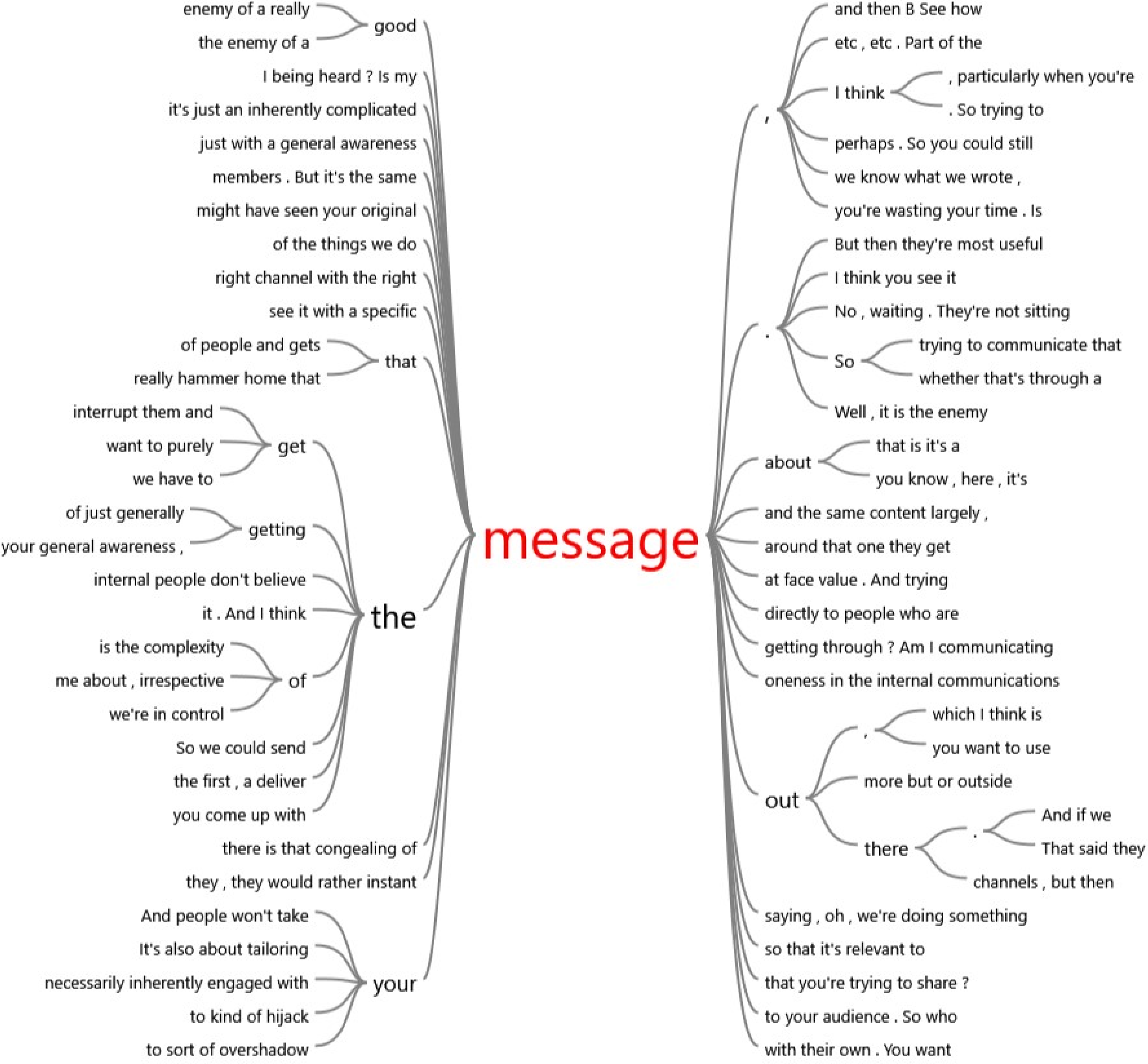
The structure of language about messages.
Across the participants, the prevailing conception of message which treats them largely as fixed things – things carrying with them impact. Messages are spoken about as being ‘sent’ or ‘good’ or ‘the same’ or something to ‘get out’ or ‘get through’. Messages are approached by communications professionals as concrete things – and that their status as such is or must be – a key component that does the work of communication.
The content captured from the ‘message’ word search in NVivo demonstrates participants appear to see the work accomplished by communication as reducing uncertainty, answering questions, clarifying positions (or items) and resolving problems – problems of access, problems of distribution and problems of targeting audiences. While Figure 1 has the iconic appearance it does as a direct result of how word mention choices appear in NVivo searches, the specific instance of the word ‘message’ denotes just how powerful – and importantly – how uniform these views of messages are across the persons interviewed in the project.
For all the diversity of persons, organisational contexts and roles performed by participants, the word and sentence structure around ‘message’ was the most uniform of all topics sampled in questions asked and answers given. This observation supports the idea that a widely and strongly held view about what communication is and how communications are to be employed exists across participant organisations.
Appreciation of channels
Across the answers gathered in the present research, channels of communication are treated primarily not only as conduits through which messages flow but as mechanistic realities. Data were used to differentiate between what was formally described as channels in interviews and those other recurring patterns of communicating which function as a type of channel as described by the research and as anchored in communication studies literature.
Broadly defined, especially within the media ecological tradition, a communications technology is any human innovation which permits persons to create, share and manage meaning(s) that would otherwise be extraordinarily difficult – if not impossible – without said item having been invented (Marvin, 1988). Very little – if anything – that persons-in-communication do regarding the production and sharing of meaning is accomplished without technology.
Channels noted by participants tend to capture only electronic or digital channels such as radio, television and the internet. At least one participant noted low-tech channels such as billboards (outdoor) and trade publications (which may occur either in paper or via the internet). However, channels were described by participants as carrying or delivering messages and message-intensive activities. Again, this is expected given the initial message-centric answers participants shared above. Lost in such an orientation, however, are those larger, interactive socio-cultural opportunities Innis (1950) reminds us of that may be latent in any technology.
Probing participant perspectives on channel choice and use further unpacks some of these orientations. Participant G, for example, stressed the reality that the choice of channel depended on (a) the nature of the communications product and (b) the communities with which communications are planned. In their work, they note using direct (face-to-face) engagement, telephone calls, zoom sessions, social media inclusive of Facebook, as well as print advertising. Participant J mirrored this idea about the choice of channel for purpose: ‘And the obvious one is if we are selling product, then it's advertising, advertising on TV advertising, on radio, advertising on social media, and advertising via by word of mouth’.
Participant K concurred and added it is important to make the communications as engaging as possible. High-quality and descriptive image – video if possible – were stressed. Participant P added this is one key advantage of social media such as LinkedIn, twitter and Facebook. Facebook was noted for its fit with ‘community’ interactions. Twitter on the other hand was described as resonating with ‘breaking news’. LinkedIn, lastly, was described as a channel best for its ability to share information of a technical nature.
Other participants outlined a rationale for channel choice. Participant T added the continued relevance of newsletters but warned organisations needed to be aware of information email overload which transforms potential newsletters into unopened files. This, they noted, is a risk for both internal and external communications and must be considered as channels are built into a communication campaign. Similarly, the potential limits of LinkedIn as a channel were that many of the people who view shared LinkedIn feeds tend to be quite siloed: ‘…people that have had the same training professional experiences as me, it's that's not representative of anything, in terms of the hydrogen community, in terms of Australia's national community, whatever it might be’.
Overwhelmingly, interviews suggest participants have similar views that channels of communication are largely technological in scope. These conduits appear valued as the way messages are sent and received and as such permit the identification of messages and permit their rapid distribution.
Interpersonal communication as a neglected Medium
‘you want to be bringing people with you on your journey as you roll out a project. So, you definitely need more interpersonal communication’. (Participant K)
As noted in the above section, the channels noted by participants are delimited to formal, mechanistic things readily identified as conduits for the transmission of messages. Further analysis of participant perceptions of communication channels suggests there are additional channel-like configurations within their day-to-day communication – though they are not initially named as such by participants. One of these is interpersonal communication.
In the context, the present research, participants suggest that interpersonal communication itself is more than just sending messages. And in speaking of interpersonal communication, participants appear to appreciate the varied social context not typically rendered when speaking about doing messaging. To be clear, participants did not explicitly list interpersonal communication as a channel.
However, there appeared across the sample an understanding that it is one. Participant W offered up the advantages seen as inherent in using of face-to-face communication: ‘Oh, look, face to face is obviously the most effective. I mean, I think because it's a real two-way conversation. And that's clearly and it can be absolutely personalized, so that that's clearly but it's resource intensive’.
Participant V mirrored this sentiment with the emphatic claim ‘I just don't, think there is any substitute for personal interaction, particularly where people are passionate, or, you know, quite forward leaning and positive about what they're talking about’. Participant G added: ‘I would say that face to face engagement is still the most effective form of consulting communities and stakeholders…a lot of the communities have said to us, we'll wait until you can engage face to face, and we don't want to attend online mechanisms’.
Participant N was one of the few informants to think about and speak about communications technologies in a holistic manner: ‘Well, the low, the low-tech communication is actually genuine communication. Everything else is just pushing information. Yeah. Yeah. It's interesting to see that there's the default to do that. Say, I've ticked the box. I've communicated. It's on the website. Mate, go find it!’
Participant P summed up what appears to be the general sentiment across all participants about interpersonal communication adding ‘there's nothing like getting onto the ground, seeing the local environment, meeting some local people and really then appreciating what are the genuine questions that they've got’.
While the way interpersonal exchanges are named as channels varied across those interviewed, there appears to be an appreciation that interpersonal communication itself is some type of medium. Moreover, several of the interviews captured the sentiment that tele-mediated talk can embody essential features and functions of co-present interpersonal communication. Zoom, Microsoft Teams and the like are noted to have the capacity to simulate many of the multiple, infra-communicational channels (ala Birdwhistell, 1970) such as gaze, body positioning, gestures and paralinguistic markers, which are common to people speaking interpersonally – face-to-face.
Also noted across participants, on the other hand, is the reality that telemediated interaction appears to have an in-built capacity to disengage people as well. This last observation is a useful postscript to explorations of channel: no communicative channel guarantees engaged, efficient communication – multiple channels, persons and a common set of rules are required to maximise communication both intra-organisationally and with varied publics.
Potential for demonstration sites as medium for public communication
‘No one actually really engages with their petrol company, either apart from, you know, buying a chocolate bar, maybe when you go and swipe your card, and if you can swipe your card at the petrol pump, then there's absolutely no engagement whatsoever’. (Participant B)
As this epigraph denotes, the way in which engagement is framed in an organisation impacts what registers as engagement and, from a research perspective, hints at what might be missed as engagement in practice. The example above appears to be informed by a notion of ‘engagement’ which is observable in the moment – and misses perhaps, an important communicational – engagement which would include a motorist viewing a petrol station's physical signage marking the location of a station – just prior to pulling in and utilising the pump. Indeed, there are likely a variety of remote or abstract engagements to be made from company to consumer in the gaseous fuels space.
Questions lingering from the SA event (research branch 1 described in methods above) motivated the researcher to test the appetite for demonstration and communication events across interview participants. One participant, (Participant C), was present at the South Australian event. When asked about the potential use of coordinated events such as a public open house-like forum for future strategic public communications, she added: ‘But then we fast forward to the South Australian safety conference, when they had the public day when people came in…the conversations that you were able to have them one-on-one meant you could answer specific questions, concerns that they had, [like] how would it impact me? Like, you know, they might have heard of fracking and is hydrogen like that?’
As this excerpt denotes, the experience of in-person communication appears to harness the ability to engage in real time with citizens and to gather from them information useful for subsequent communications activities. The above participant notes issues one might not expect to be on the minds of citizens with reference to hydrogen. Fracking and coal, for example, appear to crop up about the industry – as it attempts to decarbonise – and by association, wider environmental concerns about fossil fuels blend socially with the cleaner variant - natural gas – reducing its appeal. Intelligence gathered from citizens at demonstration events appears not only as a means to speak to the public but also to plan future strategy by listening deeply to them.
Today, a purpose-built hydrogen demonstration and education facility operates in the Australian state of Victoria. The facility embodies a comprehensive, structured approach to bring people along a carefully planned journey on the topic of hydrogen. Participant J, the creator and manager of the centre, explains: ‘The whole, that whole thing is that the concept is that you know nothing about hydrogen when you walk through that door… So going through the centre allows you to get an understanding, a base level understanding about what the concept is, what the hell is this thing all about, then going out into the service bay that has been set up saying, Hey, this is what the service looks like for a fuel cell… So, you come into the centre not knowing anything about hydrogen, and work out what it is, go for a drive and I'll put [out] the whole spoiler alert – it just drives like any other car’.
In addition to the items referenced by the centre manager, the site includes a newly installed 90kw photovoltaic array, Proton Electron Membrane electrolyser, storage tanks and refuelling stations.
From the perspective of optimising communication, the space also includes a 32-seat auditorium connected by frosted glass doors to the guided hydrogen education display. The entire environment is one that helps support – literally and figuratively – bringing visitors on a hydrogen fuel learning experience. Six learning stations break up the walking tour and anchor visitors in clearly presented, easily mastered visuals outlining answers to the what, why, how and where questions average citizens likely have about hydrogen. While this facility is connected clearly to the mobility space, it functions as an exemplar of how to resolve the information needs, challenges and goals of industry to pull persons into a conversation about decarbonisation.
Having had the experience of visiting the centre before it was officially opened and having attended the prior public (interpersonal) SA event, the researcher hypothesised it might be interesting to sample research participant interest in bespoke demonstration centres like this as a potential public communications channel. As is clear below, participants were overwhelmingly supportive of using demonstration projects as a channel to maximise public communication.
Speaking about the value of coordinating public/industry interaction in new projects, Participant T noted it is crucial to assist people to see what a project ‘might look like and people can touch it, feel it see it – makes a big difference’ when they are on the premises of a new facility. Similarly, Participant K added: ‘I go back to my time in the resources sector, and companies would always host events where you could take them on site and walk them through the project…these projects, these demonstration projects are a really important part, I think of building that social license’.
The emerging nature of hydrogen as a fuel and the serious lack of personal context into which to place this gas suggests the appropriateness of the industry following the lead of the mobility sector to create comprehensive spaces in which participants can comprehend the details of decarbonisation projects. Again, Axsen and Kurani (2011) indicate purpose-built education and communication centres likely help secure the neighbour effect.
Having a centre instantiates situated, interpersonal media. Participant W captures a nearly universal sentiment across the participants ‘I think the more conversations we can have, the better’. Participant V focuses this on the value of supporting immersive education and offered the following in response to the question if their company should consider making a dedicated space to support citizen communication on the site of a planned hydrogen production and residential hydrogen-network gas injection facility: ‘I can also see a lot of opportunity for the general public to actually better understand the things that people don't understand are the options of hydrogen… when you realize, and particularly our site, because it is a demonstration site, which is going to show exactly those things, it's going to show renewable, you know, taking renewable electricity making into a storable and dispatchable, energy, fuel….’
Another participant noted companies will need to be mindful about who enrols in public events as the possibility does exists that activists may choose to ‘hijack your message. I think you see it a lot with this sort of ‘close the gate’ kind of stuff with gas and oil’ (Participant A). Strategic management of visitors alongside the use of a skilled facilitator would significantly manage this potential issue in real-time interpersonal communication.
The prototypical education and engagement centre appears to be is a cogent example of how gas industry partners might commence a new channel of communication to educate, engage and persuade members of the public as a crucial step toward social acceptance of decarbonised gaseous fuels. The principal medium in spaces like this is interpersonal dialogue. Real-time, two-way communicational engagement appears to coordinate resolution of otherwise ambiguous information. And although participants do not describe it as such, the practice avoids the pitfall of information / push approaches to communication so rigidly build into telemediated communications.
Discussion
When two human beings get together and they are co-present – there is built into it a certain responsibility we have to each other and when people are co-present…you can’t just turn off a person. (Postman, 1995)
The interviews gathered in this project suggest the issue facing the gaseous fuels industry is not one of simply transmitting messages to persuade people. The irony of the success of digital technologies such as zoom, Microsoft teams and other means of synchronous communications is that these channels appear more successful in extending already established patterns of communication and social interactions than they are in building new ones. Lacking the ‘hook’ or constraint of being in the same room as another person appears to inhibit these systems’ ability to make new interactions from scratch. The social acceptance of a new technology whether it is a fuel, or a mode of transport, requires persons to interweave their questions and concerns with options for making new meanings and moving forward.
Our new media of digital communication have not broadened our horizons – just the opposite. They appear to have enabled our turning off those persons and perspectives by whom we wish not to be bothered. One short exchange, between the researcher and Participant G, highlights the possible driver of this effect as well as clarifies an alternative. On the topic of speech and other co-present channels of communication we find: Q: ‘Why do you think it [face-to-face communication] is that it works, why it is more effective than the flashy or high-tech choices? A: Because it's more personable, and that you can read behavioural cues from each other when you're engaging…So, I think for all of those reasons, it works better. It's a more holistic form of communication. Q: And…if the organization can make a choice of channel, let's say, it is to send someone to a place to engage rather than to use digital? A: Yeah, our clients all support that face-to-face engagement is a priority and a preference’.
Time and resources are finite. The gaseous fuels industry has faced enormous resourcing challenges since 2020 and is likely to endure more of the same again in the future. The cost, however, of not working successfully with a variety of members of the public (as well as regulators and energy competitors) will likely harden into a serious threat to the industry's survival.
On the one hand, communications professionals in this study describe their work to be about doing messaging. On further probing, however, the issue of continual and person-to-person interaction emerges. Across the data gathered from participants in the current study, a real tension emerges between the practical and the ideal, the digital and the personal. A renewed investment in face-to-face interaction – either co-present or tele-present – is likely time and money well spent. Incorporating interpersonal communication programs into newly built hydrogen education represents a synergy between the immediacy of understanding and extending a path to social acceptance.
The answers provided about interpersonal communication in this project appear to be informed with a view that communication is far more than just sending telemediated messages – but there is no shared vocabulary across participants to readily see or to speak about interpersonal communication as a medium.
What does all this tell us about communication?
Scholarly sources, company reports, news and entertainment media, ‘how to’ manuals, etc. overwhelmingly conceive of communication as an instrumental process designed to transmit established meanings between persons. This is precisely what participants in the present study offer – at least at the level of the surface meaning. In this study, this is called message / push communication. In Figure 2, the left-hand column outlines the vision of communication when message creation and distribution predominates professional practice.
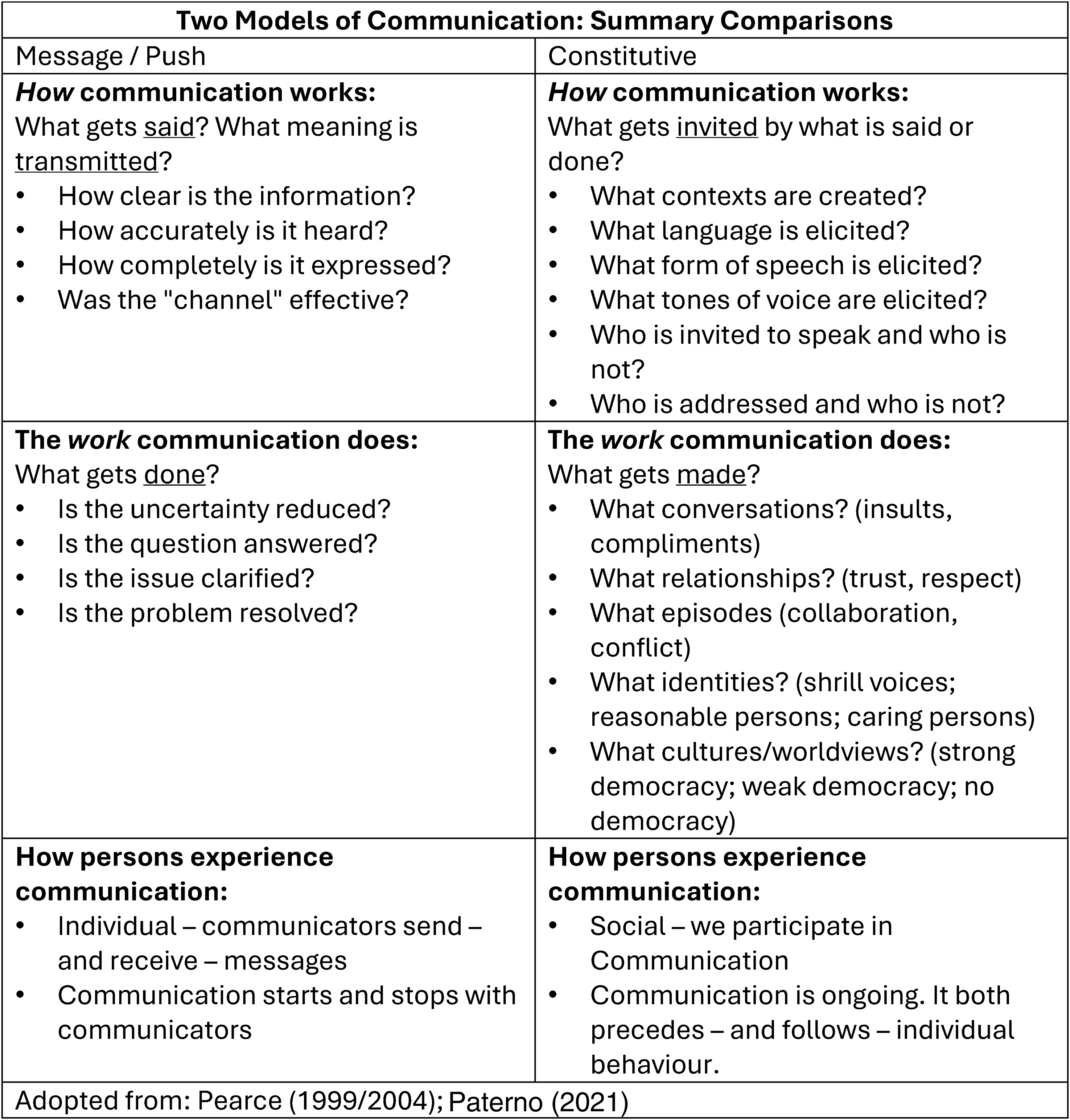
Two models of communication.
As is captured in the table, the message / push model does not mention any role communication may play in bringing into reality new social interactions – or structures. The focus of message / push is almost exclusively directed to handling pre-packaged meaning(s). It is these meaning(s) that are believed to carry forward the work that communication is believed to support.
Operating under such an approach, the successful execution of communicating is connected primarily to message clarity and expression. The message / push model concretises the idea that information itself carries forth resolution to problems of ambiguity, etc. While a gas company needs to consider the content which finds its way into advertisements or press releases, the work of an advertisement or press release is not realised in transmission of the advertisement or distribution of news release.
In contrast to this extremely popular, nearly hegemonic, approach to the modelling of communication – and the pieces of which emerge from participants when given more opportunity to speak about their work – herein called the constitutive view. As Taylor and Van Every (2011) remind us, messages are not a pre-packaged things sent – or received in – communication. Rather, information is an emergent product of persons’ engagement with communication. Returning to the above figure, and as the items in the right-hand column indicate, an alternative conception of how communication works may follow suit.
In this approach, communication is conceived as an invitation to join, rather than message-driven, meaning-transmission activity. To be clear, the differences between the two approaches are of both practical and theoretical concerns. Following this model, social meaning might better be conceived as the made meaning of the objects and events experienced in communication – not as transmitted by the stuffing of communications. As touched upon by participants in the current study, practical issues arise from the nearly exclusive focus on telemediated communication rather than on a comprehensive multi-medium approach which includes strategic, coordinated interpersonal interaction.
Conclusion
As late as 2024, scholarly investigation into communication and the topic of Australian hydrogen continued to default into investigations of select messages distributed via telemediated and digital communications (Novak, 2024). Indeed, the prevailing concept of medium continues to serve such mechanistic typologies. A shift to put authentic, situated human communication at the forefront of communication campaigns is precisely what industry folk appear to want to employ, after they exhaust pro forma talk of messages. When planning strategic communication plans, practitioners will likely need to widen their medium horizons to ensure they do not overlook key channels essential for securing social licence/meaning.
Stephens and Barrett (2016) note organisations must be nimble to adapt their communication practices – and explanations – to ongoingly align with those of their stakeholders. A key aspect not typically appreciated in corporate settings is a desire for both clarity and brevity. Stephens and Barrett caution that organisations have a lot to lose if they do not master the skill of engaging brief, clear campaigns. This applies to all issues – even that highly technical or otherwise complex. This means communication practices should be seen as opportunities to invite explanations rather than simply moments to push messages.
On a more micro level, Sanders and Fitch (2001) redirect the attention of both researchers and practitioners to the primary role communication plays connecting to both people and issues. Calling into question the common views of how change is affected in communication, Sanders et al. reiterate the idea that, from a communication perspective, messages do not carry latent effects.
The insights gathered from the present research indicate support for industry embracing a ‘new’ channel of communication such as is embodied in the Victorian hydrogen demonstration and education centre explored during this project. Moreover, this prototypical bespoke education centre makes concrete the relevance of a tool like the constitutive model of communication applied here. Flipping the message / push model on its head, this model suggests the practicality of seeing communication not as an add-on but rather as a primary part of the larger whole we call organisation. The constitutive model, with its focus on what is made in communication, aligns well with the challenge to make social acceptance and to support the neighbour effect.
New conversations, new relationships and new identities can be made when company representatives and regulators have actual conversations with persons. Inviting participants, encouraging feedback and conducting episodes of engagement – on the site of hydrogen production and generation facilities all hold a powerful opportunity to make lasting connections between people and proposed fuels. The public – and this is an imprecise term as regulators, policy makers and the like represent publics as well – needs to be seen as being invited into new patterns of communication. They do not seem to need new streams of tweets, Facebook posts or news stories.
The industry would be well-served to pay closer attention to the forms of communication employed in building connections with residents going forward. Both research and industry communications practices will need to attend to these groups and pay close attention to their general forms of communication. The reflections of COVID19 underscore the reality that relationships already established can be maintained through a transition to remote, digital technologies. However, Sherry Turkle (2015) reminds us, digital media are less capable to commence authentic, enduring connections.
For all these reasons, the research presented above suggests internal and external communications staff across the gaseous hydrocarbon industry to create an interagency working group to mirror the form of communication embodied in Victoria and create and staff a similar space in each of the upcoming hydrogen generation and injection/blending facilities across Australia.
In academe as well as everyday talk about messages, the most common answer to the question ‘why messages?’ is ‘because…messages!’ Messages are thought about as the most crucial substance of communication. They are conceived of as the filler of media. They continue to receive more attention than any other part of communicative processes. Such a bias leaves unexplored issues of medium – and as Sanders (2021) reminds us – distracts us from the consequentiality of human communication itself. It may very well make sense to selectively evoke the shorthand of messaging when speaking about communication at a surface level, but strategic communications activities require a more comprehensive view. The stakes for the industry to get communication right are high. The results of the present pilot study suggest a state-of-the-art and comprehensive approach, grounded in human communication basics, merits further testing and application.
Footnotes
Funding
The author disclosed receipt of the following financial support for the research, authorship and/or publication of this article: This study was partially funded by a grant from the Future Fuels CRC – Australian Government's Cooperative Research Centres Program (grant number RP2.1-05).
