







Abstract
This paper examines how sociology can think cinematically through the creation of sociological film, achieved by blending sociological and filmic imaginations. While traditional visual sociology often treats film as a tool for data collection, this study argues that cinema functions as a medium of thought that constructs and communicates social knowledge through image, rhythm and affect. Drawing on Just Black? (1992), Talking Heads (1980), Anything Can Happen (1995) and Chronicle of a Summer (1961), the paper demonstrates how cinematic form can embody key dimensions of sociological imagination, such as lived experience, structure–actor relations and reflexivity. By analysing how interviews and framing translate sociological inquiry into visual language, it highlights film's potential to generate affective, collaborative and public modes of understanding. The study concludes that sociological film transforms the camera from an instrument of observation into a participant in thought, making the sociological imagination visible and experiential.
Introduction
In recent years, there has been a rapidly growing interest in using visual methods within the social sciences to engage with communities, reach wider audiences, and explore more cinematic forms of expression (Lulkowska, 2024; Mitchell et al., 2024; Sebag and Durand, 2024; Van Lancker, 2025; Vannini, 2018). This shift suggests that sociology's predominantly linguistic approach to knowledge construction and communication may need to be reconsidered in light of the growing prominence of visual media. This paper examines how sociological imagination can shape film form, asking how sociology can do film. The inquiry shifts from analysing what film reveals about society to exploring how a sociological way of seeing can give form to film.
In the tradition of visual sociology, photos and films can be employed in two primary ways. First, they serve as evidence and a means of collecting data to support research; for instance, they can document specific actions and behaviours. According to Knoblauch et al. (2013: 438), early pioneers like A.C. Haddon, Baldwin Spencer, and Robert Flaherty used film to explore human behaviour. A small but growing group of researchers in this field use film to present their findings, and to enhance their analysis by drawing on film as a secondary source. In these works, researchers strive to maintain an objectivist, neutral stance when using the camera. For example, McPhail and Wohlstein (1982) used film to analyse pedestrian behaviour by applying a Cartesian approach to accurately measure distances, directions, and velocities of movement. These positivist efforts can be categorised under what Harper (1988) calls the “scientific mode.” These works aim to understand how things really are and how things really work.
Second, researchers use visuals as a means of analysis, an approach that builds on the principles of cinema analysis. It also has a relationship, though from a different epistemological standpoint to the discourse analysis of visuals, multimodal analysis, the sociology of film, and what is called textual analysis in cultural studies. Within this context, scholars such as Sutherland and Feltey (2013) have introduced the term cinematic sociology to describe how films can be used to teach abstract sociological concepts by revealing social relations and power dynamics that evoke emotional engagement and deepen students’ understanding of complex ideas.
While the objectivist approach has a rich history in visual sociology, other epistemological traditions, such as constructionism, have also shaped sociological inquiry. However, constructionism has not yet been widely applied to the practice of filmmaking within sociology. Within this context, Sebag and Durand (2024) have introduced “filmic sociology” to show how film can affect sociology. Sebag and Durand (2024) argue that film can “do sociology,” producing a mode of inquiry that is both analytic and expressive, where visual composition, editing, and narrative rhythm convey social relations and structures that written text may fail to capture. From a constructionist perspective, shaping a frame always involves choices about how to signify and communicate a social phenomenon. As Griffin (2018: 44) explains, “according to constructionism, we do not create meaning; we construct meaning. We have something to work with. What we have to work with is the world and objects in the world.” Analysing existing visual materials therefore requires attention to how meanings are produced, how representations operate, and how power is embedded in visual signification. Whether intentional or not, these signs reproduce or challenge dominant discourses. Building on this epistemological understanding of the social world, the question then becomes how we can construct the social world through film itself, using filmmaking as a sociological form of exploration rather than merely an object of analysis.
This requires clarifying what kind of sociology we are invoking. The sociology we draw upon here is not a neutral or purely academic science that observes society from a distance. It is a reflexive, interpretive, and critical practice that acknowledges its own position within the social relations it examines. It recognises that knowledge is always mediated by affect, positionality, and method, and that the sociologist actively participates in constructing the realities they seek to understand. As Gilfillan (2025: 242) notes, the challenge is to move beyond “extrinsic hypotheses” that treat people as objects of analysis, towards a “fully representational sociology” grounded in lived experience. His notion of the worker–inquirer–knower (Gilfillan, 2025: 243) reclaims the embodied and affective dimensions of knowledge as constitutive of sociological truth, aligning “doing, being and knowing” in an act of integral representation. Relying on Jones (2017, 2021) filmmaking becomes not only a tool for representing reality but a sociological practice that constructs and communicates it, allowing thought to unfold through rhythm and relation. In our approach, sociological imagination becomes an active creative force that organises the mise-en-scène, transforming observation into participation and representation into collaboration.
According to Mills (1959), the sociological imagination goes beyond grand theories and abstract empiricism, aiming to link personal issues with broader social structures. Moghimi (2023) expands on this by defining sociological imagination through six categories: sociological life, structure–actor relationships, critical perspective, academic awareness, fluidity of meaning, and the promotion of sociological imagination. This framework, developed through a thematic analysis of classical and contemporary sociological thought, provides the conceptual foundation for our argument. Sociological life integrates sociological thinking into everyday practice, linking personal biography with collective history. Structure–actor relationships highlight the dialectical interplay between individuals and social structures. Critical perspective challenges taken-for-granted assumptions and reveals hidden dimensions of social life. Academic awareness sustains reflexivity and methodological rigour while engaging wider publics. Fluidity of meaning recognises that meaning shifts across contexts and interpretations. Finally, the promotion of sociological imagination underscores collaboration and dialogue between sociologists, filmmakers, and audiences. Together, these categories form a heuristic for constructing and analysing films that embody sociological imagination and connect lived experience with broader structures of power and meaning.
According to Moghimi (2023: 479), sociological film can “effectively bridge the gap between sociologists and the publics by fostering sociological imagination.” Thus, while the niche area of visual sociology, particularly making film in academia, often use visual content as a text for analysing or a research tool, “sociological film” introduces publics, a third agent into this dialogue, to connect with. This approach is exemplified by “public sociological film”, a collaborative and participatory form of research that draws on filmmaking to connect personal narratives with broader social structures (Moghimi and Sadighi, 2025). Our approach expands the sociological film framework (Moghimi, 2023; Moghimi and Sadighi, 2025) by emphasising the role of cinema as an affective medium that, at the level of representation, enables the connection between sociological and filmic imaginations. When we discuss filmic imagination, we are talking about constructing meaning for a concept using the language of cinema, not just using the camera as a tool. 1
Filmic imagination is the mode of human imagination that takes form through cinematic means. It belongs to a broader philosophical lineage that treats cinema as a mode of thought and perception (Cavell, 1979; Deleuze, 1986, 1989; Sinnerbrink, 2011), one that constructs the world through image, time, and sound. As McGregor (2012: 212) observes, “cinema provides a perceptual experience that is at once sensory and imaginative,” inviting viewers to enter a space of make-believe where “seeing and imagining are coextensive acts.” While these perspectives situate cinema as a form of thinking, Collingwood's notion of total imagination offers a deeper philosophical grounding. For Collingwood (1958: 148), imagination is “an experience of total activity” in which thought and emotion form a single process of knowing. As Vardoulakis (2006: 309–310) elaborates, this “total imagination” precedes both sensation and thought, allowing mind and world to arise together in a single ontological movement. Building on this, filmic imagination can be understood not as the representation of reality but as the very process through which reality is constructed—through light, rhythm, and sound as modes of thought. Drawing on Morin's theory of cinema, Wade (2011: 203) describes it as “a ‘mirror-machine’ that reflects the spectator's imaginary and practical relationship with images as experienced through new technologies.” This conception positions cinema as a dynamic site where the real and the symbolic are continuously negotiated, revealing imagination as an embodied and affective process inherent to the cinematic form itself. Ford (2014: 3) similarly defines filmic imagination as a “critical category exploring the artful escape of objectification.” Taken together, these perspectives clarify that filmic imagination is not merely a way of making imagination visible but imagination in action—cinema as a living form of thought that materialises the imaginative process.
A rich literature in anthropology (MacDougall, 2019) and recent work in cinematic ethnography (Van Lancker, 2025) provide valuable methodological precedents that inform our sociological framework, while our aim remains to stay grounded in sociology and to engage these cross-disciplinary insights critically. For film and media scholars, the sociological imagination reframes cinema as a medium of relation rather than mere representation. It shows how form connects the personal and the structural, revealing how emotion, space, and rhythm express social life. It also invites reflection on how cinematic seeing produces social knowledge and how spectatorship can be sociological. Asking how sociology can shape film thus becomes essential to understanding cinema as a social practice and expanding the scope of film research.
Our analysis examines three documentaries selected through purposive sampling to represent different modes of constructing social and cinematic reality, with a focus on the interview as a shared method between documentary practice and the social sciences. Each film is analysed through close readings of key sequences that combine multimodal transcription of image, sound, and editing rhythm with sociological interpretation. Finally, we highlight the collaborative filmmaking of Chronicle of a Summer (1961) by Jean Rouch and Edgar Morin to illustrate how sociologists and filmmakers can blend sociological and filmic imaginations.
Where sociological film stands
The intersection of film and the social sciences has generated a range of overlapping terms, each marking a shift in how visual methods contribute to sociological understanding. We can trace a movement from film as documentation to film as sociological construction. Early scientific and research films sought empirical accuracy, exemplified by Margaret Mead's tripod (Mead and Bateson, 1977), which embodied distance and neutrality, while Jean Rouch's handheld camera introduced participation and subjectivity (Rouch, 2003). Building on this trajectory, we take sociological film (Moghimi, 2023) as our point of departure. While related to research and scientific films, its grounding in public sociology gives it a distinct orientation that actively constructs the sociological through the use of sociological imagination in cinema.
Film and visual sociology
In visual sociology, two distinct approaches define how images are employed in research (Harper, 2012). The first approach involves actively collecting visual materials as primary data, with sociologists capturing or sourcing images from their research environments to directly study social phenomena. In contrast, the second approach focuses on analysing existing images, such as those found in advertisements, newspapers, or family albums. Here, the emphasis is on interpreting these images within their cultural and social contexts to uncover deeper meanings and social norms. As such, film in visual sociology can function as evidence, a text for analysis, or a secondary project derived from the research outcome. However, in this tradition, sociologists may be critiqued for extracting meaning from visuals while potentially overlooking the creativity and expertise involved in their creation (Mikos, 2013). The traditional visual sociology disregards the impact of cinema or photography as a medium and overlooks the valuable insights artists contribute through their unique storytelling techniques in favour of a scientific film.
In response to the limitations of the scientific mode, sociological film aims to blend sociological theory with creative storytelling to capture social realities. Drawing from the notion of “storytelling sociology”, the “truth” in sociological film is not evaluated by standard scientific measures of validity and reliability but by the strength of the stories in capturing the vividness of lived experiences (Berger and Quinney, 2005). This visual storytelling is a meaning construction process that seeks to go beyond academia, empowering both tellers and listeners to view film not merely as an objective tool in sociology, but as a means of reflexive understanding. In this sense, films exist as both a record and a language, representing reality through a constructivist approach that shapes a blended reality and intertwines real life with reel life. This process adds affect to the film. Affect enhances social inquiry by infusing emotional and sensory dimensions into the research, making abstract concepts more tangible and relatable (Troyer and Robinson, 2006). As Leavy (2018) demonstrates, affect enables researchers to explore both micro and macro connections. It allows them to illustrate how an individual's personal life is interconnected with broader social and historical contexts (Leavy, 2020). This is the essence of sociological film (Moghimi, 2023).
By exploring performative documentary, Nichols (2010) emphasises that documentary can be viewed as a creative treatment of actuality that engages with affect and emotion, rather than as a mere transcription of real events. This idea stemming from Grierson's (1933) “creative treatment of actuality”, which collapsed the factuality of documentary into affective fiction; in other words, as Hickey-Moody and Page state “affect is the way in which art speaks” (2015: 11). Accordingly, Hassard et al. argue for “a more nuanced sense of affect and embodiment in video-based research” (2018: 1411). Video-based research, akin to other arts-based methods, is valuable for its participatory potential and aesthetic dimensions, which are often underestimated (Harris, 2020). Expressive visuals achieved through deliberate choices in close ups, pans, and transitions enhance the emotional intensity of the videography. According to Hassard et al. (2018), these editing techniques are not merely technical but become integral to the theoretical act of expressive videography. They shift beyond conventional theorising and emphasise how the emotional impact of the film is crafted through these visual strategies.
As Sandercock and Attili (2012: 164) argue, filmmaking is not merely about creating a visual product; it also generates a space for interaction and dialogue. That is, the process of filmmaking shapes the environment in which the visual narrative unfolds and engages with its audience. This space of interaction is crucial for understanding how film not only represents but also influences and stimulates discussions about social realities and cultural contexts (Mitchell, 2011). By focusing on the behind the scenes aspects such as the role of the camera, the researcher, the research environment, and the editing process, this approach problematises how these elements shape representation. Harris (2020) highlights the role of the camera in this process as a pivotal nonhuman collaborator that can convey affect through the video and film it produces. This ability of the camera to “speak” through its images opens up opportunities for diverse forms of knowledge and interpretation, suggesting new ontological understandings of both human and nonhuman interactions.
In this sense, even if a film is considered academic research, it needs to be capable of conveying meaning through gestures, body language, and other sensory information, rather than merely serving as an indexical sign pointing to what happens in front of the camera (Wood et al., 2018: 830). Therefore, our approach underscores the importance of cinematic techniques in creating a deeper, more engaged understanding of social realities, ultimately contributing to the development of what can be termed “cinematic thinking”, where the interplay between these components profoundly impacts how narratives are created and interpreted (Sinnerbrink, 2011).
Sociological film and research film
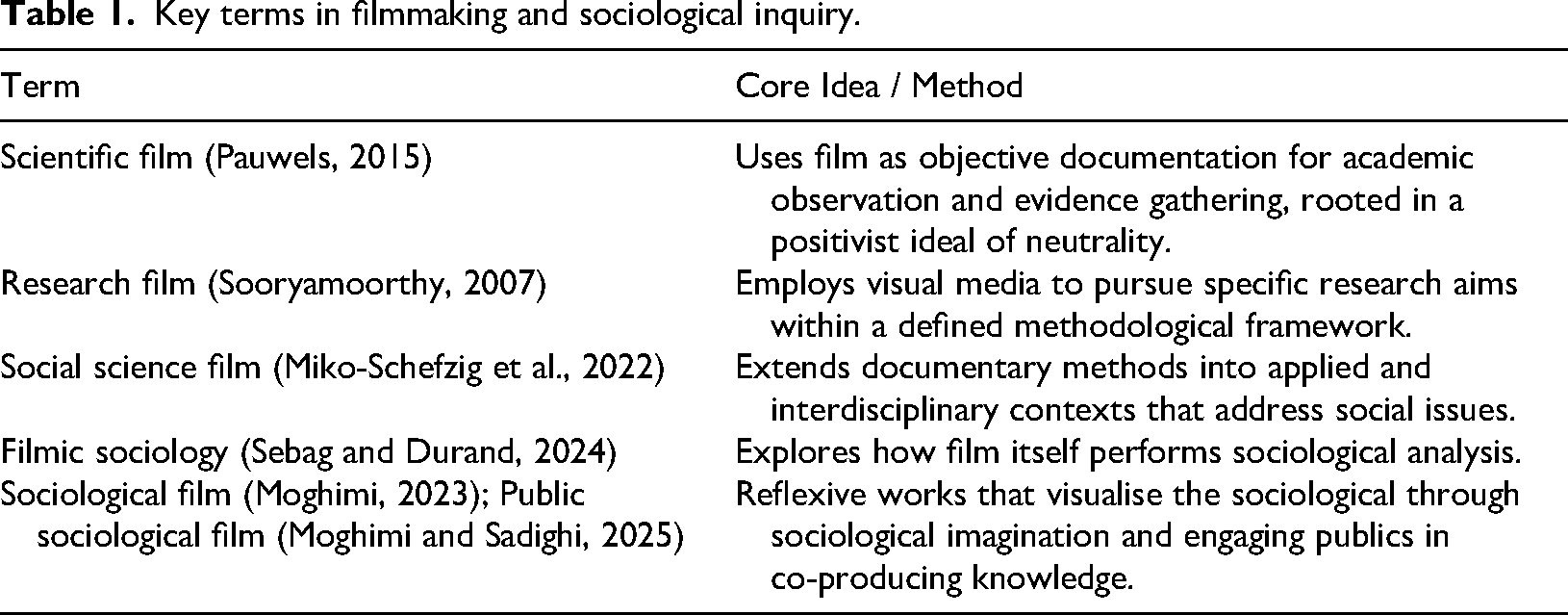
While sociological film we explore here offers a critical perspective on traditional visual sociology, it shares conceptual overlap with other related terms, including “research film” (Sooryamoorthy, 2007), “social science film” (Miko-Schefzig et al., 2022), and even the term “sociological film” itself as used by de Heusch (1962) and Kaczmarek (2020). Beyond their shared characteristics, we contend that significant distinctions exist between these terms. Recognizing these nuances enables a more precise comprehension of how various film types contribute to sociological inquiry and visual representation (Table 1).
For example, Sooryamoorthy (2007: 548–552), inspired by MacDougall (1969: 27), believes that research films serve specific research purposes and are intended for a specialised academic audience. Kaczmarek (2020: 8), expanding on Sooryamoorthy's (2007) ideas, states that “documentary, ethnographic, and sociological films have a lot in common, although the latter two types of film are scientific in nature.” Similarly, Miko-Schefzig et al. (2022), drawing on Wood's and Brown's (2011) ideas about the art-based practice of documentary filmmaking, try to integrate active role of the camera into scientific filmmaking. Accordingly, in the context of cinema vérité, their approach reflects Crawford's concept of a “fly in the soup” (1992: 78), where filmmakers are aware of their presence and its effects. They seek new ways to represent the other, using the camera as an active tool that shapes and influences the filmmaking process. Though according to their scientific approach, these efforts in practice demonstrated challenges such as what Leonard M. Henny (2012: 44) describes as the difficulty for a sociological cameraman; filming a scene, he suggests, should be like sampling, capturing a frame that represents a meaningful sample of people in that setting. As a result, these efforts aim to be recognised as stand-alone academic outputs for research reporting, encapsulated by Baptiste's (2016: 463) assertion that “a research-film can serve as an academic publication because it reflects the reporting of research that contributes to new knowledge or theories in a particular discipline(s).”
Inspired by Berger and Quienney (2005) ideas on storytelling sociology and building on Miko'’s (2013) concepts of aesthetics and dramaturgy, we argue that sociologists can enhance the communication of their ideas by adopting storytelling techniques from filmmakers. By integrating these techniques, they can apply a powerful sociological imagination throughout the filmmaking process. This approach results in impactful documentaries that blend sociological theory with creative storytelling to capture social realities and offer critical analysis tools. Wood et al. (2018: 830) summarised this ability as “doing research in a way more ‘cinematic’ than merely recording a debate on a subject or simply illustrating a written discussion.” By learning storytelling techniques from filmmakers, sociologists can communicate their ideas more effectively and engagingly (Berger and Quinney, 2005). Integrating sociological insights with compelling narratives allows documentaries to reach broader audiences and deepen understanding of social issues. Moreover, sociological frameworks help filmmakers avoid oversimplification and offer a more complex view of social phenomena. This collaborative approach fosters innovative research methods and generates new insights into social issues.
Representation of interviews in three films
This section examines how interviews are visually represented and used across three films, each reflecting a distinct epistemological and aesthetic tradition: research film (Just Black?), direct cinema (Talking Heads), and creative ethnography (Anything Can Happen). Together, they enable comparison across different modes of visual inquiry that treat the interview as both a method and a cinematic form. The analysis focuses on selected sequences, using a multimodal framework attentive to framing, rhythm, gesture, and sound as key sites of meaning-making. Each excerpt is viewed repeatedly, transcribed, and interpreted to connect filmic form with sociological content, clarifying the role of cinematic affect in visualising interviews.
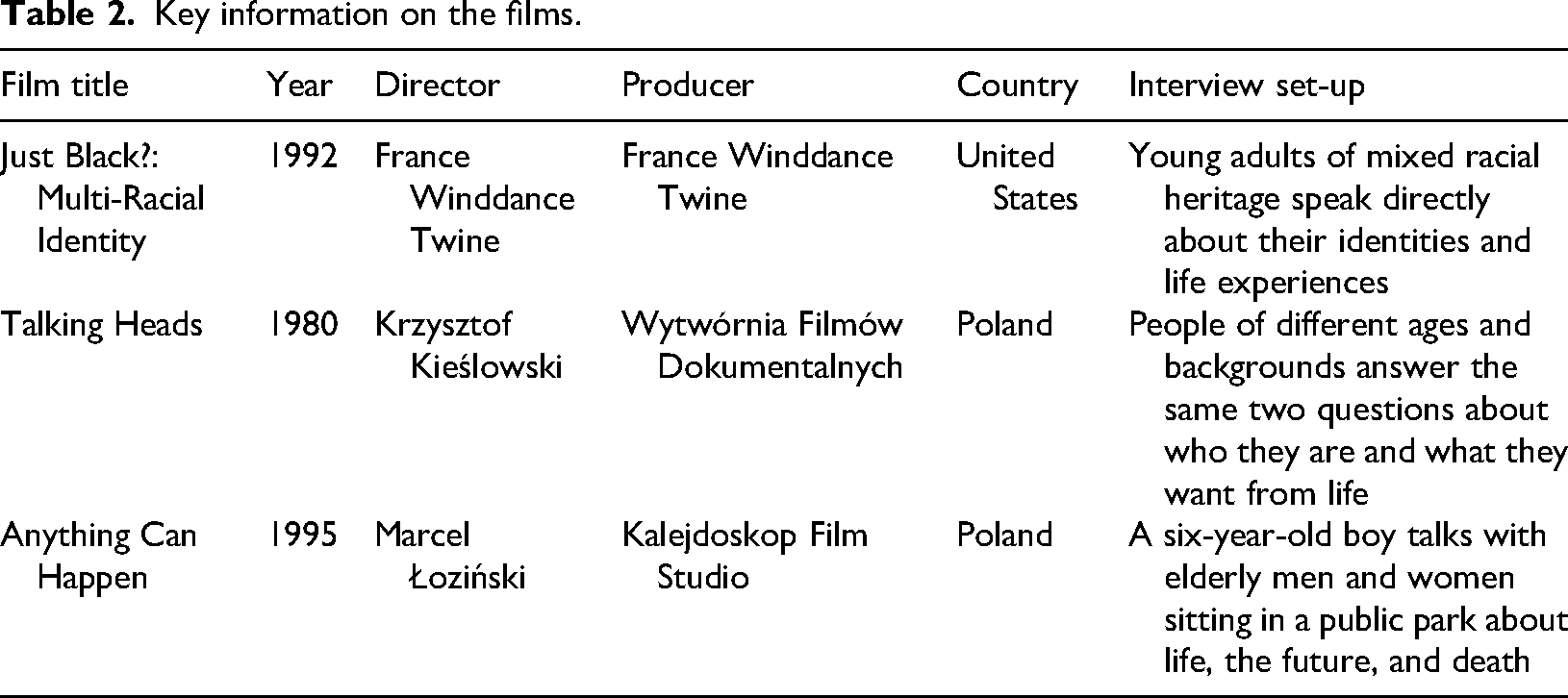
The analysis does not attempt to cover each film in full. Instead, it focuses on specific interview sequences chosen for their analytical value. These are moments where the interview interaction becomes especially clear, where participants reflect on identity, time, or social position, or where editing, framing, or silence draws attention to how the interview is being constructed. The analysis then examines how meaning develops through the relation between what is said and how it is filmed. This involves close attention to speech, pauses, gestures, framing, rhythm, and sound, and to how these elements work together within each sequence. Observations are then considered in relation to sociological concepts such as structure–actor relations and reflexivity (Table 2).
Just Black?: Multi-Racial Identity (1992) primarily focuses on multi-racial individuals within a scientific mode of inquiry. It begins on the street, asking people standing in front of the camera what race means to them. Then, five young people respond to a question that has been asked of them, sitting in front of the camera. Sometimes they share their opinions, and other times they talk about their experiences. We don’t know what the questions are, but each segment has a title that gives us a hint about the question. The interviewer isn’t physically present on screen except in a few rare instances where their voice is heard from behind the camera. The questions cover topics like: When did you realise you were Black? The issues of multi-racial individuals in family ties, the words used to refer to these people, the advantages of being multi-racial, the categories they belong to and other possible categories, and the problem Black people have with their hair, choosing a partner, stereotypes, safe places, and places to hide.
While the film tries to remain neutral by maintaining a fixed, eye-level camera angle, it is through editing, through the sequencing of individual testimonies and the rhythmic juxtaposition of differing definitions of race, that we perceive how race, as a social construct, becomes fluid and relational for the multi-racial interviewees. Each cut not only organises information but also performs an analytic gesture that reveals the social and affective variations emerging across the interviews. As MacDougall (2005: 34) observes, “the filmmaker must therefore proceed analytically, constructing a new reality out of fragments, seeing it as much with the mind as with the eye.” Meaning thus arises not simply through what is said but through the relations established between fragments, where editing transforms discrete voices into a dialogue of perspectives.
Building on the idea of incorporating affect into visual research, we argue that this film could benefit from applying filmic imagination to express its material more cinematically. Rather than simply highlighting moments from the interviewees’ lives, it could immerse viewers in their experiences and emotions while also revealing aspects of the filmmaking process itself. One might assume that this critique of the scientific mode of filmmaking shows that Just Black? lacks affect. As Mikos (2013: 419) demonstrates, the filmic codes of mise-en-scène and the conventional means of depiction and configuration play a significant role in producing meaning. In this film, the different directions each interviewee looks, their close-ups or extreme close-ups, the time between each section where a slide appears, the overall rhythm of the film, and the emotions expressed by the interviewees as they share their opinions or personal experiences all impact the audience. To add affect, we do not necessarily need to include music, explore various camera angles, or have a narrator or storyline. Affect exists within any intentionally or unintentionally constructed mise-en-scène. Following this idea, we can investigate the subtle affect in the direct cinema of Talking Heads (1980).
This short film highlights the interview format as a tool for constructing collective identities and exploring personal aspirations. Kieślowski's use of close-ups and minimal social background aligns with the objectives of direct cinema, which seeks to capture lived experience with minimal mediation. Yet Talking Heads goes beyond observation by transforming the human face into what Deleuze, via Deamer (2022: 83–84), defines as an affection-image—a cinematic surface where unfilmable internal intensities become externally legible through minute gestures, pauses, and expressions. The close-up functions as an icon (Deamer, 2022: 83), expressing both affective quality and potential action, while the sequence of interviews forms a dividual image of collective emotion that unites personal reflection with social feeling (Deamer, 2022: 84). Kieślowski's sparse settings serve as any-space-whatevers (Deamer, 2022: 85), neutral environments that amplify affect and allow emotion itself to occupy the cinematic space. In this framing, meaning arises from the interplay between image and silence, where faces and voices together construct the narrative. Extending the principles of direct cinema, Kieślowski moves from mere observation to an affective cinema that reveals individuality and collective experience through the immediacy of the filmed face.
His films and direct cinema focus on human faces and emotions, which are sometimes interpreted as political and social commentaries on Poland and the communist system (Leppla, 2021). Portraying people's feelings especially in everyday moments like happiness, indecision, or hope requires subtlety and simplicity in both filming and editing. Kieślowski aims to evoke in audiences the same feelings of sorrow and empathy he experiences when witnessing ordinary human struggles (Haltof, 2015). Therefore, in an artistic way, Kieślowski constructs affective interviews with minimal use of cinematic techniques. In contrast, Marcel Łoziński applies cinematic techniques and the idea of the creative treatment of actuality in shaping interviews in Anything can happen (1995).
Łoziński's approach to interviews in Anything Can Happen contrasts with the direct cinema techniques used by Kieślowski in Talking Heads. While Kieślowski strips down the filmmaking process to focus solely on the interviewees’ faces, Łoziński embraces the creative possibilities of cinema. He incorporates a more dynamic mise-en-scène, using the park setting not just as a backdrop but as an active element in the film's narrative—a public space where children can play and elderly people can reflect on their lives. The open, natural environment contrasts with the controlled, almost clinical spaces often associated with traditional interviews, allowing for a more organic interaction between the interviewer and the interviewees.
As Denzin (2011: 12) writes, “in the reflexive interview, two speakers enter into a dialogic relationship with each other… each becomes a party to the utterances of the other,” and this dialogic exchange transforms the interview into a shared act of meaning-making. Łoziński's film embodies what Moghimi (2023) terms “structure–actor relations” and a “critical perspective,” as Tomaszek's playful questions exposes how individual lives are shaped by social norms while gently unsettling hierarchies of knowledge and authority. The interviewer, Łoziński's six-year-old son Tomaszek, is not an expert seeking data, and the interviewees are not merely informants. The camera is not fixed at eye level but instead constructs light-hearted frames. The subtle use of ambient sound, sound effects and sequences of Tomaszek playing in the park enhances the emotional depth of the interviews. Łoziński's approach promotes fluid and playful communication between Tomaszek and the elderly participants and captures genuine connections that a rigidly structured interview format might miss. The film's editing plays a crucial role in shaping the cinematic narrative and allows the viewer to experience the whimsical rhythm of these conversations.
Anything Can Happen might be considered a poor example of direct cinema or even conventional documentary filmmaking, with some referring to it as a quasi-documentary. It blurs the line between reality and imagination, functioning as a poetic essay that, due to its hidden camera, can raise ethical questions in research films. However, it excels in applying a creative treatment of actuality. The result is a film that not only documents the interactions between a child and the elderly but also invites the audience to reflect on the larger themes of life and human connection. This approach highlights how interviews in documentary films can transcend mere information gathering to become powerful tools for exploring and conveying complex emotions and ideas. Reviewing these films shows that adhering strictly to the “scientific mode” to maintain objectivity, by using a single lens, avoiding music, and creating a video that feels more like an examination, fails to acknowledge that the “scientific mode” itself generates a specific academic affect.
The critical question then becomes: What affect is the filmmaker aiming to construct, and which role do they wish to play—an impartial scientist or a reflexive critical one who sticks to the ideas of sociological imagination? If we choose the latter, the challenge is to what extent we possess the skills to blend our sociological imagination with a filmic one. This blending might involve, as described earlier, the thoughtful use of cinematic techniques, or it could involve collaborating with an expert in filmmaking to achieve the desired effect. Blending filmic imagination with sociological imagination adds a deeper layer of affect to the representation of social life and the process of meaning construction compared to the scientific mode of filmmaking.
The power of collaboration: chronicle of a summer (1961)
Research films often struggle to garner sufficient support from academia and fail to reach broader audiences. These films frequently lack the filmic imagination needed to captivate viewers, as they remain entrenched in the scientific film paradigm and suffer from a deficiency in filmmaking expertise. Despite these challenges, sociological filmmakers have endeavoured to visualise the invisible through their sociological imagination. Documentary filmmaking, with its long and distinguished history, has adeptly highlighted social issues, amplifying marginalised voices, and exposing overlooked societal aspects. While documentaries have been pivotal in raising awareness and sparking dialogue, their exploration of social phenomena has not always been grounded in a rigorous sociological framework. This shortcoming can be attributed to the varying degrees of sociological understanding among filmmakers. As a result, there is a pressing need for a more integrated approach that combines sociological theory with the creative storytelling techniques of experienced filmmakers to produce documentaries that not only inform but also deeply engage and resonate with audiences.
Chronicle of a Summer (1961), co-directed by sociologist Edgar Morin and filmmaker Jean Rouch, is a landmark example of collaborative sociological documentary filmmaking. Produced by Anatole Dauman and Philippe Lifchitz for Argos Films and shot in Paris during the summer of 1960, the film follows a series of interview-based encounters with ordinary Parisians as they discuss work, happiness, politics, and everyday life, while reflexively questioning the filmmaking process itself. Its significance lies in this collaboration: Morin's sociological expertise shaped the interview structure, while Rouch's filmmaking practices captured everyday encounters, emotional expression, and interactional dynamics as they unfolded. This collaboration manifests the category of “academic awareness” (Moghimi 2023), as both directors continually question their methodological roles and the conditions of knowledge production within the film itself. According to Lopate (2024: 303), the film's self-reflexive ending, in which participants criticise the filmmakers for manipulation, transforms a failed experiment into an artistic triumph demonstrating that self-examination is itself a sociological act.
By starting with a simple yet profound question—”Are you happy?”—the documentary transcends traditional sociological research questions and delves deeply into the complexities of social life. The film's unique approach allows it to explore class tensions, generational divides, and the anxieties of a nation grappling with its post-colonial reality. Through conversations with diverse individuals, from artists to factory workers and from an Italian émigré to an African student, Rouch and Morin blend their filmic and sociological imaginations to offer an extraordinary document of time and place. This approach not only reveals the personal hopes and dreams of its subjects but also provides a richly textured understanding of the social landscape of 1960s Paris. In the following analysis of Chronicle of a Summer (1961) through the lens of sociological imagination (Mills, 1959), we aim to explore how this film can be seen as a sociological film.
The film enacts multiple categories of sociological imagination simultaneously. The dissection of actor–structure relations appears in how personal testimonies about happiness reveal broader systemic constraints of class, race, and colonial history. The film also performs a critical perspective by questioning the neutrality of the camera and by revealing how cinematic representation shapes truth. As Margulies (2004: 173) notes, the film is “an experiment lived by its authors and actors,” a collective psychodrama that exposes both the ethical and epistemological limits of truth-seeking. Through its filmed encounters, the project constructs a reflexive sociology that questions its own assumptions while fostering awareness of social structures.
The film represents ordinary people's lives and highlights hidden social realities by connecting their stories to a broader social context. This aligns with the core idea of Mills (1959) who shows how personal troubles in specific milieux relate to public issues of social structure. However, linking this sociological imagination to a filmic imagination requires expertise in filmmaking. This linkage corresponds to Moghimi's category of fluidity of meaning, where knowledge emerges through interpretive openness rather than fixed explanation. The film's dialogues are filled with pauses and silences that, as Margulies (2004: 176) observes, “become the utmost sign of authenticity.” These hesitations reflect the film's refusal to close meaning, allowing viewers to experience the unfolding of thought as a visual and sonic event. Borish et al. (2021: 8) similarly describe such moments as “embodied knowledge,” where gesture, tone, and rhythm become part of the analytic process—an early realisation of film as multimodal qualitative research.
The first dialogue of the film begins with Jean Rouch saying, “You see, Morin, getting people together to talk is an excellent idea. But I don’t know if we can succeed in recording as natural a conversation as we would without a camera present.” Rouch's concern about the authenticity of conversations recorded with a camera highlights the complex balance between public and private realms. By positioning subjects, the camera, and themselves in hybrid spaces—where private reflections are presented in public contexts—the film explores the dynamic interplay between personal intimacy and public performance.
Let's review the questions they ask individuals: “Are you happy?” However, they do not specify what reasons the interviewees should have for their happiness or unhappiness. Instead, the film itself reveals these nuances within the system that constructs their lived experiences, such as job, politics, race, and class. Therefore, the film positions the subjects in a hybrid space, where they reflect on their lived experiences and engage in private discussions within a public setting. Even those interviewed in their private spaces are still presented in front of the camera, thus placing them on the “front stage” of the film. The camera creates a front-stage environment that subtly shapes how participants present themselves in the presence of an audience. This dynamic encourages more deliberate and reflective self-presentation, enriching the depth of their narratives as they engage with the filmmakers’ inquiries. These dynamics evoke what Moghimi identifies as sociological life: the lived reflexivity through which individuals come to understand themselves as social beings. As Margulies (2004: 177) points out, each filmed exchange in Chronicle carries “testimonial value,” turning everyday speech into an act of social witnessing. The film thus promotes what Moghimi terms the promotion of sociological imagination—it invites publics to connect their emotions to structural realities and to think sociologically through cinematic experience.
This duality illustrates the hybrid nature of the film's setting that simultaneously tries to link biographies to history, and individuals to the collective by exploring various examples that the subjects bring up to explain why they are or are not happy. To demonstrate this hybridity, the space where biography and history are linked—where the personal is social—is conveyed not only through the narration but also through the camera's position and how it constructs this reality. The visual strategies, including mirrors, reflections, and directional pans, translate sociological imagination into filmic form, visualising the linkage between self and society. Such aesthetic choices manifest the critical perspective and the fluidity of meaning, as form itself becomes a site of reflexivity and dialogue.
One of the first scenes in the film clearly demonstrates this hybrid positioning. As shown in Figure 1, the camera is placed in a cafe, representing a hybrid space where people experience both a sense of wholeness and distinctiveness. These spaces represent moments when an individual experiences a blend of being both unique and part of a larger collective. This idea is further emphasised by the use of the mirror, which reflects the inside of the cafe, and the windows, which frame the public outside. The camera pans from right to left, situating us in a liminal space, somewhere in betweenness, reflecting how the participants navigate multiple social roles and expectations within these spaces. Additionally, the camera's right-to-left panning in the cafe symbolises a movement that challenges conventional spatial and narrative flows, reinforcing the hybrid nature of the space. Through the lens of van Leeuwen's semiotics of movement, this directional choice emphasises the fluidity and complexity of the hybrid pace, and it might suggest looking back at past events or reversing the usual order of information. (van Leeuwen, 2021)
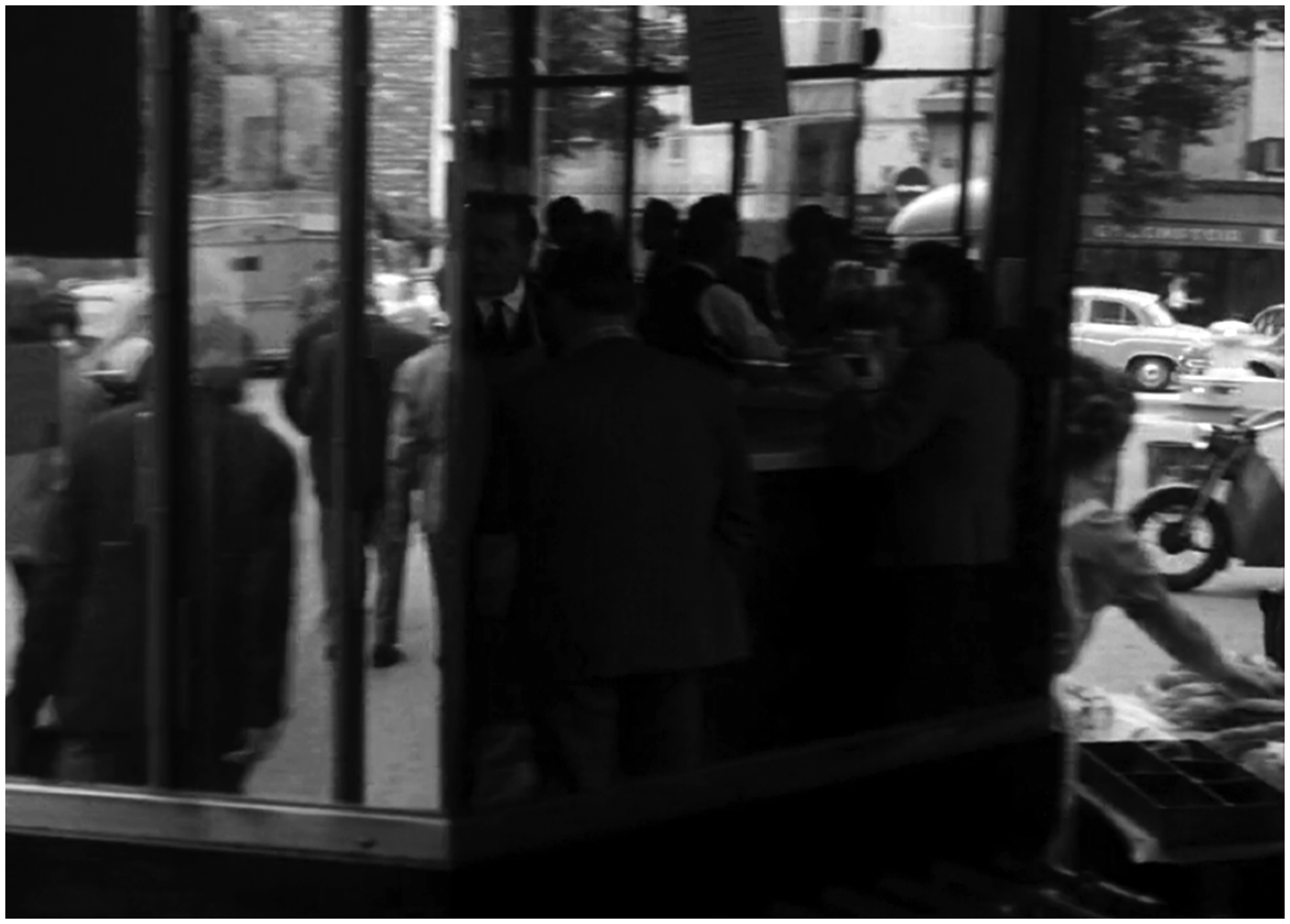
The camera is positioned inside the café, with the mirror reflecting the interior and the windows revealing the street outside.
Morin, the sociologist, aims to gather diverse opinions from ordinary people, drawing from theories of everyday life, and translating these sociological theories into a visual form through Rouch's filmmaking. While Rouch worries about the impact of the camera's presence on events, the film's narrative ultimately unfolds precisely because the camera is there. In Chronicle of a Summer, the presence of the camera acts as a catalyst for “sociation” (Simmel, 1964). It brings together individuals who might otherwise remain separate, fostering interactions that reveal their personal experiences and perspectives to shape the public. The camera also prompts them to reflect on their own lives and articulate their experiences in a way that contributes to a collective understanding. In the context of the film, the cooperative activity is the collective engagement with the filmmakers’ questions and the act of storytelling. This cooperation represents a dynamic interplay among three critical components: the sociologist, the publics, and the filmmaker. A trialectic medium that brings these agents together to represent social life and visualise the invisible. It also shows how a collaboration between a sociologist and a filmmaker or the merging of sociological and filmic imagination can spark the audience's imagination. This collaborative method promotes sociological imagination by transforming filmmaking into a shared social process. As Lopate (2024: 304) writes, the film's power lies in the “interplay of gravity and sprightliness” that only such divergent sensibilities could produce, where sociological seriousness is fused with cinematic play. The result is not just a record of society but a performance of sociology itself.
Conclusion
Key terms in filmmaking and sociological inquiry.
Key information on the films.
Footnotes
Acknowledgments
NA.

Ethical approval and informed consent statements
NA.
Funding
The authors received no financial support for the research, authorship, and/or publication of this article.
Declaration of conflicting interest
The authors declared no potential conflicts of interest with respect to the research, authorship, and/or publication of this article.
Data availability statement
NA.
Any other identifying information related to the authors and/or their institutions,funders,approval committees,etc,that might compromise anonymity
NA.