







Abstract
Existing research largely confines consent analysis to power differentials; this study uses gendered identities as an outcome of gendered socialisation processes to examine the complexity of consent in nude sharing. Through online focus groups with 29 Australian emerging adults aged 18 to 24, the research identifies gendered patterns of consent-giving shaped through socialisation. Women, often characterised by more permeable ego boundaries, tended to perceive sexting as relationally obligatory and frequently reported experiences of subtle coercion and shame. Men, whose ego boundaries are generally more rigid, tended to frame sexting as entertaining and socially normative and often downplayed potential harms. Based on these findings, this study proposes communication strategies that encourage individuals, parents, and society to engage in mutual change rather than placing the burden solely on individuals.
Younger generations, particularly late Millennials and Generation Z, have grown up in a digital environment where sexual autonomy, pleasure and agency are discussed more openly than before (Neff, 2020). As digital intimacy is normalised through dating applications, nude sharing and sexting practices (Schreus et al., 2020; Stardust et al., 2022), body positive and sex positive discourses frame consensual sexual expression as valid rather than shameful (Fahs, 2014). Within this context, nude sharing is often understood as a routine form of flirtation and intimacy (Burkett, 2015), an expression of self-confidence and body acceptance (Galanis et al., 2023), and a reciprocal communicative practice in romantic or sexual relationships (Lebedíková et al., 2024). Many young adults describe sending and receiving nudes as a social, everyday extension of text-based flirting, particularly in ongoing or long-distance relationships, rather than as an inherently deviant or risky behaviour (Sang et al., 2025).
At the same time, nude sharing remains deeply entangled with risk, harm and unequal vulnerability, with non-consensual image sharing prevalent among young adults (Ringrose et al., 2021). Even when images are initially shared with consent, senders can experience anxiety, guilt or regret when the exchange occurs under subtle relational pressure, expectations of reciprocity or fear of conflict (Thorburn et al., 2021). Relationship breakdowns, breaches of trust, or peer circulation can further transform a previously consensual act into a site of psychological distress, image weaponisation and coercive threats (Schmidt et al., 2024; Van den Eynde et al., 2025). These dynamics are intensified by broader social conditions, including gendered victim blaming, stigma and the disproportionate targeting of gender and sexual minority groups when intimate images leak or are redistributed (Seto et al., 2023). Reflecting these concerns, legal and policy debates increasingly conceptualise such harms under the framework of image based sexual abuse (IBSA), underscoring that nonconsensual sharing or secondary distribution of intimate images constitutes a form of sexual violence facilitated by digital technologies (Henry and Powell, 2016).
Consent in nude sharing cannot be reduced to a simple yes or no at the moment of sending, but is instead complex and multifaceted, (Henry and Beard, 2024); yet exsitng schoarship has paid comparatively less attention to how consent is socially constructed through processes of gender identification. This study examines the nuances of consent in sexting among young adults, focusing on how they describe pressure, obligation and discomfort, and how these consent dynamics are shaped by self-identification and gendered socialisation. In doing so, the article seeks to deepen understandings of consent in digital sexual communication, aiming to offer more practical guidelines for individuals involved in nude sharing, as well as their family and the educators.
Literature review
Importance of consent in nude sharing
Consent has long been recognised as a foundational principle in sexual ethics, law and interpersonal communication. Recent legislative developments across Australian jurisdictions, particularly in states like Victoria (Vic) and territories like the Australian Capital Territory (ACT), reflect a broader shift toward an affirmative consent standard. For example, the Crimes Act 1958 (Vic) emphasises that consent means “free and voluntary agreement.” (Crimes Act 1958 (Vic), 2026). Under these affirmative consent frameworks, which have been adopted by multiple jurisdictions including the ACT (ACT Government, 2025), individuals must take active steps to ensure that the other party is comfortable and willing, and the absence of overt resistance is no longer considered sufficient.
As legal development increasingly highlights the importance of active agreement, questions arise about the broader conditions under which consent can be regarded as truly voluntary. While many factors influence a person's capacity to give or withhold consent, legal and cultural discussions in the Western contexts have historically foregrounded power dynamics as the central determinant of whether consent is free (Ólafsdottir and Kjaran, 2019), voluntary and willing. Classic examples include quid pro quo arrangements in workplace harassment, where institutional or hierarchical power disparities explicitly constrain an individual's freedom to refuse (Lundgren and Wieslander, 2025; McGovern, 1969). As those cases hightlight, when determining whether consent is appropriate, it is important to consider extrinsic pressures that might limit one's ability to say no.
Within this broader perspective, nude sharing functions as a form of digital sexual communication where emotional vulnerability, relational expectations and peer norms can blur the distinction between voluntary participation and subtle pressure (Jones et al., 2024; Millum, 2014), complicating the assumptions embedded in traditional Western consent models that presume clear, unambiguous agreement. These patterns reveal that assessing consent in sexting requires attention to relational obligations and communication styles formed through gendered identification and socialisation.
Victim-blaming culture: Superficial understanding of consent
Despite growing legal and scholarly attention, public understandings of consent often remain superficial and heavily influenced by victim blaming narratives (Randall, 2010). Traditional consent/ sexual harassment discourse in Western law has long reflected cultural tendencies to scrutinise victims’ behaviour rather than perpetrators’ actions (Ross, 2010). Questions such as “why did you wear that?” or “why were you out late?” reflect a cultural view in which individuals are expected to have prevented their own victimisation by modifying their behaviour (Kaplan, 2020). These narratives attend to moral or legal judgments about sexual conduct rather than consent violations, placing responsibility on the victim and obscure the relational, cultural, and structural conditions that enable sexual harm (Flynn et al., 2023).
Digital environments reproduce longstanding tendencies to assign blame to victims, even as the forms of harm evolve. The phrase revenge porn, for example, reductively frames the issue through the lens of revenge, which subtly implies that the victim may have contributed to the harm or provoked the perpetrator (Mckinlay and Lavis, 2020). This framing obscures the core problem, which is the wrongful, non-consensual distribution of private material (Citron and Franks, 2014). It also aligns with broader patterns of victim blaming by diverting attention away from perpetrator agency and by masking the relational and cultural conditions that enable IBSA (Hall and Hearn, 2019). These reductions are similarly evident in public interpretations of consent-based nude sharing: when consent is understood only at a surface level, the distinction between freely given consent and consent negotiated under relational or societal pressures becomes blurred (Lee and Crofts, 2015). As a result, an initial agreement to create or exchange an image is often misread as permission for any subsequent use, including later circulation, reinterpretation or weaponisation that is then inaccurately labelled as revenge porn (McGlynn, 2017). Understanding why victims struggle to articulate discomfort or withdraw consent, however, requires more than focusing on the literal phrasing of the consent. It demands an examination of the social and communicative processes through which young adults interpret requests, feel pressure and attempt to articulate refusal, since these contextual dynamics fundamentally shape how consent is given, maintained or withdrawn.
Consent, self-identifications, and gendered socialisation
Identities and culturalised communication behaviours
While there may exist various factors that impact consent in nude sharing among long-term partners such as personalities, relationship qualities, religious beliefs, regional differences, and generations (Delevi and Weisskirch, 2013; Johnstonbaugh, 2021)), this study focuses on self-identities, a construct frequently examined in cross-cultural communication research. Prior studies in cross-cultural research have demonstrated that individualistic and collectivistic identities significantly influence whether people encode and decode messages in direct or indirect ways (Merkin, 2017). Individuals with an individualistic identity tend to focus primarily on the message itself (i.e., what is said), placing less emphasis on situational, relational, or broader social context when interpreting meaning (Park et al., 2012). In contrast, individuals with a collectivistic identity interpret communication more holistically, considering contextual and relational dynamics as integral to understanding intent (i.e., why it is said; Singles and Brown, 1995).
These cultural orientations extend beyond intrapersonal and interpersonal levels of communication and are also reflected in legal and policy frameworks. In individualistic societies such as Australia and the United States, judicial processes typically privilege what is said or done rather than the contextual factors that motivate or shape those utterances or actions (Bierbrauer, 1994; Conley and O’Barr, 1990). When courts emphasise the literal message or behaviour and de-emphasise relational or situational nuance, serious legal risks can emerge. A useful illustration of this interpretive dynamic is found in a U.S. court case (State v. France, 1989) involving a Korean American mother who was charged in connection with the death of her son. In its reasoning, the court relied primarily on the defendant's literal statements during the police investigations, treating them as direct indicators of intent. Little attention was given to how statements produced under traumatic conditions are culturally crafted; specifically, the court overlooked how cultural communication norms shape the form, intensity, and meaning of self-referential expressions during emotional distress (Abdelhady and Alkinj, 2023; Carr and Johnson, 2019). This literalist approach reflects an individualistic interpretive logic in Western cultures that privileges explicit words over cultural encoding, illustrating how messages may be misjudged when situational context is discounted (Singelis and Brown, 1995).
Ego boundaries: Self-identifications as outcome of gendered socialisation
Cultural identities are not the only element that constitutes self-identities. Individuals also develop gender identities through gendered socialisations. Equivalent to the cultural identification in gender is ego boundaries. Ego boundary has long been considered a foundational idea in psychology for understanding how people differentiate the self from others and regulate interpersonal interaction (Barish, 1980). Classic psychoanalytic theorists such as Federn (1953) defined ego boundaries as the psychological lines that separate the internal self from external world and that distinguish conscious experience from unconscious drives. Lester (1993) further expanded the concept as the degree of distinction or permeability between self and others, ego boundaries shape how individuals navigate intimacy, vulnerability, and interpersonal limits in social contexts.
This psychoanalytic framework has been widely applied to explain gendered socialisation processes and is frequently incorporated into gender communication curricula (Williams, 1993). Through this lens, the binary socialisation of gender is understood as a cultural mechanism that shapes and reinforces distinct communication styles across genders. Rigid ego boundaries mean a person's sense of self is more fixed and less adaptable and doesn’t connect or blend with others’ identities and presence (Polster, 1983), which resembles the cultural identities in individualistic societies. Individuals with rigid boundaries tend to keep others at a distance emotionally, physically, or in other ways (Lester, 1993). They tend to exhibit lower levels of emotional expressiveness and empathy (Jordan, 1991) and are unlikely to ask for help and are highly protective of their personal space both physically and psychologically (Hartmann, 1991), often in an effort to maintain autonomy and self-reliance (Barish, 1980). This tendency can make them appear emotionally detached, even in close relationships, which may lead to social and psychological isolation (Paris, 1985). Psychologically, rigid boundaries function like thick emotional walls that prevent external influences such as feelings, thoughts, or social input from entering (Chernata, 2024).
On the other hand, permeable ego boundaries reflect identities that are open to the external world and therefore more closely connected with others (Barish, 1980). People with permeable boundaries tend to show comparatively high emotional and relational involvement with others, have difficulty saying no, especially those who are close to them (Geist, 2008). They are often highly empathetic, easily influenced by others, and may become enmeshed in others’ emotions or problems (Mendelsohn, 2024). With permeable boundaries, the distinction between self and others is less clear, leading to a tendency to take on others’ feelings or identities (Geist, 2010), equivalent to collectivistic identities. Individuals with permeable ego may not strongly claim personal autonomy and maintain a separate sense of self in relational contexts (Barish, 1980).
These differences in ego boundaries stem from socialisation processes rooted in cultural norms and expectations (Addis and Cohane, 2005). Individuals socialised toward rigidity may function like having “thick walls”, whereas those with permeable boundaries often have “diffuse walls.” In Western contexts, men are often socialised to prioritise independence, stoicism, and emotional restraint, fostering rigid ego boundaries that emphasise autonomy and self-reliance (Mckenzie et al., 2018). These norms discourage emotional vulnerability and intimacy, leading men to maintain thicker emotional walls to protect their sense of self (Holmes, 2015). Conversely, women are typically socialised to prioritise nurturing, empathy, and relational interconnectedness, which cultivates more permeable ego boundaries (McDonald and Kanske, 2023). This encourages women to be more open to others’ emotions and needs, often at the expense of their own autonomy, resulting in a greater tendency to merge with others’ identities or feelings (Vongas and Al Hajj, 2015).
Ego boundaries emerge as a socialised communication style. They influence how people interpret requests, manage discomfort, express refusal, or provide consent in nude sharing. By adopting ego boundaries as an analytical tool, this study seeks to move beyond victim blaming narratives that often reflect a narrow masculine viewpoint centred on literal messages rather than relational and cultural context. Here, we examine how gendered socialisation creates vulnerabilities to normative pressures, particularly in situations where saying no conflicts with expectations for accommodation or emotional connections.
The existing literature suggests that consent in digital sexual interactions cannot be understood solely through legal definitions, power dynamics, or individual decision making. Instead, consent is shaped by gendered self-identification processes in the interpersonal contexts (i.e., the internalised permeability or rigidity of ego boundaries through socialisation). Building on these insights, this study asks: How do young adults experience and negotiate consent in the context of nude sharing, with particular attention to the ways in which gendered ego boundaries shape individual ability to navigate consent in nude sharing?
Method
Participants
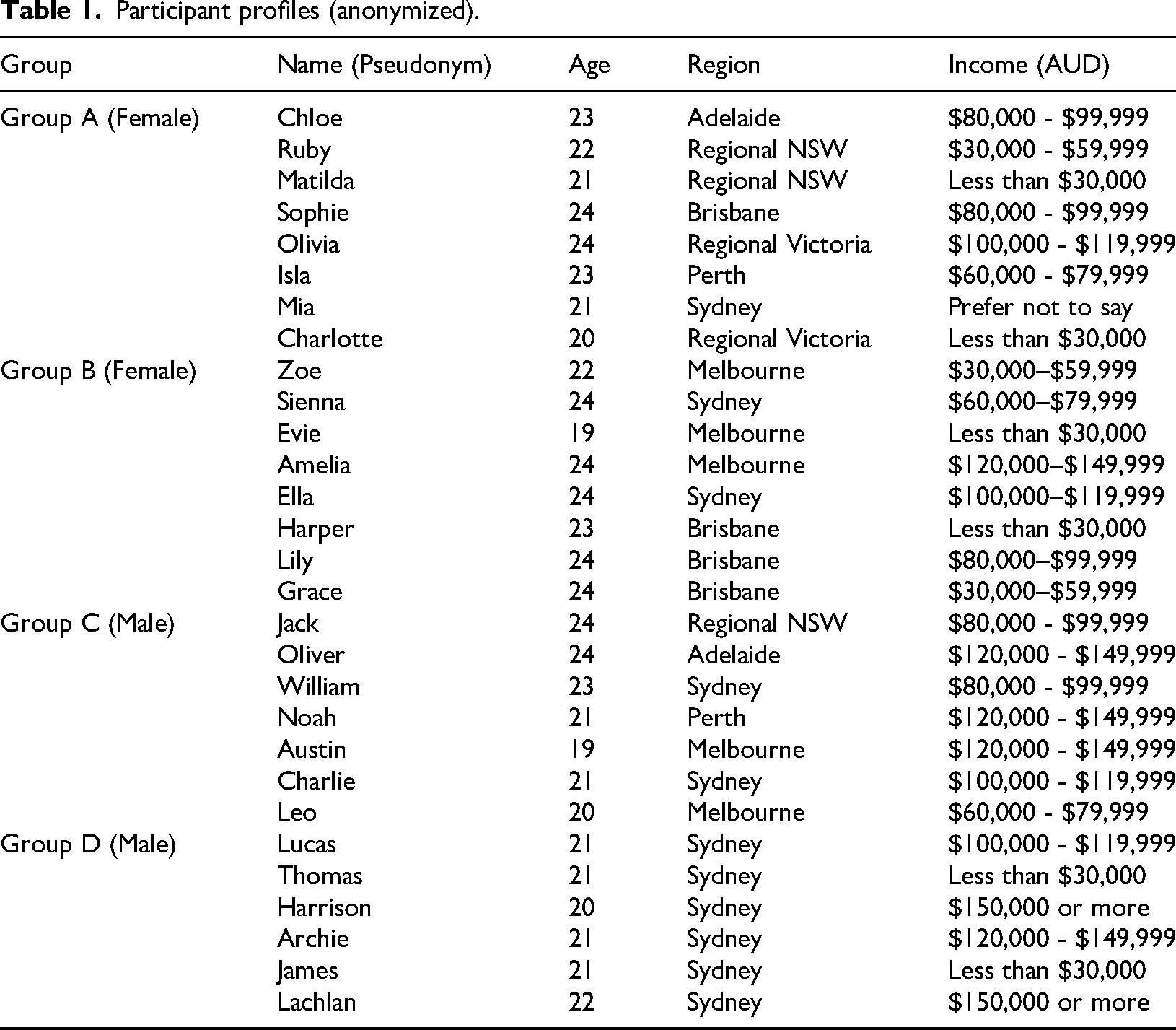
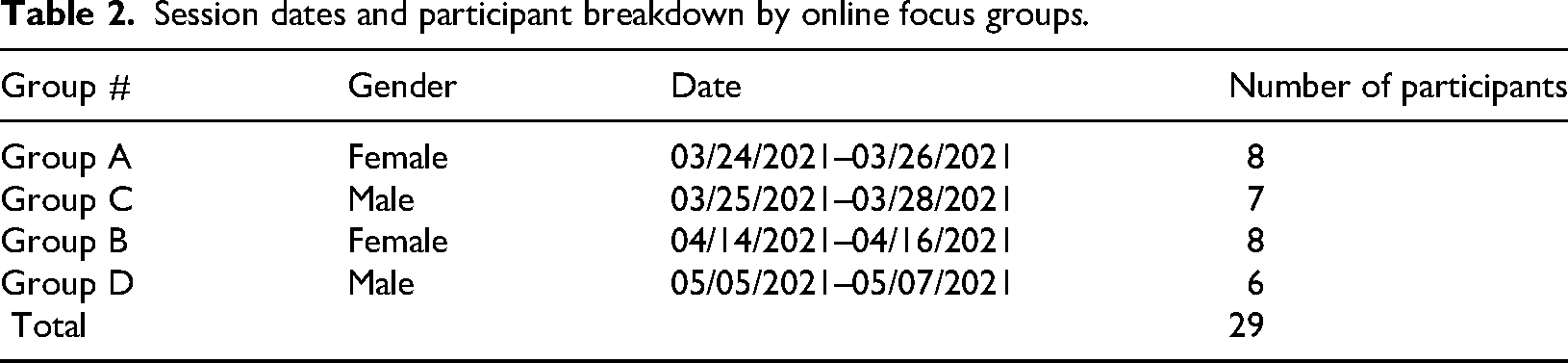
Participants were recruited from both major cities and regional areas in Australia through McNair yellowSquares. All participants provided their informed consent before participating in the study. They were also informed that they could withdraw from the study at any time when they were provided with the consent form. In order to preserve anonymity and confidentiality, each participant was assigned a pseudonym (e.g., ‘Sea Blue’ or ‘Turquoise Green’) associated with his/her ID, and this research was completed through a text-based online platform. A total of 29 young adults aged between 18 and 24 years participated in this study, including 16 identifying as female and 13 as male (Table 1). It is worth noting that a significant number of previous studies using the focus group method relied on four or five groups (Kitzinger, 1994). A more recent study also found that about 90% of all themes can be discoverable within three to six focus groups (Guest, Namey and McKenna, 2017). As shown in Table 1 and 2, this study conducted four focus groups.
Participant profiles (anonymized).
Session dates and participant breakdown by online focus groups.
Focus group procedure
Due to the highly personal nature of the study's focus, we conducted asynchronous online focus groups to explore individuals’ experiences and perceptions of IBSA in digital contexts. Online focus groups are particularly effective for discussing sensitive issues like IBSA, as they offer a higher degree of anonymity and privacy than traditional face-to-face settings (Reisner et al., 2018).
To facilitate online discussions, we employed the MySpeak online focus group platform developed by McNair yellowSquares, which has been utilised in peer-reviewed studies (e.g., Braunack-Mayer et al., 2021; Kelly et al., 2023). This text-based online platform allowed participants to share responses and interact with others in a familiar, discussion-driven format. Its asynchronous structure also enabled participants to engage more thoughtfully by allowing time to reflect on prompts and peer comments before responding. In this study, the researchers served as moderators and oversaw the session during the research period, including asking follow-up questions and monitoring the discussions.
To further encourage candid dialogue, we organised four single-gender focus groups (two with men and two with women). Each focus group was conducted online over three to four days and included between four and twelve participants, aligning with best practices for focus group design (Guest et al., 2017). The researchers served as moderators, and the specific dates and participant numbers for each session are provided in Table 2.
Analytical approach
Participants’ written posts in the online focus group discussion were collected from the platform and downloaded as Word files for analysis. The researchers then prepared an Excel file in which the raw Word data were converted and reorganised for subsequent coding. This study, consistent with Braun and Clarke (2006), adopted a deductive, theory-driven thematic analysis. The focus group data were analysed based on the ego boundary framework and data-driven themes that emerged during the analytic process were also considered (Braun and Clarke, 2006). After identifying key themes from the data, the researchers refined and presented them with illustrative quotes.
Results
Three interconnected themes were found from the analysis. These themes reflect patterned meanings across the dataset and illuminate how individuals understand, interpret and respond to relational pressure, ambiguity and responsibility within digital sexual communication. The themes are presented below with illustrative quotes to show how gendered socialisation and ego boundary orientations organise participants’ interpretations of consensual and non-consensual image sharing.
Gendered interpretations of consensual vs. non-consensual sexting
Participants’ interpretations of consensual and non-consensual nude sharing displayed a clear gendered pattern shaped by their ego boundary orientations. Men and women relied on different relational assumptions and socialised communication styles, which produced two distinct interpretive logics.
Men, reflecting more rigid ego boundaries, tended to view nude sharing as a socially normative and humorous interaction among peers, often without attending to the recipient's perspective. Silence was often interpreted as implicit consent, and any lack of explicit refusal was treated as agreement. As one male participant stated, “it's fairly consensual because it's acknowledged as funny, and do not say no. However, we do not always explicitly give consent” (Oliver). This pattern suggests limited emotional attunement to the possibility that a recipient might feel discomfort. Men also tended to distance themselves from non-consensual acts, often attributing such harm to malicious outsiders. As one participant remarked, “Most non-consensual sharing of nude images occurs by individuals with nefarious intentions” (Archie). Overall, rigid ego boundaries and low sensitivity to relational cues shaped men's interpretations of sexting as casual and playful, reducing their recognition of ambiguity or harm.
Women, whose socialisation often encourages more permeable ego boundaries, described nude sharing in relational terms, emphasising how the intentions and feelings of the other person shaped their decisions. Many associated consensual sexting with trust, emotional closeness, or long-term relationships. As Sienna explained, “I think between partners sending photos is common, and mainly found in couples or partners that have been seeing each other for a long time and therefore have a higher degree of trust”. At the same time, women frequently reported pressure to reciprocate images, especially in response to unsolicited requests or unexpected nudes. As one participant noted, “More common than consensual; I think men would typically ask for nudes and send their own anyway. I think a lot of women/girls feel pressured into sending something back” (Evie). This dynamic was reinforced by digital platform features that enable private, targeted requests. Another participant described receiving “unsolicited nudes that I didn’t ask for” (Grace). These experiences illustrate how permeable ego boundaries heighten internal conflict between preserving a relationship and protecting personal privacy, which can lead to coerced forms of consent.
Across participants, interpretations of sexting aligned closely with gendered ego boundary orientations. Men, operating with more rigid boundaries, tended to treat nude sharing as casual and humorous and often assumed that silence signalled consent. Women, shaped by more permeable boundaries, viewed such act as relational and trust-based and were more susceptible to pressure, reciprocity expectations, and coerced participation. These contrasting orientations show how gendered ego boundaries influence not only how sexting is understood, whether as casual or relational, but also how consent is interpreted, whether as silence equalling consent or as a pressured response that is difficult to refuse. This divergence accounts for the emotional and social consequences of subtle forms of IBSA that may appear consensual on the surface.
Expectations of support for non-consensual sexting
When it comes to expectations regarding support systems following non-consensual nude sharing, men's comparatively more rigid ego boundaries tend to prefer more task-focused support. They are more likely to favour institutional responses, such as counselling services and legal recourse, rather than seeking support from personal networks. For example,
On the other hand, women, influenced by permeable ego boundaries, prioritised non-judgmental, emotionally supportive responses from family and friends to cope with shame and pressure. This tendency is reflected in Evie's articulation: “Family and friends should show their support by letting the victim know that they are not judging them and that they are safe and can trust them.” Their heightened sensitivity to external evaluation made empathetic responses more critical than procedural solutions. Another female participant noted, “I think that girls are probably judged more than boys with this issue because girls are meant to be more responsible” (Chloe), reinforcing how societal expectations compound their vulnerability.
Despite these differences, both groups agreed that family members, particularly parents, often lacked sufficient understanding of digital sexual behaviour. One noted, “This kind of online behaviour is something that is relatively new and something that most parents would not have experienced at all hence there is a need to educate them” (James). These expectations represent idealised views of how support should function. This analysis shifts our focus to lived experiences, examining their actual disclosure and help-seeking behaviours for non-consensual nude sharing. The next section, then, explores what individuals experience in practice such as women's shame-driven reluctance or men's pragmatic approaches to IBSA, identifying potential gaps between anticipated support and real-world outcomes, with interpersonal support gaps further complicating these dynamics.
Experiences with support for non-consensual nude sharing
While many participants reported no direct incidents, those with experiences tended to remain silent or confide only in peers. Permeable ego boundaries among women amplified shame and deterred parental disclosure, whereas men's less permeable boundaries facilitated a more pragmatic approach to seeking help. Friends were the preferred support source for women: “If something like that did happen, I would probably talk to my best friend but nobody else. Not my family either” (Isla). In some cases, romantic partners offered crucial validation: “Only my current partner who said with certainty that he is 100% sure that my ex would have at least shown all his friends” (Olivia). Women often expressed reluctance to involve family due to embarrassment or fear of judgment. One noted, “I have not talked with family about this as I would find it awkward, but me and my friends have discussed about the possibility of intimate content being shared on the internet” (Isla). Another shared, “It was and still is embarrassing, I also knew better back then but still did it” (Grace). Disclosure was often conditional, requiring high trust: “I feel that I would speak to my close family members about it to get their opinion on what I should do” (Zoe).
Some participants’ discomfort appeared rooted in the fear of aggressive or overly emotional responses from families. One female participant recounted an experience where she chose to disclose the incident to her friend's parents, believing it had serious implications for their daughter's safety. After receiving partially nude images and voice messages from her friend's boyfriend, she informed the parents so they would be aware of what was being sent. She closely observed their response, noting that “the parents took the iPad away… then deleted the Facebook account from it” (Chloe). On one hand, men demonstrated a tendency toward instrumental, peer-based responses rather than familial support-seeking. One stated, “Wouldn’t speak to family, but it would definitely be discussed amongst my friends to work out what to do about it” (Noah). Another emphasised external action: “If this had happened, I would have told the friend to contact the police with screenshots of the post” (Archie). While men's more rigid ego boundaries allow them to treat the incident as an external problem to be solved rather than an internal source of shame, both men and women consistently saw parental digital illiteracy as a major obstacle to disclosure.
Discussion
This study advances gendered communication research by drawing on ego boundaries to illustrate how consent is shaped through culturally patterned processes of identification. Rather than viewing ego boundaries as fixed binary psychological features, this perspective foregrounds how people learn to manage consent and refusal of consent in nude sharing through gendered socialisation. Bringing a concept commonly used in cross-cultural communication into the context of digital intimacy helps clarify why some individuals interpret relational pressure as part of expected interaction, while others maintain clearer distinctions between their own intentions and those of a partner. This lens offers a culturally grounded way to understand how gendered norms become embedded in the everyday negotiation of consent in nude sharing among young adults. At the same time, these insights point toward the need for more applied guidance. Recent educative work on IBSA and sexting underscores the need for responses that move beyond abstinence or risk warnings toward a fuller understanding of contextual consent, relational pressure and coercion in young people's digital relationships (Ray and Henry, 2024; Ringrose et al., 2021; Woodley et al., 2024). Building on their suggestions, the next section turns to concrete strategies for supporting healthier relational and communicative practices in digital environments.
Consent in the grey zone: Socialised permeable ego boundaries among women
This study found that women, often with permeable ego boundaries, tend to perceive nude sharing not as a freely chosen act but as a response to relational pressure. Women participants described feeling obligated to send private content when asked, especially in situations where they feared damaging the relationship or being judged as uncooperative. They emphasised that consent in sexting could be assumed or negotiated in ambiguous ways, especially within romantic or emotionally charged relationships, acknowledging that their partner may not correctly interpret their suppressed intent. In several cases, participants described how their willingness to go along with nude sharing was less about desire and more about complying with their partners’ wants. These findings support the idea that women's ego boundaries, shaped by gendered socialisation (Addis and Cohane, 2005), critically affect their autonomy in sexting behaviours within digital environments. Women with flexible ego boundaries often experience coercive sexting not as overt abuse but as a relational obligation driven by unspoken expectations and emotionally charged digital interactions.
This subtle coercion reflects broader patterns of power that operate through internalised pressure, emotional obligation, and the silencing of discomfort (O’Halloran and Cook, 2024). In this context, treating women solely as passive victims who require protection after harm has occurred offers an incomplete understanding of their lived experiences. A more constructive approach is to support women's agency in autonomous decision making in digital spaces. Autonomy involves more than the ability to say no. It requires the capacity to clearly communicate reasons for refusal, particularly in situations where declining a request feels emotionally costly or risks damaging a valued relationship. Nonconsensual sharing and coercive sexting often exploit the ambiguity created when a refusal is not explicitly stated, which may be misread as consent, particularly by individuals with more rigid ego boundaries, mostly men, who tend to rely on overt signals and have difficulty interpreting implicit or nuanced intentions regarding consent. Relational concerns further complicate the interpretive context of consent. This pressure to comply, which can lead to a coerced yes rather than a freely chosen decision, creates significant vulnerability under contemporary legal frameworks. Western sexual assault laws that rely on affirmative consent standards, such as Australia's Affirmative Consent Law, focus on the explicitly communicated message to determine consent and often fail to account for the internal lack of autonomy that emerges in contexts shaped by relational pressure.
Therefore, educational and psychological programs need to support women in not only resisting but also expressing their psychological and sexual boundaries with confidence and clarity as a preventive measure. However, such change cannot rely solely on women's active efforts. Women's engagement in non-consensual sharing is heavily influenced by perceived gender norms, such as expectations to comply in relationships or fears that refusal may be seen as selfish (Layne, 2020). Thus, ensuring autonomy in digital environments requires societal awareness to challenge the roots of coercive dynamics rather than forcing women to manage these coercive dynamics through emotional labour and relational self-silencing. This goes beyond individual empowerment to include understanding and redefining how social discourse influences the development of ego boundaries that support respect for consent and autonomy. Addressing non-consensual sexting risks demands a comprehensive approach beyond technical digital literacy. It encompasses emotional awareness, relational judgment, and the ability to clearly express ego boundaries shaped by gendered identification processes. Ultimately, strengthening women's emotional autonomy and relational boundary-setting in intimate digital exchanges requires harmony between individual efforts and societal responsibility. Public campaigns, gender education in schools, and responsible platform technology development are practical steps to accelerate this change.
The binary interpretation of consent in long-term relationships
This study revealed that some men, often with rigid ego boundaries, perceived sexting as playful and consensual unless explicitly rejected, citing non-consensual sexting is mostly associated with malicious intent. This perspective reflects a one-sided, male-normative interpretation of sexual behaviour, wherein silence, reluctant participation, or a verbal assent is commonly interpreted as consent (Jozkowski, 2015). Such assumptions persist despite increased public awareness, which has reframed behaviours like unsolicited comments or casual physical contact as potential forms of harassment (Kessler et al., 2020). A notable oversight, however, lies in the non-consensual sharing of private content within long-term romantic relationships. When image-sharing arises from repeated requests or emotional pressure, it may involve subtle coercion even among otherwise trusting partners. These dynamics are often excluded from conventional definitions of IBSA, which typically focus on predatory acts by strangers or ex-partners (Henry and Flynn, 2019; Henry et al., 2019).
This gap underscores a critical issue: consent cannot be reduced to a binary of agreement or refusal. For individuals with permeable psychological boundaries, often women who are more attuned to relational expectations (Derné, 1992), an affirmative response may mask hesitation, obligation, or fear of disappointing a partner. This relational susceptibility is amplified in digital contexts, where social pressures and the permanence of shared images heighten exposure to harm (Hasinoff, 2015). In contrast, men often possess more rigid psychological boundaries, which foster a stronger separation between self and others, limiting their sensitivity to relational cues (Derné, 1992). This reduced emotional attunement leads them to presume that verbal assent reflects genuine willingness, overlooking contextual signals of coercion, such as a partner's hesitation or pressured agreement (Hall, 2006). Yet, consent is shaped by power dynamics and emotional context, not solely by explicit agreement (Schowengerdt et al., 2021), indicating that an affirmative response elicited under pressure, whether to maintain a relationship or conform to perceived expectations, does not constitute freely given consent (Pascoe, 2022).
These patterns suggest that interventions must do more than warn against harmful behaviours. They should cultivate prescriptive relational norms among peer groups, especially among cisgender men who tend to operate with more rigid ego boundaries. Education should help men understand the communication styles of individuals with permeable boundaries and recognise that these partners may say yes while feeling pressured, obligated, or conflicted. Rather than focusing only on what not to do, such efforts should clarify what ethical and desirable behaviour looks like in gendered interactions. If men wish to build meaningful relationships or “impress” women, they need to demonstrate careful attention to what partners truly intend, including moments when agreement is given primarily to avoid tension or disappointment. Teaching individuals with rigid ego boundaries, mostly men in masculine society, how to notice these subtle verbal and nonverbal cues and how to engage respectfully with them is a necessary step in creating supportive and relationally aware sexual cultures.
Education for men, therefore, must address this complexity by transcending legalistic interpretations of consent. It should cultivate empathy and self-reflection, prompting men to evaluate not only the presence of an affirmative response but also the emotional and relational conditions under which it was given. For example, educational programs could incorporate role-playing exercises to highlight how persistent requests or a partner's hesitant demeanour may indicate coercion rather than authentic agreement. Men should also be informed about the broader risks of image sharing, including unintended leaks or hacking, which disproportionately affect women due to societal stigma surrounding digital expressions of intimacy (Mckinlay and Lavis, 2020). Sexual ethics education should thus emphasise emotional awareness and communication skills, equipping men to recognise subtle forms of coercion and uphold their partner's psychological boundaries and emotional safety.
When support feels unsupportive: The role of family in non-consensual sexting
Consistent with previous findings (e.g., Mainwaring et al., 2023), both family members and friends were identified as important sources of support even for young adult victims. However, the emotional tone of parental responses played a decisive role in shaping young people's willingness to discuss digital relationships and sexual decision making. Participants reported that parents often lacked the cultural awareness necessary to provide meaningful support, and that anticipated judgmental or dismissive reactions discouraged open communication. Parental reactions characterised by the immediate confiscation of devices or the deletion of accounts reflect a default toward a punitive, problem-removing approach rather than a supportive and dialogue-based one. Although such actions may be intended as protective, they paradoxically strengthen the very barriers that prevent young people from seeking support from their families. By signalling that access to the digital world is conditional and that disclosure results in punishment, these responses discourage future openness and contribute to sustained silence.
More broadly, this form of ‘digital-illiteracy punitive’ response reveals parents’ limited capacity to engage with the emotional and relational complexities of online harm beyond immediate and reductive measures, thereby constraining their role as supportive interlocutors. This interpretation is further supported by recent scholarship. Accounts of parents confiscating their children's phones illustrate how punitive approaches, such as silencing or criticising teenage or young adult children, can shut down communication, particularly for daughters who experience heightened pressure, shame, and emotional vulnerability (Goldfarb et al., 2018). Moreover, parental framing of young people's engagement with sexually explicit content in terms of risk, prohibition, and control fails to recognise the normative role of digital intimacy in young people's lives (Page Jeffery et al., 2025; Woodley et al., 2024; Zen et al., 2025).
Viewed through the lens of ego boundaries, we suggest that parental support must be attuned to how gendered socialisation has shaped young people's identities and communicative habits. For children and young adults with more permeable ego boundaries, often socialised to prioritise relational harmony and others’ needs, parents’ accusatory responses to IBSA exposure (for example, asking why they sent a sexually explicit image) risk reinforcing shame and self-blame rather than fostering agency. Instead of demanding explanations for “why you did that,” parents could focus on strengthening individual agency and boundary-setting, including empowering daughters to articulate their intention and to reconsider what it means to remain in a relationship if their partner is unwilling to acknowledge or respect their discomfort, hesitation or withdrawal of consent.
For those with more rigid ego boundaries, particularly sons who have been raised within norms of emotional restraint and individual autonomy, parental strategies should emphasise the skills of actively reading nuanced and subtle consent, recognising ambivalence and silence as potential signals of discomfort, and respecting the other person's suppressed or partially articulated intentions. This involves challenging early gender socialisation messages, such as ‘boys don’t cry’, which valorise emotional restraint and invulnerability. Instead, it involves cultivating boys as culturally informed citizens who can respect difference, care for others’ wants and adapt their own desires in response to another's subtle boundaries from an early age. Aligning with emerging educational approaches that call for empathetic and culturally informed support (Page Jeffery et al., 2025), such family level practices could help reorient parental roles from punitive gatekeepers to culturally responsive co-learners who support young people in navigating the complex consent dynamics of digital intimacy along with societal support (Kuzma et al., 2024).
Limitations & future research
This study has some limitations. First, the current study relied on the theoretical framework of gendered ego boundaries without directly measuring this variable. Specifically, future research should develop and test quantitative measures of boundary permeability to complement existing qualitative insights. This could involve designing psychometric tools or validated scales to assess levels of permeability and their influence on psychological outcomes. Such measures would enhance the empirical robustness of the framework and allow for more precise predictions and applications in clinical and social contexts.
Second, there is a need to design and evaluate targeted interventions. While existing research on IBSA focuses on documenting risks or offering broad recommendations, this study advances this research field by identifying psychological mechanisms and specific relational, communication processes underlying implicit non-consensual image sharing. Future interventions should build on these findings to address the ambiguity surrounding consent in digital exchanges and to develop concrete strategies for prevention and support, especially for individuals with more permeable ego boundaries.
In addition, future research is expected to examine the temporal and relational instability of consent, particularly as relationship dynamics change or relationships come to an end. Consent to image sharing that is negotiated within an ongoing relationship may not remain meaningful or freely given as emotional intimacy, trust, or power relations shift. Participants’ accounts suggest that agreements surrounding nude sharing are often context dependent and subject to retrospective reinterpretation when relational conditions deteriorate or dissolve. This temporal dimension of consent should be further explored in IBSA research, beyond treating consent as a fixed or singular construct. Future studies should, then, investigate how individuals reassess consent following relational rupture and how gendered communication patterns influence whose interpretation of past consent becomes dominant in these moments of reassessment.
Finally, while the present study explored gendered experiences of ego boundaries primarily within a male-female binary framework, ego boundaries themselves are not inherently dichotomous. Future research must therefore extend this exploration to encompass sexual and gender minorities, as well as racial and cultural factors that influence experiences of IBSA. Existing evidence suggests that individuals belonging to these groups are disproportionately vulnerable to IBSA (Umbach et al., 2025) and often lack sufficient legal protections (Kolisetty, 2021). In particular, their experiences with subtle forms of IBSA, such as the consensual but non-consensual sharing of private content, should be further explored with a focus on how social stigmas, cultural norms, and systemic inequities shape their narratives. Intersectionality, which encompasses not only gender identity but also cultural, ethnic, and racial factors, must be a key consideration in understanding the full scope of IBSA. Incorporating sexual and gender minority perspectives, alongside an understanding of cultural contexts, would not only enhance the theoretical discourse on IBSA but also support the development of interventions that are more responsive to the specific risks and needs of these communities.
Conclusion
This study aimed to clarify how young adults navigate consent in nude sharing by examining the gendered identification processes that shape these interactions. Based on the concept of ‘ego boundary,’ it demonstrated how permeable and rigid boundary orientations influence consent patterns, particularly the interpretation of pressure, silence and ambiguity. The findings of the study also showed that family support plays a crucial role, with many young people withholding disclosure due to anticipated judgment or punitive responses. These findings highlight the need for communication strategies that align with the psychological orientations of individuals involved. For those with permeable boundaries, strengthening autonomy and expressive clarity is essential. For those with rigid boundaries, improving attunement to relational nuance is critical. Families likewise require culturally informed guidance to provide responses that foster agency and reduce shame. These insights offer practical pathways for education, prevention and relational support in digital intimacy.
Footnotes
Acknowledgements
We thank the anonymous reviewers and the editor for their insightful and constructive feedback.

Ethical considerations
Funding
The authors disclosed receipt of the following financial support for the research, authorship, and/or publication of this article: This study was supported by an ECARD grant from the University of Canberra.
Declaration of conflicting interests
The authors declared no potential conflicts of interest with respect to the research, authorship, and/or publication of this article.
Data availability statement
The data cannot be shared publicly due to the nature of the study's topic and the privacy of individuals that participated in the study.