







Abstract
In this article, the host–creator–researcher of the podcast, Eat By Ear (EBE) explains the methodology of podcast as practice-based research, with epistemological reflections relating to Singapore food cultural studies, sensory ethnography, and collaborative thinking and writing in higher education. EBE is a publicly distributed food podcast that tells the stories of chefs of hawker dishes in Singapore. In relation to existing scholarly accounts of hawker culture, the author reflects on an ethnographic process aimed at cultural re-sensing through on-location presence, the hawker-chefs’ own voices, and slow sonic sensoriality. This paper also reflects on a few unusual choices. First, the choice to present sensory ethnography findings for public listening in a novel form, the docu-dramedy – part documentary, part drama, part comedy. Second, the choice of socio-affective collaboration – in the relationship between the researcher and the subjects, and in the writing and reflection process.
Keywords
Introduction
I started thinking about a food podcast series using ethnographic methods when I returned to Singapore after living away for 25 years. In those years away, yearning for Singaporean food was a constant state of being and a common conversation topic with overseas Singaporeans. The exact moment when I started hearing the podcast in my head was when I was in my home in Singapore talking about the char on individual noodles in a dish called Wat Tan Hor with an actor friend, who performed a hilariously sensual oohing and aahing over a good Wat Tan Hor. This moment highlighted to me the intentional playful performativity that Singaporeans express when discussing food, the sensoriality of the hawker food environment, and the sense of humour and community that talking about food generates. What epistemological and pedagogical potential might an ethnography-based, sonic-sensory podcast of Singaporean food present?
This curiosity led to the creation of Eat By Ear (EBE), a publicly distributed podcast project built by sounds – the voices of hawker-chefs, the sounds of their kitchens, the atmosphere of kopitiams, hawker centres, and kitchens. Kopitiams and hawker centres are communal dining spaces that sell a wide range of affordable, freshly cooked local dishes that Singaporeans are passionate about. EBE blends academic inquiry with the narrative, aesthetic, and relational affordances of culinary and narrative podcasts. Wat Tan Hor also became the focus dish in the pilot episode.
In this article, I, the host-creator-researcher of EBE, outline and reflect on the methodology of the podcast as a form of practice-based research. First, in relation to existing scholarly accounts of hawker culture, I consider the contributions of an ethnographic process that prioritises on-location presence, the hawker-chefs’ own voices, and slow sonic sensoriality. Second, I process the pedagogical implications of presenting sensory ethnography findings for ‘cultural re-sensing’ (more of this later) through a novel public form, the docu-dramedy, part documentary, part drama, part comedy. Third, I reflect on socio-affective collaboration in the research process, producing a polyvocality that extends from the podcast to this article.
Accompanying this article is the link to Season 1 of EBE where you can listen to the full integration of the multiple layers of sounds and voices (Woo, 2025).
Food, nation, and a hawker culture in crisis
EBE enters the discursive space of Singapore food culture amidst ubiquitous gastronationalism, and loud voices worrying about hawker culture's sustainability. Food and nation are ‘commingled’ (Bell and Valentine, 1997: 168) in the Singapore government's efforts at articulating the identity of the nation. Food is marketed to visitors and to Singaporeans to call forth a sense of nation through the emotive, the ‘retro-licious’ (Duruz, 2016: 152), inviting nostalgic feelings of ‘gastronationalism’ (DeSoucey, 2010). Living in New York in 2007, when the Overseas Singaporean Unit (OSU) organised the first Singapore Day in Central Park, New York City, I joined thousands of Singaporeans
It felt good to meet Singaporean friends; it also felt loud and performative—to be part of an exclusive multimillion-dollar event. We needed Singaporean IDs or to be associated with a Singaporean to gain entry, right in the middle of a public park in New York City. The food was the lure, the oohing and ahhing over the ‘authentic’ taste, our eager performance. The community that the event called forth was that of a nation—a portable gastronationalism defined by state agencies with the message from Deputy Prime Minister Wong Kan Seng for ‘Overseas Singaporeans to stay connected no matter where they may be’ (Singapore Government Media Release, 2007).
Within Singapore, gastronationalism is expressed across the many state agencies. The Children's Museum Singapore has a special exhibit, ‘Into the Hawkerverse’, where children can meet ‘Hawker Culture Heroes’ (Children's Museum Singapore, n.d.) who built the nation, conflating the narrative of the hawker who made use of the limited resources they had to survive and thrive with the narrative of the nation (Tarulevicz, 2013). To Singaporeans overseas, the Singapore Global Network, charged with the purpose of connecting overseas Singaporeans to the homeland, has a Singapore Global Food Map, a ‘crowd-sourced food directory’ of Singaporean food, so that ‘wherever you are, you will never be too distant from a taste of home’ (Singapore Global Network, 2025). Singapore's National Heritage Board and National Environment Agency worked for two years to have Singapore's hawker culture inscribed by UNESCO on the representative list of the intangible cultural heritage of humanity. According to the inscription, ‘Hawker centres have become markers of Singapore as a multicultural city-state’ (UNESCO Intangible Cultural Heritage, 2020).
Singapore's state discourse characterises hawker culture through narratives of multiculturalism, entrepreneurialism, internationalism, and modernisation. Within Singapore, worries over the sustainability of hawker culture have been expressed in debates and discussions in the media and also in the Parliament of Singapore. Issues of concern include the question of whether the government's assignment of hawker centre management from a government agency to privately owned ‘Socially Conscious Hawker Enterprises’ (SEHCs) is helping or hurting hawkers and hawker culture; the viability of public and governmental expectations for inexpensive hawker food; increasing rental costs; the manpower crisis as there are few ‘next generation’ hawkers to take over retiring hawkers; the disappearance of more labour-intensive traditional dishes; and the erosion of hawker food identity (Chia, 2024; Lau, 2024; Lee, 2025; Leong, 2024; The Online Citizen, 2025; Yah Lah But Podcast, 2025).
Why a podcast?
I was living in Taiwan when I binge-listened to all 12 episodes of the Singaporean podcast, The AWARE Saga (AWARE, 2020) which told the story of how in 2009, the leadership of AWARE, Singapore's leading women's rights advocacy group was taken over by members of a church in an electoral coup and the manoeuvrings that eventually reinstated the secular leadership. I had known the broad strokes of the incident but did not have the details nor did I fully understand what was at stake in the coup. Listening in a different country and nine years after the event, I was struck by how intimate and present the interviews sounded in my ear, by the small details that emerged from each voice, such as, one character didn’t know how to handle the coup and decided to distribute flowers, and another character was worried about the uneaten noodles at the event. They were details that would not emerge in a formal account of the incident, but the whole effect was feeling like I was right there, inside the maelstrom, empathising with the characters, an emic perspective in research terms (see also Hoo, 2025). After listening, I shared it with my daughter who also binge-listened and we have had many conversations since about the issues raised through the podcast.
As an artist–teacher–researcher who has experimented with the pedagogical possibilities of media, the podcast form for the telling of hawker stories presents an opportunity for ‘emplaced’ (Pink, 2015: 40) ethnographic representation. From a production perspective, it is relatively inexpensive and simple compared to filmmaking – I only needed an interviewer (me), and a sound recordist to make sure I collected high-quality environmental sound and would be able to create whole worlds in post-production. From research, representation and communication perspectives, it provides the possibility of gathering the ‘sensory’ (Pink, 2015), the ‘sensuous’ (Stoller, 1997), that can evoke ‘the corporeal and experiential feelings of being there’ (Pink, 2015: 164). A survey of scholarly literature on Singapore food culture reveals methods and representation with little documentation with a sense of co-presence of hawker voices (see Duruz and Khoo, 2014; Lai and Chan, 2020; Lai and Koh, 2021; Tarulevicz, 2013). There are some limited quotations in Lai's (2010) ethnographic studies of kopitiams and single-paragraph statements in Pang et al.'s (2013) book featuring over 300 hawkers. Hawker interview data are included in Kong's (2023) research on the ‘people, place, and food’ in Singapore's hawker centres, in formal, grammatical English, likely a translation from more colloquial languages. It is hard to hear affect in these accounts, the chefs’ sense of humour and swagger, for example, is absent. Podcasts present the affordance for ‘coevalness’ (Fabian, 2014) or copresence of the researcher and the subject of research, in their own languages, accents and affect (Llinares et al., 2018). Low's (2025: 4) research points our attention to sensory ‘qualic evaluations’, focusing on how food is ‘actually experienced across time, place, and context’ by eating together with respondents and talking about the food experience and memories together. Food studies research in Singapore have pointed out the sonic calls that hawkers make to advertise their offerings. For example, the ‘kok-kok’ sounds of the noodle seller, and the ‘ting-ting’ sounds of the candy seller (Chua, 2016: Tay, 2016). However, as Gershon (2019) working in sonic ethnography points out, while sensory ethnography studies sonic qualities, the findings are not rendered through sound. What if we could literally hear hawker-chefs’ voices and hear them in-action?
From a pedagogical perspective, a well-told story in the podcast form is exciting. Using MP3 files and RSS feeds distributed through global platforms makes podcasts highly accessible and shareable for public listening, just as I could share the AWARE Saga (2020) podcast with my daughter. Working through the singular modality of sound without visuals facilitates focus and collaborative imagination with the audience. For these reasons, it is not surprising that podcasting is increasingly employed in business marketing (Acast, 2023), political messaging (Tan, 2025), in ‘digital scholarship’ and ‘social scholarship’ in anthropology, geography, and the social sciences (Alonso, 2023; Cook, 2020; Singer, 2019; Scriven, 2022).
EBE as practice-based research
EBE begins from ethnographic interviews with hawker chefs and recording the sounds of their kitchens, transformed into a docu-dramedy podcast to reveal ‘culturally novel apprehensions’ (Candy and Edmonds, 2018: 64). EBE Season 1 was launched with three episodes in an art gallery, as part of The Listening Biennial (2025), and at the same time, through mass media platforms Spotify, Apple Podcasts and Amazon Music.
EBE unfolds through overlapping layers of work: ‘following curiosities’, ‘piloting episode 1’, ‘completing season 1’, and ‘launching season 1’ (see Figure 1).
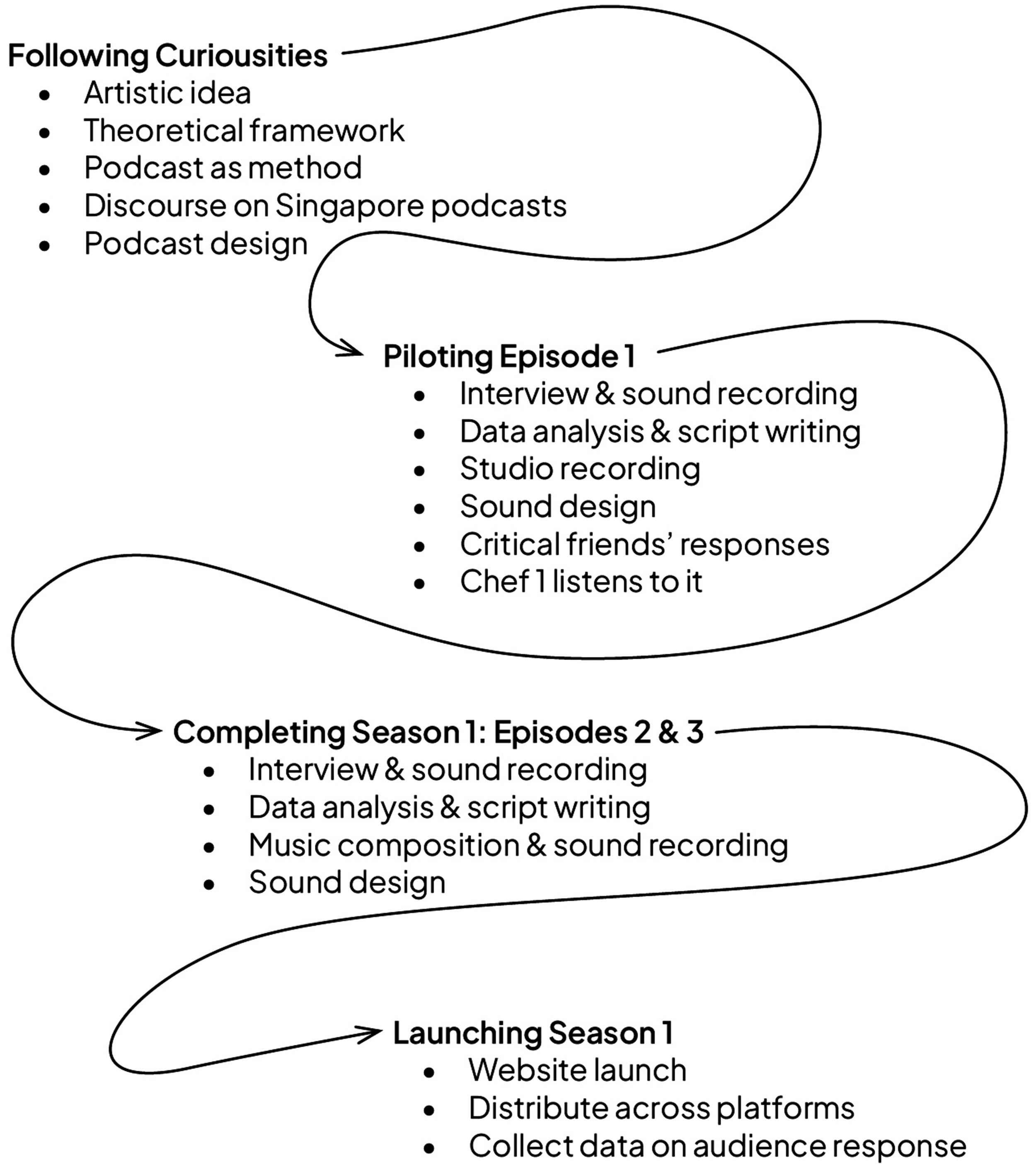
Practice-based research process (Woo, 2025).
Podcast design for cultural re-sensing
EBE is designed for audiences with some familiarity with Singapore, with English as a main language. For the Singapore diaspora and for Singaporeans my goal is pedagogical. Through years of practice-research in media (Woo, 2008), I have come to frame the way I work as a pedagogy of ‘cultural re-sensing’. This approach stands and moves in the opposite direction of what Freire (1970: 133) calls ‘cultural invasion’, where one's authentic self is overtaken by another's imposed way of labelling and naming, where one's ‘creativity’ and ‘expression’ become inhibited. Cultural re-sensing uses the ethnographic practice of documenting and communicating ‘our multisensorial embodied engagements with others … their social, material, discursive and sensory environments’ (Pink, 2015: 28) to invite an active sense-making, a reconstitution, a reformation, and a rejoining of the fragmented pieces of culture that have been missed, overlooked, or forgotten. The pleasure of rediscovering something familiar, such as a way of making a sauce, an ingredient, or an accent, a re-sensing – a visceral recognition of something familiar in an unfamiliar context – marks this experience. It brings a surprising and pleasurable realisation of possibility, a reconnection to the previously forgotten, and opens up the space to ask critical questions such as ‘Why have I forgotten?’ This mirrors the process described in Freire's (1970) ‘critical pedagogy’ and Ladson-Billing'’s (1995) ‘culturally relevant pedagogy’. How can EBE be designed to facilitate a re-sensing of food culture using sound to access missed or forgotten knowledge for a non-academic audience such as my mom, my uncle and auntie? Most importantly, how can the design position the chefs not only as research subjects but also as audience and collaborator so that they are able to shape, understand, access, and want to share our work together with others?
To facilitate cultural re-sensing, it is important that the text feels real, and familiar. To do this, data collection begins with the selection of hawkers who would talk easily and comfortably to me. I spent time eating at various stalls and chatting with the hawker-chefs, eventually choosing three chefs and three dishes. Jason Koh is in his 50s, Hui Hoy Yong is in his 60s and Halipah Bte Kadir is in her 70s. They have all cooked for over 20 years and cook from different culinary traditions, Cantonese, Teochew, and Malay. I was introduced to Chef Jason and Chef Hoy Yong by people we knew in common that gave me quicker access to gain their trust and consent to working together on this podcast. I got to know about Chef Halipah through a media article and spent time eating many times at her stall, and eventually started chatting with her. I chose them because they provided a range of culinary traditions, languages, and ages, they are willing to spend time on the interviews and sound recording sessions, we could talk with ease to each other, and I love their food.
Season One features three episodes and three chefs. I conducted and recorded an in-depth semi-structured 60–90 min interview with each participating chef at their stalls. There were many chat sessions before and after the main interview. The interview asked questions about their biographies, how they learned to cook, their cooking processes, how their dishes are different from others, and the challenges they faced. A follow-up interview is added for further questions after a first round of data analysis. Throughout the podcast, I worked with the principle of getting the chefs to express themselves in their most comfortable and eloquent way so that audiences might sense the real, the familiar and affect in their voices. This included conducting the interviews using a language that is most comfortable for the chefs and recording on location. With Chef Hoy Yong, I used Mandarin; with Chef Jason, I used English, and with Chef Halipah, I got the assistance of an interviewer-translator who spoke Malay so HBK could speak in her most comfortable language. For these interviews, I used an unintrusive small wireless lavalier microphone to get high-quality audio recordings.
Some time after the main interview I returned to the stall with a professional sound recordist, utilising high-quality directional shotgun microphones to record cooking sounds such as the beating of eggs and the washing of intestines, so that audiences can feel the place in an embodied sensorial way. For all three episodes, we recorded cooking sounds for about three hours in the early morning, starting at between 5 and 6 am as the chefs got ready for the day. To provide sonic context, we also recorded each stall's ambient environment with a multidirectional microphone. These recordings yield evocative everyday elements, such as the intermingling of languages, the dragging of plastic chairs, and the tinkling of coffee cups (Figure 2).

Using a directional shotgun mic to record cooking sounds (Woo, 2025).
Each episode builds on the chef interviews as the core and foundation. Data processing started with a complete transcription of each interview. I coded the data, highlighting key information related to themes such as personal narrative, mentorship, challenges, joys, cooking techniques, supply chain dynamics, family relationships, customer relationships, and labour issues.
To invite the audience into active sense-making, the interviews were restructured into a three-act narrative script (Ackerman, 2017; McKee, 1997) similar to what I work with in film writing. While the interviews and sounds in the ‘docu’ portion are representational, I chose to weave in a ‘non-representational’ (Pink, 2015: 163) voice of the Eater, constituting the ‘dramedy’. I made this choice initially because I needed a way for the audience to ‘see’ the food as I see it. I also wanted to develop a way to draw the audience closer. The Eater's performance does this by expressing the very familiar and playful oohing and aahing over the food that Singaporeans perform themselves regularly. This performance is a knowing wink to the Singaporean audience.
I wrote the Eater's script by paying close attention to the sensory details of each dish in great detail and exaggerating the sensory details for humour like the aesthetics of over-the-top performances of food enjoyment in the film The God of Cookery (1996) and Japanese TV show, The Solitary Gourmet (2012). For example, a plate of noodles (Wat Tan Hor) is described by the Eater in EBE (Figure 3) as A gleaming silky puddle The eggy swirls, a golden dance in Brown sauce, like a warm hand caressing my heart Binding the different elements Sealing in the heat of the smoky charred noodles

Using post-its to structure the narrative (Woo, 2025).
As I worked on the Eater's script, I realised that the Eater was becoming a proxy for how I, as an eater and also researcher, ‘sense’ each hawker-chef, the food, and the cultural context of eating. The Eater sees and eats and interprets as an expression of how I see and eat and interpret. For example, when the Eater sees Chef Hoy Yong, he describes him as a ‘kung fu master’ – that is my impression of Chef Hoy Yong when I see him standing there in his stall and it is also how Chef Hoy Yong describes his own food in the interview, as having ‘kung fu’.
The audience hears a clear difference between the exaggerated fantasy world of the Eater and the real voices of the chefs, providing a way to distinguish between my fandom and interpretation, and the chefs’ lived realities. It became an audience-friendly way to express and bracket my positionality in the research process next to the unmanipulated voices of the chefs. As a narrative strategy, this fictional voice also gave the podcast texture and a frame for the chefs’ voices, offering a processing space to make sense of the chefs’ stories and feelings. The fantasy makes the real feel more real.
Next, I analysed the transcripts to write the host's commentary, which serves to guide the listener, clarify unfamiliar terminology that the chef used, and provide historical, social, and cultural context where necessary. I added one other element, a choral singing voice, as a kind of sonic highlighter of important terms, such as the name of the dish or a central concept, such as wok hei (the breath of wok).
The final podcast interweaves the following layers of sound – my voice as the Host who provides cultural context and translations; the Chef tells their stories in their own voices and languages; the fictional Eater played by an actor; the soundscape of on-location sounds usually placed under and around the Chefs’ voices and the choral highlights; and library music and sound effects layered in the fantasy world of the Eater. Each episode ends with one minute of uninterrupted and unmanipulated on-location ambient recording where the listener is asked to close their eyes and listen carefully, like in a yoga meditation class. With a simple quiet instruction, ‘listen’, this final minute brings the focus of the listener back to an inner re-sensing of the usually overlooked sounds of a familiar environment.
An invitation to listen
I started this project asking the question of what epistemological and pedagogical potential an ethnography-based, sonic-sensory podcast of Singaporean food might present. While it is still too early in the life of the podcast to understand the broader pedagogical impact of this work, it is possible to understand how expert listeners might listen to this text. I invited two listeners, my colleagues, Rosslyn Prosser who is Australian, and Sheuo Hui Gan who is Malaysian, to listen to the first episode from their own theoretical frameworks and practice and write a response. Rosslyn is a teacher of creative writing and with her experience in feminist archival research, was able to listen to the podcast as archive. Sheuo Hui's expertise is in media studies and she listened for the techniques and quality of the mediated experience. In inviting their responses, I am listening for what they noticed and what they value in the podcast. Is it any good? What follows are post-listening notes to the episode with Chef Hoy Yong cooking the Cantonese dish Wat Tan Hor.
Post-listening notes from RP
Archives can be both noun and verb, formal and informal, official and unofficial. For this response to EBE, I will be using Anne Cvetkovich's concept of archives of feelings to talk about the ways that feelings, emotions, and affect are routinely left out of ‘official and formal’ archives. Kara Flynn (2018) suggests that ‘talking about, and consuming food, in the context of the archives provides an accessible and approachable entry point to a space that can seem daunting’. And so it is with the podcast EBE where talking about food allows for a range of stories to be told through food and the place of cooking in individual and national histories.
Cvetkovich refers to ‘the archive of feelings’ as teaching ‘the deeply sedimented histories of violence and survival that form social, political, and cultural environments. Unless we do radical kinds of recovery work around archives and also grapple with profoundly absent archives – by acknowledging missing lives and missing feelings – we can’t move forward’ (Carland and Cvetkovich, 2019). Such efforts to find missing lives and experiences is reflected in the online archival site of racialised and gendered violence in India and Pakistan. The 1947 partition archive (1947 Collections, 2024) is ‘an oral history archive of 11,500 + oral history interviews (more than 2,000,000 videos and 5,000,000 photographs)’. This archive meets the criteria of affective and formal/informal archive, as community-based historians train and capture these stories through oral history interviewing using audio and visual documentation. This archive presents a different form from the usual archival collecting, cataloguing, maintenance, and care undertaken in official archives.
We can understand how complex and important archives are when attempts to extinguish them and their contents are a well-known political strategy, as we are witnessing in the US currently, and when past ‘official documents’ have been erased/destroyed or ‘disappeared’. The precarious nature of books and archives is documented by Singaporean artist Shubigi Rao, whose work ‘Pulp: A Short Biography of the Banished Book’, ‘is a decade-long film, book and visual art project about the history of book destruction, censorship and other forms of repression, as well as the book as symbol and resistance. This involves visiting public and private collections, libraries and archives globally that have served as flashpoints in history, collecting fragments, ephemera, anecdotes, and buried secrets, and piecing together (through the film, book and artworks) a composite chronology of the conjoined literary and violent trajectories of our species’ (Rao, 2015).
EBE then is a docudrama podcast that uses a particular form of storytelling, using multiple voices and modes that blend a documentary style with dramatic techniques, presenting historical events or real-life situations in a fictional narrative.
In EBE live sounds are captured and produce a sense of place – the kopitiam – and the fictional monologue with the actor encountering the hawker lends a realism to the dramatic storytelling. For this podcast, the inclusion of the chef's voice speaking in Mandarin with a Malaysian Cantonese accent, translated and voiced by the host, whose own accent reflects her movements out of Singapore and back, provides a unique experience of negotiating cultures and languages, delivering insight into the chef through description of work practices, food and cooking and parts of his own life story. This sets the scene for understanding this place – Singapore – through the story of one man and his experiences, we really ‘see the chef’ in this podcast. Along with the interview materials providing detail on the hawker through some aspects of his life, Chef Hoy Yong speaks about his feelings regularly throughout the podcast.
How then might we think of a podcast as an affective archive and as constituting the kinds of practices found in the 1947 Partition Archive or at danger of erasure as discussed by Rao (2015)? As a form of narrowcasting, how does this podcast meet some of the criteria for thinking about the informal archive of the podcast as acknowledging missing lives? In some ways the podcast host answers this by including detail and information about the life of someone who might normally be thought of as a ‘minor’ character when measured against the lives of politicians, the ‘famous’, or change-makers. This minor character has a turn of phrase that expresses his desire and ambition, ‘Must wait’ he says, waiting is an important aspect of food not usually recorded and allows for a recognition in the listener, as this is not fast food but slow food prepared and produced out of long histories and stories of ingredients, cooking processes and cultural knowledge, often handed down by observation or orally. We hear of the chef not being able to sleep for three nights because he will be taught at the Institute of Technical Education by the famous ‘Heavenly King’ chef from Red Star restaurant Tham Yew Kai. The host's mother learned to make dim sum and other Cantonese dishes from Chef Tham Yew Kai in a makeshift Housing and Development Board community centre in Mei Ling Street in Queenstown, Singapore, gaining two certificates in the process, like many ‘mothers’ in that generation who learned from Chef Tham in community centres all over Singapore.
The podcast registers the importance of food in the social, the cultural and the political, in post-colonial Singapore, the shifts from street hawker to the modern institution of the hawker centre with the regulation and control this entails, and the recent inscription on UNESCO's Representative List of Intangible Cultural Heritage of Humanity on December 16, 2020, acknowledging the cultural significance of hawker culture, the culinary practices, skills of the hawkers, and the role of hawker centres and kopitiams as community spaces, and demonstrating the survival through food and food practices of cultures and cultural groups, in effect these are living archives.
EBE documents, (in ways that have not been done previously in Singapore), through sound, speech, and close observation; food and cooking, in the process gathering information on government and work practices, customer expectations, and the use of oral history interview practices combined with the production values of a podcast. Most importantly, the embodied experience of cooking is represented. This is a significant intervention into documenting and recording for the purposes of entertainment and the information medium of the podcast.
There is a moment in the podcast when referring to his cooking Chef Hoy Yong says it is ‘food with tears in it’. We are familiar with the idea of blood, sweat and tears, particularly when thinking about the hard work of cooking and in the heat, hustle and bustle of Singapore, the sweat, but this is ‘food with tears in it’. On a poetic level we are asked to Eat by Ear this food with tears in it, a number of readings can be made of this line, whose tears? What do they taste of? Are they the world's tears? The podcast demonstrates the affective poetics of the informal archive and ways to listen out for instances of ‘unique’ material that captures sense-making and understanding of the individual personality and these cultural ways of knowing, through thinking about affect, ‘acknowledging missing lives and missing feelings’ (Carland and Cvetkovich, 2019). The story of the chef here is a work of recovery of past stories and ways of knowing.
The podcast becomes a form of official archive as it uses documentary evidence, it can be stored and listened to for generations, is given structure through the technology of recording, and creating – and holds material that is normally located in the unofficial archive, in the spoken, the observed, the eaten and the heard.
Unofficial archives are important as registers of feeling not normally found in official archival practices. Certainly, the researcher working with archives ‘feels’. The significance of a podcast that documents what may seem like the ordinary act of cooking yet tells an important social and cultural history cannot be underestimated. Indeed, these are constant affective encounters, and for the listener too.
I end with this comment from the chef – as it records a melancholic and poetic, joyful and affective response, charting movement and diaspora, from Malaysia to Singapore with all that represents, he comes from a place of fruit, a fruit that grows out of the ground, that reproduces itself, is prickly and sticky, that has multiple uses as sustenance, as drink, as medicinal benefit and clothing and building material: ‘My name is Hui Hoy Yong: Hoi means happy and Yong means the sea. I was born in Johor Pekan Nanas where they grow pineapples, a lot of pineapples’.
Post-listening notes from SHG
My analysis of EBE – Wat Tan Hor employs cultural theorist Michel de Certeau's (1984) concept of everyday life practices – focusing on how ordinary people creatively navigate and subtly resist structural constraints in their daily routines – and literary critic Miyake's (2024) idea of ‘productive noise’, referring to how genuine knowledge often emerges through unexpected detours, encounters, and emotional insights. These theories emphasise the importance of processes rather than goal-oriented outcomes, providing an intriguing framework to understand EBE. EBE does not merely translate written script into audio form; rather, its significance arises from the intentional use of sound, sensory detail, and spontaneous linguistic exchanges to create an immersive and reflective listening experience that prompts critical dialogue.
Listening to the pilot episode, I found myself drawn to moments capturing ambient soundscapes, natural multilingual dialogue, and detailed auditory textures created through interactions among the Host, the actor playing the Eater, and Chef Hoy Yong, recorded on location. Despite the availability of numerous ready-made sound libraries, many audio elements in this project were intentionally and thoughtfully captured in real locations. This more labour-intensive approach pays off by adding an authentic, familiar sense of place, resulting in a hybrid form that merges performance with documentary elements.
The podcast's design highlights two key trajectories. Firstly, it blurs conventional cultural boundaries by developing varying expressions of Singaporean voices, consciously challenging mainstream media practices and official narratives. Secondly, through its hybrid format – which integrates semi-documentary dialogue between the host and chef with fictional performances by actors – the podcast creates a relatable setting for listeners. This encourages us to listen and re-listen to familiar spaces, people, stories, and relationships from fresh perspectives, facilitating deeper critical reflection.
For instance, Chef Hoy Yong's dialogue is deliberately preserved in Mandarin, thoughtfully accompanied by an English translation rather than simplified dubbing. This choice maintains linguistic authenticity, emphasising language as a sensory texture with its own physical presence—its rhythms, tones, and auditory qualities—not merely as a means of conveying information. These qualities enrich the listening experience, creating a tangible sense of place and moment that could not be captured through simplified dubbing. It subtly challenges conventional media practices in Singapore, which often struggle to represent everyday multilingual interactions in relatable and balanced ways.
Another seemingly trivial yet culturally significant moment occurs when the actor playing the Eater, Sivakumar Palakrishnan, an English-educated Indian Singaporean, casually uses the phrase, ‘Uncle, pai seh ah, you got green chili?’ The informal, colloquial use of the Hokkien phrase ‘pai seh ah’ (roughly translated as ‘excuse me’ or ‘sorry’, carrying nuances of humility, mild embarrassment, and concern about inconveniencing others) strategically establishes a sense of closeness precisely because the vendor is Chinese, of a different race from the speaker. These nuanced exchanges tactically disrupt typical media portrayals that emphasise clear cultural divisions – such as high versus low culture or local versus global identities – and instead reveal a richer, more layered cultural interaction. Amid these familiar exchanges, the podcast invites listeners to reconsider the complexities and relational dimensions inherent in everyday linguistic interactions. This critical framing shifts attention from merely identifying who speaks to examining forms of linguistic expression generated through everyday exchanges and how these expressions become visible or invisible within or outside mainstream media. In this manner, EBE challenges established linguistic hierarchies through deliberate, nuanced audio practices and choices.
This nuanced attention to everyday linguistic choices reflects precisely what De Certeau (1984) discusses in his relational dimension. Rather than focusing purely on individual narratives, he emphasises how identities are shaped through interactions between people. By capturing how speech and actions emerge through everyday interactions and relationships, the podcast demonstrates that identity is continually performed through ongoing exchanges rather than existing in isolation or as fixed entities. In this way, the podcast celebrates a more interconnected, culturally hybrid reality, allowing nuanced and complex identities to be expressed openly.
To deepen this interpretation, I draw upon Miyake's (2024) concept of ‘productive noise’. Miyake highlights contemporary society's emphasis on rapid, efficient, and precise information, often dismissing slower, ambiguous, sensory experiences as mere background noise. Through this lens, EBE deliberately transforms ambient kitchen sounds, multilingual dialogue, and overlapping conversations – commonly perceived as distractions – into forms of productive noise. Moreover, the podcast host explicitly encourages listeners to recognise the sensory materiality of these elements, somewhat akin to breaking the fourth wall in cinema, directly addressing listeners towards the end of the episode and inviting us to slow down, pause, and reflect upon these everyday auditory details. Ultimately, EBE creates a participatory storytelling experience through sound, offering enjoyment and interpretive possibilities rather than presenting a straightforward narrative or fixed message.
This approach aligns effectively with the project's goal of remembering sensorily through sound. EBE uses methods similar to sensory ethnography to create vibrant ‘living soundscapes’. These carefully curated soundscapes are distinct from the generic, characterless noises typically sourced from standard sound libraries, as they include specific cultural references. Drawing an analogy from cinematic studies, I liken them to ‘pillow shots’ – landscape or scenery sequences in films rich in texture, interplay of light and shadow, and atmosphere, which often convey powerful emotional resonance even seemingly without explicit narrative purpose. By guiding listeners toward thoughtful interactions with everyday ambient situations, the podcast encourages us to move beyond familiar, often muted representations, transforming passive listening into active recall and reflection.
Each episode explicitly encourages listeners to engage deeply with their everyday environments, turning ordinary background noise into opportunities for critical interpretation and introspection. This approach resonates with Krukowski's (2017) concept of ‘thick listening’, which highlights the significance of background sounds in providing context, depth, and cultural nuance. Ultimately, EBE not only offers entertaining media but has also, for me, stimulated meaningful discussions around sensory ethnography and cultural memory, with the potential to inspire new modes of remembering.
However, it might be challenging for listeners to unpack these reflective layers without guidance, as purely sensory engagement could be short-lived. Embedding guiding questions directly within each episode could help listeners engage more meaningfully. For example, prompts such as ‘When you pay close attention to familiar places, how does it alter your perception?’ or ‘What hidden stories emerge when you carefully listen to your daily environment?’ might inspire deeper reflection and encourage ongoing discussions beyond the podcast itself.
To sum up, EBE offers a subtle form of resistance through the pleasures of attentive listening, inviting listeners to rethink their conceptions of memory, location, and identity. I particularly appreciate how it celebrates individual, collective, and culturally specific moments through quiet listening that opens space for dialogue.
Reflections
Let me return to the question of epistemology. What knowledge did this sonic approach uncover? Both RP and SHG noticed ‘affect’ in EBE. RP compares the affect communicated through the richness of language to its absence in official archives, and SHG, compared it to its absence in mainstream media in Singapore. It is not that sound in itself delivers an affective sense, but that it is possible when combined with a sensory ethnographic research approach that maximises the affordances of the podcast medium. When listening to the interviews with hawkers in the National Archives of Singapore, for example, I found a sense of formality (eg, Lee, 2021; Adon, 2021). You can sometimes hear both the interviewer and the interviewees struggling with finding the correct words to express what they want to say because they are not speaking in their most comfortable language. In mainstream media, in podcasts such as
One important and time-consuming commitment in the EBE process has been to the richness of linguistic expression in a multilingual place. This requires spending time with the chefs and recording them where they could be most confident. It also requires prioritising cultural value in the editing process not only ‘facts’. In the pilot episode, for example, sound designer and I tested many configurations of how Chef Hoy Yong's voice would relate to my voice as the host-translator. If every word is translated, it slows down narrative momentum too much for a public audience, but we also wanted to ensure we captured the nuances in Chef Hoy Yong's voice. We decided to weave in and out of the two voices and ensure that whenever there was a culturally rich turn of phrase, we always heard Chef Hoy Yong speaking it. This became the scripting and editing principle for the other episodes. A ‘thick description’ (Geertz, 1973) in this podcast includes specific accents and seemingly minor cultural details, opening up the account to multiple interpretations and ‘noticings’, such as expert listener Rosslyn noticing the affect in how Chef Hoy Yong talked about his migration from Malaysia with his reference to pineapples. Singaporean and Malaysian listeners would notice another nuance, that the chef is speaking Mandarin in a specific Malaysian-Cantonese accent. This would have been impossible to represent in written text.
As listeners to this ethnographic text, both Rosslyn and Sheuo Hui experienced a sense of place. But not as a static geographic location, but as ongoing interactions of cultures, languages, identities and immigration trajectories. This is, I believe, the most important epistemological contribution of playing with the affordances of a podcast such as the possibility of stitching voices, sounds and what Sheuo Hui called ‘productive noise’ next to each other, over and under each other.
Sheuo Hui in her reflections talks about repeated listening and relatability for the audience enabled by designing the podcast for public listening. There are a few limitations to the public form. First, the chefs know that this would be public, and therefore they would present only what they allow the public to know. Second, there is interview data that I did not include because I felt it would harm the chefs as they are publicly named.
Yet, despite these limitations, there were moments that revealed to me the pedagogical potential of presenting sensory ethnography in the accessible and entertaining form of a docu-dramedy. I return to my pedagogical project of cultural re-sensing which I defined earlier as the experience of a pleasurable familiarity with a text that leads to a reconstitution, a reformation, a rejoining of fragmented pieces of culture that have been overlooked or forgotten in the loud and ubiquitous gastronational food discourse. It is as if the podcast is asking, what are our own lived memories of food in Singapore? When I shared episode one with my mom, she said, ‘Oh yah, I also learned from Tham Yew Kai’, like the chef in the episode. The graphic designer for the podcast told me that he played one episode for his mother while they were having dinner and they talked about it after. The gallery sitter where we launched the podcast told me that she is Teochew and she got excited about the Teochew song the Eater sings in episode two, and that she was going to share it with her siblings. Our research and production assistant on the project shared it with her teaching colleague in a kindergarten and sent me a screen shot that said ‘it all brought me back to living with my 9 other siblings in Anthony Road as a child and the Char Kway Teow man. We used to go and queue up with our bowl and 15 cents…. I’m going to share it with my siblings’ (personal communication, 8/26/25). While I had thought about cultural re-sensing as an individual experience, both audience responses and my own reflections suggest a more communal effect. The podcast's highly sensorial, accessible, and humourous form acts as an invitation to move the act of listening from a private experience into a communal space where listeners from different social classes and education levels, beyond the gallery walls where the podcast was first launched or the academic audience of this article, can contribute their knowledge for a fuller, collaborative remembering.
In this work, I have intentionally focused the process on socio-affective collaboration, spending time with people I enjoyed spending time with, making sure the project is mutually beneficial and their contributions recognised. This has produced a polyvocality that extends from the podcast to this article. Pink (2015) talks about how ‘a sensory ethnography should be based in a collaborative and participatory approach to research that respects participants and recognises that ethnography might have a role in the real world as well as in academia’ (Pink 2015: 68). Rosslyn ‘sees’ the chef through his words, finding resonance in his ‘must wait’ philosophy and the poetics of his language. The chefs are not simply subjects, but also collaborators in shaping their own portraits. I continue to spend time with the chefs ‘in the real world’ long after the interviews are completed. The night after I played the pilot episode of the podcast to a test audience, I brought the audio file on my phone to the kopitiam where Chef Hoy Yong cooks. After cooking, he sat at a table with headphones, attentively listening to the entire episode while drinking his post-cooking decompression beer. I looked at his every expression as I sat a distance away, worried that he might not like the podcast or how he's been represented. At the end of it, he gave me the thumbs up. He said, ‘This is powerful. I will send it to my Michelin-star chef friend’. Chef Jason, came to the podcast launch in an art gallery where he was on a panel as an invited expert talking about the future of hawker food in Singapore. With my colleagues, Rosslyn and Sheuo Hui, we not only collaborated on listening and writing, but also eating together at the various research locations. This is a radical way of knowing and working in our professional context where academic productivity looks like a single researcher producing work alone.
When I tell people I am making a podcast, they often envision two people in a studio, riffing into microphones about subjects who are not in the room. Similarly, when I tell people I am researching the stories of hawkers, they imagine me conducting interviews and then retreating to a computer to transcribe and select data into quotations. I am doing neither. Those forms do not allow for the sensing or re-sensing of culture. Instead, I am pursuing a form of podcasting that operates through sensory ethnography and performs it sensorially. It tells the story of a place through a research process that is sweaty and noisy, layered with the thick ‘sonic textures’ of human activity. It tells the stories of people who are co-present, speaking in their own languages and accents, using unexpected turns of phrase that carry the colour of their life histories. While the audience encounters these characters in their everyday lives, they have rarely heard these voices represented in media or scholarly literature. I hope they ask ‘why?’ I am after a podcast that feels weighty through a commitment to critical questioning and systematic inquiry, yet feels light to the public because it mirrors the humour, playfulness, and community that animate how Singaporeans engage with food. This practice is collaborative – with the chefs, who choose the language, tone, and memories they allow us to access; and with the audience, who bring their own communal knowledge to fill the gaps in our collaborative act of remembering. I am after an academic life where colleagues listen and respond to one another with attention, and a research practice where I can remain alive to my senses—where a simple moment of hilarity with a friend, ‘oohing and aahing’ about food, can lead to a novel modality for performing sensory ethnography (Figure 4).

Chef HHY listening to the podcast at his stall (Woo, 2025).
Footnotes
Acknowledgements
This research was made possible by funding from LASALLE College of the Arts, University of the Arts Singapore.

Funding
The authors disclosed receipt of the following financial support for the research, authorship, and/or publication of this article: This study was approved by the institutional review process of LASALLE College of the Arts, University of the Arts Singapore. All participants provided written informed consent prior to participation, including consent to publication of their identifiable information.
Declaration of conflicting interests
The authors declared no potential conflicts of interest with respect to the research, authorship, and/or publication of this article.