







Abstract
This article examines how Russia Today (RT), a state-funded international broadcaster, reframed its coverage of India before and after the Russian invasion of Ukraine. Drawing on a longitudinal dataset of 635 English-language articles published between 2019 and 2023, the study combines topic modelling with discursive framing analysis to trace a shift in RT's India-related narratives. In the pre-war period, India appeared sporadically and was framed through domestic reporting. However, after 2022, RT increasingly positioned India as a strategic partner aligned with Russia's vision of a multipolar global order. Grounded in theories of media diplomacy and discursive geopolitics, the article introduces the concept of mediated multipolarity, which refers to the communicative construction of alternative geopolitical alignments through strategic media narratives. The study contributes to debates on media's role in international politics and the evolving function of state-aligned media during periods of war and geopolitical conflict.
Keywords
Introduction
How do states use international media to reframe their global alliances in times of conflict? This question has gained renewed urgency following Russia's invasion of Ukraine in February 2022. While considerable scholarly attention has examined Russia's military strategies (Adamsky, 2024) and the role of state media as complementary instruments of influence (Taylor et al., 2024), much of this work concentrates on wartime propaganda and disinformation within Western contexts (Oleinik, 2026; Zollmann, 2024). Less attention has been paid to how Russian international media construct strategic partnerships with major non-Western actors through discursive (re)alignment. This article examines Russia Today (RT), a state-funded broadcaster, and its evolving representation of India before and after the Ukraine invasion.
India occupies a distinctive position in global geopolitics. As a BRICS 1 member, it maintains strategic relations with both Russia and Western powers while presenting itself as a voice of the Global South (Kurlantzick, 2023). Historically, India–Russia relations are rooted in Cold War cooperation, when the Soviet Union served as a key defence and development partner, including support during the 1971 Bangladesh Liberation War (Pant, 2013). These ties persisted after the USSR's dissolution through defence, energy, and technological collaboration, and within multilateral forums such as BRICS, the Shanghai Cooperation Organisation, and the Russia-India–China grouping (Kavalski, 2010).
The relationship remains materially significant. Russia accounted for approximately 36 percent of India's major arms imports between 2020 and 2024 (Singh, 2025), and over 45 percent between 2018 and 2022. Bilateral trade reached USD 65 billion in 2023–24, driven largely by energy flows (Sharma & Cyrill, 2024). Following the Russia–Ukraine war, India increased imports of Russian crude oil from 68,000 barrels per day in early 2022 to more than two million barrels per day by mid-2023, despite Western criticism (The Associated Press, 2025). These developments underscore the structural depth of their partnership.
The 2022 invasion of Ukraine marked a decisive escalation in Russia–West tensions that had intensified since Crimea (Charap & Colton, 2017; Sakwa, 2023). As sanctions expanded and diplomatic ruptures deepened, Russia pivoted more deliberately toward the Global South. India's refusal to join sanctions and its continued energy engagement drew criticism from the United States and the European Union (Verma, 2022). Indian policymakers justified this stance through the doctrine of strategic autonomy rooted in non-alignment (Rajan, 1993). This position was publicly articulated by India's External Affairs Minister S. Jaishankar, who stated that ‘Europe has to grow out of the mindset that Europe's problems are the world's problems but [that] the world's problems are not Europe's problems’ (Lehne, 2024). Such statements reflect India's attempt to preserve geopolitical flexibility amid intensifying polarisation.
These geopolitical shifts were accompanied by transformations in Russian state media narratives. Their coverage increasingly foregrounded sovereignty, resistance to Western hegemony, and alternative geopolitical alignments (Tolz & Hutchings, 2023). Within this discursive environment, RT functioned as a key international platform projecting such themes, particularly toward emerging powers such as India. For Russia, India represents not only a pragmatic economic partner but also a symbolic counterweight to Western isolation.
Existing scholarship has analysed RT's English-language operations and its role in contesting Western narratives (Pomerantsev, 2014; Tolz & Hutchings, 2023). RT has been described as a vehicle of soft power, a channel for strategic disinformation, and a counter-hegemonic actor in global media systems (Rutland & Kazantsev, 2019; Thussu, 2024). However, little research has examined RT's discursive construction of India across the temporal rupture created by the 2022 invasion.
Therefore, this study addresses that gap through a longitudinal analysis of RT's India-related coverage before and after the onset of the invasion. In doing so, the article examines how mediated multipolarity operates in practice, showing how state-aligned media symbolically construct alternative global alignments. We argue that RT's evolving portrayal of India exemplifies the communicative articulation of a multipolar order in which Global South actors are framed as sovereign, capable, and integral to post-Western futures. By situating this case within debates on media and conflict, discursive geopolitics, and state communication, the article demonstrates how international broadcasters participate in shaping geopolitical imaginaries during periods of war and systemic (re)alignment.
Literature review
RT as a geopolitical actor
Russia Today, now branded as RT, functions not merely as a news organisation but as a strategic geopolitical actor embedded in Russia's broader foreign policy apparatus. Established in 2005 by the Russian government, RT's mission is to present ‘an alternative perspective’ to Western media narratives, a stance that scholars interpret as part of a broader counter-hegemonic communication strategy (Rawnsley, 2015). RT's global broadcasts – delivered in English, Arabic, Spanish, French, and German – position it within the domain of state-sponsored international television news broadcasting, akin to BBC World, Voice of America, or China Global Television Network (CGTN). However, what distinguishes RT is its overt ideological positioning. It is known for challenging Western liberalism, amplifying critiques of NATO, legitimising Russian geopolitical ambitions and promoting a right-wing nationalist agenda through journalistic framing and discursive tropes (Elswah & Howard, 2020; Velikaya & Simons, 2020; Yablokov, 2015). Scholars have characterised RT as a vehicle of strategic narrative projection (Miskimmon et al., 2013), especially after the annexation of Crimea in 2014 and again during the 2022 invasion of Ukraine. Some argue that its content is tailored not only to defend Russian state policy but also to generate epistemic disruption – undermining the perceived objectivity of mainstream Western journalism (Hutchings, 2022).
RT's expansion into Africa, China, and the broader Global South reflects a purposeful narrative reorientation that aligns with Russia's ambitions to construct and even lead a multipolar world order. In Africa, RT has gained visibility by leveraging anti-colonial rhetoric and presenting Russia as a cooperative partner unsullied by the imperial legacies of Western powers (Duursma & Masuhr, 2022). For China, RT's coverage often reflects points of alignment with official Chinese narratives and the promotion of alternative governance models. These areas of convergence are part of a broader communicative strategy wherein both Russia and China frame themselves as proponents of a multipolar global order (Repnikova, 2017).
Across the Global South more broadly, RT cultivates political and cultural affinity appealing to shared grievances about global inequality. Its efforts could be best understood as an attempt to counter Western narratives on global affairs (Thussu, 2019). India, in this matrix, holds a distinctive position. As an English-speaking media ecosystem within a multilingual democracy with historical ties to Russia and growing global influence, India offers RT a discursive bridge to the Anglophone world and the Global South simultaneously. RT's evolving representation of India provides a useful case for examining how state-aligned international broadcasters deploy strategic narratives to advance geopolitical agendas.
Media diplomacy and strategic communication
Operating alongside traditional and public diplomacy, media diplomacy refers to the use of mass communication tools by state or state-aligned actors to influence foreign publics and shape international perceptions of state behaviour, legitimacy, and geopolitical identity (Gilboa, 1998). It is a critical component of a state's external communication strategy, often deployed in tandem with traditional diplomacy, soft power initiatives, and public relations (Gilboa, 2001). While public diplomacy typically involves direct engagement between state representatives and foreign publics or elites, media diplomacy relies on the symbolic and discursive power of broadcast narratives, journalistic framing, and information flows (Golan et al., 2019). It operates across multiple platforms – television, digital media, and social networks – to circulate narratives that align with national interests while responding to global political developments.
International broadcasters such as RT, CGTN, Voice of America, Al Jazeera English, and TRT World (Turkey's state-funded international English-language broadcaster) exemplify media diplomacy in action (Elswah & Howard, 2022; Samuel-Azran, 2013). While institutional relationships between state and media vary across political systems, international broadcasting in both democratic and authoritarian contexts often reflects broader strategic communication priorities, albeit through different editorial mechanisms (Crilley & Chatterje-Doody, 2018; Hutchings et al. 2024). They participate in a global battle of narratives, shaping legitimacy and influence not through force, but by constructing alternative epistemologies and geopolitical imaginaries that counter Western media dominance (Nye, 2008; Miskimmon et al., 2013; Roselle et al., 2014).
RT's positioning in this landscape is particularly instructive. While often dismissed in Western analyses as a disinformation tool, RT has cultivated its own unique identity among certain segments of the Global South, where its critiques of the perceived Western double standards and interventionism resonate (Rawnsley, 2015). In a mediatised world, its editorial choices frequently reflect Russia's broader foreign policy strategy: to portray itself as a sovereign, multipolar power resisting the hegemonic West (Hutchings, 2022). Thus, RT's media diplomacy involves more than international broadcasting; it is a performance of state identity on the global stage. In this performance, it simultaneously counters Western legitimacy and affirms alliances with sympathetic or strategically useful states.
Scholars have shown how international broadcasters extend foreign policy into the symbolic realm. For example, Taylor et al. (2024) illustrate how Russian broadcasters use editorial framing to assert geopolitical narratives in neighbouring states, while Santos (2024) highlights Brazil's TV Brasil Internacional as a soft power instrument projecting national identity and diplomatic ideals. RT similarly fosters symbolic alignment with publics critical of the West. Following Russia's post-2022 isolation, such alignment became essential. As sanctions deepened, Russia increasingly relied on media diplomacy to sustain and cultivate ties with non-aligned or semi-aligned states such as India, Brazil, and South Africa.
Gulenko (2024) suggests that RT functions as both a soft power instrument and a strategic weapon which simultaneously seeks legitimacy and sows doubt. In doing so, it blurs the line between journalism, propaganda, and strategic communication. The outlet's focus on multipolarity, sovereignty, and anti-Western critique is not simply editorial positioning but part of a broader diplomatic offensive. This involves crafting a communicative architecture that repositions Russia as a legitimate global player among rising and regional powers. This strategic alignment is not always explicit, but it is embedded in narrative form, tone, source selection, and thematic framing. Examining such patterns over time, particularly around inflection points like the Russian invasion of Ukraine, offers insight into how state media help enact diplomacy through discourse.
Mediated multipolarity
Existing frameworks such as discursive geopolitics and strategic narrative theory provide important tools for analysing how states articulate identity, space, and legitimacy through communication (Miskimmon et al., 2013; O’Tuathail & Agnew, 1992). However, neither framework fully accounts for how multipolarity itself becomes communicatively enacted and normalised through media practice during moments of conflict/war/systemic rupture. The existing frameworks are significantly helpful in explaining how actors narrate themselves; however, they are less attentive to how media institutions narratively elevate others as co-constitutive participants in their real and/imagined alternative world orders. Our conceptualisation draws from four overlapping bodies of work. First, discursive geopolitics shows that global order is not only materially organised but also imaginatively produced through representations of territory, identity, threat, and hierarchy (Agnew, 2003; Dodds, 2007; O’Tuathail & Agnew, 1992). Second, strategic narrative theory explains how political actors construct stories about the international system, their own role within it, and the identities of others (Miskimmon et al., 2013). Third, scholarship on media diplomacy and public diplomacy demonstrates how state and state-aligned media operate as instruments of external communication, projecting legitimacy, and influence and national positioning to foreign publics (Gilboa, 1998, 2001; Golan et al., 2019). Finally, work on international communication and global media order highlights how non-Western and state-backed media institutions contest Western communicative dominance and seek to articulate alternative geopolitical imaginaries (Kumar, 2025b; Thussu, 2024).
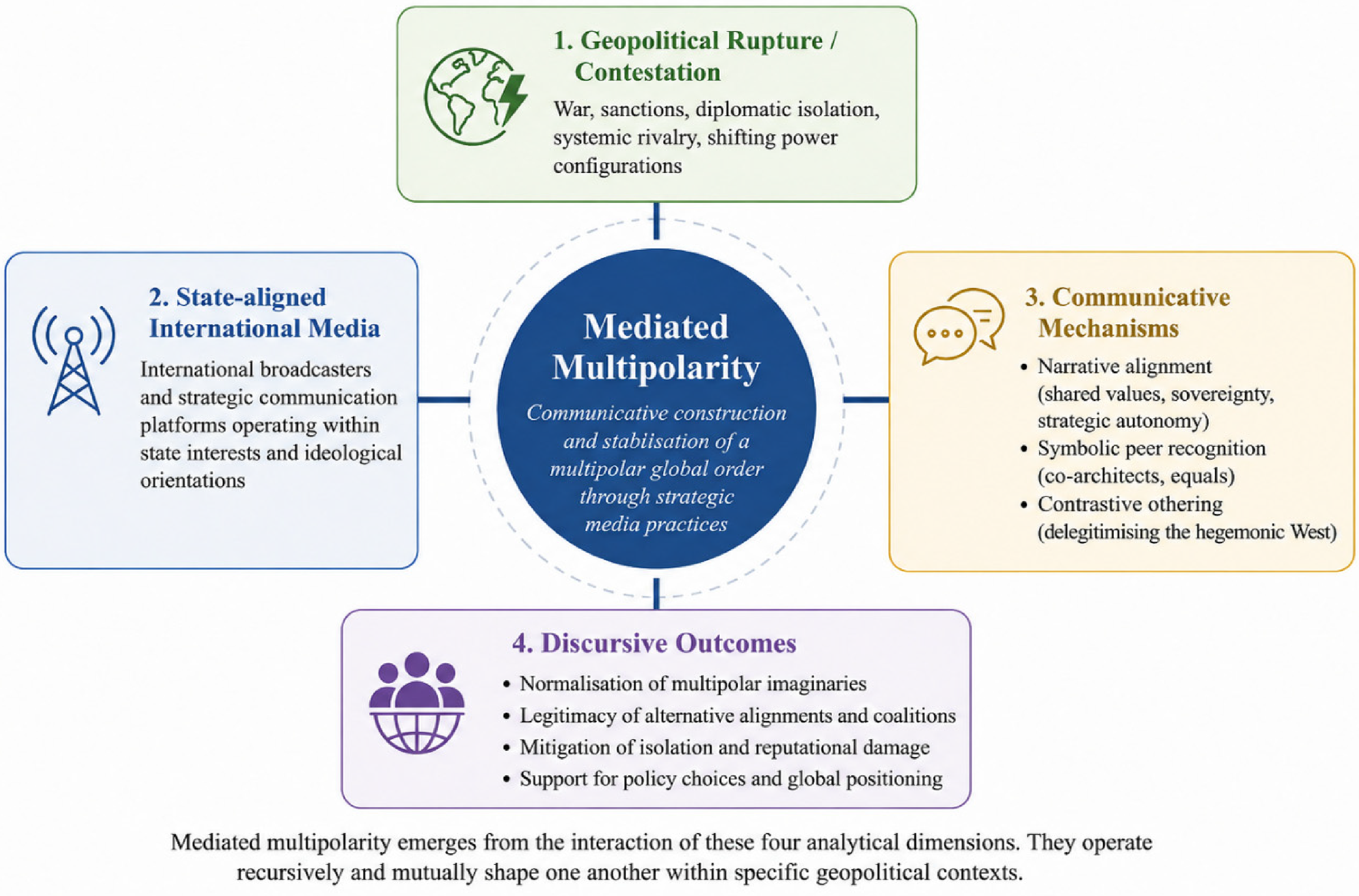
Building on these traditions, the concept of mediated multipolarity is proposed. Mediated multipolarity refers to the communicative construction and stabilisation of a multipolar global order through strategic media practices that symbolically position selected states as legitimate and equal participants in post-hegemonic arrangements. Rather than treating multipolarity solely as a material (re)distribution of power, the concept focuses on its mediated dimension: multipolarity must be narrated, circulated, and rendered plausible through discursive repetition before it acquires any political traction. In doing so, mediated multipolarity shifts analytical attention from structural power shifts to the communicative dimension through which such shifts are imagined and legitimised. It asks not only whether power is diffusing, but how that diffusion is staged and normalised across media ecosystems. The concept therefore treats multipolarity as a communicative achievement produced through repeated acts of narration, comparison, and symbolic recognition.
We propose that this process operates through three interrelated mechanisms. First, narrative alignment situates selected actors within shared ideological frames such as sovereignty, civilisational power, strategic autonomy, or resistance to external coercion, etc. Here, alignment does not necessarily require formal alliance; rather, it involves framing practices that place states within the same normative vocabulary and trajectory. Through repetition, such alignment seeks to naturalise the idea that these actors belong to a common geopolitical project. Second, symbolic peer recognition discursively positions these actors not as subordinate partners but as co-architects of (a new) international order. By emphasising agency, technological competence, diplomatic influence, or economic capacity, media narratives construct horizontal rather than hierarchical relationships. This mechanism is central to rendering multipolarity credible, as the diffusion of power must appear collectively sustained rather than merely proclaimed.
Third, contrastive othering defines multipolar actors against a delegitimised hegemonic centre. This does not necessarily involve explicit denunciation. It often operates through juxtaposition, selective emphasis, and comparative framing that presents the self or the selected multipolar actors as rational, sovereign, or pragmatic in contrast to a coercive, hypocritical, or declining West. Importantly, through this contrast, alternative alignments attempt to acquire moral legitimacy. These mechanisms render multipolarity comprehensible within everyday news discourse as they show the reduction of the distance between systemic transformation and mediated representation.
Mediated multipolarity also performs identifiable strategic functions. During sanctions, diplomatic isolation, or reputational damage, symbolic elevation of alternative partners seeks to mitigate the perceptions of marginalisation of the self by demonstrating the strength of coalition and its durability. Bilateral cooperation is (re)framed as strong alignment. Pragmatic transactions are presented as evidence of ideological convergence. Through a careful and sustained repetition, media discourse seeks to reconstitute legitimacy through communicative affirmation.
Importantly, mediated multipolarity is not confined to a single broadcaster or political system. It may emerge wherever state-aligned or strategically oriented media operate under conditions of geopolitical contestation. Therefore, its analytical value lies in identifying how media narratives assemble alternative configurations of order by narrating others into shared projects and/views of global governance.
Conceptually, mediated multipolarity builds on insights from discursive geopolitics by specifying the mechanisms through which multipolar imaginaries are operationalised in media discourse. It also complements strategic narrative theory by highlighting the role of third-party actors in geopolitical communication. Rather than focusing exclusively on how states narrate themselves, it highlights how they narratively constitute partnerships as evidence of their strength and transformation. Figure 1 presents how the concept emerges through the interaction between geopolitical contestation, state-aligned international media, communicative mechanisms, and discursive outcomes.
Analytical dimensions of mediated multipolarity.
This structure shows how geopolitical challenge activates specific communicative mechanisms within state-aligned media that seeks a discursive normalisation of alternative global alignments. Mediated multipolarity may be observed wherever international broadcasters or strategic communication platforms seek to narratively assemble alternative world orders during moments of contestation.
Data and methods
This study adopted a computationally assisted qualitative approach to examine how RT discursively reframed its coverage of India before and after the onset of the Russian invasion of Ukraine in February 2022. For this, we combined longitudinal content collection with exploratory natural language processing (NLP) techniques and manual inductive coding, allowing for both pattern detection and interpretive depth.
The dataset comprises 635 English-language news articles published on RT.com between January 2019 and December 2023. The dataset does not include television broadcast material, opinion pieces, non-English items, or duplicate articles. As no accessible archive data were available prior to 2019, the data collection period begins in that year. Articles were collected through systematic web scraping using Python-based scraping scripts and then manually checked for relevance. The search strategy began with broad India-related terms, including ‘India’, ‘New Delhi’, ‘Indian PM’, and ‘Modi’, and was then expanded through an iterative review of the initial results to include terms that frequently appeared in RT's India-related coverage, such as ‘BRICS’, ‘oil’, ‘sanctions’, ‘India-Russia’, ‘Modi-Putin’, ‘partnership’, ‘bilateral’, ‘trade’, ‘foreign ministry’, ‘cooperation’, and ‘agreement’. These keywords were used only to retrieve potentially relevant articles, not to predefine frames. Each retrieved article was then screened manually. Articles were retained only if India was a substantive focus of the headline or lead paragraph, or if India appeared as a central actor in the article's main news event. Articles in which a search term appeared only incidentally, for example in a passing reference, unrelated list, advertisement, metadata, or hyperlink text, were excluded. The final corpus was then time-stamped and divided into two periods: pre-invasion coverage before 24 February 2022 (n = 22) and post-invasion coverage on or after 24 February 2022 (n = 613). Given this imbalance, the study does not treat the pre- and post-invasion periods as symmetrical datasets. Instead, the pre-invasion material is used as a baseline for comparison, while the larger post-invasion corpus is analysed to examine how India was discursively repositioned within RT's narratives after February 2022.
Analytical procedure
NLP refers to a set of computational techniques designed to analyse and derive meaning from human language. In this study, NLP tools were used to assist with pattern recognition and thematic clustering across a large corpus of text, without replacing the qualitative interpretive process. NLP methods are increasingly employed in media and communication research to explore discourse (Jacobi et al., 2016). To ensure transparency and reproducibility, widely adopted Python-based libraries were used. Data cleaning and preprocessing were conducted using pandas for corpus management and spaCy 2 for tokenisation, lemmatisation, stop-word removal, and part-of-speech tagging. Duplicate detection was performed through string matching and metadata comparison. Articles were included only if they contained explicit references to India in the headline or lead paragraph. Non-English entries, duplicates, and opinion pieces were manually excluded. The analysis proceeded in the following three stages:
Exploratory NLP-assisted mapping
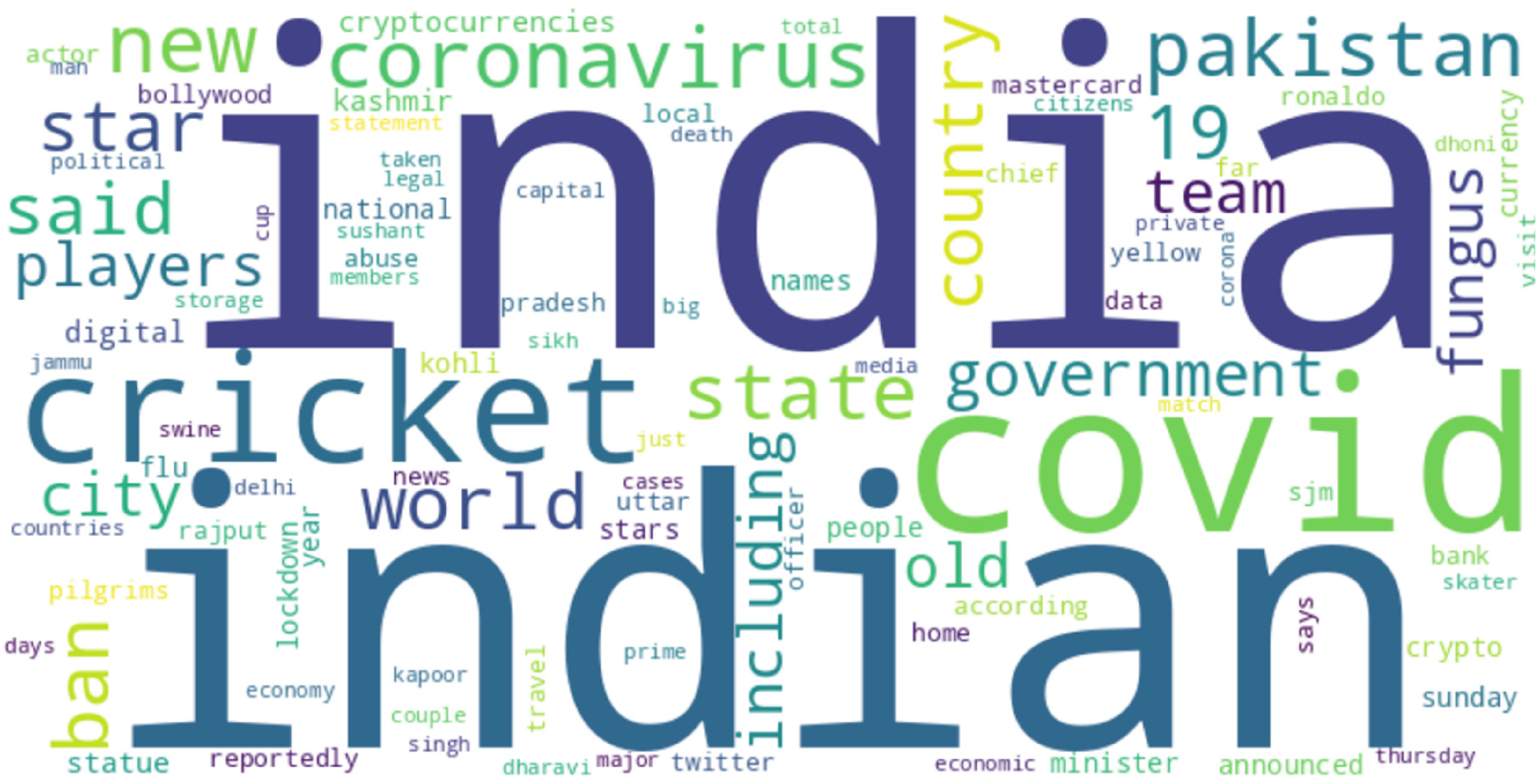
To trace thematic shifts and identify key patterns in lexical emphasis, a suite of exploratory NLP tools was applied. Word frequency distributions were generated using NLTK 3 and visualised through the wordcloud Python library, enabling comparison of dominant keywords across periods. Word clouds visualised dominant keywords in each period, highlighting vocabulary transitions from health and sports (pre-war) to multipolarity, trade, and sovereignty (post-war). In addition, a timeline of article frequency was computed using pandas and visualised with matplotlib. 4
At the same time, Keyword co-occurrence networks mapped semantic clusters around India (for example, India–Russia–BRICS sanctions), offering insight into emerging narrative constellations. Tracking keyword co-occurrence helps reveal the nature of discourse: how specific terms are repeatedly linked, and which clusters of meaning become central to the evolving narrative. This approach was particularly helpful in surfacing implicit thematic connections and identifying discursive formations that might not be evident through frequency analysis alone.
Also, Latent Dirichlet Allocation (LDA) using Gensim's 5 LdaModel was used not as a definitive categorisation tool but as a heuristic device to surface recurring themes and guide manual frame identification. This was particularly useful given the size and thematic diversity of the dataset, as LDA provided an initial structure that informed the inductive coding process and helped identify key narrative patterns. LDA is a probabilistic model that assumes each document is a mixture of topics and each topic is a distribution over words (Blei et al., 2003). This was important for this project because it enabled an interpretable approach to sifting latent themes from a large corpus, allowing for a more grounded and systematic qualitative analysis.
Inductive framing analysis
Building on the topics and term clusters surfaced by NLP tools, we then conducted an inductive frame analysis (Van Gorp, 2007) using both the headline and lead paragraph of each article as the unit of coding. Importantly, the five frames reported in the findings were derived from this qualitative inductive coding process rather than directly generated by the LDA model. Each text was read closely and coded for recurrent discursive patterns, including the presence of specific actors (for example, India, Russia, West), actions (for example, challenge, cooperation, sanction), and evaluative language (for example, assertive, resilient, multipolar). Coding was performed iteratively, with themes emerging from the data rather than imposed in advance. This approach draws on established practices in qualitative media analysis that emphasise emergent theme discovery from textual patterns (Entman, 1993; Matthes & Kohring, 2008). Frames were validated through an iterative reading process and multiple rounds of discussion between the authors. After initial theme extraction, exemplar articles were revisited to refine frame boundaries and ensure internal coherence. While this was a single-coder study, analytical reflexivity was maintained through thematic cross-checking. Frames were identified based on recurring themes, narrative structures, and co-textual elements such as actors, actions, and evaluative language.
Findings
Frame consolidation and thematic clustering
In the post-invasion corpus, five dominant frames were identified through inductive qualitative coding of headlines and lead paragraphs. The table below (Table 1) summarises the five frames, their narrative logic, and provides illustrative headlines:
Thematic clustering.
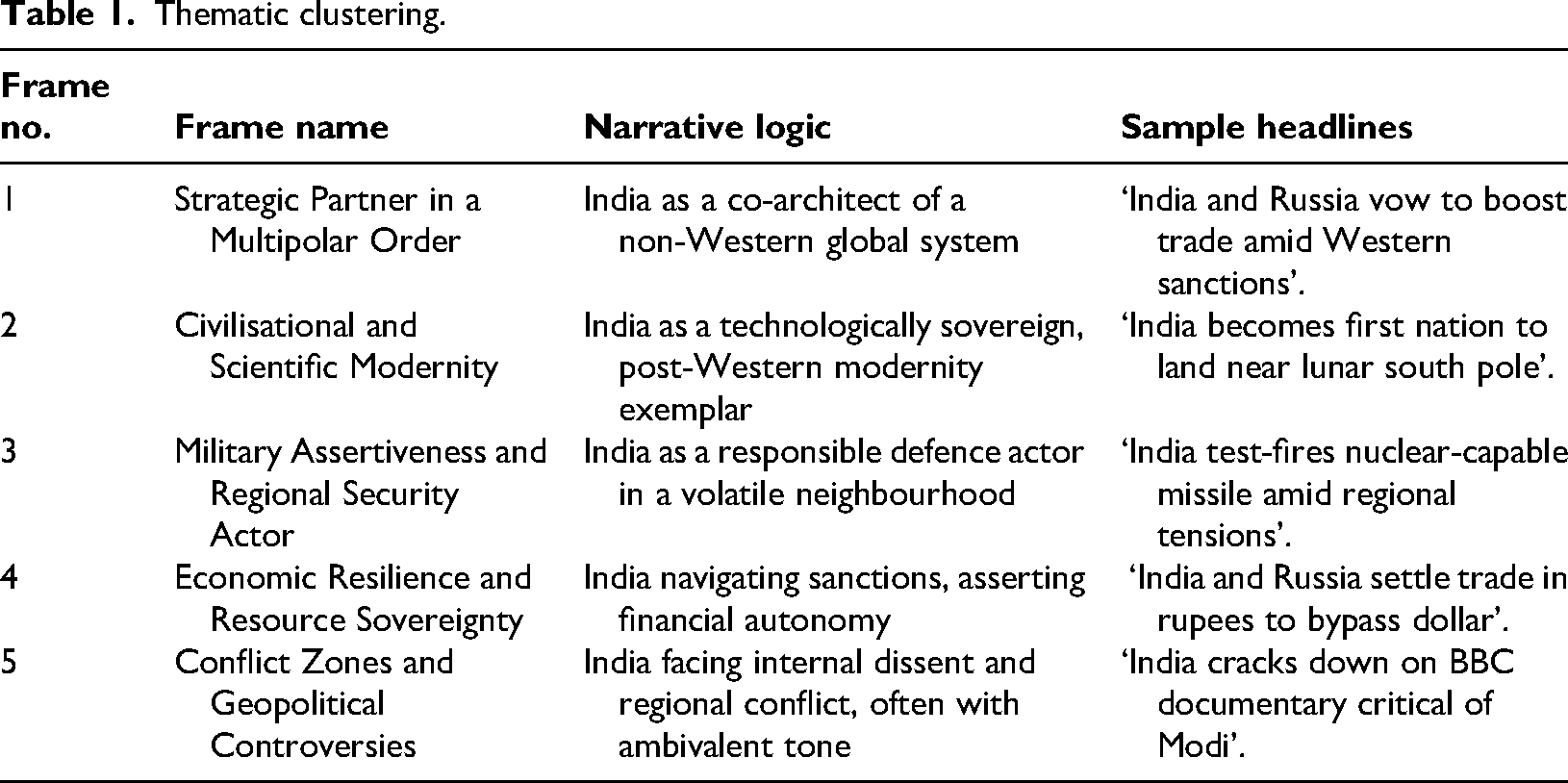
These frames show how RT repositioned India after February 2022, not simply as a country appearing in international news, but as a symbolic actor within narratives of sovereignty, strategic autonomy, and alternative global order. Before discussing each frame in detail, we first present the exploratory visualisations.
Thematic timeline
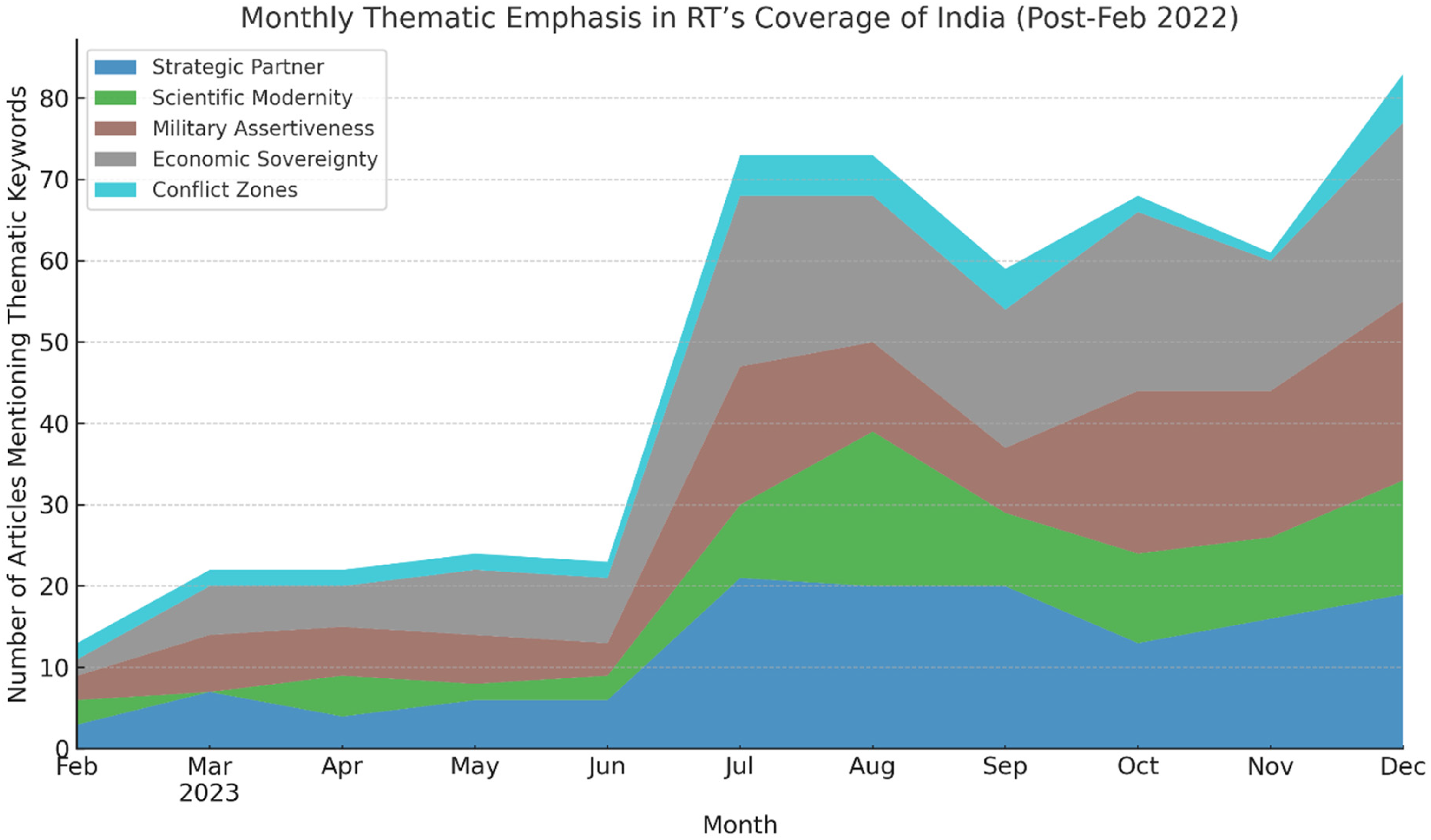
To visualise the temporal evolution of thematic priorities, a stacked area chart (Figure 2) was generated based on keyword clusters corresponding to the themes. These keywords were extracted from articles by using the scikit-learn package. Articles were grouped by month, and the presence of frame-related terms was counted within each period. The result reveals how coverage emphasis shifted over time. For example, ‘Strategic Partner’ and ‘Economic Sovereignty’ themes saw a marked rise post-February 2022, especially around major BRICS summits and sanctions. ‘Scientific Modernity’ peaked during India's lunar mission coverage, while ‘Conflict Zones’ remained sporadic but visible throughout. This demonstrates how different frames were strategically emphasised at different geopolitical moments.
Thematic timeline.
Pre-War framing of India in RT coverage (2019–February 2022)
Prior to February 2022, RT's coverage of India was limited and episodic. Only twenty-two articles in the referred directly to India during the 2019–2021 period. Given this relatively small corpus, the pre-war period is analysed qualitatively to identify dominant thematic orientations. The coverage during this period can broadly be grouped into three recurring narrative patterns. First, India frequently appeared as a site of domestic developments and internal events. Articles focused on public health developments, particularly during the COVID-19 pandemic, as well as routine policy decisions and social issues. In these stories, India was presented primarily as a national setting for domestic events rather than as an actor shaping international politics.
Second, India was often depicted through cultural and sporting narratives, particularly through references to cricket and entertainment. These stories emphasised India's cultural prominence and popular culture but carried little geopolitical significance. The prominence of terms such as ‘cricket’ and ‘world’ in the pre-2022 word cloud (Figure 3) reflects this orientation toward lifestyle and cultural coverage rather than strategic affairs.
Pre-February 2022 RT coverage of India. RT: Russia Today.
Third, a smaller subset of articles reported on routine diplomatic or economic interactions, including bilateral meetings and multilateral forums. However, these reports largely followed conventional diplomatic reporting formats and did not situate India within broader ideological narratives about global order. Cooperation between India and Russia was mentioned but framed as pragmatic engagement rather than as evidence of a shared geopolitical project. These pre-war narratives portray India primarily as a domestic news subject and cultural actor, rather than as a central participant in global power reconfiguration. However, in the post-invasion period, a clear change is evident. The following word cloud (Figure 4) reflects thematic transformation. Dominant terms include ‘Russia’, ‘India’, ‘G-20’, ‘economic’, ‘billion’, and ‘space’, ‘Modi’, etc. India now appears centrally in discussions around global economic realignment, multipolarity, and resistance to Western dominance.
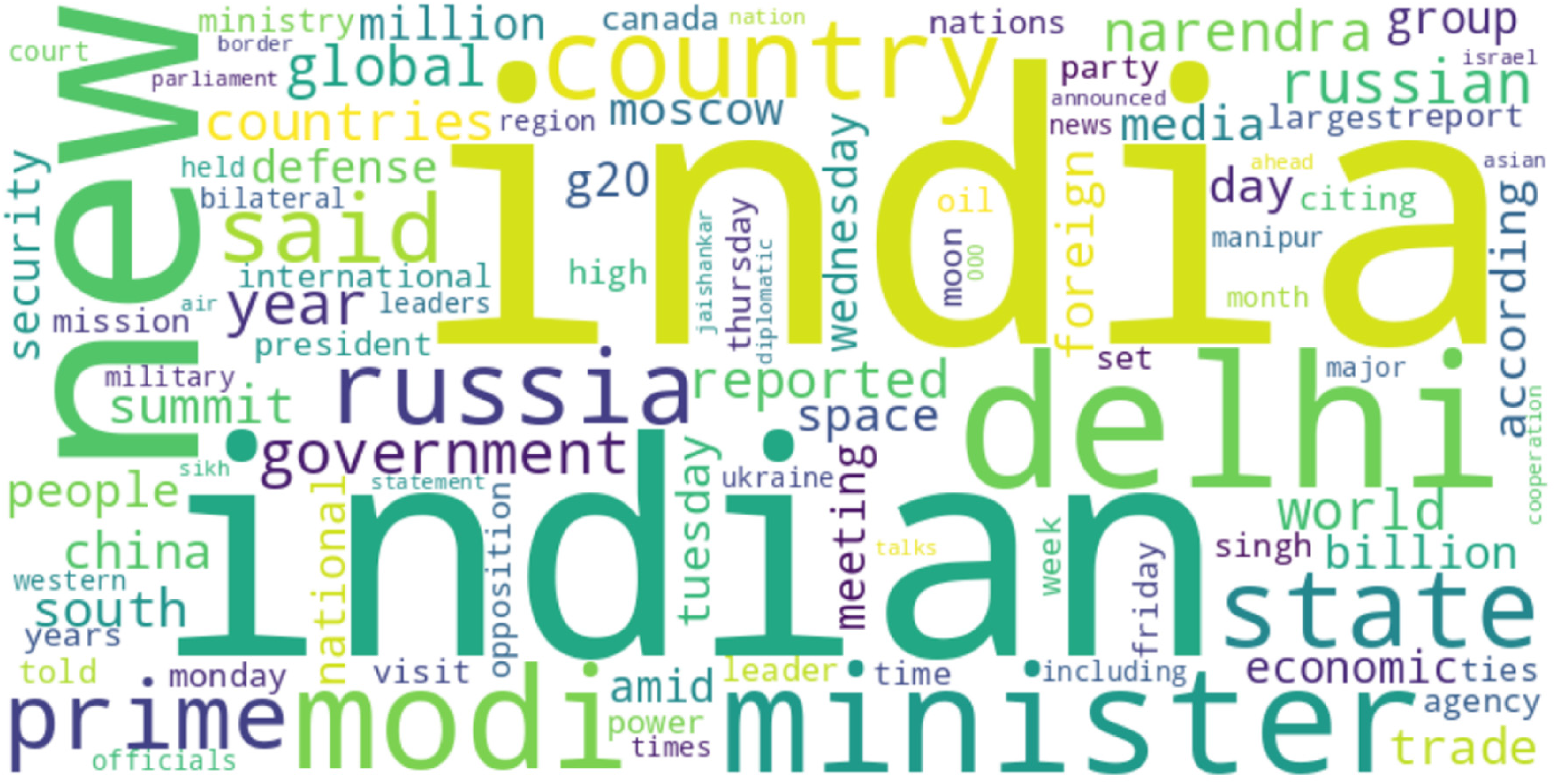
Post-February 2022 RT coverage of India. RT: Russia Today.
Importantly, some themes such as economic cooperation and defence engagement were already present in pre-2022 coverage. However, these appeared largely as routine bilateral developments rather than as elements of a broader geopolitical narrative. By contrast, in the post-invasion period, similar themes were embedded within a wider discursive framework emphasising sovereignty, multipolarity, and resistance to Western pressure. Therefore, the transformation lies less in the emergence of entirely new topics than in the narrative repositioning of India within RT's storytelling.
A further noteworthy change is in the frequency of articles. The following timeline (Figure 5) visualises the frequency of India-related articles published from January 2019 to December 2023. While the increase does not appear as an immediate spike after February 2022, the post-invasion period shows a cumulative rise in RT's India-related coverage, with the trend becoming especially visible in 2023. This suggests that India's media visibility on RT was not elevated through a single moment of editorial shift, but through a gradual repositioning that corresponded with broader geopolitical developments, including India's growing role in discussions around strategic autonomy, energy, trade, BRICS, etc.
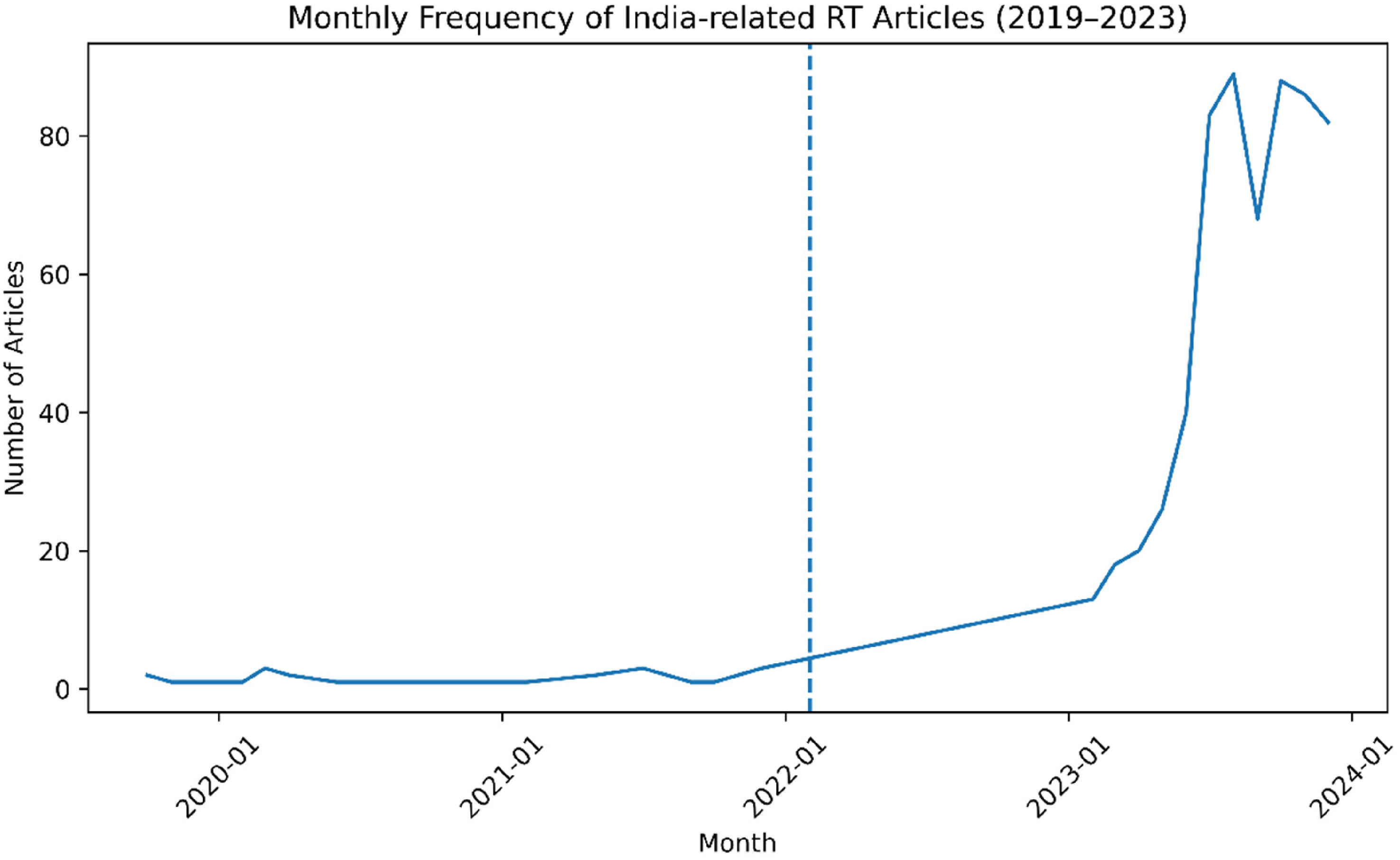
Monthly article frequency.
Keyword-Frame heatmap
A keyword heatmap (Figure 6) was generated showing the frequency of selected terms across the five frames. The heatmap reveals clear thematic clustering: terms such as ‘multipolar’, ‘BRICS’, and ‘summit’ dominate the Strategic Partner frame, while ‘moon’, ‘ISRO’, and ‘Chandrayaan’ are strongly linked to Scientific Modernity. Keywords like ‘missile’, ‘navy’, and ‘airstrike’ cluster under Military Assertiveness, while ‘rupee’, ‘oil’, and ‘sanctions’ appear prominently in the Economic Sovereignty frame. The Conflict Zones frame is marked by terms such as ‘Kashmir’, ‘Adani’, and ‘BBC’.
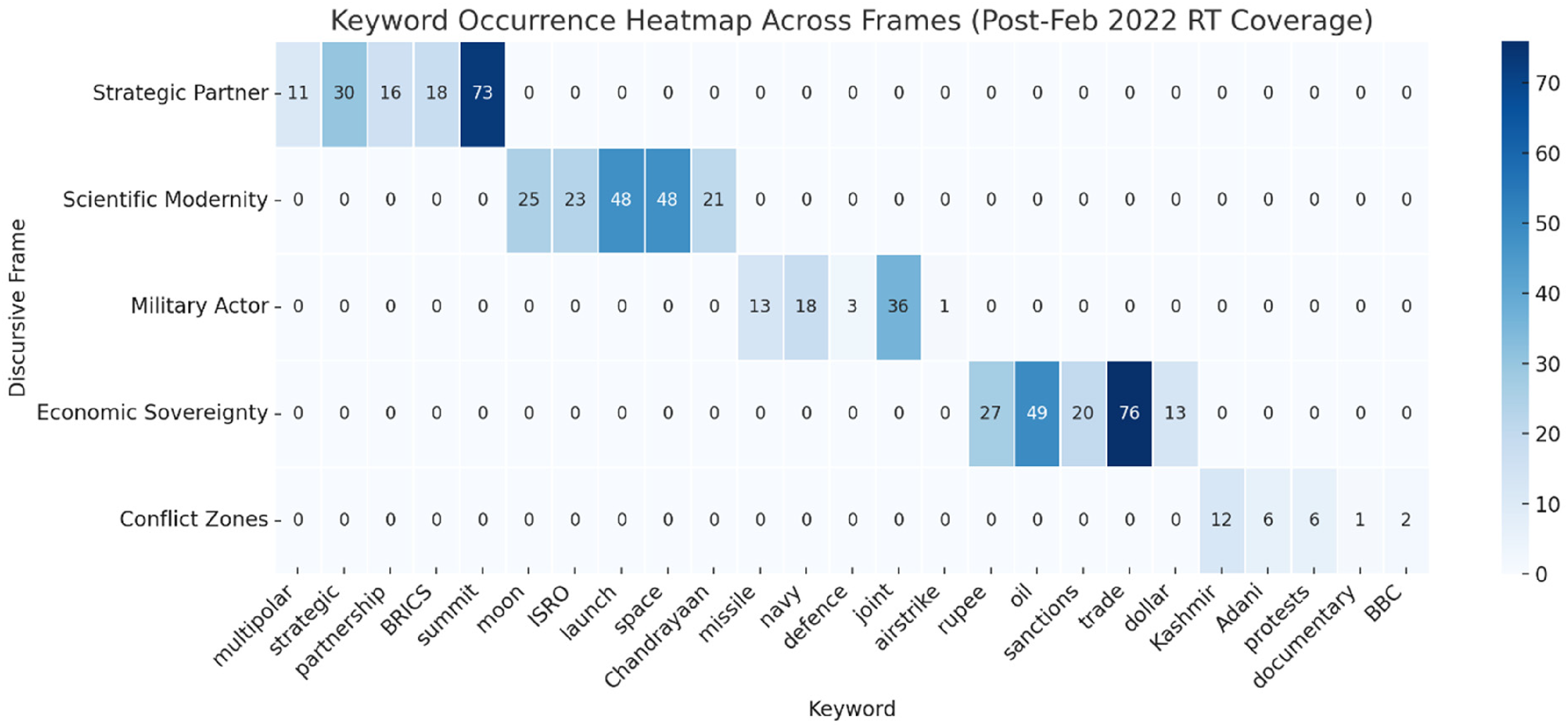
Keyword occurence heatmap.
Across the corpus of 635 articles, five dominant frames were identified that structure RT's representation of India. These frames capture distinct ways in which India is positioned within RT's geopolitical narratives, ranging from depictions of India as a partner in an emerging multipolar order to portrayals of the country within conflict-driven regional and global controversies. The most prevalent frame was Conflict Zones and Geopolitical Controversies (57.0%), followed by Economic Resilience and Resource Sovereignty (15.4%), Military Assertiveness and Regional Security Actor (12.9%), Civilisational and Scientific Modernity (8.7%), and Strategic Partner in a Multipolar Order (6.0%). The following sections examine these showing how RT constructs India's geopolitical role through recurring narrative patterns.
India as strategic partner in a multipolar order
Although not the most numerically dominant frame, this represents the most significant discursive shift in the post-2022 period. This frame is also significant because it directly articulates RT's vision of an emerging multipolar order; therefore, we begin with this frame. Articles under this category often appear in the context of BRICS summits, bilateral trade negotiations, or critiques of Western sanctions. Coverage intensity increased notably during the June 2022 and August 2023 BRICS summits, with India consistently framed as central to discussions on de-dollarisation and multipolar economic coordination. For example, in the pre-2022 period (2019–2021), none of the 22 India-related articles contained explicit references to BRICS, multipolarity, strategic partnership, or related terminology. In contrast, in the 2022–2023 period, 140 out of 613 articles (22.8%) included such language, indicating a clear discursive reorientation toward situating India within a multipolar alignment.
In addition, evidence of symbolic peer recognition is visible in RT's discourse. In several instances, India is positioned alongside Russia as an equal actor participating in efforts to reshape global economic and political arrangements. For example, the headline ‘Russia and India seek to break the dollar monopoly and dominate Eurasian trade’ (Sen Gupta, 2023) portrays the two countries as joint agents challenging Western financial dominance. Other reports highlight India's strategic autonomy in relation to the West. For example, coverage of India's G20 presidency noted that New Delhi had ‘rejected the US-led campaign to punish Russia with economic sanctions’, (RT, 2023a) emphasising India's refusal to align with Western pressure. Similarly, reporting on tensions between India and Western media institutions framed the country as an increasingly assertive global actor whose interests may diverge from those of Western powers.
India's civilisational and scientific modernity
This frame highlights India's technological and scientific achievements alongside narratives of civilisational renewal. For example, the coverage of India's Lunar mission called Chandrayaan-3 emphasised the country's growing scientific capability. One report noted that ‘India's Chandrayaan-3 mission lands on Moon’, was a ‘historic achievement’ that placed India among the small group of ‘elite’ nations (RT, 2023b). Alongside technological milestones, RT's coverage also highlighted efforts to assert cultural and institutional autonomy. For example, an article titled ‘Indian Navy to get rid of colonial past’ (RT, 2023c) reported plans to replace British-era naval designations with culturally Indian alternatives. Such narratives portray India as simultaneously modern and civilisationally self-confident. In other words, this frame combines technological achievement with cultural sovereignty, reinforcing the idea that emerging powers can pursue scientific advancement while asserting post-colonial identity.
Military assertiveness and regional security actor
Another recurrent frame presents India as a regional security actor with legitimate defence interests. Coverage frequently focuses on weapons development, military exercises, and regional security cooperation. The language is largely descriptive but implicitly portrays India as a responsible actor defending its interests within a volatile strategic environment. For example, reports such as ‘India developing its own long range air defense system’ (RT, 2023d) highlight the country's growing defence capabilities. Similarly, articles including ‘India and Russia hold joint naval drills’ (RT, 2023e) describe bilateral exercises aimed at countering global threats and ensuring maritime security in the Asia-Pacific region. Such coverage situates India as a capable military actor while simultaneously emphasising areas of cooperation with Russia. In terms of narratives, this presents India as a credible regional power.
Economic resilience and resource sovereignty
This frame centres on India's economic autonomy and its participation in alternative financial and trade arrangements. Coverage often highlights India's ability to pursue infrastructure partnerships across the Global South. For example, reports such as ‘India and UAE begin energy trade in local currencies’ (RT, 2023f) emphasise moves toward reducing dependence on dollar-based transactions. Similarly, articles including ‘India and Iran give impetus to deep sea port project’ (RT, 2023g) highlight infrastructure initiatives that strengthen regional connectivity and trade. Other coverage notes domestic energy demand and economic expansion, as reflected in headlines such as ‘India's oil consumption soars’. Overall, it portrays India as an economically resilient actor capable of managing global disruptions while maintaining strategic independence.
India in conflict zones and geopolitical controversies
The most prevalent frame in the corpus situates India within broader contexts of conflict, controversy, and political debate. Coverage includes reporting on domestic policy disputes, media regulation, tensions with neighbouring states, etc. For example, domestic political controversies appear in headlines such as ‘India's amended IT rules raise self-censorship fear for media outlets’ and ‘Why is India's fight against fake news a worry for free speech?’ (RT, 2023h). However, while such stories highlight contentious issues, the overall tone remains largely descriptive rather than overtly condemnatory. For example, articles such as ‘Kashmir – your next holiday destination? India orders lifting of travel advisory after 2-month ban’ and ‘Indian government promises justice after civilian ‘torture’ deaths in Kashmir’ illustrate how RT reports on unrest in the region while also highlighting official responses from Indian authorities. Other reports focus on geopolitical tensions, including ‘India protests over China's ‘absurd’ territorial claims’, situating India within regional disputes and strategic competition. Although these stories highlight controversy, they rarely frame India as a destabilising actor. Instead, the coverage often contextualises conflicts within broader regional dynamics or presents them alongside official justifications and competing narratives. These five frames constitute a complex discursive construction of India in RT's coverage following the invasion of Ukraine.
Discussion and conclusion
RT's evolving representation of India illustrates how international broadcasting functions as an instrument of geopolitical articulation rather than merely information dissemination. As a state-funded broadcaster operating across global platforms, RT participates in media diplomacy, understood as the strategic use of mediated communication for state positioning and influence (Gilboa, 1998; 2001). Its portrayal of India after 2022 reflects not a spontaneous editorial shift but a strategic and structured realignment with Russia's broader diplomatic pivot towards the Global South.
The comparison between pre- and post-invasion periods is crucial. Before 2022, India appeared intermittently and largely within conventional frames: trade cooperation, domestic politics, policy problems, regional security developments, etc. The coverage was episodic and bilateral in orientation. However, after the invasion of Ukraine, India's representation intensified both quantitatively and qualitatively. Themes of sovereignty, strategic autonomy, energy independence, and resistance to external pressure became more central. India was increasingly situated within broader narratives of post-Western transition and multipolar realignment. This transformation can be interpreted through the concept of mediated multipolarity. As described in the literature review, mediated multipolarity operates through three interlocking mechanisms which render the concept communicatively tangible: (i) narrative alignment, (ii) peer recognition, and (iii) contrastive othering. The following analysis applies these three mechanisms to interpret RT's representation of India.
Narrative alignment embeds India within frames that resonate with Russia's own strategic interests and vocabulary. As mentioned in the findings, post-2022 coverage repeatedly emphasises India's refusal to join Western sanctions, its independent energy decisions, and its diplomatic balancing. These elements are not presented as isolated policy choices but as markers of principled autonomy. Through such framing, India becomes narratively aligned with a vision of international order centred on sovereignty and non-interference. Multipolarity, in this configuration, is articulated as a shared normative position rather than a Russian demand.
Similarly, symbolic peer recognition elevates India from the level of partner to co-architect. As shown in the findings above, RT places Russia and India side by side as joint agents in reshaping global economic and political arrangements, particularly in relation to de-dollarisation debates, BRICS coordination, and alternative financial infrastructures. For instance, coverage describing how ‘Russia and India seek to break the dollar monopoly and dominate Eurasian trade’ positions the two states through parallel verbs and shared strategic objectives, presenting them as co-architects of alternative economic arrangements. The coverage does not portray India as dependent on Russian support (for example dependant on Russia for defence technology) or a junior partner within alliance structures. Instead, India is framed as technologically capable, economically significant, and diplomatically influential. By stressing India's agency and global standing, RT constructs an image of partnership among equals. This peer positioning serves a strategic communicative function: it diffuses the perception of Russian isolation by demonstrating that influential states (in this case India) endorse or at least coexist within its geopolitical framework. Therefore, multipolarity appears credible because it is represented as collectively sustained and not just imagined or claimed by any one actor.
In a similar vein, contrastive othering operates through a juxtaposition of India's autonomy with Western coercion. References to sanctions, criticism from the United States and the European Union (Verma, 2022), and commentary on Western double standards provide a contextual foil against which India's decisions are framed as rational and sovereign. This discursive contrast does not rely on overt condemnation of the ‘other’ (in this case the West); instead, it operates through comparative framing that constructs the peer or partner as morally and ethically superior to the ‘others’, against whom the legitimacy of a new system is discursively articulated. In this sense, mediated multipolarity is not solely about celebrating partners but about situating them within an alternative moral geography.
Discursive geopolitics helps in understanding this moral geography and particularly the audience logic of this strategy. The representation of India as sovereign, technologically advanced, and diplomatically confident speaks directly to Global South publics for whom autonomy from Western conditionalities may carry appeal. At the same time, the same framing operates as symbolic signalling toward Western audiences. It demonstrates that Russia retains engagement with major non-Western actors despite sanctions and institutional exclusion. Thus, the ultimate recipients of this discursive construction are not confined to Indian audiences. The coverage addresses multiple communities simultaneously: potential partners in the Global South, domestic Russian constituencies seeking evidence of resilience, and Western observers whose perception of Russia's isolation is being contested.
The communicative payoff of such discursive positioning operates across several domains. First, it sustains affinity with audiences in the Global South by emphasising themes such as sovereignty, strategic autonomy, etc. Second, it challenges Western narratives that portray Russia as becoming weak and marginalised. Third, it reinforces domestic perceptions of Russia's continued global relevance by showing that major states remain engaged with its diplomatic and economic initiatives. In this sense, mediated multipolarity functions not only as a narrative device but also as a communicative strategy for maintaining geopolitical legitimacy. When understood as a form of mediated soft power, this may generate strategic returns: it reinforces perceptions of enduring partnerships and projects geopolitical adaptability. Thus, multipolarity becomes normalised not as an abstract doctrine but as a visible alignment within and through media narratives.
Importantly, this alignment is neither static nor unilateral. Indian media have at times articulated narratives that resonate with Russia's framing, particularly during moments of international crisis. Kumar and Thussu (2024) demonstrate how India's Republic TV framed Russia as a long-standing partner and questioned Western accounts of the Russian invasion of Ukraine. Similarly, Kumar (2023; 2025a) shows how ‘nationalist’ news discourse constructs India as assertive and willing to confront geopolitical pressures. These domestic media narratives reinforce RT's portrayal of India as an autonomous and powerful actor, suggesting that symbolic alignment can be mutually reinforcing.
At the same time, India's ambivalent geopolitical positioning complicates any simplistic reading of such alignment. Participation in forums such as the Quad and G20 indicates continued engagement with Western-led architectures. However, this ambivalence enhances India's symbolic value within mediated multipolarity. Because India is not fully aligned with any bloc, its association with Russia carries greater legitimising weight. In other words, the credibility derived from India's strategic autonomy strengthens its role as a discursive peer. The shift identified in this study also reflects a ‘strategic narrative adaptation’ (Miskimmon et al., 2013). Following the rupture of 2022, RT reoriented its storytelling to emphasise systemic transition and alternative alignments. As Hallin & Mancini (2004) argue, media institutions do not simply mirror state policy; they participate in shaping narratives. RT's editorial recalibration illustrates this participatory role.
Footnotes
Acknowledgments
NA

Ethical approval and informed consent statements
Ethical approval was not required for this study, as it did not involve human participants, or sensitive personal data. Informed consent was therefore not applicable.
Funding
The authors received no financial support for the research, authorship, and/or publication of this article.
Declaration of conflicting interests
The authors declared no potential conflicts of interest with respect to the research, authorship, and/or publication of this article.
Data availability statement
The data supporting the findings of this study are available from the corresponding author upon reasonable request.