







Abstract
UN Women has warned that ‘The Taliban is closer than ever to achieving its vision of a society that completely erases women from public life’. The Taliban regime in Afghanistan has barred women and girls from participating in all sports since the fall of Kabul in 2021. Their systematic and widespread discrimination against women in sports is not confined to Afghanistan alone. Afghan sportswomen in exile continue to face significant challenges, including social marginalisation and limited institutional support. An example is the exiled Afghan women cricketers in Australia, who are living through challenging times and are struggling to gain official recognition to represent their country internationally. This paper analyses the role of social media in Afghan women cricketers’ global campaign for recognition. Drawing on the Communities of Practice framework, individual interviews and a focus group discussion were conducted with exiled Afghan women cricketers living in Australia. It is argued that Afghan women cricketers in exile are strategically using social media, particularly Instagram, to advocate for their inclusion in international women's cricket, maintain connections with teammates and family, and challenge gender stereotypes and marginalisation in cricket. While social media have elevated their voices for change and drawn the much-needed global attention, we argue that further efforts are required to address their challenging conditions and to ensure their full inclusion in international women's cricket.
Introduction
The post-9/11 era created new opportunities for Afghan women. The 20-year-long Western mission led by the United States and supported by its allies brought some form of ‘republic, equality, liberty and democracy’ to the war-torn country (Nehan, 2022: 2). The Hamid Karzai-headed Afghan government (2004
On the day of the fall of Kabul, thousands of Afghans rushed to Kabul's international airport to escape the Afghan Taliban's ‘theocratic descending’ model of authority (Maley, 2023: 55). Seven people were killed in the chaos at Kabul International Airport, and millions were left behind to face their fate. Today, the level of women's participation in government and civil affairs in Afghanistan has reached a new low – ZERO (UN Women, 2025). Among the casualties under the hardliner Afghan Taliban regime was sports, including cricket. In 2020, for the first time, 25 Afghan women cricketers were awarded professional contracts by the Afghan Cricket Board (ACB). The Afghan Taliban's prohibition of women's sport forced female athletes to abandon their athletic careers and flee Afghanistan due to threats to their lives. Nineteen of 25 Afghan contracted players were granted Australian humanitarian visas due to human rights restrictions at home (Moonda, 2025). The evacuation and resettlement mission was carried out by Cricket Australia (CA), along with the support of passionate volunteers, including former Australian cricketer Mel Jones and Emma Staples (formerly the head of diversity and community engagement at Cricket Victoria), and Catherine Ordway (Australian lawyer and academic) (Ordway, 2025). The majority of players were settled in Melbourne, whereas some were settled in the Australian capital city of Canberra (Moonda, 2025). Afghan women cricketers spent years in exile, persistently advocating for recognition, submitting informal requests to the International Cricket Council (ICC), and eventually launching a global campaign for official status. Previous scholarship has examined the situation of Afghan women athletes through the lenses of human rights, forced migration and gender discrimination (Jain, 2025; Sauvineau, 2025). Building on this, research suggests that digital platforms increasingly serve as critical infrastructure for marginalised communities seeking institutional recognition (Higgins et al., 2023; Ortiz et al., 2019). Yet despite these insights, little attention has been paid to the communicative strategies that enabled Afghan athletes to sustain their advocacy from exile, particularly the role of social media. This study investigates how social media contributed to raising international awareness of the Afghan women's cricket team's recognition campaign, informing the following research questions:
Gender, sport and political repression in Afghanistan
Sports are a reflection of a nation's political and social maturity (Nanayakkara, 2012; Seippel, 2024) and give women and girls the chance to strive for equal rights. Nevertheless, realising this potential remains particularly fraught in Afghanistan, a country where women's rights have been systematically suppressed across successive political regimes (Nehan, 2022). It is not only the graveyard of empires, but also a graveyard full of heavy coffins of Afghan women's dreams and freedom (Liem, 1999). The UNDP adjudged Afghanistan ‘one of the most dangerous places in the world for a woman to live in’ (Dutta, 2023). The possibility for women to participate in sports was non-existent during the Taliban's first regime (1996
However, with the return of the Taliban 2.0 1 in 2021, the repression and restrictions on women's sports once more resurfaced to ruin the plans and dreams of millions of Afghan women (Beaumont, 2021; Jan et al., 2022). To be specific, the Taliban 2.0 has officially banned all kinds of participation of women in sports (Bhakti and Yulianto, 2023), as had been predicted by several scholars (Alizada and Ferris-Rotman, 2021; Van Bijlert, 2021). The Taliban 2.0 regime has systematically sought to erase women from public life on the pretext of religion (Bhakti and Yulianto, 2023; Samantha, 2019). Hayhurst et al. (2021) also highlight the precarious situation of women under the second Taliban rule. This is all transpiring despite the assurances of the Taliban regime's spokesperson, Zabihullah Mujahid, that ‘no prejudice, inequality, and injustice would be allowed towards women in Afghanistan’ (France 24, 2021).
Bhakti and Yulianto (2023) examined photographs captured by the Associated Press’ award-winning photographer, Ebrahim Noroozi, depicting Afghan women in shuttlecock burqas from ‘12 different sports, including volleyball, skateboarding, cricket, bicycles, football, taekwondo, muay thai, mixed martial arts, wushu, boxing, and jiu jitsu’ (Bhakti and Yulianto, 2023: 146). These Afghan women left the field due to severe pressure and threats from the newly incumbent Taliban 2.0 regime. Similarly, the sports fraternity across the globe witnessed a similar fate befall the Afghan national football team, where the captain, Khalida Popal, asked her teammates to burn their uniforms and delete their social media accounts to ward off severe threats to their lives (Krishnan, 2021). It is worth noting that Afghan sportswomen's challenges are multifaceted, as they also faced severe cultural and religious hurdles even before the Taliban's 2.0 return. The former Afghanistan women's cricket team captain, Diana Barakzai, believes that women in Afghanistan ‘are victims of unacceptable [cultural] rules that prevented them from leaving the house’ (Kotschwar, 2014: 149). Apart from a few scholarly studies, such as the study by Spaaij et al. (2024) that highlights the plight of the exiled Afghan women's soccer team, it is surprising to see the lack of academic attention given to the precarious situation of Afghan women's sports.
People of Afghanistan, including its women, are fond of playing sports. Although Buzkashi, a sport involving horses, is the national sport of the country, cricket and football are more popular across Afghanistan (Bahir, 2020; Sidiq, 2022). The success and prominence of men's cricket, Amin (2018) argues, resulted in the formation of a women's team in 2010, since the ICC mandates cricket teams for both genders. The women's team was, however, disbanded in 2014 amid considerable opposition to women playing the sport. It was only revived in 2017
The Afghan women's national cricket team was first established in 2010 as part of an ICC-mandated requirement for member nations to develop both men's and women's cricket. However, it was disbanded by 2014 amid a lack of institutional support from the ACB and growing threats from hardline elements opposed to women's sport (Wright, 2023). The team was revived only after Afghanistan gained full ICC membership in 2017 (Velija, 2019). The Afghan women's team never participated in any ICC bilateral or tournament cricket. Their route to professional status came through a single national training camp held at the Alokozay Kabul International Cricket Ground in October 2020, from which 40 players were assessed and 25 selected for central contracts (Moonda, 2025). However, their contracts represented a fragile administrative acknowledgement of the women's game rather than a fully functioning system. The struggles faced by Afghan women cricketers did not begin in 2021. Wigmore and Miller (2014) document the early efforts of Diana Barakzai (an ex-Afghan women's cricket coach and player) and her three sisters, who learned to play as refugees in Pakistan after fleeing the Taliban. They returned to Kabul in 2009. Their attempts to establish women's cricket were met with fierce opposition, including female players being likened to prostitutes (Wigmore and Miller, 2014). As mentioned above, the fall of Kabul in August 2021 terminated this project entirely, with the Taliban immediately banning women's sport and the ACB subsequently cutting all contact with the contracted players. CA played a central role in evacuating and resettling 19 of the 25 contracted players and has been a named partner board in the ICC's subsequent support task force. At the same time, CA has, on three separate occasions since 2021, refused to play bilateral men's cricket against Afghanistan specifically because of the Taliban's prohibition on women's sport: cancelling a one-off Test in November 2021, withdrawing from a men's ODI series in January 2023, and pulling out of a men's T20 series in March 2024 after receiving Australian Government advice that ‘conditions for women and girls in Afghanistan are getting worse’ (Conn, 2024; Hytner, 2024). CA chairman Mike Baird publicly described the organisation as ‘very proud’ of its stance (Caffrey, 2024).
While the Afghan men's cricket team seized the opportunities presented to them and successfully showcased their abilities on the international stage, the women's team was sidelined and denied the chance to participate in any international tournament (Saif, 2020). In hopes of reinvigorating the women's cricket team, the ACB, despite the opposition from some quarters within the ACB (Saif, 2020), offered central contracts to 25 women's cricket players in 2020 (ACB, 2020). However, these efforts were effectively ended with the fall of Kabul in 2021. Out of these 25 players, 19 fled to Australia and appeared in their first charity match in January 2025 (Al Jazeera, 2025). Other players are also reported to be living in Canada and the United Kingdom. A recent study by Jain and Krieger (2025) has examined the boycott calls of the Afghan men's cricket team to compel the Taliban regime to abolish the restrictions imposed on women's sport. These boycott calls were made by 160 members of the UK's House of Commons and House of Lords, urging their country's cricketing bodies to boycott men's international tournaments, an appeal echoed by similar calls from Australia and South Africa (Vyver and Beveridge, 2025).
Social media activism and Afghan women
Scholarship on the right to sport has increasingly recognised that access to sporting participation is a matter of human dignity and human rights (Jain, 2025). In this context, the sustained efforts of Afghan women cricketers in Australia to fight for their right to play and represent their country represent a compelling case of rights-based advocacy (Jain, 2025). Central to this activism has been the use of social media, which can be defined as ‘a group of Internet-based applications that build on the ideological and technological foundations of Web 2.0, and that allow the creation and exchange of user-generated content’ (Kaplan and Haenlein, 2010: 61). Platforms such as Facebook (launched in 2004), X, formerly Twitter (launched in 2006), Instagram (launched in 2010) and TikTok (launched in 2016) have transformed how individuals and communities organise, share information and pursue collective goals (Singh and Singh, 2025). These platforms have significantly influenced how we live our lives (Humphreys, 2013; Wei et al., 2023), and their continuous advancements over the past two decades have created new possibilities for advocacy, mobilisation and the pursuit of rights. However, it is important to acknowledge that the social media landscape continues to evolve rapidly, and much of the earlier scholarship on digital activism may not fully capture the dynamics of more recent platform-specific behaviours, algorithmic curation and audience engagement patterns (Freelon et al., 2023; Mindel et al., 2024).
Social media activism can be broadly defined as ‘participatory actions that intend to bring about societal change’ (Brenman and Sanchez, 2024: 6496), and a growing body of recent scholarship has examined how digital platforms serve as sites of political contention, identity construction and community building (Ferguson et al., 2025; Gerber, 2021). In the context of sport, researchers have increasingly examined how athletes and sporting communities use social media for advocacy, brand building and challenging institutional power (Chen and Kwak, 2025; Ferguson et al., 2025). For marginalised groups in particular, social media has offered new possibilities for visibility and voice that were previously unavailable through mainstream channels (Ferguson et al., 2025). Social media has significantly contributed to decentralised social and political campaigns and movements such as the Arab Spring (Eltantawy and Wiest, 2011) and Black Lives Matter (Cox, 2017). More recently, scholarship has drawn attention to the limitations of such campaigns, including issues of performative allyship, platform censorship, algorithmic suppression and online harassment directed at activists, particularly women (Chen and Kwak, 2025; Freelon et al., 2023).
Social media activism is sometimes dismissed as superficial or transient. However, recent research suggests a more nuanced picture, demonstrating that sustained, strategic digital campaigns can generate meaningful institutional responses and shift public discourse (Ferguson et al., 2025; Mindel et al., 2024). This is particularly relevant to the case of Afghan women cricketers, whose campaign purpose was a lengthy and strategically coordinated effort. In the context of Afghanistan, Bouvier and Machin (2023) examined the impact of the hashtag #standwithwomeninafghanistan and the way women of Afghanistan registered their concerns on social media after the return of Taliban 2.0. Moreover, right after the fall of Kabul, people of Afghanistan used social media as a third space by posting with hashtags ‘#freeherface, #freehervoice or #freeherwings’ as physical demonstrations were not possible due to severe life threats.
Social media has provided a platform to Afghans to raise their voice for rights and civil liberties. For example, upon the slaying of the Hazara community's abductees, the Tabassum Movement in 2015 extensively used social media to arrange national protests against the Taliban (Shayan, 2019). Likewise, the hashtag #enlightenment campaign was another success in 2016, which was ignited by the Taliban's suicide assault on the Hazara community protest in the capital city. Furthermore, the 2017 social media campaign ‘Uprising for Change’ and the 2021 hashtag campaign #sanctionpakistan represent additional major examples of Afghan social media activism (Bose et al., 2019). While these campaigns succeeded in drawing international attention, scholars have noted that translating online momentum into concrete institutional or political change remains a persistent challenge, particularly when state actors actively suppress digital dissent (Earl et al., 2022).
Afghan women's social media activism increased exponentially (Amnesty International, 2024), as the repressive Taliban 2.0 regime severely restricted opportunities for street protests, making social media a safer and more potent avenue for marginalised women to express their dissent. However, the Taliban regime is constantly working on censoring digital dissent through internet blocking, intimidation and threats. Recent scholarship highlights that women activists operating in authoritarian or post-conflict contexts face compounded risks online, including state surveillance, gendered harassment and doxxing, all of which disproportionately silence women's voices in digital spaces (Amnesty International, 2024; Earl et al., 2022; Mujika Chao, 2022). Afghan women activists face challenges not only from the Taliban 2.0 regime but also from heightened harassment and cultural shaming that extend well beyond state suppression (Akhtar and Khedam, 2024).
Conceptual framework
This study employs the concept of CoPs (Wenger-Trayner and Wenger-Trayner, 2015) to explore how displaced women cricketers of Afghan descent collectively work as a community to advocate for their rights, to get equal participation on the international level and to bring institutional and policy change for gender equality in cricket. CoPs were first introduced by Jean Lave and her colleague Etienne Wenger in 1991 in their book ‘Situated Learning’ (Wenger-Trayner and Wenger-Trayner, 2015). Wenger further refined the concept in his book ‘Communities of practice: Learning, meaning, and identity’ in 1998 (Wenger, 1999). CoPs are defined as ‘Groups of people who share a concern or a passion for something they do and learn how to do it better as they interact regularly’ (Wenger-Trayner and Wenger-Trayner, 2015). The concept of CoPs has been used in studies of political journalism (Adnan, 2025), international relations (Bicchi, 2022), fact-checking (Brookes and Waller, 2023), sports and institutional change (Hutchins and Boyle, 2020), health care (Noar et al., 2023), knowledge transfer in small/medium-sized enterprises (Rossignoli et al., 2024), education (Tummons, 2022) and many other scholarship areas.
We argue that the CoPs framework is a useful way of studying change efforts to bring institutional and policy change in sports (e.g. promoting gender equality in cricket in this case). Previous CoPs and social movement scholarship have neglected the use of CoPs to study institutional change. Thomson et al. (2022) have further reconceptualised CoPs as an approach for promoting institutional change via the introduction of the CoPP, which they defined as ‘a group of institutionally affiliated people across different organisations or nations coalescing around a shared concern for social equality who engage in transformative practice, who learn from each other and co-create knowledge through regular interactions to act on institutional change’ (Mørk et al., 2010: 588). However, in this case, the Afghan women cricketers lack formal affiliation with the ICC and the ACB. And since the CoPs framework does not mandate formal institutional ties, it makes CoPs more suitable for the study of Afghan women cricketers, who are not recognised by the ICC or ACB but still work as a community united by their shared goal of promoting gender equality in cricket. It is important to note, however, that this is a unique community of practice, one defined not by active participation in their sport, but by their involuntary exclusion from it. Rather than a community united by shared practice in the conventional sense, these women constitute a community organised around the pursuit of visibility, advocacy and the right to practice, a distinction that both complicates and enriches the application of the CoPs framework. By viewing the displaced women cricketers of Afghan descent as an interconnected community of practice, we can better understand how they organically or purposefully use social media to fight for recognition by the ICC, shape public discourse around Afghan women's participation in cricket and influence policy outcomes. Similarly, their mobile activism aligns with the concept of the CoPs framework, where a group of people share a common concern (gender equality in cricket) and work together (mobile social media campaign) to fulfil their individual and group goals.
Methods and participants
This study has adopted a qualitative approach to explore the role of social media in facilitating Afghan women cricketers’ global campaign of recognition. In order to investigate the study's research questions, we first conducted individual interviews with Afghan women cricketers. In the second step, we introduced selected findings from interviews and discussed them in the focus group (FG) for collective discussion and validation (Flick, 2017). Afghanistan had 25 contracted women cricketers in 2020. After the fall of Kabul in 2021, 19 players were granted humanitarian visas to Australia (Moonda, 2025). Out of the 19 exiled Afghan women cricketers living in Australia, 10 players participated in this study. The remaining nine cricketers refused to participate in the study, citing security and personal reasons. Participants were contacted and recruited conveniently through the lead author's personal contacts. Even though this approach enables researchers to identify diverse respondents without much difficulty, sampling of this kind limits the generalisability of the findings. Therefore, the findings should be cautiously interpreted as exploratory, rather than representative.
Data collection
In the first step, we conducted individual semi-structured interviews with ten exiled Afghan women cricketers in Australia. Eight interviews were conducted in person, whereas two interviews were conducted via WhatsApp. Each interview lasted for 20–50 min. The majority of interviews were conducted in Pashto (participants’ and the lead author's native language) and were later translated into English for the ease of analysis. In the second step, a FG discussion was held with six participants to investigate the topic further and to ‘enhance the credibility and validity of findings’ (Carter et al., 2014: 545). In contrast to individual interviews, ‘During focus groups participants comment on each other's points of view, they may challenge themselves, manifest disagreement or ambivalence, and they debate’ (Kidd and Parshall, 2000: 294). The FG discussion lasted for 2 h and 8 min. The FG discussion was simultaneously conducted in both English and the Pashto language. Notes were taken during the FG discussion, but were not coded. They were only used to help refine the themes. The data collection (i.e. individual interviews and the FG) for this study was carried out in August 2025.
Data analysis
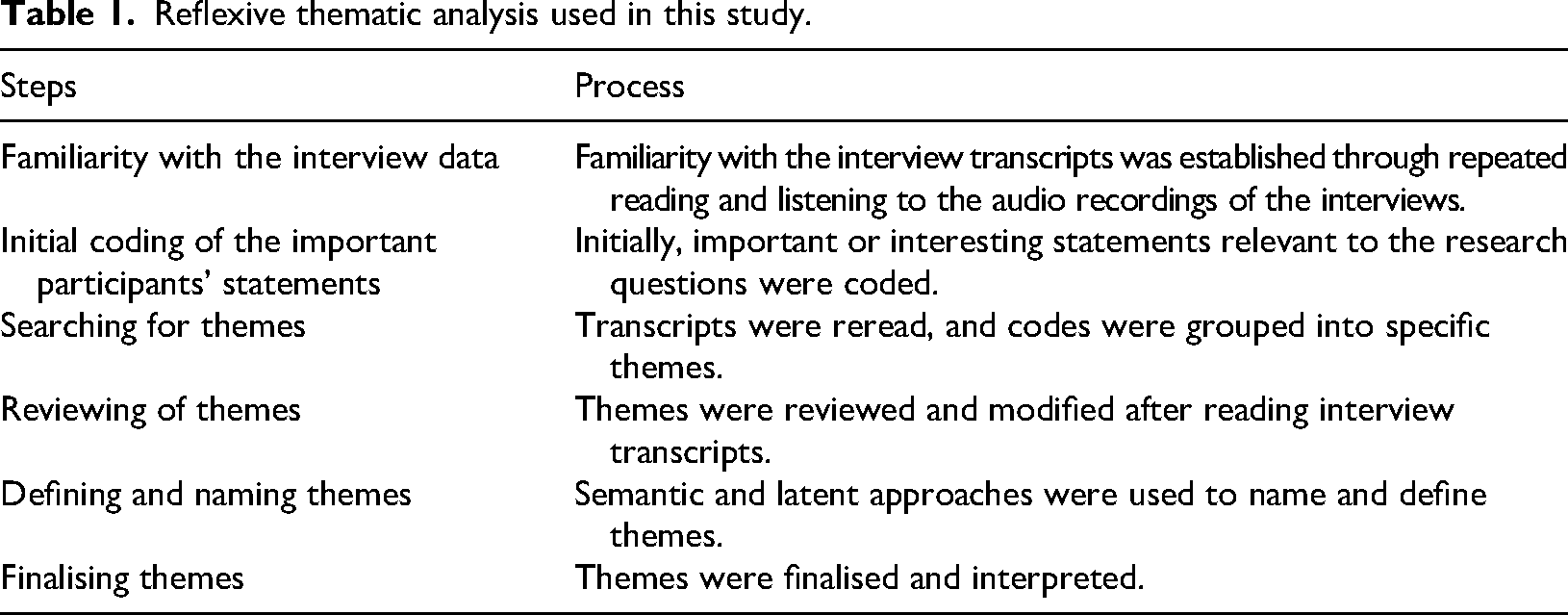
Reflexive thematic analysis (RTA) was used to analyse the data obtained from individual semi-structured interviews and the FG. RTA is ‘a theoretically flexible [qualitative] method’ for ‘developing, analysing and interpreting patterns in a qualitative data set’ (Braun and Clarke, 2021: 4). The process involved six stages: (1) Data familiarisation through repeated reading of the materials (interviews and FG transcripts), (2) Preliminary coding at various levels, (3) Identification of themes by grouping relevant codes into potential themes, (4) Re-examination of themes to build thematic maps, (5) Define and name themes, and (6) finalisation of themes (see Table 1 for details). The RTA process was carried out using NVivo 14. NVivo is an advanced and suitable qualitative data analysis software for organising and analysing unstructured qualitative data (Woolf and Silver, 2017). Once themes were developed, they were further refined and aligned with the objectives of the study.
Reflexive thematic analysis used in this study.
Informed consent and ethics approval
Informed consent was obtained from all the participants, and the study was approved by the institutional review board of the American University in the Emirates. A participant information sheet (PIS) was provided to all participants to explain the purpose of the study. Cricketers’ names are presented through pseudonyms (A–J) throughout the paper upon their request. Informed consent was obtained from all the participants, and the study was approved by the institutional review board of the American University in the Emirates. A PIS was provided to all participants to explain the purpose of the study. Cricketers’ names are presented through pseudonyms (A–J) throughout the paper upon their request.
Findings
The following four themes emerged from the RTA of interview and FG discussion data: (1) Social media and international recognition, (2) Social media and community ties, (3) Social media and gender-based online violence and (4) Social media for empowerment.
Theme one: social media and international recognition
Afghan women cricketers in the study provided numerous comments on the role of social media for online campaigning, particularly Instagram, to get official recognition and support from cricket bodies like the ICC. This theme discusses Afghan women cricketers’ mobile social media activism in exile (Australia) and their direct online engagement with sports journalists and global cricket stakeholders through social media. Participants talked about the influential role of social media in raising awareness of their struggle and challenging journey. These findings are consistent with Freelon et al.'s (2016) argument that ‘social media helps level a media playing field’ for marginalised communities and amplifies voices that are otherwise excluded from mainstream discourse (Freelon et al., 2016: 8).
An interviewee lauded social media in this way: I think it (social media) has played a huge role in showing the world our talent and the challenges that we have faced as a team and individually, and our struggle in coming to Australia from Afghanistan.
They commented on social media's role in raising awareness about the issue of ‘team's official recognition’ and helped them advocate and fight for equity in cricket: So, I started using social media as a tool of campaign, for my team, so that ICC can hear our voices and help us to play and represent our country.
Another participant added to the discussion: Without sharing so many posts and videos (campaign posts) and advocating for the team, there wouldn’t have been so much attention. I think social media, if used in the right way, can be very helpful. Only a few of us started this thing, like tagging people, hoping someone important would notice. But slowly journalists contacted us, and suddenly everyone was talking about us and our cricket.
As mentioned above, the Afghan players operated outside of any formal structure. The way in which they used social media shows how digital activism can penetrate institutional spaces and compel governing bodies (ICC in this case) to acknowledge claims that had previously been ignored (Kaun and Uldam, 2018). Participants expressed that without social media, the majority of people in Australia and globally would be unaware of the Agham Women's Cricket Team: Social media has helped us to be seen and recognised. For example, most Australians know that Afghanistan plays cricket, but they don’t know that Afghanistan has a women's team.
Afghan women cricketers commented on the social media's important role in providing them due attention from sponsors, the ICC and major cricket boards: When we came here (talking about the Afghan women's cricket team), one of our main objectives was to have some form of media representation that we could use to attract sponsors and get the attention of the ICC and other prominent boards. It was then that we realised the importance of social media.
A FG participant also highlighted this point during the collective discussion: We knew that no one was going to speak for us unless we spoke for ourselves. So we used Instagram, and we did our best, because that was the only place we had access to.
The fact that they perceived Instagram as ‘the only place’ shows the structural exclusion these women faced from mainstream sports media. Digitisation and the rise of platforms have fundamentally transformed who can produce and circulate public narratives (Staab and Thiel, 2022). For these Afghan women cricketers in exile, Instagram played an important infrastructure role and provided them a space to express themselves. This campaign also attracted engagement in the form of posts and comments from other social media platforms. For example, on X (formerly Twitter), hashtag conversations such as #cricketforall and #supportafghanwomen happened to show solidarity and support with Afghan women cricketers.
According to the participants, their online campaign has successfully drawn the attention of the ICC and a global audience, but they believe their job is half done and remain optimistic that their efforts will drive significant change for the Afghan women's cricket team: Everything I post on social media is for my team and girls’ rights. I hope that together, we will bring a meaningful change.
Another Afghan women's cricketer commented: It was mobile social media that introduced us, that has introduced Afghan women to the world. And that was social media that we people have started discussing our rights, at least.
She further added: Every time I post a reel for our campaign, I think about the girls back home who cannot play cricket, and who even cannot even say they want to play.
The findings show how Afghan women cricketers collectively built a shared practice of online advocacy that reflects the key features of the CoP framework. According to Wenger (1999), a CoP is formed when people share a common concern and develop a shared way of doing things, which is precisely what we observe here. While Afghan women cricketers acknowledged that social media made them visible to a global audience, they also recognised that visibility alone was not enough to bring about institutional change.
Theme two: social media and community ties
Afghan women cricketers expressed their views about the role of social media in maintaining their personal and professional connections: We made different groups on WhatsApp. For example, we have a group for contracted players, and another one for all the families who came here to Australia (Afghan women cricketers’ families). We can communicate with each other there and discuss the problems in our lives.
The above comment relates to the scholarly work on ‘mobile belonging in digital exile’ (Bublatzky, 2022). In her study, Bublatzky discussed the case of Parastou Forouhar, an Iranian installation artist living in exile in Germany, and argued that social media can ‘play an important role in addressing and overcoming the distress of forced displacement’ (Bublatzky, 2022: 3). She explained how exile means ‘an in-between existence’, for some people, where they live in between two countries, neither of which they belong to. She argued that social media provides the all-important ‘emotional connection’ in such challenging times. One participant commented: I think WhatsApp is a great mobile platform for communicating with teammates and family back home. I have been using it daily since I came to Australia. It keeps us connected as a team even though we are scattered across different suburbs (and cities) in Australia.
WhatsApp acted as a relational space, as well as what Bublatzky (2022) describes as an ‘in-between existence’. Another player added how this daily contact carried an emotional weight that went well beyond team logistics: WhatsApp is the first app I open in the morning. If I have not heard anything from my teammates for a long time, I feel anxious. It tells us every day what has happened to us.
In digital activism scholarship, social media is largely framed as a remedy for displacement, but for these Afghan cricketers, it also held the constant reminder of loss. Participants also emphasised the bridging role of WhatsApp in helping them ‘develop a shared repertoire of resources to achieve their goals’ (Wenger, 2011). They explained how it enables them to share information on travel, passports and finances. It helps them to support each other and strengthen their CoP as they navigate the challenges in exile: We have a WhatsApp group where we share everything, from international travel to passports and financial issues. It's a place where we discuss everything we are facing and try to help each other.
Another participant added: We helped one of our players understand her visa situation through the group (WhatsApp). We are not consultants (laughs), but we often help each other in such things. So, it is not just cricket we share in the group. We talk about visa papers, finding a place to live, and understanding the values of a new country.
The views expressed by the participants in this theme show how WhatsApp has served as an important platform for sustaining the Afghan women cricketers’ CoP in exile. The shared WhatsApp groups described by Afghan women cricket players directly reflect the CoP idea of a shared repertoire, through which members collectively develop resources and strategies to navigate common challenges.
Theme three: social media and gender-based online violence
In this theme, Afghan women cricketers expressed how their advocacy efforts have attracted a lot of hate, criticism and negative comments from Afghan people back home and abroad. As an interviewed Afghan women cricketer said: Obviously, everyone has their own mindset and point of view on social media. When you use it, there are many people in Afghanistan who do not support women's cricket. They come with their bad comments, which sometimes makes you feel upset.
Another participant added to the discussion: It is not always positive. You often get negative ones (comments) as well. When I post something, I see comments like, ‘Why are you focusing on sport? You could focus on education.’ I think cricket is not separate from education. It is all connected. When we fight for cricket (official recognition), we are also fighting for our rights.
As argued by Cumiskey (2014), ‘a woman's position within her culture may often dictate the extent to which she has to negotiate with others in order to gain access to technology’ (p. 365). This is true in the case of Afghanistan, where women and girls are going through unprecedented restrictions after the fall of Kabul in 2021 and are ‘deprived of their fundamental rights to freedom of movement and expression’ (Amnesty International, 2024). A participant in the study compared her social media experiences in Australia and Afghanistan: In Afghanistan, it was not possible for us to use mobile phones to share our lives and voices with the world. We started using it only in Australia. And I think things need to change there as well.
The findings in this theme show the dual nature of social media when used for activism. While social media has enabled them to build and sustain their CoP, they have simultaneously exposed them to hostility and opposition from within their own cultural community. It shows that the CoP does not exist in a neutral digital space but operates within contested cultural and political terrain. For example, the gender-based online violence and criticism directed at Afghan women cricketers show structural barriers, including entrenched gender norms and the Taliban's systematic suppression of women's rights, which extend beyond Afghanistan's borders into diaspora communities.
Theme four: social media for empowerment
Afghan women cricketers in the study were confident in their media abilities and were determined to make a positive impact through social media: Well, I am planning to start a podcast soon. I want to show people my struggle, journey and my life through social media. I think I can inspire other girls back home.
She further added: The money that I will earn from social media will go towards funding the education of Afghan girls. I am also thinking of establishing a sports centre for girls in Afghanistan.
Participants in the study emphasised social media's role for girls to effect change and express themselves: I think it's not just about us; every girl can use social media to bring about change in her life and make her voice heard.
Another young Afghan cricketer added to the discussion: I believe social media can give a voice to every marginalised community, just like us, and it's our twelfth player (she laughed). Without social media and our phones, not many people knew us. Nobody was speaking for us, but we have our mobiles.
The ‘twelfth player’ metaphor mentioned in the above quote reflects the confidence that social media has instilled in these young Afghan women cricketers. Social media has not only facilitated their cricket advocacy efforts but has also motivated them to raise awareness about the issues faced by other marginalised women in Afghanistan.
Discussion and conclusion
Using qualitative evidence from ten individual semi-structured interviews and a FG discussion with Afghan women cricketers in exile, this study explored the role of social media in their global campaign for official recognition. Echoing work on ‘women's influence on the development, adoption, and diffusion of mobile media’ (Cumiskey, 2014: 365) more generally and the use of social media for activism more specifically (Murthy, 2018; Neag et al., 2024), and drawing on the conceptual framework of CoP, we identified four key themes through RTA (Braun and Clarke, 2021). Participants felt that social media had played a significant role in facilitating their campaign for official recognition by the ICC, particularly through Instagram, to connect with global cricket stakeholders, including full-member cricket boards and sports journalists. Participants described a deliberate strategy of tagging ICC official pages, cricket boards and sports journalists, sharing personal testimonies and coordinating posts to maximise visibility. A measurable outcome was the ICC's formation of a task force to support Afghan women cricketers in exile, providing coaching and pathways to domestic representation (ICC, 2025). Afghan women cricketers felt cautious optimism with the ICC's last-minute intervention and were frustrated because the task force stopped short of granting the Afghan team a formal identity. ‘I don’t know what my team's name is or what will be written on the back of my shirt’, added a young Afghan women cricketer.
The findings can be understood through the CoP framework (Wenger, 2011). The Afghan women cricketers’ collective use of social media constitutes what may be termed a digital community of practice, characterised by three defining elements central to Wenger's framework: (a) a shared domain of interest, namely the pursuit of official recognition and equity in international women's cricket, (b) a sense of community sustained through ongoing mutual engagement across digital platforms, and (c) a shared repertoire of advocacy strategies, narratives, and symbolic resources developed and circulated online. For instance, mobile WhatsApp groups have given Afghan women cricketers the means to connect among themselves in exile and share resources on travel, finances and emotional support. Social media platforms like Instagram have also allowed them to engage with relevant stakeholders to convey their voices and courage. This digital CoP has not only preserved their identity as Afghan cricketers in exile but has also helped them run a meaningful online campaign. It also shows how social media can transform such displaced communities into resilient, practice-oriented communities that negotiate adversity through ongoing interaction and resource sharing (Akoumianakis, 2009).
The findings confirmed the central role of Instagram in raising awareness about the team's unresolved status. Afghan women cricketers’ campaign shares important structural features with other digital movements. Abbas et al. (2022) showed how the TikTok Intifada spoke to an international audience who no longer rely on established news media. Their study revealed that the TikTok Intifada movement created and promoted through TikTok was ‘trendy, easily relatable, and spoke to an international audience, who no longer seek established news media for news’ (Abbas et al., 2022: 306). Tufekci (2017) similarly demonstrated how digital platforms allow marginalised groups to bypass traditional gatekeepers. In her famous book ‘Twitter and Tear Gas’, Tufekci analysed the role of mobile and digital platforms in empowering marginalised groups to bypass traditional gatekeepers and amplify their voices in social movements such as the Arab Spring in Egypt, the Zapatista uprisings in Mexico and the 2016 Turkish coup attempt (Tufekci, 2017). Compared to such social movements, the Afghan women cricketers’ campaign operated within the specific cultural economy of sport, where governing bodies carry reputational pressures around fairness and inclusion. The ICC's eventual response, however incomplete, suggests that sustained and targeted visibility within that economy does produce institutional consequences.
Afghan women cricketers also expressed positive views about the role of social media in maintaining their personal and professional connections. Social media serves as an important tool for sustaining their community of practice (Wenger, 2011). It maintains and facilitates ongoing communication, including with family members in Afghanistan and with the team in exile. Despite their displacement, social media promotes a sense of belonging and shared identity. This theme not only shows the consistency of this study with relevant literature but also expands our understanding of the use of mobile devices for personal and professional connections (Storch and Ortiz Juarez-Paz, 2019). For instance, a study conducted by Padilla-Walker et al. (2012) suggests that social media usage is directly associated with high levels of family connection. Afghan cricketers specifically acknowledged the role of WhatsApp in improving their communication with family members back in Afghanistan and collaboration with their teammates in Melbourne. As Bublatzky (2022) argues, social media provides an important emotional connection for those living in exile, and these findings confirm that dynamic while extending it into a collective sporting context.
A minority of participants expressed concern about the ambivalent nature of social media (Vanden Abeele, 2021), noting that their advocacy had attracted significant abuse from Afghan communities at home and abroad. These experiences go beyond the gendered trolling that female athletes routinely face in Western sporting contexts, which is itself well documented (Litchfield et al., 2018). The abuse directed at these women is simultaneously gendered and culturally punitive, targeting not just their visibility as sportswomen but their perceived violation of community and religious norms. As Afrouz et al. (2023) note, Afghan women who contradict ascribed gender roles risk ostracism from their community. The gender-based online violence these cricketers receive is therefore an extension of the same patriarchal structure that forced them into exile and one that has followed them onto Instagram and WhatsApp. This displacement, religion, ethnicity and gender in online abuse is not yet adequately addressed in the athlete trolling scholarship and represents an important direction for future research.
Afghan women soccer players have faced similar repression, forced into exile after the fall of Kabul in 2021, with FIFA only recently beginning to engage with their situation (Sport & Rights Alliance, 2025). In both cricket and football, social media was the primary means through which displaced athletes made their circumstances visible to governing bodies and the global public. In both cases, institutional response came slowly and incompletely, and the burden of proof fell entirely on the athletes rather than on the institutions. These findings point to a structural gap in international sports governance where there is no formal mechanism obligating bodies like the ICC or FIFA to act when a member nation's government strips its own athletes of their rights. The context of exile has nonetheless provided these women with the moral ground to demand the right to play sport (Jain, 2025). Participants also shared plans to use social media for broader women's empowerment initiatives, including podcasts and vlogs promoting Afghan girls’ education and sport. Afghan women cricketers are consciously positioning themselves as long-term advocates for Afghan women, using the credibility their cricket identities have given them.
Overall, this study contributes to scholarship on social media, activism and displacement by showing how mobile affordances intersect with gender and exile in digital spaces. It also contributes to the athlete trolling scholarship by documenting a form of online abuse shaped by displacement and cultural coercion that existing Western-centred frameworks do not adequately capture. It aligns with and extends CoP scholarship by demonstrating that a community of practice can be built and sustained entirely in digital exile, without physical institutional support (Angouri, 2015). The treatment of these athletes is a serious and ongoing human rights concern. Social media has allowed them to make that injustice visible. While social media cannot single-handedly deliver institutional change, it remains an important tool for marginalised communities seeking to be seen, heard and recognised.
Footnotes

Ethics approval and informed consent
Informed consent was obtained from all the participants, and the study was approved by the institutional review board of the American University in the Emirates. A participant information sheet (PIS) was provided to all participants to explain the purpose of the study. Cricketers’ names are presented through pseudonyms (A–J) throughout the paper upon their request.
Funding
The authors received no financial support for the research, authorship, and/or publication of this article.
Declaration of conflicting interests
The authors declared no potential conflicts of interest with respect to the research, authorship, and/or publication of this article.
Data availability statement
The dataset analysed during the current study will be available from the corresponding author upon a reasonable request.