






Abstract
This article examines how publics on the margins of India's media landscape engage in digital news communication. Focusing on Northeast India, a region historically peripheral to national politics and journalism, it analyses audience interaction with regional digital-native news outlets on Facebook. Drawing on Dahlgren's interactional model of the public sphere, Keane's micro-public sphere, and recent work on affective and infrastructural publics, the study explores how emotion, reasoning, and mediated visibility intersect in peripheral contexts. Using a mixed-methods design that combines descriptive analysis of participation trends with qualitative interpretation of reader interaction, it identifies hybrid patterns of expressive and deliberative engagement. Although overall participation remains low, comment threads reveal meaningful civic presence within constrained digital infrastructures. By situating engagement from India's Northeast within debates on platform governance and media peripheries, the paper extends public sphere theory to show how small-scale digital participation contributes to everyday democratic discourse.
Introduction
The spread of digital communication technologies has fundamentally transformed how citizens access and respond to news. These changes, however, unfold unevenly across regions marked by historical, political, and infrastructural asymmetries. In India, declining data costs and expanding smartphone access have made social media a dominant medium for information and interaction. Yet this digital transition has been profoundly uneven, as connectivity, media infrastructure, and capacity for participation vary widely across regions, creating distinct patterns of engagement (Baruah, 2020; Thomas, 2021). Northeast India is geographically remote and historically peripheral to both political and media power. As a result, public discourse in the region is shaped by enduring concerns around identity, migration, and citizenship. Immigration debates, particularly around the Citizenship (Amendment) Act (CAA) 1 and cross-border mobility, have intensified regional anxieties over identity, belonging, and political representation.
Over the past decade, a considerable number of small, digital-native news outlets have emerged as alternative voices for the region (Banaji and Bhat, 2022; Baruah, 2020). Digital news media organisations, including East Mojo, Inside Northeast, News Mill, and Raiot, seek to address gaps in representation within mainstream national media. Emerging from outside conventional and legacy media networks, these organisations strive to represent local concerns that rarely find space in mainstream discourse. Their editorial mission is rooted in visibility. They narrate the region on its own terms and make its politics legible to wider publics. This is particularly important within a national discourse that has often marginalised or simplified the Northeast.
In the Northeast, migration has long been tied to concerns over demographic change, resource distribution, and ethnic identity. Prominent movements such as the Assam agitation in the 1980s and more recent debates around the CAA and National Register of Citizens (NRC) reflect its deep political sensitivity. These socio-political tensions shape the kinds of issues that regional digital media platforms foreground and disseminate within the public domain. The region's contemporary politics has also been shaped by interstate border disputes and recurring ethnic and tribal autonomy movements (Baruah, 2020; Hausing, 2021). These historical tensions have contributed to enduring perceptions of political and cultural marginalisation from mainland India (Baruah, 2020). In this context, social media functions as both a newsroom infrastructure and an important participatory space. It is where content circulates, audiences engage, and public deliberation unfolds. According to the India Digital News Report 2019, more than three-quarters of Indian internet users access news primarily through Facebook (Aneez et al., 2019), confirming the platform's role as a de facto civic arena.
While national-level studies of Indian journalism have focused on ownership structures, platformisation, or ideological polarisation (Banaji and Bhat, 2022; Kumar, 2016), little is known about how audiences in peripheral settings use these platforms to engage with news. Participation from the periphery remains under-examined, often reduced to metrics rather than analysed as a communication practice. As Dahlgren (2009) reminds us, the vitality of the public sphere depends on the interactional dimension. This is where everyday exchanges produce and negotiate meaning, emotion, and civic connection. Examining these micro-practices offers a way to understand democracy not as a singular public conversation but as a mosaic of dispersed and mediated encounters.
Peripheral publics in this context can be understood as dispersed, low-visibility communicative formations that emerge under conditions of infrastructural constraint and uneven visibility. In such contexts, participation is limited in scale but remains meaningful in its symbolic and affective contributions to democratic discourse (Couldry and Hepp, 2017; Shah, 2015). These conditions are particularly evident in regions marked by infrastructural disparities, including bandwidth instability and limited newsroom capacity, which shape how voices appear online. At the same time, social-network architectures provide unprecedented opportunities for visibility and participation. This article argues that such publics are defined not by the absence of participation but by the unequal conditions under which participation becomes visible, meaningful, and democratically consequential.
Facebook comment threads, reactions, and shares become the key sites where publics manifest themselves. People express agreement, contest narratives, and signal belonging. The low volume of visible engagement often observed in such spaces does not necessarily imply apathy. Rather, it reflects the interaction between structural limitation and communicative adaptation. These interactional practices can be understood as micro-publics in operation, where even limited exchanges sustain forms of civic visibility and engagement. Even minimal acts of participation can carry symbolic weight as expressions of presence within an unequal information environment.
This article explores these dynamics by analysing how readers engage with the Facebook pages of Northeast India's leading digital-native outlets. It examines how the publics in the region communicate around opinion and commentary articles that invite reflection and debate. The focus is not on the scale of participation but on its form and meaning. The paper examines how emotion, reasoning, and identification coexist within mediated spaces. Using a mixed-methods approach that combines descriptive mapping of participation intensity with qualitative interpretation of reader interactions, the study investigates how micro-level exchanges contribute to a broader sense of public voice.
The paper is framed by public sphere theory, affective public scholarship, and recent discussions on platform infrastructures. It conceptualises these comment spaces as a micro-public sphere (Keane, 2018), small, issue-specific arenas of communication that exist within the infrastructural confines of the platform society. By reading low-volume participation as a meaningful social act, the study challenges deficit narratives that equate engagement with numerical magnitude. Instead, it argues that citizens in peripheral regions practise democracy through modest but persistent communicative gestures.
The investigation of these hybrid, affective–deliberative interactions from India's Northeast contributes to a growing body of research on how publics emerge under asymmetrical conditions of visibility (Couldry and Hepp, 2017; Mattoni, 2021; Papacharissi, 2015; Shah, 2015). Situating the region within global debates on digital participation, the study highlights how peripheral publics adapt, resist, and re-imagine deliberation within the mediated structures that now define contemporary civic life.
Theoretical framework
Analysing digital participation from India's Northeast requires a theoretical lens that links everyday communication with structural constraints. The framework, therefore, combines perspectives from public sphere theory, affective publics, and mediated infrastructure studies to explain how publics are formed and expressed within unequal digital environments.
The concept of the public sphere remains a foundational starting point. Habermas (1991) envisioned it as a rational-critical arena where citizens discuss issues of common concern. Later, scholars such as Fraser (1992) reconceptualised it as plural space while recognising the existence of counter-publics among marginalised groups. This pluralist focus is important in Northeast India, where publics are segmented by language, ethnicity, and geography (Baruah, 2020). These divisions make it necessary to study how small, dispersed groups communicate within hybrid and often fragile media infrastructures.
Building on this pluralist foundation, Dahlgren (2005, 2009) proposed that democratic culture depends on the interactional dimension of the public sphere. Such interactions constitute everyday communicative practices through which meaning and belonging are negotiated. Likes, shares, and comments, though apparently trivial, are emblematic of this dimension. They signal civic presence and recognition. In regions where infrastructural access and media resources are limited, such gestures become crucial indicators of participation.
Complementing this, Keane (1995, 2018) describes modern democracy as a network of micro-public spheres. These are small, issue or region-specific spaces where citizens scrutinise authority and exchange views. Digital comment threads epitomise these spaces. Fleeting yet politically charged, they allow the public to articulate emotion, critique, and reasoning in miniature form. Keane's notion helps interpret the Northeast's Facebook comment spaces as micro-publics that sustain discussion despite low visibility and resource scarcity.
While classical approaches focus on reasoned argument, Papacharissi (2015) highlights the affective texture of online engagement. Papacharissi's theory of affective publics shows how emotion, including anger, pride, and empathy, operates as a connective force that keeps publics together. Rather than undermining deliberation, affect provides the energy that sustains it. For peripheral regions, where participation often manifests as emotive expression or symbolic affirmation, this framework recognises that feeling and reasoning coexist as complementary modes of civic voice. This understanding of digitally mediated participation also resonates with boyd's (2010) concept of networked publics. Her study points out how social media platforms shape the conditions under which publics gather, interact, and become visible. Extending this perspective, Abidin's (2021) concept of refracted publics highlights how communities navigate uneven visibility within platform environments. Participation may remain visible to some audiences while staying ‘below the radar’ of others. Together, these perspectives help situate peripheral publics as digitally connected yet differentially visible formations.
To operationalise these communicative dynamics, Entman's (1993) framing theory remains useful for analysing how meaning is negotiated between writers and audiences. When readers reproduce or resist frames in comment threads, they exercise interpretive agency and contribute to the public construction of issues. Although not the paper's central theoretical pillar, framing analysis underpins the qualitative coding of reader comments.
The communicative practices cannot be separated from their technological foundations. Couldry and Hepp (2017) describe the present as a deeply mediated public sphere, where algorithms and platform design determine who becomes visible and for how long. Their perspective links media participation to questions of infrastructure, data, and power. This perspective can be further situated within the political economy of digital media in India, where platform dependence, ownership structures, and interdependent media markets shape the visibility of regional voices (Elavarthi and Chitrapu, 2021; Parthasarathi and Athique, 2019). Such perspectives are essential for understanding small newsrooms that depend on Facebook for distribution. Related research on platform infrastructures and datafication (e.g., Couldry and Mejias, 2019; van Dijck et al., 2018) reinforces the idea that participation is conditioned by platform logics rather than purely by civic intent.
Extending this logic, Mattoni (2021) introduces infrastructural publics. They are collectivities that emerge through dependence on material and technological systems. Publics, she argues, are not only discursive but infrastructural formations shaped by connectivity and capacity. This aligns with Shah's (2015) notion of ‘networked margins’, where digitally connected but structurally peripheral communities negotiate visibility and participation within uneven media ecologies. In Northeast India, these dynamics are evident in conditions such as bandwidth instability, small newsroom capacity, and algorithmic unpredictability. These infrastructures, while enabling inclusion, simultaneously constrain the possibilities of deliberation (Baruah, 2020; Thomas, 2021; van Dijck et al., 2018).
Together, these frameworks describe how digital participation in the Northeast operates at the crossroads of interaction, affect, and infrastructure. These dynamics also resonate with networked forms of deliberative democracy, where participation unfolds through distributed, asynchronous interactions rather than formal consensus-building (Bruns, 2008). Dahlgren's interactional dimension clarifies how individuals perform civic presence; Keane's micro-publics capture the small-scale arenas where discussion unfolds; Papacharissi's affective publics explain the emotional currency that animates participation; and Couldry and Hepp's mediated public sphere situates these practices within platform-based constraints. Regional studies on media infrastructure ground this theory in the lived realities of the Northeast (Baruah, 2020).
This integrated approach rejects the idea that low engagement equates to a democratic deficit. Here, visible engagement refers to observable interactions within the platform, such as comments, replies, and discussion threads. Low levels of such engagement should not be interpreted as evidence of civic apathy or disengagement. In the context of infrastructural limitation, even small acts of commenting or reacting signify adaptation. Citizens work within algorithmic and material constraints to maintain presence and agency. Hence, Facebook comment threads of regional digital-native outlets can be seen as infrastructure-shaped micro-publics. Modest yet meaningful arenas where affect and deliberation intersect. Analysing these spaces through this composite lens enables a grounded understanding of how democracy is practised from the periphery of the platform society.
Methodology
Research design
The study adopts a mixed-method approach combining descriptive mapping of participation intensity with qualitative interpretation of audience interaction. The design enables both the measurement of engagement levels and the analysis of communicative meaning. This reflects the interactional dimension of the public sphere that views participation as an everyday communicative practice rather than a numerical aggregate (Dahlgren, 2009).
Four English-language digital-native news media, namely East Mojo, Inside Northeast, News Mill, and Raiot, were purposively selected. These platforms represent the most active and regionally recognised news initiatives in Northeast India. They are distinguished by a consistent publishing frequency and considerable social media following, mainly on Facebook. They are associated with the Northeast Association of Digital Communication and Media, a regional association of digital media organisations established to promote professional collaboration and ethical standards. Together, these outlets offer a balanced cross-section of commercial, civic, and activist orientations within the region's digital news ecology.
Facebook served as the empirical site because it is the dominant medium of news discovery and audience interaction in India. The India Digital News Report 2019 found that more than three-quarters of Indian internet users access news primarily through Facebook, establishing the platform as a primary arena of mediated participation (Aneez et al., 2019). For small-scale newsrooms in the Northeast, Facebook functions simultaneously as infrastructure, public forum, and feedback mechanism, providing the most accurate representation of how audiences encounter and respond to regional news. While Facebook serves as the primary empirical site for this study, it is important to note that platforms such as WhatsApp and Instagram also play a significant role in news circulation and everyday communication in India. Facebook was selected because it remains one of the principal platforms for news consumption and public interaction. According to the India Digital News Report, more than three-quarters of Indian internet users access news through Facebook, making it a particularly relevant site for examining visible forms of audience engagement and discussion (Aneez et al., 2019). However, due to their limited public accessibility and challenges of systematic data collection, WhatsApp and Instagram are not included in the present analysis.
Sampling and data source
The dataset comprised Facebook posts linking to opinion and commentary articles published by the four outlets during the formative consolidation phase of the region's digital-native news ecosystem (2018–2020). This period marks the stage when regional outlets stabilised editorial operations, and audience interaction became integral to their distribution model. It also precedes the implementation of India's 2021 Information-Technology (Intermediary Guidelines and Digital Media Ethics Code) Rules, allowing analysis of civic participation in its pre-regulatory form. Studying this window, therefore, offers a reliable baseline for understanding the natural evolution of audience engagement before state regulation reshaped the digital environment.
From a corpus of 434 opinion articles, 279 (64.28%) were political and 155 (35.71%) general in focus. Within the political subset, 191 (68.45%) addressed Northeast-specific issues, of which immigration emerged as the most recurrent theme (35.07%). This empirical dominance made immigration an analytically suitable entry point for tracing audience participation and understanding how publics in the region engage with contentious issues of identity and belonging. Opinion writing was selected because it represents the most direct form of discursive journalism, inviting reader response and debate. In public sphere theory, deliberation emerges not merely through information consumption but through reflexive discourse (Dahlgren, 2009; Habermas, 1991). Opinion and commentary pieces embody this deliberative impulse by framing issues in evaluative terms that encourage readers to contest or affirm positions. Within the study corpus, themes such as governance, identity, and citizenship recurred frequently, making these texts a productive entry point into regional civic communication.
Analytical procedure
The analysis was conducted in two stages. First, a quantitative mapping of engagement metrics, including likes, shares, and comments, was conducted to identify overall interaction patterns across outlets. These figures established participation intensity and revealed uneven audience attention. Descriptive statistics were sufficient for this purpose, as the aim was to illustrate tendencies rather than produce inferential comparisons. Second, a qualitative analysis examined the content and tone of reader comments. Comments were treated as communicative units revealing interpretive and affective orientations.
Using Entman's (1993) four framing functions, namely problem definition, causal interpretation, moral evaluation, and proposed remedy. The analysis coded how audiences constructed meaning around issues. Each comment was further categorised by communicative style that included expressive (emotion-driven) or deliberative (reason-driven or dialogic). Multi-user exchanges were read as interactional sequences indicative of emergent micro-publics (Keane, 2018). To maintain interpretive rigour, coding categories were refined through iterative reading. Attention was given to context, irony, vernacular expression, and affective tone. The goal was not numerical generalisation but the identification of discursive patterns showing how publics negotiate meaning under infrastructural constraint.
Ethics and reflexivity
The study used publicly available Facebook data without accessing private information or identifiable user profiles. No attempt was made to contact participants, and only aggregated engagement counts and anonymised excerpts were recorded. Consistent with institutional ethics policy, the dataset involved minimal risk and did not require formal consent because all material was public. Nevertheless, identifying details were removed to preserve anonymity. Reflexively, the researcher acknowledges that digital traces reflect both human and algorithmic agency. These limitations are integral to the study's interpretive stance, which treats online engagement not as objective evidence of deliberation but as a mediated signal of civic presence.
Scope and limitations
The research focuses exclusively on English-language Facebook content from four regional outlets and does not extend to vernacular media or other platforms. This scope allows analytical depth but limits generalisability across linguistic publics. Additionally, Facebook's interface changes and algorithmic opacity mean that engagement counts are approximations of visibility rather than precise measures of participation. Despite these constraints, the dataset provides a robust and contextually rich portrait of how citizens in a historically marginal region use digital platforms to articulate identity, critique, and civic voice.
Findings and analysis
Patterns of reader participation
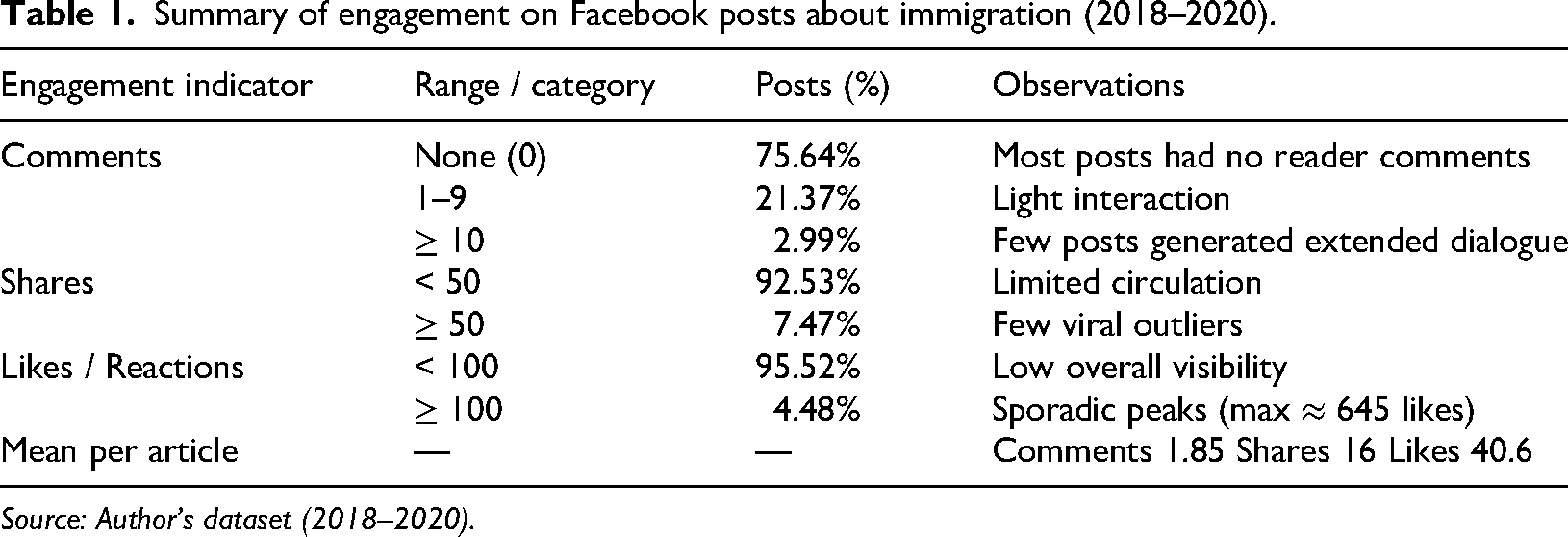
The overall participation on the Facebook pages of the four digital-native outlets was modest in volume yet unevenly distributed. Quantitative mapping of 434 commentaries revealed that most commentaries on immigration attracted limited visible engagement. More than three-quarters recorded no reader comments, and over ninety per cent registered fewer than fifty shares. Only a small minority achieved higher visibility, producing isolated peaks in reactions and shares. Table 1 summarises these engagement trends.
Summary of engagement on Facebook posts about immigration (2018–2020).
Source: Author's dataset (2018–2020).
While a large majority of posts (75.64%) attracted no comments, this absence of visible dialogue should not be read as civic indifference. As Dahlgren (2009) notes, accessibility of participatory platforms rarely guarantees deliberation, where structural and cultural barriers often suppress contribution. In the Northeast, infrastructural disparities ranging from bandwidth instability to small newsroom capacity continue to restrict sustained discussion (Baruah, 2020; Thomas, 2021).
The remaining quarter of posts that did attract engagement demonstrate that publics respond selectively to topics of emotional or identity resonance. Posts relating to the questions of belonging, ethnicity, and recognition, including the CAA, cross-border migration, and representations of Northeastern migrants in metropolitan India, elicited higher reactions and shares. Comments blended critique with affirmation. Some users defended regional integrity and cultural distinction, others invoked solidarity with affected communities or criticised political exclusion. These selective bursts of attention reveal that affective triggers, rather than information alone, drive participation. Many comments reflected concerns around identity and demographic change, often expressed through brief and affective statements such as ‘We stand together’. These episodic yet intense activities illustrate what Keane (2018) calls micro-publics. Small, issue-specific clusters of deliberation that appear and dissolve rapidly within networked environments. Participation in these comment spaces, though limited in scale, constitutes a symbolic affirmation of civic presence and community.
Expressive and deliberative interaction
Qualitative coding of 124 reader comments indicated that expressive communication overwhelmingly dominated. Most were brief affective statements like approval, irony, anger, humour, or sarcasm rather than extended reasoning. Users often employed emotive language to express frustration, pride, or irony. For instance, comments such as ‘This is the only way to destroy Northeast’ reflect anxieties around identity and demographic change. Others criticised governance through statements like ‘The state has failed to protect its own people’.
A smaller proportion of comments displayed deliberative tendencies. Of the 124 comments analysed, approximately 20% reflected deliberative engagement. These included responses that questioned policy implications or offered comparative reasoning. For example, some users asked why similar migration issues are treated differently across states, pointing to inconsistencies in implementation. Such responses often drew on factual examples, policy references, or personal experience, and sometimes evolved into short exchanges among readers. While most comments appeared as isolated interventions, these occasional exchanges indicate repeated engagement by a small subset of users within otherwise low-participation environments. In one thread, a user questioned the accuracy of a post's statistics, prompting clarification and further sharing of sources – micro-moments of reasoning within emotive discourse. These interactional sequences exemplify Keane's (1995, 2018) micro-publics, informal but meaningful arenas of everyday dialogue. Though numerically few, these deliberative comments are analytically significant because they show that reasoning and emotion coexist rather than exclude one another.
This hybrid pattern affirms Dahlgren's (2009) view that public engagement is sustained through small communicative gestures. Even minimal actions such as liking, reacting, or brief commenting constitute symbolic acts of belonging. This interpretation is supported by scholarship on digital participation, which suggests that even minimal online actions signal presence and affiliation within networked publics (Papacharissi, 2015). In peripheral contexts with limited infrastructural access, these expressions represent participation under constraint rather than its absence.
Framing patterns and meaning construction
Using Entman's (1993) framework, the analysis examined how readers constructed meaning around immigration through four interrelated framing functions. This included problem definition, causal interpretation, moral evaluation, and proposed remedy that together form integrated framing packages. Across reader comments, the dominant frame depicted immigration as a threat to regional identity and security. The problem was defined culturally. Fears of demographic change and cultural erosion outweighed economic or administrative concerns. Causal interpretations blamed porous borders, central neglect, or the manipulation of migration for electoral gain. Moral evaluations carried intense affective charge, invoking betrayal, injustice, and lost autonomy, an emotional vocabulary that displaced policy reasoning. For instance, many comments framed immigration in terms of cultural threat and loss of identity. One commenter argued that ‘protecting the culture and heritage of the local small minority tribe is the most important issue here’, while others expressed concern about indigenous communities ‘becoming minority’ in their own states. Such responses framed immigration as a question of cultural survival and demographic security rather than policy design or administrative implementation.
Cross-checking deductive categories with inductive readings of audience discourse revealed further complexity. Many users extended the threat narrative into assertions of collective pride and self-protection, while others reframed immigration as evidence of the Northeast's marginalisation within the Indian nation-state. A smaller group introduced humanitarian or coexistence perspectives, emphasising empathy and historical interdependence. These variations show that the public did not simply echo journalistic frames but re-embedded them in lived experiences of belonging, insecurity, and justice. The coexistence of defensive and empathetic framings underscores the moral and emotional diversity of public reasoning.
Overall, the audience's framing practices were morally expressive and identity driven rather than technocratic. Here, technocratic responses refer to comments focused on administrative procedures, legal frameworks, or policy implementation rather than moral or identity-based evaluations. The predominance of evaluative language indicates that publics engage through moral judgment more than policy analysis. Such tendencies are consistent with broader online communication patterns (Chong and Druckman, 2007; De Vreese, 2005). Yet the emergence of counter-frames, particularly humanitarian and coexistence perspectives, demonstrates interpretive agency. These alternative readings align with Fraser's (1992) idea of counter-public reasoning, through which marginal voices articulate dissent within dominant discourse. Even brief reframings expand deliberation beyond echo chambers, illustrating how peripheral publics in the Northeast negotiate intertwined questions of identity, security, and justice within mediated space.
Platform and outlet variations
Engagement patterns varied among outlets, reflecting differences in editorial focus and audience expectation. East Mojo and News Mill generated comparatively higher reactions, aided by multimedia use and broader coverage. Inside Northeast showed sharp but short-lived comment spikes, often linked to political controversies. Raiot, with its activist and reflective tone, hosted fewer posts but longer and more dialogic comment threads that occasionally included author–reader exchanges.
These contrasts confirm that the communicative ecology of each outlet shapes its public. Here, communicative ecology refers to the combination of editorial orientation, audience composition, platform practices, and issue focus that structures interaction within each outlet. Differences among the outlets may therefore reflect not only variations in tone and style but also the kinds of content they publish and the audiences they attract. Editorial ethos and platform management, and not technology alone, affect interaction quality (Couldry and Hepp, 2017; Helmond, 2015). Collectively, the four outlets form overlapping yet differentiated spaces that together constitute the Northeast's emergent digital public sphere.
Emergent patterns of peripheral publics
Across outlets, participation remains modest in scale but symbolically charged. The mixture of expressive and deliberative modes suggests that public interaction in peripheral regions operates through hybrid communicative forms. Following Keane (2018), these can be read as monitory micro-publics. Dispersed citizens exercising scrutiny and solidarity through mediated gestures.
Emotion here is not antithetical to democracy but a condition of it. Affective expression anchors belonging, while moments of reasoning introduce reflection. Together, they create what Papacharissi (2015) calls affective–deliberative participation, a communicative form where emotion and reasoning co-produce visibility.
Infrastructural constraints continue to shape participation. This is evident in the consistently low volume of comments across posts and the limited depth of interaction observed in most threads. Uneven connectivity, modest newsroom capacity, and algorithmic visibility filters limit sustained interaction (Baruah, 2020; Thomas, 2021). Within these constraints, even a handful of comments or shares represents civic effort under asymmetry. The publics that emerge are therefore infrastructure-shaped micro-publics (Mattoni, 2021). Fragmented but meaningful arenas where citizens of the Northeast enact presence in a national mediascape that often overlooks them.
Summary
The findings demonstrate that digital participation from India's Northeast is simultaneously limited and significant. Quantitative scarcity coexists with qualitative richness. Through the frameworks of Dahlgren, Keane, Papacharissi, and Couldry & Hepp, these Facebook interactions can be read as expressions of everyday democracy. They are micro-level acts through which citizens perform identity, critique, and belonging within constrained infrastructures. Even at low volumes, such engagements sustain the communicative texture of democratic life in a peripheral region, expanding the conceptual reach of the public sphere tradition to Asia's uneven digital landscapes.
Discussion and conclusion
Re-situating participation from the periphery
The study demonstrates that digital publics in India's Northeast engage in communicative practices that are modest in scale but rich in symbolic meaning. Rather than dismissing low engagement counts as absence, the findings urge a reconceptualisation of participation as interactional presence within constrained infrastructures. Following Dahlgren's (2009) interactional model, these small acts of liking, reacting, or brief commenting represent micro-gestures of belonging that keep democratic communication alive under unequal conditions. The region's publics, historically peripheral to both state and media attention, employ digital affordances not to replicate metropolitan deliberation but to assert visibility within asymmetrical structures of connection.
This reconceptualisation of participation from the periphery advances debates on digital citizenship in the Global South. Mainstream scholarship on participation often assumes robust infrastructures and high-volume engagement. Yet in peripheral regions, the density of participation cannot be the only measure of its significance. Instead, what matters is the directional intent. It shows how users signal alignment, critique, or affective solidarity despite technological and institutional limits. Such interactional traces constitute what Couldry and Hepp (2017) term ‘mediated presence’. The expressions of agency that rely on the infrastructures of mediation, even when these infrastructures restrict voice.
Affective–deliberative hybridity
A key insight emerging from the data is the coexistence of emotion and reasoning within the same communicative field. The dominance of expressive comments might, at first glance, appear to undermine deliberation. However, as Papacharissi (2015) argues, emotion is a constitutive element of networked publics, not their distortion. In the Northeast context, affect functions as a connective tissue linking dispersed citizens through shared experiences of marginalisation and pride. The emotive vocabulary of approval, irony, and anger thus anchors the public to issues that otherwise remain abstract.
Within this affective terrain, flashes of deliberation occur when users contest statistics, reference policy, or invoke regional history. These micro-moments confirm that deliberation survives not despite emotion but through it. The findings, therefore, extend the concept of affective publics toward an affective–deliberative model of participation. This hybrid form reflects a pragmatic public sensibility. People reason under conditions of emotional urgency and infrastructural limitation. Such hybridity expands normative expectations of the public sphere by showing that passion and critique, feeling and argument, coexist in digitally mediated civic life.
Micro-publics and everyday democracy
The selective, episodic nature of participation observed across outlets supports Keane's (2018) notion of monitory micro-publics. These are small, issue-based spheres where citizens practise oversight and commentary in real time. In the Northeast, comment threads on immigration posts functioned precisely as such micro-publics. They are temporally short but dense with affective meaning. They serve as dispersed mechanisms of ‘soft scrutiny’, where readers question representations, contest bias, or affirm belonging. Even when short-lived, these exchanges embody the ethos of everyday democracy. Here, citizens engage in public reasoning outside formal institutions.
By tracing these micro-publics, the study adds empirical depth to theories of monitory democracy in non-Western contexts. It shows that the democratic impulse endures not only through organised protest or policy debate but also through incremental, everyday acts of mediation. This finding is particularly relevant for regions where material constraints and historical marginality make large-scale deliberation difficult.
Framing and counter-public agency
The framing analysis illustrates how publics interpret contentious issues through culturally embedded moral vocabularies. The dominant threat frame surrounding immigration reflects long-standing anxieties over identity and resource distribution, but the emergence of humanitarian and coexistence perspectives demonstrates interpretive agency among citizens. These counter-frames are not merely oppositional. They signal the capacity of peripheral publics to negotiate meaning autonomously. As Fraser (1992) notes, counter-publics arise when subordinated groups generate alternative interpretations that challenge hegemonic discourse. In the Northeast, such counter-framing acts as a subtle form of negotiation. It reflects an attempt to balance self-protection with empathy within a mediated national conversation that often excludes regional nuance.
This duality – defensive and empathetic – is emblematic of publics formed under asymmetrical visibility. It suggests that peripheral citizens internalise national debates and adapt them to local histories and identities. Thus, framing becomes not merely an interpretive act but a practice of situated agency in which publics reclaim representational space through language and affect.
Infrastructural mediation and the limits of participation
The analysis also foregrounds the material dimension of digital citizenship. Participation in the Northeast is constrained by infrastructural scarcity, including limited bandwidth, small newsroom capacities, algorithmic opacity, and dependence on a single platform (Facebook). These conditions exemplify what Couldry and Hepp (2017) describe as the deep mediation of contemporary publics. The communication environments are structured as much by technological architectures as by public intent. In such contexts, publics are infrastructure-shaped rather than freely formed. As Mattoni (2021) notes, infrastructures configure visibility by determining whose voices travel and whose remain peripheral. Recognising this mediating layer reframes participation not as failure but as adaptation within uneven communicative ecosystems.
For policymakers and platform designers, this insight underscores the importance of infrastructural justice. It highlights the importance of ensuring equitable access, regional bandwidth parity, and algorithmic transparency. Without these, democratic participation will remain uneven across geography, language, and class.
Peripheral publics as conceptual contribution
By situating Northeast India's digital participation within broader debates on media and democracy, this study advances the concept of peripheral publics. These publics emerge at the intersection of structural marginality and mediated visibility. They differ from metropolitan publics not by absence of engagement but by its conditions: low volume, high affect, and infrastructural constraint. Peripheral publics thus expand the geography of the public sphere, illustrating that democratic communication in Asia is not only a metropolitan phenomenon but also a peripheral practice sustained through fragmentary, affective, and adaptive modes of engagement.
This concept contributes to comparative public sphere theory by challenging the centre-periphery hierarchy implicit in much Western literature. It also dialogues with emerging Global South scholarship that foregrounds infrastructural inequality as a constitutive element of mediated citizenship. Recognising peripheral publics as legitimate democratic actors enables more inclusive understandings of how democracy is lived and expressed in diverse communicative environments.
Conclusion
Digital participation in the Northeast of India embodies a paradox. It is limited in magnitude but meaningful in its democratic intent. Audience interaction on Facebook, found to be sporadic, emotive, and context-bound, reveals how citizens in marginal regions practise civic presence under constraint. Through hybrid affective–deliberative participation, they produce micro-publics that scrutinise, affirm, and negotiate identity within a mediated national conversation. Even when limited in scale, these interactions reflect an emergent form of civic voice that operates outside formal structures of representation.
This study, therefore, extends the public sphere theory along three axes. First, it re-defines participation as symbolic presence within infrastructural asymmetry, not simply numerical engagement. Second, it reconceptualises deliberation as an affective–deliberative continuum rather than a purely rational process. Third, it positions peripheral publics as vital components of contemporary democracy, reminding scholars that the margins of communication are not silent but differently voiced.
Future research could compare similar mediated peripheries across South and Southeast Asia to examine how infrastructural, cultural, and political specificities shape the contours of everyday digital citizenship. In tracing these small yet significant communicative acts, we understand democracy not as a fixed structure but as a dispersed, mediated practice continually negotiated through emotion, technology, and voice.
Footnotes
Acknowledgments
The author acknowledges that this article draws upon research originally conducted as part of the author's doctoral dissertation, ‘Social Media and Emerging Public Sphere: A Study of Northeast India’ (Sikkim University, 2023). The paper has been substantially revised, expanded, and updated for independent journal publication. The author also thanks colleagues and students at the School of Media and Communication, Adamas University, for their feedback during the revision process.

Ethical approval and informed consent statement
This research is based exclusively on publicly available Facebook data and did not involve direct interaction with human participants or access to private or restricted content. In accordance with the institutional research ethics policy of Adamas University, ethical approval was not required for studies analysing public domain online material. All data were anonymised and aggregated prior to analysis to ensure that no identifiable personal information is disclosed. Informed consent was not applicable because the study used data already in the public domain.
Funding
The author received no financial support for the research, authorship, and/or publication of this article.
Declaration of conflicting interests
The author declared no potential conflicts of interest with respect to the research, authorship, and/or publication of this article.
Data availability statement
The datasets generated and analysed during this study consist of publicly accessible Facebook comment threads. Aggregated engagement counts are available from the author upon reasonable request for academic, non-commercial use. No proprietary or confidential data was used.