






Abstract
The sheer volume of news and information people see online, especially on social media, can be overwhelming and make it difficult – or impossible – for people to fact-check the content they come across on a daily basis. In light of this, our study explored the everyday methods people use to decide who and what to trust online. Using a 1-week digital diary study with 55 adult participants living in Australia, we learnt that mis- and distrust cues provide people with a coping mechanism to deal with information overload. However, when we fact-checked content participants labelled as untrustworthy, 39% of these examples were factually correct. This suggests that people's hypervigilance in using mis- and distrust cues results in them frequently mis-categorising content. We draw on these findings to make recommendations relevant to news publishers and media literacy practitioners.
Keywords
Introduction
Charlene lives in a suburb of Melbourne and has a full-time job as an office manager as well as a part-time job cleaning houses. She and her husband both work six days a week and still find it hard to pay the bills. When she's not working, Charlene admits to spending a lot of time on her laptop ‘as a bit of an escape’. She struggles, however, with the amount of content she receives. ‘I’ll open up Facebook, and then I get a little bit addicted, and I’ll be sitting on there for ages’, she says, ‘and I go back to my emails – I get quite a few emails I sit and read through. I also read a fair bit of the news every day’. She also spends her time online shopping, searching on topics she's interested in, and watching Netflix, which she does for an hour or so until she falls asleep. When asked to reflect on her media diet, she says: I never thought about how much I actually had coming through on my emails every day to read. And I never really thought about all the travel news feeds that I actually read, as well. It was really overwhelming when I thought about how much time and how much came through in one day. It was mind-blowing. I thought, ‘My goodness, do I get that much stuff coming through?’ … There's just too much news out there, really is. I mean, I could not care what bloody Kim Kardashian is wearing…I don’t care whose farmer wants a wife. Who's having an affair with somebody else. But I get all those news feeds as well.
Social media is now used more frequently than any other type of media among Australian adults with more than nine in ten (94%) using social media on a regular (at least weekly) basis, compared to 87% who watch free-to-air TV, 78% who watch streaming television and 69% who use a news website or app. Almost half of Australian adults (48%) use five or more social media platforms on a weekly basis (Notley et al., 2024). Using a high number of social media platforms correlates with an increased exposure to misinformation (Notley et al., 2024). This goes some way to explaining why people's concern about misinformation is high and has been growing over time (Newman et al., 2025).
While researchers have examined the heuristic cues people rely on to make quick decisions about who and what to believe and trust online (Madrid-Morales et al., 2025; Tully et al., 2022), there is a gap in our understanding of how people respond to potentially dubious information within the online information environments they use and as part of their everyday activities. It is in this context that we sought to investigate how people decide who and what not to trust online.
Our study is based on findings from a week-long digital diary study with 55 adult Australians. In this paper we focus on what we learnt by analysing the explanations people offered for determining content to be untrustworthy and we consider the implications of these findings for research, news organisations and media literacy initiatives.
The literature review that follows examines two key areas. First, it presents research that has explored people's use of trust, mistrust and distrust to guide decisions about news and information online. Second, it presents research about how people identify misinformation online while assessing the strengths and limitations of different methods that are used to understand this.
Literature review
News and information: deciding who and what to trust online
In online environments where there is an overabundance of information available, people are forced to make judgments about what is trustworthy and what is not. Trust is a relationship between the trustor and trustee. Rotter (1967: 651) defines trust as ‘an expectancy held by an individual or group that the word, promise, verbal or written statement of another individual can be relied upon’. Trust can also be understood as a willingness to take a risk based on expected but uncertain positive outcomes (Rousseau et al., 1998). Conversely, distrust refers to a lack of trust in the trustee, while mistrust is when the trustor is wary or suspicious of the trustee, and therefore defers trust (Six and Latusek, 2023).
It is useful to differentiate between a sceptical approach toward news and information and a cynical one. Cynicism, which is closely associated with strong distrust, occurs when people presume that the information at hand is untrustworthy, which then leads to automatic rejection (Tsfati and Barnoy, 2025). Scepticism, on the other hand, is associated with mistrust, which can involve effortful suspicion where the person questions claims made and attempts to either corroborate the information or defer judgement (Li, 2025). In the context of information or news, mistrust is seen as being potentially useful since it produces a sceptical state of mind that can lead to a number of helpful engagement activities, such as carrying out research about an information source, trying to fact-check claims made or examining other information sources (Park et al., 2025b).
When confronted with an overabundance of information, people are more likely to rely on heuristics or shortcuts that allow them to make fast decisions (Metzger et al., 2010; Sundar, 2008; Winter et al., 2016). Heuristics help people to reduce the cognitive load of information processing when they make decisions (Swart and Broersma, 2022). While people have always relied on trusted sources, the nature of heuristics has been changing in a digitally networked, social media age, where news is often accompanied by cues that extend beyond the source or content itself, such as the number of shares or other people's reactions or comments (Sundar, 2008). Thus, trust in news and information may be influenced not only by the characteristics of the content (trustee) itself but also by how the audience (trustor) perceives other cues surrounding the content.
While we know a lot about how people make judgments about what to trust online, and the heuristics employed to do this, less is known about how people determine what not to trust. Our research sought to explore this gap.
Online verification practices: identifying misinformation online
Understanding the methods people use to verify information and/or identify misinformation online is not straightforward. First, people's perception of what constitutes misinformation is varied (Kyriakidou et al., 2023; McGuinness et al., 2025; Yan and Schroeder, 2025) and this is often the result of people receiving information differently based on their beliefs, biases and ideologies (Martel et al., 2020; Mourão et al., 2023). However, it can be difficult to identify and disentangle these influences when they are likely to be part of an unconscious or emotive response rather than a carefully thought-out decision. Second, much of the misinformation being circulated online is unlikely to fall into a neat true or false dichotomy; rather, it may contain partial truths or factual claims that may be selectively assembled to support a misleading narrative (Jack, 2017) and people may hone in or focus on these when they make a decision about who and what to trust.
While there have been many attempts to assess people's ability to identify misinformation online, there are limitations associated with these studies. In particular, many of these studies ask people to make decisions based on examples of information/misinformation that lack detail, context, or that fail to replicate the lived experience of complex, multi-modal and interactive online environments (Breakstone, 2024; Murphy et al., 2023). For example they may include a headline with by-line but not provide access to the full story (e.g. Jones-Jang et al., 2021; Meshi and Molina, 2025; Roozenbeek and van der Linden, 2019) or rely on self-reported intended behaviours such as whether people say they would share the content (e.g. Roozenbeek and van der Linden, 2020) without providing any context for these intended behaviours, such as by naming a specific platform where someone would make this decision. This is problematic because people's decision-making is likely to be influenced not only by the content at hand, but also by the networks and relationships they have in different media environments, and by the various trust/mistrust/distrust cues these environments enable or constrain (Karlsen and Aalberg, 2023; Tandoc, 2019). People may also be influenced by social desirability bias when asked to self-report on what they have done or will do (Fisher, 1993). In addition, the majority of these studies lack an ‘I don’t know’ or ‘unsure’ response option when they ask people to determine if something is true or false (Luskin et al., 2018), which is particularly problematic if people are not encouraged or supported to take any further action to verify information, such as looking at other sources online. Such studies are therefore arguably more akin to a true/false guessing game or knowledge test, rather than being a genuine assessment of people's ability to identify misinformation or verify information (Breakstone et al., 2024; Notley et al., 2026). These studies also fail to probe how people arrived at their decision.
A few studies have sought to address these methodological limitations by providing respondents with complete examples of media content (e.g. complete news stories, videos, social media posts with links to live content) and by asking them to use the internet to take any steps they wish to determine whether the content is true and/or reliable and to explain what they did and why (e.g. McGrew, 2018; Park et al., 2024). In this type of study, participants are given a score based on their explanation of what they did, with a scoring metric based on whether the participant demonstrated sufficient media knowledge and/or deployed useful and effective verification techniques. However, these tests are still removed from people's everyday embedded media experiences. For instance, verification test questions may include examples from social media platforms the person does not use or include examples of news or information that participants are not interested in, would not normally encounter, or to consider to be worthy of their attention. Addressing this limitation is difficult since very few people are likely to agree to the level of surveillance required to fully document their everyday online lived experiences in situ. As a result, very little is known about how people make decisions about what is trustworthy and what is not as part of their everyday, organic online experiences. Our study sought to address this gap using a digital diary study.
Research questions
To address gaps in the academic literature around the heuristic cues people use to determine who and what not to trust online in organic, everyday online contexts and assess the usefulness of these cues when it comes to identifying misinformation, our study examined the following questions:
Method
A diary study approach
Our study collected and examined examples of user-identified ‘false, misleading and untrustworthy’ content shared by participants as part of a one-week digital diary study. Noted for their high ecological validity, diary studies enable the collection of data within and as part of participants’ everyday practices in which they normally occur (Jarrahi et al., 2022). We followed an approach adopted by Subrahmanyam et al. (2020), blending elements from interval-, signal- and event-contingent reporting designs. Using a popular diary study mobile application (Indeemo), participants documented examples of misinformation and untrustworthy content as they encountered them each day throughout the course of the week (event-based reporting). The app enabled screen captures and video recording. Participants summarised or contextualised these examples through end-of-day reflection videos (interval-contingent reporting), receiving push notifications or email reminders to do so at set times throughout each day (signal-contingent reporting).
Participants
We recruited 55 participants to take part in the digital diary study from a cohort who had already completed an adult media literacy survey (Notley et al., 2024) and an information verification test survey (Park et al., 2024), both implemented by the authors as part of a larger research project. We invited participants who reported having encountered misinformation in the past week to be a part of the diary study 1 to align with the study's aim to investigate people's responses to information they regarded as dubious. Most adult Australian report they regularly see misinformation online (ACMA, 2025; Notley et al., 2024). While the study sample is not representative of the general population, we selected participants to reflect a diverse range of demographics, with additional consideration also given to their media literacy confidence (Table 1).
Summary of diary study participant demographics.
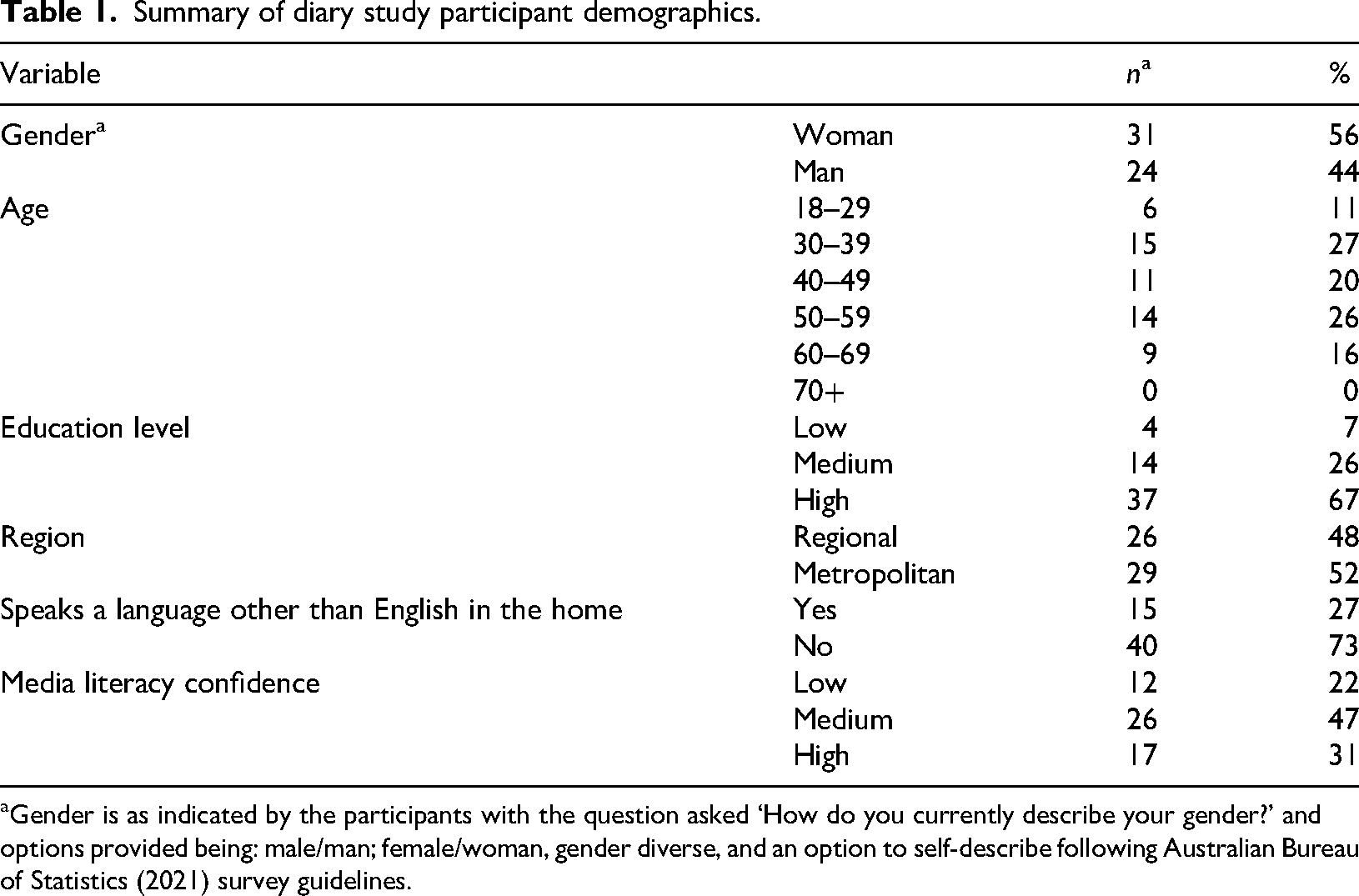
Gender is as indicated by the participants with the question asked ‘How do you currently describe your gender?’ and options provided being: male/man; female/woman, gender diverse, and an option to self-describe following Australian Bureau of Statistics (2021) survey guidelines.
Participants were compensated $100 for completing all 7 days of the diary study, $50 for completing 3 to 4 days, and a subset of these (n = 20) were compensated with a further $25 for completing an optional 1-hour follow-up interview. Forty-nine participants completed the diary study fully while six participants completed the study partially (at least 3 days or more).
Process
Participants completed the diary study in two waves in May 2024. On day one of the study, we asked participants to record an introductory selfie video through the digital diary app and to describe their routine online activities and their thoughts on where they felt most trustworthy/untrustworthy news and information could be found online. On days 2 to 6, we asked participants to spend 20 to 30 minutes each day: (a) saving examples of the news and information they came across online (by taking screenshots, screen recordings or photographs); and (b) at the end of each day, to use the app to create one or more screen recordings to reflect on how trustworthy/untrustworthy each saved example was. On day 7, we asked participants to assess how typical the week was and to reflect on where they believed the most trustworthy/untrustworthy content had come from. After the completion of the diary study, we additionally completed one-hour semi-structured interviews with 20 of the diary study participants to better understand their background context, attitudes and perspectives. In total, we collected 1564 examples, of which 322 were labelled as untrustworthy. In this paper, we report on this subset.
Data analysis
We analysed participants’ examples, their reflection videos and interview content using both inductive and reflexive thematic coding (Braun and Clarke, 2022). Initially, all participants were asked to save examples of trustworthy and untrustworthy claims and to explain how they came to this decision. Using participants’ narrations as reference, we first examined each diary study entry to identify content the participants considered to be false, misleading or untrustworthy content. Relevant examples were coded based on emergent terms or phrases we identified were frequently used by participants to describe their submissions, such as ‘fake’, ‘untrustworthy’, ‘misleading’, ‘just plain sensationalist’, ‘seems untrue’, ‘clickbait’, ‘biased nonsense’, ‘too great a claim so must be dodgy’.
Following a theoretical thematic analysis approach (Braun and Clarke, 2006), we then examined the 322 examples of false, misleading or untrustworthy claims to identify three a priori dimensions (topic, source and mode). A subset of 10% of the sample was independently coded by two coders to measure intercoder reliability. The ‘topic’ and ‘source’ dimensions achieved a Krippendorff's α value of 1.0 (indicating perfect agreement) while the ‘mode’ aspect achieved an α value of 0.91 (indicating a high level of reliability).
Next, we examined each of the examples to: (a) identify those that contained a verifiable claim and, (b) fact-check verifiable claims to determine whether participants’ assessments of them as ‘misinformation’ (being objectively false, incorrect or misleading) was fair and accurate. The authors divided the verifiable claims and fact-checked them by: (a) identifying the source of the claim and making a credibility assessment, (b) evaluating the evidence being used to support the claim being made and (c) consulting other trusted information sources to consider what they say about the claim/s being made. If a claim contained in the content was not linked to any factual information that could be verified, or the content combined fact and opinion, the coder deferred judgement and coded it as ‘too difficult to fact-check’.
As a secondary analysis method, we further examined participants’ reflection videos to understand the decision-making process used to determine the content as false, misleading or untrustworthy. An initial coding scheme was developed by one team member, to identify and explore emergent themes in the participants’ narrations about their underlying reasoning and decision-making processes (Braun and Clarke, 2006). This coding scheme was iteratively tested, discussed and refined by other team members, creating further linkages and core thematic categories, before a final coding scheme was established and agreed upon. By following this inductive approach, we were able to more strongly identify and establish the evident ‘cues’ used by participants to make decisions about what content to (dis)trust and (dis)engage with as part of their everyday news and information activities.
Findings
The source of false, misleading and untrustworthy claims
While slightly more than half (54%) of the examples saved were from social media platforms, the majority of the claims shared by participants were produced by mainstream and alternative news outlets (Table 2).
Sources of participants’ misinformation examples.
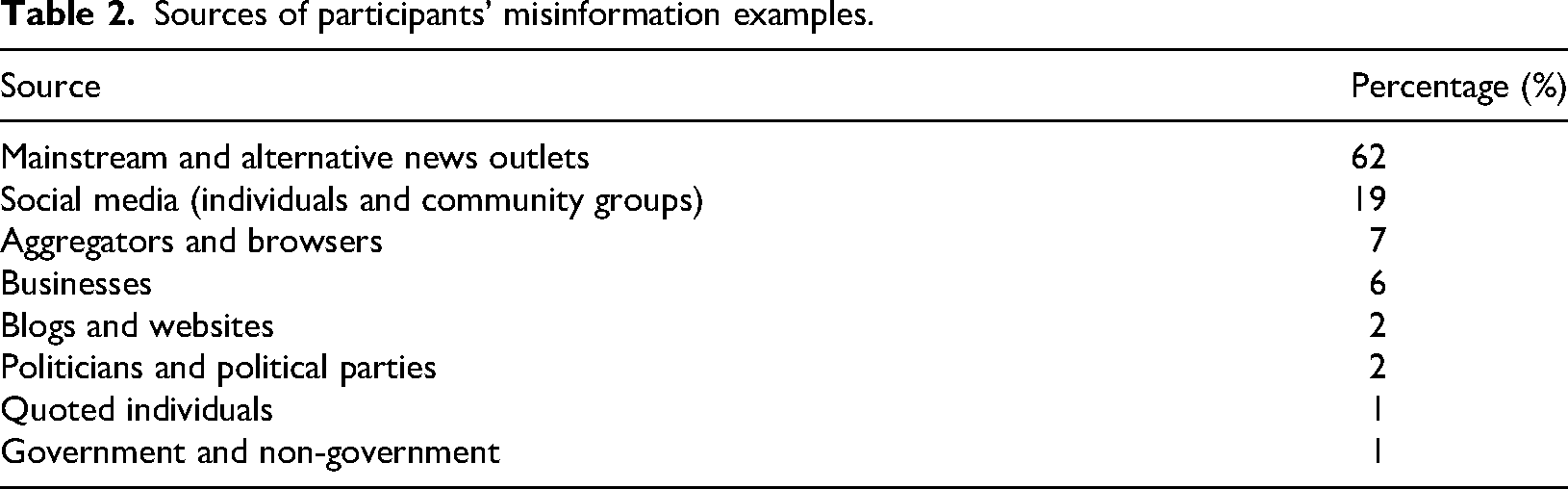
Eighty-two percent of the examples were produced by domestic mainstream or alternative news outlets; that is, outlets that are Australian-owned or registered or which are localised versions of international outlets that have been developed specifically to serve the Australian market. The vast majority of the domestic outlets included were mainstream news organisations (99%), 2 with participants sharing examples from popular commercial news outlets, as well as public service broadcasters. However, most of the examples produced by news organisations and tagged by the participants as false, misleading or untrustworthy were owned by three commercial media conglomerates – News Corp Australia (25%), Seven West Media (17%) and Nine Entertainment Co (15%) – who hold a highly concentrated share of Australia's commercial print, digital and broadcast media sectors (see Table 3).
Examples deemed ‘false, misleading and untrustworthy’, by news publisher.
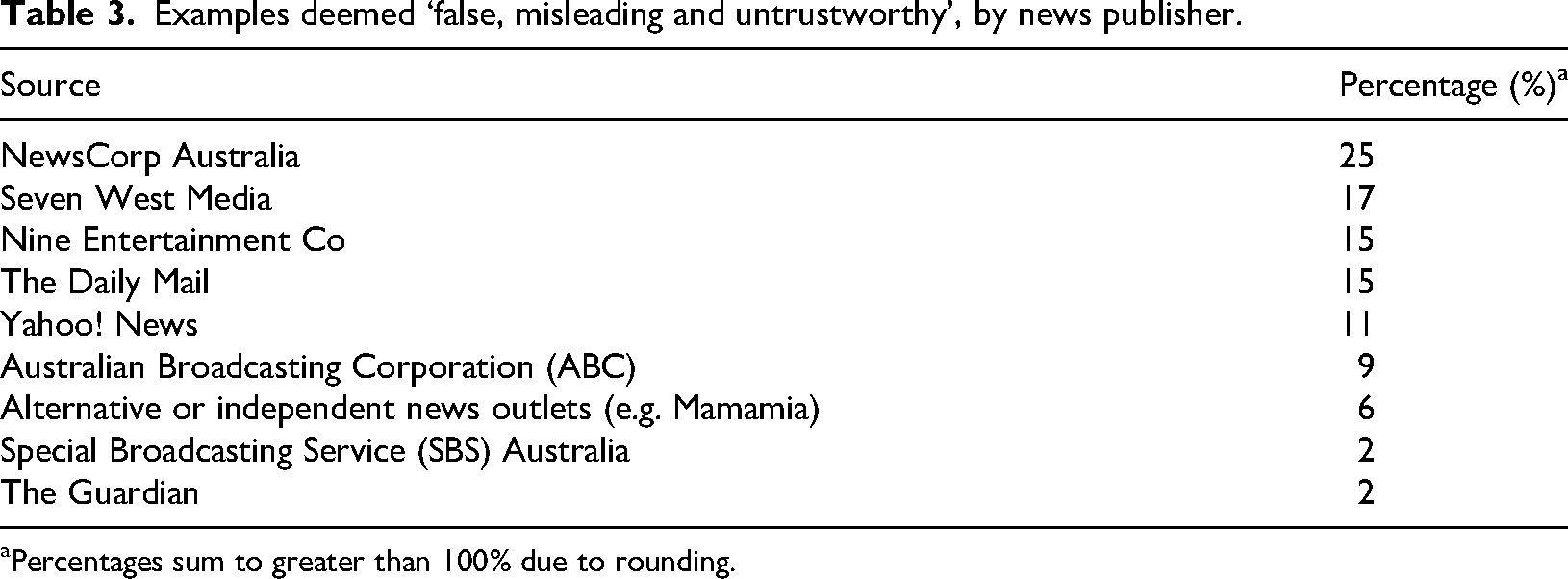
Percentages sum to greater than 100% due to rounding.
Beyond indicating the participants’ concerns regarding news media and journalistic integrity, the prevalence of mainstream news sources within participants’ examples of untrustworthy content highlights tensions between people's need to engage with news to stay informed and up-to-date on current events and the practicalities of how they understand, evaluate and engage with news content within their everyday lives (Park et al., 2025a). For instance, many of the examples shared with us were about soft news topics or entertainment news about celebrities. In addition, many examples were from news providers the participants were not following and were not interested in engaging with on social media. In this way, irrelevant, unwanted and low-quality news was polluting the social media feeds of participants which resulted in frustration and a feeling of being out of control. This feeling led people to mis- and distrust news providers they perceived to be doing things that made them untrustworthy.
People rely on mis- and distrust cues to help them quickly determine what to ignore
Almost all participants had developed their own mis- and distrust cues which they relied on to make quick, often split-second decisions about who and what is untrustworthy online. Some of these cues supported the participants to practice of ‘critical ignoring’, defined as ‘choosing what to ignore and where to invest one's limited attentional capacities’ (Kozyreva et al., 2023: 81). This was achieved by helping the participants to avoid giving content further time and attention because they deemed the source or content to be untrustworthy. Below, we report on the top five mis- and distrust cues that emerged from our analysis of participants’ reflections of their false, misleading and untrustworthy examples (see Table 4).
Top five mis- and distrust cues.
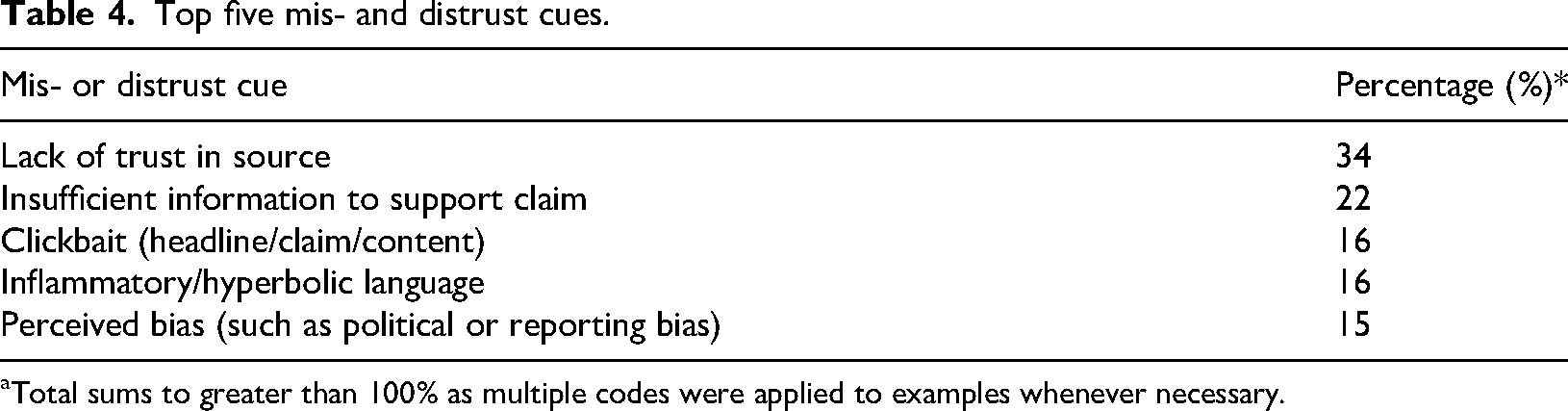
Total sums to greater than 100% as multiple codes were applied to examples whenever necessary.
Lack of trust in the source
Perceptions about source credibility had the greatest perceived impact on participants’ decision making around who and what to trust, with participants using this cue to rationalise their decision-making for close to a third (34%) of the false, misleading or untrustworthy examples they collected (see Table 4). Participants often made the decision that content was untrustworthy based on whether: they thought the source had a good reputation (often based on their own past interactions with it), the source was familiar or unknown to them, they had a general (emotionally or ideologically-grounded) dislike of the source, or the source had some level of perceived authority on an issue or topic. News brands were used as cues to identify untrustworthy information.
As an example, 28-year-old Sarah, a dental assistant living in Sydney, was immediately distrusting of stories that came from certain news outlets. This included Sky News and The Daily Mail, as well as entertainment media outlets like Buzzfeed and UniLad. In part, Sarah chose to consider all the content she encountered from these sources as questionable or suspicious because of her perception of the outlets’ general reputations. As she explained in one of her diary study reflection videos: Buzzfeed is definitely not, like, the gold standard for journalism. I think we all know that they do a lot of, kind of, pop culture stuff, a lot of irrelevant little quizzes, and they’re not known for unbiased, informative, investigative journalism…It's more kind of entertainment and reading about other people's reactions or point of view. Most of the time, if I see a piece of information from a media company like 7News or 9News, I'm inclined to trust it. But it's not 100% trust. Because I know, like, sometimes [their] journalism isn’t the best. Especially, for example, a couple of weeks ago when we had the Bondi Junction [mass stabbing] incident and 7News named the wrong person.
Clickbait
Another prominent cue guiding participants’ identification of misinformation and untrustworthy content was the use of clickbait, particularly by news outlets, which accounted for 16% of the ‘untrustworthy, false or misleading’ examples. Participants reflected on how ‘clickbaity’ or ‘attention-grabbing’ headlines raised a ‘red flag’ that indicated the source posting the content and the content itself couldn’t necessarily be trusted. For instance, 24-year old Tom, an accountant from Western Australia, noted in one of his reflection videos: Honestly, like, I don’t want to sound mean, but when someone you know tells you they’re a journalist, you just hope they’re not a journalist for one of these scum sites like news.com.au…clearly their main purpose isn’t to spread news, it's to make money by people clicking on their things because it's mainly clickbait. I guess what they’re trying to do is to get the click volume up because that's what earns them the money or helps in their metrics to say that their reach is so big, which means that they can then sell ads as part of that…
Use of inflammatory or hyperbolic language
A related cue used by participants was whether the content included inflammatory or hyperbolic language, as 16% of the examples provided were perceived as false, misleading or untrustworthy because of this. The examples associated with this cue were often perceived by participants to include exaggerated or sensationalised details about various (often trivial) situations, activities or events. Many participants commented on how they felt these misleading claims were still potentially harmful even when trivial as they routinely aimed to elicit attention by using generalisations, stereotypes or other prejudicial tactics. William, a manager in his 50 s living in regional Western Australia, shared a pertinent example: This [article] was about American utes…the journalist sort of scoured the internet finding negative comments and posts about these larger utes to make a, well, I think, a sensational article trying to inflame and upset people about these cars. I don’t think it's necessarily the view of most people and I think they’ve used this article just to try and stir up trouble.
Insufficient information to support claim
As shown in Table 4, another prominent cue used by the participants was when there was insufficient information to support or back up relevant claims (22% of false, misleading and untrustworthy examples). In these instances, participants decided not to trust content because they felt it was missing evidentiary support, like important details or links to relevant sources, or because the accounts publishing or sharing the content were unhelpfully brief in the amount of information they conveyed along with the claim. Gina, a 52-year-old educator living in a major regional town in Western Australia, often employed this cue when deciding what content to trust. Her examples were varied, yet all came from Instagram and were mostly from posts made by other individual users. As she described in her diary study reflections, rather than calling things false, she often decided not to trust content if there was not enough evidence made available: With these posts on the internet, there's just not very much information. You have to do further digging to find out exactly what they’re talking about, where they’re getting the information from. I just don’t copy and share stuff as a general rule, and I just don’t take anything at face value. I'm always trying to find out more information.
Bias
Fifteen percent of the examples identified to be false, misleading or untrue were labelled as such because the participants believed the information or source was biased due to reporting practices or political influence. These examples were again primarily focused on news content. Participants reasoned that issues such as unclear sourcing, the inclusion of subjective claims that reflected the journalists’ or outlets’ interests, concerns around political slants, the use of ‘spin’ and outlets’ institutional agenda setting influenced the quality and veracity of the claims. For instance, in describing a Sky News article he came across on X, 59-year-old psychologist Damian from Adelaide deployed mistrust when he noted how people need to be wary and factor for political bias when interacting with content online: For example, check the sources and try and make up your mind whether it's motivated by politics or whether it's actually got a lot of information contained in the story. [In this example it's] just quoting one politician talking about a particular situation and there's not really any sort of background statistics or anything like that that would help you form some sort of qualified opinion. …once upon a time I used to be able to find nearly everything I was looking for. Now I have to wade through all the sponsored ones that come up first, which quite often have got nothing related to what I just searched on.
Overall, our findings show that some participants developed their own mis- and distrust cues by drawing on their existing media knowledge, such as an awareness of how algorithmic factors impact the reporting practices of some news organisations (through an overuse of clickbait) or how sponsored content posts indicate commercial imperatives and a lack of journalistic independence. More often, however, it was apparent that participants developed their own cues through personal and prior experiences with a brand or type of media, such as deciding they don’t trust a particular news provider because of prior experiences or interactions they had with that provider on- or offline. This use of mis- and distrust cues was more complicated to understand since at times this involved healthy scepticism, where someone deferred judgement, while at other times it involved blanket cynicism, where someone automatically dismissed all content from a particular source. On some occasions people moved fluidly between using mistrust and distrust to inform their decision-making.
Regardless of whether people used mis- or distrust cues, we found that they rarely took any active steps to arrive at or confirm their decision, such as fact-checking a claim or doing a reverse image search. Instead, people relied on a mis- and distrust cues to make quick determinations about the trustworthiness of content.
Many of the claims labelled as untrustworthy were verified as being factual
Almost all of the examples the participants shared with us were unverified by them, in that they hadn’t taken steps to verify or fact-check these examples before sharing them with us. In most cases, it was evident from the examples and participants’ explanations of these that the content wasn’t particularly high stakes, relevant or important enough to warrant them spending any additional time fact-checking content. Given this, the participants’ use reliance on mis- and distrust cues to make rapid decisions about the veracity and credibility of online content makes logical sense; they had no reason to fact-check content that they perceived was of no real consequence to their life.
However, we fact-checked the examples and found that, of those that contained a verifiable claim (67%), only 12% were false or misleading, compared to 58% that were verifiably true (see Table 5). This shows that whilst mis- and distrust cues can help people to navigate increasingly overwhelming volumes of content within online information environments, their use does present some risks. Overall, we found that 39% of all examples labelled as untrustworthy, false and misleading were verifiably true, showing that people are hypervigilant in their judgements. This hypervigilance led people to wrongly categorise content as untrustworthy, misleading or false.
Fact-check analysis of examples labelled as ‘false, misleading or untrustworthy’ by participants.
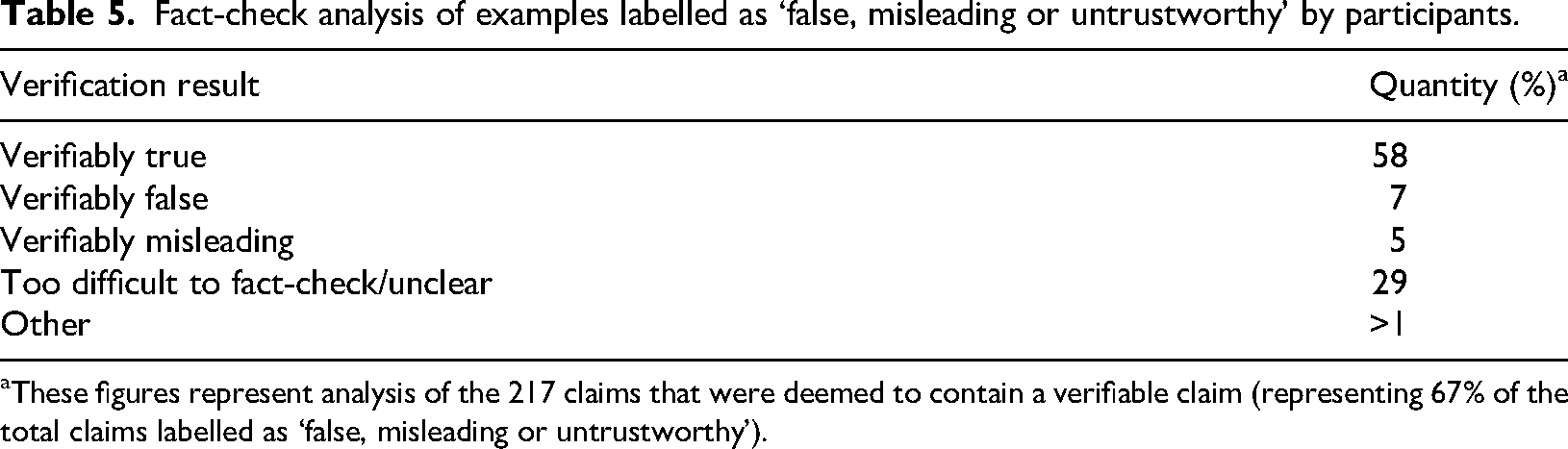
These figures represent analysis of the 217 claims that were deemed to contain a verifiable claim (representing 67% of the total claims labelled as ‘false, misleading or untrustworthy’).
In addition, 33% of all examples included claims that were not verifiable, as they were either unclear, opinion-based or did not contain a factual claim. For instance, this category of examples included a product review posted to social media that featured an opinion-based endorsement of different baby and childcare items. Another example included an investigative news article from a reputable news outlet that was unable to be independently verified as source details – in particular, for a series of images around which the article hinged – were not provided. The substantive number of non-verifiable claims further highlights how individuals’ expectations and assessments, such as about the style and tone of content, shapes their everyday decision-making about the veracity and trustworthiness of content they encounter online.
Discussion and conclusion
Most studies that examine how people make judgements about whether to trust something or not online focus on the heuristics of trust, rather than mis- or distrust. In addition, these studies tend to assess people's practices in a way that is removed from their lived experiences. This paper addresses this gap in the literature by analysing how people determine if content is untrustworthy within the online information environments they use and as part of their everyday activities.
Internet users often adopt heuristic cues or mental shortcuts while assessing the credibility of online news and information instead of employing deep analysis (Metzger and Flanagin, 2015; Sundar, 2008). However, people's use of heuristic cues to determine the trustworthiness of online content cannot be understood in isolation; rather, people's level of trust is situated within their broader media experience, knowledge and capabilities as well as their broader lived experiences. Our findings show that when faced with an overwhelming volume of information online, people pay attention to mis- and distrust cues to determine not only if the content is untrustworthy but also whether it is worthy of their engagement. This shows that people use mis- and distrust cues to manage information overload – since these cues allow them to make rapid decisions about what to ignore. This is a useful tactic for internet users to use when they are presented with content that is unrelated to their needs or has no real consequence to their life. However, while heuristics driven by scepticism are more likely to involve deferring or with-holding judgement in order to either further investigate a claim or to practice critical ignoring, heuristics driven by deep distrust are more likely involve snap decisions that involve blanket cynicism where someone assumes the content is false or misleading. Regardless of whether people used mis or distrust cues, we found that it was very rare for them to take active steps to fact-check content.
This study can be used to inform the work of news publishers, who will benefit from understanding people's mis- and distrust cues. This is important given that most examples of untrustworthy content saved by the participants was produced by Australian news providers reflecting the rise in distrust in news (Edelman Trust Institute, 2025), which can lead to news avoidance and disengagement (Park et al., 2025a, 2025b). In our study, the top cue people used to determine (un)trustworthiness was to determine how they feel about a news brand or masthead's reputation. However, in many cases, this reputation cue helps people to identify who to distrust, rather than who to trust. Investing in reputation-building and being seen as a reliable and independent source is paramount for maintaining audiences in the long term. As such, news outlets should tread carefully with opinion content since audiences often can’t or don’t differentiate it from editorial content when looking for signs of bias, another commonly used mistrust cue. News publishers should also consider avoiding sensationalising coverage and engaging in clickbait journalism, including by using hyperbolic language in headlines, the use of which people perceived to be a strong indicator of manipulation. While clickbait journalism might result in short-term gains (clicks and/or subscriptions), our study suggests it causes long-term brand and reputational harm by deeply frustrating readers who feel misled, even when the full news story is found to be factual after they click through. News organisations can also ensure social media posts include sufficient information to meet people's expectations (such as including the source of any claims made) and be more transparent about their information sources and fact-checking processes to address people's expectations regarding supporting evidence for any claims made. These findings can be used by news organisations to minimise the use of cues that lead to distrust and help to (re-)build trust in their journalistic practices.
Finally, our findings can also be used to inform media literacy interventions since they show that people rely on mis- and distrust cues to make very quick decisions about what to ignore, as a direct response to everyday information overload. Media literacy interventions seek to empower people to ‘critically engage with media in all aspects of life’ (AMLA, 2026: 1). While it is important that people can carefully fact-check information, our study shows that most people are likely to limit this practice to situations where they believe their time investment is worth it; that is, where they perceive the information being examined is relevant to their life, important or consequential. In most cases though, it makes sense to practice critical ignoring (Kozyreva et al., 2023) by quickly determining if content is irrelevant, low quality or untrustworthy. Supporting people to develop, revise and update their mistrust cues can help them to avoid, rather than engage with misinformation, in a way that is efficient and feasible and helps them to cope with information overload. However, this kind of training is not a common practice for media literacy courses, which tend to prioritise critical questioning and fact-checking processes over critical ignoring (Anstead et al., 2025; Edwards et al., 2021), despite the recommendations of some scholar-practitioners (Wineburg, 2024). Supporting people to fine-tune their mistrust cues might reduce blanket cynicism towards media, where people automatically dismiss all content from a particular news publisher or from all news media because they don’t know how to verify it. In addition, the study highlights the need for greater awareness of and education about the labels used across media formats to indicate that a payment has been made to publish or amplify the reach of news and information content to assist people to make decisions about vested interests. We therefore propose media literacy courses can be updated to address these issues in order to better support people who routinely scroll or swipe through posts on social media and need to be able to make frequent and rapid decisions about who and what to give their attention to. However, we also note a challenge associated with a reliance on mis- or distrust cues is that people tend to be hypervigilant – a significant amount of the content they label as untrustworthy, false or misleading may be verifiably true, as was the case in our study. The implications of this need further attention.
While our study addresses a gap in the literature about people's everyday mis- and distrust cues, further research is needed to explore how this tendency is related to people's choices to either engage further with the information, practice critical ignoring or to disengage with the content. Our study is based on 55 participants, and while we recruited participants to reflect a diverse range of audiences in terms of age, location, professional, education, political leaning and our diary approach supported rich in situ data collection, the findings cannot be generalised into the population. Future research is needed to scale and test these findings to a nationally representative study or to ensure inclusiveness across different population groups.
Footnotes

Ethical approval and informed consent
This project was reviewed and approved by the Western Sydney University Research Ethics Committee (project ID: H15700). Participants were provided with the study's informed consent materials and provided their verbal consent to participate in this research.
Funding
The authors disclosed receipt of the following financial support for the research, authorship, and/or publication of this article: This research was funded by the Australian Research Council through LP220100208.
Declaration of conflicting interests
The authors declared no potential conflicts of interest with respect to the research, authorship and/or publication of this article.
Data availability statement
Due to the potential identifiability of participants and other non-public figures in the dataset and the requirements of the study's ethics review, the study's dataset has not been made publicly available.