






Abstract
Induced abortion is a worldwide practice and its legalisation is a persistent demand of the women’s movement. Although in the academic literature there are numerous studies that address the study of fertility, nowhere near as much attention has been given to the analysis of induced abortion and its determining factors, and even less to the consideration of gender equality as a variable through which to understand it. This article focuses on the influence of gender equality on the rate of induced abortion in different European countries. To that end the authors have constructed an econometric panel data model with information from 26 European countries for the period 2006–2011. They have analysed comparative indicators of the gender gap in terms of education, employment and wages. In addition, they have taken into account sociodemographic covariables such as the average age of motherhood, the migration rate and the percentage of births to unmarried mothers in each country. Also, as contextual factors the authors used the Human Development Index and an indicator of the legislation on abortion in the countries studied, as well as the percentage of the population who identify as having religious beliefs. The results show that the induced abortion rate is conditioned not only by national legislation on abortion, but also by gender (in)equalities, specifically that as gender inequality decreases, so too does the frequency of induced abortions. These findings have clear political implications, showing as they do how improvements in the status of women, particularly with respect to their social and economic rights, impact on women’s reproductive decisions.
Keywords
Introduction
Induced abortion is a practice that has been used worldwide throughout human history. Sexual and reproductive rights, specifically regarding abortion, have been key demands of the feminist movement and much of the medical profession since the nineteenth century (Joffe et al., 2004). However, the incorporation of these demands into legislation and public policies has not progressed in a linear fashion over time, meaning that legal access to abortion remains uneven across countries (Guillaume and Rossier, 2018; Singh et al., 2018; Sümer and Eslen-Ziya, 2015).
Even within the member states of the European Union there is wide variation in abortion regulations and legislation, and there seems to be no tendency towards reaching a common policy of sexual and reproductive rights. Indeed, Guillaume and Rossier (2018) point out that in 2017, 29 of 43 European countries gave women the right to abortion on request during the early weeks of pregnancy, accounting for 72% of women of reproductive age in Europe, a relatively liberal approach when compared to the situation in the majority of countries around the world. However, in other European countries, such us Estonia, Slovakia, Germany, Hungary and Portugal, women are required to undergo counselling and/or a period of reflection before the abortion is carried out, while in others, such as the United Kingdom and Croatia, medical approval is needed. Other European nations have more restrictive legislation: Greece, Iceland, Finland and Italy allow abortion under certain circumstances, i.e. rape, foetal malformation, danger to the physical or mental health of the woman, or due to her socioeconomic difficulties, whereas Poland only allows termination of a pregnancy if there is a risk to the woman’s life or health or in the case of rape or incest. Finally, in Malta, Andorra, San Marino and the Vatican abortion is completely prohibited.
Thus it can be seen that legislation across Europe varies greatly, with each country’s regulation of abortion being the result of its traditions, the sociopolitical zeitgeist and the stakeholders involved, conditioning whether the legislation is more or less restrictive. Furthermore, progress towards the recognition and implementation of abortion rights in individual countries has not been a linear process, but rather, as has been indicated by some authors, has oscillated between periods of liberality and harshness (Guillaume and Rossier, 2018; Singh et al., 2018).
For example, the rise of far-right populism, which is becoming a critical force in certain countries, such as Hungary, may lead to limitations on sexual and reproductive rights, particularly abortion, since it conflicts with the conservative ‘family’ policies that such governments implement (de Zordo et al., 2016). On the other hand, social pressure, particularly stemming from feminist movements, has on other occasions ensured the defence of sexual and reproductive rights. This was the case in Spain in 2014 when the proposed regressive changes to the abortion law were halted and resulted in the resignation of the Justice Minister of the right-wing governing party. Another example is that of Ireland where, following a referendum in May 2018, the very restrictive law on abortion was changed, meaning that since January 2019 abortion has been decriminalised and is available in the first 12 weeks of pregnancy at the mother’s request and up to 24 weeks in exceptional circumstances. Northern Ireland is particularly interesting since until October 2019 it did not apply the law of the United Kingdom, meaning that for decades access to abortion was extremely limited, driving women to seek abortion beyond its borders (Best, 2005).
The data in terms of rates of induced abortions also reveal huge disparities between European countries, over 400 abortions per 1000 live births in countries such as Romania and Bulgaria in 2012 compared to 23 per 1000 in Austria in the same period (Figure 1). Looking at the average values for abortion rates across territories shows that there are countries where it varies substantially over the period 2006–2011. Of particular note is the fact that in some countries, specifically Bulgaria, Estonia, Latvia, Lithuania and Romania, the abortion rate dropped in this period (albeit that in Romania there has been an upswing in recent years), while in other countries, i.e. Austria, France, Iceland and the Netherlands, the rate remained constant over this same period (Figure 1).
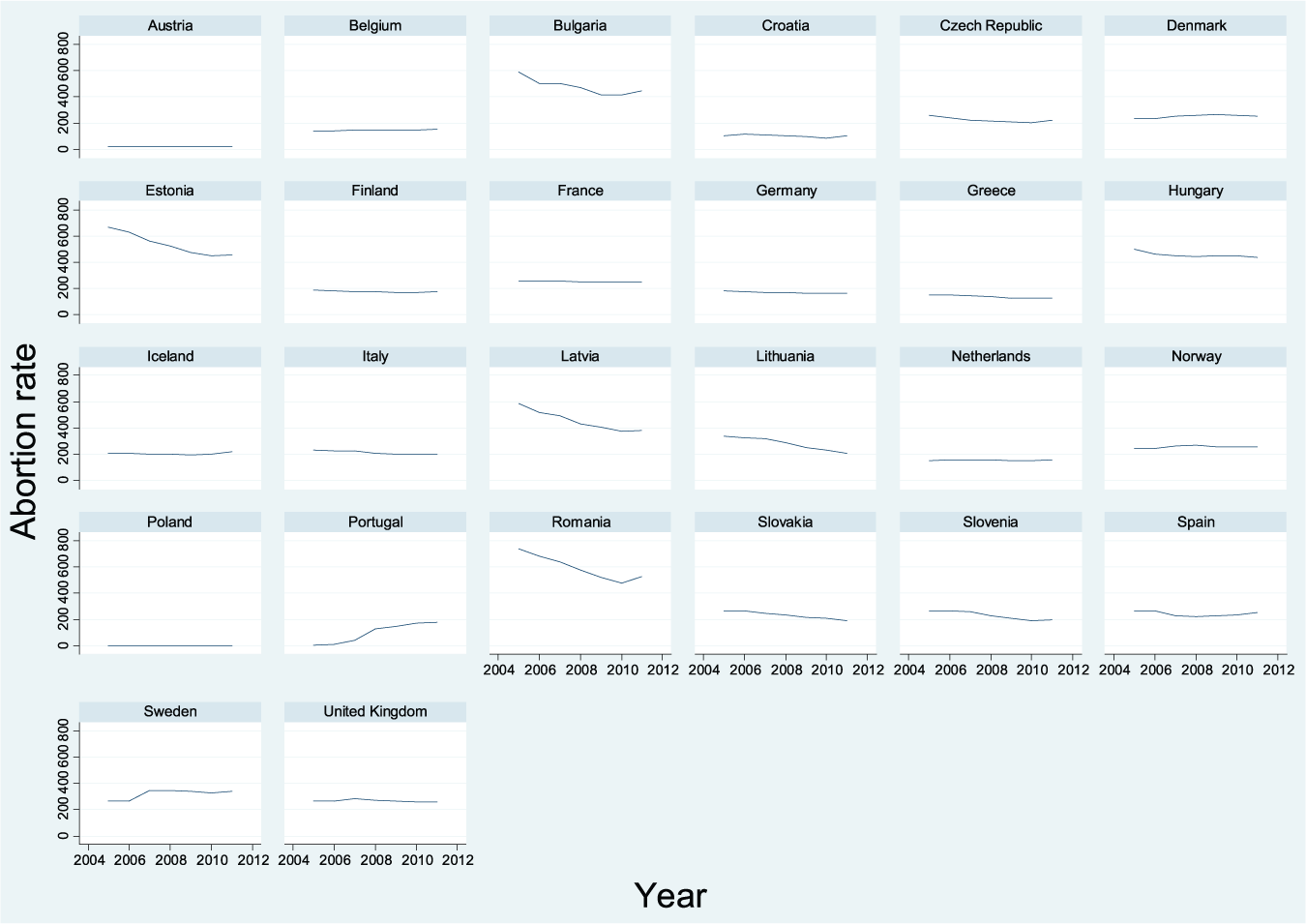
Induced abortion rate by European countries (2006–2011).
There are notable differences in both policies towards and rates of abortion in countries in Eastern and Western European countries, and some authors explain them by a mixture of the legal and social norms, as well as the social meaning attributed to abortion, in the two different parts of Europe. In Western European countries, where access to birth control methods has been common for many years, the legalisation of abortion is more recent than in Eastern countries (Dereuddre et al., 2016). The practice was considered socially acceptable much earlier in Eastern Bloc countries, where it was, and in some still is, used as a method of birth control, following in the steps of the Soviet Union (Alsop and Hockey 2001; David, 1999; Troitskaia et al., 2009).
With the dissolution of the Eastern Bloc, however, these differences between Eastern and Western European countries have reduced considerably. The abortion rate across Europe dropped to its lowest level in 2010, followed by a slight increase in 2011 (Figure 2), which could be due to the economic crisis and its impact on abortion, as has been suggested by Madureira Lima et al. (2016).
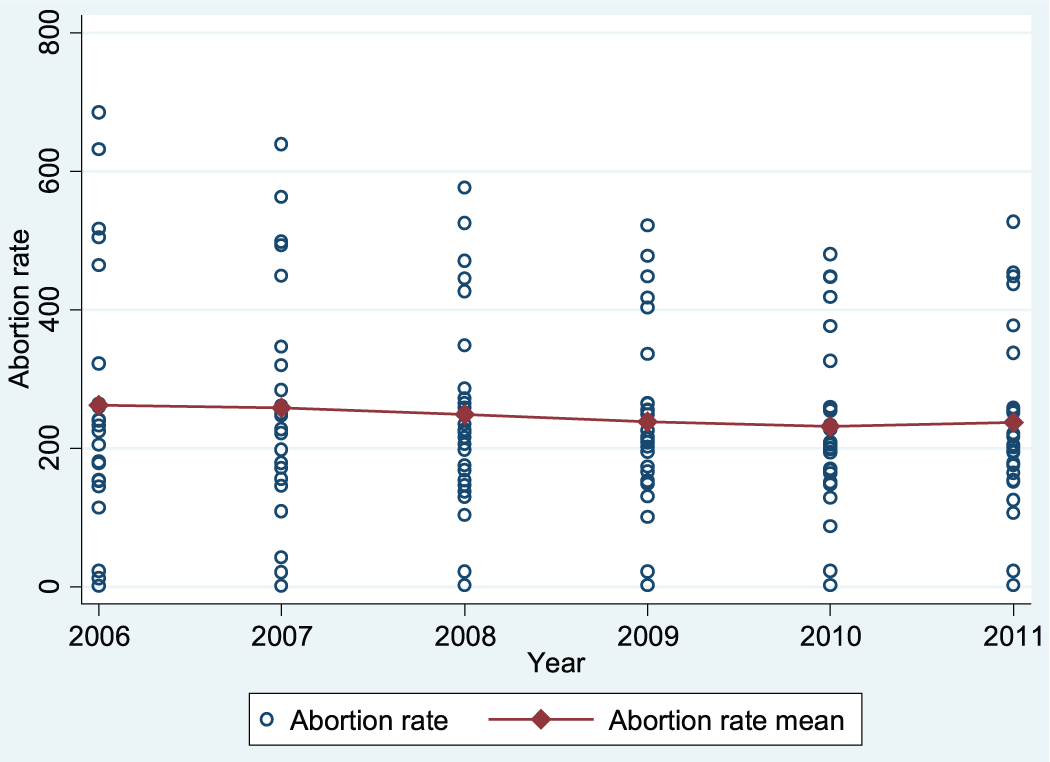
Annual abortion rate by year (2006–2011).
Figure 2 shows that differences between countries in terms of abortion are becoming less over time, and that overall rates are falling, albeit that there is a slight rise in 2011. The situation at the moment across Europe can be summed up as increasingly liberal legislation with respect to abortion, while at the same time there is a tendency towards fewer abortions being carried out (Singh et al., 2018). In this work we ask whether there are factors beyond the regulations controlling abortion which are contributing to this reduction in the abortion rate across Europe. Specifically, we wish to test whether gender equality impacts on abortion rate, and if so, to what extent. Some studies have suggested that societies with greater gender equality may have more highly developed sexual and reproductive rights and, for this reason, better access to contraception (Gissler et al., 2012). This would have the effect of reducing the number of unwanted pregnancies and, consequently, the abortion rate. To address this question we have built an econometric panel data model based on information about abortion rates and (in)equality indicators from 26 European countries over the period 2006–2011.
Research on induced abortion
Despite induced abortion being widespread throughout the world, and the fact that its practice lends itself to investigation from a variety of angles – medicine, psychology, demography, economics, sociology, political science, law and ethics, among others – the academic literature from many of these specialist fields has not given it much attention. A large part of the research that has been undertaken focuses on establishing the incidence of abortion and how this has changed over time (Sedgh et al., 2016; Singh et al., 2009, 2018), or on the reasons why women choose to have an abortion (Kirkman et al., 2009). As such, studies which refer to structural or individual conditioning factors stand out. In terms of the former, these include analyses that have explored the effects of economic, cultural, political and ideological structures on women’s decisions about induced abortion, and which have revealed the important role played by the specific contextual factors of the country involved. For instance, variation in abortion rates in relation to income level (Gil-Lacruz et al., 2012; Llorente-Marrón et al., 2016), and, more recently, how economic crisis may lead to an increase in the incidence of abortion (Madureira Lima et al., 2016).
Some studies have sought to establish the extent to which existing regulations affect the abortion rate in different countries (Asal et al., 2008; Guillaume and Rossier, 2018; Singh et al., 2018), and others have studied whether low levels of public expenditure, particularly on healthcare, may lead to increased rates of abortion (Begal and Mills, 2011; Finer et al., 2005; Pérez et al., 2013).
On the other hand are those studies which have focused on individual determinants which may influence, to a greater or lesser degree, why women have abortions, such as women’s employment status (Delgado and Barrios, 2007; Rasch et al., 2002), educational level (Font-Ribera et al., 2008; Pérez et al., 2010), civil status and age (Delgado and Barrios, 2007; Galobardes et al., 2006; Llorente-Marrón et al., 2016; Väisänen, 2017) and immigrant status (Helstrom et al., 2003; Pérez et al., 2013), among others.
Another important line of investigation with regard to abortion is that which considers religious, political and ideological obstacles to abortion and the consequences of this on women’s health and well-being (Bloomer and O’Dowd, 2014; Bolzendahl and Brooks, 2005; de Zordo et al., 2016; Frejka and Westoff, 2007; Guillaume and Rossier, 2018; Salminen-Karlsson, 2005; Smyth, 2002; Strickler and Danigelis, 2002; Walzer, 1994). Many of the issues raised or explored in such studies relate to the problems women experience when they undergo an abortion. These range from the legal restrictions that prevent or make it difficult for safe abortions to be carried out, to the additional ‘technical’ problems women may encounter in countries where abortion is permitted, such as the requirement to undergo counselling or acquire medical approval for the procedure, having to wait for a determined time between the decision and the abortion being carried out and the conscientious objection of medical practitioners, all of which delay the intervention, and could in fact make it unfeasible because of time limits (Guillaume and Rossier, 2018).
Beyond the legal and technical restrictions, women may also face religious or ideological factors that hinder the ease of access to abortion. In this sense, the influence of both religion, particularly Catholicism, and the anti-abortion movement in the promulgation of ideas opposed to gender equality and the promotion of traditional notions of motherhood should be noted (Bloomer and O’Dowd, 2014; Bolzendahl and Brooks, 2005; Frejka and Westoff, 2007; Salminen-Karlsson, 2005; Smyth, 2002; Strickler and Danigelis, 2002). Likewise, as mentioned earlier, the political context, particularly the rise of far-right populism, may constitute an additional difficulty, not only to the practice of abortions, but also for the sexual and reproductive rights of women in general (de Zordo et al., 2016).
All these obstacles can give rise to serious consequences in terms of the health and well-being of women. This is not only because it may lead to illegal and/or clandestine abortions, or to women having to travel outside their home country to terminate their pregnancy (Best, 2005; de Zordo, 2017), but also because of the difficulties and insecurity that women may experience as a result of having to challenge certain beliefs and social norms and/or stand up against judicial and medical authorities.
Finally, although in the last decade studies that address the effect of gender equality on fertility in Europe have begun to be published (McDonald, 2013; Myrskylä et al., 2009), little research has been conducted that takes into consideration gender equality as an element in understanding abortion (Dereuddre et al., 2016; Uzoigwe, 2017), despite gender being a strong determining factor of social structure and of people’s identity and affecting their actions, well-being and health outcomes (Krieger, 2003; Sen and Östlin, 2008). Reproductive decisions are some of the most important in the lives of individuals, particularly women, hence the importance of analysing the effect of gender equality, if any, on induced abortion, as this article sets out to do.
Methods
Based on the literature review presented in the previous section, we focus our article on studying the influence of key aspects related to gender (in)equality on the rate of abortion. The analysis is performed through an econometric model containing panel data from 26 European countries for the period 2006–2011. This is a technique recommended when aggregated data are used to analyse variation in time and space of dependent variables.
The indicators of gender (in)equality that we consider in this work are the gap between men and women in higher education, employment, unemployment and wages. In addition, we also consider contextual covariables, i.e. the degree of social and economic development of each country, its level of religiosity and its abortion laws. And, finally, we include individual covariables, such as the age and civil status of the women having abortions and whether they are migrants or not.
The education gap between men and women is measured here as the difference between the percentage of the male and female population with a university level education (or equivalent), EDUCATIONGAP. We have also taken into account differences in the labour market, both the gap in employment rates between men and women, and the gender difference in the rates of unemployment, EMPLOYMENTGAP and UNEMPLOYMENTGAP respectively. The wage gap between men and women is one of the most significant indicators of labour inequalities, and it is measured here as the difference between the average gross hourly earnings of male and female workers per year, WAGEGAP. All the explanatory variables are taken from Eurostat (2016), except the information on the wage gap, which comes from the UNECE database (2016).
The level of social and economic development of the countries used in this analysis is based on the Human Development Index (HDI, compiled by the United Nations Development Programme), a statistical social indicator summary of the achievements of a country in respect of the major dimensions of human development (a long and healthy life, education and living standards). In this work we have also included the variable RELIGION, that is, the percentage of people in each country declaring they hold a religious faith, the data for which are taken from the 2010 Eurobarometer. Unfortunately, this source only provides data for a single year, meaning that from a methodological perspective it is invariant over time, although, since socially it is not usual for large numbers of people to change their religious beliefs in a short period of time, we chose to use this source. That said, there does remain the shortcoming that the information does not detail whether people are religiously observant or practising, nor their attitudes towards abortion, and the data are not disaggregated by sex.
In order to capture the influence of national legislation on abortion, we classified each country into one of five categories with respect to their legal policy regarding abortion (see Table 1): POLICY1 allows abortion at a woman’s request until a certain point in the pregnancy; POLICY2 requires the woman to also undergo professional counselling and/or a period of reflection; POLICY3 requires the woman to have medical approval for the termination; POLICY4 allows abortion only under certain circumstances; POLICY5 allows abortion only in order to save the mother’s life, protect her health and in the case of rape. These variables are dichotomous, POLICY5 being the control variable.
Abortion regulations in the European countries analysed.
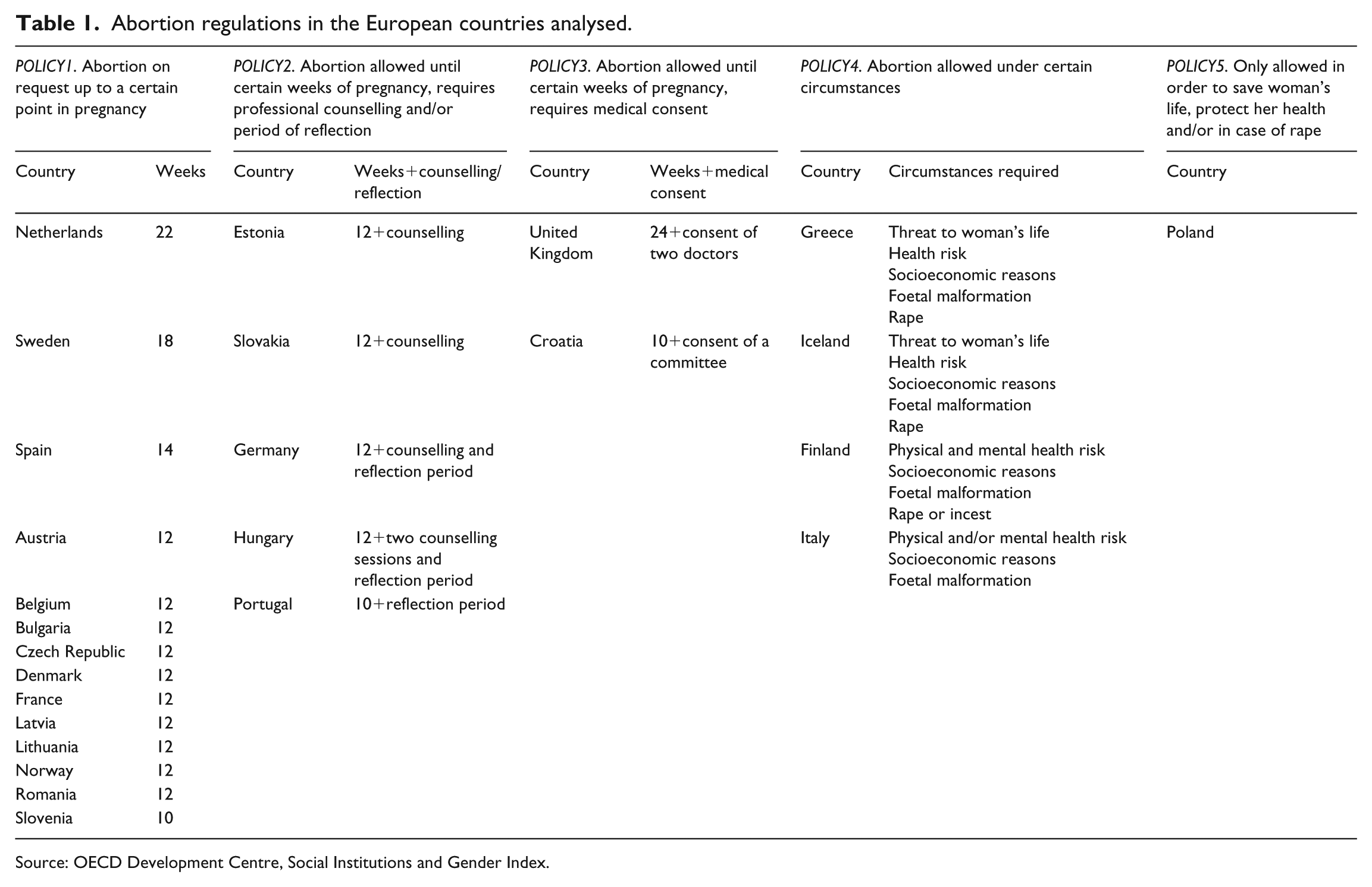
Source: OECD Development Centre, Social Institutions and Gender Index.
This model also includes the sociodemographic characteristics average age of motherhood, AGE, percentage of births to unmarried women, UNMARRIED, and the rate of net migration, MIGRATION, which are considered to be determining factors in the induced abortion rate according to the literature, as mentioned previously. All the data relating to these variables were taken from Eurostat (2016). Unfortunately, we were not able to include other variables, such as attitude to abortion, that might explain differences between countries since no sources of this kind of information are available for all the countries analysed, or for the entirety of the period covered by our analyses.
Finally, calculating the abortion rate is not easy from a methodological perspective. Not all countries share a definition of induced abortion, and illegal or clandestine abortions are, obviously, not reflected in the statistics or registered officially (Guillaume and Rossier, 2018). One indicator widely used to measure voluntary pregnancy termination is the number of abortions per 1000 women of reproductive age. However, this measure ignores the fact that abortion is a procedure only accessed by pregnant women and therefore a more appropriate measure of abortion rate should also necessarily take into account the pregnancy rate (Delgado et al., 2006). Consequently, in this work we use the Induced Abortion Rate (IAR, number of abortions per 1000 live births) obtained from the World Health Organization (2016), which eliminates bias and allows a better approach to the subject of study by considering only the population who may make use of the practice. However, this index is also only compiled on the basis of registered abortions and hence clandestine or illegal abortions are not accounted for.
The empirical exercise was carried out using a sample that combined information from 26 European countries for the period 2006–2011, the longest period for which data are available. Information from Austria, Belgium, Bulgaria, Croatia, the Czech Republic, Denmark, Estonia, Finland, France, Germany, Greece, Hungary, Iceland, Italy, Latvia, Lithuania, the Netherlands, Norway, Poland, Portugal, Romania, Slovakia, Slovenia, Spain, Sweden and the United Kingdom is used. Complete information related to certain European Union countries, namely, Cyprus, Ireland, Luxembourg and Malta, was not available because of their restrictive abortion legislation in all or some of the time period under investigation and these countries are therefore not included in the econometric analysis. In addition to the countries from the European Union, we have also included the remaining Scandinavian countries of Iceland and Norway.
Econometric modelling of IAR using panel data makes it possible to capture both the unobserved heterogeneity in a territory or time horizon, as well as the analysis of its adjustment dynamics. The econometric model is as follows:
where i and t denote the transversal and temporal identifier, respectively; yit is the dependent variable; α is the vector of the intercepts of n parameters;
Our empirical analysis was carried out at the macro level and, as such, is subject to the limitations of this type of analysis. The results should be interpreted at the country level, and cannot be applied to individual behaviour, so are not able to throw light on the micro mechanisms which are producing the changes in the aggregated tendencies of the induced abortion rate. Despite this, a great strength of our study is that the results are for the population as a whole and therefore allow generalisable observations to be made.
Results
First, we calculated a fixed effects model FE (Table 2, Model 1), which considered that the differences between countries can be captured through the differences in the constant term and that it is uniform over time. The variables were found to be individually significant, and a joint significance test of the regressors indicates that the model is significant at the 99% confidence level. In the presence of heteroscedasticity (χ2 (26) = 9507.77, p-value = 0.0000], the model was adjusted using the Huber/White, or sandwich estimators, method (Table 2, Model 2).
Estimating induced abortion rate.
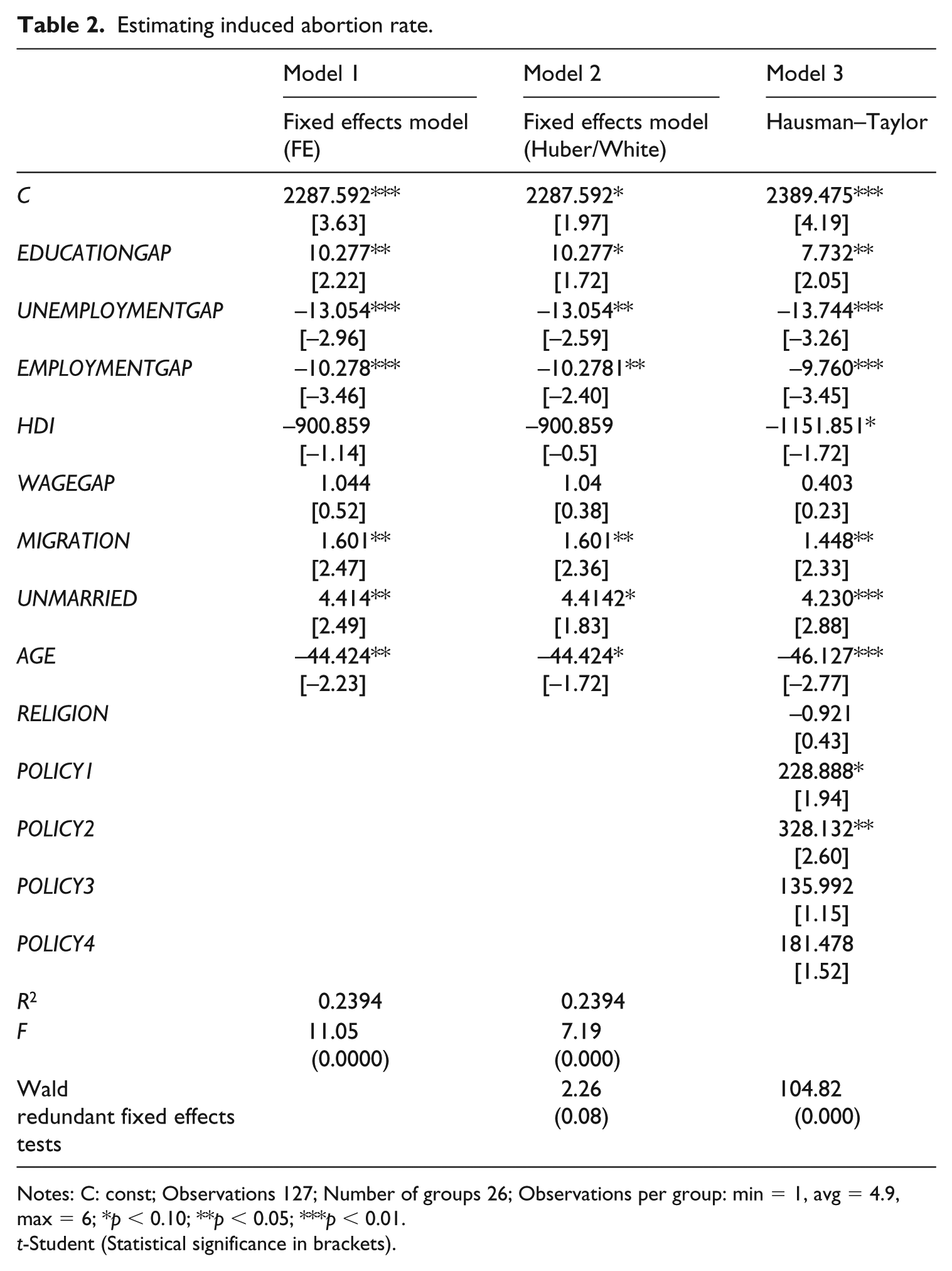
Notes: C: const; Observations 127; Number of groups 26; Observations per group: min = 1, avg = 4.9, max = 6; *p < 0.10; **p < 0.05; ***p < 0.01.
t-Student (Statistical significance in brackets).
It was possible to add temporary dummy variables for each year, which were, however, unable to control for circumstances that affected each country in a given year and thus to reduce significance bias. A temporary effects model was estimated and the maximum likelihood test for the redundancy of fixed effects applied, maintaining the null hypothesis that the fixed time effects were equal (F (5, 25) = 2.26, p-value = 0.0800).
For this reason, the most appropriate model was found to be the fixed effect model that controlled only for space (Table 2, Model 2). However, the fixed effect model does not allow for the inclusion of variables which are static across the study period, i.e. RELIGION, POLICY1, POLICY2, POLICY3 and POLICY4. Consequently, the importance of these variables in the analysis led us to use the estimation method proposed by Hausman and Taylor (HT, 1981), which provides a consistent and more efficient estimator than FE models when the number of exogenous variables that vary over time is higher than the number of both the endogenous and static variables correlated with fixed effects. This analysis provided good results (Table 2, Model 3) and applying the Jarque–Bera normality test to this model maintains the null hypothesis of normality,
The results reveal a clear causal relation between abortion and the independent variables included in the model, both the contextual and the individual factors. Specifically, national socioeconomic factors associated with welfare tend to reduce abortion HDI (–1151.851, p-value = 0.086), whereas greater inequalities in education favour its incidence EDUCATIONGAP (7.732, p-value = 0.041). The importance of equality in the labour market with respect to abortion is reflected in the sign and statistical significance of the unemployment, employment and wage gap that exist in each country: UNEMPLOYMENTGAP (–13.744, p-value = 0.001), EMPLOYMENTGAP (–9.760, p-value = 0.001), WAGEGAP (0.403, p-value = 0.816). In addition, the legal context of abortion in each country is also a determining factor: POLICY1 (228.888, p-value = 0.052), POLICY2 (328.132, p-value = 0.009), POLICY3 (135.992, p-value = 0.249) and POLICY4 (181.478, p-value = 0.127). Finally, the sign of the RELIGION variable indicates that a greater incidence of declared religious faith is linked to reduced abortion rates (–0.9215, p-value = 0.669).
The results also demonstrate the impact of individual characteristics as they evidence the importance of sociodemographic factors in the reproductive behaviour of women, and specifically in the voluntary termination of pregnancy. Specifically, we found that the rate of abortion is negatively related with average age of motherhood AGE (–46.127, p-value = 0.006) but positively associated with both the percentage of unmarried women UNMARRIED (4.230, p-value = 0.004) and migration rate MIGRATION (1.448, p-value = 0.020).
Discussion and conclusions
In this article, we have focused on an aspect which is little addressed by the current scientific literature: the interrelations between abortion and gender equality. Our analysis reveals that although European countries each have their own legal regulations, differences in legislation do not entirely account for the variation seen in induced abortion, which is in fact also conditioned by gender (in)equality, related both to socioeconomic factors of the countries and the individual-level characteristics pertaining to women in each country.
Education is a socioeconomic indicator that has been widely used in sexual and reproductive health studies (Chandra-Mouli et al., 2015; Haley et al., 2016; Rasch et al., 2002). There is some evidence suggesting that women with a low level of education are more likely to have unwanted pregnancies which end up in abortion (Font-Ribera et al., 2008). On the other hand, women with high educational levels have fewer abortions, and they also tend to have higher income profiles, greater accessibility to and knowledge of contraceptive techniques, and more possibilities to continue with the pregnancy (Sonfield et al., 2013). Similar to these finding, our study reveals that a reduction in the gap between the percentage of the male and female populations that have a tertiary level of education has a positive effect on the rate of induced abortion, EDUCATIONGAP (7.732, p-value = 0.041).
The impact of economic development level on fertility is ambiguous, according to the available literature. Authors such as Becker (1981) interpret the reduction in fertility associated with higher levels of economic development in a country as the result of rational family behaviour that replaces quantity of children with quality of children’s lives. However, in recent decades, many countries, such as France, Belgium, Sweden and Norway, have noticed that their economic progress has been accompanied by a significant upturn in fertility. This can most likely be explained by such countries experiencing a certain level of economic development whereby institutional changes occur that enhance opportunities to reconcile paid work and family life. By contrast, other studies indicate that there is no clear association between GDP and fertility (Balbo et al., 2013). In the case of abortion, when using a broader indicator of welfare and socioeconomic development, such as the Human Development Index, HDI, as we have done here, the situation is seen differently. The result for HDI (–1151.851, p-value = 0.086) reflects that as the socioeconomic development level increases, the number of induced abortions declines, revealing an inverse relationship between economic development and abortion, at least in the European context: a finding similar to that of Singh et al. (2009, 2018) on a worldwide scale.
Additionally, there is considerable evidence indicating that as women have entered the labour market, issues such as greater job security, flexible shifts and laws that do not penalise part-time employment favour the realisation of women’s desire to have a family (Rowe et al., 2009; Santelli et al., 2009; Sonfield et al., 2013) and, in contrast, the difficulty of combining paid work and family responsibilities may limit such reproductive decisions. In the case of abortion, a significant and inversely proportional effect of the employment gap variable can be observed, EMPLOYMENTGAP (–1151.851, p-value = 0.086), showing that a reduction in the labour activity gender gap produces an increase in the induced abortion rate. Data also indicate that a decrease in the unemployment gap discourages fertility and increases the abortion rate, UNEMPLOYMENTGAP (–13.7446, p-value = 0.001). In other words, in the European context, once women have entered the labour market, they tend not to put their job at risk by giving birth to an unplanned baby, and induced abortion may be one of the mechanisms used to achieve this. On the contrary, the estimate obtained reveals that lower wage differences decrease the induced abortion rate, WAGEGAP (0.4038, p-value = 0.816), indicating that greater gender equality in this respect leads to lower abortion rates, although this effect does not reach statistical significance, most likely due to issues of collinearity with other variables in the model.
Factors related to the life cycle are also important predictors of abortion. The majority of studies suggest a decrease in the probability of abortion with age, sometimes followed by a significant decrease in the late reproductive years. They also point to the greater probability of abortion in adolescence and in environments where sex before marriage is more common (Ancel et al., 2004; Font-Ribera et al., 2008). In this work, the likelihood of induced abortions is inversely proportional to the age of women: the younger the woman is, the greater the probability that an unwanted pregnancy ends in induced abortion, thus corroborating these previous findings and highlighting the importance of this predictor in the incidence of abortion in Europe, AGE (–46.127, p-value = 0.006).
The highest rate of abortion occurs in unmarried women. The results indicate that the variable UNMARRIED (4.230, p-value = 0.004) is positively related to variations in induced abortion rate, and that the effect is statistically significant. Several factors pointed to in previous research may explain this issue, such us the greater vulnerability of single women, the difficulty of facing motherhood on their own and/or social prejudices against them (Myrskylä et al., 2009). The results of the study also indicate that migration contributes significantly to conditioning the dependent variable MIGRATION (1.448, p-value = 0.020). In the European Union, there are approximately 32.5 million immigrants (6.5% of the population), the majority of whom come from countries from outside the EU, although 1.2 million are citizens of another EU member state. Several studies consider that migration status is a determinant of abortion (Márquez-Calderón and Rodríguez, 2009) and some suggest that the frequency of induced abortion among an immigrant population is higher than that corresponding to the national population (Sevoyan and Agadjanian, 2013; Zurriaga et al., 2009). Reduced social support, as well as lower educational and economic levels, compared to the native population, along with both a reduced knowledge and use of the health system, increase the vulnerability of migrant women confronted by an unwanted pregnancy.
With regard to the variable RELIGION, our findings are in line with previous research that has found that religious belief reduces the rate of induced abortion (Adamczyk, 2008; de Zordo et al., 2016; Guillaume and Rossier, 2018; Walzer, 1994). However, the source of our data, which only identified religious belief, not the practice of religious doctrine, as well as the invariant character of the RELIGION variable most likely explain why the effect did not reach statistical significance.
Finally, as might be expected, the results concerning the variables POLICY1, POLICY2, POLICY3 and POLICY4 indicate that variation from the control category of abortion being prohibited by a state has a positive impact on the rate of induced abortion in a country, i.e. the rate is higher in those countries with fewer restrictions, than in POLICY5 where abortion is only permitted to save the woman’s life, protect her health and/or in case of incest and rape. The differential coefficient of the independent term POLICY5 is statistically significant for countries with legislation conforming to POLICY1 and POLICY2, but not for those where the law is in line with POLICY3 and POLICY4: POLICY1 (228.888, p-value = 0.052), POLICY2 (328.132, p-value = 0.009), POLICY3 (135.992, p-value = 0.249) and POLICY4 (181.478, p-value = 0.127).
Our results have clear political implications. We have shown how women’s sexual and reproductive rights are not only connected with the existence of more or less liberal laws on abortion, but are also strongly associated with the development of women’s economic and social rights. An improvement in the status of women in a country not only promotes the economic and personal empowerment of women and their welfare, but also impacts on their reproductive decisions, particularly abortion. At the same time, when women’s living conditions in relation to their economic and social rights are worse, this has a negative impact on reproductive decisions, and abortion rates rise.
Despite our confidence in the results, it must be acknowledged that the study has some limitations. Firstly, as mentioned earlier, the dependent variable of abortion rate only includes abortions that are registered, and it is reasonable to assume that there are in addition abortions carried out illegally or which are not registered officially. Secondly, there are variables which may go some way in explaining induced abortion rates which it has not been possible to include in the model as information is not available for all the countries studied, for example, religious observance and the existence of social norms which condemn or condone induced abortion. Another key aspect which this study has not been able to address is the availability of safe abortion services and information about how to access them, as well as the quality and cost of such services. Neither does our analysis take into account aspects such as the availability of publicly funded services which facilitate childcare such as nursery places, state maternity benefits, access to contraception and other provisions which may affect a woman’s decision to terminate an unplanned and unwanted pregnancy. Despite these limitations, however, our study has enabled the analysis of the effect of gender equality in terms of key aspects such as employment, salary and educational level on the incidence of induced abortion, an issue which has previously not been addressed within Europe.
Footnotes
Acknowledgements
The authors would like to thank the editors and the anonymous reviewers for their valuable comments that have improved substantially the first draft of the paper. We also owe thanks to Ronnie Lendrum for her help and exquisite care with the translation.
Compliance with ethical standards
This article does not contain any studies with human participants or animals performed by any of the authors.
Declaration of Conflicting Interests
The authors declared no potential conflicts of interest with respect to the research, authorship, and/or publication of this article.
Funding
The authors received no financial support for the research, authorship, and/or publication of this article.
