







Abstract
This study examines some of the perceptions amongst Spanish LGBTQ+ youth during the first wave of the COVID-19 pandemic and the subsequent confinement and lockdown measures, between March and May 2020. During this time, many of these young people were forced to return to their family homes and restrict their social relations. This new situation often exposed them to forms of violence from which there was no escape, with negative consequences for their psychosocial health. The study evaluates the correlations between perceived social support, burdensomeness, thwarted belongingness and the people with whom LGBTQ+ youth lived during confinement. A descriptive and multivariate analysis of variance (MANOVA) and bivariate correlations is used to examine the responses of 394 LGBTQ+ youth, between 17 and 21 years of age, residing in Spain. Overall, the study finds that gender is key when explaining the differences between the experiences of LGBTQ+ youth, with women and non-binary individuals experiencing a greater perception of stigma in the places where they lived during the lockdown. Moreover, trans men and women and non-binary individuals reported receiving less support and a greater feeling of burdensomeness then the other participants. These results suggest that LGBTQ+ youth must be given special consideration during times of crisis, like the COVID-19 pandemic, and may benefit from intervention with an intersectional and transfeminist perspective.
Introduction
The COVID-19 pandemic has had a differential impact on populations that were already living in situations of social risk or vulnerability (Johnson et al., 2020). It has also made it more likely that some people will have more serious health complications or even face a premature death (Potter and Patterson, 2019; Raifman and Raifman, 2020; Wu et al., 2020), thus increasing existing social divides related to age, gender, sexuality, social class and race, among other factors (Azcona et al., 2020; Hankivsky and Kapilashrami, 2020; Liem et al., 2020; Wenham et al., 2020).
The onset of the COVID-19 pandemic was followed by government policies that forced citizens to stay at home, often with family members. In particular, young people without economic independence were faced with having to return to the family home. Many were obliged to leave their chosen living situations, which at times included roommates, and restrict their physical social networks. Moreover, many LGBTQ+ (lesbian, gay, bisexual, trans and queer) youth found themselves confronting a return to the closet in order to avoid potential intrafamily violence due to their orientation and identity (Al-Ali, 2020). The government response to the pandemic prioritized family relationships, without taking into consideration the repercussions this could have for LGBTQ+ youth, despite the fact that the family environment was one of the spaces where they experienced the most intense discrimination before the pandemic (Ahmed, 2017; Anzaldúa, 1987; Lozano and Salinas, 2016).
The impact of the COVID-19 pandemic on LGBTQ+ youth has been significant (DeMulder et al., 2020), although its consequences have not yet been explored in full (Dawson et al., 2021). Before the pandemic, this population was already characterized by its generally poor physical and mental health (Gayles and Garofalo, 2019), a consequence of both distal and proximal stressors (Meyer, 2003). Nearly two million American LGBTQ+ young people, for example, reported having suicidal thoughts before the pandemic (The Trevor Project, 2019). In another study on LGBTQ+ youth, Potter and Patterson (2019), stressed the higher level of violence against lesbian and bisexual women and a consequent greater tendency towards suicidal ideations, something also found with trans men (Ream, 2019).
After the first lockdowns, the UN High Commissioner for Human Rights (ACNUDH, 2020) warned about the impact of the restrictions to stay at home, where many LGBTQ+ youth found themselves in hostile environments, lacking support, with greater exposure to different forms of violence and, accordingly, an increase in anxiety and depression. Some studies done in the United States have warned that social isolation and deficient support networks to deal with the crisis – especially when the family itself does not offer support (DeMulder et al., 2020; Silliman Cohen and Adlin Bosk, 2020) – are linked to increased discrimination and have a negative impact on mental health, raising the risk of self-injury and suicide (Hawke et al., 2021; Kneale and Becares, 2020). In their qualitative analysis of the difficulties faced by LGBTQ+ youth, Fish et al. (2020) found that they were concerned about their mental health, blaming isolation with family members who did not support them and the loss of opportunities for socialization. In a six-country study (Portugal, the United Kingdom, Italy, Brazil, Chile and Sweden), Gato et al. (2021) observed that LGBTQ+ youth confined with their parents manifested a number of affectations associated with higher levels of depression and anxiety. They emphasized the importance of not being able to work or attend university classes, exposure to the daily adversity of the pandemic and living in a negative family environment. Moreover, little importance has been given to the study of differences in the LGBTQ+ community itself. In fact, gender identity helps to explain aspects of the impact of the pandemic. According to Chang et al. (2021), cis gay and bisexual men reported feeling less affected by the pandemic when compared to cis lesbian and bisexual women and trans and non-binary individuals.
In Spain, where little literature has been produced on the impact of COVID-19 on LGBTQ+ youth, studies prior to the pandemic had already found that this group dealt with more situations of violence and difficulties related to support from the family, school and friends (FRA, 2020). Moreover, members of the community of trans, lesbian and bisexual youth suffered from more situations of discrimination and feelings of discouragement than gay and bisexual youth (FRA, 2020). Equally notable is the fact that women did not report talking to any family members about their sexual orientation, and that trans youth usually encountered more problems in the family home (FRA, 2020).
Life under lockdown in Spain had its own particular characteristics which, of course, have affected the LGBTQ+ youth in the country. During the first wave of the pandemic, the Spanish government began to implement rigid measures in mid-March 2020, with strict home confinement (BOE, 2020) and school closures. For months, children and young people were depicted as ‘vectors of transmission’ in the media, and accused of engaging in behaviours that risked spreading the disease (Europa Press, 2020; Government of Spain, 2020; Hermoso, 2020). This stigmatization made it easier for the state to adopt strict lockdown measures specifically aimed at young people, and quite different to the measures enacted in other European countries (Red de Estudios sobre Juventud y Sociedad, 2020). On 12 March, for instance, classes were suspended for almost ten million students. Schools and universities closed their doors and many students were forced to do their classes online in their homes until the beginning of the following academic year. Young people were not allowed to leave their homes until 10 May – and even then, only within specific time slots – and on 21 May, a ‘new normality’ was decreed that involved the use of masks and social distancing for all citizens.
During the first months, while many adults in Spain created networks of solidarity with the elderly, food banks and care networks to help others with daily tasks, LGBTQ+ migrants and vulnerable trans individuals, among others (Martínez, 2020), LGBTQ+ youth in general did not receive sufficient support (Platero and López, 2020). Like their peers, LGBTQ+ youth were required to isolate, but they were often forced to live in silence (Momoitio, 2020) due to family hostility (Siveiro, 2020). Confined at home, many LGBTQ+ youth were pushed into a situation of double lockdown, with not only their independence and freedom of movement restricted, but also the possibility of expressing who they really are (Borraz, 2020). Additionally, their safe spaces, such as specific centres or events like LGBTQ+ Pride were closed, cancelled or went online, adding to the difficulty of gaining access to support resources outside the home. The impact of the pandemic on LGBTQ+ youth, then, was not only aggravated by pre-existing social disadvantages, but also by the new reduced access to physical community spaces during the pandemic.
In this context, a number of questions arise: What were the implications of the pandemic for young members of the LGBTQ+ community, and especially for sexual minority women? What was their perception of the support around them, their perceived burdensomeness, their feelings of thwarted belongingness? Answering these questions is the objective of this study.
Method
Participants
A total of 394 people, aged 17 to 21 (M = 19.36, SD = 19.50) living in Spain completed an online questionnaire between 4 April and 10 May 2020, as part of a larger study that included the participation of 2833 people at different stages of life. Of the sample of the 394 young people, 53.8% were cis-women, 17.5% cis-men, 13.5% were gender non-binary, 10.7% were trans men and 4.6% trans women.
Instruments
Except for the socio-demographic questionnaire, the scales used a response format from 1 (strongly disagree) to 6 (strongly agree).
Socio-demographic questionnaire
This questionnaire gathered information about gender identity, sexual orientation, age, education, COVID-19 status, access to treatment and changes in place of residence. The ‘change in residence’ variable asked whether a change in residence had occurred, and about the people with whom the participants lived before and after the confinement measures were enacted.
Social support frequency and satisfaction questionnaire (SSFSQ)
This survey is made of 12 items that help measure perceived social support on an emotional, informational and instrumental plane. The tool has a factorial structure composed of four dimensions: (a) social support received from partner (SSFSQ-P); (b) social support received from family (SSFSQ-F); (c) social support received from friends (SSFSQ-FR); and (d) social support received from the community (SSFSQ-C). Higher scores reflect a greater perception of social support. García-Martín et al. (2016) indicated a high reliability with internally-consistent alpha coefficients of 0.95, 0.91, 0.92 and 0.92 respectively.
LGBT neighbourhood stigma scale (SIN-Cp)
This questionnaire is composed of 3 items that measure the perception of stigma in the neighbourhood where the participant lives. The items were duplicated for the current residence, given that this space is more intimate than the neighbourhood. McConnell et al. (2018) reported an adequate internally-consistent alpha coefficient of 0.83.
Interpersonal needs questionnaire (INQ)
This questionnaire is composed of nine items, six related to the dimension of self-perception as a burden to others, that is burdensomeness (INQ-PB) and three related to the sensation of loneliness and a lack of reciprocal support, that is thwarted belongingness (INQ-TB). Feelings of burdensomeness and thwarted belongingness are two solid risk factors linked to suicidal ideation (Van Orden et al., 2010).
Higher scores reflect a greater self-perception of burdensomeness. Silva et al. (2018) reported a good overall reliability with an omega coefficient that ranged between 0.85 and 0.95.
Procedure
Participants were recruited through calls on different social networks and e-mails from feminist and LGBTQ+ NGOs between April and May 2020. An informed consent form was offered to young people living in Spain who were interested in participating. Once they agreed, they were informed that their attitudes and perceptions about psychosocial aspects regarding situations resulting from the confinement measures and the COVID-19 pandemic would be collected anonymously.
Two experts on gender psychology reviewed the questionnaire language. The questionnaire items were also given to a pilot group consisting of two lesbians of African descent, two Caucasian gay men, two Caucasian trans people, and one Caucasian intersex woman, who judged each item in terms of its comprehensibility. Finally, an expert in inclusive language reviewed the items.
Results
Descriptive statistics were obtained for each item and instrument, along with visual histograms and normality tests. The scores were calculated for each dimension by taking the average of the items.
Descriptive statistics
62.7% of the participants self-identified as bisexual, 29.2% as lesbian or gay, 5.1% as asexual and 3% as heterosexual. 68.5% were in high school, while 31.5% were taking university classes. 32.5% reported a change in residence due to the confinement measures. Before the lockdown, 64.7% were living with their parents, 28.9% with roommates, 5.1% were living alone and 1.3% with a partner. After the confinement measures were implemented, 88.8% were living with their parents, 4.8% with roommates, 3.3% alone and 3% with a partner. Finally, 4% reported having had COVID-19 or related symptoms.
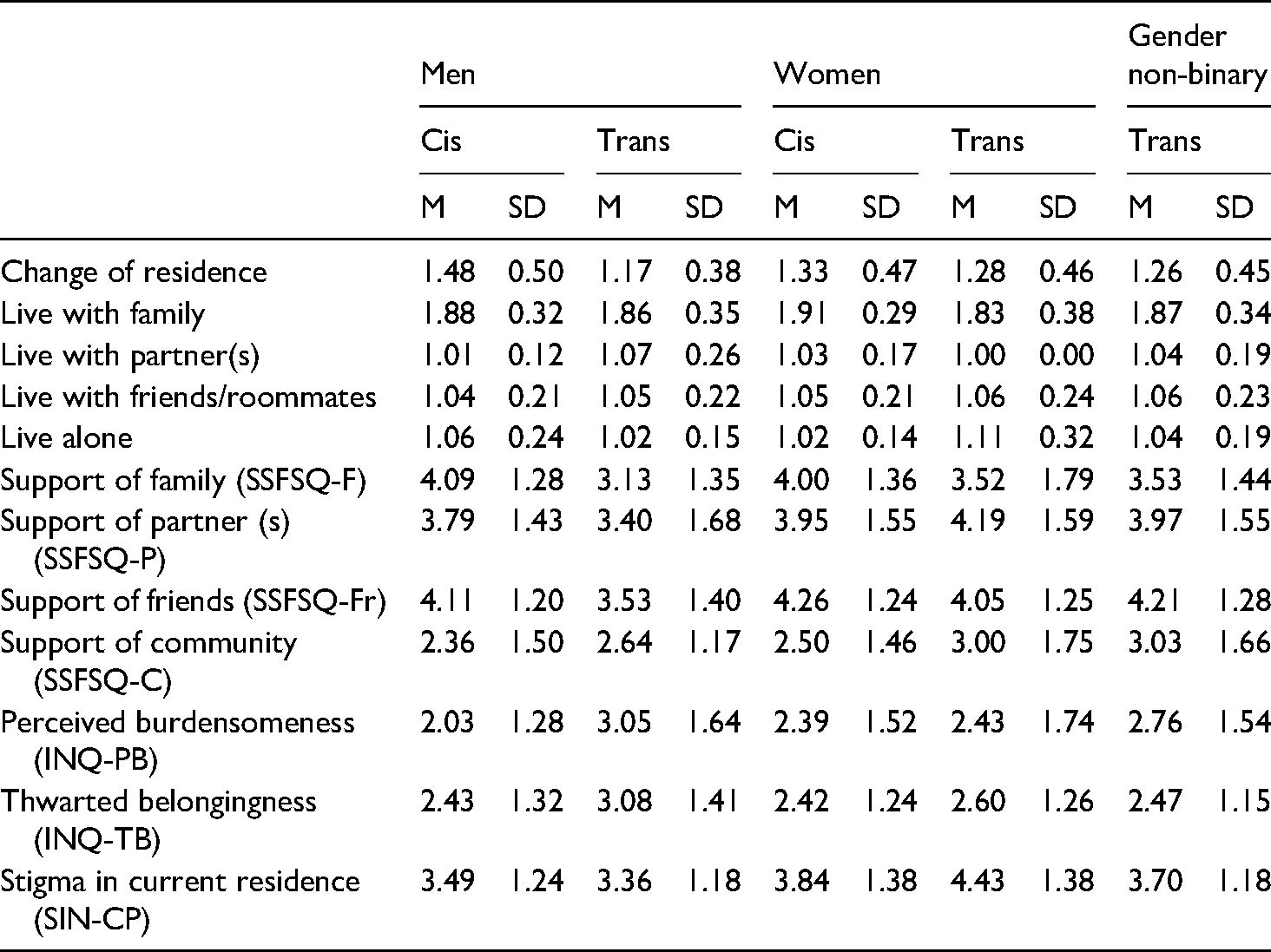
Table 1 shows the averages and standard deviations according to gender identity (woman × man × gender non-binary) and identification (cis person × trans person).
Means and standard deviations by gender identity and identification.
Multivariate analysis of variance
Differences in gender identity (being a woman, man or gender non-binary) and identification (being cis or trans) were analysed using a multivariate analysis of variance (MANOVA). Different kinds of cohabitation and changes in residence were considered dependent variables, while gender identity and identification were independent variables.
The results of the MANOVA did not indicate any significance in the interaction (gender identity × identification), F(12,283) = 1.52, p = 0.11, ηp2 = 0.06. With partner support (SSFSQ-P), the analysis of the main effects of gender identity showed the existence of significant differences between men, women and gender non-binary people, (F(2294) = 3.58, p < 0.05, ηp2 = 0.02), with women in all groups and gender non-binary people scoring the highest with this type of support. This same result was also observed in the ‘support from friends’ dimension (SSFSQ-Fr; F(2294) = 3.18, p < 0.05, ηp2 = 0.02).
Regarding perceived rejection in their current place of residence (SIN-CP), the analyses of the main effects of gender identity showed the existence of significant differences between men, women and gender non-binary people, (F(2294) = 4.96, p < 0.05, ηp2 = 0.03), with women in all groups and gender non-binary people scoring the highest in terms of perception of this type of stigma. Lastly, the analyses of the main effects of family support (SSFSQ-F; F(1294) = 10, p < 0.005;ηp2 = 0.03) and support from friends (SSFSQ-Fr; F(1294) = 3.6, p = 0.05;ηp2 = 0.01) showed the existence of significant differences between cis and trans people, with cis people in all groups scoring higher. The opposite occurred with the perception of burdensomeness (INQ-PB; F(1294) = 4.27, p < 0.05;ηp2 = 0.01), with trans people in all groups scoring higher.
Correlations
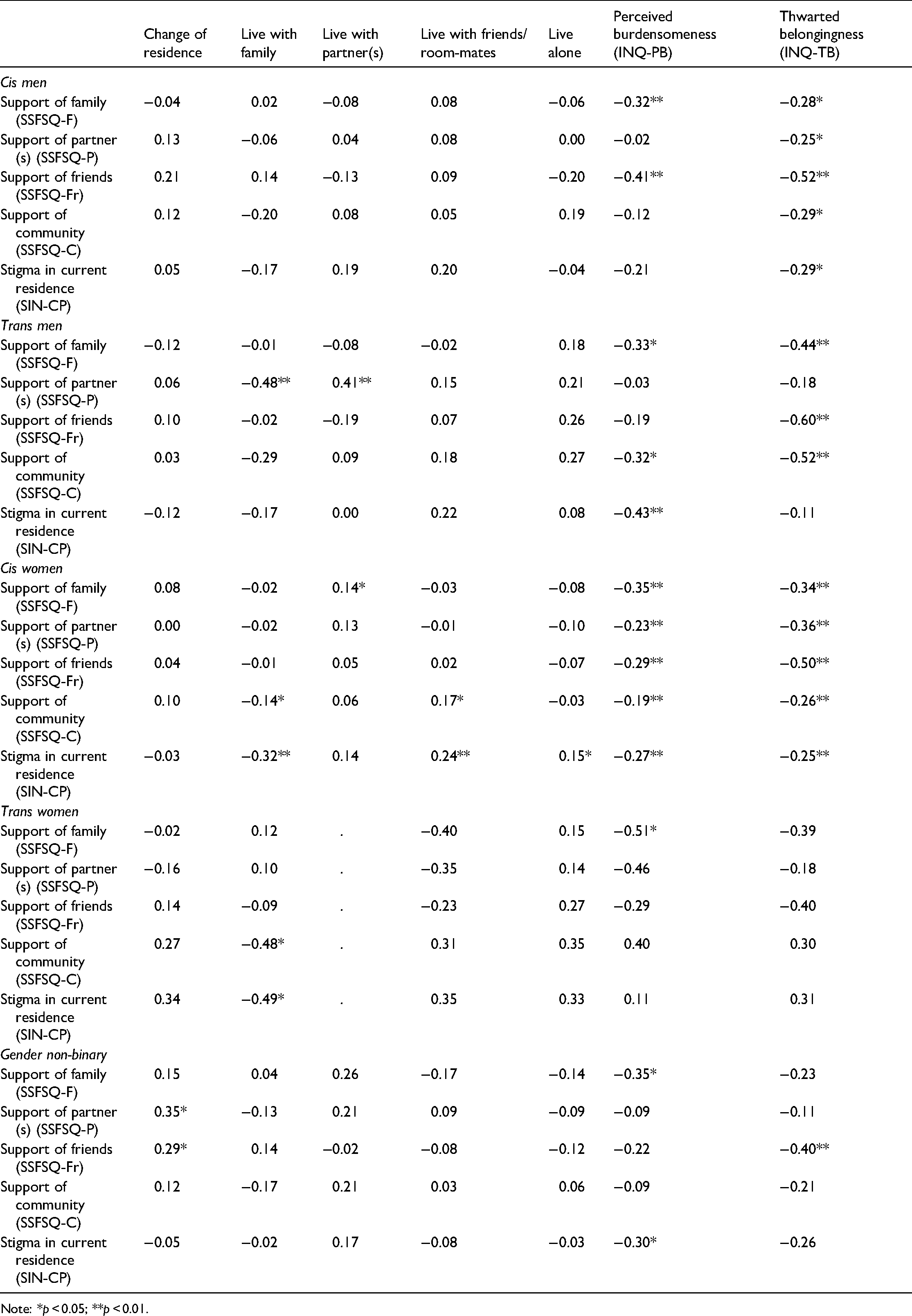
The correlations were calculated using Spearman’s ρ coefficient. The correlations for the different groups according to the SSFSQ, SIN, INQ-PB and INQ-TB variables, changes in residence and housemates appear in Table 2.
Correlations by groups.
Note: *p < 0.05; **p < 0.01.
Discussion and conclusions
This study explored the experiences of LGBTQ+ youth during the first wave of the COVID-19 pandemic in Spain, and gender was found to be essential to making sense of them. Based on the results, gender identities (being a woman, man or gender non-binary) and identification (being cis or trans) are key variables for understanding situations of cohabitation. Gender identity turns out to be a determinant for receiving some support from other people. Cis and trans women and gender non-binary youth tend to have more support from their partners and friends than cis, gay and bisexual men. On the other hand, trans men tend to receive the least support from family members, partners and friends than the rest of the participants. Likewise, young cis and trans women perceive a greater stigma in the places where they were living during the first wave of the COVID-19 pandemic, including both the home and the neighbourhood. These data are coherent with studies on the United Kingdom, where the perception of discrimination by gay cis-gender men was lower (Kneale and Becares, 2020).
However, the total data about being cis or trans in this sample suggests that this variable influences the degree of perceived support received from friends and family members, with trans people perceiving the least amount of support. Accordingly, trans people are also most likely to perceive themselves as a burden to others. Both statements support the literature in this regard. Hil Malatino suggests that the care work that trans people need to survive comes from networks that are often weak or missing (2020), adding that trans care is not always linked to the family, but is found elsewhere (Malatino, 2020, p.42), such as in community centres, schools, NGOs or on the street. Although the needed care can be found at home, those can also be hostile places. Studies on the COVID-19 confinement among Canadian youth reaffirm these findings, where trans people experienced less family support, with a negative impact on their mental health (Hawke et al., 2021).
The total correlations of the sample corroborate some of the literature, as well as current press reports. The variables that correlate most frequently in all the groups are related to rejection and non-acceptance in the places where young people were living during the first wave of the pandemic (SIN-CP), with the perception of burdensomeness (INQ-PB) and feelings of loneliness (INQ-TB).
In the group of cis gay and bisexual men, the correlations indicate that the support of friends was key to not perceiving themselves as a burden and not having feelings of thwarted belongingness. Likewise, the support of a partner or the LGTBQ+ community, or acceptance in the place where they were living had an influence on not feeling neglected or isolated. For trans men, the correlations indicate that the support of a partner influenced the decision to live with this partner instead of with family members during the lockdown. Furthermore, as with the cis men, family support was essential to trans men not perceiving themselves as a burden and not feeling lonely, although the support of the community was more significant. On the other hand, perceiving support from friends resulted in a lower feeling of isolation, and feeling accepted in the places where they were living during the first wave of the pandemic was related to a lower feeling of burdensomeness.
For cis lesbian and bisexual women, family support was related to having spent the confinement with a partner. Having any of the types of support examined in this study and feeling accepted in the places where they were living during the first wave of the pandemic were related to a lower perception of burdensomeness and feelings of thwarted belongingness. Moreover, community support and seeing themselves accepted in the places where they were living was influenced by whether they lived with family, friends or alone during the confinement. In contrast, for trans women, only a lack of family support significantly influenced their perception of burdensomeness. Support from the community and acceptance in the places where they were living were linked to spending the confinement with family members. Lastly, among non-binary youth, family support and feeling accepted in the places where they were living influenced their perception of burdensomeness. Furthermore, support from friends was related to a self-perception as less isolated. Support from friends and a partner favoured the residential mobility of non-binary individuals during the confinement.
In conclusion, this study not only confirms a situation particular to LGBTQ+ and non-binary youth, who experience specific forms of violence related to belonging to a minority and the intersection of living through an unprecedented crisis situation, but also provides new data about internal differences within this community. In fact, the study found that young women, trans and gender non-binary individuals experience more risks to their psychosocial health. These risks are related to inequalities that already exist (Lewis, 2016) and were exacerbated by the pandemic. Indeed, the data are concordant with what other studies indicate, where existing inequalities among lesbian, bisexual and trans women show greater depression-related symptoms before (Hughes et al., 2014) and during the COVID-19 pandemic (Flentje et al., 2020), especially when the women are young (Keeter, 2020).
The confinements and social restrictions forced all citizens to confront and manage new types of cohabitation, as well as to reflect on how people were living before the pandemic. For some LGBTQ+ youth, the return to the ‘safety of the family home’ exposed them to forms of intimate violence from which they could not escape (FELGTB, 2020; Xue et al., 2020). The related stigma was often extended to the context around the home, such as neighbourhoods (Burés, 2020; Villena, 2020). Moreover, in addition to existing inequalities and a lack of specific public policies to address them, state intervention with regard to the pandemic in Spain did not take the needs of this young community into consideration (Pineda and Corburn, 2020). The results of this study are highly relevant to the health of LGBTQ+ youth in general, and LBT women in particular. This study highlights the importance of support networks and places of cohabitation when it comes to one’s (self-)perception as being alone or a burden. In addition, it reveals the differences within the LGBTQ+ community, which is often treated as an undifferentiated whole. The differences found according to gender identity and identification suggest the need for an intersectional and transfeminist perspective in intervention with LGTBQ+ youth in times of crisis, with the COVID-19 pandemic serving as a topical and very real example.
The results of this study are limited in a variety of ways. First, the sample is not representative. However, its size is sufficient to provide a snapshot approximation of LGBTQ+ youth during confinement. In addition, the sample contains data from a diversity of locations across Spain. Future studies should consider the intersectional needs of the LGBTQ+ population and how support can be provided to mitigate increased negative consequences (Kennedy-MacFoy, 2021; Preciado, 2020).
Footnotes
Acknowledgements
We would like to thank all the anonymous LGBTQ+ youth who participated in our study, along with all the families, LGBTQ+ services, and professionals that support them. We would also like to acknowledge the support provided by the AFIN research group, the Flax Foundation, and the Rey Juan Carlos University.
Declaration of conflicting interests
The author(s) declared no potential conflicts of interest with respect to the research, authorship, and/or publication of this article.
Funding
The author(s) received no financial support for the research, authorship and/or publication of this article.
