






Abstract
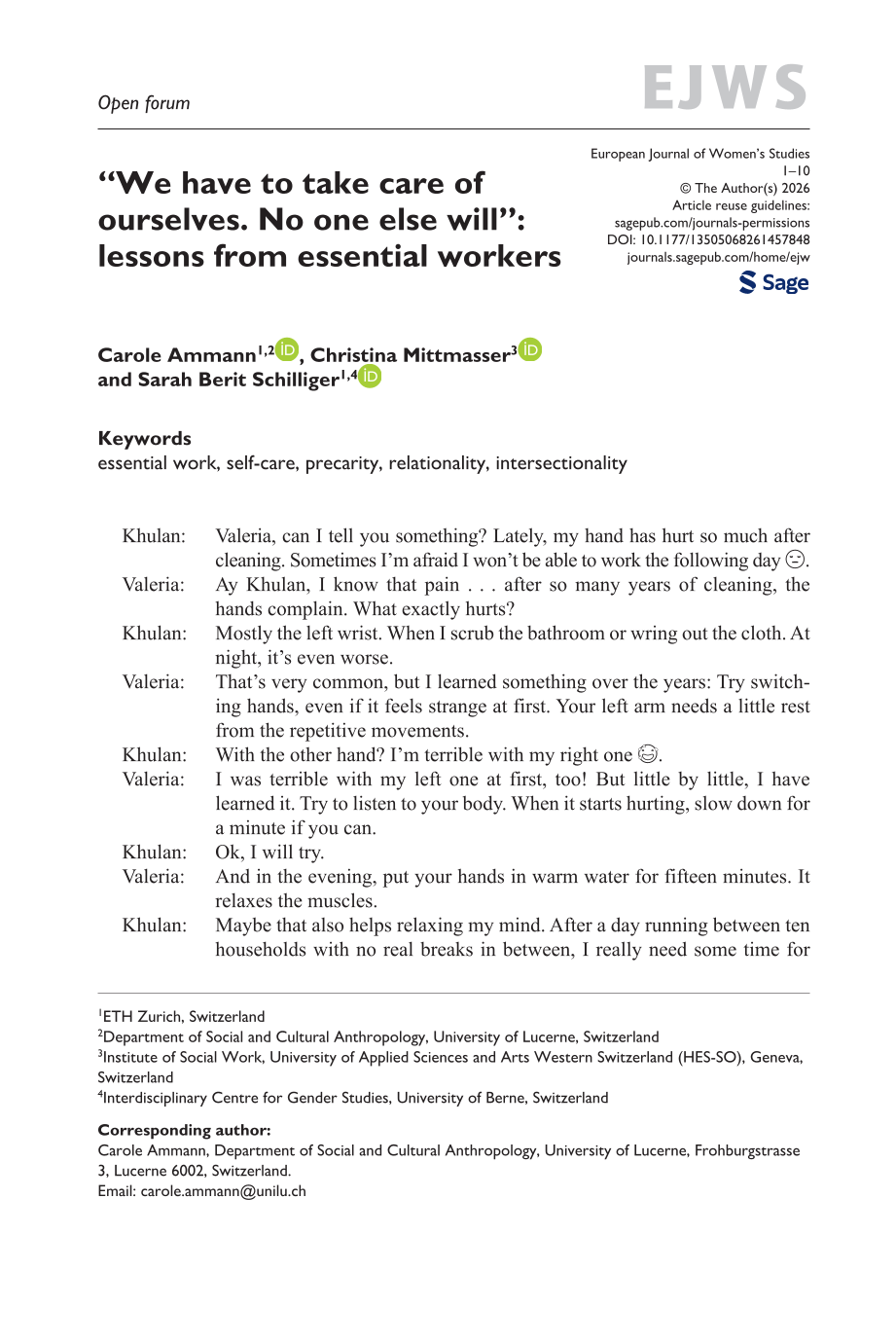
Valeria, can I tell you something? Lately, my hand has hurt so much after cleaning. Sometimes I’m afraid I won’t be able to work the following day  .
.
Ay Khulan, I know that pain . . . after so many years of cleaning, the hands complain. What exactly hurts?
Mostly the left wrist. When I scrub the bathroom or wring out the cloth. At night, it’s even worse.
That’s very common, but I learned something over the years: Try switching hands, even if it feels strange at first. Your left arm needs a little rest from the repetitive movements.
With the other hand? I’m terrible with my right one  .
.
I was terrible with my left one at first, too! But little by little, I have learned it. Try to listen to your body. When it starts hurting, slow down for a minute if you can.
Ok, I will try.
And in the evening, put your hands in warm water for fifteen minutes. It relaxes the muscles.
Maybe that also helps relaxing my mind. After a day running between ten households with no real breaks in between, I really need some time for myself in the evenings. Today I ate my lunch sandwich on a packed bus . . . everyone was angry.
I know what you mean. We have to take care of ourselves. No one else will.
True. Thank you, Valeria  I’ll start tomorrow and keep you updated.
Societies depend heavily on non–health care essential workers like Khulan and Valeria. Their labour sustains everyday life in countries like Switzerland, yet their own well-being is often neglected. This essay explores how these workers practise self-care in precarious conditions, arguing that self-care should be viewed not as an individual response to multiple crises, but as a relational, situated, and collective practice embedded in broader ecosystems of care and precarity. The essay is inspired by 130 narrative interviews with domestic workers, cleaners, day care employees, public transport drivers, and shop assistants in Switzerland, a context shaped by restrictive migration regimes, racialised labour markets, and a deepening crisis of care. All the domestic workers interviewed were born outside of Switzerland and were employed, often informally, in private households. Around a quarter of them lived and worked without residence permits. The other essential workers were formally employed and had residence permits, but many of them also have migration backgrounds. While not all research participants were parents, most had various care responsibilities, within and across national borders. Although we did not analyse their networks in detail, the interviewees repeatedly told us how the essential workers interacted with one another during and after work. Some of them formed informal groups organised around shared linguistic or national backgrounds to help them cope with the difficult working conditions. In this essay, we have chosen to present our data in the form of fictional chat conversations. This format enables us to weave together and condense interview excerpts in a creative way, while highlighting and synthesising recurring themes. This format is not intended to reproduce individual interviews verbatim, but to capture frequent patterns, relational dynamics, and shared experiences across interviews in a more accessible form. 1
Overall, the essay makes three interrelated claims. First, self-care is indispensable to essential workers’ capacity to endure everyday exploitation, yet its accessibility is profoundly shaped by intersecting inequalities. Second, self-care cannot be neatly separated from care for others; it is deeply entangled with paid and unpaid care responsibilities. Third, self-care can become an element of collective organising and worker solidarity, while also being stretched to its limits when systemic neglect is rebranded as individual responsibility. In dialogue with Black feminist scholarship on care (hooks, 1993; Lorde, 1988) and drawing on Tronto’s (1993) relational ethics of care, the essay rethinks self-care neither as “radical” nor as “neoliberal” but interrogates how essential workers enact, experience, and negotiate self-care across differently precarious positions, and how these practices reveal the unequal distribution of care and vulnerabilities.
Beyond the self-care binary
Self-care has become a frequently used term, widely circulating as a solution to stress, burnout, and exhaustion. In feminist and critical scholarship, it has long been the subject of intense debate, oscillating between two dominant poles. On one hand, Black feminist thinkers such as Audre Lorde (1988) and bell hooks (1993) theorise self-care as a radical act of survival and political warfare for those living under intersecting systems of oppression, collapsing boundaries between the personal and the political. On the other hand, critical social theorists have shown how self-care has been appropriated by neoliberal governance as a technology of self-responsibilisation, self-optimisation, and emotional regulation that shifts attention away from structural violence and austerity (Michaeli, 2017). As such, commodified self-care can reinforce inequalities while depoliticising structural sources of exhaustion (Jain, 2020).
Yet as more recent scholarship argues, this binary between radical resistance and neoliberal co-optation risks flattening the heterogeneity of practices and meanings that gather under the label of self-care (Kim and Schalk, 2021). Riccitelli’s (2024) notion of “critical self-care” is particularly helpful here, emphasising how the same practices can simultaneously reproduce and contest neoliberal regimes. Everyday practices that appear banal – resting, cooking, walking, and talking – may quietly resist hegemonic temporalities of overwork, sustain capacities for care, and create small spaces of otherwise within hostile environments. Zuckerwise (2024) further insists that self-care was never solely about the individual, but about the self in relation to others.
Essential workers’ everyday self-care practices
Three clusters of self-care practices emerged as central to sustaining workers’ bodies and minds across our heterogeneous sample: avoiding stress, recharging batteries, and attentiveness to bodily signals. For some, avoiding stress involved carefully organising daily routines to minimise rushing around and feeling anxious, for example by waking up very early. Silvina, a cleaner of public infrastructure, chats with her former colleague Dijana about this:
Silvina, how can you get up so early every day?
It’s not easy, but you get used to it.
When do you start?
At 6 o’clock.
And when do you get up?
At 4:30.
 Why so early?
I set my alarm at 4:30 because I don’t like getting up quickly. Then I take some minutes to ask myself: How do I feel today? That’s how I prepare for the day. It helps me calm down and gives me some time to myself. Otherwise, I’m always with my coworkers, my husband, or the kids. I’ve been doing this every day for many years.
 Nice, I should do that too.
This short chat between Silvina and Dijana illustrates how self-care can take shape in small, routine practices that help workers maintain a sense of calm and autonomy within demanding schedules. Silvina’s early-morning ritual shows how “avoiding stress” is not merely about rest but about creating personal time and emotional space amid care and work obligations. Her practice reflects attentiveness to bodily and emotional signals. At the same time, the dialogue suggests recognition and subtle admiration among peers for such coping strategies, hinting at a shared understanding of the need to protect one’s well-being in precarious labour conditions.
Many workers described urban green spaces, riversides, and forests as being central to recharging their batteries after noisy, emotionally intense, or sedentary workdays. Day care employees spoke of restorative walks along the river, while bus drivers described walking routes as a way of counteracting back pain caused by long periods of sitting, as well as maintaining psychological balance. Others turned to team sports or strength training to cope with the physical strain and irregular hours of shift work. While seemingly ordinary, these practices constitute vital infrastructures of endurance in the face of long hours, early starts, public exposure, and low wages. Ivana, a shop assistant, explains this in a conversation with her former colleague Priya:
(after receiving a picture with a butterfly from Ivana): Where are you?
At the river, walking and enjoying.
Are you off work today?
Yes, I must reduce overtime  . Today, I only start at 1 p.m. I really enjoy being surrounded by nature in the middle of the city. Strolling along the river calms me down and recharges my batteries. I really should get out more often. But as you know, I hardly have time for that . . . between work, children, and household chores.
I know exactly what you mean. Me time = not happening  .
.
I just need this balance. Otherwise, customers start to annoy me. Do you also feel that customer contact has become much more difficult since the COVID-19 pandemic?
Indeed 

 .
.
Paying attention to bodily signals emerged as another crucial form of self-care, particularly for workers in physically demanding sectors with poor labour protections. As we have seen in the initial chat conversation between Khulan and Valeria, this can involve switching hands and altering movements to avoid the surgery that many of their colleagues had undergone. In a sector where many workers lack formal contracts, paid sick leave, or access to adequate health care, such embodied knowledge is essential for survival. For undocumented domestic workers like Khulan, self-care often involves self-medication, enabling them to continue working when no institutional support is available.
These examples make clear that self-care is far from a leisure activity; it is a necessary condition of possibility for continued labour in contexts where bodies are literally worn out by repetitive, undervalued, and often invisible work. Yet the capacity to practise self-care is deeply uneven. Day care centres marked by chronic understaffing leave workers with barely any meaningful breaks; domestic workers like Khulan spend “breaks” commuting unpaid between households, arriving home exhausted with little time for rest; single mothers shoulder the combined weight of essential work and sole responsibility for children. For them, self-care is both indispensable and almost impossible. This underlines the necessity of an intersectional lens (Anthias, 2012; Carbajal et al., 2026), foregrounding how migration status, legal precariousness, gendered care responsibilities, age, and occupation intersect to shape the availability, timing, and meaning of self-care. While some workers can use self-care to set boundaries or refuse additional work, others lack the structural security to say no. In this sense, self-care can both challenge and reproduce inequalities: it may help individuals endure exploitative conditions, but it can also mask systemic failures by translating structural neglect into individual coping strategies.
Self-care and care entangled
Self-care is often seen as a personal practice, separate from caring for others. However, the experiences of essential workers reveal that self-care and caring for others are deeply intertwined and often occur simultaneously. Beatriz and Marella’s conversation is emblematic of this:
Hey Beatriz, how are you?
Just finished work and made mango leaf tea for myself. It helps me calm down after a long working day.
I’m doing the same with chamomile. My five minutes of peace before calling my children back home  .
.
I always call my daughter during tea time. Holding the warm cup makes the geographical distance feel smaller somehow.
Nice. Let’s meet for tea soon! 
Oh yes, you can taste my special spicy recipe. It helps staying healthy.
During interviews, we learned that essential workers regularly engage in self-care rituals, such as drinking tea. However, such practices are rarely purely individual. Domestic workers, such as Beatriz and Marella, share tea with their neighbours, friends, and even the interviewer, inviting them to participate in a ritual combining physical care, emotional regulation, and consideration for the well-being of others. Self-care thus becomes entangled with caring for others, forming part of the intimate relations of care that extend across households, neighbourhoods, and even transnational borders. This pattern was particularly apparent among the domestic workers interviewed, many of whom were embedded in global care chains and had left children and other relatives in their countries of origin. They sustain these ties through remittances and emotional support, while also relying on relatives or others to take on care responsibilities at home. The fluidity of self-care and other forms of care is also evident when considering the emotional labour performed by essential workers. They described how their work involved absorbing the fears, frustrations, and loneliness of others, especially during the pandemic. Peter, a public transport driver, described one such situation in a conversation with his mother:
Do you come for dinner?
Unfortunately, I am working.
How is work?
Today, I was calling myself again state-certified pastoral counsellor  .
.
Why, what happened?
A man who always rides with me told me, “I don’t know if we’ll see each other again. I have cancer.” I thought: People just need to communicate. Maybe this man has no one else to talk to, maybe he’s completely alone. Maybe he thinks: “I’ve known this bus driver for a few years now, I ride with him almost every day.” And then he just bursts out with it. That’s why I’m a state-certified pastoral counsellor.
How do you cope with such situations personally?
No worries, I take care of myself. After such days, I usually walk home to digest what happened.
Emotional labour often falls outside official job descriptions, remains unrecognised, and is unpaid. Self-care enables continued participation in the emotional infrastructures of society — the invisible work of listening, soothing, and maintaining social relationships. Our data show that self-care is inseparable from the broader moral and emotional economies within which essential workers are embedded. It is both a condition for and a component of caring for others, revealing the porous boundaries between self-care and care work.
Collective care and the limits of self-care
Self-care takes on additional meanings when practised collectively. Among the workers interviewed, numerous examples emerged of mutual care and everyday solidarity that not only lighten individual burdens but also open spaces for political articulation and resistance. At the level of workplace micro-practices, day care teams described how they redistributed tasks to accommodate colleagues’ shifting capacities, preferences, and life stages. Older workers, for instance, stepped back from physically strenuous work with babies to focus instead on older children; while others took on excursions that involved stressful navigation of public transport and traffic. Such adjustments quietly challenge rigid job descriptions and enact a collective ethic of care in which self-care and care for colleagues are deeply intertwined.
For workers labouring in isolation, such as many domestic workers, collectives provide crucial spaces of mutual support. Informal groups of “undocumented” migrants, so-called Sans Papiers Collective, illustrate this well. In various Swiss cities, these groups bring together “undocumented” migrants to discuss strategies for navigating everyday life without legal status and to collectively demand rights. Members describe these networks as “like a family,” emphasising the sense of safety, recognition, and joy found in regular meetings and holiday celebrations. Taking time to attend these gatherings is itself a form of self-care, allowing workers to “keep going” by replenishing emotional reserves and countering isolation. At the same time, these spaces function as political infrastructures where experiences of exhaustion can be translated into collective claims. Day care worker Sarah talks about an activist group in a chat conversation with her former colleague Anna:
How are you doing?
So-so. I’m frustrated about work right now.
Tell me.
We do so much and receive hardly any recognition or decent pay in return . . . Demands are increasing, resources remain the same .
The wages are indeed terrible.
We are systemically important, but we don’t even notice that in everyday life.
I never really felt like I was systemically important.
We ARE systematically important. Last weekend, I was at a march of the activist group “Defiant Phase.”
How was it?
The atmosphere was tense. But it was motivating to see so many like-minded people, all loudly demanding better conditions. I was very pleased to see that many parents of daycare children also took part.
Sarah’s shift from feeling undervalued to participating in a march reflects a move from individual grievance to shared resistance, where recognition is sought not only from employers but through solidarity with others. The mention of parents’ participation also suggests a widening network of support, linking care workers’ struggles to broader social concerns about the value of care.
Yet there are clear limits to the entanglement between self-care and collective organising. Some activists report feeling overwhelmed by the additional demands of meetings, demonstrations, and administrative tasks on top of already exhausting work and family responsibilities. One “undocumented” domestic worker, heavily involved as secretary of a Sans Papiers Collective, spoke of being “super tired,” having no time for herself, and needing to “take a pause” from activism. Her account highlights how practices of self-care may also involve refusing or stepping back from collective activities – without necessarily implying a lack of solidarity. Following Emejulu and Bassel’s (2020) argument that declaring exhaustion can itself be a call to solidarity, these moments of retreat can encourage others to recognise their own limits and renegotiate collective expectations. Self-care, even when enacted through temporary stepping back to prevent burnout, remains deeply relational; by acknowledging the impossibility of endless giving, it challenges heroic narratives of activism and opens space for more sustainable forms of collective care. Taken together, our examples show how essential workers build everyday infrastructures of solidarity that both sustain and exceed individual self-care. At the same time, they reveal the fragility of relying on informal collectives to compensate for systemic neglect.
Self-care as necessary but insufficient
The analyses presented here point to three broader implications for feminist debates on self-care. First, self-care is indispensable to essential workers’ ability to inhabit their roles. Practices such as managing stress, recharging batteries in nature, and listening to bodily signals act as forms of scaffolding that enable workers to continue providing the services and care on which societies depend. Where institutions and welfare regimes fall short, these practices compensate for systemic gaps, helping individuals navigate labour markets structured by insecurities, early hours, and long shifts. Yet the very necessity of such practices underscores their fragility: rest and recovery require time, stability, and security, all of which are unevenly distributed and frequently denied to those deemed “essential.”
Second, self-care manifests in differentiated ways across intersecting social positions. For relatively privileged workers, it may involve setting boundaries, refusing additional tasks, or accessing therapeutic support. For those without residence permits or secure employment, self-care often takes the form of bodily endurance and self-medication to remain employable, sustaining income flows and remittances under conditions of legal and economic vulnerability. These differences caution against universalising narratives that either celebrate self-care as inherently empowering or dismiss it as simply neoliberal. Instead, self-care appears as a field of practice in which survival, resistance, and co-optation intersect in context-specific and ambivalent ways.
Third, and perhaps most significantly, self-care is relational and embedded within broader ecosystems of care that span intimate households, workplaces, transnational networks, and activist collectives. Drawing on Tronto’s (1993) relational conception of care, self-care can be understood as one moment in a continuum of caring practices that includes caring for, caring about, and caring with others. Essential workers’ self-care practices enable them to continue supporting children, partners, employers, colleagues, and distant relatives, even as they themselves are often denied adequate care by institutions. At the same time, collective practices show how self-care becomes interwoven with infrastructures of mutual support and political contestation.
These insights resonate with Black feminist scholarship (hooks, 1993; Lorde, 1988) that calls for the revaluation and redistribution of care, insisting that self-care must be connected to collective strategies that transform the very conditions that make it necessary. In contexts where debates about the “care crisis” increasingly surface in public discourse, essential workers’ accounts force us to confront a central paradox: those who sustain everyday life are often the least cared for. Employers and institutional initiatives that promote individualised well-being while refusing structural change risk deepening this paradox by obscuring responsibility.
For feminist politics, the challenge is therefore twofold. On one hand, it is crucial to recognise self-care practices among essential workers as forms of knowledge, agency, and survival that are already transforming how care is organised in everyday life. On the other hand, it is necessary to insist that self-care cannot substitute for universal, collectively guaranteed rights to rest, health, and social protection. To care collectively is to build institutions, policies, and infrastructures that support rather than exploit workers’ capacities for care, making self-care less precarious and less dependent on individual ingenuity.
Self-care, then, should be understood as a necessary but insufficient dimension of feminist struggles over care. It sustains life in the present, revealing both the violence of current care regimes and the relational practices through which workers refuse disposability. Yet only transformations that redistribute care and power across gendered, racialised, and classed lines can create futures in which essential workers are no longer forced to patch up systemic failures through their own bodies and relationships. In such futures, self-care would remain important, but not as a substitute for collective and institutional care: rather, it would figure as one element within a more just and shared ecology of care. In the meantime, Ivana takes care of herself:
You’re at the cemetery again . . . should I be worried?
No. Paradoxically, I find the cemetery a very empowering place. I can find peace and silence here. I sometimes need that after dealing with so many people in the store.
Footnotes
Acknowledgements
We are deeply grateful to our interviewees for their time and openness. Our sincere thanks also go to our colleagues Emma Gauttier, Myrian Carbajal, Milena Chimienti, David Kaufmann, and Katrin Hofer, who have been involved in these projects.
Ethical considerations
The project “Urban Essential Workers” received approval from the ETH Zurich Ethics Commission (EK 2023-N-89). As Universities of Applied Sciences do not require formal ethical approval for this type of study, the “Domestic Workers and COVID-19” project was not subject to formal ethical review.
Consent to participate
For both projects, all participants provided written or oral consent prior to taking part in the study, including consent for the collection, analysis, and publication of anonymised data.
Funding
The authors disclosed receipt of the following financial support for the research, authorship, and/or publication of this article: The Swiss National Science Foundation supported this work as part of the National Research Programme NFP 80 “COVID-19 in Society” (grant number 210024 for “Domestic Workers and COVID-19,” https://data.snf.ch/grants/grant/210024; grant number 209953 for “Urban Essential Workers,”  ).
).
Declaration of conflicting interests
The authors declared no potential conflicts of interest with respect to the research, authorship, and/or publication of this article.