






Abstract
Prologue
In South Korea, many academic institutions with programs, institutes, curricula, and journals in women’s studies have also recently marked significant anniversaries. In 2023, the Women’s Studies Program (Yosŏnghakka) at Ewha Womans University held a 40th-anniversary event celebrating the long-standing legacy of feminist knowledge, education, and practice it has cultivated since 1982. In 2025, the Asian Journal of Women’s Studies – the first English-language academic journal dedicated to women’s studies in Asia – published a special issue for its 30th anniversary, reflecting on three decades of collaborative institutional labor in building feminist scholarship across national and cultural borders within and across Asia. In 2024, the Korean Association of Women’s Studies (KAWS) held its annual conference, titled Coalition and Growth: The Past, Present, and Future of Feminism, marking 40 years of collective history of building feminist scholarship across the diverse disciplines of social science, humanities, fine arts, medicine, and natural sciences. Established and funded by the authoritarian developmental regime of Chun Doo-hwan in 1982, the Korean Women’s Development Institute (KWDI) also celebrated its 40th anniversary in 2023.
Individual women’s studies programs that have survived the neoliberal downsizing of higher education are also organizing gatherings to celebrate their accomplishments. Currently, faculty and students in the Women’s Studies in Practice Program (Shilchŏn yŏsŏnghak) at Sungkonghoe University are preparing for their upcoming 20th-anniversary event this fall. In 2 years, the Interdisciplinary Program in Gender Studies (Yoseonghak hyŏptong-gwajŏng) at Seoul National University will celebrate its 30th anniversary. Established in 2002, the Interdisciplinary Women’s Studies program at Pusan National University has sustained itself for more than two decades despite the challenging political and cultural climate of Busan, one of the most conservative regions in South Korea. The Department of Women’s Studies at Keimyung University, located in Daegu – another city known for its patriarchal culture and political conservatism – will mark its 40th anniversary in 4 years provided it survives the ongoing institutional restructuring initiated by the university.
While the list of achievements worth celebrating continues to grow, the current state of women’s studies in Korea raises different questions and challenges, as the political and popular forces of far-right antifeminism gain momentum and the neoliberal downsizing of higher education continues. Since the emergence of women’s studies in South Korea in the 1960s, what progress, challenges, and setbacks have shaped its institutional and intellectual development? What is the current state and future prospect of women’s studies as an academic program, a body of knowledge, and a pedagogical practice after more than 50 years of history? How are neoliberalism and far-right conservatism reshaping the conditions of feminist knowledge production and education in contemporary South Korea?
A brief historical trajectories of women’s studies in South Korea from 1960s to 2000s
The institutional history of women’s studies in South Korea began in 1960, when Sookmyung Women’s University established the Research Institute for Asian Women, the first academic research institute in the country devoted exclusively to women as a subject of study. By 1975, Seoul Women’s University had founded its Women’s Studies Institute under the leadership of Dr. Koh Hwang-kyung, a prominent female leader and the university’s founder. Responding to growing interest in the field – particularly within women’s universities – Ewha Womans University, one of the oldest and most prestigious institutions in South Korea, introduced the country’s first women’s studies course in 1977. The goal of feminist education, notably, was to raise the consciousness and leadership of female students and encourage them to apply their education beyond the traditional gender role of housewife (Kim, 2010: 329). Global currents of international feminism also played an integral role in initiating women’s studies in South Korea, as discourses on human rights and gender equality reached progressive circles of Korean elites.
By the 1980s, networks of women professionals and feminist scholars had formed a national community, culminating in the establishment of the KAWS in 1984. Universities increasingly founded research institutes focused on women and gender, laying the institutional groundwork for feminist scholarship and education. Pro-democracy student organizations, such as the Female Students Association (Ch’ong-Yŏhaksaenghoe), also pressured university administrations to expand course offerings on gender justice and social transformation, as students developed a critical awareness of sexism both within anti-authoritarian movements and in broader society (Lee, 2011: 43). As a result, by the end of 1989, 42 universities had incorporated women’s studies courses into their curricula (Lee, 2011: 45).
Both the authoritarian developmental state and oppositional social movements engaged with feminism – albeit for different ends, such as economic development or political democratization. The KWDI, a state-funded research institute on women’s development and gender policy, was established in 1983 to design comprehensive policies promoting women’s participation in national development. Within the insurgent Minjung Movement, radical women examined gender-specific roles in democratization, national unification, and labor liberation. Their engagement with feminist theories of sexism, patriarchy, and women’s oppression contributed to the emergence of organized women’s movements and the later gender mainstreaming policies in the 1990s. For example, the Korea Women’s Studies Institute (KWSI), established in 1989 by young feminist scholars, focused on developing locally specific and systematic theoretical frameworks for gender equality and women’s liberation (Lee, 2011: 46).
Following democratization, women’s studies expanded rapidly in both academia and public discourse. The number of programs and research institutes grew significantly during the 1990s, and women’s studies courses became among the most popular general education offerings nationwide. In 1990, Keimyung University began enrolling master’s students in women’s studies, fostering a political and intellectual community for progressive scholars, activists, and policymakers in the region. This expansion continued: in 1996, several universities, including Dongduk Women’s University, Sookmyung Women’s University, Sungshin Women’s University, Silla University (formerly Pusan Women’s University), and Hanyang University, launched new master’s programs in women’s studies. Seoul National University established its Interdisciplinary Program in Gender Studies in 1999, followed by Pusan National University in 2002, Seogang University in 2005, and Sungkonghoe University in 2007.
The institutional growth of women’s studies in the 1990s and 2000s was driven by several factors. First, the increasing number of female college students and the rise of feminist activism on campuses generated strong demand for feminist studies. Second, at the administrative level, universities were often willing to establish new programs in interdisciplinary form that utilized existing faculty, minimizing the need for additional resources. Third, at the national level, gender policies expanded under progressive governments that adopted gender mainstreaming strategies following the 1995 Beijing World Conference on Women, creating demand for feminist professionals in law, policy, welfare, labor, media, and family services.
However, the rapid expansion and institutionalization of women’s studies did not necessarily translate into sustainable support. Despite the dedication of feminist faculties – often working across multiple disciplines – many programs suffered from limited institutional backing, leaving them overburdened and isolated. By the mid-to-late 2000s, several women’s studies programs at private universities, including Seoul Women’s University, Sookmyung Women’s University, Daegu Catholic University, Hanyang University, and Sangji University, began to close. The political shift toward conservative governance following the 2007 election of President Lee Myung-bak also contributed to this decline, as funding for gender equality policies and women’s organizations was reduced.
Against this trend, to note, some initiatives persisted. For instance, Chonnam National University launched a certificate program in gender policy training in 2010 in collaboration with the Gwangju Metropolitan Government. The program provided scholarships and professional training until its conclusion in 2015 (Kim, 2024a: 15). In 2020, Chungnam National University launched a new master’s program in Women and Gender Studies despite the rising conservative backlash against “gender ideology,” largely driven by far-right Christian groups.
The current state of women’s studies in South Korea
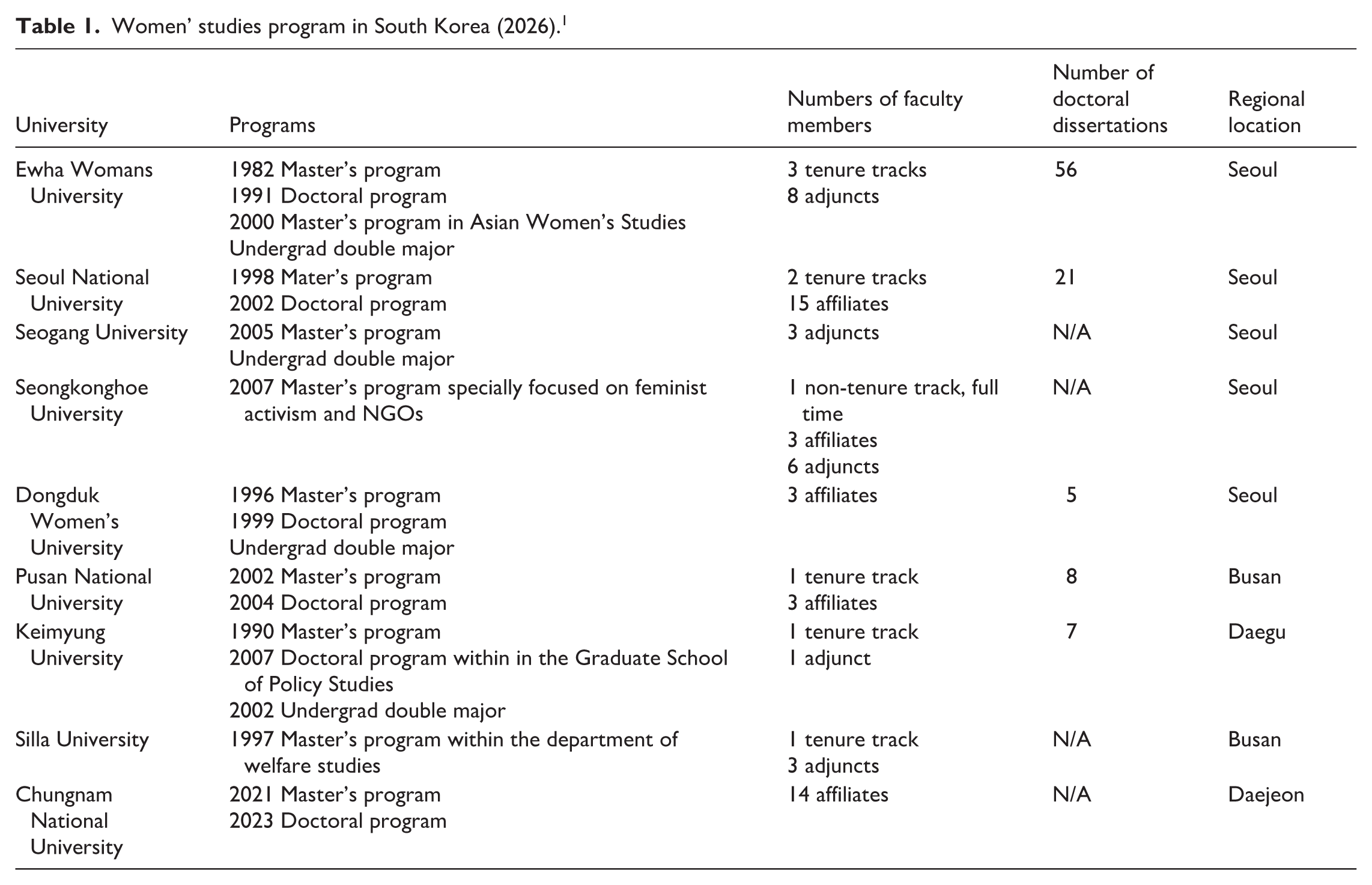
The following is a list of currently active women’s studies programs across the country. Despite the neoliberal restructuring of higher education and the conservative turn since the mid-2000s, nine programs in women’s studies remain in operation nationwide.
The Table 1 highlights key changes, trends, and reconfigurations that have occurred throughout the institutionalization of women’s studies within universities. First, in terms of regional distribution, many programs are located in the Seoul metropolitan area – the country’s economic and cultural center, which hosts the largest number of universities. Seoul is a politically more liberal and culturally cosmopolitan region, providing women’s studies with a vibrant community of feminist activism and policy networks. In contrast, in relatively conservative regions, women’s studies programs often serve as hubs for feminist scholars and activists and tend to be less prone to internal division or competition. Second, three programs are housed in state-funded public universities, while the remaining six are in private institutions. Notably, most programs outside Seoul are based in public universities, with the exception of Silla University in Pusan. This pattern reflects the relative financial stability of public institutions, which are generally less vulnerable to the pressures of neoliberal restructuring in higher education than their private counterparts. Third, the majority of women’s studies programs now operate within coeducational universities rather than single-sex institutions. This marks a significant shift from the 1970s through the 1990s, when women’s universities played a leading role in institutionalizing women’s studies, closely tied to their mission of advancing women’s education and gender equality. The diversification of the student body in women’s studies also suggests that coeducational universities have become increasingly attentive to issues of women’s leadership and gender equality on campus.
Women’ studies program in South Korea (2026). 1
In what follows, I examine specific women’s studies programs in South Korea to highlight the distinctive composition of each. To do so, I conducted three personal interviews with faculty members 2 and reviewed materials from official social media accounts, institutional statements, and annual reports published by the programs and their members. I also incorporate reflections from my own experience of teaching in the Department of Women’s Studies at Ewha Womans University since 2022. As detailed below, each of the four cases offers critical insights into the unique strengths and characteristics of individual programs, shaped by – and sustained through – varied political and institutional challenges.
First, Yoseonghak hyŏptong-gwajŏng at Seoul National University, launched in 1998 in response to growing student demand for feminist education and gender justice, demonstrates a relatively successful case of institutionalization. When it first opened, the program enrolled only three master’s students and had no full-time or tenure-track faculty. It has since grown to approximately 40 master’s and doctoral students, supported by two full-time tenure-track faculty members. The number of women’s studies courses has also increased significantly, alongside a broader presence of feminist scholars across disciplines, attesting to the field’s academic legitimacy and appeal. This gradual but steady growth, however, has depended heavily on the sustained efforts of committed individual feminist professors, whose career path was heavily curved by the heavy burden of institution building. They often had to prioritize administrative duties and teaching over their own research, while navigating an inequitable faculty-evaluation system, as they were contractually affiliated with departments other than women’s studies program.
Second, the Silch’ŏn Yŏsŏnghak Program at Sungkonghoe University, as its name suggests, was designed specifically for feminist activists engaged in women’s movements rooted in the minjung tradition and expanded during South Korea’s democratization. The program emerged from a collaborative initiative among four key partners: the Korean Women’s Associations United (KWAU), founded in 1987; the Korean Foundation for Women (KFW), established in 1999; the Amore-Pacific Foundation funded by Yuhan Kimberly Corporation; and Sungkonghoe University, a progressive institution known for its graduate programs for nongovernmental organization (NGO) and nonprofit organization (NPO) activists. By the early 2000s, many activists expressed the need for professional education to prevent burnout and adapt to shifting political and social conditions. Established in this context, the program represents an innovative model of women’s studies, bridging the divide between academia and activism through its curriculum, student body, and administration. Initially launched as a 1-year certificate program in 2007, it soon fully developed into a master’s program in 2010 with continued financial support from the Amore-Pacific Foundation. As of 2025, the program has operated for over 18 years, graduating approximately 114 master’s students and training around 1,274 feminist activists nationwide. While originally designed for full-time activists in NGOs and NPOs, it has since expanded to include younger activists working in digital networks and single-issue movements.
Third, the Yosŏnghakka at Keimyung University, which has endured both a conservative regional climate and the neoliberal restructuring of higher education since its founding in 1990, now faces renewed challenges. Notably, the program’s current struggle is not due to declining enrollment but rather from intensifying competition over shrinking institutional resources. Faculty and students have resisted administrative efforts to merge the program with the Department of Sociology, arguing that its 35-year history justifies continued institutional autonomy rather than relegation to a subfield. This case illustrates how neoliberal cost-efficiency, more than far-right political conservatism, to certain extent, can pose a direct threat to the sustainability of women’s studies. While far-right opposition has manifested in protests – such as those targeting gender and queer studies courses at Yonsei University in 2019 or the establishment of a new women’s studies program at Chungnam National University in 2020 - such backlash has not, in these instances, resulted in program closures (Park and Kim, 2019).
Fourth, the Yosŏnghakka at Ewha Womans University remains one of the most stable and well-resourced in the country despite significant downsizing from its peak. The number of faculty members has decreased from six to three, placing greater strain on the program’s operations and its affiliated research institutes. The student body is also changing, with an increasing number of international students from across Asia and beyond, contributing to greater diversity in national, ethnic, political, and religious backgrounds. While this diversification enriches the program, it also presents challenges for curriculum design and classroom instruction given the wide range of academic preparation among students. This shift reflects not only growing global interest in Korean and Asian women’s studies but also institutional strategies to address declining domestic enrollment due to low birth rates and intensified competition in higher education. At the same time, rising political conservatism and popular antifeminism have created subtle pressures within the classroom. Some Korean undergraduate students express concern about their future career prospects, amid circulating claims that major corporations – particularly in the tech sector – may discriminate against graduates of women’s universities or those with academic records indicating an interest in feminism (Oh, 2019).
Epilogue
Currently, women’s movements, women’s studies, and gender equality policies face intense backlash from a conservative bloc of young men whose antifeminist views have been cultivated through online male-dominated communities and reinforced by conservative politicians. In addition, major private companies, such as NCSoft and KB Kookmin Bank, have been criticized for practices perceived as anti-feminist, including the dismissal of employees identified as feminists and the manipulation of hiring processes in ways that favored male applicants (Bae, 2022; Choi, 2024; Kim, 2024b). Overall, the growing tide of antifeminism within political and economic institutions poses significant challenges to the sustainability of women’s studies, as it discourages younger generations from engaging with issues of gender equality and broader social justice concerns. The political polarization between young women and young men in South Korea, which often overlaps with broader divisions between liberal progressivism and conservatism, also indicates that gender equality lies at the heart of national politics and debates over the future direction of Korean society. This, in turn, underscores the continued importance and relevance of women’s studies and feminism.
The neoliberal restructuring of higher education poses another significant challenge to women’s studies, as it intensifies competition among universities, academic disciplines, and individual scholars. In particular, declining fertility rates and domestic student enrollment, combined with universities’ increasing emphasis on profitability, often lead to the downsizing of women’s studies programs in various forms. This trend also pressures programs to prioritize quantitative measures – such as student numbers, publication counts, and research funding – over the quality of education, thereby diluting the radical and transformative potential of feminist scholarship.
Resisting the commodification of higher education while also creating inclusive and supportive environments for international and non-traditional students requires rethinking both the content and boundaries of women’s studies in Korea and across Asia. The broader context of gender equality policies, women’s movements, and everyday gender relations should guide the future direction of the field. Women’s studies must remain responsive to the shifting realities of women’s lives and feminist activism, engaging these changes to produce critical, transformative, and socially relevant knowledge.
Footnotes

Funding
The author received no financial support for the research, authorship, and/or publication of this article.
Declaration of conflicting interests
The author declared no potential conflicts of interest with respect to the research, authorship, and/or publication of this article.