







Abstract
The research process and production of scientific knowledge has traditionally been understood to be based on abstract analysis and intellectual capacity rather than physical and emotional resources, promoting an understanding of academic practice as a detached, non-emotional and objective activity. Lately, several researchers have bemoaned this lack of recognition of the bodiliness of our work. In this study, we attempt to address this gap by exploring and conceptualizing some of the ways in which the embodied dimensions of academic research practices are intertwined with the articulation of ideas in the writing of scientific texts. In order to pursue our aim, we draw on experiences explicated through an autoethnographic approach, including the generation of personal narratives and in-depth conversations with 18 researchers from different universities in Europe and the US. The article contributes to the sociology of science and academic literacy literature, by conceptualizing the interconnectedness between sensuous and discursive understandings in this context. With the advancement of this theoretical approach, we illuminate how scientific practice is bound up with emotional, embodied, material, social, political and institutional forces. We also challenge the dichotomy between ‘knowledge work’ or theoretical tasks on the one hand, and ‘body work’ or physical labor on the other.
Keywords
Introduction
On an evening in October 2009, we (the authors of the present article) had an informal conversation about our current work situation as researchers. We felt very comfortable and happy at that moment, discussing how the research process according to our own experiences appeared linked to various emotional and physical states, and the context surrounding us. We asked ourselves: How can we understand this? Why is the role of embodiment and materiality so little recognized in the literature on scientific practice? Feeling inspired by the situation, we decided to do something about these questions.
After some reading we realized that lately, several researchers had bemoaned the lack of understanding around research work (see Butterwick and Dawson, 2005), and particularly the bodiliness and emotionality of our work (Dutton and Morhart, 2010; Van Maanen, 2010; Whiteman, 2010). As argued by Bell and King (2010: 429): Academics may be seen as a professional organizational group that is particularly reluctant to acknowledge or reflect upon the embodied aspects of their collective identity practices. The dichotomous and hierarchical opposition that exists between mind and body, intellect and emotion within academia presents the character of the ideal academic in a way which suppresses and subordinates the concept of the body through defining it negatively as unnecessary, intrusive or incidental.
While feminist studies of science have underlined the influence of gender (and undeniably the body) on the scientific research process (e.g. Barad, 1998; Haraway, 1989; Harding, 1993; McCloskey, 1999), few scholars have added to this tradition. Notable exceptions include Whiteman (2010) and Dutton and Morhart (2010), who highlight how the researcher’s emotions can enrich management studies and our understanding for organizational issues (see Bell and King, 2010; Engelsrud, 2005). Works within the academic literacy field also include attempts to acknowledge the embodied aspects of writing (e.g. Brandt, 1990; Haas, 1996; Royster, 1996).
However, we are still far from a systematic integration of the role of the body, emotions and aesthetics in studies of science and academic writing and commentators have lately made calls for more work in this domain, to share our ‘embodied experiences of the culture’ (Bell and King, 2010: 437) and to explore the effects of researchers’ emotions in organization studies (Whiteman et al., 2009; see also Kleinman and Copp, 1993; Lofland et al., 2006; Warren and Karner, 2004). Literacy scholars have particularly asked for work on how the sensuous/material and ideational/immaterial aspects of writing are interlinked (Lillis and Scott, 2007; Lu and Horner, 1998).
In this study, we attempt to respond to these calls by exploring and conceptualizing the intertwined nature of the embodied and discursive dimensions of academic research practices. More specifically, we focus on the practice of writing, which is today at the core of scientific practice (Wolf, 2008). In order to pursue our aim, we have engaged in in-depth conversations with 18 researchers from different universities in Sweden, Finland and the US. We are obviously full members of the research setting and the studied group and our method is inspired by analytic autoethnography (Anderson, 2006).
We feel that it is particularly intriguing to concentrate on the bodily facets of academic practices not only because this is something with which we have personal experience, but also as the research process, and production of academic knowledge, has traditionally been viewed as based on abstract analysis and intellectual capacity rather than physical and emotional resources (see e.g. Breuer, 2005). Challenging this one-sided (disembodied) view of academic work, which is most likely reinforced by the research community as a way of maintaining the status and ‘privileged position’ of the objective scientist, represent an important drive force in our work with this article. Our aspiration is to change the theoretical approach taken in studies of scientific practices, academic work, and writing. 1
The article contributes to science and literacy studies in several ways. Drawing primarily on Merleau-Ponty (1962, 1968) we first provide a framework for studying links between the ideational and material aspects of scientific writing practices. By highlighting how the body is an active force and resource—an agent—in academic research practices, we add to the nascent literature on embodiment in research and the management literature more generally, which heretofore mainly has illustrated the body as shaped by discourse (e.g. Bell and King, 2010; see also Yakhlef, 2010). In this way, we further respond to calls for theories on ‘embodied and socially, temporally, and spatially situated knowledge’ (Keller and Longino, 1996: 9). At a more general level, our work challenges the traditional dichotomy between ‘physical’ labor and ‘knowledge’ work or intellectual work, and the related distinction between white and blue collar work (see McNally, 2001; Zuboff, 1984). It is our argument that intellectual work is indeed a physical performance, and it needs to be acknowledged as such.
The article is structured as follows: first we discuss previous work on research and writing as practices, highlighting the limited treatment of materiality and the body in this context. Second, we present our theoretical approach and the method used. After that, we present the findings thematically, illustrating both the need and difficulty of carrying out research in ways that acknowledge the embodied character of academic work. 2 Finally, we draw conclusions from the study and discuss its implications.
Situating science
The traditional understanding of scientific knowledge suggests that it is the result of logical reasoning applied to observational and experimental data acquired by value-neutral and context-independent methods (e.g. Breuer, 2005). While this view remains and is influential in how we present research methods—a point to which we will return—there is today a large body of scholarship suggesting that scientific evidence is inevitably influenced by the scientist and the context of which he or she is a part.
Defining context
Social, ideological and political structures were early identified as important aspects of the research context. For example, Kuhn (1962) and Feyerabend (1987) insisted that scientific observation is always influenced by theoretical commitments and situated in the prevailing scientific paradigm. Sociology of science studies further underlined the role of social, rhetorical and political structures in scientific work (see Knorr-Cetina, 1999; Latour, 1987; Latour and Woolgar, 1986).
Is context only discourse, then? What about sensible, tangible, non-discursive aspects associated with the human body and its material surroundings? These aspects have been less elaborated, but several efforts are worth mentioning. Sociologists of science have looked at materiality in terms of the role played by artefacts such as engines, probes and detectors in structuring scientific practice (eg. Callon and Latour, 1992; Knorr-Cetina, 1999; Latour, 1987; Law, 1993; Pickering, 1993); however, these studies focus more on how knowledge is distributed and inscribed in such material objects than on the role of the human body as a subject in the operation of scientific practice. For example, Latour’s studies of laboratory settings focus on the discursive, cognitive interactions between humans and nonhumans (see Preda, 1999) while saying little about the sensuous experiences of the human body. Feminist scholarship expanded the view of the material context by emphasizing how non-discursive or embodied aims and gender (biological as well as social) affect the practice of science and scientific accounts of the world (e.g. Barad, 1998; Haraway, 1989; Harding, 1993; Keller and Longino, 1996; Smith, 1990). Recent studies of the embodied characteristics of academic work have made efforts to extend these insights (e.g. Bell and King, 2010; Spicer, 2005). For example, Bell and King (2010) explore how individuals come to enter the field of critical management. Their focus is on the body skills that individuals use to demonstrate their proficiency in ‘being a critical management scholar’ at conferences. They find that the ability to be controlled; endure and silence the body are important skills in the academic conference setting: ‘the proficient CS academic learns to cultivate her dispassionate, disembodied mind by subordinating her volatile, emotional body’ (p. 436). Bell and King (2010: 430) conclude that ‘the body is thus the surface onto which the culture is inscribed and the vehicle for its reproduction through enabling the interiorization of ethical values that guide behavior’. Thus, Bell and King (2010) provide an excellent account of how the socio-political norms are internalized by scientists’ bodies.
A view of the body as more active is presented in Engelsrud (2005) and a recent 2010 issue of Journal of Management Inquiry, which focuses on the positive role of emotions in empirical data collection and analysis. Here, Van Maanen (2010: 338) states that ‘feelings, values, and moral precepts guide our work as surely as they guide our actions beyond our research endeavours’. For him, a driving force in his work has been the emotion of grievance arising from ‘a deep and personal sense that things aren’t as they should be and no one is doing anything about it’ (p. 338). In the same issue, Dutton and Morhart (2010: 342) claim that heart-warming experiences can inject the relationship between the researcher and the respondents with humanity and mutual understanding, reduce stereotyping, and ‘offer insights into phenomena often blinded by the quest for “objectivity”’. Obviously, this view of emotions as a resource in scientific work is in sharp contrast to the traditional association of bodily sensual characteristics with unreliability and faultiness in understandings of science (Breuer, 2005: 104).
In summary, the view of science as situated in a context and influenced by the researcher’s personal dispositions is increasingly accepted. However, most empirical studies of scientific practice have emphasized the social and discursive aspects of this situatedness. The few studies bringing material aspects to the fore mainly refer to the body in terms of its internalization of social, discursive norms and have mainly depicted the body as making itself heard by means of suffering, for instance, being in pain, feeing exhausted, feeling embarrassed etc (Bell and King, 2010; Spicer, 2005). Now, is this really the sole role of the body? A nascent area of management research emphasizing the positive role of emotions in academic work suggests that the answer to this question is no. As we shall discuss next, academic literacy and composition scholarship can help us elaborate on these issues.
Academic literacy studies
The field of literacy and composition studies has exhibited a shift from a linguistic focus on text towards ethnographic studies of the practices surrounding the production of texts during the last decade (Barton et al., 1999; Brandt, 1990, 2001 Lillis and Scott, 2007). Several works in the literacy field have explored the social and political context of academic writing practices. For example, Lillis and Curry (2010) highlight that academic text production is situated in geographical, geopolitical and geolinguistic contexts that determine for example access to resources and possibilities to publish (see Canagarajah, 2002; Fleckenstein, 2003; Kirsch and Ritchie, 1995; LeCourt, 2004). While providing significant insights, these studies primarily situate writing in cultural and discursive contexts while discussing the embodied and material aspects of writing practice to a lesser extent.
Notable exceptions include Haas (1996) who examines the effects of ‘material and cultural tools’, such as computers on the thinking process. Her study of writers’ use of computers in the 1980s illuminates how writers’ reading of their own texts change when they use computers instead of a pen and paper: ‘different writing technologies set up radically different spatial, tactile, visual, and even temporal relations between the writer’s material body and his or her material text’ (p. 226). While Haas (1996) views writing as a practice based in culture, in mind and in body, her work mostly elaborates on the effect of computers on the thinking process, while theorizing less about other material aspects of the research context, and the role of writers’ bodies therein.
In general, the nascent literacy literature on body and materiality (e.g. Royster, 1996; Swales, 1998) does not theorize much about the links between the material and immaterial. Authors have criticized the disembodied nature of current work in ethnographic studies of academic literacy/composition (e.g. Lu and Horner, 1998; Spellmeyer, 1996) emphasizing the need for studies of the dialectical rather than the polar relation between sensuous experience and discourse (Lu and Horner, 1998). While Haas (1996) provides important inroads to such studies by defining writing/thinking and technology as co-constitutive, and by arguing that this symbiotic relationship is based in the embodied actions of human beings, there is a need for models allowing us to further approach ‘thought as felt and feeling as thought’ (Lu and Horner, 1998).
The promise of practice theory
As argued by Lillis and Scott: practice offers a way of linking language with what individuals, as socially situated actors, do both at the level of ‘context of situation’ and at the level of ‘context of culture’ … practice signals that specific instances of language use—spoken and written texts—do not exist in isolation but are bound up with what people do—practices—in the material, social world. (Lillis and Scott, 2007: 11–12, see also Barton et al., 1999)
A focus on practices (Bourdieu, 1990; Heidegger, 1962) invites us to focus on different dimensions of human activity: its ongoing character; its embodiment within human bodies; its embeddedness in socio-political contexts; its relation to the material and symbolic capabilities of artifacts; its dependence on shared practical understandings; its capacity for improvised responses to emergent situations; and its enactment—generation, reinforcement, renewal and transformation—of social structures through everyday action (see Giddens, 1984; Leonardi and Barley, 2010; Orlikowski, 2000). Few works however provide empirical or theoretical accounts of how the ideational and material dimensions of writing practices are intertwined, and in particular the role of the human body in this context. This is symptomatic of the practice literature at a more general level. While Bourdieu (1990) suggests that the body is constituted by and constitutes practices and shared understandings, the material and bodily aspects of practice remain under-researched (see e.g. Hindmarsh and Pilnick, 2007; Jarzabkowski, 2009; Orlikowski and Scott, 2008; Schatzki, 2001; Yakhlef, 2010). Orlikowski and colleagues (Orlikowski, 2007; Orlikowski and Scott, 2008) have argued for a ‘sociomaterial’ approach, acknowledging that the social and material are entangled in practices. However, there has generally been an emphasis on the social in terms of the discursive to describe practices (Brown and Duguid, 1991; Contu and Willmott, 2003; Gherardi, 2000; Lave and Wenger, 1991). One reason for this may be the view that practices pre-exist individuals (Schatzki, 2001) and are genuine collective entities ’immune’ to individualist analysis (Barnes, 2001). Against this background, several authors have argued that the body commands attention in practice theory, not to return to an individualism, but as the meeting point of individual activity and society (see Jarzabkowski, 2009; Schatzki, 2001), i.e. what Brandt (1990) early identified as the need to link the little picture (individual writing processes) on the one hand, and the big picture (how literacy is embedded in cultural, political and rhetorical processes) on the other.
A phenomenological approach to academic writing as embodied practice
The present article defines practice as ‘embodied, materially mediated arrays of human activity centrally organized around shared practical understanding’ (Schatzki, 2001: 2). Thought, from this view, is not produced by a transcendental consciousness but is forthcoming in engaged, bodily activity (see Bourdieu, 1977, 1990; Gallagher, 2005; Taylor, 1995; Yakhlef, 2010). As Yanow (2006: 1748) says: ‘practice-relevant knowledge … is “available” only in and through interacting with the machines, through hands-on, trial-and-error doing’. Hence, activity is the central element of practice. We combine this perspective with phenomenologist theories of Heidegger, Husserl and Merleau-Ponty to further elaborate on the body as the actor performing activity and thus constituting a link between ideal and material aspects of academic writing practice (Yakhlef, 2010).
Perception as an active and intentional bodily performance
Merleau-Ponty (1962) emphasizes that the body is the medium of all perception. It is through sensuous experiences such as smelling, feeling, seeing, tasting, emotional arousal, touching, etc. that we as body-subjects come to know our reality. These acts of sensing and perceiving are active corporeal performances, a reaching out towards the environment, rather than a matter of our senses passively recording external objects and our minds subsequently interpreting these representations in our brain. Our perceiving body is guided by a fundamental intentionality to be in harmony with its context, and it perceives and responds to cues that enable us to function smoothly in the practices in which we participate. That is, consciousness is not a matter of ‘I think’ but ‘I can’: Perception and action are closely intertwined as we perceive what we can act on. As noted by Husserl, everything we experience is shaped by possibilities for engaged action. ‘Seeing’ a cup, for example, actually involves experiencing: a range of possibilities involving the cup. … there are the possibilities of gazing upon it from a different angle so as to reveal its hidden aspects and of picking it up. And the possibility of drinking from it is especially salient. (Ratcliffe, 2010: 136; see also Husserl, 2001)
In any experience, only certain possibilities are offered up and only some of these appear especially salient. Some possibilities have an affective force, which makes pronounced bodily dispositions involving the object appear in the object and makes us feel the ‘affective pull of enticing possibilities’ (Husserl, 2001: 98). This implies that sensuous and affective states are not accompanying phenomena. They have an indispensable role in structuring experience. Heidegger (1962: 175) used the term ‘Befindlichkeit’ to refer to emotions, moods and sensuous experiences as ‘ways of finding oneself in a world’, of ‘In-der-Welt-Sein’. 3
History as a bodily infrastructure
Our bodily perception and responsiveness is pre-reflective as it is not guided by explicit instructions from our mind, but rather by the body’s fundamental intention to achieve a grip on and participate in a practice. Action and perception operate in tandem in an unmediated way without necessarily taking detours through our ‘reflective’ mind. Yet, there is mediation at another level. What makes sense for us to do and thus to see, feel or hear is influenced by our previous experiences and situatedness in a cultural context, i.e. Bourdieu’s notion of habitus (1977, 1990). Experiences are incorporated into our body schema, and our history becomes ‘sedimented’ in our bodily gestures and lived out in practice. Hence, our sensuous perception is based on a bodily infrastructure that includes past doings and sayings (Schatzki, 2001). This infrastructure can be understood as a non-discursive reflection, an abstraction which is not explicated in language, but in terms of habits (Yakhlef, 2010).
The flesh—movements between the sentient and the sensed
In his later work, Merleau-Ponty (1968) refers to perception as the self-revelation of the sense of a world in and through a being which is itself a part of the world, flesh of its flesh. The ‘flesh’ is the generality of the sensible, ‘an anonymity innate to myself’ (p. 133). To see, from this view, is to be being drawn into a dimension of Being. He writes: ‘When seeing, I do not hold an object at the terminus of my gaze. Rather I am delivered over to a field of the sensible’, which is structured in terms of the ‘difference between things and colors, a momentary crystallization of colored being or visibility’ (p. 132). Hence, rather than speaking of perceiving body subjects he speaks of a visibility ‘sometimes wondering, sometimes reassembled’ (p. 138) through the interaction between the visible and the invisible, the body and the world, in the flesh. This notion of reversibility challenges the model of subject, act and object, referring instead to the body as the place where the sensible reveals itself. Merleau-Ponty talks about the reversibility in terms of the body’s non-coincidence with itself. Our hand, eye, voice are both touching, seeing and speaking, and at the same time tangible, visible and audible. However, we never, at the same instance, experience our hand as touching and as touched. He writes: ‘either my right hand really passes over to the rank of the touched, but then its hold on the world is interrupted, or it retains its hold on the world, but then I do not really touch it’ (p. 148). Similarly, Ratcliffe (2010) discusses how when you touch something hot, the primary object of experience might well be your hand, as you pull it back in pain. But in routine activities, what is felt is not the hand but what it touches. Our hand is not an object of perception but an organ of perception, our hand and body become immerged with the world. ‘The feeling is neither external nor internal in its phenomenology—it is a matter of connectedness, relatedness, lack of differentiation, which should not be pulled apart and re-interpreted in terms of two separate phenomenological components’ (Ratcliffe, 2010: 135). This resonates with feminist scholars’ notion of the erotic dimension of knowledge (Keller and Longino, 1996) and the argument that the subject of knowledge should be placed on the same causal plane as the objects of knowledge (Barad, 1998; Haraway, 1989; Harding, 1993; Keller and Longino, 1996).
Texts and pretexts
Merleau-Ponty (1968) suggests that ideas come forth in the flesh, thus allowing language to emerge. Meaning comes from movement between ‘silent’ and linguistic meaning. From this view, language is not a self-referential system detached from the body, labor and praxis (as in, for example, Saussurean linguistics and post structuralism (McNally, 2001)). As argued by McNally: language is part of a behavioral complex with an evolutionary history… language is not identical with consciousness and knowledge … it is built upon and presupposes extra-linguistic forms of understanding. Language is dependent on other forms of corporeal and praxic knowledge … any language depends upon a prior grasp of a range of practical activities which are intelligible to some degree in and of themselves … the body, sensation, labor, and eros, constitute the basis for the intelligibility of social life, and of the material world in which social life is lived. (McNally, 2001: 108, see also Heidegger, 1962)
As argued by Lillis and Scott (2007: 12), language might be understood as practice—resource. For, by engaging in an existing practice we are maintaining a particular type of representational resource; by drawing on a particular type of representational resources, we are maintaining a particular type of social practice. Hence, the notion of practice conceptualizes the link between the activities of reading and writing and the social structures in which they are embedded and which they help to shape (Barton et al., 1999).
Milloy (2005) provides a fascinating account of writing inspired by the Merleau-Pontian view of texts. She writes about a ‘touching in absence’, which takes place in a gesture of writing: Just because I am sitting in a chair, whether with pen in hand or fingers hovering in expectation over the keyboard, it does not mean I am still, motionless. The whole body is poised in between and resonates with movements, spilling toward words that mark out the journey along the markings on the page. (Milloy, 2005: 546–547)
Hence, Milloy (2005: 548) refers to a text before language: ‘This first writing, before words, like a primary movement of kinesthesia, is not intentional in a sense of conscious purpose, although there is a proprioceptive intentionality that I call Eros’. She writes that Eros is a pulse ‘between I move and the reflective I can move. Eros holds with I move while it drives towards the I can. Eros posits I want to move, but it moves even before that’ (p. 548).
This view of writing as movement driven by Eros, suggesting that writing is a physical performance provides an alternative to the view of science and academic writing as detached logical reasoning We have built on this view and the other assumptions highlighted in the phenomenological approach outlined above when studying and writing about how the material and immaterial aspects of academic writing are intertwined.
Method
Autoethnography
Our approach is inspired by analytic autoethnography, which Anderson (2006) refers to as research in which the researcher is (1) a full member of the research group or setting (2) visible as such a member in published texts, and (3) committed to developing theoretical understandings of broader social phenomena. We are also inspired by embodied approaches in management studies and the social sciences (e.g. Dale, 2001; Knights and Thanem, 2005; Munkejord, 2009) and in line with for example Breuer (2005), who suggests that researchers should focus on, and cultivate, a body-centered and self-reflexive orientation for gaining knowledge; we have attempted to utilize an auto-ethnographic method tuned towards an embodied methodology. We assume that our knowledge of others is not merely generated from a well-informed mental state through causal explanation or deep interpretation. To a large extent, it is built on our pre-conceptual, pre-discursive and bodily capacity to grasp their emotions, intentions and experiences: We know our peer-researchers’ bodies through our own bodies. We further assume that our bodies (our body language, emotional expression, etc.) affected our peer-researchers during interviews (e.g. Dale, 2001). This relates to the notion of auto-ethnographer as a ‘live participative embodied researcher’ (Spry, 2001: 709), which implies: ‘concentrating on the body as the site from which the story is generated, thus beginning with the methodological praxis of reintegrating my body [read ‘our bodies’] and mind [s] into my [our] scholarship’ (Spry, 2001: 708).
Our purpose is not simply to document personal experience, to provide an ‘insider’s perspective’, or to evoke emotional resonance with the reader. We wish to ‘use empirical data to gain insight into some broader set of social phenomena than those provided by the data themselves’ (Anderson, 2006: 387). That is, to formulate, refine and extend theoretical understandings of social processes. Hence, we do not merely build on our own experiences, but also draw on 18 other researchers’ experiences of academic work. The participants are researchers at seven different departments and three different universities in Sweden and in the US (see Table 1). Rather than performing interviews, we engaged in face-to-face, in-depth conversations with them (McCracken, 1988) that enabled flexibility and open-endedness. The conversations lasted for about 60 minutes each.
Participant academic practitioners.
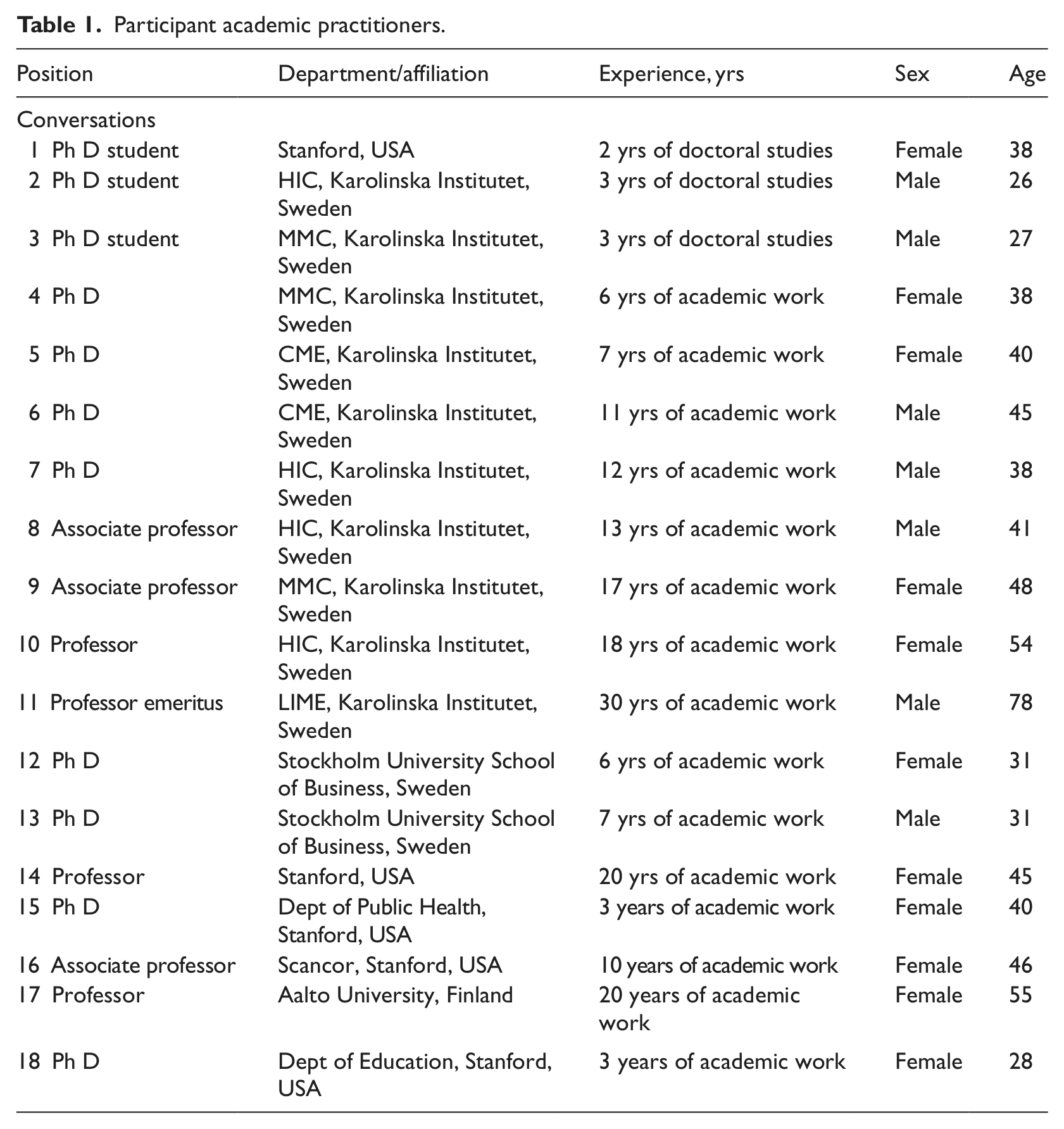
A limitation with the conversational method is that respondents may have difficulties articulating their bodily experiences. Hence, we tried to create a casual, ‘coffee-chat’ atmosphere during the conversations, to encourage openness and to reduce impression management, which other researchers have found to be common in peer-to-peer interviews in the research setting (Bryman and Cassell, 2006). In the conversations, we also integrated and related respondents’ reasoning to our own experiences, which oftentimes encouraged the respondents to elaborate on their answers. This enabled our participants and us to together open up and reflect on our experiences as a community. This approach resembles Kirsch’s (1997) notion of interpretive responsibilities, which underlines the need to begin to collaborate with the individuals we study, viewing them more as ‘writers’ rather than ‘respondents’.
Thus, we consider our research to be co-produced by our peers and us. Our ambition has been to let this co-production show throughout the article in an attempt to rid ourselves from fictive claims of objectivity, but we are aware that we are still hiding ourselves behind phrases like ‘research says’ in the literature review inter alia, which connotes a disembodied speaker who gives voice to reality (see Cintron, 1993).
Our conversational approach created a spirit and space where we could ask open-ended questions such as: ‘Could you describe what an ordinary work week looks like for you?’’ ‘What is creativity in research for you?’, ‘How do you feel when you are most creative?’, ‘How and when do you write?’, ‘How do you get your best ideas?’, ‘How and when do you write the problem definition, discussion and conclusion sections?’, ‘Under what circumstances do you feel less creative?’, etc. In general, by relating to our own bodily experiences, we were able to understand the respondents more fully, ask relevant questions and probe them during the conversations. We really enjoyed the conversations, which were filled with laughter, empathy, and mutual sharing and co-construction of experiences, and sometimes also astonishment of how diverse experiences we actually had. This would have been impossible had we not been members of the group under study.
Overall, we feel that the chosen approach enabled a deeper informative reciprocity between us and the other ‘group members’ interviewed. Like other autoethnographers, we found that insights from conversations made us understand our own situation better (Davies, 1999).
To further utilize our own experience, both authors wrote down our personal writing experiences in diary format (describing writing episodes occurring during the day, etc.) periodically during the writing of this article. These are referred to as ‘personal narratives’ in the empirical presentation. The narratives changed along with the revision of the theoretical framework. The extracts included here are influenced by the notion of writing as movements between silent and linguistic meaning, between individual acts of writing and the institutional context. This was something we increasingly experienced along with the explication of this aspect in the theoretical framework. Hence, we are not claiming that the narratives are ‘truthful’ recordings of our factual experience at a specific time. The narratives are constructed fragments of experience, influenced by the writing process itself (Gannon, 2006). Nevertheless, they are written with the honest ambition to share a dimension of experience—in a publishable way.
Data analysis
During the conversations, we continuously took notes and we also recorded the conversations. Following the pattern for inductive research (Denzin and Lincoln, 2003), we worked recursively between the conversation notes, the interview transcripts, our own narratives and the theory being developed. We first focused on building detailed descriptions of particular bodily and material experiences mentioned in conversations or personally experienced. These primary and hands-on descriptions were then coded tentatively at a more abstract level, where we as researchers aimed to shed light on and understand the data in interaction with the theoretical framework. This was a repeated process of interrogating the data, revising the theory and returning to the data. Thus, in line with Strauss (1987) who underscores that coding is not merely about giving categories to data, but also about conceptualizing the data, raising questions, providing provisional answers about the relationships among and within the data, and discovering the data, coding was an essential part of the analytic procedure. It enabled us to open up an inquiry about the data, to complicate it and expand it, and hence move toward interpretation.
Reflections on the methodology
As mentioned above, the limitation with the conversational approach for the purpose of this article is that our peers may have difficulties articulating how their bodies are intertwined with their writing. In order to address this, we could have conducted observations of our peer researchers to grasp the role that bodily and material dimensions played in their writing process. However, this would limit the respondents’ possibility to bring forward their own experiences, and instead, we would risk falling prey to, and mainly giving voice to our own interpretations. Observations could also be too intrusive for studying the delicate and individual writing process and thus reduce the flow.
Furthermore, since the aim of ethnography and autoethnography is to provide detailed (sometimes referred to as ‘truthful’) accounts of experiences, it is simultaneously important to question how much of our experienced reality we can bring forward in text. Postmodernists argue that text making is a rhetorical construction without a necessary connection to reality because words cannot be grounded in anything but themselves. Furthermore, Cintron (1993) states that verbal language (converted to transcripts) by its very nature is not a clear window into reality. We agree with these researchers, and during the writing of this article, we have experienced how challenging it is to try conveying our embodied experiences and those of our respondents, and how limiting is not only the discursive format, but also the academic article format. However, as academics of our time, we are more or less obliged to adhere to the standard presentation of research in textual form despite its restrictions, and in addition, these texts need to follow a strict academic writing format with strong institutional origins. The problem of the limiting academic format is something that Richardson (2000: 517) bemoans, claiming that academic texts are becoming more and more de-personalized and boring, and that this is due to the fact that scientific conventions hold tremendous material and symbolic power over social scientists and ‘our sense of self is diminished as we are homogenized through professional socialization’, which reduces any signs of personal style in our texts. She also claims that what she refers to as the ‘mechanistic scientism’ has caused us to view writing as something we do after the research is done, i.e. ‘writing up’ research (echoing a view of writing as writing down our pre-existing thoughts and research findings) rather than as a creative and dynamic process and a method of discovery imperative to the research process. Van Maanen (1995: 134) underlines the institutional dimension of this problem: we cultivate and teach a writing style of nonstyle that values limited metaphor, simplicity and a formal, if not mathematical, precision. Much of our writing is washed by a thick spray of claimed objectivity since artful delights and forms are seen by many if not most writers (and readers) in the field to interfere with the presentation of what is actually there in a given social world.
Within the field of organization studies, Mumby and Putnam (1992) conclude that the expression of emotions has not been encouraged, and the status quo still appears to remain 17 years after their statement, with commentators bemoaning that: ‘the majority of narratives on organization studies remain sanitized, emotion-less texts’ (Whiteman et al., 2009: 47). For Fuchs (2001) this kind of writing is symbolic of researchers’ attempts to legitimize their research, and beliefs that de-personalized, mechanic and emotion-less texts make research more objective. Very recently, similar complaints have also been raised by Mohrman (2010: 346) who states that: ‘we strive to remove our emotions, political agendas, and biases through the pristine methodology we try to employ—as if our work is somehow privileged and as if we produce truth about “them,” our subjects’.
The mechanistic scientism and sanitizing of an embodied researcher in research texts is surprising given that a number of qualitative methodology books have acknowledged the role of emotions as part of fieldwork (Kleinman and Copp, 1993; Lofland et al., 2006; Warren and Karner, 2004). Referring to the role that emotions play in conducting fieldwork, Lofland et al. (2006: 136) claimed that: ‘[C]ognitions are an integral part of feelings, just as emotions are an integral part of meanings’ and that to separate emotions from reason ‘is[…] to distort the experienced world’. Ellis (2007: 14) explained how she and her colleagues in sociological autoethnography ‘feel and tell stories, remembering in [their] bodies, and reacting against the harshness of the critical attitude on which the academy prides itself’, aspiring to ‘offer up an alternative way of being and feeling in academia’. Blakely (2007: 6) underlined that acknowledging emotions in research can ‘open up space for new questions, ideas, and interpretations; challenge fundamental concepts, such as claims to truth, subjectivity, objectivity, and experience, allowing new approaches to method, theory, and knowledge to be explored’.
In this research article, we have made serious attempts to acknowledge and address these shortcomings, and in this process we have realized how entwined we are in the academic discourse and how difficult it is to free ourselves from the constraints that this imposes on our writing. So how can we write in a more embodied way? How can we create texts that are less ‘sanitized’ from emotions and more interesting and closer to the reality that we as researchers experience when we are out in the field?
Here, we have aimed at modestly practicing what Richardson (2000) referred to as experimental writing, which implies that we have remained personal and revealed our own lived experiences, hence experimenting with the constraining academic format, and aimed at capitalizing on and incorporating our bodily sense-making and emotions in the research process and the text. Our aim has been to encourage the reader to relive the events and instances we experienced as fully as possible—this is however a great challenge.
Self-reflexivity
Personal writing styles such as autoethnography have been criticized for leaving little room for critical analysis and evaluation (e.g. Brandt et al., 2001; Garratt and Hodkinson, 1998; Kirsch, 1997), especially of the self. An important part in ethnographical studies in general, and autoethnography in particular, is the notion of self-reflexivity, which implies that the researcher writes into his or her research how the self has affected the research in question. ‘On the one hand, self-reflexivity is used to describe a meta-theoretical reflection upon the activity of writing texts. On the other, it is also employed to name a phenomenological or experiential moment of interacting with others in the field’ (Probyn, 1993: 62). Thus, any account we produce must simultaneously inscribe and transcend the self who produces it (Mortensen and Kirsch, 1996). According to previous research, this is a true challenge for several reasons.
First, some scholars have raised critiques regarding self-reflexivity, complaining that: ‘even the most torrid of ethnographic self-reflexivity leaves untouched material questions about the gender, sexuality and class of those who conduct the self-reflection’ (Probyn, 1993: 60). In other words, by and large, it is a male that emerges in most ethnographic work and masculinity is the unremarkable norm. Thus, we need to go one step further and ask: ‘what exactly a self-reflexive self is reflecting upon’ (Probyn, 1993: 60). In this work, we have made an attempt to be self-reflexive but we also want to problematize the concept and show the difficulties implied. We are both heterosexual women and mothers, with a similar background coming from white, middle-class families with childhoods in wealthy suburbs; we are both conscious about our bodies in terms of exercise and healthy food; and we are both advanced academic scholars. This background affected our choice of research topic and the empirical data in multiple ways. However, exactly how it affected our research and how to make this explicit involves several difficulties. The first reason for this is that we have no ways of knowing how our research would have looked if we had been, for example, male, or homosexual, since we have no effective and truthful ways of imagining another embodiment than our own. However, we have the feeling that being who we are has enabled our interactions and conversations with other female researchers, with whom we shared many (female?) experiences. McGuire (2002) illustrates similar experiences, describing an interview she conducted while researching attitudes of farmwomen in rural Ireland. Both McGuire and the interviewee were mothers, and McGuire was nursing her child as they spoke, which affected how she related to the other woman, and felt ‘the sheer physicality of our mutual understanding. We understood each other, not only cognitively or emotionally, but also with our bodies … I remember this moment now with my body/mind, not just mentally’. Thus, for McGuire, shared physical experience can be capitalized on in ethnographic work since it works as a sort of intuitive understanding of social situations that enables us to adapt to the situation, make more meaningful interactions and also be able to recall (with an embodied mind) those more easily.
Along similar lines, Breuer (2005) acknowledges the importance of viewing the bodily contact between researcher and respondents as a resource in observation or interview situations, drawing a parallel to psychoanalysis, where this is referred to as countertransference. In our interviews, we experienced these emphatic potencies of understanding especially in relation to our conversations with female researchers, with whom we often felt a stronger connection (for example by touching each other during the conversation).
It is important to keep in mind that despite researchers’ attempts at self-reflexivity, questions have nevertheless been raised regarding the capability for self-knowledge and self-articulation (Gannon, 2006), and while autoethnographic research presumes that subjects can speak for themselves, poststructuralists disrupt this presumption and stress the impossibilities of writing the self. As an alternative, Gannon argues for a reconfigured poststructural autoethnography, where self-knowledge is considered to be tentative, contingent, and situated and where there are no full experiences that we can articulate in our research in order to reveal our ‘true’ identities or ‘hidden selves’. Our human nature is rather viewed as reconstituted by the forms that we create along the way, in writing for example.
A second critique that has been raised by Brandt et al. (2001: 6) is that choices regarding how to read ourselves are shaped by ‘narratives that dominate our minds and world at the time’. Subjectivity is hence a relational matter, but oftentimes, the evidence of experience that the autoethnographer struggles to capture in her writing, risks overlooking questions about the constructed nature of experience, and how one’s story is necessarily structured through language and history (Scott, 1991). No experience, no matter how intimate or individual, can be explained solely with reference to itself (oneself). Everything, even (and perhaps especially) our bodies, is always already inscribed within a culture (Derrida and Ewald, 1995).
Academics acknowledging their subjectivity as a relational matter and making this explicit in their writing are still rare, and Hindman (2001: 2) calls for more research that addresses the institutional origins of individual writing and examines ‘how tastes, affect, and knowledge are disciplined by and for particular, institutional realities’. This takes self-reflexivity a step further, and rather than halting at aspects of our background such as for example race, gender, etc. we also need to capture how the self is shaped by institutions, ideologies and discourse. Villanueva (1991) refers to this as autobiography, which implies problematizing the existential and the institutional origins of individual preferences. In an attempt to confront and interrogate the cultural and institutional logics via textual practices that simultaneously represent and trouble our selves at the same time (Denzin and Lincoln, 2003), we have attempted to begin to acknowledge in our writing how the academic institutional and cultural norms have shaped our and our colleagues’ experiences, making clear that these are entwined with a specific time, history and context that need to be shed light on in order to more fully grasp why particular experiences are lived and recounted rather than others. 4
Academic writing practices as situated movements between the sensuous and discursive
In this empirical section, we will draw upon our personal narratives of academic writing, and our peers’ experiences related to this. To start with, we would like to underline that our own understanding and those of our colleagues about how to define academic writing, to a large extent overlapped. Generally, our colleagues referred to the academic writing process as a task of theorizing in terms of identifying theoretical gaps, conceptualizing empirical material in novel ways and creating new perspectives. No-one disputed the idea that discursive creativity involves sensuous experiences and is closely intertwined with the physical context, which was in line with our own experiences. The feeling of sharing similar experiences was, especially at the initial stage of the conversations with peers, almost a relief, or at least, a satisfactory feeling to discover that we were not alone with these experiences. However, we early understood that there is great variation in individuals’ experiences of how they were able to/allowed to use their sensuous experiences as resources in their writing processes. In the following we provide illustrative examples (quotes from our conversation with peers and extracts of own narratives) of the data from which we drew our inferences sorted along three main themes. The themes overlap, but illustrate qualitative aspects of how sensuous and discursive understandings are interlinked in academic writing practice.
Moving before seeing
What emerged from conversations and our personal narratives was that discursive thought comes forth through physical engagement with text, material tools and memories rather than being thought ideas awaiting transcription. The following extract illustrates how ideas emerge and are successively made explicit in-action: I seldom have a clear formulation in my head before writing a paper. Rather, my intention is often to ‘write my way to’ an idea or conclusion. In fact, I could not ask someone else to ‘write down my thoughts’ as most of my conclusions emerge through the bodily effort of writing. In a sense my hands draw conclusions as much as my brain. (conversation, E1)
Hence, hands-on movements and re-arrangements of text precede the ‘I see’ (see Table 2A). Material tools participate in these movements, as extensions of our bodies. Of course, the material tools recruited by researchers differ depending on their individual history. The computer was not as ready at hand to everyone as it is described in the quote above. Older colleagues rather referred to how sketching on a piece of paper allowed meaning to become visible through rounds and rounds of revising: There is a huge difference between reading on the computer and on a printed paper. I often print my drafts. It is easier to make creative notes on a paper, compared to a digital document. I just get better ideas when I can read my texts on paper, and having a pencil ready to hand … this makes the journey to publication shorter. (conversation, E2)
Additional empirical illustrations of identified themes.
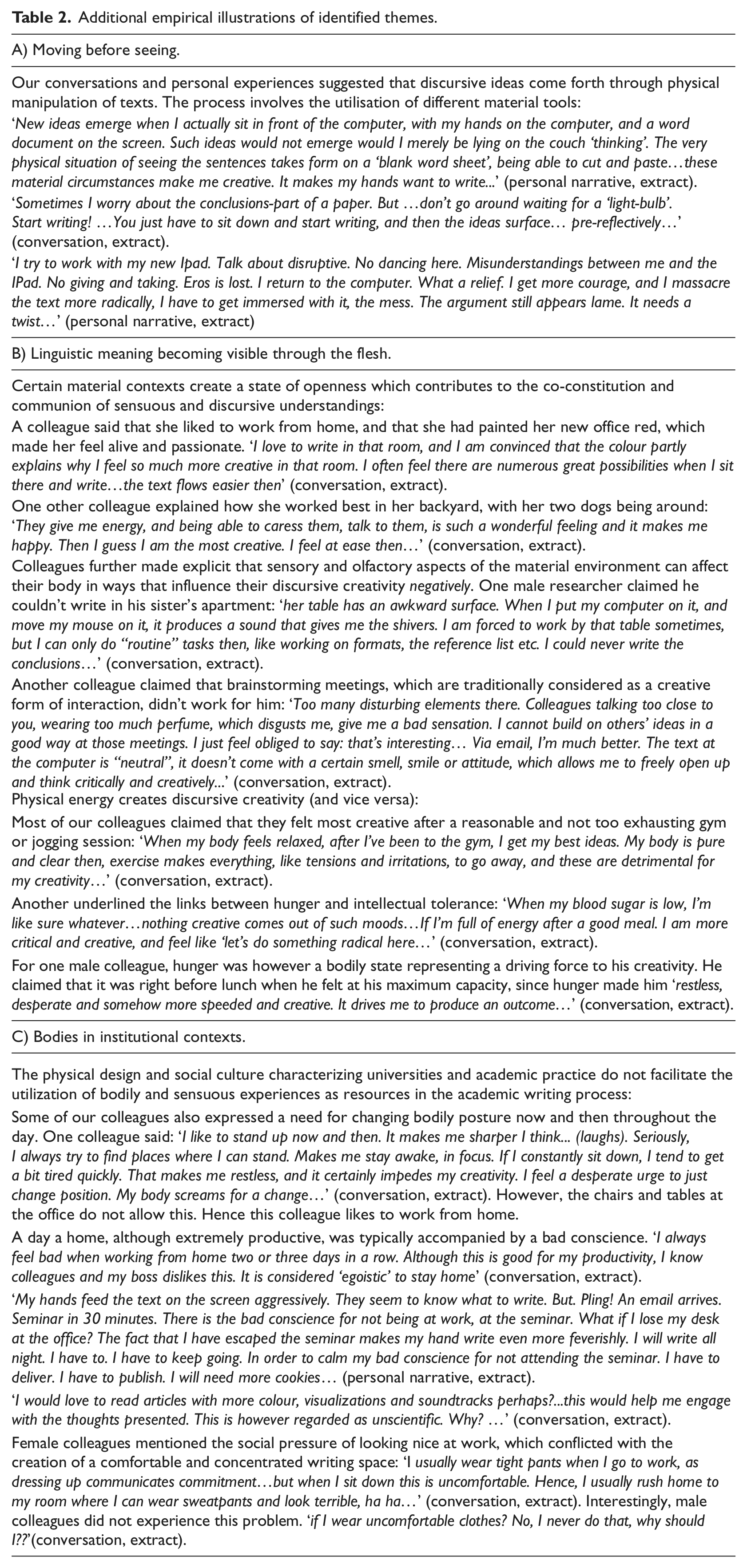
The interaction between bodies, tools and texts are immediate and spontaneous but also manifestations of individual practitioners’ history and a practice-related culture. What makes sense for us to see and what makes sense for a pair of hands to do depends on the goals inherent in the practice of academic writing. We perceive gaps that we can address, as illustrated in a personal narrative extract: I’m at my parents’ house and I know that I will be able to work undisturbed for as long as I want. What a luxury. I open the latest version of my challenging manuscript. Will I be able to turn it into a publishable paper? Before I know this, I need to work hands-on with the text, which is now a mishmash of parts from an old submission, summaries of new references suggested by the reviewers, and new empirical material. I let my hands and the mouse structure the text, hoping for inconsistencies and gaps to become visible. My hands shuffle sentences according to categories such as literature review, method, implications (potentially, depending on the final aim of this paper). My hands know the difference between these categories very well. My hands move fast. I rearrange the text, leaving new spaces in between paragraphs. Empty spaces that solicit me to create. These are routine movements based on practice-based, embodied rules. Between my hands, the caps, and the text, there exists a relationship by principle, allowing me to get a grip of the text and skilfully perform the practice of academic writing. My hands know how to touch the caps and the text. The text needs to be gently touched. I cannot delete whole chunks of text—although I know I will in the end. They have to be incrementally recombined, repurposed, in order for new meaning to come forth. We work together, the text and I. I coming forth but also ‘having been’ at places, having learned and incorporated norms, the traces of education that are in my body, the reviewers comments still lingering in my body. I breathe in the text and breathe out a new phrase. The aim increasingly reveals itself, by moving between the inside and outside of my body. Is this a fruitful way forward, i.e. something I could potentially publish within the given timeframe? Yes, I think so. This, rather than a mere observation of a ‘gap’ is what drives me. Being who I am, and where I am (Assistant Professor at a ‘standard’ University) I re-formulate my aim rather modestly. I don’t argue against the big theories. I ‘extend them’. As I am not a famous professor, I don’t write that ‘I believe’, but ‘the present study suggests’. My hands formulate this in a way that works in the academic field, given who I am. Meaning deleting the personal. And to some extent, the passion. (personal narrative, E3)
Linguistic meaning becoming visible through the flesh
The notion of the practice of academic writing as a blurring of boundaries between the embodied researcher and external study object (artefacts such as texts or technologies, or persons being interviewed), and between ‘felt’ meanings and explicated meanings, emerged in several of our conversations with our peers. This involved certain sensuous experiences or bodily states, which we understood as states of ‘openness’ to possibilities ‘behind’ the text, to emotional drives, and to one’s own pre-linguistic thoughts. One female colleague referred to how certain bodily states made her see silent meanings in articles that others have written: When I’m in the right mood … in the right setting … I react to things in texts [articles] that I wouldn’t have cared about or even seen at another moment … it’s between the lines. I see … gaps that I could address … and then the ideas start popping up. (conversation, E4)
When asked what the right mood and setting actually means, she said: It’s a feeling of relaxation and confidence in my creative ability, that I can … which makes me open to possibilities somehow … and sensitive to my own ideas and my critical and creative ability…. (conversation, E5)
Similarly, a male colleague poetically talked about how when he was in certain bodily states, his own texts could create thoughts inside of him: when I’m creative, the text does things with me. This goes for also my own texts. They can certainly make me react, in bodily ways, and create new ideas. I envision possible extensions of the text. … when I am totally absorbed by the text, the text writes itself… My own sentences can astonish me! Its almost like the computer write sentences that I subsequently read, that my mind reacts to, which produces new thoughts and feelings. (conversation, E6)
Sensuous and emotional states can trigger movements between silent and linguistic meaning by making us ‘absorbed by’ or touched by texts or objects of study, and thereby more and more engaged in their potential and message (see Table 2B). The feelings acquired towards certain informants and theories were mentioned as resources in the practice of academic writing in this context. This is illustrated in the following personal narrative extract: When performing interviews, I can really become involved and engaged in the person in question. Develop intimacy and a personal relationship with the interviewee really helps me to interpret the transcript later on. My interpretation becomes more ‘empathic’ and thereby more accurate. If I feel that I ‘grasp’ the interviewee’s perspective much more, I am directed to those people’s stories. I am triggered to analyse them thoroughly. It is really positive for those interviews, I think I make so much more out of them. In cases where I develop no feelings toward the informant whatsoever, I am not triggered to analyze it further and the analysis becomes limited. Of course I try to be ‘fair’ but this happens unwillingly. Similarly, if a colleague that I like—or dislike—recommends me a theory, I read it immediately, and really try to understand it. If another colleague, which I care less about hands me an article, I may not read it. (personal narrative, E7)
Writing our own experience (being written) we increasingly became aware of movements between being sensed and sensing in this context, as illustrated in the following extract: As my hands move the words around, I grasp for traces of messages. And the text touches me. Chunks of text call on my experience as a practitioner in this field, the past sayings and doings during observations, academic seminars, previous submissions. I am now the sensed, through the words on the screen via caps touching my fingertips, entering my body and accumulated experience …. I let the concepts search in my body for silent meanings that could make the concepts concrete, or scenes that challenge them. I don’t need to read the transcripts at this stage. My body is the link to sensuous memories that are condensed abstractions, ‘scenes’ encompassing so much more information that what can ever be transcribed from an interview or observation. I can see her face, that peculiar respondent. The message is there in her eyes, what was important to her. This force interacts with the pieces of text on the screen, other authors’ conclusions, and my own text, the line breaks. I sense the emerging crystallization of an argument. An argument that could be publishable, that I know from previous submission experiences. An argument that I feel that one of the reviewer would like, clicks with the silent meaning in my body. (personal narrative, E8)
The narrative illustrates Milloy’s (2005) argument that vision can enter a realm of touch, which involves the whole body—all of the sense and more, the flesh and the flesh-of-the world—when we write. Indeed, determining if the emerging meaning is seen, felt or heard is impossible.
Bodies in institutional contexts
Our colleagues also shared with us how the sociomaterial context is linked to their ability to get ‘immersed’ with texts and thus experience the creative engagement described above. Many mentioned the influence of atmosphere and context, such as smells, visual factors, sound, light and temperature on their ability to theorize in creative ways. One colleague said that she liked to work from home as this allowed her to start baking bread if she felt uncreative, and after that practical task and the smell of baked bread, she felt more creative and could all of a sudden get a good flow and new ideas in the writing. Our conversations also brought to the fore that our intellectual energy and engagement is tightly linked to our physical energy. For example, physical exercise may lead not only to a body but also a ‘mind’ feeling free and focused, which can boost the ability to write new thoughts. As related to bodily needs, researchers underlined the need to change posture or workplace once in a while throughout the day in order to maintain the ability to write effectively: If I’ve been sitting in a library for an hour, writing on my conclusion, I sometimes feel that I am done thinking creatively—at that place. I reach saturation, so to speak. If I take a walk or go to a café instead, I am recharged with creativity. I don’t know if it is the change of place, or that I have moved my body. I simply feel open for new ideas. (conversation, E9, see Table 2C)
What was striking was the conflict between the bodily need to change physical location, snack, change posture etc. on the one hand (see Table 2C), and the physical design and culture of universities on the other. For example, food was brought up as a basic requirement for being able to be creative, and this sometimes collided with the way office space was set up and the implicit rules residing within these spaces. One colleague said: I like to eat when I think. When I’m at work, I feel bad snacking and chewing on things all the time. I believe that it disturbs others. I mean, it’s hard to eat an apple quietly, or drink coffee without making slurp sounds. So I feel … constrained … and this impedes my ability to write and think. (conversation, E10)
The cultural pressure to ‘be at the office’ and open landscape design at many universities also conflicts with the perceived need to devote several hours without interruptions to the manipulation of a text: In general, lately, I’ve felt a constant physical pressure and a conflict inside, that has impeded my ability to write good pieces. One the one hand, there is the pressure to be at the office 9–5, be available to students, attend seminars, be a good fellow and peer. On the other hand, we are in an industry that primarily counts publications. Still, we get money based on the number of graduated students. I don’t think University management knows how to deal with this. And this has made me rush around hastily writing texts in between seminars and student chats. I feel haunted. (conversation, E11, see Table 2C)
While senior researchers at least have their own offices and thus a possibility to shut the door, junior PhD students mentioned another type of difficulty related to the social pressure to be at the University rather than working from home for instance. Younger colleagues referred to feeling rootless due to not having their own office space. One male PhD student said: I don’t have a space that is ‘mine’ at the University. Instead, I am forced to look for available desks and computers in the open landscape that are not in use at the moment. This impedes my writing rhythm. Becoming comfortable and really involved in the writing or reading process takes some while if you are sitting at a new and unfamiliar desk, and always someone else’s computer. I would prefer working from home but then this would make me unpopular and reduce my chances of being employed later on. (conversation, E12)
What emerged from these conversations and our own experience at a more general level was the importance of identifying a personal writing rhythm and daily routine that works, and allows one to utilize all senses in a way that fosters the ability to write and publish. The need to establish routines tied to sensuous experiences, physical spaces and to time was emphasized too as a way to find passion in writing. However, in many cases, the institutional context does not encourage this. Instead, many colleagues talked about how they spend their summer vacation writing. That is when they can live out their personal preferences, for example writing at the same desktop (in their summer house) undisturbed, slurping coffee all day, go to the gym at 11, snack at 11.30 and then write at a café in the afternoon, as one of our colleagues described his ideal day.
Conclusions and implications
The traditional view of research as logical, detached reasoning applied to data acquired by context-independent methods has been rejected by numerous scholars (e.g. Knorr-Cetina, 1999; Kuhn, 1962; Latour, 1987; Latour and Woolgar, 1986). While many agree that contextual aspects influence how scientific and academic texts are constructed, the literature to date has however focused primarily on the discursive or social aspects of this ‘situatedness’ (e.g. Canagarajah, 2002; Keller and Longino, 1996; Latour, 1987; Lillis and Curry, 2010; see also in review by Lillis and Scott, 2007). The present study extends the nascent streams of literature that have begun to study the material and bodily aspects of academic or literacy practice (e.g. Barton et al., 1999; Bell and King, 2010; Haas, 1996; Milloy, 2005; Royster, 1996; Spicer, 2005; Swales, 1998; Van Maanen, 2010; Whiteman, 2010). While these works provide important insights, the field is still theoretically underdeveloped and in need of further empirical examples of what Spellmeyer terms ‘ordinary sensuous life’ (in Lu and Horner, 1998: 131).
Inspired by recent calls within the feminist and academic literacy field to attend to the mutual constitution of sensuous and discursive understandings (Keller and Grontkowski, 1996; Lillis and Scott, 2007; Lu and Horner, 1998), the present study provides a phenomenological lens for studying academic writing as sociomaterial practice (Bourdieu, 1990; Merleau-Ponty, 1962, 1968; Orlikowski, 2007; Schatzki, 2001; Yakhlef, 2010). From this view, the body represents the link between the material and the ideational, between the visible and the invisible, between the individual academic and the overall academic culture. We illustrate this view with empirical material generated through an autoethnographic approach and from in-depth conversations with peers.
What emerges from our own and our peer researchers’ fragments of personal experience are scenes that exemplify writing as a physical, hands-on engagement, which involves the whole body rather than being a matter of our eyes recording events and our mind subsequently reflecting on and analyzing the recorded data (extracts E1–E3, see Table 2A). Various sensuous experiences related to certain materials, tools, people, and acts such as chewing, touching and smelling play a significant role in the production of texts, by providing a kinesthetic and proprioceptive orientation that guide our attention and writing in certain directions rather than others. Hence, sensuous experience is both a way in which the body feels, and an externally oriented feeling through which we perceive the world (Heidegger, 1962; Merleau-Ponty, 1962, 1968; Ratcliffe, 2010).
This sensuous experience is closely connected to the tools we are surrounded with, be it a pen, a computer, or a notebook, or our material context, a fact that begs us to question the instrumental view of technology as a neutral means to produce a written language. As argued by Haas (1996: xii) ‘[t]ransparency is suspect’. In line with Haas (1996), we argue that technology remakes discourse, and we try to provide an alternative to assumptions about technological determinism and technological transparency by considering the entwinement of the embodied actions of human beings, cultural tools and cognitive activity as together constituting the source of production of academic texts.
The conceptualization we provide further suggests that our sensuous perception is based on a bodily infrastructure of habits, which originates in our participation in a practice. What empirical facts and theoretical gaps we identify and what conclusions we draw depend on what makes practical sense for us to see and say—we perceive that which we can act on—which in turn depends on our previous sensuous and discursive experiences in an academic practice (see extracts E9–E12 and Table 2C) (Bourdieu, 1990; Yakhlef, 2010; see also Kaufer and Geisler, 1989). Hence, our ‘unmediated’ sensuous experience is far from isolated from history or from social or textual norms. Rather, there is a continuous movement between the social and material, between the individual and cultural, a dialectic which occurs in the flesh (see extracts E4–E8 and Table 2C) and materializes in academic texts, through the body (Merleau-Ponty, 1968; Milloy, 2005). Thus, scientific accounts come forth through scientists sensing and being sensed by a text, a discourse, where movements between pre-linguistic and explicated meanings touch each other through our bodies (see extracts E4–E8 and Table 2C).
This view points at an erotic dimension of science, which, we argue, is what drives the production of academic texts and which we see as an important aspect of literacy skills. As Brandt (1990) wrote in an early book, literacy skill is about maintaining the ability to write. While Brandt (1990, 2001) emphasized that structural conditions and social engagement are key, we would add a material and sensuous engagement, or rather, the movements between the material and the ideational as being key in this context. In her later work, Brandt (2001: 19) refers to the structural contexts that support literacy as literacy sponsors, which are ‘any agents, local or distant, concrete or abstract, who enable, support, teach, and model, as well as recruit, regulate, suppress, or withhold, literacy—and gain advantage by it in some way’. Indeed, structural conditions, the sponsors, are what provide the emergence of various literacies, illustrating the intertwining between writing, reading and social and material conditions, while these movements are what provide us with the ability to keep writing, as individuals. As noted by Steinberg (1992: 4) ‘the movement we feel as erotic impulse, relates to sexuality, [but] it extends well beyond the sexual act itself’. Milloy (2005: 548) explicates that it is ‘rather an experience of desire, an energy that allows for a movement of self into space and time, a forthcoming.’ This indeed resonates with our understanding and experience of writing. Milloy (2005: 548) continues: ‘Eros infuses both the pre-reflective kinesthesia and discursive reflection with a drive that resides in between self and other. It infuses the movement with meaning that is a drive toward, forth.’ Hence, Eros, sensuous experience, emphasizes both an internally-directed and world-directed bodily experience (Ratcliffe, 2010).
In summary, we seek to begin to provide an alternative to the deeply rooted view of sensuous experience as separated from rational reasoning, and associated with faultiness, imperfection and unreliability (e.g. Breuer, 2005; Damasio, 1995). While we argue that sensuous experience, the body, is a resource in academic writing practices, we do not claim that this is unproblematic. It fortifies the need to acknowledge and flesh out how emotions and sensuous experiences come to play a role in the research process and reflect on the challenges involved—without producing texts that are navel-gazing, narcissistic accounts devoid of theoretical relevance and epistemological problematization. Currently there is an ongoing debate about this within academia, in part associated with the increasing popularity of autoethnographic approaches (Brandt et al., 2001; Bridwell-Bowles, 1992; Cintron, 1993; Gannon, 2006; Hindman, 2001; Kirsch, 1997) and recent calls by researchers, for example in the field of organization studies, for the need to innovate and incorporate methods that are appropriate for capturing organizational phenomena that are less prone to be quantified, measured and objectively assessed, such as aesthetic data on organizations (Warren, 2008). Hopefully, this article contributes to this debate by providing an example of how bringing in the personal does not necessarily exclude theoretical reasoning and insights beyond the self.
Implications
In addition to the implications relevant for the sociology of science and academic literacy studies noted above, our work complicates the distinction between blue collar or physical work on the one hand, and white collar or intellectual (read: disembodied) work on the other. We emphasize the physicality of the most intellectual occupation imaginable: theorizing. While authors such as Zuboff (1984) have previously problematized the dichotomy between intellectual/knowledge work and physical labor by arguing that blue-collar work is becoming increasingly intellectualized, we argue that there is a need to re-integrate the body into the understanding of white-collar work. We realize this is a delicate issue. Class interests among researchers will inevitably hold on to this distinction. 5 The historical heritage and distinct division between physical and intellectual labor has affected the shaping of the professional identity of academics and created a discourse impregnated with a desire to demarcate our work from the working class by neglecting the physicality of our work, and an aspiration to defend and legitimize science as an objective activity denuded from emotions, desires, passion etc. Indeed, this divide has longstanding roots in the pre-industrial era, where there was repugnance towards labor; where ‘the decisive challenge of social mobility was to permanently rid oneself of the stigma of physical labor’ (Zuboff, 1984: 25) and where labor was associated with ‘our animal condition, struggling to survive in dirt and darkness’ (Zuboff, 1984: 26). As argued by Elias (2000), maintaining a distance from the body became an important sign of hierarchical position. The historical class divide with management, supervision and intelligence positioned on one side and labor, physical hardship and the body situated on the other is still influential (McNally, 2001) and has shaped the view of academic work as intellectual and hence, disembodied. We hope, however, that so called intellectuals are ready to rethink this division and start conceptualizing different types of work according to other dimensions than the physical/non-physical scale. This said, our argument is not that there is no need for a distinction between white-collar and blue-collar work. However, we suggest that the classification in itself along the lines of being embodied versus dis-embodied may not hold.
Our work further has implications for the organizational and sociological literature more generally, where there has been a growing interest in the bodiliness of human experience (e.g. Shilling, 2007), and many commentators have emphasized the need to go beyond the view of the body as a ‘dead container’, by attending to the lived, active body (e.g. Dale, 2001; Grosz, 1990; McNally, 2001; Schilhab et al., 2008) especially in practice theory (e.g. Jarzabkowski, 2009; Schatzki, 2001; Yakhlef, 2010). We provide a conceptualization that explicates some ways in which sensuous and discursive understandings are mutually constitutive. Our aspiration has been to illustrate some of the many ways in which the body constitutes an extraordinary resource with agency, a subject which creatively transforms rather than simply enacts norms (this article is an example of such a transformatory attempt). In general, by supporting Merleau-Ponty’s philosophy of human subjectivity, the study challenges the separation of mind from body, nature from culture and reason from emotion, which, as noted by Williams and Bendelow (1998: 250): ‘has been a consistent theme in Western thought, dating as far back as Plato’s deliberations in the Phaedo, Aristotle’s musings in De Anima, and exemplified par excellence in Descartes’ famous dictum “Cogito ergo sum”’. The dualistic legacy is certainly reflected in mainstream organizational research where the body is ‘rarely seen as being relevant to the development of knowledge about organizations’ (Dale, 2001: 8) and where there has been a tendency to define the rational, objective, detached and disembodied human mind as the seat of truth and knowledge (see Bourdieu, 1990). The present study can be positioned within the nascent organization and management literature that challenges these traditional views (e.g. Dale, 2001; Fineman, 2005; Knights and Thanem, 2005; Küpers and Weibler, 2008; Turner, 1991; Williams and Bendelow, 1998; Yakhlef, 2010) and we encourage researchers to further rethink the biological in non-reductionist terms.
At a more practical level, our work implies a need for paying increased attention to wellness in the academic setting. During the last few years organization scholars have focused increasingly on understanding the role of well-being in organizations (see Burke, 2001; Grant et al., 2007; Guest et al., 2010; Holman, 2006), but we have devoted much less thought to how wellness can be enhanced, and its potential beneficial consequences for our own work practices. As argued by Brandt (1990: 8), writing is not merely a matter of preparing a text for an eventual reader but also ‘a matter of maintaining the conditions that keep writing itself going’. As related to this, we point towards the importance of creating academic organizational settings that stimulate sensuous experiences. As organization scholars, we have been successful in understanding the role of organizational spatial design in general (see Hofbauer, 2000; Kornberger and Clegg, 2004; Oommen et al., 2009), but, similar to the above, academics have paid little attention to understanding and designing the spaces where we ourselves reside and develop routines and rhythms that help us to carry out research activities. The ‘textual bias’ evident in the treatment of language/writing as a linguistic object in the academic literacy field has further led to policy solutions which are too textual in nature (Lillis and Scott, 2007). We need to acknowledge that engaged writing is an erotic experience and explore how to facilitate the utilization of positive sensuous experiences, and avoid disruptive sensuous experiences (see extracts E4–E8, E9–E12, Table 2B, 2C) in this context. Our material highlights that the hierarchies within academia are reflected in the individual’s possibilities to utilize one’s sensuous experience by working in a material environment that evokes desired feelings and facilitates the writing process. ‘Lower-level’ academics without permanent employment or degrees are often pressured to be present at work while not having a proper working space. The freedom to work where and how one prefers is tightly linked to informal and formal positions at academic institutions. When discussing the role of organizational spaces in the production of texts, it is further important to underline that different bodies experience spaces differently. In a Merleau-Pontian spirit, space is not neutral, but lived, which inevitably also entails political consequences. For example, for individuals with impairments, space is disabling. Imaging, for example, researchers with back problems or reduced eyesight and the challenges they encounter in carrying out writing and reading activities. From this perspective, it becomes clear that an embodied and sensuous perspective on research enables us to shed light on previously ignored politics and ethics of research.
The purpose of this article is not to suggest specific measures that can be taken in order to make scholars more productive or feel more passionate in their writing, nor do we have support in our findings for making such suggestions. However, we want to underline the role of context and materiality in the production of academic texts, and the importance of thinking creatively about how these can be adapted. More importantly, we show the merits of a view on scientific practice as sensuous and discursive activities being mutually constitutive, and the dimensions of scientific practice that this lens allows us to illuminate —emotional, embodied, material, social, political and institutional.
The recognition of the mutual constitution of sensuous and discursive understanding is finally relevant for students of organizational learning more generally, and managers and employees in practice. It suggests that different modalities stimulate embodied learning (see Yakhlef, 2010), and senses other than vision are relevant. Facts that are linked to emotions will be more likely attended to. With today’s overload of text and numerical data, there are vast opportunities to influence organizational members’ attention to, elaboration of, and memory of such data by using for example images, colors, sounds, smells, etc. to fortify messages and facilitate knowledge transfer. This is old news for marketing people, yet clearly underdeveloped in today’s organizations and in studies of knowledge management and organizational learning. Thus, taking on this lens to study organizational learning would enable us to generate new understandings and approaches for knowledge transfer, which suggest that the development of the tools and processes for transferring knowledge need to take into account not only the cognitive dimensions, but also tap into and engage organizational members’ entire bodies. For example, the proposed approach could shed new light on the recent trend of creating organizational narratives, i.e. storytelling, and the need for those to incorporate both discursive and sensuous dimensions.
Further, the proposed approach can shed new light on our understanding of organizational space, and directs attention to the need to create spatial designs that allow for both discursive and sensuous engagement with the world, enabling vision to enter the realm of touch, and stimulating embodied learning based on a dialectic between touching and being touched.
Limitations and future research suggestions
This study draws on an autoethnographic method, including autobiographical parts, which have been suggested by some to be both impossible and at the same time inevitable (Gannon, 2006: 490). How can we ‘write ourselves’ in ways that bring science forward? Further work on this topic, including more experimental presentation methods such as graphic visualization and musical narratives are warranted, to re-think academic work as well as the current format of academic accounts and publications. To what extent is the researcher responsible for producing accounts that evoke emotions? Does this imply a shift from the ‘technical’ utilitarian writing, emphasizing clarity and conciseness, to a more poetic form of writing that allows ambiguity, paradox and internal conflicts?
It is clear that we have only begun to approach the mutual constitution and tensions between sensuous experience and discourse in the lived realities of academics. Future research will hopefully shed more light on this and exemplify how these forces play out within different context, cultures and parts of academic and societal life in general.
Finally, our findings may also partly be indicative of academics’ reactions to a new work order emerging within academia (see extracts E9–E12). Globalization, commoditization and corporatization of the university have led to increased competition within universities and changed the work conditions, where the work climate, especially for ‘low-status’ academic workers such as those on temporary contracts, is increasingly demanding (Ross, 2010). Downing (2007) addresses the large structural changes of the university, and refers to the academic workplace becoming a ‘dual labor market’ whereby the privileged faculty serves ‘as the intellectual conscience of the nation’, and the rapidly expanding ‘flexible workforce’ serves as ‘a silenced group within the new sweatshops of academic labor’ (Downing, 2007: 51) where the struggle for publications, positions and prestige entice workers to work continuously. Gee et al. (1998: 6) shed light on another aspect of this new work order and how it enlists workers, underlining that compared to work in the old capitalism, today’s work order requires workers to ‘invest their hearts, minds, and bodies fully in their work’, which can amount to a form of mind (and body) control and indirect coercion. This issue warrants more scholarly attention.
Footnotes
Funding
This research received no specific grant from any funding agency in the public, commercial of not-for-profit sectors.