







Abstract
This enquiry sets out to explore leadership development as an intrinsically aesthetic experience, drawing on the reflexivity of participants from four intensive, long-term leadership development experiences to claim that the very architecture of knowing and experience in leadership development may be interpreted as shaped aesthetically. Five different aesthetic discourses are identified and named as partiality, dissipation, disruption, sensation and connectedness. The interdependence between these is then examined in one extended participant narrative. What emerges is an understanding of leadership development as a felt experience, where any leadership concepts are known and experienced through the lens of a vivid milieu of affective, visceral, sensory, embodied and relational processes, which aesthetically shape what participants come to recognise as leadership. We propose that paying attention to the aesthetics of leadership development has the potential to radically change how leadership development is researched, practiced and understood.
Introduction
While still a comparatively new research field, scholarly enquiry into leadership development has begun to acknowledge a broad spectrum of development on offer, greater ontological diversity with which it is theorised, and more nuanced understandings of learning and development processes (see Beech, 2008; Bolden and Gosling, 2006; Carroll and Levy, 2010; Gagnon, 2008; Ladkin, 2010; Nicholson and Carroll, 2013). Distinctions have been usefully made between individual leader-focused development and collective leadership-based development (Day, 2000; Day and Harrison, 2007), management and leadership identities (Carroll and Levy, 2010), mindset and skill set approaches (Kennedy et al., 2013) and interpretive, dialogic and critical leadership development discourses (Mabey, 2013). As a consequence, research into leadership development is becoming a more paradigmatically plural, complex and contested endeavour.
Arts-based and aesthetic approaches to leadership development have a well-defined, if not yet quantitatively large, place in this more expansive leadership development research terrain. Edwards et al. (2013) located such approaches in a growing realisation of the experiential, situated and contextually sensitive nature of leadership development, which builds a need for non-cognitive methods in order for ‘participants to access intuitions, feelings, stories, improvisation, experience, imagination, active listening, awareness in the moment, novel words and empathy’ (p. 5).
While appreciative of such research, this enquiry is predicated, not on arts or aesthetics as a resource for leadership development, but on leadership development as having an intrinsic aesthetic quality that is at least as important as the deployment of artistic techniques within development arenas. We theorise five dimensions of the aesthetic experience of leadership development, drawing on empirical data. We posit these experiences as intrinsic and part of the architecture of a leadership development experience with the intention of supporting researchers and practitioners to learn how to recognise, ‘read’ and work with the intrinsic aesthetics of any leadership development intervention, not simply because the strength and veracity of the leadership development depends on it, but because the nature of the leadership being developed is interdependent with it. Overall, we propose that anyone conceptualising, designing, delivering and evaluating leadership development needs to pay attention to its sophisticated and sustained aesthetic qualities.
The authors of this enquiry worked through a set of interviews and online reflections of 95 participants from four 18-month intensive leadership development programmes (LDPs). The impetus for adopting an aesthetic analysis was driven by the data, the expressed experiences of participants, whose words could not be conceptualised adequately using more ‘standard’ thematic or textual methods. As a result of such an analysis, we construct our findings akin to Fineman’s (2008: 239) ‘meteorological map of emotion fronts, pressures, contours and zones’ that brings leadership development to affective, visceral, sensory, embodied and relational life; or, in explicitly aesthetic terms, make visible ‘a unique structure of the thing, a unique way of being, which speaks to all my senses at once’ (Merleau-Ponty, 1964: 50). Our understanding is that this ‘unique structure of the thing’ is ‘the ground, the grist, the raw material from which meaning is made’ (Woodward and Funk, 2010: 301) and leadership development scholarship has yet to empirically grapple with such an aesthetic grounding to the extent that it needs to.
There are a number of theoretical and practice-orientated outcomes from the aesthetic ‘meteorological map’ represented in this enquiry (Fineman, 2008). The first is that participants of LDPs are seen as central in the creative construction of the learning and development in ways that are not often made visible. In the great majority of research, the LDP is treated as an event or a pre-constructed product and an entity that is rationally prepared, given to participants ‘to mechanically absorb’ (Hotho and Dowling, 2010: 625) or, resist or subvert (Carroll and Nicholson, 2014; Gagnon and Collinson, 2014). When LDPs are viewed through an aesthetics lens, as in this enquiry, participants become figures akin to artists constructing the different dimensions of the development experience in unique, creative and agentic ways.
Second, in surfacing the aesthetic dimensions of leadership development, we hope to provide a correction to what can, for practitioners or practice-oriented scholars, seem like incessant demands to provide rational and prescriptive language and criteria targeted at issues related to return on investment. One implication of our findings, which point to a strong aesthetic construction from participants of the notion of leadership, is that leadership development scholars (and often practitioners of development) need not play into ‘the charade of predictability and control when both are illusions and not possible in practice’ (Woodward and Funk, 2010: 296). We hope that by making aesthetics of leadership development and its discourses visible, that alternative ways of articulating, framing and evaluating leadership development can be explored.
This enquiry is based on the following questions: What is the felt experience of leadership development? What discourses do participants draw on to articulate this felt sense of leadership development? What are the implications of this felt experience and its discursive representation for how leadership development is conceptualised, researched, practiced and understood? In order to answer these questions, we first explore the literature on the aesthetics of organisations, leadership and leadership development. Second, we discuss the methodological issues relating to aesthetic enquiry and detail the design, methodology and methods adopted. We next present and analyse our empirical material, identifying, analysing and elaborating upon our five discourses. We then analyse a participant narrative representing all discourses together, to present a more holistic representation of an aesthetic of leadership development. Finally, we discuss the implications of approaching leadership development aesthetically and framing leadership development in such terms for future research and practice.
Theorising aesthetics in organisations
In this section, we review the organisational aesthetics literature and find support for approaching the aesthetics of leadership development as something potentially intrinsic to the leadership development experience, with great potential existing to explore the LDP as an aesthetic domain. Aesthetics tends to be broadly defined in terms of sensory knowledge (Hansen et al., 2007), sensory or felt experience (George and Ladkin, 2008) or what Woodward and Funk (2010) termed the ‘sensual territories – the embodied, emotional, sensual, symbolic elements of ourselves’ (p. 302). Usually included as part of its definition is the meaning or cognition accomplished as a result of this felt or sensual knowledge of experience or artefacts (Hansen et al., 2007). There are a number of theoretical imperatives that arise from such a definitional terrain that seem to strongly pertain to the area of leadership development. The first is that aesthetic knowing is often contrasted with realist, intellectual, propositional and rational knowledge (Hansen et al., 2007; Taylor and Hansen, 2005). Taylor and Hansen (2005) argue that this is ‘a distinction that is not just about how we know things, but why we know things’ (p. 1213). Second, while aesthetics has traditionally been closely linked with art and artistic expression, Hansen et al. (2007) remind us that all artefacts, interactions, spaces and places, including mundane workspaces and routine work interactions have a certain aesthetic quality generated through ‘the continual stream of sense impressions that provide the backdrop to everyday life’ (Warren, 2008: 561).
Undeniably, aesthetics has found its way into the general organisational terrain where a committed arts and aesthetics community has sought to carve out a relationship between arts, aesthetics and organising in general. Strati (1992), one of the early leaders of that community, argued forcibly for researchers not to ‘compartmentalize the aesthetic into organizational products or into the various boxes in which organizational life is conducted and studied’ but to use it more like ‘an epistemological metaphor’ particularly salient for exploring the ambiguities, subtleties, complexities and irregularities of everyday organisational and work realities (p. 569). For Strati (1992), aesthetics has the capacity to open ‘windows in the walls of the organization’ in a uniquely sophisticated way (p. 569).
Taylor and Hansen (2005) have constructed a much-used framework of organisational aesthetics research, which helps researchers locate and position their scholarship. They form a quadrant model by interposing intellectual or artistic analyses and forms with instrumental or aesthetic issues. This research falls into the most established body of work, which attempts to move into the sensory or aesthetic dimensions of organisational knowledge, on the assumption that such dimensions are a necessary and significant aspect of organisational realities. Taylor and Hansen (2005) recognise the strengths of this approach as orientating to provide ‘new ways to look at old problems’ but warn against making subject material ‘trite – a neat and interesting “another way” to look at these instrumental issues’, which in effect acts as ‘a band-aid’ not ‘satisfying insights to deeper issues’ (p. 1221). We take this warning seriously approaching the aesthetic as potentially intrinsic to the fabric of development, reorienting stakeholder expectations, rather than being viewed simply as a pedagogic add-on to LDPs.
Aesthetics, leadership and leadership development
Given that aesthetics is orientated to sensory, felt, embodied and relational experience and knowledge, then one might expect leadership research to have embraced aesthetics in its attempts to understand the dramas, emotions and crises that commonly accompany the rise and fall of individuals, organisations and collectives, and their pursuit of power, influence and voice. Our world, after all, seems dominated by a constant stream of leadership spectacles, stories and debates: the sight and sound of crowds chanting for the UK Labour leader, Jeremy Corbyn; the (absent) presence of Aung San Suu Kyi in relation to the ethnic cleansing of the Rohingya people; the ‘semiotic salad’ of Donald Trump (Bennett, 2016). Such assemblages of language, sights and sounds create visceral and passionately contested responses that undeniably go beyond cognitive and rational ways of knowing and experiencing. In this, we agree with Sinclair (2005), who argues that leadership tends to operate as ‘a bodily practice, a physical performance in addition to a triumph of mental or motivational mastery … often highly dramatic and full-bodied’ (p. 387).
Hansen et al. (2007) claim that aesthetics offers ‘two enduring components’ to leadership studies in, first, sensory engagement and, second, the experiential (p. 553). They argue that these two components make much of what has been ‘hidden and unrecognized’ about leadership visible. A focus on the engagement and experience of sensory phenomena in contexts where leadership can be understood as occurring means focusing on interactions with a more ‘holistic perspective and multidimensional view of skills and competencies of people’ in such interactions (Hansen et al., 2007: 553). What comes into focus here is embodiment, corporeality, relationality, positioning and movement through spaces, tacit assumptions and the whole set of gestures that construct leadership practice. In their enquiry, it seems that aesthetics, aesthetic awareness and aesthetic practices are part of the crucial ‘toolbox’ that anyone within a leadership dynamic should seek to acquire and practice. Grint (2001) goes further by making the case that leadership should be understood as intrinsically more akin to the arts than the sciences, something where rhetoric and dramatic performance are drawn upon to ‘[induce] the audience to believe in the world you paint with words and props’ (p. 28).
Ladkin (2008) argues that all leadership has an aesthetic dimension, whether that is intentionally recognised or not, but it is one that leadership acts will be judged by in practice nonetheless. While aesthetics can encompass the ugly, grotesque and discordant, Ladkin (2008) focuses on case studies of leading beautifully, ‘a quality of being … directed towards the best of human purposes’ (p. 40). Leading beautifully is ultimately portrayed as an ethical engagement with self, others and the world, something inherently relational, and aesthetics as the ‘sensory, spiritual and moral knowledge’ that shapes such an engagement.
Articles by Hansen et al. (2007) and Ladkin (2008) argue that aesthetics should be considered central and intrinsic to leadership practice and research, given that no form or approach to leadership can avoid sensory experience, emotion and embodiment. Neither mentions leadership development specifically but leadership development would appear a strong candidate for sustained attention from an aesthetic perspective, given there surely would be little hope of producing aesthetic leadership in practice if ways of developing aesthetic responsiveness, awareness and focus were not considered.
Leadership development, however, has followed the largely linear, rational, psychological, instrumental and quantitative orientation of mainstream leadership studies. Traditionally, leadership development has relied on ‘essentialist and normative ideals’, which represent leadership development as indispensable, prescriptive, strongly psychometric, self-orientated and largely transformational (Edwards et al., 2013: 5). Not surprisingly, what comprises the bulk of such LDPs appears to be appraisal tools, different forms of coaching and mentoring, and a host of models or frameworks on topics such as strategy and change. In Mabey’s (2013) leadership development discourse framework, such a tradition is driven by functionalist assumptions where organisational performance, productivity and effectiveness are ‘the overriding consideration’ (p. 361).
Critical and alternative approaches (Edwards et al., 2013) could be considered as supplementing, complementing or subverting such a focus on rational and instrumental performance. These approaches are based on an understanding of leadership development as experiential, relational, socially situated, contextual and emotional. In contrast, more dialogic approaches to leadership development incorporate conversation techniques, diverse interactions and sensemaking as development staples. Arts-based or aesthetic approaches to development drawing on music, theatre, dance, art and artistic endeavour move leadership development further away from cognitive, rational and primarily instrumental objectives. Such arts-based approaches rely on tacit, holistic and sensory experiences accompanied by sense/meaning making and social/collective interactions (Taylor, 2008).
Making sense of the arts-based development terrain, Taylor and Ladkin (2009) offer a typology of methods as an orientation for research and practice: skill-transfer models are adopted where artistic learning helps build skills in organisational life; projective techniques, where affect is foregrounded; illustrations of essence, where arts-based methods help participants experience the ‘depths and connections’ of concepts; and ‘making’, where participants’ making of artistic objects helps foster a ‘deeper experience of personal presence and connection’ (p. 56). Examples of such arts-based studies in the leadership development terrain include Kennedy et al.’s (2015) exploration of how the cinematic technique of montage can be drawn upon in a development setting to unfold the possibilities of conflict in leadership, Hawkins and Edwards’ (2015) focus on the making of photographs and models to explore experiences of liminality and doubt in leadership and Schedlitzki et al.’s (2015) turn to the myths of Ancient Greece to invite participants to ‘re-story’ the connected relationships between leaders and ways of knowing. These studies help us see the potential of arts-based methods in opening rich and generative possibilities of aesthetic engagement.
Introducing a distinction between arts-based development and the aesthetics of leadership development becomes critical at this point, however. This distinction is not clear-cut, with both concepts usually often used interchangeably. Nevertheless, making such a separation allows for the possibility of applying an aesthetic interpretation to non-artistic spaces and processes, for illuminating some of the intrinsic aesthetic architecture of leadership development.
Research design and methodology
Theoretical and methodological framework
Research into aesthetic ways of knowing is essentially research into the experiential and sensual. However, aesthetic experience is known to be in-the-moment, fleeting, fluid and partially formed, adding a particular array of difficulties for researchers (Hansen et al., 2007). It is usually only the perception of experience that can be captured as it finds its way into words or conversation (George and Ladkin, 2008). This requires that researchers have some access to the experiences and sensemaking from that experience (Taylor and Hansen, 2005), suggesting ethnography and discourse as prime candidates for aesthetics-based research. Taylor and Hansen (2005) suggested ethnographic interviews as a way of experiencing direct engagement with the experience and access to the sensemaking/aesthetic reflexivity associated with it. This enquiry did utilise such methods. The first author was a participant observer in all four LDPs and a key member of the team supporting programme participants to reflect and communicate such reflections in written or interview form.
Aesthetic experiences and perceptions, however, travel only imperfectly into language, being ‘not entirely verbal, nor entirely sayable’ (Strati, 2000: 14; Warren, 2008). Where they do enter language, they enter it frequently as metaphor and imagery or in comparable forms of ‘allusive, poetic language’ (Gagliardi, 1996: 576, quoted in Warren, 2008: 561). Warren (2008) reminds us that such ‘allusive, poetic language’ oscillates between the subjective and intersubjective, where the ‘encounters are subjectively experienced and individually embodied, [but] the interpretation of those encounters is socially shaped’ (p. 561). This places aesthetics in a firmly social constructionist paradigm, where utterances reflect an intense subjectivity but the meaning they evoke is socially shaped and situated. We reflect that leadership development appeals as an ideal context for such aesthetic exploration given the presence of the individual (leader) within the context of a more collective leadership. Aesthetic reflexivity consequently feels ‘emotionally infused’ (Warren, 2008: 569) and lends itself strongly to the discursive methods this enquiry draws upon.
This enquiry focuses on discursive phenomena such as imagery and narrative. We assume that participants enter into LDPs already immersed in rich accounts of leadership, which may be bolstered or undermined by their engagement. The two discursive forms adopted as analytical foci speak strongly to core assumptions held in constructionist perspectives of development. One assumption is that ‘a move away from traditional leadership has emotional costs’ (Denyer and Turnbull James, 2016: 278) and consequently leadership development in this vein involves facilitating participants’ sensemaking of their ‘emotional knowledge’ (Sturdy et al., 2006: 845), which is often achieved through imagery and metaphor. After all, leadership development that asks participants to challenge core assumptions, break existing patterns and grapple with intense identity work has a necessarily affective and imagistic quality.
That development, knowledge acquisition and sensemaking are strongly interconnected with narrative has been well established in research. Narrative in fact is considered a fundamental building block of knowledge or cognition (Boland and Tenkasi, 1995; Bruner, 1986), strategy and action (Weick, 1995) or organising (Orr, 1990). In fact, we could argue that the entire development experience has a ‘storied quality’ (Hotho and Dowling, 2010: 619), a process whereby participants seek to make sense of the self at work in relation to discourses of leadership (see also Schedlitzki et al., 2015). In this enquiry, it is the narrative’s link to experience and emotion that is central. The characterisation of narrative is that which carries ‘a deep-seated, sticky, common-sensical stock of knowledge’ that points to ‘shared world views’ (Patriotta, 2003: 353) that makes it a repository for the tacit, experiential and momentary sensation at the heart of aesthetics.
Building on such a relational and aesthetic account of narrative, we draw strongly from ‘embodied narrative sensemaking’ (Cunliffe and Coupland, 2012), where narratives are viewed as ‘imaginative constructions of order, a “fabulation”, shaped from discordant or unexpected and diverse events and actions’ (p. 5). Such a perspective seeks to take account of the embodied performance of narrative, as something caught up in the specificities of context and in the corporeal presentations of participants, rather than as something disembodied, operating solely within the realms of language (Brown and Coupland, 2015; Clarke and Knights, 2015; Coupland, 2015). As suggested by Cunliffe and Coupland (2012), imagery is entwined closely with body and narrative, as people crafting stories draw on a stock of normative and creative imagery to convey a sense of a narrative. We have taken ‘imaginative’ quite literally and, in Table 1 have assembled metaphors that boldly conjure the meaning and ordering that participants attribute to their leadership development experience.
Discourse of partiality.

Empirical collection
Empirical material for this article was collected from four separate LDPs (with executives, senior managers, emergent/youth and community leaders) over 5 years. There were 95 participants in total and they encompassed corporate, not-for-profit, professional and community sectors. All groups undertook a long-term, sustained, 18-month programme with a university-affiliated provider committed to constructionist and critical paradigms.
The foundations of each programme were built on reflective, interpersonal and innovative practice. Particular focus was placed on conversation, conflict and sensemaking (Weick, 1979), building on an assumption that leadership goes beyond the acquisition of technical skills. Instead, leadership was approached as processual, relational and contextual, and as requiring sustained identity, affective and ideas work. The 18-month programmes consisted of six to eight workshops that lasted 2 or 3 days. The time between workshops of approximately 3 months focused on peer work, action learning groups, activities and discussions within an online learning environment. It is difficult to conjure up the nature and indeed ‘feel’ of such programmes. The pedagogy and leadership philosophy underpinning these four programmes understands leadership to be the property of a collective where the weight of development time is allocated to building social capital, new collective rituals and conversation formats, sense- and meaning-making capacity, and big-picture or whole-system capability: leadership development in Day’s (2000) terms. In practice, that means individual participants develop an awareness of what they contribute to the broader collective, as well as challenging well-established ‘myths’ (Schedlitzki et al., 2015) of heroic, linear and leader-centric assumptions. A mixture of facilitator-led conceptual presentations, interaction formats such as world cafes and ‘fishbowl’ conversation exercises, ‘real work’ action group projects and sensemaking circles comprise the workshop component of the programmes. It is important to note here that given the leadership (as opposed to leader) nature of these specific LDPs, alongside the dominance of social, ‘whole group’ development processes and experiences, participants were plunged repeatedly into experiences that invited critical reflection, sensemaking and interdependent learning. It is plausible, therefore, that the particular conceptual approach of the programmes at the very least bolstered the strength of sensory and aesthetic language that made a development aesthetic so visible. This assertion holds important implications for the possibilities and caveats emanating from the research, which will be discussed in the conclusion of the article.
Participants undertook pre-, mid- and post-programme interviews, wrote and posted quarterly reflections online, undertook numerous written development tasks and were part of active online discussions. The empirical material used here comes primarily from development ‘snapshots’. Snapshots were completed three times throughout the 18 months and involved responding online to a set of facilitator prompts and questions. Those questions asked participants to articulate their own definitions, narratives and questions with respect to their learning. This meant that they had to work intentionally to find a voice and language that could capture this kind of development. In our analysis, we have paid particular attention to pronouns, syntax, patterns of imagery and tone on the assumption that such discursive properties take us beyond the rational and cognitive, towards the aesthetic. We present the five discourses in a table at the start of the next section, discuss each in turn, and then present one narrative integrating all five, followed by its discussion.
Partiality indicates a widespread discourse present through all the different groups of participants that speaks to the piecemeal, ongoing and dynamic feeling of development work. We have chosen four very different metaphors as representative of such a discourse, yet they all share some commonalities (Table 1). The first is the notion of ‘ongoing’ and ‘continuous’ that resonates in the up-and-down motion of a wave, the ceaseless folding and unfolding of paper and the progress of water through the different eddies and pathways of a stream. Development work is presented as being more akin to a flow than a shift, multidirectional and stimulated by very different elements, and a form of slow and ongoing immersion. All four metaphors suggest that a pre-planned approach does not roll out and that something more emergent is at work (‘try as you might, you’ll never be able to fold the paper up the same way again’). Overall, one gains a sense of a myriad of actions, realisations and patterns, sometimes coming together and other times forcing new directions and never reaching a point that is fixed or closed; in other words, always in a state of liminality (Hawkins and Edwards, 2015). In this discourse, construction of leadership from a participant’s perspective involves learning to be comfortable in the flow of experience and interaction where insights, encounters and actions are ceaselessly crafted but where a final and complete ‘picture’ never emerges.
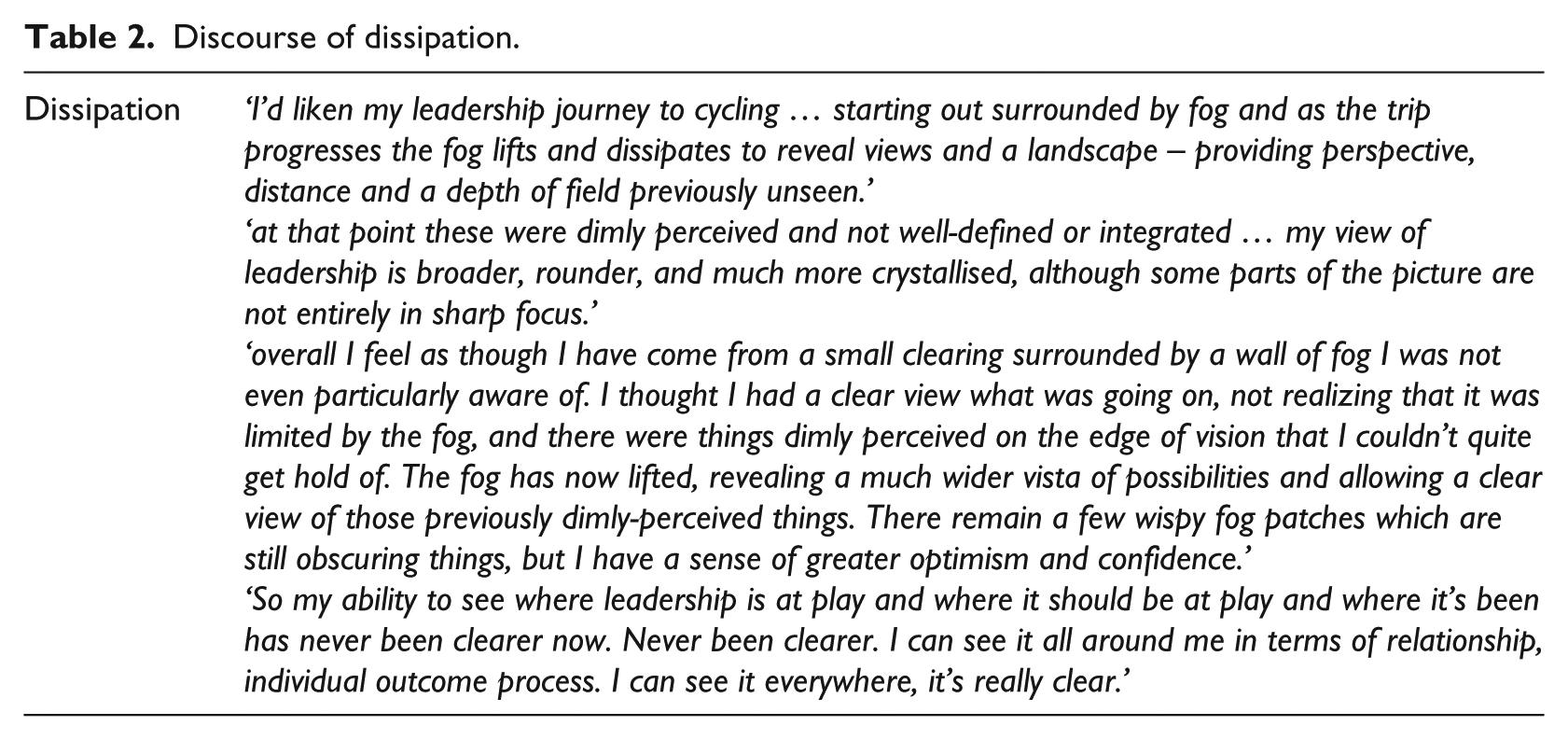
The utterances we have grouped under dissipation all work on the tension between seeing and not seeing, with images of fog or dimness frequently used (Table 2). The bodies of participants and the spaces they occupy are centre stage and expressed through predominantly first-person narratives. There is a sense of participants seeking to understand space through their senses: bringing certain things into focus, blurring other spaces, appreciating a vista and even appreciating leadership as something shapely (‘broader’, ‘rounder’, ‘clearer’). The focus is particularly on what limits or constrains seeing (‘at that point these were dimly perceived and not well-defined or integrated’) and discovering the existence of things that ‘I was not even particularly aware of’. There is the finding of ‘perspective, distance and a depth of field’, the ability to encompass what is ‘broader, rounder, and much more crystallized’ and an ‘optimism and confidence’ at the uncovering of ‘a much wider vista of possibilities and allowing a clear view’. We note the partiality of the previous discourse is also evident here. For example, ‘some parts of the picture are not entirely in sharp focus’ and ‘there remain a few wispy fog patches’, suggesting that unfettered views are unlikely to be held for long.
Discourse of dissipation.
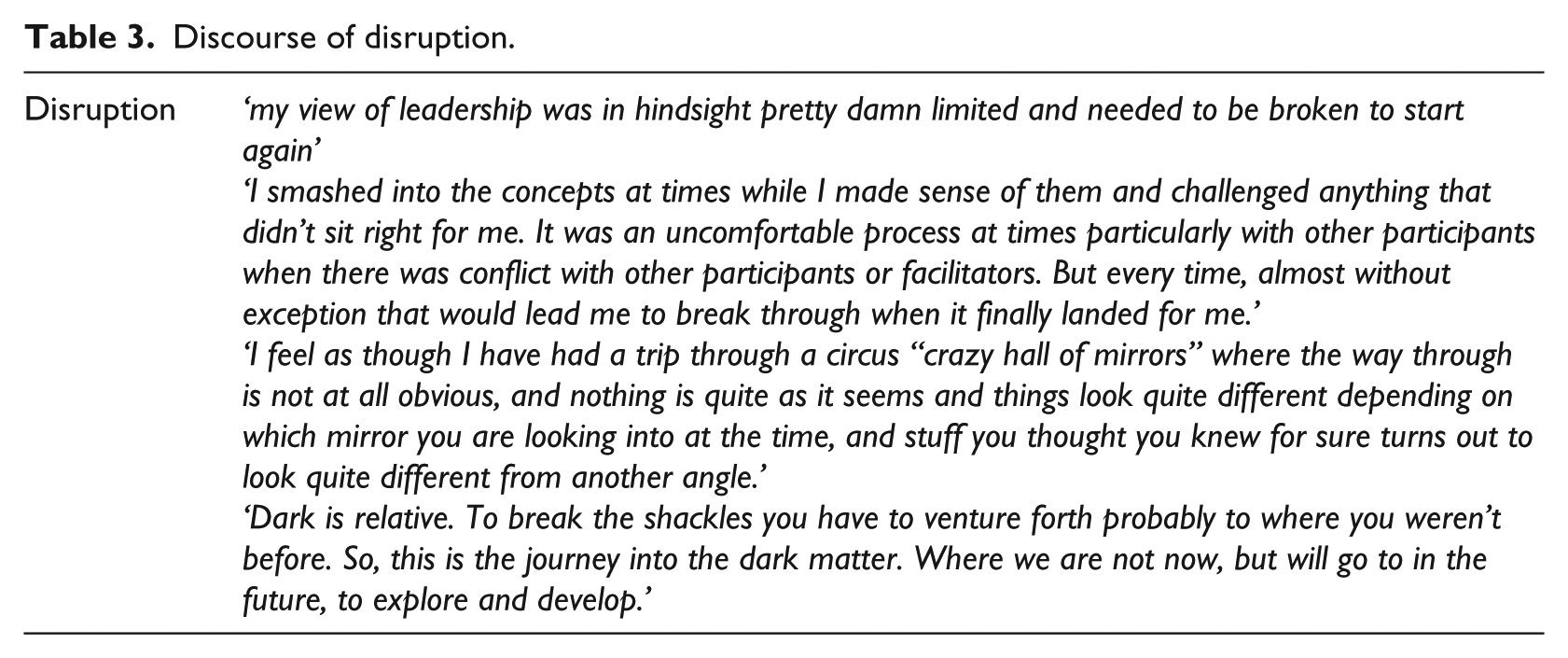
Disruption at a first glance would appear to be the most agentic of our four processes (Table 3). There is certainly a robustness, fixedness and violence at play here, where mindsets are ‘smashed’, ‘challenged’ and ‘needed to be broken to start again’, and change is depicted as a ‘break-through’, suggesting that development work can be dramatic, tense and even experienced in violent terms. We note, however, the importance of discomfort (‘It was an uncomfortable process at times’), conflict (‘every time, almost without exception that would lead me to break through when it finally landed for me’), disequilibrium (‘nothing is quite as it seems’) and rupture (‘to break the shackles’) in this discourse. We note more direct ‘I’ language in this discourse (‘I smashed’, ‘I made sense of them’) and the highlighting of other participants as opposed to facilitators (‘particularly with other participants’), implying drivers of development feel in participant hands in this discourse. Disruption is experienced through the body – it is the participant’s body that ‘smashes’, that pulls itself through ‘a crazy hall of mirrors’ – re-enforcing the visceral and present nature of this development.
Discourse of disruption.
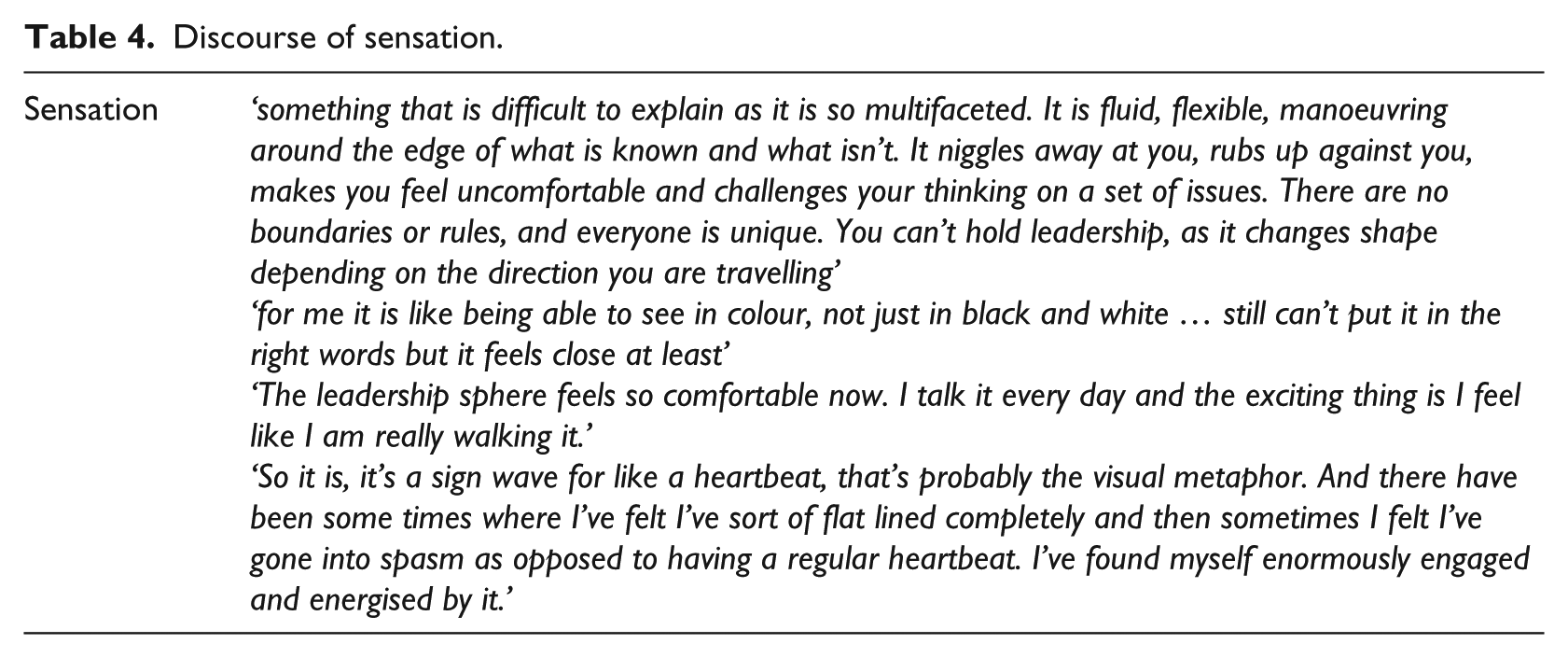
The fourth discourse, sensation, has been present in part across all the empirical material in this section (Table 4). Touch is evoked in the first utterance, where the movement between different ways of thinking, seeing, feeling or connecting ‘niggles away at you, rubs up against you, makes you feel uncomfortable’. In the final utterance in that section, a distinction is made between going ‘into spasm’ and ‘a regular heartbeat’, which evokes the range of visceral experience and embodied intensity on display. Equally powerful is the experience of mindset change as akin to the arrival of a new generation of technology ‘in colour, not just in black and white’. Very common in this discourse were notions of ‘close’, ‘comfortable’ and ‘walking’ differently. What was distant is now closer, what was anxious is now comfortable and what was a ‘thing’ to acquire has become a travelling companion. This sensory and embodied quality brings a different lens to leadership development than the usual focus upon discrete segments of knowledge removed from the body and context of the participant.
Discourse of sensation.
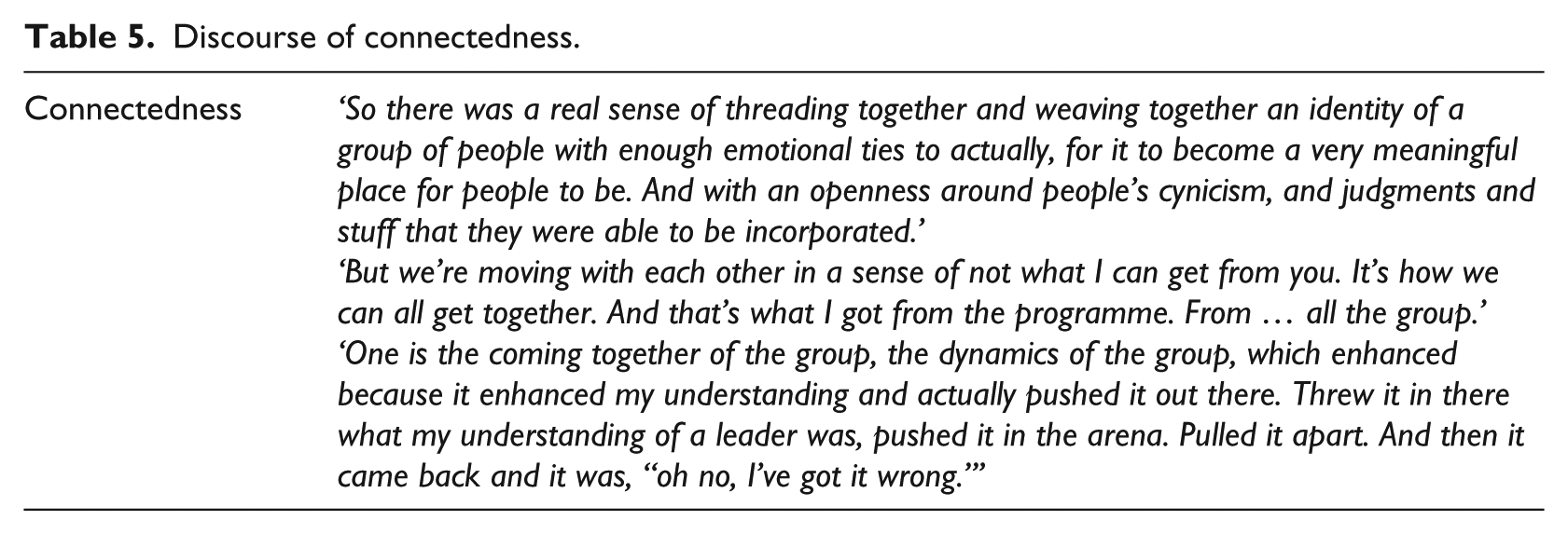
The fifth discourse of connectedness was evoked continuously in participant language but less metaphorically (Table 5). Participants continually drew on verbs, ‘threading’, ‘weaving’, ‘moving’ and ‘coming together’ to depict the shifting and interaction of individuals, subgroups and whole groups through the development experience. The final utterance in the section reveals this to encompass both continuous and discontinuous movement where the group ‘pushed’ and ‘pulled’ at material and dynamics, causing discordance: ‘I’ve got it wrong’. The admission of wrongness is crucial given the interpersonal dynamics of groups are often biased towards harmony, accommodation and unity. This discourse reveals a more complex set of interactions within the programmes where ‘cynicism, and judgments and stuff’ jostle with ‘openness’ to create a rich interpersonal repertoire. Also, complex is the relationship between individual and collective, where the ‘I’, while present and visible, is only a subset of the ‘we’ (‘a sense of not what I can get from you. It’s how we can all get together’).
Discourse of connectedness.
These five discourses (partiality, dissipation, disruption, sensation and connectedness) were present in each programme but not all individual participants recorded each discourse, and we could find no common sequence of discourses. We note that while we have chosen four metaphors from each discourse, we do not make the claim that these exact metaphors are replicated across the different programmes. The metaphors and imagery were chosen to reflect and represent what seemed strong patterns in the experience of this kind of leadership development. We did notice, however, that partiality was more articulated by the senior/executive groups while dissipation was most widespread in the emergent/youth groups. All groups talked to disruption and connectedness more or less equally while the community group came through most strongly with sensation. We are hesitant about making any judgements about what were in any case fine-grained differences between the programmes, given that ultimately each programme design, delivery and trajectory were influenced by emergent contextual factors and the unique relational and contextual dynamic of each group. However, given the comparatively large number of participants tracked through four programmes linked by a common development pedagogy and philosophy of leadership, we do wonder if these five discourses represent an outline architecture of aesthetic experience of more collective leadership (as opposed to individual leader) development. We can potentially see this more clearly in one particular participant narrative (Table 6).
An aesthetic narrative.
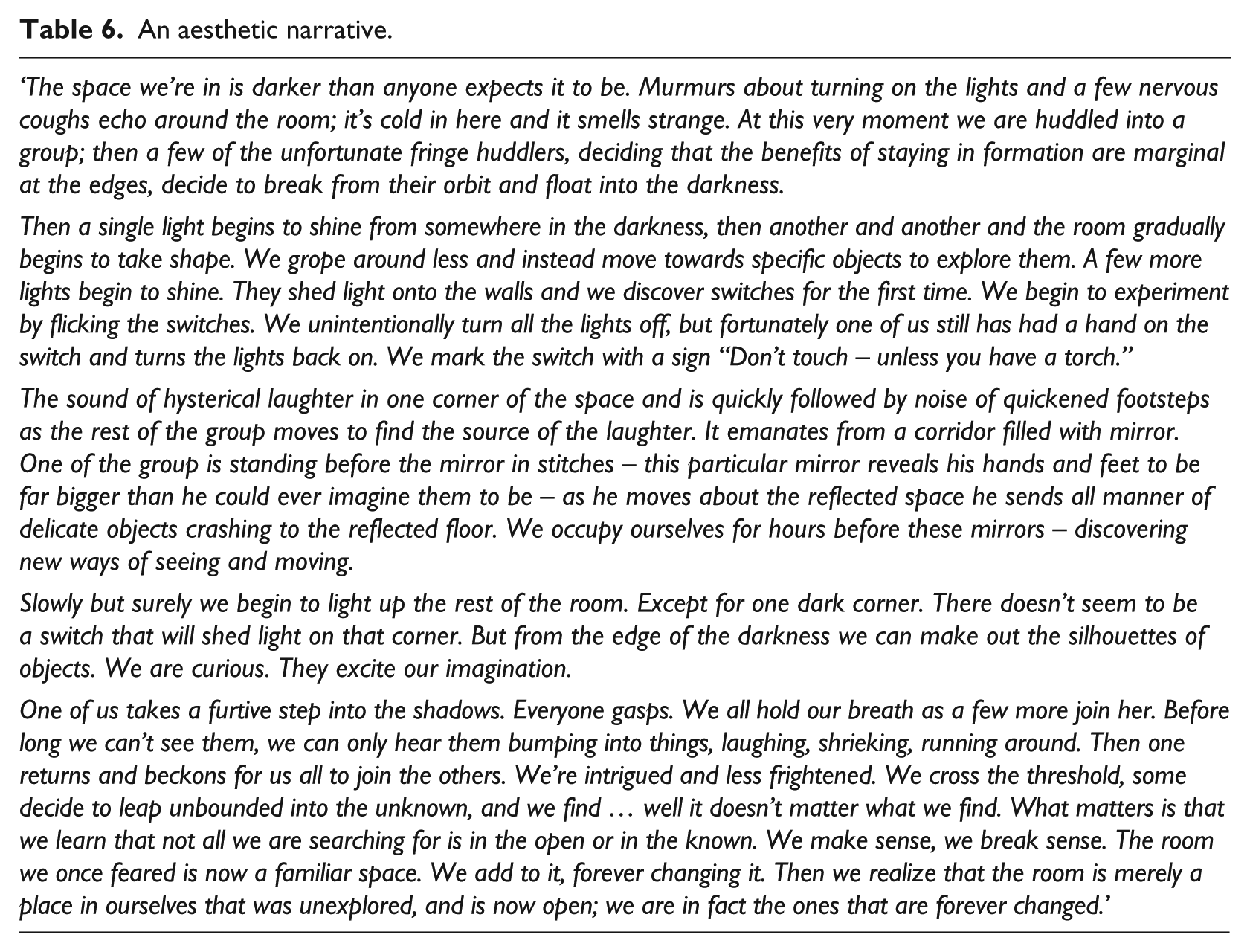
Storying leadership development aesthetics
Binaries pervade this narrative, some of which include: light/dark, individual/collective, centre/margins, stuckness/movement, seriousness/play and fear/confidence. Such binaries evoke heightened embodied and relational senses – of perception, touch and vision – of the participant as she constructs a development experience; this is a process of embodied and relational engagement. All five identified discourses manifest here, with a gradual exploration of what is present in the room (partiality); the ability to see what has been dark and hidden (dissipation); the ‘play’ with the mirrors that distorts sense of self and recreates the relationship between person and the objects in the room (disruption); the feel of ‘new ways of seeing and moving’ (sensation) and the patterns of individual and collective insight and movement (connectedness). At the same time, the five discourses find new expression in this narrative. Perhaps what is distinctive in the narrative, as opposed to the discourses, is the agency, control and power that these participants in the room feel they have. It is the participants who are flicking the light switches on and off, thus causing random sequences of dissipation and disruption, suggesting a degree of felt control. Likewise, the mirror activity is playful and experimental, thus lightening the feel of disruption; this is playful and actively pursued disruption, rather than disruption that derails. Overall, in this narrative development is reinvented as a collective, relational, holistic, embodied and processual exploration.
We note a number of narrative devices in this extract that particularly speak to the aesthetics of leadership development. This is a collective narrative and there is primarily a ‘we’ present. What changes developmentally is the nature of movement (from ‘groping’ to ‘experimenting’), the ability to see (‘the room gradually begins to take shape’), the sociality of the group (‘staying in formation’ to ‘bumping into things, laughing, shrieking, running around’, ‘to leap unbounded into the unknown’), and the capacity to construct, alter and change the development space (‘we add to it, forever changing it’). We note the sensory quality at play; coughs are ‘nervous’, laughter is ‘hysterical’, footsteps are ‘quickened’ and space ultimately becomes ‘familiar’. What is developed does not appear to be cognitive ability, knowledge or personality traits but ‘new ways of seeing and moving’ so that one is ‘forever changed’.
We wonder if this narrative is akin to a mirror image with none of the design, planning, content and intent of a formal development plotline but the parallel construction of participant discovery, group process and sensory discovery of change. While facilitators plan and shape content, and prepare to engage with participant dynamics and difficult questions, this participant’s experience of leadership manifests as a process of assembling a range of interweaving, embodied, sensory and relational responses to others and to the self. Given the narrative, unlike most of the discourse imagery (which are ‘I’ narrations), is narrated from a first-person plural stance (‘we’), then we are plunged into a relational, collective experience that fluidly moves into the development space in lyrical and emergent ways. We found this narrative thus both strongly congruent but also different in its aesthetic tone and expression to the five discourses.
Discussion
In this section, we further expand upon what it means to theorise leadership development, from a basis of participant experience, as something intrinsically aesthetic. We connect our findings to aesthetics philosophy, illuminating future avenues for research. We continue by arguing that foregrounding participants’ aesthetic experiences implies alternative ways of pursuing research that prioritises the intersubjective and embodied presence of both researchers and participants. We conclude by reflecting on some of the practice implications of our research.
Drawing on our data, we might usefully differentiate the aesthetic experience of leadership development as concerning the ontological rather than the epistemological, which in turn implies a certain aesthetic architecture to the notion of leadership development. Our participants, as they journeyed through a leadership development experience, were concerned with their sense of being in leadership, grappling with leadership as something that seemed to throw into question the very sense of the subject of leadership, what it means to be a leader in relation to others (Butler, 2015; Nicholson and Carroll, 2013; Smolović Jones et al., 2016), as well as the relation of that subject to intersubjective leadership work (Cunliffe and Eriksen, 2011). Our posited discourses of the aesthetics of leadership development (partiality, dissipation, disruption, sensation and connectedness) convey a sense of being in the world in uncertain, mutually dependent and relational ways, rather than of seeking to master the world through knowing leadership.
Apparent in our participant discourses and narrative was the notion that people experienced leadership development as a site of complexity. The notion of the aesthetic as something that disrupts previously held ‘distributions’ between concepts, self and sensory experience is something Rancière holds as central to the aesthetic regime, in distinction to alternative regimes, such as mimetic regimes, which maintain a stricter equivalence between people’s ‘proper’ place in relation to structures of authority (Rancière, 2012, 2015). The ‘aesthetic experience’ for Rancière (2009) is an embodied one, generating ‘a multiplication of connections and disconnections that reframe the relation between bodies’ (p. 7). Leadership development was experienced by our participants as a volatile process, one of contest and challenge, as participants’ ways of knowing themselves within organisation were called into question (disruption). We ought to view such experiences as important signals of profound, even structural, change at play, where a reordering of the senses, bodies and conceptual co-ordinates can happen (Rancière, 2015). The emergence of strong expressions of sensory, aesthetic experience can be read by facilitators and designers of leadership development as a sign that previous assumptions and orderings are entering a zone of disequilibrium and liminality (Hawkins and Edwards, 2015), hence essential for meaningful processes of change.
We make the case that at the root of this reframing is a shift to an ontologically relational way of knowing (Clarke and Knights, 2015). As we are conditioned by dominant organisational language and norms to know our organisations, and ourselves in organisation, in impersonal and disembodied ways (Gagnon and Collinson, 2014; Pullen and Rhodes, 2014; Tomlinson et al., 2013), it is perhaps no surprise that inviting participants to experience themselves in alternative ways implies disruption that can be thought of as a form of radical ontological uncertainty. Knowing the world as foundationally relational entails the shattering of previously held epistemologies into a complex web of being in leadership (Knights, 2015).
The connection between relationality and the aesthetic is one well rehearsed in philosophy. For Kant (1790/2009), for example, the ‘free play’ of the aesthetic was unique as a realm where subjects could find a form of ‘universal communication’, ‘since no definite concept restricts them to a particular rule of cognition’ (p. loc842). It is via the aesthetic, uniquely, for Kant that people could find relational connection. We can also turn to Marx, who in his Economic and Philosophic Manuscripts (1844/2011) elevated the aesthetic as that bond through which communal work – and indeed community constituted through work – attained its power and meaning. For Marx (1844/2011), emancipation in and through work was closely tied to the aesthetic, an ‘emancipation of all human sense and attributes … precisely because these senses and attributes have become, subjectively and objectively, human [emphasis in the original]’ (p. loc1934). While we do not claim, (sadly), most leadership development as a form central to radical social and economic change, in leadership development terms, we might consider the aesthetic to be intrinsic and inseparable from the work of participants in navigating – and connecting – through the concept of leadership.
The sense and significance of being together in leadership was best illustrated by our extended narrative, where the experiences of this participant were always constructed in relation to others; experiences of surprise, of darkness, even of horror, were posited as relational. They only made sense in relation to the foundational co-presence of others (of co-participants and facilitators). These were experiences that could only be understood and expressed by setting aside more discrete and rational ways of knowing, and pursuing an embodied and affective way of enacting leadership; making sense of leadership by smelling, touching and hearing it together, or, rather, that the acts of smelling, touching and hearing leadership together were themselves acts of constructing leadership – acts that brought leadership into being. These were also experiences that only make sense in the relational and material acts of work in leadership: without the leadership work, such aesthetic experiences would lose their power, becoming, perhaps, mere ‘free play’. Leadership work, and experiencing it in aesthetic ways, should be interpreted as an important gateway to alternative experiences of being at work, ones that imply ethical responsiveness and a fresh sensory appreciation for others at work (Cunliffe and Eriksen, 2011; Knights and O’Leary, 2006).
Our findings suggest future ways of researching leadership development that emphasise engagement with alternative theories and methodologies, ways of further making sense of the aesthetic architecture of leadership development. Approaches that draw upon political and ethics theory (Kelly, 2014; Knights and O’Leary, 2006; Smolović Jones et al., 2016), aesthetics (Hawkins and Edwards, 2015; Kennedy et al., 2015; Ladkin, 2010) and the relationship between language and the material (Hawkins, 2015), each offer the potential – albeit in different ways – for illuminating how leadership and its development stretch beyond the rationally knowable, implicating bodies, the senses, alliances of people and technologies within its orbit. Future research might seek to make connections across the disciplines of aesthetics, ethics, political theory and organisation studies, exploring in depth the connections between, and manifestations of, subjects, sensuality and organising in leadership development work. Likewise, we might consider how ethnographic methodologies that engage with intersubjective ways of knowing might enhance understanding of what it means to be there as participants experience leadership development in terms of their own aesthetic experiences.
In terms of practice, we wish to highlight salient implications of our research. The first concerns the design and facilitation of LDPs. As researchers who also facilitate leadership development, we note the emphasis placed in the mainstream literature, as well as the expectations we place on ourselves and others, of designing and managing elegant and neat development programmes. While we do not seek to diminish the importance of subject knowledge and detailed planning in the design and delivery of programmes, we also note that such an emphasis inevitably overlooks the more embodied and sensual dynamics of leadership development.
Our research suggests that a key element of facilitating leadership development is that of being present, in the located experiences of participants, so as to feel and sense the relational and embodied shape of the process. We view the arts of sensing and feeling not as an optional extra over and above ‘conventional’ leadership development facilitation but as a necessity. If we interpret leadership as intrinsically aesthetic and relational, facilitators are always already part of the sensual process of leadership development, like it or not, their only choice in the matter being how they participate in such a sensorium. Our findings suggest that the cool and aloof rationalist is unlikely to be a helpful persona to adopt. It is our hope that our five dimensions of the aesthetics of leadership development might act as a provisional ‘map’ to enable facilitators to navigate the partial, dissipative, disruptive, sensual and connected aesthetic architecture of the leadership development experience.
Our data convey in many ways a sense of participants getting lost but also recovering, as they explore new possibilities and ways of experiencing leadership. We find this sense of uncertainty instructive from a facilitator perspective, as it suggests that we may consider the urge to ‘fix’ or ‘solve’ ambiguity in development unhelpful. In drawing out the participant perspective of a whole development experience, we hope we have highlighted the ephemeral nature of being lost in leadership. Participants are perhaps perpetually lost and found, albeit in different ways at different times. As facilitators, we might consider ways in which we can help participants become more or less lost, all the while taking some comfort in the fact that being lost is a normal occurrence within an aesthetic sense of self and one’s relational sense of self at work.
Finally, we note that leadership development aesthetics are never going to be quick and easy for facilitators to identify, ‘read’ and work with. The author who facilitated these programmes only became aware of this aesthetic dimension of leadership development after completing a number of programmes and learning tacitly and instinctively to work with them. It is easy to picture how such patterns could be experienced as problematic for facilitators: as patterns of discontinuity (partiality), lack of clarity (dissipation) and destructive conflict (disruption). While this enquiry has given shape to what was tacit, we suspect that most facilitators would hold comparable tacit or instinctive markers for how development work progresses and our hope is that by offering a process, language and way of understanding leadership development aesthetics, we invite facilitators to work more explicitly with the aesthetics of what happens in such spaces. As noted earlier in the article, there is likely a connection between the conceptual underpinnings of the programmes studied and the discourses produced by participants. It seems plausible to state that the aesthetics analysed here are connected to a leadership approach to development, an approach that foregrounds group interaction, sensemaking and critical reflection, whereas it seems less likely that such dynamics would be present in a leader-focused programme. While it is outside the scope of this study to assert generalisability for our findings, we assert that it is plausible, based on our more informal knowledge and experience of similar programmes elsewhere, for a similar aesthetic architecture to be present in other leadership-dominated programmes. Ultimately, further interrogating, challenging and refining of our model in other contexts is a matter for future research.
Conclusion
This article has sought to better understand the aesthetics of leadership development from the perspective of participants, rather than seeking to map expectations and theoretically informed notions of leadership onto participants. While existing research has drawn attention to valuable theory and practice that can help structure thinking concerning the arts-based interventions within leadership development, our study has been more concerned with interpreting leadership development as intrinsically aesthetic, at the level of architecture. Such a notion is rooted firmly in the empirical accounts of participants, yet also connected to a strong stream of organisational literature and aesthetics philosophy. Central to our findings was the notion of a form of leadership development foregrounding the embodied, relational and affective, as participants drew on a range of metaphors to navigate the complexity and intersubjective dimensions of organisational relationship. Leadership, for participants, demanded a requirement to go beyond a rational and detached relationship to knowledge and this enquiry, we hope, will act as a further call for providers, facilitators and other leadership development stakeholders to join them in such a rich, textured and multidimensional exploration.
Footnotes
Acknowledgements
We acknowledge the following past and present members from the New Zealand Leadership Institute for their support of this research and their active involvement in the data collection and thinking behind this project: Joline Francoeur, Dr Fiona Kennedy, Ann Moore, Philippa Collins, and Alexandra Tod.
Funding
The author(s) received no financial support for the research, authorship, and/or publication of this article.