







Abstract
Knowledge co-production within academic-practitioner research collaborations is a promising means to address the pressing issue of research impact. Yet current theorising is hampered by a limited appreciation of power in the relationship between research partners. In this study, we explore various types of power and their effects on knowledge co-production in government-funded research collaborations. Drawing on interviews with academics and practitioners working on Australian Research Council Linkage Scheme projects, we initially document the prominence of structural and normative types of power, alongside resource power. We further show that both structural and normative power fail to conform to key principles of knowledge co-production. As a result, many of the projects studied fell short of the knowledge co-production ideal. Our investigation leads us to identify a boundary condition: knowledge co-production theory in its current form is bounded by resource power conditions. Our expanded perspective provides for an elaboration of knowledge co-production theory. We also explore the implications of our findings for business schools in search of impact.
Keywords
Introduction
Knowledge co-production (KCP) entails the synergistic combination of academic and practitioner knowledge in the research process. It represents a leading framework to address the so-called theory-practice gap (Banks et al., 2016), which originated in debates concerning the nature and purpose of business schools (Gulati, 2007; Pettigrew and Starkey, 2016). More recently, this discussion expanded to include research impact beyond academia, harking back to Simon’s (1967) vision of business schools immersed in both science and practice.
Growing demands for research impact (Pettigrew and Starkey, 2016) have recently led to the incorporation of impact metrics in national research assessment exercises across many nations (ARC, 2019; REF, 2019). Universities in general, and business schools in particular, are being urged to encourage collaborations with practitioners and to include such collaborations among their expanding set of impact indicators (AACSB, 2018; Pettigrew, 2011).
Co-production of knowledge between academics and practitioners has been put forward as a promising means to generate impact by capitalising on theory and practice (Pettigrew and Starkey, 2016). While KCP features prominently in some disciplines (Nowotny et al., 2001) it is less prolific in management and related social sciences, leading some to suggest that the theory-practice gap may be widening in those domains (Bartunek and McKenzie, 2017).
KCP focuses on the social production of knowledge. Relying on the differentiation and integration of academic and practitioner knowledge (Antonacopoulou, 2009), it is able to formulate and address the ‘big research questions’ that are beyond the capacity of either side working on their own (Banks et al., 2016). For practitioners, the specific benefits from KCP arise from research that is closely aligned with their needs and more easily implemented (Banks et al., 2016). For academics, sustained collaborations with practitioners ensure a ‘second loop’ alongside the initial, academic loop (Vermeulen, 2007), supplying valuable research topics and data (Tushman and O’Reilly, 2007). This second loop also prevents researchers from retreating into ever more abstract and irrelevant research (Bennis and O’Toole, 2005), and ensures outcomes that are prescriptive and grounded in practice (Huff et al., 2006).
KCP is crucially dependent on the relationship between collaborating academics and practitioners (Bartunek and McKenzie, 2017). The overarching advice emanating from extant literature is that task-related conflicts between the two sides are to be encouraged while destructive, interpersonal conflicts are to be curbed (Van de Ven and Johnson, 2006). These suggestions, abbreviated as ‘creative’ or ‘constructive’ conflict management, flow from strong assumptions about the type of power prevailing in these relationships, and the nature of the ensuing conflict.
Our investigation set out to problematise the emerging body of KCP theory. By ‘identifying and challenging the assumptions underlying existing theories [. . .we aim to facilitate. . .] the development of more interesting and influential theories’ (Alvesson and Sandberg, 2011: 247). As our point of departure, we posit that extant scholarship on KCP is hampered by a limited appreciation of power in the collaborators’ relationship. Specifically, a preoccupation with resource power and concomitant observable conflict has blinded it to other types of power and their repercussions for KCP. To investigate this line of argument we adopt the following two research questions in the context of major Australian academic-practitioner research collaboration projects: What types of power are present in these projects? and How do the different types of power affect KCP?
To probe these questions, we initially borrow a three-dimensional framework of power that is well established within the political sciences (Lukes, 2005) and the field of management (Fleming and Spicer, 2014). The framework is concerned with decision-making among actors representing factions with different interests, reminiscent of academic-practitioner research collaborations. This similarity of context supports our ‘horizontal theory borrowing’ (Whetten et al., 2009). The framework distinguishes three dimensions of power, that is, resource, structural and normative, suggesting that power is not only exercised in open, contested decision-making (resource power) but also by limiting decision-making alternatives (structural power) and by shaping the very wants of the controlled (normative power) (Lukes, 2005: 27). The framework allows us to discern types of power not currently featured in the KCP literature. We then examine the various types of power vis-a-vis the principles of KCP distilled from the literature.
Our empirical context is the Australian Research Council (ARC) Linkage Scheme. It is the Australian government’s main programme for promoting innovation in academic-practitioner collaborations (ARC, 2018c). We adduce qualitative evidence of the various types of power present in our sample and match them against the principles of KCP. Our data clearly indicate the presence of structural and normative forms of power within some ARC Linkage projects, alongside resource power. We show that these additional forms of power are incompatible with key principles of KCP and conclude that many of the projects covered fall short of the KCP ideal and their full research impact potential.
Our contribution in this paper is two-fold. First, our conceptual and empirical work leads us to impose a boundary condition: KCP theory in its current form is bounded by resource power conditions. Given the presence of other types of power in research collaborations, the theory’s predictive power and generalisability (Weick, 1999) are impaired. Our expanded perspective brings additional types of power, inherently averse to KCP, into focus, and represents an elaboration (Fisher and Aguinis, 2017) of KCP theory. Second, we also present preliminary inductive insights elaborating resource power. Specifically, we suggest that for resource power to yield KCP requires more than constructive conflict management: practitioners need to be enabled by academics.
In the next section we review KCP in the academic-practitioner collaboration literature, highlighting a restrictive view of power as well as three foundational principles. We then introduce our framework of power and map it against the three principles of KCP. Following a description of our method we present our results. In the final section we discuss the significance of our findings for the emerging body of KCP theory and the implications for business schools’ impact agenda.
Knowledge co-production in academic-practitioner research collaborations
The conception of KCP enjoys widespread popularity across the social sciences (e.g. Kemp and Rotmans, 2009; Lehmann and Gilson, 2015). In the management literature, it was introduced through Van de Ven and Johnson’s (2006) work on ‘engaged scholarship’. Although KCP has been embraced by several scholarly communities, it is not without critics (Antonacopoulou, 2010a; Flinders et al., 2016; Jasanoff, 2004; McKelvey, 2006). Some even view KCP as inherently unattainable due to the contrasting institutional logics of academics and practitioners (Kieser and Leiner, 2009).
KCP seeks to leverage the prominent differences between academics and practitioners by taking a holistic approach to multi-faceted, unstructured problems whose complexity exceeds the capacity of either side working on their own (Pettigrew, 2003; Van de Ven and Johnson, 2006). With KCP, academic researchers and practitioners share research activities and work jointly across all stages of the research process. While the precise division of labour is negotiated, based on the project’s focus and the specific skill set of the research partners (Van de Ven, 2007: 268), unrestricted engagement is a prerequisite (Van de Ven, 2007: 27–28).
KCP and its proposed benefits are founded on a set of pluralist assumptions (Van de Ven and Johnston, 2006). Pluralism views social relations as spanning rival groups with divergent interests. As a result, conflict is deemed unavoidable; it is also deemed healthy rather than something to be avoided or resolved. The adoption of a pluralist perspective was instrumental in moving the academic-practitioner collaboration literature beyond earlier knowledge transfer views. Among other, it enabled an appreciation of the generative power of conflict and recognition of the benefits of knowledge integration (Pettigrew, 2003; Van de Ven, 2007).
We began our investigation by canvassing scholarship concerned with KCP in the management and wider social science domain (e.g. Flinders et al., 2016; Orr and Bennett, 2012; Van de Ven and Johnson, 2006). Our review yielded three foundational principles of KCP relevant for academic-practitioner research collaborations. 1
First, theory and practice are seen as distinct yet complementary forms of knowledge. Both represent partial ways of seeing a research problem and therefore hold equal status (Van de Ven and Johnson, 2006). In turn, academics and practitioners are equals, with a mutual appreciation for the depth and complexity of the other side’s knowledge (Orr and Bennett, 2012). Specifically, practitioners are more than (co-)funders of research or providers of data. They are recognised as potential contributors across all stages of research; their actual contribution being contingent on their specific expertise and experience (Pettigrew, 2003).
Second, KCP entails a negotiated relationship between academics and practitioners (Van de Ven, 2007). Research relationships are unique to each project and require discrete protocols. Negotiations serve to clarify expectations, enhance joint benefits, and instil greater accountability in both sides (Van de Ven, 2007). Forming the relationship requires a clarification of the rules of collaboration, including the roles of each partner (Van de Ven and Johnson, 2006). Sustaining the relationship requires these terms to be continually negotiated as the project evolves, requiring a basis of trust and open communication (Amabile et al., 2001).
Third, KCP seeks to exploit rather than resolve academic-practitioner differences. In research collaborations, conflict and tension are inevitable on account of the marked differences between academics and practitioners (Katz and Martin, 1997). These differences stem from the distinct nature of theory and practice (Tranfield et al., 2004); the specialised knowledge of both academics and practitioners (Banks et al., 2016); their inconsistent research time frames, values and goals (Shapiro et al., 2007); as well as their differing objectives regarding the dissemination of knowledge (Perkmann and West, 2015). The resulting tension is to be sustained and utilised ‘in generative ways rather than choosing one side over the other’ (Bartunek and Rynes, 2014: 1192). KCP relies on intellectual arbitrage to harness the distinctiveness of both theory and practice. The aim is not to amalgamate or aggregate, but to integrate divergent perspectives to arrive at a richer understanding of the issue being investigated (Antonacopoulou, 2009). This requires the constructive (or ‘creative’) management of conflict (Van de Ven, 2007), which entails the spurring of task conflict (i.e. disagreements over the task at hand) while containing relationship conflicts (Jehn, 1997). These three principles – recognition of knowledge value and complementarity; negotiation of the relationship; and exploitation of different perspectives – are shared across the KCP literature relevant to research collaborations.
A broader perspective on power
The academic-practitioner relationship, including aspects of conflict and power, is key to understanding why some research collaborations fail to attain KCP (Bartunek and McKenzie, 2017). At present, the KCP literature is preoccupied with observable forms of power and surface-level conflict. In other words, KCP theory valorises resource power but overlooks other types of power, predicated on social forces and institutional practices (Lukes, 2005). These other types of power have found empirical support in fields such as sociology (e.g. Caine and Krogman, 2010), psychology (e.g. Culley and Angelique, 2011) and management (e.g. Gond et al., 2016). These literatures frequently identify two additional, prominent types of power, modelled on Lukes’s (2005) second and third dimensions. 2 We follow this lead and employ a tripartite framework of power to study research collaborations. Using intuitive labels that capture the essence of the underlying concepts, we distinguish resource, structural and normative power.
The main concern with such ‘horizontal theory borrowing’ is contextual insensitivity (Mowday and Sutton, 1993; Whetten et al., 2009). Lukes’s framework of power and its elaborations (e.g. Fleming and Spicer, 2014) have been successfully applied across numerous settings. Most importantly, they have been applied extensively in the context of coalitions of diverse actors cooperating for a period of time (e.g. Gond et al., 2016; Raik et al., 2008), mirroring our own study setting and justifying our borrowing of theory.
Types of power
Drawing on Dahl (1957), we define power as the ability of A to influence B contrary to their interests. The three forms of power (see Table 1), can be distinguished on account of interest configurations and the ensuing type of conflict. They are based on Lukes’s (2005) ‘dimensions of power’ and Fleming and Spicer’s (2014) ‘faces of power’.
Three types of power.
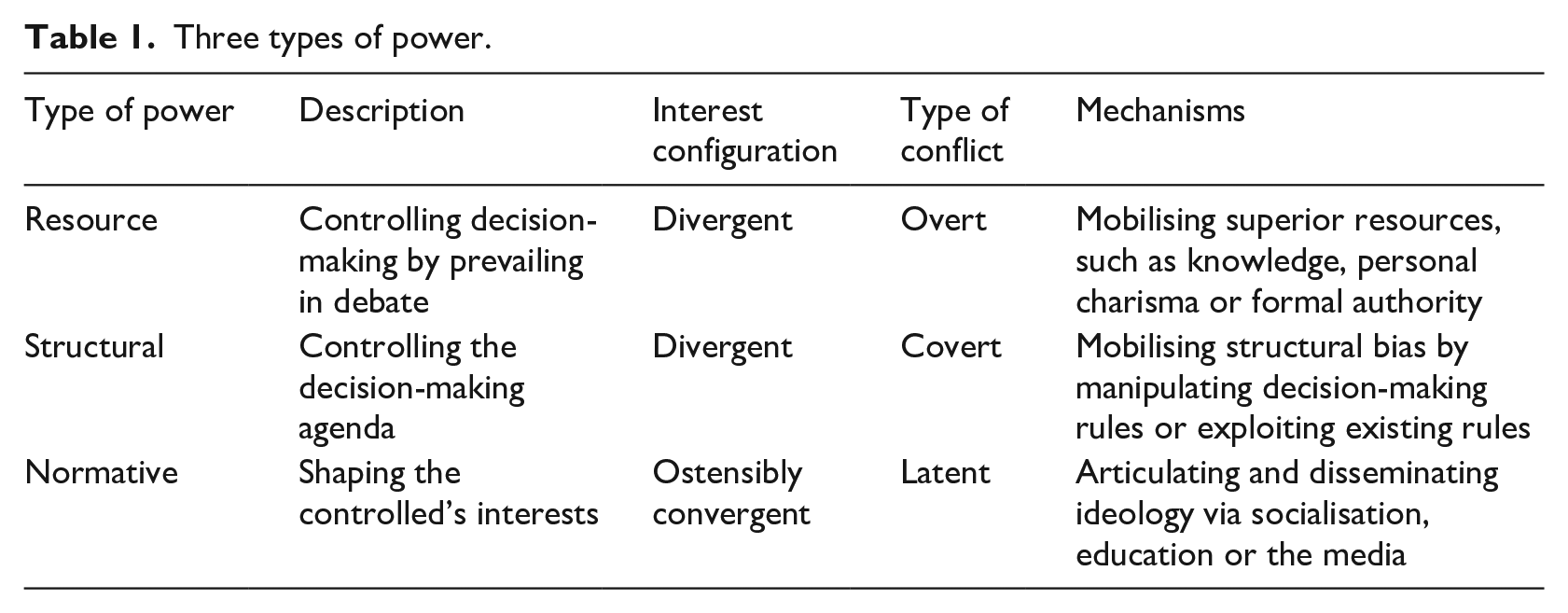
Resource power is founded on a pluralist perspective. It is concerned with observable power exercised in decision-making (Fleming and Spicer, 2014). According to resource power theorists, decision-making occurs in an open, contestable forum, among actors with competing interests. Actors are aware of, and able to mobilise, their own interests. These interests are expressed as preferences and revealed in political participation, leading to observable ‘overt conflict’ (Lukes, 2005). Because decision-making is assumed to be open to everyone, non-participation is viewed as tacit agreement (Caine and Krogman, 2010). The powerful prevail in debates by mobilising their superior resources, be they knowledge, personal charisma or formal authority (Dahl, 1957; Gaventa and Cornwall, 2008). Expertise, for example, is a resource that can be used to ‘win’ debates concerning particular decisions, thereby affecting others.
Owing to its origins in Weber’s (1947) account of authority in organisations, resource power was originally presented as a rather coercive form of power. In the words of Fleming and Spicer, the controlled party ‘are simply told what to do “or else”’ (2007: 14). Yet already Dahl (1957) recognised more democratic forms of resource power, in line with more recent accounts of power as a spectrum ranging from coercive to non-coercive (Belaya and Hanf, 2009; Hardy, 1996).
Structural power is founded on a behavioural view (Bachrach and Baratz, 1962). Behaviouralists contend that power occurs in the act of decision-making, as captured by resource power, but also in so-called ‘nondecision-making’, as captured by structural power. Structural power is exercised by controlling the decision-making agenda (Fleming and Spicer, 2014). As a result, decision-making is confined to ‘safe issues’, that is, those aligned with the controlling party’s interests (Bachrach and Baratz, 1962: 948). Non-aligned issues are taken ‘off the table’ by the controlling party, that is, they are turned into ‘nondecisions’, through the exploitation of structural bias. Structural bias refers to protocols and rules favouring one side over the other.
The controlling party may limit others’ participation in decision-making, for instance, by restricting their information or by making the process overly complicated and cumbersome (Gaventa and Cornwall, 2008; Rodriguez et al., 2007). The ensuing conflict – due to divergent interests between the controlled and controlling parties – is ‘covert’ inasmuch as the former is precluded from airing their preferences in the political arena. Though aggrieved, the controlled are resigned to their exclusion from decision-making (Lukes, 2005).
Normative power is founded on a radical view (Lukes, 2005). It contends that, in addition to its resource and structural manifestations, power may also be exerted by shaping the controlled party’s desires, beliefs and perceptions in ways contrary to their interests (Hayward and Lukes, 2008: 6). This is achieved by moulding actors’ understandings and choices so as to be accepting of their role and the existing order of things (Lukes, 2005: 11). As a result, conflicts as well as grievances are removed. Effectively, the controlled control themselves.
Normative power is established through the articulation and dissemination of norms and ideals. The controlling party may use mechanisms such as socialisation and education to promulgate truths and myths (Culley and Angelique, 2011). The resulting ideology cultivates strictly limited preferences and wants. As a result, the controlled no longer act in accordance with their ‘real interests’, which are obscured by language and symbols (Caine and Krogman, 2010). The ensuing conflict is labelled ‘latent’ on account of the contradiction between the interests of those exercising power and the underlying, real interests of those they dominate (Lukes, 2005: 28). To the controlled, the (latent) conflict is, for all intents and purposes, non-existent.
Inter-relationships among types of power
These three types of power are sometimes ordered, with normative power – as ‘the most sophisticated’ (Hardy, 1996: S8), ‘most effective’ and ‘supreme’ form (Lukes, 2005: 27, 28) – at the top; structural power in the middle; and resource power at the bottom. Importantly, Lukes (2005) and other theorists (Hardy, 1996) maintain that the three types of power may coincide. Parsons (1995) added further detail, exploring their interrelationship. Effectively, the dominant type of power imposes boundaries within which the other type(s) may unfold (see Figure 1). Specifically, any issues ‘excluded by the operation of either the third or the second face of power [normative or structural power] is not going to appear as an issue for conflict in the first face of power [resource power], while anything excluded by the third face of power is not going to appear as an item within the second face of power’ (Robinson, 2006: 24). Put differently, with structural power as the dominant type, resource power can only be exercised over those issues allowed onto the decision-making agenda. In turn, with normative power as the dominant type, structural power can only be exercised over those issues permitted by the prevailing norms. In short, the dominant type of power constrains the scope over which the other type(s) may be exercised.
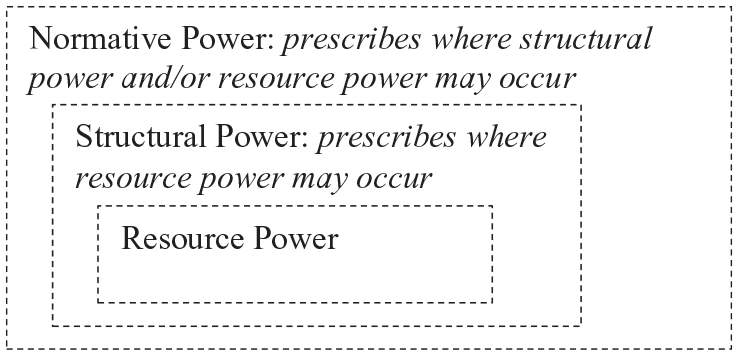
Interrelationships among the three types of power.
Types of power and principles of knowledge co-production
In this section we combine the theoretical building blocks introduced above. We map, conceptually, the three types of power against the principles of KCP identified earlier (see Table 2). This is done so as to establish their compatibility, or otherwise, with KCP.
Power types’ compliance with KCP principles.
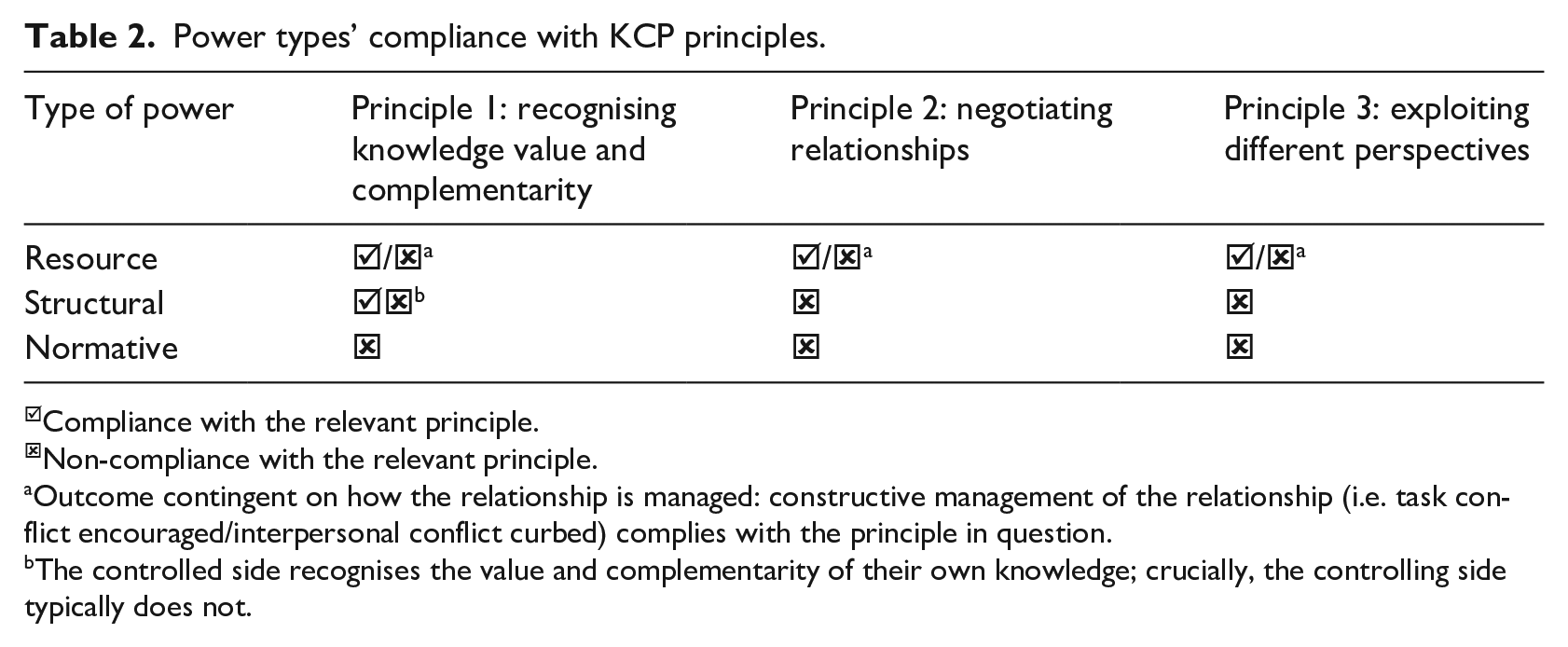
 Compliance with the relevant principle.
 Non-compliance with the relevant principle.
Outcome contingent on how the relationship is managed: constructive management of the relationship (i.e. task conflict encouraged/interpersonal conflict curbed) complies with the principle in question.
The controlled side recognises the value and complementarity of their own knowledge; crucially, the controlling side typically does not.
Resource power, provided conflict is managed constructively, is conducive to KCP inasmuch as it is compatible with the three corresponding principles. Given that the conceptions of resource power and KCP share pluralist assumptions, it is no surprise that the former can be reconciled with KCP principles. In a world where interests are clearly articulated and competing freely, the complementarity of knowledge can be recognised, the relationship negotiated and different perspectives harnessed. Importantly, resource power allows for KCP but does not guarantee it. Unless the relationship is managed constructively, by maximising task conflict and minimising interpersonal conflict, it will not satisfy the principles of KCP. For instance, a relationship that deteriorates into a contest of egos rather than ideas will not result in a negotiated relationship and will fail to exploit any synergies from complementary perspectives and knowledge bases. It may even undermine the recognition of value and complementarity in the other side’s knowledge.
Structural power is not conducive to KCP, on account of violating KCP principles. In essence, structural power narrows the scope and potential of academic-practitioner relations. The controlled side may recognise the value and complementarity of their knowledge but, crucially, the controlling side does not. Since decision-making under structural power is restricted to ‘safe issues’, parties are unable to negotiate the full spectrum of their interests and the generative power of different perspectives is compromised.
Normative power is also not conducive to KCP, on account of compromising all three of the KCP principles. Since normative power defines ‘the very terrain in which political actors understand their organisational situation’ (Fleming and Spicer, 2014: 243), it creates the appearance of consensus and harmonious relationships. Yet seemingly constructive academic-practitioner relationships obscure the exercise of power. Decision-making consensus stems from practitioners willingly acquiescing to academics’ decisions under the impression of interest alignment. Potential conflicts owing to ‘real interest’ differentials never surface because they have been ideologically smothered. In the same vein, normative power systematically suppresses any meaningful negotiation with, and exploitation of, complementary perspectives as these no longer exist. It also prevents the controlled from seeing the value and complementarity of their knowledge by legitimising traditional research norms. These norms, embodied in Mode 1 research (Gibbons et al., 1994), espouse a strict theory-practice hierarchy.
Clearly, at a conceptual level, both structural power and normative power are antithetical to the principles of KCP. We further explore these preliminary conclusions in our Findings.
Method
Since we are studying the intricacies of academic-practitioner relationships, a qualitative design is appropriate. Utilising an established framework of power (and a derived framework concerning KCP principles), we explore the effects of various types of power on knowledge co-production in research collaborations.
Participant selection
The main source of data for this study are semi-structured interviews with academics and practitioners, working on 24 ARC Linkage Scheme projects. The Linkage scheme is Australia’s main programme for promoting innovation by encouraging academic-practitioner collaboration (ARC, 2018c). The scheme was designed with the express purpose of aligning research with practitioner needs (ARC, 2018c) and Australian universities view Linkage grants as key indicators of their researchers’ impact (AACSB, 2012). Government funds allocated during the two most recent rounds totalled nearly A$170m (ARC, 2018d).
The Linkage scheme supports projects ‘undertaken to acquire new knowledge, and involve risk or innovation’ with the express aim to provide national economic, social, environmental or cultural benefits (ARC, 2018c: no page number). Linkage projects are funded up to a value of A$1.5m (ARC, 2018c), with the Australian government typically matching the funds provided by the practitioner organisations. These ‘partner organisations’ (ARC, 2018a) may be commercial entities, government departments and/or community organisations. Linkage projects mandate close collaboration between academics and practitioners. The selection criteria require ‘evidence that each of the Partner Organisation(s) is genuinely committed to, and prepared to collaborate in, the Project’ (ARC, 2018a: 35).
Our unit of analysis is the project, while our unit of observation is the individual academic or practitioner representing their respective side. We did not embark on a ‘large n’ qualitative investigation in a misguided ambition for statistical generalisation (Piekkari et al., 2009). Instead, we opted for a comparatively large number of projects (n = 24) so as to give ourselves every chance of observing the exercise of different forms of power and their effects on KCP. In doing so we inevitably traded some richness of data for breadth of coverage. We also acknowledge our own position in this investigation, that of academics studying the relationship between fellow-academics and practitioners. This issue was repeatedly discussed among the coauthors. One of the resulting decisions was to keep two coauthors at arm’s-length from data collection.
In total we interviewed 25 academics and 23 practitioners from partner organisations. Interview data were triangulated with ARC policy documents regarding formal project rules and procedures as well as relevant project documentation obtained during the interviews. With Project 15, for instance, we obtained the project’s complete process documentation. The academic project leader had also drawn up their own ‘engagement model’, and subsequently published an article about engaging practitioners in research collaborations, both of which we obtained.
We initially accessed the complete list of Linkage projects on the ARC website. From this list, we purposefully identified projects that (i) commenced between the years of 2005 and 2009 (to ensure respondents’ ability to comprehensively assess the collaboration), (ii) were located in the states of Queensland or Victoria (for reasons of accessibility) and (iii) involved two or more partner organisations, representing at least two different ‘entity types’ (Australian Government, 2018). The third sampling criterion ensured the selection of projects with complex and multi-faceted relationships between academics and various kinds of practitioners, providing us with maximum opportunities to observe the full range of power configurations. By deliberately targeting information-rich cases, we engaged in purposeful sampling. More specifically, we engaged in intensity sampling, involving the selection of ‘rich examples of the phenomenon of interest, but not [necessarily] highly unusual cases’ (Patton, 2002: 234). The resulting sample of 35 projects included both on-going as well as two recently completed projects (on average, Linkage projects last three years) and spanned a wide variety of research fields as defined by the ARC (2015).
We then contacted the academic First Chief Investigator of each project. Of the 35 contacted, 25 agreed to an interview. Academics who declined to participate were either on extended leave or felt their project had not yet advanced to a stage for them to provide a comprehensive assessment. We then asked each participating academic to nominate the practitioner organisation representative(s) most involved in the project. We contacted 28 practitioners, 23 of whom agreed to participate. Four declined because of demands on their time, one felt it was premature to comment on the project. We ended up with a final sample of 24 projects, informed by responses from 25 academics and 23 practitioners. As shown in Table 3, five projects ended up without a practitioner respondent and we aimed to validate the academic’s account through particularly detailed questioning and follow-ups.
Description of projects and interview participants.
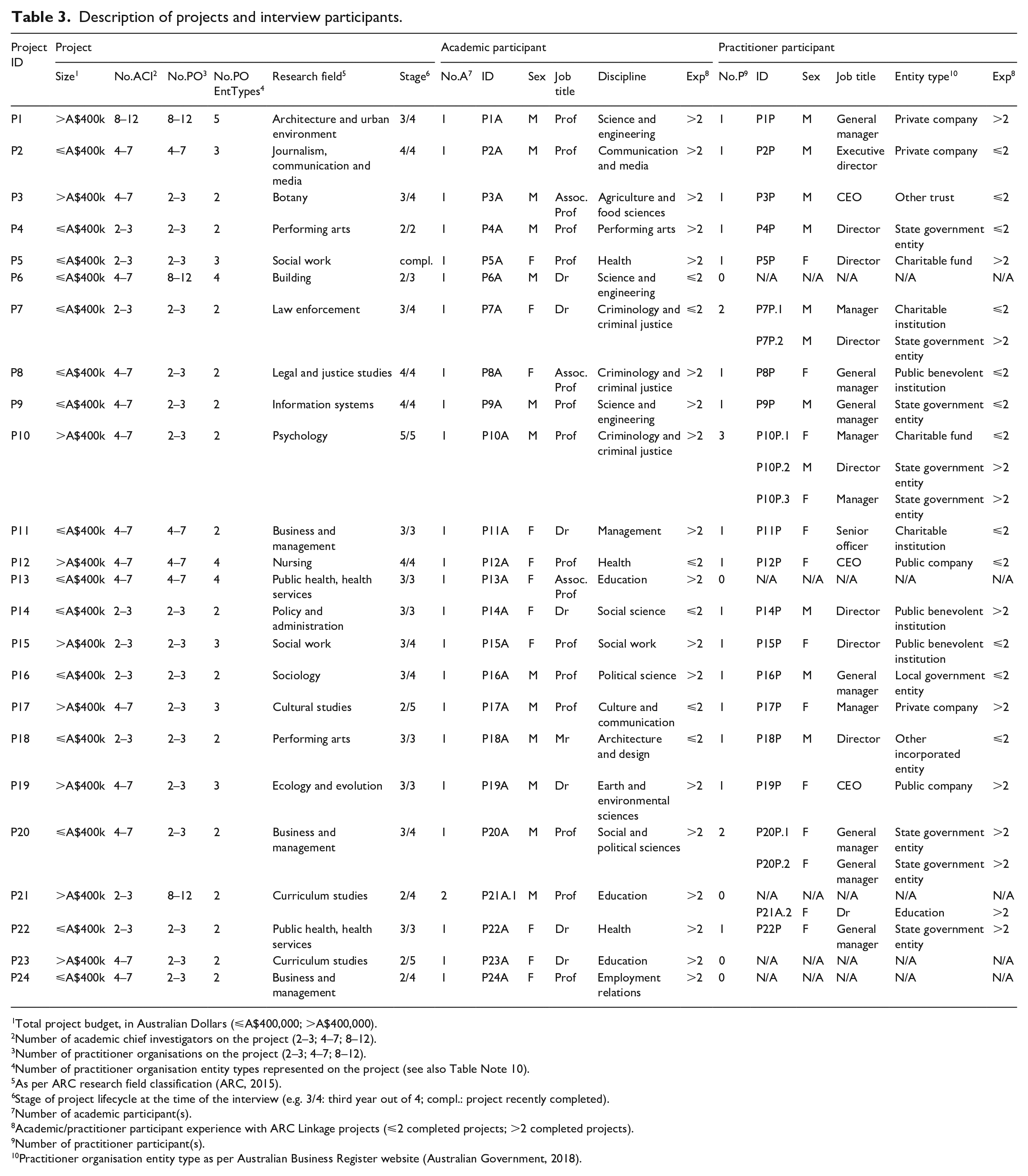
Total project budget, in Australian Dollars (⩽A$400,000; >A$400,000).
Number of academic chief investigators on the project (2–3; 4–7; 8–12).
Number of practitioner organisations on the project (2–3; 4–7; 8–12).
Number of practitioner organisation entity types represented on the project (see also Table Note 10).
As per ARC research field classification (ARC, 2015).
Stage of project lifecycle at the time of the interview (e.g. 3/4: third year out of 4; compl.: project recently completed).
Number of academic participant(s).
Academic/practitioner participant experience with ARC Linkage projects (⩽2 completed projects; >2 completed projects).
Number of practitioner participant(s).
Practitioner organisation entity type as per Australian Business Register website (Australian Government, 2018).
With few exceptions we relied on single respondents to represent, respectively, the practitioner or academic side (see Table 3). However, our respondents were project leaders and as such they were the individuals most knowledgeable about the academic-practitioner relationship. Targeting these ‘key informants’ (Kumar et al., 1993) allowed us to maximise our ‘opportunities to learn’ (Stake, 2003: 152).
Interviews and follow-ups were conducted between October 2009 and July 2011. The interviews lasted an average of 60 minutes, were digitally recorded and transcribed. Table 3 contains contextual information about the interviewees and projects, both of which are de-identified. ‘P1A’, for instance, is the academic respondent for Project 1. To ensure respondents’ anonymity we only report coarse-grained personal and project information.
As per Table 3, only 3 of the 24 projects are officially classed as Business and Management. However, all of the remaining 21 projects included some business/management element. For example, 20 of the 21 projects featured a senior manager as the leading practitioner partner. Three of them contained a management researcher among the academic team. Finally, four of them had an explicit business/managerial focus. For instance, one project focused on strategic decision-making in urban development. Another one, classified as Information Systems, focused on developing collaborative business processes for sharing services across organisations.
Interview protocol and data analysis
We used semi-structured interviews to generate data about participants’ experiences concerning power and KCP principles. Specifically, participants were asked about their levels of involvement in project-related decision-making processes; the degree and nature of conflict in the project; as well as their respective roles and responsibilities. Moreover, participants were asked about topics such as their (opportunities for) contribution to the project; the process for setting collaboration terms; and benefits derived from the collaboration. Participants responded with reference to the Linkage project in question but, where applicable, were also asked to report their overall experiences with Linkage projects.
Our interviews elicited long-term retrospective accounts and are therefore open to criticisms regarding errors of recall. Such errors may be the result of cognitive processes, including ex post rationalisation, self-presentation and attribution; they may also be the result of a lapse in memory (Golden, 1992; Rosenzweig, 2007). The salience of the projects for our respondents – who were project leaders for their respective sides – attenuate faulty memory (Miller et al., 1997). Recruiting multiple respondents per project (for 19 out of 24 projects) also allowed us to validate some of the information obtained. For the same reason we also deployed follow-up questions, and, where available, harvested archival project documentation. Finally, with some exceptions (most prominently our counterfactual scenarios, see below), our questions elicited information concerning concrete behaviours and project specifics. Collectively, these techniques have been shown to attenuate the effects of cognitive processes such as rationalisation, self-presentation and attribution (Cardinal et al., 2004; Miller et al., 1997).
Observable behaviour cannot be relied on as the sole indicator of power (Lukes, 2005). In addition to questions regarding participants’ conduct, we also used hypothetical scenarios. These are established techniques (Soda and Furnari, 2012) to encourage participants to reflect on their behaviour. By eliciting underlying interests and potential engagement we were able to unearth the counterfactual (Caine and Krogman, 2010). Hypotheticals for academics included items such as How would the project have been executed differently if practitioners had coordinated it?, and What benefits would you lose if you did not conduct research with [partner organisation]?. Practitioner hypotheticals included questions such as If you were the project leader, what would you do differently? and What benefits would you lose if you did not participate in Linkage projects with [academic team]?, Could you have participated more? If not, why not?.
We undertook theory-led thematic analysis (Boyatzis, 1998) to understand the link between types of power and KCP. We were guided by the two separate theoretical frameworks (power; KCP principles) introduced earlier. In our analysis we iterated between the data and theoretical themes. The data was coded using NVivo. Coding was led by one researcher and periodically reviewed by, and discussed with, two of the coauthors. The process continued until the team was satisfied that each project could be assigned its type(s) of power and its (non)compliance with KCP principles.
We initially coded to ascertain a project’s dominant type of power (see section Inter-relationships among types of power, above). Table 4 provides operational descriptions used to identify segments of interview transcripts as indicating resource, structural or normative power. We followed Lukes’s (2005) protocols for attributing power, which involved, first, showing that the controlled party would have acted differently, in line with their interests, and, second, identifying how the controlling party exercised power.
Operational descriptions of types of power.
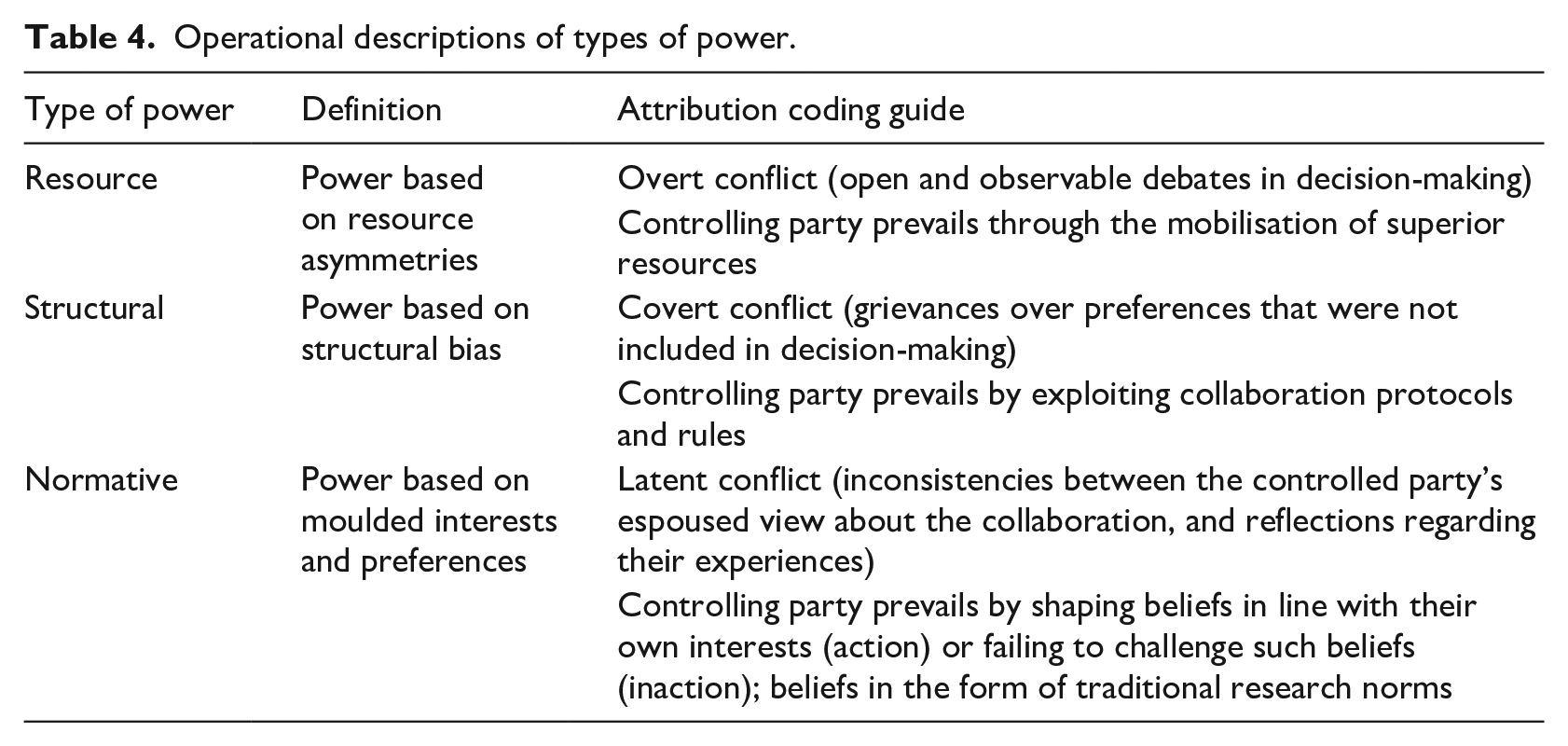
The first component required identifying the controlled party’s interests in order to assess the extent to which they were infringed by the controlling party. With resource power, interests are freely articulated by all the parties themselves. Actors are aware of, and free to mobilise, their own interests. With structural power, actors are aware of, but not free to mobilise, their interests. Their interests are expressed as grievances for preferences that were excluded from the decision-making agenda. With normative power, actors are neither aware of, nor able to act on, their interests. The most straightforward way to identify normative power is to look for latent conflict, the contradiction between the interests of those exercising power and the ‘real interests’ of the controlled (Lukes, 2005: 28). To do so we examined inconsistencies between the controlled party’s initial, espoused view about the research collaboration process, and their subsequent reflections on it. These reflections were elicited through hypotheticals.
The second component focuses on the party exercising power, confirming that they acted (or failed to act) so as to secure the compliance of those they controlled (Lukes, 2005). The exercise of resource power is directly observable in decision-making. Power is asserted by ‘winning’ debates concerning particular decisions on account of superior resources. The exercise of structural power is observable in preferences being (partly or wholly) excluded from debate by the controlling party exploiting existing rules and protocols. The exercise of normative power is more difficult to ascertain because it can be exercised as action or inaction. Power is asserted by shaping beliefs in line with the controlling party’s interests (‘action’) or, more subtly, by failing to challenge the prevailing beliefs (‘inaction’). Both can be exercised intentionally or unintentionally.
Ultimately, identifying normative power also necessitates apportioning responsibility (Hayward and Lukes, 2008). This requires establishing that the controlling party had the capacity to act differently and that they ought to have been aware of the consequences of their (in)action.
Once we had established a project’s dominant type of power, we then coded the corresponding transcripts for compliance or noncompliance with the relevant KCP principles. Compliance with all three principles was deemed to indicate a project attaining KCP. This final coding effort complements our earlier, conceptual attempt at mapping power types onto KCP principles.
Findings
Our empirical effort revealed instances of resource, structural and normative power across the 24 projects in our sample. We documented the dominant type of power present in each project and its compliance (or otherwise) with KCP principles.
Resource power projects
We observed five projects that featured resource power as the dominant (and only) type of power. The academic-practitioner relationship was characterised by open and unrestricted debates prior to decisions being reached. Typically it was the party with greater expertise and/or experience that prevailed in the making of particular decisions.
With Projects 15, 17, 18 and 23, conflict was managed constructively for the duration of the project (at the time of interview). Interpersonal or cultural differences did not escalate into relationship conflicts and these projects attained KCP by virtue of complying with the three KCP principles. Academics employed various techniques to encourage academic-practitioner debate prior to decision-making. In Project 15, for instance, academic P15A sought to remove workshop hierarchies by utilising anonymous voting processes. In Project 18, the academics went to great lengths to attain full transparency of project documentation and provided ample time to discuss issues prior to collective decision-making. In Project 23, academic P23A purposely built relationships prior to the project by volunteering at the partner organisation. In Project 17, academic P17A liaised between the partner organisations (all representing different entity types) to initiate prior debates among practitioners, thus engendering more engaged debates during project meetings.
Such forms of academic encouragement (P15P) was recognised by practitioners, and several attributed their engagement to the leadership of the academic(s). Leadership cannot be underestimated. [. . . There is] the strength of this project, but it’s also because [academic P15A] is very open to hearing different voices and encouraging that. (P15P)
At the same time, these academics and practitioners recounted a variety of disagreements. Most of these conflicts arose over project-related decisions (such as project milestones, methods, data analyses or research sites) but also due to differences in personalities, organisational culture and communication style. Importantly, all these issues were openly discussed before being settled. Technical issues were mostly resolved following an extensive process of consultation and negotiation. Any interpersonal/interorganisational disagreements were resolved through de-escalation techniques, such as acknowledging tensions, allocating various resources for conflict resolution or deliberately slowing processes for tensions to subside.
Project 1 stood apart from the other resource power projects because of its distinct relationship dynamic. For an extended period of time, the project was plagued by severe interpersonal conflicts. During that period the academic team utilised formal project authority to bring many debates to a premature close and practitioners regularly voiced their dissatisfaction with decision processes as well as outcomes. According to P1P, we all put forward ideas but then really [P1A] and the [rest of the academic] team decided what was going to be researched. (P1P)
Academic-practitioner conflicts ensued over interpersonal (and interorganisational) differences and misunderstandings in the context of resourcing decisions. P1A felt the partner organisations were very unsympathetic to his difficulties in scaling back the project after it was underfunded. In turn, practitioner P1P described the academic project leader as difficult to work with and insisted that If you do it right from the beginning and spend that time you never have these issues. Unfortunately, then it gets egos and people are people and it gets difficult. You never want to get there but, unfortunately, we got there. (P1P) Project 1 was not markedly different from the other projects in this category except that it had the greatest number of participating organisations and had received the most severe funding cut. These factors added complexity, thereby increasing the likelihood of personal conflicts, and the corresponding management challenge.
Both the academic and practitioner agreed that, after about a year, the interpersonal conflict was eventually managed, following prolonged mediation by senior university executives. Both sides reported that project outcomes were impacted by the earlier tensions. Practitioner P1P attributed limited project outcomes to a lack of practitioner engagement at the beginning of the project, stating While the research will be useful for someone, probably more academics, for industry it’s going to be very, very limited. [. . .] research for research’s sake has won in this endeavour. So what we’ll get from it will be very, very limited. (P1P) Project 1 did eventually satisfy the KCP principles once the interpersonal conflict had been resolved, but by then much of the project design had been locked in and the project ultimately fell short of its KCP potential.
By contrast, Projects 15, 17, 18, and 23 displayed much more consistent patterns over their life cycles. All four projects featured both academics and practitioners contributing freely to research activities, reflecting the value accorded to the other side’s knowledge (Principle 1 ). They also emphasised continual and open discussion of project processes between research partners, demonstrating a willingness to negotiate (Principle 2 ). For instance, Project 17 involved a series of translational processes to clarify mutual expectations on an ongoing basis.
Finally, Projects 15, 17, 18 and 23 also featured active efforts to spur and harness professional disagreements in an effort to arrive at new ways of understanding project issues (Principle 3 ). Practitioners acknowledged the benefits from blending the different worldviews. As stated by P18P, for instance, You’ve got again an arts organisation involved with university and there are different perspectives coming from either side from which both benefit and both are enriched. (P18P) P17P commented that I think that academics, as all partners do, come with a particular paradigm and as that paradigm intersects with the paradigms of each of the individual stakeholders sitting around the table, they need to blend and diffuse into [. . .] one. (P17P) Academics also recognised the unique insights generated during (sometimes heated) debates.
In conclusion, projects 15, 17, 18 and 23 consistently complied with all three principles and were therefore deemed to achieve KCP. As theorised earlier, the exercise of resource power, if managed constructively, is compatible with KCP principles. The earlier mentioned Project 1 featured resource power but, for an extended period of time, without constructive conflict management, thus violating KCP principles.
While our investigation was predicated on existing theories, we also looked to our data for novel, inductive insights. With four of the resource projects (P15, 17, 18 and 23), we observed academics deploying a variety of practices that arguably went beyond the confines of conflict management, instead enabling practitioners. Academics enabled practitioners by developing their research skills, legitimising their role within projects, and encouraging them to recognise their own, distinct knowledge. We revisit the issue of academic enablement (and its implications for the conceptualisation of resource power) in the Discussion and Conclusion section.
Structural power projects
We observed eight projects featuring structural power as the dominant type, with practitioner engagement curtailed by academics controlling project proceedings. Academic researchers either actively excluded practitioners from decision-making (P6 and P19) or limited practitioners’ capacity to participate in certain decisions (P8, P9, P13, P21, P22 and P24). The latter was achieved by academics setting the terms of the decision-making process, determining what was being debated and who participated. These actions severely restricted practitioners’ ability to engage. Although frustrated with these strictures, practitioners accepted their inability to challenge the academic side.
With Project 19, for instance, we observed ‘covert conflict’ over issues concerning project management, analysis and fieldwork. Practitioners were effectively excluded from the corresponding decisions and P19P articulated a litany of related grievances. Despite these frustrations, P19P accepted that academics were in control on account of Linkage terms and conditions. P19P maintained No, I’ve never seen the budgets either. That’s another thing that really annoys me. We just give them money and we have absolutely no say in what happens. [. . .] I don’t get heard and they don’t think I’m in a position to dictate to them, even with our money. P19P added that, following an episode where the academic researchers failed to adhere to recognised industry protocols, I just got so sick of it. In the end I just gave up; it just got too hard. (P19P)
Other projects exhibited subtler forms of structural power. Project 8, for instance, featured frequent project meetings, yet the interviewed practitioner explained that their engagement was hampered by a lack of meeting minutes as well as research summaries in plain language. I find the biggest challenge around research projects for me is the different language that an academic talks [. . .] The language between the [research] partners is really powerful and I think it’s underestimated as to how much of a barrier it puts up in the relationship. (P8P)
Project 9 also featured frequent project meetings between practitioners and academics. Practitioners did receive detailed agendas in advance; they were able to request further project details and to veto certain project decisions. However, the practitioner organisations were approached very late in the research development stage, thereby severely limiting the injection of alternative ideas and the benefits from a wider perspective. P9P commented that Project 9 was brought to us as a kind of fairly well thought-through proposition. And what we did, we had a go at it and said, we don’t like these bits and think you ought to change that. But, really, it was like tailoring the thing rather than getting a great switch [. . .] There’s no way you can really do that because the people that bring it to you are kind of tied to that field. (P9P)
Across these projects, practitioners felt limited in their involvement on account of their partial or complete exclusion from particular project issues. With the resource power projects (see earlier) the corresponding decisions would be debated before being taken; here they were effectively handed down. Practitioners did feel aggrieved over their lack of input and voiced their grievances yet were resigned to their inability to challenge academics’ decision-making.
The terms and conditions of ARC Linkage projects accord the academic side significant sway. Academics are assigned formal project authority and only academics can serve as First Chief Investigators. They are responsible for project application, administering project funds, and submitting the End-of-Year Reports and the Final Report (ARC, 2018a). The application process is also firmly rooted in academic standards. Among other, the application form requires a detailed description of the conceptual framework, research design, methods and analyses (ARC, 2018b), necessitating in-depth academic knowledge rarely possessed by practitioners. Also, ARC Linkage projects are designed around academic research timeframes. A frequent response from practitioners was that the average (three-year) duration did not suit their needs because of the difficulty in retaining staff for the duration of the project or their sector’s dynamic nature.
Overall, ARC Linkage projects are governed by a set of rules favouring academics and academic processes. Practitioners do have some scope to negotiate project agreements under the existing terms and conditions but their ability to meaningfully negotiate is, according to several of our respondents, hampered by a limited understanding of Linkage processes.
We assessed the exercise of structural power in our projects as inconsistent with KCP. The practitioners associated with projects involving structural power invariably recognised the value of their own expertise (Principle 1), which explains their frustrations with being excluded. Yet Linkage rules harnessed by the academic partner(s), who, crucially, did not fully recognise practitioners’ complementary expertise (Principle 1), prevented meaningful negotiation (Principle 2) and a synergistic blending of perspectives (Principle 3).
For instance, P9P described their expertise as follows, I bring the real-world component [. . .]. They’re doing this pure research. They admit they may not be fully up to date with the way business is done, let’s say, so we’re bringing that. (P9P) (Principle 1) Yet their late involvement did not provide the scope to negotiate a re-conception of the project, reducing it to a take-it-or-leave-it proposition (Principle 2). P9P bemoaned that practitioner input was mainly used to customise the project methodology, but the full benefit of their perspective remained unrealised on account of a pre-conceived project (Principle 3). In conclusion, the projects in this category fell short of KCP on account of failing to comply with some KCP principles.
Normative power projects
We observed eleven projects featuring normative power as the dominant type. All these projects were marked by ostensibly healthy relationships, with harmonious cooperation between academics and practitioners. Practitioners engaged on a narrow range of aspects and interviews revealed practitioners refraining from further involvement on account of entrenched traditional research norms. According to these norms, held consistently by both practitioners and academics, universities are the dominant partner and academic knowledge trumps practitioner insights.
Despite these overarching norms, some academics did try to engage practitioners on select issues. Messages encouraging participation were communicated via reports, newsletters and presentations (P3, P10, P12, P14 and P16), practitioner conferences (P14 and P16), as well as via formal and informal project meetings and social events (P3, P4, P7, P11, P14, P16 and P20). With two projects (P2 and P5) practitioners were explicitly invited to be part of project conceptualisation.
Practitioners’ responses were overwhelmingly restrained. Viewing their role as merely facilitating and supporting academics, they effectively denied the complementary value of their own expertise and perspective. Practitioner P16P, for instance, claimed their distinct contribution as connecting academic researchers to the field, while underscoring they willingly deferred to academics on all other issues. It’s a university research project. We’ve agreed to the broad parameters, we’re letting them get on with the job and, where we can, we’re supporting them. (P16P) Similar opinions were voiced by the practitioner respondent on Project 11. Because I’m not a researcher, I felt a little bit like a third wheel at times for no other reason than I don’t have the time and I don’t have the experience. (P11P) With Project 11, academic-practitioner discussion and interaction was limited to data collection and preliminary data analysis.
With the structural power projects discussed in the previous section, practitioner exclusion from project decisions was met with open frustration. With the current projects, practitioners’ exclusion was voluntary, even self-imposed; and both sides were oblivious to the corresponding suppression of practitioners’ interests and perspectives. Such instances of ‘latent conflict’ were uncovered through hypotheticals put to practitioner respondents (e.g. ‘If you were the project leader, what would you have done differently?’) coupled with requests to reflect on their behaviour and experiences. In response, practitioners revealed the counterfactuals.
In Project 20, for instance, the practitioners’ contribution consisted of strictly limited input concerning survey design and administration. They willingly left all other project aspects to the academic team. Only on reflection did the two participating practitioners offer a raft of possible project modifications. P20P.1 eventually concluded If I was actually the project leader it would be nice to have everybody on the same page [. . .] so you get a broader perspective of what those outcomes need to be. Interestingly, even when reflecting on missed opportunities, both responding practitioners did not criticise the arrangement, with P20P.2 stating, We see the university as the experts in research and therefore we’d be loath to disagree. Both practitioners described the project as a university project and their role as limited to facilitating and supporting academics.
The extent of traditional research norm internalisation was further illustrated by practitioner P7P.1, who initially explained they expected academics to approach them with fully-developed research proposals (i.e. a 16-page application form containing the project overview, conceptual model, research methods and instruments). However, on reflection P7P.1 stated that they did want to shape the research process. Such inconsistencies between espoused views and reflections revealed practitioners to be acting against their underlying ‘real interests’ (Lukes, 2005).
The academics on these projects accepted their privileged position, seeing it as mostly inevitable and unchangeable. For instance, academic P20A stated they would prefer more engaged practitioners, while simultaneously suggesting that practitioners did not have the capacity to contribute meaningfully. P20A, who had extensive research experience with ARC Linkage and other grant schemes, stated that practitioners generally tended to remain passive, owing to a lack of know-how and initiative. [Practitioners are] not aware enough of the content of the project, I think, to make any legitimate requests; ‘legitimate’ in the sense that they just don’t have enough understanding of the project. I think it’s not because we don’t want them to, it’s just that there’s never been that sort of engagement. Referring specifically to Project 20, P20A added that, The industry partners don’t have the insights into the project, they don’t often have the capability. Which isn’t a criticism, it just is as it is. They’re policy people, they’re not researchers. It’s difficult for them to actually make requests. Moreover, P20A did not see it as their responsibility to change that, and did not make efforts to cultivate engagement beyond a token invitation to all practitioners to contribute.
This view was even more pronounced in Project 16. P16A saw few benefits associated with practitioner involvement, insisting that We take responsibility for these decisions because it’s our project. (P16A, participant’s emphasis) P16A explained that a reputation for research excellence was their biggest selling point to practitioners. Both P16A and the corresponding practitioner maintained that partner organisations took part in Linkage projects so as to access evidence-based research. By underscoring project benefits on account of research excellence and evidence-based research, as well as negating benefits from practitioner involvement, P16A effectively perpetuated traditional research norms.
To sum up, by failing to correct traditional research norms (‘inaction’), academic researchers entrenched their own interests and exercised normative power. Importantly, since they embraced the same norms as practitioners, the exercise of power by academics was unintentional. 3
As theorised earlier, the exercise of normative power compromises all three principles of KCP. Our empirical effort confirmed that practitioners as well as academics associated with projects featuring normative power failed to recognise the value and complementarity of practitioner knowledge (Principle 1), thereby denying any meaningful negotiation (Principle 2), and curtailing the exploitation of differing perspectives (Principle 3).
It is important to stress that both sides initially dismissed the idea that practitioners had much to contribute. The projects were characterised by tightly circumscribed relationships (Principle 2) and practitioner involvement was overwhelmingly confined to securing funding and data access (Principle 1). Yet practitioners embraced their limited role and, as a result, the need for negotiation and a synthesis of perspectives did not even arise (Principles 2, 3). As summed up by practitioner P4P, I’m more the industry observer, or I feel like I’m more the industry observer at times than the industry participant. Yet the relationships with the academics were deemed sound, characterised as very positive, constructive, and helpful (P16P). The practitioners explained that they willingly complied with academic direction and saw no reason for further engagement. In the initial words of P4P, I am quite respectful of them as professional researchers and if we feel confident that the project’s in good hands, we’re not going to interfere. (P4P) Crucially, it was only on reflection that practitioners revealed the extent to which their embrace of traditional research norms violated KCP principles. In conclusion, the projects in this category fell short of KCP on account of failing to comply with any of the KCP principles.
Summary of findings
The purpose of this investigation has been to better understand what types of power exist in academic-practitioner research collaborations, and to explore how the different types affect KCP. We harnessed an established framework to identify types of power present in our sample and identified two types neglected in extant KCP scholarship. Across a broad variety of ARC Linkage projects, we found structural and normative power relationships, alongside resource power. We also documented the effects of structural and normative power on KCP. By violating some or all KCP principles – recognition of knowledge value and complementarity; negotiation of the relationship; exploitation of different perspectives – both structural and normative power projects failed to attain KCP.
As explained earlier, multiple types of power may be present in a given project, with the dominant type imposing boundaries within which the other type(s) may occur. Such domain issues were frequently observed in our projects. For instance, the earlier described Project 9 featured structural power as the dominant type, coupled with limited resource power. According to practitioner P9P, open exchange and contested decision-making (i.e. resource power) was restricted to issues of method; virtually all other project aspects were presented to practitioners as forgone conclusions by the academic team (i.e. structural power). In other words, resource power was only allowed to flourish beyond the reach of structural power.
Domain issues were also evident in the earlier described Project 4, featuring normative power as the dominant type, coupled with strictly limited resource power. Unrestricted debate was confined to the issues of funding (allocation across practitioner partners; proportions of in kind vs. cash funding) and access to the field (selection of the research sites, decisions concerning data collection practicalities and administration of data collection instruments). Normative power prevailed over all other project aspects, with practitioners willingly submitting to academic project leaders, in contravention of their underlying ‘real interests’.
Discussion and conclusion
Theoretical contribution 1: Knowledge co-production and types of power
The notion of KCP enjoys considerable popularity among scholars of academic-practitioner collaboration but it is not without its critics. One of the more prominent ones, McKelvey (2006), essentially accuses the theory of excessive naivety. Our criticism is less harsh but in a similar vein: the usefulness of KCP theory is limited by its neglect of subtler forms of power. The exercise of structural power and especially normative power in academic-practitioner relationships may give the appearance of constructive collaboration but both contravene fundamental principles of KCP. As such, their presence clearly signals the absence of engaged collaborators and a lack of KCP.
Generalisability constitutes one of the desirable properties of any theory (Thorngate, 1976; Weick, 1999), yet all theories are tied to a particular domain. Boundary conditions represent an important element of theory development, demarcating the limits of generalisability (Bacharach, 1989). Our conceptual and empirical work culminates in our primary contribution, uncovering a boundary condition. In its current form, KCP theory is clearly bounded by resource power conditions. Its prediction of KCP benefits when constructively managing the relationship is crucially dependent on conditions of resource power. (We further qualify this statement with our second theoretical contribution, below.) The exercise of structural or normative power is beyond the theory’s current domain. Both violate key principles of KCP, thereby compromising the theory’s predictions.
In the words of Alvesson and Sandberg (2011: 247), ‘problematisation, in the sense of identifying and challenging the assumptions underlying existing theories [. . .] appears to be a central ingredient in the development of more interesting and influential theories’. In the KCP literature, the introduction of the pluralist view by Van de Ven (2007) and others rendered such a contribution. The pluralist view relinquished the prevailing assumptions of convergent interests and linear academic-practitioner knowledge production (Van de Ven and Johnson, 2006: 808). It spawned an expanded, pluralist version of KCP theory that revealed generative conflict and the synergistic integration of different perspectives.
Yet current, pluralist KCP theory comes with its own set of in-built assumptions concerning the presence of resource power and overt conflict. By adopting a broader perspective we effectively relax these assumptions and subtler types of power and conflict come into view (cf. Van de Ven et al., 2017, for a similar approach in a different domain). Since these additional types carry profound implications for the explanandum of KCP theory, they cannot be ignored.
Shugan (2007) counsels that ‘authors should never claim advantage by merely asserting that their assumptions are more realistic’ (p. 458). In other words, authors also ought to furnish an explicit explanation of why the prevailing assumptions adversely impact findings, predictions or implications. In our view, the prevailing assumption concerning resource power leads theorists to believe that KCP hinges solely on constructive conflict management techniques. Our expanded perspective brings additional types of power, inherently antithetical to KCP, into focus. In so doing it reveals instances of ostensibly effective collaborative relationships that fail to live up to the KCP ideal. Our expanded perspective elaborates KCP theory, thereby improving its predictive powers and reconciling it with observed empirical anomalies.
Theoretical contribution 2: Resource power and academic enablement
As mentioned earlier, while our investigation was predicated on existing theories, it was also open to novel, genuinely inductive insights arising from our data. We wish to offer some preliminary conclusions pertaining to the conceptualisation of resource power and its KCP benefits. Close scrutiny of our resource power projects indicates that KCP did not occur organically but had to be facilitated by the academic side. Crucially, this required substantially more than mere constructive conflict management, thus straying from extant KCP theory. It required what we term the enablement of practitioners by academics. Specifically, academics employed a variety of enabling practices that developed practitioners’ research skills, legitimised practitioners’ role within the project, and integrated them into the research team. 4
Developing practitioners’ research skills ranged from specific, formal research training delivered to select practitioners, to informal ‘on-the-job’ exposure to research. For instance, in the case of Project 18, P18A worked closely with two practitioners in the development of the project grant and throughout the project. Practitioners were part of the evolving research question conversations as well as method conversations (P18A). Such research exposure was expressly designed to prompt practitioner reflection on, and discussion of, the research process. At the centre of P18A’s efforts at exposing practitioners to research was the notion of research as a process not an outcome (P18A). As explained by P18A, one thing [. . .] I do is to really grill them about the process. Often they’ll go ‘Yeah’ and you go ‘No, no, no! That’s really important. How you do it is the research’. (P18A, respondent’s emphases). The two practitioners were tasked to disseminate the lessons from their research exposure to the remaining practitioners.
Legitimising practitioners’ role within the project involved providing them with significant voice in project decisions by assigning them formal and informal responsibilities. For instance, P15A divided Project 15 into three groups: the project operations research group, the advisory group, and the governance group. In each group, academics and practitioners were given joint responsibility for decisions so as to signal that practitioner involvement in decision-making is valid and legitimate. As explained by academic P15A, and emphatically acknowledged by P15P, [it is] really about saying everyone brings different things [. . .] to the table and to the development of a research project. (P15A)
Integrating practitioners involved socialising and embedding them into the research team so that they viewed themselves as equal partners in research, capable of contributing. For instance, in Project 17, academic P17A underscored the importance of forging close bonds among team members. To help practitioners discover and appreciate their own value, P17A encouraged conversations among practitioners by instigating a dedicated feedback process (P17A). The technician might not have the imagination that the artist does and similarly the curators might not know what the town planner requires [. . .] So one of the things we do is to roll them together so that one [practitioner] partner speaks to the next and learns from the other. (P17A)
Collectively, these practices enabled practitioners to contribute, echoing the century-old ideas of Mary Parker Follett. Follett developed her own, unique concept of power. So-called ‘power with’ is ‘a jointly developed power, a co-active [. . .] power’ (Follett, reprinted in Graham, 1995: 103) (For a more detailed account of Follet’s views on power, see Carlsen et al., 2020; or Johansson and Woodilla, 2011). Most relevant for our investigation is Follet’s insistence that, in the context of the manager-worker relationship, the former ‘should give workers a chance to grow capacity [. . .] for themselves’ (Follett, reprinted in Metcalf and Urwick, 1942: 109).
Enabling academics do just that in the context of collaborative research projects: they afford practitioners opportunities to grow their capacity to engage. When practitioners capitalise on these opportunities they can assume their role as equal partners in research projects with open, contested decision-making. As such, these projects still align with the conception of resource power set out earlier, yet they also contain a novel, processual element that diverges from extant views of resource power in KCP theory. In that, these projects represent instances fusing traditional forms of ‘power over’ with elements of Follett’s ‘power with’ (Carlsen et al., 2020).
Beyond these theoretical contributions, our findings also have practical implications for business schools (and individual academics) in search of research impact.
Implications for business schools and research impact
To paraphrase Ghoshal and Moran, extant KCP theory may be ‘bad for [business school] practice’ (1996: 13). Specifically, current theory may leave business schools under the impression that creating more opportunities for practitioner engagement, and the deployment of conflict management techniques, is all that is required to achieve KCP. Our investigation paints a more nuanced picture, and yields cues for an expanded business school agenda.
To spur research impact, the literature proposes a variety of institutional changes. Some authors advocate wholesale reforms of national research assessment schemes and international accreditation bodies in an effort to incorporate impact (Aguinis et al., 2014; Thorpe and Rawlinson, 2013). Others aim to promote impact through changes at the university level, such as increased support for academics collaborating with practitioners as well as modified tenure and promotion criteria (Adler and Harzing, 2009; Banks et al., 2016). Yet these reforms, some already underway, others yet to be implemented as the ‘impact agenda’ (Salter et al., 2017) unfolds, may not go far enough. These institutional changes, at the university, national and international level, primarily foster more opportunities for interacting with practitioners. To maximise the impact yield from these interactions, business schools should look to our findings.
Our data suggest that academics (and practitioners) often believe fervently in the superiority of academic knowledge. These deep-seated beliefs exist despite extensive scholarship attesting to the value of practitioner knowledge. These beliefs result in the exercise of structural and normative power and, ultimately, undermine KCP and research impact.
Business schools do have the capacity to counter these beliefs (Salter et al., 2017), yet current research training is focussed on technical aspects such as methodology, data analysis techniques and the presentation of results. PhD programmes do not equip new researchers with the knowledge and sensitivity required for interacting with practitioners as research partners or subjects. Neither do professional development initiatives for more experienced researchers. What is missing is the equivalent of bedside manner in medical schools. Bedside manner, among other, captures a physician’s empathy and awareness; it is an established part of the formal as well as informal medical curriculum (Weissmann et al., 2006). In short, business schools need to nurture researchers that have the requisite knowledge and are sensitised to their own positioning vis-à-vis practitioners.
As a first step, academics need to be furnished with a fuller understanding of the processes of power and conflict in research collaborations with practitioners. More specifically, research training in business schools needs to instil in academics a cognisance of the different types of power and their possible adverse effects on KCP.
To capitalise on this knowledge, there is also a need to cultivate in academics an awareness of their own, powerful role in shaping relationships with external partners. The importance of individuals’ reflexivity 5 in changing their behaviour is widely acknowledged, yet more recent writings emphasise the need to go beyond Schön’s (1983) ‘reflective practitioner’. The objective of organisational reflexivity is to increase collective scope for questioning prevailing assumptions and for rendering power relations visible (Keevers and Treleaven, 2011) as well as generating opportunities for ‘unsettling’ established ways of working (Cunliffe, 2009). To encourage such questioning and critique on an ongoing basis (Keevers and Treleaven, 2011), the introduction of reflexive practices in business schools would need to be firmly embedded in organisational routines and practices (Nicolini et al., 2004), and incorporated into the curriculum (Antonacopoulou, 2010b).
Ultimately, to fully engage practitioners, business schools may also want to familiarise academics with a range of behaviours designed to recruit practitioners as co-researchers. The enabling practices uncovered by our investigation represent a useful start. The recent academic-practitioner collaboration literature, beyond raising broader questions about the ontology, epistemology and ethics of co-production, also offers a rich repository of techniques, such as incorporating conversational processes (Cunliffe and Scaratti, 2017), using bridging words (Shotter, 2010) or articulating academic vulnerabilities and uncertainties (Sharma and Bansal, 2020).
With a fuller appreciation of the workings and effects of power, a more reflexive stance, as well as familiarity with enabling practices and techniques, academics will be able to engage with practitioners more deeply and on more equal terms. In turn, this will help business schools to maximise their impact yield and get them closer to Simon’s (1967) vision of an institution with a foot in both the science and practice camps.
