







Abstract
The purpose of this paper is to illuminate liminality as processual experiences and to disrupt (hetero)normative paradigms of organizational liminality identity work. I present an intimate inquiry of liminality from within lived liminal experience. My empirical focus is on personal liminal subjectivities as they unfold in specific, psychosocial time, and spaces—my situated, changing lives as a woman executive, mature doctoral candidate, and emergent academic. The posthuman calls for multi-directional, transdisciplinary openings, and experimental forms. In this paper I make four interweaving research contributions: (1) braiding philosophies, I conceptualize a pragmatist–posthuman organic theory of liminal subjectivity; (2) I illuminate my lived liminal experiences as affectual, conscious, and semi-conscious, where my identities are unbounded from self and recast as sociomaterial, entangled productions; (3) I innovate “methodologically” with an embrocation of Dewey’s experiential and esthetic philosophical methods, a flowing mixture of sensate scholarship and the adoption of radical–reflexivities; (4) I call for a community of inquiry into liminality as part of a quest to develop knowing democratically, in partnership with practitioners and all matter. My unfinished adventure is to perform scholarship useful to academics and practitioners, which can help make our practical lived experiences of liminality more bearable and fruitful.
Introduction
My desire is to illuminate the affective everyday struggles of liminal professional identity experiences arriving at some practical learning insights. I break with (hetero)normative paradigms that dominate research on organizational liminality identity based on established Western conceptualizations of inquiry commencing with a theoretical starting point, proceeding to objective observation of static phenomena, interpretation, and distillation of original knowledge. In this paradigm reality equals what can be known, new knowledge is made by (academic) knowing-minds and the researcher comes to finite, universal conclusions. I adopt a messier processual approach beginning with my situated, lived, liminal experiences where I’m entangled in moving, transactional, uncertain, and often unknowable worlds, motivated to change things in practice.
I weave my paper with the help of several feminist philosophers including Anzaldúa, Braidotti, Cixous, and Grosz. Creating an unusual configuration with them, I draw-in the radical thinking of American Pragmatist John Dewey whose 70-year project was to regenerate philosophy to meet life’s evolving and commonplace difficulties (Fesmire, 2015). Dewey’s revolutionary start point is that inquiry begins not with abstract philosophical theory, but with lived “problematic situations” that check our composure. His alternative thinking forms a weft thread throughout my paper. Dewey’s philosophy is refreshingly humble, practical, and melioristic, aiming to make our ordinary predicaments more luminous, and our undergoings through them more fruitful and developmental, individually, and collectively (Dewey, [1925]2008). He urges us to set aside our intellectual habits and expectations of academic knowledge making, condemning the idea that all experience is knowing and knowable, calling it out as an intellectualist’s fallacy (Dewey, [1929]2008: 232). For Dewey knowing is democratic, practical, social, and its ends-in-mind are to do with creating better worlds for all. This resonates with me as a feminist practitioner-scholar immersed in organizations’ commonplace struggles including those of equality. Dewey’s pragmatism has called out to other feminists (cf. Heldke, 2019) and I follow the work of Barrett (2013) in bringing Dewey into conversation with poststructural feminism, extending with dialog with posthuman feminism.
In recent years my professional identity has become an indeterminate, problematic situation checking my composure and stimulating this inquiry (Dewey, [1938]2008). The (relative) harmony of my career identity as a senior woman executive with its habitual activities established over decades capsizes. In my fifties I’m suddenly in alien professional territory struggling to stay afloat. I work fulltime in a 24/7 role. I study part-time for my PhD at an overseas university, lurching toward becoming an early-career academic. I leave my corporate role to focus on writing-up. Post PhD, I start teaching and researching in US universities (where I live) trying to find footings—a full-time academic job or a portfolio career? Throughout, I remain indelibly an organization practitioner though I’m confused about who any of my professional selves are or what’s possible at my age. I become disorientated, isolated from others, including my established communities of practice.
My aim is to open up affective dimensions of liminality where “twilight, the vague, dark and mysterious flourish” (Dewey, [1925]2008: 369). I engage with the immediate felt or qualitative dimensions of experience (Dewey, [1930]2008). This includes the unfelt, the noncognitive, “which makes up a vastly greater part of experience than does the conscious field” (p. 370). Out of this affective lived liminal experience I’ll present “half-knowledge” that contains “uncertainties, mysteries and doubts” (Keats, 1817, in Dewey, [1934]2005: 33) as provisional insights available for retesting in further lived experiences.
Dewey identifies the immediate quality of experience with the esthetic (Fesmire, 2015) and prompts us into experiencing life like artists rather than scientists or philosophers (Alexander, 2004, 2014). Inquiry for Dewey is both “literally and metaphorically art” and can be “valued and enjoyed” as such (Fesmire, 2015: 193–194). This paper is organized and written differently as a way to capture the qualitative dimensions of immediate liminal experience and as a venture into thinking and experiencing as an artist. Such theoretical and methodological experimentation is in harmony with this journal’s aims which call for different approaches and new perspectives on learning and exploration of philosophies of knowledge and knowing, including gendered ones. It is also a continuation of the collection of experimental essays that formed a recent Special Issue on “Writing Differently” in this journal (Gilmore et al., 2019), a Special Section “Changing Writing/Writing for Change” in Gender, Work & Organization (Beavan et al., 2021) as well as other creative essay MOS journal articles and chapters (Cunliffe, 2017; Jääskeläinen and Helin, 2021; Mandalaki and Pérezts, 2020; Pullen, 2018; Gilmore at al., 2019; Sinclair, 2019).
For Dewey ([1925]2008), language (communication) is the “tool of tools” (p. 246). Language “transforms the kind of being we are; it allows us to participate in a shared life of being and value. . .mutual listening.” Language is culture, the “full symbolic mode of human existence” over time (Alexander, 2014: 82–84, original emphasis). I begin this essay with the cultural roots of two words key to my study.
Etymology of liminal and limning
Oxford English Dictionary (OED)/The definitive record of the English language.
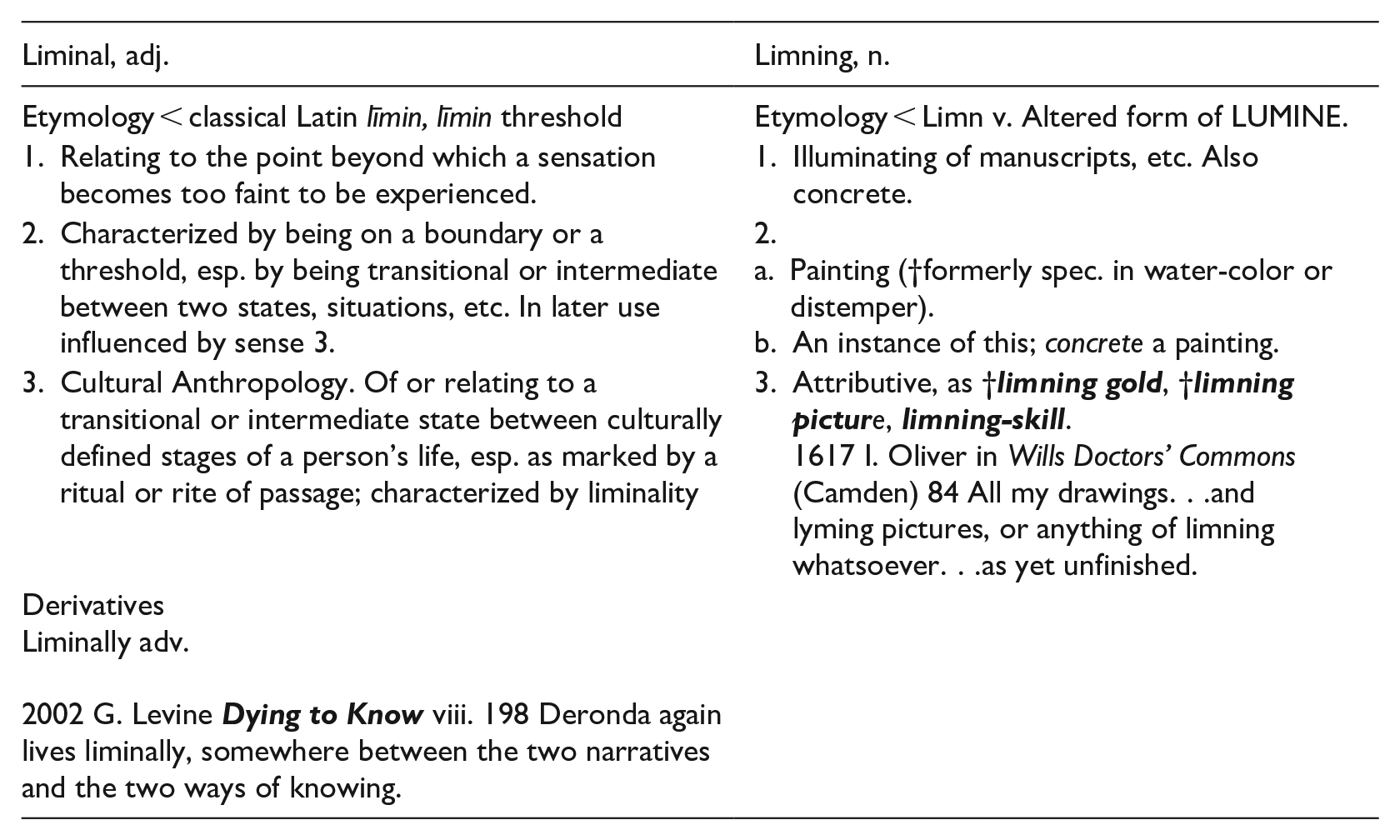
Angles of approach
I move to describing angles of approach that facilitate my inquiry. I have separated them but in practice they are constantly interweaving and are sometimes explicit and other times implicit in the text.
Alterity
Women are underrepresented at senior levels in organizations (Hunt et al., 2020) and in MOS (Financial Times, 2020; Fotaki and Harding, 2018). It follows that the study of female executives is under-researched, including their psychic life (Baker and Kelan, 2018), as “sanitized masculinity continues to be the prevalent norm” (Fotaki and Harding, 2018: 35). Heteronormativity in the workplace and the academy is rarely challenged (Rumens, 2016) including in studies of liminality. How can we argue for equality and inclusiveness in organizations if we won’t accept alterity in MOS? Some challenges can be spotted however, mostly in feminist and queer locales, which I’m (re)joining here (Beavan, 2019; de Souza et al, 2016; Fotaki and Harding, 2018; McDonald, 2016; Parker, 2001; Rhodes, 2019; Weatherall, 2019). My experiences of liminality are affective, fluid, and messy. Straight, sanitized methods cannot capture them. I use intimate scholarship, which is embodied, embedded, and embrained (Braidotti, 2018) and esthetic scholarship (Dewey, [1925]2008) to illuminate my liminal (un)felt ferments.
Affect
Losing my established professional identity, I feel peculiar without bearings or company. My worlds grate against each other and I bleed confidence, as if on an extended maternity leave. “Monsters of doubt” are my constant companions (Hawkins and Edwards, 2013: 24). My selves are both no-longer and not-yet. I’m in borderlands, one of the “Los atravesdaos,” crossing over, going through the confines of the “normal.” Perceived as squint-eyed, perverse, troublesome, half-dead by vigilant communities on both sides of the wall. I exist on the “thin edge of barbwire” (Anzaldúa, 2012: 35).
My problematic, affective, liminal experiences are the doorway into my inquiry. I am conducting my research on the process of liminality from within the process (Dewey, [1938]2008). My start point is therefore entitative although my inquiry interest and approaches are processual.
Processual
Workplace and researcher identity categories are generally assumed to be stable and identifiable (McDonald, 2013, 2016). An exception are studies of organizational liminality which focus on identity transitions (cf. Beech, 2011); though the prevailing model of liminality presented is sequential, with the uncertain liminal period bookended by settled selves. My experience of liminality is far messier. Ibarra’s (1999) work stands out for a shift into a processual conceptualization of multiple, provisional selves. Ideas that are extended creatively by Simpson and Carroll (2020) who processually re-theorize “identity work as liminal—emergent, edgy, ephemeral, precarious and fluid in nature” (p. 502). Leadership identity work, they suggest, can be seen as a site of “perpetual liminality” (p. 508) and also learning. I take belays from these moves plunging into conceptualizing liminality as ongoing performative flows and professional identities as multiple, evanescent, always forming and reforming, coagulating experiences. This is not without difficulties. The unified individual is sedimented into our thinking (cf. Harding, 2020).
My specific interest is in illuminating how new subjectivities may be produced out of this disturbing liminal environment where tension “grips this place like a virus” (Anzaldúa, 2012: 25–26). Living in this state seems interminable; a lock-down.
Braidotti’s posthuman feminism
Braidotti shines a torch; hope in the dark. I embrace her affirmative posthuman feminism which builds on elements from earlier feminisms and is distinct. Her position shares with humanist feminism a focus on an embodied and equal woman-in-the world. It follows poststructural feminism with its antihumanist critique rejecting universalism, binary thinking, and the abstract idea of Man, (critiqued as masculine, white, Eurocentric), emphasizing “the carnal nature of thought. . . its embedded and embodied structure” (Braidotti, 2016: 678). She moves further, to a world where the human is humbled, living as just one lifeform. All matter for Braidotti, is vibrant and material, interacting in complex ways within social, psychic and natural environments. The human however is not rendered obsolete. Braidotti’s call is to renegotiate what it is to be a human who is composed, conceptualized and experienced socially, and for relational and affective accounts. I perceive connections with Dewey, though her articulations are explicitly feminist and labeled posthuman.
Dewey’s experiential and esthetic empirical methods
To answer her call involves a radical shift from a stable researcher objectively studying static phenomena to what Dewey calls studying experience. Dewey is not using our common use of experience as the pool of life happenings we accumulate intra-psychically and use as knowledge. For Dewey experience is an active happening in the social world involving transactions (felt and unfelt) between things that alter things. “We do something to the thing and then it does something to us in return: such is the peculiar combination” (Dewey, [1916]1980: 146). Experiencer and experienced are cojoined and both are changed by the experience, which is also a singular situation with a unique, unifying affective quality. Dewey believes as humans we seek a sense of fulfillment and unity in experience and when experiences feel chaotic or frustrating, we are provoked through discomfort into action from which we learn. For Dewey experience and learning are one process. I focus empirically on a small number of situations, Dewey’s word for an active happening, a bounded event in a social world. In a situation all matter is transacting and transforming, and the situation is also atemporal, filled with the consequences of past experiences and generative with new possibilities. After Dewey I’m using experience as method.
This poses some challenges. Everything is moving in Dewey’s situation and this fluid lifeworld, is largely noncognitive, “[t]he visible is set in the invisible; and in the end what is unseen decides what happens in the seen; the tangible rests precariously upon the untouched and the ungrasped” (Dewey, [1925]2008: 44). The way to perceive the invisible, he suggests, is to learn to look out of the corner of our eyes employing an esthetic gaze. This requires patience. Then the danger is, that should we sight something, we rush-in imposing conceptual schema to sense-make. Dewey’s solution to interpretive hastiness is distinctive. He suggests iterative mapping, looping from the thick situation to reflexivity and then back to concrete situation, always contextually sensitive (Fesmire, 2015). Knowing is fallible in this method. At best warranted assertions (Dewey, [1938] 2008) may be inferred using our imagination (Dewey, 1941). Warranted assertions are not axioms, they are partial, provisional, creative, conclusions which always contain some doubt, yet are ready for testing in loops of experience and reflexivity in situations. In this paper I’ll be making some warranted assertions which I’ll try out (with imagination) and then reshape ready for more testing–in–experience. I’m assaying to make theory processually, organic theory, which is living, imaginative, material, morphing, vibrant, emerging from lived experience and reflexivity.
Perceiving the (un)felt
My research gaze in this paper is attuned to the unsettling, dynamic processes of liminality including fleeting encounters, subtle movements, flows, and affective intensities that make up liminal experience. I have to look beyond Dewey’s somewhat vague instructions (Alexander, 2004) to find ways to perceive the (un)felt in each situation. I start with my selves as affective, relational, transacting entities as a portal to move outwards into the world (Braidotti, 2018; Dewey, [1934]2005) embracing zig-zag and associative thinking (Braidotti, 2013; Milner, [1937]2011). My focus also includes the OED’s first definition of liminality as “relating to the point beyond which a sensation becomes too faint to be experienced.” Faint affective resonances are listened to and netted as a method of accessing the “off the radar of the self” (Ashcraft, 2020: 852) and I develop other perceptive skills. My body registers danger even though I am not in physical danger and fear is clearly relative given my privileges. Danger hones my affective antennae, “I feel the lingering charge in the air. . .sense emotions someone (or something) near me is emitting.” I semi-consciously cultivate “la facultad” (Anzaldúa, 2012: 60–61), the capacity to see in surface phenomena deeper structures, an instant sensing, arrived at without conscious reasoning, sometimes communicated in images and symbols. This faculty breaks the habitual modes of seeing reality and the patterns of consciousness, residing not in reason but in the body. My senses become “acute and piercing.” La facultad is a “survival tactic” that people caught between worlds cultivate when feeling dangerously unsafe and also, weirdly, simultaneously “excruciatingly alive to the world” lived in the “serpent” of borderland experiences (Anzaldúa, 2012: 47).
The application of these skills is visible in vignettes of my liminal experiences.
Radical–reflexivities
The Deweyan experiential empirical method establishes cycles of reflexivity between immersion in experience (via situations). I work with McDonald’s (2013, 2016) concept of queer reflexivity which destabilizes notions of stable normative identities of the researcher and/or participants defining them instead as intensely relational, highly context-specific, multiple, and dynamic. Critical to this framing is that this is not reflexivity centered on the relational (Cunliffe, 2016), though it is intensely relational, but that it destabilizes the reflector, going beyond the intersubjective into the transpersonal. This is aligned with my processual and posthuman orientations.
I am particularly interested in Serra Undurraga’s (2020) conceptualization of affective reflexivities (plural) that produce different worlds and selves. For her, reflexivity is an “inevitable activity that is both expressive of a sense of self and continuously creating this very self” (p. 920, original emphasis). In this sense reflexivity is not an activity but a movement where we create selves. Different reflexivities produce differently. If we are in humanist mode, where we think we can stand outside of ourselves observing, we may yield a production of a unitary and stable subjectivity. If we use a more “opaque reflexivity with a relational-social understanding of subjectivity” this may “yield a sense of decentred humanness: [where we are] aware of how our constant engagements with the material non-human are enabling our existence and experience” (p. 926).
In combination these radical–reflexivities afford a subaqueous, decentring, generative exploration of my lived liminal experiences in different situations.
Écriture féminine
I adopt Cixous’s (1976) écriture féminine. A writing that refuses the “phallogocentric marinade” (Thanem and Knights, 2019: 121) by embracing the female body (Höpfl, 2007; Pullen and Rhodes, 2015) and forms part of the organization studies “writing differently” movement (Gilmore et al., 2019). It’s a form of writing that decentres the intact self, facilitating an opening to the invisible. Much of Cixous’s sixty-year oeuvre is written in a hyperdream “[s]he wanders, but lying down. In dream. Talks to herself. Woman’s voyage as a body” (Cixous and Clément, 1986: 66). It is writing which portrays flowing affectual intensities “by which all borders are crossed, the human being enters into floods and expands from its others, vegetal, mineral, animal” in ordinary moments when “it is necessary to have brushes to clean shoes” (Cixous and Calle-Gruber, 1997: 165). I follow other organizational scholars who have written écriture féminine (Author, 2019; Vachhani, 2019).
With these angles of approach sketched, I turn to the conversations in MOS on liminality that I am joining.
Malestream anthropological and humanist roots of liminality studies in MOS
In MOS liminality has been defined by the work of white, European, male cultural anthropologists. Van Gennep ([1960] 2019) in his 1909 book, Les Rites de passage, used liminal to describe the rituals of transition between one social identity and another. Van Gennep’s idea of “rites of passage” was later taken up and developed by Turner (1967). Turner (1967) crystallized liminality as a state “betwixt and between” where the liminal subject (the liminar) faces “social ambiguity” and “structural invisibility” (p. 95), later becoming reintegrated into a new post-liminal status with a more coherent identity and societal (re)acceptance.
According to these authorial, anthropological accounts, ritual functions to provide cultural support to liminars struggling with identity ambiguity and transition. Viewed in psychoanalytical terms, ceremonial rites serve to contain existential anxieties and emotional turbulence, which typically accompany identity transitions and may also formally delineate a transitional space (Winnicott, 1975) for the liminar in which identity play and transformational learning might occur.
Van Gennep’s and Turner’s are studies conducted from the point of view of an academic, disembodied, external, expert observer, and this perspective dominates studies of liminality. It’s the mode of knowledge making that Dewey takes issue with (Dewey, [1929]2008). Their foundational work has also influenced the lexicon—see above the third OED definition of liminality—and scholars within organization studies have adopted the anthropological concept of liminality to explore and explain moments of individual identity change within contemporary organizations. Beech (2011) offers a comprehensive review of such applications pointing to the various ways it has been employed to examine, inter alia: occupations, hierarchical roles, spaces, and events, and organizational networks. Many of these studies share an interest in the manifestation of ambiguity and uncertainty associated with transitions between different subject positions in organizations and their potential for creativity and innovation at an individual and/or organizational level. Their focus is less on rituals and more on meanings that organizational members associate with in-between roles/spaces/occupations. Söderlund and Borg (2018) in a review of the application of liminality in MOS demonstrate that the conception of liminality has been significantly extended beyond the sequential to make more visible the roles and positions of the liminar and the liminal space in which transition takes place. Some of these studies also refreshingly examine dimensions of liminal experience both from the perspective of the researcher and liminars (Czarniawska and Mazza, 2003; Eriksson-Zetterquist, 2002; Page et al., 2014). Recently some researchers have suggested that the precarity of the 21st century workplace has made liminality more difficult to traverse and pervasive (Ibarra and Obodaru, 2016, 2020; Petriglieri et al., 2018, 2019). My personal lived experience as an adjunct professor reflects this conceptualization.
Organizational studies of liminality are, therefore, also studies of professional identity; a topic which has been the subject of extensive attention by organization researchers. This paper is not the place to offer a review of the organizational identity literature as this has been addressed comprehensively elsewhere (cf. Brown, 2015, 2020). What is striking about this body of work though, is that even studies engaging with poststructural or even posthuman framings, tend “to begin with, and boil down to, the individual” (Ashcraft, 2020: 848). Humanist Man exerts epistemological staying power.
Overall, studies of liminality in MOS remain malestream with little space for alterity.
Toward an unbounding of the intact humanist individual in MOS
Psychodynamic studies emphasize liminal space as a holding space and a playground for identity work, (Ibarra, 1999, 2003; Ibarra and Obodaru, 2016, 2020; Petriglieri and Petriglieri, 2010; Petriglieri et al., 2018, 2019). Play/ing offers a more generative potentiality to liminality, shaking the humanist premise of a stable identity into possibilities of multiple, provisional selves. Petriglieri (2020a) pushes further and provocatively suggests that identity itself is a fabrication and that psychoanalysis can offer an alternative theorization of identity as a multiplicity, dynamic, full of unconscious affect and vitality. He urges us to move our lenses out into the world, advocating for a systems psychodynamic viewpoint (Petriglieri, 2020b) as a human relations 2.0, though he simultaneously struggles to let go of the concept of a singular self who must keep going to be fully human and feel alive.
Ashcraft (2020) has also sought to replace the “fantasy of the bounded individual” (p. 848). Drawing on affect theory she assays to illuminate “pre-individual. . . “senses of self””(p. 849). This is a move to recast identity as a posthuman sociomaterial production and specifically to suggest that the human subject emerges through sensate connection with others, connections of which we are only half aware. We believe in our self-governance but in fact we are sleepwalking. “Occupational identity is not made by people but through senses of self: semi-conscious, transpersonal bodily encounters that collide with, as well as constitute, human will and effort” (p. 859, original emphasis). Researching affective pre-individual flows is, as Ashcraft says, alien terrain and she introduces the unbounded figure of the Sleepwalker an intriguing, if abstract, “hybrid figure at once human and non-human. . .who acts under the influence of relational currents it cannot discern” (p. 861).
A processual and concrete approach to identity is also taken up by Simpson and Carroll (2020) who in an empirical study of leadership development work theorize a position of “perpetual liminality” where identities are ephemeral, precarious and continually “formed and reformed within the dynamic flow of identity work” (p. 514). Their attention is drawn to “small changes of imagery, vocabulary and tone. . .of the emerging identity situation” (p. 505). It’s an assay to capture “actual goings-on” of identity work and this resonates with me as a practitioner.
Ashcraft and Simpson and Carroll’s papers are inspirational, radical reformulations of identity work opening the door to alterity. I extend their work with my processual explorations to illuminate the “actual goings on” of my liminal identity flows and identify new becomings.
What kind of human am I/we, am I/we becoming?
How do we re-define the subject without reference to humanistic man? This paper is not the place to tackle this significant challenge in depth. I turn first to Dewey because I believe the antecedents of posthuman conceptualizations of subjectivity can be located in American Pragmatism. Dewey’s ideas were, and remain, radical. For Dewey, sociality precedes individuality. We are formed through interaction with the social world (Dewey, [1934]2005). A complex multiplicity, we are a knot of multiple selves in dialog with each other; selves which are temporal and evolving. Our selves change the social world and are changed by it. Nothing is stable and everything is always processual and unfolding. Dewey, as we have seen, doesn’t privilege cognitive thinking; that which is not known is just as real as that which is known (Dewey, [1925]2008). Selves can be formed by what is out of our conscious awareness.
To concretize I’m sharing a writing extract of a situation. The writing is intimate scholarship and, following Dewey, I’ve given it title to reflect its unifying affective quality. I have placed the writing in a text box and used different fonts to aid readability. I’ll follow the same process with other writing extracts.
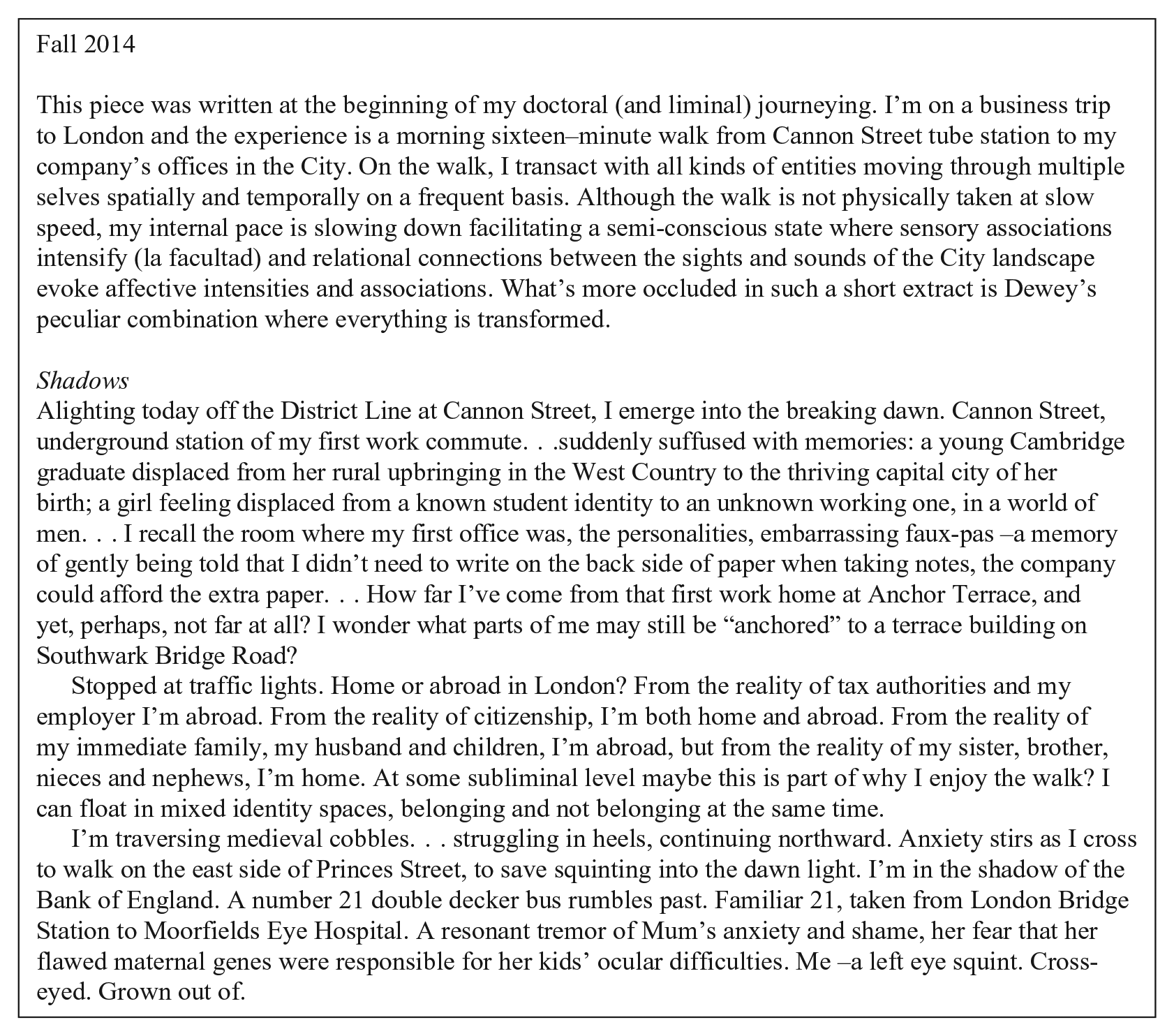
Dewey ([1929]2008) also suggests that natural entities have two basic tendencies: to reach out and associate with other entities; and to individuate, discovering our unique qualities. Individuality is not a given, it arises from a social development process and is a process of growth and learning. He uses the metaphor of a garden (Sullivan, 2001). As individuals, our individuality can be distinguished from other entities, we need to cultivate our personal gardens to develop our unique qualities. At the same time, our individual cultivation is only possible because of transactions with other entities in the social world. These concepts of sociality preceding individuality, association, individuation, and learning are vital to my gestation of an organic pragmatist–posthuman theory of liminality.
Braidotti theoretically outlines a processual vision of human subjectivity “foregrounding an open, relational, multiple–self-other entity framed by embodiment, sexuality, affectivity, empathy, and desire as core qualities” (Braidotti, 2016: 681, 686) and also our unique differentiation. “We-Are-(All)-In-This-Together-But-We-Are-Not-One-And-The-Same”; “becoming-subjects-together” (Braidotti, 2019: 52, 73). Neither unitary nor autonomous as subjects, we are embedded and embodied, deeply steeped in the material world and individually accountable. Part of a complex, relational, and affective assemblage with human and non-human others that renders porous the boundaries between inside and outside of self. We are never just one. We are flows, processes, relationality. It is affectivity that activates our body into new becomings. She is always affirmative, “the human being’s in-built tendency is toward joy and self-expression and not toward implosion” (p. 47). Again, I concretize with a writing extract.
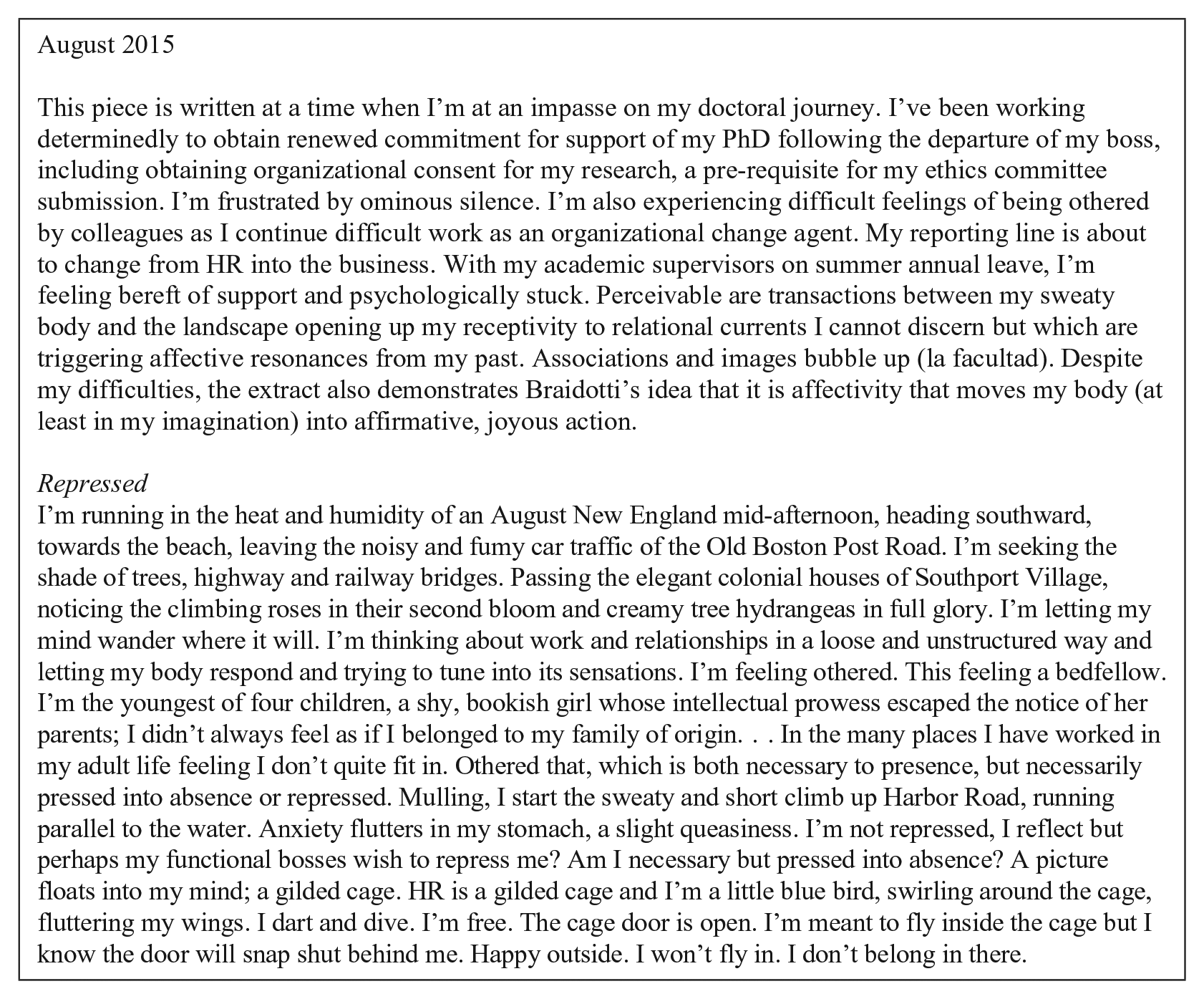
“The loss of humanist unity is the starting point for alternative ways of becoming-subjects-together….But because ‘we’ are not one and the same, the patterns of becoming will necessarily differ” (p. 47, 73) . Thus, for Braidotti, posthuman subjectivity, is a practical project. She calls for “adequate and differential accounts of multiple subject positions that are in process of becoming” (p. 69) that account for “different speeds and patterns of becoming” (p. 72). A call I am answering in this paper.
Following Dewey and Braidotti, my conceptualization of subjectivity is processual and relational including with the more-than-human dynamic and situated in the material world, embedded and embodied, differentiated and connected. Although I’m sympathetic to Simpson and Carroll’s (2020) theorization of liminality as ongoing practice rather than a state—as perpetual and as a learning experience–the liminality I am experiencing is affectively acute and of a different order and duration. My sense of professional identities is collapsing, and conscious new becomings end in regular disappointment.
With this understanding of pragmatist–posthuman subjectivities I’m turning to articulate a theory of liminality.
An adventure: Conceptualizing a pragmatist–posthuman feminism/t’s organic theory of liminality
What is theory?
The normative definition is that theory must offer universal principles, philosophical rigor, contrasted with practical relevance. Dewey refutes such dualistic thinking, radically reframing it. For Dewey, there is no epistemological difference between theory and practice. The chief value of theory for Dewey is if it can be useful for solving real-world problems, prospectively. Theory emerges from experience and must be reexplored in new experience. Action is therefore an integral part of theory, not something separate, lesser, or after. As we have seen, for Dewey theory and knowing are always fallible and contextual at best warranted assertions may emerge. Warranted assertions are nor axioms. They are tentative conclusions, which using imagination, are ready for retesting in more lived experience in order to improve it.
A small number of warranted assertions
Warranted, in the sense of based on what has come before in this paper and from other lived liminal experiences not represented here. Assertable in that they point forward to something yet to be done—test them against radically-reflexively written experiences—in order to make further warrantable assertions; an action-learning cycle.
What I am offering is neither certain nor permanent. It is organic theory. I offer, briefly, four warranted assertions. Each is followed by an affective vignette as a testing ground. After the vignette I comment on and rework the warranted assertion to try out in new inquiry with the vision of establishing a practice–theory–practice rhythm. The affective and relational complexity of my liminal experiences is apparent. It is impossible given the word limit constraints of a journal article to do this complexity justice in my comments; out of necessity I am selective.
Liminality as a time of arrested relationality and therefore arrested becomings
I return again to self as an affective, relational, transacting entity, and as a portal to move outwards into the world (Braidotti, 2016; Dewey, [1934]2005). Dewey proposed that natural entities have two basic tendencies, the first of which is to reach out and associate with other entities. For Braidotti, it is affectivity that activates our body into becoming. My warranted assertion is that my becomings are stuttering without transactions in social worlds. I’ve unbecome a corporate executive and PhD student. Isolation is a dominant feeling, most intense in my memory, in the period after I had submitted my dissertation. In the lull I started studying for a low-residency MFA (Master’s in Fine Arts) at Naropa University driven partly by a desire to find community as well as to develop my creative writing skills.
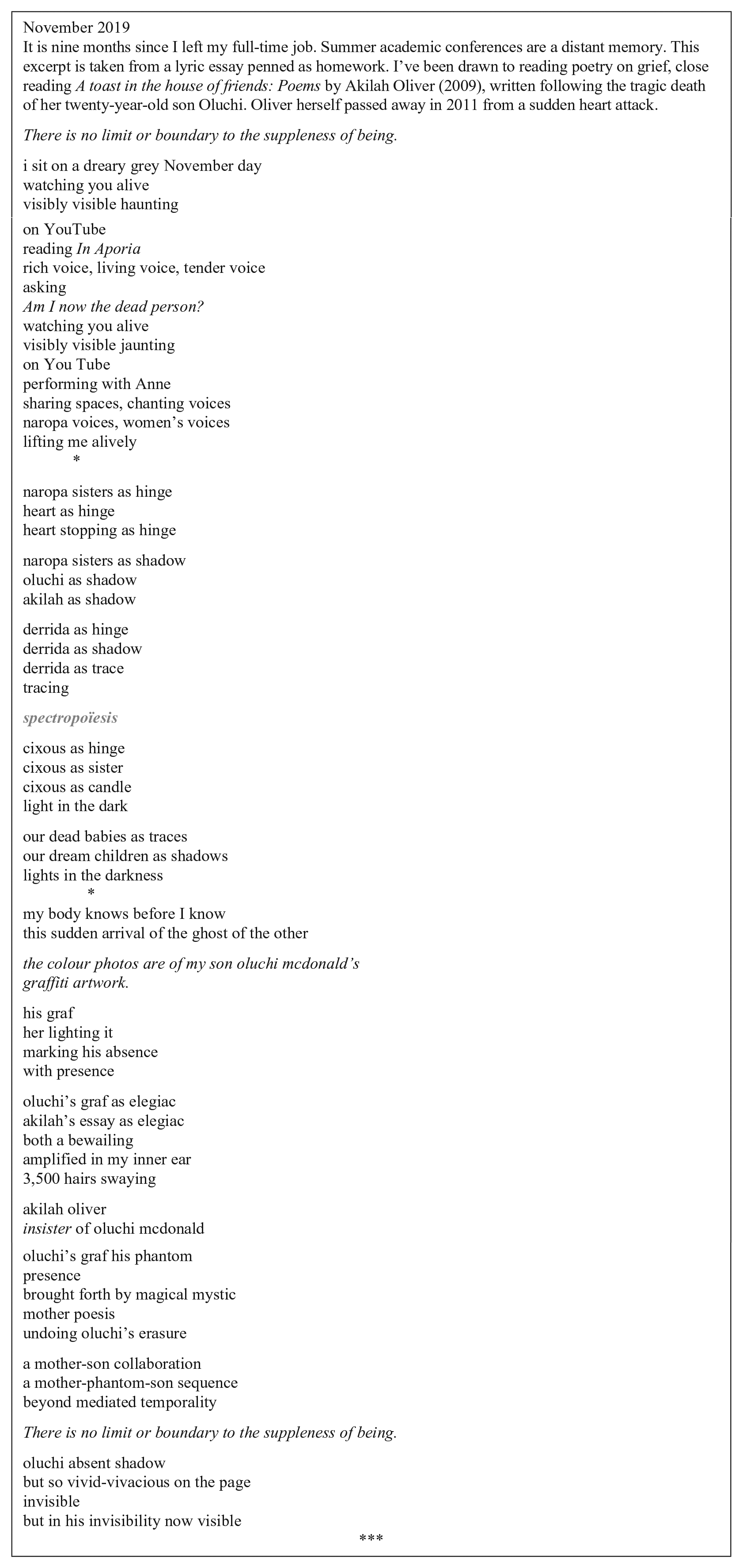
There is allusion in this poem to loss of my previous professional identities and to troubling experience of living in the liminal borderlands apparent in the line “Am I now the dead person?.” However, to my amazement what I read in this situation is not an absence of relationality but an abundance. I’m actively transacting in an affective, relational world—though the relationality is via and includes texts and YouTube. I’m part of a complex, relational, and affective assemblage with human and non-human others that renders porous the boundaries between inside and outside of self as well as temporality. The poem, texts, people are flows, processes, relationality. The extract foregrounds “an open, relational, multiple–self-other entity framed by embodiment, sexuality, affectivity, empathy, and desire as core qualities” (Braidotti, 2016: 681, 686). In this extract Akilah, Oluchi, Derrida, Cixous, Anne (Waldman), Naropa sisters, YouTube, hearts, lost children, and many other entities and I are “becoming-subjects-together” (Braidotti, 2019: 73). Affirmative joy triumphs liminal darkness as Oluchi, (and I) become “vivid-vivacious” on the page.
To return to Dewey, we can also see sociality preceding individuality. It is out of this social assemblage that I am finding, even though it was out of my conscious awareness, a new self, I am becoming-poet. Finally, there are different reflexivities at work in the piece that facilitate visibilities of pre-individual affectual intensities. There is Serra Undurraga’s (2020) opaque reflexivity as a movement where intuition and bodily feelings such as 3500 inner ear hairs swaying, is opening up new meanings. McDonald’s (2013, 2016) queer reflexivity is destabilizing me as reflector, going beyond the intersubjective into the transpersonal.
I reshape the warranted assertion: liminality as a time of surprising relationality with humans and more-than-humans that affectively generate becoming-subjects-together and individually, which may be out of conscious awareness.
Liminality as a time of arrested individuation
Dewey’s ([1929]2008) second tendency is a desire to individuate, discovering our unique qualities. Individuality is not a given, it arises from a social development process and is a process of growth and learning. Perhaps my ability to learn and individuate is arrested without a social development process and at a time when confidence in my professional skills is also diminishing?
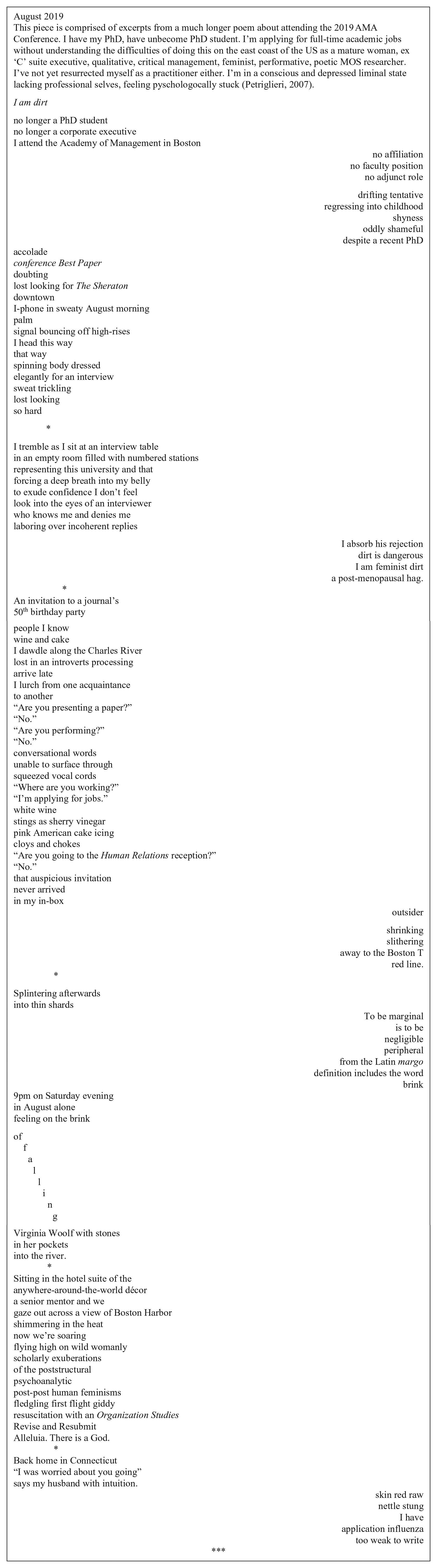
In this piece my reflexivity is more “transparent and essentialist” (Serra Undurraga, 2020). Others are perceived, including the cake and wine, as enemies, or, in the case of my mentor, an ally. It is easy to see pathology in my mood. I am feeling lack, not my unique qualities, and affect is predominately negative producing an abject self. That said, there are visible complex, relational, and affective assemblages with human and non-human others—interviewers, guests at the journal party, my mentor and the Charles river, hotel rooms, shimmering view, Organization Studies journal—that render porous the boundaries between inside and outside of myself. The exception to the abjection is the contrasting scene with my mentor where exuberance is in the air moving between us and there is a shift toward a more affective/relational modality and reflexivity. In this moment we are together, and in relationality with the room and view, becoming–academics and I have a sense of discovery of my potentiality as a publishable MOS academic.
I amend this warranted assertion to: liminality as a time of abjection which arrests individuation and ability to discover unique qualities, though this is uneven and surprising sparkling moments (White and Epston, 1990) illuminate new potential becomings.
This moves me to my next warranted assertion.
Moments of astonishment which provide anticipatory illuminations of new futurities
What might speed-up becomings? “The present moment is both the record of what we are ceasing to be and the seeds of what we are in the process of becoming, at the same time” (Braidotti, 2018: 184). I have a felt sense of inchoate sparkling moments when I perceived something. Queer theorist Muñoz (2009), argues, following Bloch, for a sense of astonishment that “allows us to see a different time and place” that emerges out of the “darkness of the lived instant.” Astonishment, he suggests, “helps us surpass the limitations of an alienating present” allowing us “to see a different time and place. . .wish-landscapes” (p. 5). He suggests we can detect this sense of astonishment in relationality with entities, wish landscapes, such as, for Muñoz, O’Hara’s poems or Warhol’s paintings. We become “imbued with a feeling of forward-dawning futurity….The anticipatory illumination of certain objects is a kind of potentiality that is open, indeterminate, like the affective contours of hope itself” (p. 7). Moments of sensory and relational astonished contemplation are modes of being and feeling of the not quite there, yet concrete and embodied. Anticipatory illumination can and regularly will be disappointed but, disappointment must be risked, as such moments are “indispensable to the act of imaging transformation” (p. 9, my emphasis). Vision is both material and metaphorical. Muñoz’s idea of moments of astonishment is affirmative, reflecting Braidotti’s idea that as humans we move toward joy. I illustrate with two extracts which return us to earlier situations. The first is a continuation of my commuting walk and the second to my summer run to the beach.
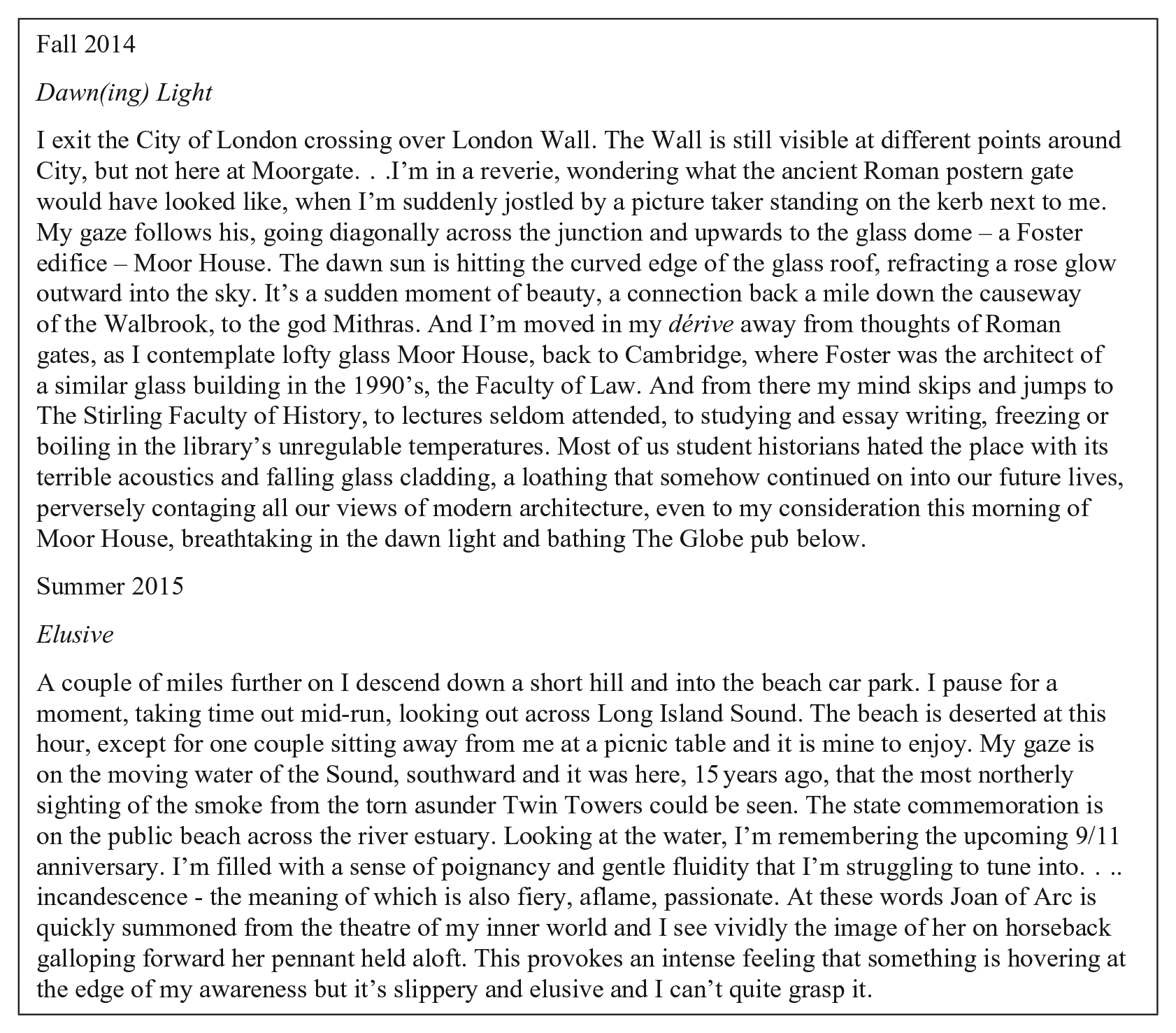
Capturing semi-conscious feelings of a futurity, not quite here, is difficult. The idea is to perceive alien pre-individual affectual intensities or collisions which the body feels, yet cannot discern consciously (Ashcraft, 2020) and, to represent this phenomena in language. Poetry works as an esthetic opening to pre-individual intensities (Kristeva, 1984), but prose is how I captured these experiences. In the first excerpt it is dawn breaking over Moor House that provides the moment of astonishment. My reflexivity is queer, moving from intersubjective to transpersonal. Although my conscious thoughts fly backward to my student days, in the falling cladding, there is perhaps an unconscious anticipatory illumination of my futurity as a critical management scholar?
In the second excerpt powerful affects are evoked in/by the assemblage of water, the beach, burning towers and my embodied gaze. La facultad again can be perceived, this time in the form an associative image (Joan of Arc) and in my instant sensing of the burning twin towers. I am astonished, with a sense of poignancy and gentle fluidity, and again, is there an unconscious anticipatory illumination of an affirmative, elusive futurity in the figure of Joan, on horseback, galloping forward with her pennant held aloft.
The moments of astonishment are vague and elusive. This warranted assertion I see no need to reframe at this stage, rather the need is to continue to test it out in the mundanity of lived, liminal experiences and see what emerges. I turn to my fourth and final warranted assertion (although the possibilities for warranted assertions could continue).
We make sudden, semi-conscious leaps toward possible new futurities
I feel this intuitively and turn to Grosz (2002, 2012) to help me articulate my ideas. Like Muñoz, she’s interested in how we envisage and engender a future unlike the present, when we don’t know what such a future entails. The future she suggests is an “openness of becoming that enables divergence from what exists” and that the “past is the condition for infinite futures” and that we can leap into a future we do not control through finding something “untimely in the patriarchal present and past” (Grosz, 2012: 49, my emphases). She continues, we have to invest in the “power of the leap, by which the actual emerges and produces itself from its virtual resources [generating] the surprise of the new” (Grosz, 2002: 18–19). Although she is talking about feminism and her idea of the leap is briefly articulated, abstract and disembodied, it’s a useful concept to try and glimpse moments when I felt myself suddenly vaulting into new becomings escaping otherness.
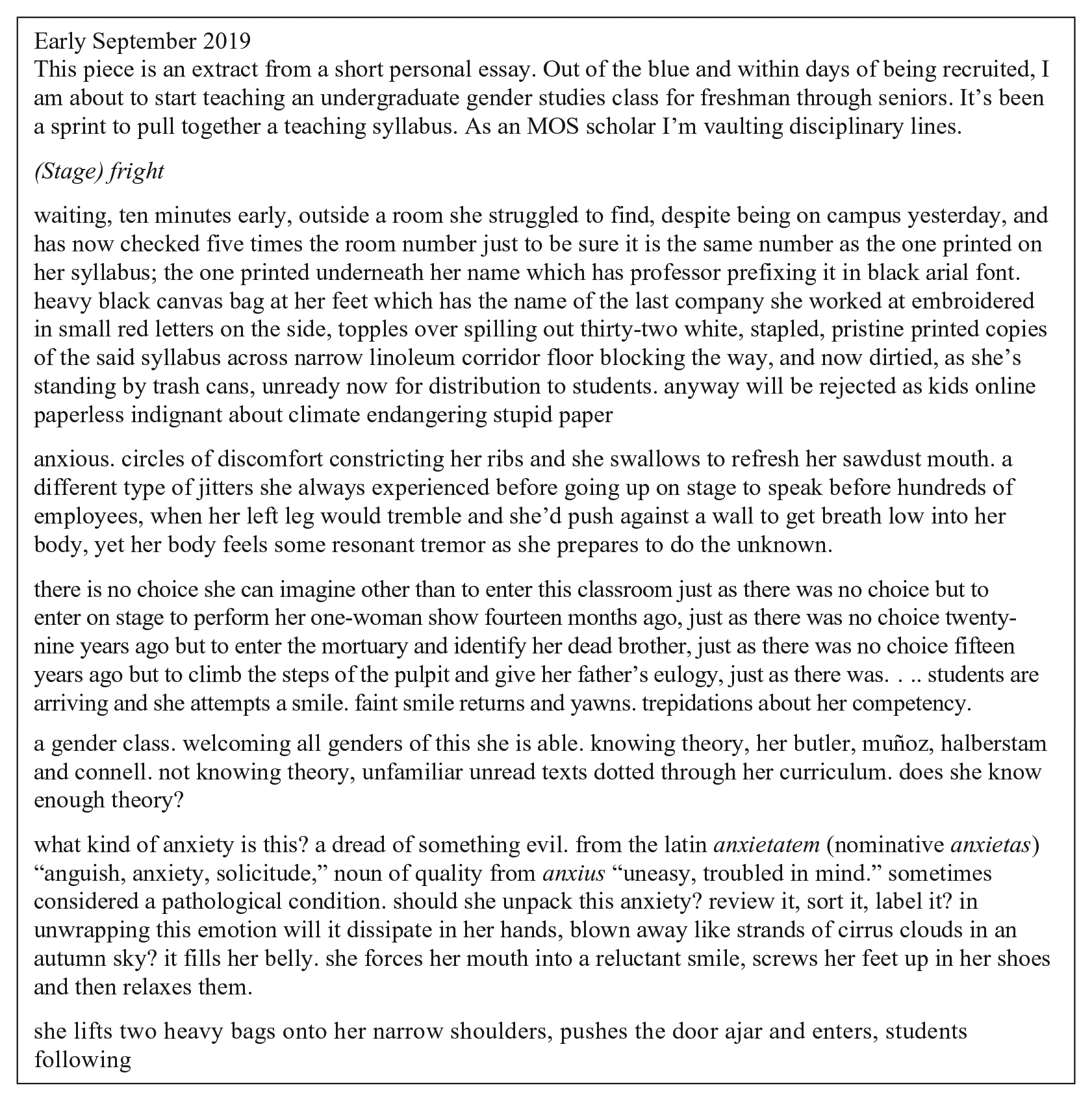
This piece is radically–reflexive and a whole assemblage of the corridor, bags, syllabi, trash cans, students, and are flows, processes, relationality. My I seems humbled and the extract is written, not consciously when it was penned, in the third person. Anxiety is intense and moving from myself through the spilling copies of the syllabus and through the arriving students and their anxiety is contagious too in “trepidations about her competency.” I identify at least three opportunities for a leap, the first two from my patriarchal past and the third from my present. In the first I’m calling on courage, times when I’ve faced “no choice” but to be strong and to do something difficult, to overcome anxiety, and vault me across the threshold and into the classroom. In the second, with my associative leap into the etymology of anxiety, it is intellectual knowledge that I’m using to leap. In the third, counterintuitively, it is lifting two heavy bags onto my shoulders that enable me to leap forward and push the classroom door ajar. All three leaps involve a harnessing of masculine performances—strength and intellect.
This warranted assertion I’m leaving as is, to explore in further inquiry. I sense in this experience and in others, such as the Joan of Arc moment at the beach, there is a surprising leap out of liminality into a new professional becoming. I’m not yet sure whether this is catalyzed from, or only catalyzed by, something untimely in the patriarchal present and past.
A Deweyan inquiry is never completed. My warranted assertions are the start-point for further experience-based inquiries into lived liminal experiences. However, here I can take my inquiry only a little further. The Law of Journal Word Counts constrains me. I’m traversing to “discussion” and “conclusions.”
As yet unfinished
An aim of this paper is to disrupt (hetero)normative paradigms of organizational liminal identity work. I’ve limned (un)felt ferments of liminal experience and articulated and applied an organic pragmatist–posthuman feminism theory of liminality. I’ve used esthetic and intimate scholarship, a variety of angles of approach, to illuminate liminal situations revealing how self is a sociomaterial production and new selves emerge affectivity and relationally from entanglements with other entities. I hope my assay will provoke other processual, affective, and relational accounts of liminal identity work. There is a danger, however, that this may lead us back to studies on liminal identity processes by researchers from outside the processes. This would be a return to (hetero)normativity. Dewey saw presciently the dangers of a “class of experts” becoming “so removed from common interests as to become a class with private interests and private knowledge” (Shields, 2003: 529). A chasm separates, in my view, the daily, dirty, dynamic, goings-on in flesh–and–blood organizations and MOS research in (ivory-tower) universities.
Braidotti is always affirmative. I believe we can invest in a leap, saltating over border walls to (re)join practitioners in solving real-world problems prospectively and in partnership. As a step toward a “human relations 2.0” (Petriglieri, 2020b: 9), and as a fourth contribution of this paper, I am making a generative call, based on pragmatist ideas, to establish a community of inquiry (Shields, 2003) shaped around the problematic, doubting situation of the liminal professional. This Deweyan approach puts unfolding liminal experience, not theory, as the point of our departure. Democratic and emancipatory a “rich participatory community,” practitioners and scholars, could engage in ongoing research, working as a “participatory democracy” (Shields, 2003: 522) with “mutual respect, mutual toleration, give and take, the pooling of experience” (Campbell, 1998: 40). Everyone involved, as co-researchers and co-subjects (Reason, 1999). I hear shouts of “utopian” given the individualistic world of the global neoliberal business school, where crushing research production and profit targets kill-off our desires for creative experimentation and sustained deep engagement with practitioners. However, reframed, “[c]oncrete utopias are educated hope” (Muñoz, 2009: 3). Reason (1999) provides us with an education on how to get started with his “Layperson’s Guide” to collaborative inquiry (Reason, 1999: 1350). Communities of inquiry in MOS are, I envision, a hopeful surge towards a futurity without walls where we “work towards the betterment not of one kind of people but for the common good” (Addams, [1895]1970, in Shields, 2003: 524, Shield’s emphasis). A posthuman “affirmative mode of potentia” (Braidotti, 2019: 158).
Endings, or becoming-subjects-together
I have assayed to show we might carry out inquiries into liminality, and more broadly inquiry in MOS, generatively. Togetherness. Day-by-day working alongside each other, as academics, practitioners, and all entangled vibrant matter. The forging of a participatory democracy between the business school and practitioners as anticipatory illumination and a place for limning gold. On La Frontera, “[b]ecoming-subjects-together” (Braidotti, 2019: 73).
“This land was Mexican once was Indian always and is, And will be again.” (Anzaldúa, 2012: 113)
Footnotes
Acknowledgements
I wish to thank Peter Case and Margaret Page, my doctoral supervisors, for their wonderful collaboration on early drafts of this paper. Special thanks also to my anonymous peer reviewers for their respons-able reviewing. I experienced the process as affirmative and mentoring where I felt my text was close read, responded to carefully, dialogically, and perceptively. The paper strengthened and I grew as a scholar as a result. I also wish to thank ML Associate Editor Jamie McDonald for his excellent guidance throughout the review process. Responsibility for remaining errors and omissions are mine alone.
Funding
The author received no financial support for the research, authorship, and/or publication of this article.
