







Abstract
Recognizing the prevalence of suffering among management teachers and students, we raise the importance of compassion as central to the practice of management teaching. To aid in understanding how suffering and compassion arise in management teaching, we call upon a theoretical view of their rhizomatic structure, which conveys the widespread, complex, and largely unspoken spreading of suffering and corresponding need for compassion in the work of management teaching. To meet this suffering with compassion, we propose two clusters of practices central to teaching that lend themselves to helping management teachers see possibilities for more skillfully intertwining suffering and compassion. The first focuses on how management teachers can design the context for teaching in ways that make compassion more likely, focusing specifically on roles and networks. The second draws upon Honneth’s recognitional infrastructure to focus on how teachers can approach the relational practice of teaching with emphasis on enriching human recognition of suffering. We conclude with a caution about overly simplistic approaches and overly individualized views of compassion in the work of management teaching. We call for systemic approaches to action that will enrich our imaginations as we approach management teaching and its role in our collective responsiveness to suffering.
Management teachers and students are suffering. Our experience of suffering is often silenced and written out of accounts of management learning, just as heartbreaking experiences in research are often silenced and written out of sanitized accounts (e.g. Adler and Hansen, 2012; Behar, 1996; Howard-Grenville, 2021; Whiteman, 2010). In this paper, we join with voices seeking to break the silence around suffering in management teaching and learning (Greenberg and Hibbert, 2020; Miller, 2002) and call for greater attention to the necessity of meeting suffering with compassion. We discuss both systemic and episodic sources of suffering in teaching and learning and introduce relational design principles that management teachers can draw upon to create conditions in which suffering, both their own and that of their students, can be met with compassion. We conclude with a challenge to leaders in management education to take a more courageous stance in preparing and supporting teachers to call forth more compassion to meet the suffering that envelopes our work.
Overview
Compassion is defined as a complex, four-part, social process that involves noticing suffering, interpreting suffering in particular ways, feeling empathic concern in response to suffering, and acting to address or alleviate it (Dutton et al., 2014; Kanov et al., 2004). While management teachers may not consider compassion as central to their work, widespread suffering in the classroom and beyond calls for increased emphasis on compassion. Management scholars increasingly recognize that emotions and values are intrinsic to the work of management and to management teaching (Mohrman, 2010). An emotionless approach to management teaching is not only faulty, misleading, and incomplete (Kiriakos and Tienari, 2018; Mohrman, 2010), it renders our work irrelevant to contemporary institutions, organizations, and lives (Weick, 1999). In this paper, we argue that speaking the unspoken around suffering in management education is a necessary step toward intertwining that suffering with compassion as a source for recovery, resilience, healing, adaptability, and growth (Dutton et al., 2014; Goetz et al., 2010; Goetz and Simon-Thomas, 2017). Thus when we argue that teaching with compassion is a necessary shift in management education, this call is for the benefit of the teachers as well as the students. Management teaching without compassion perpetuates suffering.
Our paper begins with a fuller depiction of the levels and types of suffering and compassion that are present in management education. It reveals unspoken truths about the presence of suffering and compassion in our classrooms. We acknowledge the sources of suffering of both teachers and students that are systemic in management education and higher education generally, as well as sources that are episodic and highly individualized. We are clear that calling for the courage to teach with compassion means working courageously toward the transformation of systemic sources of suffering as well as developing skilled relational practices to interact with compassion toward colleagues and students who are suffering.
We draw from two important theoretical inspirations as we encourage classroom design and relational practices that speak to these unspoken experiences in management education. First, drawing on Deleuze’s vision of the rhizome, we portray both suffering and compassion as forms of rhizomatic activity that trouble the bureaucratic structure of management education (Lawley, 2005). The rhizome offers a metaphorical image of an organic force growing and spreading under the surface. In botany, common rhizomes include fast-spreading, hardy plants such as ginger or bamboo. We draw on Deleuzian rhizomatic theorizing as a means of conceptualizing suffering and compassion as complex, invisible, and spreading-below-the surface, which helps explain the challenge of teaching with compassion. We point toward Honneth’s (2004) vision of an infrastructure of recognition, which posits that relational moves involving human recognition of one another’s worth form a social infrastructure of connectedness that creates conditions for the development of respect and self-respect, trust and self-trust, and esteem and self-esteem for those within that infrastructure. Honneth’s vision inspires our articulation of an agentic design and relational enactment that supports compassion in management education, even while the broader systemic and structural forces remain unchanged.
Speaking the unspoken: Giving voice to suffering and compassion in management education
Suffering is a grand word, the kind of word sometimes reserved for traumatic events or life-changing losses. Experiences such as daily chronic stress, the slow erosion of meaningful work, or the almost-invisible slights of incivility and micro-aggression don’t often warrant the word “suffering.” Nonetheless, these experiences fit a definition of suffering understood as a challenge to the integrity of personhood (Cassell, 1999). When we understand suffering as a threat to the integrity of one’s own identity and experience (Kahn and Steeves, 1986; Kanov, 2021) we see that the everyday experiences of management education are riddled with such threats. This view of suffering makes clear that we cannot understand contemporary management education unless we acknowledge the suffering we have been trained so studiously to absent and erase. Silenced suffering in management education is not a benign absence, but rather a cancer creeping through the field (Frost, 1999, 2007).
Some have begun to break this silence. A few teachers are opening windows into the work of “professing in the midst of tragedy” (Miller, 2002: 571). Others are sharing how to cope with the challenges of teaching during a pandemic (e.g. Greenberg and Hibbert, 2020; Inter-agency Network for Education in Emergencies, 2020). However, these stories are still too rare, as Vickers (2015) illuminates in calling for the inclusion of life experiences as part of the articulation of scholarly work. We do not hide our discussion of the experiences of suffering in teaching management behind what Meier and Wegener (2017) term “defensive writing.” Rather, we seek academic writing that strives for resonance with the reader through the conscious and plain-language use of images, memories, emotions, and our own experiences. We embrace a challenge to what is generally called “scientific” writing, which “excises much of what it is to be human—the poetics of our humanity if you like—and thus our knowledge, understanding, and learning are inhibited.” (Gilmore et al., 2019). We want to share, listen, and learn from the suffering that surfaces in teaching as we look carefully at whether, when, and how we might meet such suffering with compassion. We hope to provoke in the spirit of Brewis and Bell (2020), fostering a new dialog about compassion in management education by sharing stories such as this one, which came breaking through the surface of an essay written by a student we will call Oliver (names of students have been changed and identifying details removed from the story): Since I’ve been at college, I have felt like the school has been against me. I have examples of not getting into clubs or extracurricular groups because I could not answer obscure questions. I got a poor grade, but the exam covered material that was never discussed in the class. And now, I am also blaming COVID for taking away a year of experiences I would have had in college as I finally got used to being here. Throughout all these instances, I felt like I was being punished.
Oliver experiences the everyday reality of management education as a kind of punishment; an enduring and persistent threat to how he sees himself and his potential to navigate the world. What does Oliver’s experience mean for management educators? How might we respond to Oliver’s experience with compassion that is responsive to such suffering? Management education is largely silent about such topics.
Students’ suffering serves as a sort of mirror for management teachers as well. As teachers we often experience a variety of punishing insecurities and challenges to our identities as professionals. Similar expressions to Oliver’s appear in accounts such as those captured by Knights and Clarke (2014) in their study of the fragility of academic selves in current university environments. They document respondents’ descriptions of the everyday reality of suffering as a management teacher in terms like these: “. . .the job is never done; it’s never done properly, and it’s never done well enough. You’re always feeling terribly guilty. (Professor, quoted p. 342) . . . The fear of failure can be difficult. . . . your confidence can become very fragile.” (Professor, quoted p. 344)
We listen to a polyvocality of the voices of teachers and learners like those above; voices that render experiences of suffering and compassion in management education with more lifelikeness. We hear in these voices a widespread suffering that appears in every corner of management education. We theorize from this widespread suffering that a systemic response is necessary, shifting management education as a field toward greater compassion, even as we depart from a world of stylized organizational theory (Howard-Grenville, 2021). We do so with the hope that our own experiences of teaching, blended with the voices of others, can serve as a source of inspiration to explore the dilemmas, paradoxes, challenges, and rewards that come into view when we speak the unspoken suffering in management education and open up a conversation about the courage to teach with compassion.
A first unspoken: Teachers of management are suffering
Jones et al. (2020) articulate what they deem to be an emerging global zeitgeist referred to as the “performative university.” This perspective recognizes the fragility and brutality of instrumental management approaches to academic work and names the heightened sense of anxiety, powerlessness, mistrust, and “terror” among members of academic institutions. This perspective points to sources of longstanding, persistent, and widespread suffering that seem to be escalating with the adoption of income-maximizing managerial strategies for universities around the globe (Jones et al., 2020). It may be a cruel irony that teachers of management are suffering at the hands of the very theories they have long been professing. Management education has often construed managers as rational beings devoid of emotion and embodied experiences such as suffering (Ashkanasy, 2007). Ghoshal (2005) asks why, in the face of so much contrary evidence, the field of management continues to perpetuate a pessimistic view of purely self-interested people who are motivated to opportunistically take advantage of others. The emphasis in management education on power as a form of domination, social exchange as the sole mode of interacting, and the relative absence of relational views of human nature have informed a global managerialism that now dehumanizes those who profess it as well as those who study it (Ghoshal, 2005; Jones et al., 2020).
Suffering befits the state of protracted distress and fundamental human challenge Jones et al. (2020) describe in their portrayal of the performative university. Smith et al. (1995), in a study of academic faculty in a US public university, found that high self-expectations, financial concerns about support for their work, and a lack of sufficient time to keep up with developments in the field were sources of significant work stress for more than half of those surveyed at the time. Jones et al. (2020) suggest this trend has only escalated. Studies like these conclude that work overload is a major contributor to a significant degree of suffering for faculty and highlight how this workload is differentially experienced, with female faculty and faculty of color likely to bear even greater stress (Flaherty, 2020). A similar observation from Lapine and Sachdev (2019) finds that pressures to manage speech in the classroom, combined with gendered role expectations, create conditions in which female faculty are more likely to experience negative physical and psychological effects from their work and to feel as if they are being asked to “juggle in heels.”
Responses to the coronavirus global pandemic have required immense additions to faculty workloads and hurried adjustments to remote teaching, usually with little preparation or support. Early evidence suggests that such increased work demands sparked increases in working hours, loss of positions, significant added strain, and difficult adjustments that are taxing the physical and mental health of university faculty (Flaherty, 2020; Santos et al., 2021). One survey reported over 40% are considering leaving the profession (Flaherty, 2020). Management educators are no exception. Greenberg and Hibbert (2020) describe the layers of loss experienced by management teachers, which extend from pedagogical to career-wide losses. Bari (2021) offers an account of life as a faculty member in the shifting sands of pandemic teaching, capturing a form of suffering arising from teaching that is mediated by endless screens: It’s at the moment when the screen goes blank and I’m left alone in my living room that I feel a pang. I remember all the other teaching, like when a timid student corners you at the end of a class or an eager one catches you in the corridor. Our work happens in spontaneous encounters — you remember that there’s a book about exactly the thing this student is describing and it’s right here, so you hand it over directly. There’s something heartbreaking about the silent corridors and empty classrooms of the last year. The university may not always be pretty or well maintained, but it is designed to enable encounters between thinking beings in a real place and time.
Recent studies of university workers reveal that many find their work climates to be closed and defensive, while personally experiencing significant feelings of anger, shame, failure, depression, and burnout (Smith and Ulus, 2020). Austin and Pilat (1990) paint a vivid picture of academic teachers as overtaxed, highly stressed people running from one task to the next, anxiously awaiting potentially painful and largely negative evaluations at every turn. All the while, professional expectations often dictate that teachers endure these conditions without revealing their suffering or appearing as if they are experiencing distress (Ratle et al., 2020). This may be even more true for management teachers, who must often put on a persona of expertise about a field of practice for which they have little personal experience. Pfeffer and Fong (2002) pointed out that management education emphasizes teaching students to learn to talk about business as experts by reading cases and pronouncing on organizations they do not know or understand. Faculty likewise preside over this learning by lecturing and pronouncing rather than engaging students in action or reflective practice. Pressure to put on the face of an expert grows even more difficult to bear with the pressures of the pandemic.
A second unspoken: Students of management are suffering
The climate of “terror” in management education institutions identified by Ratle et al. (2020) and articulated further by Jones et al. (2020) could hardly help but affect management students as well. As with faculty, this “terror” arises in conjunction with managerially driven “targets” that quantify performance through technical and technological abstractions and seek to generate numbers that can be presented as “objective” measurements of performance (Jones et al., 2020; Taberner, 2018). Students encounter such targets in many guises, in the loss of support structures due to cost containment, decreasing student to faculty ratios, scrutinized and sanitized career choices, and evaluation systems that rely on technological abstractions to quantify their performance in myriad ways. A student, Roxanna, described to us the use of a time clock in one of her online classes, which was used to count the seconds that elapsed before students hit the “unmute” button on their remote learning software. The higher the number of seconds, the lower the participation score for that day. In Roxanna’s account, this practice created a sense of near panic and a constant state of anxious hovering near the keyboard and a fear of being unable to act quickly enough if called upon by the instructor. The distress disrupted her ability to listen to the lesson or understand the subject.
Many management teachers face unique mandated grading policies, which rarely take into account students’ perspectives (Venugopal and Kakani, 2002). These policies contribute to faculty members’ perceived need to invent coercive quantifications of “participation” in the class, whether counting response time or quantifying the number of remarks offered in class. In some management schools, this type of quantification of students is a required part of the evaluation scheme. Students quickly learn to “game the system” and compete for small differentiations in recognition by the teacher to gain higher scores. Such grading systems are sources of stress and difficulty for both faculty and students of management (Venugopal and Kakani, 2002), often draining away a sense of meaningful engagement with the work of teaching or scholarship (Austin and Pilat, 1990).
Students experience mental and physical health challenges that arise with the terror of living in the performative university (Brown, 2020). A 2014 survey of law students across U.S. institutions found that high rates of anxiety and financial stress culminated in substance abuse or addiction for a third of students seeking professional degrees, with relatively few willing to disclose their struggles or seek help (Organ et al., 2016). These levels are even higher in undergraduate student populations, where suicide is now the second most common cause of death among American college students (Liu et al., 2019; Rosiek et al., 2016). Silence around this suffering for students is similar to the experiences of teachers in these “terror” regimes, with students reporting persistent perceptions that open discussions of anxiety, substance use, or other forms of suffering are likely to undermine professional outcomes, threaten job offers, or limit opportunities for academic status and success (Organ et al., 2016). While professional education institutions focused on law and medicine in the US have undertaken significant efforts to measure and address forms of suffering that arise for students from these mental health challenges, we know of no such widespread effort expended by business associations or management education institutions. This continued silence contributes to a lack of systemic attention to suffering and an absence of compassion.
A third unspoken: Compassion in the face of widespread suffering
In his book chronicling his time with renowned teacher Elie Wiesel, Burger (2018) conveys a story of Professor Wiesel meeting with a young survivor of political violence, famine, and widespread rape and torture in Zimbabwe under the Mugabe regime. Professor Wiesel said to the young woman: “I told you in class that you must tell your story. This is because, if even one person learns from it how to be more human, you will have made your memories into a blessing. We must turn our suffering into a bridge so that others might suffer less” (Burger, 2018: 19). There are important arguments about bringing compassion into management teaching, and our field needs robust dialog about whether and how the responsibilities of responding to suffering fall to faculty. Yet we cannot allow such argument to obscure the need. We too are charged with the work Wiesel charged his students to undertake: to build bridges that help us walk toward worlds in which management teachers and students might suffer less.
It is not the role of management faculty to be clinical psychologists or social workers, and that is not our aim. It is also the case that social safety nets matter, and compassion is not a substitute for them. The rise of exploitative global capitalism has eroded these social safety nets in ways that destabilize financial and social well-being (Dunning, 2004; George, 2014; Prins et al., 2015). Many students and teachers experience trauma from rings of inequality, injustice, racism, and violence that extend far beyond our classrooms, even as they resonate within them. So it is important to be clear that witnessing this suffering and offering our compassion as teachers—however bountiful—is no substitute for social goods, such as safe communities, clean water, healthy food, adequate housing, inclusive organizations, or living wages. Management scholarship, with its focus on performance, efficiency, and shareholder value, often overlooks teaching or research about social concerns and collective welfare (George, 2014). Yet, we do so at our own peril. Management educators and students are living lives marked by suffering and in need of compassion. And such compassion is quietly unfolding in schools of management, whether or not it is formally embraced. We speak the unspoken presence of compassion to call for greater support for this work and its important effects, as part of the deep ethical structure of teaching is not solely the conveying of ideas but also the ongoing forming and becoming of human beings (Jennings, 2020; Nussbaum, 1996; Simpson et al., 2014a).
The rhizomic nature of suffering and compassion in management education
A rhizome is a root-like, subterranean form of life that spreads underground, producing new roots and also sending up shoots that sometimes break through the surface. The philosopher Deleuze articulates a vision of the rhizome not as solely metaphorical, but rather as a way to theorize forces that are fluid, moving, growing, expansive, complexly interconnected, and continually connecting in infinite combinations (Lawley, 2005). Rhizomatic activity co-exists with and with yet “troubles” bureaucratic structures as it depends on relations and movement, undermining static, or tree-like structures (Lawley, 2005). Rhizomatic activity is theorized as omnipresent, with creative potential that can deviate from accepted notions. Rhizomatic activity is also theorized as taking shape in multiple and shifting possibilities that move beneath the surface, largely invisible until they suddenly emerge. Finally, rhizomatic activity is conceptualized as endlessly changing, spreading out everywhere underneath visible structures (Kuronen and Huhtinen, 2017; Lawley, 2005; Pick, 2017).
When we theorize suffering as rhizomatic activity, we attempt to capture its subterranean nature—often existing below the level of awareness in the organization—as well as its multiple and shifting forms that sometimes break the surface of organizational life and explode into view, as in Miller’s (2002) account of professing in the midst of tragedy. Similarly, we theorize compassion as rhizomatic activity that is intertwined with and always forming in relation to suffering, with additional forms and changing possibilities that move as suffering moves.
As we witness the widespread, myriad, complex, and largely unspoken spreading of suffering in the work of management teaching, we find this vision of rhizomatic activity to be useful for describing suffering and compassion in relation to the performative university. Suffering occurs everywhere, omnipresent and shifting, largely invisible until it suddenly emerges in unanticipated ways, such as an outburst in a classroom, a chronically absent colleague, an angry email, or a student’s essay full of distress. Such emergences can be met with disdain or indifference. They can also be met with compassion, which must be similarly rhizomatic as it arises in relation to suffering, shifting to fit the circumstance. Compassion intertwines with the unique instance of suffering and then disappears again out of view. We argue here that we need to adopt approaches to the design of management education that anticipate the rhizomatic nature of suffering and embrace the possibilities of compassion arising when and where it is needed.
This theoretical view of a rhizomatic activity structure of suffering and compassion helps us understand that it is not enough to speak suffering and compassion out of the silence once; true to its rhizomatic structure, it will emerge again and again, then disappear under the surface of things, continuing to move, spread, and grow. This is similar, in our reading, to Pick’s (2017) account of how a rhizomatic view of organization theory might allow it to be more relevant, challenging, and communally practiced if the field of organization studies better understood and enacted the emergence of theory from mysterious, ongoing, endlessly unfolding connections between organization, researcher, idea, and communities of knowing. As teachers, if we take into account the rhizomatic quality of suffering and compassion in our management schools, we might design our classes and enact our teaching informed by the possibility of its emergence and with an eye toward making it more likely that, both individually and collectively, we can enact compassionate responses when suffering appears.
We do not embrace the rhizomatic activity structure of suffering to obscure, nor to add jargon to what we have claimed as a deliberately personal and plain-spoken text. We embrace it because it helps us apprehend something useful about our work as teachers. If suffering takes shape as an endless organic activity moving, changing, and spreading beneath the surface of our work, sometimes finding a way to emerge into the light, we can set forth to do our work as teachers informed by this rhizomatic character. Suffering is there, whether we see it or not. Sooner or later, suffering will break through the surface of our work, and when it does, we will be called upon to respond resourcefully, or we will refuse that call because we are unprepared, frightened, or overwhelmed. Most of us would want to respond to suffering in our teaching with compassion, and a theoretical purchase on the rhizomatic activity structure helps us understand better why and how to be prepared to meet suffering, whatever its form, however and whenever it surfaces.
Designing management classrooms for compassion
Recognizing the centrality of suffering and the need for and importance of compassion in the work of management teaching, we now ask what management teachers might do to make it more likely that when suffering surfaces in their classrooms they will have the resourcing capacity, skill, and willingness to meet it with compassion. We address this question by discussing two clusters of practices central to teaching that also lend themselves to helping management teachers see possibilities for more skillfully intertwining suffering and compassion. The first focuses on how management teachers can design the context for teaching in ways that make compassion more likely. This cluster of design practices is the work of planning, thinking, and anticipating a class in ways that will nurture two likelihoods: the likelihood that students and teachers will feel safe enough to reveal suffering when necessary or important to do so; and the likelihood that students and teachers will feel connected in ways that enable them to notice, interpret, feel, and act toward suffering in ways that seek to alleviate it. The second cluster of practices focuses on how teachers can approach the relational infrastructure of teaching, emphasizing momentary and immediate interactions and human recognition, with emphasis on the embodied moments of teaching practice that enrich the relational environment and respond to suffering. Both approaches are summarized in Table 1.
Classroom designs and practices to foster responsiveness to suffering.
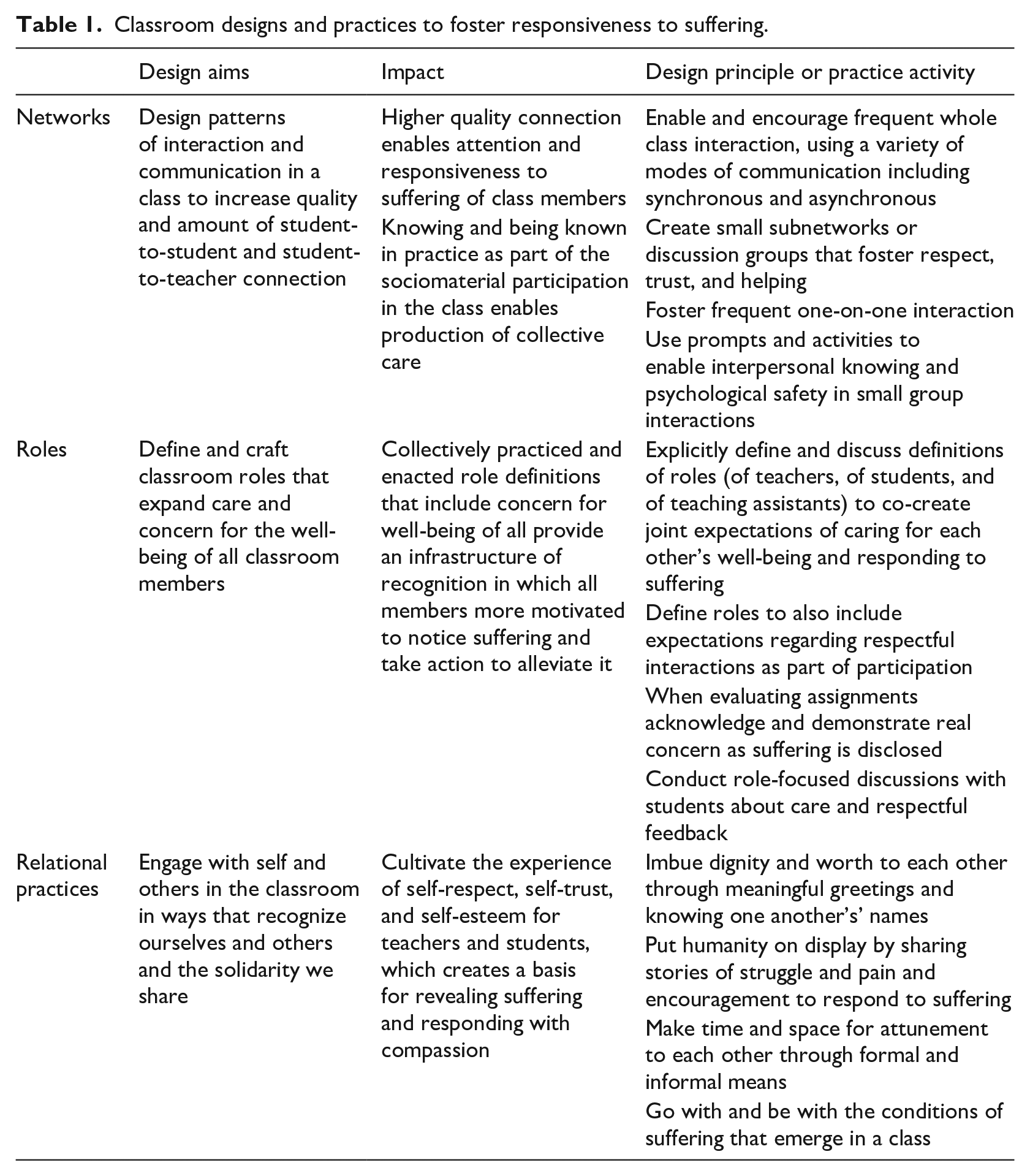
Designing networks that can activate compassion
The human experience of acting to alleviate suffering depends on the attentional capacity of noticing its presence. The ability to notice suffering is hampered by many factors that are common in management teaching. A heavy workload hinders the availability of attention to the human state of others (Knights and Clarke, 2014). Status hierarchies and power differences likewise can hinder noticing suffering (Dutton et al., 2014; Fiske, 1993), so teachers often can’t see suffering in their midst. Through this lens it becomes important in designing for compassion to intentionally foster networks in management teaching within which people are better able to notice and respond to one another’s changing human conditions. These networks will be characterized by higher quality ties that can carry feelings of care and concern when suffering appears.
Teachers can intentionally design opportunities for frequent interaction among students to increase the possibility for strengthening the ties between them. We can intentionally design activities that we cascade into these small sub-networks of students in ways that are more likely to catalyze interactions between students that are marked by respect or trust (Fowler and Christakis, 2010). If students are tied more strongly to each other and interact in ways that are more respectful, trusting and helpful (i.e. higher quality) the likelihood of responding to suffering with compassion increases (Worline and Dutton, 2017).
The design of small group discussions provides one example of a teaching domain that affects network formation. For example, in our class we intentionally design most sessions to include student discussion groups that recur throughout the course. We give these small groups a name (e.g. learning circles), assign students to these small groups early in the course, and create time and space for the groups to convene consistently. In so doing, class members report that the quality of their ties to one another is enhanced. One student explained: “The team format was far and away the best! It was a great opportunity to debrief information and digest the material with new students, people I would now call friends.” This student’s report conveys the dual aims of this design: to foster more interconnected learning and to enhance the quality of network ties. Note that this use of networks in designing classrooms also relieves the teacher of being the sole source of support for students who may be suffering, as they can also turn toward one another for compassion.
Introducing activities and prompts designed with the intention of helping support higher-quality connection helps students reduce anxiety and enter discussion time where they can get to know one another more deeply and build psychological safety (Carmeli et al., 2009; Edmondson, 2012; Edmondson and Lei, 2014) as well as relational and social capital (Baker and Dutton, 2007). Even without the role of a designated facilitator or teaching assistant for the group, students usually enjoy and make good use of these small-group interactions. The groups help students ask better questions, challenge ideas together, and surface what they don’t know or don’t understand. At the same time, group-based networks help students learn more about the human condition of their peers and notice more of what is going on under the “surface” of the class. In one case, after learning a member of their discussion group was experiencing housing difficulties, students from a discussion group approached the teaching staff to relay this suffering and coordinate the development of resources in response. The students themselves activated compassionate action for a classmate, then invited the teachers to join and expand on their response. This case illustrates ways in which intentionally designing networks within management classes helps to build a collective capability to notice and respond to suffering that is not solely the responsibility of the teacher but rather is distributed across all members of the classroom community.
Designing a class to make good use of small-group network structures depends not only on the structures themselves, but also on attending to and enhancing the quality of the ties in those small-group structures. Heavy doses of anxiety, social comparison, self-criticism, or feelings of inadequacy and insecurity hinder us from noticing suffering and feeling empathic concern or from interpreting ourselves as capable and agentic actors in the face of suffering (Atkins and Parker, 2012). Pairing students in dyads for short interactions that are designed intentionally to enhance the quality of connections is another design practice that is often employed in management teaching for a focus on ideas, but it can be expanded to focus on care as well. For instance, we design dyadic interactions that begin every class session. We deliberately design these and name them “connection activities.” Examples include activities such as sharing one idea from today’s reading or class material that inspired you and one idea that challenged you. This prompt is designed to elicit a simultaneous emphasis on learning class ideas and learning something about the other person. These designs also enhance the human connectivity of the class in ways that increase the likelihood of compassion in the face of suffering.
Designing roles that convey responsibility for responding to suffering with compassion
Every classroom is an ecosystem of roles. Naming and defining these roles are important aspects of designing a class experience, both for the purposes of knowledge and responsibility sharing as well as creating conditions that nurture an emphasis on collective responsibility for well-being. Worline and Dutton (2017) suggest that designing responsibility for caring about one another’s well-being into already defined roles such as “teacher,” “student,” and “teaching assistant” increases the likelihood of compassion when suffering emerges (see also Dutton and Worline, 2020). Gherardi and Rodeschini (2016) describe concern for others as a form of collective competence that depends on situating knowing about one another and a collective performance grounded in an ethic of care. Teachers of management can articulate and materially situate the classroom as a community of care through how we describe roles and invite others to enact role performances, even when they are not teaching about care and compassion per se.
When collective responsibility to care about one another’s well-being is murky or left undefined, suffering can be exacerbated rather than alleviated. For instance, a student in one of our classes relayed a story about turning to a professor after the murder of a cousin, expecting the professor to care about her well-being after such a traumatic experience. When she asked for an extension and described the murder, the professor refused. When the student did her best but still handed in an assignment late, she learned that the professor had submitted a failing grade to the university with a note that the cousin’s death did not qualify for any extension because it was not an “immediate” family member. The harm here is not simply the refusal of flexibility on a deadline, but also the professor’s lack of communication and seeming lack of human recognition of the suffering that stemmed from this trauma. Perhaps this professor did not regard such communication and recognition as part of the responsibilities inherent in the job, while the student did. Mismatched expectations about the responsibility for care of one another’s well-being exacerbated the suffering in this case.
Instead of leaving responsibility for one another’s well-being unaddressed, we can more deliberately design this responsibility into our work roles in legitimated ways. For instance, teachers can create written expectations about the role of teacher, student, and teaching assistant as part of the introduction of the class, incorporating within these expectations that they will treat the well-being of one another as an important concern. Teachers can invite conversation and creative crafting of these ideas as part of the situated knowing and competent participation in the class. Teachers can introduce themselves and their role in the class in ways that set up an expectation for respectful interaction as part of their responsibility toward students. Wright et al. (2019) make an important case for teachers to clearly consider power dynamics and ethics as part of their role and to create opportunities for students to understand their stance as part of enacting experiential learning wisely and well. Teachers can set an expectation about how students will enact their roles in the class, calling upon students to see caring about one another’s well-being and the teacher’s well-being as part of the responsibility of class participation. These kinds of design choices enable the kind of recognitional infrastructure in which students learn to care about one another and respond to suffering with compassion as part of their participation in the community of learners (Gherardi and Rodeschini, 2016).
Teachers can expand their role as assignment evaluators to include noticing, acknowledging, validating, inquiring, or inviting engagement with students’ descriptions of their well-being or suffering when they disclose this in writing. For instance, one student in our classes wrote that he was experiencing “a lot of doubt and fear about the next professional step in my life,” and other statements that disclosed a sense of suffering related to a professional identity. As he expanded on this self-doubt in writing, we enacted the role of teacher as inquiring and inviting conversation, rather than simply giving the essay a score without comment. To not respond with at least an acknowledgment of seeing this suffering felt like a denial of the student’s lived reality. An ongoing accomplishment of compassion requires that teachers and students see responding to these revelations of the lived reality of suffering as part of the knowledgeable doing involved in learning the subject. In our experience, the pandemic has expanded the space for emergence of suffering in students’ writing, where loneliness, isolation, loss, and a sense of being at the mercy of destructive forces emerges often in students’ descriptions of their lives. To teach with compassion is to enact the role in such a way that acknowledging these losses is as much part of marking exams or essays as is recording any final scores.
It is not only the role of teacher that can be defined and enacted in ways that expand the likelihood of compassion in the face of suffering. Students are rarely invited to intentionally and deliberately craft their roles. In our classes, we take time at the beginning to call attention to the importance of the role of student and to ask students to engage in discussion about how they understand and hold responsibility in that role. We find these role-focused conversations help to open questions of whether and how students feel responsible for offering feedback to their peers and teachers, fostering attention to respectful interrelating as part of the role. This conversation opens space to address a role shift of offering appreciation as well as critique as part of participating in class. As most students have experienced, the sting from careless feedback from a peer can linger long after a class has faded. The stab of careless feedback to teachers, which may flow from students’ failure to grasp the power in their role as evaluators, can also linger. Inviting students to think more deeply about their role increases the likelihood of compassion when suffering emerges.
Finally, teachers can also invite teaching assistants or other staff members involved with the class to articulate their role expectations and name their roles in ways that convey more responsibility for one another’s well-being. For instance, in a recent class the teaching assistants renamed their role and positioned themselves as coaches for the students. The teaching assistants designed activities that invited students to share struggles with the materials or with life outside the classroom, creating a different kind of engagement between teaching staff and students. The different role label served as a signal of collective support for well-being, safety, learning, and growth. The role definition included responsibility for noticing what was happening in the human dimension of the classroom, making it more likely that compassion would emerge intertwined with suffering.
Enrich relational practices that intertwine suffering with compassion
Palmer (1998) characterized the courage to teach as bold and vulnerable engagement in a tri-part conversation between: (a) a teacher with him- or herself, (b) a teacher with those who are joining the conversation as learners, and (c) the teacher and learners with the subject at hand. Palmer’s work recognizes the fundamental relationality of teaching and suggests that this relationality can be treacherous: To teach is to be in relation with fear. To teach with compassion is to recognize an additional treacherousness: To teach is to be in relation with suffering. Here we adopt a view informed by Honneth’s (2004) recognitional infrastructure, in which we come to recognize ourselves as valued members of a classroom through an ongoing relational process in which our capacity to recognize ourselves emerges from encounters with others’ recognition of us (Anderson and Honneth, 2005).
The relationality of teaching with compassion invites exploration of one’s own frailties, failures and fractures, and we need spaces in which management teachers can encounter their own suffering with concern (Frelin, 2013). The courage to teach with compassion also invites exploration of the strains and struggles borne by students, requiring relational practices that bring us into dialog with recognition of the solidarity we have with one another as human beings. And finally, the courage to teach with compassion invites exploration of critical dialogs about the harmful practices and exploitative power held within the field of management (George, 2014). The quality of social relations of recognition within management teaching can condition the experience of self-respect, self-trust, and self-esteem for teachers and students (Anderson and Honneth, 2005).
Imbue with dignity and worth
If we assume that the people who enter our classroom doors, including ourselves, are often carrying with them some form of fear, uncertainty, anxiety, or other manifestation of the terror of the performative university (Jones et al., 2020), our basic assumptions about human dignity and worth are at stake in the relational infrastructures we create. Here we emphasize two small moves that matter in imbuing people with dignity and worth, though there are many more we could explore (see e.g. Frelin, 2013). We choose these because they are part of the everyday work of teaching in such a fundamental way that all teachers will recognize them.
Pessi (2020) made the argument that moments of greeting in everyday interaction in organizations are enactments of dignity, done in such a way that we either recognize the worth of the other through the form of our hello or deny that worth by its absence. She claims that both compassion and justice are bound up in the practice of everyday greetings. A relational practice of greeting one another in ways that are informed by the deliberate intention of recognizing one another’s worth enriches the social contract and strengthens the collective fabric for all who enter.
Students in large university classes rarely know one another’s names and rarely expect that teachers will know their names. Even in smaller classes, students and teachers may not recognize the importance or value of learning one another’s names. And yet, learning and saying one another’s names is a powerful small move that serves to imbue one another with worth (Chugh, 2018). Recognizing one another by name is an act of simple, profound humanness. In our classes, we invite our teaching assistants to join us in learning the students’ names before they arrive on the first day of class. After the first day, we continue to study the students’ names, greeting each student by name as they arrive at the class. Since the introduction of remote teaching during the pandemic, we have switched to greeting each student as they appear on the screen. While it may seem insignificant to some, this act of recognition is profound in creating a relational infrastructure of dignity and worth.
Put humanity on display
The phrase to “put humanity on display” comes from the words of a dean describing how his business school had responded to students’ suffering from losses in a fire that affected multiple members of the community (Dutton et al., 2006). For teachers of management, who live with normative expectations for professional detachment that keep emotional expressivity to a minimum, humanity on display may seem foreign. However, within a recognitional infrastructure, humanity on display makes sense as a modeling of the intersubjective creation of self-respect and self-worth. When teachers can express distress and care in relation to stories of suffering that emerge in a classroom, their humanity is on display as an example of how others might recognize suffering and respond. Putting humanity on display can also involve invitations to others in the classroom to tap into their responses to suffering (Lawrence and Maitlis, 2012). The pandemic has afforded opportunities for teachers to share stories of how they are struggling and to invite students to recognize one another’s suffering with compassion. Our students shared disappointments, feelings of apathy, stagnation, fatigue, and disconnection. As they recognized themselves in one another, we were able to acknowledge and hold these experiences in a human community that was rich with care.
Teachers’ capacity to awaken compassion by putting humanity on display is not limited to a coronavirus response. Housing and food disruptions, natural disasters, terrorist attacks, mass violence, and other tragedies that engender widespread suffering regularly affect teachers’ and students’ lives. These are circumstances in which teachers can put their humanity on display, talking about their own responses to the circumstances and inviting others to share. Teachers can make space for human frailty, acknowledging difficulty focusing or concentrating, and offering flexibility where possible. Humanity on display requires the courage of teachers and students to find ways to consciously invite the destabilization of suffering into the classroom and to trust that compassion will arise as well.
Make time and space for attunement
Tuning into another person’s suffering requires being psychologically present to their conditions and experiences (Kahn, 1992). In the absence of physical co-presence with students, teachers need to find new techniques to remain receptive to signals about the human state of students. As Bari (2021) describes this aspect of teaching: Teaching is about an attunement to actual bodies in actual space. It’s in the way we read the room for responsiveness or reluctance, adapting when we sense incomprehension, clarifying when we find confusion.
Attuning to suffering in a classroom involves reading small signals, such as noticing a gregarious student has been unusually quiet or an inquisitive co-teacher has stopped asking questions. Attuning often also involves a willingness to humbly inquire about the other’s well-being. Questions posed with sensitivity and concern that originate in caring curiosity about another’s well-being are a skilled practice that can be developed. Humble inquiry resists expertise and instead draws on what is unknown, inviting more effective reflective conversation (Schein, 2013). Such humble inquiry also requires skillful noticing of changing human conditions and of the contextual factors that shape our ability to recognize one another. For instance, quiet times and places that offer protected space for conversations invite disclosures that may disappear when performance pressures appear in a public eye. Making quiet times and spaces for conversations with students enriches the possibilities for recognizing one another in the presence of suffering. These may be office hours or moments at the end of a class when we remain present and available to people instead of being preoccupied with notes or technologies.
In addition to making time and space for attuning formally, such as office hours and availability for meetings with students, teachers can use a variety of means to convey accessibility and availability. For instance, by sharing multiple options for student communications, such as email, phone, text message, or slack channels, we can convey technological presence. In class we can watch faces on video conference software to make space for attuning; sometimes using a 1-minute quiet reflection to invite students to try to see one another’s faces through a lens of common humanity. We also use behavioral synchrony in simple ways, such as inviting all members of the class to “unmute” the software at the same time and say hello or to gesture together in the direction of the web camera.
Teachers and students can attune through chat activities or written reflections as well. Suffering surfaced when one of our students posted on a discussion board dedicated to sharing an expression of appreciation that he was grateful he had been able to rescue his grandmother safely from a house destroyed by a flood. Watching a classroom sharing board where this disaster appeared among other appreciations alerted us to a condition we would otherwise have overlooked. Attuning to it enabled us to reach out with a recognition of this form of suffering and with a query about the student’s well-being.
Being with and going with
In the conversation that takes place between teachers and their subject matter, we all develop a means and style of bringing knowledge and ideas to the classroom. The subject matter makes its demands, and we listen, creating lesson plans, lecture notes, diagrams, and activities. And we invent ways to be with students as they enter this conversation: discussion questions, writing tasks, chat prompts, visualization tools. The pressure to cover material, prepare students for exams, and represent the subject well gives teaching a rhythm of its own and an internal logic that often demands we press on, even if interesting ideas beckon from tangential alleyways. And yet being with students when suffering appears can sometimes require the willingness to “go with” them in directions that are not true to our lecture notes or discussion prompts. Moments like these are the teaching equivalents of Weick’s (1993) well-known moments, when experts have difficulty dropping their tools, even when it might be a lifesaving move. A willingness to “go with a class” can arise from unexpected comments appearing in online chat. Recently in a class we offered an opening query to students about how they were doing as a way to begin a session. The students’ responses revealed overwhelming stress and uncertainty about the future. Instead of carrying forward with the planned lesson, we adapted the lesson on the spot to incorporate a greater focus on self-awareness, social connection, and self-compassion. Recognizing and being with the students’ reality is part of a relational terrain that we can walk together, inviting our experiences, the subject matter, and the teacher to go together into new directions of learning (Dutton et al., 2002). In response, a student offered this reflection: “It was a great reflection and helped me remember that I am more important than my productivity. You reminded me of that.”
Another example of the courage to teach with compassion by being with and going with a class arose for us when students insisted that our class respond differently than we were already responding in the immediate wake of the murder of George Floyd, a Black American man whose death at the hands of the police triggered widespread global protests against police brutality, racism, and social injustice. Here it was the contesting of students against the pressure of resuming our scheduled curriculum that demanded some form of being with the class and going with them where their interests carried passionate urgency. Some students were in the grip of secondary trauma from witnessing and re-witnessing a murder via video. These students required mental health support beyond the classroom walls, which we were able to offer as referrals from one-on-one conversations.
Dropping our “tools” in this case meant revisiting the syllabus and lineup of guests to introduce different kinds of conversations into the subject matter as we covered it. It also meant making small group discussion spaces in addition to formal class meetings where students could meet with one another and class coaches as they struggled with how to humanly understand and respond to what was happening around them. A potent mix of anxiety and fear blended with political polarization that permeated a society in the grip of a pandemic, all arising alongside racial and social outrage that demanded expression.
True to its rhizomatic structure, suffering erupted in the classroom in forms such as emails, feedback forms, discussion questions, and verbal protests that the class, while responding in some manner, was not making enough space to go with the students. They demanded of us: what did the subject of management have to offer to this moment? Finding the courage to teach with compassion in this case meant listening and responding, acknowledging students who appeared frightened, sharing vulnerability about not always knowing what to do, and a willingness to go into this terrain together.
As we sought the guidance of new or different voices in our subject matter, we found different texts and conversations to inform us, so we changed our reading lists. We also built shared resource boards and lists of readings, websites, protests, and calls to action of various kinds, which we shared as part of the course materials that we developed together as teachers and students striving to answer the question about what management had to offer to the moment. In this example of being with and going with, the students themselves were hungry to generate and share resources that enabled them to learn, cope, and grow as they experienced outrage, grief, and fear. Meeting that hunger with an invitation to be with them and go with them where they wanted to go created an astounding experience of mutual recognition.
Personally, putting our humanity on display in this case meant offering ourselves compassion for not always knowing how to handle this trauma well with our students, for not always knowing how to adapt a syllabus while a class was in motion, and for failures to respond well while we were imperfectly attempting to acknowledge this outpouring of suffering. Teaching in this manner can entail enormous amounts of effort, and reiterating what we’ve already said above, teachers aren’t psychologists or social workers. No management teacher is a substitute for necessary medical help. But we can be active agents who call upon schools of management to respond with more alacrity and care to these calls for greater engagement with questions of race and racial justice, unequal distribution of wealth, and forms of violence sanctioned by managerial targets and given to governing bodies and systems of policing.
Going with students into the terrain of suffering related to racial injustice often demands more of faculty of color (Turner et al., 2008). A move toward broader recognition of the need for compassion in the teaching of management is a move toward remedying this inequality by emphasizing the responsibility of those in spaces of privilege to do this work. Teaching with compassion is not and cannot be solely the province of women, teachers of color, and others on the margins of the academy who are already overtaxed with calls for extra mentoring, help, and affiliation from students of color who are marginalized or excluded. Our call is a call to all management education institutions to step into their responsibility for fostering well-being for all, students, and teachers alike.
Simplistic approaches cause harm: A warning about teaching with compassion
In their genealogy of compassion, Simpson et al. (2014a) warn of the dangers of regarding compassion in an overly simplistic manner or in regarding it as an exclusively “positive” social good in some essential way. They note the history of the concept in religious traditions and the ways that compassion has been bound together with discipline in these traditions, often brutally so (Simpson et al., 2014b). So while we unapologetically call for an examination of the role of compassion in management teaching, we simultaneously stand with Simpson et al. in arguing against an overly simplistic or reductionist approach to the paradoxical work of teaching with compassion. We are with Waddington (2021: 5), who writes about the compassionate university offering “hope without illusion.” We emphasize the need for accountability, such as those put forward by Wright et al. (2019) who note that opening spaces of challenge without proper training in how to facilitate and respond to it is an ethical danger in management education. We want to recognize the courage and wisdom that is required in this work and warn against minimizing the awareness and effort involved in developed skilled practices that enable this kind of approach to teaching
We call for a systemic introduction of compassion into the preparation of those who do the work of management teaching, weaving approaches to compassion into graduate programs and teaching apprenticeships. We also call for greater investment in building the skills of teachers and cultivating the critical and appreciative dialogs we need to form a better understanding of the role and place of teaching with compassion in management. Without giving in to overly simplistic approaches, we want to explore ways that teaching management with compassion might enrich our imaginations and expand our capacities for better and more effective teaching overall.
In pointing to the Deleuzian idea of the rhizomatic nature of suffering and its appearances in management teaching, we have attempted to capture some measure of the shifting, moving, endlessly unfolding complexity inherent in intertwining suffering with compassion. In the face of this complexity, no simplistic approach will succeed. To teach with compassion is an expression of skilled practice that bears continual learning over a lifetime of work. Pedagogy scholar Denial (2019) narrates her changing approach to relationships with students over the course of her career, starting with unlearning the advice she received as an apprentice graduate student instructor to be cruel and unsparing in her approach to students, lest her authority be challenged. She arrives at the idea of a “pedagogy of kindness” in which she sees that meeting needs of students with compassion has simplified rather than complicated her teaching by improving her relationships.
A systemic approach to preparing management faculty to teach with compassion would not only serve students, it would also lessen the suffering of faculty. Miller (2002) pointed to the suffering caused by feeling unprepared for handling suffering when crisis hit her campus: We were not prepared to deal with the emotional turmoil that ensued when 12 young people were wrenched from a community in the prime of their lives. Of course, one could argue that one could never be prepared for something like that. Indeed, there were clearly no established rules for how to behave "authentically" in such a nonnormative event. . .. As professionals, we often lack socialization for dealing with emotions at work (p. 572).
Systemic approaches to activating conversations about compassion in the practice of management and management teaching are necessary in the face of suffering created by feeling unprepared for the work that is demanded of us as teachers. In arguing for recognition of the rhizomatic activity structures of suffering and compassion, we suggest something much deeper and more radical than isolated responses or individualistic episodes of compassionate action. We argue instead that management education and institutions associated with the preparation of management teachers have an obligation to prepare us for this work of responding to suffering, which is inevitable in our roles as teachers, and to invest in spaces where the work of teaching with compassion can deepen and grow (Smith and Ulus, 2020). Drawing on ideas and research such as that of Gherardi and Rodeschini (2016), who show the collective competence of compassion as situated in the broader collective knowing and doing of a community of practice and an enacted ethic of care, we need to be doing compassion and to wrestle with its complexities and difficulties and challenges as management teachers in order to learn about how we can do compassion better. We point to the lack of conversation and situated learning and doing of compassion in management teaching as a gaping wound in our collective body as a field of management; a wound that needs immediate attention if we want the stem the tide of suffering.
As Denial (2019) points out, care or compassion in teaching is often used as a kind of “band aid” over the wounds we have named, including the lack of institutional support for students and faculty of color, women, and non-binary people of all races. Compassion is not and cannot be a band aid for institutionalized racism, sexism, and other forms of discrimination. Compassion situated deeply in our practice as management teachers requires that we recognize the differential costs of suffering on teachers and engage as a collective in more knowledgeable and competent means of offering additional resources for those who are overtaxed. Our management schools must care for the mental and emotional well-being of teachers—not by ignoring suffering or driving it out of our practice, but by acknowledging the conditions of suffering that pervade our work and actively supporting our ability to respond effectively. And the suffering of students and faculty of color cries out for greater compassion as an immediate space for the direction of our collective attention and empathic concern.
Simplistic approaches to the question of teaching with compassion also cause harm when they do not recognize the social embedding of teachers, students, classrooms, management schools, and universities in broader social systems that differ greatly in their structuring of economic and social care. Societies do differ along these dimensions, and those that discount the solidarity of community in favor of the self-sufficient individual generate different forms of suffering. The rise of global capitalism and spread of structural economic inequality colors the study of management. Human teachers are embedded in collapsing social contracts that are far beyond their purview. No individualistic compassionate response, however skillful, can remedy these conditions or serve as a substitute for challenging them. Greater compassion in management teaching may mean finding ways to incorporate this perspective into an examination of management; it also calls on management education to pay attention to the social and economic well-being of those doing the teaching and learning.
Finally, overly simple views of the dynamic ebb and flow of suffering may suggest to some that simply scripting some compassion responses or routinizing some recognitions of stressful circumstances is enough, but it is not (Cutcliffe, 2002). All teachers have limits, make mistakes, and suffer themselves—and will therefore likely have moments of ineffectiveness in responding to suffering in their classrooms. Training and preparation that helps teachers understand and allay their fears surrounding compassion is a necessary element of teaching with compassion. This element is usually missing in preparing teachers for entering the management classroom. Without such attention, fear of compassion can block this kind of work (Gilbert et al., 2011). Perhaps some personality or dispositional qualities make the work of compassion easier or harder for some of us, such as those who feel empathic concern more acutely, exhibit more extroversion, agreeableness, or openness to new experiences (Shiota et al., 2006). We need more preparation and space for enhancing awareness in conversation with others who also grapple with the questions of how to teach with compassion. People who are exhausted by other pressing conditions may find teaching with compassion overwhelming or simply impossible (Figley, 2002). Burnout—a different form of emotional exhaustion—may exacerbate a sense of overwhelm when suffering appears (Figley, 2002). Management education would benefit from more research focused on how educators and students meet suffering with compassion without become exhausted and how educational institutions could better support faculty and students with policies that allow for adequate breaks, rest, flexibility, and time for recovery.
All of these are very real limits on teaching with compassion when it is regarded as an individualistic or isolated pursuit. For this reason, we call on management education and institutions that prepare management teachers to adopt a view of compassion that is far more collective and collaborative. When people come together in communities dedicated to creating safe holding spaces for suffering, when they are invited to enter dialog about teaching dilemmas and paradoxes and to explore with others how to handle them with greater compassion, the collective activity expands (Forester and McKibbon, 2020; Waddington, 2021). Such communities of practice are likely to not only help us learn about compassion, but also shift our view of effective management teaching and learning as a whole.
A call to action
While danger lurks in overly simplified approaches to teaching with compassion, a greater danger lurks in refusing to deepen and expand this conversation about the practice of teaching with compassion in management education. As a pandemic continues to ravage the health and well-being of the globe, it must be obvious that tragedies and traumas beset us, whatever our field or approach. No one is spared from suffering. We join others in the growing call to action for universities to take this issue seriously (Smith and Ulus, 2020). We will only grow as a community of teachers into a greater collective capability to attend to more of this suffering, interpret one another’s frailties with more generosity, feel more concern for each other’s well-being, and act to address one another’s needs if together we open this dialog and allow it to enhance our growth as people and as professionals (Waddington, 2021).
Let’s embrace the complexities of teaching with compassion, even as we refuse its oversimplification. Let’s get to work talking and thinking about the paradoxical work of creating policies and practices that support teaching with stability and flexibility, justice and compassion, structure, and humanness at the same time. Let’s enter into conversation about the nuances and dilemmas where we encounter both care and its limits. Let’s both appreciate and push against the constraints on skillful compassion work in the performative university. Let’s challenge the field of management and its teachers to offer an ennobling vision of what society can be (Wuthnow, 1991). For surely if actively embracing the teaching of management with compassion comes with risks and dangers of harm, embracing the teaching of management without compassion comes with an equal likelihood that we are the active perpetrators of harm.
