







Abstract
This ‘Provocation essay’ is aimed at triggering reflection and fostering renewed research into organizational stupidity and its intersections with management learning. It opens with a critical poem evoking diverse aspects of our daily encounters with the idiocy, nonsense, and absurdity that pervades organizations. It continues with a more comprehensive review of the still diffuse research literature to reveal a typology of three approaches to studying organizational stupidity (systemic-mechanistic, critical-sociological and cultural-functionalist). It closes with a discussion of how stupidity detracts from reflexivity but can also play useful roles in organizations, which ultimately invites more management learning research on the topic.
Keywords
Into the realm of organizational folly
Behind those walls stands a fine firm built by bright folks. From out here, it seems all smart and neat but no hoax: its innards are plagued by nonsense, are obtuse baroques. I enter with some silly questions: Please tell me, why all the merry-go-rounds? Discombobulations: Why so many rat races? Why such vain battlegrounds? I’m a befuddled scholar: Why the organizational stupidity that abounds? Oh, let thus my duty be to understand how that decent manager grew into a hypocrite; to discover how such great intelligence spawned pages devoid of wit; to unveil the business histories of their stockpiled bullshit. Off I go, with good intentions and mixed methods, to do my erudite trickery. I look further, anew, and again at their laughable stocks of daily misery, muddling through trails of trials and tribulations, little hope of victory. Indeed, there I encounter defunct creativity, for their frigid board members they must please; cadaverous futures, for short-sighted stockholders they must appease; decency that is no more, for always another penny they must squeeze. I see dazed men and women who carry on with their senseless work. Too many mouths to feed, ends that must meet, mortgages that lurk. Their souls hung out of sight. They no longer care about this cirque. But if I contemplate further, underneath their wacky ways of today I find the heroic sagas of pioneers. Their mishmashes are the very scars of clever survival through the years. Their weird morphology is but the archaeology of hard work, glory, and tears. Through mazes of law and opaque cultural manners, they walk the feasible way. The tortuous paths, the murky talk, the impractical rituals keep insanity at bay. Their chicanery saves faces, their cynicism saves jobs, their folly saves the day! I then return to academic vanity. Let the struggle with meandering sentences and vague ideas recommence. Messy data, hellish thick descriptions, scanty glimpses of dubious sense. Wasteful writing and rambling thinking. My very profession a sad offence. Back to my days of irrelevant contentment, my life of spoiled bookworm. Papers sink beneath the waves of oblivion, theories never to confirm. And yet, behind those walls, there are bright folks building a fine firm. -o-0-o-
To put it simply, this Provocation essay is about organizational stupidity.
By addressing such a pedestrian matter, I wish to call attention to the hidden causes, unsuspected functions and often dispiriting consequences of the collective idiocy, nonsense and absurdity that pervades organizations. Despite being a source of trouble and waste to managers, employees, customers and other stakeholders, this all-pervasive phenomenon remains surprisingly understudied. Yet, better understanding it is particularly crucial to the management learning field (Coraiola and Murcia, 2020) because, by disabling reflexivity (Cunliffe, 2002), organizational stupidity detracts organizations from accumulating knowledge and improving decision-making. I thus review the still diffuse literature on the subject and contribute with a more comprehensive perspective, which includes a typology of three approaches to studying organizational stupidity. Concurring with the Management Learning vocation of publishing ‘unexpected, unconventional, unusual and unorthodox’ pieces (Bell and Bridgman, 2018: 3), this poem-cum-commentary is ultimately aimed at using poetry and experimentation to ‘feed imagination, seed change and cultivate learning’ (Brewis and Bell, 2020: 536).
The poem that opens this piece is a critical – perhaps jocose nonetheless – evocation of diverse aspects of organizational stupidity. Into the realm of organizational folly is a free-verse elegy written from the perspective of a management researcher. That is all I write about it here, for each reader should approach a piece of poetry with their own gaze. A more explicit explanation of the poem would thus be antithetical to the very nature of that medium. 1 Still, and in the spirit of writing differently (Gilmore et al., 2019), I take the liberty of playfully permeating this commentary with occasional fragments {within braces} extracted from the poem. These fragments should add a related, but not always obvious, connotation to the passage. By so doing, I wish to move beyond juxtaposing poetic and academic writing to also set points of contact where the two distinct voices can meet.
A closer look at organizational stupidity
In this commentary, I address streams of literature built around the neighbouring concepts of organizational stupidity (Albrecht, 1980; Alvesson and Spicer, 2012; Kerfoot, 2003; McComber and Jenkins, 1972; Paulsen, 2017); incompetence (Ott and Shafritz, 1994; Peter and Hull, 1969; Wagner, 2002); bullshit (Allen et al., 2012; (Christensen et al., 2019; Spicer, 2018); nonsense (Azevedo, 2020); and absurdity (Starkey et al., 2019). Those are typically critical texts that on occasion adopt a humorous twist and usually portray organizational stupidity as ubiquitously observable in all fields of management research. {Organizations’ innards are plagued by nonsense.} There is stupidity in public administration (McComber and Jenkins, 1972; Ott and Shafritz, 1994); in financial services (Allen et al., 2012); in nursing management (Kerfoot, 2003); in business education (Bedeian, 2002; Olsen, 2011; Starkey et al., 2019); in organizational cultures (Azevedo, 2020); and in management communication (Spicer, 2018).
I begin by acknowledging some antecedents of extant literatures that address stupidity in organizations. That is followed by a proposed conceptual terrain for organizational stupidity research. I then put forward a typology of three major approaches to studying it before concluding with a short discussion.
Some antecedents of present-day organizational stupidity research
Arguably, organizational stupidity research was founded by a few publications up to six decades ago (McComber and Jenkins, 1972; Parkinson, 1955; Peter and Hull, 1969) before eventually regaining some vigour over the last decade (Alvesson and Spicer, 2012; Christensen et al., 2019; Paulsen, 2017; Spicer, 2018; Starkey et al., 2019; Azevedo, 2020). On one hand, organizational stupidity constitutes a phenomenon that should be as old as organizations themselves. On the other hand, some argue that bullshit and absurdity {laughable stocks of daily misery} have become more prevalent in recent times (Foley, 2010; Frankfurt, 2005), in an age of kakistocracy with many societies being ruled by the worst possible leaders (Mohammed, 2020: 246).
The etymology of stupidity comes from the Latin noun stupiditatem [dullness, folly or senselessness], derived from the adjective stupidus [dull, foolish or confounded]. Stupid people are hence those who are slow of mind, lacking intelligence or reason, or given to unintelligent decisions or acts (Merriam-Webster, 2021). When working together, they are likely to create stupid organizations, but a distinctive feature of collective stupidity is that a gathering of intelligent individuals can add up to be collectively stupid. {Great intelligence spawning pages devoid of wit.} As enunciated in what became known as Albrecht’s Law: Intelligent people who can think and act very effectively as individuals can, as a group, exhibit the most profoundly stupid and counterproductive responses to the demands of their environment. (Albrecht, 1980: 236)
Pioneering texts have tried to explain the stupidity bourgeoning in organizations, particularly in bureaucracies, by describing mechanisms articulated as laws or principles. Those notably include Cyril N. Parkinson’s enunciation of Parkinson’s Law, postulating that ‘work expands so as to fill the time available for its completion’ (Parkinson, 1955, 1957) and Laurence J. Peter’s formalization of the Peter Principle, stating that ‘in a hierarchy, every employee tends to rise to his level of incompetence’ (Peter and Hull, 1969). More recently, in what became known as the Dunning-Kruger effect, it has been shown that incompetent people tend to underestimate their own incompetency, whereas those who are more competent tend to be more aware of their limitations (Kruger and Dunning, 1999).
The existing research on organizational dysfunctionalities is evidently much broader than the attempt to describe problematic aspects of organizations as laws and principles named after their proponents. Indeed, some foundations of organizational theory rest upon seminal research on bounded rationality (March and Simon, 1958; Simon, 1955) and upon studies of flawed decisions with catastrophic consequences for working teams (e.g. the death of firefighters who did not drop their heavy tools Weick, 1993) or to entire organizations (e.g. deviant decisions at the National Aeronautics and Space Administration (NASA) that caused the Challenger space shuttle disaster Vaughan, 1996). I argue nevertheless that, despite providing crucial explanations of decision failures, those studies do not fully characterize organizational stupidity research. It could be disputed that limited rationality and bad decision-making are by definition stupid, but the assessment of the literature reveals that organizational stupidity research tends to look at more pathologically pervasive dysfunctionalities than just at precise instances of decision failures (Ott and Shafritz, 1994: 372–373).
Organizational stupidity hence refers to the systemic collective stupidity that can potentially permeate entire organizations (Kerfoot, 2003; Paulsen, 2017; Peter and Hull, 1969). {All the merry-go-rounds, so many rat races, such vain battlegrounds.} For instance – and referring again to a seminal text – Parkinson described, over half a century ago, organizations suffering from injelititis, a pathology caused by the rise to authority of individuals with unusually high injelitance (i.e. the combination of incompetence and jealousy): We find everywhere a type of organization [. . .] in which the higher officials are plodding and dull, those less senior are active only in intrigue against each other, and the junior men are frustrated or frivolous. Little is being attempted. Nothing is being achieved. (Parkinson, 1957: 78)
{Defunct creativity, cadaverous futures.} Widespread organizational stupidity can indeed – as discussed in more detail later in this essay – be rooted in systems, in collective behaviour and in organizational cultures. First, however, it may be useful to shed some light on how the notion of organizational stupidity relates to – and often becomes entangled with – some of its neighbouring concepts.
Mapping the terrain of organizational stupidity research
Organizational stupidity can be conflated with other concepts, notably organizational incompetence, bullshit, nonsense and absurdity. To outline the scope of organizational stupidity research, it is hence useful to map a specific terrain (Brewis and Bell, 2020: 535) by better understanding how those concepts relate to each other.
Organizational incompetence, which can be defined as the ‘repeated pattern of an organization not able or willing to learn from its environment, its failures, or its successes’ (Ott and Shafritz, 1994: 370), is a quasi-synonym of organizational stupidity, possibly with two minor semantic distinctions. First, incompetence carries the somewhat more procedural or less derogatory connotation of lack of competence (Peter and Hull, 1969). Second, incompetence (as the lack of qualities needed for effective action Merriam-Webster, 2021) tends to be perceived as more likely to be remediated through organizational redesign (Peter and Hull, 1969) and through the acquisition of organizational knowledge, typically by training or hiring (Ott and Shafritz, 1994).
Bullshit can be defined as a colloquial or vulgar noun for nonsense or foolish insolent talk (Merriam-Webster, 2021). It refers more often to what is said {the murky talk}, whereas stupidity and incompetence refer more often to what is done. Moreover, although both organizational stupidity and bullshit result in time and resources being wasted, organizational bullshit is occasionally recognized as having social functions and as related to specific managerial practices (Christensen et al., 2019). Organizational bullshit has recently attracted substantial attention from both academics and practitioners, and research on the topic is becoming more sophisticated. Although initial studies addressed mostly the harmful consequences of bullshit (Frankfurt, 2005) and proposed agendas for minimizing the production and exchange of business bullshit (Spicer, 2018), the focus of bullshit research has gradually turned to its performative functions and to the interactions between those involved in its transactions, namely the bullshitter and the bullshittee (Allen et al., 2012; Christensen et al., 2019).
Management research built upon the concepts of organizational nonsense (Azevedo, 2020) and absurdity (Starkey et al., 2019) remains extremely rare. Those terms tend to refer to aspects of organizational life that pose a challenge to organizational members and researchers by being ‘apparently absurd or contrary to good sense’ (Azevedo, 2020: 385). {Wacky ways; tortuous paths.} Consequently, they often invite the reader to ‘reflect on the human condition and on our current business and social context’ (Starkey et al., 2019: 592–593). Organizational stupidity and incompetence are hence more often depicted as inherent to the organization, whereas texts on organizational bullshit, nonsense and absurdity tend to adopt a more subjectivist perspective. There is, for instance, no clear agreement on what constitutes organizational bullshit (Spicer, 2018), and it is potentially possible to make sense of what appears to be nonsensical or absurd (Azevedo, 2020). In other words, organizational stupidity and incompetence are often perceived as belonging to the organization, whereas organizational bullshit, nonsense and absurdity can also be in the eye of the beholder.
Finally, organizational bullshit is also portrayed as a communication practice ‘intentionally designed to bear no relationship to truth by purposefully obscuring organizational function and reality’ (Mohammed, 2020: 244). {Meandering sentences and vague ideas.} Therefore, although it may at first glance appear just stupid, organizational bullshit is often created and maintained by design (Spicer, 2018: xii). It means that some talented organizational members can purposefully build an architecture of bullshit to serve their interests. That perspective contrasts with the typical understanding that organizational absurdity, stupidity and incompetence emerge as the unplanned, almost organic accumulation of idiosyncrasies. In that regard, organizational nonsense arguably occupies an intermediate position because it can be both the result of idiosyncratic occurrences and of intentional actions by agents (Azevedo, 2020).
This effort to delineate a research terrain for organizational stupidity sheds some light on the relationships between concepts that occasionally overlap and get conflated. I hence acknowledge the extant uncertainty (Brewis and Bell, 2020: 533) of organizational stupidity conceptualizations but, nonetheless, I refrain from either selecting or proposing a precise definition. Rather, I examine the emergence of a possible management learning literature that comprises a range of views of stupidity in organizations and that also encompasses other organizational attributes deemed dysfunctional. Thus, by treating organizational stupidity in broader terms, I also survey the research literature that addresses organizational incompetence, bullshit, nonsense and absurdity.
A typology of approaches to studying organizational stupidity
Various are the ways of approaching the stupidity that exists in organizations. My effort to build a more comprehensive perspective reveals, in particular, the existence of three major ways to study organizational stupidity and its neighbouring concepts. Each approach has specific consequences for the management learning field and, together, they form a typology that can help us to assess and examine the organizational stupidity phenomenon in a more structured manner.
A systemic-mechanistic approach
In this approach, organizations are perceived as systems that contain flaws to be corrected. {Obtuse baroques; weird morphologies.} As in a systems theory view, organizational stupidity constitutes sub-optimal equilibria of systems which management should correct by reconfiguring their organizations. The systemic-mechanistic approach often enunciates normative directions for improving organizations by making changes to organizational structure, leadership style and knowledge management: Stupid organizations will flourish unless the knowledge and experience of all within the organization are harnessed effectively. [. . .] Without structures such as shared leadership and other forms of participative management, the organization or unit cannot access and use the available information and wisdom in the organization. (Kerfoot, 2003: 92)
Under this approach, organizations are analogous to mechanisms where inadequate outcomes are due to deficient design or lack of resources. Some studies may even equate organizational stupidity with lack of technology as, for instance, in McComber and Jenkins’s early proposition of an ‘organizational stupidity factor’: The rate at which an organization falls behind technology and becomes less able to compete may be called the ‘Organizational Stupidity Factor’ since it represents the rate at which the organization will make stupid decisions. (McComber and Jenkins, 1972: 46)
Alternatively, if the scarce resource is knowledge, the organization will suffer from a collective form of ignorance, hence being prone to making bad decisions (Roberts, 2013). Therefore, although tending to have a less negative connotation, ignorance (i.e. lack of knowledge, or not knowing something) is a major cause of stupidity. This unveils a fundamental relation between organizational stupidity and ignorance, both crucial concepts to the management learning field (Coraiola and Murcia, 2020: 236).
Moreover – and complementing Albrecht’s Law – under the systemic-mechanistic approach, intelligent individuals become collectively stupid because they are in the grip of bad systems. Considerations given to systems have priority over those directed at individuals because, as in Pfeffer and Sutton’s (2006: 102) ‘law of crappy systems trumps the law of crappy people’, ‘bad systems do far more damage than bad people, and a bad system can make a genius look like an idiot’. Thus, organizations may become systems that encourage intelligent people to act stupidly: ‘Organisations hire smart people, but then positively encourage them not to use their intelligence [and those] who learn how to switch off their brains are rewarded’ (Spicer, 2016).
That approach has a straightforward, if not simplistic, relationship with management learning: an organization will be better equipped to learn if it adopts suitable technology, organizational structures, leadership methods and knowledge management. Studies adopting a systemic-mechanistic approach are still being conducted, but that view tends {as heroic sagas of pioneers} to predate the other two. Interestingly though, despite being built mostly upon early studies of bureaucracies – or perhaps because of that – this approach leans towards proposing solutions that focus on formal aspects of organizations (e.g. structure, technology and managerial methods). The underlying assumption is that human behaviour and choice can be observed through a prism of rationality (Simon, 1955), and, therefore, these studies tend not to take notice of the collective stupidity that emanates from the human interactions that create and operate systems.
A fundamental limitation of this approach is thus that, by ignoring human factors, it proposes solutions that can actually be unworkable. For instance, one of its fundamental tenets is that managers must redesign their organizations with better systems to reduce organizational stupidity. Such redesign efforts would be particularly profitable because the organization would gain productivity by being less stupid. That poses a perverse conundrum, however: reducing stupidity would be a smart move, but stupid organizations are systems that encourage managers not to use their intelligence.
A critical-sociological approach
The second approach describes and often denounces organizational stupidity as a perverse consequence of combined sociological and institutional factors. Although more sophisticated sociological frames are adopted to explain it, this approach basically agrees with Albrecht’s (1980: 268) view that organizational stupidity is ‘an inevitable part of all large human endeavors’. {Trails of trials and tribulations, little hope of victory.} Organizational stupidity can thus be reduced, but never eradicated. In the systemic-mechanistic approach, the antidote to organizational stupidity is to design better systems, whereas here, the palliative remedy is to promote organizational learning, reflexivity and critical thinking capabilities. Indeed, in this approach, organizational stupidity can be defined as the ‘refusal to use critical thinking’ (Starkey et al., 2019: 595). In their critique, Kenneth Starkey and co-authors denounce management and management education as too often being exercises in rhinoceritis, a concept of dysfunctional group thinking adapted from Ionesco’s views on absurdity: rhinoceritis is ‘a pernicious and pervasive tendency to conformity that leads to an inability to think critically about the state we are in’ (Starkey et al., 2019: 592).
Organizations thus become the worsened portrait of their creators, that is, human beings who are imperfect, incapable of full rationality and sometimes animated by egoism and by lack of respect for others. The critical-sociological approach responds to the previous one by taking human nature into account. It typically combines sociological stances and critical perspectives to explain how human interactions produce organizational stupidity. Such views are often closely related to issues of lack of reflexivity (Cunliffe, 2002) and to organizational learning deficiencies, which are recurrent concerns for the Management Learning community (Anderson et al., 2020). In some instances, this approach can be aimed at identifying and exposing the spurious moral origins and consequences of the stupidity that permeates organizations {decency that is no more}, which fits an agenda that is typical of critical management studies.
Overall, by recognizing that collective stupidity is rooted in human interactions, this approach can portray individuals as both the victims of the oppression caused by organizational stupidity and as the source of the moral flaws that create it. On one hand, organizations can do stupid things despite their members’ and leaders’ intelligence, good intentions and dedication. Learning from perspectives of bounded rationality and of flawed collective decision-making, studies adopting a critical-sociological approach can disclose unforeseen dysfunctional consequences of how people learn, communicate and act, with the blame usually assigned to decision processes turned chaotic (Cohen et al., 1972); to underlying psychological dispositions causing teamwork failure (Weick, 1993); and to gradual deviation of behaviour due to work complexity and pressure (Vaughan, 1999). On the other hand, some studies in this approach also emphasize the moral imperfection of individuals that, if raised to positions of influence, will contribute to the erosion of the collective moral constitution, thereby making the entire organization degenerate and stupid. {Decent managers growing into hypocrites.} Those texts are typically devoted to revealing the dark side of organizations (Bedeian, 2002; Vaughan, 1999); to explaining how industries and organizations may slip into moral decrepitude (Jackall, 1988); and decrying the process whereby leaders may be blinded by ‘power, prestige, and performance [that make them] stubborn, stupid, and resistant to valid evidence’ (Pfeffer and Sutton, 2006: 225; Bedeian, 2002).
Interestingly, when probing into the sociological and moral complexities of organizations that eventually act stupidly, scholars find abundant inspiration in their own academic institutions (Bedeian, 2002; Olsen, 2011; Starkey et al., 2019; Wagner, 2002). {My very profession a sad offence.} That may be illustrated by two notable cases related to the recruitment and leadership styles of deans. The first was told by Johan P. Olsen (2011). He explained in an interview that the fortuitous observation of an academic institution hiring its new dean provided him and his co-authors with the inspiration for their very influential garbage can model of organizational choice (Cohen et al., 1972). The dean search they observed evolved in a chaotic manner, basically due to the random availability of those in charge of the collective decision. It ended with none of the potential candidates being selected. {Discombobulations.} The second case was presented by Arthur G. Bedeian (2002) as the dean’s disease to illustrate how the moral deficiencies of a leader can contribute to making an entire organization stupid. He borrowed from some organizational stupidity classics, such as Parkinson’s (1957) injelitance concept (see also Brimelow, 1989), to denounce the manifestation of ‘the darker side of power’ in deans’ offices: [There are cases] where deans have doubts about their own competence and are jealous of anyone seen as more able or prominent. In such instances, [. . . deans] surround themselves with acolytes who are nonthreatening, so as to protect their ego and position. Parkinson (1957) has justly labeled this phenomenon ‘injelitance’, defined as a form of organizational paralysis compounded equally of incompetence and jealousy. (Bedeian, 2002: 167)
In summation, this approach identifies the sociological origins of organizational stupidity, denounces the moral flaws of organizational members and exposes their perverse consequences. The implicit solution it offers to organizational stupidity is to reinforce the individual and collective capacities of communicating, learning, and, more importantly, to reflect critically on the possible flaws of their organizations. However, even if considering that the eradication of organizational stupidity is a quixotic fight because it is rooted in the very nature of human interactions, both this approach and the previous one implicitly assume that organizational stupidity is inherently bad and should be tackled.
A cultural-functionalist approach
Beyond the idea that stupidity can be culturally induced (Alvesson and Spicer, 2016: ch. 8) and the explicit sense of people ‘act[ing] stupidly out of a desire to adhere to cultural norms’ (Ott and Shafritz, 1994: 375), the third approach suggests that an organizational feature that seems dysfunctional, but that endures over time, probably exists because it fulfils a function. It drops the assumption of organizational stupidity as being dysfunctional or perverse to adopt instead a more subjectivist perspective, which, as argued earlier, is an attribute more often assigned to organizational bullshit, nonsense and absurdity than to organizational stupidity and incompetence. In the cultural-functionalist approach, the perceived organizational pathology can be in the eye of the beholder (Ott and Shafritz, 1994: 373). Organizational stupidity ‘may provide certainty, regularity, and may be functional to maintaining organizational order’ (Coraiola and Murcia, 2020: 235, emphasis in original). Therefore, stupidity can have a reason for being. {Opaque cultural manners; they walk the feasible way.} For instance, a language deemed bullshit because it lacks meaning and is inflated with grandiose claims can be simply the result of a genuine attempt to think and communicate better: [We] have in mind a productive sort of bullshit: bullshit that ultimately produces better thought and better selves. We must acknowledge that benign bullshit is inevitable when people are attempting to write well. (Eubanks and Schaeffer, 2008: 387)
Some of these studies openly adhere to a culturalist view of the firm (Schein, 1985) and are even explicitly aimed at developing ‘a better understanding of possible origins, functions, and consequences of traits of organizational cultures perceived as nonsensical’ (Azevedo, 2020: 398). More often, however, they simply build upon the assumption that organizational features potentially deemed stupid, bullshit, nonsensical or absurd can have useful functions (Allen et al., 2012: 26). For instance, organizational bullshit can serve managers when they command or strategize (Christensen, Kärreman, and Rasche, 20191595); functional stupidity allows workers to ‘not ask critical questions’ (Paulsen, 2017: 200); and there is an ever-growing repertoire of otherwise pointless tasks that are useful for filling the work hours of those stuck in bullshit jobs (Glaser, 2014; Graeber, 2013, 2018). {Cynicism saves jobs.} There are thus many reasons for people in organizations to decide not to learn (Coraiola and Murcia, 2020: 235–236), and stupidity can fulfil various functions in organizations: [Functional stupidity] can save the organization and its members from the frictions provoked by doubt and reflection. Functional stupidity contributes to maintaining and strengthening organizational order. It can also motivate people, help them to cultivate their careers, and subordinate them to socially acceptable forms of management and leadership. (Alvesson and Spicer, 2012: 1196)
This approach tends to adopt a particularism stance by perceiving organizational stupidity as context specific. The reasons why workers end up ‘not thinking too much’ cannot be generalized across workplaces (Paulsen, 2017: 200) and apparently trivial considerations such as ‘why smart executives fail’ may require the analysis of specific histories of companies to disclose particular patterns of managerial behaviour (Finkelstein, 2006). {Business histories of stockpiled bullshit.} The surrounding cultural context also matters. For instance, the apparent nonsense of a French corporation’s director spending a long time describing a little-known passage of a philosopher’s life {erudite trickery} may fulfil the crucial function of reinforcing his legitimacy with a ‘necessary demonstration of erudition’ (Azevedo, 2020: 394).
For the cultural-functionalist approach, the ‘important task is to understand more about what it is and what role it plays in organizations’ (Christensen, Kärreman, and Rasche, 2019) {Underneath their wacky ways.} The effort to disclose those roles can take the form, for instance, of business history research of past managerial failures (Finkelstein, 2006); of cultural interpretations aimed at making sense of corporate cultures’ nonsensical traits (Azevedo, 2020); or of ethnographic research about the ‘rationales of stupidity’ that motivate workers to carry on with the work they know is stupid (Paulsen, 2017: 200–204). The search for the hidden functions of what is apparently stupid also profits from the work done in other disciplines, which reveal, for instance (in sociology, communication and education studies, respectively) that ignorance can be a productive asset to individuals and organizations (McGoey, 2012); that ambiguity can play an important role in organizational communication (Eisenberg, 1984); and that bullshit can become a form of resistance (Gaztambide-Fernández, 2011).
The intersection with the management learning field is perhaps more subtle but very promising: a closer investigation of organizational stupidity can reveal some unsuspected limits to the promotion of organizational learning. In some instances, or beyond a certain level, learning and reflexivity become detrimental and counterproductive. Occasionally, to progress in a job or to preserve an organization, it is better not to act intelligently (Spicer, 2016), not to think too much (Paulsen, 2017) and even to make a strategic use of ignorance (McGoey, 2012). {Their chicanery saves faces; their folly saves the day.} There is, therefore, a time and place for reflexivity in organizations but also a time and a place for avoiding it.
Finally, in contrast to the previous two, the third approach refrains from making objective judgements about the quality or morality of organizations. Instead, it tends to adopt a Boasian cultural relativism perspective and to assume that the functions of what is apparently stupid can only be revealed if one understands the organization’s specific features and ways of functioning. {Impractical rituals keep insanity at bay.} That unveils a particularly problematic aspect of the cultural-functionalist approach: its primary interest is neither to correct the organizational stupidity (as in the first one) nor to mitigate it (as in the second one), but just to understand, appreciate and, possibly, find better ways to accept and live with it.
Three complementary understandings
The main aspects of the approaches composing the typology I describe are presented in Table 1. It can be noted that most of our views on stupidity in the field of management learning have surpassed a systemic-mechanistic approach to embrace a more typically critical-sociological one. However, it has only been very recently that we have evoked the possible functional role of stupidity (Coraiola and Murcia, 2020: 235–236).
Main aspects of the three approaches to studying organizational stupidity.
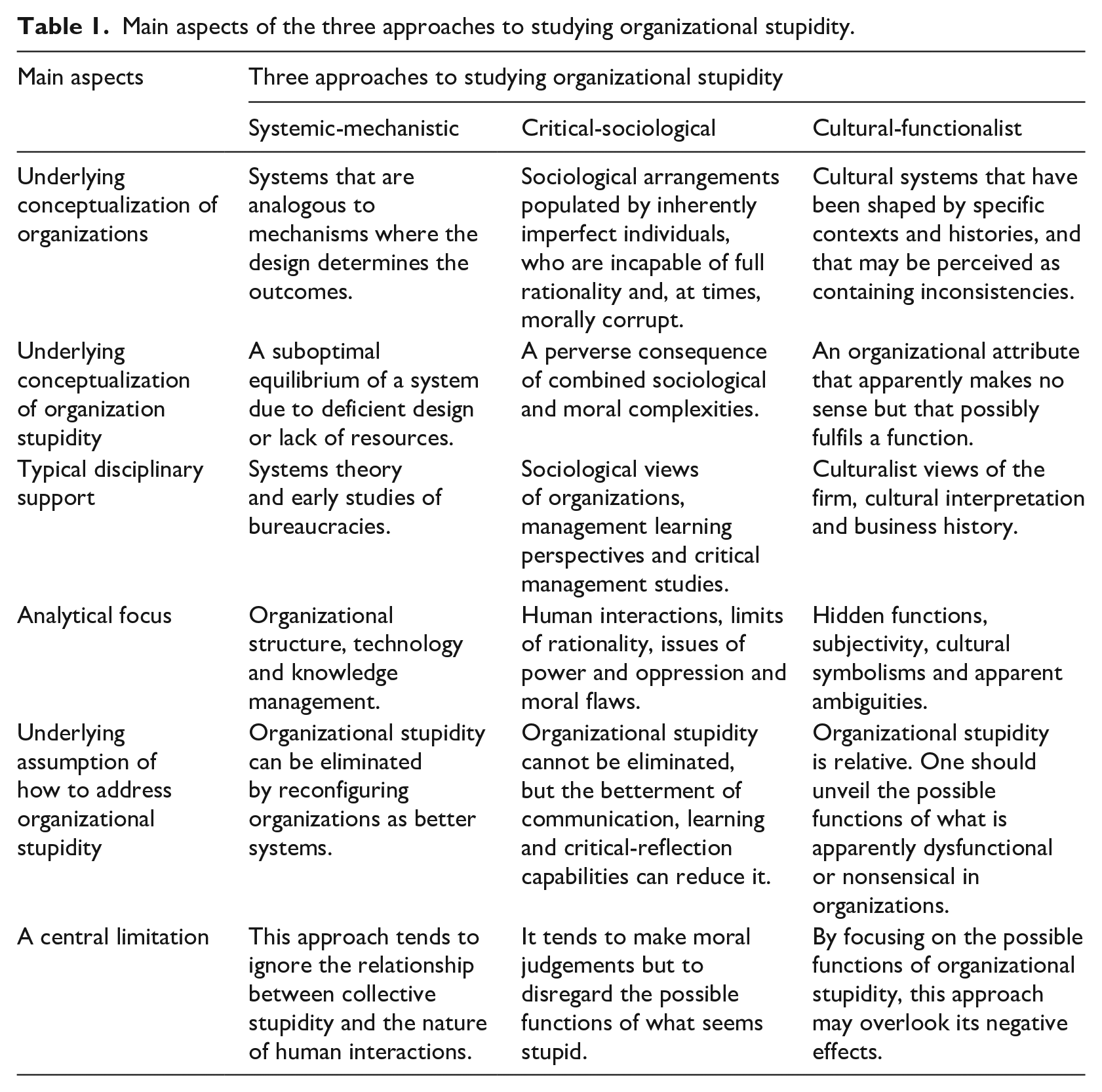
Overall, the typology shows that we already rely upon complementary perspectives to explain specific instances of organizational stupidity. For the sake of illustrating how they produce distinct explanations, I revisit here how the literature tries to make sense of the creation of useless jobs by organizations. Early references perceived the issue mostly through a systemic-mechanistic approach: Granted that work (and especially paper work) is thus elastic in its demands on time, it is manifest that there need be little or no relationship between the work to be done and the size of the staff to which it may be assigned. (Parkinson, 1955: 1)
That phenomenon has recently regained attention, especially since David Graeber (2013)
2
popularized the concept of bullshit jobs and argued that ‘at least half of all work being done in our society could be eliminated without making any real difference at all’ (Graeber, 2018: 26). {Dazed men and women who carry on with their senseless work.} His proposition is more closely affiliated to the critical-sociological approach in that it criticizes current economic models and questions how human interactions eventually contribute to preserving worthless jobs: [A] bullshit job is a form of paid employment that is so completely pointless, unnecessary, or pernicious that even the employee cannot justify its existence even though, as part of the conditions of employment, the employee feels obliged to pretend that this is not the case. (Graeber, 2018: 9–10)
Finally, a cultural-functionalist approach could probe the possible hidden functions of pointless jobs existing in capitalist societies that should promote efficiency. A key to deciphering this apparent conundrum resides in the assumption that ‘it doesn’t matter if those jobs do something useful; we just assume that more jobs is better no matter what’ (Graeber, quoted in Illing, 2018). That underlying cultural assumption (Schein, 1985) does indeed reflect an entrenched ambiguity of an economic model that combines a neoliberal discourse of austerity and an obsession with economic growth that requires the permanent creation of jobs (Glaser, 2014).
Therefore, by delineating three approaches for addressing organizational stupidity, the typology allows us to advance towards a more complete understanding of the phenomenon even if, as with the proverbial blind men describing an elephant, the full picture can still elude us.
Conclusion
Organizational learning – the most frequent theme of study in Management Learning (Anderson et al., 2020: 23) – is hindered by the extant collective stupidity that compromises reflexivity, knowledge gathering and better decision-making. To open up the ‘existing ways of thinking about knowledge and learning to critical scrutiny’ (Bell and Bridgman, 2018: 3) in this Provocation essay, I examined the emergence of literature streams addressing organizational stupidity and neighbouring conceptualizations. I began by identifying some antecedents to current perspectives, then delimited a terrain for research on organizational stupidity and identified intersections with the management learning field. Taking stock of the existing research on the topic, I contributed a more comprehensive perspective and proposed a typology of three approaches to studying organizational stupidity.
We know – often from painful experience – that stupidity, incompetence, bullshit, nonsense and absurdity are ubiquitous organizational phenomena, but we still need to understand why they are so abundant and persistent. {I’m a befuddled scholar: Why the organizational stupidity that abounds?} Although the literature review indicates that research on the topic remains theoretically underdeveloped, some important preliminary efforts have been made. More importantly, this essay points to some specific intersections between stupidity and organizational learning that, I argue, deserve further investigation. There is a vast world of mysterious, unexamined stupidity out there, and it would be silly not to put some effort into better understanding it.
Future research could investigate the performative functions of organizational stupidity and the ways it may serve individual and collective interests. Instead of aiming at its unachievable eradication, management learning scholars should learn about stupidity and investigate, for instance, how its gradual acquisition allows individuals to advance and companies to prosper. Growing research evidence shows that, contrary to what we may suppose, certain organizational objectives can only be reached by being stupid (Allen et al., 2012; Christensen et al., 2019; Paulsen, 2017). That is perhaps a disturbing finding for management learning scholars, but a serious look at how stupidity flourishes and thrives in organizations indicates that learning and reflexivity can on occasion be detrimental to individual careers and businesses as a whole. Our incursion into the realm of organizational folly thus warns us that too much of a good thing can be bad. Overall, it also suggests that our research effort to understand organizational learning must be matched by the attempt to also understand how organizations unlearn, forget and, on occasion, act stupidly. Therefore, I call for more vigorous research into the unsuspected causes and functions of aspects of organizational life that tend to remain unexamined because they are dismissed as mere stupidity.
Finally, {return to academic vanity} I insist that studying stupidity is urgent not only because it permeates the organizations we study but also because it pervades the very work we do as scholars. Indeed, academic writing is flooded with bullshit language (Eubanks and Schaeffer, 2008); a considerable share of the tasks we perform resemble those of bullshit jobs (Graeber, 2013, 2018); and absurdity flourishes with splendorous vitality in management research and education (Starkey et al., 2019). I hence hope that this Provocation essay encourages us, as management researchers, to reflect more carefully on and to debate more openly all the organizational stupidity and evident ridiculousness that surrounds us. {Papers sink beneath the waves of oblivion, theories never to confirm.} Which brings me back to poetry, to self-irony, and how this commentary began: My research was so irrela-vent, That they made me an associate prof of management. [. . .] And if managing nothing, your lives are spent, Then you all may be professors of management! (Kerr Inkson, 2010, in: The professor of management)
Footnotes
Acknowledgements
I sincerely thank the three editors (Emma Bell, Todd Bridgman, and Deborah Brewis), the two anonymous reviewers, and the following fellow academics who have been kind enough to read and comment on a poem and a commentary about organizational stupidity: Stephen Gates, Jean-Baptiste Litrico, Celine Louche Andrew Gates, Camilla Quental, Natalia Vershinina, Lisa Anderson, and Yuliya Shymko.
Funding
The author received no financial support for the research, authorship and/or publication of this article.
