






Abstract
Although teaching in Business Schools takes a theory-driven perspective, there are multiple different interpretations of what this means. We make a contribution by examining how management educators define ‘theory’ and explore how differing definitions lead to variations in the way that teaching is conceptualised and designed. We adopt phenomenographic methods to reveal a five-level hierarchy of theory definitions ranging from simple descriptive notions of ‘theory as an idea’ to more explanatory definitions with causal and practice implications. This hierarchy shapes the way management educators design their teaching with those with the most sophisticated understanding of theory being the most practically focused in their teaching. Although all the interviewees view theory as having an interventional purpose to shape or change managerial action, management educators are haphazard in the ways they teach students to apply theory. We conclude by discussing the implications of these findings for the essential–non-essentialist debate in management education and suggest avenues for future research.
Keywords
Theory has a preeminent place in business school teaching (Cornelissen et al., 2021; Pfeffer and Fong, 2002; Porter and McKibbin, 1988; Wren et al., 2007). One of the reasons students come to universities is to find out what is known on the subject of business and management so that they can apply the best and latest ideas in their future and current jobs (Mintzberg, 2004; Pfeffer and Fong, 2002; Rubin and Dierdorff, 2009; Rynes, 2012). This knowledge comes from many empirical and conceptual studies and is distilled into theories that are broadly applicable. It is these theories that are the bedrock of much, if not most, teaching in Business Schools and it is teaching this theory that separates universities from the more practically focussed teaching in technical colleges and the specific skills training offered inside companies (Buckley, 2018; Mintzberg, 2004). Hence, academics have a theoretical gaze that produces teaching strong on knowledge, insight and reflection, but light on practitioner skills (Abraham and Karns, 2009; Hibbert, 2013; Navarro, 2008; Tourish, 2020). Courses tend to be about general principles rather than the specific problems of particular managers and organisations (Bell and Clarke, 2014). As Wren et al. (2007) concluded, ‘it appears as though the trend in our pedagogy has been more directed towards the exercise of theory and analysis than toward training our students in thinking, analysis, and application skills’ (p. 490).
There is a long-standing and ongoing discussion about the nature of theory (e.g. Bacharach, 1989; Bartunek, 2020; Cornelissen et al., 2021; Dubin, 1978; Hambrick, 2007; Streeck, 2017; Wacker, 1998; Whetten, 1989) and it is far from clear whether a common conceptualisation exists. Definitions range from the simple, ‘a theory is an idea’, through to more complex ones incorporating causality, explanatory power and multiple facets (e.g. prescriptive requirements that theories should answer what, how, why, who, where and when questions). These differences are important because of the general consensus that management education is taught from a theory-driven perspective (Lewicki and Bailey, 2009; Perriton and Hodgson, 2013; Rubin and Dierdorff, 2009; Yoder, 2019). If, as seems likely, there are meaningful differences in the way that management academics conceptualise the nature of theory, it will challenge the simplicity of notions of theory-driven teaching and provide a more nuanced understanding of the relationship.
There are multiple perspectives on how ‘theory’ relates to management education. On one level, there are the particular theories that are taught (e.g. Porter’s five forces model, attribution theory, contingency theory of leadership, Fordism and post-colonial theory). Another perspective is to equate theory with the research literature. Alternatively, theory is about the scholarly environment and its difference to the practical world of business. These and other perspectives swirl around in Business Schools and become conflated and confused in management educators’ minds. Theory is a word used in many contexts and in many ways, yet the word ‘theory’ is taken as a given. Discussions around the use of theory in Business Schools rarely delve into how management academics understand the nature of theory. There is an implicit assumption that the word is similarly understood by all, whereas, as we shall demonstrate, the reality is that every management educator has their own implicit theory of theory. These implicit theories of theory are important because differences in the way that teachers conceptualise theory are likely to drive differences in the way they design their teaching. Our primary contributions are (1) to surface the different ways that management academics understand and conceptualise the nature of theory in management education and (2) to explore the impact of different conceptualisations on the design of teaching.
This article begins by exploring the nature of implicit theories and how these might play out with management educators’ implicit theories about theory and the impact they might have. It then moves on to review of the different ways in which theory has been conceptualised generally, before moving on to look at how theory is applied in management education, particularly focusing on the changing emphasis management educators place on theory and application. In the rest of the article, we report an empirical study using phenomenographic methods to capture how management educators define theory, the ways they apply it in the classroom and what they hope their management students will learn as a result. This study allows us to develop an explanation of theory application with implications for the design of teaching in Business Schools, which we discuss at the end of the article.
Theory and management education
An implicit theory of theory
Implicit theories are people’s lay ideas about how the world works (Detert and Edmondson, 2011). They capture people’s informal ideas or lay conceptions about the causes and nature of behavioural phenomena and are their explanations of everyday problems (Furnham, 1988; Levy et al., 2006). Implicit theories have been likened to cognitive scripts in the way they process stimuli in the brain to provide the rationale for action (Bacharach et al., 2000). Implicit theories are personal belief structures about the nature of cause and effect on a particular matter (Anderson and Lindsay, 1998; Detert and Edmondson, 2011). They contrast to explicit theories that represent scientific explanations of such things. In the social sciences, implicit theories are arguably more important than explicit theories because implicit theories drive people’s sense-making, their behaviour and the decisions they make (Schneider, 1973; Sternberg et al., 2005). These might be informed by explicit theories, but explicit theories only influence a person’s behaviour after they have been processed within the individual (Lewicki, 1986).
People have different implicit theories underpinning each of their regular behaviours (Furnham, 1988). These range from the relatively mundane everyday challenges people face such as the best route to work or how to make spaghetti bolognese through to complex social behaviours, such as what motivates people or what behaviours are considered ethical. Many management disciplines have embraced implicit theories. These include personality (Borkenau, 1992; Schneider, 1973; Yeager et al., 2014), intelligence (Blackwell et al., 2007; Costa and Faria, 2018; Sternberg, 1985) and voice (Detert and Edmondson, 2011; Knoll et al., 2020). One domain of study that has embraced implicit theories particularly strongly is leadership (Fairhurst and Grant, 2010; Lord et al., 2020; Meindl, 1995). People’s implicit leadership theories (ILTs) capture their definitions of leadership and contain the factors that people use to evaluate whether someone is a leader or not (Epitropaki and Martin, 2004; Offermann and Coats, 2018). They are known to develop very young in life, before schooling begins and develop through childhood and into adulthood (Antonakis and Dalgas, 2009; Ayman-Nolley and Ayman, 2005; Lord and Maher, 1991). They reside unconsciously in people’s minds, but have a strong effect on behaviour (Lord and Maher, 1991; Tavares et al., 2018). They have been shown to determine the behaviours people adopt when they want to be viewed as a leader and their reactions to those people they regard as leaders (Felfe and Schyns, 2014; Foti et al., 2017; House et al., 2002; Junker et al., 2016; Kenney et al., 1996; Riggs and Porter, 2017).
Theory is a concept very much like leadership in the sense that it is a word that people use in everyday speech long before they encounter academic definitions of it (Cornelissen et al., 2021). Through life experience, people develop an understanding of what the word theory means and they use it in common parlance. Yet, just like leadership, it is a word that can be understood very differently. A theory can be an idea, a notion, a guess, a thought, an explanation, a scientific or mathematical proof and many other things. But unlike leadership, people becoming management educators have to overlay a formal understanding of theory on their everyday definitions. This is likely to cause variation in the different ways that people conceptualise theory, leading to different decisions related to the application of theory in management teaching.
Definitions of theory
Ironically, the word ‘theory’ is an imprecisely defined one. It owes its origins to the ancient Greek word, theōria, which is commonly translated as ‘contemplation’ (Harrington, 2005: 2), especially in the philosophical sense of contemplating the cosmos, art, religion or science. Nowadays, lay definitions of the word range from relatively simple notions of an idea or an abstract thought through to more scientific usages, such as a testable hypothesis, or a general principle that explains a phenomenon, or a body of knowledge providing a systematic understanding of a subject (Merton, 1967; Sutton and Staw, 1995). In the simpler definitions, a theory is an idea without any causal connotations, whereas many of the more sophisticated definitions may involve a causal or explanatory element.
In scholarly environs, the word theory is similarly understood in diverse ways. Lamenting on this, Merton (1967) stressed the importance of clarifying the meaning of the word: Like so many words that are bandied about, the word theory threatens to become meaningless. Because its referents are so diverse – including everything from minor working hypotheses, through comprehensive but vague and unordered speculations, to axiomatic systems of thought – use of the word often obscures rather than creates understanding. (p. 39)
Addressing this diversity, Bacharach (1989) suggests that a ‘theory is a statement of relations among concepts within a set of boundary assumptions and constraints’ (p. 496). He sees theory as a ‘linguistic device’ (Bacharach, 1989: 496) helping observers avoid being dazzled or put off by the complexity of their observations or experience; a way to make sense of what is happening or expected to happen. In the same issue of Academy of Management Review, Whetten (1989) offered an integration of the various definitions of theory that has been widely cited and commonly adopted. He proposed that a complete theory must contain four essential elements: What, How, Why, and a combination of Who, Where and When.
The ‘What’ element outlines a set of factors that should (and should not) be considered as part of the explanation and focuses on two key qualities: comprehensiveness and parsimony. The ‘How’ element looks at relationships between the factors. Whetten (1989) argued that together the ‘What’ and the ‘How’ provide the description of a theory. The ‘Why’ element contains the ‘the theoretical glue that welds the model together’. (Whetten, 1989: 491). This aspect of a theory provides the logic explaining how a theory aligns with present theories of practice and process. Whetten (1989) summarises succinctly, ‘What and How describe; only Why explains’ (p. 491). The final three questions – ‘Who’, ‘Where’ and ‘When’ – combine to set the boundary conditions of a theory. Will it work in different situations, with different people, ethnicities, different countries or industries? Is it bound to a specific area, timeframe or situation? Whetten (1989) contends, ‘few theorists explicitly focus on the contextual limits of their propositions. In their efforts to understand a social phenomenon they tend to consider it only in familiar surroundings and at one point in time’ (p. 492).
Although implied in Whetten’s (1989) relationship element, ‘good theories’ (Wacker, 1998: 367) should possess a predictive quality to them. That is, they do not just describe a state of affairs, but also make predictive claims. Wacker (1998, p. 364) makes this point specifically and adds ‘Should’, ‘Could’ and ‘Would’ questions: ‘Could a specific event occur?’, ‘Should a specific event occur?’ and ‘Would a specific event occur?’’. These questions are particularly interesting because they move theory into an applied space in which theories are good if they predict future events, allows them to be empirically tested and refuted, and contextualises them.
Despite Whetten’s and Wacker’s attempts to integrate theory discussions into an understandable and relatively simple set of building blocks, the definitional debate on theory continues. Glanz et al. (2008), writing about social and behavioural theories in health intervention research, emphasise the practical nature of theory thus: ‘A theory is a set of interrelated concepts, definitions, and propositions that explains or predicts events or situations by specifying relations among variables’ (p. 26), and they argue that theories help explain behaviour and how it might be changed. Boer et al. (2015) similarly emphasise the applied nature of theory and talk about its causal nature. But, somewhat unconventionally, they argue that theory need not be the starting point for academic research and could instead respond to practitioners’ issues further emphasising a practical perspective on theory. Considering the nature of theory in a political context, Streeck (2017) argues that theory is only interesting when it has practical significance.
In addition to these contributions, other streams of research have explored the manner in which practical application intertwines with theory (e.g. Astley and Zammuto, 1992; Davydov, 1990, 2008; Engeström, 2015, 2020a, 2020b; Ilyenkov, 1982; Tranfield and Starkey, 1998). Scaratti and Ivaldi (2021) argue that theory exists for practical application as witnessed in Mode 2 discussions and calls for research that responds to real-world problems (Bartunek, 2011; Biggart, 2016; Nowotny et al., 2003; Starkey and Madan, 2001; Tranfield, 2002; Tranfield and Starkey, 1998; Van Aken, 2005). Scaratti and Ivaldi (2021) argue that as the ‘principal limit of scientific rationality is its context-free assumption [. . .] focused on a well specific object, defined by a theory and studied through an experimental laboratory approach (being recursively replicable)’ (p. 4), there is a disconnection between such theory and its social context.
Drawing on the work of Ilyenkov (1982) and Davydov (1990, 2008), Engeström (2015, 2020a, 2020b) and Engeström and Sannino (2010) have explored the conversion of abstract theory into concrete actionable ideas. Ilyenkov (1982) argued that theory was an abstraction from sensually experienced phenomena so that it might become relevant to many objects and forms. Theory forms from sensual experiences of the concrete (termed, germ cells) into this sense-free abstraction so that it might then be reapplied to the concrete. Ilyenkov (1982) emphasises the need to understand the complexity and wholeness of concepts and not consider them in isolation to form a coherent whole. Davydov (1990) explains that where this approach differs from the static theory definitions of Whetten, Wacker and similar others is that theory is expressed as movement from the germ cell, through abstraction, to action. Engeström (2020a) notes that the approach of Ilyenkov and Davydov combines scientific and practical everyday thinking before highlighting the increasing separation of these two worlds. In Engeström (2020b), he unites these different worlds through the notion of ‘in the wild’ (p. 99). By this, he refers to the everyday world where ‘human action and cognition are never fully predictable or programmable’ (Engeström, 2020b: 101). He cautions against accepting theory from abstract and sterile laboratories where cognition is studied in captivity and instead suggests that ‘educational researchers need to step out of the classrooms, into the wild’ (Engeström, 2020a: 42), the real world where knowledge is never complete, if they are to be truly applied.
Cornelissen (2017, 2019), Cornelissen et al. (2021) and Ketokivi et al. (2017) encourage management educators to expand their understanding of theory from the cause–effect relationships that dominate management research. Cornelissen (2017) adds process-based and typological approaches, which Whetten (1989) and others do not touch upon. The process-based approach is one based on narrative explanation of the subject around a generalised mechanism. The typological approach brings together different dimensions to explain the fuzzy nature of many subjects to create a coherent and explanatory typology. On a related note, Cornelissen et al. (2021) also take a pluralistic stance on theory and, among other approaches, include notions of conceptualising or framing a subject, practice-based views of theorising which are rooted in observational interpretation, emancipatory theorising that seeks to reveal political constraint in organisational life and multiple forms of explanatory theorising akin to the approaches of Bacharach, Whetten and Wacker. Cornelissen et al. (2021) argue that their pluralist stance to theory requires ‘that we, as researchers, also believe that other traditions of theorising have something substantial to add and in distinct and critical ways help further our common knowledge base’ (p. 14). Optimistically, they assert, When researchers embrace this ideal, they actively consider theoretical work steeped in a different tradition and engage in an open exchange and conversation with one another. Looking beyond the confines of their own form of theorising, such an open conversation has researchers reaching out and going out of their way to read contributions in other forms and then think through the consequences for the topic and for their own work (Cutcher et al., 2020). The result, we believe, will be a joining up that is more than the sum of its parts; forms of critique will provoke thoughts and spur new forms of theorising, and explanatory and interpretive forms of theorising will together create a more enriching and nuanced picture of our phenomena of interest. (Cornelissen et al. (2021: 14)
Focusing on the field of organisation studies, Cornelissen (2019) also paints a positive picture of theory arguing that there are many more approaches to it than typical definitions would suggest, and furthermore, theories are constantly changing and evolving, which keeps thought moving.
Theory application in management teaching
The most extensive studies of the academics’ understanding of theory in management teaching have been conducted by Wren et al. (1980, 1994, 2007) over three decades. They asked management educators about the relative emphasis they place on theoretical concepts vis-à-vis practical application in their teaching. They conducted the first study in the late 1970s, and then repeated it approximately a decade apart in the late 1980s and the mid-2000s to explore the trends. With undergraduate teaching, they found a significant shift of emphasis towards theory in the final survey, which was particularly pronounced and at its highest recorded levels in principles of management, organisational theory, organisational behaviour and business ethics. Conversely, in postgraduate teaching in these subjects, the trend is towards greater emphasis on application. In addition, these studies showed that management educators attempt practical application in a wide variety of ways. These range from talking from personal experience, guest speakers, utilising the students’ experience, through cases and simulations, to experiential activities and service opportunities (Wren et al., 1980, 1994, 2007).
One interesting feature of the studies by Wren et al. (1980, 1994, 2007) is that they did not define theory in their questionnaires. They assumed that their Academy of Management member respondents similarly understood its nature, which is not necessarily the case. Moreover, their method risks conflating theory and application as theoretical concepts might be explained in class within an applied context and practical application requires a theoretical base. Consequently, while their studies provide information about the shift in emphasis between theory and practice, it does not tell us about how theory is understood and how theory affects its practical application, nor the circumstances influencing the emphasis. These are the next steps in this line of research.
Research questions
Discussions of theory-based teaching assume that the word ‘theory’ is commonly understood. This is not necessarily the case as the definitional debate on theory shows. Our primary interest was understanding how management educators define the word theory and, if differences exist, what are the implications for the design of teaching. In addition, stimulated by the work of Engeström (2015, 2020a, 2020b) and the need for management educators to extend beyond classroom abstractions and into the wild, we had subsidiary interests associated with the practical application of theory. What does ‘the application of theory’ mean to management educators?
Phenomenographic research
Phenomenography is a research methodology developed in the field of education that has often been used to understand how people learn (Åkerlind, 2018; Billsberry et al., 2019; Marton, 1994; Marton and Säljö, 1984; Marton and Svensson, 1979), but it has broader application as well. Marton (1986) explains that phenomenography is a research methodology that maps ‘the qualitatively different ways in which people experience, conceptualise, perceive and understand various aspects of, and phenomena in, the world around them’ (p. 31). A defining feature of phenomenographic research is that it focuses on the distinctions between respondents and seeks to find meaningful categories of difference. In many fields, these categories of difference have been shown to have hierarchical structures (Marton, 1975, 1986, 1994; Säljö, 1979). For example, in studies of how people learn, it has revealed a hierarchical structure from surface- to deep-level learning and linked these to behaviours such as how people approach study (e.g. Marton, 1994; Marton et al., 1993). This ability of the phenomenographic approach to uncover meaningful hierarchy in different people’s experience of a phenomenon and linking this hierarchy to differing outcomes was a primary driver for its use in this empirical study. We wanted to find out whether there is a hierarchy in the way that management educators define theory and to see whether this influences the way they design their teaching. Hence, this approach is directly aligned with our research goals.
Phenomenographic research works by asking people, typically 20–30 people (Åkerlind, 2005; Bowden, 2005; Marton and Booth, 1997; Tight, 2016; Trigwell, 2000), to reflect on a similar experience. The transcripts are then analysed to find meaningful variation in the descriptions of the experience (Åkerlind, 2005). As such, phenomenography takes the perspective of the participant, listens to their account of their experience and draws lessons. It is a participant-driven approach rather than a researcher-driven one, although the researchers decide what experience the participants will focus on (Marton and Svensson, 1979). Interestingly, most phenomenographic studies have discovered that people experience a phenomenon in a relatively few, typically five to seven, distinctly different ways, and these are hierarchically arranged according to depth of understanding (Billsberry et al., 2019). In applying this approach to discovering how management educators understand theory, our hope was to identify variation that would be both hierarchically meaningful and predictive of different ways to teach.
Methodology
Sample selection
Our goal was to talk to a broad range of people teaching in Business Schools regardless of their backgrounds. The sample for this study comprises 27 management educators from 26 Higher Education institutions, in 23 cities, across 13 countries. Appreciating the research realities of collecting data in English and the worldwide imbalances of management education provision, we sought representation of respondents from Europe (n = 13), North America (n = 7) and Asia-Pacific (n = 7).
Potential invitees were chosen randomly from the Academy of Management online member database. Although this does limit the sample to people able to become members of the Academy of Management, this is the world’s largest association of academics in the field of management and contains large numbers of people at all levels of their careers and from most parts of the world. Once randomly selected, they were assessed online to ensure they met all of the following criteria. To receive an invitation to participate, they had to be an academic member in one of the following divisions of the Academy of Management: Management Education and Development, Organisation and Management Theory, Organisation Development and Change, Organisational Behaviour or Strategic Management. These divisions were chosen as they are known to be disciplines where teaching is known to focus on the management of organisations or the people in them and take a theory-driven approach (Ambrosini et al., 2009; Charlier et al., 2011; Navarro, 2008; Rynes and Brown, 2011; Wren et al., 2007).
Potential invitees also had to have a current teaching role. This was a prerequisite because we knew we wanted to explore the implications of variations in implicit theories of theory on teaching. However, we decided against setting a research prerequisite because we wanted to capture a broad range of people teaching in Business Schools and not just those with a particular research background. Moreover, by not imposing a research prerequisite, we reduced range restriction in the ways understanding of theory had been acquired in the sample. For the same reasons, we decided not to exclude tenured or tenure-track employees; subdivisions that are not necessarily relevant outside the United States. These assessments were conducted through their university Internet home pages. When the participants met these selection criteria, their contact details were obtained from their university home page. An individualised email was sent to each person’s university email address inviting them to participate in the study.
A total of 110 potential participants were invited to participate. Two follow-up emails were sent to invitees who did not respond. By the end of August 2018, over 245 invitations and follow-up emails had been sent. The acceptance rate of participants to the invitation was 24.6%. The people who declined the invitation represented 12.7%. The remaining 62.7% chose not to respond to the invitation or the follow-up emails. The response outcomes by region are shown in Table 1.
Participant invitations by region.

Eighteen of the participants were women and nine were men. The average period of employment at their current university was 6.5 years and the average time since gaining their doctorates was 12.4 years.
Data collection
Following typical phenomenographic practice (Tight, 2016; Willis, 2018), in-depth semi-structured open-ended interviews were used to collect data. Phenomenography works best when primary questions are supplemented with follow-ups to clarify and gather deeper information (Åkerlind, 2012). As our primary objective was to discover whether significant variations exist in the way that management academics define theory in their teaching, we began with a series of questions that explored their definitions of theory in the context of their teaching. Our secondary goal was to discover whether any variation results in different approaches to teaching. Hence, the latter questions explored facets of how the participants applied theory in their classrooms. Table 2 contains the structure of the interview and the primary questions asked in this study.
Interview protocol.
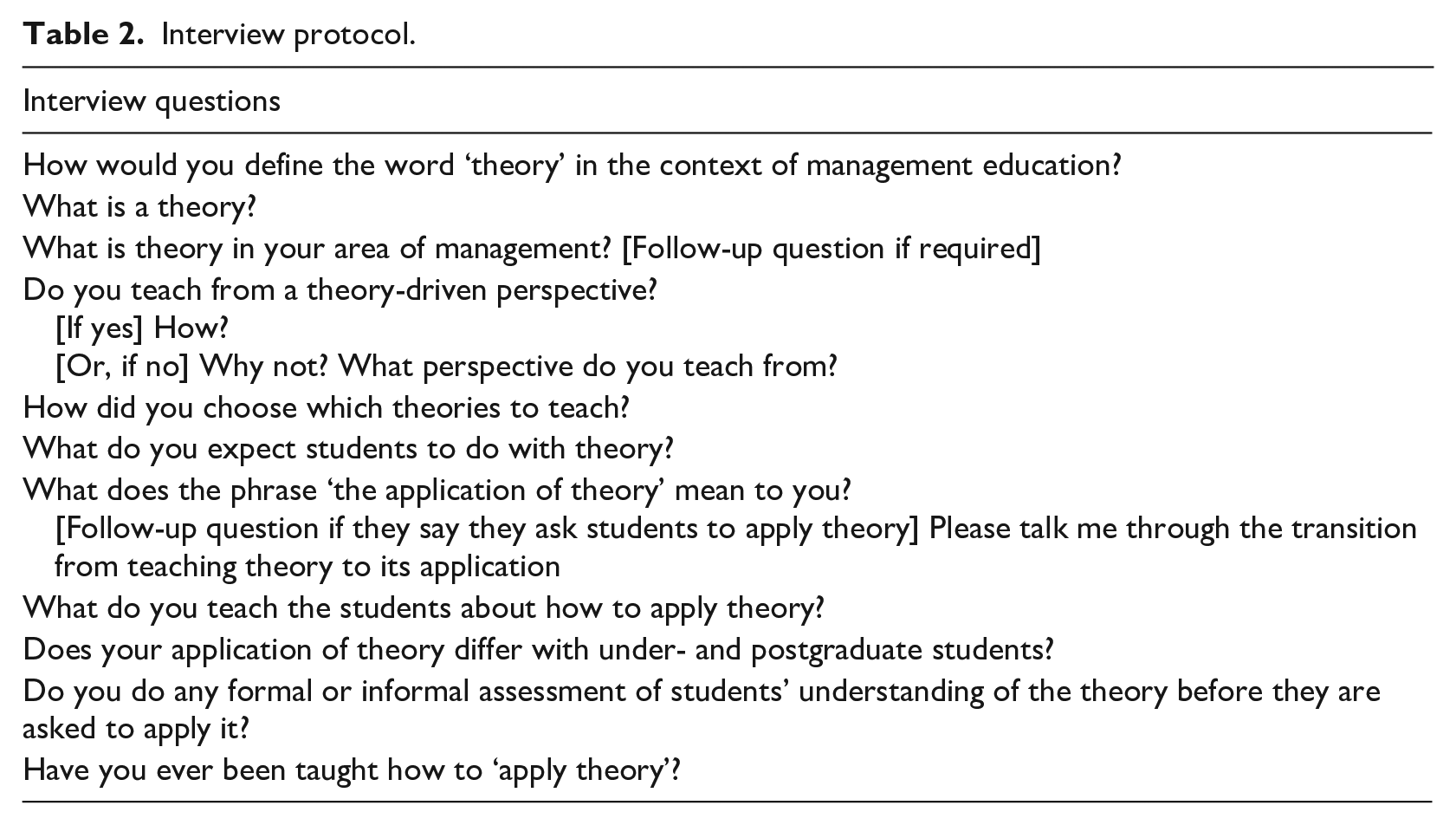
As the interviewees were based around the world, the interviews were conducted using an Internet communications platform, namely, Skype. The interviews were digitally recorded and transcribed. The interviews were conducted in English between November 2017 and August 2018. The shortest interview was 15 minutes and 7 seconds, and the longest interview was 51 minutes and 41 seconds. The average length of all interviews was 25 minutes and 33 seconds. In total, the 27 interviews generated over 110,000 words of transcribed dialogue.
Data analysis
Whereas the goal of phenomenological research is to surface individual participants’ experiences and their personal interpretations of them, phenomenographic studies aim to understand variation in meaning across the group of participants as a whole and to discover how these are hierarchically arranged (Åkerlind, 2005). Hence, no transcript can be understood in isolation. It becomes important data when hierarchically analysed within the context of the group as a whole (Åkerlind, 2005).
To follow this approach, the two authors took an iterative approach and read and re-read the transcripts many times seeking meaningful difference in the participants’ definitions of theory. These readings were punctuated with many discussions about the comparative nature of the theory definitions until a hierarchy emerged. This approach to data analysis is justified because phenomenography does not purport to be a grounded approach (Tight, 2016). Instead, it acknowledges the researchers’ interpretation and prior understanding of the topic (Lamb et al., 2011). This is one of the tensions with this research methodology. While it seeks an understanding of the participants’ experience, it does so on the researchers’ terms (Billsberry et al., 2019; Webb, 1997).
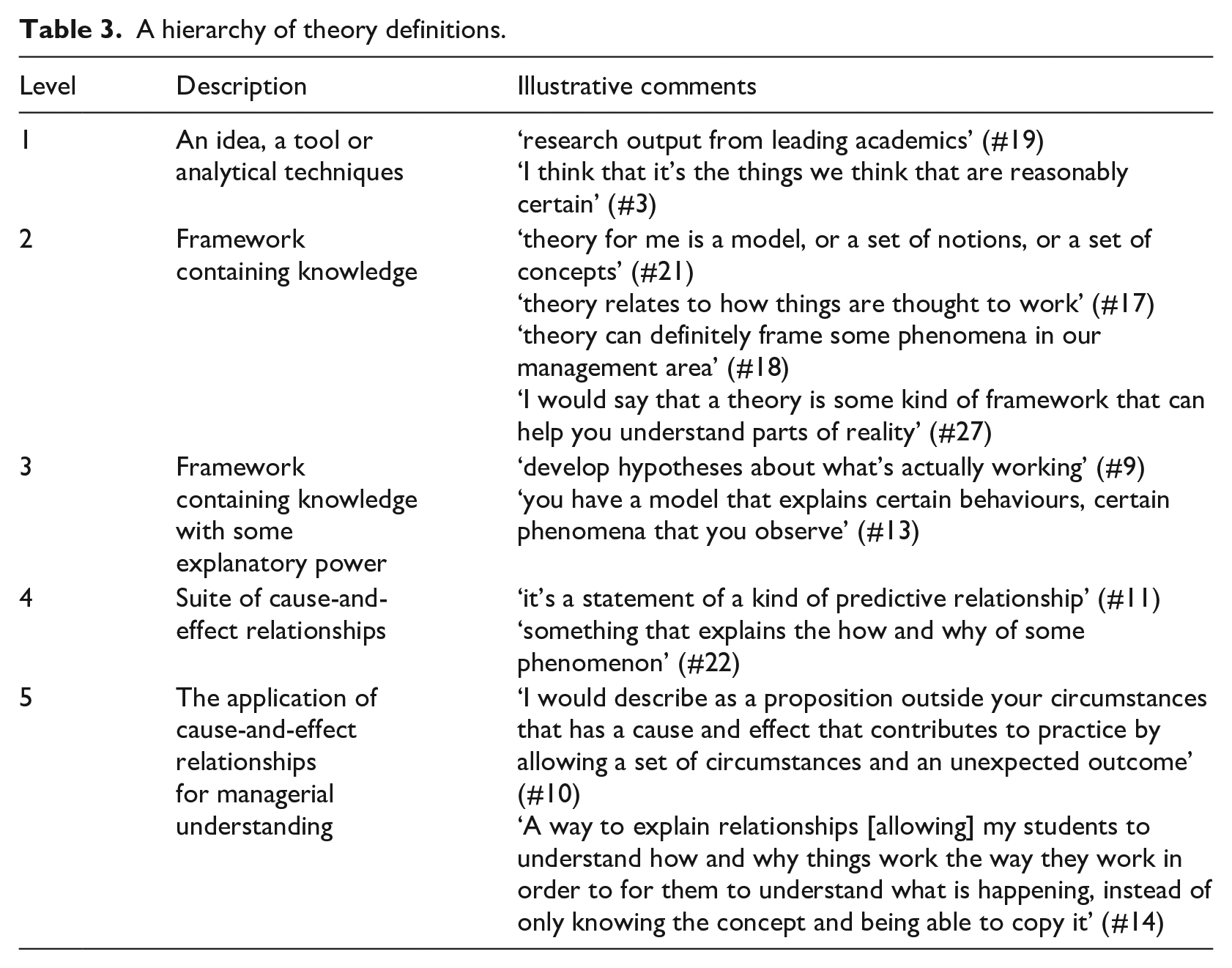
The first division found in the dataset was between those definitions that suggested at some form of explanatory purpose to theory versus those that depicted it without causation. Sixteen participants (1, 2, 3, 4, 7, 15, 16, 17, 18, 19, 20, 21, 23, 24, 25 and 27) offered descriptive definitions without causation of explanatory power. The authors then compared these 16 definitions against each other and were able to separate out a category of simple non-causal explanations focussing on a single idea, tool or technique (n = 6) from a category containing knowledge frameworks (n = 10). Taking this subset approach to categorisation helps with the number of comparisons that must be undertaken. The remaining 11 (5, 6, 8, 9, 10, 11, 12, 13, 14, 22 and 26) offered more sophisticated definitions with explanatory or causal elements. These 11 definitions could be broken down into three categories of causal frameworks (n = 6), a suite of cause-and-effect relationships (n = 2) and a suite of cause-and-effect relationships for the purpose of managerial understanding (n = 3). Given the relatively low numbers in the final two categories, we discussed collapsing these into one category. We decided against doing so because there was meaningful similarity within each subset and a meaningful difference between the two. Thus, we were able to identify five qualitatively different categorisations of theory definitions from the definitions proffered by the interviewees. These are presented in a hierarchy in the descriptive or explanatory manner that theory is conceptualised (from hereon, these are labelled as least to most sophisticated). The first two levels do not contain any sense of causality in the definitions, whereas the third, fourth and fifth levels do. Exemplars of sentences and phrases used to compile this hierarchy can be found in Table 3.
A hierarchy of theory definitions.
Findings
Management educators’ implicit theories of theory
The first observation is that management educators’ implicit theories of theory are not consciously held. The first substantive question asked participants to provide a definition of theory in the context of management education. Although the participants knew what the general direction of the interview would be, most participants had to take a few moments before they could offer a definition. ‘What is a theory? A theory is [pause] Gosh [pause] I would define it as a way to umm’ (#23). ‘How would I define it?’ (#1), acknowledging they had not really thought about a definition of theory. ‘Mmmm [pause] Okay. I haven’t thought about a definition, but umm’ (#20). Some stalled for time: ‘That’s a good question’ (#3 and #5), ‘Umm, it’s a very difficult question’ (#27) or ‘So, you know the definition of theory is always fairly tricky in my view’ (#6). Just a few were able to supply immediate definitions: ‘I would explain or define theory in the context of management education as a way of describing how things are done or can be done’ (#12). For our interviewees, theory is a word that they use all the time. But although the word appears to be part of the common lexicon, these hesitations and pauses suggest that it is a word they have internalised and use expecting others to understand without question. In this sense, the data support the idea that ‘theory’ appears to be a word like ‘leadership’ – one that has multiple definitions, but which people use from their own implicit understanding of the concept without checking that others share their perspective (Grint, 1997; Lawler, 2005).
In line with Merton’s (1967) lament, the participants in our study proffered widely varying definitions of theory from the very simplistic to the highly explanatory. They ranged from a basic premise that theory is an idea, tool, or technique: ‘A premise that is devised using agreed upon or defined concepts’ (#15); ‘a published mechanism for understanding the relationship between things’ (#7) or ‘research output from leading academics’ (#19). Of those in the middle ground, the participants used words that defined theory as ‘a framework of knowledge’ (#18) and ‘A set of notions [. . .] or concepts’ (#21). In the third of five categories, these framework definitions included some explanatory power: ‘Develop hypotheses about what’s actually working’ (#9) and ‘you have a model that explains certain behaviours, certain phenomena that you observe’ (#13). At the more sophisticated end of the spectrum, definitions included the notion of multiple concepts being linked in cause-and-effect relationships: ‘something that explains the how and why of some phenomenon’ (#22) or ‘it’s a statement of a kind of predictive relationship’ (#11). The most sophisticated definitions of all included a practical element: A way to explain relationships [allowing] my students to understand how and why things work the way they work in order to for them to understand what is happening, instead of only knowing the concept and being able to copy it. (#14)
These five categories are divided in the following way. The least sophisticated implicit theory of theory is a non-causal definition focused around a single idea. To all intents and purposes, this is an undeveloped lay theory that has not been challenged during academic training and socialisation. The second level is a more nuanced, non-causal definition focused around multiple notions or a framework of ideas. Frequently, when voicing these definitions, we could hear respondents grappling with the dissonance between their original lay theories and the ones they were experiencing in academic environments. For example, for me theory relates to how things are thought to work. Umm based on either prior practice that has been analysed and defined into a standard set of this is what, er how we think things work. And also around the research that is conducted in that field to be able to say good practices are, what bad practices are, what leads from one thing to another, and that kind of thing. (#17)
The third level of the hierarchy contains causal definitions based around multiple notions or a framework of ideas, but stopping short of the more formal definitions of Whetten (1989) or Wacker (1998). Here, the definitions hint at the respondents taking academic definitions of theory on-board, integrating them with their original lay theories, but without the formal definitions developed in the literature. For example, I don’t really have an exact definition in my mind. But in my mind theory is something that is some sort of framework that explains how and why things occur. Umm . . . so that’s kind of more . . . that’s . . . that’s the first things that come to my mind in terms of theory. And I see that it’s important in our teaching because it helps our students to understand why and how things occur. Umm . . . and also it extends their knowledge to the extent that how that applies to similar or other contexts. (#6)
The fourth level aligns well with Whetten’s (1989) definition of theory and demonstrates some study of the nature of theory, which has fully supplanted lay theories that existed prior to academic encounter. The highest level in the hierarchy captures the applied focus that Wacker (1998) added to the definition of Whetten (1989). With only 5 of the 27 participants in these last two categories, it suggests that most of these participants are internalising academic understandings of theory haphazardly in their daily encounters at work. Only seven of the participants said they had received any formal training on the nature of theory. Eight said they were self-taught and a further seven said they had no formal training on theory. The remaining five offered no comment.
Theory definitions and approaches to teaching
Thirteen interviewees said they teach from a theory-driven perspective and four from a mix of theory and practice. For example, ‘I think there is no choice. I mean teaching at university is from a theory-driven perspective’ (#21) or ‘I do teach from a theory-driven perspective. I think that is fundamental. In fact, I think that most of what we teach is theory; but one tries to make it as interesting as possible’ (#23). Six said they were mostly practice-driven, although they admitted they used theory to ground their practice-driven application. Only two interviewees indicated they were purely practice-driven. Two were unsure or did not respond to the question.
We explored the relationship between the explanatory or descriptive nature of interviewees’ definitions of theory and their approach to teaching. We found that the interviewees who proffered the least sophisticated definitions of theory tended to adopt a theory-driven approach to teaching and those who proffered the most sophisticated definitions of theory tended to have the most practice-driven approaches to teaching. These findings might appear counter-intuitive on first glance. People with the most developed notions of theory might be expected to take a theory-driven approach to their teaching, but they do not; it is the management educators with the least developed implicit theories of theory that do that. Two factors help to explain this finding. First, it is the management academics with least time in the profession that tend to take the theory-driven teaching approach. It takes time to develop a broad understanding of a topic and its relevance to practical managerial decisions (Lewicki and Bailey, 2016; Marx et al., 2016; Ward and Brennan, 2020). Moreover, these people are more likely to teach large undergraduate classes where more theory-driven teaching, the use of textbooks and teaching more abstractly are the norm (Wren et al., 2007). Second, the more sophisticated definitions of theory contain the most practical elements with its causation and explanations of managerial phenomena. Those management educators who have internalised these applied approaches are likely to teach more practically, be given cohorts that appreciate such application and develop a stronger interest in the nature of theory application: I think what’s interesting is because undergrads don’t have as much work experience, it’s actually much harder to teach in an applied way to them. And a lot easier to talk about theory with them. But with MBA students they have the experience, they want to make sense of it, they want to put a framework around it. But they don’t want that framework to be too abstract. (#22)
The application of theory
The prompt for the above-reported analyses comes from the work by Wren et al. (1980, 1994, 2007), and their separation of theory and practical application. To explore this separation in more depth, we asked interviewees to discuss the theory-driven nature of their teaching. A few saw ‘teaching from a theory-driven perspective’ as the natural order of things and something they have not challenged: ‘The theory driven perspective is actually laid out at the front of that unit’ (#5). But the majority of interviewees talked about either the conjoined nature of theory and practical application as sequenced phases in teaching or questioned the separation of theory and practice altogether. Examples of the sequenced approach include the following: ‘Start with the basic models, frameworks, arguments, challenges [. . .] We use very practical examples: theory – practice – theory – practice’ (#1); ‘Start with the theory, the theoretical concepts’ (#19); ‘I try to define concepts first. And in defining concepts one gets to the level of what is a theory around that concept. And once the theory has been stated then we try to look for ways that applies’ (#23); and ‘We apply these theories to a case or their own work situation, etc. or sometimes the other way around. But we always connect theories to practical examples’ (#14).
Those interviewees questioning the separation of theory and practice described the application of theory process differently. One person considered themselves a ‘practice theorist’ (#26). They described their approach in the following way: ‘the way I see the world is very much through practices; meaning that we’re all in different social worlds all the time and if we get by then we learn what the practices of the world are’ (#26). Other examples used were ‘I guess I do teach from a theory-based perspective [. . .] I’m teaching people how to critique. So, I come from a critical perspective [. . .] I’m interested in what works in your environment, in your context’ (#11) and My work still comes from a basis of theory even though I may not refer to that directly in what I would be teaching them [. . .] but that theory is for application. [It is] for managers and leaders to understand why the theory operates and how they can use it in their own management practice and improve their own management practice. (#10)
Students’ expected use of theory
Delving deeper, when asked what they expect students to do with theory, five of the interviewees expected no more than basic understanding of the theories. Ten were more ambitious and advocated analytical skills using theory and the application of theory to different situations: ‘they have to explain the theory and apply it in different situations’ (#4); I expect them to apply the theory in the context of whatever the question is that they are looking at. So, I’ll expect them to be able to say how the theory is relevant. Or irrelevant if they want to say it’s irrelevant, and that’s fine as long as they can argue for it. At a higher level, to compare and contrast different theories. (#16)
The most ambitious management educators were hoping their students would use theory critically to bridge the gap between theory and practice: I expect them to be able to articulate why particular perspectives are useful [for] a particular problem. That’s really what I need them to be able to do [. . .] they have to review the evidence base properly, but when they review the evidence base, they also need to be mindful of the theory base as well. (#24) I get them to apply the theory to understand [. . .] that there are different ways of looking at the world and so that they become more critical in general and that there isn’t just one way at looking at a situation or a perspective on things. (#3)
When explored through the lens of the interviewees’ definitions of theory, a pattern emerged. Those with the least sophisticated definitions of theory tended to see theory as a guide for managerial action and decision-making: ‘if you’re able to apply those in practical ways in the workplace you should get [. . .] increased performance’ (#15); ‘I talk about and how you can bring about cultural change in an organisation through HR systems’ (#4); and ‘they put themselves in the position of somebody who’s making a decision’ (#23). Those defining theory as a framework (both causally and non-causally) see the application of theory more analytically and as signposting for factors to think about: ‘taking something apart, looking under the hood, using these tools and having a good result from that’ (#2); ‘We analyse these situations. I suppose in a classroom [. . .] this can be analysed, and we can apply theories’ (#21); and ‘so that’s the object they have to analyse. In order to do that they have to apply a chosen theoretical framework’ (#5). Those interviewees with the most sophisticated definitions of theory included analysis and the understanding of process and added the application of theory, which was phrased as different perspectives or as critique: ‘show the ways in which the theory helped them makes sense of what was going on, but also ways in which people talk that goes outside of the theoretical frame that they had used’ (#12) and ‘Critique! You know, the whole Chinese system is not based on critique, so everything that they’ve been taught before coming into my classroom is something completely different’ (#11).
Teaching the application of theory
Many of the management educators are working with postgraduate audiences. In such circumstances, the application of theory implies making changes in the workplace that could influence organisational, team and individual outcomes. Most of their implicit theories of theory are underpinned by the notion that theory is taught in the context-free sterility of the classroom (Engeström, 2020a; Scaratti and Ivaldi, 2021) before being let loose into the organisational environment. The direction of travel in these implicit theories of theory is from classroom to the wild; not the reverse where management educators go into the wild to experience the challenges their students are facing and work with them to find solutions (Engeström, 2020a, 2020b). This ‘into the wild’ (Engeström, 2020a: 42) approach suggests that teaching could be more focused on practical skills that make managers ‘skilled investigators of their business environments’ (Billsberry, 2015: 194) rather than developing them as exporters of management theory.
In this export model, management educators have to think about how well prepared their students are to make real life decisions based on the theory taught in the context-free sterility of classrooms where no one can get hurt. Although the interviewees indicated they thought this was an important task, they do not address it in a systematic way. ‘It’s a very important question, because usually when students hear that there would be some theories included in the course [. . .] many of them immediately deny the usefulness of theories’ (#20). Instead, each management educator had their own way of teaching the application of theory, but, with just a couple of exceptions, these occurred haphazardly and we gained a sense that interviewees were reconstructing or remembering the (largely) unplanned moments when they covered the application of theory rather than explaining a predetermined programme of teaching.
Many of the initial reactions to the question about how the interviewees taught students how to apply theory were hesitant. ‘Mmm . . . I’m not sure’ (#16). ‘Umm right. That’s a really good question actually. I guess I haven’t really thought about that’ (#6). Once past this initial delay, the interviewees recalled their pedagogic interventions to help their students learn how to apply theory. These included simple explanation and illustration, ‘I apply the theories in class. So, I’ll present a theory and then I’ll talk about it, and the different elements of it, and how it applies into different contexts and different things’ (#16); the design of assessment, ‘I make them apply it through assessment. So, I force them into doing it’ (#3); and the use of case studies and other applied settings, I generally have two cases, one to start with and one to end with. It can be a newspaper article, or it can be video about organisation, or it can be a written case study that I know or found somewhere. [. . .] I want them to apply [theory] to cases. (#27)
However, the overwhelming sense of the responses to this question is that many of the management educators seem to assume that their students naturally or innately understand what ‘applying theory’ means. For example, a management educator who sees theory and practice as linked and takes a critical approach simply expects students to know what applying theory means without further explanation: ‘Please analysis this case and apply this model or theory to the case’ (#14). Another interviewee captured the sense that teaching students how to apply theory is best done through trial and error: I think it’s hard to teach to apply. I think you have to apply. Do you know what I’m trying to say? It’s kind of like, how did you learn how to kiss? How did you learn how to ride a bike? You know what I mean? At some point in time, you have to get over gravity and momentum, and gear ratios and velocity of pedal, and wobble of front wheel and all of that, and you’ve got to go ride the bike. You know. You could argue sometimes you could just get on a bike and scrape your knees a few times and never have to learn all that stuff and you could still ride a bike. I’m not all the way there, but I do feel that, particularly in management, it’s contextually nuanced, that you know, you can’t fake application. You’ve got to do it. (#9)
Some interviewees even denied that it was their responsibility to teach students how to apply theory. For example, one interviewee said, ‘First they need to read the literature, and [. . .] see which methodology goes with which theory’ (#25).
Discussion
The phenomenographic approach to management education research is an excellent way to discover underlying patterns in people’s thinking. In this study, it has been used to reveal differences in the ways that management educators define theory and the implications of these differences on the way teaching is designed and theory is applied. The main contribution of this study is the discovery that management academics do not have a common understanding of theory. Instead, their definitions differ according to a hierarchy of how sophisticated their implicit theories of theories are. These range from simple notions that theory is an idea or a concept, through frameworks of understanding, to cause and effect relationships for managerial understanding. In addition, the way in which management academics define theory is associated with their approach to teaching. Management educators with the least sophisticated definitions are the ones most likely to teach from a theoretical perspective, whereas management educators with the most sophisticated definitions are the ones most likely to teach from a practice perspective. Moreover, the management teachers who hold the least sophisticated definitions are the ones most likely see the role of theory as providing direct guidance for managerial action. The management educators who define theory as a framework of understanding see theory as cognitive signposts to aid analysis, while the teachers with the most sophisticated definitions tend to see theory’s role as highlighting different perspectives and for critique to aid a complex understanding of managerial challenges. The main findings of the study are graphically summarised in Figure 1.
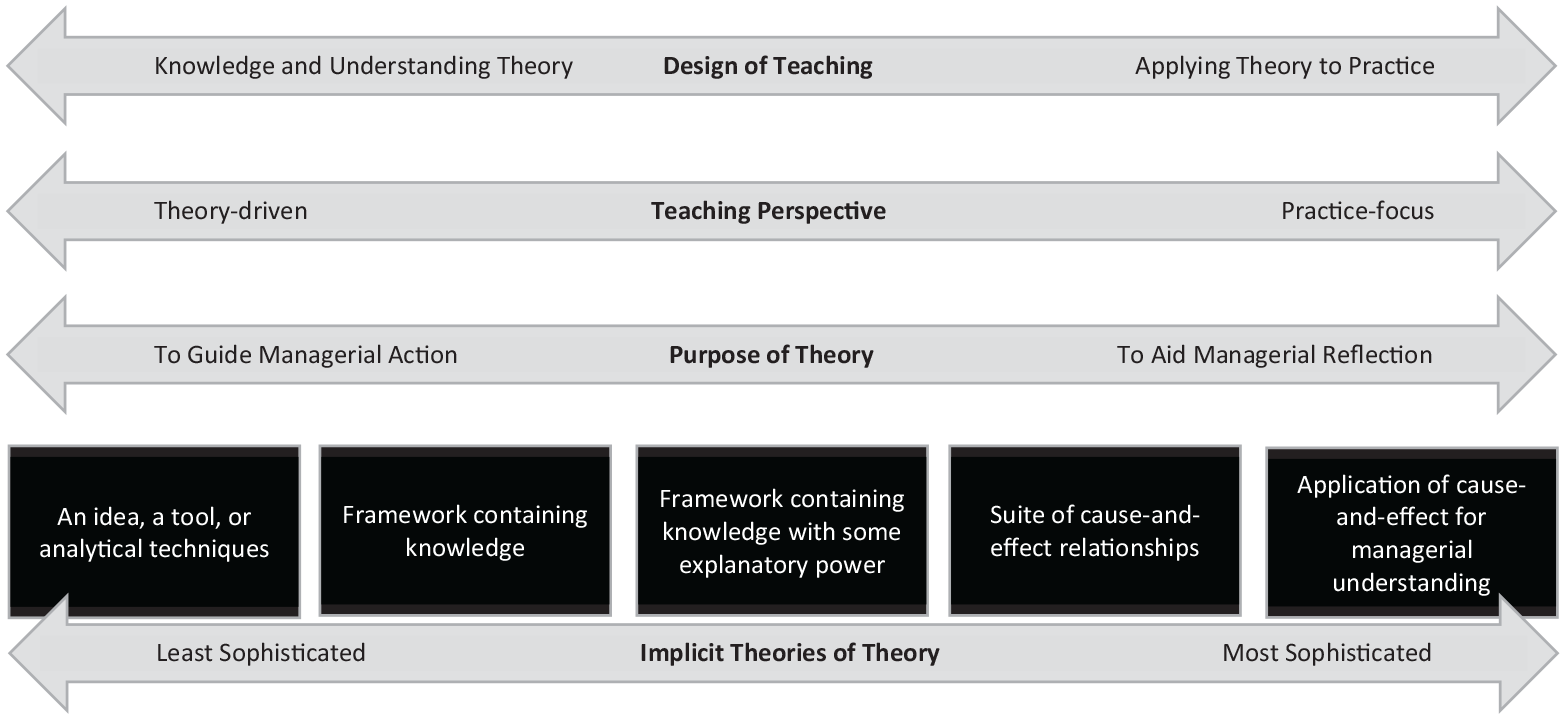
Graphical depiction of the relationship of different implicit theories of theory to teaching and application.
These findings demonstrate that while management educators adhere to theory as their primary means to teach, there is considerable variation in the ways they conceptualise this fundamental component of their jobs. For some, teaching is about fuelling their students with tools and techniques that lead directly to managerial action. For others, teaching is an intellectual exercise where theory is used to analyse and understand managerial situations. And yet for others, teaching is about informed critique. Hence, the differences in the way management academics define theory does more than demonstrate that there is no shared understanding of the nature of theory; these differences lead to variation in the way students experience their management studies. As a consequence, when discussing the application of theory, this study has shown that neither the ‘theory’ element nor the ‘application’ element is understood commonly.
Moreover, when thinking about the application of theory, this study has shown that the interaction of theory and application is highly contested. The participants in this study almost all recognised both the theory and application elements of their teaching. However, there were considerably different conceptualisations of this process. Some saw theory as providing clear guidance for managerial action, and the managerial context was merely the environment in which these actions take place. Others saw theory and application interacting, which carried through to the classroom where theory and its application were conceptualised sequentially. These two approaches ‘push’ theory to the applied situation. A third approach, albeit a minority one, begins with the organisational environment and ‘pulls’ relevant theory from the ‘classroom’.
Underpinning the choice of approach is where the management educators stand on the essentialist–non-essentialist debate (Billsberry et al., 2019). Do they view theory as objective knowledge about management to be applied to managerial situations (the essentialist approach) or do they regard the nature of management as largely unknown and unknowable (the non-essentialist approach)? Those adopting an essentialist approach regard theory as the essential truths to be taught to managers. This approach represents the mainstream approach to management education and the justification for much management research: scholars do research on management to find out how things work and then translate this into theory that can be applied or pushed into the workplace.
In contrast, non-essentialist management scholars (e.g. Billsberry et al., 2019; Grint, 2005) draw on interpretivist analysis to argue that management is socially constructed and, as such, it not only means different things to different people, but also will mean different things in every situation. The consequence of this approach is that it reverses the traditional dynamic of the classroom. Instead of the ‘sage on the stage’ imparting accepted management theory to the students, the students, their concerns and the issues in the environments they inhabit, especially when they are working postgraduate students, become the driver of management learning. This approach to learning where students are, at least, equal partners in the design of their learning is embodied in the andragogic approach to management education (Forrest and Peterson, 2006; Knowles, 1980). Here, the idea is that ‘unlike children, adult learners are not defined by their roles as students but rather by the various identities they must use to live their lives’ (Forrest and Peterson, 2006: 116).
The non-essentialist approach is also emerging in the research conducted by management scholars with calls for high-impact research that tackle the ills of the world (e.g. Biggart, 2016; Mitev and Venters, 2009; Simsek et al., 2018) and calls for research grounded in the phenomena of management practice (Ployhart and Bartunek, 2019). Although they were relatively few in number, it is interesting that the management educators in this study with the most sophisticated definitions of theory were the ones most likely to align with this non-essentialist perspective. Perhaps, a greater understanding of the nature of theory leads to a critical appreciation of the limits of what theory can achieve, or perhaps, people with particular perspectives are differently motivated in their study of the nature of theory, or perhaps, greater engagement with theory puts management educators in closer contact with the realities of the workplace (Paton et al., 2014). Might more focus on the teaching of the nature of theory be a backdoor to greater application? Might it move us towards higher impact research? And might it lead us towards management teaching and management research grounded in the concerns of managers? Answers to such questions could move management education from its advocacy of its self-determined, self-generated and self-important theory to a more applied approach desired by students, managers and organisations (Astley and Zammuto, 1992; Mintzberg, 2004; Pfeffer and Fong, 2002).
Despite the variations in the way that the management educators defined theory, it was noticeable that almost all of their definitions could be easily plotted somewhere on a scale of explanatory theorising (Cornelissen et al., 2021). The ‘fundamental premise of explanatory forms of theorising is that theory is used to identify and establish the fundamental processes and structures that “underlie” and therefore explain a given topic’ (Cornelissen et al., 2021: 6). The participants in this study talked about theory in terms of empirically generated ideas, models, frameworks, causes and effects. These definitions offered a deterministic perspective (i.e. things happen for a reason and these can be theorised and applied to other similar events) and there seemed to be an underlying assumption that theories represent considered and momentous thinking. Just occasionally, there was a reference to the sort of ideas that Ilyenkov, Davydov and Engeström discussed and the notion that educators should experience the wild, should not accept the seductiveness of context-free abstract theory and should not think that theories are complete explanations. But, it seems that if alternative approaches to theory are to gain traction, there are strong institutionalised barriers to be overcome.
Another theme emerging from this study is that while the interviewees may vary on how they conceive the application of theory, they all saw theory as somehow contributing to managerial practice. This might be for future use as is typically the case with undergraduate students or immediate use with many postgraduate students. With this applied edge, theory is being used for managerial intervention whether it is introducing a course of action, an analytical framework, or for critical reflection. In all cases, managers and prospective managers are taught theory to help them make changes in the workplace. They may be acting through intermediaries, but their purpose is to influence the workplace with their theories. The management theory delivered in the classroom is intended to be interventional. Given that there are likely to be real implications associated with such application, it would seem paramount that management educators train their students in how to apply theory, which would include handling sensitivities, managing the politics of intervention, anticipating issues and setting up remedies. The management educators we interviewed described haphazard approaches in the ways they teach students how to apply theory and none spoke about these sorts of issues. Moreover, interventional teaching like this would surely have an ethical component. If a management scholar wanted to run a research project influencing something in an organisation that could have ramifications for employees and business, there would be quite heavy-duty ethics procedures to navigate. How is the theoretically driven applied teaching described by our interviewees any different?
Limitations
One of the limitations of the phenomenographic approach is that it rarely allows the researcher to break down the data into categories, such as gender, age or other foci because the sample size for each category decays to a level where there is little confidence that saturation has been achieved. Many, perhaps most, phenomenographic studies have been conducted with between 20 and 30 participants (Åkerlind, 2005; Bowden, 2005; Marton and Booth, 1997; Tight, 2016; Trigwell, 2000). Although this will seem a low number to many, it works because the researcher’s goal is the study of relationships between the various responses. When viewed in this way, with 27 participants there are notionally 351 binary combinations to consider and many more when permutations of three or more participants are compared. When, say, there are 18 women in one group and nine men in the other, as in this study, the numbers drop away and there is little confidence in the validity of each group. Hence, while this study allows for conclusions to be made for management educators in general, it is unable to comment on any subdivisions. Interestingly, the participants made comments suggesting that some of these subdivisions were important prompting the need for further research in these areas.
First, discipline-specific effects. This study employed a broad range of management educators in the disciplines of management education and development, organisation and management theory, organisation development and change, organisational behaviour and strategic management. As we were adopting a phenomenographic approach, although we could draw conclusions for management education generally, it was not possible to explore discipline-specific effects. It might be that some subjects, such as organisation theory with its critical management studies orientation, naturally require a more questioning approach in which the application of theory is central. Future studies should focus on particular disciplines to see if the general findings hold and how they might vary by discipline.
The second subdivision that we could not analyse with sufficient confidence was whether management educators’ approach to theory application differed depending on whether they were teaching undergraduate or postgraduate students. We asked directly about this subdivision, but needed a larger sample size for sufficiency in each category. The responses we gathered suggest that the type of student makes a big difference in the way that management educators apply theory. For example, It’s very different about whether you’re talking about undergraduates or graduate students so [. . .] With undergrads [. . .] you know, to be honest, if they could make any sense at all of any idea it was like – hurrah! – because most of them couldn’t write English [. . .] But if I’m teaching postgraduates or experienced people, [. . .] my teaching is really of a critical perspective. (#11) If we’re talking about undergraduates as opposed to postgraduates, I would expect the students to be able to consolidate their understanding, [. . .] For postgraduates, [. . .] I think there is a big difference [. . .] because many of them when you’re talking about organizational culture they understand [. . .] So, I would expect the students to perhaps go away back into their organisations and maybe look at things differently. Maybe trying out things differently based on anything we’ve talked about. (#1)
Of the 19 participants who teach both undergraduate and postgraduate students, only three said they did not change their application of theory across the levels and two of those said they might change their approach depending on the age and maturity of the students. Future studies should explore differences between under- and postgraduate management teaching, and, within postgraduate management teaching, it should separate out whether teaching students with and without managerial experience makes a difference to the design of teaching as well.
Conclusion
This study showed that the way management educators define theory shapes the way they design their teaching. In particular, those defining theory least sophisticatedly tended to teach from a theoretical perspective and saw theory as providing guidance for managerial action. Those with the most sophisticated definitions are the ones most likely to teach from a practice perspective and used theory to highlight different viewpoints and for critique. Although all the interviewees viewed theory as having an interventional purpose in shaping or changing managerial action in some way, management educators were haphazard in the ways they taught students to apply theory, if they did it at all.
