







Abstract
The negative impacts of grades on students’ approach to learning and well-being have renewed the interest in gradeless learning in higher education, with the current literature focusing on the positive outcomes for students, including the advancement of student learning, reduced stress, increased motivation, and enhanced performance. While the idea of freeing students from the weight of grades sounds promising, grades are so integral to the educational system that the effects of learning without grades may not provide the relief intended. In this article, we present a qualitative case study of how business and management students experienced having gradeless learning in their first year of an undergraduate program. Our data show that students felt true ambivalence about learning without grades. Although gradeless learning was associated with less pressure, higher motivation, and a more collaborative approach to learning, it also engendered feelings of identity loss and uncertainty among students about their own performance and future opportunities. Our study contributes to previous studies on the impact of grades by revealing the ambivalence experienced by students when learning without the well-known metric of grades in a performance culture. Moreover, it provides new empirical insights into how business and management students experience gradeless learning.
Introduction
Recent research in higher education has shown that some changes in university cultures have caused increasing mental health and well-being issues among faculty at large (Jones, 2018; Ruth et al., 2018). The growing weight put on metrics-based performance indicators, including publication targets and productivity measures, has been a predominant theme of such research. This shifting focus on metrics has impacted the university as an institution (Tourish et al., 2017), collegial relationships, and workplace cultures (Kallio et al., 2016; Parker, 2014) alike, as well as individual academics who may feel some insecurity about their identity (Bristow et al., 2017; Knights and Clarke, 2014; Ratle et al., 2020). While researchers have increasingly focused on academics’ well-recognized experience with the “target and terrors” of performance management (Jones et al., 2020), some have also explored how an emphasis on performance impacts the well-being and mental health of students (Wass et al., 2020). Studies show that students find higher education highly stressful (Bore et al., 2016), and various interventions have been aimed at alleviating this stress, including well-being courses and programs (Stallman, 2011), offers of mindfulness and yoga classes (Regehr et al., 2013), an array of counseling options (Panda et al., 2015; Shearer et al., 2016), and the facilitation of peer support (Byrom, 2018).
However, less attention has been focused on the well-established and often taken-for-granted metric of higher education: grades (Beatty, 2004; Kohn, 1993). Although educators (and students) often assume a strong correlation between grades and student motivation (Dobrow et al., 2011), grading student performance has come under increasing fire for lowering intrinsic motivation (Deci et al., 2001; Kohn, 1993). Grading is further criticized for shifting students’ focus to performance instead of learning (Dweck, 1986; Lynch and Hennessy, 2017), fostering unhealthy competition (Tannock, 2017), inducing stress and anxiety (Chamberlin et al., 2018), and causing much attention and energy to go into memorization and surface learning at the expense of deep learning (Dobrow et al., 2011).
This may be even more pronounced in business and management education, as students are found to be more instrumental and career-oriented (Rynes et al., 2003; Sutherland et al., 2018), more self-interested (Arieli et al., 2016; Wang et al., 2011) and less focused on learning than on attaining a good degree (Ottewill, 2003). Indeed, grades may make it more difficult to achieve the desired learning outcomes in the context of business and management education, not least when teaching transformative skills, for example, critical reflexivity, based on dialogue, collaboration, and interaction (Dyer and Hurd, 2016; Hibbert and Cunliffe, 2015; Walker et al., 2019). The potential negative impacts of grading on students’ well-being and learning have spurred renewed interest in alternatives, such as pass/fail systems and narrative evaluations, often referred to as “gradeless learning” (Golding, 2019; McMorran and Ragupathi, 2020)—a term we adopt in this article to refer to learning that is not linked to numerical or letter-based grading. Studies of such alternatives have yielded generally positive results, showing that they can ease stress and foster a more collaborative approach to learning (see, for example, Bloodgood et al., 2009; McMorran and Ragupathi, 2020; Rohe et al., 2006) as well as result in deep learning and reflection (Altahawi et al., 2012; Dahlgren et al., 2009; Danielewicz and Elbow, 2009). However, these studies usually focus on measuring the general effects of gradeless learning on stress level, learning approach, student motivation, and performance while dedicating less attention to capturing students’ experiences and possible challenges regarding participating in gradeless learning (for exceptions, see Altahawi et al., 2012; McMorran et al., 2017). Particularly overlooked is how abandoning grades might negatively affect students’ sense of who they are becoming. We address this gap by focusing on students’ experiences of gradeless learning. Inspired by phenomenology, we approach experience as events, specific moments, or states in a person’s life while still appreciating the richness and complexity of experience embedded in context (Moustakas, 1994). Our aim is to provide a more nuanced picture of the positive and negative effects of participating in gradeless learning and extend this discussion to business and management learning. The following question has guided our research: How do business and management students experience learning without grades and how does this experience impact students’ transition to university?
To answer this question, we conducted a case study at a large Danish business school, investigating how first-year students experienced gradeless learning in a mid-sized undergraduate program (n = 160) where pass/fail assessments and feedback had replaced all grades. We specifically chose to study gradeless learning in students’ first year of study as we were interested in how gradeless learning might ease the process of transitioning into university and because prior literature has indicated that exposure to competency-based assessment in the first years of university can shape students approach to learning later in their studies (Altahawi et al., 2012; McMorran et al., 2017; Rohe et al., 2006).
Given that higher education students are deeply enculturated to receive grades throughout their secondary school education, our findings show that students experience both emancipatory and constraining effects when not receiving grades. To explain these simultaneously positive and negative orientations to gradeless learning, in our analysis, we engage with the notion of ambivalence (Baek, 2010; Harrist, 2006; Rothman et al., 2017), a perspective, to our knowledge, not previously applied to studies of gradeless learning. However, such a perspective offers fertile ground on which to study how gradeless learning influences students’ ability both to cope with feelings of confusion, contradiction, and self-doubt and to catalyze engagement and reflexivity in the process of becoming university students. We argue that studying the implications of gradeless learning in a business school setting is especially interesting, as such students have been found to be more goal-oriented or have higher levels of instrumental rationality than the average university student (Ottewill, 2003; Rynes and Trank, 1999; Sutherland et al., 2018) and, therefore, may experience even greater ambivalence when no grades are given.
This study contributes to the understanding of assessment in business and management education by giving voice to students’ reflections and emotions when participating in gradeless leaning and provides novel empirical insights on their mixed emotions toward this scheme. On the one hand, they feel relief from the pressures of performance measurement while at the same time feeling the unease of not having grades to rely on as a constituting aspect of what it means to be a student in business and management education today. This counterbalancing of emancipating and constraining effects of gradeless learning, we conceive of as a “gradeless paradox.”
The article is structured as follows. We first provide an overview of the literature on grades and gradeless learning followed by a presentation of the theoretical concept of ambivalence in transition into university. We then present the methodology and our findings before discussing students’ ambivalent orientations to gradeless learning. Finally, we offer some implications for practice and suggestions for future research.
Grades and gradeless learning
Often used to incentivize students’ interest and motivation, grades are so integral to education that a gradeless way of learning is hard to imagine (Beatty, 2004; Kohn, 1993). However, the use of grades is also criticized for decreasing students’ intrinsic motivation (Deci et al., 2001) and for causing students to put more weight on performance than learning (Dobrow et al., 2011; Dweck, 1986), a double-edged sword that Dobrow et al. (2011) have called “the grading paradox.” Beatty (2004) argues that, taken to the extreme, the economic metaphors underlying grades (averages, inflation, competition, and failure) objectify education and reinforces an instrumental focus on grades as the outcome of learning, an emphasis rather detached from the idea that grades motivate students to engage in learning. When students perceive grades as the primary outcome of education, they pursue performance, not learning goals. When it comes to collaboration, this pursuit can adversely impact outcomes for the learning environment (Hayek et al., 2015) and demotivate individuals who fail to obtain good grades (Beatty, 2004). To avoid such negative consequences, some scholars have advocated for abandoning grades entirely (Kohn, 1993; Tannock, 2017), while others have experimented with less drastic alternatives, for example, introducing one or two gradeless courses or a gradeless first semester (see, for example, McMorran et al., 2017; White and Fantone, 2010).
Prior studies have demonstrated that grades negatively affect the emotional state of students, as they come under mounting pressure to perform according to pre-defined standards, a situation that appears to engender higher levels of stress and anxiety and reduce well-being. Studying an institution-wide gradeless first semester, McMorran et al. (2017) and McMorran and Ragupathi (2020) found that students clearly experienced less stress when not being graded. Bloodgood et al. (2009) and Rohe et al. (2006) also reported greater well-being, including reduced stress, and Spring et al. (2011) concluded that enhanced student well-being compensated for a slight drop in academic performance. Gradeless learning literature also emphasizes how students may approach learning differently in a gradeless setting that promotes a deeper understanding of content. This is, for example, the case in Danielewicz and Elbow (2009) who introduced contract grading in their classroom as a means of guiding students’ study approach toward the process of learning. In contract grading, students earn a grade, for example, B, by completing specified course activities and not based on the quality of their exam performance. They found that students took more control of the learning process and became more reflexive about feedback when it was decoupled from their grades. This finding is echoed by Dahlgren et al. (2009) and Altahawi et al. (2012), both of whom reported that gradeless systems catalyzed deep learning through reflexive behaviors. Finally, McMorran et al. (2017) found that gradeless learning helped students to become less risk-averse and to gain the courage to take courses outside their immediate comfort zones.
Gradeless learning has also been associated with increased motivation and interest. Comparing academic motivation between institutions with different grading systems, Chamberlin et al. (2018) found that metric-based grading decreased academic motivation while also raising students’ anxiety, thus resulting in risk avoidance. Narrative evaluation as an alternative was found to support autonomy, competence, and relatedness. Other studies have similarly found that pass/fail assessments and narrative evaluation heighten academic motivation (Bloodgood et al., 2009) and motivate collaboration (White and Fantone, 2010). Focusing specifically on the first year of university, McMorran et al. (2017) reported that a gradeless system enabled a smoother transition to university, helping students develop “a love of learning” (p. 362). A final theme in the gradeless learning literature is the relationship between academic performance and learning without grades. In this case, though, how the absence of grades impacts academic performance is less clear. Although Spring et al. (2011) found that psychology students receiving pass/fail results performed more poorly than those graded on a scale, other studies, such as Rohe et al. (2006) and White and Fantone (2010), reported no significant difference.
Studies on gradeless learning usually focus on measuring overall effects on stress level, learning approach, student motivation, and performance while dedicating relatively less attention to students’ experiences and possible challenges regarding participating in gradeless learning. However, gradeless learning may introduce new challenges, and abandoning grades altogether might affect students’ development and their sense of who they are becoming. To explore these aspects, we focus on the role of ambivalence in the transition to becoming a university student.
Student ambivalence in the transition to university
Scholars have scrutinized how institutions, faculty, and staff can support students’ transition to existing institutionalized structures (Erickson et al., 2010; Thompson and Brownlee, 2013; Wilcox et al., 2005), identifying some important “transition pedagogies” for delivering an integrated and holistic first-year experience (Kift et al., 2010). According to Gale and Parker (2014), however, such transition strategies primarily serve the institution and existing system, which implicitly view transition as a process of either induction or development and, therefore, focus on how they can support students in adapting their beliefs about learning and knowledge to the established system (Brownlee et al., 2009). Alternatively, Gale and Parker (2014) view student transition as “becoming,” arguing that there is no singular way of addressing student transition. Students are a heterogeneous group who navigate a complex reality where the line between the private and the public spheres is blurred. Student transition may therefore significantly trigger an intense process of identity work (Hawkins and Edwards, 2015) as students struggle to create, present, and sustain their personal identities so that they are congruent with their self-concept (Snow and Anderson, 1987: 1348). Understanding student transition as becoming accentuates how higher education needs to accommodate students’ various needs, and not just help fit them into existing system structures. The notion of becoming has two important implications for our theorization. First, we suggest that the study of student transition to university especially when learning without the well-known metric of grades should capture students’ experiences and the possible challenges of participating in gradeless learning because this may impact their becoming. Second, we suggest that the ambivalence of students engaged in this transition may intensify as they seek to cope with feelings of confusion, contradiction, and self-doubt (Hawkins and Edwards, 2015).
In the past decade, the widely experienced phenomenon of ambivalence has developed into an attractive area of study (Baek, 2010; Harrist, 2006; Rothman et al., 2017). While ambivalence held a prominent place in the theories of Freud (Holder, 1975), referring to feelings of love and hate directed at the same object, scholars today have broadened the definition to emphasize how opposing attitudes or feelings toward an object, event, idea, or person (Ashforth et al., 2014; Rothman et al., 2017) can exist simultaneously and thus make people feel torn between them. Ambivalence is often conceptualized as the co-activation of “positive” and “negative” feelings or attitudes (Priester and Petty, 2001). Others, however, underline a broader definition, acknowledging that ambivalence may arise from the simultaneous experience of two negative emotions that differ in their behavioral guidance (Rothman et al., 2017; Rothman and Wiesenfeld, 2007). These scholars therefore emphasize that ambivalence should be defined as the simultaneous experience of opposing orientations to an object or target, not necessarily confined to “positive” and “negative” ones. For the purpose of this article, we adopt this latter definition of ambivalence. On a similar note, ambivalence is distinct from constructs such as dissonance and ambiguity in that it specifically concerns opposing forces that lead to conflicting evaluations of an object or target and not simply to discrepancies or inconsistencies.
The discipline of psychology has long been concerned with ambivalence, for example in mental health problems, where it may manifest in chronic ambivalence and splitting (e.g. Akhtar and Byrne, 1983; Braverman, 1987). Today, however, ambivalence is also studied as a common experience in everyday life that may arise in both mundane and dramatic, emotionally intense situations (Ersner-Hershfield et al., 2008; Larsen et al., 2001; Larsen and McGraw, 2011; Laurenceau et al., 2005).
Sources of ambivalence are often related to relationships, situations and events, and structural conditions (Rothman et al., 2017). Relationships that trigger ambivalence include parent–child relationships and other relationships across multiple domains of life and work. Ambivalence can also spring from events and situations, particularly where change is involved, as it can provoke conflicting emotions of, say, excitement and fear (Vince and Broussine, 1996) as well as hope and uncertainty. In relation to our specific case study, psychological research has shown that personal transition events can give rise to ambivalence (Ersner-Hershfield et al., 2008; Larsen et al., 2001), with individuals feeling a mixture of happiness and sadness as they face meaningful endings. Structural conditions that engender ambivalence can be conflicting demands inherent in the social structures on which, for example, norms, ideologies, and roles are built (Merton, 1976).
Seeking to provide a more nuanced understanding of gradeless learning, we analyze how students experience their first year of a degree program. The transition to university is an intense experience, rife with pressure, tensions, and opportunities for development. The notion of ambivalence can help us understand the complex, affective, and non-rational aspects of student behavior and experience thus far overlooked or underemphasized in the predominant literature about gradeless learning. Accordingly, we use ambivalence as a theoretical concept for exploring the multifaceted experiences within the same individuals, specifically their simultaneous experience of opposing attitudes or feelings about gradeless learning and the internal conflict this gives rise to.
Methods
We collected the primary data from individual and group interviews to gain an in-depth understanding of the experiences and potential challenges students face when exposed to gradeless learning. Our study follows two consecutive cohorts admitted in 2018 and 2019. We, respectively, refer to them as the classes of 2021 and 2022, based on their expected years of graduation.
Setting and study population
Our study follows an undergraduate business and psychology program where gradeless learning and assessment have been implemented for the first year of study. The program annually admits between 150 and 160 students, whose average age is 21.5 years, with 71%–76% being female. The admission grade point average (GPA) is 2 points above the university average on a 7-point scale, which classifies these students as high achievers. The program’s first year is dedicated to curricula in economics (microeconomics, behavioral economics, and accounting), psychology (personality, cognitive, and social psychology), organization theory, and quantitative methods. Besides attending lectures and tutorials, students work in small groups of 4–5, which are shuffled twice during the first year.
Reports of rising stress levels and a more hostile, competitive environment prompted the study board to implement a gradeless first year. The initiative was initiated by student representatives, and the aim was to emphasize learning over performance, thereby also reducing stress and increasing student well-being. Once institutional support had been granted, the program’s management collaborated with a pedagogical consultant to design an intervention, slated to start in fall 2018, in which all first-year grades would be substituted with pass/fail assessments and written and oral feedback from educators and student peers. All educators were invited to workshops on how to give students feedback and to hold gradeless exams, and regular meetings were held with educators to discuss challenges and ensure the removal of administrative obstacles. To provide solid ground for evaluation of the gradeless initiative three researchers—the authors, followed the initiative closely with the second author also more directly involved as part of the teaching team.
Sample and data collection
The first and second authors collected qualitative data by conducting semi-structured interviews, individually and in groups. Student participants were recruited via an e-mail sent to all incoming students and all students who replied were included in the sample. All participants were of Danish nationality. Eight students from each class participated in two interviews, held at the end of the first semester in December (wave 1) and at the end of the second semester in June (wave 2). We additionally conducted two group interviews with five different students in each group from the class of 2021. The group interviews were added to gain additional insights on the dynamics of the experiences and were only conducted for the class of 2021 due to COVID-19 restrictions for class of 2022. Table 1 provides a breakdown of the 26 interviewees, 16 of which were students interviewed individually and 10 interviewed in groups.
Interviews and interviewees’ characteristics.
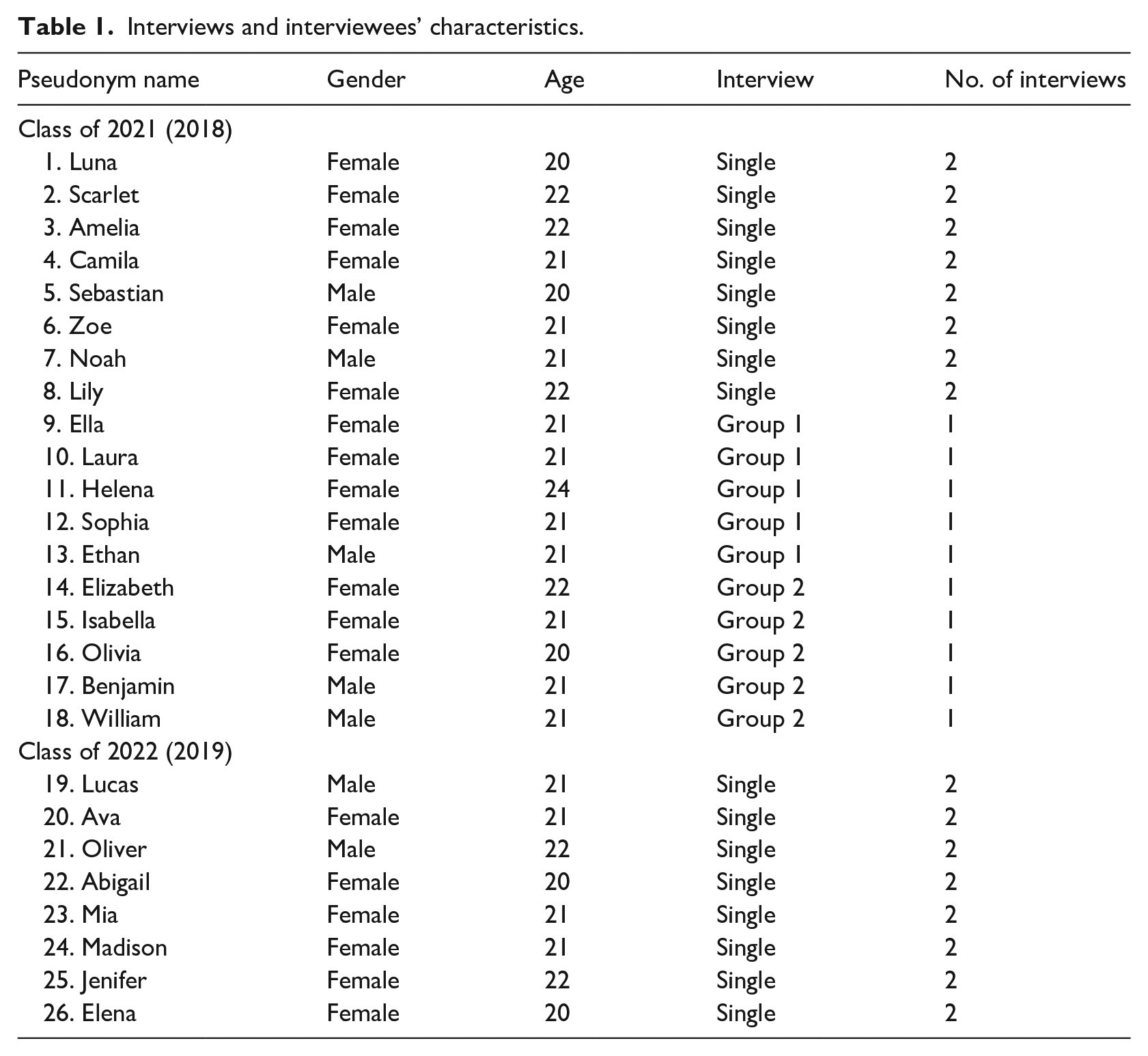
To give students an opportunity to voice their experiences of gradeless learning, we asked participants to compare their experiences being graded in secondary school with their current experience of gradeless learning. The first wave of interviews addressed what had motivated students to study business and psychology, their expectations for a first university year without grades, previous experiences with grades, and specific experiences with gradeless learning activities during the first semester. The second wave of interviews focused on students’ experiences throughout the year, particularly in regard to study strategies, their classes’ study environment, and the learning and assessment activities in various course elements. We invited students to give specific examples describing situations where they perceived that the gradeless program had influenced their learning experience. Several of these conversations turned into reflexive accounts and thereby important learning experiences for students. The second wave of interviews built on the first by capitalizing on themes that emerged during our analysis, and by following up on these specific topics. We asked similar questions in the group interviews, although here we were especially interested in how the students discussed their experiences of the gradeless program among themselves. Interviews lasted from 45 to 90 minutes. All were audio-taped with permission and transcribed verbatim. The interview transcripts generated over 850 pages of single-spaced text, and we used the software program NVivo 11 to inductively code and organize all interview data.
Data analysis
Using thematic analysis (Braun and Clarke, 2006), we analyzed the interview data and searched for patterns to identify themes regarding how students experienced studying without grades. Our data analysis followed an iterative process by which we moved between our emerging understanding of the data and theoretical ideas from the literature (Charmaz, 2006; Miles and Huberman, 1994). We analyzed the interview data in two phases: the first took place following each wave of data collection, and the second once data collection was complete.
After each wave of data collection, the first and second authors engaged in analysis by jointly conducting close readings of interview transcripts during Phase 1. Inductive coding (Braun and Clarke, 2006) was used to find and group related statements into first-order codes, and to tentatively group related codes into second-order categories. We did not develop any specific hypotheses about gradeless learning systems before engaging in the coding process, and this first phase was highly iterative with many rounds of grouping and regrouping codes. For example, statements about feeling “less pressure” and “surplus energy,” and “being able to breathe” and “taking one thing at a time” kept recurring in relation to how students felt they were “getting through the first semester as whole human beings” because the gradeless program gave them “time to learn to become learners.” These codes coalesced as features of the broader second-order category of “well-being associated with starting at university.” While coding the data, we consulted previous literature on gradeless learning. For example, we coded students’ accounts of how they experienced “less peer competition” and were “more willing to help each other” in the gradeless learning environment while studying existing research about grades, competition, and collaboration (Dobrow et al., 2011; Hayek et al., 2015; White and Fantone, 2010) and similar studies on a shift to pass/fail assessment at medical schools (Bloodgood et al., 2009; McMorran et al., 2017). This informed the second-order category of “collaborative learning.” On completing the first phase for both waves of data collection, we had coded all interview transcripts with first-order codes, of which those relating to gradeless learning were sorted into well-developed and recurring second-order categories.
In the second phase of data analysis, we changed to a more theoretical thematic analysis (Hayes, 1997) combining inductive and deductive thinking. The literature on gradeless learning helped us understand the positive impacts of the gradeless program on student learning and well-being, but we noticed that the data included intangible dimensions relating specifically to the significance of grades, which had not been captured in past theoretical frameworks. Why did students praise the gradeless program for reducing pressure and stress, but then claim that learning without grades made them anxious about their level of academic achievement? Why did they talk so positively about the strong group cohesion and collaborative learning approach fostered by the gradeless program while also criticizing the fact that, without grades, others could not determine the quality of their achievements and hence their position in the social hierarchy? Moreover, despite the numerous student accounts about the harmful impacts of grades in terms of stress and competitiveness, why did they continue to view grades as core signifiers of who they were—straight-A students, for example?
To better understand the apparently more complex and ambiguous significance of grades, in the second phase of the data analysis, we conducted an ambivalence reading (Harrist, 2006; Rothman et al., 2017) of the data to uncover how gradeless learning not only had emancipatory effects but also appeared to foster personal, and even existential, difficulties for students—difficulties that seemed counterproductive to the overall goal of the intervention. Our analytical process therefore became increasingly focused on the role grades play in students’ learning and academic development, and we developed a more critical approach to exploring both the promises and challenges of substituting grades with pass/fail assessment and feedback. Table 2 presents our coding structure and some excerpts from the data, showing the different levels of abstraction from first-order codes and second-order categories to the three aggregate themes of “relief for now and anxiety for the future,” “intrinsically motivated while disengaged from learning,” and “feeling part of a community but lamenting individual identity loss.”
Data structure for key themes.
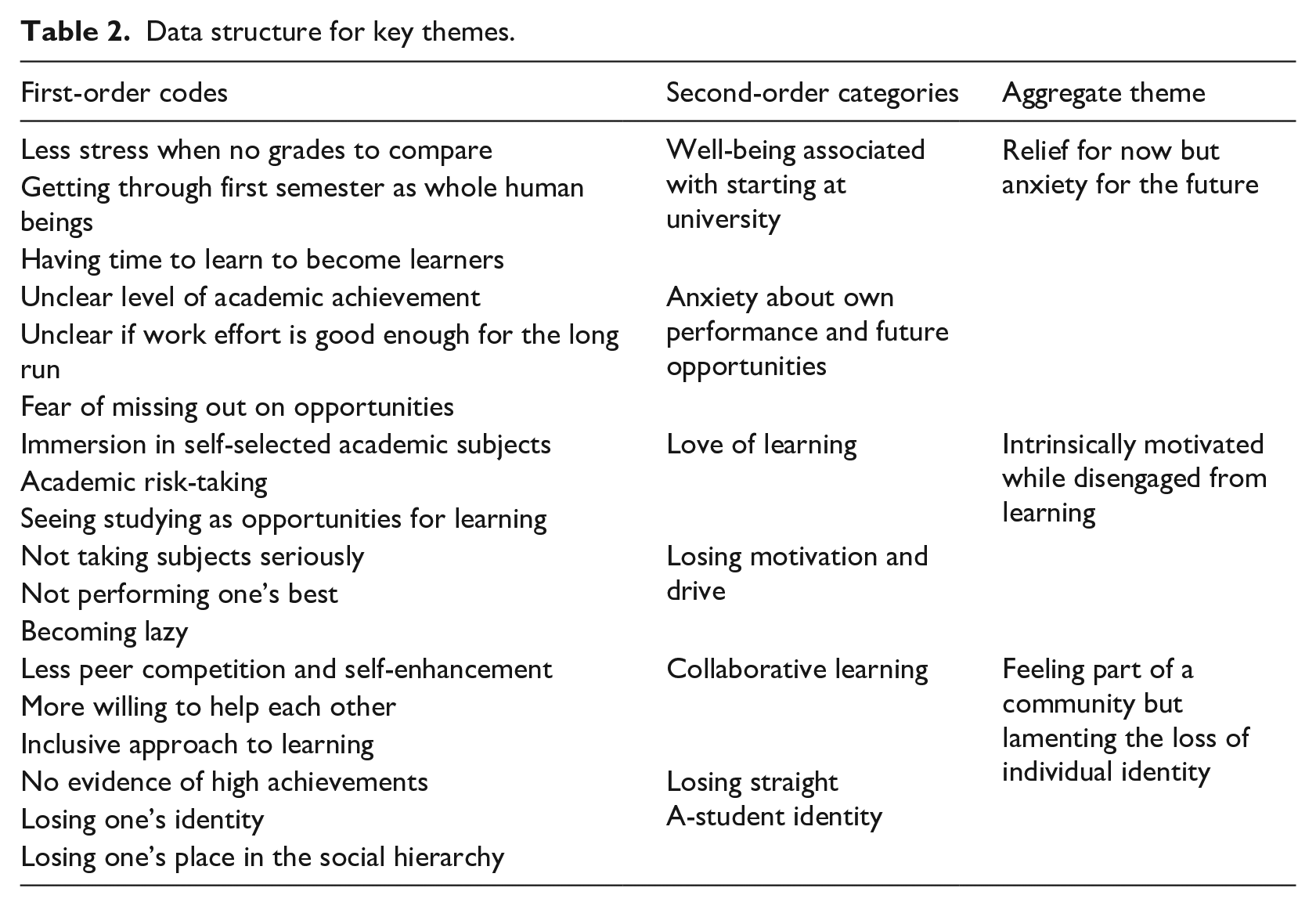
Findings
The findings are structured around students’ simultaneous experience of opposing orientations to gradeless learning, as illustrated by three prominent cases of ambivalence: (a) relief for now and anxiety for the future, (b) intrinsically motivated while disengaged from learning, and (c) feeling part of a community but lamenting loss of individual identity.
Relief for now but anxiety for the future
Students felt relieved that there were no grades but were also anxious when trying to assess their own performance. Like all participating students, Amelia was a high achiever in high school. However, she felt that grades and being graded created a stressful learning environment of mutual and constant comparison among students. Although acknowledging that this dynamic drove her to do her best, she found it extremely exhausting in the long run. She was therefore relieved to learn that pass/fail assessment and feedback would replace all grades in the first year of the business and psychology program: “For me, it was a huge relief that I didn’t have to worry about grades. It felt like a big weight was taken off my shoulders. It was wildly emancipating” (Amelia). Like others, Amelia perceived the gradeless program as a psychological free space, emphasizing that this had got her through the first semester feeling like a whole human being.
However, learning without grades also caused Amelia a great deal of anxiety about whether her academic performance was “good enough.” Like other students, she habitually relied on grades not only to motivate her learning, but also to assess her current level of academic achievement. She felt anxious about whether her current work effort would allow her to perform well later in her studies. Would she gain the necessary proficiency during the first year to get high grades in the second? Amelia said, For now, it feels good that I don’t have to pressure myself to study all the time, but what if I pass all subjects in the first year, but then only get Cs and Ds in the second year? So, I worry that it’s not good in the long run.
Amelia feared that the comforting sense of relief she felt during the first year would morph into ineptitude and stress in the second year. Abigail shared a similar story. She explained that the gradeless program had helped her adjust to university life because she had time to learn without the usual worry and stress over grades. As she transitioned to university, she felt that the gradeless learning environment allowed her to experiment with different study techniques: It’s nice not to feel super pressured as a first-year student. I feel there’s a breathing space to say to myself, “well this study approach certainly didn’t work, so I need to read that chapter again,” right?
Abigail felt that being free of worries about grades enabled her to cope with the turbulence that comes with starting at university, which for her meant settling in a new city as well as into her various courses and their content. She therefore saw the gradeless learning environment as a great relief and much less stressful than her high school experience. At the same time, however, Abigail felt anxious that without grades as an indicator, it was difficult to assess whether she was learning what she needed to. She explained that in her perception the grading system accurately reflected her learning progress, so she relied on grades to provide paramount and easy-to-understand information about her academic level and learning in a way that pass/fail, and even detailed feedback, could not. She said: “It’s a habit to use grades to measure progress, but it worries me a lot that I can’t detect any progress in my learning.” Whereas high grades communicated a job well done, low grades would usually trigger a drive to work harder and do better next time. With only feedback, though, she found it virtually impossible to assess where on the grading scale her performances belonged, which led her to worry whether she was studying and learning enough.
Other students felt the same ambivalence in their orientations to the gradeless program. Jenifer, for example, shared her feelings of being much less stressed when no grades were given: It actually means much less stress when there’s no one to compare with, and you feel neither better nor worse than the others. You feel you’re equal, and that’s good when transitioning into a new environment.
Like others, she also feared that without grades she was not learning enough, and she anticipated several threats to her future identity as regarded admission to her preferred postgraduate program, acceptance by exchange programs to high-ranking universities overseas, and ultimately the job of her dreams: It’s very difficult for me to know if I study enough or if I need to study much more than I do now. We feel a lot of anxiety about whether we can go on exchange, and many of us really want to go. But we feel that we don’t have anything to show for it. Whereas students from other programs have their GPA score, we have a note. (Jenifer)
While students associated gradeless learning with less pressure and more relief in their adjustment to university life, they also felt anxious that not receiving grades would obstruct their future aspirations and dreams. Furthermore, ambivalence toward gradeless learning was visible in the students’ learning orientations.
Intrinsically motivated while disengaging from learning
By learning without grades, students felt highly motivated to immerse themselves in academic subjects, but being assessed with pass/fail and feedback made it difficult to stay engaged and take their studies seriously. Zoe talked about spending hours reading demanding academic texts to understand the thinking and theories behind them. Rather than feel stressed about having to read everything on the syllabi, she prioritized the most important and engaged more deeply with the materials on those topics she found particularly intriguing. She explained, Yesterday I sat down with only this one journal article to read and write comprehensive notes. I wouldn’t have had the same energy to do that if I had been stressing myself with “oh no, you mustn’t get a bad grade.” I’ve always been a perfectionist so it’s actually very nice not to have this idea in my head that I have to perform well and get a top grade. (Zoe)
Easing the pressure, the gradeless program made Zoe feel intrinsically motivated, giving her the energy to engage more deeply with certain subjects. However, Zoe was concerned about failing to engage with some subjects, despite their constituting the program’s core academic disciplines of psychology and economics: I didn’t engage with the personality psychology course. I did not study for any of the lectures. We only had to write a five-page group assignment, which was assessed with pass or fail. Even the professor did not appear engaged in the subjects, so I sort of just came and went as I pleased. (Zoe)
The quote by Zoe alludes to some of the constraining effects students face when they can no longer rely on grades to motivate learning. She further explained that she approached other less popular subjects with equally lax study habits. In microeconomics, for example, she could see that her insufficient engagement with the subject meant that she did not learn its content. She explained that her disengagement from certain subjects and courses happened because the lack of grades led her to take them less seriously. While this casual behavior negatively impacted her learning, it also stressed her out, as it informed her notion of who she became when not taking some academic subjects seriously: a slacker who would be unable to keep up in the second year of study.
In another story, Elena shared how the gradeless learning environment fostered a “love of learning” in her (McMorran et al., 2017). With no grades, she felt that she could enjoy studying all subjects, even the difficult ones where her performance was lower: It makes me happy that I don’t begin university hating those subjects where my performance was low because they have been sullied by a bad grade. I do know something about all the subjects because I passed them, and I got feedback. And that makes me feel elevated. (Elena)
Elena explained that studying in the gradeless program had helped her develop a different, more positive relationship to the subjects, which made her happy because this relationship reminded her why she had decided to study at university in the first place: to learn about different subjects of interest to her. Elena also talked about how the gradeless environment motivated her to take more risks when writing group assignments, as she worried less about being penalized with a low grade. Indeed, she was willing to test new ideas and be more open to other group members’ perspectives, and often ended up writing assignments differently than her usual modus operandi. With the assurance of no low-grade penalties for failures, Elena focused on what she believed would be the best learning opportunity for everyone in the group.
Elena was conscious, though, that she took exams and assignments much more lightly in the gradeless program and that this decreased her motivation to work hard. She said, It never gets really serious with pass and fail. I just read the feedback and think “oh well, that’s nice. Now I know what to do next time.” I feel more carefree and that it’s not the end of the world.
She often felt that the lack of grades meant that groups submitted their assignments without even trying to do the best work possible. She described how, with feedback, going for a good grade made no sense, so she simply saw no point in performing at her best.
Many other students experienced this ambivalence. Benjamin, for example, praised the freedom the program provided to engage thoroughly with the texts and subjects he found intriguing: “I love to engage with subjects that are interesting, reading and discussing them with others.” He admitted that he simultaneously did not seriously engage with course materials he found uninteresting and felt less pressured to prepare properly for certain exams: “Difficult or boring subjects, I sort of ignore. For example, I ignored the economics exam up until the week of the exam, where I realized ‘Oh I’ve got this exam’. I ignored it because no grades were waiting” (Benjamin). While the gradeless program eased the pressure and allowed students to feel intrinsically motivated in their studies, they found it difficult to maintain their motivation to work assiduously in all subjects, thus disengaging from those they found uninteresting or difficult. As we show in the next section, ambivalence toward gradeless learning was also visible in the students’ orientations to the group.
Feeling part of a community but lamenting the loss of individual identity
Students emphasized that learning without grades fostered more collaborative learning approaches, which created a unique sense of belongingness to the class. By not receiving any grades, however, students simultaneously felt the loss of an important part of their individual identity.
Camile was a student who both enjoyed the relief from grades and missed them. She explained that peer competition had characterized the traditional graded learning environment in her high school, where students constantly compared grades. She found that students often relied on grades to define not only their own but also each other’s performance and achievement. This sort of dynamic, she explained, adversely affected the study culture because everyone was focused on self-enhancement as a means of outshining the others: Grades make for a self-centered ego culture because you always want to be a little better than everyone else, so you help only those few individuals who are closest to you. But in the gradeless environment, we’re much more willing to help each other by sharing notes, ideas, and materials. Everyone has the same attitude that we’ve got nothing to lose by helping each other getting through it. (Camile)
Camile felt that not having to compete for grades in the gradeless program made students more willing to help each other, and, like many other students, she enjoyed the supportive study culture and felt a strong sense of belonging to the class.
At the same time, however, she felt that without grades she had lost an important signifier of who she was, because her performances were no longer as visible to others. Camile said, I’ve always liked receiving grades because I’ve always done very well ... so it worries me that I have no grades to show. I can only show that I’ve passed the first year, but what’s it worth and does that say anything about me at all when everyone else is focused on performance and grades.
She further explained that good grades were tangible evidence of a good performance, a pat on the back for working hard and doing well, and therefore gave a rush of endorphins that made her feel good about herself. The gradeless program did not similarly enable her to feel the positive effects of a good performance.
The same ambivalence emerged in Oliver’s story. Oliver talked about how the freedom from grade pressure made him feel free to engage in the learning and well-being of others. He emphasized that caring about each other was good for feeling a sense of belonging to the class and attributed the strong group cohesion to the gradeless environment. He felt that he and his fellow students could focus on each other in more positive ways: I definitely see a shift, because in our study group we focus on making sure that everyone learns the stuff rather than writing the best possible assignment. I really like to win and had we been graded, I would have collaborated only with those in the group who could deliver on writing a top-grade assignment. But the structure with pass/fail assessments makes room for caring about everyone in the group and making sure that we all learn from doing an assignment.
Oliver experienced that this inclusive approach to group work strengthened the group’s cohesion, but he also spoke about losing an essential and valued part of his identity when learning without grades. Without straight-As to define him, he felt in doubt about who he was: We’re used to receiving grades; you get a number, which says everything about how good you are. And that feeds into your understanding of who you are. But when there are no grades some of us tend to think “if I’m not a straight-A student, then what am I? Am I then a ‘just-passed’ student?” It’s a huge challenge not knowing if you’re the best or the second best. They only tell us if what we did was correct. So naturally, we feel deprived of an essential part of our identity.
With no grades to show for outstanding exam performance and assignments, Oliver had no clear sense of how smart he was, which in turn made him feel that he could no longer claim the top spot in the social hierarchy. This loss of his straight-A student identity meant that he also lost confidence in himself.
Other students experienced the same ambivalence between group belonging and individual identity loss. Luna, for example, felt relieved that students in the program did not use grades to measure each other: Nobody wants to be seen as a D. On a bad day a bad grade mirrors how good you are as a human being. But with no grades, we don’t evaluate each other all the time and that’s a huge relief. Instead, we can focus on more positive aspects of studying.
Still, she confessed that she liked receiving good grades because they placed her at the top of the social hierarchy, where she would gain recognition and respect from fellow students: “I always get super-happy when I get an A. It’s the only concrete thing you have that says something about how good you are. And getting the good grades is definitely a way to gain respect.” Still, with no grades to verify her achievements, she felt that her social position became more elusive. The gradeless program therefore both gave students a unique sense of belonging to the class and caused concerns that their high achievements were invisible to others and their identities thus lost.
Sources of ambivalence in student transitions
In this final part of the analysis, we focus on relating our empirical findings on students’ experiences of gradeless learning to the three sources of ambivalence: relationships, situations and events, and structural conditions (Rothman et al., 2017). First, our findings show that the relationships between students act as a source of ambivalence in gradeless learning when students perceive each other as simultaneous competitors and peers. Camile expresses these ambivalent feelings. On the one hand, she misses the gratification and rush of endorphins that receiving a higher grade than her peers creates, but one the other hand, she appreciates not having to compare her performance to others with the risk of not being seen as a high performer (Zou and Ingram, 2013).
Second, the event of transitioning into university acts as another source of ambivalence as the identity work of students intensifies in their process of becoming, and students are not able to rely on experiences from their previous education, including grades. Because identity work is so intense during transitional periods (Hawkins and Edwards, 2015), students constantly look for mechanisms to create a positive identity. This can be a struggle if they cannot rely on known identifiers, which in turn impacts the ultimate potential of gradeless learning. This was expressed by Oliver, who felt doubt about his identity when he did not receive grades to support the construction of himself as a straight-A student. This relates to Raaper’s (2019) point that universities not only provide educational experiences to students, but also “shape students’ subjectivities including their identities, values, and sense of what it means to become citizens of the world” (Raaper, 2019: 2). This subjectification process occurs continuously as students’ identities are negotiated, accepted, and transformed (Lehn-Christiansen, 2011), for which reason the absence of grades as an available metric in the subjectification process leads students to feel a simultaneous sense of loss and relief.
Finally, grades and grading are structural conditions that constitute a third source of ambivalence in our study. Rothman et al. (2017) refer to this source as sociological ambivalence, as it indicates the conflicting demands inherent in organizational conditions, social structures, and collective identities (Ashforth et al., 2014; Wang and Pratt, 2008). While grades are part of the established reward system, students’ orientation to them is ambivalent, as they motivate students to put in extra effort and also stop them from lingering on a single topic—even when necessary for learning. In Zoe’s case, gradeless learning motivated her to spend time on particularly interesting topics but at the same time led her to deprioritize other topics and therefore worry that the exam would include questions she could not answer. In the next section, we discuss our findings.
The gradeless paradox
In this article, we contribute to existing work on gradeless learning (e.g. Bloodgood et al., 2009; McMorran and Ragupathi, 2020) and extend previous studies on grades in business and management education (Beatty, 2004; Dobrow et al., 2011) by revealing the ambivalence experienced by students when learning without the well-known metric of grades. Playing on the grading paradox coined by Dobrow et al. (2011), we refer to this ambivalence as a gradeless paradox. Indeed, gradeless learning aims to ease the transition to becoming university students, and to shift the focus from performance to learning, but this study shows that gradeless learning simultaneously increases students’ stress levels in relation to their sense of self and identity, perhaps even leading to behavioral disengagement. While the discipline of psychology has long studied ambivalence, it has largely considered it a condition to be avoided or resolved, characterizing it as unpleasant and undesirable (Van Harreveld et al., 2008). Research focusing on the psychological experience of ambivalence has showed that feeling torn and conflicted may elicit one-sided, narrow thinking as a way of resolving ambivalence. This may be because holding ambivalent attitudes increases uncertainty-related negative emotions, such as anxiety and doubt, which trigger motivated perceptions of the world as orderly (Van Harreveld et al., 2014).
Our study confirms this research by showing these processes. As students progressed through the first year of the program and their ambivalence toward gradeless learning became stronger, many of them explicitly expressed that they missed grades and looked forward to being graded again on the second year. They appeared to have forgotten the pressure and stress that comes with being graded. Instead, the idea of grades became the means for ordering the complex and paradoxical experience of learning in the gradeless environment. Confirming most psychological research, the outcome of experiencing ambivalence in our study similarly appeared to be primarily negative, with students missing, wanting, and asking for grades after a period of learning without grades. We can only speculate if students would have benefited more from the learning experience, had the full bachelor’s degree been gradeless, as they would then not have been anxious about future grading.
However, more recent examinations of ambivalence in, for example, organizational behavior go beyond the negative consequences of ambivalence and view it as something that can also facilitate positive outcomes (Pratt and Pradies, 2011). Some research suggests that it is possible to make more productive use of ambivalence by embracing it rather than quickly resolving it. For example, Molinsky (2013) showed that in the context of international MBA students, ambivalence was a transitional step that helped students adapt to a new cultural context. The conflict inherent in their ambivalence helped motivating students’ willingness to reconsider past or current interpersonal behavior and incorporate new behavior into their cultural repertoire. This way, ambivalence was a step for bridging conflict to adaptation. Other studies have similarly showed that ambivalence, specifically emotional ambivalence—which is the coexistence of positive and negative emotions—can be beneficial for developing psychological resilience and enhanced wellbeing. This is because ambivalence, when embraced, can help people develop a strategy of “tak[ing] the good with the bad” when confronting life’s difficulties (Larsen et al., 2003: 220).
In the context of our study, the opposing forces experienced by students to gradeless learning could be turned into an opportunity for experiential learning. Such a learning opportunity would enable students to exercise critical reflexivity in regard to their own individual behavior and their behavior in relation to others (Hibbert and Cunliffe, 2015). Moreover, gradeless learning offers an opportunity to challenge students’ perceptions of control. When students are no longer graded, they focus less on being in control and more on exploring and thinking outside the box—itself a positive response to ambivalence, as pointed out by Pratt and Pradies (2011). As such, gradeless learning can create an educational practice that contributes to rethinking of management education by encouraging students not only to become more reflexive (Hibbert and Cunliffe, 2015) but also to stay in “negative capability,” the realm of not knowing (Saggurthi and Thakur, 2016), despite experiencing discomfort. This could help to enhance students’ capacity to successfully adapt to key life stressors—another positive response to ambivalence pointed out by Pratt and Pradies (2011).
Altering students’ learning attitude and behavior will require that we support them in unlearning by acknowledging the thorny relationship between grades and motivation (cf. McMorran and Ragupathi, 2020), and also, and in particular, by critically reflecting on the tendency to let grades define them. While the former entails support for students as they adjust to the new expectations of gradeless learning and find new motivations to replace that of grades, the latter requires a more profound change. Recent scholars debate how individual performance requirements and governance by numbers is reshaping academia at the systemic and structural levels, transforming academic subjectivity to reproduce neoliberal competitiveness rather than humanistic values (Kuldova, 2021; Mau, 2019). Grading can be seen as supporting this performance culture and as a core metric influencing students’ perception of self. Achieving any lasting effects will therefore require major adjustments in how we, as educators, assess students with a view to not inadvertently reproduce the performance pressures that we as academics are subjected to.
Implications and future research
The discussions of our findings, lead to some practical implications. First, we suggest that students’ experience of ambivalence in gradeless learning could be used more systematically as a learning opportunity in first-year courses that are part of the gradeless learning program. A critical first step of such learning processes would be to encourage students to become aware of ambivalent feelings and also more tolerant of them. This could be done by developing learning sessions around acknowledging the discomfort of ambivalence and the ensuing tendency to shed this discomfort by dropping one “side” of the conflict inherent in ambivalence and favoring the other. In our case, students should become aware of and encouraged to reflect on the tendency to take an either–or approach to grades and gradeless learning, viewing them as either good or bad. This admission may relieve some of the shame and insecurity associated with ambivalence. Likewise, the emotional similarity among students could help buffer their response as they struggle to become university students. An important second step would be to demonstrate that it is the very experience of conflict and contradiction inherent in ambivalence that can both increase attention to divergent perspectives and motivate the balancing between them.
A second implication for practice concerns the length and timing of the gradeless learning period. Some universities have applied gradeless learning to the first semester of a program, whereas the one we studied substituted pass/fail assessments and feedback for grades during the entire first year of undergraduate study. A gradeless first year has the benefit of giving students breathing room to adjust to university life and could critically impact their performance in future years, perhaps even when it comes to student retention and the decision to continue a university program or post-graduate study. However, it is unclear how durable these benefits are. Students who started the program in our study were used to being graded over the course of their secondary school education and thereby socialized into a performance culture, rewarded and motivated by high grades. After the gradeless first year, they will be returning to fully graded education for the remainder of their university studies and the gradeless period is thus only a brief respite from our grade-centric society, which may undermine any potential long-term effects of the gradeless approach to learning and assessment. As the long-term rather than short-term effects are often what motivates the implementation of gradeless learning, we encourage future research to follow cohorts exposed to gradeless learning over time, with the aim being to shed light on the long-term impacts as well as the optimal timing for and duration of gradeless learning.
Conclusion
This study makes a distinct contribution to the literature on gradeless learning (Altahawi et al., 2012; Bloodgood et al., 2009; McMorran et al., 2017; McMorran and Ragupathi, 2020) and to previous studies on grades in business and management education (Beatty, 2004; Dobrow et al., 2011) by providing detailed empirical insights into students’ mixed emotions when learning without grades. Contrary to our expectations, we found that gradeless learning did not provide the relief we expected. Students indeed felt relieved from the peer-pressure of receiving good grades but missed what they saw as a clear marker of their academic performance and perceived a loss of identity without the feelings of gratification, prestige, and respect connected with receiving high grades. We therefore conclude that the emancipating effects of gradeless learning may be counterbalanced by its constraining effects, creating, in effect, a gradeless paradox.
In many ways, this gradeless paradox resembles the ambivalence which can be found when studying academics’ experiences from accreditation and ranking systems. On the one hand, quantification provides transparency of expectations and requirements, and on the other hand, it is a stressor that influences the well-being of faculty not least in business schools where this target and terror regime has been studied intensively in the later years (Jones et al., 2020). Finally, in regard to learning, our students reported more willingness to explore new opportunities and collaborate with others which we find is important in a business education context where students tend to be more instrumental in their approach to learning (Sutherland et al., 2018). Gradeless learning thus has the potential to foster such competencies which have been identified as vital for business education to educate for the future (Cajiao and Burke, 2016).
