






Abstract
This conceptual article addresses the urgent need for leadership capable of navigating ecological degradation, social fragmentation, and organisational complexity. It argues that to tackle these challenges, leadership development must evolve, moving beyond traditional models that focus on individualistic goals and abstract skill transmission. Drawing on Situated Learning Theory, we propose a new fourth-generation coaching framework designed to support regenerative leadership. This framework integrates five interdependent systems: psychological, spiritual, ecological, somatic, and social. It positions coaching as an embodied, relational, and participatory learning process, where meaning is co-constructed through engagement with people, place and purpose. By fostering post-conventional development, the framework helps cultivate leaders who can think systemically, engage with complex environments, and embrace ecological responsibility. This approach bridges the gap between leadership demands and developmental capacity, offering a transformative response to the global challenges of our time. We position coaching not merely as a developmental tool but as a critical practice for nurturing the regenerative leadership needed for sustainability. This article contributes to the ongoing discourse at the intersection of leadership learning, systems thinking, and ecological responsibility, offering a new perspective on how leadership should be learned in an interconnected world.
Keywords
Introduction
As global challenges such as climate change, social inequality and environmental degradation intensify, leadership has once again emerged as a critical focus of organisational learning (Dugan, 2024; Wamsler et al., 2024). Despite this urgency, many leadership development models still centre on individualistic ideals, often portraying the leader as a heroic figure capable of solving crises alone (Heizmann and Liu, 2018; Schyns et al., 2012). This leaves leaders ill-equipped to navigate the systemic complexity they now face. In contrast, regenerative leadership offers a more holistic approach, emphasising the restoration and enhancement of both human and ecological systems (Kempster and Jackson, 2021). It calls for a profound shift in mind-set, one that prioritises interconnectedness, collaboration, and sustainability over individual achievement, fostering deeper, more meaningful connections with ourselves, others, and the natural world (Aoustin, 2023).
Coaching is increasingly recognised as a key element in leadership development (Hu et al., 2024; Plotkina and Sri Ramalu, 2024), yet it often remains centred on the individual, mirroring the limitations of traditional leadership models. Approaches, grounded in cognitive or behaviourist frameworks, treat coaching as a neutral process detached from local contexts (Shoukry and Fatien, 2023). By focusing on competence, goal-setting, and performance metrics, they overlook the cultural and systemic factors that shape leaders in complex, interconnected environments (Shoukry and Cox, 2018). As a result, they struggle to respond to the broader systemic challenges leaders now face. Substantive transformation in leadership requires not only a shift in knowledge but also a profound change in how leaders sense, relate, and act within the interconnected systems around them (Gibbs, 2021).
This article responds to these limitations by proposing a framework for leadership development that is systemic, relational, and embodied. Drawing on Situated Learning Theory (Lave and Wenger, 1991), we argue that ‘leading’ should be understood as participation within dynamic communities of practice, shaped by real-world interactions with people, place, and purpose (Warwick, 2024). Although Situated Learning Theory has been critiqued for overlooking individual agency, creativity, and the constitutive role of bodies, spaces, and environments (Billett, 2006; Contu and Willmott, 2003; Fenwick, 2015), as well as not being able to sustain empirical scrutiny (Affognon, 2026), it is widely recognised that the theory remains relevant and can be revitalised to address these criticisms. Its enduring significance rests on the understanding that learning frequently extends beyond formal instruction and emerges informally and indirectly through participation in situated work practises (Ellström, 2006; Wallo et al., 2024). In contemporary organisational contexts characterised by complexity and continuous change, situated forms of learning are viewed as particularly salient (Decius et al., 2023). In this article, we contribute to the revitalisation of Situated Learning Theory by situating leaders not only within social communities of practice but also within their psychological and somatic experience, and within spiritual and ecological systems that shape how they make meaning and act.
While leadership development provides the broader backdrop, our focus in this conceptual article is specifically on leadership coaching as the developmental mechanism best suited to foster regenerative leadership. The article proceeds as follows: we examine how dominant economic paradigms shape organisational priorities and leadership expectations, introducing the concept of a leadership complexity gap: the widening mismatch between leadership demands and developmental capacity. We then trace the emergence of fourth-generation coaching and highlight the need for a coherent theoretical foundation for regenerative leadership development. Building on this analysis, we present the Integrated Systems Coaching Framework, which synthesises psychological, spiritual, ecological, somatic, and social domains of learning into a unified model for fourth-generation coaching. We conclude by outlining a research agenda for testing, refining, and extending this approach across diverse organisational, cultural, and ecological settings.
Economic logics shaping leadership
Degenerative logics: Shareholder and state capitalism
Understanding what leadership must contend with today requires examining the economic systems that have shaped organisational priorities and learning environments. In Western economies, shareholder capitalism has long positioned corporations as vehicles for maximising returns to investors (Friedman, 1970) and economic expansion. Within this model, social and ecological concerns have been treated as externalities, secondary to the fiduciary duty to shareholders (Mayer, 2021). State capitalism, although structured differently, similarly prioritises economic expansion through state-directed control of key sectors (Wright et al., 2021). In both cases, social and ecological harms are often displaced or deferred. These logics contrast with relational worldviews, including many Indigenous perspectives, which emphasise interdependence with the more-than-human world but remain marginal within dominant economic paradigms (Wehrheim, 2023). Within these dominant systems, efforts to address these harms, such as Environmental, Social, and Governance (ESG) frameworks, have had limited transformative impact, often reinforcing compliance rather than enabling genuine systemic change (Kathan et al., 2025; Li et al., 2022). This signals not only an economic failure but also a leadership learning failure.
Regenerative logics: Stakeholder capitalism within ecological limits
In response to the limitations of shareholder primacy, stakeholder capitalism argues that organisations should serve the interests of all those affected by their operations (Freeman, 1984), as the core purpose of business is to profitably solve problems for people and the planet (Mayer, 2018). This model has received high-profile endorsement from organisations such as the World Economic Forum (2019), BlackRock (Fink, 2022), and the Business Roundtable (2019), which redefined corporate purpose around key stakeholder groups, including customers, employees, suppliers, communities, and shareholders. This broadens the moral and strategic horizons of leadership by positioning organisations within a wider web of relationships.
However, significant challenges remain. Stakeholder identification is often ambiguous and left to managerial discretion, raising questions about legitimacy and coherence (Mhlanga, 2022). Moreover, while stakeholder language broadens the field of concern, the underlying logic of growth, competition and investor primacy remains largely unchallenged (Murray, 2022). A more fundamental critique emerges in the degrowth and post-growth literature, which questions the viability of perpetual economic expansion and reframes prosperity as the capacity to flourish within ecological limits (Jackson, 2011; Schneider et al., 2010).
Regenerative economics builds on these critiques by offering constructive alternatives, such as Doughnut Economics and Economics for the Common Good, that reconceive economies as living systems rather than machines for extraction and accumulation (Raworth, 2017; Schumacher, 1993 [1973]; Tirole, 2018). Taken together, stakeholder, degrowth, post-growth, and regenerative economic perspectives recast organisations as actors within living social-ecological systems rather than isolated profit machines. This shift has direct implications for leadership: it calls for leaders who can think and act systemically, hold ecological and social responsibilities in view, and work creatively within limits. The next section considers how these systemic pressures create a widening mismatch between the complexity of contemporary challenges and current leadership development practices.
Leadership development and the complexity gap
Although macro-economic debates may appear distant from organisational life, they manifest directly in leadership expectations through shifting stakeholder demands, regulatory pressures, sustainability performance metrics, and the widening mismatch between ecological constraints and organisational growth logics. These pressures shape the lived realities in which leaders operate, making the link between economic paradigms and leadership learning both direct and consequential. Currently, leaders tend to take for granted that growth is the dominant organisational and societal goal (Slade Shantz et al., 2025). Yet, Sekulova et al. (2013) argue that success does not only come from generating tangible results, as it can also come from consideration of people’s needs and the quality of group communication, inclusion and decision-making processes. Slade Shantz et al. (2025) argue that organising principles such as resizing, decelerating tempo, regenerating sufficiency, and governing trade-offs reveal how organisations can prioritise ecological sustainability and social well-being over perpetual expansion.
The traditional leadership paradigm, grounded in mechanistic metaphors of control, hierarchy and predictability, has become inadequate for addressing the complex challenges of ecological sustainability and fostering genuine social well‑being. This paradigm, influenced by neoclassical economics and industrial-era thinking, assumes that organisations can be optimised through linear logic, clear hierarchies, and task-specific competencies (Burns and Stalker, 1961; Mars et al., 2012). Leadership within this paradigm is largely technical: a matter of solving known problems using known tools (Jaques, 1989). Traditional leadership models have historically emphasised individual attributes and leader-centred models (e.g. trait theory, (Stogdill, 1948, 1974), leadership styles (Tannenbaum and Schmidt, 1958), contingency theory (Fiedler, 1967), and transformational leadership (Burns, 1978)).
In contrast, sustainability leadership requires that leaders lead ‘with’ rather than ‘over’ others and value paradox, contradiction, and dissonance as healthy fuels for new thinking, discoveries, and innovations that can create economically, socially, and environmentally sustainable solutions (Ferdig, 2007). This requires leadership that extends beyond the self-interest of the ego. This supports the emerging leadership models that transcend individual characteristics or differences, conceptualising leadership as dyadic, paradox-savvy, shared, collaborative, relational, strategic, global, and a complex social dynamic (Sajjad et al., 2024). Sustainability leadership goes beyond these conceptualisations to explicitly recognise that a leader needs to make sense of and engage with multilevel paradoxical tensions and address divergent social, economic, and environmental goals simultaneously. This evolution of leadership theories suggests that rather than being rooted in machine metaphors, leadership now needs to be rooted in ecosystem metaphors that view organisations as living systems, embedded in and responsive to broader social and ecological networks. These metaphors emphasise distributed authority, dynamic coordination, and mutual learning, rather than top-down control.
This shift requires more than the acquisition of new tools or training; it calls for a fundamental transformation in how leaders construct meaning. Adult developmental psychology conceptualises this transformation as the progression from conventional to post-conventional stages of development (i.e. Kegan, 1982; Loevinger, 1987; Torbert, 2004). At each stage, aspects of a leader’s psychology evolve such that higher stages transcend and integrate the content of lower stages into increasingly complex models of reality. At post-conventional stages, leaders are more likely to embrace multiple perspectives, tolerate paradox, and approach uncertainty as an opportunity for learning rather than as a threat. These capacities, termed leadership agility by Joiner (2011), are essential for navigating the volatility, uncertainty, complexity, and ambiguity (VUCA) that define contemporary organisational contexts. Brown (2012) argues that achieving the complex and demanding goals of global sustainability requires a diverse cadre of leaders equipped with advanced meaning-making capacities, which are most fully realised in those who have progressed to post-conventional stages of development. Taken together, this literature suggests that society requires a broad cadre of leaders who have developed to these stages if we are to cultivate the leadership capacity necessary to confront ecological degradation, social fragmentation, and organisational complexity.
Yet, such developmental capacity remains rare. A 2015 study by PricewaterhouseCoopers (PwC, 2015) using Torbert’s Action Logic framework found that only 8% of senior leaders consistently operate at the post-conventional level of meaning-making necessary to lead in complex environments. Smitsman and Smitsman (2021) similarly argue that many senior leaders lack the systems thinking needed to engage meaningfully with long-term ecological and social transformation. Consequently, a leadership complexity gap is emerging: a widening mismatch between regenerative economic demands and current leadership capacity.
It is evident, therefore, that regenerative economics calls for regenerative leaders who can think systemically, integrate multiple perspectives, act with relational awareness, and lead with empathy and compassion. Coaching, when aligned with Situated Learning Theory (Lave and Wenger, 1991), becomes a powerful method for developing regenerative leadership. Most leadership training programmes continue to rely on disembedded, cognitive, or skills-based models (Day et al., 2021). They treat learning as a form of content delivery: a curriculum of competencies, knowledge, or behaviours to be internalised by the individual. This approach abstracts leadership from the messy, relational, and ecological realities in which it takes place. By contrast, Situated Learning Theory positions learning as a process of becoming within systems of practice. Identity, agency, and capacity are not acquired individually and then applied; they emerge through participation in communities, dilemmas, and material environments (Fenwick, 2012; Wenger, 1999). This reframing has critical implications for leadership development. It suggests that leaders do not simply learn about complexity; they must learn within it, through sustained engagement with the systems they seek to influence (Raelin, 2011). Leadership learning thus becomes relational, embodied, and deeply contextual.
Coaching for regenerative futures: The emergence of a fourth generation
In a regenerative economy, leadership demands the capacity to think systemically, act relationally, and respond adaptively in the face of ambiguity and emergence (Adner, 2017; Stacey, 1995). These are all qualities associated with post-conventional development. Leadership coaching must evolve in parallel to support this growing complexity. Coaching has long supported leadership development, evolving alongside shifting organisational and societal demands. As coaching has matured as a field, scholars have mapped this evolution through successive generations of practice. Building on the work of Stelter et al. (2010), Grant (2017) charts three generations of coaching that reflect a shift in organisational priorities, from individual performance management in the 1990s, to competency frameworks in the 2000s, and more recently to well-being and sustainability in the 2010s. Table 1 draws on the work of Stelter et al. and Grant to summarise these generational distinctions in terms of learning focus, key characteristics, theoretical foundations, and limitations.
Evolution of coaching practice: From first to fourth generation.
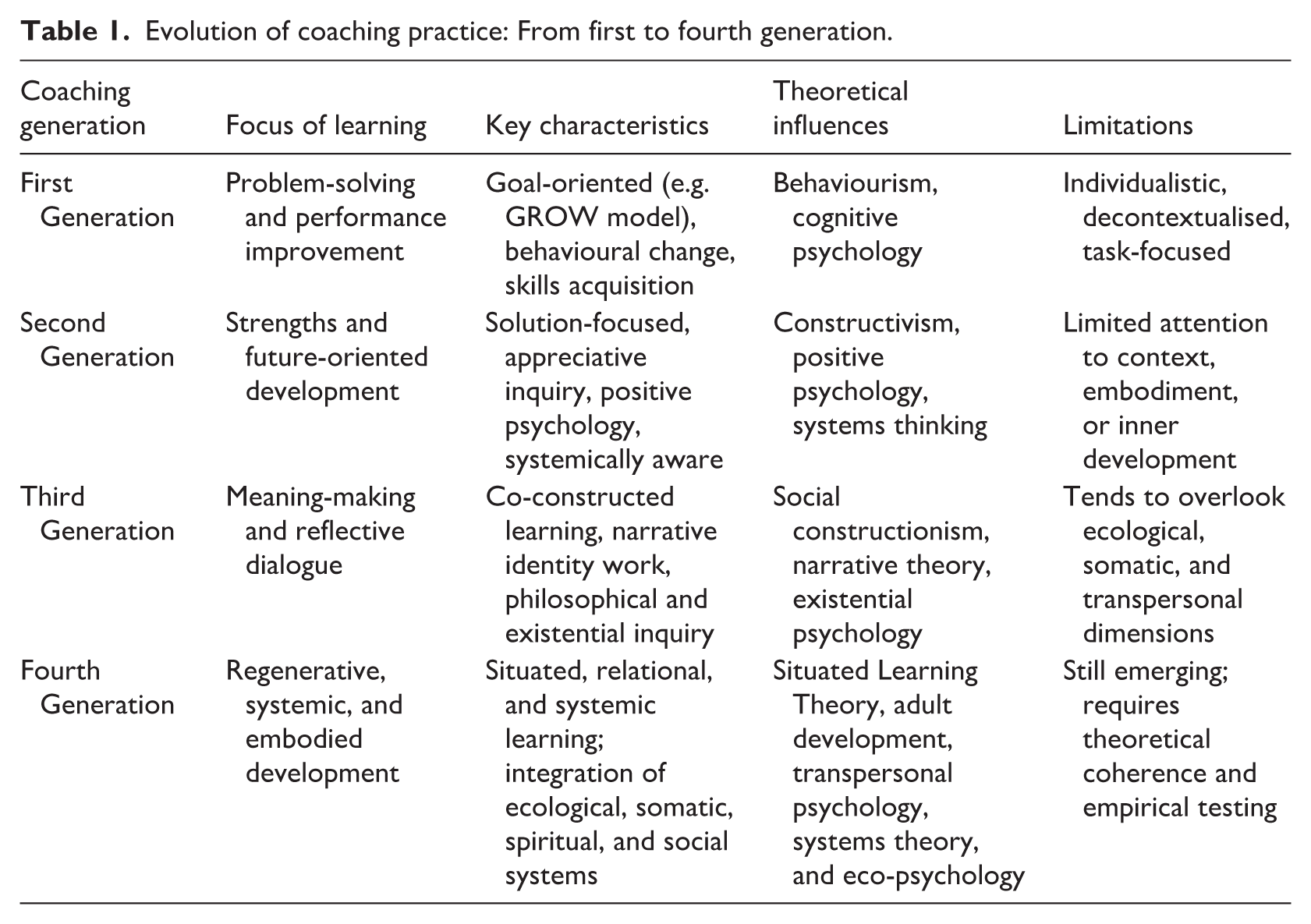
To bridge the leadership complexity gap, what is needed is not only new knowledge but also new ways of learning. Today, we are witnessing the emergence of a fourth generation of leadership coaching, one that explicitly engages the psychological, ecological and systemic dimensions of regenerative leadership. As each new generation includes and builds upon its predecessor, these shifts reflect a broadening of what leadership coaching is for and how learning is understood.
Integrated summary of the theoretical perspectives advanced by Stelter et al. and Grant
Fourth-generation approaches (e.g. Transpersonal Coaching, Regenerative Coaching, and Dynamic Presencing Coaching (e.g. Grant, 2017; Gunnlaugson, 2024; Hartelius et al., 2013; Law, 2022; Stelter et al., 2010; Whybrow, 2021)) introduce an expanded epistemology in which valid knowledge arises not only from cognitive insight but also from embodied sensation, ecological attunement, relational experience, and spiritual meaning-making. While individual fourth-generation approaches to coaching undoubtedly offer valuable contributions, they frequently mirror the interests and competencies of the coach rather than addressing the specific requirements of leaders within their organisational and societal contexts (O’Connor, 2020). Moreover, these approaches risk being reduced to industry trends, as suggested by the rapid positioning of outdoor coaching as a niche offering in an increasingly crowded coaching market (Passmore, 2022). More critically, when employed in isolation, such approaches risk fragmenting the very complexity they aim to address. This highlights the need for an integrative framework grounded in a coherent theory of learning.
The Integrated Systems Coaching Framework constitutes the central conceptual contribution of this article. While synthesising insights from diverse fourth-generation practices, it offers a unified model that links regenerative leadership demands with a coherent learning theory foundation. We propose Situated Learning Theory as the unifying foundation. In the next section, we explore how Situated Learning Theory reframes coaching as a participatory, ecological, and ethical process of becoming, and introduce the Integrated Systems Coaching Framework.
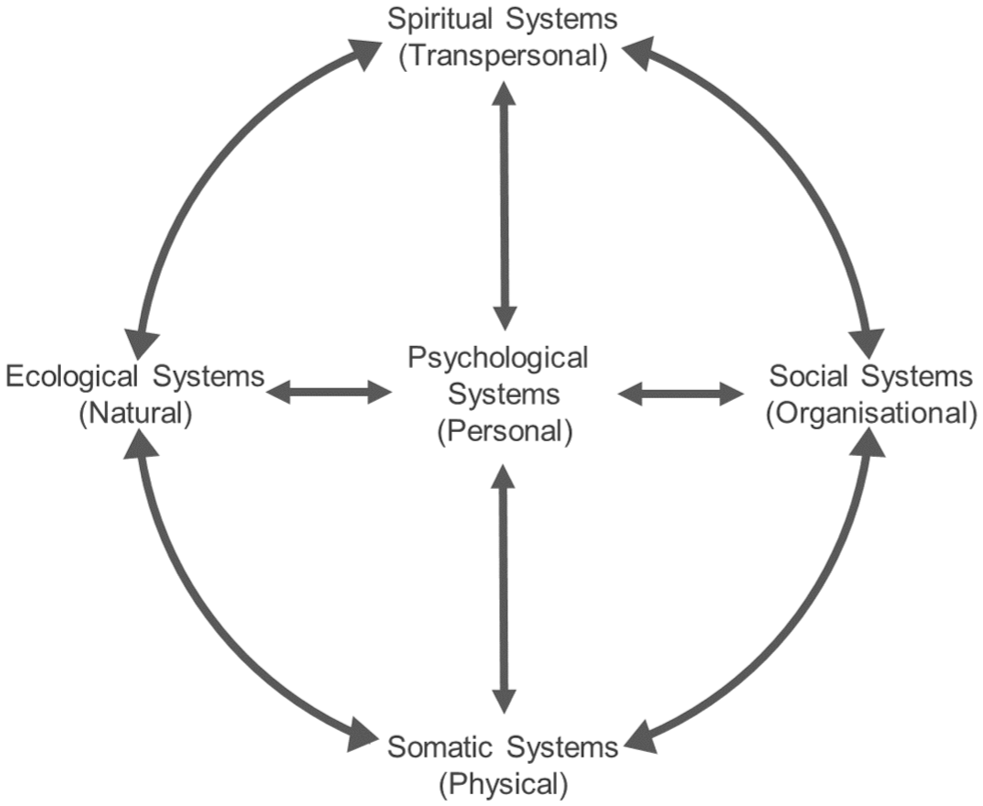
A fourth-generation integrated systems coaching framework.
An integrated systems coaching framework for regenerative leadership
Building on our earlier proposition that coaching is best understood as a situated learning practice, the Integrated Systems Coaching Framework embeds leadership development within five interdependent systems: psychological, spiritual, ecological, somatic, and social. This framework responds to the disconnection at the root of many contemporary eco-social crises: between mind and body, ego and soul, human and nature (Eisenstein, 2011; Scharmer, 2009; Uhl, 2013). It draws on transpersonal, regenerative, and eco-somatic coaching traditions to support leaders as whole, context-embedded beings, formed by and formative of the systems in which they lead. In line with Situated Learning Theory, the framework posits that leadership capacities develop through participation in authentic systems of practice, not through abstract instruction, but through lived interaction with people, values, dilemmas, and environments. Each system constitutes a distinct yet interconnected domain of situated practice. When leadership coaching is aligned with these domains, it becomes a space for integrating inner and outer worlds and fostering both personal and systemic transformation. Accordingly, leadership coaching cannot be understood as a purely one-to-one endeavour. Rather, it requires engagement with nature as a co-facilitator of the developmental process and participation in social systems through group coaching. Such practices enable leaders to critically interrogate the institutional structures they inhabit, structures often shaped by mechanistic assumptions of control, efficiency, and hierarchy, and to reimagine them in service of regenerative economies.
Psychological systems: Facilitating a quieter ego
In complex and regenerative contexts, the ego becomes a key site of transformation. As Washburn (1994) notes, the ego mediates our experience of separation, offering both protection and constraint. Bauer and Wayment (2008) identify five key functions of the ego: self-evaluation, social positioning, self-concept construction, impulse regulation, and the pursuit of self-interest. An ego that is focused on self-preservation often focuses on control and status, limiting the flexibility required in today’s VUCA conditions. This ‘loud’ ego interprets the self in individualistic, immediate, and external terms, and depends on external validation. By contrast, a ‘quiet’ ego, more typical of post-conventional stages of adult development, supports a more relational, long-term and internally validated sense of self (Bauer, 2008).
When egoic defences soften, leaders are better able to engage a wider range of intelligences, including emotional, embodied, and spiritual forms, which aid the leader in engaging with complexity. Taylor (2018) suggests that such shifts allow psychological energy to flow more freely through perception, facilitating deeper insight and integration. Sexton (2025) found that quieting the ego is associated with access to flow states (Csikszentmihályi, 1975), while Kotler (2021) links these flow states to increased presence, adaptability, and a sense of purpose. Importantly, quietening the ego is not simply an internal process but one that unfolds through participation, such as in communities of practice, where identity and ways of being are shaped relationally over time (Billett, 2006; Wenger, 1999). Through developing the relationships with the systems within which they are embedded, leaders experience and learn that their ego is no longer required to provide a self-protection barrier, and it naturally quietens. In this way, the quieting of the ego becomes part of an ongoing identity shift that enables more responsive and integrated leadership. As such, the psychological system within this framework contributes to regenerative leadership by supporting a move away from self-protection and control towards engagement with complexity, interdependence, and systemic awareness.
Spiritual systems: Finding meaning through connection
The spiritual system within the Integrated Systems Coaching Framework refers to the dimension of leadership that engages with meaning, purpose, and connection to something beyond the self. Spirituality here is not religious, but relates to meaning, values and connection (Janowski, 2002). Across many spiritual traditions, the spiritual self, often described as the soul or Higher Self, is considered whole and enduring, distinct from the egoic self, shaped by day-to-day roles and demands (Assagioli, 2012; Hickman, 2014; Javairia and Khan, 2014; Smith, 1991 [1958]). When leaders lose connection with this deeper dimension, they risk encountering what Scharmer (2018) terms a ‘spiritual divide’. Such disconnection often manifests as a loss of coherence and purpose, and in some cases, it aligns with what Frankl (2004 [1946]) described as an existential vacuum. Drawing on his experiences in Auschwitz, Frankl argued that meaning is not a luxury but a psychological necessity. Echoing Nietzsche’s insight that ‘if we have our own why of life, we shall get along with almost any how’ (Nietzsche, 1889 [1976]), this perspective underscores purpose as a foundational source of resilience and direction. Spiritual connection further shapes how leaders engage with the natural world. When nature is perceived as interconnected or sacred rather than merely instrumental, attitudes and behaviours shift towards greater care and responsibility (Suzuki, cited in Perry, 2016). Wamsler et al. (2021) emphasise the significance of inner dimensions, such as values, worldviews, and beliefs, as leverage points for sustainability transformation. Although these inner shifts may remain invisible, they profoundly influence the broader social and institutional systems from which behaviours emerge (Abson et al., 2017; Meadows, 1999).
The Integrated Systems Coaching Framework facilitates access to this dimension by creating space for reflection and reconnection with the spiritual self, which is achieved through contemplation, dialogue, time in nature or somatic practice. These practices quiet the ego and restore meaning and belonging, the foundations of regenerative leadership. Situated Learning Theory offers a lens for understanding spiritual learning as embedded in symbolic, relational, and ritual practices. From indigenous ceremonies to contemplative walks, spiritual insight often arises through participation in shared meaning systems and place‑based practices (Haakedal, 2007; Westerlund, 2021). Exploring purpose in coaching or engaging in reflective dialogue thus constitutes situated acts of spiritual learning: relational and embodied experiences rooted in specific times, places, and communities. In this way, the spiritual system strengthens internal coherence and reconnects leaders to values that transcend immediate organisational demands, enabling more grounded leadership and sustained commitment to systemic transformation.
Ecological systems: Nature as a portal to transformation
The ecological system within the Integrated Systems Coaching Framework recognises the natural world as more than a backdrop for development. Reconnecting with nature, particularly through immersive or eco-somatic practices, provides a context in which leaders can shift from mechanistic worldviews to more systemic, integrated forms of awareness. This shift often includes a quieting of the ego and a reorientation from individual control to ecological interconnection (Goswami, 1993; Rosenblatt and Bartlett, 1976). Nature becomes a mirror and a teacher, providing metaphors and models for adaptation, resilience, and reciprocity. The field of biomimicry (Baumeister, 2014) formalises this learning approach by encouraging leaders to learn from nature’s forms, processes, and ecosystems. A growing body of research suggests that natural environments can support profound developmental experiences. Van Droffelaar and Jacobs (2017), and subsequent studies (Van Droffelaar and Jacobs, 2018; Van Droffelaar, 2021; Van Droffelaar, 2025), found that immersive wilderness settings often facilitate what Maslow (1962) termed peak experiences, temporary but impactful states characterised by a sense of unity, insight, and self-transcendence. These experiences have been associated with leadership traits such as humility, moral clarity, and perspective-taking. Krippner (1972) extends this concept to plateau experiences, which refer to more sustained periods of expanded awareness and meaning. When integrated, such experiences may contribute to enduring shifts in worldview, meaning-making, and behaviour associated with the post-conventional stages of psychological development.
This ecological orientation reflects a view of learning as embedded in practice and context. Leadership coaching in natural environments or through ecological metaphors engages leaders intellectually, somatically, and relationally (Burn and Passmore, 2022). Learning thus extends beyond cognitive systems thinking to include direct, lived interaction with ecosystems. Within this framework, ecological systems foster re‑sensitisation to interdependence and reorientation of purpose beyond self‑interest. Leadership coaching that integrates ecological awareness cultivates not only personal insight, but also an ethical and systemic sensibility needed for regenerative leadership.
Somatic systems: Connecting mind and body
The somatic system within the Integrated Systems Coaching Framework addresses the role of the body in leadership learning and development. Conventional approaches to leadership often privilege cognitive and behavioural dimensions, overlooking the ways in which physical sensations, movement patterns, and embodied awareness contribute to how leaders interpret and respond to complexity. Somatic coaching challenges this imbalance by positioning the body not as an adjunct to the mind, but as an essential source of intelligence and integration. Somatic approaches emphasise that patterns of posture, breath, and movement both reflect and shape how individuals relate to themselves, others, and their environment (Jackson, 2017; Matthews, 2013). These practices contribute to greater physiological coherence and resourcefulness, particularly in high-pressure or ambiguous conditions (Brendel and Bennett, 2016; Goldman Schuyler et al., 2021). Strozzi-Heckler (2014) argues that sustainable transformation requires change to be lived in the body, through presence, regulation, and action. The somatic system supports regenerative leadership by fostering attentional discipline, emotional clarity, and embodied congruence.
Somatic learning does not occur through instruction but through doing, in environments that evoke and shape physical awareness (Courtland, 2019). Whether in a natural setting or an organisational context, the leader’s body becomes an instrument of learning, perceiving feedback, navigating relational energy, and anchoring insight through embodied practice.
Social systems: Organisations that connect people
The social system recognises that leadership learning is fundamentally relational and embedded in organisational contexts. Organisations are not only structures for productivity, but are also social environments that shape how individuals relate to themselves, one another, and the systems around them. Leadership development must therefore attend to the quality of participation. Leadership coaching that integrates the social system supports this shift by engaging not just individuals, but the broader patterns, relationships, and dynamics that influence collective action (Lawrence, 2021). Empirical research supports the benefits of social system-level interventions. Bachmann and Willermann (2024) confirm that coaching approaches that include team and organisational dimensions tend to produce greater collaboration, distributed accountability, and adaptability. Social learning processes such as sensemaking, the construction of meaning through shared interpretation of events, are central to effective leadership in complex contexts (Weick et al., 2005). However, these benefits are not automatic. They depend on social conditions that support inclusion, psychological safety, and diversity of thought. Without these, teams risk falling into groupthink or defensive routines (Janis, 1982). Deliberate relational practices, such as presence, silence, and vulnerability, can further enhance coherence within groups. Sandra and Nandram (2013) describe how such practices create conditions for entrainment, in which group members experience synchronised energy and collective flow. Guenther (2022) refers to this phenomenon as group beingness, a state of emergent coherence and trust that supports mutual understanding and transformation.
Organisational learning can thus be understood as emerging through shared participation, negotiation of meaning, and engagement with real challenges (Wenger-Trayner and Wenger-Trayner, 2020). Leadership coaching, in this view, does not merely occur within the organisation but contributes to its ongoing development by cultivating reflective dialogue, experimentation, and new relational patterns. The social system, therefore, supports regenerative leadership by strengthening collective intelligence, systemic awareness, and the relational capacity required to lead in complexity.
Discussion
This article set out to respond to the growing mismatch between the complexity of contemporary socio-ecological challenges and the developmental capacity of leaders tasked with addressing them. Building on critiques of individualised and decontextualised leadership development (Day et al., 2021; Heizmann and Liu, 2018), it introduces the Integrated Systems Coaching Framework as a fourth-generation approach embedding leadership development across psychological, spiritual, ecological, somatic, and social systems.
In doing so, the article contributes to debates on how leaders learn to engage with complexity and interdependence (Sajjad et al., 2024; Wamsler et al., 2024). While existing approaches recognise relational and contextual dimensions, they often fall short of the deeper shifts required for regenerative futures. The proposed framework addresses this gap by repositioning coaching as a participatory process of becoming, where learning emerges through engagement with people, place, and purpose rather than the acquisition of abstract competencies.
Theoretical contributions
A key contribution of this article lies in extending Situated Learning Theory into domains that have traditionally remained peripheral within management and leadership studies. While SLT has long emphasised the social and relational nature of learning (Lave and Wenger, 1991; Wenger, 1999), it has been critiqued for insufficiently accounting for embodiment and broader ecological contexts (Contu and Willmott, 2003; Fenwick, 2015). By integrating psychological, somatic, spiritual, and ecological systems into a unified framework, this article responds to such critiques and aligns with ecological perspectives that conceptualise learning as distributed across human and more-than-human systems (Fenwick, 2012, 2015).
This expanded interpretation of SLT also resonates with emerging sustainability scholarship that highlights the role of inner dimensions, such as values, beliefs, and worldviews, as critical leverage points for systemic transformation (Abson et al., 2017; Meadows, 1999). Rather than treating these dimensions as separate from organisational practice, the Integrated Systems Coaching Framework positions them as integral to leadership learning. In doing so, it contributes to a growing body of work that seeks to bridge the divide between inner development and external systems change (Wamsler et al., 2021).
A second theoretical contribution lies in providing conceptual coherence to the emerging landscape of fourth-generation coaching. While prior work has identified a shift towards more holistic, relational, and meaning-oriented approaches (Grant, 2017; Stelter et al., 2010), the field remains fragmented, with different approaches emphasising domains such as embodiment, spirituality, or ecology in isolation (Whybrow, 2021). By integrating these domains within a single framework grounded in a coherent theory of learning, this article advances a more unified understanding of fourth-generation coaching as inherently systemic and multi-dimensional.
Third, the framework contributes to leadership development theory by reframing the nature of capability itself. Rather than conceptualising leadership capability as a set of skills or competencies to be acquired, it positions capability as an emergent property of participation within complex systems of practice (Raelin, 2011; Wenger-Trayner and Wenger-Trayner, 2020). This shift aligns with adult developmental perspectives that emphasise the evolution of meaning-making structures (Kegan, 1982; Torbert, 2004), while extending these perspectives to incorporate embodied, ecological, and transpersonal dimensions of development.
Practical implications
The framework also has important implications for coaching practice and organisational leadership development. First, it challenges the continued dominance of individualised coaching models that focus primarily on goal attainment, performance, and behavioural change. While such approaches remain valuable in certain contexts, they are insufficient for addressing the systemic and relational challenges associated with sustainability and regenerative leadership (Sajjad et al., 2024). Instead, coaching practices must expand to engage with the broader systems within which leadership is enacted, including organisational cultures, stakeholder relationships, and ecological environments.
Second, the Integrated Systems Coaching Framework implies a significant shift in the capabilities required of coaches. Rather than specialising in a single domain, coaches may need to develop the capacity to work fluidly across psychological, somatic, relational, ecological, and spiritual dimensions. This raises important questions regarding coach training, professional standards, and ethical practice, particularly in relation to areas such as spirituality and embodied work, which remain less formalised within the coaching profession (Jackson, 2017).
Third, the framework suggests that leadership development interventions may need to extend beyond traditional organisational settings. Practices such as outdoor coaching, group-based interventions, and participatory learning processes become central rather than peripheral, as they provide the situated contexts through which learning emerges (Burn and Passmore, 2022; Wenger-Trayner and Wenger-Trayner, 2020). While such approaches may involve additional time, cost, and logistical complexity, they offer the potential for deeper and more sustained forms of transformation that align with the demands of regenerative leadership.
At the organisational level, adopting a systems-based approach to coaching may also require shifts in how leadership development is conceptualised and evaluated. Rather than focusing solely on individual performance outcomes, organisations may need to consider broader indicators of impact, such as collective sensemaking, relational quality, and systemic awareness (Bachmann and Willermann, 2024; Weick et al., 2005). This aligns with wider critiques of narrow performance metrics and calls for more holistic approaches to assessing leadership effectiveness in complex environments.
Limitations and future research directions
While the Integrated Systems Coaching Framework offers a comprehensive approach to leadership development, it also raises several practical and conceptual challenges. One key tension lies in operationalising systemic concepts (O’Connor, 2020). First, such an approach requires coaches to expand their capability to work across all five systems simultaneously. As noted earlier, many coaches prefer to specialise in a single system and often market their services accordingly. Integrating these domains within a single framework may place significant demands on coaches, potentially raising concerns about depth versus breadth of practice.
A second challenge relates to the situated and systemic nature of the approach. Expanding coaching beyond the individual to include social and ecological systems introduces complexities around boundaries, confidentiality, and psychological safety. For example, engaging stakeholders or working within organisational systems may create tensions between individual and collective interests, requiring careful ethical consideration.
Third, the framework may encounter practical constraints within organisational contexts. Time pressures, resource limitations, and existing organisational cultures may limit the extent to which systemic and embodied approaches can be implemented. There is a risk that elements of fourth-generation coaching, such as outdoor or ecological practices, may be adopted superficially as trends rather than integrated meaningfully into organisational learning processes.
While these challenges are significant, the framework’s potential to close the leadership complexity gap justifies further exploration. To realise the full potential of the Integrated Systems Coaching Framework and build a robust evidence base, we propose a research agenda that invites empirical, design-led, and participatory inquiry. Future research must explore how it functions in diverse organisational, cultural, and ecological contexts. Longitudinal studies could assess how developmental change unfolds over time across the framework’s five systems, shedding light on how systems-informed coaching cultivates leaders’ capacities for ethical decision-making, ecological consciousness, and systems thinking. In parallel, phenomenological and mixed-methods research could investigate how learning is experienced and embodied across less commonly examined domains, such as spirituality and somatic.
Questions worth exploring include how ecological and bodily experiences in coaching shape identity development and meaning-making, and what relational, organisational, or cultural conditions support the integration of spiritual insight into leadership practice. At a collective level, future studies might also examine how fourth-generation coaching influences team dynamics, group sensemaking, and systemic awareness, expanding the scope of leadership learning beyond the individual to include community and organisational transformation. Finally, this research agenda calls for methodological innovation that reflects the very principles the framework espouses. Embodied ethnography, ecological narrative inquiry, and arts-based methods could provide rich, context-sensitive ways to study learning processes that are often tacit, emergent, and situated. In all of these endeavours, the research itself becomes a space for regenerative praxis, modelling reflexivity, relationality, and the co-creation of knowledge.
Conclusion
This article has argued that addressing today’s ecological, social, and organisational challenges requires not only a shift in leadership practice but also a fundamental rethinking of how leadership is learned. Existing responses, such as ESG frameworks or stakeholder capitalism, remain limited in their transformative potential when leadership development continues to rely on abstract, decontextualised, and individualised models. In contrast, we propose that learning for regenerative leadership must be relational, embodied, and situated within real-world systems of practice.
Our first original contribution lies in applying Situated Learning Theory as a foundational lens for coaching in complex and regenerative contexts. We move beyond treating coaching as a vehicle for skills transmission or behavioural change, and instead conceptualise it as a participatory, systemic learning process that unfolds through engagement with ecological, social, psychological, spiritual, and somatic systems. Learning, in this view, is not internalised and applied; it is co-constructed through interaction with people, place, and purpose. This extends SLT into the sustainability and coaching domains and challenges prevailing assumptions in management learning that privilege disembodied, cognitive forms of knowledge.
Our second contribution is the development of the Integrated Systems Coaching Framework, which brings conceptual coherence to emerging fourth-generation coaching practices. By integrating insights from transpersonal, regenerative, and eco-somatic coaching traditions, the framework brings together strands of practice that are typically treated separately. It supports leadership transformation that is not only cognitive or interpersonal but also embodied, ecological, and ethically grounded. Each system within the framework offers a distinct domain of practice and reflection, while their integration enables deeper responsiveness to the complexity of contemporary leadership contexts and to the demands of regenerative economics.
Finally, the article offers practical and scholarly contributions. For practitioners, the framework suggests that leadership coaching must move beyond the individual executive and into the ecological and social systems within which leadership is enacted. For scholars, it opens a research agenda to examine how fourth-generation coaching operates in practice, how knowledge is generated across multiple systems of learning, and how such practices may contribute to ecological and social regeneration. We envisage the framework not as a static model, but as a living, evolving praxis that can be adapted, interrogated, and co-developed through continued experimentation in and with the communities and ecologies where leadership is learned.
Footnotes
Acknowledgements
The authors would like to thank colleagues and collaborators in the field of coaching psychology and regenerative leadership for their ongoing contributions and inspiration.

Ethical considerations
There are no human participants in this article, and informed consent is not required.
Funding
The authors received no financial support for the research, authorship and/or publication of this article.
Declaration of conflicting interests
Since completion of this manuscript, the authors have co-founded Natural Systems, an organisation providing coaching, consultancy, and leadership development services informed by principles related to those discussed in this article. The authors received no financial support for the research, authorship, or publication of this article, and the organisation had no involvement in the development of the manuscript.
Data availability statement
No datasets were generated or analysed for this article.