






Abstract
This study examines how women academics in science, technology, engineering, and mathematics (STEM) navigate their careers through identity-related experiences, focusing on their journey within neoliberal academia. Despite the systemic marginalisation of women academics, existing career progression models often overlook the complex temporal dynamics and identity-related tensions they face. Using constructivist grounded theory and an intersectional lens, we conducted 32 guided interviews with women academics, exploring how they engage in integrated identity processes to navigate career progression. These processes involve three key mechanisms: (1) Anchored career narratives that stabilise trajectories through personal and professional reference points; (2) the intersectional identity work matrix, exploring the interplay of multifaceted identities; and (3) the identity play nexus, which envisions promotional futures. We devise a new conceptual framework from these findings to guide future research by providing a nuanced understanding of how marginalised individuals manage identity tensions to advance their careers amid the neoliberal meritocracy favouring the traditional, linear career model. This framework offers theoretically informed contributions to addressing the limitations of existing career models for women, highlighting the need for more inclusive approaches that consider the temporal and identity-related challenges in gender-segregated academic settings.
Keywords
Introduction
Academic career trajectories have long been shaped by normative structures that define success through rigid, linear pathways. These are often demarcated by job titles, publication counts, and externally recognised outputs—measures that frequently fail to accommodate the diversity of academic experiences within neoliberal academia (Abdellatif et al., 2025; Galuppo et al., 2025; Rosa, 2022). Neoliberalism in this context refers to the institutionalisation of performance metrics, entrepreneurial logics, and audit cultures that reconfigure universities into competitive enterprises, shifting equity concerns from collective responsibility to individual self-management (Asirvatham and Humphries-Kil, 2020; Lipton, 2020). These conditions overlap with meritocratic ideals—the belief that academic success arises purely from individual talent, effort, and measurable achievement—which collectively produce persistent barriers for women across academia (Mkhize and Idahosa, 2025; Wijaya Mulya and Sakhiyya, 2020).
Globally, these challenges are particularly exacerbated in science, technology, engineering, and mathematics (STEM) fields (Blair-Loy and Cech, 2022). The STEM disciplines have long privileged linear, output-driven trajectories and uninterrupted productivity, which align with white, male, and Western ideals of academic worthiness, where broader definitions of impact, reflexivity, and relational scholarship are increasingly legitimised (Kataeva, 2022; Maxwell et al., 2019). The epistemic cultures of STEM academia—anchored in assumed competition and disembodied credibility—intersect with neoliberal imperatives to produce conditions that are not merely exclusionary but also structurally misaligned with the lives and labour of many women academics (Almukhambetova, 2025; Avolio and Cajo, 2024; Mkhize and Idahosa, 2025). While such exclusionary dynamics are embedded across global STEM disciplines, they are especially visible in the Australian context, where formal commitments to equity coexist with entrenched institutional disparities. In Australia, women account for just 29% of the academic STEM workforce—compared to 49% in non-STEM disciplines—and are even more underrepresented at senior levels (Department of Industry, Science Resources, 2023). Despite national policy frameworks, institutional charters, and targeted initiatives, the academic pipeline in Australian STEM academia remains leaky and uneven (Almukhambetova et al., 2022; Wanelik et al., 2020). Consequently, women academics in STEM contend not only with institutionalised gender bias but also with meritocratic performative norms that systematically devalue their contributions, aspirations, and trajectories (Coleman et al., 2023; Wijaya Mulya and Sakhiyya, 2020). This disconnect between policy and lived experience renders Australian STEM academia an ideal site for interrogating how gendered career progression remains structurally obstructed even amid formal equity commitments (Bowyer et al., 2022; McKinnon, 2022).
Our study situates its inquiry specifically within the disciplinary, cultural, and institutional context of STEM academia. By doing so, we move beyond generic accounts of marginalisation to develop a more power-conscious and temporally attuned understanding of career progression navigation. Temporality is defined as the socially constructed, dynamic, and plural experience of time within organisational contexts where the interplay of past, present, and future is fluid, shaped by power relations, sensemaking, and material practices (Dawson and Sykes, 2019; Mayrhofer and Gunz, 2020; Vostal, 2015). We foreground the temporal dimensions of how women make sense of, and respond to, career progression in merit-based institutions. Specifically, we propose a theoretical framework that captures how women academics in STEM draw on stabilising values (anchor points (AP)), negotiate multiple identity demands (intersectional identity work (IIW)), and explore future academic possibilities (identity play (IP)) as part of a broader career strategy. While these analytic constructs have been studied separately, our framework brings them into conversation to illuminate how identity is navigated across time in contexts shaped by inequality and rigid performance regimes.
The remainder of the article is structured by first presenting the research context and theoretical background of the study. While this theoretical background appears early in the article, it reflects an abductive and iterative process of engagement with theory, grounded in a philosophical commitment to constructivist grounded theory (CGT). As we elaborate in the data analysis section of the methods, our approach to data generation and analysis was far from linear—marked by the inevitable messiness of iterative fieldwork and reflexive engagement—although it is presented here in a more orderly form for clarity. The findings are followed by the emergent theoretical framework and the study’s theoretical and practical contributions. The article concludes with a discussion of limitations, directions for future research, and concluding reflections.
Research context
We begin by outlining the institutional and disciplinary context within which women’s career progression unfolds.
Women’s career progression in contemporary STEM academia
Despite extensive critique of exclusionary structures in STEM academia, empirical studies continue to show how these systems shape women’s career progression—particularly through norms of uninterrupted productivity, limited leadership access, and undervaluation of care-informed pathways (Almukhambetova, 2025; Avolio and Cajo, 2024). Promotion within continuing appointments often requires sustained performance at the next level, typically without formal recognition or support (Blair-Loy and Cech, 2022; Feldman and Sandoval, 2018). These expectations clash with realities of career interruptions—due to caregiving, health, or structural barriers—which disrupt linear productivity models and compel women to reestablish credibility upon return (Maxwell et al., 2019). Women are also disproportionately tasked with service, pastoral care, and administrative duties—essential yet undervalued forms of labour (Diezmann and Grieshaber, 2019). In environments where teaching-only and part-time roles are common and institutional prestige hinges on research output, these contributions are further marginalised (Bennett et al., 2017; Rogers and Swain, 2022). Although this study does not focus on casual academics, the broader culture of research prioritisation and employment precarity shapes the conditions under which even senior women navigate careers (Fraser and Ryan, 2020; Woelert et al., 2026). Women with strong records in grants, teaching, and leadership must still continually validate their careers against dominant standards of excellence (McKinnon and O’Connell, 2020).
These dynamics are not unique to one national context. In Australia, they are embedded in a codified progression system spanning Levels A to E, which institutionalises performance expectations aligned with neoliberal and meritocratic norms (McKinnon, 2022; Sharafizad et al., 2024). Level C (senior lecturer) marks the mid-career transition, while Levels D and E correspond to associate professor and professor ranks (Nguyen et al., 2023). Though these ranks offer nominal security, progression remains contingent on sustained performance, often without guaranteed support (Francis and Stulz, 2020; Nguyen et al., 2023). Vertical segregation intensifies across these levels: women hold 32% of Level C roles, 28% at Level D, and only 20% at Level E (Department of Industry, Science Resources, 2023). These figures reflect persistent structural bottlenecks and gendered norms around leadership, merit, and institutional fit (Lipton, 2020; McKinnon and O’Connell, 2020). Accordingly, this study focuses on women at Levels C to E—roles demanding significant contributions across research, teaching, and service, yet governed by intensified scrutiny and misalignments between institutional expectations and lived experience. These bottlenecks must be understood through an intersectional lens that attends to the identity demands shaping women’s progression.
Intersectionality in the career progression landscape
Navigating these academic roles involves more than professional performance; women in STEM must also contend with overlapping identity demands shaped by care, migrant identities, and disciplinary norms (Budtz-Jørgensen et al., 2019). These intersecting demands do not operate in isolation but converge in ways that are both experientially layered and structurally patterned. Therefore, central to our approach is intersectionality—a framework that not only attends to the co-constitution of multiple identities but also foregrounds the power relations that shape their salience and consequences in particular contexts. As Hill Collins and Bilge (2020: 2) explain, intersectionality “investigates how intersecting power relations influence social relations across diverse societies as well as individual experiences in life . . . a way of understanding and explaining complexity, in the world, in people, and in human experiences.” This framing enables us to move beyond static, individualised understandings of identity to examine how women in STEM academia negotiate identity tensions within—and against—structural constraints. While prior scholarship has documented exclusionary norms and institutional barriers, less attention has been given to how women strategically navigate these pressures over time. A key gap lies in theorising the dynamic interplay between structure and agency—particularly how intersecting identities shape, and are shaped by, evolving institutional expectations and lived experiences within STEM academia. Rather than attributing career progression to isolated acts of merit, our approach foregrounds how exclusion is reproduced through institutional norms and epistemic cultures that obscure structural inequality (Araneda-Guirriman et al., 2023; Olry-Louis et al., 2022). These challenges are especially acute for women in STEM, whose aspirations and identities often diverge from dominant scripts of academic success. Building on this foundation, the next section explores how temporality and tensions shape the navigation of career progression in gendered STEM academia.
Navigation of tensions and temporality in career progression within STEM academia
Research on women in STEM and academia highlights the tensions in career progression shaped by personal, relational, and collective factors (Casad et al., 2021; Ruel, 2018). At the personal level, identity is entangled with institutional expectations and accountability (Callagher et al., 2021; Lehtonen and Yang, 2025). For women in STEM, these tensions often stem from conflicts between moral commitments and performative demands. Portie-Williamson et al. (2022) show how professionals experience moral injury when norms compel self-presentation that contradicts deeply held values. At the relational level, these dilemmas are produced through encounters with colleagues and evaluators. Fernando et al. (2020) illustrate how immigrant academics adopt dominant behavioural codes to appear competent, revealing identity as actively reshaped by unspoken norms of belonging. At the collective level, organisational cultures demand both assimilation and distinction. McCluney and Rabelo (2019) describe this paradox as the simultaneous pull of belongingness and uniqueness, exposing visibility as both necessary and risky. These dynamics intersect with career alignment: dominant narratives of linear, self-directed careers render alternative trajectories—shaped by care or exclusion—illegible (Chudzikowski et al., 2020). Existing work theorises identity tensions but often treats them as episodic rather than evolving processes (Casad et al., 2021; Liyanagamage and Fernando, 2022). What remains underexplored is how these tensions unfold over time within neoliberal logics of meritocracy and productivity (Bristow et al., 2025; Galuppo et al., 2025; Gavin et al., 2023).
This study foregrounds temporality as a central analytic, using time orientation—preferences towards past, present, or future—as a lens for understanding identity navigation (Mayrhofer and Gunz, 2020; Riach and Loretto, 2009). Linking career progression to time orientation illuminates how academics perceive and negotiate identities across temporal contexts (Brown, 2005; Weatherall and Ahuja, 2021). Within neoliberal academia, time becomes a regulated resource. Vostal (2015) critiques the accelerating pace of academic life, while Ylijoki (2010) contrasts “project time”—dominated by deadlines—with “process time,” reflecting slower scholarly development. These regimes privilege continuity and linearity while devaluing relational or interrupted temporalities, systematically marginalising those whose lives diverge from normative scripts (Sabelis and Schilling, 2013; Ylijoki and Mäntylä, 2003). For women in STEM, these constraints intersect with identity-based exclusions, making certain futures less visible or achievable (Rodriguez et al., 2025). Watt (2006) shows how gendered beliefs about scientific ability shape participation early, persisting into academia where credibility must be performed within masculinised norms privileging assertiveness and hyper-availability (Ashcraft et al., 2016; Fagan and Teasdale, 2020). Policy discourses emphasising adaptability have not disrupted these norms, leaving women to navigate tokenism and deficit framings under intensified scrutiny (Ruel, 2018; Sugiyama et al., 2024). This article addresses these concerns by examining how women academics in STEM negotiate temporal dimensions of career progression within neoliberal architectures structured by meritocratic ideals and rigid time regimes. Their experiences reveal systemic contradictions—between what is valued, visible, and possible. We conceptualise these navigations as integrated identity processes spanning past, present, and future: reflexive practices through which women resist dominant scripts, re-anchor trajectories, and articulate alternative meanings of legitimacy and success. In doing so, we contribute a temporally attuned, intersectional approach to career theory that foregrounds the structural labour required simply to be recognised within STEM academia.
Theoretical framework
Against this backdrop, the theoretical framework proceeds by elaborating three interrelated analytical dimensions—AP, IIW, and IP—which together provide the conceptual architecture for examining how women in STEM academia navigate identity tensions and temporalities in career progression. These concepts reflect how women make sense of career navigation across time—drawing from the past, negotiating tensions in the present, and imagining possible academic futures. The AP refers to stabilising values or commitments that provide continuity in navigating institutional pressures, such as feminist beliefs or familial obligations (Ruel, 2018, 2019b). The IIW captures the simultaneous negotiation of overlapping personal and professional identities, while IP enables participants to explore possible selves and alternative career pathways within the constraints of meritocratic institutions (Atewologun et al., 2015; Ibarra and Petriglieri, 2010). Rather than being deductively applied, this framework was developed through an iterative, data-led process informed by abductive reasoning, thus reflecting a temporal logic that was not theoretically imposed but evolved through our engagement with empirical material. To deepen this temporally and intersectionally embedded analysis of career navigation, we now turn to the first of three analytic dimensions, APs.
Anchor points
Ruel (2018) expanded Glenn’s (2002) foundational work to explore the dynamic, power-infused construction of identities that act as stable APs, offering continuity and grounding across life stages, including careers. The APs are personal values, beliefs, or experiences that individuals rely on to stabilise their sense of self amid external pressures (Ruel, 2018, 2019b). We conceptualise APs both as a research tool and a personal mechanism for women in STEM. As a research tool, they reveal how marginalised individuals maintain identity coherence under systemic constraints; as personal resources, they guide career navigation and resilience. For women in STEM academia, APs—such as feminist beliefs, cultural identities, or family commitments—help navigate promotion processes and resist pressures to conform to normative career expectations. According to Van Hilten and Ruel (2022), APs provide a critical lens for understanding tensions created by the “us versus them” divide in gender-segregated workplaces. This divide, often intensified by cultural and gender norms, makes APs essential for resilience. They also illuminate how individuals exercise autonomy over time, making sense of lived experiences and career-related tensions (Aromaa et al., 2019; Van Hilten and Ruel, 2022). For instance, a long-standing commitment to equity-oriented academic practice may offer clarity when institutional demands align with personal values. Conversely, in contexts privileging productivity or competition, the same AP may generate dissonance, leaving individuals uncertain about reconciling commitments with advancement. These scenarios show that APs are not universally stabilising; they operate relationally—anchoring identity when alignment exists and producing tension when it does not. Misalignment between APs and neoliberal, meritocratic career structures can threaten identity coherence. Nonetheless, APs provide a framework for studying career progression tensions, enabling individuals to hold onto values despite shifting workplace demands (Aromaa et al., 2019; Ruel, 2019a; Van Hilten and Ruel, 2022). While APs are crucial for understanding how participants integrate personal experiences into career decisions, IIW—the second analytical dimension—deepens this understanding by revealing women academics’ strategies to manage overlapping identities.
Intersectional identity work
The IIW refers to the ongoing construction and negotiation of identities in response to tensions arising within intersecting systems of oppression (Atewologun et al., 2015, 2020). While APs emphasise stability, IIW foregrounds the fluid navigation of multiple, sometimes conflicting identities under structural inequalities. The APs act as internal resources, whereas IIW highlights relational work to maintain or adjust identities in line with institutional demands, often without scope for reinvention (Ibarra and Petriglieri, 2010). Building on Crenshaw’s articulation of intersectionality and Collins’ power-conscious framing (Hill Collins and Bilge, 2020), IIW examines how career tensions emerge from the interplay of macrolevel institutional logics and microlevel identity management. The IIW has been applied to marginalised professionals, including women leaders, immigrant scholars, and disabled workers (Donmanige et al., 2025). In this study, IIW interrogates how neoliberal academic regimes—hyper-productivity, constant visibility, and individualised merit—are navigated by women whose racialised, gendered, and classed identities diverge from the normative ideal of the disembodied academic (Strauβ and Boncori, 2020). Importantly, IIW is not framed as individual adaptation but as situated practice shaped by power-laden norms of credibility and success embedded in STEM academia. Our approach aligns with McCall’s (2005) intracategorical framework, directing attention to neglected intersections within women in STEM. Differences in caregiving, ethnicity, migration, and class shape distinct encounters with inclusion and progression (Kele et al., 2022). The IIW traces how institutionalised power is lived and resisted: managing visibility and invisibility—being hypervisible as a token yet invisible in leadership—illustrates systemic patterns of representation (Galbally et al., 2023). Decisions about parental leave or flexible work are constrained by assumptions about commitment and linear careers, disadvantaging women with caregiving responsibilities (Kataeva, 2022; Ruel, 2019a). These constraints, reinforced by gendered divisions of labour, fuel concerns about suitability for senior roles (Sharafizad et al., 2024). Thus, IIW offers a lens for understanding how women in STEM navigate identity dissonance and structurally encoded exclusions, linking micropolitics of self-presentation to macropolitics of institutional regulation. It builds on APs by showing that stability is negotiated through daily encounters with organisational norms and power structures, while also extending towards imagining future academic selves within—or against—neoliberal constraints.
Identity play
Career progression requires individuals to navigate their current identities while envisioning and preparing for the roles they aspire to achieve (Budtz-Jørgensen et al., 2019; Nazar and Van der Heijden, 2014). These prospective selves act as motivators, influencing career conduct, mentally preparing individuals for new circumstances, and experimenting with possible selves when navigating the intricate career progression process (Strauss et al., 2012). To this end, IP involves provisional trials of potential future selves, promoting identity growth and exploration (Ibarra and Obodaru, 2016; Stanko et al., 2022). Extending the concept of IP, Stanko et al. (2022) offered a new definition that considers how an individual places a version of themself in different scenarios of oneself. They include “possible” (concerned with inventing and reinventing oneself), “improbable” (selves that are possible but highly unlikely ever to become part of the actual self), and “impossible selves” (as selves that will never become actual). This taxonomy sharpens how scholars can account for the tensions and limits involved in imagining futures under constrained institutional conditions. Stanko et al. (2022) revealed the interplay between situated work practices and human agency, illustrating how these interactions influence possible, improbable, and impossible selves. This expands our understanding of identity exploration under institutional and material constraints, especially in academia. For women academics in STEM, where the ideal academic is often imagined as disembodied, uninterrupted, and male-coded, IP allows for provisional engagement with senior roles that may otherwise feel incompatible or implausible. While IIW reveals how individuals navigate tensions among existing identities shaped by structural power relations, IP offers a future-facing, imaginative mechanism through which individuals test and rehearse different academic selves (Stanko et al., 2022). This shift from managing current constraints to envisioning alternatives makes IP especially valuable in understanding how women in STEM negotiate the limited templates available within meritocratic academic environments. While IIW focuses on navigating existing multiple, intersecting identities within societal constraints, IP emphasises creativity and imagination. This distinction provides a fresh perspective on identity dynamics by focusing on possibilities rather than constraints in career progression. In this article, we show how IP allows women academics in STEM to explore future career selves, constructing alternative trajectories and fostering resilience in male-dominated contexts. This imaginative experimentation—rather than wholesale transformation—enables navigation without abandoning core commitments.
Together with APs and IIW, IP forms the conceptual foundation for our study, offering a temporally attuned, power-conscious analysis of identity-related tensions in career progression. Against this backdrop, we address the research question: how do women academics navigate career progression through identity-related experiences in STEM academia? We explore lived experiences as they navigate advancement to senior roles, responding to calls to capture how marginalised workers negotiate progression in highly normative, gender-segregated settings.
Method
This section outlines the research design, sampling strategy, data generation, and analytical approach underpinning the study.
Research design overview
This article draws on a larger qualitative study examining the career progression landscape of Australian STEM academia, which included in-depth interviews with 32 women academics (mid- to senior levels) and 18 institutional decision-makers (e.g. deans of faculties, heads of departments) involved in academic promotion. While the broader project sought to capture both groups’ lived experiences and perspectives, early coding revealed recurrent moments where institutional criteria and individual professional values were in direct tension. These moments frequently centred on the recalibration of professional identities during promotion processes—for example, the implicit privileging of research outputs over activities such as community engagement or collaborative leadership. The recurrence of such tensions across early transcripts prompted a shift in analytic focus, leading to the decision to centre this article on the women academics’ lived experiences, with these identity negotiations forming the conceptual anchor for the findings. We adopted CGT informed by an intersectionality framework that foregrounds power, structure, and temporal complexity (Kassam et al., 2020). Our use of intersectionality follows Hill Collins (2020) analysis of power, moving beyond static accounts of identity to examine how intersecting systems—such as gendered norms, racialised academic practices, and class-based assumptions—pattern lived experiences in STEM. In this study, intersectionality functioned as a methodological lens, sensitising data collection and analysis to the interplay between social location and institutional power and attuning us to how participants navigated identity tensions within evolving academic contexts. By centring both structure and agency, the combined CGT-intersectionality approach enabled us to interrogate dominant merit-based narratives and trace the strategies women used to negotiate institutional boundaries of legitimacy and success (Kassam et al., 2020; Levitt, 2021). The following section addresses researcher reflexivity and positionality, detailing how the research team’s identities, disciplinary backgrounds, and institutional locations informed the study’s design, data generation, and interpretive decisions.
Reflexivity and positionality
Researcher reflexivity and positionality were integral to the study, ensuring a critical and transparent approach throughout (Spellman, 2024). The research team comprised one doctoral researcher (first author) and three tenured faculty members (two associate professors and a senior lecturer) across two Australian universities. The team brought together expertise in career research, organisational psychology, business, management, industrial relations, and nursing. All members had training in qualitative methods and prior experience in constructivist and interpretive paradigms, which shaped our methodological self-consciousness throughout the study. The first three authors had migrant backgrounds, and all four had between 5 and 15 years of experience in academia, which positioned us in various ways relative to participants’ experiences. Our disciplinary backgrounds—psychology (first author), management (second author), industrial relations (third author), and nursing (fourth author)—provided distinct analytical lenses that shaped both the framing of research questions and the interpretation of findings. We approached positionality as dynamic and layered (Spellman, 2024). The first author, who led the interviews and coding, drew on her identity as a migrant woman academic and her training in psychology to build rapport with participants while also recognising that her own experience of career barriers outside Australia could risk biasing attention towards negative framings.
To address potential missed areas, alternative interpretations were actively debated between the first and second authors, using loosely coupled abductive reasoning to move iteratively between data and theory. This form of reasoning refers to a semi-programmatic analytic mode grounded in empirical data, extant literature, and established methodological principles while also allowing space for impromptu creativity, serendipitous insight, and intuitive leaps (Fleming and Oswick, 2025). These interpretations were then shared with the third and fourth authors to assess whether the analytical claims resonated with their disciplinary perspectives and experiential understandings. Researcher reflexivity was practised throughout via memo writing, peer debriefing, and team discussions (Spellman, 2024; Yip, 2023). For instance, team discussions identified when assumptions stemming from insider positions—such as familiarity with academic systems—might obscure the significance of participants’ insights. This practice aligned with CGT’s emphasis on methodological self-consciousness and enhanced the credibility and trustworthiness of our findings (Charmaz, 2014). We also considered power dynamics within the research encounter. While participants often viewed the first author as a peer, particularly those in Level C roles, she remained aware that institutional affiliation and her role as a doctoral researcher could introduce perceived hierarchies. Following Yip (2023), we used these moments as analytical cues, examining how trust was negotiated and how disclosures emerged in relation to the researcher’s positionality. Therefore, collective reflexivity enabled us to integrate these dynamics into analytic decision-making, including sampling and data generation in the study.
Comprehensive overview of the sampling strategy and interview protocol
Ethical approval for the study was granted by the Social Sciences Human Research Ethics Committee of the first author’s affiliated university. We used purposive sampling to recruit women academics in STEM disciplines across Australian universities who held senior positions. Participants were identified via publicly accessible university websites, and targeted email invitations were sent to over 120 women academics across 16 institutions. These participants were selected because their positions reflect a critical juncture in academic career progression where leadership roles become institutionally possible but remain structurally contested. As noted in the literature review, mid- to senior-career levels are characterised by intensifying performance demands, declining gender representation, and heightened scrutiny—making them particularly suited to investigating identity-related career tensions (Bowyer et al., 2022). Participation was voluntary, and all participants received an information sheet outlining the study’s purpose and their rights. The 32 participants of this study range from 14 senior lecturers (C) in the mid-career level, 7 associate professors (D), and 11 professors (E) in senior career levels. The demographic data (see Table 1) of the women academics highlight a significant intersection of identities, with many participants navigating careers in STEM as migrants (e.g. from Europe and Asia) or as first-generation academics within their families. A notable proportion is balancing caregiving responsibilities, which, coupled with their relationship statuses and community affiliations (e.g. queer, first in the family), thus indicates the diversity in personal circumstances and illustrates the critical role of identity in shaping career progression pathways.
Participant overview.
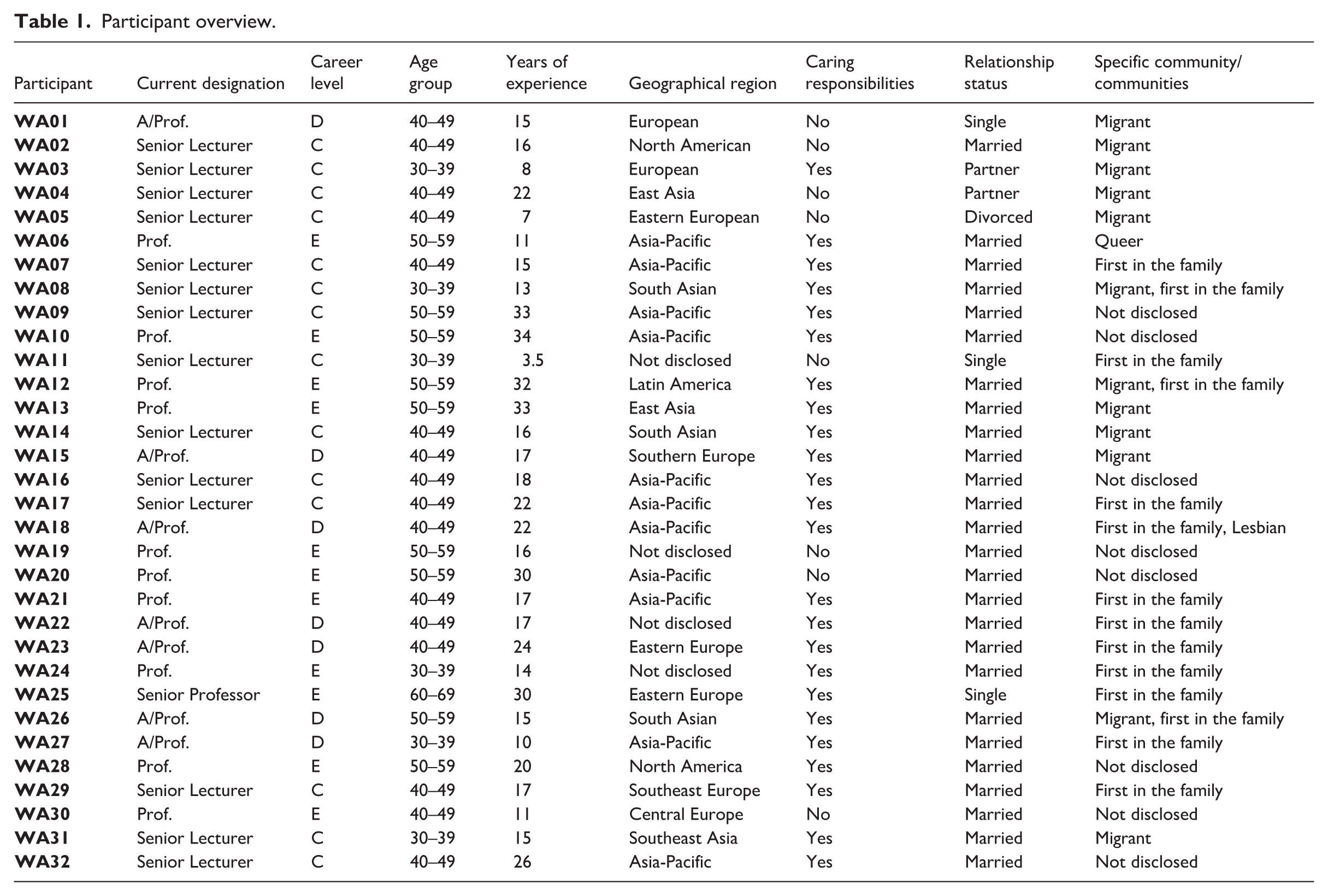
The development of the interview protocols was preceded by 1 focus group discussion and 10 pilot interviews with women academics in STEM, which served to refine question wording, sequencing, and thematic coverage. The interview guide served as a flexible framework, allowing discussions to evolve organically and incorporate novel insights. The guide comprised open-ended questions in four key thematic areas: (1) the evolution of personal and professional roles, (2) sources of career support and mentorship, (3) experiences with the academic promotion process, and (4) identity-related tensions. Sample questions included: “Can you map your career progression across different personal and work roles?” and “Tell me about your most recent promotion—what supported or constrained your decision to apply?” Participants were also asked to reflect on their experiences and negotiations of career progression conversations. These diverse narratives provided a rich empirical foundation for our analytical focus on how identity tensions are navigated over time. Interviews were conducted online or in person, recorded with informed consent, and transcribed verbatim. Interview duration ranged from 38 to 83 minutes, with a mean of 43 minutes. Theoretical saturation was reached after 26 interviews, with the final 6 confirming the recurrence of central themes (Hennink and Kaiser, 2022). The next section outlines the data analysis procedures.
Data analysis
Data analysis followed an iterative process using constant comparative methods (Charmaz, 2021). A focused coding structure was employed and supported by NVivo software, balancing analytic creativity with rigour throughout the coding stages (Charmaz, 2021). Initial codes were generated through line-by-line in vivo coding, while subsequent focused coding enabled the identification of patterns across interviews. Memo writing and peer debriefing supported reflexive engagement with emerging insights, facilitating analytic depth and transparency throughout the process (Charmaz, 2014; Retkowsky et al., 2023). Theoretical coding was then used to integrate and refine core categories. To establish the representativeness of emergent categories, we drew on Hill et al.’s (2005) framework, which classifies codes as variant (evident in two or three participants), typical (appearing in at least half), or general (present in all). While the analysis extended beyond merely identifying typical categories, most theoretical codes were evident across at least half of the participants’ narratives.
To concretise how the analytic process moved from raw data to theoretical development, we offer an illustrative example. In early interviews, participants described career navigation dilemmas that were deeply entangled with institutional constraints and identity positioning. For instance, one participant described having difficulty advancing to the next level and feeling dissatisfied with the outcome of promotion negotiations, while another recounted being deliberately slowed down in her efforts to reach Level E (WA07—Level C, Australian, carer, first in the family; WA01—Level D, migrant, not in a relationship). These accounts were initially coded with terms such as career progression blocked and self-imposed pacing. Through focused coding, these excerpts were grouped under the abstract conceptual category career progression tensions, which captured how women navigated misalignments between institutional expectations and personal or identity-informed constraints. Moreover, surprising and layered accounts—such as participants’ references to cultural values and conflicting institutional demands—prompted a return to literature beyond the initial scope. For instance, while the research initially centred on IIW to examine how women academics negotiate multiple identities in career progression, early interview data revealed that participants routinely drew on past professional and personal experiences to stabilise their career narratives. This insight prompted an expansion of the theoretical framework, particularly through engagement with Ruel’s (2019b) work in the Canadian space sector. Thus, providing a critical comparative foundation for developing anchored career narratives as a core theoretical category in our analysis.
As analysis continued, the focus shifted to the temporal and identity-laden scaffolding women deployed to make sense of and resist institutional demands. This marked a key conceptual turning point—a moment of what Klag and Langley (2013) describe as a conceptual leap, in which abstract theoretical insight emerges from sustained empirical engagement. Through iterative memoing—written records of the researcher’s thought process—(Sudarsan et al., 2022: 381)—and abductive inquiry, the first author posed the critical question: are these participants navigating careers through identity strategies that are both anchored and imaginative? In addition, as the analysis progressed, participants’ references to imagined futures and career recalibration introduced the concept of IP as a complementary lens to IIW. This expansion was catalysed by sustained theoretical memoing and was further sharpened when the first author attended a workshop on temporality led by Christopher Sykes (Dawson and Sykes, 2016). This facilitated deeper recognition of how past, present, and future time points functioned as structuring devices in women’s and institutional decision-makers of career progressions, such as deans of faculties and heads of department narratives. This temporal orientation also clarified distinctions among the three theoretical codes, which are further explored in the sections to follow. For example, WA02’s return to academia despite familial disapproval illustrated the stabilising role of emotionally fraught AP, WA18’s assertion of queer feminist identity highlighted how preexisting configurations were strategically mobilised within institutionalised gender norms, and WA04’s decision to delay promotion to spend time with her mother demonstrated how imagined futures could be shaped through IP. These codes were not developed in isolation but evolved through constant comparison, theoretical sampling, and reflexive engagement with data and literature. Therefore, the final theoretical framework did not emerge deductively but crystallised through abductive, temporally attuned, and reflexively mediated analysis (Fleming and Oswick, 2025; Sætre and Van de Ven, 2021). It captures how women academics in STEM navigate institutional misalignment and identity tension through stabilising referents, strategic reconfiguration of identities, and imaginative future projections. These strategies—anchoring, negotiating, and envisioning—are explored in the following section.
Anchoring, intersecting, and playing—mechanisms of identity navigation in women’s STEM careers
In this study, we explored the identity-related experiences of women academics in STEM as they navigate career progression. Overall, we found that women academics in STEM engage in both existing identity navigation processes and forward-looking strategies as they navigate tensions and crossroads in their career progression. These identity processes were organised into three empirically grounded mechanisms that structure the findings: anchored career narratives, which draw on values and commitments to maintain continuity; the IIW matrix, which captures how participants manage overlapping identity-based tensions; and the IP nexus, which reflects more imaginative engagement with possible academic futures. Although these mechanisms are presented separately for clarity, the data reveal that participants often shift between them across different contexts—an insight we revisit in the concluding section of the findings and in the contributions section.
Anchored career narratives
Anchored career narratives examine how women academics stabilise career trajectories through reference points connecting personal and professional lives. Anchors—family support, migrant identity, and career-first orientation—help sustain coherence amid institutional uncertainty yet can fracture under organisational misalignment, prompting re-anchoring and identity renegotiation. Family support emerged as both a moral compass and a site of tension, shaping interpretations of work experiences and decisions about progression. Anchors are not static; they evolve through relational processes as women navigate coherence and contradiction within STEM’s demanding contexts. An example is seen when academics persist in academia despite family disapproval: My family could not provide me with any comfort because they couldn’t understand why I would even participate, why I would give people like this who sought to treat me like this was acceptable, why I would give them a moment of my time. And yet I went back. I . . . I consider it for me like a battered wife. Your family looks at you and shakes their head and goes, why be there? (WA02—Career Level C, North American, migrant, married)
This quote starkly captures the emotional complexity embedded in anchored career narratives. For WA02, familial disapproval becomes a destabilising force that amplifies vulnerability. Her metaphor of being “like a battered wife” offers a searing critique of institutionalised harm, symbolising profound dissonance between ethical commitments and systemic marginalisation (Sharafizad et al., 2024). Yet her return reflects anchoring to the intrinsic value of work, revealing how the absence of external validation can paradoxically stabilise persistence. This interplay underscores how APs become sites of emotional reckoning and strategic reengagement for women with intersecting identities. Conversely, WA25 pointed to the positive impact of spousal support: He’s (husband) generally supportive . . . and he knows that I put my career first most of the time, but sometimes he really calls me on it . . . I have often thought I wouldn’t have a life outside work if I didn’t have him. You know, he actually does help bring that balance back into my life . . . (WA25—Career Level E, Eastern Europe, first in the family, single parent)
In contrast to WA02, WA25 positions spousal support as a stabilising anchor that facilitates a demanding academic career while mitigating overwork. Her narrative reflects how relational anchors resist the absorptive logics of academic labour, especially in settings that valorise individualism and constant productivity (Abdellatif et al., 2025; Johansson et al., 2024). Another anchor point was migrant identity. The WA05 illustrates how prior cultural norms shape interpretations of host-country academia: It’s much stronger for me than being a woman. I notice that how women are raised in Australia is probably different than in Europe. Because I think . . . Europe is much more, much more equal. (WA05—Career Level C, Eastern European, migrant, divorced)
Her European egalitarian background serves as a benchmark for assessing gendered expectations in Australian STEM academia. When misaligned with institutional logics, these comparative moral referents generate dissonance (Brown, 2015; Patton and Doherty, 2020). Temporal anchors also shaped career pacing. The WA01 reflects deliberate resistance to accelerationist norms: But umm . . . I now find myself slowed down, actively slowed down, in my trying to get to level E. And part of that, I’ve been told, has been of my own making because I have tended to the form at a certain level that is above the essential area . . . (WA01—Career Level D, European, migrant, not in a relationship)
Her recalibration highlights agency in resisting externally imposed timelines, prioritising meaningful alignment over normative progression scripts (Asirvatham and Humphries-Kil, 2020; Watermeyer, 2015). In contrast, WA07 exemplifies pressure to conform to linear career expectations: . . . now I’m in a five-year position with not really getting what I wanted out of the negotiation . . . about pretty much every single part of my career, I’ve had issues in getting to that next level. With the exception of PhD to post-doc, that was easy . . . (WA07—Career Level C, Asia-Pacific, married, first in the family, carer)
Her narrative reflects cumulative fatigue when institutional scripts fail to accommodate complexity or caregiving responsibilities. This struggle underscores how AP interact with rigid promotion regimes, exposing the fragility of progression within intersecting identity structures (Bowyer et al., 2022; Villar-Aguilés and Obiol-Francés, 2022).
These narratives reveal the temporal, relational, and structural complexity of anchored career narratives. When aligned, anchors create coherence and momentum; when misaligned, they become sites of tension, exposing fissures in institutional logics. Career anchors function as dynamic reference points, activated in response to structural affordances and constraints of neoliberal STEM academia. They act as provisional stabilisers that, when tested by structural shifts or identity conflicts, prompt adaptive identity work. Participants described moving from reliance on cultural anchors to reshaping professional identities when those anchors no longer sufficed, underscoring how stability is always provisional and negotiated through intersecting identities. Our focus here is on the temporal and relational grounding that precedes the more deliberate identity reconfigurations explored in the IIW matrix. This distinction clarifies conceptual boundaries while recognising that, in practice, these processes interweave.
Intersectional identity work matrix (IIW matrix)
The IIW matrix examines the interplay of multifaceted identities across personal and professional spheres. Informed by Hill Collins and Bilge’s (2020) concept of the matrix of domination, this framework offers a lens for understanding how women academics experience intersecting systems of power—sexism, racism, heteronormativity, and classism—within neoliberal, meritocratic institutions. The examples that follow illustrate how participants drew on varied and sometimes conflicting identity resources—grief, migration, parenthood, minority status, and sexual orientation—to resist, reframe, or redirect academic trajectories in the face of structural inequities. The IIW foregrounds not only identity navigation but also the structural conditions that constrain or enable such work. Rather than treating identity work as adaptive or individualised, this section explores how participants leveraged existing identities in response to institutional marginalisation, highlighting how these identities are situated within power relations. The IIW appeared frequently in reflections on how prior experiences and identity configurations were drawn upon to stabilise self-understanding amid failure or exclusion. These narratives reveal how women reactivated AP—grief, migration, parenthood, and minority status—to reframe institutional assessments and exercise agency over career paths. For instance, WA07’s quote underscores how familial loss, caregiving, and social class background act as sources of perspective and endurance: I think a lot of that has played into my resilience in and ability to push to achieve and I don’t think I’m pretty good with failure. I don’t. It doesn’t really get to me because I think I’ve experienced bigger things in life, like death, death of a sibling and things like that. It’s a lot. I have a bit of perspective . . . (WA07—Career Level C, Asia-Pacific, married, first in the family, carer)
The WA07’s narrative does not frame resilience as an abstract trait but as grounded in lived hardship. Her positioning as a first-in-family academic and carer intensifies emotional labour, while detachment from institutional failure signals rejection of dominant evaluative norms. These intersecting positions recalibrate what counts as success, diluting the disciplining force of neoliberal meritocratic measures. This constitutes resistant identity work—reclaiming value from nonacademic spheres and asserting dignity against devaluation (Ross et al., 2022). The WA02’s account reveals the emotional toll and institutional devaluation faced by precariously positioned academics who labour invisibly to meet ever-rising benchmarks: . . . Often spending a lot of my time feeling like a failure and questioning my abilities and always always feeling not good enough. And I think what reinforced that was what I was trying to do when I wasn’t being paid to work part-time, where I was an adjunct. I was trying to do my own research or finish up chapters from my various postdocs to try desperately to get those published so that I had more publications, so that I had more citations, so that I could apply for an ARC grant . . .. I exhausted it, and every single time, I was rejected and told it wasn’t good enough, that, you know, I wasn’t in the top 10% . . . (WA02—Career Level C, North American, migrant, not in a relationship)
This reflection illustrates how structural vulnerability—shaped by precarious employment, settler-colonial dislocation, and racialised metrics of excellence—deepens academic marginalisation. As an Indigenous, migrant woman in Australian STEM, WA02 occupies a structurally underrepresented position that institutional discourses often frame in deficit terms. Her narrative exemplifies IIW as a response to epistemic exclusion: repeated attempts to align with dominant norms of worth—publications, citations, and grant success—both reaffirm belonging and reproduce internalised inadequacy. Rather than straightforward adaptation, WA02 undertakes an exhausting cycle of identity recalibration that mirrors symbolic violence. Her experience shows identity work as an ongoing negotiation of legitimacy within systems that devalue minoritised academic labour. Similarly, WA18 highlights the tension of asserting a politicised identity within a male-dominated, heteronormative academic culture: I can be really blunt about it [feminist beliefs and LGBTQA identity], a lot of men I work with are really anxious around that, you know, and I can understand why there’s societal pressure. They’re worried about being inappropriate as I’m vocal in my feminist beliefs and being a member of the LGBTQA+ community. (WA18—Career Level D, Asia-Pacific, married, lesbian, first in the family)
The WA18 leverages intersecting identities—gender, sexuality, and feminist consciousness—as mechanisms of self-definition and disruption. Her reference to men’s discomfort reveals how asserting these identities destabilises gender norms and evokes institutional unease. This discomfort operates as both constraint and catalyst: while risking exclusion, it opens discursive rupture where heteronormative and patriarchal expectations become visible and contestable. Identity work here becomes political emplacement within a system rewarding conformity and silencing dissent (Coleman et al., 2023; Salazar, 2023). While WA18’s strategy involves vocal assertion and disruption from within, WA12 offers a perspective on career decisions shaped by intersecting identities conflicting with institutional expectations. Her choice to step down from leadership reflects not retreat but refusal rooted in structural disillusionment: I think today is the first time since 2011 that I do not hold a leadership position because I just asked for a break . . . I think something changed inside me, and I am really not happy with how higher education in Australia . . . (WA12—Career Level E, Latin America, married, carer, migrant, first in the family)
The WA12’s decision challenges the normative equation of success with constant progression. Her identity as a migrant, carer, and woman of colour magnifies structural alienation, as institutional expectations for relentless availability clash with culturally embedded responsibilities. Rather than framing burnout as individual vulnerability, her statement reveals cumulative disenchantment. Her choice constitutes an intersectional withdrawal strategy—preserving self-worth amid marginalisation (Cretchley et al., 2014; Feldman and Sandoval, 2018). Extending this departure from institutional conformity, WA06 illustrates how IIW can also involve spatial reorientation beyond the university itself: I have been offered more leadership roles outside of universities than inside universities. I also seek more leadership roles beyond the universities because my contributions are invited more, heard and respected . . . External opportunities to progress my career are a priority for me partly because I’m not interested in playing power games for university promotions (into Executive level) . . . (WA06—Career Level E, Asia-Pacific, married, queer)
The WA06’s narrative reflects a strategic redirection of identity work beyond academia. Her decision to seek leadership elsewhere is not an abandonment of ambition but an intersectionally informed strategy of boundary-crossing. As a queer woman in senior academia, she positions external spaces as more inclusive and affirming, challenging masculinised, competitive logics embedded in promotion systems (Ashencaen Crabtree and Shiel, 2019; Liu et al., 2026).
These accounts show that existing identities are not merely managed but also mobilised—as anchors of resilience or frameworks for refusal, redirection, and resistance. The IIW is therefore not an internal adjustment to professional norms but a negotiation within power-laden structures. Intersectionality functions as an analytic of power, revealing how women’s career strategies are shaped by histories of marginalisation and institutional inequity. This matrixed identity work builds on narrative coherence afforded by AP while opening space for imaginative exploration elaborated in the next section on IP. Within the IIW matrix, participants negotiated tensions through historically situated, culturally embedded, and professionally constrained positionalities. Yet identity work extends beyond managing present contradictions. Women academics also engaged in prospective identity navigation—envisioning future selves, testing pathways, and weighing the affordances and sacrifices of promotion. Whereas IIW foregrounds negotiation within power-saturated contexts, IP introduces a more imaginative and agentic process for reconfiguring potential academic futures.
Identity play (IP) nexus in promotional futures
The IP nexus explores how women academics imagine and pursue advancement through possible selves, fostering hope and linking identity exploration with career progression. Three recurring patterns emerged: prioritising family or personal commitments over promotion, rehearsing readiness through leadership or service roles, and making life-course decisions—such as forgoing children—based on anticipated career demands. Through experimenting with potential roles, participants assessed how envisioned futures aligned with values and aspirations. Such experimentation was crucial for navigating complex academic environments, where women weighed the implications of senior roles for work-life balance, time, and governance responsibilities. These patterns form three modalities of IP: temporal deferral (postponing promotion to protect personal priorities), anticipatory enactment (testing provisional selves through institutional roles), and preemptive self-limitation (foreclosing futures in anticipation of structural incompatibilities). Together, they clarify the temporal, emotional, and structural logics of IP. As participants tested hypothetical scenarios and temporal trade-offs, they aligned future selves with present responsibilities, illustrating IP as both adaptive and constrained.
Demonstrating the first modality of temporal deferral, WA04’s excerpt reflects a temporal recalibration grounded in care ethics, where personal priorities override institutional expectations.
To me, it’s not that much of an issue if I’m promoted or not. I do have my mum . . . so you know, I try to see her as much as I can. So, last year, I didn’t want to spend my entire month staring at my computer when I could just hang out with my mum. So that was my decision, that was the main reason why I didn’t apply. (WA04—Career Level C, East Asia, partnered, migrant, no caring responsibilities)
The WA04’s decision illustrates strategic deferral and highlights how collectivist orientations—often shaped by cultural norms and migrant positionalities—intersect with academic expectations, reinforcing IP as a gendered, cultural, and affective exercise (Järvinen and Mik-Meyer, 2024; Larsen and Brandenburg, 2023). This illustrates the modality of temporal deferral, in which promotion is intentionally postponed, safeguarding relational and moral commitments.
Showcasing the second modality of anticipatory enactment, WA28 demonstrates proactive engagement with institutional roles to build readiness for imagined futures: I realised early on that part of my progression planning would go into administrative roles. So first, I sought them out . . . So most of my time was spent on being deputy head of school . . . And so that’s allowing me to see an even bigger view of the university . . . (WA28—Career Level E, North America, married, not disclosed community affiliation)
Her IP is future-oriented and institutionally embedded, affirming that promotional readiness is not only cognitive but materially enacted through institutional participation (Abdellatif et al., 2025; Rosa, 2022; Strauβ and Boncori, 2020). This anticipatory enactment echoes the concept of provisional selves (Ibarra and Obodaru, 2016) and draws on AP’s established earlier work in her career—such as cross-institutional collaboration—which stabilises imagined leadership identities. This demonstrates the temporal interplay between anchored career narratives and IP, where past experiences provide legitimacy and emotional grounding for experimenting with provisional senior selves. Here, IP takes the form of anticipatory enactment, as future leadership identities are provisionally inhabited through present institutional roles. The WA12 concerned strategic pursuit of leadership and service roles as a way to rehearse readiness for promotion: But . . . look, I will be very honest. I really enjoy being head of discipline and after that, every job that I got is because I put my hand up. And because I really like that . . . (WA12—Career Level E, Latin America, married, migrant, first in the family, carer)
This narrative captures the affective dimension of IP, where joy and satisfaction in leadership roles consolidate the imagined self in senior positions. Her migrant and first-in-family status adds layers to this trajectory, suggesting that IP may function as a tool of self-legitimation in contexts where structural barriers—such as underrepresentation or cultural othering—undermine self-worth (Bowyer et al., 2022; Maxwell et al., 2019). Enjoyment becomes affirmation, sustaining continued enactment of possible selves despite marginalisation. This further exemplifies anticipatory enactment, where affective investment stabilises and reinforces provisional senior selves.
The third modality revolved around decisions to delay or forgo having children—where IP surfaced in its most existential form, balancing personal life decisions with academic demands: But some of the reasons why I chose not to have children is because I recognise that children and academia are in many ways incompatible. I see the horrors happening to my colleagues and I realised that things were already so hard I couldn’t make my life harder. That in itself is its own story, but. I don’t know . . . (WA02—Career Level C, North American, married, migrant, no caring responsibilities)
This narrative demonstrates the emotionally charged stakes of IP when participants negotiate irreconcilable futures. The tension between caregiving and academic life reflects critiques of neoliberal academia’s incompatibility with embodied lives (Brown and Loza, 2025; Wieners and Weber, 2020). The WA02’s decision reflects a preemptive negotiation of the matrix of domination, where intersecting pressures of race, migration, and gendered care norms render certain futures untenable. The IP here functions less as aspirational self-design and more as damage limitation, safeguarding professional continuity at the expense of personal aspirations. This illustrates preemptive self-limitation, where imagined futures are actively foreclosed in anticipation of structural incompatibilities.
Across these narratives, the IP nexus spans a spectrum from constraint-driven adaptation to agentic future-shaping. The WA04 and WA02 illustrate how anticipated constraints—care duties and structural incompatibilities—prompt temporal deferral or self-limitation, while WA28 and WA12 exemplify more agentic anticipatory enactment. This variation underscores that IP is not inherently liberatory; its outcomes depend on structural flexibility and intersectional positioning. Promotional aspirations are negotiated within a nexus of personal values, institutional scripts, and identity investments, adding a critical dimension to understanding academic agency under gendered and racialised systems of promotion in STEM. These three modalities demonstrate that IP operates as a differentiated repertoire through which promotional futures are postponed, enacted, or curtailed. Overall, the findings show that women academics do not rely on a single mode of identity navigation but draw from a repertoire of strategies—anchored career narratives, IIW, and IP—depending on context, institutional pressures, and personal commitments. These mechanisms were rarely deployed in isolation. The AP often provided temporal and moral grounding for IP or intersectional agency, while IP enabled imagining futures that reconciled tensions arising from competing identity expectations. Rather than a fixed sequence, these processes operated dynamically and in combination, shifting in response to career crossroads, institutional climates, and life-stage considerations. This integrated, temporally situated identity work reflects how marginalised academics exercise constrained agency within normative meritocratic systems. In the following section, we explore the study’s theoretical and practical contributions.
Theoretical contributions: Temporal Identity Navigation for Career Progression (TIN-CP)
Our study sheds new light on how women academics’ identity-related lived experiences affect their career progression in STEM by offering a deeper and more nuanced understanding of women’s experiences and strategies, unveiling the nonmeritocratic pathways women in STEM have to navigate. We examine the theoretical implications of these strategies as forms of resistance, negotiation, and regulation in contemporary academic life. We apply and extend the conceptual parameters of AP, IIW, and IP to illuminate their roles, interconnections, and specific manifestations within the career progression landscape of STEM academia. Anchored career narratives offer stability and coherence, helping individuals ground their professional trajectories within broader life contexts. The IIW matrix explores how individuals navigate complex identity intersections to sustain agency and pursue career advancement. Finally, IP nexus in promotional futures facilitates the exploration of future possibilities, allowing individuals to envision and plan their career paths in alignment with personal and professional aspirations. These mechanisms reflect adaptive, agentic identity processes, extending scholarship by showing identity work as interdependent and unfolding over time under structural constraint rather than as static or isolated constructs. In this and the following sections, we explore the study’s theoretical and practical contributions.
Drawing on our findings, we propose the TIN-CP framework to explain how individuals navigate traditional power-based academic structures. The TIN-CP captures the interplay of identity tensions and temporal dynamics in gender-segregated academic environments, offering a new lens on how identity work unfolds across time, space, and systemic constraint. The framework integrates three temporally connected mechanisms—anchored career narratives, the IIW matrix, and the IP nexus in promotional futures—to draw how women academics progress under conditions of constraint. The interaction of these mechanisms reveals how women balance present challenges with future aspirations, recalibrate identities over time, and manage transitions amid competing institutional logics, role expectations, and personal commitments. A central tension lies in the temporal and structural misalignment between academic expectations and caregiving responsibilities, which reproduces masculine norms of linear, uninterrupted careers. This dynamic reinforces the divide between production (paid work) and reproduction (care labour), sustaining gendered power relations in STEM. The TIN-CP thus foregrounds identity work as dynamic, iterative, and temporally situated, unfolding across career stages and organisational contexts. The framework also highlights the significance of institutional decision-makers of career progression, such as heads of departments and deans of faculties, whose awareness of women academics’ AP is vital for more equitable promotion practices and policy design. Grounded in lived experience, WA02’s account illustrates identity navigation across temporal planes. Returning to academia despite familial resistance, she sustained coherence amid exclusion by drawing on past commitments and professional ideals. Facing rejection and unpaid labour, she negotiated identity within dominant metrics while anticipating future trade-offs—including the decision not to pursue parenthood—as a strategic response to misaligned expectations. Her narrative exemplifies how individuals move between stabilising pasts, present recalibration, and protective imagining of future selves. The WA02’s case typifies the temporal identity navigation central to TIN-CP, where past, present, and future operate as interwoven coordinates for making sense of and acting within institutional constraints. Accordingly, our practical recommendations below prioritise systemic interventions that shift responsibility from individual women to institutional structures, addressing inequities without compounding workload or burnout risk.
Within TIN-CP, anchored career narratives function as the first core mechanism, providing stability and coherence across time and space. As per the study findings, the foundational elements ground individuals’ career trajectories within broader life contexts. Similar to previous scholars (Bardon and Pezé, 2020; Nguyen et al., 2023), we argue that stability proves indispensable for the marginalised who rely on deeply held personal values, such as feminist beliefs, to navigate their professional paths. For example, one participant recounted how her feminist identity served as a stabilising force, providing long-term consistency encompassing various aspects of life and identity, aiding her in navigating male-dominated committees despite gendered expectations (WA02—Career Level C). This stability is augmented by coherence, which enables individuals to sustain a consistent narrative even when confronted with divergent cultural or professional environments. Migrant women academics, for instance, frequently reconcile the disparities between their home and host cultures, thereby maintaining coherence in their professional identities while simultaneously adapting to new contexts. The TIN-CP framework extends prior work (Nazar and Van der Heijden, 2014; Retkowsky et al., 2023) by reframing stability—typically treated as a background condition in studies—as an actively maintained resource under systemic pressure, thereby advancing understanding of career navigation within oppressive structures.
The second mechanism in TIN-CP, the IIW matrix, captures the strategic and agentic identity management practices women academics employ in response to temporally shifting career demands and systemic biases. The IIW involves strategic identity management and the exercise of agency, enabling individuals to navigate systemic biases and identity-related tensions. While prior research highlights the role of agency and resilience in such contexts (Budtz-Jørgensen et al., 2019; Nazar and Van der Heijden, 2014), the TIN-CP demonstrates that such agency is continuously negotiated and reconfigured across shifting institutional and temporal conditions. For example, participants employed IIW to manage their multifaceted identities (e.g. researcher, scientist, supervisor) in response to career setbacks, thereby converting potential vulnerabilities into strengths (WA07—Career Level C). This strategic identity management underscores individuals’ active role in aligning their diverse identities with career progression goals, demonstrating the critical importance of agency in navigating complex identity intersections. Agency is not individualistic self-assertion but an ongoing negotiation of norms, expectations, and identity demands that are often misaligned or exclusionary. It is neither stable nor universal but emerges contextually through patterned negotiations with institutional structures and identity-based constraints, reflecting how women academics continually recalibrate strategies in response to shifting conditions. It extends beyond individual autonomy to navigating organisational norms, often aligning with dominant cultural expectations (Nguyen et al., 2023). Marginalised individuals must reconcile these expectations with their intersectional identities, which can impede career progression. Agency also involves adapting to contextual factors that may necessitate strategic adjustments, such as a mid-career woman academic adopting short-term, reactive career management strategies to secure funding and stability (Christian et al., 2023; Kracen et al., 2023). This highlights the interplay between institutional pressures and individual agency in career navigation. The TIN-CP advances theoretical understanding by embedding IIW in temporally shifting conditions, offering a more processual understanding of how marginalised actors perform identity over time (Arifeen and Syed, 2020; Chudzikowski et al., 2020; Retkowsky et al., 2023). In TIN-CP, IIW is understood as a process unfolding over time, with strategies recalibrated in response to evolving institutional conditions and life stages.
The third mechanism within TIN-CP, the IP nexus in promotional futures, operates as a forward-looking and exploratory process, allowing women academics to experiment with possible selves and future career trajectories within—and sometimes against—the constraints of the academic system. The IP introduces a crucial dimension of exploration and future self-consideration, both of which are integral to fostering adaptability and innovation in career development. This construct enables women academics to explore diverse roles and career pathways in trial and error, aligning their aspirations with the shifting demands of their professional environments. Recent scholarship highlights the significance of IP as a process through which individuals engage in provisional trials of potential future selves, navigating the liminality between their current identities and aspirational roles. Building on prior work (Budtz-Jørgensen et al., 2019; Ibarra and Obodaru, 2016, 2020), we show that IP in promotion contexts is not purely exploratory but is shaped by anticipatory considerations of institutional expectations and constraints. In STEM academia, where career trajectories are often rigid and advancement is closely linked to meritocratic evaluations, IP is essential for exploring alternative pathways. For instance, one participant detailed how she proactively pursued leadership roles to gauge her potential and readiness for promotion, underscoring the pivotal role of IP in facilitating dynamic identity construction (WA12—Career Level E). Through IP, individuals engage in strategic identity experimentation, envisioning and planning future career trajectories that harmonise with both personal and professional goals. The theoretical framework of IP reveals how individuals utilise identity exploration to weave narratives that harmonise past experiences with future aspirations (Ghaempanah and Khapova, 2020). This process fosters adaptability in dynamic work environments and encourages growth and innovation within a traditionally meritocratic system that often emphasises a narrow range of achievements. By integrating IP nexus in promotional futures into the TIN-CP framework, this study positions IP not as a supplement to traditional pathways but as a critical practice of reimagining one’s future self under constraint. In doing so, we specify three analytically distinct modalities of IP nexus in promotional futures—temporal deferral, anticipatory enactment, and preemptive self-limitation—which clarify how promotional futures are variously postponed, rehearsed, or strategically narrowed. By tracing these modalities across empirical contexts, we render the IP nexus in promotional futures more conceptually transportable beyond STEM academia and more sensitive to the temporal and structural contingencies shaping academic careers. This addresses a significant gap in career progression literature, where the focus has typically been on adaptability without adequately accounting for the creative and exploratory aspects of identity work (Karam and Afiouni, 2021). In TIN-CP, IP thus operates alongside AP and IIW to ensure that temporal identity navigation remains both adaptive and imaginative, even within structurally constrained environments.
The TIN-CP framework addresses critical gaps in career progression theories by integrating temporal and spatial dimensions of identity management within rigid, gender-segregated workplaces (Bowyer et al., 2022; Kataeva, 2022). Unlike traditional models such as protean and boundaryless careers, which emphasise adaptability and self-direction, TIN-CP accounts for the complex challenges marginalised individuals encounter in meritocracy-based promotional pathways. It conceptualises identity navigation as an ongoing, temporally situated process shaped by tensions, competing obligations, and emergent identity possibilities. The framework links temporal and spatial aspects to lived experiences across career stages. Spatial dimensions refer to the multiple spaces individuals occupy through intersecting identities and APs—such as cultural background, gender, or family roles (Ruel, 2019b; Schneidhofer et al., 2015). These spaces influence identity alignment, presenting both constraints and resources. For example, migrant women academics may draw on cultural APs to maintain coherence while navigating unfamiliar professional environments. Temporality reflects progression through career levels (Hughes, 2021; Olry-Louis et al., 2022). At mid-career (e.g. Level C), external pressures often challenge alignment between aspirations and organisational norms. At senior levels (D and E), increased agency enables more active negotiation of trajectories. The TIN-CP foregrounds this temporal recalibration as central to identity navigation, emphasising how strategies evolve with shifting life and institutional conditions. In doing so, this extends temporality-focused career research by demonstrating how identity strategies are continuously reconfigured across structurally constrained career trajectories.
Practical implications
This research underscores the critical need for organisations in gender-segregated, neoliberal, or meritocratic work environments to adopt a holistic approach that supports marginalised individuals to navigate these complex settings. The TIN-CP framework centres institutional responsibility and emphasises systemic reform, guiding individuals and organisational stakeholders to recognise and address the systemic causes of inequality in career progression, rather than placing the onus on individuals to self-manage or disclose disadvantage. Using the three dimensions, it provides clear and actionable insights for institutional decision-makers—including promotion committees, department heads, and human resources (HR) managers—to implement tangible policies and initiatives that hold institutions accountable for creating environments where identity-related tensions are acknowledged and structurally addressed. Importantly, interventions must avoid positioning equity as an additional burden: added programmes and tools on top of regular work roles often exacerbate inequities by contributing to burnout, particularly when directed at “work-life” support or marginalised groups. Our recommendations, therefore, stress embedding equity practices into existing governance, evaluation, and workload structures rather than layering new responsibilities onto individuals.
Anchored career narratives—institutional decision-makers of career progression need to identify and nurture these APs, such as family support or core personal values, that help individuals maintain stability amid challenging moments. For instance, conducting regular assessments to identify values and commitments shaping employees’ decisions can ensure these are not marginalised in career planning. The HR and line managers could design specific training programmes to recognise and support these identity-relevant anchors. Crucially, institutions must ensure that valuing such commitments is structurally embedded, rather than treated as exceptional or burdensome. For example, women academics who invest in mentoring or service roles should not be penalised in research-centric evaluations. Embedding career-enhancing value recognition into promotion frameworks ensures such contributions are institutionally validated, addressing potential conflicts between personal values and performance metrics (McCluney and Rabelo, 2019; Robinson et al., 2024). We therefore advocate for the structural embedding of equity-focused practices within governance and evaluation systems, underpinned by accountability mechanisms, resource allocation, and leadership mandates that shift responsibility towards institutions.
The IIW matrix highlights the importance of agency in navigating systemic biases and identity-related tensions. However, this should not be misread as an individual’s sole responsibility. Institutional actors must move beyond rhetorical commitments to diversity by embedding intersectional awareness into structural processes. Promotion committees and department heads can support IIW by creating environments where intersecting identities are recognised as sources of value. This includes integrating diversity metrics into decision-making protocols and providing sustained resourcing for equity initiatives. Crucially, support for IIW should not rely on voluntary attendance or additional workload burdens. Instead, such support should be integrated into leadership development pathways and reflected in promotion and review criteria. For example, resilience-building programmes that help employees navigate complex identity demands must be resourced as institutional initiatives rather than optional supplements, ensuring they are embedded within core institutional responsibilities rather than adding to existing workloads (Arifeen and Syed, 2020; Ross et al., 2022).
The IP nexus in promotional futures can be facilitated through formal structures that legitimise career experimentation. Institutional decision-makers of career progression should offer structured opportunities for role exploration, such as short-term leadership assignments, cross-disciplinary projects, or governance rotations. These initiatives should be institutionally embedded within succession planning and workload models, not reliant on extra-role volunteering. Career development workshops and mentorship programmes should focus on mapping aspirational career paths that recognise the multiple temporalities—personal and professional—guiding women’s decisions. Importantly, such interventions must be structurally embedded as core components of equitable academic development, not treated as peripheral add-ons. We therefore highlight the roles of institutional actors—including institutional decision-makers of career progression, HR leaders, and department heads—in implementing changes through formal structures such as promotion frameworks, succession planning, and performance reviews. As Mayrhofer et al. (2004) and Maseda et al. (2022) demonstrate, embedding these programmes within existing workload models prevents the creation of additional burdens while aligning strategic institutional objectives with personalised identity trajectories, ensuring that interventions support rather than exhaust the very individuals they aim to assist.
Limitations and suggestions for future research
The TIN-CP provides a robust, practice-oriented framework for understanding identity management in diverse and restrictive contexts. However, it assumes a level of personal agency that may not be accessible to all individuals, particularly those operating in highly constrained or oppressive environments (Froehlich et al., 2020). Future research should examine how varying levels of agency and external support shape the effectiveness of APs, IIW, and IP across organisational contexts. To better capture the career experiences of marginalised workforces, scholars should adopt diverse methodological approaches that reflect the multifaceted nature of identity management. Further research should also include workers in nonstandard arrangements, such as part-time or sessional roles, to address the distinct challenges they encounter. Expanding empirical contexts to include marginalised professional groups across the global North and South is essential for developing culturally sensitive and contextually relevant strategies that reflect diverse perspectives and structural realities.
Conclusion
This study advances a processual, temporally attuned understanding of career progression, showing how women academics in STEM navigate identity tensions within meritocratic and gendered academic systems. Through the TIN-CP framework, we highlight the interplay of stability, adaptation, and imagination in navigating fractured career paths. The TIN-CP integrates AP, IIW, and IP as temporally distributed processes that enable marginalised individuals to sustain agency while negotiating structural constraints. It reorients career theory by decentring linear, individualised accounts of success and revealing the temporal contingencies and identity negotiations that underpin progression in gender-segregated professions. By illuminating interconnections between past experiences, present negotiation, and imagined futures, the framework offers a vocabulary for engaging identity as dynamic, strategic, and institutionally mediated, contributing to critiques of normative meritocratic models. Beyond its conceptual contribution, the study informs institutional practice by illustrating how identity processes can be recognised and supported in promotion and development systems. Ultimately, this work calls for structural attentiveness to the lived complexities of marginalised academics and encourages future research to extend TIN-CP across diverse contexts and career stages.
Footnotes
Acknowledgements
We wish to thank the Special Issue Editor, Prof. Axel Haunschild, and the anonymous reviewers for their valuable feedback. We particularly appreciate the constructive and compassionate spirit in which the feedback was offered, while still allowing the authors to retain their own scholarly voice throughout the revision process. Their thoughtful engagement not only strengthened the rigour of this article but also contributed significantly to shaping Iresha’s doctoral thesis, which was awarded the Best Doctoral Dissertation 2025 by the Australia and New Zealand Academy of Management.

Ethical considerations
The Social Sciences Human Research Ethics Committee of the University of Wollongong, Australia, approved the study under 2022/372.
Consent to participate
Participation was voluntary. Before the study, all participants were provided with a detailed participant information sheet. Prior to data collection, researchers obtained written and verbal informed consent from all participants.
Consent for publication
The authors have obtained written informed consent to publish anonymised data. Accordingly, all demographic data shared in the article have been anonymised.
Funding
The authors received no financial support for the research, authorship, and/or publication of this article.
Declaration of conflicting interests
The authors declared no potential conflicts of interest with respect to the research, authorship, and/or publication of this article.
Data availability statement
The data generated during and/or analysed during the current study are part of a doctoral thesis and are, therefore, not publicly available at this time. However, they can be made available from the corresponding author upon reasonable request, subject to any applicable institutional or ethical considerations.