






Abstract
Leadership development typically occurs a long way from situated leadership practices when student managers attend formal leadership programmes at business schools. This reinforces an understanding of leadership as an individual, decontextualised capability rather than a relational, situated leadership learning process. This article advances an alternative, process-relational perspective by examining peer shadowing as a pedagogical intervention that reconnects leadership development to everyday practice. Using qualitative data from a cohort of student managers – including written reflections, peer conversations, and classroom interactions – we conduct a thematic analysis informed by legitimate peripheral participation. We theorise two key processes – seeing with and seeing through – to explain how participants encounter and reinterpret leadership as a situated practice. Seeing with captures how shadowers attune to relational and contextual dynamics in their partner’s work; seeing through reflects the reflexive movement whereby participants reassess their own leadership assumptions. The article makes three contributions: it introduces a process-relational ontology into leadership development scholarship; it conceptualises peer shadowing as a pedagogical mechanism capable of enacting this orientation; it provides empirical insight into how shifts towards leadership as situated and relational practice can be facilitated in executive education. In doing so, the study offers theoretical and pedagogical implications for management learning.
Introduction
This article explores how peer shadowing, within an executive development context, can support participants in understanding leadership as an everyday, situated practice (Birkinshaw and Gudka, 2022; Carroll et al., 2008; Kennedy et al., 2013; Meier and Carroll, 2023; Petriglieri and Petriglieri, 2010; Yip et al., 2020). In doing so, it moves away from pedagogical approaches that foreground leadership as an individualised endeavour, such as self-development (Orvis and Ratwani, 2010), personal leadership (Petriglieri et al., 2011), or leader self-disclosure (Ito and Lam, 2024). Our starting point is the understanding that leadership learning happens all the time, whether we intentionally seek to manage the processes of learning or whether such processes occur, often imperceptibly, through naturalistic observation and participation in practice (Kempster and Stewart, 2010; Martin et al., 2026). Leadership development, by contrast, is an explicit intervention designed and implemented with the intent to engender leadership learning. However, leadership development typically occurs a long way from situated practice – both physically and figuratively (O’Brien and O’Brien, 2025). Attention is invariably on the leader (Eva et al., 2021) and invites an exploration around self, relations, and organisation through questions like: ‘how am I practicing my leadership?’, ‘what kind of leadership does my context demand?’, and ‘how do I enhance my leadership?’ In these cases, leadership development is framed in largely entitative terms, focusing primarily on the skills and capacities of the individual (Bennis, 2009; Day, 2000). This entity orientation is still dominant in leadership development scholarship despite sustained critique for ‘focus[ing] on individuals rather than observing and studying processes’ (Crevani, 2018: 83). Such approaches risk overlooking that leadership practice cannot be separated from its context (Raelin, 2016), whether that context is relatively stable or in constant flux (Martin et al., 2026). Likewise, they risk neglecting the fundamentally relational character of leadership learning (Edwards et al., 2025). Related critiques extend to pedagogical approaches that are seen as less capable of surfacing the processual dynamics through which leadership emerges in practice (see, for example, Crevani et al., 2010; Drath et al., 2008; Martin et al., 2026; Mavin et al., 2024; McCauley and Palus, 2021).
In response, we bring attention to processual perspectives that foreground the continuous movements and relational flows through which leadership practice emerges and becomes over time (Carroll and Simpson, 2012; Chia, 2017; Crevani, 2018; Hernes, 2014; Langley et al., 2013). From this perspective, leadership is not treated as a fixed set of attributes or competencies but as an ongoing accomplishment constituted through practice (Carroll et al., 2008). This is not to deny the existence of leadership roles or skills but rather to recognise them as abstractions derived from the ongoing dynamics of leadership in practice (Raelin, 2011; Simpson and Carroll, 2020; Sklaveniti, 2020). A process orientation thus shifts analytical attention away from static notions of leadership development – such as predefined stages or competency frameworks – towards the continuously emergent and performative nature of leadership as it unfolds in practice (Cox and Hassard, 2018; Eva et al., 2021; Meier and Carroll, 2020). In this way, leadership development as a processual-relational dynamic is proposed to give insight into the relational and situated qualities of leadership (Hibbert et al., 2017). Building on these perspectives, we ask how can shadowing within formal leadership development help to reveal leadership as an emerging process of leadership practice?
To address this question, we conceptualise leadership learning through the lens of legitimate peripheral participation (LPP), where learning is understood as occurring through participation in practice, as newcomers gain access to and learn from the everyday activities of more established members (Lave, 1988, 2011, 2019; Lave and Wenger, 1991). This opens a new avenue for leadership development research by exploring pedagogical approaches that are capable of revealing leadership learning as an emergent and situated process. Our study draws on an executive education context in which participants engaged in peer shadowing (Nicolini and Korica, 2025); the shadower is positioned as a newcomer within the shadowee’s context, and the shadowee takes on the role of the experienced practitioner. While the shadowee has a legitimate role to participate within the context of the practices of leading and following, the shadower has a legitimate role as a visiting peer who may see these practices in a different light (Czarniawska-Joerges, 2007). Peer shadowing thereby enables participants to see the nuanced, subtle, relational, and contextual aspects of everyday leadership practice – and to take some agency to shape emergent processes of leadership learning. It extends leadership development beyond classroom-based interventions and romanticised notions of the ‘leader I wish to become’, towards a more reflexive engagement with the ongoing, situated process of everyday leading and following as a continual process of becoming.
Our article contributes to the leadership development literature in three interrelated ways. First is an ontological orientation. We respond to ongoing calls (e.g. Ferry and Guthey, 2025; James et al., 2007; Martin et al., 2026; Souza, 2023; Vuhuong and Edwards, 2022) to move beyond entitative assumptions by foregrounding leadership development as a processual, relational and situated phenomenon enacted in everyday practice (Eva et al., 2021; Simpson and Carroll, 2008). Second, it is a conceptualisation of process-relational leadership development. Drawing on the notion of LPP (Lave and Wenger, 1991), we develop a conceptual framing to explain how participants learn about leadership through peer shadowing. In doing so, we introduce the interrelated processes of seeing with and seeing through (Cunliffe, 2008; Smith et al., 2019). Third, it is a practical contribution to leadership development practice as we empirically illustrate how peer shadowing within an executive development programme is a useful intervention to engage participants in learning about leadership as an emergent and relational process (Lalleman et al., 2017; Nicolini and Korica, 2025).
We briefly summarise the structure of the article. First, the literature review locates our theorisation within a process-oriented perspective supporting the idea of leadership development as an emergent process. The literature review also reframes the idea of LPP, adapting it to the context of shadowing in leadership learning. Second, we outline the methodological approach that focuses on participants’ written reports and peer dialogues based on shadowing. Third, we present our findings as two interrelated themes of seeing with and seeing through and explore both using extracts from the data. Fourth, we develop our theoretical argument for how shadowing, understood through LPP, enables reflexive inquiry into processes of emergent leadership practice. Finally, we discuss the implications for leadership development and offer a critical reflection on power dynamics within the intervention.
Leadership development: A processual orientation
Literature embracing a process approach has been emerging as a strand of work within the leadership learning and leadership development field (for a recent review, see Saunders, 2024). From the perspective of process theory (Dall’Alba, 2009; Hernes, 2014), entities are in a continuous and dynamic evolution that is always in flux, emphasising that existence is a state of perpetual change rather than static being (Langley et al., 2013). This perspective posits that organisations, individuals, and phenomena are not fixed structures but are constantly shaped and reshaped through ongoing activities and interactions (Chia, 2017) in a never-ending processual dynamic (Dall’Alba, 2009).
Building from a processual perspective, leadership learning has been conceptualised as a fluid, ongoing, dynamic, and emergent endeavour (Carroll and Simpson, 2012; Crevani, 2018; Langley et al., 2016; Meier and Carroll, 2020, 2023; Nicholson and Carroll, 2013). Through participation in a situated practice, individuals acquire knowledge-in-action about the existing practice by exploring and exposing underlying assumptions and understandings integrated into the social construction of everyday practices and identities (Nicolini et al., 2022; Willocks, 2023). We use this perspective as a lens to explore the learning mechanisms involved in peer shadowing observations.
Situated learning and leadership development
To explore how participants learn about leadership in practice, we draw on Lave and Wenger’s (1991) theory of situated learning, which conceptualises learning as an ongoing, socially embedded process deeply intertwined with participation in social practices, contextual factors, and cultural dynamics (Farnsworth et al., 2016). Learning is often unintentional rather than consciously structured and evolves progressively as individuals engage more fully in practice (O’Brien and Battista, 2020). Central to situated learning is the interaction between newcomers and experienced practitioners, positioning learning as a dynamic process through which practice is co-constructed and reconfigured over time (Lave and Wenger, 1991). Resonant with the process orientation of emergent practice construction, learning is understood as a relational and negotiated process, shaped through the ongoing interplay between experience and understanding that are mutually constitutive and embedded in the social and cultural contexts in which it takes place (Lave and Wenger, 1991).
A key concept within situated learning is LPP, which frames the development of practice as something learned collectively through participation in a community (Lave and Wenger, 1991; Wenger-Trayner et al., 2023). Newcomers participate legitimately, though peripherally, in everyday activities and are often struck by unfamiliar practices, while ‘old-timers’ tend to remain unaware of the nuanced, taken-for-granted aspects of their own practice. In this study, we use the process of LPP within shadowing to support the participants’ learning about their current practice of leading through the dialogic process between the shadower, positioned as a newcomer, and the shadowee, positioned as an old-timer.
From a pedagogical perspective, Smith et al. (2019) identify a central challenge for leadership development as engaging meaningfully with a processual understanding of social learning. A process-relational orientation reframes leadership development by foregrounding contextual embeddedness and by creating conditions through which implicit knowledge can be surfaced (Cunliffe, 2008). This is particularly relevant given that leadership learning has rarely emphasised deliberate observation of others’ practice (Hartmann et al., 2022), and managers often struggle to provide ‘thick’ descriptions of their everyday leadership work (Orr, 1996; Takoeva, 2021), relying instead on episodic ‘thin’ accounts of notable experiences (e.g. Bennis and Thomas, 2002; McCall, 2004).
Drawing on Cunliffe’s (2002, 2004, 2008) work on dialogical reflexivity, leadership development designs grounded in situated learning emphasise reflexive dialogue as a means of opening possibilities for critical and self-reflexivity by engaging with tensions, contradictions, and otherness in practice (Cunliffe, 2008). Dialogical reflexivity assumes a reality-constituting process that is never fully controllable but rather ‘emerges in the spontaneous, taken-for-granted, nonverbal/verbal, subjective, un/conscious ways in which we respond, react, and negotiate meaning with others’ (Cunliffe, 2004: 410). Moreover, dialogical approaches position learning less as individual introspection and more as a relational, interventionist activity unfolding in everyday interactions (Bucholtz, 2001; Rennstam and Ashcraft, 2014). Through these very interactions, realities and identities are constituted in relational, collaborative, and responsive ways (Cunliffe, 2004). This view is echoed in work on co-constructed reflexive practices (Kempster and Iszatt-White, 2013) and invitational reflexivity (Jian, 2022; Meier and Carroll, 2023), which emphasise horizontal, dialogical engagement over hierarchical communication. While reflection in this context is understood as primarily a cognitive activity, attaining ‘learning by reflecting on experience’ (Cunliffe and Easterby-Smith, 2004: 31), reflexivity or ‘practical reflexivity’ embraces ‘learning in experience’ through dialogical and relational activities. 1 Taken together, these perspectives lead directly to our primary pedagogical intervention – peer shadowing – which we now introduce.
Shadowing as a leadership development intervention
Shadowing builds from a research technique (Czarniawska-Joerges, 2007), where a researcher (the ‘shadower’) undertakes direct observation of the ‘shadowee’ and the context in which behaviours become manifest (Bartkowiak-Theron and Sappey, 2012; Lalleman et al., 2017). Shadowing provides a most practical mechanism for exploring the everyday activities occurring through LPP (Takoeva, 2021). Perhaps the best-known use of shadowing in business studies is the ethnographic study of business leaders conducted by Mintzberg (1973), focusing not on their grand decisions or powerful actions but on their everyday activities (Bøe et al., 2017). Czarniawska (2014) describes shadowing as a type of observation technique where selected people are followed for a period of time in their everyday occupations to study the ways of work and life. Drawing on Bakhtin (1981 in Czarniawska, 2014: 44), she argues that shadowing provides an attitude of ‘outsidedness’ that offers ‘different grounds for communication than does much-romanticized empathy’, including the opportunity of establishing a dialogical relationship as a source of knowledge (Czarniawska, 2014). This outsideness has resonance with a newcomer commencing the process of LPP and being struck by seeing the practices occurring. In this way, the shadower is peripheral in observing others in the same way a newcomer engages through LPP.
Shadowing has been reported most prominently in clinical leadership (see Lalleman et al., 2017, for a comprehensive review), as well as in pedagogical or educational leadership (see, for example, Bøe et al., 2017; Hognestad and Bøe, 2016). Such literature is most instructive in terms of explicating techniques of undertaking shadowing in different modes (McDonald, 2005) and in different organisational settings, including education. For example, a recent article suggests carefully designed, ‘structured shadowing as a pedagogy’ to support undergraduate students’ reflections on management practice (Nicolini and Korica, 2025). Within leadership development research, we identified limited use of shadowing to explore leadership practice. While a small number of studies have employed shadowing (Barnes et al., 2015; Gordon et al., 2012), none (to our knowledge) explicitly examine shadowing within leadership development from a process-relational perspective that understands leadership as a situated and relational practice. This motivated us to explore how shadowing, embedded in formal leadership development, can surface the processual dynamics of leadership practice and support participants in engaging with leadership as an emergent, situated process. Next, we present the methodological approach.
Methodology
The context for the peer shadowing intervention is a mandatory leadership module of the Master of Public Governance programme, a Danish business school’s executive programme for public sector leaders. The cohort consisted of 20 public sector leaders (one did not finish the course). The peer shadowing intervention was part of the curriculum, and all participants were expected to carry out the activity in collaboration with a peer, shadowing the other for a day in their organisation and vice versa. In special cases where visitors were not allowed in a particular organisation due to, for example, security risks, teachers found alternative options for carrying out the activity with a colleague or engaging in an autoethnography instead. Inviting a peer into one’s workplace requires a high level of trust and care. To support a safe and constructive learning environment, instructors prepared participants in several ways. Before the module began, each participant attended a 1.5-hour individual session with an instructor, where the experiential activities were introduced and participants received guidance on identifying a suitable focus for the shadowing intervention, balancing personal comfort with developmental challenge. In the first session of the module, participants were divided into groups of five to six students to discuss collaboration guidelines, including confidentiality and any personal considerations. Shadowing partners were paired within these groups. Throughout the course, participants were encouraged to raise concerns with their groups or instructors, and debrief sessions were held both within groups and with instructors.
The pedagogical purpose of the shadowing activity was to support participants’ reflections on their leadership practice and their discussions on leadership development. It was based on participants’ dialogical relationships to support learning about leadership by recognising and reflecting on differences made explicit when shadowing others, enabling participants to become reflexive of the shared social experience (drawing on Cunliffe, 2002, 2022; Cunliffe and Easterby-Smith, 2004). By explicitly framing challenges as a pedagogical resource rather than a personal critique, we aimed to create conditions under which participants could safely explore their limits of understanding while maintaining trust in the learning process.
The peer shadowing intervention was supported by a detailed manual and included a series of steps summarised in Table 1.
Eight steps of the shadowing exercise.
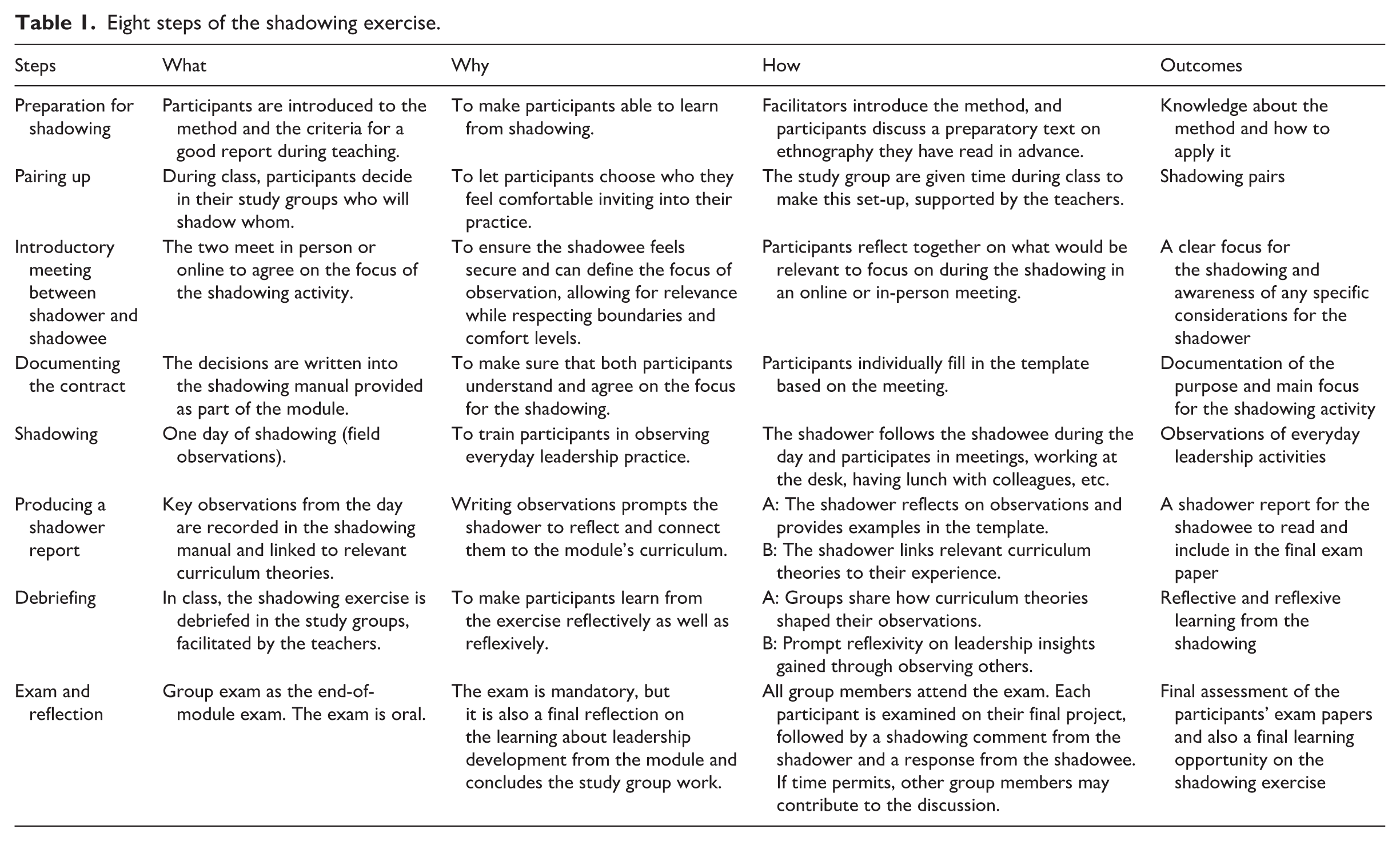
Data were gathered from multiple sources generated through the eight steps outlined in Table 1. The participants (see Table 2) conducted the shadowing intervention independently, as the presence of a researcher was considered too intrusive for this off-campus and inherently sensitive assignment. As a result, data on the shadowing process were accessed indirectly through participants’ written shadower reports, final exam papers, and transcripts from group-based oral examinations, during which each participant’s leadership development project was discussed and assessed. The dataset included 19 exam papers, each accompanied by a shadower report as an appendix, and audio recordings of 30-minute oral exams for each participant, amounting to a total of 9.5 hours of recorded material. All recordings were transcribed for analysis.
Shadowing pairings and participant profiles.
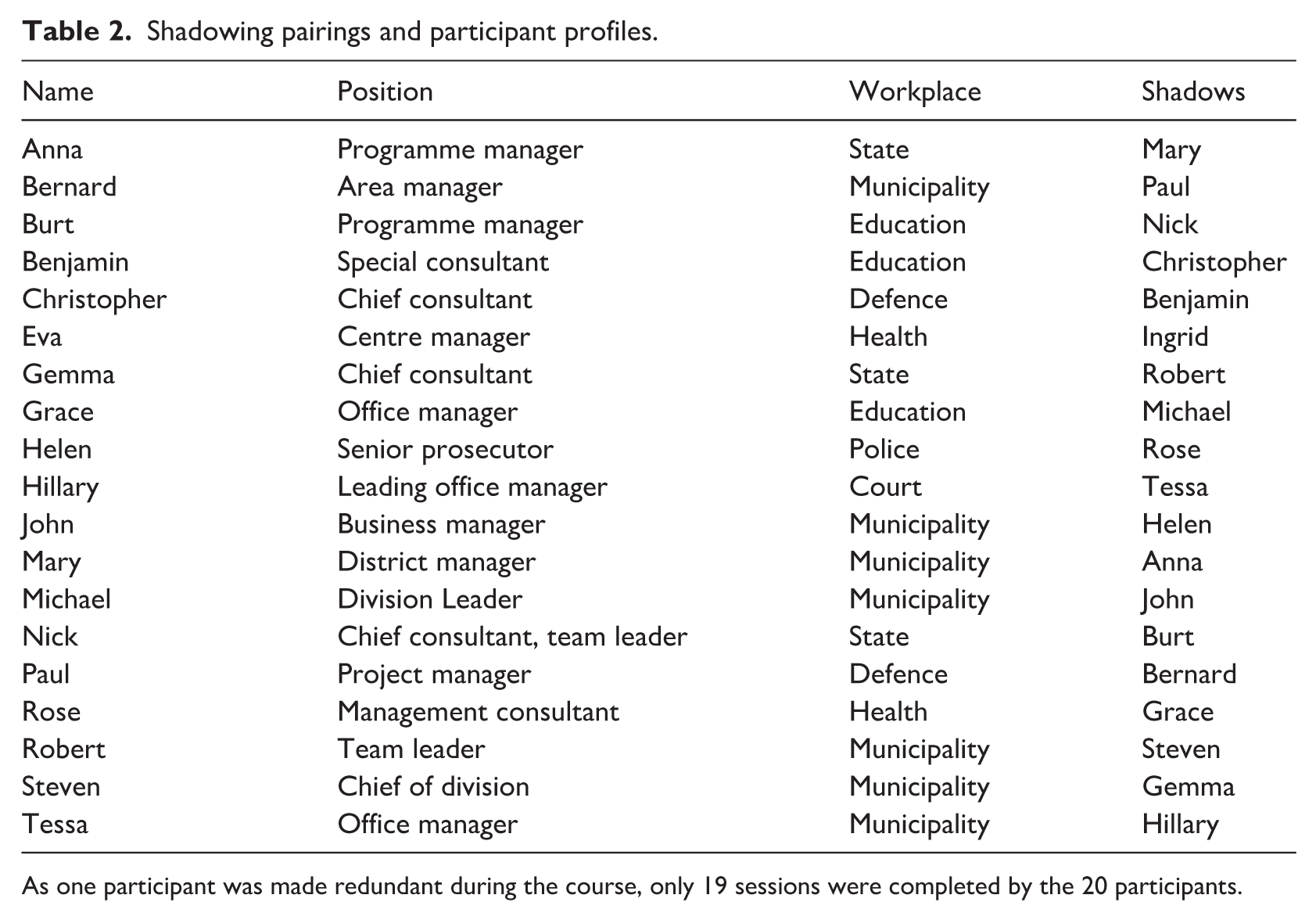
As one participant was made redundant during the course, only 19 sessions were completed by the 20 participants.
To analyse the data, we conducted a reflexive thematic analysis (Braun and Clarke, 2006, 2022, 2023) of final exam papers, including shadower reports, and transcribed oral examination conversations. Two authors independently familiarised themselves with the data, coded selected excerpts using colour-coded documents shared via a cloud drive and resolved discrepancies through written comments. Following a relational approach (Hosking, 2011), we looked for what the shadower noticed to be ‘scenic moments’ in ‘everyday relationally responsive dialogical practices of leaders’ and what they noticed to influence such moments, including ‘practical features of the “landscape”, and surfacing tensions’ (Cunliffe and Eriksen, 2011: 1444). We also looked at how the shadower and the shadowee reflected on these observations regarding their own practice. To attune and align our relational approach, we began with one case to align our coding, then analysed the full dataset. In a final phase, we collaboratively organised participants’ concrete observations by mapping them onto post-it notes on a whiteboard. These were then grouped into clusters to produce more robust themes that we judged to be most relevant for addressing the research question. This process was inspired by the inductive methodology developed by Gioia et al. (2013). Table 3 provides an overview of the steps involved in this inductive process.
Inductive process of uncovering disrupting dynamics for seeing with.
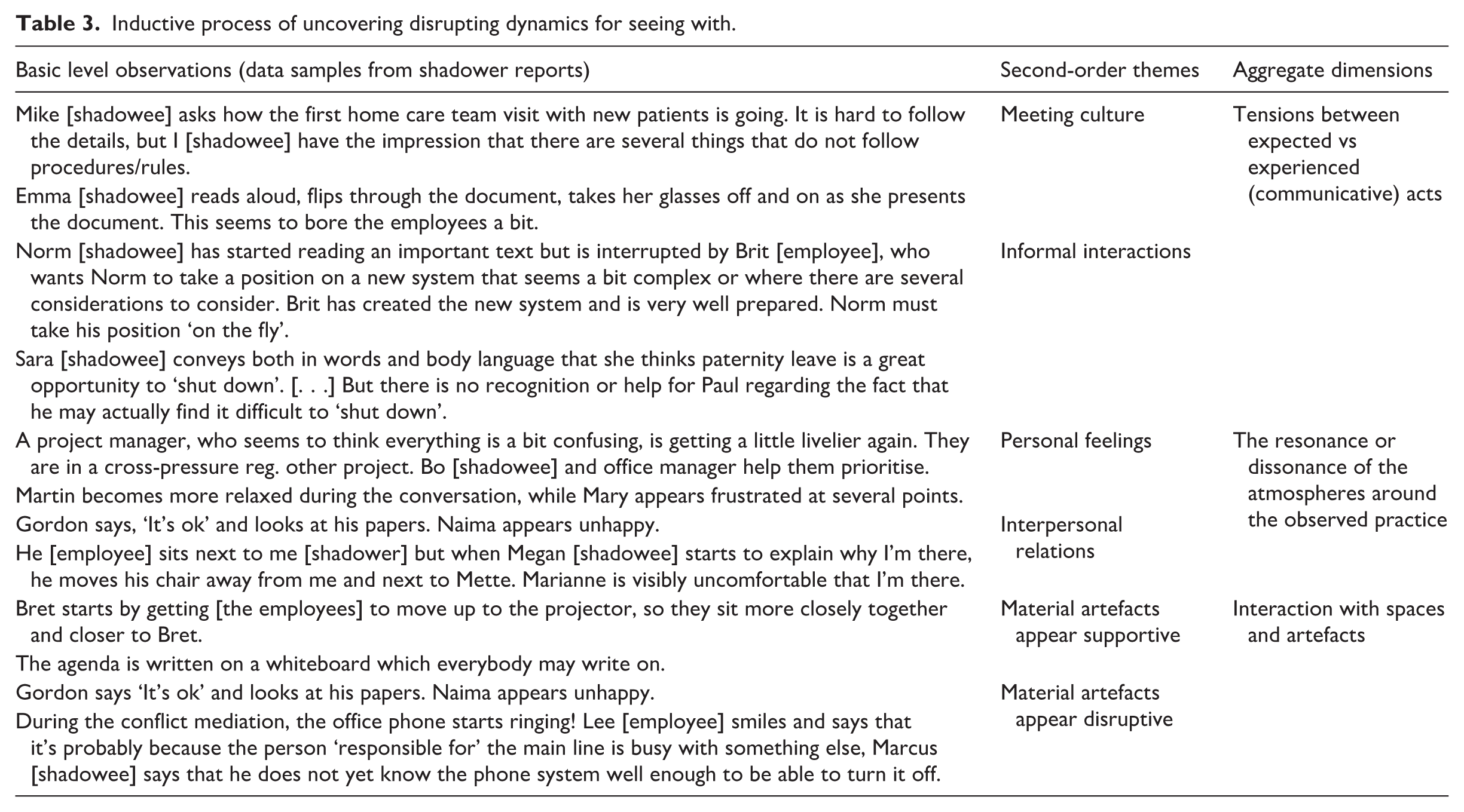
This resulted in three themes that cover what the shadower noticed when visiting their peer: first, communication and interaction, including choice of words, tone of voice, and how the participants interacted during meetings or informal encounters; second, atmospheres, referring to the shadower’s observations of emotional responses and subjective experience of, for example, tensions in the room; and third, observations of interactions including what objects were involved, such as phones, and how these objects influenced behaviour, as, for example, a specific meeting room set-up.
We then went back to the dataset and did a new round of readings in a fourth phase to make sure the initial themes made sense and highlighted the most important patterns across the dataset in relation to our research question. In this phase, our aim was to develop theoretical insights from the data, which we elaborate on in the ‘Discussion’ section. We identified two high-level processes from the peer shadowing intervention, both consonant with our relational approach: seeing with that denotes the shadower’s observations of the intricacies in the shadowee’s practice – seeing the differences, both social and material – and seeing through, which denotes the shadower’s reflexive learning from observing the shadowee’s practice (cf. Czarniawska, 2014). We also noticed differences in how participants responded to seeing with and seeing through, and we coded these differences in three categories of either confirming, expanding, or challenging the participants’ own perceptions of their leadership practice (cf. Cunliffe and Eriksen, 2011). In the final phase of the analysis, we integrated exemplary data extracts into the analytic narrative, which we present in the following section.
Power dynamics in peer shadowing
Power is an inherent aspect of shadowing as an experiential learning activity (Wright et al., 2019) and informed both the design and facilitation of the activity. As a mandatory and assessed component of a formal leadership development module, peer shadowing was institutionally framed in ways that foreground issues of power, transparency, and trust, raising important ethical considerations (Lund Dean et al., 2020). Specifically, the requirement to submit a written report based on the shadowing experience created both motivation and obligation for participants to engage seriously and reflectively while also introducing pressure to perform in line with perceived pedagogical expectations (Wright et al., 2019). In response, the programme was designed to balance psychological safety with constructive challenge. Participants were encouraged to engage openly with uncertainty, vulnerability, and difference, supported by explicit ethical framing and facilitation. This safe yet challenging environment (O’Flanagan and Jester, 2025) enabled participants to question taken-for-granted assumptions about leadership, experiment with unfamiliar perspectives, and engage reflexively with feedback emerging from the shadowing process.
By explicitly framing challenge as a pedagogical resource, the programme sought to create conditions in which participants could extend their boundaries of understanding while sustaining trust in the learning process. At the same time, facilitators remained attentive to the relational and affective dimensions of power that inevitably emerge in experiential learning activities (Wright et al., 2019). An example of this is the debrief session following the shadowing exercise, where we asked participants to reflect on the interpersonal and psychological power dynamics between shadower and shadowee (Green, 2025) and the potential discomfort or disruption that may arise through observation and reporting on another’s practice. Moreover, participants were informed at the very beginning about the opportunity to opt out of the shadowing activity with no consequences for completing the module (Lund Dean et al., 2020). No participants chose this option.
Findings
This study examines how shadowing can enable participants to see leadership as an emergent process situated in everyday life, something that traditional pedagogical activities are not well equipped to do. Central to this are the two processes of seeing with and seeing through. We shall show how these two processes provide access to situated and reflexive leadership learning through LPP in peers’ practices. For clarity, the process of seeing with opens new understandings of leadership practice through the shadower, who, as a newcomer, sees implicit aspects of leadership practice and makes those explicit for the shadowee. Building on reflections on what constitutes leadership in practice, the following reflexive process (Cunliffe, 2004) of seeing through engenders vicarious leadership learning for the shadower while giving potential agency for action for the shadowee.
The structure of our findings is in two parts. In the first, we start with describing the observations of everyday leadership practice that prompted the attention of the shadower – seeing with – and we present illustrative examples of the shadowee’s reflective responses to shadower observations, aligning with three responses of confirming, expanding, and challenging. Second, we present findings from the reflexive responses, that is, seeing through, where the shadower explicates learning about their own practice from seeing that of another. Again, this is followed by examples of participants’ responses either confirming, expanding, or challenging existing understandings of leadership, here at a deeper and more fully reflexive level.
From observing practices to thinking about practices
Here, we examine what captures shadowers’ attention from LPP in shadowees’ practice, focusing in particular on the disrupting dynamics that generate ‘aha’ moments and prompt thinking about leadership from simple reflections to more profound reflexivity.
First prompt for thinking about leadership: Tensions between expected versus experienced (communicative) acts
The first prompt concerned tensions between expected versus experienced (communicative) acts, including both speech acts and more implicit forms of communication such as body language, facial expressions, gaze, and moments of silence. Shadowers often noted deviations from how they anticipated the shadowee would act and highlighted moments they experienced as strikingly different from their own practice, sometimes accompanied by suggestions for alternative responses. For example, Rose observed that Grace engaged in extensive small talk with employees, paying constant attention to ‘how they are doing/what they need’, which Rose felt ‘comes out of the blue and disturbs the meeting’. This illustrates how normativity permeates perception, as seeing with also involves comparison and judgement. Subtler impressions, such as the pace and duration of conversations, were also noted. Burt, shadowing Nick, reported that a conversation ‘surpassed the implicit norm for how long such a conversation could take’, pointing to organisational norms. Rose similarly noted that ‘Grace doesn’t really wait for an answer’, again making the normative lens explicit.
Bodily communication was another trigger prompting reflection on the shadowee’s leadership. In the exam, Helen described being struck by inconsistencies between Rose’s behaviour and body language: she ‘opens her arms and smiles, [but] avoids eye contact, crosses her arms, and chews her gum frantically’, which Helen read as signalling clear dislike of the message. Similarly, Helen observed Rose’s frequent checking of her phone and notebook during a meeting, which she understood as a form of distancing from the interaction. Such moments, where the shadowee breaks with expected interactional norms, recur throughout the material and highlight how expectations shape perceptions of leadership in practice. Shadowers also noted situations where expected behaviours failed to appear. Bernard, for instance, observed that in Paul’s hierarchical organisation, ‘there was no introduction to the meeting and its agenda. They just started head on. Roles, expectations, and content were completely established beforehand’. He also recalled a silent struggle for control between Paul and a superior: ‘[your] voice became lower but the good argument wins. So, you hit back without turning it into a fight – which calls for my respect’. These accounts suggest that shadowers interpret both what is present and absent in interaction through normative lenses shaped by prior knowledge of organisational relations. Likewise, they point to the situated learning process in which shadowers single out significant experiential dimensions emerging from the ongoing interactions and relational dynamics, visible in the expression of ‘respect’.
Second prompt for thinking about leadership: The resonance or dissonance of the atmospheres around the observed practice
The second prompt for thinking about leadership relates to the resonance or dissonance of the atmospheres around the observed practice perceived by the shadowers. They reported how presence was felt ‘in the room’ and how emotions were conveyed. For example, Paul observed Bernard creating a good atmosphere by ‘walking around and greeting people with nice and friendly comments which supports a good start to the day’. The ability to establish a ‘welcoming atmosphere’ or a ‘positive feeling’ was mentioned in most accounts, particularly in meetings. Outside meetings, impressions were more varied: John described Helen as ‘a bit tense’ while waiting in court but, nevertheless, able to create a ‘very comfortable atmosphere’, leading John to ’realise [. . .] how big a difference it does that [the persons present] can feel this’. Shadowers also identified a negative atmosphere. Rose described confusion with ‘phones ringing’, ‘no clear agenda’, and ‘little control of who gets to talk’, which led her to think about the effects on employees, noting that ‘at least two employees leave with unfinished business’. Bernard sensed a feeling of ‘severity’ in meetings starting abruptly, ‘like boom (a snap by the fingers) now we start’, and Tessa was struck by the ‘stately and stout’ building where she met Hillary, contrasting it to the ‘frantic environment’ of her own organisation. While these observations may seem trivial, they suggest that attentive leadership involves sensing atmosphere to keep ahead of potential conflicts and other organisational obstacles.
Third prompt for thinking about leadership: Interaction with spaces and artefacts
Finally, our data show that as the shadower moves through different spaces and interacts with artefacts, they notice material aspects of practice such as the physical environment, objects, and attire. For instance, Christopher observes what happens when Benjamin ‘starts by asking [his employees] to rearrange so they sit more closely together and [closer] to the screen’, prompting reflection on how physical arrangements enable knowledge sharing and involvement. Robert observed power distances when ‘line managers positioned themselves in the room in relation to Steven [. . .] Steven sat in the corner, and the next couple of seats were empty’, while Mary interpreted an employee’s isolation as deliberate when he ‘entrenched himself in the corner [wearing his] headphones’.
Other examples show how artefacts shape impressions. John described the urgency of ‘police cars arriving with boxes of evidence’ while ‘phones keep ringing frantically’, prompting reflections on the emotional demands of leadership under stress. In contrast, Rose associated Grace’s ‘wall full of pictures from all kinds of events at the office mixed with pictures of children and grandchildren’ with a sense of homeliness. Tessa pointed to judges’ robes as symbols of both solemnity and routine, and Helen interpreted Rose’s posture – ‘hid[ing] in her uniform with her hands in her pockets’ and sliding ‘halfway down the chair and under the table’ – as signalling pressure and withdrawal. Across these examples, shadowers link material cues to the dynamics of organisational life.
All three dynamics observed – unexpected communicative acts, perceptions of atmospheric resonance or dissonance, and interaction with spaces and artefacts – are inherently processual, unfolding through ongoing interaction and continually shaped within local relationships (Kennedy et al., 2015). They are presented to the shadowee through the shadower report and become occasions for further dialogue in subsequent debrief dialogues, both in class and at the oral exam. Next, we present findings on shadowees’ responses to these observations, either confirming, expanding or challenging their preconceived perceptions.
Reflective responses from seeing with
Shadowees often confirmed the shadowers’ observations by linking them to their own developmental focus. Helen, for example, aimed to adapt her communication, and John’s report confirmed that she was ’on the right path’ and encouraged her to continue experimenting with her communication by ‘showing confidence, interest and a positive attitude; practice active listening; inquire and continue to work with language, body language and tone of voice’. Observations could also expand shadowees’ understandings. Reflecting on her leadership challenge of strengthening coaching, Mary reported that Anna’s feedback ‘helped me focus on what may not make sense and to ask more questions’, a shift she mentioned at the exam to have produced good results and encouraged her to ‘continuously assess how I succeed with developing my leadership skills’. Finally, shadowers sometimes challenged shadowees’ perceptions of their leadership practice. Nick, observing Burt, described a situation where Burt felt obstructed but which Nick read as colleagues legitimately seeking clarification and stated that: ‘My interpretation is different: The colleagues wished to know more about “What’s in it for us?” In many ways, it was a legitimate question’. Burt later acknowledged being ‘caught in patterns’ and accepted Nick’s interpretation as equally plausible: ‘I could see that his analysis of the situation was just as probable as my own . . . and a source for both reflection but also “strategic change” of my approach to practice leadership’. This prompted him to listen more carefully and be aware of his own preconceptions.
While all responses contributed to learning, observations that expanded or challenged shadowees’ perceptions seemed particularly powerful for leadership development, provided they were accepted as opportunities for reflection. We now turn from seeing with to seeing through – a reflexive process sparked by engaging with another’s leadership practice.
Reflexive responses from seeing through
Seeing through refers to how shadowers learn about their own practice by observing others’ leadership. From a processual perspective, seeing through develops over time as a reflexive extension of seeing with and emerges only in a limited number of instances. In this article, we adopt a broad conception of reflexivity which, following Dyer and Hurd (2016), includes challenging theory (Alvesson and Willmott, 1996), changing organisational processes (Spicer et al., 2009) and talking and acting in new ways. Our most consequential form of reflexivity – challenging – aligns with more radical or critical conceptions of reflexivity, which involves ‘unsettling conventional practices’ (Cunliffe and Easterby-Smith, 2004: 31).
Adam shadowed a highly paced central government manager, prompting reflexive insights into his own leadership practice. Observing this pace made him reconsider how sending frantic emails ‘to keep [his] desk clear’ might put undue pressure on employees, a dilemma of pace versus pressure that became visible only through observing a peer’s practice via LPP. In relation to his shadowee, Adam begins to recognise his own previously familiar practice as unsustainably high-paced, and this recognition unsettles his existing assumptions through reflexive engagement. Although the shadowing exercise was designed primarily for the shadowee’s learning, our findings show that shadowers also engage in reflexive learning in ways that are difficult to predict.
Juliet, for example, reported at the oral exam that shadowing Hannah had made her ‘think about something, because [. . .] after I had seen how Hannah behaved there [. . .] the presence that you [Hannah] show out there, that’s actually the path we need to take to show good leadership’. The exchange illustrates a dialogical process (e.g. Dyer and Hurd, 2016) through which Juliet makes sense of Hannah’s practice from her position as a legitimate peripheral participant through horizontal, conversational talk that simultaneously connects reflexively to an ideal of good leadership. ‘Presence’ here is not offered as a polite cliché, but witnessing Hanah’s presence unsettles the way Juliet hitherto has thought of leadership altogether. The situated nature of the interaction reflects Juliet’s participation at the periphery of Hannah’s everyday practice, while the relational quality is evident in her use of the pronoun ‘we’, which perhaps even extends beyond the dyad to include the broader community of leadership learners. Through this reflexive dialogue both participants are positioned as learners oriented towards a shared understanding of leadership as enacted presence in practice.
Also, during the oral exam, Theo recalled an earlier dialogue concerning Victoria’s chief executive officer (CEO), who had remarked that work was, ‘just something we play’. Theo reflected that ‘we could learn a lot from that, all of us, and that’s at least something I’ve picked up’. Through this exchange, Theo came to recognise that leadership can – and perhaps should – include having fun and enjoying oneself, even when mistakes are made, a view he described as ‘so atypical of leadership’. Here, reflexivity emerges dialogically rather than through private introspection in the classical sense, unfolding instead in situated, everyday conversations in which meaning and significance are co-constructed between interlocutors. His dialogical reflexivity unsettles his own conventional practice of regarding leadership as serious and grave. Through dialogical reflexivity, the shadowers’ outsideness becomes a source of learning. While the shadowing exercise may initially appear oriented towards generating insight into the shadowees’ practices, our findings show that it often gives rise to even more significant learning about the shadowers’ own leadership practices. This learning draws on the shadowers’ relatively low-status position as newcomers, which enables them to engage with interaction from different communicative grounds (Czarniawska, 2014) than those typically foregrounded in methods such as interviews, where empathy and alignment are emphasised. At the same time, it remains difficult to specify when such dialogical exchanges become felicitous – when they successfully trigger reflexivity and situated learning. This points to the need for a more nuanced understanding of the conditions and dynamics through which dialogical reflexivity unfolds. In the following section, we therefore turn to how shadowers respond to their observations of shadowees’ practices.
The reflexivity from the conversations about the experience of seeing ongoing leadership practices of others either confirms, expands, or challenges existing perceptions of leadership. For example, Bernard reports that observing Paul during the shadowing experience confirmed his belief that effective communication is central to being an impactful leader: Being able to motivate [employees], to make them feel seen, heard, and understood . . . is one of the foundations of all kinds of leadership. Actually, in every relation to others. It is important that as a leader you can communicate purposefully, to communicate what you want in a way that your chances of being understood are increased while being aware that all communication both analogue and digital is received through a filter, selected, prioritized and influenced by culture and context – actually this is relevant in all parts of life.
Expanding John’s own thoughts on the importance of being present and available as a leader, he noticed: I must admit that the observation I did when shadowing Helen made a substantive impression on me as Helen was really present and I realized how much difference it makes on the recipients [of the communication] that they can feel this presence.
He continues his reflexive thoughts in the exam conversation by sharing that I have also become more aware that being present can create better conditions for my employees and I agree with [the leadership scholar Keith Grint] that leadership often is about creating the right conditions for avoiding problems. This accordingly means that if I mean to conduct ‘clear leadership’, as my observer expresses it, physical presence is paramount.
Finally, reflecting on others’ leadership practices can also challenge one’s own leadership practice, which aligns closer to Cunliffe and Easterby-Smith’s (2004) idea of practical reflexivity. Gemma, for example, reflected on observing a situation where Robert talked to his leader about the difficulty of managing his work-life balance but received less support from his supervisor than he sought. This led her to share her reflexive thoughts on how she could challenge her own practice of requesting support from her superiors by ‘transparently revealing her own uncertainty’, regarding her needs from her superior to be able to address a leadership challenge as shared rather than as only hers. Similarly, Michael wrote in his assignment: I learned a lot from my work as an ethnographer, which I want to bring into my own management practice. Jim [the shadowee] was very clear in his leadership and had clear opinions and statements about how he wanted things done.
He expanded this further at the oral exam, directly addressing Jim: ‘You were so clear about your goals and how you wanted it to be. I would like to have some of that!’ While Michael did not explicitly articulate his own shortcomings, the clarity and consistency of his shadowee’s leadership clearly challenged his understanding of his own practice.
Our analysis has highlighted how LLP in leadership practice enables participants in leadership development programmes to see and learn about leadership as an ongoing everyday practice, something that traditional leadership development pedagogies are not equally well suited to facilitate. In the discussion, we conceptualise how the processes of seeing with and seeing through interrelate and how they connect to situated learning.
Shadowing and its implications for situated leadership development
Traditional classroom-based pedagogies that invite managers to recount formative leadership experiences (Saunders, 2024) often fail to capture the nuanced, everyday processes through which leadership is constructed (Kempster and Stewart, 2010). This limitation reflects the entitative assumptions underpinning such designs, as well as the often imperceptible dynamics by which the flow of leading and following occurs.
From a processual perspective, our analysis shows how peer shadowing reveals emergent leadership practices in managerial contexts. Through the interrelated processes of seeing with and seeing through, participants gain insight into key leadership dynamics, which we conceptualise in Figure 1.
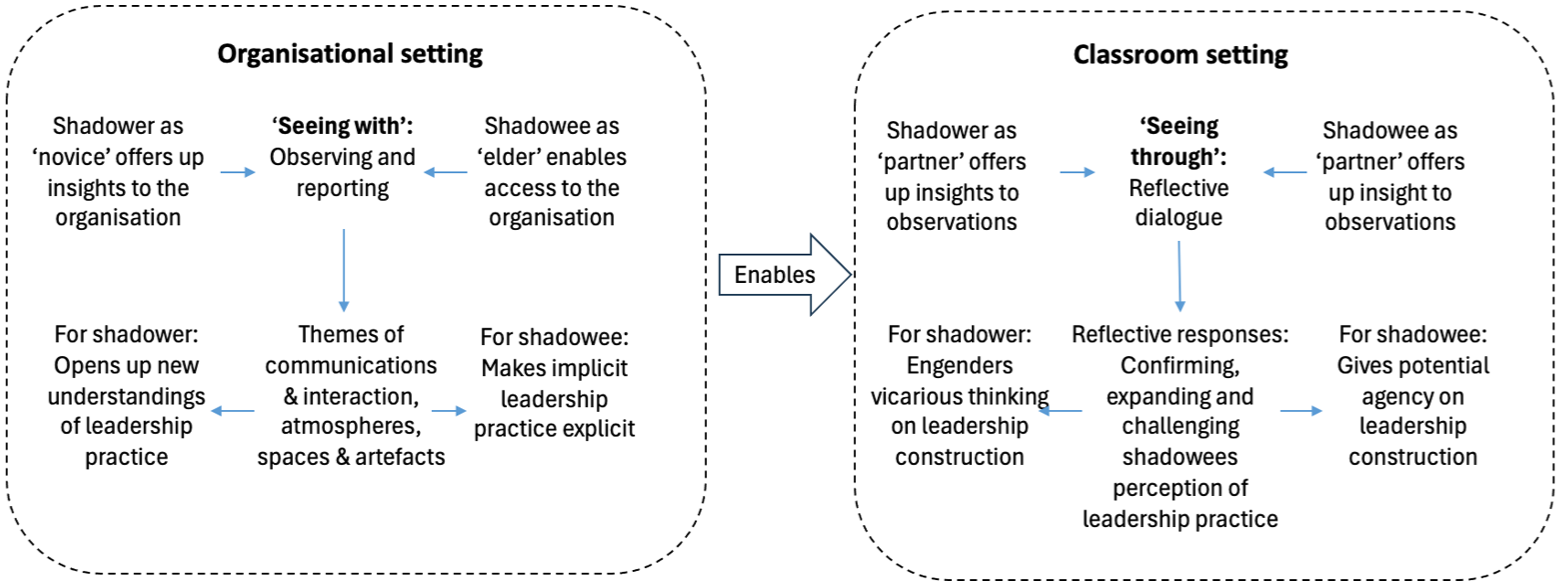
Revealing situated leadership practice through shadowing.
Figure 1 depicts two interconnected sub-processes linked through the programme activity of peer shadowing, with seeing with primarily occurring in the host organisation and seeing through unfolding within the classroom. We say primarily as the findings provide data for this argument. However, drawing on a process-relational ontology, we do not want to exclude the likelihood of both seeing with and seeing through occurring in the classroom and organisational settings, respectively. Shadowing begins in the organisational setting, as a shadower visits a peer’s organisation. Drawing on LPP, the shadowee occupies the position of ‘old-timer’, while the shadower enters as a legitimate newcomer through the programme intervention (Lave and Wenger, 1991). This legitimacy enables participation in everyday organisational activities such as meetings, events and informal conversations. Seeing with happens through observation, note-taking, and the production of a report structured around key observed themes, which the shadowee reviews in preparation for the later in-class debrief that follows the visit to the host’s organisation (Smith et al., 2019).
The second sub-process of seeing through primarily takes place back in the classroom after the organisational shadowing has concluded. Here, the shadower and the shadowee act as learning partners in a continuous process of LPP, supported by programme facilitators. Through structured engagement with the shadowing report, the pair confirm, expand, or challenge insights into leadership practice. In doing so, the peer shadowing intervention creates dialogical encounters (Beech et al., 2010) where participants jointly explore and reframe understandings of leadership rather than merely exchange observations. At the pair level, interactions between shadower and shadowee invite relational reflexivity (Cunliffe and Karunanayake, 2013), as the participants critically examine their own leadership practices through the lens of another’s perceptions and reflections. The debrief around the shadower’s report offers a moment of vicarious learning, as the shadower simultaneously reflects on their own leadership while describing and questioning what they observed in the context of the shadowee. This dialogical reflexivity is further amplified during the collective discussions in the final group session, where multiple perspectives converge, supporting a broader social construction of leadership understandings (Hibbert et al., 2014). A key outcome from seeing through is for both partners and the wider group to gain deeper insight into leadership as a relational, situated process, alongside an expanded sense of agency for future intervention. We return to this point when discussing leadership practice, power, and emancipation.
The framework presented in Figure 1 provides a theoretical structure for how leadership development can be designed to engage with and embrace processes of everyday leadership. Moreover, it provides a pathway and catalyst for theory construction for understanding how leadership development can reveal the ‘temporally situated, complex and connected nature of the contexts within which leadership is usually enacted’ (Hibbert et al., 2017: 618). Without some form of pedagogical intervention (such as shadowing), managers run the risk of being excluded from an understanding of the dynamics shaping themselves and their everyday leadership interactions (Kempster and Stewart, 2010).
Our theoretical framework reframes the use of LPP in shadowing for application within leadership development for two reasons: first, to give attention to processes of ongoing practice construction because LPP is itself a process enabling such practice construction; second, as a consequence of the first, it enables insight into leadership as an emergent process. For example, our data has highlighted three dynamics of everyday leadership that were noticed by the shadower and which may not have been identified by an insider alone: unexpected communicative acts, perceptions of atmospheric resonance or dissonance, and interaction with spaces and artefacts. Czarniawska highlights that a strength of shadowing lies in the recognition of differences: ‘one cannot ever really see one’s own exterior and comprehend it as a whole . . . our real exterior can be seen and understood only by other people, because they are located outside us in space, and because they are others’ (quote by Bakhtin in Czarniawska, 2014: 45). Integral to the adaptation of LPP (in Figure 1) is the utilisation of the idea that LPP can occur within leadership development programmes. Smith et al. (2019: 81) suggested the use of LPP within leadership development with the notion of an emergent curriculum of social learning: ‘a curriculum that is capable of being translated and applied to their practices, because it is drawn from their practices’. The trajectory of participant learning within a leadership development programme was seen to be most varied, dependent on individual commitment to becoming a full and active member. Similarly, the facilitators’ commitment to letting go of an entitative understanding of learning and embracing a process-relational orientation was identified as significant. This orientation emphasised learning as emergent practice construction and required ‘moving away from content expertise and flowing with the vulnerability of a [curriculum and] pedagogy of the unknowable’ (Hibbert and Cunliffe, 2015: 186). There is much resonance here with our theorising of leadership development through LPP in shadowing. Also of note is the issue identified with the facilitators’ power to enable LPP within a leadership development programme. In Smith et al. (2019), they speak of ‘enablers’ – quasi ‘old-timers’ steeped in a commitment to a process-relational orientation of leadership development. Yet they do not speak about power, an aspect we wish to give attention to.
Power within leadership development
The strength of the shadowing process lies partly in the institutional power embedded in assessment and the legitimate authority of the facilitators. The written report is a mandatory and assessable outcome and functions as a central artefact in the shadowing process. By making both the requirement and assessment criteria explicit (see methodology), facilitators foreground power as an integral condition for revealing leadership through LPP. We question whether shadowing conducted outside a formal educational programme – without facilitation, instruction, and assessment – would generate comparable insight. Making shadowing compulsory requires participants to suspend their habitual role as acting managers and adopt an observational stance rarely prioritised in everyday practice. The educational context further positions the report as a focal point for reflexive dialogue, shaped by assessment expectations and relational engagement between shadowing partners.
At the same time, shadowing introduces power-related tensions inherent to experiential learning (Wright et al., 2019). As an intrusive and disruptive activity (Johnson, 2014), experiential and transformative learning demands careful facilitation to manage power asymmetries and ethical concerns (Smith and Kempster, 2019; Kjærgaard and Meier, 2022). While psychological discomfort may be a condition for learning (Czarniawska, 2014), it must be appropriately supported (Lund Dean et al., 2020; Wright et al., 2019). The report itself exerts considerable power by confirming, extending, or challenging participants’ understandings of practice. Grounded in direct observation, it is difficult to dismiss as irrelevant, yet it risks assuming the status of an ‘objective gaze’ – what Haraway (1988) describes as the ‘God trick’ of seeing from nowhere.
Although the programme seeks to establish a safe learning environment (Mavin et al., 2024; O’Flanagan and Jester, 2025), questions remain regarding the longer-term implications of reflexive and potentially emancipatory learning. Smith and Kempster (2019) caution that unbounded reflexivity may provoke unsettling transformations, particularly when participants return to organisational contexts with limited support. This tension is inherent to emancipatory interventions but is especially acute in leadership development, where participants – as a consequence of their roles – often hold disproportionate organisational influence.
Leadership development as an emergent process
Regarding the emergent practice construction (Dall’Alba, 2009; Sklaveniti, 2020), the exam conversations revealed managers beginning to recognise aspects of leadership practice in their contexts. However, their orientation still leaned towards becoming better leaders – a view that misunderstands leadership construction forged through LPP as an emergent process within an organisation. Managers may notice everyday leadership practice, modify behaviour, and influence their setting within an organisation; however, leadership practice is not a linear process of enhancement leading to new levels of leadership competencies. Rather, it can be understood as a continuous process where leadership plays out in interactions and context and may or may not lead to better leadership behaviour or outcomes (Saunders, 2024). It is not a process to be shaped to the individual’s will (Alvesson and Jonsson, 2018). This then risks raising hopes for change that cannot be immediately fulfilled. For educators, this creates a tension between responding to managers’ desire for guidance on how to become better leaders – reflecting an entitative orientation – and facilitating shadowing as a process that reveals leadership as emergent, relational, and continuously becoming (Crevani and Endrissat, 2016).
Practical implications for leadership development designs
Building on the critique above, we suggest some practical implications for facilitators who seek to use shadowing to surface leadership dynamics in development programmes. Over more than 10 years and with over 1000 participants, responses to shadowing have been consistently positive, and we have no reason to think that participants in this study are different from previous cohorts. Directly quoting from the data, participants were ‘surprised about how much you learn by seeing others [practices]’, valuing the ‘strong experience to be a fly on the wall in such a vulnerable situation’. They described shadowing as ‘an eye opener teaching me how to both observe and letting someone else observe me’ and reported ‘increase[d] awareness of different positionings’ and the insight that ‘all communication . . . is received, filtered, selected, prioritised and influenced by culture and context . . . well the entire life’. Although some initially expressed scepticism, many later reported appreciation for the insights gained from ‘an important learning opportunity’, even when the shadowing experience involved emotional strain. Overall, participants evaluated peer shadowing as an unexpected but meaningful contribution to their understanding of leadership as a continually constructed process.
At the same time, we encountered several facilitation challenges. Not all participants engaged equally in the process, and some treated shadowing as a friendly visit rather than a learning intervention. To reduce the risk of this, we point to the importance of scaffolding the learning process, including a clear framing of aims, guidance on what to observe and dedicated time in class for planning and debriefing. Even so, participants’ organisational pressures (e.g. lay-offs, experience of harassment, and major financial cutbacks) make it difficult for even the experienced facilitator to ensure proper engagement with the task. This calls for flexibility and willingness to find individual solutions. A further challenge is the use of oral exams as a basis for reflexive dialogues. While the oral exam was intended as a holding environment (Petriglieri and Petriglieri, 2010) for open and critical reflections, exam situations are laden with asymmetries of authority and power that may temper critical engagement. As a result, interactions tend to be more neutral than critical or probing. Also, conflict or anxiety avoidance (Vince, 2010) has dominated with a tendency to privilege benign or non-confrontational interpretations of observations (Heifetz et al., 2009; Kennedy et al., 2015). To counter this tendency, we designed a dedicated session to make these dynamics salient in conversations following the shadowing partners’ exam report discussions.
Conclusion
The field of leadership development scholarship and practice continues to be dominated by an entity orientation despite sustained critique for ‘focus[ing] on individuals rather than observing and studying processes’ (Crevani, 2018: 83). Such a critique reflects Raelin’s (2016) argument that to understand the practice of leadership requires an explicit connection to its context. In terms of learning leadership practices, emphasis must be given to situated processes and relationships (Edwards et al., 2025). Such an orientation to leadership development has three major challenges. The first is ontological: a shift from an entity perspective to a process-relational perspective. Leadership development would foreground the continuous movements and relational flows through which leadership practice emerges and becomes over time (Carroll and Simpson, 2012; Chia, 2017; Crevani, 2018; Hernes, 2014; Langley et al., 2013). From this perspective, leadership is not treated as a fixed set of attributes or competencies (Carroll et al., 2008) but as an ongoing accomplishment constituted through practice. The second and related challenge is conceptual – moving away from conceptualising leadership development as static building blocks of skills and competencies and towards leadership development that is rooted in the continuously emergent, processual, and relational leadership practice (Eva et al., 2021; Meier and Carroll, 2020). The third challenge is in the forms of intervention in leadership development practice that can reveal the often impeccable aspects of process-relational dynamics shaping situated leadership practice and in a manner that can be helpful to participants within leadership development programmes.
It is these three challenges that we have sought to address in this article. As a consequence, our contributions are threefold. First, at an ontological level, our findings suggest the value for leadership development studies to further exploit and extend the turn towards a process-relational orientation (Carroll and Simpson, 2012; Crevani, 2018; Crevani and Endrissat, 2016; Langley et al., 2016; Meier and Carroll, 2020, 2023; Nicholson and Carroll, 2013; Raelin et al., 2018). This points to a deeper and perhaps more fundamental reorientation concerning the ontology of leadership development. Within leadership studies, there are many new forms of leadership being explored and offered up for managers to consider that are broadly centred on a process-relational ontology: for example, collective, distributed, and shared leadership (Denis et al., 2012; Ospina et al., 2020). However, the field of leadership development could be considered lagging behind such theory development in leadership studies in terms of process-relational approaches (Souza, 2023; Vuhuong and Edwards, 2022). Day’s (2000) influential paper offered up much potential to reshape the field of leadership development. The central argument was to distinguish between human capital as leader development and social capital as leadership development. Both capitals are conceived within an entitative conception, and subsequent research has built on such an assumption (see, for example, Adler and Kwon, 2002; Day and O’Connor, 2003; Gentry and Leslie, 2007; McCallum and O’Connell, 2009; Zacharakis and Flora, 2005). There is, however, less research that has assumed a process-relational ontology from which leadership development has been conceived. We draw on Kempster and Stewart’s (2010) work for its focus on the relational processes shaping leadership learning. However, this work does not address how such processes can be enacted within leadership development programme design. We therefore position peer shadowing as a pedagogical mechanism for operationalising a process-relational ontology within leadership development.
Second, at a conceptual level and through our deployment of LPP, as illustrated in Figure 1, we provide insight into how leadership development through peer shadowing can be reframed as a process-relational dynamic, rather than a linear acquisition of skills. Figure 1 conceptualises peer shadowing as two related sub-processes: seeing with, in which participants attend to process-relational dynamics unfolding in organisational practice, and seeing through, which involves structured reflexive dialogue within the peer shadowing pairs, rendering previously unobserved aspects of leadership. Our contribution extends the work of Cunliffe (2008) and Smith et al. (2019) by showing how peer shadowing brings leadership, as constituted through everyday emergent, situated, and relational dynamics, into analytic focus. In this way, peer shadowing through a process-relational pedagogic design offers up an approach to leadership learning that traditional entitative approaches are less capable of.
Our third contribution is to lay out in much detail how the ontological and conceptual ambitions can be undertaken within leadership development practices through peer shadowing, thus expanding the scope of shadowing pedagogy (Lalleman et al., 2017; Nicolini and Korica, 2025). We have demonstrated a considerable and subtle learning outcome for both shadower and shadowee from an otherwise rather confined management education setting. Yet the applicability of shadowing, we suggest, goes well beyond this setting and may reach into broader organisational spheres such as corporate leadership development programmes in which, for example, potential leaders may shadow senior leaders and vice versa, creating unexpected leadership learning across the organisation, perhaps challenging and expanding prevailing leadership perceptions. Due to its layered effects – seeing with and seeing through – shadowing allows learners at different levels and capacities to gain from the experience. Given adequate instruction and supervision, shadowing remains a powerful yet frugal intervention due to the ready availability of its two primary resources: the ongoing, everyday leadership practices and the observant peer.
While instructors remain accountable for instruction and supervision, peer shadowing is an inherently participant-driven intervention. It invites instructors to empower students of leadership development to forge their own path in learning not only from the variety of leadership practices but also from which of these resonate or perhaps challenge their deepest held convictions. It is thus leadership development within leadership practice, offering a format which may match the complexity of leadership in contemporary organisations while retaining a succinct simplicity in its design. Its strength lies in the unlikely power of seeing with and seeing through.
However, we wish to emphasise that it is difficult for programme participants to understand leadership development as an emergent process, and we have problematised this in our discussion, including considerations of power and depth of reflexivity. We acknowledge certain limitations of this study, particularly in terms of the applicability of insights to other contexts. The participant group was relatively homogeneous, consisting exclusively of native speakers working in public sector organisations. In addition, the participants in this study shared similar cultural backgrounds, and a majority identified as female. These demographic factors may have influenced participants’ openness to shadowing and their experiences of the practice. Exploring how shadowing is received and enacted by more diverse participant groups – including variations in sectors, gender, culture, and language background – would offer valuable insights into its broader applicability and impact.
Notwithstanding the practical limitations above, our three contributions provide an opportunity for the field of leadership development to explore a process-relational orientation to leadership development. The field of leadership studies has offered up much insight into leadership as a process-relational dynamic. There is considerable scope for the field of leadership development to build on this work and develop scholarship that can help to reframe how managers gain insight into the unfolding situated leadership practices that they participate in.
Footnotes

Funding
The authors received no financial support for the research, authorship, and/or publication of this article.
Declaration of conflicting interests
The authors declared no potential conflicts of interest with respect to the research, authorship, and/or publication of this article.