






Abstract
Organisations in polycrisis no longer face isolated shocks but overlapping disruptions that unsettle professional identities and everyday work. This study examines how staff in UK universities learn, unlearn, and resist when institutional change accelerates beyond their capacity to adapt. Through a textual–visual thematic analysis of 41 participants’ narratives and self-selected photographs, we specify how hysteresis operates as a learning condition under sustained polycrisis. We identify three patterned responses under conditions of hysteresis: adaptive (pragmatic recalibration), ambivalent (emotional suspension), and resistive (ethical defiance). These reveal how affect, time, and institutional complexity shape divergent ways of making sense and sustaining integrity in turbulent contexts. The study advances management learning theory by showing how professionals learn morally and emotionally amid uncertainty, demonstrates the value of multimodal inquiry for tracing affective dynamics, and offers insight into how leaders might recognise and support varied trajectories of becoming during sustained disruption.
Introduction
How do professionals learn when organisational change no longer arrives as a discrete episode but as a sustained condition of disruption? Contemporary organisations increasingly operate under conditions of polycrisis, where economic, political, ecological, technological, and social shocks intersect and reinforce one another (Groutsis et al., 2023; Wood et al., 2024). Such conditions do not necessarily dismantle everyday routines in immediate or visible ways. Teaching continues, meetings are held, and performance indicators are monitored. What shifts is not always the form of work, but its moral and affective meaning. Routines that once expressed professional purpose increasingly become vehicles for survival under audit, marketisation, performance management, and digital efficiency logics.
This study examines these dynamics in the context of UK higher education, a sector experiencing sustained turbulence driven by marketisation, funding volatility, digitalisation, performance metrics, and recurrent restructuring and redundancy exercises (Billsberry et al., 2023; Brown, 2015; Vos and Page, 2020). These pressures are shaped by an evolving regulatory architecture, including Office for Students (OfS) oversight, Research Excellence Framework (REF), and Teaching Excellence Framework (TEF) assessment regimes; immigration policy on international student visas; and successive funding settlements that have tightened public investment while incentivising market behaviour. While core activities such as teaching, research, and administration persist, their conditions of enactment have become increasingly unstable, emotionally charged, and ethically contested.
The dynamics examined here concern the persistence of professional practice under shifting evaluative logics, the growing misalignment between inherited standards of good work and new institutional criteria, and the affective strain that accompanies this sustained misfit. By inherited standards of good work, we mean dispositions formed under earlier institutional conditions, including collegial autonomy, scholarly depth, pedagogical discretion, and peer recognition. By new institutional criteria, we mean REF and TEF outputs, National Student Survey scores, retention metrics, journal ranking lists such as ABS, and audit-driven workload models. In this context, learning refers to patterned reorientation of practical sense under conditions where alignment between professional dispositions and institutional expectations remains persistently unsettled. As such, learning is framed neither as formal skill acquisition nor as successful adaptation.
UK higher education is not treated here as an exceptional case but as an analytically revealing site. The sector is unusually exposed to external shocks due to its reliance on market mechanisms, international student flows, and performance-based funding regimes (Papatsiba and Marginson, 2025). Global developments such as pandemics, geopolitical instability, and financial crises are rapidly translated into local organisational consequences, including budget shortfalls, hiring freezes, and intensified audit practices. Recent estimates suggest that nearly half of UK universities anticipate operating deficits in the near term (OfS, 2025), signalling a sector under existential strain. In this sense, universities function as a microcosm of organisational life under overlapping and mutually reinforcing disruptions.
Universities have always been changing institutions. What distinguishes the present moment is the convergence of two dynamics. The first is the sustained intensification of marketisation and managerial reform, characterisable as a deepening neoliberalisation of the sector through funding regimes, audit, and competition. The second is the layering of these reforms with exogenous shocks, including pandemics, geopolitical disruption, anti-migration policy drive, energy and inflation volatility, and rapid digital transition. Polycrisis, in our framing, names the entanglement of these dynamics rather than either alone. Neoliberalisation is therefore necessary but not sufficient to explain the present condition.
Sectoral pressures translate into institutional crisis through three transmission mechanisms: regulatory and funding compliance, market positioning relative to competitors, and the cascading effect of these pressures onto departments, teams, and individual professionals. Importantly, institutional crises do not automatically result in the breakdown of professional practice. Its effects unfold incrementally. Core activities continue, but under shifting evaluative, temporal, and moral conditions. As institutional demands accumulate and accelerate, professionals continue to act, teach, research, and administer. What changes is the evaluative horizon within which these activities are judged and experienced. The criteria of valued work, defined principally through metrics, such as student satisfaction scores, journal rankings, grant capture, and retention figures, change frequently in their thresholds, weighting, and rationale, often within annual review cycles. The practical orientations through which professionals have learned to do their work, including scholarly judgement, pedagogical care, and collegial deliberation, are formed across decades of professional socialisation and recalibrate only slowly. The mismatch between the velocity of evaluative criteria and the slower temporality of dispositional formation is precisely what generates hysteresis. For example, marking standards judged appropriate under earlier educational logics are now evaluated against retention and satisfaction targets, leaving professionals to reconcile two evaluative frames simultaneously.
Much of the management learning literature conceptualises learning in crisis as a process of sensemaking, adaptation, or skill acquisition that enables recovery or renewed alignment (Cunliffe, 2004; Hibbert and Cunliffe, 2015). Crisis is often treated as a bounded interruption, after which organisations and individuals recalibrate (Oleksiyenko et al., 2023). This framing is less adequate for contexts in which disruption is prolonged and cumulative, and where the conditions generating misalignment remain unresolved. Under such circumstances, the question becomes how professionals remain oriented to work when misalignment persists rather than resolves.
Related scholarship on institutional change has examined how individuals negotiate contradictions and emotional demands through identity work (Brown, 2015; Creed et al., 2010; Lok and De Rond, 2013). By institutional change in UK higher education, we refer to three concrete shifts over the past two decades: the reconfiguration of evaluative regimes (REF, TEF, NSS, ABS rankings), the marketisation of student recruitment and tuition, and the managerialisation of governance through workload models, audit, and recurrent restructuring. These changes do not arrive as discrete events but cumulate, generating sustained reconfiguration rather than a single transformation. This literature has shown how actors reconstruct identities in response to shifting institutional logics, often emphasising reflexivity, narrative work, and strategic adaptation. While highly relevant, these approaches tend to assume that alignment can ultimately be restored through interpretive or identity labour (Voronov and Weber, 2020). A hysteresis lens shifts attention to situations in which alignment remains deferred because dispositions formed under earlier institutional conditions continue to orient practice even as the field changes (Ivemark and Ambrose, 2021). Rather than focusing on identity reconstruction alone, hysteresis foregrounds the temporal endurance and affective strain of misalignment, capturing how professionals live with unresolved tension between who they have learned to be and what institutions increasingly require.
Existing management learning literatures (Cunliffe, 2004; Hibbert and Cunliffe, 2015; Oleksiyenko et al., 2023) and institutional change scholarship (Brown, 2015; Creed et al., 2010; Lok and De Rond, 2013; Voronov and Weber, 2020) provide rich accounts of sensemaking, identity work, and adaptation during episodes of disruption. However, they tend to assume that crisis is temporally bounded and that some form of recalibration, repair, or realignment remains possible. Less attention has been paid to situations in which institutional transformation is repeated and cumulative, such that alignment is continuously deferred. We therefore advance a framework that can account for how professional orientations persist, strain, and adjust when the conditions that originally sustained them no longer stabilise. To address this limitation, we draw on Pierre Bourdieu’s (1990) concept of hysteresis, which describes the lag that arises when historically formed dispositions encounter a social field that has changed more rapidly than those dispositions can adjust. By lag we mean the temporal endurance of embodied orientations sedimented under earlier field conditions, which continue to organise practical sense even when the field has changed. For instance, a senior academic whose dispositions for collegial peer evaluation were formed across two decades of departmental governance may continue to weight collegial judgement heavily even as appraisal has been reconfigured around metric outputs. A teaching-focused colleague whose pedagogical judgement is anchored in challenging students intellectually may continue to mark accordingly even as institutional incentives reward retention-sensitive grading. Hysteresis names a condition in which practices persist even as the conditions that once rendered them effective have shifted, producing misalignment rather than rupture (Bourdieu and Passeron, 1977).
We retain Bourdieu’s relational understanding of hysteresis as the lag between historically formed dispositions and changing field conditions. Our focus is on how this lag operates under conditions where institutional transformation is sustained rather than episodic. Instead, hysteresis becomes an enduring condition of professional life, marked by affective strain, ethical tension, and temporal compression (Özbilgin and Erbil, 2025). This allows learning in this context to be conceptualised as an ongoing process of living with misalignment. While existing studies have used hysteresis to diagnose disjunctures between dispositions and shifting fields, they have rarely examined how hysteresis is lived, negotiated, and learned through in everyday organisational life (Dirk and Gelderblom, 2017). What remains underexplored is how professionals respond when misalignment persists and the conditions that generate it intensify. Drawing on a textual–visual thematic analysis of narratives and self-selected images from 41 staff members across UK universities, we examine how hysteresis is experienced and negotiated in everyday work. Rather than assuming a single trajectory of adaptation, the analysis identifies three patterned responses under conditions of hysteresis: adaptive, ambivalent, and resistive. Each reflects a distinct mode of learning through misalignment.
We retain polycrisis as the structural condition that shapes how hysteresis is lived in our case. Polycrisis intensifies hysteresis by accelerating, layering, and entangling field changes that generate misalignment, ensuring that recalibration is structurally deferred rather than only temporarily delayed. Throughout the analysis, we therefore return to polycrisis not as a backdrop but as the condition that gives hysteresis its distinctive temporal and affective shape.
Our paper makes three contributions to management learning scholarship. First, it reframes learning under crisis as an affective and moral process shaped by persistent misalignment rather than temporary disruption. Second, it specifies how hysteresis gives rise to differentiated learning trajectories rather than a singular experiential pattern. Third, it shows how multimodal qualitative methods can surface tacit and embodied dimensions of learning that remain difficult to articulate under conditions of sustained organisational turbulence. In summary, the paper asks: How do professionals remain oriented to their work when institutional change persistently outpaces dispositional recalibration? By examining learning as patterned reorientation under conditions of sustained misalignment, we contribute a temporally grounded account of professional endurance in organisational polycrisis.
The paper proceeds as follows. The following section develops the theoretical framework by situating hysteresis within Bourdieusian accounts of habitus and field and examining how conditions of polycrisis reconfigure the temporal dynamics of misalignment. This is followed by a methodological section outlining the research design, the use of textual–visual thematic analysis, and the empirical context of UK higher education. The “Findings” section presents three patterned responses to sustained misalignment: adaptive, ambivalent, and resistive responses under hysteresis. The “Discussion” situates these patterns within debates on management learning, identity, and organisational change, and considers their theoretical and practical implications. The paper concludes by reflecting on hysteresis as a lens for understanding learning under conditions of prolonged institutional disruption.
Bourdieu, hysteresis, and the challenge of polycrisis
Bourdieu (1990) introduced hysteresis to describe the lag that arises when historically acquired dispositions encounter a social field undergoing transformation at a pace that moves faster than their adjustment. Hysteresis names a relational condition that emerges under specific circumstances, particularly when cumulative changes in the field destabilise the practical correspondence between dispositions and the conditions in which they were formed. Global changes (pandemic disruption, geopolitical realignment, energy and inflation shocks, and climate pressures) translate into sector-wide changes (funding settlements, regulatory recalibration, immigration policy, REF and TEF reforms), which then translate into institutional changes (restructuring, redundancy, workload model revisions, and technological adoption). Dispositions, in Bourdieu’s formulation, are historically formed, embodied, and pre reflective schemes of perception, judgement, and action sedimented through repeated engagement in relatively stable contexts (Bourdieu, 1990; see also Wacquant, 2014). Hysteresis becomes visible when these embodied orientations continue to guide action despite altered evaluative or organisational conditions, producing a mismatch between habitual practice (habitus) and the logic of a transformed field (Özbilgin and Erbil, 2025). Hysteresis arises when changes in the field alter these criteria at a pace or in a direction that exceeds the recalibration of habitus, producing misalignment even as action continues (Strand and Lizardo, 2017).
Habitus, field, and capital are mutually constitutive in Bourdieu’s system. Capital functions as the resource through which positions are taken, defended, or lost within the field, and dispositions are calibrated to the forms and volumes of capital available in particular positions. The forms most relevant to our context are cultural capital (disciplinary expertise, scholarly reputation, and doctoral training), symbolic capital (peer recognition, journal placement, and external honours), social capital (collegial networks, editorial roles, and doctoral lineage), and economic capital (research funding capture, salary, and security of contract). Polycrisis revalues these forms unevenly, with metric-measurable forms appreciating relative to slower forms of peer recognition, and this revaluation reshapes the experience of hysteresis according to capital position.
Hysteresis names a layered temporality in which past dispositions, present field demands, and anticipated futures contend within practice. Three mechanisms are at work. Sedimentation inscribes earlier institutional conditions in practical sense, generating durable schemes that organise present action even after the field has changed. Anticipation orients action towards expected futures based on what worked before, generating projections that hysteresis renders inaccurate when conditions shift. Reflexive disruption arises when mismatch becomes acute, allowing fragmentary recalibration without restoring alignment. The temporal movement of the subject is therefore a sustained layering across these mechanisms rather than a clean transition from past to present.
We retain hexis, the bodily inscription of dispositions, as a constitutive aspect of habitus formation. Our reliance on participant narratives and self-selected images rather than ethnographic observation limits direct access to embodied comportment, but participant references to hypertension, body pains, sleeplessness, and to embodied affects of heaviness and hesitation are read as traces of hexis under hysteresis. Ethnographic work would be better placed to develop this dimension, and we flag it as a future research direction.
While classical accounts often treat this mismatch as temporary, Bourdieu (1990: 62) himself hints at the multiplicity of responses it may generate, noting that misalignment can produce “misadaptation as well as adaptation, revolt as well as resignation.” Although this insight is not systematically developed in his work, it anticipates the possibility that hysteresis gives rise to divergent trajectories rather than a singular outcome.
In Bourdieusian terms, institutions and fields are analytically related but not interchangeable (Bourdieu, 1990). Institutions refer to relatively stabilised organisational and regulatory arrangements that codify rules, metrics, and expectations, while fields denote the relational spaces in which actors occupy positions, compete for legitimacy, and experience institutional logics in practice. Our analysis foregrounds hysteresis as a condition emerging at the intersection of institutional change and field-level struggles. In Bourdieu’s formulation, dispositions organise action beneath conscious deliberation (Bourdieu, 1990). Hysteresis does not presume heightened reflexivity. When misalignment occurs, awareness may emerge, but it is typically practical and situational rather than strategic or fully articulated. This matters for our analysis because it directs attention to subtle adjustments, hesitations, and tensions rather than to explicit programmes of transformation. Under sustained institutional turbulence, such practical adjustments may persist without producing restored alignment.
The analytic value of hysteresis lies in its relational and temporal focus. Field refers to the structured social space in which action takes place, defined by specific logics, power relations, and criteria of value (Bourdieu, 1993). What may appear as inertia in this context is not refusal to change, but the persistence of dispositions that are, as Bourdieu (1990: 108) notes, “endlessly transformed.”
Hysteresis names a layered temporality. Past dispositions, present field demands, and anticipated futures contend within practice through three mechanisms. Sedimentation inscribes earlier institutional conditions in practical sense, generating durable schemes that organise present action even after the field has changed. Anticipation orients action towards expected futures based on what worked before, generating projections that hysteresis renders inaccurate when conditions shift. Reflexive disruption arises when mismatch becomes acute, allowing fragmentary recalibration without restoring alignment. The temporal movement of the subject is therefore a sustained layering across these mechanisms rather than a clean transition from past to present.
Classical accounts assume that such lag is temporary, resolved as dispositions recalibrate or as the field stabilises (Hardy, 2008). The question for this study is how hysteresis unfolds in contexts characterised by repeated and overlapping institutional transformations, where the conditions that would ordinarily enable recalibration remain unsettled. Empirically, hysteresis is identified through sustained misalignment between embodied professional dispositions and transformed institutional conditions (Özbilgin and Erbil, 2025). In this study, participants describe continuing to orient their practices around inherited standards of academic work, such as collegiality, pedagogical care, and scholarly autonomy, while encountering organisational environments increasingly shaped by audit, performance metrics, market responsiveness, and digital efficiency. Field transformation is evidenced through managerial reform, intensified performance management, marketised funding regimes, digitalisation, and recurrent restructuring processes (Billsberry et al., 2023). Three logics structure the present field: managerialism (managerial control, performance management, and corporate-style governance: Billsberry et al., 2023; Kallio et al., 2016); marketisation (competition for students, fees, and rankings: Brown, 2015; Vos and Page, 2020); and audit (metrics, ranking panels, and inspection regimes: Cunliffe, 2025). Together these logics reconfigure what counts as good academic work and how it is measured. Hysteresis becomes analytically visible where these transformations outpace dispositional recalibration, producing strain, hesitation, or persistence of practice under conditions that no longer sustain its taken-for-granted logic.
To anchor the temporal comparison that follows in the analysis, we briefly characterise the prior institutional conditions under which many of our long-serving participants formed their professional dispositions. The academic field of the late 1990s and early 2000s, while not free of injustice or exclusion, was characterised by relatively stable funding settlements, a more peer-led evaluative regime, slower cycles of restructuring, and a stronger collegial governance ethos. We frame this not as a golden age but as the institutional condition under which earlier dispositions were sedimented. The reader should hold this comparator in mind when participants refer in the findings to prior institutional conditions.
While hysteresis is often treated as a temporary lag, Bourdieu’s later work illustrates how misalignment can become affectively charged and enduring. In The Bachelors’ Ball, hysteresis is traced through the experiences of peasants whose dispositions remain misaligned with rapidly transforming economic and social structures, generating ambivalence, resignation, and resistance rather than adjustment (Bourdieu, 2008). Drawing on this insight, we conceptualise hysteresis not as a phase to be overcome but as a persistent condition of organisational life under sustained and cumulative change. This framing foregrounds hysteresis as a lived condition of lag under sustained transformation, helping explain why learning under polycrisis often unfolds through ambivalent or resistive trajectories rather than successful recalibration.
If hysteresis names the lag between dispositions and field transformation, the contemporary condition of polycrisis intensifies the persistence and visibility of hysteresis within specific organisational contexts. Polycrisis designates not multiple crises occurring simultaneously, but their entanglement, with each amplifying the others in recursive loops (Tooze, 2022). Universities exemplify this condition. Rapid digital transitions (Rudolph et al., 2024), energy price volatility (OfS, 2024), algorithmic audit regimes (Cunliffe, 2025), and ethical challenges linked to climate change (Mailhot and Lachapelle, 2024) generate sustained turbulence rather than episodic disruption. In UK higher education, this looks like successive REF cycles with shifting weightings, repeated TEF iterations, recurring restructuring rounds, year-on-year fluctuation in international student visa policy, accelerating digital transformation pressures, and persistent budget volatility. Sustained turbulence is, in our framing, a consequence of polycrisis rather than a synonym for it; polycrisis names the entanglement of forces, while sustained turbulence describes its phenomenological signature inside organisations. In such contexts, the stabilisation of field logics required for dispositional recalibration is repeatedly deferred (Dirk and Gelderblom, 2017). Hysteresis is therefore experienced not as permanent in principle, but as enduring in practice, contingent on the sustained absence of equilibrium.
Polycrisis does not redefine hysteresis, but alters the conditions under which it arises and persists. Repeated and overlapping institutional changes increase the likelihood that misalignment will be experienced as ongoing rather than transitional. Three features of polycrisis are particularly salient. The first is field porosity. The relative autonomy of economic, political, and educational fields assumed in classical theory is increasingly eroded as external shocks rapidly penetrate organisational life (Bourdieu, 1993; Castells, 2015; Feng, 2023). The second is temporal compression. Accelerated cycles of evaluation and reform shorten feedback loops, rendering strategies obsolete before they can stabilise (Rosa, 2013; Rerup et al., 2022). The third is affective saturation. As institutions intensify symbolic control through metrics and audits despite diminishing steering capacity, emotional residues of exhaustion, anxiety, and defensive cynicism accumulate (Blühdorn, 2025). By symbolic control we mean, with Bourdieu (1990) and Wacquant (2014), the exercise of authority through categories of evaluation, classification, and legitimate language that come to be misrecognised as natural rather than imposed. In contemporary universities, symbolic control operates through metrics, rankings, league tables, audit categories, and managerial vocabularies that frame what counts as good academic work. This matters for our analysis because symbolic control is the mechanism by which institutional logics colonise practical sense, deepening hysteresis even as the steering effectiveness of those logics may be uneven. These affects mediate the relation between habitus and field, shaping how misalignment is lived and learned.
Porosity, temporal compression, and affective saturation render hysteresis not episodic but patterned. Misalignment fragments across positions, producing differentiated experiences of adaptation, ambivalence, and resistance. Polycrisis intensifies the likelihood that hysteresis will be experienced as enduring and differentiated within specific organisational contexts. Revisiting hysteresis in light of polycrisis preserves its relational core while clarifying the conditions under which misalignment may endure. This conceptual framing prepares the ground for examining how professionals respond when recalibration remains structurally deferred.
Methods
Building on the question posed at the outset, this section sets out the empirical strategy through which we examine how hysteresis is experienced and negotiated in contemporary academia. To operationalise this analysis, we adopted Textual–Visual Thematic Analysis (TVTA; Trombeta and Cox, 2022), an approach suited to examining temporal disjuncture, affective rupture, and the limits of verbal articulation. TVTA enables analytic integration of what participants narrate and what they choose to represent visually, allowing institutional transformation to be examined as both linguistic account and symbolic articulation. Where conventional thematic analysis can flatten contradiction or sanitise emotion, TVTA foregrounds ambiguity, tension, and silence by treating visuals and narratives as mutually illuminating rather than as separate datasets.
Data and participants
The study was conducted on UK higher education amid intensifying institutional turbulence. Using an online qualitative design, participants responded to open-ended prompts organised around three thematic anchors: institutional transformation, precarity, and professional identity. These anchors were derived from the theoretical framework. Transformation operationalised the field-level shifts in evaluative and organisational logics discussed earlier; precarity operationalised the conditions of temporal compression and affective saturation under polycrisis; and professional identity operationalised the embodied dispositions formed under prior institutional conditions whose persistence renders hysteresis analytically visible. Indicative prompts included: “Describe a moment when familiar ways of doing your work felt strained or difficult to sustain?,” “How have changes in your institution reshaped what counts as good work in your role?,” and “What aspects of your professional identity feel most in tension with current institutional demands?” Participants also uploaded images symbolising these experiences.
Online qualitative surveys can generate rich reflexive accounts where the analytic interest lies in narratives, practices, and orientations rather than direct access to embodied states (Braun et al., 2021). While hysteresis cannot be observed directly through self-report, the design provides access to how misalignment is experienced, narrated, and rendered intelligible, including the limits of articulation that accompany strain. Visual materials functioned as mediating devices through which participants expressed practical breakdowns, constrained horizons of action, and moments of hesitation under altered institutional conditions (Li, 2025).
Forty-one participants contributed between January and May 2025, representing research-intensive, teaching-focused, private, and specialist UK institutions. Roles spanned academic and professional staff across career stages and contract types. The sample provided conceptual breadth, including variation in gender, ethnicity, age, migrant status, caring responsibilities, and union membership. Many participants had more than two decades of experience in higher education, enabling comparison between earlier field conditions and contemporary turbulence. Table 1 includes participants’ demographic details.
Participants’ demographics.
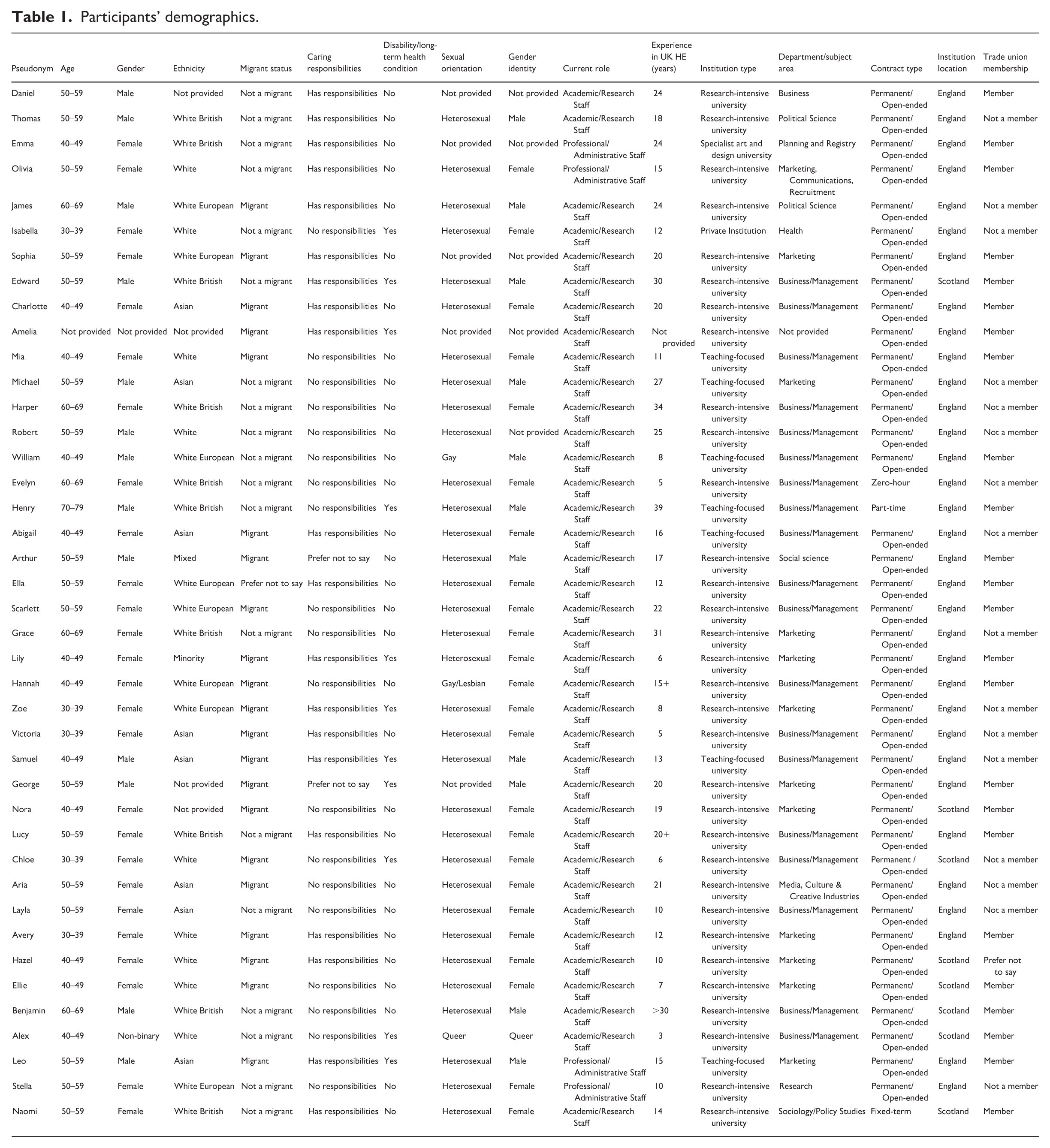
These demographic markers in Table 1 are reported as a transparent disclosure of sample composition and as analytically relevant to how hysteresis is lived. Gender, ethnicity, migrant status, and caring responsibilities operate as embodied positions through which capital is unevenly distributed and recognised within the academic field, mediating which trajectory of response (adaptive, ambivalent, or resistive) becomes liveable for a given professional under sustained polycrisis.
The decision to include both academic and professional services staff was theoretically motivated rather than incidental. Hysteresis is conceptualised here as a field-level condition produced by the misalignment between historically formed professional dispositions and transformed institutional logics. The transformations driving this misalignment, including marketisation, audit intensification, metricisation, and digitalisation, do not operate on a single occupational group in isolation; they restructure the field as a whole. The pressures encountered are differentiated. A research-contract academic responding to journal ranking regimes, a teaching-focused colleague navigating retention metrics, and a careers manager working under student satisfaction targets occupy distinct positions within the same transformed field. The analytic interest lies precisely in how dispositions formed under earlier institutional conditions are displaced across these positions, producing the patterned modes of adaptive, ambivalent, and resistive response identified in the analysis. Heterogeneity is therefore not treated as noise to be controlled but as a condition for examining how a shared structural lag is lived through differentiated occupational locations.
A similar logic informed the inclusion of participants from research-intensive, teaching-focused, private, and specialist institutions. UK higher education is not a homogeneous sector. Russell Group, Post-1992, private, and specialist providers face differentiated funding regimes, regulatory expectations, and competitive pressures. The argument is not that these institutions experience identical conditions, but that they are subject to a common set of transformations, including OfS regulation, REF and TEF cycles, fee structures, and marketised recruitment, which reshape the field within which professional dispositions were formed. Sampling from multiple institutional types allowed the analysis to identify whether the lag between dispositions and field, the analytic object of the study, recurs as a patterned condition rather than a feature confined to one institutional sub-group. The intention was not to homogenise institutions but to examine whether hysteresis manifests across institutional positions despite differentiated local pressures. The patterned recurrence of adaptive, ambivalent, and resistive responses across institutional types supports the analytic claim that hysteresis operates at the level of the field rather than the individual organisation.
Because hysteresis concerns embodied and often tacit dispositions, neither textual nor visual data can be treated as direct representations of habitus. Visual materials are therefore not used to access embodied experience more directly than text, but as elicitation devices through which participants articulate and interpret experiences of misalignment (Glegg, 2019). Consistent with Management Learning’s reflexive tradition, participants selected images and provided their own interpretations, ensuring that visuals functioned as co-constructed expressions rather than researcher-imposed illustrations (Cunliffe, 2004; Hibbert & Cunliffe, 2015). Prompts were designed to elicit situated accounts of moments where established ways of working felt strained, unsettled, or difficult to sustain, rather than abstract reflections on change.
Participants were invited to submit up to four images capturing how their work felt or unfolded when routines continued but no longer seemed to fit institutional demands. The invitation was open but oriented to persistence, strain, and misfit rather than crisis in general. Participants were asked to explain how each image related to their everyday practices and to moments when familiar ways of doing academic work felt difficult to sustain, hollowed out, or misaligned with institutional expectations. Images were treated as analytically relevant only insofar as they anchored participants’ accounts of continued practice under altered conditions.
Although participants narrate their experiences reflectively, our analysis treats such narration as situated articulations of practical tensions rather than as transparent access to embodied dispositions. All participants gave informed consent in line with ethical protocols approved by the lead author’s institutional ethics committee. Identifying information was removed, and data were stored in accordance with General Data Protection Regulation (GDPR)-compliant procedures (European Union, 2016).
Analysis
Hysteresis functions as the analytical lens in this study. Learning is the empirical phenomenon examined through that lens. Hysteresis was identified empirically through patterned accounts of sustained misalignment between participants’ embodied professional dispositions and changing institutional demands. Analytically, we traced not only moments of change but the persistence of dissonance, lag, and exhaustion across time, including cases where new practices were adopted without restoring a sense of alignment. In this study, learning refers to patterned reorientation of practical sense under conditions of sustained misalignment. It does not denote mastery, skill acquisition, or restored alignment. Rather, it captures how professionals recalibrate, endure, or contest institutional demands while dispositions formed under earlier conditions continue to orient their practice. This approach enables examination of temporality, affect, and constraint in participants’ accounts of institutional transformation.
Using hysteresis as an analytical lens, we interpret participants’ narratives and images as patterned ways of living with misalignment between habitus and field. Hysteresis itself is not treated as an empirical outcome but as a relational condition through which different forms of coping, endurance, and resistance become intelligible. The analysis identifies three such patterned responses, adaptive, ambivalent, and resistive responses under hysteresis, reflecting distinct ways of responding to sustained disruption (see Figure 1).
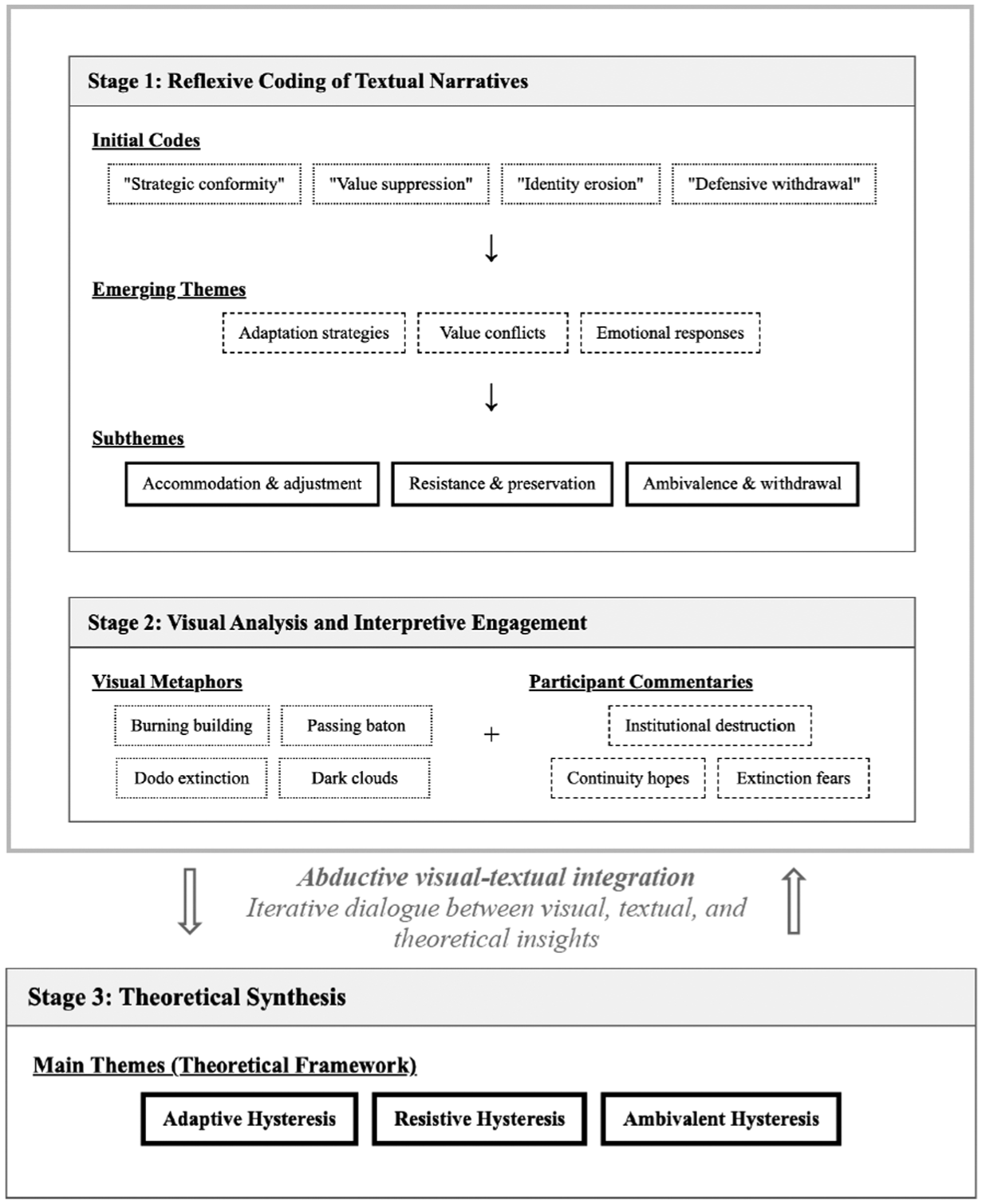
Illustrative process of Textual–Visual Thematic Analysis (TVTA): from codes to theoretical framework.
The analysis followed a TVTA procedure (Trombeta and Cox, 2022), in which textual narratives and visual materials were examined iteratively and in relation to one another.
Stage 1. Reflexive coding of textual narratives
We began with a reflexive thematic analysis of participants’ written responses (Braun and Clarke, 2006, 2019). Coding was open and interpretive, with attention to temporal shifts, evaluative changes, and affective expressions such as exhaustion, disillusionment, anxiety, and quiet resistance. In vivo and descriptive codes captured how participants narrated their professional lives before, during, and in anticipation of institutional transformation. Coding was conducted collaboratively, with reflexive dialogue among researchers to refine themes and ensure analytic rigour. Initial codes were grouped into emerging themes and subthemes capturing patterned responses to institutional change, with sensitivity to temporality and persistence.
Stage 2. Visual analysis and interpretive engagement
Participants submitted 36 visual materials, including self-produced photographs, images sourced online, and symbolic visuals from publicly available repositories. Images were analysed alongside accompanying narratives as part of the TVTA. Visual materials were not treated as direct representations of embodied dispositions or as evidence of hysteresis in themselves. Rather, they were analytically relevant insofar as they illuminated situations in which habitual orientations persisted despite altered evaluative or organisational logics (Glegg, 2019). Images were selected as exemplars based on analytic salience, resonance with textual accounts, and their capacity to convey affective and temporal dimensions of misalignment. Because of copyright restrictions, images are not reproduced and are treated as elicitation devices whose meaning emerges through participants’ interpretations.
Stage 3. TVTA integration and theoretical synthesis
In the final stage, textual and visual insights were synthesised through an abductive analytic process (Timmermans and Tavory, 2012), moving iteratively between empirical patterns and Bourdieusian concepts of habitus, field, and temporal misalignment. Initial codes (e.g. “strategic conformity,” “value suppression,” and “cautious in meetings”) were paired with participants’ images and interpretations, then read against Bourdieusian conceptual coordinates and returned to the data to test, refine, or revise the reading. Through repeated cycles, codes were grouped into subthemes (“accommodation and adjustment,” “professional identity transformation”) and subthemes into the three patterned themes. Accounts qualified as temporal misalignment when a disposition formed under earlier institutional conditions continued to orient practice; a transformed institutional logic no longer corresponded with that disposition; and practice continued under strain, hesitation, withdrawal, or moral discomfort. Accounts describing complete reorientation without residual tension were interpreted as adjustment rather than misalignment. Points of convergence and tension between narratives and images, alongside recurring silences and muted dissonances, were treated as meaningful when they sustained broader patterns of misalignment (Alvesson and Kärreman, 2011).
This iterative dialogue between data and theory produced a typology comprising adaptive, ambivalent, and resistive responses under hysteresis. These modes are not rigid categories but positions along a continuum of response to field change, each containing variation in how professionals negotiate misalignment over time. Table 2 presents the structured data configuration that underpins our thematic framework, detailing the textual and visual codes, their integration, and the subthemes through which each form of hysteresis was empirically grounded and theoretically conceptualised. While the three-level data structure follows a format commonly associated with Gioia et al. (2013) for transparency, the analysis departs from a Gioia-style inductive logic by adopting an abductive approach and integrating visual and textual data through TVTA.
Data structure.
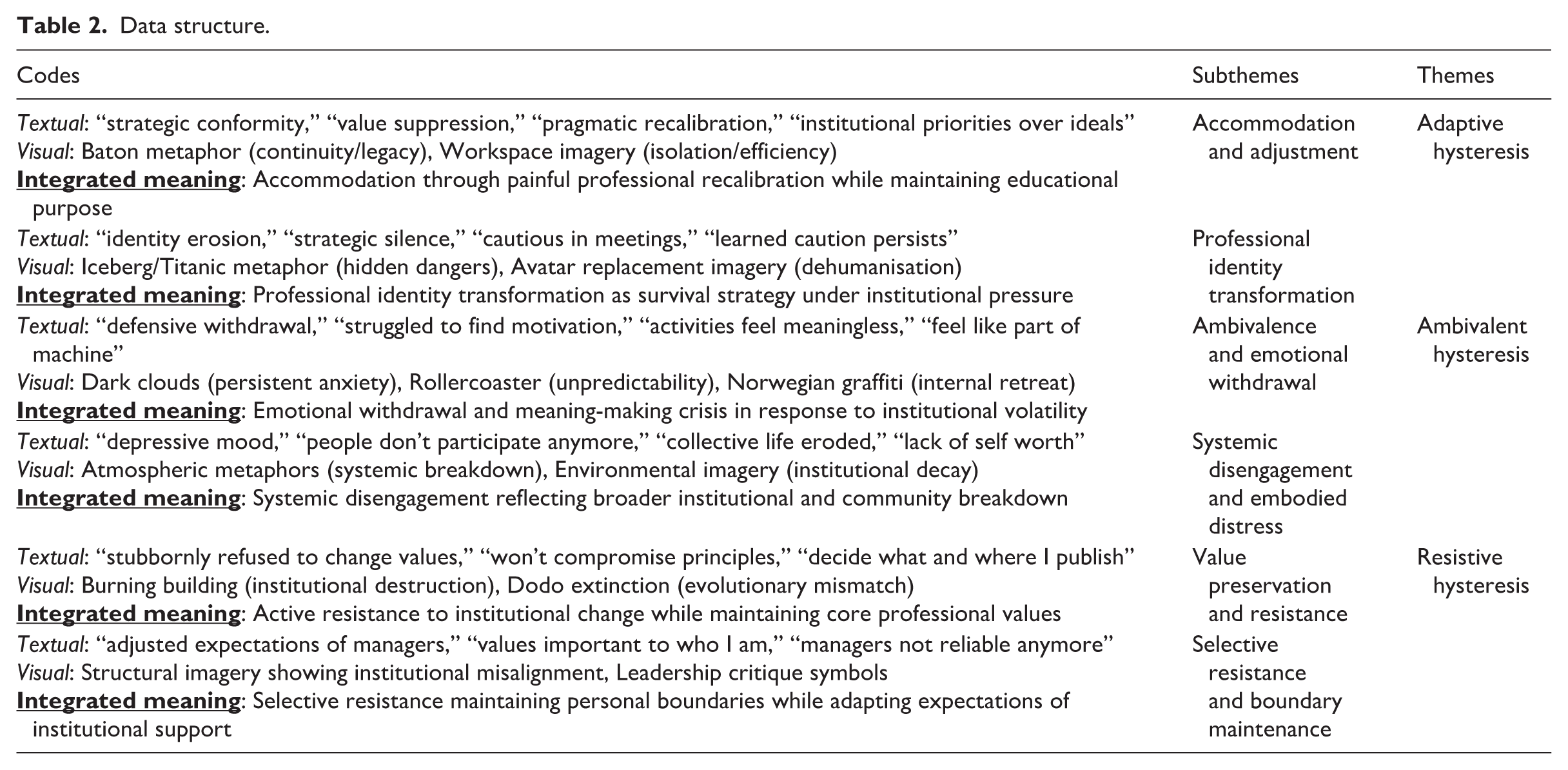
These three patterned responses under conditions of hysteresis emerged from the data rather than being imposed upon it, reflecting the inductive spirit of our analytical approach while remaining theoretically informed by Bourdieusian concepts of habitus, field, and temporal misalignment.
Findings
In the analysis that follows, hysteresis is identified where historically formed professional dispositions continue to orient practice despite altered institutional conditions. The focus is therefore on moments where prior commitments, expectations, or standards of good work no longer correspond to prevailing organisational logics, producing sustained tension rather than immediate recalibration.
In the UK higher education context examined here, and consistent with the prior institutional conditions specified in the theoretical framework, participants’ dispositions were largely formed under conditions emphasising collegial autonomy, scholarly depth, and pedagogical discretion. Contemporary institutional logics increasingly privilege metric performance, retention management, funding volatility, and audit intensity. The misalignment between these successive conditions forms the structural basis of hysteresis in this study.
Across 41 participants’ narratives and images, the lag between embodied professional orientations and transformed institutional logics did not produce a uniform response. Instead, the same underlying misalignment generated patterned differences in how professionals recalibrated, endured, or contested institutional demands. Rather than a uniform experience of misfit, participants described patterned ways of responding to displacement within changing institutions in polycrisis. Some recalibrated pragmatically, bending practices to new demands while containing frustration. Others remained suspended in tension, torn between attachment to earlier norms and resignation to new realities. Still others articulated principled refusals to compromise core values, even when this entailed marginalisation or withdrawal. These responses are conceptualised as adaptive, ambivalent, and resistive responses under hysteresis.
The three modes were not analytically imposed but emerged from the iterative integration of textual and visual materials. Words and images converged to convey recurring textures of adjustment, suspension, and defiance, revealing how professionals negotiated affect, identity, and integrity under sustained turbulence. Importantly, not all forms of coping or adjustment are treated as evidence of hysteresis. Following Bourdieu, hysteresis is analytically identified where dispositions formed under prior institutional conditions continue to orient practice despite misalignment with current field logics. The empirical focus is therefore on moments of persistence, discomfort, or strain arising from this lag. Where participants described active recalibration that restored alignment with institutional demands, these accounts are interpreted as adjustment rather than hysteresis.
Participants’ experiences are analysed in relation to field-level logics as articulated in their own accounts. Managerialism, marketisation, and audit surfaced through references to performance metrics, funding pressures, workload models, and evaluative criteria shaping everyday decision-making and constraining professional judgement. Accounts of adaptation, ambivalence, or resistance are thus situated within the organisational demands participants explicitly identified, including intensified performance management, market-oriented recruitment practices, and digitally mediated efficiency measures. This anchors individual experiences in the field transformations shaping contemporary academic work.
Learning is used here to denote shifts in practical orientation that occur within sustained misalignment. These shifts may involve recalibration, boundary-setting, or emotional withdrawal, yet they unfold while earlier dispositions continue to organise judgement and practice. In some cases, learning takes the form of compliance or constrained accommodation rather than renewal. This is treated not as a conceptual limitation but as an empirical finding, highlighting how learning under prolonged institutional turbulence may involve endurance, withdrawal, or compromised adjustment rather than reflexive transformation.
Adaptive hysteresis as learning
Adaptive response under hysteresis captures a mode in which professionals adjust practices and self-understandings while remaining oriented by dispositions formed under earlier institutional conditions. Hysteresis here refers to the endurance of prior professional commitments amid field transformation. Recalibration unfolds within that condition rather than resolving it. Unlike identity work frameworks, which emphasise reflexive reconstruction and narrative repair, adaptive responses under hysteresis foreground the endurance of embodied orientations that continue to shape action even as actors accommodate new demands. This perspective illuminates how adaptation unfolds over extended periods of misalignment, generating affective saturation as professionals repeatedly reconcile inherited standards of good work with shifting institutional logics. In this way, hysteresis extends institutional and identity-based accounts by theorising adaptation not as resolution, but as sustained negotiation under conditions where alignment is continuously deferred.
Adaptive responses under hysteresis, as developed in our typology, capture the painful recalibration of professional habitus in response to institutional transformation. Rather than indicating passive assimilation, this form of hysteresis reflects a negotiated response to the erosion of stable academic norms, where survival increasingly depends on strategic self-adjustment. For many participants, adaptation involved the suppression of prior values and ideals, the internalisation of institutional priorities, and a recalibrated sense of professional worth tethered to shifting metrics of performance. Our participant, Abigail, an Asian woman working as academic staff in a Business and Management department with 16 years of service, articulated this recalibration as a gradual shift in disposition, noting, I have had to become more pragmatic, focusing on job security and institutional priorities rather than academic ideals. I’ve also learned to be more politically aware and cautious in meetings and emails, which is a shift from how I used to engage more openly and collaboratively. (Abigail, aged 40–49, Female, Asian, Academic/Research Staff, Business/Management, 16 years of service)
Abigail’s guarded communication reflects continued expectation of collegial openness formed under earlier institutional norms. Her strategic caution represents pragmatic adjustment within that condition rather than its dissolution. Abigail’s description of becoming “more politically aware and cautious” indicates friction between earlier collegial dispositions and a field increasingly structured by risk management and surveillance. The shift is strategic, yet it remains anchored in awareness that her prior mode of open engagement has become costly. Hysteresis is visible here not as refusal to change, but as the persistence of earlier expectations about academic dialogue that no longer fit institutional conditions. Her reflection encapsulates a shift from collegial openness to calculated restraint, shaped by a context in which ongoing institutional precarity has rendered vulnerability costly. This transformation reflects a broader pattern of professional identity modulation, whereby individuals strategically manage how they are seen and heard, aligning themselves with prevalent logics of performance and institutional loyalty (Kallio et al., 2016). While participants often describe strategies developed to survive institutional precarity, these strategies are analytically relevant to hysteresis only insofar as they are shaped by dispositions that remain anchored in earlier understandings of academic work. In these accounts, the significance lies in survival per se and in the persistence of embodied expectations about autonomy, collegiality, or educational purpose that no longer correspond to prevailing evaluative criteria. It is this misalignment, rather than adaptation itself, that constitutes hysteresis in Bourdieusian terms. Similarly, another participant, Victoria, described how managerial imperatives around retention shaped her pedagogical choices: There is a push from my institution to not fail students as this affects the retention rate. So I’m more lenient with students nowadays. I pass them more easily to avoid them being unhappy and then quitting. (Victoria, aged 30–39, Female, Asian, Academic/Research Staff, Business/Management with 5 years of service)
Victoria’s leniency is framed as compliance with retention metrics, yet her explanation reveals displacement of prior pedagogical standards rather than their disappearance. The need to “avoid them being unhappy and then quitting” replaces earlier criteria of academic judgement. The tension lies in the substitution of market-based retention logic for educational evaluation, signalling misalignment between inherited pedagogical habitus and performance-driven field demands. The shift towards retention-sensitive marking reflects accommodation to institutional metrics while earlier pedagogical standards remain normatively salient, producing tension between inherited judgement criteria and performance-based governance. Her account illustrates the theme of strategic conformity, where decisions around assessment are no longer grounded primarily in educational standards but are recalibrated to align with institutional survival metrics. Echoing the work of Vos and Page (2020) that discusses marketised landscape affect teaching practices and the role of teachers, here, the field’s accelerating shift towards marketised logics of student satisfaction dislocates the pedagogical habitus, compelling a redefinition of what it means to be a “good academic” under audit culture, with managerialism being practised, prioritising personal gain and compliance over substance (Billsberry et al., 2023).
Aria, an academic staff in a Political Science department with 11 years of service, extended this adaptive recalibration into the domain of career planning. She described how institutional uncertainty and constant restructurings led her to reconsider her academic trajectory, shifting focus away from traditional scholarly goals towards forms of professional agility that would enhance her survival in a precarious system: Long-term career planning wise, due to the uncertainty in the type of project and the funder, it is difficult to stick to the areas that I’ve been teaching or researching about; instead, I feel the need to diversify my skillsets and expertise and to present them in the way that a funder can see the value of awarding. (Aria, aged 50–59, Female, Asian, Academic/Research Staff, Media, Culture and Creative Industries, with 21 years of service)
Her comment reflects how temporal compression and field porosity generate what we term pragmatic flexibility, an increasingly instrumentalised approach to academic identity wherein continuity of purpose is subordinated to the shifting demands of funders and institutional gatekeepers. This quote signals the dissolution of long-range academic planning as an organising structure, replaced instead by a contingent, funder-facing orientation that privileges versatility over depth.
These narratives converge around a central theme: adaptation as an affectively laden, institutionally coerced, and identity-disruptive process. Rather than evolving in response to intellectual curiosity or disciplinary development, professional subjectivity is increasingly shaped by the need to remain legible within systems that reward flexibility, silence, and institutional loyalty, echoing the findings of Billsberry et al. (2023) in discussion of the Managerialist Control of the Business School post COVID-19 pandemic. Adaptive responses under hysteresis, then, is not merely a lag; it is a form of survival that carries affective costs, disillusionment, caution, and the gradual erosion of academic ideals. It is precisely in these moments of muted dissonance, where adaptation masquerades as agency, that the emotional burden of hysteresis becomes most visible.
Participants in this category worked to maintain a sense of continuity with their prior professional values and identities, even as the institutional structures supporting them eroded. This mode was typified by a commitment to purpose, often framed through care for students or the endurance of professional routines. For example, Thomas, shared an image of a baton being passed in a relay, explaining: We should pass the baton to the next generation . . . It captures both hope and resignation. (Thomas, aged 50–59, male, white British, Academic/Research Staff, Political Science, with 18 years of service)
Here, the visual metaphor served to anchor a disposition of pedagogical responsibility amidst systemic disillusionment. It encapsulated the temporal stretch of adaptive responses hysteresis, holding onto legacy commitments while acknowledging their fragile future. William imagined their desk with laptop, headphones, and diary as a potential submission, noting: My life is supporting students . . . but this individualised, tech-mediated existence has become disturbingly normal. I’ll be replaced by an avatar soon. (William, aged 40–49, Male, White European, Academic/Research Staff, Business/Management, with 8 years of service)
In William’s own framing, this photo-commentary articulated adaptive responses under hysteresis with a tone of weary pragmatism, revealing the emotional strain of performing purpose in a system that increasingly rewards automation over care. These accounts show that adaptive responses hysteresis is less about willing flexibility than about strategic survival. Participants adjust not out of choice, but to remain legible in systems that reward compliance over conviction. Beneath this pragmatism lies the erosion of purpose, as professional values are quietly reconfigured to fit shifting institutional demands. Adaptation, in this sense, reflects endurance shaped by constraint rather than straightforward empowerment.
Ambivalent hysteresis as learning
Ambivalent responses under hysteresis conditions happens by affective saturation: exhaustion, loss of meaning, and a quiet retreat from institutional life that signals neither full alignment nor explicit rupture. In this mode, the professional habitus remains misaligned with the reconfigured field, but instead of recalibrating or confronting, the response is one of emotional dissonance, depressive affect, and existential fatigue. One participant, Charlotte, poignantly described the toll of redundancy processes, even when not personally affected: I felt very low. Even though I knew my position was safe, emotionally, I still felt the pain. Many days, I struggled to find the motivation to get out of bed and turn on the computer. I used to work happily, always eager to start new research projects and develop my papers. Now, those activities feel meaningless. (Charlotte, aged 40–49, Female, Asian, Academic/Research Staff, Business/Management, with 20 years of service)
Charlotte’s account reflects more than demotivation. Her earlier orientation towards research as meaningful and self-propelling persists, yet it no longer resonates within a field dominated by redundancy processes and performance surveillance. The misfit lies in the continued valuation of scholarly purpose within institutional conditions that no longer sustain it. Hysteresis becomes visible in the endurance of those commitments despite their erosion. Her narrative captures a mode of response in which individuals are suspended between investment and withdrawal, caught in a liminal space where prior attachments to academic purpose remain, but their meaning has become obscured or hollowed out. This form is most marked at the height of the redundancy exercise. It exemplifies how institutional crisis reverberates beyond the immediate targets of restructuring. Even those who survive the cuts report a deep erosion of purpose and vitality. This collapse of motivation reflects the sedimentation of ambivalent responses under hysteresis: a lingering disaffection that clouds once-meaningful activities with futility. This affective withdrawal is echoed by Lily, who observed, It diminished my enthusiasm and willingness to teach, it created a need to protect my time that felt a bit in contradiction with my natural willingness to create, take part and share. It added worries about the future. The atmosphere is charged with a depressive mood, people don’t participate in our collective life anymore. (Lily, aged 40–49, Female, Minority, Academic/Research Staff, Marketing, with 6 years of service)
Lily’s description of the contradiction between her “natural willingness to create” and the need for self-protection captures the embodied dimension of lag. The habitus formed around collegial contribution and shared endeavour encounters a field structured by precarity and defensive time management. The resulting tension may not be attributed to simple dissatisfaction. It is due to a sustained misalignment between inherited academic dispositions and contemporary institutional rationalities. Here, we witness the emotional contradiction at the heart of ambivalent responses under hysteresis: the desire to contribute is stifled by an overwhelming need for self-preservation. The institution, once imagined as a space for creativity and intellectual community, is now suffused with depressive atmospherics, leading to a fraying of collective ties and a gradual retreat from shared endeavour. A third participant, Samuel, underscored the corporeal toll of this disaffection: How about hypertension, diabetes, body pains, etc. due to stress and lack of time to do anything else? Also, lack of self worth. I don’t really feel that I do anything meaningful. I feel like I am just a part of a machine that can be worked till break and be replaced. (Samuel, aged 40–49, Male, Asian, Academic/Research Staff, Business/Management, with 13 years of service)
His account brings into view the embodiment of ambivalence, the psychosomatic manifestation of existential disconnection and institutional dehumanisation. When academic labour is reduced to mechanised output, affective estrangement becomes physically inscribed. The language of disposability, work till break and be replaced, points to a profound collapse in ontological security, where the self is no longer anchored by a sense of professional purpose.
These accounts collectively reveal how ambivalent responses under hysteresis are not a failure to adapt or resist, but a condition of emotional suspension under institutional strain. The professional subject, once animated by ideals of teaching, research, and collegiality, is now caught in a cycle of diminished returns, where participation feels burdensome and retreat feels both necessary and insufficient. The dissonance between internal values and external conditions generates a form of existential inertia, a grinding endurance marked by loss of affective investment and a fading belief in institutional meaning. Ambivalent responses under hysteresis, in this sense, resemble quiet grief of professionals who stay not because they believe, but because they cannot yet imagine where else they might go.
Participants in this mode described a sense of being caught between investment and withdrawal. They expressed ambivalence towards their institutions, recognising the loss of alignment but remaining entangled in professional roles and histories. Olivia selected a rollercoaster image, writing, One moment we’re climbing, the next we’re plummeting. Unlike a funfair ride, this one never ends—and we can’t get off. (Olivia, aged 50–59, Female, White, Professional/Administrative Staff, Marketing Communications & Recruitment, with 15 years of service)
This commentary captures the affective volatility of ambivalent responses under hysteresis: a cyclical experience of hope and despair, progress and regression, agency and constraint. James described their intended photo as dark clouds, representing a persistent, low-level sense of dread: It’s not a dramatic storm, just a greyness that doesn’t lift. Everything feels weighted with anxiety about the future. (James, aged 60–69, Male, White, Academic/Research Staff, Political Science, with 24 years of service)
The visual and textual narrative pointed to the slow sedimentation of ambivalence, where critique does not necessarily yield exit but generates a grinding endurance. A further participant, Samuel, cited a graffiti wall in Norway that read “you’ll find paradise in your own heart”: It symbolises a retreat into my own world . . . The only refuge lies in internal withdrawal. (Samuel, aged 40–49, Male, Asian, Academic/Research Staff, Business/Management, with 13 years of service)
Here, ambivalent responses under hysteresis took the form of emotional self-protection, a symbolic exit from institutional life without physical departure. What remains is not resistance, nor acceptance, but a mode of surviving through detachment. These accounts suggest that when institutional conditions undermine meaning without offering alternatives, ambivalence becomes a form of endurance. It allows professionals to remain, but not fully participate; to show up, but not feel seen. In this quiet withdrawal, we see the cost of institutional misalignment not in protest or departure, but in the fading affective ties that once sustained academic life.
Resistive hysteresis as learning
Resistive responses under hysteresis conditions occur when individuals hold onto inherited professional values or ethical orientations despite misalignment with the field. This resistance can lead to marginalisation, exclusion from advancement, and in many cases, self-selected or imposed exits from the sector (e.g. early retirement, career changes, or burnout).
In our material, this mode of response appeared as a conscious refusal to realign with restructured institutional fields, a determination to maintain continuity with inherited professional values despite mounting institutional friction. Unlike adaptive responses under hysteresis, which entails painful recalibration, or ambivalent responses under hysteresis, which reflects emotional withdrawal, this form is marked by principled defiance. It manifests in acts of value preservation that are often subtle yet consequential—refusals to dilute academic standards, comply with performance metrics, or internalise managerial logics. While such resistance affirms professional integrity, it frequently incurs costs in the form of strained relationships, stalled advancement, or institutional marginalisation. Nora, articulated her stance in clear terms: While there have been such pressures (e.g. keep students happy because of “metrics”), I have stubbornly refused to change my professional values and behaviour (e.g. make assignments less challenging, changing my marks to conform to “normal distribution, mean of results, etc. . .”). (Nora, aged 40–49, Female, Academic/Research Staff, Marketing, with 19 years of service)
Nora’s refusal gains analytic force when read as persistence of pedagogical dispositions formed under earlier institutional conditions that valued academic judgement over metric conformity. Her stance is not merely oppositional; it reflects continuity of embodied standards that no longer correspond to prevailing evaluative regimes. The friction between these durable orientations and performance metrics constitutes the hysteresis effect. Her use of “stubbornly” signals not just perseverance but a refusal to be interpellated by marketised logics that have led many academics to experience a loss of autonomy and increasing pressure due to performance metrics and limited resources for teaching development (Vos and Page, 2020). This resistance occurs not through open rebellion but via the quiet continuity of professional standards, a fidelity to pedagogical rigour that remains intact despite structural incentives to compromise. In this instance, the field’s demand for pliability meets a habitus structured by durable convictions, resulting in a low-grade but sustained institutional friction. Our participant, Henry, expressed resistance within the domain of research evaluation, noting, I have had to actively resist the fixation on journal rankings, e.g. Hazing and then (C)ABS which has affected my relationship with my line and other managers, e.g., HoDs. [. . .] Managers have by and large accepted I will not change my view that I decide what and where I publish while making a case for them to counter, mostly failing, arguments to include my publications in submissions for assessment. (Henry, aged 70–79, Male, White British, Academic/Research Staff, Business/Management, with 39 years of service)
Henry’s insistence on authorial autonomy similarly reflects dispositions calibrated to a field in which scholarly contribution was evaluated primarily through peer recognition rather than ranked audit systems. His conflict with managers illustrates the lag between inherited academic norms and restructured governance logics. Resistance thus appears as persistence of historically sedimented professional orientations under altered field conditions. His statement reveals a more overt form of strategic disidentification, where the participant not only resists managerial expectations but insists on authorial autonomy. By asserting control over publication decisions, he challenges the audit culture that has recalibrated research worth through ranked lists and narrow performance rubrics, an approach that undermines universities’ foundational role in fostering critical thinking, creativity, and societal progress (Adler and Harzing, 2009). His resistance is not without consequence: damaged relations with managers, exclusion from institutional metrics, and a degree of tolerated nonconformity that underscores the fragility of dissent within managerial academia. Alex, framed their resistance through the lens of identity and relational rupture: I have strictly maintained my values as they’re important to who I am and how I view myself as an education professional. I have adjusted my expectations of managers, whom I previously felt more able to rely on and go to with problems. (Alex, aged 40–49, Non-binary, White, Academic/Research Staff, Business/Management, with 3 years of service)
Their response embodies the moral stakes of resistive responses under hysteresis, not simply what one does, but who one insists on being. By decoupling their self-conception from shifting managerial norms, they preserve an ethical anchor in an otherwise unstable field. Yet this refusal is not without cost: the trust once placed in institutional relationships has eroded, replaced by guarded distance and lowered expectations of support. Resistance, in this account, is sustained through withdrawal of faith rather than overt defiance.
Across these narratives, resistive responses under hysteresis emerges as an ethical stance, an insistence on remaining unchanged amid institutional transformations that demand conformity. It is an assertion of professional sovereignty that often flies under the radar: no grand gestures, no declarations of dissent, but rather a quiet refusal to bend, to dilute, or to perform for metrics. These acts of principled inertia, however, are not without consequence. Participants describe fractured relations with management, diminished institutional recognition, and the slow isolation that can accompany non-compliance. Yet what these accounts reveal is that in times of institutional turbulence, not changing can be as radical a gesture as adapting. Resistive responses under hysteresis marks not a failure to evolve, but a conscious decision to stand still as the field moves around and sometimes away from them.
Participants described themselves as recognising the institutional rupture and explicitly disidentifying from mainstream logics. Their images expressed critique not only of policy and management but of the existential direction of higher education. Emma submitted a photo of a burning building, explaining, “This was once beautiful and purposeful. Now we’re all standing by, watching it burn.” The image, dense with symbolism, captured not only loss but helplessness, resistance thwarted by the scale and pace of destruction. (Emma, aged 40–49, Female, White, Professional/Administrative Staff, Planning & Registry, with 25 years of service)
While Emma’s image conveyed collapse through fire, Layla turned to extinction as metaphor. She submitted a picture of a dodo and declared: “We’ll become extinct if we keep doing more with less. The dodo is a warning.” This image, both wry and grave, spoke to the evolutionary misfit of contemporary academia, its refusal to adapt structurally, despite rhetorical commitment to innovation. (Layla, aged 50–59, Female, Asian, Academic/Research Staff, Business/Management, with 10 years of service)
Academic professionals are increasingly expected to adjust to institutional metrics that reward compliance over conviction. Yet some continue to uphold values that no longer “count” in this environment. They may, for instance, refuse to lower academic standards or to treat autonomy as expendable. Why do they persist in these practices, even when the costs include marginalisation, stalled careers, or strained professional relationships? One answer, we suggest, lies in a deep commitment to professional integrity, a commitment that resists capture by performance regimes. We understand this response not as obstinacy, but as a form of resistive responses under hysteresis: a mode of quiet refusal enacted through principled non-compliance. Rather than recalibrating or withdrawing, these individuals hold the line. They decline to internalise the managerial logic of the institution, even as it intensifies around them. And in doing so, they assert that integrity still matters, even when it is no longer institutionally recognised.
Unlike earlier periods of organisational change, where exit through mobility or migration could be imagined as a viable response, participants experiencing resistive responses under hysteresis rarely articulated alternative futures or collective routes for change. Resistance was expressed instead through ethical positioning, quiet refusal, and the preservation of personal or professional boundaries, rather than through projects of exit or transformation. The data reveal a striking absence of imagined horizons, with participants often describing an inability to envision a future for themselves or for their institutions beyond ongoing decline or survival. Where hope appeared, it was fragile and displaced, located in personal integrity rather than in expectations of institutional renewal. This suggests that resistive responses under hysteresis under polycrisis reflects not only opposition to change, but a broader condition of paralysis in which resistance persists without a credible sense of exit or futurity.
Discussion
The findings demonstrate how sustained misalignment between historically formed professional dispositions and transformed institutional logics generates patterned responses within hysteresis. This analysis captures academics within an ongoing phase of institutional turbulence rather than at a point of stabilisation or resolution. The longer-term outcomes of this transformation, whether recalibration, reconfiguration, or breakdown, remain empirically indeterminate within our temporal window. This study specifies how hysteresis operates under sustained polycrisis conditions, demonstrating how enduring dispositional lag generates differentiated responses without altering the relational structure of the concept. Our argument therefore concerns the lived dynamics of misalignment during protracted change, not the ultimate trajectory of the field. Rather than a single trajectory of adjustment, the lag between habitus and field produces differentiated modes of recalibration, ambivalence, and principled refusal. These modes do not redefine hysteresis. They specify how the same relational condition is inhabited differently when institutional turbulence persists and recalibration remains structurally deferred.
Adaptive responses under hysteresis extend identity work scholarship by showing recalibration under constraint rather than restored coherence (Shams, 2019). Participants adjust their conduct, tone, or strategic positioning in order to remain institutionally legible. Yet earlier professional orientations continue to shape judgement and generate friction. The shift from collegial openness to guarded communication, or from pedagogical discretion to retention-sensitive marking, does not signal full dispositional alignment with managerial logics. Instead, inherited standards of academic purpose remain present, even as they are muted or strategically bracketed. Identity work scholarship is internally diverse. An institutionally oriented strand emphasises resolution, repair, and renewed coherence (Nixon and Scullion, 2022; Voronov and Vince, 2012), while a processual strand centres fragmentation and ongoing struggle without resolution assumptions (Sveningsson and Alvesson, 2003). Our hysteresis lens is closer in spirit to the processual strand and shares its scepticism towards smooth recalibration. What hysteresis adds, even with respect to that strand, is a distinctive temporal and relational layer: an account of why fragmentation and struggle persist in the specific form they do, namely as the lag between dispositions formed under earlier field conditions and reconfigured field logics under polycrisis. It is an ongoing negotiation in which dispositional commitments are partially suppressed but not extinguished. Hysteresis clarifies why adaptation may appear smooth at the behavioural level while tension persists at the level of practical sense.
This perspective extends Nixon’s (2003) account of professional renewal under New Public Management. Nixon highlights how enduring academic values such as accuracy, sincerity, and authenticity function as moral stabilisers amid managerial turbulence. Our findings resonate with this insight but shift analytic attention to the constraints imposed by accelerated polycrisis conditions. Where Nixon emphasises moral agency enabling adaptation, hysteresis foregrounds the dispositional lag that complicates or slows such renewal when institutional transformation outpaces recalibration.
Ambivalent responses under hysteresis speak directly to emotional labour research by demonstrating how affective strain accumulates when dispositions calibrated to collegiality, autonomy, and scholarly depth encounter performance-driven and precarious institutional environments. Exhaustion, withdrawal, and diminished enthusiasm in the data are not merely reactions to workload intensity. They reflect the prolonged effort of sustaining professional meaning under conditions that no longer reinforce it. Participants continue to value teaching, research, and collegial life, yet the institutional context renders these commitments fragile or hollow. Emotional labour becomes less an episodic management of feeling and more a background condition of endurance (Hochschild, 2008). Hysteresis reframes ambivalence as the embodied experience of misalignment rather than as simple dissatisfaction or disengagement (Ivemark and Ambrose, 2021).
Resistive responses under hysteresis contribute to institutional work scholarship by foregrounding boundary defence as persistence of historically sedimented dispositions. Acts of refusal around grading standards, publication venues, or managerial directives are not reducible to strategic dissent. They reflect continuity of professional commitments formed under earlier institutional arrangements in which scholarly judgement and pedagogical autonomy carried different weight. Resistance in this sense is not innovation or disruption. It is maintenance of dispositional integrity under altered field logics. The costs described by participants, strained relationships, stalled progression, marginal positioning, underscore that resistance emerges from lag between embodied orientations and contemporary evaluative regimes.
Across all three modes, polycrisis intensifies the persistence and visibility of hysteresis within specific organisational contexts. Repeated restructuring, funding volatility, metric intensification, and audit expansion unsettle field logics before recalibration can stabilise. Under such conditions, hysteresis is less likely to resolve through gradual adjustment. Instead, professionals inhabit a temporally extended condition in which inherited dispositions continue to orient action despite altered institutional incentives. The differentiated responses identified here demonstrate that the same structural misalignment can produce pragmatic recalibration, affective withdrawal, or principled defence depending on position, tolerance for risk, and attachment to prior norms.
Capital position shapes the form, but not the existence, of hysteresis. Professionals with higher accumulated capital, including senior tenured staff with strong publication records and external recognition, often have greater room to inhabit resistive responses, since their position absorbs the costs of nonconformity. Henry’s long career of refusal around journal rankings illustrates this pattern. Professionals with less capital, including early career, fixed term, or precariously contracted staff, more often experience adaptive or ambivalent responses, since the costs of resistance are sharper. Victoria’s retention sensitive recalibration illustrates this pattern. The relation is not deterministic; it runs through dispositions and field conditions, not as a simple resource calculation. Capital position therefore mediates which trajectory is liveable, while polycrisis generates the underlying misalignment that all three trajectories navigate.
Notably, this misalignment unfolds within institutions that continue to function and reproduce field structures. REF and TEF regimes, disciplinary hierarchies, tenure systems, and metric-based governance persist as stabilising mechanisms even amid turbulence. These enduring structures prevent institutional collapse while simultaneously intensifying the gap between inherited professional dispositions and reconfigured evaluative criteria. The contribution of this study lies in analysing enduring misalignment within functioning institutions rather than institutional breakdown.
The findings also clarify how the lag between habitus and field produces differentiated responses and subjectivities (see Table 3). Adaptive responses are marked by pragmatic recalibration and strategic conformity oriented towards sustaining participation. Ambivalent responses are characterised by withdrawal and hesitation, as participants remain suspended between investment and disaffection. Resistive responses centre ethical boundary setting and confrontation, though often at the cost of isolation and devaluation. These are not mutually exclusive categories but poles along a continuum of response to field change. Across many accounts, ambivalence emerges as a prominent affective register, a tension between commitment and estrangement that intensifies as institutional turbulence persists. Adaptive responses often exhibit what Berlant (2011) terms as cruel optimism, sustaining hopes of renewal despite repeated disappointment. Ambivalent responses reflect oscillation between attachment and betrayal, resonating with dynamics of estrangement and longing (Swales and Owens, 2019). Resistive responses foreground principle and critique, echoing concerns with the crisis of meaning and forms of reclaiming identity linked to individuation (Ladkin et al., 2018). Read together, the three modes recast hysteresis under sustained disruption not as a single trajectory of adjustment but as a differentiated field of learning shaped by structural turbulence and affective labour.
Summary of forms, dimensions, and subjectivities of hysteresis.
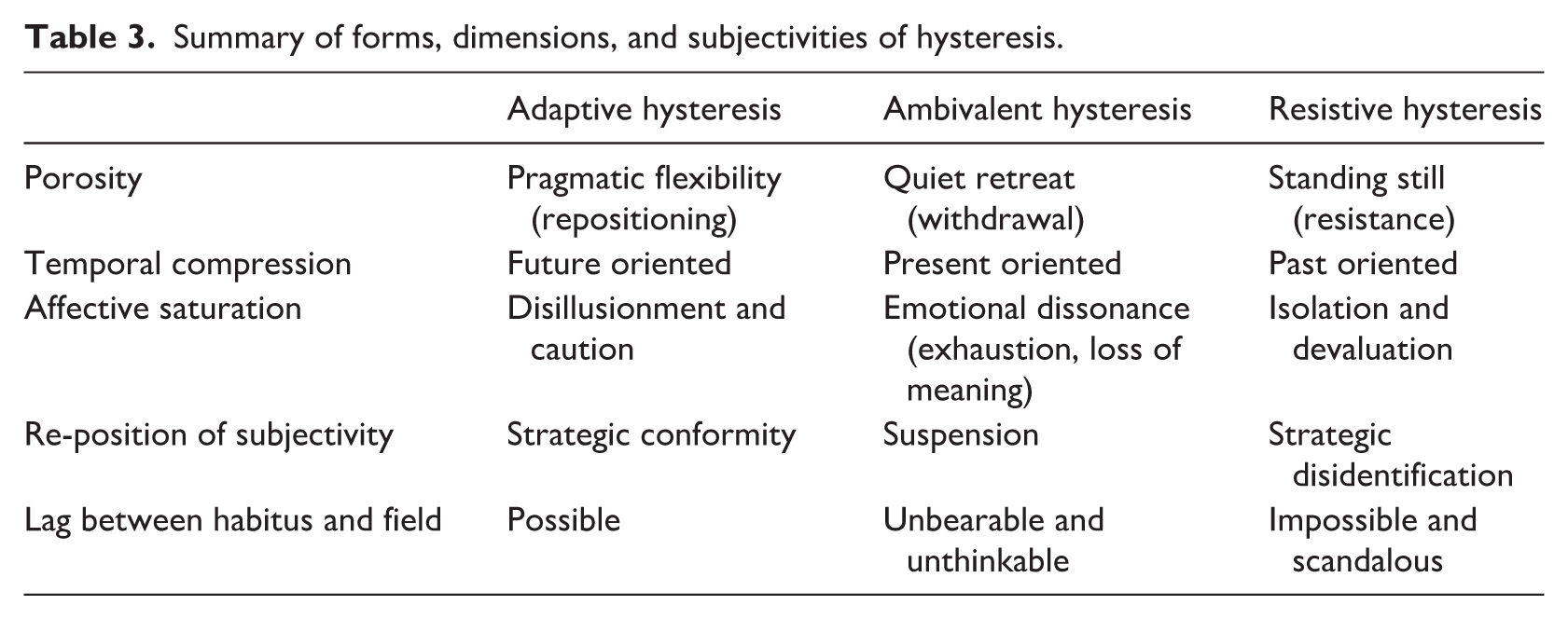
We can now specify what professionals are learning morally and emotionally in each trajectory. Adaptive responses involve moral learning about the negotiability of inherited values under institutional constraint; professionals learn how to suspend or strategically bracket commitments to collegial openness, pedagogical judgement, or scholarly autonomy in order to remain institutionally viable, and they learn the affective discipline (caution, restraint, and calibrated visibility) that this requires. Ambivalent responses involve moral learning about the limits of institutional belonging; professionals learn to disinvest emotionally from work that no longer reciprocates investment, while simultaneously learning to manage the grief, depressive affect, and embodied costs of sustained disengagement. Resistive responses involve moral learning about the costs of integrity; professionals learn what it means to refuse institutional categories, what one is willing to lose in order to do so, and how to inhabit an ethical position without imagining its institutional vindication.
The three trajectories extend management learning debates beyond adjustment, identity repair, and resilience. Adjustment frameworks emphasise restored fit. Identity repair frameworks emphasise narrative coherence. Resilience frameworks emphasise capacity to bounce back. Our findings show that under sustained polycrisis none of these endpoints reliably arrive. Learning, in this condition, is the practical, moral, and affective reorientation that takes place within a misalignment that does not resolve.
Theoretically, the study repositions hysteresis within management learning by clarifying that learning under sustained turbulence need not culminate in alignment. Learning, as observed here, refers to patterned reorientation of practical sense within misalignment. Professionals recalibrate boundaries, adjust expectations, or redefine what counts as viable engagement, yet they do so while earlier dispositions remain active. This shifts attention from episodic crisis recovery to the temporal endurance of lag. It also challenges celebratory narratives of adaptability in organisation studies by foregrounding the emotional and ethical costs of continuous recalibration.
The contribution therefore lies in specifying how hysteresis operates as a lived condition under polycrisis and in demonstrating that the lag between habitus and field generates patterned modes of response rather than a uniform trajectory. By distinguishing adaptive, ambivalent, and resistive responses, the analysis clarifies how professionals remain oriented to work when alignment between dispositions and institutional conditions is repeatedly deferred. Hysteresis, viewed in this way, becomes a lens for understanding learning as endurance, recalibration, and boundary maintenance under prolonged institutional transformation rather than as a transitional phase awaiting resolution. Field porosity further specifies these dynamics. The erosion of field autonomy under polycrisis constitutes a shared structural condition across the three modes as economic logics increasingly penetrate the academic field through metrics, competition, and market-oriented governance. Yet this penetration is experienced differently. In adaptive responses under hysteresis, it is often normalised and translated into pragmatic recalibration. In ambivalent responses under hysteresis, it generates tension as actors recognise misalignment but struggle to reconcile competing logics. In resistive responses under hysteresis, it becomes a focal point of critique, prompting defence of professional values or symbolic withdrawal from economically driven demands. This differentiation clarifies how a shared structural condition yields divergent learning trajectories depending on the interpretation, position, and capacity to absorb risk.
Participants frequently describe their responses in terms of coping, surviving, or simply “getting by” rather than learning. This raises the question of whether framing these patterned responses as learning trajectories risks conceptual over-extension. We retain the term deliberately. Learning here does not imply mastery, progress, or empowerment. It denotes constrained reorientation of practical sense under conditions of sustained hysteresis. Even compliance or withdrawal reflects patterned recalibration shaped by enduring dispositions encountering altered field conditions. Framing these responses as learning remains analytically productive because it reveals that such adjustments are not random or purely reactive, but structured by dispositional lag. This broader conceptualisation brings into view darker or ambivalent modalities of learning that remain obscured in paradigms centred on adaptation or renewal.
Theoretically, the study contributes to the literature on identity work, institutional work, and emotions by foregrounding the temporal endurance of misalignment. These literatures illuminate how professionals negotiate meaning, legitimacy, and affect, but often centre moments of repair, recalibration, or accommodation. A hysteresis lens explains why adjustment remains incomplete and dissonance persists, not because actors fail to respond, but because organisational transformation accelerates and accumulates faster than dispositions can be reworked. This shifts attention from episodic change to the temporal structure of institutional turbulence and its consequences for learning.
Multimodal inquiry enabled us to trace dimensions of professional experience that interview-based approaches risk smoothing. Visual elicitation surfaced embodied affects and temporal compressions that participants struggled to articulate in narrative form. The dodo and burning building images carried critique that the accompanying text muted. The rollercoaster and dark cloud images registered cyclical and atmospheric affects that exceeded propositional description. The baton image and the workspace image traced temporal orientations (pedagogical inheritance, individualised technological mediation) that interview formats might have rendered as strategic talk. Multimodal data also exposed productive contradictions between word and image, where text presented coping while image revealed grief. TVTA enabled us to keep these silences, contradictions, and temporal shifts analytically alive rather than resolving them prematurely.
Leadership practice grounded in resilience, adaptation, or individual coping reproduces the responsibilisation that polycrisis already imposes on professionals. The typology developed here supports three orientations for learning oriented leadership. (1) Recognition: leaders learning to identify which trajectory a professional is inhabiting, rather than reading all responses through a single resilience lens. (2) Differentiated support: protecting space for ambivalent withdrawal as a legitimate response to sustained turbulence rather than pathologising it; respecting principled refusal as an institutional good rather than a managerial irritation; supporting adaptive recalibration without normalising strategic silencing as professional maturity. (3) Reflexive governance: structuring institutional dialogue so that the costs of sustained reform become collectively articulable rather than privately borne. These orientations align the practical contribution with the management learning literature on care, reflexivity, and ethical leadership, and clarify that supporting different forms of becoming is itself a learning-oriented leadership practice.
Institutional change under conditions of hysteresis is unlikely to emerge through immediate alignment. Rather, it unfolds through layered processes. At the micro level, professionals recalibrate boundaries and expectations within constraint. At the meso level, collective articulation of shared tensions through structured sensemaking can transform private strain into coordinated voice. At the macro level, partial stabilisation of governance logics, for example, moderation of metric velocity or clearer priority-setting, creates conditions under which dispositional recalibration becomes viable. Change therefore proceeds not by eliminating misalignment but by rendering it collectively intelligible and institutionally addressable.
Beyond UK higher education, the argument travels to organisational settings characterised by sustained acceleration, instability, and repeated reform. Dominant accounts in organisation studies often celebrate creative destruction or continuous innovation, privileging adaptability while overlooking the emotional, temporal, and dispositional costs of constant change. Conceptualising hysteresis as a learning condition rather than a transitional lag offers a corrective by showing how learning unfolds under enduring misalignment rather than through seamless recalibration. This perspective aligns with work on identity–society misalignment in entrepreneurship and related fields, where actors struggle to align dispositions with rapidly shifting economic and normative environments. Framing learning through hysteresis therefore extends organisation studies debates by foregrounding the limits of adaptability and the patterned consequences of living with permanent change.
Conclusion
Our findings show that institutional crises are not only sites of organisational strain but also crucibles of professional learning in which values, emotions, and identities are renegotiated under sustained misalignment. By distinguishing adaptive, ambivalent, and resistive responses, we specify how learning unfolds through temporal lag, affective strain, and structural constraint, explaining why some professionals recalibrate while others withdraw or refuse, and what these trajectories cost for individuals and institutions.
Rather than positioning academics as passive recipients of reform, the analysis shows how their patterned responses co-constitute the university’s evolving form. This reframes institutional responsibility. Leading change becomes less a matter of enforcing compliance than of shaping the conditions under which learning can occur in ways that sustain professional purpose. As participants’ accounts of grading leniency, guarded communication, and publication conflicts illustrate, metric-driven governance (cf. Billsberry et al., 2023) can intensify disconnection (cf. Painter-Morland, 2006) by displacing earlier collegial and pedagogical standards with performance-oriented criteria. Participants’ descriptions of diminished enthusiasm, protective withdrawal, and ethical boundary-setting demonstrate how affective strain accumulates under sustained misalignment.
At the same time, care and reflexivity are not always absent through neglect. Organisational redesign may actively marginalise care and reflexive spaces to increase managerial control (Billsberry et al., 2023), intensify responsibilisation (Nixon and Scullion, 2022), or limit collective voice (Vos and Page, 2020). Under such conditions, appeals to reflexive leadership can be constrained or rendered symbolic, and resistance to learning may be institutionally produced rather than individually driven (Gill, 2019; Lok and De Rond, 2013). Situating leadership within these power relations clarifies that the erosion of care can function as a governance strategy rather than an unintended failure.
While prior work illuminates how professionals negotiate meaning, legitimacy, and emotion during change, it often assumes the possibility of recalibration or repair. Hysteresis directs attention to the persistence of misalignment between embodied dispositions and transforming institutional conditions, capturing situations in which identity and institutional work remain unresolved and affectively charged over time. The framework therefore clarifies how professionals respond to transformation and explains why such responses may endure, fracture, or fail to stabilise under conditions of polycrisis.
Finally, viewing universities as complex adaptive systems that are dynamic, interdependent, and open rather than as mechanistic organisations governed primarily through control logics offers a more realistic orientation to polycrisis. While our focus is academic staff, future research can examine how students, senior managers, and communities experience cumulative crises and participate in institutional becoming. Attending diverse academic subjectivities, adaptive, ambivalent, and resistive alike, alongside the political limits of care-oriented leadership, can support governance that moves beyond compliance towards more relational, responsive, and ethically attuned forms of higher education.
Footnotes

Ethical approval
Ethical approval was obtained from the Brunel University London Research Ethics Committee prior to data collection.
Consent to participate
All participants provided informed consent, and all identifying information was anonymised in accordance with GDPR (European Union, 2016).
Funding
The authors received no financial support for the research, authorship, and/or publication of this article.
Declaration of conflicting interests
The authors declared no potential conflicts of interest with respect to the research, authorship, and/or publication of this article.
Data availability statement
Due to confidentiality and ethical restrictions, the qualitative data (narratives and images) generated for this study are not publicly available. An anonymised summary of the coding structure is available from the corresponding author upon reasonable request.