







Abstract
In this Connexions essay, we advance a multispecies research agenda for theorizing well-being within Organization Studies (OS). Research must urgently move beyond the bounded human subject to consider the power-laden, relational, and interconnected multispecies dynamics through which everyday well-being practices, and their absences, are (re)produced within organizational practices. As an interdisciplinary team of scholars from Animal Organization Studies, Anthrozoology, Veterinary medicine, and Social Health Sciences, we expand the traditional anthropocentric scope in OS to include humans’ relationality and mutual vulnerability with the health and well-being of animals and nature. We critique the neglect of these intimately interconnected relationships in dominant OS well-being theorizing and aim to expand the current discourse. Thus, we endorse a multispecies well-being approach of One Welfare from veterinary and animal health sciences, which recognizes the intricate interdependencies between health, welfare, and, ultimately, the well-being of humans, animals, and broader ecosystems. As such, it offers a more holistic framework for addressing community well-being, particularly in contexts that rely on working animals. To demonstrate the state of the art in the OS discourse, we examine publications on well-being in Organization to offer insights on limitations in terms of multispecies inclusivity in the current literature. We argue that focusing on human well-being apart from interconnected well-being of animals and nature creates a theoretical gap to understand the practice-based relational impacts, such as in multispecies work. Our contribution is to highlight these limitations and extend the One Welfare lens that sees human well-being as interlinked to other species into OS.
Introduction
Well-being is an elusive concept with a myriad of theorizations, ideologies, and meanings (e.g. Cori et al., 2025; Islam et al., 2024; Watson et al., 2023). These range from positive associations with individual happiness (as “duty”) such as derived from positive psychology research (e.g. Martela, 2024; Miller and Rose, 2008), to darker, critical, and ideological interpretations of corporate well-being within Critical Management Studies (e.g. Cederström and Spicer, 2015; Dale and Burrell, 2014; Davies, 2015). Defined as a multifaceted construct, well-being encompasses physical, psychological, and social dimensions (Wallace, 2025). Growing CMS-oriented well-being theorizing, particularly in Organization (e.g. Holmqvist et al., 2013; Sambajee and Scholarios, 2023; Watson et al., 2023), has explored “ideal” human workers under neoliberal austerity and how organizations subtly invade, control, and shape human bodies, health, and well-being to “fit” their work context (Dale and Burrell, 2014). This literature questions the pursuit of endless performance maximization, and the “happy-productive worker” hypothesis (Wright and Cropanzano, 2007), where interests of managers and workers inevitably align. It also calls for attention to underresearched and intersectional aspects such as gender, race, structure, agency, and non-Western contexts (e.g. Sambajee and Scholarios, 2023; Watson et al., 2023).
Yet, individuals of other species remain grossly absent from these debates, even though similar, if not much more extreme, neoliberal logics of productivity, control, oppression, and optimization extend to, for example, animals used for food production, in zoos, in laboratories, and, even to companion animals. These logics shape animal bodies working with and for humans and may construct “ideal” animal workers, for example, human-controlled showjumping horses portrayed as “loving” to work (Jammaers and Huopalainen, 2023), or massively exploited animal “workers” 1 whose well-being is subordinated to profit-maximized logics, human-led control, commodification, and organizational performance (e.g. Clarke and Knights, 2022; Coulter, 2016; Schwartz, 2020). Most animals are organized by humans within power structures, yet they have their own emotions, desires and work-lives (Coulter, 2016, 2023), despite the human tendency to overlook, silence, and ignore them (Bekoff, 2010).
As a contested, ambiguous (Cori et al., 2025; Islam et al., 2024) yet well-established concept within Organization Studies (OS), particularly in Organizational Behavior, we observe that well-being theorizing has primarily focused on human (work) experiences (Wallace, 2025) and subjective well-being (Diener et al., 2018). A logical starting point, this nevertheless narrows the focus to employee health and engagement (e.g. Boccoli et al., 2023), and humans as bounded, individual actors. This largely presents human well-being as a matter of self-governance, control, and optimization (Cederström and Spicer, 2015), while separating it from animals and other organisms, power relations, and larger structural issues (Foster, 2018). The OS well-being literature overlooks how well-being practices are inherently tied to (un)sustainability (Islam et al., 2024), since human well-being and porous human bodies are entangled with, for example, animals, bacteria, and fungi (Cleaveland et al., 2001), as well as with the treatment and conditions of nature, including ecological collapse and planetary issues (Huopalainen and Jammaers, 2025; Labatut, 2023; Tallberg and Huopalainen, 2024). Within this pressing context, multispecies 2 well-being relations should be of utmost concern for OS, an aspect which, relevant to this discussion, the emerging field of Animal Organization Studies (AOS) highlights. Yet the deeply anthropocentric, instrumental, and largely uncritical focus in dominant OS well-being discourses has systematically neglected animals and other beings from the moral circle of concern, while also framing nature as a resource-based “environment” to exploit (Jäger et al., 2025) or merely as “context” (Labatut, 2023). 3
In this Connexions essay, we expand an interdisciplinary research agenda (Ducrot et al., 2024; Liu et al., 2019; Sointu, 2005) for the theoretical and practical OS well-being field. We firmly situate well-being as a multispecies concern within the troubling context of the Anthropocene, where biodiversity loss, detrimental species extinction, climate disasters, pandemics, global health crises, and zoonotic viruses remind us of the profound interconnectedness among species, porous bodies, and matters. We critically note that the anthropocentric welfare paradigm, reflected in broader understandings of animal (ab)use, permits the systematic suffering of animals, perpetuated through (legal) frameworks framed in terms such as “welfare” or “well-being” (Wahlberg and Frasch, 2025).
Against this backdrop, within OS, where the actual practices of organizing well-being are studied, we see the move from anthropocentric to a multispecies contextualization as ambitious yet necessary in the current crises (compare Clarke et al., 2022; Cori et al., 2025). This shifting perspective allows new understandings and more species-inclusive solutions to emerge. Specifically, we critique the lack of attention afforded to human relationality with other animals in well-being discourses through linking the One Welfare perspective (Pinillos, 2017; Rabinowitz and Conti, 2013) from animal health sciences (e.g. Grandin, 2025; Platto et al., 2025), to OS. To focus our discussion, this essay focuses predominantly on humans and other animals; yet we acknowledge that such human-animal relationality is always tied to broader questions of planetary well-being, including interdependences among animals (including humans), forests, plants, ecosystems, and other organisms. Addressing these complex planetary well-being issues should be a key concern for OS scholarship, for reasons we discuss in this essay, especially as human-led organizing activities detrimentally exploit ecosystems and the living beings within them.
To illustrate our arguments, we examine whether well-being is featured beyond humans in the Organization well-being discourse. We identified 21 Organization articles concerned with well-being to analyze whether they mention animals (see Appendix 1). We chose Organization for its critical impact on well-being discourse in the field (Watson et al., 2023), but we acknowledge the limitations of doing so. Well-being is discussed in several OS journals, yet to discuss its anthropocentric framing and potential for expansion in a cohesive manner, we narrowed our search to this one well-established journal that particularly engages in constructive and critical debates. In this forum, we had hoped to find potentially more forward-looking scholarship. This focus also allows us to discuss how human-animal well-being intertwines in organizational practices, and how these interconnections could be genuinely (re)generative (Watson et al., 2023) in centering animals’ voices and fostering mutual well-being, especially in future research.
The core of our essay highlights limitations of multispecies considerations within the current OS well-being literature through a One Welfare lens. This lens considers human well-being as interlinked with other species; hence, we bridge theory to practice, one of the aims of a Connexions essay, rather than conducting a systematic literature review of the entire field. Following Cori et al. (2025), we contend that well-being research must move beyond the individual human to consider the structural, contextual, and, we add, multispecies relations through which well-being, and its absence, are produced in organizational practices and beyond. This includes examining the relational and interspecies dynamics that contribute to everyday well-being across these contexts. Finally, we argue that it is essential to develop more species-inclusive well-being theories in OS, and while we acknowledge the limitations of any framing, we present the One Welfare framework as one avenue forward.
Rethinking well-being: One Welfare to “multispecies well-being”
To introduce a multispecies understanding of well-being, OS scholars need to critically reflect on what the concept of well-being in the field encompasses and whose interests are typically included, or more importantly excluded, in its scope. How we define both organizations and well-being is key to determining who is seen as mattering within these constructs. As a multifaceted phenomenon, well-being by definition spans both “work” and other life domains outside of the “workplace,” encompassing individual and collective sources of well-being (Sambajee and Scholarios, 2023). We expand the relational understanding of well-being (White, 2017) to include multiple species who work for, with, and also without or independently of humans (Coulter, 2016). This acknowledges well-being to encompass physical, emotional, and psychological aspects that are sensitive to context (Cori et al., 2025): all of which are key for animal well-being. The International Labor Organization posits that “workplace well-being relates to all aspects of working life, from the quality and safety of the physical environment, to how workers feel about their work, their working environment, the climate at work and work organization.” 4 The same principles, feelings about work, quality and safety of the environment, and organizational conditions should also apply to animal co-workers in tourism, leisure, therapy, or other interspecies service settings. Animals work for humans in various capacities and roles, but most often not under conditions they have chosen or consent to (Coulter, 2016; Haraway, 2008).
Work well-being practices are often rooted in intersecting inequalities, which affect workers across species unevenly (Jammaers and Huopalainen, 2023). Animals are at “work” in multiple contexts, or their bodies are worked upon in diverse and often violent ways: rabbits and mice in research laboratories (Davies et al., 2024a, 2024b), mine detection rats in demilitarizing disarmament (DeAngelo, 2018), bees in agricultural fields (Davies and Riach, 2019), cats in cafés, alligators in tourist attractions, horses in racing, elephants in logging or tourism (Barua, 2017, 2018), and dogs in policing (Knight and Sang, 2020), service roles (Huopalainen and Satama, 2026; Jammaers, 2023) or therapy (Charles and Wolkowitz, 2024). Animals who are positioned as co-workers are often afforded greater agency in human-led organizations than those in the roles of clients, commodities, acquaintances, or companions of humans (Kandel et al., 2025). Nevertheless, animal co-workers remain subject to extensive human-led control and supervision, and their experiences and well-being are often treated as secondary to humans. Consequently, working animals are directly affected by human-led workplace cultures, norms, conditions, with their health and well-being intertwined with and dependent on human well-being and organizational outcomes. Including animals into well-being theorizing acknowledges these interdependencies and uneven power dynamics and, importantly, attunes to the needs of individual animals to broaden ethical understanding of workplace well-being within a One Welfare framework.
One Welfare with insights from animal health sciences
According to Cassidy (2016), health across species has a long history, most notably developed since veterinary medicine became a distinct profession in the late 18th century (e.g. Bresalier et al., 2015; Woods and Bresalier, 2014 ). Approximately 60 years later, the first document on Animal Welfare, the Cruel Treatment of Cattle Act (United Kingdom, 1822), was created, and later Charles Darwin further discussed animal behavior and emotions in his classic text The Expression of the Emotions in Man and Animals (1872). Yet, alongside these longer histories, Animal Welfare research as a formal science is still relatively young. It started in the 1960s from concerns about how intensifying animal production affects the animals themselves (Brambell, 1965), following the shocking publication of Animal Machines (Harrison, 1964). Here, the first type of Animal Welfare research focused only on reducing negative states in animals such as stress, distress, and pain (Morton and Griffiths, 1985). This was later followed by research in optimizing the living conditions, attempting to make them more “species appropriate” (Mellor, 2015). Finally, during the last years there has been a growing emphasis on the role of animals’ experiences and feelings, promoting positive ones (opportunities for play, choice, social bonding)—analogous to positive-psychology in humans (Miller et al., 2022).
Zoonotic disease research dates back to the 1850s (Virchow, 1855), evolving into the concept of “One Medicine,” where the shared health between humans and other animals was emphasized (Schwabe, 1964). Forty years later, the environment was added to this framework, and instead of One Medicine, One Health was born. The World Health Organization defines One Health as the health of humans, domestic and wild animals, plants, and the wider environment (including ecosystems), all of which are closely linked and interdependent. Today, also the World Organization for Animal Health works on animal health, zoonotic disease control, and animal welfare as part of the One Health approach. As a continuation of One Health, the latest development of this approach is One Welfare, incorporating the wellbeing of humans, domestic and wild animals, plants, and ecosystems (Colonius and Earley, 2013).
While health offers a clinical and physiological foundation for animals, welfare expands the overall concept by incorporating psychological, ethical, and societal dimensions (Ducrot et al., 2024; Pinillos et al., 2016 ). This integration calls for interdisciplinary collaboration and improved dialogue with various stakeholders in society, to move beyond traditional veterinary medicine and production-oriented farming toward an integrated One Welfare framework (Ducrot et al., 2024). The most well-established animal welfare framework, The Five Freedoms, presents a model for animal health divided into freedom from hunger and thirst, from discomfort, from pain, injury and disease, from fear and distress, and freedom to express normal behavior (Farm Animal Welfare Council [FAWC], 1992). However, this has been critiqued for focusing only on physical welfare concerns, rather than the broader aspects of well-being and a life worth living (Mellor, 2016).
Thus, the newer Five Domains Model (2020) describes health, welfare and well-being, also within the context of interspecies interactions (Mellor et al., 2020). The Five Domains are species-appropriate nutrition, physical environment, health, behavioral interactions, and mental state, and in this way they support our argument for entangled multispecies well-being. However, human and animal well-being are not always interdependent; animals can thrive unrelated to human well-being, and vice versa. Interestingly, one can clinically measure this entanglement. For example, heart rate variability (HRV), which measures fluctuations in the time intervals between consecutive heartbeats and is regulated by the autonomic nervous system, has been used to assess co-regulation between humans and dogs. Studies have observed synchronization in HRV and activity when humans and dogs engage in shared tasks (Koskela et al., 2024), which indicates how well-being is linked across species involved in cooperative work.
Hence, introducing this widely-used One Welfare approach to the well-being literature in OS allows us to consider contextual human-animal well-being relations in practices of organizing. As we seek to ethically include animals to allow them to exhibit natural behaviors and experience well-being in organizational practices (Huopalainen et al., 2026), we must ask what’s in it for the animals? (cf. Birke, 2009) and how we can provide reliable assessments of animals’ well-being (compare Valros and Hänninen, 2025), as well as the mutual well-being of humans and animals, by acknowledging their (and our human) individual needs. By highlighting entangled health, well-being, and environments across species, One Welfare provides a pathway to mitigate (or at least better understand) the adverse impacts of human practices of organizing on animals and ecosystems (Pinillos, 2017; Rabinowitz and Conti, 2013). Attention to animal well-being is part of our ethical duty of care for them and for broader ecosystems: part of a recognition of their right to exercise agency, exist and flourish. As such, OS scholars might ask: How can we take human well-being seriously, while also considering our relational well-being with various other species both in research designs and in practice–in multispecies workplaces? How can we adopt integrated approaches that promote the well-being of other species and ecosystems?
Urgent One Welfare matters: Human-animal well-being connections
Each complex issue of entangled human-animal well-being, when examined more closely, reveals the structural and contextual factors that produce, or inhibit, well-being, with consequences for both the humans and animals involved. Taking two extreme examples of common human-animal relationships, such as that involved in factory farming and with companion animals, shows markedly different aspects of multispecies well-being. While factory farming (which we will discuss in more detail below as an example) reveals overwhelmingly negative consequences for animals, humans, and the planet, human-animal companionships can support health and promote multispecies well-being, although research so far has focused mostly on how animals support human well-being. For instance, studies show that dogs can decrease the risk of allergies and asthma in children (Indolfi et al., 2023), as well as detect and alert upcoming migraine episodes (Marcus and Bhowmick, 2013), diabetes blood sugar changes (Rooney et al., 2019), epileptic seizures (Catala et al., 2020), cancerous cells (Half et al., 2024), and Sars-CoV-2 (Kantele et al., 2022). In these ways, dogs actively support human health. However, the act of supporting human health, if we take assistance dogs as an example, is not an isolated act on behalf of dogs, but rather an entangled effort: humans share the responsibility, care, and work required to achieve mutual well-being for human and dog (Huopalainen and Satama, 2026; Warda, 2025). A promising path for enhancing animal well-being lies in fostering positive human-animal relationships in the sense of rewarding mutually beneficial contact and not only on aiming to minimize negative interactions. Future research could focus on the roles of agency, as well as on cognitive and neurobiological underpinnings. In the future, designing multispecies interventions should focus on species-specific needs and individual differences (Rault et al., 2020). The attachment styles between humans and dogs, to continue with them as an example, affect both guardian and animal well-being and highlight the potential to improve relationships (Ståhl et al., 2023).
However, other challenges arise from such close interspecies relations. For example, antibiotic resistance results from medicating an increasing number of companion animals with the same antibiotics that humans use (Chen et al., 2024 ), and there are sporadic reports of zoonotic diseases that have transferred from dogs to humans (e.g. Anturaniemi et al., 2019). These highlight the possible health risks of multispecies workplaces. Environmentally, ecosystems and wildlife suffer due to increasing numbers of “production animals” being reared to feed the growing human (and companion animal) population (Lucas et al., 2023). These examples highlight the close entanglements of multispecies well-being as expressed in the One Welfare lens.
In OS, humans working with live animals are said to engage in interspecies work (Blattner et al., 2020; Coulter, 2016; Tallberg and Hamilton, 2022). Interspecies work can take an ever-growing number of forms and is done in a wide range of settings by both able-bodied and disabled actors across species (Jammaers, 2023; Taylor, 2017; Warda, 2022, 2025). Whether done by humans or animals, work can fall within broad categories as being voluntary, mandated (which the majority of work discussed in this essay is), subsistence, or eco-social (Coulter, 2016). Some of this work is carried out in public urban spaces, such as that of police horses (e.g. Schuurman, 2021); in elite sports business settings (e.g. Jammaers and Huopalainen, 2023); in less populated areas, such as that of Conservation Canines, who assist researchers and conservationists in protecting the environment and wildlife (e.g. D’Souza et al., 2020); in the privacy of our homes, such as that of diabetic alert dogs (e.g. Eason, 2019); or within tourism experiences, such as that of trail ride horses (e.g. Dashper, 2020). Across such contexts, animal workers can thrive when managers and their humans prioritize humane (Coulter, 2016), decent work environments and processes (Meller et al., 2022). However, multispecies workers remain vulnerable to human denigration, systemic violence, and exploitation (e.g. Coulter, 2016; Huopalainen and Jammaers, 2025; Tallberg et al., 2022). For decades, ecofeminist theory (Adams and Gruen, 2021; Plumwood, 2006) has pointed at colonialism, white supremacy, misogyny, anthropocentrism, and ableism as shaping and maintaining structures which directly support “othering” – in all its forms – feeding each other to ultimately lead to declines in both individual well-being and that of entire ecosystems.
Factory farming – An example
One such structure that institutionalizes the abuse of interspecies and planetary well-being is factory farming. Animals and humans living and working together in high numbers, in a limited space, poses a significant risk for the transferring of zoonotic diseases (Marchese and Hovorka, 2022: 5), and the number of animals in industrialized factory farming has quadrupled since the 1960s (Janssens, 2022). The aim of factory farming is the efficient production of animal bodies without notable regard for the well-being of animals, human employees (Marchese and Hovorka, 2022), or the planet. Factory farming contributes to the aforementioned maintenance of “othering” through, for example, anthropocentrism and ableism: bodies are hyper-vulnerable, treated as mere instruments for production (e.g. Gillespie, 2018), their breeding and treatment resulting in a lifetime of suffering, sickness, injury, and disabilities (Taylor, 2011, 2017). Given that the role of animals in this context is passive and they are forced into positions where their bodies are dismembered as “commodities and as modes of production” (Barua, 2018: 1), they are not workers. However, discourse through a biopolitical lens has considered the work of growing bodies as “body” or “metabolic” work (Blattner, 2019: 73), and while questions around “what is work?” are interesting to ponder, this is complex and beyond the scope of this essay to delve into, apart from pointing to the limited consideration of well-being in these multispecies workplaces.
Further, humans working in slaughterhouses often from immigrant or low socioeconomic backgrounds, are also subject to poor working conditions. It is common for managers to ask employees to work overtime, without proper training or safety equipment, while facing horrific and precarious workplace conditions that can be physically and emotionally traumatic (Baran et al., 2016; Marchese and Hovorka, 2022). Slaughterhouse studies show that the detrimental well-being of humans go beyond the perceived low status and sociological “taint” involved in the “dirty” work, and in this way, human and animal well-being in these contexts are entangled (Baran et al., 2016). Moreover, the impact of factory farming and the supporting systems of slaughterhouses extend to planetary well-being. As Coulter (2016: 159) writes, such industrialized killing, “exemplifies a kind of banality of evil [that] [. . .] is bad for people, animals, the environment, and the health of all three. All deserve better.”
Critically looking for multispecies well-being in Organization
Adopting a One Welfare approach in organizations such as factory farms or slaughterhouses might seem challenging, as for true multispecies well-being to be seriously considered in these contexts they would likely no longer exist. Yet, theoretically striving to understand well-being in more holistic terms might lead to changes in such practices. To limit the well-being discourse to the human world as separate from other species, means an incomplete understanding of the interconnected reality especially in terms of work and organizing. To understand whether the well-being literature considers the interconnected well-being reality we have so far presented in this essay, we conducted a Web of Science “mini-review” for the keywords “wellbeing” and “well-being” within the journal Organization on October 24th, 2024. Altogether we found 21 articles with these keywords (see Appendix 1). Six of the 21 well-being articles mentioned animal/animals, but only two did so in a meaningful way. For example, “animal concerns” were mentioned as part of the social work police do, rather than that of police dogs and horses (Turnbull and Wass, 2015), “animal care” was offered as a service to employees at the case company of the study (Islam et al., 2023), and Imas et al. (2012) mention animals in abstract ways (using metaphorical imagination of animal abilities to overcome difficulties such as how a mosquito cloud can defeat a rhinoceros).
Only two articles were related to the actual well-being of animals and humans and these were related to our essay example earlier–factory farming and slaughter. In the first article, Baran et al. (2016) looked at the routine killing in slaughterhouses and the negative effects on the human workers. Here, empathetic suffering by the worker to the animal being slaughtered and its impacts on human well-being is the focus of the article. As such, its focus is on the detrimental aspects to human well-being of witnessing and causing animal suffering in the workplace. In the second article, Huopalainen and Jammaers (2025) focus on factory farm animals, but through a vulnerability lens for the animals through artmaking. Here, animal well-being is at the core, but there is room for more in-depth exploration, for example, in the One Welfare framing of interconnected vulnerabilities and multispecies (un)well-being as a result.
Future research directions: Creating space for multispecies well-being in OS
How species-inclusively we define and think about well-being will directly shape the approaches we take to organizing, managing, and governing, as these efforts require a vision of whose interests “matter” and how these are valued to decision-makers. Acknowledging there have been other literature review articles such as Connolly and Cullen (2018) who have revised the field of animals in organizing, we are not replicating such efforts. Rather, as a Connexions essay, we are bringing together the previous anthropocentric mainstream well-being literature to animals in organizations highlighting the former’s gaps in theorizing. While it is increasingly recognized that companion animals in the workplace can and do enhance human employee well-being (Kelemen et al., 2020; Wilkin et al., 2016), this perspective speaks little to how the well-being of the animals themselves is considered, which thereby risks reproducing an anthropocentric framing of both well-being and workplace relations.
In an earlier study of equine sports business, Jammaers and Huopalainen (2023) critically ask whether the dominant for-profit equine business model can ever be good for the animals from a well-being and caring perspective. Similarly, one could question whether other for-profit activities reliant on animals, such as the booming tourism industry of Lapland sled-dog work involving “contractual” human-animal work relationship (see Tallberg et al., 2022), can truly feature animal well-being above economic reasons, or whether business models need to radically be reimagined to seriously uphold well-being for other species. Yet, some sled-dog businesses are working toward better industry-wide animal well-being standards (García-Rosell, 2022) indicating a shift, especially among some smaller businesses (although these are still very few), toward more recognition of animal interests beyond their instrumental value (García-Rosell and Tallberg, 2021). In these cases, a One Welfare approach might illuminate strategies toward better long-term viability that consider other species and their well-being alongside economic and other anthropocentric reasoning.
Within the mainstream well-being articles (those not considering animals) of our review for this essay, there are avenues for expansion toward less anthropocentric lenses, toward one that includes well-being of other species in multispecies organizing contexts. For example, for the articles dealing with well-being in extreme jobs (Gascoigne et al., 2015; Turnbull and Wass, 2015), adopting a multispecies well-being lens might open new dimensions regarding intersecting inequalities, agency, and power, and how such factors impact well-being. Further, in discussing academics’ emotional well-being (Smith and Ulus, 2020), one might ask “What is gained (or not) through a One Welfare lens of multispecies well-being in our research designs?” This can relate to both the emotional well-being of academics themselves as an occupational group and how we construct our lives with other species and the planet, as well as the professional choices we make as OS scholars to include multispecies life into our studies and theory-building. By widening the scope of OS analysis beyond humans and explicitly incorporating the interconnectedness of multispecies well-being in topic selection, research design, and execution, future well-being research could gain new depth in understanding well-being.
Incorporating a multispecies One Welfare approach
How, then, can OS scholars incorporate such multispecies One Welfare approaches? Drawing on two of the articles reviewed in this essay (see Appendix 1), we identify some multispecies blind spots in the studies and present research design considerations as examples for how such a multispecies One Welfare approach could be implemented in practice.
The first study, by Navazhylava et al. (2023), raised a timely research question concerning how the global community re-envisioned well-being through technology use during the pandemic. They collected data from the YouTube channel Yoga with Adriene, whose videos reach millions of people seeking to improve their health and well-being. While they researched and presented this channel through an anthropocentric lens, it prominently stars Adriene’s companion dog, Benji. More than an occasional presence, Benji is introduced by Adriene at the start of each yoga session while he rests next to Adriene’s yoga mat for the entirety of the video, initiating fond comments from viewers. By disregarding him in the article, Navazhylava et al. (2023) overlook the role Benji may play in explaining why and how individuals engage with and benefit from this influential well-being channel.. It is also not mentioned in the aforementioned article why Benji was not considered in the research design. This could be considered surprising, considering the intensified interest in well-being sought through companion animals during the pandemic (e.g. Damberg and Frömbling, 2022), which was the timeframe of this article. We might assume that his presence was not considered impactful enough for consideration, or he was simply not seen as an actor within the Yoga with Adriene organization.
We suggest that Yoga With Adriene’s sessions are multispecies sequences that are co-produced by Benji: an actor organized and managed by both the film crew and Adriene. This can be recognized in multiple ways: he is asked to be in frame, his mat is placed next to the yoga mat, there is an organizational routine whereby he is introduced at the start of each video, and his presence is addressed as he moves through the space or Adriene otherwise engages with him in particular yoga positions. In this way, Benji is strategically incorporated into the channel’s brand, acting as an element of these videos that viewers come to expect as part of a service that aims to improve their health and well-being. Methodologically, comparable future examples within OS research design might include taking note of the mention of Benji while coding comment contents, as done anthropocentrically by Navazhylava et al. (2023). The channel’s rich archive of videos may also be analyzed frame-by-frame to take note of whether and how Benji’s presence is managed, organized, and communicated. Furthermore, the article prompts us to reflect: Could digital well-being applications of self-care be harnessed to find ways to support the planet and animals? Where does the organizing in the wellness industry intersect (or does it) with care for multispecies well-being?
In our second example of how a One Welfare lens could expand an OS well-being discussion is in the article by Turnbull and Wass (2015). The study aimed to define the extreme work of policing, and how this is produced and sustained. Here, stress involved in policing is a main theme, yet it sidesteps any mention of police dogs or police horses who work with humans in community engagement, riots, and protests, such as in the #BlackLivesMatter Protests of 2020 (Warda et al., 2022). Yet, since the publication of Turnbull and Wass (2015) work, Knight and Sang (2020) have recognized police dogs as organizational actors, critiquing the “discursive” framing of police dogs within their line of work, which future work on this topic can surely build on. Hence, the well-being and experience of stress by the police animals should be considered within the well-being discourse, because they are workers facing the stressors of extreme work of policing alongside officers, and the work routines and organizational practices that allow a police force to provide their services are co-produced by officers, police dogs, and police horses. Further, as a study recently found, the very act of working together with police dogs can impact human officers’ perceived organizational support and increase their willingness to approach their organization for their own mental health support (Quick and Piza, 2022), suggesting further evidence that these experiences of well-being are, therefore, entangled in multiple ways. Rather than only including survey questions on the working and leisure times of human officers (as in Turnbull and Wass’ (2015) study), future studies could include questions related to the structuring of work for police horses and dogs as well. Doing so could enrich understanding of the organizational practices and potential normalization of overwork that can detrimentally impact well-being and health across species, not only human officers.
To conclude
In this Connexions essay, we have argued for moving conceptualization of well-being in the OS discourse beyond humans. In advocating for a more comprehensive and holistic view of multispecies well-being in research practices and incorporating health-related expertise from other fields, we presented this essay as a collaborative effort among scholars in Animal Organization Studies, Anthrozoology, the Social Health Sciences, and Veterinary Medicine. Conducting a review of published Organization well-being articles until 2024, we found that the well-being lens has predominantly been anthropocentric, with very limited discussion of animal well-being (or interconnected well-beings beyond humans). We remain critical of anthropocentric mainstream OS well-being literature that largely assumes that “well-being means developing as a person” (Marks and Shah, 2004: 2), indicating “human” individual. This underlying assumption reinforces the persistent view that human well-being is separate from animals and nature, a view that is largely an artificial construct and a product of Eurocentric, colonialist, and capitalist worldviews.
Although more work has begun to emerge since we did the Web of Science search in 2024, the imbalance remains striking. For example, Kandel et al. (2025) mention well-being in their article on animal roles in organizations, but the concept could be explored in greater depth and nuance. As Hannah and Robertson (2017) remind us, human-animal work contexts hold deep societal, economical, affective, and medical significance in OS, an aspect not evidenced in our literature sample as only two articles meaningfully took animal well-being into consideration. What does this say about our priorities and ethical choices as OS scholars? Or even our theoretical insights and the focus of our empirical work in researching well-being, when we are omitting key actors in the field simply because they are not human?
To answer the call by other OS scholars (e.g. Kandel et al., 2025; Labatut, 2023; Tallberg et al., 2025) for more work on organizing with other species, we argued for extending the OS well-being discourse to include multispecies relations in a One Welfare framing. While animal health sciences inform us about physiological, psychological, and other welfare issues affecting animals, the social sciences, such as OS, reveal how human-led social systems are organized around power, marginalization, vulnerability, exploitation, and intersectional gender differences—and how these sociological constructs impact shared well-being. In this way, different fields can learn from one another by addressing intersecting and overlapping factors that shape practices of well-being. A key way forward, as we see it, is to foster interdisciplinary collaboration to stimulate multispecies innovation in well-being theorizing. Ultimately, balancing human, animal, and planetary well-being is a shared responsibility across disciplines; however, the transformational potential of One Welfare is yet to be realized.
At the same time, we acknowledge the challenges inherent in interdisciplinary collaboration and recognize the limitations of incorporating a One Welfare lens, which, despite its efforts to connect the well-being of humans, animals and the environment, risks remaining a somewhat abstract framework detached from political and organizational realities. What well-being means as a concept in real-life, situated, and messy practices, and what and whose health and well-being are prioritized, is complex and risks being simplified, depoliticized, or undertheorized in many current frameworks, including One Welfare. Despite its aim to advance an interconnected agenda for societies, organizations, and policy-makers alike, One Welfare does not necessarily enable us to engage deeply enough with issues of power, intersecting inequalities or with the political and socioeconomic contexts that explain how “human-animal-ecosystem interfaces are harmed in the first place” (Taylor, 2024: 236). It also falls short of addressing the political, economic, and social structures that cause and profit from such “injured entanglements” (Taylor, 2024: 237). As we see it, this framework provides a fruitful starting point from which to expand critical thinking.
Currently, One Welfare says too little about intersecting inequalities (compare Jammaers and Huopalainen, 2023), which largely shape multispecies well-being practices. These intersecting inequalities, including the ways gender, speciesism, racism, and sexism intersect in practices of well- and ill-being, require more critical evaluation. A multispecies approach sensitive to these issues acknowledges the real differences in human and animal positionalities and capacities within power structures (Braidotti, 2020), while emphasizing the porous boundaries between species. We also acknowledge Indigenous wisdom based on relational ontologies (e.g. Arjaliès and Banerjee, 2024; Kwaymullina, 2005) that also consider processes of decolonization and have existed in various contexts among myriad Indigenous cultures long before Western medical frameworks and notions of well-being gained ground. Moreover, in sustainability discourse, Guimarães-Costa et al. (2025) urge us to move the sustainability logic altogether toward the approach of “flourishing-for-all” to better translate the discourse into actual practices. Based on these examples, we might even argue that the notion of well-being, even when conceptualized relationally (White, 2017) or critically (Watson et al., 2023), is in itself problematic and has its limitations, and that other theoretical concepts might be needed in the future. What if we spoke more about compassion? Or mutual care building on relational ethics?
Finally, multispecies approaches to well-being aim to create more sustainable and inclusive organizations and societies by minimizing or eradicating organized suffering, enriching theorizing, and influencing the well-being goals of managers, policymakers, and organizations toward a more sustainable and ethical planet for multiple species. Well-being, after all, is an especially pressing political and practical objective in current troubling times of growing inequalities, rising authoritarianism, and mass biodiversity, climate and nature catastrophes caused by humans. Can these human-led crises call forth more expansive, radical, and decolonized understandings that value affective relationality, our entanglements, and interconnectedness?
OS scholars must not only recognize the invaluable well-being contributions animals make to individuals, organizations, and societies, but more importantly, take their well-being seriously within our entangled (work) relationships. Ensuring well-being for all planetary life while also planning how to feed the 8 billion humans of this planet is one of the key challenges of our time. We suggest a research agenda based on multispecies inclusivity (Tallberg et al., 2025) to expand our understanding of well-being. Rather than maintaining a limited focus on Human Relations, we call for a radically novel research area: Multispecies Relations, which include our own species (Huopalainen and Satama, 2026). A multispecies approach to well-being urges us to view organizational contexts as entangled habitats and ecologies, where the well-being of all beings needs to be respected, nurtured and cared for. A thriving planet is only possible if all its inhabitants, across species boundaries, experience well-being, are respected, valued, and nurtured.
Footnotes
Appendix 1
Web of Science search results of wellbeing/well-being articles in Organization.
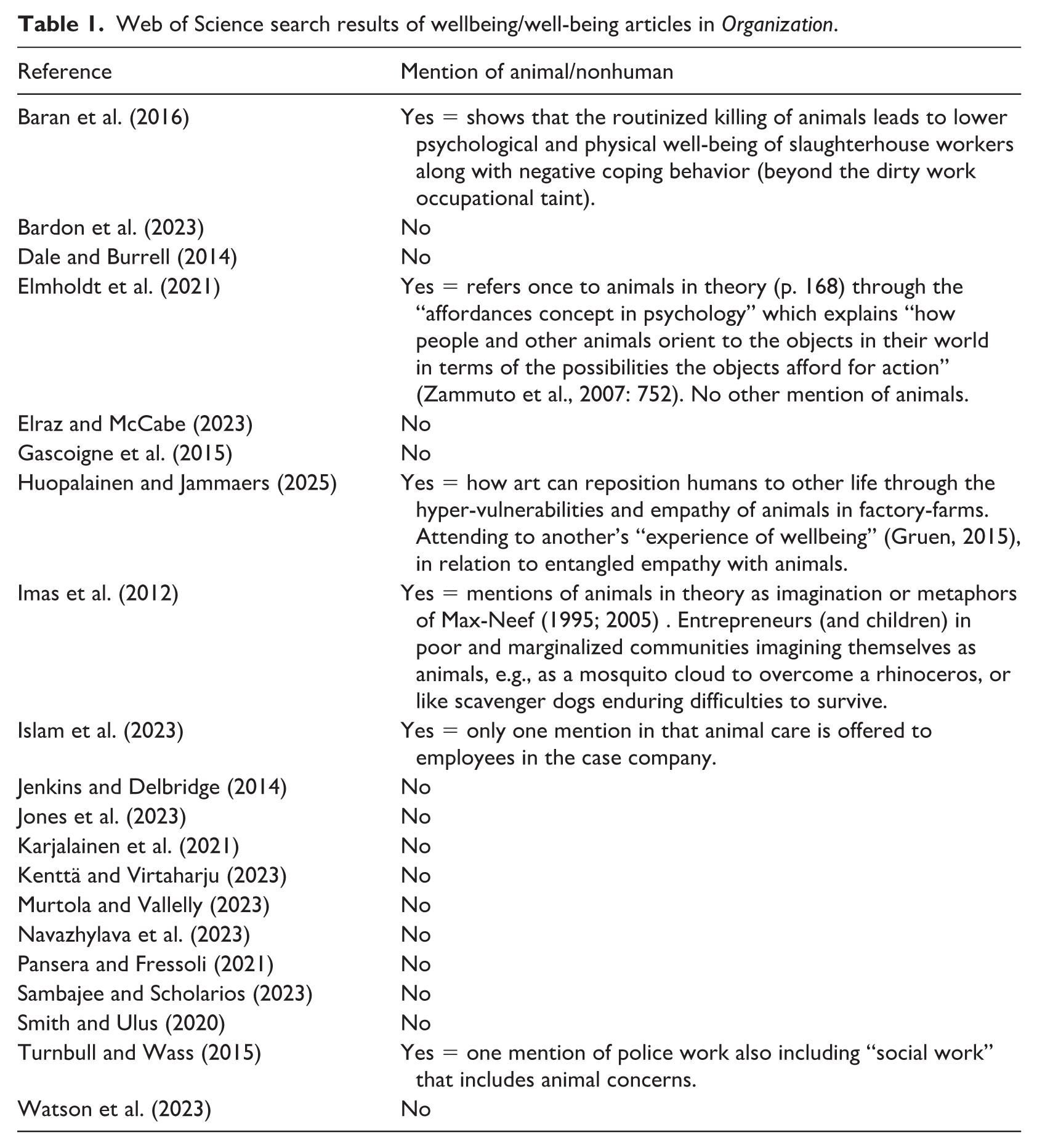
| Reference | Mention of animal/nonhuman |
|---|---|
| Baran et al. (2016) | Yes = shows that the routinized killing of animals leads to lower psychological and physical well-being of slaughterhouse workers along with negative coping behavior (beyond the dirty work occupational taint). |
| Bardon et al. (2023) | No |
| Dale and Burrell (2014) | No |
| Elmholdt et al. (2021) | Yes = refers once to animals in theory (p. 168) through the “affordances concept in psychology” which explains “how people and other animals orient to the objects in their world in terms of the possibilities the objects afford for action” (Zammuto et al., 2007: 752). No other mention of animals. |
| Elraz and McCabe (2023) | No |
| Gascoigne et al. (2015) | No |
| Huopalainen and Jammaers (2025) | Yes = how art can reposition humans to other life through the hyper-vulnerabilities and empathy of animals in factory-farms. Attending to another’s “experience of wellbeing” (Gruen, 2015), in relation to entangled empathy with animals. |
| Imas et al. (2012) | Yes = mentions of animals in theory as imagination or metaphors of Max-Neef (1995; 2005) . Entrepreneurs (and children) in poor and marginalized communities imagining themselves as animals, e.g., as a mosquito cloud to overcome a rhinoceros, or like scavenger dogs enduring difficulties to survive. |
| Islam et al. (2023) | Yes = only one mention in that animal care is offered to employees in the case company. |
| Jenkins and Delbridge (2014) | No |
| Jones et al. (2023) | No |
| Karjalainen et al. (2021) | No |
| Kenttä and Virtaharju (2023) | No |
| Murtola and Vallelly (2023) | No |
| Navazhylava et al. (2023) | No |
| Pansera and Fressoli (2021) | No |
| Sambajee and Scholarios (2023) | No |
| Smith and Ulus (2020) | No |
| Turnbull and Wass (2015) | Yes = one mention of police work also including “social work” that includes animal concerns. |
| Watson et al. (2023) | No |
ORCID iDs

Ethical considerations
Not applicable. The research project that this paper is part of has received a research ethics approval (decision number D/1337/03.04/2023) to cover collecting and analyzing qualitative data in multispecies contexts.
Consent to participate
Yes. This research focuses on human-animal interactions analyzed and interpreted from a human point of view.
Funding
The authors disclosed receipt of the following financial support for the research, authorship, and/or publication of this article: This research is funded by the Research Council of Finland for project PAWWS - People and Animal Wellbeing at Work and in Society (funding decisions #355434, #355435 and #364262).
Declaration of conflicting interests
The authors declared no potential conflicts of interest with respect to the research, authorship, and/or publication of this article.