






Abstract
This article investigates how non-profit organizations (NPOs) in Morocco deploy mockery to respond to reporting pressures of an international humanitarian regime. Theoretically, we develop a neocolonial framework that integrates the inner and outer dimensions of mockery with its key mechanisms—epistemic filtering, template imposition, and tactical compliance—to explain the co-production of contested non-cooperative spaces. Based on multi-sited fieldwork in NPOs working in Morocco, the study makes three contributions. Firstly, we reposition epistemic neocolonialism not only as error (misrepresentation) but as performance (mockery): a ritualized genre that diminishes participation, manufactures non-cooperation, and undermines resistance. Secondly, we go beyond the dominance/resistance binary by theorizing complicity, conviviality, and parody as co-present in NPOs, showing how refusal and compliance interpenetrate within hybrid authoritarian governance and donor-driven regimes in Morocco. Thirdly, we extend research on NPOs in the Souths by offering a spatialization of neocolonial power in the non-profit sector, which ties mockery to the creation of contested non-cooperative spaces: our study shows that marginalized groups do not merely encounter discursive misrepresentation but are structurally positioned in non-cooperative environments where neocolonial actors systematically stifle cooperation.
Introduction
Neocolonialism, as a contemporary manifestation of enduring global power asymmetries, operates less through overt territorial control than through the inner workings of an international humanitarian and development regime (Nkrumah, 1965). Grounded in capitalist free-market logics, this regime perpetuates dependency and exclusion under the guise of empowerment and reform (Chowdhury, 2023). In doing so, it reproduces the moral and material hierarchies of colonialism, reinforcing unequal North–South 1 relations while presenting them as cooperative partnerships (Alcadipani et al., 2012; Sikka and Willmott, 2010). Studies have widely shown that domination often works symbolically—through caricature, erasure, and the disciplining of what “counts” as knowledge—rather than only through brute force (Abdallah, 2025; Prasad, 2003; Yousfi, 2021b). Building on Bhabha’s (1994: p. 122) insight that the colonized are recognized as “almost the same, but not quite,” we integrate Chowdhury’s (2023) account of epistemic neocolonialism with Mbembe’s (2021) emphasis on quotidian rituals of conviviality, accommodation, and subversion to expand our understanding of neocolonialism beyond misrepresentation. In this study, we thereby advance neocolonial research by examining how mockery is deployed in the human rights nonprofit sector in Morocco, where marginalized groups are simultaneously constrained by and negotiate with powerful international actors.
Under neocolonialism, indigenous groups are repeatedly misrepresented through meta-ignorance and meta-insensitivity (Chowdhury, 2023). These external factors act as upstream drivers that normalize mockery and parody those life worlds, rendering their speech inadequate on arrival, thereby perpetuating epistemic neocolonialism (Ilo, 2025). This mockery from the outside creates, in turn, ambivalent non-cooperative spaces (Chowdhury, 2021; Derakhshan and Chowdhury, 2025) where marginalized actors are simultaneously included and excluded. At the same time, as we later discuss, there is also an internal dimension to mockery that is enacted from within when marginalized groups resist and respond to powerful actors, even when they lose various freedoms. Thus, “mockery from within” (Mbembe, 2021: 1268) takes place when subaltern actors negotiate, bend, and hollow out imposed rituals—complying tactically while refusing to accept their terms. Such resistance rarely looks heroic; it is brittle, often complicit, operating within dominant structures while seeking to challenge and transform them (Enaji, 2021).
Power imbalances, prevalent in the non-profit sector (Chowdhury, 2017; O’Reilly’s, 2010), make Moroccan non-profit organizations (NPOs) a particularly relevant setting for examining the dialectics of inner and outer mockery. Morocco’s organizational landscape reflects a hybrid structure, where traditional governance systems inherited from the colonial period are actualized in a hybrid authoritarian regime that coexist with modern institutions influenced predominantly by western administrative and managerial models. In this context, Moroccan NPOs are subject to neocolonial forces that offer external powerful actors “power without responsibility,” subjecting those who suffer from it to “exploitation without redress” (Nkrumah, 1965: ix).
By examining how mockery unfolds as a multidimensional phenomenon in Morocco, we provide a threefold understanding of its implications: First, neocolonialism as mockery shows how voices are parodied and compelled into international reporting rituals and are filtered by state censorship (its outer dimension) while actors undermine those rituals from within (its inner dimension). Second, we show how mockery scales into non-cooperative spaces (Derakhshan and Chowdhury, 2025), which become sites of both constraint and ongoing contestation. Third, our focus on Morocco provides an understanding of where these mechanisms of neocolonial mockery assemble and with what stakes: authoritarian gatekeeping and donor managerialism generate the outer dimension of mockery, whereas communities’ tactical resistance and solidarities instantiate the inner dimension in everyday organizational practice.
This study makes three interrelated contributions. Firstly, by going beyond misrepresentation, we reposition neocolonialism as mockery: a repeatable, ritualized genre that diminishes participation and manufactures non-cooperation. Secondly, our two-dimensional approach to mockery from outside and from within avoids the dominance/resistance binary by theorizing complicity, conviviality, and parody as co-present in the organizational life of NPOs, showing how refusal and compliance interpenetrate within authoritarian and donor-driven regimes in Morocco. Thirdly, we offer a spatialization of neocolonial power in the non-profit sector. By tying mockery to the making of non-cooperative spaces, we extend organizational research at the intersection of resistance, compliance, and agency in NPOs in the Souths: marginalized groups here do not merely encounter discursive misrepresentation but are structurally positioned in non-cooperative environments where neocolonial actors systematically block cooperation and undermine resistance.
The article is structured as follows. We begin by advancing the understanding of neocolonialism in Morocco, revealing both the reproduction of exclusion and silencing, but also the fragile forms of resistance that destabilize dominant narratives. We next discuss neocolonial mockery, describing its dimensions and mechanisms. In the methods section that follows, the multi-sited data collection and abductive analytical procedures are described. Afterward, we present our findings that show outer and inner mockery coproduce Morocco as a contested non-cooperative space. Finally, in the discussion section, we discuss our contributions and outline the limitations of the study.
Theoretical framework
Neocolonialism in Morocco
Neocolonialism refers to the nature of relations after independence between European powers and their former colonies of the non-European world (Uzoigwe, 2019). Organizational research has long emphasized that domination operates not only through coercion but through symbolic and epistemic violence, parody, and the disciplining of marginalized voices (Nkomo, 2011; Prasad, 2003). This managerial recolonization of the Souths is not only a matter of impositions by arms and incentives of aid by actors from the Norths but also implicates local managerial elites who advance managerialism in different localities of the Souths (Yousfi, 2014).
In the Moroccan context, neocolonialism is best understood as the historical and contemporary reconfiguration of colonial power relations through economic, organizational, and epistemic means rather than direct political rule (Stenner, 2012). Following independence, relations with former colonial powers—most notably France and Spain—did not dissolve but were rearticulated through development aid, trade dependencies, and the diffusion of Western administrative and managerial rationalities (Uzoigwe, 2019; Yousfi, 2014). Organizational scholarship helps illuminate how these dynamics operate less through overt coercion than through symbolic domination, normalization, and the privileging of certain forms of knowledge and expertise (Nkomo, 2011; Prasad, 2003). In Morocco, this has entailed the persistent valorization of Western languages, educational credentials, and bureaucratic competencies as markers of legitimacy, while local and vernacular modes of organizing are rendered informal, inefficient, or invisible.
These neocolonial dynamics are particularly evident in the nonprofit sector of human rights and civil society. International NPOs (iNPOs), while providing crucial funding and visibility, play a central role in diffusing standardized organizational forms, reporting practices, and performance metrics that reflect Northern managerial ideologies (Fowler, 2000). Such practices can be read as a contemporary form of colonialism insofar as they erode locally embedded management practices and reproduce Western global hegemony (Yousfi, 2011, 2014). Moroccan NPOs are thus compelled to align with donor-driven templates to secure resources and recognition, even when these templates poorly fit local political realities or grassroots priorities (Banks et al., 2015; Mawdsley, 2017). This process mirrors earlier colonial strategies in Morocco, where European powers-maintained control through dual administrative systems, economic dependency, and social fragmentation between a Western-aligned urban elite and marginalized rural populations (Yousfi, 2014).
Crucially, these pressures unfold within a specific political configuration structured around the makhzen, the term commonly used to define the Moroccan regime. Originally signifying a “storehouse,” the makhzen has come to denote the apparatus of power organized as an unbroken chain extending from the sovereign—whose authority is divinely grounded—through ministers, governors, and local officials (Hamblin, 2015: 184). It represents the locus where power and resources are concentrated, encompassing the palace and its formal and informal clients who set the policy agenda and act as gatekeepers to political reform (Hamblin, 2015; Hill, 2019). Within this context, neocolonialism intersects with an authoritarian political order, rendering human rights NPOs particularly vulnerable. Organizations reporting on issues deemed sensitive by the makhzen—such as the Monarchy, Islam, or the Western Sahara—must navigate both donor-imposed reporting regimes and the risks of repression, surveillance, and discursive silencing by local authorities (Hill, 2019). Neocolonialism thus manifests as a layered condition in Morocco, produced through the entanglement of Western managerial domination and the enduring centralized power of the makhzen. To theorize how such layered forms of power are enacted and contested in everyday organizing, we build upon and expand traditional notions of mockery (Bhabha, 1994; Dobusch et al., 2021) and develop a neocolonial reading that captures both domination and resistance as relational and co-constitutive processes (Chowdhury, 2023).
Neocolonial mockery: From outside and from within
In Bhabha’s (1994) formulation, mockery emerges from the slippages, excesses, and exaggerations that accompany the repetition of dominant norms. As imported models are performed “almost the same, but not quite,” (Bhabha, 1994: 122) it produces ironic distortions that render these norms unstable and potentially absurd. Mockery thus operates through strategic misperformance: actors appear to comply with hegemonic expectations while subtly ridiculing, hollowing out, or exposing their authority, revealing the fragility of power that relies on imitation for its reproduction (Bhabha, 1994; Prasad, 2003).
Neocolonial mockery, we argue, operates along two interrelated dimensions, which capture the domination-subordination continuum across which irony, parody, and symbolic violence are performed, reproduced, and resisted. Externally, it takes the form of outer mockery, where dominant actors parody and police marginalized voices by enforcing rituals of compliance that emphasize their inferiority. Here, powerful actors compel marginalized groups to adopt the forms, discourses, and evaluative criteria of the powerful, only to strip them of meaning or portray them as inadequate. This mocking dynamic simultaneously included and excluded marginalized actors are, which become visible yet silenced, present yet misrepresented. Internally, mockery from within (Mbembe, 2021: 1268) captures how marginalized actors tactically comply and turn powerful actors’ symbols into sites of resistance by re-signifying-imposed norms and rituals. Such resistance is ambivalent and often complicit, as it emerges from within dominant structures and discursive struggle while simultaneously seeking to unsettle and transform them (Hall, 2011).
This dialectical process between outer and inner mockery underscores that neocolonial power is neither monolithic nor static but continually (re)constituted through rituals of compliance, parody, and subversion (Uzoigwe, 2019). Outer mockery captures the systemic and institutionalized dimensions of neocolonialism—those enacted by donors, bureaucracies, national elites, and local governments who impose standards that parody as well as police marginalized actors. Inner mockery, by contrast, illuminates the micropolitical resistance practices through which subaltern actors inhabit, distort, and resist these forms of domination from within. Together, these two dimensions foreground the relational and recursive character of neocolonial power: domination and resistance are not discrete moments, but interdependent processes that co-constitute one another within everyday organizational life (Banerjee, 2022; Chowdhury, 2017; Contu, 2008). In what follows, we identify three mechanisms—epistemic filtering, template imposition, and tactical compliance—that underlie neocolonial mockery in Morocco. Of course, these mechanisms are not exhaustive but rather context dependent. In Moroccan human rights nonprofit organizing each mechanism captures a distinct yet interlocking modality of how neocolonial domination and subaltern resistance unfold.
Epistemic filtering
The first mechanism through which neocolonial mockery operates is epistemic filtering — the process by which authoritarian repression and control from local authorities interweaves with epistemic domination from global North organizations. Epistemic filtering delineates the boundaries of what can be known, said, and taken seriously in organizational life. Meta-ignorance and meta-insensitivity, as Chowdhury (2023) describes, are the epistemic infrastructures through which neocolonial domination is reproduced. Meta-ignorance refers to the willful refusal of powerful actors to recognize their ignorance about marginalized life worlds; a refusal rooted in arrogance and epistemic closure that silences certain voices and knowledges within dominant discourses. Meta-insensitivity captures the affective dimension of this ignorance—the failure to attune to, empathize with, or learn from the perspectives of the marginalized. Together, these meta-attitudes sustain a neocolonial condition in which certain forms of knowing are deemed universally valid, while others are dismissed as anecdotal, emotional, or unscientific.
Through these meta-attitudes, epistemic filtering generates selection effects in access, framing, and validation: whose voices are invited into the conversation, which questions are asked, and whose interpretations are treated as authoritative. The result is a recursive process exemplifying outer mockery that centers the epistemic norms of powerful actors and renders alternative, contextually grounded ways of knowing peripheral or invisible. Studies have indeed demonstrated this logic across multiple domains. For instance, Banerjee (2022) shows how the coloniality of knowledge underpins the management of the Anthropocene, reproducing a universalist, technocratic worldview that marginalizes Indigenous epistemologies. Similarly, Nkomo (2011) and Dar (2018) document how management research continues to erase Southern and Black intellectual traditions by privileging Eurocentric categories of rationality and modernity. Ronde (2025) extends this critique by showing how Northern-led humanitarian iNPOs perpetuate unequal power relations and ongoing neocolonialism by legitimizing Northern authority while silencing local moral vocabularies.
In the Moroccan context, as mentioned above, a dense network of royal, bureaucratic, and business elites has concentrated power through hierarchical patronage, control over civil society, and the moral authority of the monarchy (Hamblin, 2015; Hill, 2019). This configuration constitutes a local regime that engages in epistemic filtering, where certain voices—those aligned with state or elite interests—are amplified, while critical perspectives, particularly around human rights, are silenced or criminalized. As OHCHR (2021) shows, NPOs addressing politically sensitive issues such as press freedom, Islam, or Western Sahara face arbitrary registration refusals, legal harassment, and imprisonment. These practices constitute a form of outer mockery: marginalized NPO actors are invited into the language of civic engagement yet punished for exercising it.
Outer mockery through epistemic filtering intensifies under specific conditions: when legitimacy resources hinge on external audits and metrics (Townsend et al., 2002), when monitoring in NPOs is extensive but dialogic uptake minimal (O’Dwyer and Unerman, 2010), and when elite coalitions collude across state and corporate domains to preserve epistemic authority. Under such conditions, filtering produces an illusion of inclusion: marginalized actors are invited to speak but only through vocabularies that reassert their inferiority. Thus, epistemic filtering not only silences the subaltern but also parodies their voice—turning the very performance of compliance into evidence of epistemic incapacity.
Template imposition
The second mechanism through which neocolonial mockery operates is template imposition and represents the codification of epistemic filtering. Donors, international organizations, and state agencies, together with local elites, embed Western managerial rationalities within standardized forms—reporting templates, KPIs, log frames, and audit regimes—presented as neutral tools for accountability (Yousfi, 2021a). Yet as such “technical” devices are ideological: they universalize a narrow rationality while rendering local practices unintelligible or deficient (Banerjee, 2022). For example, template imposition in the non-profit sector operates through an Orientalist lens that pre-codes actors situated in the Souths as perpetually inadequate and in need of neoliberal managerial solutions (Albu and Murphy, 2024). It enforces a ritual of mockery where compliance with imposed norms is both mandatory and meaningless: the closer marginalized actors approximate dominant reporting templates, the more their difference is reinscribed.
Template domination intensifies in the Moroccan non-profit sector under three interrelated boundary conditions. First, when legitimacy resources depend almost entirely on external audits and performance indicators, templates acquire coercive force, transforming procedural conformity into a survival strategy (Elbers and Schulpen, 2011). Second, when state surveillance is dense but dialogic channels are weak, interorganizational collaboration collapses into reporting rituals that erode genuine collaboration (O’Dwyer and Unerman, 2010). Third, when elite coalitions in both the Souths and the Norths tacitly collude—donors, bureaucrats, and local intermediaries sharing incentives to maintain symbolic order—mockery becomes systemic and self-reinforcing (Banerjee and Linstead, 2004). Under these conditions, template imposition turns organizations into theaters of parody: marginalized groups must enact legitimacy rituals that affirm their own marginality. This is well reflected by international donors and NPOs’ demands of conformity to Western managerial standards—such as standardized reporting guidelines, performance metrics, and “evidence-based” impact frameworks—as conditions of legitimacy (Mawdsley, 2017; Yousfi, 2014). These templates universalize Western notions of rationality and accountability while marginalizing local epistemologies and practices. They present managerialism as neutral, yet they reproduce dependency and symbolic violence by defining what counts as credible knowledge (Yousfi, 2021a). But more importantly, particularly with regards to reporting guidelines, local NPOs are placed in a double bind: to gain recognition from international donors and iNPOs, Moroccan NPOs must speak through vocabularies that simultaneously authorize them and expose them to the retaliation of the local authoritative regime (the makhzen). This is outer mockery’s structural expression: inclusion on demeaning terms.
Tactical compliance
The inner dimension of mockery is tactical compliance and informs how marginalized actors resist domination from within. When overt resistance is too costly or dangerous, actors comply strategically—performing required rituals while withholding genuine consent. Instead of interpreting colonial relations in terms of absolute resistance or absolute domination, the emphasis is on “mockery from within,” and on the logic of “conviviality”” (Mbembe, 2021: 110). Here, the oppressor/oppressed binaries become blurred, and the focus is on the potential complicity between neocolonial forces, corrupt elites, and their subjects. Tactical compliance involves irony, mockery, and coded refusal. It is the art of appearing to cooperate while subtly undermining the terms of cooperation (Bhabha, 1984). For example, Moroccan NPOs adopt Western reporting formats, but often infuse them with locally meaningful narratives, or find alternatives to resist the totalizing logic of donor frameworks. They selectively comply while preserving the substance of critique. Such tactics are precarious—exposing NPOs to sanctions of non-compliance by donors and repression by the state—but they constitute vital forms of agency. Tactical compliance exposes the limits of both authoritarian and neocolonial control by turning parody back on the powerful: the rituals of reporting, legitimation, and performance that donors and regimes demand become hollowed-out artifacts (Prasad, 2003). Within Morocco’s hybrid authoritarianism, where repression and reform co-exist uneasily, these fragile practices of mimicry and refusal represent a quiet insurgency—a way of keeping critical spaces alive under conditions designed to extinguish them.
The potency of inner mockery depends on particular boundary conditions. First, tactical compliance flourishes when communities retain solidaristic ties that allow covert coordination and shared interpretation beneath the surface of compliance (Colin, 2024; Fleming and Spicer, 2008). Second, when risks of overt dissent are high—through surveillance, censorship, or economic dependency—ironic and parodic gestures become safer vehicles for resistance (Enaji, 2021). Third, when imposed rituals are symbolically thick but substantively thin—that is, highly ritualized performances yet easily decoupled from practice—they become fertile ground for parody (Brunsson, 2002). Under these conditions, mockery from within becomes a survival strategy that transforms compliance into critique. Tactical compliance thus reveals that resistance persists—not through confrontation, but through the subversive re-signification of domination’s rituals (Lugones, 2003).
Taken together, the outer/inner dialectic of mockery indicates that neocolonialism is not a “single permanently stable system” (Mbembe, 2021: 108) but, rather, a plural network of overlapping domains, “each having its own logic yet liable to be entangled with other logics” (Mbembe, 2021: 104). We focus on these three mechanisms not as a comprehensive typology but because they together capture the full circuit through which neocolonial power operates and is contested by NPOs in Morocco. Other potential mechanisms that may be found in other settings and regions—such as coercion, co-optation, or outright exclusion (Townsend et al., 2002)—describe familiar patterns of domination but fail to grasp the implications of neocolonial relations today. By contrast, epistemic filtering, template imposition, and tactical compliance reveal how power and resistance are mediated when mockery is deployed as a neocolonial mode of control that relies not on silencing alone, but on compelling speech, imitation, and participation under terms that ridicule and devalue. These mechanisms together expose how neocolonial power sustains itself through mockery, and how marginalized actors, even when constrained, reappropriate mockery as a resource for survival and critique.
Methods
Data contextualization
The first author conducted fieldwork in Morocco over 2 years (2016–2018), using a multiple case study approach approved by the Independent Research Ethics Committee (L-09-2016). Data were collected across 12 NPO sites through interviews, participant observations, workshops, and document analysis. The research team’s approach to data collection, interpretation, and representation was shaped by an awareness of epistemic neocolonialism (Chowdhury, 2023) and the risks of ignorance and insensitivity —that is, the researcher’s failure to recognize contextual histories, emotional realities, and subtle forms of voice suppression that often accompany fieldwork in repressive settings.
Collaborative fieldwork and assistance
Recognizing that access and understanding required deep immersion in local contexts, the first author collaborated with a Moroccan research assistant (RA) of Amazigh ethnicity, who possessed established credibility within local civil society networks. Rather than treating the RA as a logistical intermediary, the first author viewed the relationship as a “dynamic duo” (Middleton and Pradhan, 2014: 355)—a partnership of co-production. The RA was thus a co-interpreter who mediated between epistemic worlds, not just a cultural broker. In a 6-month pilot that took place before the project started, the RA co-designed portions of the interview protocols, translated and contextualized plans for field interactions, and critically reviewed sampling strategies for cultural nuance. Participants themselves also served as co-producers, suggesting language corrections, highlighting misinterpretations, and, at times, contesting the first author’s framing of certain political or cultural terms. These contributions were not treated as peripheral but as constitutive of knowledge production. The RA and participants’ oppositional insights—particularly their skepticism toward iNPOs’ reporting mechanisms—helped the authors identify instances where their own analytical assumptions risked reproducing elite or Westernized logics. This process was crucial in reducing misrepresentation and ensuring that marginalized actors’ epistemic positions informed not just the data but the framing of analysis.
Positionalities and oppositional views
Throughout the research process, both authors adopted an “oppositional views” Chowdhury (2023: p. 563) approach —a self-conscious rejection of hegemonic academic assumptions that normalize Western superiority and objectivity. This stance required continuously interrogating how their own privileges—academic, geopolitical, linguistic, and institutional, as both authors are based at Northern universities—shaped the act of representation. For the first author, of Romanian ethnicity, occupying a shifting insider–outsider positionality in a politically charged, patriarchal field meant navigating between access and suspicion. Here, partial linguistic distance from participants (not speaking fluent Darija) occasionally limited nuance, yet this gap also exposed how insidious the privileging of some forms of articulation over others can be. To counter these tendencies, the authors used oppositional reflexivity rather than conventional self-reflection (Rennstam and Kärreman, 2020). This meant intentionally centering rejectionist practices: questioning the “neutrality” of field methods, confronting the mirage of managerial objectivity, and actively inviting contradiction from participants and assistants. The second author of Chilean ethnicity, who worked at a geographical and cultural distance, acted as an epistemic provocateur—continually questioning interpretive comfort zones and highlighting colonial residues in both data interpretation and writing. This dynamic mirrors the enactment of double consciousness: that is, an ability to see one’s own research through the critical gaze of those historically objectified by it (Chowdhury, 2021; Rios et al., 2017).
Mistakes, misunderstandings, and learning
Despite these precautions, the team encountered errors and misunderstandings that shaped their data analysis and collection. Early in the project, one translated transcript flattened local idioms of resistance into Western rights-based language, unintentionally diluting participants’ moral vernacular. Several interviewees later contested this representation, prompting the team to restore idiomatic expressions (such as tashkil) —even when they risked being “unintelligible” to Western audiences. Similarly, a misreading of a respondent’s irony about “foreign partners” was initially coded as cooperation rather than critique, reflecting the subtle ways in which insensitivity can persist even in critically minded research. The authors confronted these shortcomings through collective analysis with the RA and co-authors, annotating transcripts to trace how meaning was lost or distorted across languages, institutional expectations, and positional biases. These reflective moments were explicitly documented in analytical memos, allowing the authors to track their complicities and modify interpretations before publication.
Reducing misrepresentation through rejectionist practice
While reflexivity and participant validation were important, the team recognized that these mechanisms alone risk reproducing tokenism if they remain procedural rather than epistemic. Instead, the authors sought to internalize oppositional views as a guiding methodology—an ongoing refusal to normalize Western managerial epistemes. This involved several practical commitments: We explicitly privileged participants’ dissenting voices and critical humor as analytical anchors rather than “anecdotal noise.” The writing process was done from a politically engaged stance that acknowledges the violence of epistemic silencing rather than claiming objectivity. We documented moments when the researchers themselves contributed to epistemic harm, such as overlooking classified gender relations within NPOs or assuming safety protocols mirrored Western ethics. We included the RA’s interpretive input in the analysis and acknowledged participants’ conceptual labor as part of co-production.
From reflexivity to positionally reflexive work
Since reflexivity alone is not sufficient, our oppositional reflexivity stance was informed more concretely by positionally reflexive work (Albu et al., 2024). Instead of presuming that sharing findings or “giving voice” sufficed, we emphasized listening oppositionally (Chowdhury, 2023): treating contradictions, tensions, and participant critiques as gifts rather than challenges to authority. This practice of oppositional listening—hearing through the discomfort of being criticized—allowed the research team to encounter the limits of their own frameworks and re-center local meanings of justice and risk. Through this process, the research team sought not only to avoid misrepresentation by being aware of how privileges, identities, and roles intersected and affected the situations they were in. We continuously remodeled our ethics of collaboration based on a relational and dynamic approach (Middleton and Pradhan, 2014): one that views knowledge production as an ongoing negotiation of power, humility, and resistance. The outcome was not a perfect representation but a more honest account of imperfection —a recognition that fieldwork knowledge remains partial, contested, and always subject to revision (Chowdhury, 2022).
Data collection
Three data sources were used: documentary data, interviews, and observations. Documentary data comprised 115 pages of textual outputs (i.e. mission reports, annual reports, website reports, and social media posts). 12 semi-structured interviews were conducted with middle and lower, both temporary and full-time positions (advocacy officers, field researchers, volunteers, etc.) that were actively engaged in reporting the activities of their NPO to international audiences (i.e. writing reports, emails, press releases, etc.). The interviews provided insight into both the experiences and assumptions of participants. We recruited 12 informants working in Morocco and Western Sahara provinces through the snowball sampling technique (see Appendix).
Our range of interviews, even though relatively modest, enabled theoretical saturation given that our sample was homogenous, and our objectives were narrowly defined. We addressed selection bias and narrow sampling by continuously recruiting new informants through our RA and expanding the diversity of our sample. The respondents were interviewed face-to-face based on semi-structured interviews (lasting approx. 30–60 minutes) in various locations chosen by respondents based on safety considerations. The interviews were transcribed into 126 pages of single-spaced text. Observations were conducted by the first author at 2 team meetings, as well as at a 2-day training workshop organized by representatives from all levels (policy officers, managers, volunteers, etc.) from all participating NPOs. The goal of the workshop was that local NPOs’ workers would familiarize each other with writing reports, following reporting guidelines, and maintaining digital security.
This research design offered the distinct benefit of fostering social immersion and closeness between researchers and informants, which obviously comes with its own challenges and drawbacks (Rabinow, 2007), including potential risks to the safety of informants, the researcher, and the integrity of the data. Several precautions were taken to ensure sensitivity to participants’ needs, safety, and well-being. Among these measures was the establishment of a comprehensive digital security protocol for all communications with informants and data collection activities. Moreover, the fieldnotes and interview responses were subjected to local ethics reviews and participant involvement through a shared encrypted drive with all participants to ensure that we accurately represented the worldviews of the respondents.
Abductive thematic analysis
We employed an abductive phronetic analytical procedure (Tavory and Timmermans, 2014), emphasizing an iterative dialog between the empirical material and the researchers’ theoretical repertoire (Tracy and Hinrichs, 2017). Abduction allowed us to move back and forth between theory and data, constantly revising and expanding our understanding of neocolonial mockery as it unfolded in practice. While acknowledging the theory-laden nature of our interpretive process, we adopted elements of grounded theory to structure the early stages of analysis—particularly open coding and iterative categorization (Tracy and Hinrichs, 2017). This process encouraged theoretical sensitivity while maintaining empirical openness to what the data revealed about the lived manifestations of neocolonialism in Moroccan NPOs.
Initial coding and category development
The first author led the initial coding, supported by the research assistant’s local insights and the second author’s theoretical interrogation. Together, we began with broad descriptive coding to identify recurring patterns, metaphors, and contradictions in how participants described their experiences with iNPOs, state authorities, and their own communities. Five preliminary categories emerged: (1) Historical continuities of control: How colonial legacies and hybrid authoritarianism shaped the regulatory and institutional environment of Moroccan NPOs. This included narratives about surveillance, censorship, and bureaucratic gatekeeping. (2) Material dependency and resource scarcity: How donor funding structures, technological inequalities, and access to international networks constrained local autonomy and organizational sustainability. (3) Discursive legitimacy and representation: How NPOs framed their missions and reports to appeal to international audiences, often negotiating between local moral vocabularies and western humanitarian expectations. (4) Formal managerial templates: How iNPO reporting systems, audits, and guidelines imposed western managerial rationalities that restructured everyday practices within local NPOs. (5) Everyday practices of resistance and adaptation: How local actors responded to repression and donor imposition through irony, parody, selective compliance, and the creation of solidaristic “workarounds.”
Each category revealed a different layer of how power and resistance were enacted within neocolonial relationships. However, as the analysis deepened, we realized that some categories were analytically saturated in the literature (e.g. “historical continuities of control” and “material dependency,” Kreitmeyr, 2019) or empirically less central to our data. While these dimensions provided important context, they did not capture the symbolic and relational dynamics of mockery that our participants repeatedly described.
Through abductive iteration, we refocused our analysis around three interrelated mechanisms that most powerfully illuminated the dialectic of outer and inner mockery in Moroccan NPOs: Epistemic Filtering—capturing how knowledge hierarchies and censorship practices structured what could be known, said, or represented; Template Imposition—showing how donor-driven managerial systems transformed legitimacy into performance, compelling mimicry of Western norms; Tactical Compliance—revealing how local actors re-signified these impositions through irony, partial adherence, and symbolic defiance. These three mechanisms were not only empirically dominant but also conceptually generative, offering a way to bridge micro-level practices of compliance with macro-level structures of neocolonial dominance. They represented “general representations of insight” (Becker, 1998: 128)— concepts that speak both to the specific case and to broader processes of neocolonial power.
We ultimately excluded the first two categories— historical continuities of control and material dependency —for three reasons. First, these issues are extensively theorized in organizational and development research (Prasad, 2003), and while present in our data, they did not advance our central argument about mockery as a mode of domination and resistance. Second, participants rarely articulated these dimensions explicitly; their concerns centered more on how control manifested through daily reporting practices and discursive norms than on historical structures per se. Third, these dimensions often served as background conditions rather than dynamic processes in the empirical material. In contrast, the categories of epistemic filtering, template imposition, and tactical compliance captured the co-productive dynamics of outer and inner mockery —how dominance and resistance unfolded simultaneously in practice. Together, these mechanisms provided a coherent analytical frame for understanding the production of contested non-cooperative spaces, where visible cooperation coexists with invisible refusal. This abductive process thus linked the micro-politics of organizational life in Moroccan NPOs to the broader logics of epistemic neocolonialism. Through iterative cycles of coding, dialog, and theoretical reflection, the final framework emerged as both empirically grounded and theoretically novel—demonstrating how mockery operates not merely as symbolic ridicule but as a complex organizational process that structures, disciplines, and simultaneously enables resistance within neocolonial spaces.
Findings
Outer mockery and epistemic filtering
Outer mockery in the Moroccan NPO field manifests through a form of authoritarian inclusion without voice, in which participation is tolerated only within state-sanctioned boundaries of discourse. This dynamic exemplifies epistemic filtering, the mechanism through which powerful actors define what can be said, by whom, and under what conditions. Through censorship, surveillance, and the criminalization of dissent, the Moroccan state constructs an epistemic order that simultaneously invites engagement and punishes expression, producing a public sphere marked by fear, self-censorship, and strategic silence. Participants consistently described this experience as one of conditional inclusion—being allowed to operate as human rights defenders only under the implicit threat of repression: Moroccan prosecution procedures are a kind of revenge/settlement with those people who demand freedom, human dignity, and social justice. I can now get up to five years in prison because of what I share on social media platforms (interview, Respondent 8).
This statement encapsulates the logic of outer mockery: actors are formally included in public discourse, yet the very act of speaking becomes grounds for punishment. What appears as cooperation is, in practice, a form of subordination, where state authorities use legal and procedural mechanisms to parody the ideals of justice and human rights they publicly claim to uphold: The government is also using illegal methods in their surveillance, like phone and mail surveillance, prosecutions, intimidation, bribing, and so on. Workers in Morocco are walking on a minefield: we never know when it will explode. (interview, Respondent 9)
Such accounts illustrate how epistemic filtering operates not only through censorship but also through the internalization of fear — a disciplinary chilling effect that ensures self-censorship long before external punishment occurs. Workers described constant uncertainty, heightened risk, and limited access to secure resources, which further constrained their ability to act: How can they [iNPO] expect that one person should be good at reading laws, drafting policy and then knowing all the data security stuff when meeting contacts in the field to do the reporting? They [iNPO] don’t care at all. All their technology and human rights [division] sits in Geneva or London and will stay there. But we [human rights officers] work here [in Morocco] and we do not have any digital security resources, and we are endangering our sources. For instance, I have a Facebook account I setup to talk with a contact on the ground [in Morocco]. And now I realize that it is endangering us both since that [coordinating on Facebook] is not safe, and the repercussions can be really scary.” (Workshop fieldnotes, Respondent 6)
Local constraints such as arrests and prosecutions on defamation charges, which were common retaliation practices of the government, also contributed to NPOs orientation to engaging with western reporting. This reveals the interconnection between domestic epistemic filtering and external neocolonial dynamics. The state’s surveillance and censorship combine with epistemic domination from outside—international donors’ indifference to local risks—to entrench a non-cooperative environment. iNPOs’ insistence on standardized reporting and digital coordination reproduces outer mockery by exposing local workers to harm under the guise of efficiency: I’ve been forcibly disappeared 1–2 years, detained without any rights for 2 years, and imprisoned without a trial for 2 years. [. . .] We have been blacklisted for 10 years [. . .] So, we hope we can be heard again. (Interview, Respondent 3, emphasis added)
The cumulative effect of these practices is the co-production of silence. State prosecution procedures function as a form of revenge against speech, while international reporting regimes compel self-surveillance and instrumental compliance. Both systems operate through epistemic filtering: powerful actors decide which forms of knowledge are legitimate, whose narratives are credible, and what risks are acceptable. As earlier studies note (Kreitmeyr, 2019), such conditions foster self-censorship and resignation, transforming participation into inauthentic cooperation. In this context, outer mockery becomes the everyday language of neocolonial power—one in which inclusion is inseparable from humiliation, and speaking against it always risks punishment.
Outer mockery and template imposition
Outer mockery also manifests through template imposition, the mechanism by which iNPOs and donors universalize Western managerial rationalities under the guise of transparency and accountability. In Morocco, local NPOs must adopt standardized reporting frameworks—templates, checklists, performance indicators, and prescribed “neutral” writing styles—to gain recognition within the global humanitarian field. This process constitutes a form of epistemic domination from without: international actors define what counts as credible evidence, legitimate speech, and professional competence, while relegating local modes of advocacy and knowledge to the margins. As such, legitimacy itself becomes a parody—an appearance of inclusion predicated on compliance rather than genuine dialog.
For NPOs operating under Morocco’s hybrid authoritarian regime, collaboration with iNPOs is both a survival strategy and a site of subordination. Participants described how compliance with donor reporting guidelines is a pragmatic necessity, enabling access to resources and protection in an otherwise repressive environment. This illustrates the parody of legitimacy: to be recognized as professional, local actors must translate their lived experiences of injustice into the technical grammar of donor reporting: Doing the reporting work isn’t easy. You need to go and meet the people who were subject to abuses, often they don’t have time and do not react immediately, so you need to be flexible and spend all your time on it. Often people just go on and on about “oh in Morocco the police are just beating people and are so bad and so on” and I am actually interested in one specific case, so I ask them but tell me what the police did to you, but they keep on saying, ‘yes but you know in Morocco the police beat people and treats them bad’. So, you need a lot of stamina and perseverance to get people to talk about it, then write it objectively, and tick all the boxes on the reporting checklist (interview, Respondent 12).
Through such processes, outer mockery transforms participation into hollowed rituals. Reporting ceases to be a means of amplifying marginalized voices and becomes instead a practice that validates the authority of iNPOs. The power of the monarchy and that of iNPOs intersect here, producing a double bind: local NPOs must conform to Western templates to gain legitimacy, yet such compliance exposes them to state persecution for “collaboration with foreign powers” (OHCHR, 2021). One respondent emphasized how this paradox shapes their strategic engagement with international audiences. As indicated, a pragmatic orientation drove local NPOs to accept imposed templates and engage with Western reporting. Workers considered the monarchy’s preoccupation with how the western media depicts Morocco as “the only force that can give pause to the regime’s repressive tactics” (interview, Respondent 2). Engaging with international news media was an attempt to pressure the local government to reduce repressive tactics: We are working mainly by writing reports and emails, but then we have the website and social media. We worked on this dissemination for a long time, and it helped to publicize the subject. The website has been working in four languages for a period in four languages Arabic, French, English, and Spanish. So even before using social media, we were active by sending photos and emails to international contacts and journalists. It’s our only way of being heard (interview, Respondent 3)
Here, the outer mockery lies in the selective solidarity of iNPOs: once the risks become tangible, the same actors that demanded compliance retreat into self-protection, leaving local organizations exposed. Western reporting templates, framed as universal tools for accountability, thus function as instruments of abandonment — they impose the esthetic of legitimacy without material support. As one participant recounted: Several international and local NPOs’ reports formed the basis for the ICCPR report where Morocco is a signatory. iNPO4 was working to assist us, the local partner organizations in developing [reporting] capacities to investigate surveillance and advocate for strong privacy protections. It was important for us to be present there in those conversations, so we worked together. But the moment the authorities started to prosecute workers for collaboration with foreign powers, the iNPO in question switched their position and decided not to do anything in Morocco because you put people at risk. You put yourself at risk. You put your organization at risk. We understand it but we also feel let down and detached from whatever comes from them (interview, Respondent 9)
iNPOs frequently set the terms of legitimacy, favoring technocratic, “neutral” forms of knowledge production that exclude local idioms, grassroots practices, and experiential expertise. For many of our respondents, adopting imposed templates and reporting protocols involved personal risk, surveillance, and even incarceration. The illusion of empowerment through compliance quickly fractured when global recognition did not protect them on the ground: Following these guidelines got me into prison. They [iNPOs representatives] told me ‘Ahmed, come to Geneva, speak about human rights and show how your organization does the reporting. We want to promote best practices.’ So, I went and told them, this is who I am and what we do, and then I started receiving threats. And then, when I returned home, I got into prison. It took them [iNPOs representatives] four months of campaigning to international contacts to get me out. So, I had to lay low for a while and change my approach to more unorthodox means of reporting. I use pseudonyms now even though [iNPOs] are not fond of them.” (Interview, Respondent 5)
This exemplifies the violent irony of outer mockery: the very reporting mechanisms that promise visibility render activists vulnerable (Rega and Medrado, 2023). Reporting becomes both the measure of legitimacy and the instrument of exposure. In this context, template imposition and epistemic filtering intertwine, generating a double bind and co-producing the contested non-cooperative space that defines Morocco’s human rights sector. Donor regimes and state repression converge to institutionalize participation as spectacle, inclusion as dependency, and cooperation as risk. Ultimately, outer mockery through template imposition transforms accountability into a mode of neocolonial power. It compels marginalized actors to perform “cooperation” in forms that affirm their inferiority, while punishing any deviation from the script. This dual process—recognition without protection, participation without voice—illustrates how neocolonial mockery sustains itself through procedural means. Within such double binds, cooperation becomes impossible, and resistance, if it endures, must take shape through the ironic and subversive tactics of mockery from within.
Inner mockery and tactical compliance
If outer mockery produces dominance through epistemic filtering and template imposition, inner mockery represents its dialectical counterpoint—a fragile but persistent form of agency enacted through tactical compliance. Under neocolonial and authoritarian constraints, NPO workers resist not through open defiance but through ironic participation, strategic misperformance, and hollowed compliance. These practices constitute what we identify as fragile resistance through parody, where actors appear to conform to imposed rituals while subtly subverting their meaning. In such contexts, mockery becomes a weapon of the weak: it allows critique without direct confrontation and survival without capitulation. Marginalized workers described compliance as a necessary façade, an obligatory performance enacted to satisfy donors and regulators while retaining a measure of control over meaning. As one respondent remarked with humor and irony: “It’s all for show. It’s tashkil (approx. trans. mere form-filling) added the respondent jokingly” (Fieldnote, Respondent 11).
Humor functions as epistemic subversion —a form of everyday theorizing that exposes the emptiness of donor-imposed rituals (Prasad, 2003). Re-labeling international reporting procedures as mere formality transforms compliance into parody. The ritual is performed, but its significance is redefined by those compelled to enact it. Through this strategic misperformance (Bhabha, 1994), workers transform imposed bureaucratic practices into symbols of their absurdity. Compliance becomes a stage where irony and critique coexist, revealing the fragility of neocolonial power. This performative resistance is also evident when international partners exercise epistemic control over reports, redacting content to maintain diplomatic acceptability. In recounting such experiences, one respondent deployed sarcasm to question the legitimacy of foreign authority: We once organized a press release with our report at the embassy [. . .] They had printed the report, and it was full of red lines. The aide of the consul came to me and said: ‘this is not correct [. . .]’ I should have asked him ‘But are you Moroccan’? Plus ça change, plus c’est la même chose. (Interview, Respondent 1)
Inner mockery performs a dual function. It protects the speaker by cloaking critique in humor while simultaneously exposing the neocolonial power embedded in knowledge hierarchies. The respondent’s rhetorical question—“But are you Moroccan?”—is a pointed act of epistemic boundary-drawing: it mocks the authority of outsiders to determine the accuracy of local knowledge. This moment illustrates how inner mockery contests epistemic domination from within, converting ridicule into a subtle form of reclamation.
When formal avenues of advocacy were closed, local actors shifted toward solidaristic workarounds —sit-ins, social media campaigns, and symbolic performances—to sustain visibility and solidarity beyond the reach of international gatekeeping. One participant explained: “Most of the time we would do peaceful demonstrations and share them on Facebook after the ‘sit ins.’ But these did not fit with the desired [international reporting] rules.” (Interview, Respondent 3). These practices demonstrate how inner mockery and tactical compliance co-produce contested non-cooperative spaces. Even as the formal channels of cooperation (reporting, funding, etc.) are colonized by external expectations, NPOs generate informal circuits of resistance that circumvent these epistemic constraints. Tactical compliance thus becomes not a passive adaptation but an active reconfiguration of neocolonial scripts—a way of reclaiming agency within constrained conditions. Participants also described how the double bond intensified as repression escalated. One respondent noted how state restrictions on public gatherings intersected with donor-imposed reporting demands: It was one year and a half ago that the problems started, when the ministry of interior declared that local NPOs, including ours, are not aligned with the vision of the authorities. What they [the authorities] want is to take us out of public and international spaces. For instance, we cannot rent any big facility like a hotel or a conference hall for any workshop to train our personnel on how to write reports based on iNPOs mechanisms. Whenever we try this, then that hotel receives a phone call to cancel our booking and to throw us out. The only place we can use is our premises here at the Lawyers Club (but it is rather small and often busy). That is all. Like this, they are trying to keep us from spreading our message out in the public space, and now and then they succeed because of apathy and censorship among our workers. But we have become better at working with iNPOs’ mechanisms, we do a lot of training of ‘best local practices’ where we have different volunteers sharing what reporting works there [in Geneva] but doesn’t work here. (Interview, Respondent 8)
This reflection captures the spatial politics of tactical compliance. The respondent’s distinction between “there” (the international sphere) and “here” (the local context) underscores how actors continuously recalibrate compliance in response to shifting power dynamics. Cooperation, in this setting, is performative and negotiated: it sustains access to international legitimacy (“there”) while resisting epistemic silencing “here.” The result is a simultaneously imitative and insurgent practice that both fulfills and frustrates the expectations of iNPOs governance. Other participants described similar skepticism toward international expertise, revealing how inner mockery serves as a protective mechanism: I discovered that there was virtually no digital security in place. Sensitive information was being stored on insecure devices with no information back-up, no encryption, no secure communication channels, and no use of pseudonyms. So, we take whatever comes from international NPO with a grain of salt. There is double pressure on us, and we need to work harder and with our own resources since they do not offer any other help. We have to make sure that everyone is safe, their names hidden, and also report to international NPO. (Workshop fieldnotes, Respondent 7, emphasis added)
This comment reveals how mockery from within produces epistemic distance: local actors recognize the contradictions of donor prescriptions and reinterpret them through irony and skepticism. Their compliance is strategic, not submissive—it performs legitimacy while maintaining morale and operational autonomy. Ultimately, inner mockery and tactical compliance co-produce contested non-cooperative spaces by keeping the appearance of cooperation alive while hollowing out its substance. Through humor, irony, and strategic misperformance, Moroccan NPOs sustain fragile solidarities and reclaim limited autonomy within neocolonial regimes of power. Their actions reveal that in contexts of epistemic closure and repression, resistance persists not in open rebellion but in the reworking of domination’s rituals. Mockery from within becomes both a critique of neocolonial legitimacy and a lived strategy of survival—an act of fragile defiance that asserts local agency within the very structures that seek to silence it.
In fine, across the Moroccan NPO field, the three mechanisms— epistemic filtering, template imposition, and tactical compliance —interact to co-produce a contested non-cooperative space. These intertwined mechanisms render non-cooperation both systemic and performative. Epistemic filtering silences from above; template imposition disciplines from without; tactical compliance resists from within. The result is not the absence of cooperation, but its simulation: a façade sustained by humor, conviviality, and irony. The contested non-cooperative space is a terrain where visible compliance masks invisible refusal, where legitimacy operates as parody, and where the colonized must “speak” through forms that simultaneously expose and reproduce their subordination. The double bind thus becomes the lived condition of neocolonial power: cooperation is demanded yet punished, resistance persists yet remains precarious. Within this ambivalent space, mockery operates as both a symptom of domination and a resource for survival, illuminating how power and agency are continually negotiated through the uneasy interplay of imitation, irony, and refusal.
Discussion
Our findings show how neocolonial mockery is not a singular discursive process but a dialectical and spatial phenomenon in a relational field of action through which compliance, resistance, and agency are continuously co-produced (see Figure 1). The mechanisms of epistemic filtering, template imposition, and tactical compliance interact to shape the emergence of contested non-cooperative spaces, where marginalized actors’ participation is both demanded and devalued. Each mechanism performs a distinct function: epistemic filtering defines the epistemological boundaries of inclusion, template imposition materializes those boundaries through procedural control, and tactical compliance transforms these constraints into fragile possibilities for subversion. Together, these processes generate a double bind —a condition in which marginalized actors must perform cooperation to survive, even as such cooperation reproduces their subordination.
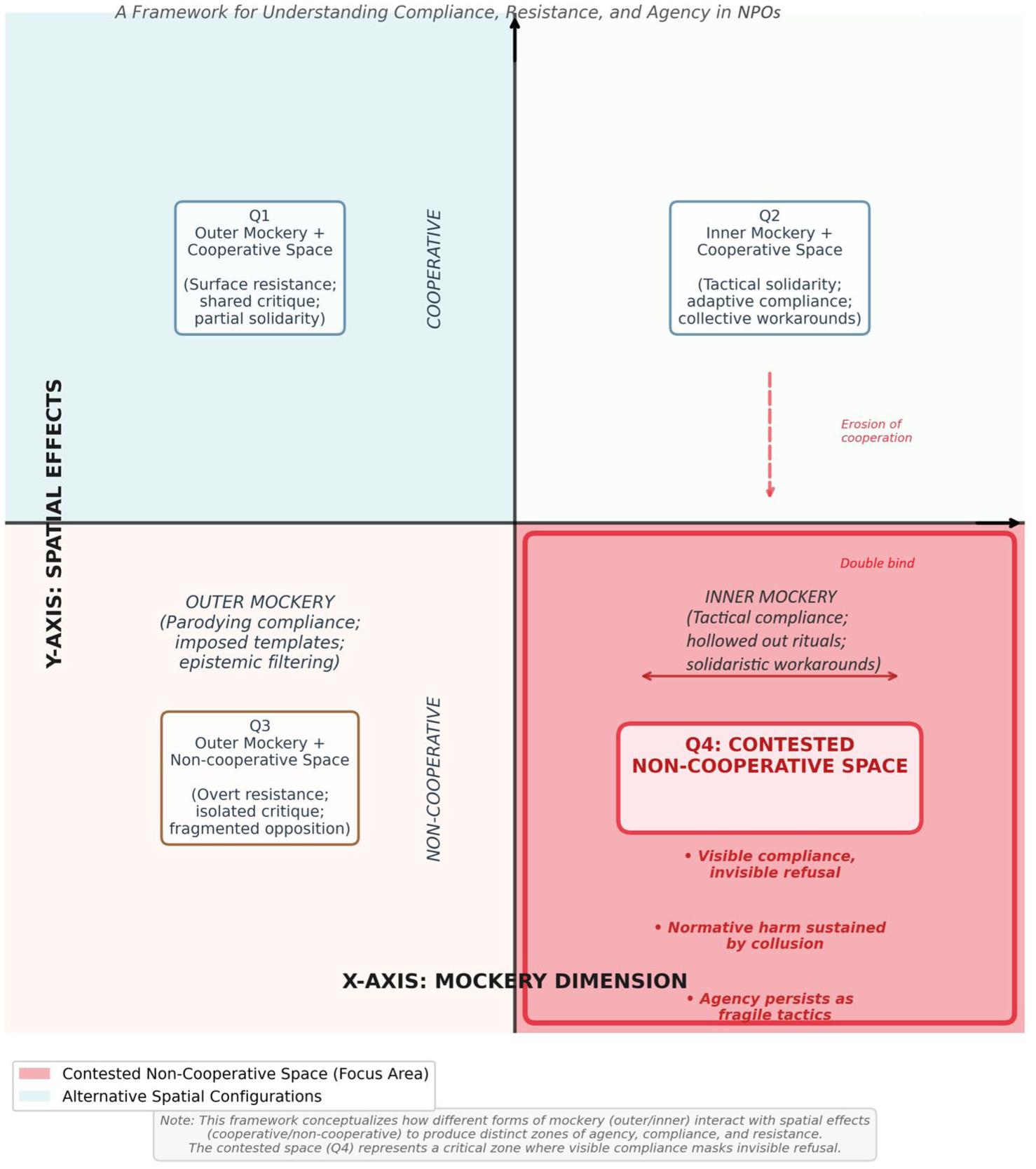
Neocolonial mockery and non-cooperative spaces.
Epistemic filtering: Constructing the boundaries of inclusion
In the upper-left quadrant, outer mockery intersects with relatively cooperative settings, where engagement between powerful and marginalized actors remains possible but asymmetrical. Here, epistemic filtering operates through selective inclusion: marginalized actors are invited to “participate” but only within epistemic terms defined by the powerful (Prasad, 2003). In Morocco, these dynamics manifest when the state authorizes certain NPOs to operate under tight discursive constraints, allowing critiques that remain symbolically safe but excluding those that challenge monarchical or religious authority. Cooperation thus becomes conditional, and “dialogue” serves as a technology of containment. The mockery lies in this contradiction—marginalized voices are heard only insofar as they echo dominant frames (CPJ, 2025). This space, while outwardly cooperative, is already structured by non-cooperation at the epistemic level to sustain the illusion of inclusion while maintaining epistemic superiority (Chowdhury, 2023).
Template imposition: Institutionalizing procedural control
In the lower-left quadrant, outer mockery operates within overtly non-cooperative spaces. Template imposition translates epistemic hierarchies into procedural constraints, compelling marginalized actors to accept dominant organizational forms under coercive conditions. In the Moroccan NPO field, this is evident when iNPOs and donors enforce Western reporting templates and metrics that serve donor accountability rather than local empowerment. These templates embody the epistemic assumptions of managerial modernity: that legitimacy derives from quantification, standardization, and “evidence-based” evaluation (Yousfi, 2021a). When local actors comply, their knowledge is hollowed out and re-presented as data, effectively severing meaning from experience. Cooperation becomes impossible because the very mechanisms that demand participation also nullify its substance. Outer mockery here operates through the parody of accountability — a procedural theater where inclusion is ritualized, but voice is denied. This quadrant marks the consolidation of non-cooperation as a structural condition, underpinned by the co-production of epistemic hierarchies and the limited efficacy of institutional protocols for accountability that taint citizens’ hopes for change (Colin, 2024).
Tactical compliance: Resisting from within
The upper-right quadrant represents spaces where inner mockery coexists with cooperation. Tactical compliance emerges as marginalized actors’ creative response to epistemic and procedural domination. Here, Moroccan NPOs tactically adopt donor reporting guidelines while subtly re-signifying them—embedding local idioms, moral claims, or community priorities into bureaucratic forms. Cooperation persists, but it is ambivalent: actors engage strategically to sustain access to resources and visibility while quietly contesting imposed meanings. This quadrant captures the ambiguous potential of mockery from within (Bhabha, 1994; Mbembe, 2021)—the ability to inhabit domination’s language ironically, to comply outwardly yet refuse inwardly. Cooperation in such contexts is maintained through irony and adaptation, but its erosion begins when external templates tighten, and local meanings are progressively evacuated. The red dashed arrow in the framework (“Erosion of cooperation”) illustrates this drift toward the lower-right quadrant, where dominance intensifies and resistance becomes precarious.
Contested non-cooperative spaces
The lower-right quadrant (Q4)—the contested non-cooperative space—is the focal point of our findings. Non-cooperative spaces are “highly restrictive, disadvantageous, or even harmful” socio-organizational environments in which institutional arrangements deliberately curtail cooperation and block marginalized actors from meaningful participation, despite their capacities and skills (Chowdhury, 2021: 917; Derakhshan and Chowdhury, 2025). Neocolonialism functions as a structural driver of such spaces by embedding actors in regimes of dispossession, surveillance, and silence, where harm is normalized under the guise of order, productivity, and progress (Lobbedez et al., 2025). In Morocco, this produces a contested non-cooperative space shaped by the convergence of outer and inner mockery, generating a double bind: NPOs must perform compliance with both state and donor demands to survive, even as these performances reproduce the very structures that marginalize them.
This space is sustained by three interconnected mechanisms that mediate the dialectic between exclusion and agency. Epistemic filtering dictates which voices are admissible; template imposition constrains how those voices must speak; and tactical compliance transforms these impositions into tools of fragile resistance. However, this resistance remains precarious—visible compliance masks invisible refusal, and parody becomes both a mode of survival and a symptom of subordination. In this quadrant, cooperation is not simply absent; it is performed as if it existed. The space becomes non-cooperative precisely because actors must continuously enact the illusion of collaboration under coercive terms. Mockery here is not merely symbolic—it is spatial and affective, shaping how actors navigate the contradictions of dependency, recognition, and resistance. The contested non-cooperative space thus represents the culmination of neocolonial mockery: a social terrain where inclusion operates through ridicule, and agency persists only through ironic participation.
Conceptualizing the Moroccan nonprofit sector as a contested non-cooperative space offers a spatial understanding of neocolonial power. It shows how domination operates through symbolic inclusion and procedural coercion, while resistance persists through complicity, conviviality, and parody rather than open opposition. These everyday practices of inner mockery underscore that neocolonialism is never total: it depends on the participation, humor, and subversion of those it seeks to govern. NPO workers’ negotiations thus reveal how, even within spaces marked by repression and epistemic violence, agency endures through the subtle reworking of domination’s very rituals.
Our findings make a threefold contribution to understanding neocolonial compliance, resistance, and agency in the non-profit sector. First, by going beyond misrepresentation, we reconceptualize epistemic neocolonialism as a ritualized genre of mockery that diminishes participation, manufactures non-cooperation, and undermines resistance. Second, our two-dimensional approach to mockery—outer and inner—moves past the dominance/resistance binary by theorizing complicity, conviviality, and parody as co-present in organizational life, showing how refusal and compliance interpenetrate within hybrid authoritarian and donor-driven regimes in Morocco. Third, we spatialize neocolonial power by linking mockery to the creation of contested non-cooperative spaces, thus extending research on resistance, compliance, and agency in the Souths. Our framework illustrates how the three mechanisms—epistemic filtering, template imposition, and tactical compliance—interact to generate these spaces. Epistemic filtering constructs the boundaries of inclusion (Q1), template imposition enforces procedural control and non-cooperation (Q3), and tactical compliance sustains ironic, partial cooperation (Q2), while their convergence in Q4 produces the contested non-cooperative space where visible compliance masks invisible refusal. In this double bind, marginalized actors must speak through the idioms of their oppressors to survive, even as such mimicry becomes the very medium of critique. Thus, mockery emerges not only as a metaphor for domination but as a spatial and performative mechanism through which cooperation is undermined and resistance persists in fragile, parodic forms.
This study is not without limitations. First, although the multi-sited design provided rich qualitative insights, the sample of Moroccan NPOs remains relatively small and sector-specific, which may limit the transferability of our findings to other contexts or forms of activism in the Souths. Second, while we sought to minimize ignorance and insensitivity through oppositional reflexivity, our positionalities as researchers based in Northern institutions inevitably shaped what could be seen, translated, and theorized. Third, given the political sensitivity of the field, some accounts may have been self-censored, and our presence may have influenced participants’ willingness to express critique openly. Finally, by privileging mockery as an analytic lens, we may have downplayed other modalities of resistance or solidarity that fall outside irony and parody. These limitations underscore that our findings should be read as a situated interpretation rather than a comprehensive account of neocolonial dynamics in the Moroccan non-profit sector.
Footnotes
Appendix
Acknowledgements
We appreciate the many useful comments and remarks we have received on earlier versions of this manuscript.

Ethical considerations
The study was approved by the Independent Research Ethics Committee (L-09-2016).
Consent to participate
All participants provided informed consent prior to their participation in the study.
Funding
The authors disclosed receipt of the following financial support for the research, authorship, and/or publication of this article: This work was supported by the Udenrigsministeriet (L-09-2016).
Declaration of conflicting interests
The authors declared no potential conflicts of interest with respect to the research, authorship, and/or publication of this article.
Data availability statement
The raw/processed data required to reproduce the study’s findings cannot be shared at this time due to ethical reasons (e.g. in order to preserve the anonymity and safety of participants).
Notes
Author biographies
References
Supplementary Material
Please find the following supplemental material available below.
For Open Access articles published under a Creative Commons License, all supplemental material carries the same license as the article it is associated with.
For non-Open Access articles published, all supplemental material carries a non-exclusive license, and permission requests for re-use of supplemental material or any part of supplemental material shall be sent directly to the copyright owner as specified in the copyright notice associated with the article.
