






Abstract
This paper examines how algorithmic control operates when workers participate in configuring the systems that organize their own work. Drawing on a longitudinal case study in a public-sector agency, it shows how teams translated shared priorities into numerical rules within a digital interface. Through this process, collective deliberations were rendered durable and came to structure the sequencing of future work. I develop the concept of technical self-control to capture this form of governance: control that emerges through participatory rule inscription rather than managerial imposition. Even simple and transparent algorithms, configured by workers themselves, narrowed discretion by stabilizing what counted as the appropriate next task. Over time, these locally configured arrangements also enabled managerial recentralization by making work orderings visible and comparable. By focusing on interface-mediated rule setting in a conventional organization, the study shifts attention from opacity to the formalizing effects of participation in algorithmic management.
Keywords
Introduction
Research on algorithmic management has expanded rapidly over the past decade, documenting how algorithmic systems are increasingly used to coordinate, evaluate, and direct work, and how they reshape managerial authority and worker autonomy (de Vaujany et al., 2021; Kellogg et al., 2020). This literature has shown how algorithmic management intensifies surveillance, reorganizes accountability, and contributes to new forms of precarity and dependency, particularly in platform-based and gig-economy settings (Curchod et al., 2020; Möhlmann et al., 2021; Newlands, 2021; Walker et al., 2021). These studies have been central in demonstrating how algorithmic systems transform the governance of work by embedding control in data-driven infrastructures that structure access to tasks, performance and evaluation of work.
Alongside this focus on consequences, a growing body of research has examined how algorithmic management is accomplished in practice. Rather than treating algorithmic control as technologically autonomous, this literature has shown how control is produced through ongoing human work, including interpretation of algorithmic outputs, local adjustment of system behavior, and coordination around digital interfaces (Bucher et al., 2021; Jarrahi et al., 2021; Kellogg et al., 2020). It has further demonstrated how routine and often backgrounded forms of digital work are necessary to sustain algorithmic systems and make them appear stable and objective in everyday organizational settings (Justesen and Plesner, 2024). Analytically, these studies have been useful for explaining how variability and contestation emerge in algorithmic control arrangements, and how such control requires active maintenance and organizational work.
While these two strands of research provide strong accounts of the consequences of algorithmic management and the socio-material practices through which it is enacted, they have offered less explicit theorization of how configuration work may shape the organization of work in advance. When workers collectively participate in configuring systems that allocate, prioritize, or evaluate work, such activity does not only sustain coordination in the present; it may also contribute to fixing how work is ordered, sequenced, and evaluated over time. Under such conditions, workers do not only maintain algorithmic systems; they also take part in shaping the conditions under which future work is organized and assessed. This forward-oriented dimension of configuration, and its implications for control and accountability in conventional organizational settings, remains insufficiently examined.
This problem is especially salient in conventional organizations – established bureaucratic settings characterized by relatively stable employment, formalized roles, and entrenched norms of accountability (Krzywdzinski et al., 2025; Monteiro and Adler, 2022). In such contexts, decisions about how work will be organized in advance are consequential because they are tightly coupled to questions of responsibility, justification, and evaluation within hierarchical structures. Digital interfaces play a central mediating role in this process by translating abstract rules and priorities into actionable sequences of work, thereby shaping how control is experienced and enacted in everyday practice. Algorithmic management in such settings must therefore operate through, and be compatible with, these accountability structures. To examine how these interface-mediated formalizations unfold in practice, this paper analyzes a case in which office workers in a conventional public-sector organization were tasked with configuring an algorithmic system to coordinate their work.
Empirically, the paper asks what happens when workers participate in configuring the algorithmic rules that organize their work. Analytically, I examine such configuring as the performance of technical self-control, a worker-led and technology enabled form of control. The argument is as follows: If control intensifies even when algorithms are simple, transparent, and configured by workers themselves, then algorithmic control cannot depend solely on opacity, the interpretative uncertainty associated with algorithmic systems (cf. Jarrahi et al., 2021), or lack of worker involvement (cf. Krzywdzinski et al., 2025). Indeed, as I show, it operates through the embedding of collectively defined priorities in the system’s configuration, shaping how work is ordered and how discretion is exercised over time.
In this paper, technical self-control refers to an emergent, practice-accomplished, and interface-mediated collective form of control. It combines elements of technical control (Edwards, 1979) with elements of concertive control (Barker, 1993; Sewell, 1998), but its distinctive feature lies in how collective deliberation becomes inscribed into durable technical configurations. Through this inscription, discretion is governed not primarily through retrospective evaluation but through the stabilization of an anticipated order of tasks. Drawing on a practice-theoretical reading of Heidegger (1962[1927]), the paper conceptualizes this process as the technical governance of projection, that is, the shaping of which futures of work become intelligible and actionable within a shared practice world through algorithmic means. As I show, increased worker involvement in configuration thus does not necessarily expand discretion; it can instead restrict it by shaping how future action is ordered and constrained.
The paper makes three related contributions. First, it advances research on algorithmic management by theorizing configuration not only as present-oriented maintenance work but as a practice through which collective priorities become embedded in technical rule structures that shape the ordering of work over time. Second, it contributes to theories of organizational control by showing how participatory configuration may restrict rather than expand discretion when worker involvement contributes to the technical inscription of priorities. Third, it demonstrates how such participatory formalization may generate conditions for managerial recentralization by making work orderings visible, comparable, and thereby enabling standardization over time.
This paper is structured as follows. It begins by presenting a review of literature on technical control leading into contemporary algorithmic management and control. Next, it outlines the theoretical orientation used to conceptualize technical self-control. It then presents the research design and the empirical context. The paper concludes with the findings and their contributions.
Technical control – and technologies of control
This section reviews how organizational control has been theorized in organizational research to situate the present study within contemporary debates on algorithmic management. While surveying research that predates algorithmic management, I will also clarify how such research is still analytically useful to study contemporary algorithmic control.
The role of technology as a means of organizing and directing work has long been central to studies of control. Edwards (1979) conceptualized technical control as a complement to bureaucratic control, arguing that technologies could discipline work by structuring the labor process itself. In his classic account, machinery directs activity, sets pace, and renders deviations immediately visible, thereby enabling control without continuous managerial supervision. Technical control, in this sense, operates through the material organization of work rather than through explicit commands or hierarchical monitoring. While Edwards acknowledged the growing role of computer technologies in extending technical control, his analysis primarily addressed industrial settings and therefore provides limited guidance for understanding contemporary digital and algorithmic systems.
Subsequent research has examined how information technologies expand and reconfigure the possibilities for technical control. Studies of workplace surveillance have shown how digital systems can be deliberately designed to monitor performance, quantify behavior, and discipline workers through new regimes of visibility (Ball, 2010; Newell and Marabelli, 2015; Sewell et al., 2012). Research on automated control further demonstrates how technologies can enact organizational structures directly, reducing discretion and blurring the boundary between technical and bureaucratic control (Lammi, 2021; Taylor and Bain, 1999). As computational capacities have developed, algorithms have increasingly been framed as systems capable of directing, evaluating, and disciplining work, giving Edwards’ notion of technical control a contemporary expression (Kellogg et al., 2020).
A large body of research on algorithmic management has since emerged, particularly in studies of platform-based work. In these settings, algorithms allocate tasks, evaluate performance, and shape access to future opportunities under conditions characterized by opacity and asymmetrical power relations (Curchod et al., 2020; Walker et al., 2021). Workers’ attempts to anticipate or contest algorithmic decisions are often constrained by the inscrutability of these systems, making it difficult to understand how decisions are made or to resist their effects (Bucher et al., 2021; Burrell, 2016). This literature has been central in documenting how algorithmic control produces dependency, vulnerability, and new forms of precarity, but it has largely examined contexts in which workers have little influence over, or insight into, the systems that govern their work.
Alongside this emphasis on opacity and asymmetry, contemporary research has challenged the idea that algorithmic systems operate autonomously. Instead, algorithms are increasingly understood as organizational accomplishments whose governing force depends on ongoing human work (Neyland, 2015). Studies show that algorithmic control is sustained through interpretation of outputs, adjustment of system behavior, coordination across digital infrastructures, and responses to breakdowns or exceptions (Bailey et al., 2010; Jarrahi et al., 2021; Justesen and Plesner, 2024; Kellogg et al., 2020). In these accounts, configuration and maintenance work are often treated as present-oriented activities aimed at making systems function as managerially intended, foregrounding how these systems are sustained. They rarely theorize configuration work as a stabilizing act that converts contingent priorities in the present into a means of structuring future work.
Importantly, much of this work locates configuration and coordination around digital interfaces. Interfaces are not merely channels through which algorithmic outputs are delivered, but material sites where rules, categories, and priorities are specified, tested, and enacted in everyday work. Recent studies highlight how interfaces translate abstract algorithmic logics into concrete sequences of action, shaping how tasks are encountered, ordered, and evaluated in practice in various ways (Lipp et al., 2025). From this perspective, interfaces mediate not only the enactment of control but also its organizational credibility, making algorithmic orderings visible, actionable, and accountable. Yet even within this literature, configuration is typically analyzed as a way of sustaining control in use, rather than as a process through which expectations about future work are collectively formalized and stabilized in advance. If interfaces are understood, as Lipp et al. (2025) suggest, as processual sites where relations are translated, formatted, and politically structured, then participatory configuration becomes more than maintenance work.
Contemporary debates on algorithmic management increasingly emphasize that algorithmic control is distributed across socio-technical arrangements, enacted through ongoing coordination, interpretation, and responsibility-taking, and often operating without a clearly identifiable controller (Jarrahi et al., 2021; Kellogg et al., 2020; Neyland, 2015). From this perspective, algorithmic control is neither simply imposed on workers nor exhausted by surveillance or sanction. It emerges through the alignment of technologies, organizational expectations, and collective practices over time. Workers participate in configuring, but are they in control? Within this broader understanding of control as relational and organizationally accomplished, earlier theories of collective and participatory control retain analytical relevance as points of comparison.
One such point of comparison is research on concertive control. Concertive control refers to a mode of control in which workers collectively establish norms that regulate their own conduct (Barker, 1993). Emerging in studies of teamwork and self-management (Sewell, 1998; Trist, 1977), concertive control has often been presented as a participatory alternative to hierarchical authority. Empirical research, however, shows that increased participation does not necessarily expand discretion. Shared norms may become powerful sources of discipline, enforced through peer surveillance and collective sanctioning, and experienced as particularly binding because they are collectively produced rather than managerially imposed. More broadly, studies of organizational power emphasize that control does not reside solely in overt authority or episodic domination but is embedded in organizational rules and structural arrangements that shape what actions are possible and legitimate (cf. Clegg, 1989). Hence, participatory arrangements do not necessarily eliminate control; they may reconfigure how it is embedded and exercised. Relatedly, critical research on autonomy and self-management shows how practices of involvement and empowerment can reconfigure control by relocating responsibility onto workers, encouraging forms of self-discipline and self-surveillance in the name of freedom (cf. Fleming and Sturdy, 2009).
As Barker (1993) showed, when workers are tasked with organizing their own work in line with organizational objectives, they collaborate to articulate shared understandings of appropriate conduct. Over time, these understandings are stabilized by being translated into explicit norms and rules that guide coordination. Although concertive control differs from bureaucratic and technical control in its origins, it nonetheless directs, evaluates, and disciplines work in ways consistent with broader frameworks of organizational control. This tendency for collectively produced expectations to harden into binding arrangements provides a useful comparative lens for examining how participatory configuration of algorithmic systems can similarly constrain future action, not through managerial imposition, but through the technical formalization of shared orientations toward work.
These insights on worker participation, however, require extension to account for how algorithmic technologies mediate control, and the role of worker configuration of such technology. I do so in this paper through a case that I elaborate on next.
A case of algorithmic (self-)control of office work
This paper examines an initiative to reorganize office work through algorithmic coordination in a conventional public-sector organization. The case provides an empirical setting in which workers were given responsibility for configuring the algorithmic rules that structured their own work. Before outlining the research design, I describe the organizational context and the initiative under study.
In 2015, the Agency (pseudonym) initiated a project aimed at developing new ways of coordinating office work. The initiative targeted caseworkers responsible for processing applications for remuneration and making decisions in accordance with statutory rules. At the time, work coordination relied heavily on manual procedures for identifying, prioritizing, and distributing tasks. Management sought to increase efficiency by introducing a digital interface that could automate aspects of work allocation while remaining compatible with existing bureaucratic procedures and accountability requirements.
To this end, a new interface was developed and integrated into the Agency’s legacy work system. The interface enabled the use of simple, rule-based algorithms to direct work by assigning tasks and visualizing workloads. Importantly, these algorithms – referred to locally as “priorities” – were not predefined by system designers or imposed centrally. Instead, teams of caseworkers were given responsibility for configuring and adjusting the rules that governed how work was ordered and distributed within their teams. The term “priorities” was already in use prior to the initiative, referring to the ordering of work tasks, and the interface was designed to formalize and automate this existing practice rather than replace it.
The initiative thus placed significant responsibility in the hands of workers themselves. Work in the unit was organized into semi-stable teams of approximately 6–10 caseworkers, each responsible for a shared pool of cases within a defined administrative domain. Teams differed in their composition and experience: some consisted largely of senior caseworkers with long tenure and deep familiarity with statutory rules, while others included a higher proportion of recently hired or rotating staff. Although formal roles were similar across teams, informal divisions of labor varied, particularly with respect to mentoring, handling complex cases, and covering for absent colleagues. These differences shaped how much reliance teams placed on collective coordination processes, and how attractive algorithmic ordering appeared as a way of stabilizing work in advance.
These teams were expected to collectively define the rules through which tasks would be allocated and to revise these rules over time. The system was deliberately designed to be transparent and interpretable, reflecting the Agency’s bureaucratic expectations regarding justification, traceability, and accountability in case handling. Rather than introducing opaque or autonomous systems, the interface was intended to support established forms of rule-based decision-making in office work. In addition to configuring task allocation, the interface allowed teams to monitor their collective workflow. Through shared visualizations, workers could assess how work progressed in relation to organizational targets and discuss whether adjustments were needed. Management framed this arrangement as a form of self-management, in which teams would use the interface to coordinate, evaluate, and regulate their own work without direct managerial intervention in day-to-day task distribution.
Although the initiative was launched in 2015, the case is valuable precisely because it predates contemporary machine-learning–based systems. The simplicity and transparency of the rule-based algorithms make it easier to examine how algorithmic control operates through participatory configuration, rather than through opacity or technical sophistication (cf. Jarrahi et al., 2021). As such, it serves analytically as a small-N theory-exploring case (Ragin, 1992) rather than an effort to generalize (Tsoukas, 2009). The case also captures a formative moment in the Agency’s broader trajectory of automation. Participants and managers later described the initiative as an important reference point for subsequent digitalization efforts, as it established shared expectations about how work could be formalized, monitored, and coordinated through algorithmic systems.
The next section outlines the research design and data collection on which the analysis is based.
Research approach and design
This study is grounded in a practice-theoretical approach (Reckwitz, 2002; Schatzki, 2001) that treats work as unfolding within shared practice-worlds rather than as the execution of individual intentions or the results of rigid structures. Selected concepts from Heidegger’s Being and Time (Heidegger, 1962[1927]) are used as sensitizing resources to study algorithmic control. In particular, Heidegger’s account of projection is drawn on to articulate how future-oriented possibilities of action are organized within practices (1962[1927]: 84), and his notion of das Man (the They) is mobilized to capture how shared expectations come to appear as impersonal and self-evident (1962[1927]: 219–224). I use Heidegger’s notion of projection to specify the temporality at stake in participatory configuration: control operates by stabilizing a horizon of actionable “next steps” in advance. In this case, the interface does not simply represent priorities; it materially organizes which futures of work become practically available and legitimate. Heidegger’s account of das Man further helps articulate how collectively authored priorities can become impersonal. Once translated into rule structures, “our” judgments are encountered as what “one does,” a taken-for-granted ordering that levels down differences into deviation from a shared normality rather than contestation of managerial authority.
These concepts are used here as sensitizing vocabulary for a specific empirical phenomenon – technical self-control and future-binding in a bureaucratic and accountability-oriented setting. From this perspective, adherence to or avoidance of algorithmic systems is not simply a matter of compliance or resistance but reflects different ways of positioning oneself in relation to socially produced expectations that govern work in such a setting in advance.
Data collection
The empirical material is drawn from a longitudinal qualitative case study conducted between the fall of 2014 and the beginning of 2017, spanning approximately 28 months. Data collection combined ethnographic interviews (Spradley, 1979) and observations, including periods of shadowing (Czarniawska, 2007). While the broader research project included multiple settings within the Agency, this paper focuses on one organizational unit in which workers were directly responsible for configuring the algorithmic rules that structured their work. Senior management at the Agency were open to me studying different units in so far as I shared my impressions of how events unfolded. This unit was selected because it offered particularly clear access to participatory configuration practices and their organizational consequences. See a list of key events below (Table 1)
Chronology of key events.
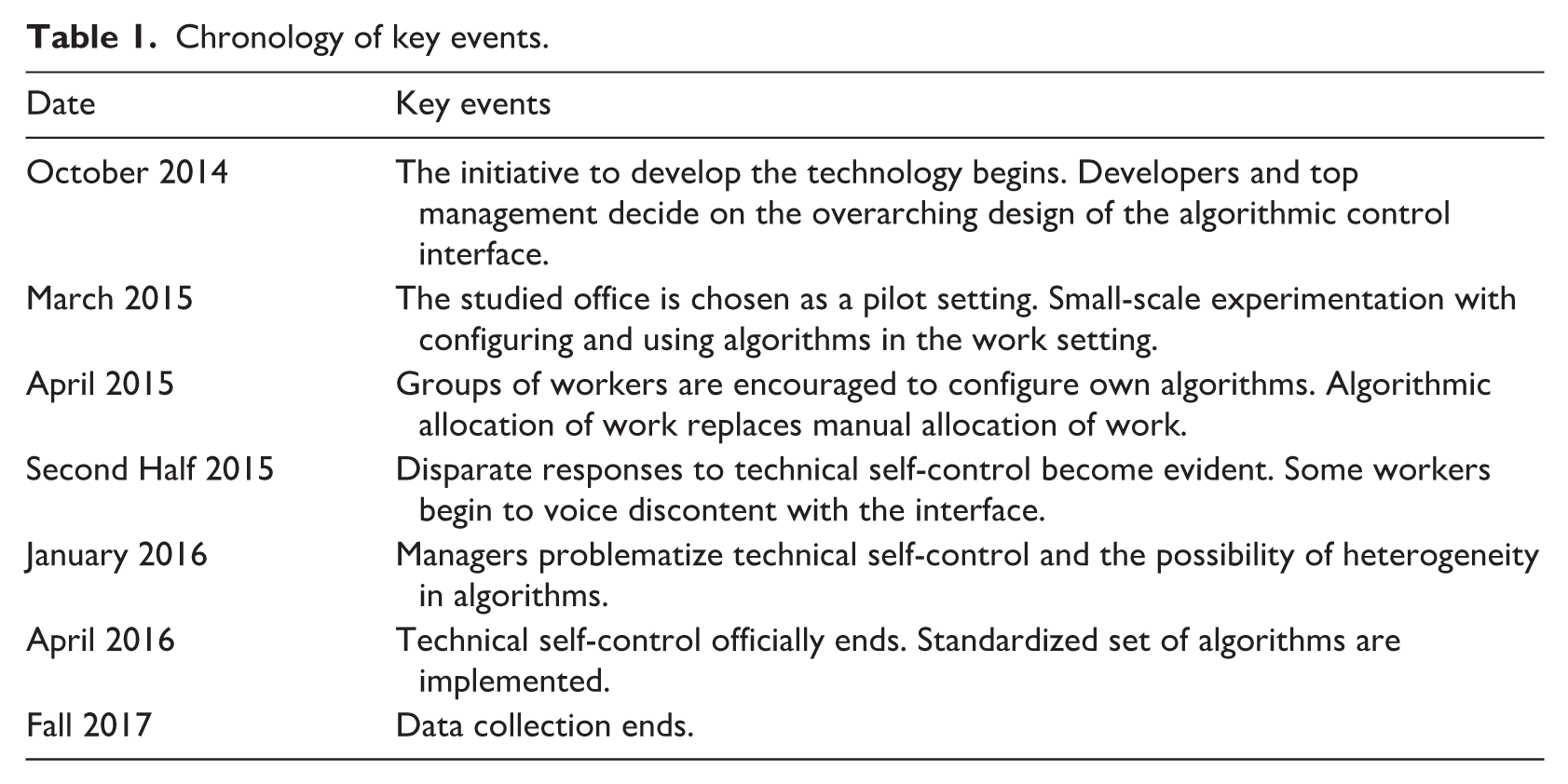
At the time of the study, the focal unit consisted of approximately 60 workers and two managers. The data set includes 29 interviews with workers and managers. Interviews were unstructured but practice-oriented (Nicolini, 2009) and typically lasted between 45 minutes and 2 hours. Interviews were done before the implementation in April 2015, during the implementation throughout 2015, and after technical self-control ended in 2016. See Table 2 below for an overview.
Interviews.
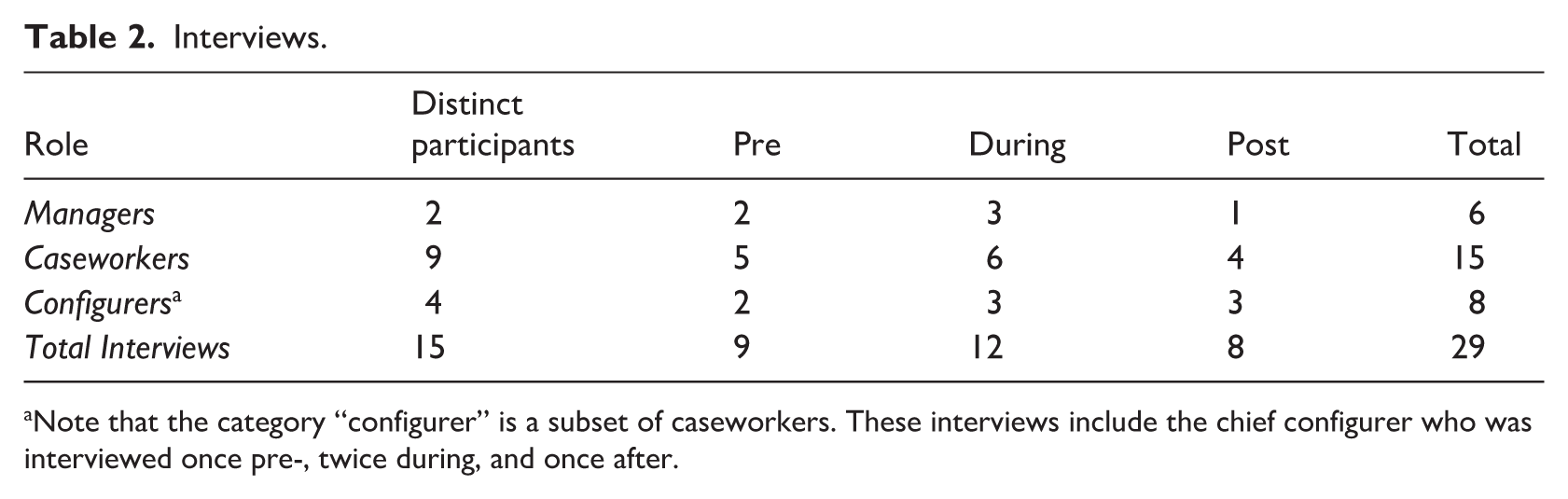
Note that the category “configurer” is a subset of caseworkers. These interviews include the chief configurer who was interviewed once pre-, twice during, and once after.
Interviews with managers addressed the rationale behind the initiative, how its implementation was organized, and how its outcomes were perceived over time. These interviews were conducted both prior to implementation and during its rollout, with particular attention to anticipated challenges and emerging concerns. Similarly, I interviewed the same set of workers during the study as events unfolded. Most interviews were recorded and transcribed verbatim; in a small number of cases where recording was not possible, detailed notes were taken during or immediately after the interaction.
Interviews with workers were conducted in tandem with observations and focused on everyday work practices, collaboration within teams, and experiences of configuring and using the algorithmic interface. During fieldwork, I was present as a non-participating researcher with access to daily work activities, meetings, and informal interactions, but did not perform casework or participate in decision-making. Observations were conducted to gain insight into a range of activities, including casework, worker collaboration, configuration activities at the interface, and so on; and workers allowed me to ask questions and tag along during their workday.
In addition, I had access to internal documentation, user manuals, and email correspondence related to the implementation and use of the system. These materials were used to trace how expectations regarding the interface and its use were communicated, negotiated, and revised over time.
Analysis
The analysis was conducted as an iterative and interpretive engagement with the empirical material, oriented toward disclosing how algorithmic control took shape and became practically intelligible within the studied setting. Rather than treating practices as objects to be decomposed into variables or themes, the analysis sought to make visible how workers’ engagements with algorithmic configuration unfolded within a shared practice-world and how these engagements shaped anticipations of future work.
Analytical work began during fieldwork through ongoing interpretive reflection and the writing of analytic notes and memos. Initial coding was used as a pragmatic means of organizing material and directing attention to recurring situations, tensions, and events during data collection. However, coding was not treated as the epistemic foundation of the analysis. Instead understanding was taken to emerge through sustained interpretive engagement with practices, with analytic distinctions serving to articulate, rather than produce, this understanding. This orientation has elsewhere been described as a practice-hermeneutic approach to analysis (Lammi, 2026).
At later stages of analysis, the material was revisited to examine how algorithmic technologies were configured, how workers responded to these configurations, and how such responses were motivated. Analytic distinctions were developed in dialog with the empirical material and the evolving understanding of the practice-world under study, with particular attention to moments where taken-for-granted expectations were disrupted, negotiated, or made explicit. Such moments were treated as analytically revealing of how algorithmic configuration shaped anticipations of future work.
Particular attention was paid to temporal development across the fieldwork period. Comparisons were made between early experimentation with the interface, subsequent stabilization of configurations, and later moments of tension or withdrawal. Through this process, three analytically distinct ways of engaging with technical self-control were identified: active configuring, passive stabilization, and avoidant distance.
These ways of engaging are best understood as recurrent and situational orientations within the practice-world studied, reflecting how workers aligned themselves with or distanced themselves from the emerging form of control. In the next section, I provide a narrative analysis of how these orientations took shape over time, situating them in the unfolding sequence of events through which technical self-control emerged in everyday work practices.
Setting the scene for technical self-control
In the beginning of 2015, the studied office presented its workers with the new interface for directing and evaluating work within teams. Prior to the introduction of the interface, teams of workers were expected to not only navigate systems to find distinct cases belonging to them but also know which tasks were required to be done within these. This manual coordination process proved intricate, as streamlined guidelines often lacked the specificity needed to effectively guide and assist novice workers. Consequently, teams frequently relied on the assistance of more experienced colleagues to effectively guide them to complete their work. The managerial objective behind implementing the interface was to encourage workers to utilize it for coordination purposes, thus bypassing the complexity of the existing systems.
The interface offered tools to display the overall workload assigned to a team and to organize the distribution of tasks among team members. In practice, the interface was to serve as the main way of collecting work instructions. A worker would open the interface and receive work through it automatically. For it to function, however, workers were expected to configure their own algorithms and insert them in the interface. The rationale behind the initiative was that workers would design algorithms together in their teams as they saw fit. For this to be possible, workers were expected to not only devise an own list of prioritized work tasks and distribution order but also learn how to translate that list into algorithmic form in the interface.
From the point of view of the project managers, the effort was framed to show how the Agency aspired to invest in technologies that increased workers’ sense of control. Local management drew on this rationale when tasked to implement the technology. While managers were keen on emphasizing the increased importance of worker involvement, there was an additional reason at play for letting workers engage in devising their own algorithms. To begin with, local management swiftly recognized the demanding nature of setting up the interface, given that it necessitated configuring algorithms. Even if the rationale was intended to reduce complexity, using the interface to control the work for the entire setting proved too complex for managers. Hence, managers figured it would be better to let this task fall to workers instead. In other words, the delegation of the task to curate algorithms was also a means for management to avoid a form of work they anticipated was to be too much of a hassle.
The initiative was met with mild enthusiasm among workers despite the emphasis on worker involvement. Prior to the implementation most workers were individually responsible for choosing their work tasks. While workers were used to work in teams, they mostly collaborated to assist each other as they saw fit. For instance, workers were used to cover for absent colleagues, to assist each other in when examining tricky cases, and in helping in the training of new colleagues. The new change implied the necessity to organize teamwork through the interface and its algorithms.
Casework in the Agency was subject to multiple and partly conflicting accountability pressures. Caseworkers were expected to process cases efficiently in line with organizational throughput targets, while also ensuring strict compliance with statutory rules and maintaining documentation suitable for audit and appeal. Although individual performance was not algorithmically scored, aggregate productivity and backlog levels were monitored at team and unit level, and deviations could prompt managerial intervention. Professional norms emphasized consistency, fairness, and defensibility of decisions, making deviations from established priorities difficult to justify ex post. These conditions rendered advance specification of work priorities both attractive and risky, as algorithmic ordering promised predictability while simultaneously constraining discretion.
Regardless, the initiative was not understood to be a major problem by workers. During early meetings, both managers and workers agreed on how the possibility to reduce the complexity of work task selection could be an important feature to train new workers and help the teams cover for absent colleagues.
Although emphasis was placed on highlighting how teams were to collectively engage with the interface, each team was expected to have one worker in charge of curating their algorithms. These chosen few were referred to as “configurers” and were expected to learn both how the interface worked and how to translate a team’s desires into algorithmic form. To find configurers, managers would either suggest possible candidates – often among those they perceived as technologically proficient or particularly experienced – or workers would suggest volunteers among themselves. As expressed early on among teams, it was not particularly hard to find volunteers who seemed interested in tinkering with the interface. Assigning this role was then not a contentious issue among workers, although selected “configurers” expressed varied degrees of enthusiasm about their new roles. While workers were expected to use the interface, configurers were expected to develop a deep familiarity with its technological infrastructure, surpassing the knowledge level of managers regarding the system. Although the initiative was introduced as a shared and relatively unproblematic change, workers’ subsequent engagements with configuring and using the interface diverged noticeably.
Configuring algorithms: Translating collective expectations into rules
To function as a coordination device, the interface required teams to actively configure the rules through which work would be ordered and distributed. While the system could recognize categories of tasks and cases through its integration with existing bureaucratic systems, it did not operate autonomously. For work to be directed through the interface, teams had to specify a set of rules, a manually arranged algorithm, that determined which tasks would be selected, when, and for whom.
Configuration did not presuppose formal programming expertise. The interface provided a simple but rigid structure for defining two elements: numerical values assigned to categories of tasks, and conditional if–then statements that modified these values based on specified criteria. At any given moment, the task with the highest numerical value was selected and automatically assigned to a worker. Once completed, the next highest task was selected in turn. In this way, configuration entailed deciding which tasks should count as most urgent under which conditions.
In practice, designated configurers translated collective expectations about priorities into this rule-based format. They assigned baseline values, introduced time-based escalation rules, differentiated outputs across groups, and occasionally added new categories. What teams discussed in meetings; how to balance complex cases, how to support new colleagues, how to avoid backlogs, had to be rendered into numerical hierarchies and conditional logic.
Despite the apparent simplicity of the system, this translation proved demanding. Collective understandings of appropriate sequencing did not map neatly onto numerical values. Multiple configurations could produce similar outcomes, making it difficult to determine whether an algorithm faithfully reflected team intentions (cf. Dourish, 2016; Lange et al., 2019). It was through this translation work that technical self-control took empirical form.
Through configuration, teams did more than adjust technical parameters. They specified in advance what would count as acting properly and efficiently. Algorithmic rules formalized the projected work order within their shared practice-world, orienting present action toward a collectively defined future rather than individually chosen trajectories (cf. Heidegger, 1962[1927]: 84). Once inscribed in the interface, priorities no longer existed as flexible understandings but as structured ordering devices that governed future action.
A key element easing the complexity of this process was the provision of a template algorithm. Rather than designing algorithms from scratch, most teams began by modifying this template incrementally. The template was widely perceived as sensible and familiar. Workers trusted it because it had been developed by a former colleague understood to “know the work,” and because it appeared to align with existing ways of prioritizing tasks.
As the chief configurer later explained, this familiarity was not accidental: “My first step in working with this interface was to put in the priorities that many were already following. However, this set of priorities was actually derived from what had broadly been decided on by managers in the past.” – Chief Configurer (Pre-implementation)
The template thus carried earlier managerial priorities into the participatory configuration process. Although teams experienced configuration as an opportunity to define their own rules, the point of departure already formalized a particular ordering of work. Through incremental modification rather than wholesale redesign, collective expectations were translated into technical rules that committed teams to specific ways of organizing future work, often without explicit reflection on their origins.
Delegation, templates, and the ambivalence of participation
Workers were formally granted responsibility for defining how work would be ordered. Yet they did so within a system whose technical structure, categories, and interface logic were already given. Moreover, while teams were expected to deliberate collectively, the actual translation of expectations into algorithmic form was concentrated in the hands of designated configurers.
Configurers had no formal authority and remained ordinary caseworkers. However, they occupied a socially distinctive position as intermediaries between team discussions and the technical system. Their interpretations often carried disproportionate weight, particularly where others lacked time or interest in engaging with configuration. Participation was thus both collective and uneven, combining shared deliberation with specialized mediation.
The role of the chief configurer reinforced this ambivalence. Widely regarded as a neutral source of technical support, the chief configurer facilitated local configuration without appearing as a managerial authority. Yet by supplying the template algorithm and guiding modifications, this role stabilized the process within an already structured framework.
Participation therefore operated primarily through modification rather than fundamental deliberation. Teams adjusted numerical values and conditional thresholds, but rarely reconsidered the underlying logic embedded in the template. What appeared as worker-generated ordering was, in practice, a refinement of priorities that had already been institutionally established.
This arrangement produced a distinctive form of ambivalence. On the one hand, workers genuinely participated: they discussed priorities, requested adjustments, and saw their decisions implemented. On the other hand, participation did not displace managerial control. It redistributed responsibility for its enactment.
Once algorithmic priorities were experienced as collectively produced, they acquired an impersonal authority. Questioning them required reopening decisions that “we” had agreed upon. What might previously have appeared as external managerial demands now appeared as shared commitments. In this way, delegation and participation did not weaken control but transformed its mode of operation, making it more distributed, more legitimate, and less visible as control.
Algorithmic configuration contributed to narrowing the range of conceivable future possibilities of work by stabilizing a normative sense of what “one does” (Heidegger, 1962[1927]: 165, 185). Consequently, the ordering of work became not merely a managerial directive, but a collectively formalized expectation embedded in technical form. Nonetheless, not all engaged with technical self-control in the same way.
Diverging engagements with technical self-control
Three recurrent ways of engaging with technical self-control were observed in the studied setting. The ways of engaging described below differ not primarily in attitudes toward technology, but in how workers positioned themselves in relation to the future that the algorithmic system articulated. These orientations can be understood as different modes of projection (cf. Heidegger, 1962[1927]: 184–188) within a shared practice-world: ways of taking up, reproducing, or distancing oneself from a technically formalized understanding of what future work was for and how present action should be directed toward it. The ways emerged over time as workers encountered the demands of configuring, using, and responding to algorithmically formalized expectations about future work.
The analysis below traces how these ways differed in their relation to configuration practices, the template algorithm, and expectations about future work. Each orientation reflects a distinct way of engaging with the same technical arrangement and its normative implications.
Active configuring: Shaping future work through collective formalization
The first way of engaging involved active engagement with configuration. Workers engaging in this way, typically in teams with highly involved configurers, treated the interface as a central tool for coordinating collective work. Configuration was understood as an ongoing activity through which team expectations about priorities, workload distribution, and sequencing of tasks were translated into algorithmic rules.
Across these teams, the template algorithm functioned as a starting point rather than a constraint. As a configurer stated: “People tell me what is needed and based on that I try to make changes on the fly” (Configurer A, During). These configurers regularly adjusted numerical values, added conditions, and introduced new rule sets to address emerging issues, such as the accumulation of complex cases or uneven workloads. Future work expectations were thus actively articulated and revised: teams discussed what should be prioritized, when exceptions were warranted, and how the algorithm should respond to changing circumstances.
What was accepted in this orientation was the premise that future work should be formally specified in advance, transparently and collectively. Algorithmic rules were seen as legitimate expressions of collective intent, even when they imposed rigidity. What was avoided was reliance on individual discretion or informal coordination outside the interface, albeit at the cost of committing to explicit and binding expectations.
Passive stabilization: Accepting and reproducing algorithmic ordering
A second way of engaging involved passive stabilization of algorithmic control through both acceptance and reproduction. Through this engagement, workers and teams accepted the algorithmic ordering of work as the normal and appropriate way of coordinating activity, while largely refraining from actively reconfiguring its underlying priorities. Although teams formally participated in the configuration process, their engagement was typically limited to minor, temporary, or reactive adjustments. The template algorithm was treated as a satisfactory baseline and rarely questioned. As a hesitant configurer confessed: “I simply copy the template. It’s already a good set of priorities so I don’t know why I or anyone else would change it” (Configurer B, During).
Configuration was thus accepted in principle but effectively delegated to the existing rule set. Workers trusted that the template reflected a reasonable ordering of work and saw little need to intervene. Rather than actively shaping future work through deliberation, teams relied on the template to stabilize expectations in advance. The algorithm functioned as a taken-for-granted infrastructure for ordering work.
This also encompassed workers who engaged with the interface primarily through routine use. For them, the algorithms were not experienced as expressions of active collective decision-making but accepted as part of the expected procedural environment of work. Tasks were followed because they were assigned through the interface, not because workers felt invested in how priorities had been defined. Nevertheless, by using the system as intended, these workers contributed to reproducing the same algorithmic ordering of future work.
Across these cases, what was accepted was the authority of algorithmic ordering as a given basis for coordination. What was avoided was the effort, uncertainty, and exposure involved in reopening deliberation about priorities or translating collective discussions into algorithmic form. What was at stake was not autonomy in defining future work, but the convenience and predictability of having future tasks already decided in a way that felt familiar and socially appropriate.
Avoidant distance: Preserving discretion by bypassing the interface
The third way of engaging involved a more distant stance against active configuring. Unlike passive stabilization, this orientation does not reproduce algorithmic ordering through routine use but maintains distance from it through individual withdrawal. Workers engaging in this manner sought to preserve individual discretion by navigating legacy systems and selecting tasks on their own, thereby avoiding algorithmic direction where possible.
Configuration was rejected in practice, even if not openly contested. The template was not treated as legitimate, but neither was it challenged. Future work expectations embedded in the algorithms were experienced as constraining and misaligned with what these workers considered appropriate professional judgment. That is, some workers chose to pass over the normative expectations in algorithmic form as they chose their own way of enacting what they conceived of as being a “good” caseworker (cf. Heidegger, 1962: 317). This did not entail an individualistic sense of being “good” but rather a shared alternative one among these workers.
What was important here was responsibility for completing work above the means in which it was accessed. As a skeptical caseworker expressed: “It’s not like this thing improves anything. If there’s work to be done, we will do it” (Caseworker A, During). Hence, what was avoided was submission to collectively formalized expectations about how and when work should be done through the interface. As they saw it, what was at stake was the preservation of personal control over pacing, task selection, and variation in work, particularly among more experienced workers.
Importantly, avoidance of the interface did not take the form of overt resistance. Workers who bypassed algorithmic direction did not contest the algorithms openly, propose alternative configurations, or initiate collective discussions about changing the system. Instead, they withdrew from participation in configuration and deliberation altogether.
This avoidance was shaped by several considerations. Openly questioning algorithmic priorities required exposing one’s preferences to the team and justifying deviations from collectively agreed expectations. Such exposure was experienced as morally risky and potentially degrading, particularly when arguments concerned fatigue, variation, or personal work rhythms. Moreover, these workers widely perceived that reconfiguring the algorithms would not fundamentally restore discretion: any alternative would still formalize future work in advance and impose rigidity, merely in a different form.
As a result, resistance did not reopen discretionary space. It coexisted with future-binding arrangements rather than undoing them. Workers could bypass the interface individually, but the algorithmic system remained the dominant reference for coordination and evaluation. Avoidance thus functioned less as opposition and more as a way of quietly maintaining distance from a form of control that was difficult to contest without reinforcing it.
From technical self-control to managerial recentralization
Over time, the heterogeneity of team-level configurations and diverging ways of engaging with the interface became increasingly problematic from a managerial perspective. While worker-led configuration had initially been framed as a way to increase autonomy and adaptability, it produced a patchwork of algorithmic arrangements that were difficult to oversee and compare.
Management began to reframe this variability as a source of opacity, risk, and lack of control. Differences between team algorithms were described as undermining transparency and accountability, particularly in relation to organizational targets and performance monitoring. The very features that had justified delegation – local adaptation and participatory configuration – were now interpreted as obstacles to effective oversight.
In response, management moved to standardize algorithmic rules across teams. Central definitions replaced local configurations, and discretion over rule-setting was gradually withdrawn. Paradoxically, worker participation in technical self-control facilitated this recentralization. By demonstrating that algorithmic coordination could structure work effectively, even when configured by workers themselves, the initiative provided empirical justification for expanding and centralizing algorithmic control.
Technical self-control thus did not mark a transition away from managerial authority. Instead, it functioned as a transitional arrangement through which algorithmic governance was normalized and rendered necessary. Worker involvement stabilized algorithmic control in practice, making its later recentralization appear both reasonable and inevitable.
Discussion
This paper contributes to research on algorithmic management by showing that control may intensify through worker participation when collective priorities are translated into durable technical rules that pre-commit the ordering of future work. The central concept developed here is technical self-control: participatory algorithmic configuration through which workers help bind future action to collectively formulated or negotiated rule structures. This contribution suggests three broader implications: configuration may bind future work; opacity is not necessary for algorithmic control to narrow discretion; and worker participation may deepen rather than mitigate organizational control. I expand on these next.
As mentioned, enactment-oriented accounts have convincingly demonstrated that algorithmic control depends on ongoing work, including interpretation, adjustment, repair, and coordination around digital systems (Jarrahi et al., 2021; Kellogg et al., 2020; Neyland, 2015). This paper extends that line of inquiry by showing that participatory configuration is not simply maintenance work directed at keeping systems functioning, but – under certain conditions – a future-binding organizational practice. Once inscribed into the interface, these arrangements structured future action beyond the moments of deliberation that produced them.
Importantly, algorithmic control operates here without informational asymmetries or opaque computational systems (Curchod et al., 2020; Rosenblat and Stark, 2016; Walker et al., 2021). What is distinctive here is instead the temporality of control. Governance did not primarily operate through retrospective evaluation or episodic managerial intervention, but through the collective stabilization of projection: the shaping of which futures of work became practically available and legitimate within a shared practice world (Heidegger, 1962[1927]). Through configuration, teams did not simply “use” the system; they took part in articulating and fixing a horizon of legitimate next actions.
Recent discussions have increasingly examined participation, hybrid governance, and worker influence in algorithmic management (Krzywdzinski et al., 2025), often treating these as a counterweight to unilateral managerial imposition. The findings here complicate such accounts. Participation may mitigate certain forms of domination, but it can also stabilize control when it takes the form of collective formalization. Worker involvement does not automatically expand discretion; under some conditions, it may restrict it.
The findings also resonate with earlier concerns raised in studies of concertive control (Barker, 1993; Sewell, 1998), while indicating a distinct mechanism. Concertive control stabilizes norms primarily through ongoing social interaction, peer monitoring, and collective sanctioning. Technical self-control, by contrast, stabilizes collective priorities through technical inscription: shared understandings are rendered explicit, calculable, and materially embedded as rule structures that continue to order work even when interaction and deliberation recede. The crucial shift is therefore from norm internalization to rule inscription. In this respect, the interface did not merely display collectively defined priorities; it rendered them actionable and procedurally authoritative through the very process of configuration (cf. Lipp et al., 2025). What made this authority especially difficult to contest was precisely that the priorities had been collectively negotiated. The binding force of the ordering did not present itself as a managerial demand from outside, but as a stabilized outcome of “what we have decided.”
This impersonalization had two consequences worth raising. First, contesting the ordering of work became more difficult because it required reopening collectively formalized priorities rather than merely disagreeing with a manager. The target of critique was no longer an external authority, but a shared commitment, now encountered as an infrastructural fact. Resistance was thereby displaced from oppositional confrontation toward quieter modes of refusal, circumvention, or withdrawal. Second, active configuration frequently reproduced rather than subverted managerial priorities. Because teams configured their rules in relation to an inherited template, participation often deepened compliance with pre-existing bureaucratic logics. What appeared as worker authorship of priorities became a mechanism for stabilizing and extending organizational expectations in technical form.
These dynamics speak directly to debates in algorithmic management that frame worker responses primarily in terms of compliance, gaming, and overt resistance (Bucher et al., 2021; Kellogg et al., 2020). Echoing longstanding critical concerns regarding empowerment, responsibilization, and self-governance (Fleming and Sturdy, 2009), the case shows how worker involvement may redistribute rather than diminish control by embedding collective commitments in technical infrastructures. This redistributes the moral and social costs of dissent. Resistance becomes more individualized and avoidant than collective and confrontational. In the present case, this was visible through avoidant distance, where discretion was preserved by bypassing the interface rather than by reopening deliberation about the rules themselves.
The study also sheds light on how participatory algorithmic configuration can generate conditions for managerial recentralization. Algorithmic management scholarship has often emphasized the decentralizing and fragmenting effects of digital systems (de Vaujany et al., 2021). The present case points to an additional dynamic: participatory formalization produced visibility; visibility produced comparability; and comparability rendered standardization both feasible and legitimate. Variation in locally configured priorities became visible across teams, making differences in work ordering increasingly comparable and open to managerial evaluation. The very process that initially distributed control also created the informational and organizational basis for its later consolidation. Technical self-control thus contained conditions of its own reversal, leading to a general tightening of managerial control of work in the long run.
The dynamics identified here are most likely to emerge in conventional, accountability-intensive organizations where algorithms are transparent and rule-based, where workers might be invited to configure task allocation within pre-given interface architectures, and where work priorities are tightly coupled to justification, audit, and comparability. The claim advanced here is therefore conditional rather than universal, but analytically relevant beyond the immediate case wherever participation becomes intertwined with technical inscription in organizing work.
Although the empirical case examined here concerns a transparent and relatively simple rule-based system, the mechanism identified is relevant for contemporary forms of AI-enabled algorithmic management. Contemporary AI-enabled systems do not displace this dynamic but may deepen it by making configuration more granular, adaptive, and continuously recalibrated. Rather than binding future work through relatively stable rule structures alone, these systems can dynamically refine priorities, recommendations, and classifications in ways that remain shaped by worker involvement while still limiting discretion in consequential ways. Under such conditions, collectively authored and negotiated priorities may become even more difficult to contest, not because they are necessarily opaque, but because they are increasingly embedded in evolving infrastructures that quietly reorganize what counts as appropriate action. The critical question is therefore not simply whether workers participate in configuring such systems, but what forms of ordering participation help to stabilize over time.
Conclusions
This study has examined what follows when workers participate in configuring the algorithmic rules that organize their work. It introduced the concept of technical self-control to capture a distinct form of governance that emerges under such conditions. Technical self-control designates a situation in which collectively articulated expectations are translated into technical rules that continue to order work after deliberation has receded.
The argument of the paper is conditional. The case concerns a conventional, accountability-intensive public organization using transparent and rule-based systems. Under such institutional and technical conditions, participatory configuration can generate technical self-control because expectations are tightly coupled to audit, justification, and comparability. Other settings characterized by opacity, precarity, or limited worker involvement may produce different dynamics.
More broadly, these findings suggest that algorithmic governance in conventional organizations cannot be evaluated simply by asking whether workers are involved. Participation does not automatically counteract control. Under certain institutional conditions, it may deepen it as discretion is narrowed not through exclusion but through involvement in shaping the arrangements that organize future work.
This raises a more uncomfortable issue for organizations pursuing digital transformation. It is not sufficient to claim that systems are legitimate because “humans are in the loop” or workers helped design or configure them. Closer scrutiny of what kinds of technologies are introduced, what forms of rule inscription they require, and how they reorganize the horizon of possible action over time is required. Involvement can redistribute responsibility and render governance more acceptable, yet it can also make control more difficult to contest precisely because it appears as something “we” have decided. If that is the case, then the critical task is not merely to insert humans into algorithmic systems, but to reflect on which forms of technological ordering become formalized and stabilized, and with what consequences for discretion and accountability.
Footnotes

Funding
The author disclosed receipt of the following financial support for the research, authorship, and/or publication of this article: This research was funded by a grant from AFA Försäkring [grant nr. 220263].
Declaration of conflicting interests
The author declared no potential conflicts of interest with respect to the research, authorship, and/or publication of this article.